
Paid search can work for B2B, but a campaign built only to capture immediate leads can miss buyers who need time to evaluate a solution. The average B2B sales cycle involves 8 touchpoints, so a scalable ppc campaign structure for b2b should connect search intent, useful follow-up, and sales outcomes across the journey.
If clicks are coming in but qualified opportunities aren’t, the issue may be how campaigns are organized and measured, not simply how much you spend. B2B buying groups take time to research, compare options, and reach a decision. Your campaign needs to reflect that reality.
This guide shows you how to assess paid search for B2B, choose metrics that matter beyond clicks and form fills, and connect ad activity to conversions across longer sales cycles. Then you’ll learn how to organize campaigns around buyer intent and funnel stage, so you can identify what’s working and make smarter decisions about where to scale.
Key Takeaways
- Match search, display, placements, keywords, and audience targeting to the buyers and intent you want to reach.
- Look beyond clicks and form fills by tracking lead quality, pipeline progress, and revenue alongside campaign metrics.
- Connect ad interactions to CRM outcomes so long sales cycles don’t make valuable campaigns look ineffective.
- Build campaigns around funnel stage and buying intent, then use performance data to guide where to refine and scale.
- Align ad messaging, landing pages, and follow-up so each touchpoint moves qualified prospects toward a decision.
Does paid search work for B2B?
Yes. B2B companies generate an average of $2 for every $1 invested in Google Ads, according to the market data in this brief. Gartner reports that complex B2B solutions typically involve buying groups of 6 to 10 decision-makers. Structure campaigns to reach their different questions, not just one lead form.
Google and Microsoft campaigns typically organize around search intent and keyword themes. LinkedIn Ads can target professional audiences by role and industry. Separate campaigns by buyer stage to tailor each message, then compare qualified outcomes across platforms.
Group keywords by intent first: brand, problem, solution, and comparison terms. Separate match types into different ad groups or campaigns when they need distinct budgets, messaging, or query controls. Mixing them too broadly can obscure which searches generate relevant leads.
Common risks include grouping unrelated services together, targeting too broadly, and judging success by clicks alone. A generic “business software” keyword may attract research traffic, while a solution-specific query can signal clearer intent. Review search terms and audience results to identify wasted spend.
- Define buyer personas before selecting placements. List each high-value persona by role, industry, and buyer stage. A finance leader comparing vendors needs different proof from an operations manager researching a workflow problem. Use those distinctions to choose search, display, or audience-based placements, and align each ad with a relevant landing page.
- Separate search campaigns by intent and theme. Build focused groups for brand terms, pain-point searches, solution categories, and competitor-comparison intent. Keep closely related keywords together, but separate themes when the offer or landing page changes. For example, “reduce invoice processing time” and “invoice automation platform” suggest related needs, but different stages of research.
- Match platform structure to its targeting strength. On Google Ads, organize around keyword themes and use available targeting such as demographics, location, device, and interests. Apply a similar search-intent structure in Microsoft Ads, then compare performance separately. On LinkedIn Ads, segment by role and industry, with distinct campaigns for awareness and active consideration.
- Use display and remarketing to reconnect. Build display audiences from meaningful site behavior, such as visiting a solution page or viewing a case study. Exclude converted leads when the message is no longer relevant. Remarketing campaigns often achieve conversion rates 50-100% higher than cold traffic campaigns, according to the market data in this brief.
- Review targeting and placements as one system. Check search terms, audience segments, and placement reports together. If an industry segment clicks but produces poor-fit leads, refine its message or targeting. Test search, display, and video formats against the same buyer need, then shift effort toward the placements that create sales-relevant engagement.
What metrics should be tracked in B2B paid ads?
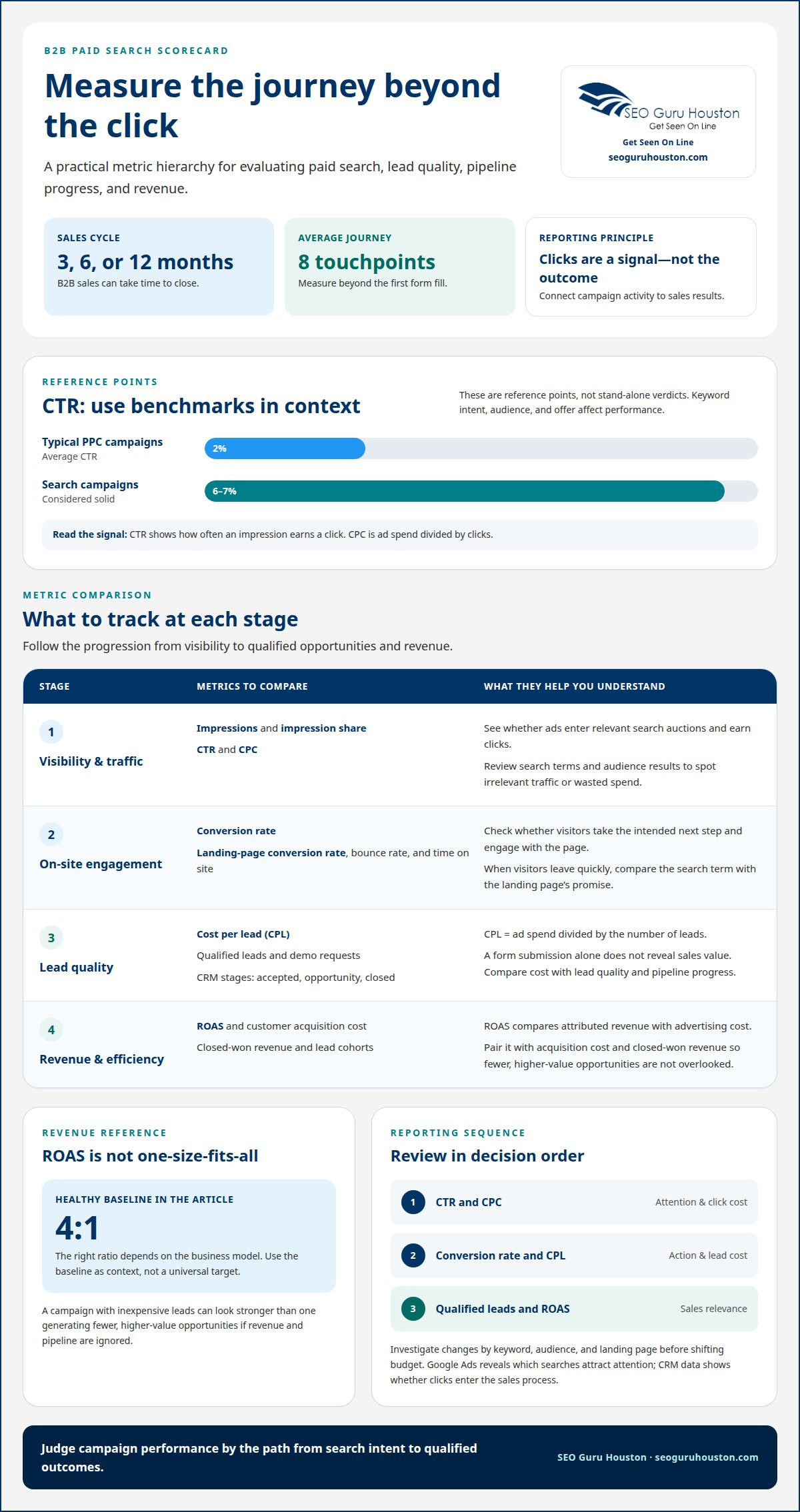
- Track the full path from impression to lead. Start with impressions and impression share to see whether Google Ads enters relevant Google Search auctions. Then measure click-through rate (CTR), cost per click (CPC), and conversion rate. CTR shows how often an impression earns a click; CPC is ad spend divided by clicks. A 6-7% CTR is considered solid for search campaigns, while the average CTR for typical PPC campaigns is 2%. Treat these as reference points, not isolated verdicts: keyword intent, audience, and offer all affect performance.
- Measure what happens after the click. Track landing-page conversion rate, bounce rate, and time on site to see whether visitors engage with the next step. If a campaign earns clicks but visitors leave quickly, compare the search term with the page’s promise. For example, an ad for a product demo should lead to a page that explains the demo and makes requesting one clear. Segment results by campaign, keyword, device, and demographics so strong averages don’t hide a weak audience or page.
- Separate lead volume from lead quality. Cost per lead (CPL) divides ad spend by the number of leads, but a form submission alone doesn’t reveal sales value. Track qualified leads and demo requests separately, then connect those records with CRM stages such as accepted, opportunity, and closed. Compare costs with lead quality and pipeline progress rather than treating an average as a universal target.
- Evaluate revenue against spend. Return on ad spend (ROAS) compares attributed revenue with advertising cost. A 4:1 ROAS is a healthy baseline, but the right ratio depends on the business model. Pair ROAS with customer acquisition cost and closed-won revenue; otherwise, a campaign generating inexpensive leads may appear stronger than one producing fewer, higher-value opportunities. Review results by campaign and lead cohort to identify which sources contribute to actual sales.
- Use a consistent review sequence. In each reporting cycle, compare CTR and CPC first, then conversion rate and CPL, followed by qualified leads and ROAS. Investigate changes by keyword, audience, and landing page before shifting budget. Google Ads data can show which searches attract attention; CRM data helps reveal whether those clicks enter the sales process. A clear metric hierarchy turns reports into decisions, not just dashboards.
Conversion tracking and attribution for long sales cycles
Track the journey beyond the first form fill. B2B sales can take 3, 6, or 12 months, with an average of 8 touchpoints.
-
Set Up Conversion Tracking
Record each meaningful action, from a landing-page inquiry to a sales-qualified lead and closed deal. Connect ad interactions with CRM stages so campaigns aren’t judged only by their earliest conversion. Check that each event fires once and maps to the right campaign. Don’t treat repeat visits or low-intent downloads as equivalent to sales opportunities. Digital marketing teams like Barlo Digital often emphasize starting with comprehensive tracking and measurement audits to ensure search data accurately reflects pipeline value.
- Preserve campaign context through the sales journey. Capture the campaign, keyword, and landing page associated with each lead, then retain that information as the record advances through sales stages. This lets you compare first-touch and later interactions without crediting every touch with a full conversion. For example, an initial search click may introduce a solution, while a later visit prompts a demo request.
-
Assess Lead Quality and Conversion Costs
Compare conversion volume with sales acceptance, opportunity creation, and closed revenue. Treat CTR and CPC as diagnostic signals, not final outcomes: strong click engagement can still produce poor-fit leads. Calculate cost per conversion for each meaningful milestone, then compare it with the resulting ROI. Don’t optimize for the cheapest form submission if those contacts rarely progress.
- Align the landing page with the tracked action. Keep the ad promise, page content, and conversion event consistent. A demo campaign should direct visitors to a page explaining the demo, with a clear call to action and a streamlined form. Track form completions separately from later qualification, so page tests improve lead generation without disguising low-quality submissions as success.
- Review attribution against actual sales outcomes. Compare platform-reported conversions with CRM opportunities and closed-won records by campaign and lead cohort. This shows why conversion counts need sales context: investigate lead sources, qualification, and follow-up before scaling spend.
- Use mature data to guide optimization. Long sales cycles delay revenue signals, so keep early indicators visible while opportunities progress. Review whether search terms reach the right accounts, whether landing pages generate qualified inquiries, and whether those leads advance. Use that evidence to refine targeting and messaging instead of making a major change after a brief spike in form submissions.
Full-funnel PPC strategy for B2B buying journeys
Organize campaigns by buyer stage and audience, then match each segment with a relevant offer and message. Gartner research indicates approximately 80% of the B2B buying journey happens without direct vendor contact. A ppc campaign structure for b2b should therefore support independent research and guide prospects toward useful next steps.
-
Map the B2B Buying Journey to Funnel Stages
Define awareness, consideration, and decision stages by the questions buyers ask at each point. Awareness audiences may need educational content about a business problem; consideration audiences need solution comparisons; decision-stage prospects need a clear next step. Make sure these stages reflect the real buying process, not just website actions. A product-page visit, for example, signals interest but doesn’t establish readiness for a sales conversation.
-
Assign PPC Roles Across the Funnel
Give each campaign a distinct job, such as introducing a problem, helping buyers evaluate options, or generating qualified inquiries. Search can capture active research, while display and paid social can reconnect with relevant audiences between searches. LinkedIn can reach professional audiences by role and industry with stage-specific content. Don’t expect every campaign to produce an immediate sales-ready lead.
-
Organize Campaigns by Stage and Audience
Separate campaigns by funnel stage, audience, and offer so results remain actionable. For example, create distinct groups for operations leaders researching efficiency and finance leaders evaluating cost control. On LinkedIn, use professional audience attributes; on search, align keyword themes with the same buyer need. Keep campaign names consistent, such as “consideration, operations, efficiency,” and exclude converted leads from messages intended for first-time prospects.
-
Tailor Ads to Each Funnel Stage
Write awareness messaging around the business problem, not a hard sales pitch. For consideration, explain outcomes such as cost savings, efficiency gains, or risk reduction, then offer a useful comparison or guide. At the decision stage, make the next action clear and match the landing page to the ad. Use interests and audience signals to improve relevance, not as substitutes for clear intent or compelling messaging.
- Set a measurable planning goal. Connect stage-specific activity to a business outcome, then review how audiences advance. A sample B2B lead-generation goal is 75 qualified leads per month within four months, with cost per acquisition under $65. Treat this as a planning example, not a universal benchmark. Use the ppc campaign structure for b2b to assess whether each campaign supports that goal, then refine its audience or offer when engagement fails to progress.
Campaign structure designed to scale
The best ppc campaign structure for b2b separates campaigns by business goal, product or service, and buyer intent. There’s no fixed campaign or ad-group count; create separate Google Ads campaigns when products need distinct budgets, audiences, or outcomes, then group closely related keywords together.
-
Separate Campaigns by Product or Service
Build a separate Google Ads campaign for each product or service that needs its own budget, audience, or outcome. A company selling analytics software and implementation support, for example, could separate them because buyers search for different solutions. Give each campaign a matching landing page and conversion goal. Don’t combine offers just because they belong to the same company; mixed intent makes performance harder to interpret and scale.
-
Set the Number of Campaigns and Ad Groups
Start with the simplest structure that gives you useful control, then expand when performance or business needs call for it. Create an ad group for a tightly related keyword theme, such as “inventory analytics” and closely related searches, rather than grouping every product term together. Add campaigns when budget, geography, audience, or funnel goals need independent management. Avoid creating extra groups that split similar traffic without changing your decisions.
- Keep the campaign hierarchy consistent. Use a naming pattern that shows platform, product, intent, and audience. A Google Ads campaign might be labeled “Search | Analytics | Solution | Operations,” with ad groups for closely related search themes. Apply the same logic to Microsoft Ads while retaining platform-specific reporting. Clear names help teams find valuable traffic and understand each campaign’s purpose.
- Build for controlled expansion. Launch with core high-intent search campaigns, then add awareness or remarketing campaigns when you have a defined audience and relevant message. Keep search, display, and social activity distinct enough to compare results. For example, a display campaign for product-page visitors should have a different goal from search ads aimed at new prospects.
- Protect budget and learning signals. Avoid spreading limited traffic across near-identical campaigns. If two ad groups target the same keyword theme and landing page, combine them unless they need separate controls. Review search terms, audience fit, and conversion quality before adding another layer. Each campaign should address a business need, not simply make the account look more detailed.
- Scale what supports a purchase decision. Expand by adding a product line, buyer intent, or audience only when it creates a meaningful new opportunity. Keep awareness messaging distinct from decision-stage offers, and connect each route to the right page. A ppc campaign structure for b2b should make the next growth decision clear. To turn that structure into a practical growth plan, plan scalable PPC campaigns.
SEO Guru Houston: Houston SEO Services
SEO Guru Houston can help when your B2B campaigns need clearer structure, stronger measurement, or better alignment with sales goals. Its comprehensive PPC Services support paid-search planning, while B2B Marketing and Inbound Marketing services can connect campaign activity with broader demand generation.
Turn to SEO Guru Houston when campaigns target overlapping audiences, landing pages don’t match ad intent, or lead volume isn’t translating into qualified opportunities. PPC management includes campaign creation, ad copy optimization, keyword and geographic targeting, conversion tracking, ongoing account management, monthly calls, and reporting. Specialized SEO services can complement paid search by supporting visibility beyond ads.
Ready to discuss your campaign goals? Contact SEO Guru Houston or visit seoguruhouston.com.
Turn Your Campaign Plan Into a Growth System
Start with a business priority and turn it into a focused campaign plan. Decide which audience, offer, and sales outcome deserve attention first. Assign an owner to each decision so campaign changes have a clear purpose rather than becoming disconnected tests.
A durable ppc campaign structure for B2B should make the next move easier to see. Set criteria for expanding a campaign, refining its message, or pausing an approach. Then use those criteria consistently as new opportunities emerge. This creates a practical framework your team can adapt as products, audiences, and sales priorities change.
Bring marketing and sales into the planning process early. Agreeing on what makes an opportunity valuable helps both teams act on the same signals and keeps campaign decisions tied to business priorities.
SEO Guru Houston can help you turn your campaign priorities into a coordinated plan. Contact SEO Guru Houston today to discuss your next step. Build with focus, learn from each decision, and keep moving toward sustainable growth.
Frequently Asked Questions
What is the difference between B2C and B2B paid ads?
B2C paid ads often target individual consumers, while B2B ads address people evaluating purchases for an organization. That changes the message and the conversion path. A consumer ad might promote a product purchase; a B2B ad could offer a product walkthrough to a technical evaluator and business-case material to a budget owner. For teams executing across both sectors, performance marketing agencies such as peytondigital.com illustrate how data-driven strategies adjust to distinct buyer journeys. Build creative around the audience’s role in the decision, not just the company’s industry.
What Is B2B PPC?
B2B PPC is paid advertising where a business pays when someone clicks an ad promoting its products or services to other businesses. A software provider, for example, might use paid search to reach companies researching a specific operational challenge. The click is only the start: the campaign should connect the ad’s promise with a relevant next step, such as a consultation request or product information.
What about the middle of the funnel?
Middle-funnel campaigns help prospects compare approaches after recognizing a problem but before choosing a vendor. Offer useful decision-support content, such as a feature comparison, implementation overview, or case study. Someone who downloaded a guide, for example, could later see an ad addressing integration questions. Keep follow-up relevant to that earlier action, and don’t push for a sales conversation before the prospect has enough context.
How should B2B PPC budgets and bids be allocated across campaigns?
Prioritize campaigns by business value, audience relevance, and observed lead progression. Maintain coverage for high-intent searches that reach active buyers, then allocate testing budget to new audiences or messages with a clear learning goal. Review spend alongside qualified opportunities, not click volume alone. If a campaign attracts traffic but few relevant prospects, adjust its targeting or offer before increasing its budget.
Which conversion actions should B2B PPC campaigns track?
Track actions that show meaningful progress, from a completed inquiry form to a qualified opportunity or closed sale. Choose events based on how prospects engage with your business: a demo request may suit a complex software offer, while a detailed consultation request may fit a professional service. Keep low-commitment actions, such as content downloads, separate from actions that signal stronger buying intent.
How should B2B landing pages align with campaigns and ad groups?
Make sure each landing page matches the campaign’s promise and audience. An ad group focused on compliance software should lead to a page explaining that solution, not a general company homepage. Match headlines, proof points, and calls to action to the visitor’s likely question. Keep the form focused on information needed for follow-up, and remove competing links that distract from the intended action.

