
Tag Archives: Audience Targeting

Is Facebook Advertising Effective for B2B? Assess the Fit

Facebook can be an effective B2B advertising channel, but only when the campaign is built around how business buyers discover, evaluate, and choose solutions. The answer to whether Facebook advertising is effective for B2B depends on fit: the right audience, a relevant offer, and messaging matched to the buyer’s stage matter more than simply running ads. Treat it as a strategic channel, not a shortcut to instant sales.

It’s fair to question whether a platform often associated with consumer brands can support a longer, more considered business purchase. The opportunity is there when your audience uses Facebook, your campaign gives them a useful reason to engage, and your landing page carries the conversation forward. This guide explains when Facebook can fit a B2B brand, how its strategy differs from B2C, and how precise targeting and funnel-stage messages can strengthen campaign effectiveness. You’ll also learn what to measure beyond clicks, so you can judge whether your ads are attracting the right prospects and helping move them toward a meaningful next step.

Key Takeaways

  • Assess whether Facebook can reach the people involved in your B2B buying process before committing campaign budget.
  • Adapt B2B creative to build trust and support a considered decision, rather than relying on consumer-style, immediate-purchase messaging.
  • Use custom and lookalike audiences to shape who sees your ads, then refine targeting based on the prospects who engage.
  • Match each message and landing-page experience to the buyer’s next step, including smaller actions that signal growing interest.
  • Measure campaign performance against business outcomes, so clicks alone don’t disguise whether your ads are contributing to conversions.

1. Should Your B2B Brand Advertise on Facebook?

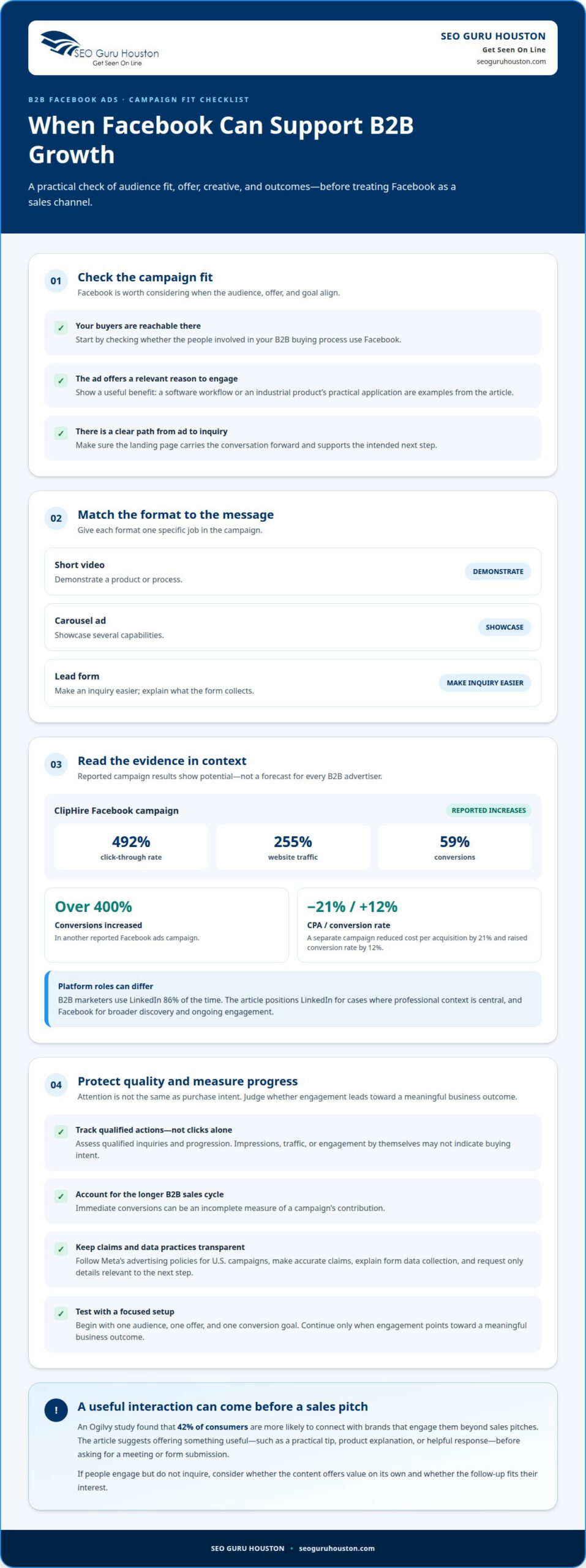
Facebook can support B2B growth when its audience, offer, and campaign goal align. The results from ClipHire show why the channel deserves a measured test: its Facebook campaign increased click-through rate by 492%, website traffic by 255%, and conversions by 59%. So, is Facebook advertising effective for B2B? It can be, when you judge performance by qualified actions, not attention alone.

No single industry automatically performs best. The strongest fit comes when buyers are reachable on Facebook and an ad can show a relevant benefit. For example, a software company can demonstrate a product workflow, while an industrial supplier can spotlight a practical application. Both need a clear path from ad to inquiry.

Campaign outcomes can vary sharply by offer and execution. In another reported campaign, Facebook ads increased a client’s conversions by over 400%. A separate campaign reduced cost per acquisition by 21% and raised conversion rate by 12%. These examples show potential, not a forecast for every B2B advertiser.

Facebook and LinkedIn can serve different roles. B2B marketers use LinkedIn 86% of the time, while Facebook can broaden discovery and support ongoing engagement. Use LinkedIn when professional context is central; consider Facebook for reaching prospects with useful content and following up with people who showed interest.

Choose the ad format to suit the message. Short video can demonstrate a product or process; carousel ads can showcase several capabilities; lead forms can make inquiries easier. Give each format a specific purpose, such as presenting a software demo, a customer-use scenario, or a downloadable guide.

For U.S. campaigns, follow Meta’s advertising policies and use data transparently. Make claims accurate, explain what a form collects, and request only details relevant to the next step. Avoid copy that implies you know someone’s sensitive or private circumstances.

There are limits. Facebook engagement doesn’t automatically mean purchase intent, and a broad audience can produce low-quality clicks. Long B2B sales cycles also make immediate conversions an incomplete measure. Track qualified inquiries and progression, not just impressions or traffic.

Start with one audience, one offer, and one conversion goal. For example, promote a case study to relevant decision-makers and assess whether they take the intended next step. Continue the test only if engagement points toward a meaningful business outcome.

That makes the quality of the interaction worth considering alongside the offer. An Ogilvy study found that 42% of consumers are more likely to connect with brands that engage them beyond sales pitches. For B2B advertisers, that can mean giving prospects something useful before asking for a meeting or submitting a form. A practical tip, a product explanation, or a helpful response can make the brand’s presence feel relevant rather than purely promotional.

Use this principle to shape both the ad and the response that follows. Offer information that addresses a genuine business question, then make the next step clear without making it feel like a demand. If people engage but do not inquire, assess whether the content offers value on its own and whether the follow-up matches their interest. The goal is a useful exchange that builds trust and gives the campaign a measurable purpose.

2. Differences between B2B and B2C ad strategies

A B2C ad often sells a product directly to an individual buyer. A B2B ad usually supports a decision involving several people, business needs, and follow-up. For example, a project-management platform may need to persuade a department lead and earn approval from finance. That changes the offer, message, and campaign goal.

Start with the buying decision, not the product category. A consumer furniture ad might lead with a new sofa and a purchase prompt. A commercial furniture company could instead show how configurable workstations suit a growing office. The B2B message connects the offer to a business task, such as planning a workspace or comparing specifications.

The audience also changes the creative. A consumer campaign can focus on personal preference, convenience, or an immediate need. A B2B campaign should make its business relevance clear. For instance, an accounting software ad can highlight invoice workflows for finance teams, while avoiding claims that every company shares the same process.

Proof matters in different ways, too. A consumer may respond to a product demonstration or a straightforward feature comparison. A business buyer may need evidence to explain a decision internally. A case study, implementation overview, or product demonstration can give prospects material to discuss with colleagues. Keep every claim specific and supportable.

The conversion action should fit the amount of commitment. A direct purchase prompt may suit a low-cost consumer product. A B2B prospect evaluating enterprise software may prefer a demo request or a detailed guide first. Make the next step explicit: explain what the person receives after submitting a form, and keep the requested details relevant.

Campaign timing follows the same distinction. A consumer promotion may focus on a seasonal purchase window. A business campaign can support research over a longer decision process, with separate messages for learning, evaluating, and taking action. For example, introduce a checklist before offering a product demonstration.

Use different success measures for each objective. A B2C campaign may prioritize completed purchases. For a B2B campaign, assess whether inquiries fit the intended customer profile and progress toward a sales conversation. A high click rate with irrelevant inquiries signals a mismatch between the ad promise and the offer.

Build the campaign in sequence: define the business problem, write a buyer-focused message, choose an appropriate next step, and align the landing page. A cybersecurity provider, for instance, could offer a risk-assessment guide instead of asking for an immediate sale. This gives prospects a useful first action while keeping the campaign connected to a business need.
Is Facebook Advertising Effective for B2B? Assess the Fit

3. Effectiveness of Facebook ads for B2B brands

Facebook campaign effectiveness depends on the business result you measure. A campaign may attract attention without generating suitable inquiries, while a smaller audience may produce prospects worth pursuing. A software firm, for example, should distinguish guide downloads from demo requests and sales-qualified leads. Each action signals a different level of commercial intent.

There isn’t one typical conversion rate that applies across B2B Facebook campaigns. A guide download, demo request, and qualified inquiry are different conversions, so compare rates only when the action and audience match. A campaign offering a product demonstration shouldn’t be benchmarked against one offering an introductory checklist.

Set a measurable objective before launching. If a cybersecurity company wants demo requests, its primary measure should be completed requests from relevant businesses, not video views. If the goal is to introduce a new service, meaningful engagement with an explanatory page may be an earlier signal. The objective determines which campaign events matter.

Connect ad activity to the landing-page action. A mismatch can weaken performance: an ad promising a practical procurement guide should lead to that guide, not a generic homepage. Track the steps from ad click to form completion and review where prospective buyers leave. This gives you a clearer diagnosis than clicks alone.

Lead quality matters as much as volume. A student’s form submission for an assignment is different from an inquiry by a company evaluating vendors. Define useful qualification criteria, such as business type, role, or stated need, then assess which ads generate matching inquiries. Don’t treat every completed form as an equal sales opportunity.

Facebook campaign results can change when the audience, creative, offer, or landing page changes. Test one meaningful variable at a time. For example, a manufacturing supplier could compare a production-process video with a downloadable equipment checklist while keeping the audience and next step consistent. This makes the comparison more informative.

Review performance across the full path to revenue. A strong click-through rate may conceal weak lead quality, while an early-stage campaign may support later decisions without generating immediate inquiries. Compare engagement with qualified leads and sales progression, using consistent definitions. This keeps reporting focused on business outcomes.

Use the findings to make a deliberate adjustment: refine the audience, sharpen the offer, or improve the landing page. If prospects click but don’t submit the form, review the page’s relevance and friction. If submissions rarely qualify, refine the message to attract businesses with a matching need. Then measure the revised campaign against its original goal.

There is no single typical conversion rate for B2B Facebook ads; results vary with the audience and the action being measured. Compare rates only for campaigns with the same conversion goal and audience.

4. Facebook targeting with custom and lookalike audiences

An effective B2B Facebook campaign starts with a defined business goal, a focused audience, and a relevant offer. Custom audiences can reconnect with people who already engaged, while lookalike audiences help find new users resembling a selected source audience. For example, a software firm might reach past site visitors, then seek similar prospects.

A custom audience uses a business’s existing audience signals, such as customer records, website activity, or engagement with a Facebook or Instagram account. Each source serves a different purpose: a customer list can support retention, while product-page visitors may be suitable for follow-up advertising.

Choose the source according to the campaign’s next step. A company promoting a product demo could focus on visitors to its demo information page. A firm introducing a new service might target people who engaged with its social content. Avoid combining unrelated interactions, such as webinar viewers and existing customers, into one audience without a clear reason.

Lookalike audiences extend a useful source audience to reach new people with similar characteristics. A B2B advertiser could use its qualified customer records as the source, rather than every form submission. The source quality matters: if it contains poor-fit leads, the resulting audience may reflect that weakness.

Keep audience groups distinct enough to interpret the results. For example, separate recent product-page visitors from people who watched a general brand video. Tailor the message to each group: the first may need a detailed comparison, while the second may benefit from an introductory explanation.

Use customer data responsibly and keep audience inputs relevant to the campaign. Consider how records were collected and whether their use aligns with your privacy commitments. Ad copy should address business needs without implying knowledge of sensitive personal details.

Evaluate an audience by the quality of the resulting actions, not its size alone. Compare qualified inquiries from customer-based targeting with those from a lookalike audience. If the lookalike audience brings broad interest but few relevant prospects, refine the source, offer, or message before expanding the campaign.

5. Funnel-stage messaging and micro-conversions

A B2B buyer rarely moves from first impression to sales conversation in one click. A facilities manager discovering a maintenance platform needs different information from a manager comparing vendors. Map each Facebook ad to the buyer’s current question, then offer one clear next action. This keeps the message useful instead of demanding a decision too soon.

At the awareness stage, introduce the problem and explain its business impact. A logistics company, for example, could promote a guide to reducing delivery delays. Use plain language in the ad, then direct readers to a page that delivers the promised guidance. A hard sales pitch can feel premature to someone still defining the problem.

Consideration-stage messages help prospects evaluate possible approaches. A manufacturing software provider might share a process comparison, product walkthrough, or case study. Each asset should answer a specific question, such as how a workflow changes or which teams use the tool. The next step could be viewing a demonstration rather than immediately booking a sales call.

Decision-stage creative can make the commercial next step more direct. A prospect who has reviewed a product page may be ready to request a consultation or tailored demonstration. Match the ad’s promise to the form and follow-up. If the ad offers a product walkthrough, the landing page should make it easy to understand and request.

Micro-conversions are smaller actions that show progress before a final inquiry. Examples include watching a product video, opening a comparison page, or downloading a checklist. Track them separately from qualified leads. A video view signals attention, but not the same intent as a completed demo request.

Build a sequence that reflects those actions. Someone who reads an introductory guide could later see a detailed comparison. A visitor to a pricing or product page could receive a demonstration offer. Exclude people who already completed the intended action, where campaign setup allows, so follow-up messages remain relevant rather than repetitive.

Keep the landing page aligned with each funnel stage. An ad for a guide should open the guide’s page, while a demonstration ad should explain what the demonstration covers. Remove unrelated navigation or competing offers when they distract from the chosen action. Then review the path from ad engagement to form completion and qualified inquiry.

Set a distinct success measure for each message: guide downloads for awareness, comparison engagement for consideration, and qualified requests for decision-stage campaigns. Review these actions together to see where prospects advance or stall. Turn your funnel map into a focused campaign sequence, with each ad earning the next step through relevant information.

Track every interaction—whether it involves a document download, comparison view, or demonstration request. Tailor each message to its funnel stage, and optimize its landing page to convert ad-generated traffic. Review whether the page makes that stage’s next action clear and easy.

SEO Guru Houston

SEO Guru Houston helps B2B brands assess whether Facebook advertising supports their audience, goals, and sales process. If you’re unsure how paid social fits alongside search and lead generation, comprehensive B2B Marketing, PPC Services, and Inbound Marketing solutions can connect campaign planning with the broader path from discovery to inquiry. Professional SEO Services can also support visibility when prospects research solutions beyond social platforms.

Turn to SEO Guru Houston when your ads attract attention but don’t clearly support qualified inquiries, or when you need a more connected strategy across channels. Share your audience, campaign goals, and current challenges to start a focused conversation. Contact SEO Guru Houston to discuss the right next step for your B2B marketing.

Turn Your Facebook Strategy Into a Measurable Next Step

Turn your campaign idea into a clear test. Decide which business outcome matters, define the audience that can influence it, and choose an action that signals genuine interest. Then align the ad, landing page, and follow-up around that same goal.

Whether Facebook advertising is effective for B2B depends on how well the campaign advances a real business objective. Treat each launch as a learning opportunity: use the results to sharpen the message, improve the audience fit, and guide prospects toward a useful next conversation. A disciplined approach gives your team a stronger basis for deciding what to refine or scale.

If you’re ready to shape a focused plan around your B2B goals, contact SEO Guru Houston today. Take the next step with clarity, and build a campaign strategy that keeps your business moving forward.

Frequently Asked Questions

Should Your B2B Brand Advertise on Facebook?

Yes, if your prospective buyers use Facebook and you can connect their attention to a relevant business need. For example, a company selling specialized inventory software could test an educational resource for operations teams, then assess whether resulting inquiries represent suitable organizations. If your audience is difficult to reach there or the offer needs a highly specific professional context, prioritize channels that better match those conditions.

How effective is Facebook advertising for B2B lead generation?

Facebook can generate B2B leads, but the useful measure is whether those leads fit your sales criteria and advance into real conversations. For example, a training provider could separate inquiries from companies seeking team instruction from individual requests for personal courses. Align the form questions with that distinction, then review lead feedback with sales. This helps identify whether the campaign attracts prospective buyers, rather than simply collecting contact details.

Which B2B industries perform best with Facebook advertising?

No single B2B industry automatically performs best. Facebook is a stronger fit when buyers are reachable there and the ad can show a relevant benefit, such as a software workflow or an industrial application.
LinkedIn Ads for B2B Lead Generation: Targeting and ROI

A filled form is only the start; the right targeting and a low-friction form turn LinkedIn ads for B2B lead generation into a stronger path to qualified pipeline. Build audiences around professional attributes such as job title, company, industry, seniority, and skills. Then use LinkedIn Lead Gen Forms to pre-fill profile details, making it easier for prospects to share their information in a single click.

It makes sense to focus on audience fit and form completion, because a high lead count alone can hide poor-quality prospects. This guide explains how to define your ideal customer profile, target decision-makers, and optimize form fields without sacrificing useful qualification details. You’ll also learn how to assess lead quality beyond the initial submission and measure campaign performance through the pipeline, from clicks and conversions to sales outcomes. The goal is simple: make every campaign decision serve better-fit leads and clearer ROI.

Key Takeaways

  • Define your ideal customer profile before building an audience, then focus targeting on the professional attributes that signal buying relevance.
  • Make Lead Gen Forms easy to complete while keeping only the fields that help your team qualify and follow up with prospects.
  • Look beyond lead volume: evaluate whether submissions fit your audience and progress toward meaningful sales conversations.
  • Track campaign performance through the pipeline so you can identify where leads stall and which changes may improve results.
  • Use a mix of content and ad formats to keep your brand relevant as B2B buyers research their options.

1. ICP definition and LinkedIn audience targeting

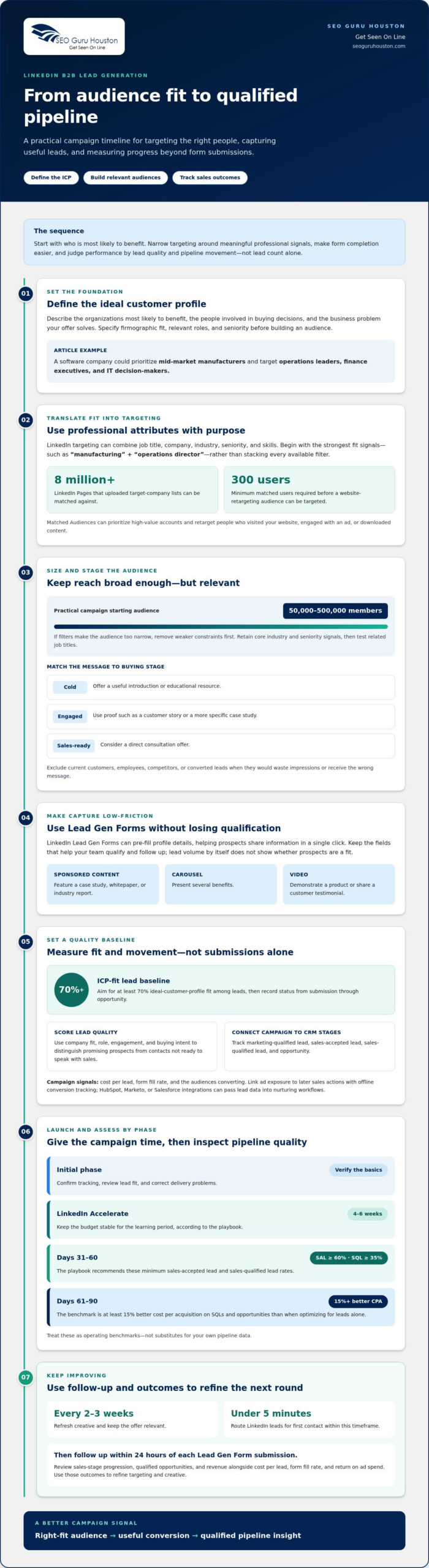
Strong LinkedIn ads for B2B lead generation start with a precise ideal customer profile (ICP), not a broad industry label. Define the organizations most likely to benefit, then identify the people involved in their buying decisions. For example, a software company might prioritize mid-market manufacturers and target operations leaders, finance executives, and IT decision-makers. Specify firmographic fit, relevant roles, seniority, and the business problem your offer addresses.

Translate that ICP into LinkedIn’s professional targeting criteria. Advertisers can select job title, company, industry, seniority, and skills, then combine attributes to narrow relevance. Start with the strongest fit signals, such as “manufacturing” plus “operations director,” instead of stacking every possible filter. LinkedIn can match uploaded target-company lists against more than 8 million LinkedIn Pages, helping account-based campaigns reach decision-makers at named organizations.

Use Matched Audiences to prioritize high-value accounts and build retargeting groups from people who visited your website, engaged with an ad, or downloaded content. Website retargeting requires at least 300 matched users before the audience can be targeted. Keep prospecting and retargeting distinct: a first-touch audience may need an educational resource, while people who already engaged can receive a more specific case study or demo offer.

Audience size matters. A practical campaign starting point is 50,000-500,000 members, as recommended in the guidance summarized here. If your filters make the audience too narrow, remove weaker constraints before expanding beyond your ICP. For example, retain the target industry and seniority, but test related job titles. Exclude current customers, employees, competitors, or converted leads where those groups would waste impressions or receive the wrong message.

Map audiences to buying stages before choosing creative. Cold prospects need a useful introduction; engaged visitors may respond to proof, such as a customer story; sales-ready accounts may be ready for a direct consultation offer. This staged approach supports demand generation without assuming every prospect is equally close to buying.

How do LinkedIn ads compare with Google Ads and Meta ads for B2B leads? LinkedIn’s professional attributes and company targeting help focus on roles and accounts, while Google Ads can reach people expressing search intent. Meta ads commonly use broader demographic and interest signals, so the strongest channel depends on whether account fit, active search, or broader discovery matters most.

What LinkedIn advertising policies and targeting restrictions apply to lead generation? Use LinkedIn’s available professional attributes and eligible Matched Audiences, and ensure each audience meets platform requirements. In particular, website retargeting needs 300 matched users; campaign content and targeting must also follow LinkedIn’s advertising policies.

2. Lead quality, pipeline measurement, and campaign optimization

Lead volume can look strong while sales receives few useful opportunities. Set a quality baseline before launch: aim for at least 70% ideal-customer-profile fit among leads, then record each lead’s status from submission through opportunity. A simple scoring model can weigh company fit, role, engagement, and buying intent. Use those criteria to distinguish promising prospects from contacts who downloaded an asset but aren’t ready to speak with sales.

Build conversion tracking around the campaign objective, not clicks alone. LinkedIn Lead Gen Forms reporting includes cost per lead, form fill rate, and the audiences converting. Connect those metrics to CRM stages such as marketing-qualified lead, sales-accepted lead, sales-qualified lead, and opportunity. Offline conversion tracking can link ad exposure to later sales actions, while integrations with HubSpot, Marketo, or Salesforce can pass lead data into nurturing workflows.

Choose creative that fits both the offer and the buying stage. Sponsored Content can feature a case study, whitepaper, or industry report; carousel ads can present several benefits, while video can demonstrate a product or share a customer testimonial. Lead Gen Forms reduce manual entry, but results still depend on audience fit and a useful offer. Test creative variations and compare qualified pipeline, not just click-through rate.

Its ad auction uses advertiser bids, and Campaign Manager supports daily or lifetime budgets that you can change as results develop. Start with a budget aligned to the test’s audience and conversion goal; avoid frequent changes that make it harder to compare performance. LinkedIn Accelerate campaigns should receive 4-6 weeks of stable budget to learn, according to the playbook.

Use a staged launch. During the initial phase, confirm tracking, review lead fit, and correct delivery problems. During days 31-60, the playbook recommends an SAL rate of at least 60% and an SQL rate of at least 35%. By days 61-90, it recommends achieving at least 15% better CPA on SQLs and opportunities than when optimizing for leads alone. Treat these as operating benchmarks, not substitutes for your own pipeline data.

How do you improve conversion and lead quality? Refresh creative every 2-3 weeks, keep the offer relevant, and use lead scoring to prioritize follow-up. Route LinkedIn leads for first contact in under five minutes, then follow up within 24 hours of each Lead Gen Form submission.

How should you measure campaigns? Review cost per lead and form fill rate alongside lead quality, sales-stage progression, and return on ad spend. Track whether leads become sales-accepted leads, qualified opportunities, and revenue, then use those outcomes to refine targeting, creative, and bids.

Common risks include judging success by lead count, neglecting follow-up, and letting irrelevant impressions consume budget. Keep the wasted impression rate below 5%, and use retargeting, including website and video engagement, to support the pipeline. About 30% of assisted pipeline in a LinkedIn B2B campaign should come from retargeting, according to the playbook.

Need a clearer demand generation plan connecting paid campaigns to pipeline? Explore demand generation strategy as a way to align audience, offer, and follow-up.

LinkedIn Ads for B2B Lead Generation: Targeting and ROI

3. CTR, conversion rate, CPL, lead quality, and ROAS

Use click-through rate (CTR) to diagnose whether an ad earns attention, not to declare a campaign successful. Cold-prospecting LinkedIn content ads should aim for at least 0.5% CTR. Single-image ads paired with Lead Gen Forms typically see 0.4-0.8% CTR. Compare each campaign with its format and audience, since a relevant decision-maker click matters more than an unqualified click.

Conversion rate reveals what happens after the click. Calculate it by dividing completed actions by the relevant visits, then multiplying by 100. For a Lead Gen Form campaign, track both form opens and completed submissions to spot friction. A form-fill rate of 10-20% is a target for cold audiences, while warm audiences can aim for 20-40%. If clicks are healthy but completions lag, review the offer, form fields, and message match.

LinkedIn reports that Lead Gen Form campaigns increase conversions by 2-3x compared with standard Sponsored Content campaigns. That comparison can help guide a test, but assess your own audience and conversion path. Test one clear variable at a time, such as the offer or creative, and compare completed forms and qualified leads. Keep campaign objectives, attribution settings, and reporting periods consistent so the result reflects the change you tested.

Cost per lead (CPL) is campaign spend divided by submitted leads. LinkedIn’s guide reports that its cost per lead is 28% lower than Google AdWords. Use that comparison as context, not a substitute for your account’s actual results. A low CPL can still mask weak fit, so segment leads by company, role, and sales qualification. For example, compare the CPL of all form submissions with the CPL of sales-qualified leads.

Lead quality connects advertising metrics to revenue potential. Score fit and intent using signals such as target-company match, decision-making responsibility, and engagement with a high-value asset. Then assess how leads progress into sales conversations and opportunities. An audience that generates fewer submissions but more qualified opportunities may be more valuable than a larger, less relevant group.

Return on ad spend (ROAS) compares revenue attributed to ads with campaign spend. Calculate it by dividing attributed revenue by advertising cost, using the same attribution approach across campaigns. For a longer B2B sales cycle, monitor qualified pipeline and closed revenue alongside immediate form conversions. This prevents early engagement from being mistaken for final business impact.

Review metrics as a connected sequence: CTR indicates attention, conversion rate shows response, CPL measures acquisition efficiency, and lead quality tests fit. ROAS connects the path to revenue. When results weaken, identify the stage first. Low CTR may point to an audience or creative issue; low form completion suggests friction in the offer or form; high lead volume with a weak pipeline calls for stronger qualification and follow-up.

4. Lead Gen Forms and form-field optimization

LinkedIn Lead Gen Forms reduce friction by pre-filling professional details from a member’s profile. Depending on available profile information, fields can include name, contact details, company, seniority, job title, and location. Members can submit with one click instead of typing each answer, making the form useful for mobile users responding to Sponsored Content or a Message Ad.

Keep the form focused on the information sales needs to act. A practical starting point is four fields for most B2B forms. For example, request name, work email, company, and job title when those details support lead routing and qualification. Each extra question asks for more effort, so add a field only when its answer changes follow-up, qualification, or audience segmentation.

Match the form to the offer. Someone requesting an introductory guide may only need to provide basic work details, while a consultation request may justify a qualifying question about business needs. Keep the question direct and easy to answer. For example, offer a short set of choices about the prospect’s main challenge instead of asking for a lengthy description.

Set expectations before the click. Explain in the ad what the prospect will receive, who the offer is for, and what happens after submission. Then use the thank-you page to deliver the promised resource or direct the person to a relevant website destination. A downloadable eBook, case study, or product information page can clarify the next step.

LinkedIn Lead Gen Forms reporting shows cost per lead, form fill rate, and which audiences convert. Review these measures together: a high fill rate matters only when submissions fit your target accounts and provide actionable details. Leads can be downloaded from Campaign Manager or sent to a CRM or marketing automation platform. Connecting the data to HubSpot, Marketo, or Salesforce supports timely routing and nurturing.

Test changes deliberately. Compare one form version with another, changing a single element such as the offer description, field selection, or call to action. Track both completed submissions and downstream lead quality, then keep the version that contributes stronger prospects. LinkedIn’s guide reports that Bynder increased leads by 400% using Lead Gen Forms, but that case study is not a forecast for every campaign.

Use a 10% form completion rate as a target, then diagnose performance against your own audience and offer. If completion is weak, check whether the ad promise matches the form, whether each requested detail is essential, and whether the thank-you page gives a clear next step. Small edits to those elements can make the path from LinkedIn impression to useful lead more direct.

5. How do LinkedIn ads generate B2B leads?

LinkedIn ads put a business offer in front of professionals researching solutions and guide interested members toward a next step. A typical path moves from a relevant impression to content engagement, a form submission, and sales follow-up. Strong campaigns connect each step, keeping the ad promise, landing experience, and follow-up message consistent.

Sponsored Content appears in members’ feeds and can promote whitepapers, case studies, or industry reports. A carousel can present related ideas, such as a business challenge, its impact, and a practical solution. Video ads can feature a short product demonstration or customer testimonial. Match the format to the asset: a report suits a detailed learning offer, while a demo can show how a product works.

LinkedIn Message Ads can deliver personalized messages to members’ inboxes for account-based marketing. Dynamic Ads use profile data to create personalized experiences, while Spotlight Ads can direct people to a landing page. Follower Ads serve a different purpose: growing a Company Page audience. Choose the format for the action you want, rather than treating every ad type as interchangeable.

For a named-account campaign, pair a useful asset with company and role relevance. For example, a manufacturer could promote an operations case study to decision-makers at selected manufacturing accounts. Prospects who engage can later see a more focused offer. LinkedIn retargeting can reach people who visited a website, engaged with an ad, or downloaded content, helping the campaign continue the conversation.

Content helps buyers evaluate options before they’re ready to speak with sales. LinkedIn’s lead generation guide says a typical B2B buyer consumes 7 to 10 pieces of content before making a choice. Plan a sequence that offers distinct value, such as an industry report, a practical case study, and a product demonstration. Each asset should answer a different question and make the next step clear.

Buying decisions involve more than one person. LinkedIn research found that 3.1 to 4.6 groups can influence a B2B purchase decision. Build messages for the roles involved, such as finance, technical, and operational stakeholders, and give each group a reason to engage. A campaign that speaks to only one contact may miss other voices shaping the purchase.

Ultimately, LinkedIn ads for B2B lead generation work by combining professional targeting, relevant content, and a clear conversion path. Map each creative to an audience need, then connect form submissions and content engagement with suitable sales follow-up. Plan your LinkedIn lead generation approach around the pipeline you want to build.

SEO Guru Houston: Houston SEO Services

SEO Guru Houston can help when LinkedIn campaigns need to connect with a broader B2B acquisition strategy. Its B2B marketing and PPC services support businesses aligning paid campaigns with audience needs, landing pages, and pipeline goals. SEO services can complement that work by building organic visibility for prospects researching solutions beyond an ad click.

Turn to SEO Guru Houston when campaign activity generates leads but it is unclear how channels contribute to sales opportunities. SEO, PPC, and inbound marketing can bring targeting, content, and follow-up into sharper focus, while supporting buyer education across relevant touchpoints.

Contact SEO Guru Houston to discuss how these services can fit your B2B marketing goals.

Turn Campaign Insight Into Your Next Growth Move

The next step is to make every marketing channel support the same business goal. Treat each LinkedIn campaign as part of a wider path: the message creates interest, your website builds understanding, and a relevant next step helps prospects continue their research. That perspective keeps LinkedIn advertising for B2B lead generation connected to the conversations and opportunities your business wants to create.

SEO Guru Houston can support that broader strategy through B2B marketing, PPC, and SEO services. These offerings can help align paid visibility with B2B audience needs and organic discovery, giving your team a clearer foundation for reaching prospective customers across their research journey.

Ready to shape a more connected approach to B2B growth? Contact SEO Guru Houston to discuss your marketing goals and the next steps that fit your business. Build with focus, learn from each campaign, and keep moving toward stronger opportunities.

Frequently Asked Questions

How to target B2B audiences on LinkedIn by job title, company, and industry?

Build a LinkedIn audience by combining the role, organization, and sector that define a qualified prospect. For example, target procurement leaders at healthcare companies, then compare that segment with operations leaders at the same companies. Keep audience groups distinct so reporting shows which combination attracts stronger prospects. Exclude existing customers or converted leads when the offer is aimed at new business, and refine targeting with sales feedback.

What is the average cost per lead for LinkedIn B2B ads in the United States?

LinkedIn B2B cost per lead varies with the auction, audience competition, ad format, offer, and conversion rate, so one average won’t predict your campaign’s result. A narrow audience of senior decision-makers may cost more to reach than a broader group, while a stronger offer can improve form completions. Track spend against qualified leads and sales opportunities, not submissions alone, to understand whether the campaign’s acquisition cost supports your pipeline goals.

How to set up LinkedIn Lead Gen Forms step by step?

Create a LinkedIn Page and access Campaign Manager, then build a Sponsored Content or Message Ad campaign with a Lead Gen Form. Choose only the fields needed to qualify leads, keeping most forms to four fields or fewer, and add a thank-you page. Download leads from Campaign Manager or connect the form to a CRM or marketing automation platform.

Amazon DSP Advertising Guide: How to Plan, Compare, and Measure Campaigns

Amazon DSP works best not as a replacement for Sponsored Ads, but as an audience and measurement layer that can extend your media plan beyond active searches. The two approaches are easy to blur, especially when campaigns use different audiences, placements, and formats. Treating them as interchangeable can make goals and results harder to interpret. This amazon dsp advertising guide explains where each approach fits and how they can work together.

If you’re deciding which audiences to target, how to structure a campaign, or how to connect ad activity with business outcomes, start by setting objectives and measurement criteria before launch. That gives you a basis for evaluating results instead of relying on guesswork after the budget is spent. This guide covers how Amazon DSP works, when it can complement Sponsored Ads, how to compare access models, and which signals can help assess performance. You’ll be better prepared to plan a measurable campaign and connect Amazon advertising to your wider marketing goals.

Key Takeaways

  • Use Amazon DSP to reach relevant audiences across eligible placements, with campaign choices tied to a clear business objective.
  • Plan campaigns in sequence: define the goal, audience, creative, delivery approach, and measurement plan.
  • Compare Amazon DSP with Sponsored Ads by audience strategy, placement context, and each channel’s role in the customer journey.
  • This amazon dsp advertising guide explains how to distinguish delivery metrics from business outcomes and choose KPIs before launch.
  • Use a readiness checklist to clarify your destination, budget controls, and measurement needs before deciding how to execute.

What Is Amazon DSP Advertising, and What Role Does It Play?

Amazon DSP is a programmatic platform for buying digital advertising placements and reaching audiences across eligible Amazon-owned and third-party environments. Instead of relying mainly on a shopper’s search terms, advertisers can use audience signals to serve display, video, and other available ad formats. This distinguishes DSP from keyword-led Sponsored Ads, which commonly appear in shopping contexts when customers search or browse products. The Demand-Side Platform (DSP) model automates the purchase of eligible ad impressions according to campaign settings.

Think of DSP as an audience-reach layer in a broader Amazon marketing plan, not a default replacement for Sponsored Ads. It can help a brand reach people before they search, reconnect with relevant audiences later, or support both stages with different messages. Inventory and features depend on the market, account eligibility, and buying arrangement. Plan around the inventory and controls available to your campaign instead of assuming every format or environment is accessible.

How does demand-side platform advertising work?

Programmatic buying uses automated bidding to compete for eligible ad impressions. The advertiser sets campaign inputs, including the objective, audience, creative, placements, and budget controls. The platform evaluates opportunities and bids according to that setup. Auction mechanics, inventory, and controls vary by placement and platform configuration, so selecting an audience does not mean the same ad will appear everywhere.

For a practical starting point, define who you want to reach and what response matters before choosing creative. A prospecting campaign might introduce a product category to a relevant audience, while remarketing could show a follow-up message to people who have already engaged. Treat these as separate campaign jobs, each with its own message and success criteria.

Which goals can Amazon DSP support?

DSP campaigns can be planned around awareness, consideration, or conversion, depending on available formats, audiences, and campaign setup. Awareness introduces a brand to relevant people; consideration encourages deeper product or brand exploration; conversion focuses on a defined action. These are planning objectives, not guaranteed results. Choose measures that match the goal and interpret performance in the context of the customer journey.

For example, a brand seeking new prospects could prioritize relevant reach and exposure, then use a separate remarketing campaign to reconnect with people who showed interest. The first campaign builds awareness; the second encourages an already-engaged audience to take a next step. Keeping those purposes distinct makes performance easier to assess and gives each creative a clear role.

This distinction is central to an effective amazon dsp advertising guide: DSP buys access to audiences across eligible placements, while Sponsored Ads commonly capture shopping intent within Amazon contexts. Use DSP when audience reach or re-engagement supports your objectives, and coordinate it with Sponsored Ads when both channels can serve different moments in the journey. Before launch, confirm the eligible inventory and capabilities for the campaign’s market and buying arrangement. Then set clear expectations for what each activity is designed to accomplish.

How to Plan an Amazon DSP Campaign From Audience to Creative

A campaign becomes more focused when every choice follows from a business objective. Before selecting audiences or formats, decide what the advertising needs to accomplish and how you’ll recognize progress. Then connect that goal to campaign structure, creative, the destination customers will visit, and a measurement plan. This sequence ties media activity to the wider Amazon marketing plan instead of treating each ad as a standalone tactic.

Set the objective, audience, and campaign structure

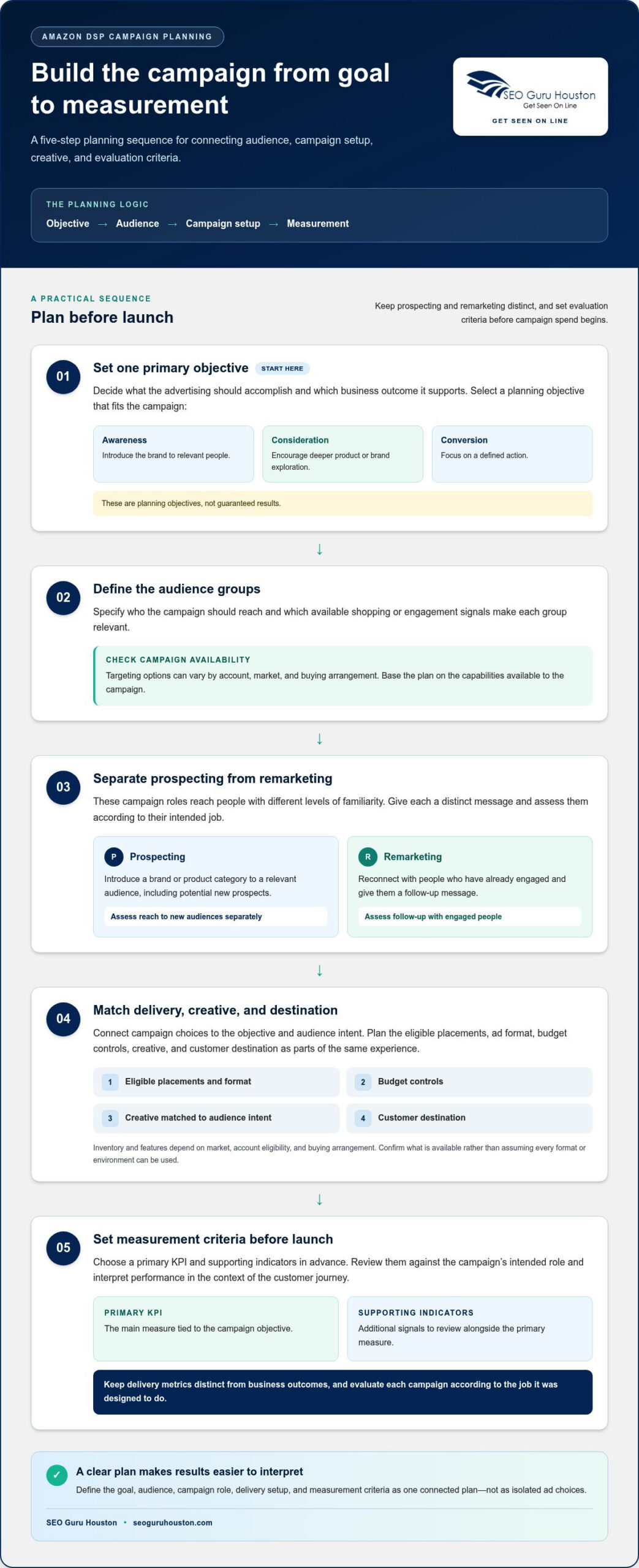
Start with one primary objective, such as introducing a product to potential customers or encouraging an interested audience to take a next step. Define the business outcome it should support, then identify relevant audience groups using available shopping or engagement signals. Targeting options can vary by account, market, and buying arrangement, so base the plan on current campaign capabilities rather than assumptions.

Organize prospecting and remarketing separately. Their audiences have different levels of familiarity, so they need different messages and should not be judged by identical expectations. Use this planning sequence:

  1. Set the objective. State the business goal and the primary outcome you’ll use to evaluate it.
  2. Define audience groups. Specify who the campaign should reach and which signals make each group relevant.
  3. Separate campaign roles. Keep prospecting distinct from remarketing so you can assess reach to new audiences separately from follow-up with engaged people.
  4. Choose delivery inputs. Match eligible placements, format, and budget controls to the audience and objective.
  5. Set measurement criteria. Choose a primary KPI and supporting indicators before launch, then review them against the campaign’s intended role.

For example, a prospecting campaign for a product category might introduce the brand to relevant shoppers, while remarketing could focus on people who have already interacted with the brand or product. The available audience signals and controls depend on the campaign setup.

Match creative and landing experience to audience intent

Creative should meet people where they are in the customer journey. An awareness message needs to communicate the product or brand clearly. A consideration message can explain a meaningful point of difference. A conversion-focused ad should make the next step easy to understand. Select formats based on the message and eligible inventory, not novelty alone.

Review the customer journey from ad to destination before launch. If an ad promotes a product, make sure the product is available and its detail page supports the promise with accurate, useful information. For off-Amazon campaigns, check that the destination page is relevant, functional, and consistent with the ad. A mismatch can undermine the experience even when the audience and creative are well chosen.

Test with discipline. Change one meaningful variable at a time, such as the headline, visual, or call to action, while keeping other elements consistent. That makes results easier to interpret and helps distinguish a creative effect from changes in audience or delivery. This amazon dsp advertising guide’s planning approach works best when testing and measurement are designed together.

When campaign strategy, execution, and destination experience need to work as one, explore Amazon marketing services as part of a coordinated growth plan.

Amazon DSP vs. Sponsored Ads: Choose the Right Channel Mix

Choose the channel based on the moment you need to influence. Sponsored Ads commonly connect products with active shopping intent, while Amazon DSP can support audience-based reach across eligible Amazon-owned and third-party placements. They address different media needs, so the decision is not simply which channel is better. Consider whether your plan needs to capture demand, build awareness beyond search, or coordinate both.

Use this comparison as a starting point. Specific formats, placements, targeting options, and reporting can vary by market, account, and campaign setup.

Consideration Sponsored Ads Amazon DSP
Typical objective Promote product discovery and reach shoppers showing relevant shopping intent. Build broader audience reach, support consideration, or re-engage eligible audiences.
Audience approach Often connects ads with search queries or shopping activity, depending on ad type and settings. Uses audience-based buying, with targeting options dependent on current campaign capabilities.
Placement context Commonly appears in Amazon shopping contexts, such as search results and product pages. Can include eligible Amazon-owned and third-party environments, depending on inventory and setup.
Measurement considerations Assess performance against the campaign objective, including relevant clicks and attributed sales. Consider delivery and audience measures alongside outcomes such as product consideration and attributed conversions.

When should a brand prioritize Sponsored Ads?

Prioritize Sponsored Ads when capturing active product searches is the immediate need. They can suit campaigns built around specific products, search intent, and product discovery. First check that the advertised catalog is available and its listings are clear, accurate, and ready to turn interest into consideration. Then assess results against the campaign’s defined objective instead of assuming every campaign should use the same success measure.

When can Amazon DSP add a complementary layer?

Consider DSP when your strategy needs to reach relevant audiences beyond active search moments or reconnect with eligible audiences who have already engaged. It is not automatically necessary or superior. Its role depends on the objective, available inventory, audience options, and your capacity to measure the campaign. Keep its purpose distinct from Sponsored Ads, and avoid counting the same outcome twice in reporting.

The channels can complement each other when their roles, budgets, and reporting are coordinated. For example, Sponsored Ads may focus on shoppers searching for a product, while DSP supports awareness among broader audiences or remarketing to eligible previous engagers. Set separate objectives and budget controls, then use a shared reporting view to understand how each channel contributes to the customer journey. That is the practical decision framework at the heart of an amazon dsp advertising guide: choose media for its job, not simply because it is available.

Amazon DSP Advertising Guide: How to Plan, Compare, and Measure Campaigns

How to Measure Amazon DSP Performance and Address Common Concerns

Measurement starts before launch. Set one primary KPI that reflects the campaign’s business objective, then choose secondary metrics to explain what may be helping or hindering progress. A reach campaign should not be judged by the same standard as a conversion-focused effort. Define the reporting period and attribution settings in advance, too, so the team compares results consistently rather than changing the rules after seeing the numbers.

Separate delivery signals from outcomes. Impressions, reach, frequency, and spend describe how a campaign ran. Qualified visits, product consideration, and attributed conversions indicate responses or actions. Both matter, but delivery alone does not prove business impact, and an attributed conversion does not by itself establish that an ad caused a sale.

Which KPIs should an Amazon DSP campaign track?

Match measures to the campaign’s job. For awareness, monitor reach and frequency to understand audience exposure. For consideration, review engagement and relevant product signals, such as detail page views where available. For conversion objectives, assess attributed conversions alongside spend and delivery context. Keep the primary KPI focused, then use secondary indicators to diagnose performance rather than treating every metric as equally important.

Before launch, write down what each KPI means, its data source, and the decision it will inform. This makes later reporting more useful.

How can advertisers test incrementality and reduce waste?

Establish a baseline and, where data and platform options allow, compare campaign results with an appropriate holdout or another comparison method. During optimization, review frequency, audience overlap, creative fatigue, and placement quality. These checks can reveal saturation or weak delivery, but changes should follow evidence and remain aligned with the campaign objective.

Document limitations before drawing conclusions. Seasonality, price changes, inventory, promotions, and other marketing activity can affect results alongside advertising. Where available and appropriate, deeper cross-channel analysis can help assess how exposures relate to outcomes, but the method and its limits should be clear in the report.

Attribution is a measurement lens, not conclusive proof of incremental impact. It assigns credit according to defined rules; it does not necessarily show what would have happened without the ad. Campaign windows and attribution settings affect which interactions qualify for credit and therefore can change reported results. For Amazon Store ads, including DSP, Amazon’s shopping-signal enhanced last-touch model took effect on January 1, 2026, replacing the previous 14-day view-through window.

Keep reporting grounded by reading delivery, customer response, and attributed outcomes together, then qualifying conclusions according to the measurement method. For a campaign plan built around objectives and measurable growth, explore Amazon advertising support.

Turn Amazon DSP Strategy Into a Measurable Growth Plan

A campaign is ready when its objective, execution, and measurement plan connect to a business outcome. Before committing media, make sure your team can explain who it wants to reach, what the audience should see, where interested customers will go, and how performance will inform the next decision. This makes Amazon DSP a governed part of your marketing strategy rather than a standalone media test.

What should a team prepare before launching?

Use this readiness checklist to find gaps before campaign delivery begins:

  • Goal: State the business objective and define the primary success measure.
  • Audience: Document the intended audience, relevant signals, and the role of prospecting or remarketing.
  • Product and creative: Gather accurate product information and creative that matches the campaign’s objective and audience intent.
  • Destination: Confirm the product detail page or landing page is relevant, available, and consistent with the ad promise.
  • Budget governance: Set spending guardrails, approval responsibilities, and the process for reviewing or adjusting investment.
  • Measurement plan: Record primary and supporting KPIs, attribution settings, reporting cadence, and known limitations.

Assign owners before launch. Decide who approves creative, monitors delivery, reviews results, and authorizes optimization. Agree on a reporting cadence and what conditions would trigger a change, such as delivery outside agreed guardrails or a gap between the campaign objective and observed performance. Clear ownership keeps decisions timely and makes results easier to interpret.

How can specialist support connect campaign strategy to growth?

In-house execution can work when your team has the time, platform knowledge, creative resources, and measurement process to manage the campaign consistently. Specialized Amazon campaign support can add capacity when planning, audience strategy, creative coordination, or performance analysis competes with other priorities. The right model depends on your team’s capabilities and the work required, not on the assumption that every advertiser needs the same level of support.

Our Amazon-specific marketing can be aligned with PPC and demand generation around shared business objectives and the customer journey. This coordination helps clarify how Amazon advertising fits alongside other paid activity and demand-building efforts. Landing-page design and web development can also support a consistent post-click experience when a campaign sends customers to a website. Strategy, execution, market conditions, and measurement all shape results, so set expectations around what the campaign can test and learn rather than treating outcomes as guaranteed.

Use this amazon dsp advertising guide to turn campaign decisions into a plan your team can govern and assess. Ready to connect Amazon advertising with broader growth goals? Build a stronger Amazon marketing strategy.

Make Your Next Amazon Campaign More Intentional

Your next step is not necessarily to launch another campaign. Decide what your current plan needs to learn, then align the people, budget, and reporting around that priority. Use this amazon dsp advertising guide as a starting point for a focused working session: identify the business question, agree on how you’ll evaluate it, and assign clear ownership for acting on what the data shows.

That planning can connect Amazon-specific marketing with PPC and demand generation, so each effort supports shared business outcomes rather than competing for attention. Our digital marketing services bring these capabilities together with a focus on strategy, execution, and measurable growth. Campaign outcomes still depend on strategy, implementation, market conditions, and measurement, so build learning and optimization into the plan.

Ready to turn your next decision into a coordinated growth plan? Build a smarter Amazon advertising strategy. Move forward with clarity and make every campaign choice serve a defined purpose.

Frequently Asked Questions

What is Amazon DSP advertising?

Amazon DSP advertising is the programmatic buying of eligible digital ad placements to reach selected audiences. It can support awareness, consideration, or conversion goals, depending on campaign setup and current capabilities. Unlike keyword-led Sponsored Ads, DSP can help reach people outside an active product search. In this amazon dsp advertising guide, think of DSP as one part of a coordinated plan, not a shortcut to guaranteed sales.

Is Amazon DSP only for companies that sell on Amazon?

No. Selling products on Amazon is not the only possible strategic context for Amazon DSP, though access, inventory, and features depend on current policies and campaign arrangements. For example, a business seeking to introduce its brand to relevant audiences may assess DSP even if its main conversion destination is its own website. Before planning, clarify account eligibility and whether the intended campaign can use its chosen audience, placement, and destination.

How is Amazon DSP different from Amazon Sponsored Ads?

Sponsored Ads commonly connect product discovery with shopping intent, while DSP supports programmatic, audience-based reach across eligible placements. A brand promoting a newly launched product might use Sponsored Ads to appear in relevant shopping contexts and evaluate DSP to reach audiences earlier in their decision process. Start the comparison with the job each campaign must do, then consider audience, placement, and measurement. Confirm current product names and capabilities during planning.

Can a small or growing brand use Amazon DSP?

Potentially, if the campaign’s objectives, resources, audience strategy, and measurement needs make it a sensible fit. Company size alone does not determine suitability. A growing brand should first assess whether product listings are ready, whether it has usable creative, who will manage delivery, and what outcome the investment needs to demonstrate. If those inputs are unclear, strengthen the plan before committing rather than treating DSP access as the goal.

How much does Amazon DSP advertising cost?

There is no single cost that applies to every Amazon DSP campaign. Spend can vary with the buying arrangement, campaign setup, audience, eligible inventory, and management needs. Budget planning should also account for creative production and measurement, not just media delivery. Start with the business objective and define spending limits and evaluation criteria before launch. Then assess current platform terms and the full campaign requirements for your plan.

How long does it take to see results from Amazon DSP?

Timing depends on the objective, audience, delivery, creative, measurement window, and outcome being assessed. Delivery indicators can show whether a campaign is serving before conversion patterns are clear. For example, an awareness effort may be reviewed through exposure measures, while a sales-focused effort requires enough time and data to assess attributed actions. Set review intervals before launch and avoid firm conclusions from a small or incomplete data set.

What should I measure in an Amazon DSP campaign?

Choose metrics that answer the campaign’s business question. For awareness, review reach and frequency. For consideration, look at engagement or relevant product-interest signals. For conversion, assess attributed outcomes alongside spend and delivery. A useful reporting note records campaign dates, attribution settings, and external influences such as promotions or price changes. This context helps teams interpret the data without claiming that an ad alone caused the result.