Tag Archives: Business Growth

Affordable SEO Company: How to Invest in Growth Without Overspending

The cheapest SEO proposal can become the most expensive choice if it delivers activity without progress. An affordable SEO company should make your investment work harder by prioritizing opportunities tied to your business goals, not by offering the longest task list for the lowest price.

It’s reasonable to want clear deliverables, a manageable budget, and evidence that the work is moving your business forward. But comparing headline prices alone won’t show whether an engagement includes the right mix of technical improvements, content strategy, and performance measurement. SEO also takes time, so expectations should account for meaningful milestones as well as longer-term growth.

This guide explains what a focused SEO engagement can include and how to compare proposals by scope, strategic fit, and measurable outcomes. You’ll learn how to connect SEO priorities with business objectives, evaluate progress beyond rankings, and choose an approach that can adapt as your needs change. The goal is to invest with confidence, protect your budget, and build a stronger foundation for sustainable growth.

Key Takeaways

  • An affordable SEO company focuses on the work that fits your goals and resources, not simply the lowest quote.
  • Assess your business objectives, website condition, competition, and capacity to determine which SEO priorities matter most.
  • Compare proposals by scope clarity, prioritization, measurement, communication, and flexibility to understand where value comes from.
  • Set your SEO direction by defining an outcome, establishing a baseline, choosing priorities, and tracking qualified demand and conversions.
  • SEO can work alongside PPC, B2B and inbound marketing, and website improvements. The right mix depends on your growth priorities.

What Does an Affordable SEO Company Actually Mean?

Budget pressure is real. Every marketing dollar needs a job, and an SEO proposal full of unfamiliar tasks can make it hard to tell what you’re buying. But the lowest quote isn’t automatically the most affordable choice. If research, technical fixes, or performance tracking are missing, a low upfront cost may leave the problems limiting organic growth untouched.

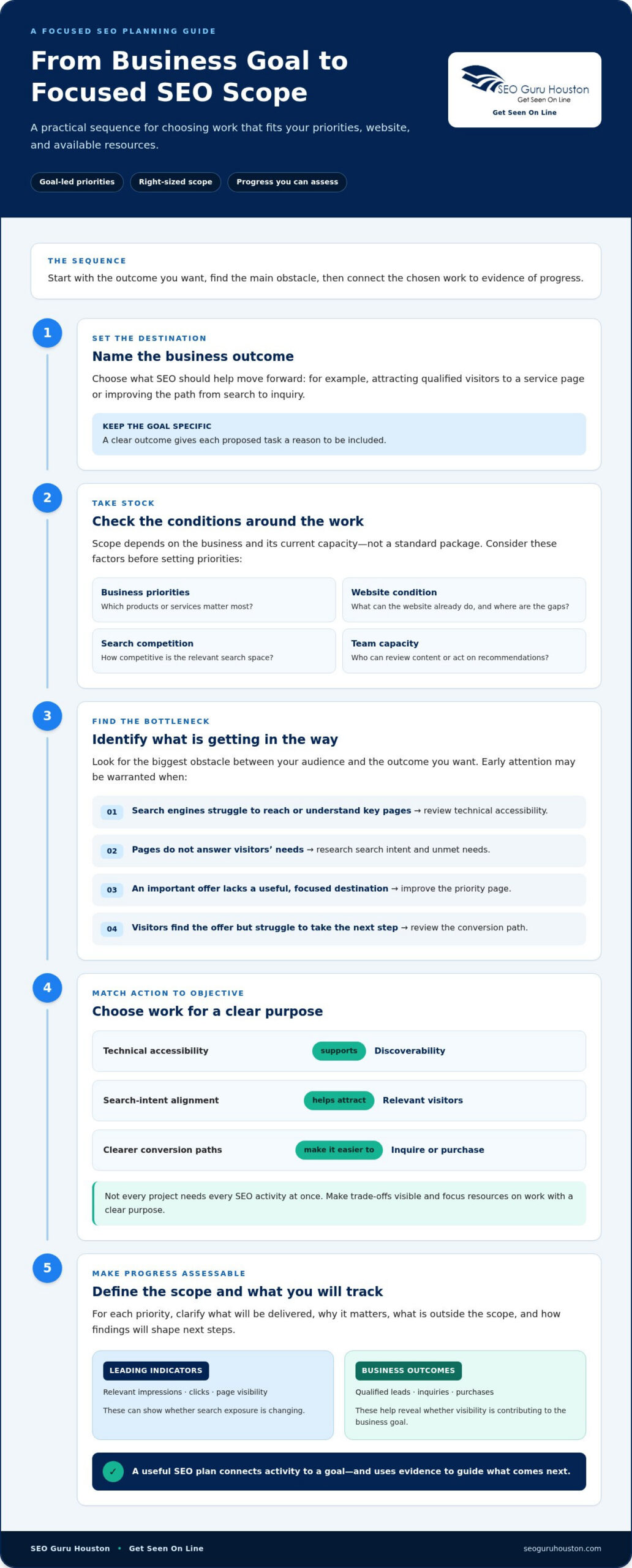
Affordability in SEO means a transparent, right-sized scope that connects available resources to measurable business priorities. Start with a clear outcome, such as attracting qualified visitors to a service page or improving the path from search to inquiry. Then identify the work most relevant to that outcome, specify what will be delivered, and define how progress will be assessed.

Search engine optimization (SEO) brings together activities that help improve a website’s visibility in search. A useful engagement turns that broad discipline into a focused plan. It isn’t a thin set of actions without a rationale, or an unexplained list of tasks that sounds comprehensive but isn’t tied to your business.

How Is Affordable SEO Different From Cheap SEO?

Affordable SEO prioritizes. Cheap SEO may simply remove the work needed to make informed decisions. A focused plan can concentrate on the most relevant pages and issues first while still grounding recommendations in research and tracking. Cutting those foundations makes it harder to evaluate the work because there’s no clear rationale or way to connect activity to progress.

Deliverable clarity matters more than a headline figure. You should understand what the work includes, why it matters, what falls outside the scope, and how findings will shape next steps. Imagine a company whose priority is generating more qualified inquiries for one service. A focused engagement might research search intent, improve that service page, and monitor relevant inquiry actions. A vague task list might promise assorted updates without explaining how they support the goal. The difference isn’t the number of tasks, but the reasoning behind them.

Who Can Benefit From a Focused SEO Engagement?

A focused engagement can suit a business that wants stronger organic visibility but needs to sequence marketing investments carefully. That might be a growing company with a defined service to promote, a business with limited capacity to create or update content, or a team strengthening its search foundation before expanding its efforts. The right starting point depends on the business, not a standard package.

Before setting scope, clarify the outcome and the resources available to support the work. Consider which products or services matter most, what the website can already do, and who can review content or act on recommendations. If your team can support only a narrow initiative, concentrating on a priority page may be more practical than spreading effort across the entire site. If capacity changes, priorities can change with it.

An affordable SEO company should make those trade-offs visible, not disguise them behind a low price or a long list of deliverables. A good-fit engagement gives your business a clear first move and a reasoned way to build from there.

What Shapes the Scope and Value of Affordable SEO Services?

SEO scope should reflect the business you’re trying to grow, not a standard checklist. A company seeking qualified inquiries for a specific service needs a different plan from an online retailer expanding product visibility. The website’s current condition, the competitiveness of its search space, and the time your team can contribute all affect what belongs in the plan and what should wait.

Think of the work in two layers. Foundational SEO addresses whether search engines can access and understand important pages, whether those pages match relevant search intent, and whether visitors can take a useful next step. Ongoing improvement may involve developing content for unmet needs, strengthening the site’s authority, and using performance data to refine priorities. A well-scoped engagement makes the transition between these layers clear. For a broader perspective on strategy, explore this guide to professional SEO services.

An affordable SEO company should explain why each priority fits your goals and what evidence will help assess its value. Not every project needs every SEO activity at once. The plan should make trade-offs visible so your resources go toward work with a clear purpose.

Which SEO Activities Deserve Early Attention?

Start with the website’s actual needs, not a generic checklist. Technical accessibility deserves attention if search engines struggle to reach or understand key pages. Search-intent research matters if visitors have needs your pages don’t answer. Improve priority pages when important services or products lack a useful, focused destination. Review conversion paths when people can find the offer but can’t easily take the next step.

Connect each activity to an objective: accessibility supports discoverability, intent alignment helps attract relevant visitors, and clearer conversion paths make it easier for those visitors to inquire or purchase. To decide what comes first, identify the biggest obstacle between your audience and the business outcome you want.

How Should SEO Performance Be Measured?

Use both leading indicators and business outcomes. Relevant impressions, clicks, and page visibility can show whether search exposure is changing. Qualified leads, inquiries, or purchases help reveal whether that visibility supports the business. Google Search Console can help you review search queries and page performance, while analytics data can show how visitors behave after landing on the site. Together, these sources provide context, not a promise of particular rankings or revenue.

SEO reporting should connect completed work to search visibility and meaningful business outcomes, so each review informs the next decision. A useful report explains what changed, what the data suggests, and what action follows instead of presenting metrics without interpretation.

  • Goal: Name the business outcome the SEO work is meant to support.
  • Baseline: Record relevant page, search, and conversion performance before changes.
  • Review: Compare progress over time and adjust priorities as evidence or business needs change.

Connecting scope to measurement turns SEO from a collection of tasks into a growth strategy. If your priorities call for a broader view of search and digital growth, explore SEO strategy and marketing resources to see how related efforts can fit together.

Affordable SEO Company vs. Low-Cost Provider: How to Compare Value

A proposal’s total cost tells you what you’d pay, not what the work is designed to accomplish. Compare the reasoning behind the scope: which business priority it serves, how the work will be measured, and what happens as needs change. A focused engagement may fit a defined objective; a broader partnership may suit a business addressing several connected growth needs. Neither is automatically better because it costs less or covers more.

Use this comparison to look beyond labels. These are common patterns, not fixed rules. A bare-minimum scope can suit a narrow need when its limits are clear.

What to compare Focused engagement Bare-minimum offer Broader growth partnership
Scope clarity Defines a specific objective, work areas, and boundaries. May list limited tasks without explaining their purpose. Connects SEO with related marketing or website work.
Prioritization Concentrates effort on the most relevant opportunity. May provide a fixed set of routine activities. Can address several priorities, if they’re genuinely needed.
Measurement Tracks indicators tied to the selected objective. May report activity without explaining its significance. Can connect performance across channels and conversion paths.
Communication Explains progress, decisions, and next steps. May offer limited context around completed tasks. Coordinates updates across connected areas of work.
Flexibility Can refocus as the priority evolves. May have little room to adjust its preset scope. Can shift emphasis among services as business needs change.

What Should a Transparent SEO Proposal Explain?

A transparent proposal links four parts: the business objective, the work chosen to support it, the reporting used to review progress, and expectations for discussing what comes next. The connections matter. If a deliverable has no stated purpose, or a report tracks measures unrelated to the objective, it’s difficult to judge whether the work is useful. An affordable SEO company should make those connections understandable without promising a specific ranking or revenue result.

Look for explanations, not just labels. “Improve key pages” is hard to evaluate without knowing which pages, why they matter, and how progress will be reviewed. A clear scope makes assumptions and boundaries visible, helping you compare substance rather than headline price.

When Does a Broader Growth Partnership Make Sense?

SEO can bring relevant visitors to a website, but it can’t resolve every barrier to growth by itself. If a landing page makes it hard to take action, website improvements may support the path from visit to inquiry. If the business needs to reach demand sooner while organic visibility develops, PPC may complement SEO. A broader partnership makes sense when those needs are connected and your team can act on them.

More services aren’t automatically more valuable. The right combination depends on the goal, capacity, and gaps identified. For broader context on how SEO fits into digital marketing, read this SEO marketing company guide. If your priorities span search and website performance, SEO and digital growth strategy can provide a useful starting point.
Affordable SEO Company: How to Invest in Growth Without Overspending

How to Set an SEO Budget and Priorities That Fit Your Business

An SEO budget works best when it’s built around a business result, not a wish list of tasks. Start with what growth should look like, identify the current barriers, then assign resources to the work most likely to move the right measure. This grounds priorities in evidence and makes it easier to explain why some work comes first while other opportunities wait.

Use this sequence to turn a broad ambition into a workable plan:

  1. Define the business outcome. Choose a meaningful objective, such as attracting qualified inquiries for a particular service or increasing relevant organic visits to important product pages.
  2. Assess the baseline. Review current search visibility, website activity, conversion paths, and inquiry data. Use your own site’s performance as the reference point rather than assuming an industry benchmark applies.
  3. Prioritize the constraint. Identify what most limits progress. It might be a technical issue, an important page that doesn’t meet search intent, or a website experience that makes it hard to take action. Fund the work that addresses that obstacle first.
  4. Set measures. Pair an early indicator, such as relevant organic visits, with a business outcome, such as qualified inquiries. Define what counts and where the data comes from before work begins.
  5. Review and adjust. Compare results with the baseline, discuss what the evidence suggests, and revisit the plan when capacity, business goals, or customer needs change.

This sequence gives an affordable SEO company a practical framework for prioritizing effort without treating every possible task as equally urgent.

How Can You Set Useful SEO Objectives?

Make broad goals observable. “Grow online” is difficult to act on. “Increase relevant organic visits to the service page and track how many become qualified inquiries” gives the team a direction and a way to learn. Record the starting point and keep definitions consistent across review periods. If the meaning of a qualified inquiry changes, note that change so performance comparisons remain useful.

Don’t judge the plan on traffic volume alone. More visits may not matter if those visitors aren’t looking for what the business offers or don’t take a meaningful next step. Match each measure to the customer journey and the outcome the business values.

How Should You Balance SEO With Other Growth Channels?

SEO can build organic visibility over time, while paid search may support demand that needs attention sooner. Website and landing page improvements can help visitors understand an offer and act on it. The right mix depends on your objective, available resources, and how customers move from discovery to decision. Not every business needs every channel at once.

If search attracts the right audience but the page makes conversion difficult, focused landing page design may address a more urgent constraint than expanding traffic efforts. Reassess the mix as evidence and priorities evolve.

Build your next steps around a clear goal, an honest baseline, and measures that connect marketing activity to business progress. Explore SEO growth services to consider how a data-driven search strategy can support your priorities.

How an Integrated SEO Partner Turns Affordability Into Growth

SEO creates more value when it supports a clear business objective instead of operating as a disconnected list of tasks. Search visibility matters, but so does what visitors find when they arrive and whether the site helps them take a meaningful next step. Connecting those pieces helps direct effort toward the full path from discovery to inquiry.

An integrated approach can draw on SEO, PPC, B2B marketing, inbound marketing, and website development and landing page design. That doesn’t mean every business needs every capability. A company focused on organic discovery may prioritize SEO; one seeking paid-search visibility may add PPC. If relevant visitors reach a page that doesn’t explain the offer or guide action, web improvements may be the more immediate priority. The right combination follows the goal.

For an affordable SEO company, integration is about coordination, not piling services onto a plan. Search strategy can inform which pages deserve attention, landing page work can support the visitor’s next step, and lead-generation priorities can shape which outcomes to track. Each activity should have a role in the business objective.

When Can SEO, PPC, and Web Development Work Together?

Organic search and paid search can serve different needs. SEO supports a longer-term effort to build visibility for relevant searches, while PPC can support paid-search objectives. Their roles may complement each other, but they aren’t interchangeable and shouldn’t be assumed to deliver the same outcomes.

Website development and landing page design connect those traffic sources to the customer journey. For example, a business seeking qualified inquiries might align search content and paid-search messaging with a page that clearly presents the relevant service and next step. A company focused on a different audience or offer may need a different page or channel mix. The best sequence depends on the goal, site condition, and available resources. There’s no universal timeline or guaranteed result. Evaluate progress against the measures selected for the project.

What Should a Practical First Conversation Establish?

Start with the business need. What outcome matters most? Which audience are you trying to reach, what challenges currently interrupt their path to action, and what marketing resources can your team contribute? Answers help distinguish a search visibility challenge from a conversion issue or a need to coordinate demand generation across channels.

A useful discussion connects those answers to possible priorities and services. If the main obstacle is organic discoverability, SEO may lead. If the page experience is holding back inquiries, web work may deserve attention. If paid visibility is part of the objective, PPC may have a role. This keeps the plan focused instead of treating service breadth as a reason to use everything.

Bring your goals and current challenges into focus, then turn them into a practical growth direction. Discuss your SEO growth goals and take the next step with purpose.

Turn Your Next SEO Decision Into Forward Momentum

Your SEO plan doesn’t need to solve every growth challenge at once. It needs to give your team a clear next move, a way to assess whether that move is useful, and room to adapt as the business evolves. Treat each review as a decision point: keep investing in work that supports your objectives, refine what isn’t connecting, and shift focus when your priorities or capacity change.

That’s how an affordable SEO company engagement can become a practical growth tool rather than a fixed list of deliverables. Start with the business question that matters most, then build a focused plan around the answer. Progress comes from deliberate decisions and learning from the evidence, not from trying to do everything at once.

Ready to turn your priorities into a clear direction? Map out your next SEO priorities and take the next step with confidence. Your growth strategy can start focused and become stronger as your business moves forward.

Frequently Asked Questions

Can an affordable SEO company guarantee first-page rankings?

No. An affordable SEO company can research opportunities, improve relevant pages, and monitor search performance, but it can’t control search engine results or promise a specific position. Rankings shift with competition, search changes, and other factors beyond any agency’s control. Look for clear explanations of planned work and progress measures instead. For example, track whether priority pages gain relevant impressions and attract visitors who match your intended audience.

How long does it take to see results from SEO?

There’s no reliable universal timeline because progress depends on the site’s starting condition, competition, scope, and how quickly recommendations are implemented. Some changes, such as correcting a page access issue, may be observable before broader business outcomes become clear. Treat early movement as a signal to investigate, not proof of success. Compare performance with a baseline over consistent periods, and assess whether visibility is developing into relevant visits and meaningful actions.

What should an SEO report include?

A useful report should show work completed, pages or search themes affected, relevant performance changes, and recommended next actions. It should define the reporting period and clarify how key metrics are calculated. For example, a report might distinguish visitors to a priority service page from all organic visits, then show whether those visitors completed a tracked inquiry action. Context matters: numbers without interpretation don’t explain what to do next.

Can an SEO strategy change as my business goals change?

Yes. SEO priorities should respond when your business shifts focus, changes its offerings, or discovers that a different audience or page deserves attention. A company moving toward a new service line, for example, may need to reassess which pages and search topics receive effort. Keep previous goals and reporting definitions documented, then note why the plan changed. That preserves useful comparisons while making room for new priorities.

Does affordable SEO include content creation?

It can, but content creation should be explicitly defined in the engagement rather than assumed. Clarify whether the work involves content research, outlines, drafting, updating existing pages, or reviewing material your team provides. The right choice depends on the goal and your internal capacity. If a page already answers customer questions well, improving its clarity may be more useful than adding another article. Focus content investment on a real audience need.

Is SEO or PPC better when a business needs leads quickly?

PPC can support paid-search visibility for a near-term campaign, while SEO builds organic visibility through ongoing work and may take longer to influence business outcomes. Neither channel guarantees leads. Before directing more traffic to a site, check that the offer is clear, the landing page matches the ad or search intent, and inquiry tracking works. The best choice depends on urgency, budget capacity, customer journey, and whether the business can respond to demand.
When to Hire a Digital Marketing Agency: A 2026 Decision Guide

What if your next growth move isn’t adding another marketing channel, but getting the right expertise behind the ones you already use? If you’re asking when to hire a digital marketing agency, look at the gap between your goals and your team’s capacity to execute and measure. Campaigns that keep slipping, disconnected channel activity, and unclear links between marketing and qualified leads are signals worth investigating.

You don’t need to outsource every marketing decision to make progress. But when your team lacks the time or specialist skills to build a consistent strategy, outside support can turn scattered effort into focused work tied to business outcomes. The key is to set priorities, share useful information, and agree on how success will be measured.

This 2026 decision guide will help you recognize when agency support is timely, what to prepare before engaging a team, and how to make the investment accountable. You’ll learn how to assess readiness, match needs such as search visibility, paid campaigns, and landing page performance to relevant services, and set goals and measurement expectations before work begins.

Key Takeaways

  • Recognize when stalled progress, inconsistent execution, skill gaps, or limited capacity make outside expertise a strategic next step.
  • Before choosing channels or tactics, clarify your business goals, audience, offer, available data, and decision-makers.
  • Connect needs such as stronger search visibility or more qualified leads to relevant capabilities and meaningful measures of success.
  • Set a focused scope and document responsibilities, communication, decision rights, and reporting expectations before work begins.
  • Use a readiness checklist to decide when to hire a digital marketing agency, when to prepare first, or when your current team can keep moving forward.

When should you hire a digital marketing agency? Recognize the signals

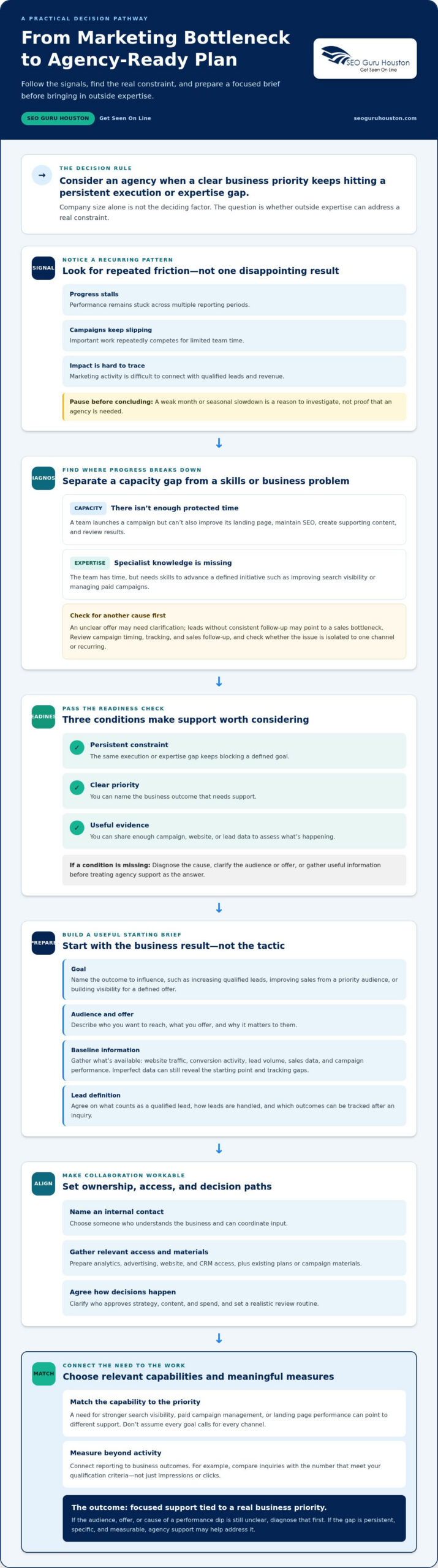
Hiring an agency is a strategic decision, not an automatic milestone as your business grows. The right time is when a clear business priority keeps running into a persistent execution or expertise gap. A small team may be ready if it has a defined growth goal and needs specialist support. A larger company may not need an agency if its in-house team has the time and skills to deliver.

Look for a pattern rather than reacting to one disappointing result. Progress may stall across multiple reporting periods, important campaigns may repeatedly slip, or marketing activity may be difficult to connect to qualified leads and revenue. A temporary campaign dip or seasonal slowdown calls for diagnosis first. Check whether the change is limited to one channel or points to a recurring issue. Review campaign timing, tracking, and sales follow-up before deciding that outside help is the answer.

Which marketing problems signal a capacity or expertise gap?

A capacity gap appears when essential work repeatedly competes for the same limited hours. Your team might launch a campaign but lack time to improve its landing page, maintain SEO, create supporting content, and review results. A skills gap is different: the team has time, but not the specialist knowledge to advance a defined initiative, such as improving search visibility or managing paid campaigns. Because Digital marketing spans multiple channels and methods, identify the capability you need instead of assuming you need help with everything.

Separate execution problems from strategy or sales problems, too. If customers don’t understand the offer, more promotion may amplify the confusion. If leads arrive but aren’t followed up consistently, the bottleneck may be in sales rather than marketing. Pinpoint where progress breaks down before assigning the problem to an agency.

When is an agency premature or unnecessary?

Promotion works best when you can explain who the offer serves, what value it provides, and what action you want customers to take. If those fundamentals are unsettled, clarify them before scaling campaigns. Likewise, don’t treat one weak month as proof that you need an outside team. Review the underlying data, compare performance over an appropriate period, and look for a recurring constraint.

Focused internal execution may be the right choice when your team has the relevant skills, protected time, and a way to measure progress. Use this quick readiness check:

  • Persistent constraint: The same execution or expertise gap keeps blocking a defined goal.
  • Clear priority: You can name the business outcome that needs support.
  • Useful evidence: You can share enough campaign, website, or lead data to assess what’s happening.

If those conditions are present, agency support may help close a specific gap. If the audience, offer, or cause of a performance dip is still unclear, diagnose that first. The deciding factor isn’t company size. It’s whether outside expertise can address a real constraint tied to a business priority.

What should your business have in place before hiring an agency?

You don’t need a flawless marketing operation before bringing in outside expertise. You do need enough clarity to collaborate: what the business is trying to achieve, who it serves, what it offers, what information is available, and who can make decisions. This preparation keeps the work anchored to business outcomes rather than defaulting to channel activity.

Start with the result, not the tactic. “Grow the business” is an ambition; increasing qualified leads, improving sales from a priority audience, or building visibility for a defined offer gives the work a clearer direction. Once the outcome is clear, assess whether SEO, PPC, a landing page, or another approach fits the need. That sequence helps you evaluate when to hire a digital marketing agency without assuming every goal calls for every channel.

Set goals and establish a usable baseline

Write down the priority, the audience you want to reach, and the offer you want them to consider. Then gather the baseline information you already have: website traffic, conversion activity, lead volume, sales data, and campaign performance. The data doesn’t need to be perfect. It should help your team and agency understand the starting point and identify gaps in tracking.

Connect marketing measures to the sales process. Clarify what counts as a qualified lead, how leads are handled, and which outcomes the business can track after an inquiry. For example, compare the number of inquiries with the number that meet your qualification criteria. That context makes reporting more useful than a list of impressions or clicks alone.

Prepare the people, access, and decision process

Name an internal contact who understands the business and can coordinate input. Gather access to relevant analytics, advertising, website, and CRM accounts, along with existing plans or campaign materials. Decide who approves strategy, content, and spend, and agree on a realistic routine for reviews. Clear ownership prevents important decisions from stalling between teams.

Use this short preparation sequence before an agency conversation:

  • Goal: State the business outcome you want to influence.
  • Audience and offer: Describe who you serve and why the offer matters to them.
  • Data: Collect available performance and sales information, noting any gaps.
  • People: Identify the day-to-day contact and decision-makers.
  • Process: Clarify access, approval responsibilities, and review expectations.

Readiness means being prepared to share context, make timely decisions, and learn from evidence, not having every metric or process optimized in advance. If your priorities involve visibility, qualified traffic, or lead generation, reviewing SEO and PPC marketing support can help you identify capabilities that fit those goals.

How do you know agency support can deliver value, not just activity?

Agency support creates value when it closes a specific capability or capacity gap and ties the work to a business priority. Compare the options realistically: an internal team may know the product and customers deeply, while an agency can add specialist expertise or execution capacity. Either model still needs coordination, timely decisions, and clear accountability. The question of when to hire a digital marketing agency comes down to whether the added support can advance an outcome your team has defined, not simply produce more tasks.

Separate deliverables from results. Publishing content, launching ads, or building a landing page are deliverables. Qualified opportunities, sales, and stronger visibility for relevant searches are outcomes. Deliverables can be tracked directly; outcomes depend on factors such as the offer, execution, competition, customer behavior, and measurement quality. No channel or agency can guarantee a particular business result.

Which capabilities may be worth bringing in?

Business need Relevant capability Useful measures
Improve visibility for relevant searches SEO Organic impressions, relevant traffic, qualified inquiries
Reach people actively searching for an offer PPC Campaign traffic, conversion activity, cost per qualified lead
Turn campaign visits into inquiries Landing pages or website development Conversion rate, form submissions, qualified leads

What should meaningful reporting help you understand?

Good reporting explains what changed, what it may mean, and what action comes next. Google Analytics can help assess website visits and on-site behavior. Google Search Console can show search visibility and activity from organic results. CRM data can help connect inquiries to lead quality and sales progress. These sources answer different questions, so they’re most useful when interpreted together.

Separate leading indicators, such as impressions, clicks, and page conversions, from downstream outcomes like qualified opportunities and closed sales. Revenue attribution may be incomplete when customer journeys span channels or data is missing, so make limitations visible rather than overstating certainty. In regular reviews, expect a clear account of work completed, performance against agreed measures, decisions made, and next steps. That’s how you judge progress, not by the length of an activity report.

When to Hire a Digital Marketing Agency: A 2026 Decision Guide

How should you define scope, goals, and accountability before hiring?

A strong agency engagement starts with clear boundaries: which business priority needs attention, what work falls within scope, and how both sides will judge progress. Resist the urge to buy every channel at once. A focused first engagement makes it easier to coordinate work, interpret results, and decide what deserves investment next.

How do you choose a realistic first scope?

Start with the constraint you’ve diagnosed. If relevant searchers aren’t finding your business, SEO may fit the priority. If you need to capture existing demand through paid campaigns, PPC may be appropriate. If visitors arrive but struggle to take the next step, website development or a landing page could address the friction. Demand generation may fit when the challenge is creating and developing interest among potential buyers, while lifecycle and retention goals often call for dedicated email and CRM specialists like Vertical Brands.

Factor in your sales cycle, internal support, and ability to measure progress. A longer sales cycle may require tracking early engagement and lead quality before closed sales provide a useful signal. A campaign also needs internal owners who can supply business context, respond to inquiries, and make timely decisions. Connected services can make sense when one isolated tactic can’t address the full path from discovery to conversion. Keep the scope focused on the business problem, not a checklist of channels.

Which expectations should be agreed before work begins?

Put the working agreement in writing so the team and agency share the same definition of progress. Include the objective, baseline measures, deliverables, responsibilities, approval rights, communication cadence, and review intervals. Clarify who provides source materials, approves content, manages access, and decides whether to adjust campaign direction or spend.

Set a review framework that considers business outcomes alongside context. A change in traffic or lead volume matters, but so do lead quality, seasonality, sales follow-up, and changes to the offer. Agree on how results and limitations will be explained, what decisions each review should inform, and how strategic changes will be communicated. This creates accountability without treating a single metric as the whole story.

  • Objective: Name the business priority and the audience it serves.
  • Scope: Specify the work included and what falls outside the engagement.
  • Ownership: Assign agency and internal responsibilities, including approvals.
  • Measurement: Record the starting point, success indicators, and reporting rhythm.

Be wary of promises of guaranteed rankings, leads, or revenue. A clear scope can make work and decisions accountable, but outcomes depend on execution, market conditions, the offer, and reliable measurement. SEO Guru Houston provides SEO, PPC, web development, and demand generation services. Explore digital marketing services to see how these capabilities can support a focused plan.

When is it time to move forward with a digital marketing agency?

Move forward when four conditions align: your business has a clear goal, a persistent capability gap is holding back progress, relevant data can be shared, and leadership agrees on the priority. That combination gives an agency something concrete to work toward and your team a basis for evaluating the work. Company size alone doesn’t determine readiness.

Still unsure when to hire a digital marketing agency? Use this decision check:

  • Act now: You can name the business challenge, identify the expertise or capacity you’re missing, provide useful context or data, and get decisions from aligned leaders.
  • Prepare first: Your audience, offer, goal, or measurement is unclear. Resolve those questions before expanding activity.
  • Continue with current resources: Your team has the skills and protected time to address the priority, and current execution is consistent enough to assess.

Begin with the challenge, not a predetermined channel or package. A visibility problem may point toward SEO; a need to capture existing demand may call for PPC; a conversion bottleneck may involve the website or landing page. If the gap concerns reaching and developing potential business customers, B2B or inbound marketing may be relevant. The right scope follows the diagnosis.

What does a productive agency relationship require?

Strong collaboration depends on shared context: who your customers are, how your offer is positioned, how sales handles inquiries, and which business priorities matter most. The agency brings marketing expertise and execution capacity, while your team provides decisions and knowledge of the business. Progress is a cycle of strategy, implementation, measurement, and informed adjustment, not a handoff that replaces internal judgment.

What is the next step if your business is ready?

Prepare a concise brief before discussing scope. Include your goal, audience, offer, current marketing efforts, known constraints, available data, and the decisions or support your team can provide. Note whether the priority is search visibility, paid demand capture, B2B lead generation, inbound growth, or a website conversion challenge. This keeps the conversation focused on the business need and the capabilities that may address it.

With that brief in hand, you can discuss a tailored scope with SEO Guru Houston and define what progress should look like before work begins. Build a focused digital growth plan around a real business priority, clear responsibilities, and measures your team can use to make decisions.

Turn Your Marketing Priorities Into a Focused Plan

The decision about when to hire a digital marketing agency comes down to more than a growth target. Look for a clear business priority, a persistent gap your team can’t readily close, and the people, data, and decision-making support needed to act. Then define a focused scope and agree on how progress will be reviewed.

Agency support should connect expertise to business needs, not just increase the volume of marketing activity. SEO and PPC can support search visibility and qualified traffic, while B2B and inbound marketing, website development, landing pages, and demand generation can address other growth priorities. The right starting point depends on your goals, audience, and current constraints.

Ready to turn your next priority into a practical, accountable plan? Build a focused digital growth plan with SEO Guru Houston. Start with the challenge you need to solve, then move forward with clear responsibilities and measures.

Frequently Asked Questions

When should a small business hire a digital marketing agency?

A small business should consider agency support when it has a defined growth goal but lacks the time, specialist skills, or consistent execution to pursue it. First clarify your target audience, offer, and desired outcome. Then identify the specific gap external expertise would address, such as improving search visibility or managing paid campaigns. For example, specialists such as Big Voice – Digital Marketing Agency help growing SMEs focus on commercial outcomes rather than vanity metrics. Company size matters less than readiness and a clear business need when deciding when to hire a digital marketing agency.

How do I know if my business is ready to hire a marketing agency?

Your business is ready when you can explain its priority, target audience, and desired outcome, even if the strategy is still developing. Assign an internal decision-maker, make relevant website, campaign, or CRM data accessible, and confirm who follows up with leads. You don’t need perfect reporting. You do need enough context and internal coordination to collaborate, review progress, and make timely decisions as the work develops.

Can a digital marketing agency help if my business has no marketing strategy?

Yes, an agency can help shape a strategy, but your business should contribute knowledge of its customers, offer, competitive context, and commercial goals. If those fundamentals are unclear, make clarifying them part of the strategic work. Agree on a business priority and how progress will be assessed before launching campaigns. This helps prevent disconnected tactics and keeps expectations realistic while the strategy takes shape and is put into practice.

What should I expect when hiring a digital marketing agency?

Expect an initial alignment on business goals, audience, current marketing activity, responsibilities, and measurement. The agreed scope may include SEO, PPC, website development, landing pages, or demand generation, depending on the need. Set communication and review expectations early, including who approves work and how decisions are shared. Evaluate progress through clear reporting and business context, not activity counts alone. Results depend on execution, market conditions, and measurement.

Is it better to hire an agency or build an in-house marketing team?

The right choice depends on the expertise, time, and management capacity your business needs. An in-house team may offer close day-to-day knowledge of customers and operations, while an agency can add external specialist capabilities and execution support. Some businesses combine both. Compare the skills required, how consistently the work is getting done, and whether results can be measured. Choose the approach that best supports your priorities and available resources.

How much does it cost to hire a digital marketing agency?

Agency fees vary based on the work’s scope, services, complexity, and level of support, so there isn’t one useful figure for every business. Define the business outcome and work required before comparing proposals. Review responsibilities, deliverables, reporting, and measurement alongside the fee. A low price or a long list of promised activities doesn’t establish value on its own. Focus on whether the proposed scope addresses a clear business need.

What happens if I hire a digital marketing agency before my business is ready?

An unclear offer, misaligned goals, missing account access, or limited internal follow-through can slow work and make progress harder to assess. You don’t need a perfect foundation before engaging an agency, though. Identify the biggest readiness gap and decide whether it can be addressed within a defined scope. Agree on responsibilities, access, and how progress will be reviewed. Clear expectations help both sides address constraints rather than mistake them for campaign results.

Questions to Ask Before Hiring a Marketing Agency: A 2026 Guide

What if the best marketing agency isn’t the one with the slickest pitch, but the one that can explain how it makes decisions? The questions to ask before hiring a marketing agency should reveal more than a polished presentation. They should show whether its strategy connects your business goals to the right channels, measurable outcomes, and accountable execution.

Expect clear answers about what success means, how progress will be reported, what happens first, and who is responsible for each step. Without that clarity, marketing activity can pile up while its business impact remains hard to see.

This 2026 guide gives you focused questions to assess an agency’s strategy, measurement, delivery process, and fit with your team. You’ll learn how to evaluate whether SEO, PPC, websites, and demand generation support the same growth priorities, and how to set expectations for reporting and responsibilities before work begins. Go into the conversation ready to look beyond promises and assess the plan behind them.

Key Takeaways

  • Start with the business outcome you need, your target audience, and the barrier standing in the way, rather than leading with a channel request.
  • Use questions to ask before hiring a marketing agency to understand how research and audience insight shape channel choices and priorities.
  • Find out how campaign indicators connect to qualified leads, sales, or pipeline, and what reporting can and can’t show.
  • Clarify who leads and performs the work, how communication flows, and how issues are handled before signing.
  • Compare agencies across strategy, measurement, execution, communication, and business fit to make a decision based on clear reasoning.

Questions to Ask Before Hiring a Marketing Agency: Start With Your Goals

Start with the business result you need, the audience you want to reach, and what’s holding progress back. Don’t lead with “We need SEO” or “We want more social posts.” Those are possible tactics, not the underlying problem. A capable agency should first understand what your business needs to change, then explain which marketing priorities could help. If you’re still defining an agency’s role, this overview of what is a marketing agency provides helpful background.

Which business goal should the agency solve first?

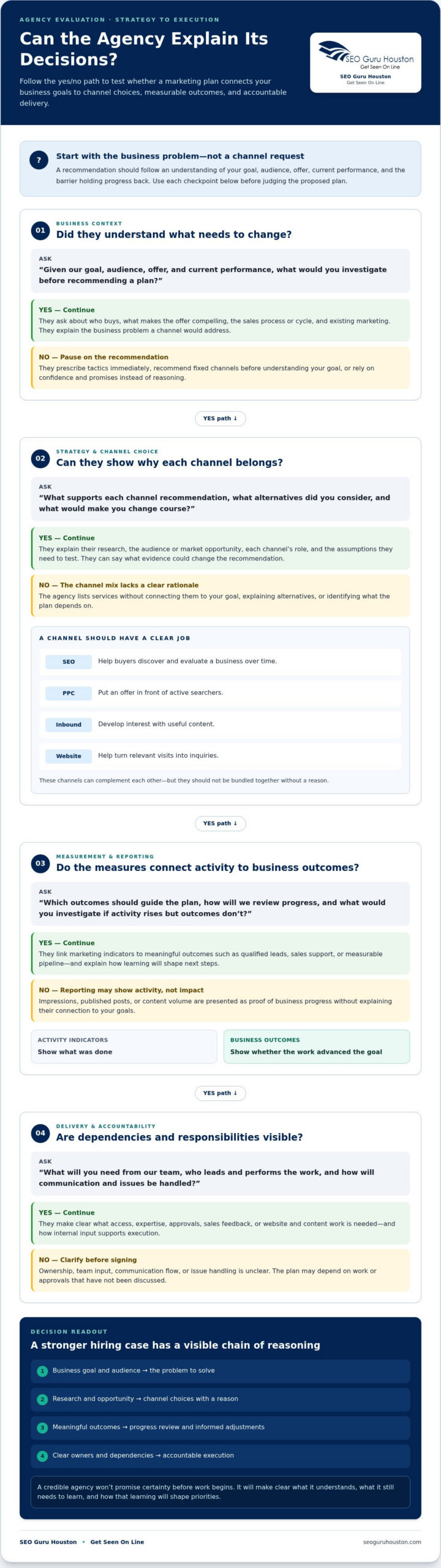
Ask: “Given our goal, audience, offer, and current performance, what would you investigate before recommending a plan?” The answer should show how the agency connects your business context to marketing decisions. For example, a company looking for more qualified sales conversations may need to clarify its ideal buyers, offer, and sales cycle before deciding whether SEO, PPC, inbound marketing, or another channel belongs in the plan.

Listen for questions about who buys, what makes the offer compelling, how long a sale takes, and what current performance reveals. A channel recommendation can make sense, but it should follow a clear explanation of the problem it addresses. Be cautious if the agency prescribes tactics immediately or relies on confidence and promises instead of reasoning.

Quick answer check:

  • Strong signal: The agency asks about your audience, offer, sales process, and existing marketing.
  • Strong signal: It explains the business problem a proposed channel would address.
  • Warning sign: It recommends a fixed set of channels before understanding your goal.

How will the agency define a successful partnership?

Ask: “Which outcomes should guide the plan, and how will we review progress?” The answer should connect marketing work to a business result, such as generating qualified leads, supporting sales, or building a measurable pipeline. Clarify how the agency will evaluate progress and use what it learns to set next steps.

Separate outcomes from activity. Impressions, published posts, and content volume can show what was done, but they don’t prove that the work advanced your business goal. Ask how those indicators relate to meaningful results and what the agency would investigate if activity increases but outcomes don’t.

“A useful agency brief names the business outcome, the audience it matters to, and the barrier marketing must help overcome.”

A credible answer won’t promise certainty before the work begins. It will make the logic visible: what the agency understands, what it still needs to learn, and how that knowledge will shape priorities. Among the questions to ask before hiring a marketing agency, this one helps reveal whether the pitch is built around your business or simply around a list of services.

Ask How the Marketing Agency Builds Strategy and Chooses Channels

A strategic recommendation should have a clear chain of reasoning: what the agency learned about your audience and market, which opportunity it sees, and why the proposed channels fit your goal and resources. Ask what research informs the plan, how the agency understands buyer needs and competitors, and what evidence could change its recommendation. The questions to ask before hiring a marketing agency should test the thinking behind the channel mix, not just the list of services.

How does the agency decide which channels deserve investment?

Ask: “What supports each channel recommendation, what alternatives did you consider, and what would make you change course?” Listen for a clear explanation of each channel’s role in the customer journey. SEO may help buyers discover and evaluate a business over time; PPC can put an offer in front of active searchers; inbound marketing can develop interest with useful content; and website or landing page work can help turn relevant visits into inquiries. Similarly, for creator and UGC initiatives, specialized partners like Indie Collaborates show how vetted influencer campaigns should connect directly to measurable performance. These channels can complement each other, but they shouldn’t be bundled together without a reason.

For a closer look at search strategy, explore this guide to professional SEO services.

What to assess Useful agency reasoning What to learn
Strategy Connects the audience, business goal, and market opportunity Why this plan fits your situation
Channel rationale Explains each channel’s job and alternatives considered Where attention and effort will go
Dependencies Identifies needed website changes, content, access, or approvals What must be ready for execution
Expected learning Names the assumptions to test and how findings inform adjustments How the strategy can evolve

What will the agency need from your team?

Ask what access, subject-matter expertise, approvals, and sales feedback the work depends on. A sound plan makes responsibilities visible. Your team may provide product knowledge or review content, while the agency uses that input to shape campaigns, pages, and lead-generation activity. Clarify how the plan will use existing assets and internal marketing capacity, so it builds on what’s already working rather than duplicating effort.

If business-to-business growth is a priority, this B2B demand generation guide offers a related perspective. A tailored digital plan works best when agency recommendations, internal expertise, and sales feedback support the same goals. Learn more about SEO Guru Houston’s digital marketing approach and how connected digital services can support planning.

Questions About Marketing Results, Reporting, and Proof

A marketing report should help you make decisions, not just display activity. Ask which indicators connect campaign work to qualified leads, sales, or pipeline, and how the agency will assess whether performance is moving in the right direction. The answer should distinguish early signals, such as relevant traffic or completed inquiries, from business outcomes that may take longer to emerge.

Channel metrics show what marketing activity produced; business outcomes show whether that activity mattered to the company.

What should a useful marketing report explain?

Ask what the report includes, how often you’ll review it, which data sources it uses, and who will interpret the findings. Depending on your setup, sources might include Google Analytics 4, Google Ads, and CRM data. A dashboard alone isn’t enough. Look for clearly defined metrics, trends over time, context for changes, and recommended actions.

Clarify attribution limits, too. A customer may interact with several channels before becoming a lead or buyer, and available tracking may not show every influence. Ask how the agency will account for that uncertainty rather than presenting one channel’s numbers as the complete story. If results differ from expectations, the agency should explain what it will investigate, such as lead quality, landing-page performance, campaign targeting, or tracking issues.

  • Clear definitions: You know what counts as a lead and how it’s qualified.
  • Useful context: The report explains what changed and why it may matter.
  • Next steps: Findings lead to specific questions, tests, or adjustments.

How can you assess case studies and performance claims?

Ask what the client’s starting point and objectives were, what timeframe the results covered, and which work the agency handled. A useful case study explains relevant context, including changes to the offer, website, sales process, or other marketing activity. Ask how results were measured and what the agency can reasonably attribute to its contribution.

Past performance can show how an agency thinks and works, but it can’t guarantee the same outcome for your business. Your audience, competition, resources, sales cycle, and starting conditions may differ. Treat a case study as evidence to examine, not a forecast. Among the questions to ask before hiring a marketing agency, this one helps distinguish transparent proof from a headline claim. Look for careful explanations, not promises based on someone else’s results.

Questions to Ask Before Hiring a Marketing Agency: A 2026 Guide

Ask About Execution, Communication, and Accountability Before You Sign

A sound strategy needs a working process behind it. Before signing, make sure you know who owns the work, how tasks move from plan to delivery, how updates and decisions are handled, and what happens when problems arise. These questions to ask before hiring a marketing agency help turn a promising pitch into clear expectations your team can use day to day.

  • Ownership: Who leads the account, who performs the work, and who makes decisions on each side?
  • Workflow: How do tasks, approvals, dependencies, and deadlines move from kickoff to completion?
  • Communication: How often will you meet, which channels will you use, and where will decisions be recorded?
  • Issue resolution: How will the team raise delays, performance concerns, or proposed scope changes?

Who owns the work and how will progress stay visible?

Ask who your day-to-day contact will be and which specialists will contribute. Then agree on a meeting rhythm, communication channels, approval windows, and the people authorized to make decisions. After each review, action items should have clear owners and next steps. Documented dependencies, such as your team supplying subject-matter input or approving a landing page, make it easier to catch delays before they stall execution.

What happens when priorities or performance change?

Ask how the team will use new evidence to adjust campaign priorities and explain changes to the plan. Clarify how a scope change is raised, how its impact on timing or workload is evaluated, and how it’s approved before work shifts. If results raise concerns, expect direct communication about what the team sees, what it’s investigating, and what happens next. Avoid arrangements where reporting changes without explanation or issues become a blame exercise.

Put the working model in writing before the engagement begins: contacts, responsibilities, review points, approval steps, and how changes are handled. That gives both teams a shared reference when priorities shift and makes accountability practical, not just a word in a pitch.

See how SEO Guru Houston’s digital marketing services bring strategy and execution together across SEO, PPC, websites, and demand generation.

Turn Your Marketing Agency Questions Into a Clear Hiring Decision

A confident presentation can make every agency sound capable. Base your decision on the quality of its reasoning and whether its approach fits your business. Use the same questions to ask before hiring a marketing agency in each conversation, then record specific evidence instead of relying on who made the strongest impression.

How do you compare answers without choosing the best presentation?

Score each agency across the same five areas: strategy, measurement, execution, communication, and business fit. You might rate each area from 1 to 3, where a low score means the answer lacked clarity and a high score means it was specific, relevant, and supported by clear reasoning. Add a brief note beside each score so your decision reflects what the agency actually explained.

  • Strategy: Did the recommendation connect to your goals and audience?
  • Measurement: Were outcomes and reporting explained in practical terms?
  • Execution: Were roles, workflow, and dependencies clear?
  • Communication: Did the agency explain how decisions and concerns will be handled?
  • Business fit: Did its proposed approach account for your resources and priorities?

Compare answers against the business outcomes you established, not against how polished the pitch felt. If an agency leaves an assumption unanswered, record it as a point to resolve in the proposed scope. That can prompt a useful discussion rather than automatically ruling out a potential partner. Look for clear logic, realistic expectations, and a defined route from planning to action.

What should happen after choosing a marketing agency?

Before work begins, make sure the agreed scope captures the goal, responsibilities, reporting approach, and review points. Use the kickoff to align on access, decision-makers, immediate priorities, and what your team needs to provide. Then agree on how progress will be reviewed and how new information can shape strategic adjustments. A shared plan gives both teams a practical starting point.

Ready to turn your priorities into a focused plan? Build a strategy for measurable digital growth with SEO Guru Houston. A strong partnership starts with a clear goal, a tailored digital strategy, and an accountable path forward.

Choose a Growth Partner With a Clear Plan

The questions to ask before hiring a marketing agency should help you see beyond the pitch. Look for a strategy grounded in your business goals, a measurement plan that connects marketing activity to meaningful outcomes, and a working process with clear ownership and communication.

Before you commit, make sure the proposed scope explains what the agency will do, what your team will contribute, and how you’ll review progress together. The right partnership isn’t built on confident promises. It’s built on sound reasoning, realistic expectations, and a plan that can adapt as you learn.

SEO Guru Houston connects specialized SEO and PPC services with website development, landing pages, and demand generation to support business growth. Discuss a digital strategy built around your growth goals and take the next step with clarity.

Frequently Asked Questions

What questions should I ask before hiring a marketing agency?

The questions to ask before hiring a marketing agency should reveal how it will understand your goals, choose channels, measure progress, and manage the work. Ask who will perform the work, what your team needs to provide, and how recommendations may change as new evidence emerges. Use the same core questions with each agency to compare clear reasoning and defined responsibilities instead of broad promises or presentation style.

How do I know if a marketing agency is right for my business?

A suitable agency should understand your audience, sales process, growth goals, and internal capacity before recommending an approach. In specialized sectors, this alignment is crucial; for example, luxury houses often turn to niche brand strategy consultancies like Omedia Paris because prestige audiences require distinct storytelling and positioning. Ask it to explain why its strategy fits your situation and how it will evaluate progress. Relevant experience can help you assess its capabilities, but it doesn’t guarantee the same results for your business. Consider the quality of its reasoning, communication, reporting plan, and ability to adapt as your needs and findings evolve.

What should a marketing agency include in its proposal?

A useful proposal connects your business goals to a defined strategy, recommended services, responsibilities, measurement, and a process for reviewing progress. It should state important assumptions and dependencies, such as access, approvals, or input from your team. Check that the proposal explains how findings will be reported and what decisions they’ll inform. These details give both sides a practical basis for agreeing on scope, priorities, and how the work will proceed.

How can I tell whether a marketing agency’s results are genuine?

Ask what the client’s starting point and objective were, how results were measured, what timeframe was involved, and which work the agency performed. Look for context about other factors that may have influenced the outcome, such as changes to the website or sales process. A case study can demonstrate experience, but it isn’t a forecast for your company. Credible explanations describe limitations and how the findings shaped later decisions.

Should I hire one agency for SEO and PPC?

It depends on your goals, audience, internal capacity, and how the channels need to work together. Ask how SEO and PPC each support the strategy, how performance will be assessed, and who coordinates the work. One agency may provide a more integrated plan, while a focused engagement may fit a narrower priority. Choose based on strategic fit, clear ownership, and the agency’s ability to connect channel activity to your business objectives.

How often should a marketing agency report results?

Set a reporting cadence that fits the campaign, the decisions you need to make, and the time required for meaningful data to emerge. Ask what regular updates will cover and how the team will flag urgent issues. A useful report explains results, context, and recommended next steps rather than presenting unexplained numbers. Agree on the format and schedule during planning, then revisit them if campaign activity or business priorities change.

What are red flags when hiring a marketing agency?

Be cautious if an agency guarantees outcomes outside its control, recommends tactics without explaining why, or reports activity without connecting it to business objectives. Unclear responsibilities and unanswered questions about assumptions can also create friction. These signs warrant specific follow-up, not necessarily an immediate decision. Ask how success will be measured, who owns each task, and how changes will be handled. Proceed when the answers give you enough clarity to define scope and expectations.

Thought Leadership Content Strategy: The Assertive Guide to Market Dominance in 2026

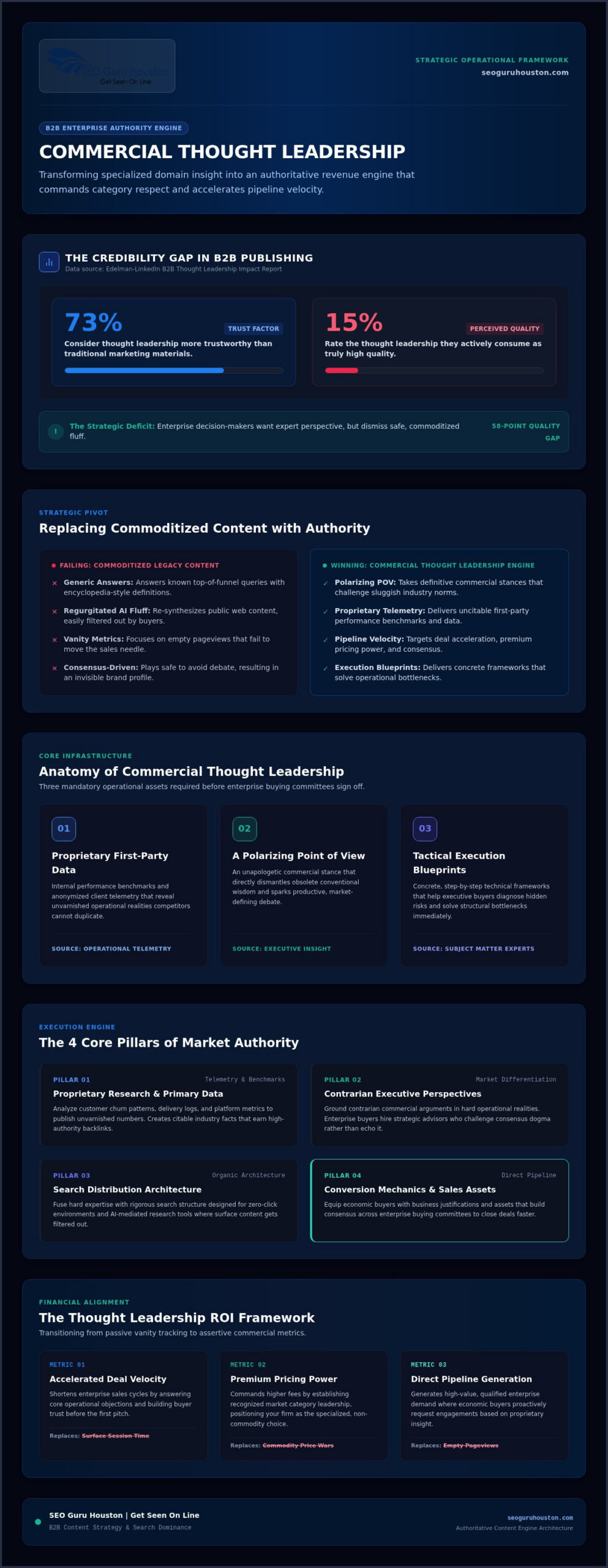
According to the Edelman-LinkedIn B2B Thought Leadership Impact Report, 73% of decision-makers consider thought leadership more trustworthy than traditional marketing materials, yet only 15% rate what they consume as high quality. Closing that massive credibility gap requires an assertive thought leadership content strategy that treats domain expertise as an immediate revenue driver rather than a vanity publishing exercise.

You already know the frustration of pumping out safe, commoditized articles that generate empty pageviews without moving the sales needle. It’s exhausting to fight for ten minutes on a calendar with busy executives, only to watch bolder competitors capture category mindshare with decisive, market-defining points of view.

It’s time to take control of the conversation. You’re about to master how to transform specialized executive insight into an authoritative content engine that commands industry respect and accelerates pipeline revenue. Ahead, we break down the four operational pillars of market authority, battle-tested methods for extracting internal expert knowledge, and the exact distribution frameworks required to dominate executive networks in 2026.

Key Takeaways

  • Learn how an assertive thought leadership content strategy replaces commoditized blog posts with market-defining perspectives that command executive authority.
  • Master the four foundational pillars separating category leaders from reactive followers: proprietary research, executive perspectives, search distribution, and conversion mechanics.
  • Replace vanity traffic metrics with an aggressive ROI framework focused on deal velocity, premium pricing power, and direct pipeline generation.
  • Execute a repeatable 5-step blueprint to audit competitor whitespace and systematically extract deep technical insight from your busiest subject matter experts.
  • Convert strategic brand narratives into high-impact sales assets that build consensus across enterprise buying committees and close deals faster.

What Is a Thought Leadership Content Strategy in 2026?

A modern thought leadership content strategy is not a vanity publishing initiative, nor is it a corporate public relations campaign. It is an intentional commercial framework engineered to establish decisive market authority and accelerate enterprise pipeline. Too many mid-market B2B companies mistakenly believe establishing authority requires licensing third-party editorial journalism or funding multi-million-dollar research programs. In reality, real authority stems from taking definitive stances on pressing commercial challenges, framing unrecognized risks, and offering operational frameworks that competitors simply cannot duplicate.

Legacy content models focus on answering known top-of-funnel queries with generic advice. That model is dead. Today, modern buyers ruthlessly disqualify vendors who push safe, commoditized definitions. To capture executive mindshare, brands must study how recognized industry thought leaders dismantle conventional wisdom, shifting their perspective from passive educational publishing to aggressive, point-of-difference market education.

The Anatomy of Commercial Thought Leadership

Building an authoritative revenue engine requires three non-negotiable operational assets:

  • Proprietary First-Party Data: Internal performance benchmarks and anonymized client telemetry that reveal unvarnished operational realities.
  • A Polarizing Point of View: An unapologetic commercial stance that directly challenges sluggish industry norms and sparks productive debate.
  • Tactical Execution Blueprints: Concrete, step-by-step frameworks that help executive buyers solve structural operational bottlenecks immediately.

When enterprise buying committees evaluate six-figure contracts, they do not read surface-level fluff. They look for proven partners who demonstrate rigorous commercial clarity. Authoritative positioning directly bridges the gap between high-level brand awareness and qualified demand generation, giving economic buyers the exact business justification they need to sign off on your deal.

Why Commoditized Content Fails Modern B2B Buyers

Automated generative tools have flooded search engines with synthetic, regurgitated answers. Consequently, enterprise executives have developed an aggressive filter against surface-level listicles and basic educational explainers. If your content sounds like a digital encyclopedia, decision-makers assume your execution capabilities are equally average.

Standing out in zero-click search environments and AI-mediated research tools demands original perspectives that algorithms cannot synthesize from existing public web pages. An assertive thought leadership content strategy plants a flag in the market. It positions your firm as the obvious, specialized category leader before an executive prospect ever formally requests a proposal.

The 4 Core Pillars of an Authoritative B2B Content Engine

Most publishing programs fail because they treat content creation and search distribution as disconnected disciplines. Competitors focus solely on primary surveys or rely entirely on sporadic social media activity. That leaves a massive competitive opening. A dominant thought leadership content strategy fuses hard data, executive vision, organic search architecture, and direct conversion mechanics into a self-sustaining revenue engine that systematically captures category leadership nationally.

Pillar 1: Proprietary Industry Data and Primary Research

Surveys are useful, but your internal telemetry is an untapped goldmine. Analyze your platform metrics, customer benchmarks, and annual service delivery logs to uncover hidden market dynamics. When you publish unvarnished numbers on customer churn patterns, implementation bottlenecks, or cost inefficiencies, you produce citable industry facts. Trade publications and competing analysts have no choice but to reference your findings, earning high-authority backlinks and cementing your brand as the primary market source.

Pillar 2: The Contrarian Point of View

Safe advice breeds invisible brands. Enterprise buyers do not hire partners who merely agree with the consensus; they look for strategic advisors who challenge obsolete industry dogma. Ground your contrarian arguments in real-world operational results. If popular wisdom says to cut top-of-funnel investments during economic uncertainty, show the operational cost of going dark. As highlighted by Harvard Business Review, cut-and-paste opinions are obsolete, making genuine operational expertise the only sustainable baseline for executive credibility. Bold positioning naturally filters out price-sensitive commodity buyers while attracting sophisticated buyers who value decisive guidance.

Pillars 3 & 4: Intent Distribution and Conversion Architecture

Brilliant insights are worthless if they sit in unindexed PDF files or disappear down social feeds within forty-eight hours. Market leaders structure their ideas into permanent organic assets that capture sustained executive search intent across every stage of the evaluation cycle.

  • Semantic Intent Architecture: Map deep-dive executive viewpoints to high-intent commercial keywords. Connect high-level market predictions to bottom-of-funnel capability pages through tight contextual internal linking.
  • Executive Conversion Mechanics: Remove friction by replacing generic newsletter subscription boxes with direct access to diagnostic tools, technical briefs, and executive briefings.

Pairing strategic insight with high converting landing page design transforms passive readers into scheduled enterprise sales calls. If your distribution architecture lacks the technical precision to route high-intent executive traffic into measurable sales pipeline, exploring specialized enterprise demand generation support can bridge that critical conversion gap.

Thought Leadership vs. Traditional Content Marketing: The ROI Framework

Traditional content marketing relies on a volume game. Teams publish dozens of basic keyword-targeted articles each month, hoping to capture broad search traffic and convert visitors through gated eBooks. That playbook is broken. Chasing sheer search volume attracts student researchers, entry-level practitioners, and competitors, but it rarely moves the needle for high-value enterprise sales. A commercially focused thought leadership content strategy abandons the volume trap to prioritize deep audience qualification and rapid deal velocity.

Enterprise sales cycles drag on because complex buying committees harbor unspoken objections regarding risk, implementation feasibility, and operational disruption. Assertive thought leadership tackles these friction points head-on before a prospect ever speaks to your sales team. By publicly dismantling the hidden costs of legacy solutions and laying out clear roadmaps for change, you educate buyers early. You enter the sales cycle as a trusted strategic advisor rather than a desperate vendor pitching generic features.

Metrics That Matter: Pipeline Velocity vs. Vanity Pageviews

Stop reporting impressions, social shares, and raw pageviews to executive leadership. Boardrooms care about revenue. Dominant content programs measure performance using hard commercial indicators:

  • Sales Cycle Compression: Tracking how quickly prospects advance through pipeline stages after consuming your strategic frameworks.
  • RFP Win Rates and Pricing Power: High-authority positioning commands respect. Gartner notes that 67% of B2B buyers prefer an entirely rep-free buying experience; when content handles the heavy lifting, close rates and contract sizes naturally increase.
  • Direct Pipeline Attribution: Monitoring first-touch and multi-touch qualified inbound revenue tied directly to executive whitepapers and technical teardowns.

Building Defensible Moats with Inbound Demand

Generic blog content offers zero competitive protection. Automated search scrapers can summarize basic listicles in seconds, robbing your website of clicks and visibility. Original proprietary frameworks, contrarian executive stances, and rigorous field insights create an impenetrable intellectual moat. Competitors cannot replicate genuine frontline discoveries.

Integrating these high-caliber perspectives into a structured inbound marketing strategy for b2b compounds your organic reach over time. Every authoritative asset acts as a permanent commercial beacon. It captures high-intent decision-makers, defends against competitive poaching, and builds an enduring foundation for measurable business growth.

Thought Leadership Content Strategy: The Assertive Guide to Market Dominance in 2026

How to Build and Execute Your Thought Leadership Strategy

Executing a dominant thought leadership content strategy doesn’t require bloated consulting retainers or disruptive corporate retreats. It requires an agile, disciplined operational engine that extracts frontline practitioner knowledge and systematically transforms it into market-defining pipeline assets.

Steps 1 & 2: Market Interrogation and Narrative Positioning

Start by interrogating market search queries to uncover critical knowledge gaps your competitors are too timid to address. Look at where industry advice remains vague, outdated, or overly cautious. Next, run monthly customer advisory interviews to isolate the expensive, operational bottlenecks enterprise buyers battle behind closed doors.

Use these insights to build distinct editorial pillars that reinforce your core methodology. Anchor every narrative theme within a dedicated b2b demand generation agency framework to ensure high-level brand positioning feeds qualified commercial intent.

Step 3: The Frictionless Subject Matter Expert Extraction System

According to the Content Marketing Institute, at 37% of B2B organizations, fewer than 5% of internal subject matter experts actively contribute to marketing assets. Busy leaders don’t have time to write 3,000-word essays. Force them to draft copy from scratch, and your production calendar will collapse.

Fix this breakdown with a frictionless extraction protocol:

  • Schedule 30-Minute Monthly Interviews: Interview technical founders, engineers, and product specialists using targeted commercial prompts.
  • Record and Transcribe Conversations: Capture authentic industry jargon, battle-tested operational stories, and unfiltered technical opinions.
  • Synthesize Raw Transcripts: Ghostwrite authoritative, insight-dense strategic arguments that protect executive calendars while preserving their authentic voice.

Steps 4 & 5: Multi-Format Production and Distribution Flywheel

Draft your long-form flagship guides with dual-intent architecture: dense enough to sway executive buying committees and technically structured for organic search dominance. Once published, deconstruct that core intellectual property across multiple channels. Convert key arguments into high-impact LinkedIn frameworks, short executive video summaries, and focused newsletter breakdowns.

Partnering with a proven seo marketing company ensures your authoritative assets achieve maximum crawlability, high search rankings, and generative engine visibility. Stop letting valuable internal expertise sit dormant on internal servers. Claim your market authority and engineer a content distribution engine that drives aggressive pipeline growth today.

Transforming Industry Insight into Scalable Revenue

Sporadic publishing schedules will never build category dominance. If your company treats content creation as an ad-hoc marketing chore, you leave enterprise revenue on the table. Transforming specialized insight into commercial pipeline requires shifting from reactive blogging to an always-on revenue engine. A winning thought leadership content strategy bridges the gap between deep intellectual capital and tangible commercial evaluation, ensuring every published perspective steers executive prospects directly toward your capabilities.

Institutionalizing Authority Across Owned Web Properties

Relying solely on external platforms leaves your business vulnerable to algorithmic whim. Build your digital headquarters into an unassailable center of gravity. Organize your domain around comprehensive resource hubs that solve complex enterprise dilemmas from multiple strategic angles.

Connect these deep-dive thought pieces to high-converting commercial pages using purposeful internal linking. When high-level strategic teardowns route qualified traffic directly into bottom-of-funnel solutions, you turn academic interest into commercial momentum. Enforce non-negotiable editorial standards across every asset: zero fluff, verifiable frontline data, and actionable strategic execution. Compromise on quality, and you compromise executive trust.

Accelerating Market Dominance with Strategic Execution

Scaling this operational infrastructure requires decisive action across your entire digital footprint:

  • Prune Commoditized Content: Ruthlessly audit your existing library. Strip out low-value listicles, generic definitions, and outdated posts that dilute your authoritative stance.
  • Syndicate with Commercial Precision: Pair organic search architecture with targeted paid distribution to place your strategic viewpoints squarely in front of active enterprise buying committees.
  • Align Narrative with Commercial ROI: Treat every guide, benchmark report, and executive breakdown as an active sales enablement asset designed to validate high-ticket purchase decisions.

Category leaders don’t wait for market demand to materialize; they actively shape it. Executing an aggressive thought leadership content strategy secures valuable organic search positions while positioning your firm as the indisputable benchmark in your space. When you align specialized technical knowledge with an assertive distribution engine, you don’t just participate in industry conversations. You dictate them.

Turn Executive Insight into Measurable Market Authority

Market dominance isn’t won by playing safe or churning out generic blog posts that enterprise buyers ignore. Category leaders win by taking decisive commercial stances, deploying proprietary operational data, and transforming specialized practitioner insight into an unassailable demand engine. A rigorous thought leadership content strategy doesn’t just educate your target market; it commands executive respect, dismantles buying friction upfront, and systematically shortens complex sales cycles.

The window to capture uncontested category mindshare is wide open, but only for organizations willing to lead with conviction. At SEO Guru Houston, we engineer data-backed SEO and content architectures built to dominate competitive enterprise search landscapes. Our proven national B2B demand generation frameworks bridge the gap between technical search visibility and measurable pipeline growth, ensuring your intellectual capital translates directly into bottom-line returns. Scale your inbound revenue with SEO Guru Houston and start commanding the market dominance your expertise deserves.

Frequently Asked Questions

What is the primary difference between thought leadership and content marketing?

The primary difference lies in commercial intent and intellectual originality. Traditional content marketing answers existing tactical search queries to harvest informational traffic. An assertive thought leadership content strategy re-architects how buyers view their problems, introducing proprietary viewpoints that position your methodology as the only logical choice. Content marketing educates entry-level practitioners on basic tactics; thought leadership influences senior executives who control enterprise budgets and make decisive vendor selections.

How do we measure the actual ROI of a thought leadership content strategy?

Measure thought leadership ROI through sales velocity, RFP selection rates, and closed-won revenue rather than superficial pageviews. Track inbound attribution by asking prospects where they first discovered your perspective. Monitor pipeline cycle duration to evaluate whether strategic pieces resolve operational objections before initial calls. When high-value buyers reference your research in procurement evaluations and accept premium pricing, your thought leadership content strategy is directly driving bottom-line profitability.

How often should an enterprise publish thought leadership content to see measurable results?

Quality and strategic depth vastly outweigh raw publishing frequency in enterprise B2B markets. One comprehensive, research-backed flagship asset per month, supported by weekly executive commentary across professional channels, generates stronger commercial traction than daily low-effort posts. Buyers don’t need endless noise. They require defensible frameworks that solve structural problems. Consistency matters, but publishing half-baked opinions just to fill an arbitrary editorial calendar destroys executive credibility. Focus on substance over volume.

Can small or mid-market B2B companies successfully compete against industry giants in thought leadership?

Yes, agile mid-market firms consistently outmaneuver industry giants by adopting sharper, unfiltered market stances. Large enterprises are often paralyzed by corporate bureaucracy and risk-averse legal departments, resulting in bland, consensus-driven messaging. Nimble mid-market firms can move decisively, publishing contrarian operational truths and frontline telemetry that corporate giants won’t dare touch. By dominating specific niche problems with uncompromising technical depth, smaller companies establish definitive authority and win high-ticket contracts over sluggish incumbents.

How do we extract insights from busy C-suite executives who lack time to write?

Use a monthly journalistic interview protocol instead of asking executives to write drafts from scratch. Schedule a focused 30-minute monthly recorded discussion where a skilled interviewer prompts the executive on recent client wins, emerging market threats, and common buyer mistakes. Transcribe the session to capture authentic terminology and cadence. Your content marketing team then structures that raw technical insight into polished long-form assets and social dispatches, requiring only a ten-minute final review from the executive.

What role does search engine optimization play in an executive thought leadership strategy?

Search engine optimization transforms transient thought leadership perspectives into permanent, compounding commercial assets. Without deliberate search architecture, executive insights disappear down social feeds within days. Proper technical SEO aligns your original arguments with high-intent commercial queries, ensuring decision-makers find your frameworks whenever they actively research solutions. Optimizing your core ideas for search engines and generative answer platforms ensures continuous inbound visibility without relying on perpetual ad spend or relentless social posting.

How do we identify contrarian viewpoints that resonate without alienating prospective clients?

Target broken industry conventions and ineffective legacy workflows rather than criticizing specific people or prospects. Focus on standard industry practices that silently drain capital, waste executive time, or produce mediocre outcomes. Validate your critique with proprietary performance data or operational case studies showing why traditional methods fail. When you articulate the hidden costs of legacy thinking with analytical clarity, you don’t alienate enterprise buyers; you prove you possess the foresight to fix expensive organizational blind spots.

Affordable SEO Company: How to Secure High-ROI Growth Without the Enterprise Price Tag

Why are you still paying for “rankings” that don’t put a single dollar in your bank account? Most business owners have been burned by low-quality agencies promising the world, only to end up with a manual penalty and a pile of technical jargon. You don’t need a massive enterprise budget to dominate your market. You do need a high roi seo company that understands the difference between vanity metrics and actual demand generation. It’s frustrating to watch competitors climb the search results while you’re stuck deciphering reports that mean nothing for your bottom line.

You deserve a strategy that translates search volume into sales. This guide will show you how to stop wasting your marketing spend on “cheap” fixes and start identifying high-efficiency partners who drive measurable revenue. We’re breaking down the exact framework for vetting an affordable SEO company, navigating the fallout of the June 2026 spam updates, and leveraging the fact that organic leads close at a rate of 14.6 percent. You’ll learn how to bridge the gap between visibility and prominence without the bloated agency fees.

Key Takeaways

  • Stop measuring success by the size of your monthly bill and start focusing on cost-per-acquisition to ensure your marketing spend fuels actual business growth.
  • Discover how to identify a high roi seo company by demanding transparency on revenue-driven case studies rather than hollow traffic graphs.
  • Protect your brand from the “cheap SEO” trap of automated link building and low-quality AI content that risks long-term search engine penalties.
  • Learn why integrating demand generation and website video marketing is the ultimate force multiplier for turning organic visibility into market dominance.
  • Master the assertive vetting process to ensure your SEO partner uses AI to enhance your results rather than just cutting their own operational costs.

Redefining the ‘Affordable SEO Company’ for 2026 Market Realities

If you judge an agency by the size of their monthly invoice, you’ve already lost the battle for market dominance. True affordability in digital marketing isn’t found in a low-cost retainer; it’s found in a low cost-per-acquisition (CPA). A high roi seo company doesn’t just sell you a list of tasks or a block of hours. They sell you a mechanism for growth. In the 2026 landscape, the “Efficiency Gap” is wider than ever. A top-tier strategist can deliver more impact in 10 hours of high-level technical execution than a “cheap” agency can in 100 hours of manual, outdated grunt work. If your current provider isn’t obsessing over your bottom line, they aren’t affordable. They’re an expense that’s draining your resources.

The market has shifted. Simply appearing on page one is no longer the finish line. With AI Overviews now appearing in over 13 percent of Google queries and zero-click searches rising, your strategy must evolve from chasing rankings to capturing intent. This requires a sophisticated understanding of Search engine optimization (SEO) that prioritizes conversion over mere visibility. You need a partner who treats your budget like their own capital, investing it where it generates the highest velocity of return.

The Difference Between Price and Value in Digital Marketing

The “Cheap SEO Trap” is a fast track to business invisibility. Low fees often indicate that an agency is cutting corners, using automated link schemes, or employing unvetted offshore teams that don’t understand your brand voice. Think about the math. A $2,000 monthly retainer that generates $20,000 in new revenue is infinitely cheaper than a $500 retainer that generates zero. One is an investment; the other is a donation. Technical expertise also reduces long-term costs. A properly optimized site architecture prevents expensive technical debt and ensures every future content piece performs better from day one.

Why Demand Generation is the Only Metric That Matters

Stop celebrating vanity metrics. Keyword positions and raw traffic numbers look great on a slide deck, but they don’t pay the bills. You need a high roi seo company that integrates organic search with a comprehensive b2b demand generation agency mindset. This approach ensures that the people finding your site are actually qualified to buy. Demand generation is the process of creating intense market desire for your solution. When you align your SEO strategy with this goal, you transform your website from a digital brochure into a high-performance revenue engine. This shift in focus is what separates market leaders from those who are simply “trying out” digital marketing.

The Hidden Costs of ‘Cheap’ SEO: Why Low-Cost Packages Fail

Choosing a bargain-bin agency isn’t just a budget mistake; it’s business sabotage. In 2026, the digital landscape is littered with the remains of domains that tried to cheat the system. Automated link building and spun content might provide a temporary spike, but Google’s June 2026 spam update proved that manipulative tactics have a short shelf life. When you hire a high roi seo company, you’re paying for strategic integrity. Cheap agencies often outsource your brand to unvetted third parties who have no stake in your reputation. They dilute your voice and gamble with your digital assets. This isn’t just inefficient; it’s dangerous.

The reality is that recovery is always more expensive than doing it right the first time. Once a domain is flagged for scaled content abuse or artificial link schemes, the path back to prominence is long and costly. If you want to dominate your market, you cannot afford to be associated with low-quality, high-risk tactics. Cheap SEO is the fastest way to become invisible in a competitive landscape. You need a partner who understands that every backlink and every paragraph is a reflection of your brand’s authority.

AI Spam vs. Authority Content

Search engines have evolved past the point of being fooled by simple keyword density. The May 2026 core update shifted the focus toward real-world experience and deep technical expertise. If your “affordable” service is just pumping out AI-generated fluff, you’re inviting a penalty. High-impact growth requires a “Guru” level of authority that demonstrates E-E-A-T at every turn. Authentic content establishes absolute authority and turns skeptical visitors into loyal partners. If you want to see how real technical expertise transforms a business, you can explore our results-driven approach to content strategy.

The Technical Debt of Poor SEO

Low-cost fixes create a mountain of technical debt that will eventually come due. A messy site structure doesn’t just confuse search bots; it destroys your conversion rate. It’s impossible to maintain a high converting landing page design if the underlying code is a disaster. Cheap agencies ignore site speed and user experience because those factors require actual engineering talent. For national scaling, an SEO-first development mindset is mandatory. Don’t let a “budget” choice become a permanent anchor on your growth. A high roi seo company ensures your foundation is built for speed and scale from day one. Investing in professional houston website development from the start eliminates the costly rework that cheap solutions inevitably demand.

Comparing SEO Pricing Models: What Actually Drives Revenue?

How you structure your payment dictates the velocity of your growth. If you treat SEO as a utility bill, you’ll get utility-level results. To secure a partnership with a high roi seo company, you must choose a model that aligns with your specific stage of business. Hourly consulting is a surgical tool. It’s perfect if you have an internal team that just needs a guru to point them toward the right technical nuances. Project-based models excel during high-stakes transitions, like site migrations or comprehensive technical overhauls, ensuring you don’t lose existing equity. However, if you’re hungry for market dominance, the monthly retainer remains the undisputed engine of progress.

Be wary of performance-based “pay-for-rankings” schemes. These models often incentivize agencies to target low-competition, zero-revenue keywords just to tick a box. You don’t want rankings; you want revenue. A high roi seo company focuses on the commercial intent of keywords, not just the volume. They align their success with your bottom line, not just a position on a search results page. This alignment is the fundamental difference between a vendor and a strategic partner.

The Retainer Myth: What Are You Actually Paying For?

Most business owners view a retainer as a “maintenance fee.” That’s a mistake. A professional retainer is an active investment in four key pillars: strategy, technical optimization, authority building, and high-value content. If your monthly report only shows “work completed” without showing how that work impacted your revenue, you’re paying for activity, not results. Transparency is non-negotiable. You deserve to see exactly where your resources are allocated and how each action moves you closer to market prominence. Demand a breakdown that links technical execution to financial gain.

Scaling Your Budget with Your Growth

A sophisticated agency doesn’t just spend your money; they help you reinvest your profits. The goal is to create a self-funding growth cycle. Many businesses find that local seo houston serves as the ideal launchpad. It allows you to build a foundation of cash flow by dominating your immediate geography. Once you’ve secured your local territory, you can transition those gains into more aggressive national scaling. This phased approach ensures your marketing spend is always proportional to your revenue, allowing you to scale from invisibility to dominance without overextending your capital.

Affordable SEO Company: How to Secure High-ROI Growth Without the Enterprise Price Tag

The Assertive Vetting Checklist: How to Spot a High-ROI Partner

Don’t let a smooth-talking salesperson dictate your digital future. You need a high roi seo company that operates with the precision of a surgeon and the foresight of a chess master. Vetting a partner isn’t about checking boxes; it’s about exposing weaknesses. If an agency can’t handle a rigorous interrogation, they certainly can’t handle the competitive pressure of the 2026 search landscape. You’re looking for a strategist, not a clerk.

  • Step 1: Demand case studies with revenue data. Anyone can buy traffic, but not everyone can turn that traffic into a deposit. If they only show you “ranking improvements,” they’re hiding a lack of commercial results.
  • Step 2: Grill them on their 2026 AI strategy. Are they using generative tools to flood your site with low-value fluff to save themselves money, or are they using AI to enhance technical audits and data analysis for your benefit?
  • Step 3: Evaluate their communication style. You want a high-performance coach who pushes you to improve your offer, not a computer that spits out automated, jargon-heavy reports once a month.
  • Step 4: Check their cross-channel integration. A high roi seo company understands how organic search interacts with PPC and web development to create a seamless revenue engine.
  • Step 5: Verify their “Guru” status. Look at their own site. If it’s slow, invisible, or poorly designed, they aren’t practicing what they preach.

Questions That Make Bad Agencies Nervous

Bad agencies hide behind complexity. If you want to see them sweat, ask these three questions during your next sales call. First: “How do you tie your SEO efforts back to my CRM data?” If they can’t track a lead from a click to a closed deal, they aren’t focused on your growth. Second: “What is your process for handling a sudden algorithm shift?” You need a proactive response plan, not a partner that waits for your traffic to crater before they take action. Third: “Can you show me a landing page you designed that converted at over 10%?” Visibility is useless if your site can’t close the deal.

Red Flags to Watch Out For

The digital marketing world is full of empty promises and “secret sauce.” Guaranteed #1 rankings remain a classic red flag. No one controls Google; if they claim they do, they’re lying. Another warning sign is a proprietary process they refuse to explain in plain English. Complexity is often a mask for incompetence. Most importantly, watch out for a total lack of focus on conversion rate optimization houston. Driving traffic to a site that doesn’t convert is like pouring water into a bucket full of holes. If you’re ready to stop gambling and start winning, partner with a team that prioritizes your bottom line.

SEO Guru Houston: National-Scale Results on a Strategic Budget

Stop treating your marketing budget like a gamble. You need a high roi seo company that views digital strategy as a fundamental necessity for business survival, not an optional luxury. At SEO Guru Houston, we’ve stripped away the abstract theories and black-box reporting that plague the industry. Our focus is squarely on demand generation. We don’t just want you to rank; we want you to dominate your market by creating intense desire for your solutions. This shift from passive visibility to active market leadership is what separates our partners from their stagnant competitors.

Our strategy utilizes a powerful force multiplier: the integration of video marketing for business websites. In a 2026 search environment where 60 percent of queries end without a click, your site must convert the traffic it does receive at an elite level. Video content builds immediate authority and trust, exploding your conversion rates and ensuring that every dollar spent on SEO works ten times harder. We don’t just drive leads; we drive high-intent prospects who are ready to close.

Our assertive, high-performance coaching style is designed for winners. We provide the technical precision of a veteran agency with the urgent, results-first mindset of a savvy business strategist. You won’t find any fluff here. We provide measurable progress through transparent data, linking every technical audit and content update directly to your bottom line. If you’re hungry for transformation, you need a partner who is as committed to your financial gain as you are.

The SEO Guru Process: Precision and Movement

Success isn’t accidental. It’s the result of identifying a specific market gap and bridging it with absolute authority. Our process moves you from invisibility to prominence by leveraging data-driven advertising and technical SEO nuances. We specialize in B2B marketing for industrial and high-stakes commercial niches where precision is mandatory. For companies operating in manufacturing and heavy industry sectors, a dedicated approach to industrial lead generation texas is essential to filling a high-precision pipeline with qualified prospects. By aligning your site architecture with the latest 2026 algorithm updates, we ensure your brand remains a primary source for both human users and AI-generated search summaries.

Your Next Move: Transformation or Stagnation?

Every day you hesitate is a day your competitors are claiming your market share. Stagnation is a choice. Choosing a high roi seo company means choosing a future where your business is the undisputed authority in your field. True affordability isn’t about the lowest price; it’s about the highest efficiency. It’s about ensuring your brand is never forgotten in a crowded digital landscape. Stop bleeding budget on agencies that offer nothing but excuses. Take decisive action, bridge your strategy gap, and start driving measurable revenue growth today.

Dominate Your Market with Strategic Precision

The era of “set it and forget it” digital marketing is dead. You’ve seen how the distinction between price and value determines whether your business scales or stagnates. By prioritizing demand generation and cost-per-acquisition over hollow metrics, you’re no longer just buying traffic. You’re building a revenue engine. The most expensive SEO is the kind that fails to convert. It’s time to stop settling for “cheap” fixes that lead to technical debt and manual penalties.

You have the vetting checklist and the strategy for 2026. Now it’s time for execution. Partnering with a high roi seo company that specializes in B2B demand generation and competitive industrial niches ensures you don’t just participate in the search landscape; you own it. Our assertive coaching approach is designed to bridge your efficiency gap and drive measurable financial gain. Success belongs to those who take decisive action.

Stop Guessing and Start Scaling: Get Your High-ROI SEO Strategy Now

Your transformation from invisibility to prominence is within reach. Let’s get to work and claim your market share today.

Frequently Asked Questions

What should I expect to pay for a high-ROI SEO company in 2026?

Can an affordable SEO company really compete with big-budget enterprises?

Precision always beats a bloated budget. Enterprises often move slowly and focus on broad, low-intent keywords that don’t drive immediate sales. A nimble, high-efficiency partner can identify specific market gaps and high-converting niches that giants overlook. By focusing on conversion efficiency and technical site speed, you can outmaneuver larger competitors without needing to match their raw marketing spend dollar for dollar.

How long does it take to see a real ROI from SEO services?

You’ll typically see measurable improvements in technical health and keyword indexing within the first 90 days. However, a significant financial return usually requires six to twelve months of consistent, high-level execution. This timeline depends on your domain’s current authority and the competitive density of your industry. SEO is a compounding asset; the work done in the first few months builds the foundation for exponential revenue growth in the future.

Is it better to hire a local SEO firm or a national agency?

What is the difference between lead generation and demand generation in SEO?

Lead generation captures existing interest, while demand generation creates it. Lead gen focuses on collecting contact info from people who are already looking for a solution. Demand generation uses SEO to educate your market and establish your brand as the only logical choice before the prospect even starts a formal search. A high roi seo company integrates both strategies to ensure your traffic is both high-volume and high-intent.

Why do most ‘affordable’ SEO packages fail to deliver results?

Most “affordable” packages are actually just “cheap” templates that rely on automated link building and low-quality AI content. These tactics ignore the technical health of your site and fail to align with your specific business goals. They focus on vanity metrics like “total keywords ranked” instead of actual revenue. Without a custom strategy tailored to your cost-per-acquisition, these packages become a sunk cost rather than a strategic investment.

How do I measure the success of my SEO investment?

Focus on cost-per-acquisition (CPA) and organic revenue growth rather than raw traffic numbers. While rankings are a leading indicator, the ultimate success metric is how many organic visitors turn into paying customers. Use your CRM data to track the path from a specific search query to a closed deal. A high roi seo company will provide transparent reporting that links technical performance directly to your financial gain.

Should I prioritize SEO or PPC if I have a limited marketing budget?

Start with PPC for immediate cash flow if your budget is tight, but reinvest those gains into SEO as quickly as possible. PPC provides instant visibility but stops the moment you stop paying. SEO builds a permanent digital asset that lowers your long-term acquisition costs. The most assertive strategy uses PPC to test keyword conversions and then applies those insights to fuel a high-performance organic growth plan.