
Tag Archives: CAC

Justify Marketing Spend to Your Boss: 2026 Guide

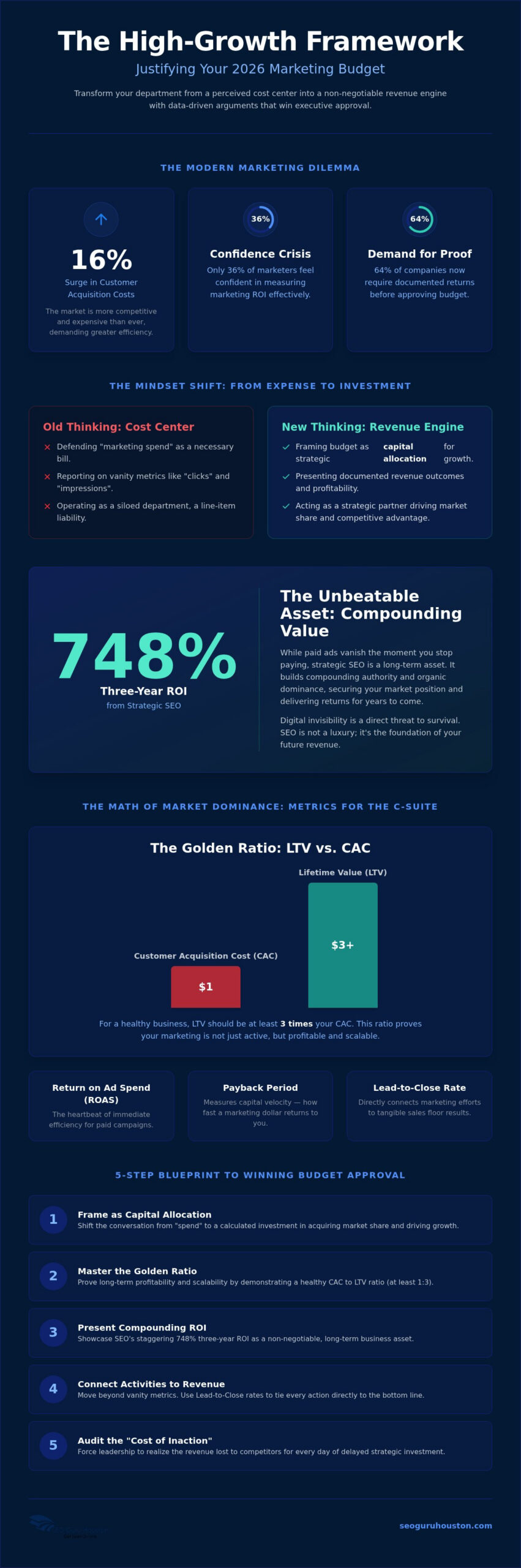
If your marketing budget is the first thing on the chopping block during quarterly reviews, you aren’t running a department; you’re managing a liability. In a market where customer acquisition costs have surged by up to 16% this year alone, guessing isn’t an option. You might be searching for how to justify marketing spend to my boss because the old ways of reporting ‘clicks’ and ‘impressions’ aren’t cutting it anymore. It’s a common pain. Only 36% of marketers feel confident in their ability to measure ROI, yet 64% of companies now demand documented returns before approving a single dollar.

You know that marketing is a profit center, but translating that belief into an executive-ready presentation is a different beast. We’re here to bridge that gap. This 2026 guide transforms your budget from an optional line-item into a non-negotiable revenue engine using our high-growth justification framework. You’ll learn how to connect long-term SEO gains, which deliver a staggering 748% three-year ROI, directly to immediate business goals. We’re moving past the fluff and giving you the technical authority to lead the room, secure your 2026 budget, and finally claim your seat as a strategic partner in the executive suite.

Key Takeaways

  • Stop treating your budget like a bill to be paid and start framing it as strategic capital allocation for market dominance.
  • Learn exactly how to justify marketing spend to my boss by shifting the conversation from daily activities to documented revenue outcomes.
  • Master the “golden ratio” of CAC vs. LTV to prove that every dollar invested is a calculated step toward long-term profitability.
  • Discover why SEO remains the most efficient 2026 investment and how to present its compounding ROI as a non-negotiable business asset.
  • Use our 5-step blueprint to audit the “cost of inaction,” forcing leadership to realize exactly what the company loses by playing it safe.

Stop Defending an Expense: Frame Marketing as a Revenue Engine

Marketing isn’t a bill you pay; it’s an investment you leverage. If you’re still treating your department budget like a utility payment, you’ve already lost the battle for growth. Most executives view marketing as a cost center, a necessary evil that bleeds cash without a clear return. You must flip this script immediately. To win the room, you need to stop talking about “marketing spend” and start talking about capital allocation for growth. You aren’t asking for permission to spend money. You’re presenting a calculated plan to acquire market share. Marketing ROI is the ratio of revenue generated to the cost of the engine that produced it.

The 2026 reality is brutal. With the rise of AI Overviews and generative search, the digital landscape is shifting faster than most legacy companies can react. Standing still in this environment is actually moving backward. If you aren’t aggressively claiming digital real estate now, you’re handing your future revenue to competitors who are. Understanding understanding marketing effectiveness is the first step in learning how to justify marketing spend to my boss. It requires moving beyond tactical execution and into strategic financial planning.

The Survival Necessity of Digital Presence

Digital invisibility is a fundamental threat to business survival. In the 2026 search ecosystem, if your brand doesn’t appear in the initial AI-generated answers, you don’t exist to the modern buyer. The cost of inaction is staggering. Every day you delay a high-growth strategy, you’re paying an “invisibility tax” in the form of revenue lost to faster, more aggressive competitors. This is why professional seo services are not a luxury; they’re a long-term asset. Unlike paid ads that stop the moment you stop paying, organic dominance builds compounding value over time, delivering an estimated 748% three-year ROI that secures your market position for years to come.

Winning the Mindset War with the C-Suite

To secure a bigger budget, you must speak the language of the CEO: growth, market share, and competitive advantage. Executives don’t care about “likes” or “impressions” because those metrics don’t show up on a balance sheet. They care about leads and revenue. When you’re figuring out how to justify marketing spend to my boss, position your department as the growth engine of the enterprise. Frame every dollar as a scalable lever. If you can prove that $1 in equals $X out, the conversation stops being about “saving money” and starts being about how much more capital the company can afford to deploy into your high-performance machine.

The Math of Market Dominance: Key Metrics Your Boss Actually Cares About

Executives don’t care about “engagement.” They care about the math. If you want to know how to justify marketing spend to my boss, start with the golden ratio: Customer Acquisition Cost (CAC) vs. Lifetime Value (LTV). In a high-performance organization, your LTV should be at least three times your CAC. If it’s lower, your strategy is inefficient. If it’s significantly higher, you’re actually under-investing and leaving market share for your rivals to snatch up. This is the assertive logic of persuading your boss to invest in aggressive growth rather than safe stagnation.

Return on Ad Spend (ROAS) is the heartbeat of effective ppc management. It tells the story of immediate efficiency. However, don’t stop there. You must track the “Payback Period.” This is the exact number of months it takes for a marketing dollar to return to the company’s pocket. A shorter payback period means more capital can be recycled back into the engine, accelerating your dominance. Finally, connect your efforts directly to the sales floor by tracking Lead-to-Close rates. If marketing generates leads that don’t close, you aren’t building a revenue engine; you’re just making noise.

B2B and Industrial Specific Metrics

B2B sales cycles are complex. You can’t rely on simple click-to-buy data. In industrial sectors, ‘Demand Generation’ is the metric that truly matters. Stop reporting on Marketing Qualified Leads (MQLs) that clutter the CRM without converting. Focus on Sales-Ready Leads. These are prospects who have bypassed the fluff and are ready for a bottom-line conversation. Partnering with a specialized b2b demand generation agency ensures your data aligns with the reality of the sales floor, not just a marketing spreadsheet.

Attribution Models: Proving What Actually Works

Which attribution model should you show your boss? While first-touch shows where the journey began, multi-touch attribution provides the full picture of how high converting landing page design impacts the final decision. You must also account for ‘Dark Social.’ This is the brand authority built in private channels and word-of-mouth that drives the highest-quality deals. If you’re ready to prove your department’s impact, it’s time to implement a data-driven growth strategy that your executive team cannot ignore.

Beyond Vanity Metrics: Connecting SEO and PPC to the Bottom Line

Stop showing your boss traffic graphs that don’t lead to a bank deposit. Traffic is a vanity metric unless it’s tied to a transaction. When you’re figuring out how to justify marketing spend to my boss, you must demonstrate how SEO and PPC function as a unified front to seize market share. You aren’t building a digital scrapbooking project; you’re building a revenue engine. By dominating the search results on both ends, you create an undeniable aura of authority that increases trust and conversion rates across the board. Search dominance is the modern equivalent of owning the most valuable real estate in your industry.

SEO as a Long-Term Business Asset

SEO is the most efficient long-term investment in the 2026 ecosystem. Cutting your SEO budget is exactly like stopping the maintenance on a multi-million dollar factory; the production line might keep moving today, but eventual collapse is a mathematical certainty. Organic traffic builds “equity” that your competitors can’t simply buy their way over with a larger credit card limit. By leveraging a high-performance seo marketing company, you aren’t just “ranking” for keywords. You’re systematically reducing your long-term Customer Acquisition Cost. Every piece of authority you build today acts as a permanent moat around your market position, making it increasingly expensive for rivals to challenge your dominance.

PPC: The Precision Tool for Rapid Growth

If SEO is the engine’s durability, PPC is the high-octane fuel that provides immediate acceleration. It’s the precision tool you use to test new markets and products with surgical accuracy. You can use the “instant gratification” of paid search to offset the longer lead times of organic growth, ensuring the company sees cash flow while the SEO moat is being dug. A strategic PPC audit is a powerful weapon when you’re explaining how to justify marketing spend to my boss because it highlights immediate cost-saving opportunities. If your current campaigns are bleeding budget due to sloppy oversight, identifying that waste and redirecting it into high-intent leads proves you’re a steward of the company’s capital. Showing that $1 in equals $X out with aggressive management transforms your budget from an expense into a scalable lever for growth.
Justify Marketing Spend to Your Boss: 2026 Guide

The 5-Step Blueprint to Winning Budget Approval Every Time

Data alone won’t win the room. If you want to know how to justify marketing spend to my boss, you have to realize that leadership doesn’t buy services; they buy outcomes. You aren’t presenting a request for funds. You’re presenting a blueprint for market dominance. To succeed, you must shift from a defensive posture to an assertive, strategic one. Follow this five-step sequence to transform your budget meeting into a growth summit.

  • Step 1: Audit the ‘Cost of Inaction’. Show exactly what the company is losing right now. If your competitors are scaling and you’re standing still, calculate the revenue leakage. Fear of loss is often a more powerful motivator than the hope of gain.
  • Step 2: Align Marketing Goals with Business Objectives. Forget rankings. Talk about revenue, market share, and customer acquisition. If the CEO wants 20% growth, show how your budget is the direct path to that number.
  • Step 3: Present a Tiered Budget Plan. Offer three options: Good, Better, and Market Dominance. This shifts the conversation from “Should we do this?” to “Which level of growth do we want to achieve?”
  • Step 4: Use Competitor Benchmarking. Trigger the competitive ambition of your executive team. Show them the “Search Share of Voice” charts where rivals are eating your lunch. No boss likes losing to a competitor they feel superior to.
  • Step 5: Propose a ‘Pilot Program’. Reduce the perceived risk by suggesting a 90-day high-intensity sprint with clear KPIs. It’s much easier to get a “yes” for a proven pilot than a permanent annual commitment.

Crafting the Narrative: The ‘Guru’ Approach

Stop presenting dry spreadsheets. Start telling a story of transformation. You are the high-performance coach leading the company from digital invisibility to market prominence. When the “it’s too expensive” rebuttal comes, don’t flinch. Remind them that expensive is a relative term. A $10,000 investment that returns $0 is expensive. A $100,000 investment that returns $1,000,000 is a bargain. Lead them to the logical conclusion that they can’t afford *not* to invest.

The Power of Visual Proof

Visuals should scream authority. Use “Search Share of Voice” charts to visualize the gap between your brand and the market leaders. Present an inbound marketing strategy for b2b funnel that illustrates a crystal-clear path from the first click to the final cash deposit. Your comparison slide should be stark: a “Current State” of stagnation versus a “Future Growth State” of dominance. If you’re ready to stop guessing and start winning, it’s time to partner with a results-oriented strategist who can provide the data you need to secure your 2026 budget.

Scaling with a Results-Oriented Partner: Why Strategy Beats Activity

Activity is just noise without a high-growth strategy. You don’t need a vendor who simply checks boxes; you need an assertive partner who hunts for market dominance. Most businesses fail because they hire an “Affordable SEO Company” that provides generic reports and stagnant results. That’s a cost center. You need a High-ROI Growth Partner. This is a fundamental necessity for businesses hungry for prominence in the 2026 search ecosystem. SEO Guru Houston bridges the gap between technical nuance and raw business strategy. We don’t just “do SEO”; we provide the measurable progress and strategic advantage your executive team demands to see on the balance sheet.

A specialized partner understands that every dollar must be a calculated move. When you’re figuring out how to justify marketing spend to my boss, you need to present more than just a list of tasks. You need to show a sophisticated understanding of how technical search metrics translate into financial return. We provide the data-driven justification framework that transforms your marketing budget from a line-item expense into a non-negotiable revenue engine. Strategy beats activity every single time because strategy is focused on the bottom line.

The Value of External Authority

Bosses often ignore internal pleas but listen intently to external experts. It’s the “Guru Effect.” When you’re struggling with how to justify marketing spend to my boss, a third-party audit is your most powerful weapon. It provides an unbiased, data-driven validation of your budget requests that internal spreadsheets often lack. By leveraging an agency’s track record of proven success, you effectively de-risk the entire investment. It’s no longer just your opinion against the CFO’s skepticism; it’s a proven roadmap backed by specialized expertise and market-leading results.

Execution: Moving from Approval to Prominence

Securing the budget is only the beginning of the transformation. You must move from approval to prominence immediately to maintain executive confidence. Our “First 90 Days” plan focuses on delivering quick wins that build trust and solidify your budget for the rest of the year. This creates a relentless feedback loop of success where each win justifies the next dollar of capital allocation. Constant, transparent reporting ensures the C-suite sees the revenue engine working in real-time. If you’re ready to stop defending and start leading, it’s time to Dominate your market and explode your revenue with SEO Guru Houston.

Claim Your Market Dominance in 2026

You have the blueprint and the data. Now, you need the conviction to lead. The shift toward AI-driven search means that playing it safe is no longer an option; it’s a slow path to irrelevance. By reframing your budget as a profit center and focusing on the core math of CAC and LTV, you’ve mastered how to justify marketing spend to my boss. You aren’t asking for a favor. You’re offering a path to industrial dominance that your competitors are too slow to take.

Our team specializes in results-oriented B2B and industrial demand generation. We provide the technical nuance and ambitious digital strategies required to transform your brand from invisible to indispensable. Don’t settle for “activity” when you can have measurable progress. Ready to secure your budget and dominate your market? Let SEO Guru Houston build your high-ROI growth engine today!

The transition from a cost center to a revenue engine starts with your next meeting. Go in with authority and claim the growth your company deserves. Your seat at the executive table is waiting; it’s time to take it.

Frequently Asked Questions

What is the best way to explain the value of SEO to a non-technical boss?

Explain it as a digital asset. SEO is like owning the building instead of renting it. It’s the most efficient way to lower long-term CAC. Tell them it delivers a 748% three-year ROI. This isn’t just about rankings; it’s about owning the search ecosystem. This shift in perspective helps when you’re learning how to justify marketing spend to my boss. You’re building a permanent revenue engine that works even when you sleep.

How do I justify a marketing budget increase when sales are down?

Defend the engine. When sales are down, you don’t cut the fuel; you fix the engine. Cutting spend now ensures your competitors will capture the remaining market share. Frame the increase as a recovery plan. Show how the cost of inaction is higher than the budget request. If you stop now, the cost to restart and regain your position later will be 5 to 25 times more expensive than maintaining it.

What metrics should I prioritize in a budget meeting with the CFO?

CFOs speak the language of capital efficiency. Prioritize Customer Acquisition Cost (CAC), Lifetime Value (LTV), and the Payback Period. They don’t care about clicks; they care about how quickly a marketing dollar returns to the balance sheet. Show the “Golden Ratio” of 3:1 for LTV to CAC. This data-driven approach is the ultimate answer for how to justify marketing spend to my boss during high-stakes financial reviews.

How can I prove that our PPC spend isn’t being wasted?

Transparency is the antidote to skepticism. Present a surgical audit that identifies “bleeding budget” from low-intent keywords. Show exactly how you’ve eliminated waste and redirected those funds into high-converting landing pages. Use multi-touch attribution to link every dollar spent directly to a sales-ready lead. When you prove that $1 in equals $X out with aggressive management, the conversation shifts from “wasted spend” to “scalable growth lever.”

What is a ‘reasonable’ marketing budget as a percentage of revenue in 2026?

Most high-growth B2B firms allocate 5% to 15% of total revenue to marketing. In the competitive 2026 landscape, staying at the lower end often leads to stagnation. If your goal is market dominance, you must treat this as capital allocation for growth rather than an expense. The right percentage depends on your specific industry’s CAC benchmarks and your company’s ambition to outpace the competition in search visibility.

How do I handle a boss who only believes in traditional print advertising?

Shift the focus to trackable ROI. Traditional print is a “spray and pray” tactic that offers zero visibility into effectiveness. Digital marketing allows for precision targeting and measurable returns. Show your boss a “Search Share of Voice” chart that visualizes exactly how much revenue your competitors are siphoning away through search. Once they see the digital gap, the argument for print usually collapses under the weight of lost opportunity.

What is the ‘cost of inaction’ and how do I calculate it for my company?

The cost of inaction is the revenue you lose every day you aren’t at the top of search results. Calculate it by taking the total search volume for your top keywords, multiplying by the average click-through rate of a top-3 position, and then applying your close rate and average deal value. This number represents the “Invisibility Tax” you’re currently paying. It’s often much higher than the cost of a high-performance marketing strategy.

Can I justify spend on ‘brand awareness’ in a B2B industrial sector?

Absolutely, but frame it as “Brand Authority.” In industrial B2B sectors, buyers don’t just click and buy; they research. Brand awareness builds the trust needed to shorten long sales cycles. It creates a “halo effect” that increases the efficiency of your PPC and SEO efforts. By establishing yourself as the authoritative expert, you reduce resistance on the sales floor and make every other marketing dollar work harder for the bottom line.
Reduce Customer Acquisition Cost: Market Dominance Guide

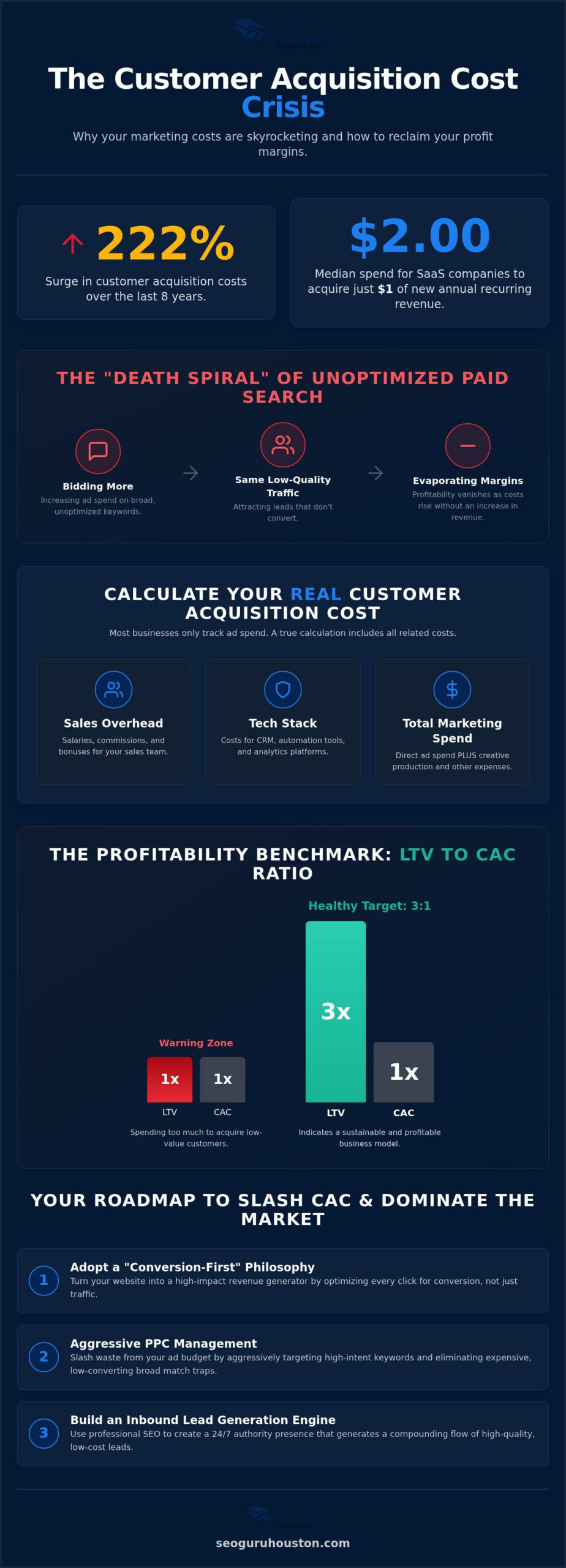
Customer acquisition costs have surged by a staggering 222% over the last eight years. Today, the median SaaS company spends $2.00 just to acquire $1 of new annual recurring revenue. This isn’t just a trend; it’s a crisis for businesses that don’t adapt. You’re likely feeling the pressure of skyrocketing PPC costs and low-quality leads that refuse to convert. If you’re struggling to track real ROI while your budget disappears, you need a definitive strategy for how to reduce customer acquisition cost before your margins vanish.

You’re right to feel the urgency. The era of inefficient, growth-at-all-costs marketing is dead. This guide provides the high-performance strategic framework you need to slash your CAC and explode your profit margins. We’re moving beyond abstract theory to deliver a comprehensive method for market dominance. It’s time to transform your digital presence from invisible to prominent.

We’ll break down the exact tactics for building a predictable lead flow through demand generation and precision landing pages. You’ll learn how to leverage data-driven strategies that turn high-intent traffic into loyal customers. Let’s stop the budget bleed and start scaling your business with the authority it deserves.

Key Takeaways

  • Identify the hidden drivers of the 2026 CAC crisis to stop the “Death Spiral” of unoptimized paid search spend.
  • Master how to reduce customer acquisition cost by adopting a “Conversion-First” philosophy that turns your website into a high-impact revenue generator.
  • Slash the fat from your PPC budget by aggressively targeting high-intent keywords and eliminating expensive broad match traps.
  • Forge a 24/7 inbound lead generation engine that uses professional SEO to create a compounding effect on your profit margins.
  • Follow a definitive five-step roadmap to transition from high-cost struggles to aggressive, predictable market dominance.

The CAC Crisis of 2026: Why Your Acquisition Costs are Skyrocketing

The digital landscape in 2026 is a battlefield. If you think your rising ad spend is just a temporary fluctuation, you’re dangerously mistaken. Customer acquisition costs have surged 222% over the last eight years because the old rules of engagement no longer apply. Relying on unoptimized paid search creates a “Death Spiral” where you bid more for the same low-quality traffic while your margins evaporate. This isn’t just a marketing problem; it’s a fundamental threat to your business survival. You can’t outspend a broken strategy.

Reducing these costs requires a tactical hunt for efficiency. You shouldn’t just be looking at your ad dashboard. You need to scrutinize every touchpoint in your funnel. Understanding how to reduce customer acquisition cost starts with acknowledging that passive marketing is a liability. If you aren’t dominating high-intent channels with precision, you’re simply funding your competitors’ growth. Utilizing professional ppc management is no longer optional; it’s a survival requirement for any brand that wants to scale profitably.

The Hidden Costs of Passive Marketing

Outdated SEO strategies are a silent killer for your bottom line. If your content doesn’t align with modern search intent or lacks technical authority, you’re missing thousands in organic opportunities every month. Invisibility in a saturated market is a choice, and it’s an expensive one. Many businesses fall into the trap of hiring “affordable” marketing services that promise the world for pennies. These low-cost providers often lack the technical depth to drive actual conversions, which results in a bloated CAC. True market dominance requires a commitment to professional seo services that turn searchers into buyers.

Calculating Your Real CAC: Beyond the Basics

Most businesses calculate Customer Acquisition Cost (CAC) by looking only at their direct ad spend. That’s a rookie mistake that hides the true health of your company. To find your real cost, you must include sales overhead, your entire tech stack, and creative production expenses.

  • Sales Overhead: You must account for salaries, commissions, and bonuses for your sales team.
  • Tech Stack: Include CRM costs, automation tools, and analytics platforms that facilitate the sale.
  • LTV Relationship: Aim for a Lifetime Value (LTV) to CAC ratio of at least 3:1. Anything less indicates you’re spending too much to acquire customers who aren’t worth the investment.

Blended CAC is the ultimate truth for business growth because it accounts for the total investment required across all channels to bring a customer through the door. If you want to master how to reduce customer acquisition cost, you must first be honest about what you’re actually spending. Stop hiding from the data and start hunting for the gaps in your conversion engine.

Optimizing the Conversion Engine: Turning Traffic into Revenue

Your website is likely the single biggest leak in your profit bucket. If you’re pouring thousands into paid ads but sending that traffic to a cluttered, slow, or generic homepage, you aren’t marketing; you’re gambling. A “Conversion-First” philosophy demands that every click lands on a page designed for one thing: the conversion. This is the most direct answer to how to reduce customer acquisition cost. By doubling your conversion rate, you effectively cut your CAC in half without spending an extra dime on media. Stop lighting money on fire by sending high-intent traffic to dead-end pages.

Professional website video marketing is a high-performance tool that slashes friction and builds instant trust. In a digital market where attention spans are measured in milliseconds, video explains complex value propositions faster than any block of text. It triggers the psychological “need for a solution” by humanizing your brand and demonstrating results. You need to turn skeptics into believers immediately. If you fail to capture attention and provide a clear path forward within the first three seconds, you’ve lost the lead and wasted the acquisition spend. High-quality leads don’t happen by accident; they are the result of a precision-engineered user journey.

High-Converting Landing Page Design: The Non-Negotiable

Success starts with high converting landing page design. Every element on the page must be intentional and assertive. Use clear, direct CTAs that tell the user exactly what to do next. Don’t ask for their business; direct them toward the solution. Mobile optimization is no longer an optional feature. Since the majority of commercial searches now occur on mobile devices, a clunky mobile experience is a death sentence for your ROI. If your site doesn’t load instantly on a 5G connection, your CAC will remain high while your competitors steal your market share.

Conversion Rate Optimization (CRO) as a CAC Killer

Conversion Rate Optimization (CRO) is a tactical hunt for missed revenue. Use A/B testing to compare headlines, form lengths, and button colors. These aren’t just cosmetic changes; they’re data-driven experiments that deliver measurable progress toward your bottom line. Heatmaps are another essential tool, showing exactly where users click and where they get stuck. If people are scrolling past your primary offer, you have a structural problem that needs immediate attention. The “Guru” tip is simple: fix the leaks in your funnel before you pour more cash into the top. It’s much cheaper to convert the traffic you already have than to buy more. For those ready to scale, investing in professional website development is the first step toward a dominant growth engine.

Aggressive PPC Management: Cutting the Fat from Your Paid Spend

Stop bleeding your budget on low-intent keywords and broad match traps that serve Google’s bottom line instead of yours. If you’re wondering how to reduce customer acquisition cost, you must start by auditing your paid search for waste. Broad match is a vanity metric trap; it brings traffic, but not the kind that converts into high-margin revenue. Professional ppc management is a fundamental necessity because it replaces guesswork with precision. You need a tactical approach that hunts for high-intent buyers while ruthlessly excluding tire-kickers who have no intention of closing.

Negative keyword lists are your strongest defense in protecting your ROI. By proactively blocking irrelevant queries, you ensure your ads only appear for the most profitable searches. Pair this with assertive, high-energy ad copy. Your ads shouldn’t just attract clicks; they should pre-qualify leads. If your copy is direct about who you serve and the specific problems you solve, you’ll naturally repel low-quality prospects before they cost you a single cent. It’s about quality over quantity every single time.

Paid Search vs. Demand Generation

Shift your mindset from simply buying clicks to aggressively generating demand. This means aligning your spend with high-value customer segments that possess a high lifetime value. You aren’t just looking for a transaction; you’re looking for market dominance. For those in the e-commerce space, dominating the results requires a specialized approach through amazon marketing services. Whether on Google or Amazon, the goal is to occupy the most valuable digital real estate where your customers are already hunting for solutions. Don’t wait for them to find you; occupy the space where they are already looking.

The ROI of Precision Targeting

Leverage first-party data to lower your cost per lead. In an era of increasing privacy changes and platform signal loss, relying on generic third-party data is a losing game. By using your own customer insights to inform your targeting, you bypass the inaccuracies of broad ad platforms and can achieve a 30-50% CAC advantage. Combine this with aggressive retargeting strategies. Bringing a warm prospect back to your site is significantly cheaper than finding a new one from scratch. This creates a powerful synergy with your SEO efforts; organic traffic feeds your retargeting pools, allowing you to close deals at a fraction of the initial cost. “Set it and forget it” PPC is a recipe for financial disaster. Consistent, daily optimization is the only way to maintain a competitive edge and keep your acquisition costs from spiraling out of control.

Reduce Customer Acquisition Cost: Market Dominance Guide

The Inbound Authority Play: Using SEO to Decimate CAC

Stop thinking of SEO as a slow-burn luxury. It is a tactical weapon for margin expansion. While paid ads provide immediate visibility, they vanish the moment you stop paying the toll; organic search creates a compounding effect that decimates your long-term costs. Research shows that organic acquisition channels cost 30% to 50% less than paid channels. If you want to master how to reduce customer acquisition cost, you must shift your focus from renting traffic to owning it. High-performance professional seo services build a foundation of digital equity that pays dividends long after the initial investment.

Building an “Inbound Engine” means turning your website into a 24/7 lead generation machine. This isn’t about generic blog posts. It’s about establishing absolute authority in a market where skeptics are the default. When you dominate the search results for high-intent queries, you aren’t just getting a click; you’re gaining immediate brand trust. This trust shortens the sales cycle and reduces the friction that typically inflates acquisition costs. You need to occupy the search real estate that your competitors are currently renting at a premium.

B2B Inbound Marketing for Market Dominance

Implementing a comprehensive b2b inbound marketing strategy requires targeting every stage of the funnel. You can’t just focus on the bottom. Technical SEO ensures that your high-value assets are actually seen by search engines and users alike. Without a clean technical foundation, your best content remains invisible. Pair this with a backlink profile that screams industry leadership. High-authority links act as endorsements, signaling to both Google and your prospects that you are the definitive choice in your sector. This level of dominance makes your acquisition efforts predictable and scalable.

Authority Content: The Ultimate CAC Reducer

True market leaders don’t settle for surface-level summaries. You must create deep-dive guides that solve complex business problems for your target audience. This type of authority content does the heavy lifting for your sales team. Case studies are particularly effective here; they provide the social proof needed to move prospects through the funnel faster. Understanding how to reduce customer acquisition cost involves owning the most valuable search real estate and refusing to give it up. When you provide more value than anyone else, the market naturally gravitates toward you. It is time to stop chasing leads and start attracting them with a dominant B2B inbound marketing strategy.

Scaling for Market Dominance: Your CAC Reduction Roadmap

Scaling is where the pretenders are separated from the market leaders. If you attempt to grow on a foundation of inefficient spend, you’re only accelerating your financial collapse. Transitioning from a high-CAC struggle to a low-CAC scale requires a definitive 5-step blueprint. You must audit your real costs, optimize your conversion engine, refine your paid targeting, build organic authority, and then iterate for dominance. This isn’t a one-time fix; it’s a perpetual hunt for efficiency. Partnering with a b2b demand generation agency provides the technical expertise and strategic oversight necessary to execute this shift at speed.

Monitoring the right KPIs is critical. Stop obsessing over vanity metrics like impressions or clicks. Real market leaders focus on the LTV:CAC ratio, aiming for that 3:1 benchmark that investors demand. They watch the CAC payback period, which currently sits at a median of 6.8 months for established companies. If your metrics are heading in the wrong direction, you need to pivot immediately. Understanding how to reduce customer acquisition cost is about maintaining an aggressive mindset of constant optimization. You’re either expanding your territory or losing it to someone more agile.

Implementing the Demand Generation Framework

Success requires absolute alignment between your marketing and sales teams. A disjointed customer journey is an expensive journey. You must use data-driven insights to pivot your strategies in real-time based on actual lead quality, not just lead volume. This is where a high-performance coach becomes indispensable. You need someone who can look at your technical setup and identify the friction points you’ve grown blind to. If you want to know how to reduce customer acquisition cost while scaling revenue, you have to embrace the complexity of demand generation and own every stage of the funnel.

Taking Decisive Action

Waiting to optimize is a choice to lose money. Every day you delay, your competitors are refining their funnels and stealing your market share. The 60% increase in CAC since 2021 proves that the market doesn’t reward the hesitant. To lower your CAC this quarter, you must first clean your contact data to improve outbound efficiency. Second, kill every low-intent ad group that hasn’t converted in 30 days. Third, deploy a dedicated landing page for your highest-spend campaign. Ready to dominate? Partner with the SEO Guru Houston team today!

Dominate Your Market with Precision Efficiency

The digital landscape is ruthless to the inefficient. You now have the strategic framework required to dismantle high acquisition costs and reclaim your profit margins. By prioritizing a conversion-first website design and implementing aggressive PPC management, you move from simply buying clicks to generating high-value demand. We’ve established that mastering how to reduce customer acquisition cost isn’t just about spending less; it’s about investing smarter in the channels that offer compounding returns.

Success belongs to the bold who take decisive action. Stop settling for low-quality leads and unoptimized funnels that drain your resources. Our result-oriented digital marketing experts are ready to deploy high-performance B2B demand generation and expert SEO and PPC strategies to fuel your growth. The path from invisibility to market prominence is clear. It’s time to stop the budget bleed and start scaling with absolute confidence.

Stop Bleeding Budget and Dominate Your Market-Contact SEO Guru Houston Now!

Frequently Asked Questions

What is a good Customer Acquisition Cost for B2B?

A good CAC for B2B is defined by your Lifetime Value (LTV), with a target ratio of 3:1 being the industry gold standard. For B2B SaaS companies, the average cost for paid channels is approximately $341, while organic channels drop to $205. If your acquisition cost exceeds 33% of a customer’s total value, your margins are in danger. You must prioritize high-intent channels to keep this ratio healthy and sustainable.

How long does it take to see a reduction in CAC through SEO?

You should expect to see measurable progress within six to twelve months of implementing a professional SEO strategy. While technical optimizations can provide immediate efficiency gains, the compounding effect of high-authority content takes time to build. Once your organic engine matures, it creates a 24/7 lead generation stream that significantly lowers your blended CAC. This long-term equity is what separates market leaders from those constantly renting expensive ad space.

Can I reduce CAC without lowering my marketing budget?

Yes, you can reduce your acquisition costs by shifting your focus from spending to efficiency. Improving your conversion rates through high-performance landing pages allows you to acquire more customers for the same dollar amount. This strategy targets the middle of your funnel rather than just pouring more cash into the top. When you master how to reduce customer acquisition cost through conversion optimization, you effectively lower the cost per acquisition without sacrificing lead volume.

What is the fastest way to lower CAC in a competitive market?

The fastest way to lower your acquisition costs is to audit your existing PPC spend and eliminate low-intent keyword waste. Broad match traps often inflate budgets by 20% or more without delivering conversions. By aggressively implementing negative keyword lists and directing traffic to dedicated, conversion-optimized landing pages, you see an immediate improvement in ROI. This tactical hunt for efficiency provides the quick wins needed while your long-term organic strategies continue to gain momentum.

How does landing page design impact acquisition costs?

Landing page design is the single most influential factor in your conversion rate. If your page fails to load instantly or lacks an assertive call-to-action, your acquisition costs will skyrocket. A precision-engineered landing page reduces friction and builds instant trust, turning a higher percentage of clicks into leads. Doubling your conversion rate through professional design effectively cuts your CAC in half without requiring any additional investment in paid advertising or expensive traffic generation.

Why is my PPC CAC so much higher than my organic CAC?

Your PPC costs are higher because you are paying a premium for immediate visibility in a competitive auction. Ad platforms have seen a 60% increase in costs since 2021, and you are constantly fighting rising CPCs. Organic channels cost 30% to 50% less because they leverage compounding authority rather than a pay-to-play model. Learning how to reduce customer acquisition cost involves balancing these channels to ensure your expensive paid leads are offset by low-cost organic traffic.

Is it possible to scale lead volume while reducing CAC?

Scaling lead volume while reducing costs is the ultimate goal of a high-performance demand generation framework. This is achieved by diversifying your acquisition channels and improving the efficiency of your sales funnel. As you build organic authority and refine your PPC targeting, you reach a tipping point where your brand recognition lowers the friction of every new sale. This allows for aggressive expansion into new markets without the typical corresponding spike in acquisition expenses.

What role does video marketing play in lowering acquisition costs?

Professional website video marketing slashes acquisition costs by accelerating the trust-building process. Video can explain a complex value proposition in seconds, which significantly shortens the sales cycle and reduces the burden on your sales team. By increasing engagement and time-on-site, video content improves your overall conversion metrics. This high-impact medium turns cold prospects into warm leads faster than text alone, making it a fundamental necessity for businesses hungry for market dominance.