Tag Archives: Content Marketing

Creating Customer Testimonial Videos: A Practical Guide to Stories That Build Trust

A buyer-ready testimonial starts with evidence, not a camera. The strongest approach to creating customer testimonial videos isn’t a polished script or expensive setup. It’s choosing a real customer story that answers questions prospective buyers are already asking.

An interview can feel awkward, overly promotional, or demanding on your team’s time and equipment. A clear plan makes the conversation more natural and production more manageable. Focus on the customer’s challenge, why they chose your solution, and what they experienced afterward, then let them explain it in their own words.

This guide walks you through a repeatable process, from selecting a customer and preparing questions to recording, editing, publishing, and evaluating the video. You’ll learn how to shape a credible story around buyer concerns and use it across your website, landing pages, sales conversations, and demand generation. The goal isn’t video for its own sake. It’s proof that helps the right buyers take a confident next step.

Key Takeaways

  • Start with a buyer question and a customer story that answers it with specific, credible details.
  • Make the interview feel natural by agreeing on the story, sharing prompts, and setting expectations before recording.
  • Choose remote or in-person recording based on the control and production complexity your project needs.
  • When creating customer testimonial videos, edit for a clear story and make shorter cuts without changing the customer’s meaning.
  • Give each video a defined audience, destination, and next action so it can support a repeatable marketing workflow.

Why creating customer testimonial videos starts with the buyer’s decision

A customer testimonial video is a customer-led account of a real experience, told in the customer’s own words. It isn’t a brand-written ad with a customer delivering polished praise. Prospects need to hear what happened, what the customer considered, and why the experience might be relevant to someone like them. The Wikipedia article on testimonials offers a comprehensive understanding of their role in marketing.

Generic compliments such as “great service” or “easy to work with” sound positive, but leave a buyer’s real questions unanswered. Specifics make a story useful: what challenge prompted the customer to look for a solution, what alternatives or concerns they weighed, and what changed after making a decision. A video can’t establish that every viewer will have the same experience. It can give prospects enough context to judge whether the customer’s situation resembles their own.

Start by naming the doubt you want the story to address. Is a buyer unsure how a solution fits an existing workflow? Do they want to understand what implementation involved or why a customer chose one approach over another? One video can’t credibly answer every question. Give it a clear job and let the customer’s firsthand account do the work. Production polish helps, but it can’t replace relevance, detail, and a coherent story.

Choose the customer story that answers a buyer question

Look for a customer whose experience matches the audience and use case you want to reach. Then identify a moment they can describe from direct experience: a challenge that triggered their search, a concern that shaped their decision, or an outcome they can explain clearly. For example, if prospects are worried about fitting a new service into a busy process, feature a customer who can describe the steps they took and what they needed to know before deciding.

Connect the story to a known objection or information gap from sales conversations, customer questions, or feedback. Use a simple selection test: can this person explain the problem, decision, and experience in concrete terms that would help a similar buyer assess their options? If the story offers only broad praise, refine the angle or choose a different customer before recording.

Set a focused goal before recording

Choose one primary audience and one stage of the buying journey. Someone discovering a problem needs different context from a prospect comparing solutions. Decide whether the video should explain a challenge, show how a solution was used, or build confidence in a choice. That focus guides the questions, the final edit, and where the video belongs, such as a relevant website page or landing page.

Define a useful next action without promising a particular result. You might want viewers to explore a related service page, discuss their needs with your team, or review another resource. Keep the story honest and the goal specific. That’s the foundation of creating customer testimonial videos that support a real buyer decision instead of adding content without a clear purpose.

How to plan a customer testimonial interview that feels natural

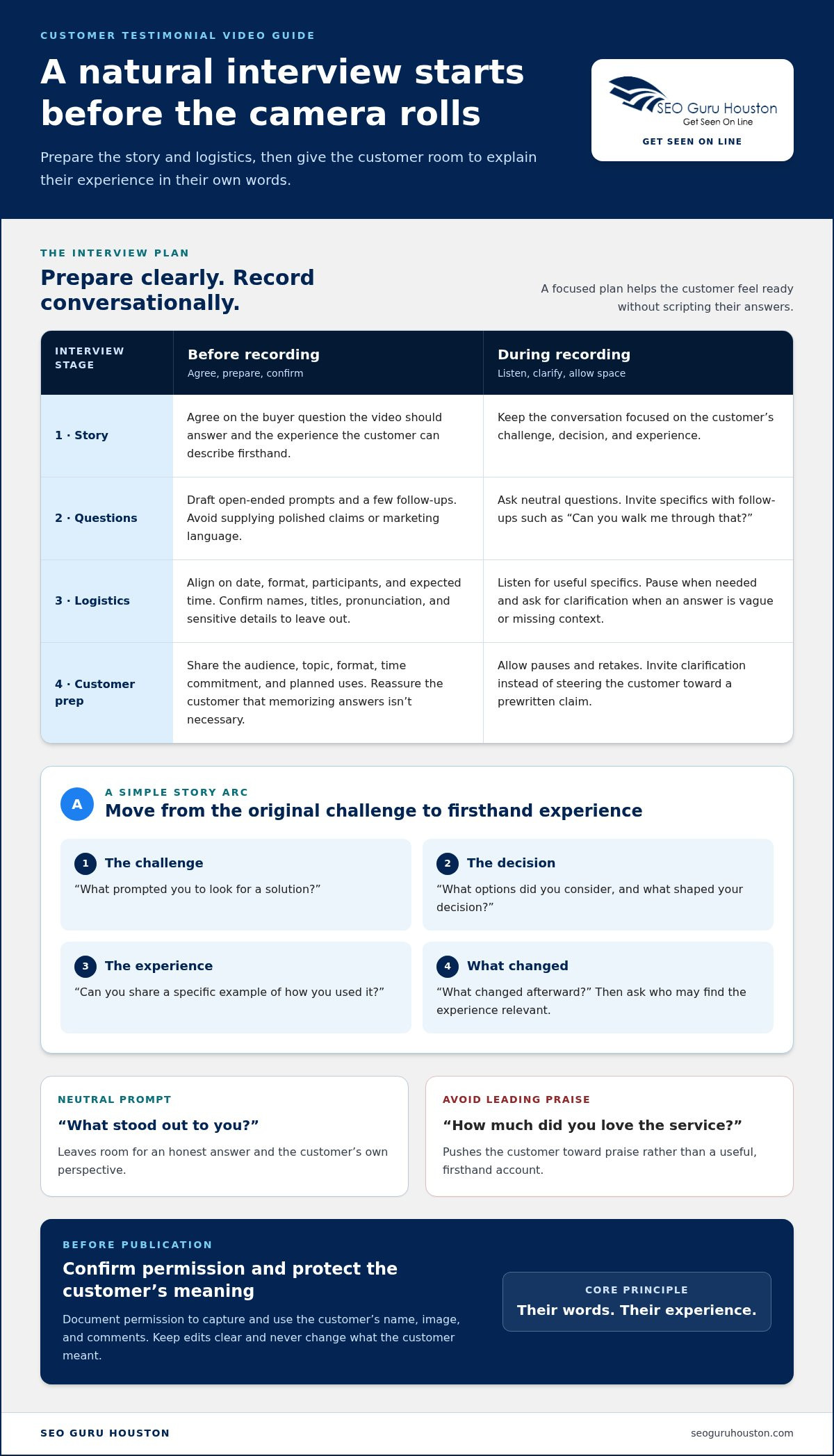
A relaxed interview comes from a clear purpose, thoughtful preparation, and enough room for the customer to speak naturally. Share the topic, expected time commitment, recording format, and intended uses in advance. That gives the customer a chance to prepare without turning their answers into a script.

Use this sequence to keep the process focused:

  • 1. Agree on the story. Confirm the buyer question the video should address and the experience the customer can speak about firsthand.
  • 2. Prepare prompts. Draft open-ended questions and a few follow-ups. Avoid supplying polished claims or asking the customer to repeat marketing language.
  • 3. Confirm logistics. Align on the date, format, participants, and expected time. Confirm names, titles, pronunciation, and any sensitive information to leave out.
  • 4. Record conversationally. Listen for useful specifics, pause when needed, and ask for clarification if an answer is vague or missing context.

Build interview questions around a simple story arc

Let the conversation move from the customer’s original challenge to the decision and firsthand experience. Ask, “What prompted you to look for a solution?” then “What options did you consider, and what shaped your decision?” Follow with, “Can you share a specific example of how you used it?” and “What changed afterward?” Close by asking who might find the experience relevant and what they’d want that audience to know.

Keep questions neutral. “What stood out to you?” invites an honest answer; “How much did you love the service?” pushes toward praise. Follow-ups such as “Can you walk me through that?” or “What did that look like in practice?” help turn general statements into details a viewer can evaluate.

Help customers feel prepared without scripting their answers

Send a short briefing that explains the audience, topic, format, time commitment, and planned uses. Reassure the customer that they don’t need to memorize anything. Agree beforehand on how to say names, job titles, and company names, and identify confidential details to avoid. During the interview, allow pauses and retakes. Invite clarification instead of steering the customer toward a prewritten claim.

Before recording and publication, document permission to capture and use the customer’s name, image, and comments. Review current FTC guidance on endorsements, testimonials, and disclosures for the specific situation, especially if there’s a relationship or arrangement viewers may need to understand. The Small Business Administration offers insights into maximizing the marketing impact of customer testimonials, including practical considerations for shaping a testimonial strategy.

A simple interview plan keeps production aligned with the buyer journey and the video’s eventual destination. As you plan a broader website video marketing strategy, connect each interview’s purpose to the page and next step it should support.

Remote or in-person recording: choose the right testimonial video setup

The right setup captures a clear, comfortable account without adding complexity the story doesn’t need. Before choosing equipment, consider how much production control you need, how easily the customer can participate, and what the video needs to show. A customer describing a decision may work well remotely. A story that depends on a workplace setting or product demonstration may benefit from in-person filming.

Three common approaches offer different tradeoffs:

  • Remote self-recording: The customer records independently with a smartphone or webcam. It’s convenient and gives them control over timing, but framing, sound, and lighting can vary.
  • Guided remote interview: The customer joins a live conversation while an interviewer provides prompts and simple direction. It offers convenience while helping keep the story focused, though connection quality and the customer’s recording environment still matter.
  • In-person filming: A planned shoot offers more control over the setting, camera, and sound. It also involves more coordination, including scheduling, location access, and equipment planning.

Match the camera to the intended use, not to the idea that more gear always means a better testimonial. A smartphone may be suitable if it records clear video and can be positioned steadily. A webcam can work for a straightforward interview in a well-lit, quiet space. A dedicated camera may offer greater control when the scene or finished video calls for it. In every case, prioritize clear audio, stable framing, suitable light, and an uncluttered background. Viewers should focus on the customer’s account, not distractions in the shot.

When remote recording fits the customer and project

Remote recording can make participation easier when customer schedules or locations make travel difficult. Before the interview, test the connection and check the camera angle, sound, and light. Position the camera near eye level, reduce background noise, and make sure the customer is framed comfortably. An interviewer can guide the conversation with simple cues, such as pausing between answers or adjusting the camera, without taking over the customer’s story.

When in-person filming adds value

Choose in-person filming when the setting, a demonstration, or several participants add useful context that a remote conversation can’t capture as clearly. Plan for location access, scheduling, and equipment so the shoot doesn’t become a burden for the customer. Keep the story’s purpose central: extra production helps only if it makes the experience easier to understand.

If a customer feels uneasy on camera, make the process less intimidating. Start with an informal conversation, record shorter segments, or consider an audio-first approach if it fits the intended use. Let the customer pause or restart a response. In creating customer testimonial videos, the best setup is a practical one that protects the customer’s comfort and keeps their account clear.
Creating Customer Testimonial Videos: A Practical Guide to Stories That Build Trust

Edit, publish, and measure customer testimonial videos

Editing should sharpen the customer’s story, not reshape it into a brand script. Keep enough context for viewers to understand the original challenge, preserve specific details that make the experience useful, and end with a concise conclusion. Remove repeated points, long pauses, and side conversations, but don’t cut a qualification or key detail in a way that changes the customer’s meaning.

Keep a full-length version as the source asset, then create shorter cuts for placements where a focused excerpt makes sense. A short edit might highlight one buyer concern or a specific part of the customer’s experience. Review each cut against the original: does it still accurately represent what the customer said, and can viewers understand the point without missing context? Accurate captions also help people follow the story when they aren’t listening to the audio.

Adapt the testimonial for each channel

Give the video a descriptive title that identifies the customer’s problem or use case instead of a vague label such as “Customer Story.” Publish it where the story helps answer a relevant question: on a related website page or landing page, in sales materials, or on a social channel. Match the call to action to the content. A viewer who has just watched a customer explain a use case may benefit from a related next step, not an unrelated offer.

For a landing page, place the testimonial near the information it supports and make the page’s next step clear. Thoughtful high-converting landing page design can connect the customer’s story with relevant details and a useful action. Keep the title, captions, surrounding copy, and destination consistent so the video feels like part of the buyer experience, not an isolated asset.

Evaluate whether the video supports the buyer journey

Before publishing, record a baseline and define what you want to learn. Avoid assuming that a change in leads or sales came from one video alone. Where tracking permits, compare engagement and conversion behavior across placements, and look at signals that relate to the video’s job:

  • Qualified engagement: Are relevant viewers watching or interacting with the story?
  • Video completion: Are viewers reaching the key detail or conclusion?
  • Assisted conversions: Does the video appear in the path of people who take a useful next step?
  • Sales-team usage: Do team members share it, and does it help address prospect questions?

Pair measurement with feedback. Ask sales teams which questions prospects raise after seeing the video and whether the story helps explain the customer’s use case. Use those observations to refine placement, messaging, or future story selection. For a connected approach, explore website video marketing as part of the broader website and demand generation experience.

Turn customer testimonial videos into a repeatable growth asset

A testimonial becomes a growth asset when it has a clear role beyond being published. Build a workflow you can repeat, and connect every story to an audience, a buying question, a destination, and a measurable next action. That keeps creating customer testimonial videos tied to the buyer journey instead of turning production into a one-off project.

Use a simple operating checklist:

  • Select: Choose a customer story that speaks to a distinct buyer need or concern.
  • Prepare: Agree on the story, intended audience, questions, and where the video may appear.
  • Record: Capture the customer’s experience in a format that suits the story and their comfort.
  • Review: Check the edit for accuracy, context, and approved use before publication.
  • Publish: Place the video beside content that helps viewers understand the relevant problem or solution.
  • Learn: Review engagement, next-step activity, and sales-team feedback to guide future stories.

For each video, document the intended audience, the question it answers, the page or channel where it belongs, and the action a viewer can take. This brief helps marketing and sales use the same story consistently and makes it easier to see whether the video is reaching the right people.

Make customer stories part of a wider B2B strategy

Pair a testimonial with educational content that explains the surrounding problem, then make it available to sales teams for conversations where the customer’s experience adds relevant context. Build a range of stories around distinct buyer needs, such as ease of adoption, a particular use case, or confidence in the decision. Avoid publishing several videos that all make the same general point. A connected B2B demand generation strategy can help align these stories with the information buyers need at different stages.

Choose a production approach that matches your team

Self-managed production gives an internal team direct editorial control, but requires time to coordinate customers, recording, and review. Software-assisted collection can make it easier to gather customer responses, though the team still needs to guide story selection and quality checks. Specialist video marketing support may suit teams with limited internal capacity or more involved publishing needs. Compare each approach by time, customer experience, editorial control, and the work your team can realistically own.

Website video marketing can connect testimonial stories to relevant website pages, landing pages, and demand-generation activity as part of a broader digital strategy. To shape how customer videos fit into your site experience, explore website video marketing.

Make your next customer story count

Choose one unanswered buyer question and make it the starting point for your next testimonial. That focus gives your team a practical way to turn a customer conversation into useful proof, then learn from how prospects and sales teams respond. Keep refining the process as you discover which stories help buyers understand their options.

For stronger impact, treat video as part of the experience around it, not a standalone asset. A testimonial can work alongside a relevant website page, landing page, inbound marketing content, or demand generation effort, with each supporting a different step in the buyer’s decision. Website video marketing can connect those pieces into a more cohesive digital strategy.

Explore website video marketing and consider how website development, landing-page design, inbound marketing, and demand generation can support customer stories across your buyer journey. Start with one clear question, one genuine voice, and one useful next step.

Frequently Asked Questions

How do you create a customer testimonial video?

Start by choosing a real customer whose experience can help a specific audience evaluate your solution. Confirm the story’s focus and intended use, then arrange an interview or recording format that suits the customer. After recording, edit for clarity, check factual details with the customer, and publish the video where it can support a relevant decision. A simple written brief can keep marketing, sales, and the customer aligned from the start.

What questions should I ask in a customer testimonial interview?

Ask questions that invite a firsthand account, such as “What was happening before you started looking for a solution?” and “What nearly stopped you from moving forward?” Follow up with requests for examples: “Can you describe a moment when that mattered?” Avoid questions that assume the customer was satisfied or achieved a particular result. Neutral prompts give customers room to share useful details, including limitations or unexpected parts of their experience.

How long should a customer testimonial video be?

Make the video long enough to explain the customer’s situation and experience, but no longer than the story needs. A short social post may call for a single focused insight, while a website story for buyers comparing options may need more context. Review the edit by asking whether each section helps viewers understand the customer’s perspective. If a detail adds no useful information, consider removing it or saving it for another cut.

Can you create a testimonial video remotely?

Yes. A remote testimonial can be recorded through a live video interview or by asking the customer to record independently. Before filming, check that the recording device has enough battery and storage, notifications are silenced, and the customer knows how to pause or restart. If the internet connection is unreliable, recording locally on the customer’s device and transferring the file afterward may help avoid interruptions during the interview.

How do you make a customer testimonial video feel authentic?

Let the customer speak in their own language rather than asking them to memorize promotional lines. Share the topic in advance, but leave room for answers you didn’t anticipate. Keep edits faithful to the full response, and don’t remove context that changes its meaning. You can also invite the customer to describe a tradeoff, learning curve, or detail that surprised them. Honest nuance often sounds more credible than flawless praise.

Where should you use customer testimonial videos?

Place each video where its story answers a relevant question. A customer describing a specific use case may fit on the corresponding service page, while a story about evaluating options could support a sales follow-up or consideration-stage email. Social channels can help share a focused excerpt with an audience already interested in the topic. Match the surrounding message to the video so viewers know why it’s relevant and what to explore next.

Do customers need to approve a testimonial video before publication?

Build a customer review into your process before publishing. Confirm that the customer understands where the video may appear and has approved the use of their name, role, company details, and likeness. Let them flag factual errors or sensitive information in the edit, while preserving the integrity of their statements. If the customer has a business relationship or received something of value, review current endorsement guidance and any disclosure considerations before release.

How do you measure the impact of a customer testimonial video?

Measure the video against its purpose, not views alone. For a video intended to help prospects explore a service, review relevant page engagement and whether viewers take the next step. For sales enablement, ask team members whether they shared it and what questions followed. Compare results across placements when tracking allows, and note other changes that could influence performance. This gives you useful evidence without assuming the video caused every outcome.
B2B Social Media Strategy: A Practical 2026 Guide

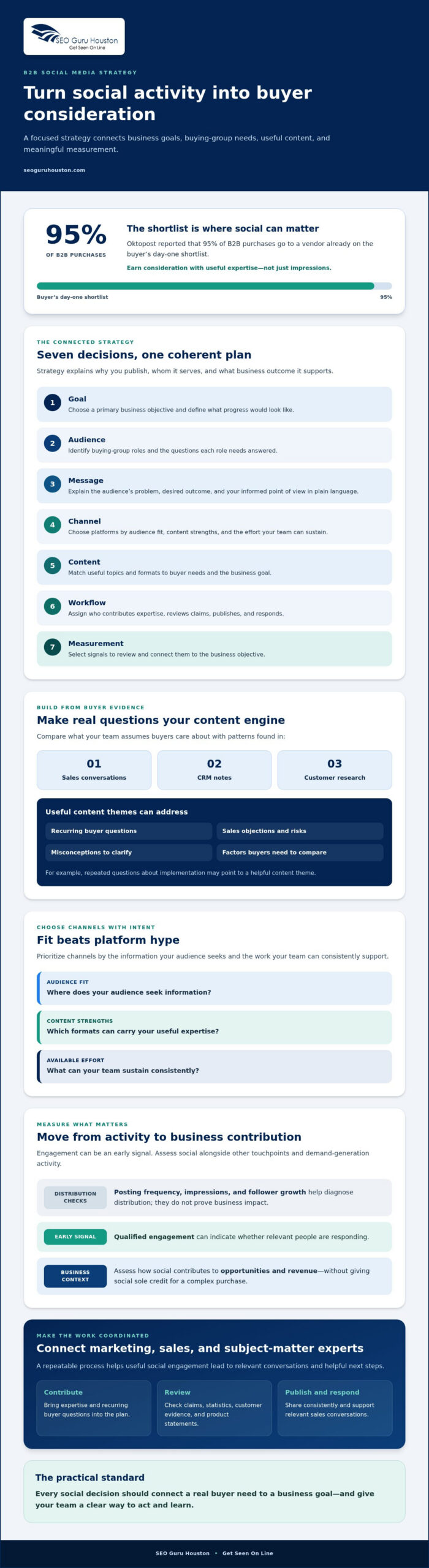
What if your social media presence helped buyers shortlist your company before they ever spoke with sales? Oktopost reported in June 2026 that 95% of B2B purchases go to a vendor already on the buyer’s day-one shortlist. A social media strategy for b2b companies should help earn that consideration, not just collect impressions. Yet it’s easy to spread a small team across too many platforms, publish without a clear audience, and struggle to connect engagement with opportunities or revenue.

You’re right to expect more from social than a steady stream of posts. The challenge is building a focused approach that supports how buying groups research, compare, and validate potential vendors, while giving your team a practical way to create and distribute useful content consistently.

This guide shows you how to prioritize platforms around your audience and business goals, shape an editorial focus, and establish a repeatable content workflow. You’ll also learn how to track meaningful pipeline signals alongside engagement, so you can assess social activity in the context of demand generation and broader digital marketing.

Key Takeaways

  • Build a social media strategy for b2b companies around business goals, buying-group needs, and clear measures of success.
  • Turn customer questions and sales objections into useful content themes your team can plan and publish consistently.
  • Choose channels based on audience fit, content strengths, and available effort, not platform hype.
  • Track qualified engagement as an early signal, then assess how social contributes to opportunities and revenue.
  • Coordinate marketing, sales, and subject-matter experts so social engagement leads to relevant conversations and helpful next steps.

What a B2B Social Media Strategy Must Accomplish

A social media strategy is more than a decision to post regularly. A B2B social media strategy is a set of connected decisions about business goals, buying groups, channels, content, resources, and measurement that guides how social supports growth. A publishing calendar tells your team what goes out and when. Strategy explains why it matters, whom it serves, and what outcome it should support.

That distinction keeps activity from becoming the goal. Posting frequency, impressions, and follower growth can help diagnose distribution, but they don’t prove social is moving the business forward. Define the outcomes first, such as helping the right buyers discover your company, building trust through useful expertise, supporting consideration, giving sales relevant material for conversations, or staying helpful to existing customers.

Start with business goals and buying-group needs

Choose one primary business objective before selecting platforms or formats. Then map the people involved in a purchase, including decision-makers, influencers, and others who shape evaluation. What do they need to understand? Which objections or risks slow a decision? A social media strategy for b2b companies becomes more focused when it answers real buying questions instead of assuming every audience wants the same message.

Separate assumptions from evidence. Compare what your team thinks buyers care about with patterns in sales conversations, CRM notes, and customer research. If prospects repeatedly ask how implementation works, for example, that may point to a useful content theme. Keep the objective specific enough to guide choices, but broad enough to address the buying group’s different information needs.

Set a realistic role for social media

Social can help buyers discover your expertise, encounter consistent messages, learn about a problem, and find relevant resources. It can also support sales conversations and customer retention when teams share useful, timely information. As a foundation, this overview of social media marketing explains the broader practice; a B2B strategy connects it to a defined audience and business purpose.

Keep expectations grounded. Organic social can influence a complex purchase without being the only source a buyer encounters, so it rarely deserves sole credit for a conversion. Measure its contribution alongside other touchpoints and demand-generation activity. A broader B2B demand generation framework can help show how social fits with channels and follow-up that support demand capture. The aim is not to claim every win for social. It’s to make social’s role clear, useful, and measurable.

Build a B2B Social Media Strategy Around Audience, Message, and Content

Once the business objective is clear, turn it into a plan your team can execute. A strong social media strategy for b2b companies connects what buyers need to know with what your business needs to accomplish. Use this sequence to keep the decisions connected:

  • 1. Goal: Choose the primary business objective and define what progress would look like.
  • 2. Audience: Identify the buying-group roles you need to reach and the questions each role asks.
  • 3. Message: State the audience’s problem, the outcome they want, and your informed point of view in plain language.
  • 4. Channel: Select platforms based on where your audience seeks information and which formats your team can sustain.
  • 5. Content: Match useful topics and formats to buyer needs and the goal.
  • 6. Workflow: Assign who contributes expertise, reviews claims, publishes, and responds.
  • 7. Measurement: Decide which signals you’ll review and how they relate to the business objective.

Translate buyer research into a clear message

Make the message specific enough to guide content, but not so broad it could belong to any company. Ask subject-matter experts and sales teams to surface recurring questions, misconceptions, and objections. Then check those ideas against sales conversations, CRM notes, and customer research. A useful post might explain a complex decision factor, address a common concern, or clarify what buyers should compare.

A B2B social content plan should reflect the questions buyers actually ask, so every post helps them make a better-informed decision. Keep claims precise. Verify statistics, customer evidence, and product statements before publishing, and don’t present an illustrative example as a customer result.

Create content pillars and a workable publishing system

Group ideas into a small set of recurring themes tied to audience needs and business priorities. For example, a team might organize content around expert insights, educational resources, customer proof approved for use, and carefully selected material from credible sources. Each type has a different job: original insight builds perspective, education answers questions, verified proof provides evidence, and curation adds useful context.

Choose formats to fit the message, not a trend. Expert commentary can unpack a timely issue; short video can make a process easier to understand; documents can organize a practical checklist; discussion prompts can invite relevant questions. Set a realistic production rhythm, name contributors and reviewers, and repurpose strong ideas thoughtfully rather than posting filler to meet a quota. For a complementary approach to connecting useful content with buyer needs, explore B2B inbound marketing.

Choose B2B Social Media Channels by Buyer Fit, Not Hype

The strongest channel isn’t automatically the one with the loudest buzz or the biggest reported audience. It’s the one your buying group uses for relevant information, where your team can contribute credibly and consistently. LinkedIn can support professional discovery and conversation, but that doesn’t make it the default choice for every B2B buyer. Validate assumptions against customer research, sales feedback, and the channels prospects mention during evaluation.

Assess platform fit before committing resources

Compare each channel against four practical questions: Are decision-makers and influencers there? Does the platform suit the content you can produce well? How much effort will consistent participation require? What business role could it support? The table is a starting point, not a universal ranking. Confirm fit with evidence from your own audience.

Channel Potential audience fit Content fit Relative effort Possible goal
LinkedIn Buyers who use professional networks for industry information and discussion Expert commentary, company perspectives, useful documents, conversation prompts Moderate, with regular input from knowledgeable contributors Discovery, credibility, and professional conversation
YouTube Buyers who seek in-depth explanations or demonstrations Educational explainers, interviews, walkthroughs High if planning, production, and review exceed team capacity Education and consideration
Reddit or specialist communities People who seek peer discussion or answers in topic-focused spaces Detailed responses, practical insights, careful participation Moderate to high, depending on the research and engagement required Listening, discovery, and trust through relevant participation

Effort depends on your team, not just the platform. A subject expert who enjoys explaining technical topics may make video a workable choice; a lean team without production capacity may get more from focused written contributions. Start with a manageable channel set. Expand only when buyer evidence supports it and you can maintain quality without weakening existing efforts. For teams that need external expertise to establish and maintain a consistent digital footprint, consulting marketing specialists like cornerstone-ms.co.uk can help bridge the resource gap.

Match channel roles to the wider buyer journey

Think of social as a route into useful information, not the whole journey. A post can introduce a problem or explain an idea; a relevant resource on your site can provide depth and a clear next step. Coordinate social distribution with search, paid campaigns, and conversion-focused landing pages so each touchpoint supports the same message. For campaign traffic, use the high-converting landing page guide to consider how the destination can support the action you want visitors to take.

Keep testing disciplined: define what evidence would justify continuing, adjusting, or adding a channel. That turns platform selection from guesswork into a practical decision within your social media strategy for b2b companies.

B2B Social Media Strategy: A Practical 2026 Guide

Launch, Measure, and Improve Your B2B Social Media Strategy

A social program becomes measurable when the team agrees on what it’s trying to change and how it will review progress. Use a simple launch sequence to establish that discipline before activity scales:

  • 1. Set a baseline. Record current performance for the channels and business indicators tied to your objective. Note how the data is defined and where it comes from.
  • 2. Assign ownership. Name who plans content, approves claims, publishes, monitors responses, and shares relevant activity with sales.
  • 3. Build the calendar. Schedule themes and formats your team can sustain, leaving room to respond to timely questions and conversations.
  • 4. Configure tracking. Use consistent UTM parameters on campaign links where appropriate, and confirm that the destination page and analytics setup can capture relevant visits. Record useful context in CRM records when the process supports it.
  • 5. Set a review cadence. Choose a regular interval for checking early signals and a longer window for assessing outcomes that take time to develop.
  • 6. Iterate with evidence. Keep what supports the objective, refine what shows promise, and stop activity that consumes effort without a clear role.

Choose KPIs that reflect the strategy’s objective

Match a small set of indicators to the goal, then define the measurement period and what counts. Qualified comments, relevant conversations, resource visits, or responses from target roles can serve as leading indicators. Reach and engagement help diagnose whether content is being seen and prompting a response, but they don’t automatically demonstrate pipeline contribution.

Opportunities, progression through CRM stages, and revenue are lagging outcomes. Review these alongside campaign data and sales feedback where available. UTM parameters can identify some visits or conversions associated with tagged links, but they can’t capture every influence: buyers may see a post, discuss it internally, and return through another channel. Social reporting can show contribution and patterns, but it isn’t proof that social alone generated the revenue.

Run focused experiments and adjust the plan

Test one meaningful variable at a time, such as the audience, format, message, or call to action. Write down the hypothesis, observation window, result, and decision before repeating the test. If you change several elements at once, it’s harder to tell what affected the outcome.

Use Google Analytics 4 and CRM reporting only when they’re configured, relevant to the question, and verified by your team. Keep measurement practical. If your team needs support connecting social media marketing with broader demand generation, explore coordinated marketing support.

Turn Your B2B Social Media Strategy Into Coordinated Demand Generation

Social earns more value when it connects to what happens next. A useful post can introduce a challenge, an educational resource can help a buyer explore it, and a sales conversation can address the questions that follow. Treat each interaction as part of a connected path, not a demand-generation result on its own.

Connect social content to a useful next step

Match the call to action to the reader’s readiness. Someone encountering your company for the first time may benefit from an educational guide; a buyer comparing options may need a detailed resource or a relevant conversation with your team. Avoid asking every reader for the same commitment. The next step should feel like a logical continuation of the content.

Make sure the destination page delivers on the post’s promise. It should clearly identify who the resource is for, what the visitor will find, and what they can do next. Coordinate social campaigns with inbound marketing so posts, useful resources, and follow-up support a consistent experience instead of treating every post as a standalone lead generator.

Make the handoff clear

Set expectations for what happens when someone engages. Marketing can identify relevant interactions and share context; sales can decide whether a direct response is appropriate; subject-matter experts can clarify technical questions or contribute accurate answers. Define who owns each handoff and what information to pass along, such as the content viewed, the question asked, or the buyer’s stated need. A timely, relevant response builds on the interaction without assuming every like or comment signals purchase intent.

Before assigning ownership, check your internal capacity across strategy, creative, publishing, analytics, and subject expertise. Keep the work in-house where responsibilities and time are clear. If coordinating channels or interpreting measurement exceeds that capacity, outside support may help align social media marketing with B2B marketing, demand generation, PPC, and website or landing-page services. The agency offers these services as potential parts of a coordinated digital approach.

Use this action checklist

  • Connect each content theme to a buyer need and a business priority.
  • Choose a next step that fits the reader’s readiness, then make the destination page clear and relevant.
  • Agree on how marketing, sales, and subject-matter experts will route and respond to meaningful engagement.
  • Review ownership and capacity before expanding channels or publishing commitments.
  • Assess social alongside other demand-generation activity, without assigning it sole credit for a complex conversion.

Ready to connect social activity with a broader B2B marketing plan? Build a stronger B2B digital marketing strategy with support aligned to your business goals.

Turn Your Social Strategy Into Measurable Momentum

A focused social media strategy for b2b companies starts with business goals and buyer needs, then turns them into channel choices and useful content your team can sustain. Prioritize platforms based on evidence, not hype. Measure qualified engagement as an early signal, then review how social activity connects with opportunities and revenue without claiming sole credit for complex buying decisions.

The next step is coordination. Connect social posts to relevant resources, align marketing and sales on useful follow-up, and make sure each channel supports the wider demand-generation journey. If your team needs help bringing those pieces together, the agency offers social media marketing, B2B marketing, demand generation, SEO, PPC, website development, and landing-page capabilities that can support a coordinated digital approach.

Build a stronger B2B digital marketing strategy around your audience and business goals. Start with a clear objective, keep learning from buyer signals, and give your team a practical plan to move forward with confidence.

Frequently Asked Questions

What is a social media strategy for a B2B company?

A B2B social media strategy connects business objectives with buyer audiences, channel choices, messaging, content, team responsibilities, and measurement. It defines what social should help accomplish and how the company will assess progress. Unlike a posting calendar, it explains why the company publishes, whom it serves, and how social supports the wider buying journey. For example, a strategy might use expert content to answer buyer concerns and guide interested readers to a relevant resource.

Which social media platform is best for B2B companies?

There’s no single best platform for every B2B company. LinkedIn may suit professional conversations and business-focused content, while YouTube may fit audiences that prefer video explanations. Other channels can make sense if buyers use them to research relevant topics. Choose based on evidence about your audience, the content your team can produce credibly, your business goals, and available capacity. Test assumptions with a focused effort before committing substantial resources to a channel.

How often should a B2B company post on social media?

Post at a pace your team can sustain while keeping content useful and relevant. The right frequency depends on audience expectations, available resources, and how much time it takes to create and review quality content. Set a realistic cadence rather than publishing simply to fill a calendar. Then assess whether the schedule helps you reach the intended audience and learn from performance. Adjust if consistency begins to compromise quality or strain team capacity.

How do B2B companies measure social media strategy results?

Start with the strategy’s objective, then choose a small set of indicators that show progress. Reach and engagement can reveal whether content attracts attention, while qualified visits, conversions, CRM activity, and sales feedback add business context. Use consistent tracking, including UTM parameters on campaign links where appropriate. Attribution has limits: social may influence a long buying journey without being the only measurable source. Review patterns across channels instead of assigning every outcome to one post.

Can social media generate leads for B2B companies?

Yes, social can contribute to B2B lead generation by helping relevant buyers discover useful expertise and take a meaningful next step. Its contribution depends on audience fit, messaging, content, the destination experience, and follow-up. Not every interaction indicates purchase intent, and not every lead is ready for sales. Define qualification criteria, connect campaign posts to relevant landing pages, and make sure appropriate CRM processes help your team track and respond to interest.

What content should B2B companies post on social media?

Share content that answers genuine buyer questions and demonstrates useful expertise. Options include expert commentary, educational resources, product or service explanations, short videos, event insights, and customer evidence when its facts are verified and use is approved. Organize topics into a few recurring themes tied to audience needs. Match each post’s format and next step to its purpose, and avoid unsupported claims. A practical explanation of a common sales objection can be more useful than a generic promotional update.

How long does it take for a B2B social media strategy to work?

There’s no universal timeline for a B2B social media strategy to work. Timing depends on your starting audience, sales cycle, content quality, publishing consistency, and ability to distribute content and follow up. Qualified engagement may show up before measurable pipeline influence. Establish a baseline, set review periods that reflect your buying cycle, and look for trends across activity rather than judging the plan by one post. Use what you learn to refine the strategy over time.

B2B Video Marketing Agency: Dominate Your Market and Explode Revenue in 2026

Most B2B companies are still treating video like an expensive digital brochure, wasting thousands on “cinematic” fluff that fails to move the needle. By 2026, if your video strategy isn’t the primary infrastructure of your revenue engine, you’re essentially invisible to your market. Finding a b2b video marketing agency that actually understands your complex sales cycle is the difference between market dominance and total irrelevance.

It’s frustrating to watch your budget disappear into high-production videos that get zero views or fail to explain your technical SaaS or industrial products. You’ve likely struggled to measure the direct impact of these assets on your sales pipeline, making video feel like a luxury rather than a necessity. We’re here to change that. You’ll learn how to transform video from a creative expense into a high-octane demand generation engine that drives measurable B2B growth. This guide provides a clear strategy for video at every funnel stage, showing you how to increase landing page conversions and shorten sales cycles through better-educated prospects. It’s time to stop guessing and start winning.

Key Takeaways

  • Stop burning budget on “safe” corporate videos that fail to convert and start building the essential video infrastructure 2026 buyers demand.
  • Learn how a specialized b2b video marketing agency builds a strategic ecosystem that maps high-converting content to every stage of your specific buyer journey.
  • Discover the critical metrics that separate creative boutiques from true growth partners, ensuring your video assets drive measurable ROI rather than just vanity views.
  • Identify and bridge revenue gaps in your current strategy by integrating technical marketing mastery with world-class video production for maximum impact.
  • Shorten your sales cycles and explode revenue by transforming complex technical products into clear, demand-generating assets that educate prospects before they ever talk to sales.

The Brutal Reality of B2B Video Marketing in 2026

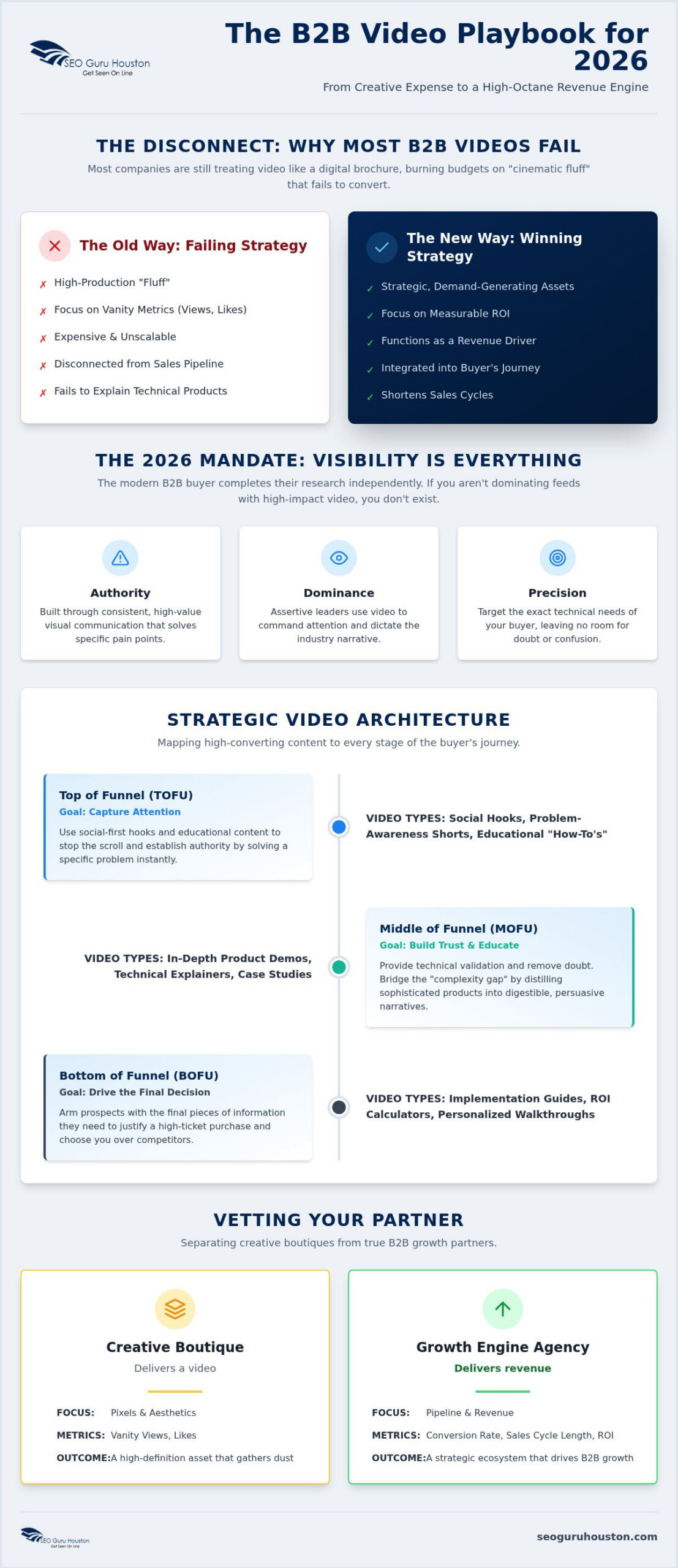
Playing it safe is the fastest way to go bankrupt. If your current video strategy consists of a shaky “about us” video and a few generic testimonials, you’re handing your market share to competitors on a silver platter. The modern industrial and SaaS landscape is digital-first, and the 2026 B2B buyer is more cynical than ever. They don’t want a cold call; they want a demonstration of value. A high-performance b2b video marketing agency isn’t just a production house. It’s a strategic revenue partner that builds the digital infrastructure your sales team needs to survive.

The Death of the Traditional Sales Deck

The days of “let’s hop on a discovery call” are over. Buyers now complete the majority of their research independently. They use video to vet your technical expertise and product functionality long before they hit your demo button. By applying core social video marketing principles to your technical content, you meet prospects where they are: scrolling, searching, and comparing. Video content now handles the heavy lifting of awareness, consideration, and technical validation. Prospects who engage with video are often more qualified and ready to close. The Video-First Sales Cycle for 2026 is an automated, content-driven journey where video assets educate, qualify, and convert prospects before a human salesperson ever enters the chat.

Why Invisibility is Your Biggest Revenue Killer

Invisibility is a choice. If your brand isn’t dominating search results and social feeds with high-impact video, you simply don’t exist in the mind of the buyer. Competitors are already using aggressive video strategies to intercept your high-intent traffic. They’re answering the technical questions your prospects are asking while you’re still drafting a PDF brochure. You must transition from a passive brand to an assertive market leader to maintain relevance.

  • Authority: Built through consistent, high-value visual communication that solves specific pain points.
  • Dominance: Assertive leaders use video to command attention and dictate the industry narrative.
  • Precision: High-impact video targets the exact technical needs of your buyer, leaving no room for doubt.

Partnering with a specialized b2b video marketing agency ensures your technical products are translated into compelling, revenue-driving assets. Stop being a spectator in your own industry. Move from invisibility to prominence by making video the backbone of your demand generation engine. If you aren’t visible, you aren’t an option.

Strategic Video Architecture: Beyond High-Definition Fluff

Resolution is a vanity metric. If your video is shot in 8K but lacks a demand generation strategy, you’re just making high-fidelity noise. A results-driven b2b video marketing agency focuses on the architecture of the funnel, not just the pixels on the screen. While your competitors are busy arguing over lighting setups and lens choices, you should be focused on how each frame contributes to your bottom line. We build video ecosystems that don’t just look professional; they function as a primary revenue driver.

The complexity gap is where sales go to die. Industrial and technical products often fail to gain traction because prospects can’t visualize the solution or understand the ROI quickly enough. Strategic video architecture solves this by distilling technical sophistication into digestible, persuasive narratives. It’s about using the science of high-converting explainers to bridge that gap, ensuring your technical superiority is obvious within the first thirty seconds. If you aren’t using video to simplify the complex, you’re making it harder for your customers to buy from you.

TOFU: Capturing Attention in a Saturated Market

Executives are busy, cynical, and constantly bombarded with low-value content. Your top-of-funnel strategy must position you as the definitive guru immediately. This requires a social-first approach for LinkedIn and professional networks that leads with a “hook” strong enough to stop the scroll. We focus on educational content that solves a specific problem before asking for a single minute of a prospect’s time. By delivering instant value, you build the authority needed to move them to the next stage of the journey.

MOFU and BOFU: Driving the Final Decision

Conversion happens when doubt is removed. Middle and bottom-of-funnel videos serve as the technical validation your prospects need to justify a high-ticket purchase. Case study videos turn abstract client success into undeniable, persuasive evidence, while product demos handle common objections before they’re ever raised in a sales meeting. Integrating these high-impact assets into your high converting landing page design creates a frictionless path to revenue. When video and landing page strategy work in tandem, you don’t just capture leads; you educate them until they’re ready to close.

Success in 2026 requires more than just “making a video.” It requires a comprehensive demand generation engine. If you’re ready to stop wasting budget on creative fluff and start building a high-octane growth tool, it’s time to partner with a b2b video marketing agency that speaks the language of ROI.

Creative Boutique vs. Growth Engine: Vetting Your Partner

Hiring a video production company that doesn’t understand the nuances of B2B is a recipe for expensive failure. Most agencies focus on aesthetics, lighting, and “storytelling” without ever mentioning your sales pipeline. While a creative boutique might deliver a visually stunning asset, a true b2b video marketing agency delivers a growth engine. If your partner can’t explain how their content integrates with your CRM or shortens your sales cycle, you’re just buying art. You don’t need art; you need revenue.

Technical industry expertise is a non-negotiable requirement. If an agency doesn’t understand the difference between a load balancer and a cloud-native API, they can’t sell your product to a CTO. They’ll produce fluff that your technical buyers will see through in seconds. You must vet your partner on their ability to grasp complex industrial or SaaS concepts. Ask them: “How do you translate our technical specifications into a narrative that drives demand?” If they look confused, walk away immediately.

Production Quality vs. Marketing Strategy

A beautiful video with no distribution strategy is a failed investment. It’s that simple. You should evaluate an agency’s understanding of demand generation versus simple lead generation. Lead gen gets you an email address; demand gen builds the desire to buy. Your creative must be data-driven rather than based on “artistic” intuition. We prioritize key metrics like ROI, conversion rate increases, and pipeline velocity over vanity metrics like view counts. High views on a video that attracts the wrong audience are worthless.

The Full-Stack Advantage

The most effective video assets don’t exist in a vacuum. Your video agency must understand how their work fits into a larger technical marketing ecosystem. This includes a deep knowledge of professional seo services to ensure your content is actually discoverable. If your video isn’t optimized for technical search visibility, it won’t reach the high-intent prospects you’re targeting. A growth-focused b2b video marketing agency ensures seamless integration with your PPC campaigns, social media strategy, and inbound marketing efforts. This full-stack approach transforms a single video into a multi-channel revenue generator that works 24/7. Don’t settle for a partner who only knows how to hit “record.” Demand a strategist who knows how to win.

B2B Video Marketing Agency: Dominate Your Market and Explode Revenue in 2026

High-Impact Implementation: Where Video Meets Demand Gen

Implementation is where the pretenders are separated from the market leaders. You don’t need more “content”; you need a repeatable framework that turns viewers into high-intent leads. A high-performance b2b video marketing agency follows a rigorous five-step process to ensure every frame contributes to your bottom line. Stop guessing and start executing with precision.

  • Step 1: Audit and Gap Analysis. We identify where your sales pipeline is leaking. If you have traffic but no conversions, you have a trust gap that only video can bridge.
  • Step 2: Buyer Journey Mapping. We map specific video assets to every stage of your buyer’s journey, ensuring the right message hits at the right time.
  • Step 3: Landing Page Optimization. We embed high-impact video into your service pages to increase engagement and skyrocket conversion rates.
  • Step 4: Assertive Distribution. We push your content through a dominant inbound marketing strategy for b2b that captures demand where it lives.
  • Step 5: Data-Driven Iteration. We analyze real-time engagement and pipeline data to refine your strategy, doubling down on what drives revenue.

Industrial and Manufacturing Specifics

For those in heavy industry, the challenge is visualizing the invisible. The best industrial b2b marketing agencies use video to pull back the curtain on proprietary processes and complex machinery. In high-ticket partnerships, trust is the only currency that matters. Video allows you to demonstrate technical superiority and operational scale, proving you have the infrastructure to handle enterprise-level demands before the first site visit even happens.

Maximizing ROI with Video SEO

Visibility is not an accident. To dominate 2026 search results, your video assets must be technically optimized with proper schema markup. This ensures search engines understand your content, giving you a massive advantage in video search results. Video serves as a high-engagement anchor that reduces bounce rates on critical service pages by providing immediate, visually digestible answers to complex technical queries. When users stay longer, your rankings climb. This creates a powerful feedback loop of visibility and authority that your competitors simply cannot match. If you’re ready to stop being invisible and start dominating your niche, it’s time to build your demand generation engine with the experts.

The SEO Guru Edge: Integrating Video into a 10x Growth Engine

Choosing a generic production house is a choice to remain average. To dominate your sector, you need a b2b video marketing agency that operates at the intersection of cinematic quality and technical marketing mastery. We don’t just produce content; we engineer high-performance assets designed to integrate seamlessly into a broader revenue engine. While others focus on the “feel” of a video, we focus on the data that proves its value. It’s the difference between a creative expense and a strategic investment.

Our “no-fluff” approach is built on a simple premise: if it doesn’t drive measurable B2B revenue growth, it doesn’t belong in your strategy. We’ve seen too many industrial and SaaS companies waste massive budgets on “cinematic” projects that never reach their target audience. We solve this by ensuring every video is backed by a rigorous distribution plan and technical SEO optimization. You’re no longer just a spectator in your market. You’re the dominant force setting the pace.

The Guru Methodology

Success in complex B2B markets requires a specific type of aggression. Our methodology combines deep technical expertise with a high-energy business strategy that leaves nothing to chance. We specialize in turning “boring” or highly technical topics into high-performance video assets that command attention and build immediate authority. Whether it’s a proprietary manufacturing process or a complex software architecture, we translate your technical superiority into a language your buyers understand. Our commitment is to your market dominance and your financial return. We don’t settle for “good enough,” and neither should you.

Take Decisive Action

Every day you wait is another day you’re bleeding revenue to more assertive competitors. Outdated marketing tactics are a liability in 2026. The first step to a high-converting, video-first strategy is acknowledging that your current approach isn’t enough. You need a partner that understands the high-stakes reality of industrial commerce and the technical nuances of modern search ecosystems. It’s time to stop hoping for growth and start demanding it. Scale your revenue with SEO Guru today! The market won’t wait for you to catch up; take the lead now.

Claim Your Market Dominance with a Video-First Strategy

The window for passive marketing is closing fast. If you aren’t leading with high-impact video assets, you’re losing high-intent prospects every single day. We’ve detailed how a specialized b2b video marketing agency transforms technical complexity into a high-octane revenue engine. It’s about moving from invisibility to a position of absolute authority by integrating video into every stage of your sales funnel. You’ve seen the framework; now it’s time to execute with precision.

Since 2017, SEO Guru has served as the results-oriented growth partner for industrial and manufacturing market leaders. We are specialists in demand generation who understand that your success depends on measurable ROI rather than vanity metrics. Our proven track record of scaling B2B revenue ensures that your video strategy becomes a fundamental necessity for growth, not a creative expense. You have the choice to remain a spectator or become the dominant force in your niche. Your transformation starts with a single, assertive decision.

Dominate Your Market—Partner with SEO Guru Now!

The future of your industry belongs to the bold. Let’s build your high-performance growth engine today and ensure your business doesn’t just survive but leads the market in 2026. Success is waiting for those ready to take action.

Frequently Asked Questions

What should I look for in a B2B video marketing agency?

Look for a partner that prioritizes demand generation over simple production quality. You need an agency that understands your technical sales cycle and can translate complex industrial products into persuasive revenue assets. Ensure they have a proven track record of integrating video with high-converting landing pages. If they don’t talk about ROI or pipeline velocity, they’re just a production house, not a strategic growth partner.

How much does B2B video production typically cost for an industrial company?

Costs vary based on technical complexity and project scope. A high-performance strategy often involves multiple assets mapped to different funnel stages rather than a standalone clip. Instead of looking for the lowest price, evaluate the potential return on investment. Professional video marketing is a strategic investment in your digital infrastructure that should be budgeted based on your revenue growth goals. We focus on results that justify the spend.

Can video marketing really drive leads for a “boring” B2B product?

Absolutely. There’s no such thing as a boring product when you focus on solving high-stakes problems for your buyers. Video is the most effective tool for bridging the complexity gap in industrial marketing. It allows you to visualize proprietary processes and demonstrate technical superiority in seconds. By providing clear, visual answers to technical questions, you build the trust necessary to drive high-intent leads for even the most specialized products.

How do I measure the ROI of my B2B video campaigns?

Stop looking at vanity metrics like view counts and start tracking pipeline impact. A true b2b video marketing agency measures success through increased conversion rates on landing pages and shorter sales cycles. You should monitor how video consumption correlates with lead quality and deal velocity within your CRM. Real ROI is found in the measurable growth of your revenue engine, not in social media likes or impressions.

What is the ideal length for a B2B explainer video in 2026?

The ideal length depends on the stage of the buyer journey. Top-of-funnel social content should be punchy and value-driven, often under 60 seconds to stop the scroll. However, technical product demos or deep-dive explainers for mid-funnel prospects can run three to five minutes if the content remains highly relevant. Your focus should always be on information density rather than hitting a specific time stamp. If it’s useful, they’ll watch.

Does video marketing help with my search engine rankings?

Yes, it’s a critical component of modern technical search visibility. Video content significantly increases page dwell time, which sends a strong authority signal to search engines. When you implement proper technical schema markup, your videos can appear directly in search results, capturing more real estate. This high-engagement anchor reduces bounce rates on critical service pages, creating a feedback loop that consistently pushes your rankings higher than your competitors.

How often should a B2B company produce new video content?

Consistency is more important than sheer volume. You should aim to build a foundational ecosystem of evergreen assets first, covering your primary products and technical processes. Once your core funnel is supported, a regular cadence of educational or social-first content keeps your brand at the forefront of your prospect’s minds. A b2b video marketing agency can help you develop a sustainable content roadmap that maintains market dominance without burning your budget.

What is the difference between a video production company and a video marketing agency?

A production company focuses on the “what,” while a marketing agency focuses on the “why” and “how.” Production houses care about lighting, cameras, and aesthetics. In contrast, a marketing-focused partner integrates those visuals into a larger demand generation strategy. They ensure your video assets are optimized for SEO, mapped to the buyer journey, and designed specifically to explode your revenue. Don’t just hire someone to hit record; hire a growth strategist.

Small Business SEO Services: The Non-Negotiable Growth Engine for 2026

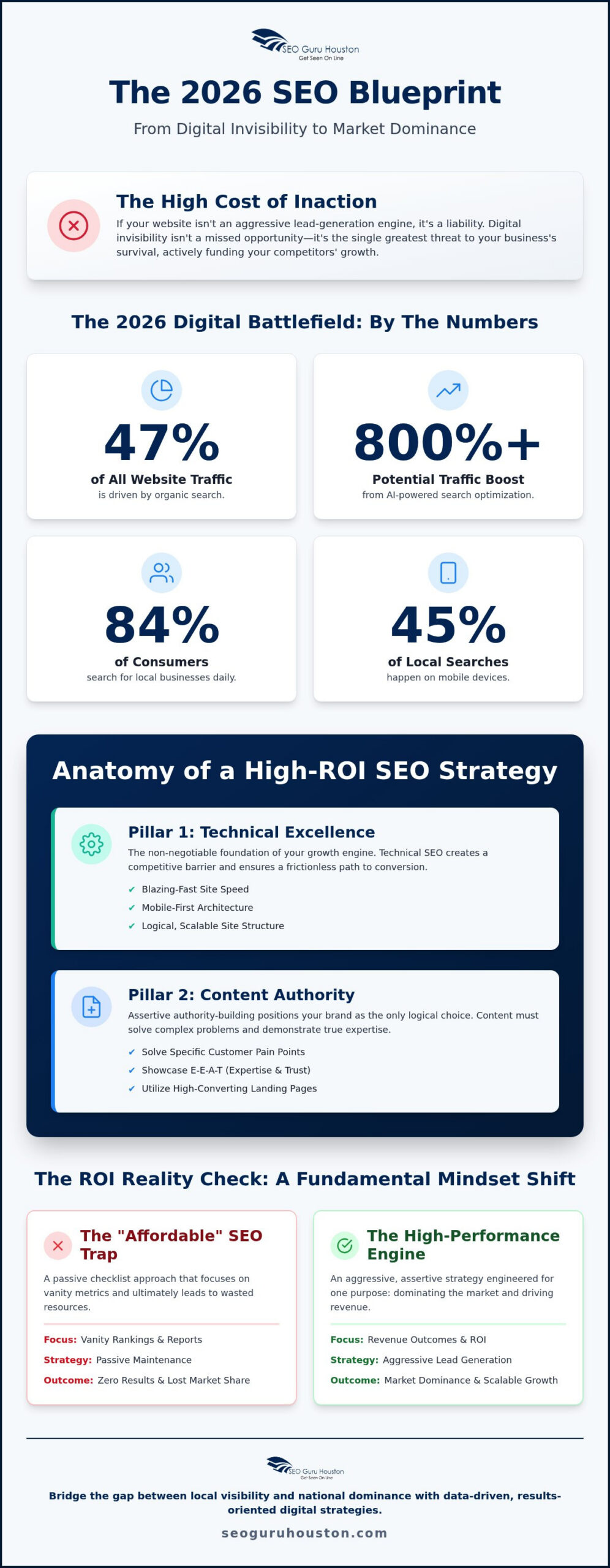
If your website isn’t actively hunting for market share, it’s nothing more than an expensive digital paperweight. You know your product is superior, yet you remain invisible while competitors capture the lion’s share of the digital market. It’s frustrating to get burned by low-cost agencies that deliver zero results and hide behind technical jargon you didn’t ask for. You need a strategy that translates directly into financial gain. By mastering small business SEO, you stop hoping for leads and start demanding them. Organic search drives nearly 47% of all website traffic in 2026. If you aren’t capturing that volume, you’re simply handing your revenue to the competition.

We agree that the digital landscape feels like a moving target, especially with AI-powered search platforms now capable of boosting traffic by over 800% for optimized sites. This article promises to strip away the fluff and show you how to transform your brand into a market-dominating revenue machine. We’ll preview the exact framework needed to navigate Generative Engine Optimization and precision targeting. Get ready to move from the sidelines to the center of the arena. It’s time to build a high-performance growth engine that doesn’t just survive; it dominates.

Key Takeaways

  • Reframe SEO from a passive digital checklist into an aggressive lead-generation engine that secures your market share against the threat of invisibility.
  • Master the “Content Authority” pillar by aligning technical site architecture with expert insights that solve specific customer pain points.
  • Discover why high-performance houston small business seo requires a growth partner focused on revenue outcomes rather than just monthly traffic reports.
  • Learn to implement a demand generation framework that uses high-converting landing pages to capture and scale assertive search behaviors.
  • Bridge the gap between local visibility and national industrial dominance using data-driven, results-oriented digital strategies.

Beyond Rankings: Why Small Business SEO is a Survival Necessity in 2026

In 2026, organic search drives nearly 47% of all website traffic. If you’re treating Search engine optimization (SEO) as a checkbox on a maintenance list, you’ve already lost the battle. High-performance houston small business seo is no longer about “ranking” for vanity terms. It is an assertive, high-stakes hunt for market share. Passive strategies that rely on hope are relics of the past. Today, you must deploy an aggressive lead-generation engine designed to intercept prospects at the exact moment of intent. Digital invisibility isn’t just a missed opportunity; it’s the single greatest threat to your business survival.

The Death of the “Good Enough” Digital Presence

A basic website is a digital brochure that nobody reads. In a market where 84% of consumers search for local businesses daily, “good enough” is a death sentence. Every day you remain on page two, you’re actively funding your competitor’s growth. You can calculate the cost of inaction by looking at your industry’s average lead value and multiplying it by the search volume you’re currently missing. If your site isn’t optimized for the 2026 search ecosystem, you’re essentially handing your revenue to the firm down the street. Small business SEO is a mandatory pillar of national demand generation that transforms your digital footprint from a liability into a high-performance asset.

From Invisibility to Absolute Market Dominance

Domination starts with a mindset shift. You don’t wait to be a market leader to rank like one. You rank like one to become the leader. When your brand appears at the top of search results, a psychological trigger occurs in the prospect’s mind. They equate visibility with authority and trust. This credibility is established before the first sales interaction even occurs. You need a high-performance strategist who understands business outcomes, not just a technician who tinkers with meta tags. The Guru perspective focuses on revenue-obsessed houston small business seo that bridges the gap between technical execution and rapid scaling. By adopting an assertive digital strategy, you ensure your brand isn’t just a participant in the market but the force that dictates it. Successful businesses in 2026 don’t wait for customers to find them; they build an infrastructure that makes finding them inevitable.

The Anatomy of a High-ROI Small Business SEO Strategy

A high-performance digital strategy isn’t a collection of random tactics. It’s a precision-engineered system designed for market conquest. In 2026, search engines don’t just look for keywords; they look for infrastructure and authority. If you want to dominate houston small business seo, you must stop thinking about rankings and start focusing on revenue. Your strategy needs to be a cohesive framework that captures intent and forces action. This requires a shift from passive maintenance to assertive, technical dominance.

Technical Excellence as a Competitive Barrier

Technical SEO is the foundation of your growth engine. If your site is slow, you’re losing money before the page even loads. Slow-loading websites are silent revenue killers. Google and other platforms prioritize speed and mobile-first design as non-negotiable standards. In 2026, 45% of consumers use Google as their primary tool for location-specific searches, almost exclusively on mobile devices. Your site architecture must be clean, logical, and built to support rapid national scaling. This isn’t just about passing a technical audit; it’s about creating a frictionless path to conversion. Savvy marketers use these technical foundations to attract traffic from search engines and ensure that traffic doesn’t bounce to a competitor.

Content That Commands Authority and Engagement

Generic blogging is a waste of resources. You need assertive authority building that positions your brand as the only logical choice. Content must solve complex customer pain points through expert, technical insights that demonstrate real-world experience. This is how you win in the age of E-E-A-T. Integrating high converting landing page design is essential to explode your engagement rates. You aren’t just writing for humans anymore. You’re optimizing for Large Language Models (LLMs) and AI search visibility. AI-powered platforms can increase website traffic by over 800% for sites that establish clear, structured authority. Target high-intent keywords that signal a customer is ready to pull the trigger immediately.

Every element of your strategy must feed into the demand generation funnel. SEO moves the user from a vague query to a definitive conversion. If your search presence doesn’t result in measurable leads, it’s failing your business. You need a strategy that bridges technical nuances with savvy business strategy to win at houston small business seo. For those ready to scale their impact, exploring professional Houston SEO services ensures every technical fix and content piece serves your bottom line. Stop settling for traffic and start demanding market share.

Affordable SEO vs. High-Performance Growth Partners: The ROI Reality Check

Cheap SEO is the most expensive mistake your business will ever make. If a provider offers you a “starter package” for a few hundred dollars, they aren’t building a growth engine; they’re managing your decline. Low-cost services rely on automated templates, offshore link farms, and outdated tactics that eventually trigger search engine penalties. You don’t need a vendor to check boxes. You need a growth partner who treats houston small business seo as a high-stakes investment in market share. The Guru warning is simple: if the service is too cheap, you are paying the price in lost revenue and missed opportunities. Domination requires resources, precision, and an assertive strategy that refuses to settle for page two.

Calculating the real ROI of your investment requires moving beyond surface-level spending. True ROI is measured by the delta between your total investment and the lifetime value of the leads generated. While foundational resources like the SBDC National Information Clearinghouse provide excellent overviews of getting noticed online, a high-performance partner weaponizes these basics to drive financial gain. You aren’t just buying traffic; you’re purchasing a predictable stream of revenue.

Vanity Metrics vs. Real-World Revenue Drivers

Ranking number one for a low-intent keyword is a vanity metric that wastes your budget. It might look good on a monthly report, but it doesn’t pay the bills. You need to distinguish between “empty traffic” and high-value conversions. Assertive strategy focuses on professional seo services that target qualified leads who are ready to buy. If your current agency spends more time talking about “impressions” than “sales,” it’s time to reevaluate your partnership. High-performance SEO isolates the queries that signal immediate intent and dominates those spaces with surgical precision.

The Long-Term Compound Value of Assertive Partnerships

Think of your digital presence as a compound interest account for your brand authority. Every technical fix and high-authority link builds a fortress around your market share. Month-to-month contracts often signal a lack of commitment; they suggest the provider isn’t confident in the long-term results they can deliver. You need a partner who understands the nuances of a b2b demand generation agency mindset. This approach ensures your houston small business seo efforts scale alongside your national ambitions. When you invest in high-caliber strategy, you aren’t just surviving the 2026 search ecosystem. You are owning it.

Small Business SEO Services: The Non-Negotiable Growth Engine for 2026

Implementing the Demand Generation Framework for Rapid Scaling

Rapid scaling doesn’t happen by accident. It requires a repeatable, data-driven framework that converts passive searchers into aggressive advocates for your brand. You must move beyond basic keyword targeting and start identifying high-value customer personas. These aren’t just demographic profiles; they are psychological blueprints of your ideal buyers. By understanding their assertive search behaviors, you can intercept them at the exact moment their pain points become unbearable. This is the core of houston small business seo that actually moves the needle. Stop guessing and start targeting the queries that indicate a high probability of conversion.

The Landing Page: Where Search Intent Meets the Sale

Sending high-intent traffic to your homepage is a tactical error. Your homepage is a generalist; high-intent SEO traffic needs a specialist. A dedicated destination removes distractions and focuses the user on a single, compelling action. This is why high converting landing page design is a non-negotiable requirement for market dominance. You need a layout that mirrors the user’s search intent perfectly. Use assertive CTAs that leave no room for ambiguity. Back your claims with heavy-hitting social proof and technical case studies. If your landing page doesn’t command immediate action, you’re just paying for your competitors to look better by comparison.

Video Marketing: The 2026 Engagement Multiplier

Engagement is the primary signal of quality in the 2026 search landscape. Website video marketing is the fastest way to build that engagement while reducing friction in the B2B sales process. Video content allows you to demonstrate expertise and authority in seconds. It’s a powerful tool for simplifying complex industrial solutions that would otherwise require pages of technical text. Integrating professional video into your inbound marketing strategy for b2b creates a psychological bond with the prospect. They see your face, hear your voice, and trust your process before they ever pick up the phone. Search engines notice when users linger to watch your content, rewarding you with higher authority and visibility.

Continuous Conversion Rate Optimization (CRO) is the final piece of the scaling puzzle. You must maximize every search visitor. Test your headlines; refine your lead capture forms; optimize your mobile site speed. If you’re ready to dominate your niche, it’s time to partner with a team that executes houston small business seo as a total demand generation system. Don’t just settle for traffic. Demand a revenue machine.

Dominating Your Market with SEO Guru Houston’s Result-Oriented Approach

SEO Guru Houston doesn’t operate like a passive agency. We are revenue-obsessed. Our philosophy is built on an aggressive, data-driven framework that bridges the gap between technical nuances and strategic, national business growth. If you want a vendor to manage your decline, look elsewhere. If you want a high-performance coach who treats your bottom line as the only metric that matters, you’re in the right place. We provide the assertive houston small business seo that transforms invisible brands into market-dominating forces. We don’t just fix websites; we build growth engines designed for national industrial dominance.

A Track Record of Assertive Success

We pride ourselves on discovering what high-value prospects actually search for. While others guess, we use data to uncover intent-heavy queries like “industrial lead generation” that signal a buyer is ready to commit. Positioning ourselves as a bold innovator isn’t a marketing gimmick. It’s a necessity in a 2026 landscape where digital trends shift overnight. The “Guru” in our name is a commitment to specialized knowledge. It means we stay ahead of AI search disruptions and algorithm shifts so you don’t have to. We’ve built a national track record of success by being more precise and more aggressive than the competition. When you partner with us, you gain access to a veteran team that understands the practical realities of commerce and scaling.

Your Assertive Blueprint for Market Dominance

Winning requires a structured path. Our results-oriented approach is built on three non-negotiable pillars:

  • Strategy: Identifying high-value personas and the assertive search behaviors that lead to revenue.
  • Execution: Deploying technical excellence, mobile-first optimization, and high-converting landing pages.
  • Scaling: Utilizing website video marketing and demand generation frameworks to capture national market share.

The time for hesitation is over. Every day you wait is another day your competitors solidify their hold on your potential customers. You have a choice: remain digitally invisible or take decisive action to claim your prominence. You’ve seen the data. You understand the stakes. High-performance houston small business seo is the engine that will drive your brand into a dominant 2026. Stop settling for a basic digital presence and start demanding financial return. Your market is waiting for a leader. Stop losing revenue and start dominating your search market today!

Claim Your Digital Prominence in 2026

The search ecosystem of 2026 demands more than just visibility; it requires absolute authority. You’ve seen how a high-performance demand generation framework turns search queries into revenue. By prioritizing technical excellence and high-converting landing page design, you move from being a participant to a market leader. Settling for low-cost, passive services is a gamble with your business survival. You need an assertive partner who treats houston small business seo as a non-negotiable foundation for national scaling.

As National B2B Demand Generation Experts, we bridge the gap between technical nuance and measurable financial gain. Our high-energy, results-oriented coaching philosophy ensures you aren’t just checking boxes but dominating your niche. We specialize in high-converting web development and ROI, delivering the strategic advantage your brand deserves. Don’t let your competitors capture the leads that belong to you. Take decisive action today to transform your digital footprint into a market-dominating revenue machine. It’s time to own your future.

Stop Guessing and Start Scaling: Get Your Assertive SEO Strategy Now!

Frequently Asked Questions

How much do small business SEO services typically cost in 2026?

Industry averages for single-location businesses generally range from $1,500 to $2,500 per month for entry-level packages. Established companies seeking mid-tier solutions often invest between $2,500 and $5,000 monthly to cover comprehensive link building and technical fixes. These figures reflect the resources required for assertive market conquest. While lower-cost starter plans exist, high-performance growth requires a budget that supports aggressive demand generation and expert content creation. Your investment must align with your revenue goals. To better understand how these professional budgets are structured, you can explore monthly management fees for SEO services from the team at Web Media Grp. to see how results-oriented agencies price their work.

Most businesses begin seeing measurable improvements in search visibility within 60 to 90 days of implementation. However, achieving a significant return on investment typically takes around six months of consistent, assertive strategy. This timeline allows search engines to index technical changes and recognize your growing brand authority. High-performance SEO is a compound interest account; the results accelerate as your foundation strengthens. Patience is required, but the eventual revenue lift justifies the initial lead time.

Can a small business really compete with national corporations in search results?

Small businesses can outmaneuver national corporations by leveraging agility and precision targeting. While large firms have massive budgets, they often lack the technical depth needed to dominate specific, high-intent niches. By focusing on expert insights and solving specific customer pain points, you build a level of authority that broad corporate content cannot match. This often involves leveraging niche platforms; for example, you can discover Aged Care Made Easy to see how specialized directories connect local providers with high-intent audiences. Assertive houston small business seo allows you to capture high-value traffic that big players often overlook due to their generalized approach.

A generic agency focuses on vanity metrics like keyword rankings and monthly traffic reports. In contrast, a demand generation partner is obsessed with your bottom line and financial gain. We bridge the gap between technical SEO and strategic business growth by focusing on lead quality and conversion. While a vendor might check boxes, a partner builds a high-performance engine designed to intercept prospects and force immediate sales action. It’s the difference between being seen and being profitable.

Is video marketing necessary for my small business website SEO in 2026?

Website video marketing is a non-negotiable engagement multiplier in 2026. Search engines prioritize sites where users linger, and professional video content is the fastest way to increase time-on-site. It reduces friction in the B2B sales process by building trust and demonstrating expertise in seconds. Integrating explainer videos into your inbound strategy signals quality to search algorithms while simultaneously warming up cold leads. If you aren’t using video, you’re leaving a massive engagement gap for competitors to fill.

What happens to my visibility if I stop investing in SEO services?

Digital invisibility is the immediate result of stopping your SEO investment. Search algorithms are constantly evolving, and your competitors aren’t pausing their hunt for your market share. When you stop, your technical foundation begins to decay and your content relevance drops. Rankings are not permanent; they are a reflection of active authority. If you stop feeding the engine, your traffic will stagnate and eventually plummet, handing your hard-earned revenue back to the competition.

How does AI search impact my small business website visibility?

AI search and Generative Engine Optimization (GEO) are reshaping how prospects find solutions. Optimizing your content to be cited in AI-generated summaries is now a critical survival tactic. AI-powered search platforms have been documented to increase website traffic by over 800% for sites that establish clear, structured authority. If your site isn’t optimized for these LLMs, you risk becoming invisible to users who rely on AI assistants for location-specific searches and technical recommendations.

Do I need to redesign my website to see significant results from SEO?

Not every project requires a total overhaul, but high-performance results often necessitate technical upgrades. If your current site is slow, lacks mobile-first design, or has a convoluted architecture, a redesign might be the only way to clear the path for growth. We focus on high-converting landing page design that integrates seamlessly with your demand generation framework. Significant results depend on a friction-free user experience that search engines reward through houston small business seo.