Tag Archives: conversion tracking

How to Build a Full-Funnel PPC Campaign Structure for B2B

Paid search can work for B2B, but a campaign built only to capture immediate leads can miss buyers who need time to evaluate a solution. The average B2B sales cycle involves 8 touchpoints, so a scalable ppc campaign structure for b2b should connect search intent, useful follow-up, and sales outcomes across the journey.

If clicks are coming in but qualified opportunities aren’t, the issue may be how campaigns are organized and measured, not simply how much you spend. B2B buying groups take time to research, compare options, and reach a decision. Your campaign needs to reflect that reality.

This guide shows you how to assess paid search for B2B, choose metrics that matter beyond clicks and form fills, and connect ad activity to conversions across longer sales cycles. Then you’ll learn how to organize campaigns around buyer intent and funnel stage, so you can identify what’s working and make smarter decisions about where to scale.

Key Takeaways

  • Match search, display, placements, keywords, and audience targeting to the buyers and intent you want to reach.
  • Look beyond clicks and form fills by tracking lead quality, pipeline progress, and revenue alongside campaign metrics.
  • Connect ad interactions to CRM outcomes so long sales cycles don’t make valuable campaigns look ineffective.
  • Build campaigns around funnel stage and buying intent, then use performance data to guide where to refine and scale.
  • Align ad messaging, landing pages, and follow-up so each touchpoint moves qualified prospects toward a decision.

Does paid search work for B2B?

Yes. B2B companies generate an average of $2 for every $1 invested in Google Ads, according to the market data in this brief. Gartner reports that complex B2B solutions typically involve buying groups of 6 to 10 decision-makers. Structure campaigns to reach their different questions, not just one lead form.

Google and Microsoft campaigns typically organize around search intent and keyword themes. LinkedIn Ads can target professional audiences by role and industry. Separate campaigns by buyer stage to tailor each message, then compare qualified outcomes across platforms.

Group keywords by intent first: brand, problem, solution, and comparison terms. Separate match types into different ad groups or campaigns when they need distinct budgets, messaging, or query controls. Mixing them too broadly can obscure which searches generate relevant leads.

Common risks include grouping unrelated services together, targeting too broadly, and judging success by clicks alone. A generic “business software” keyword may attract research traffic, while a solution-specific query can signal clearer intent. Review search terms and audience results to identify wasted spend.

  1. Define buyer personas before selecting placements. List each high-value persona by role, industry, and buyer stage. A finance leader comparing vendors needs different proof from an operations manager researching a workflow problem. Use those distinctions to choose search, display, or audience-based placements, and align each ad with a relevant landing page.
  2. Separate search campaigns by intent and theme. Build focused groups for brand terms, pain-point searches, solution categories, and competitor-comparison intent. Keep closely related keywords together, but separate themes when the offer or landing page changes. For example, “reduce invoice processing time” and “invoice automation platform” suggest related needs, but different stages of research.
  3. Match platform structure to its targeting strength. On Google Ads, organize around keyword themes and use available targeting such as demographics, location, device, and interests. Apply a similar search-intent structure in Microsoft Ads, then compare performance separately. On LinkedIn Ads, segment by role and industry, with distinct campaigns for awareness and active consideration.
  4. Use display and remarketing to reconnect. Build display audiences from meaningful site behavior, such as visiting a solution page or viewing a case study. Exclude converted leads when the message is no longer relevant. Remarketing campaigns often achieve conversion rates 50-100% higher than cold traffic campaigns, according to the market data in this brief.
  5. Review targeting and placements as one system. Check search terms, audience segments, and placement reports together. If an industry segment clicks but produces poor-fit leads, refine its message or targeting. Test search, display, and video formats against the same buyer need, then shift effort toward the placements that create sales-relevant engagement.

What metrics should be tracked in B2B paid ads?

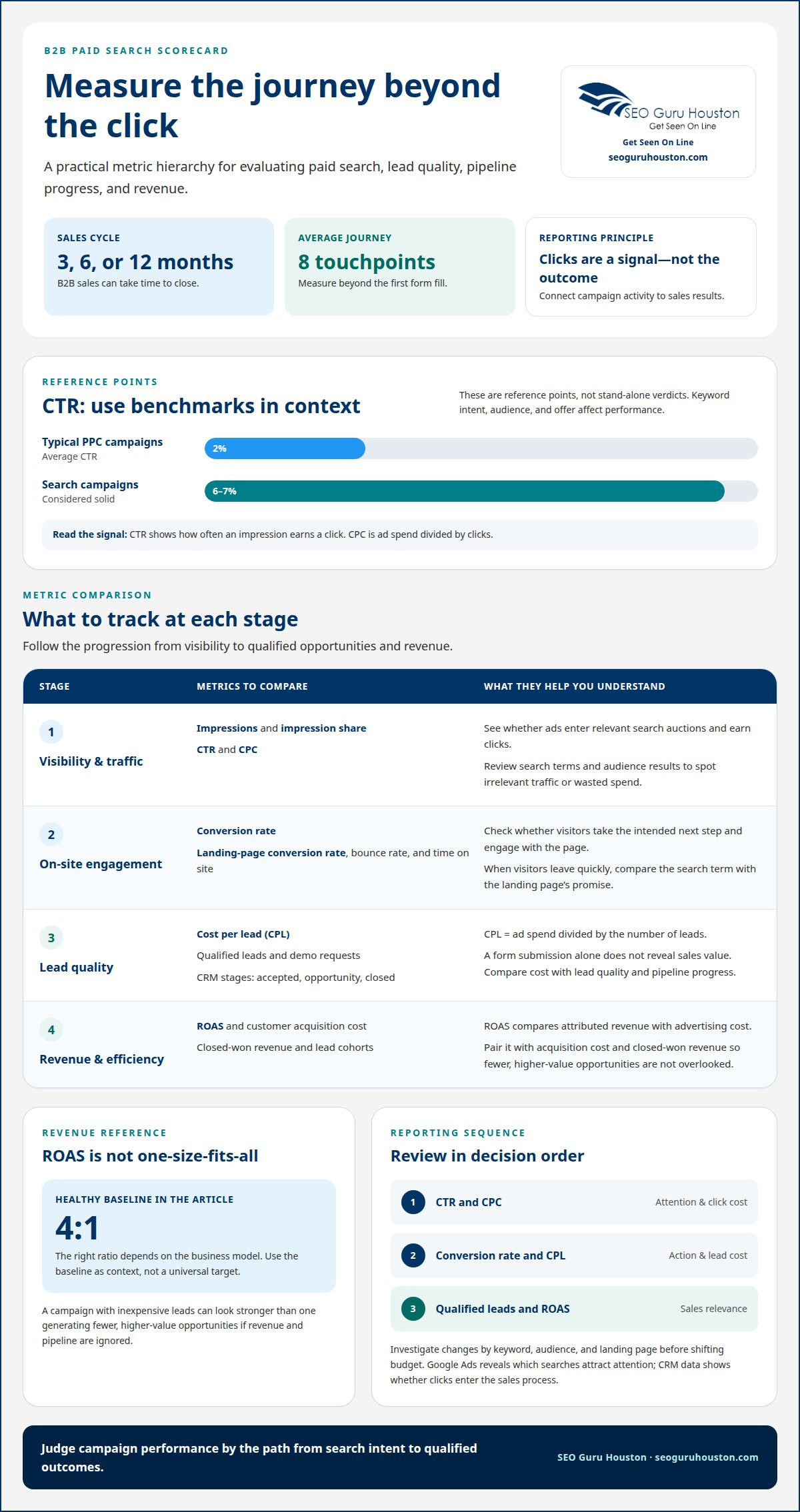
  1. Track the full path from impression to lead. Start with impressions and impression share to see whether Google Ads enters relevant Google Search auctions. Then measure click-through rate (CTR), cost per click (CPC), and conversion rate. CTR shows how often an impression earns a click; CPC is ad spend divided by clicks. A 6-7% CTR is considered solid for search campaigns, while the average CTR for typical PPC campaigns is 2%. Treat these as reference points, not isolated verdicts: keyword intent, audience, and offer all affect performance.
  2. Measure what happens after the click. Track landing-page conversion rate, bounce rate, and time on site to see whether visitors engage with the next step. If a campaign earns clicks but visitors leave quickly, compare the search term with the page’s promise. For example, an ad for a product demo should lead to a page that explains the demo and makes requesting one clear. Segment results by campaign, keyword, device, and demographics so strong averages don’t hide a weak audience or page.
  3. Separate lead volume from lead quality. Cost per lead (CPL) divides ad spend by the number of leads, but a form submission alone doesn’t reveal sales value. Track qualified leads and demo requests separately, then connect those records with CRM stages such as accepted, opportunity, and closed. Compare costs with lead quality and pipeline progress rather than treating an average as a universal target.
  4. Evaluate revenue against spend. Return on ad spend (ROAS) compares attributed revenue with advertising cost. A 4:1 ROAS is a healthy baseline, but the right ratio depends on the business model. Pair ROAS with customer acquisition cost and closed-won revenue; otherwise, a campaign generating inexpensive leads may appear stronger than one producing fewer, higher-value opportunities. Review results by campaign and lead cohort to identify which sources contribute to actual sales.
  5. Use a consistent review sequence. In each reporting cycle, compare CTR and CPC first, then conversion rate and CPL, followed by qualified leads and ROAS. Investigate changes by keyword, audience, and landing page before shifting budget. Google Ads data can show which searches attract attention; CRM data helps reveal whether those clicks enter the sales process. A clear metric hierarchy turns reports into decisions, not just dashboards.

Conversion tracking and attribution for long sales cycles

Track the journey beyond the first form fill. B2B sales can take 3, 6, or 12 months, with an average of 8 touchpoints.

  1. Set Up Conversion Tracking

    Record each meaningful action, from a landing-page inquiry to a sales-qualified lead and closed deal. Connect ad interactions with CRM stages so campaigns aren’t judged only by their earliest conversion. Check that each event fires once and maps to the right campaign. Don’t treat repeat visits or low-intent downloads as equivalent to sales opportunities. Digital marketing teams like Barlo Digital often emphasize starting with comprehensive tracking and measurement audits to ensure search data accurately reflects pipeline value.

  2. Preserve campaign context through the sales journey. Capture the campaign, keyword, and landing page associated with each lead, then retain that information as the record advances through sales stages. This lets you compare first-touch and later interactions without crediting every touch with a full conversion. For example, an initial search click may introduce a solution, while a later visit prompts a demo request.
  3. Assess Lead Quality and Conversion Costs

    Compare conversion volume with sales acceptance, opportunity creation, and closed revenue. Treat CTR and CPC as diagnostic signals, not final outcomes: strong click engagement can still produce poor-fit leads. Calculate cost per conversion for each meaningful milestone, then compare it with the resulting ROI. Don’t optimize for the cheapest form submission if those contacts rarely progress.

  4. Align the landing page with the tracked action. Keep the ad promise, page content, and conversion event consistent. A demo campaign should direct visitors to a page explaining the demo, with a clear call to action and a streamlined form. Track form completions separately from later qualification, so page tests improve lead generation without disguising low-quality submissions as success.
  5. Review attribution against actual sales outcomes. Compare platform-reported conversions with CRM opportunities and closed-won records by campaign and lead cohort. This shows why conversion counts need sales context: investigate lead sources, qualification, and follow-up before scaling spend.
  6. Use mature data to guide optimization. Long sales cycles delay revenue signals, so keep early indicators visible while opportunities progress. Review whether search terms reach the right accounts, whether landing pages generate qualified inquiries, and whether those leads advance. Use that evidence to refine targeting and messaging instead of making a major change after a brief spike in form submissions.
How to Build a Full-Funnel PPC Campaign Structure for B2B

Full-funnel PPC strategy for B2B buying journeys

Organize campaigns by buyer stage and audience, then match each segment with a relevant offer and message. Gartner research indicates approximately 80% of the B2B buying journey happens without direct vendor contact. A ppc campaign structure for b2b should therefore support independent research and guide prospects toward useful next steps.

  1. Map the B2B Buying Journey to Funnel Stages

    Define awareness, consideration, and decision stages by the questions buyers ask at each point. Awareness audiences may need educational content about a business problem; consideration audiences need solution comparisons; decision-stage prospects need a clear next step. Make sure these stages reflect the real buying process, not just website actions. A product-page visit, for example, signals interest but doesn’t establish readiness for a sales conversation.

  2. Assign PPC Roles Across the Funnel

    Give each campaign a distinct job, such as introducing a problem, helping buyers evaluate options, or generating qualified inquiries. Search can capture active research, while display and paid social can reconnect with relevant audiences between searches. LinkedIn can reach professional audiences by role and industry with stage-specific content. Don’t expect every campaign to produce an immediate sales-ready lead.

  3. Organize Campaigns by Stage and Audience

    Separate campaigns by funnel stage, audience, and offer so results remain actionable. For example, create distinct groups for operations leaders researching efficiency and finance leaders evaluating cost control. On LinkedIn, use professional audience attributes; on search, align keyword themes with the same buyer need. Keep campaign names consistent, such as “consideration, operations, efficiency,” and exclude converted leads from messages intended for first-time prospects.

  4. Tailor Ads to Each Funnel Stage

    Write awareness messaging around the business problem, not a hard sales pitch. For consideration, explain outcomes such as cost savings, efficiency gains, or risk reduction, then offer a useful comparison or guide. At the decision stage, make the next action clear and match the landing page to the ad. Use interests and audience signals to improve relevance, not as substitutes for clear intent or compelling messaging.

  5. Set a measurable planning goal. Connect stage-specific activity to a business outcome, then review how audiences advance. A sample B2B lead-generation goal is 75 qualified leads per month within four months, with cost per acquisition under $65. Treat this as a planning example, not a universal benchmark. Use the ppc campaign structure for b2b to assess whether each campaign supports that goal, then refine its audience or offer when engagement fails to progress.

Campaign structure designed to scale

The best ppc campaign structure for b2b separates campaigns by business goal, product or service, and buyer intent. There’s no fixed campaign or ad-group count; create separate Google Ads campaigns when products need distinct budgets, audiences, or outcomes, then group closely related keywords together.

  1. Separate Campaigns by Product or Service

    Build a separate Google Ads campaign for each product or service that needs its own budget, audience, or outcome. A company selling analytics software and implementation support, for example, could separate them because buyers search for different solutions. Give each campaign a matching landing page and conversion goal. Don’t combine offers just because they belong to the same company; mixed intent makes performance harder to interpret and scale.

  2. Set the Number of Campaigns and Ad Groups

    Start with the simplest structure that gives you useful control, then expand when performance or business needs call for it. Create an ad group for a tightly related keyword theme, such as “inventory analytics” and closely related searches, rather than grouping every product term together. Add campaigns when budget, geography, audience, or funnel goals need independent management. Avoid creating extra groups that split similar traffic without changing your decisions.

  3. Keep the campaign hierarchy consistent. Use a naming pattern that shows platform, product, intent, and audience. A Google Ads campaign might be labeled “Search | Analytics | Solution | Operations,” with ad groups for closely related search themes. Apply the same logic to Microsoft Ads while retaining platform-specific reporting. Clear names help teams find valuable traffic and understand each campaign’s purpose.
  4. Build for controlled expansion. Launch with core high-intent search campaigns, then add awareness or remarketing campaigns when you have a defined audience and relevant message. Keep search, display, and social activity distinct enough to compare results. For example, a display campaign for product-page visitors should have a different goal from search ads aimed at new prospects.
  5. Protect budget and learning signals. Avoid spreading limited traffic across near-identical campaigns. If two ad groups target the same keyword theme and landing page, combine them unless they need separate controls. Review search terms, audience fit, and conversion quality before adding another layer. Each campaign should address a business need, not simply make the account look more detailed.
  6. Scale what supports a purchase decision. Expand by adding a product line, buyer intent, or audience only when it creates a meaningful new opportunity. Keep awareness messaging distinct from decision-stage offers, and connect each route to the right page. A ppc campaign structure for b2b should make the next growth decision clear. To turn that structure into a practical growth plan, plan scalable PPC campaigns.

SEO Guru Houston: Houston SEO Services

SEO Guru Houston can help when your B2B campaigns need clearer structure, stronger measurement, or better alignment with sales goals. Its comprehensive PPC Services support paid-search planning, while B2B Marketing and Inbound Marketing services can connect campaign activity with broader demand generation.

Turn to SEO Guru Houston when campaigns target overlapping audiences, landing pages don’t match ad intent, or lead volume isn’t translating into qualified opportunities. PPC management includes campaign creation, ad copy optimization, keyword and geographic targeting, conversion tracking, ongoing account management, monthly calls, and reporting. Specialized SEO services can complement paid search by supporting visibility beyond ads.

Ready to discuss your campaign goals? Contact SEO Guru Houston or visit seoguruhouston.com.

Turn Your Campaign Plan Into a Growth System

Start with a business priority and turn it into a focused campaign plan. Decide which audience, offer, and sales outcome deserve attention first. Assign an owner to each decision so campaign changes have a clear purpose rather than becoming disconnected tests.

A durable ppc campaign structure for B2B should make the next move easier to see. Set criteria for expanding a campaign, refining its message, or pausing an approach. Then use those criteria consistently as new opportunities emerge. This creates a practical framework your team can adapt as products, audiences, and sales priorities change.

Bring marketing and sales into the planning process early. Agreeing on what makes an opportunity valuable helps both teams act on the same signals and keeps campaign decisions tied to business priorities.

SEO Guru Houston can help you turn your campaign priorities into a coordinated plan. Contact SEO Guru Houston today to discuss your next step. Build with focus, learn from each decision, and keep moving toward sustainable growth.

Frequently Asked Questions

What is the difference between B2C and B2B paid ads?

B2C paid ads often target individual consumers, while B2B ads address people evaluating purchases for an organization. That changes the message and the conversion path. A consumer ad might promote a product purchase; a B2B ad could offer a product walkthrough to a technical evaluator and business-case material to a budget owner. For teams executing across both sectors, performance marketing agencies such as peytondigital.com illustrate how data-driven strategies adjust to distinct buyer journeys. Build creative around the audience’s role in the decision, not just the company’s industry.

What Is B2B PPC?

B2B PPC is paid advertising where a business pays when someone clicks an ad promoting its products or services to other businesses. A software provider, for example, might use paid search to reach companies researching a specific operational challenge. The click is only the start: the campaign should connect the ad’s promise with a relevant next step, such as a consultation request or product information.

What about the middle of the funnel?

Middle-funnel campaigns help prospects compare approaches after recognizing a problem but before choosing a vendor. Offer useful decision-support content, such as a feature comparison, implementation overview, or case study. Someone who downloaded a guide, for example, could later see an ad addressing integration questions. Keep follow-up relevant to that earlier action, and don’t push for a sales conversation before the prospect has enough context.

How should B2B PPC budgets and bids be allocated across campaigns?

Prioritize campaigns by business value, audience relevance, and observed lead progression. Maintain coverage for high-intent searches that reach active buyers, then allocate testing budget to new audiences or messages with a clear learning goal. Review spend alongside qualified opportunities, not click volume alone. If a campaign attracts traffic but few relevant prospects, adjust its targeting or offer before increasing its budget.

Which conversion actions should B2B PPC campaigns track?

Track actions that show meaningful progress, from a completed inquiry form to a qualified opportunity or closed sale. Choose events based on how prospects engage with your business: a demo request may suit a complex software offer, while a detailed consultation request may fit a professional service. Keep low-commitment actions, such as content downloads, separate from actions that signal stronger buying intent.

How should B2B landing pages align with campaigns and ad groups?

Make sure each landing page matches the campaign’s promise and audience. An ad group focused on compliance software should lead to a page explaining that solution, not a general company homepage. Match headlines, proof points, and calls to action to the visitor’s likely question. Keep the form focused on information needed for follow-up, and remove competing links that distract from the intended action.
Lower Cost per Lead in Google Ads with Smarter Campaigns

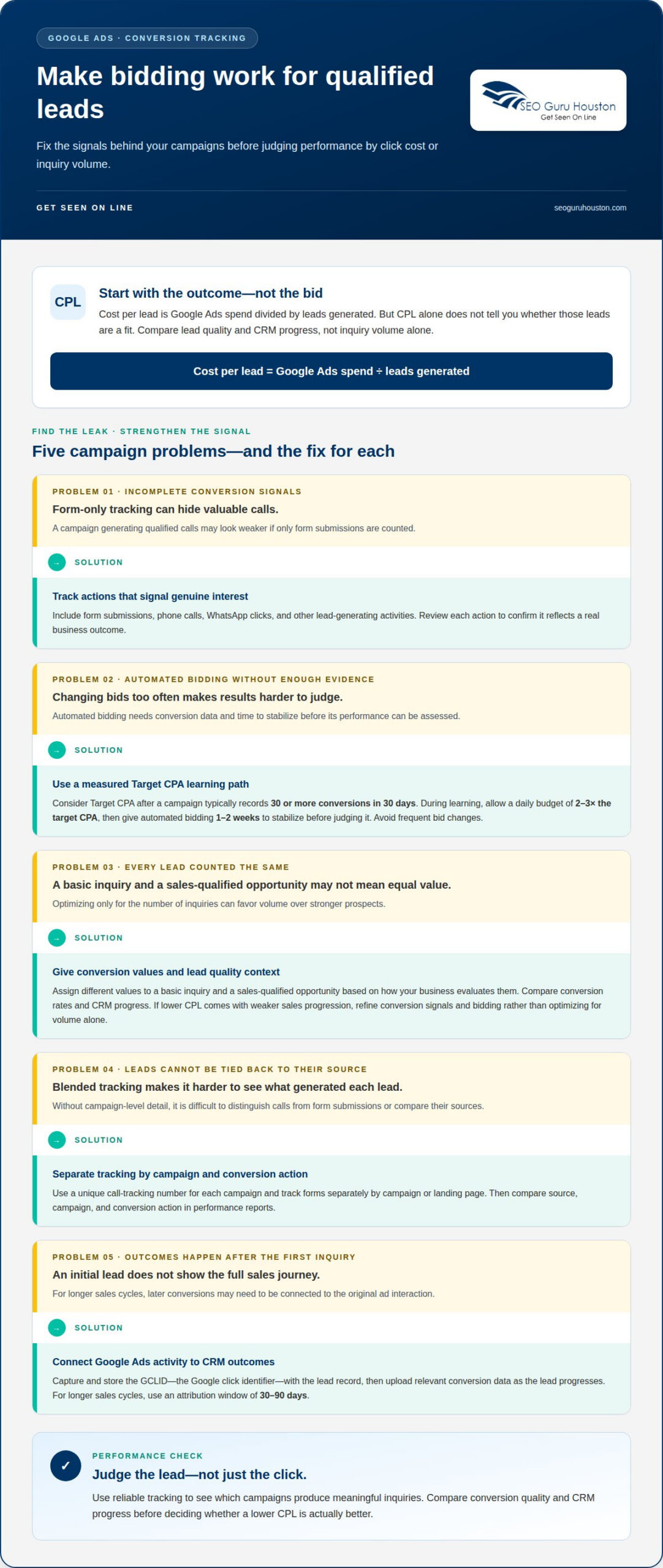
A cheaper click isn’t the goal; an affordable, qualified lead is. Calculate cost per lead by dividing Google Ads spend by the number of leads generated. To understand how to lower cost per lead in Google Ads, improve the traffic, ads, and landing pages that turn clicks into inquiries. CPL tells only part of the story if those leads aren’t a fit for your business.

Rising costs can make it tempting to cut bids or pause campaigns quickly. A better approach is to find where spend is leaking and strengthen the parts of the campaign that attract and convert suitable prospects. This guide explains how to calculate CPL, assess what a lead is worth, and refine bidding and conversion tracking without losing sight of lead quality.

You’ll also learn how to improve ad relevance, organize campaigns around services and intent, and use search-term reviews and negative keywords to reduce irrelevant clicks. With a clearer view of performance, you can focus on campaigns that generate valuable leads, not just more traffic.

Key Takeaways

  • Compare cost per lead with lead quality so you can prioritize campaigns that generate prospects likely to become customers.
  • Use reliable conversion tracking to see which ads and campaigns produce meaningful inquiries, then adjust bidding based on that evidence.
  • Align keywords, ad copy, and landing-page messaging to attract relevant clicks and make the next step clear.
  • Organize campaigns around distinct services, locations, and search intent to make performance easier to assess and optimize.
  • Review search terms regularly and exclude irrelevant queries that spend budget without bringing in suitable leads.

1. Bidding strategy and conversion tracking

Start with the conversion, not the bid. In Google Ads, track actions that signal genuine interest, such as form submissions, phone calls, WhatsApp clicks, and other lead-generating activities. If you track only form submissions, a campaign generating qualified calls may look weaker than it is. Review each conversion action to ensure it reflects a real business outcome.

Conversion values can help Smart Bidding distinguish leads with different potential. For example, assign different values to a basic inquiry and a sales-qualified opportunity, based on how your business evaluates them. That gives bidding signals more context than counting every form fill equally. For longer sales cycles, use an attribution window of 30-90 days so conversions that happen later can still be connected to the original ad interaction.

Make call tracking and form attribution specific enough to identify what generated each lead. Use a unique call-tracking number for each campaign, and track forms separately by campaign or landing page. Then compare the source, campaign, and conversion action in performance reports. Separate tracking makes it easier to distinguish campaigns that drive calls from those that generate form submissions.

For offline conversion tracking, connect Google Ads interactions with later CRM outcomes. Capture and store the GCLID, Google’s click identifier, with the lead record when someone submits a form or calls. As the lead progresses through the pipeline, upload the relevant conversion data to Google Ads. This connects campaign activity to milestones beyond the initial inquiry and helps bidding learn from outcomes closer to revenue.

Google Ads policies govern advertising and conversion tracking. Collect only the information needed to measure lead outcomes, and align notices and consent with the privacy requirements that apply to your audience. To assess lead quality, compare conversion rates and CRM progress, not just inquiry volume. If a lower CPL comes with fewer qualified opportunities or weaker sales progression, refine your conversion signals and bidding strategy instead of optimizing for volume alone.

2. Quality Score and ad-to-landing-page relevance

A relevant click is more valuable than a cheap click that leaves immediately. Quality Score is associated with how closely keywords, ads, and landing pages align. Improving those signals can strengthen campaign efficiency while bringing more suitable visitors to your offer. A Quality Score of 8-10 can reduce cost per click by as much as 50%, but the score isn’t a substitute for measuring actual leads.

Start by aligning the message. If a keyword targets emergency plumbing, the ad should promote emergency plumbing, and the landing page should explain that service. A visitor who lands on a broad company homepage has to search again for the offer. Match each ad group’s intent with a focused page, a clear service description, and one lead-generation call to action.

Optimize the page around the visitor’s decision. Put the service, location, and key benefit near the top so people can quickly confirm they’ve found the right page. Keep the form focused on essential qualifying details, and make the submit button easy to find. If the ad offers a quote request, make requesting a quote the obvious next step.

Mobile experience demands its own review. Open the landing page on a phone and test the full path: load, read, tap, and submit. Remove layout clutter, shorten unnecessary form fields, and make buttons easy to use on a small screen. A strong score won’t fix confusing copy or a broken form.

Use controlled tests to find which changes improve conversion rates. Change one meaningful element at a time, such as the headline, form length, or call-to-action wording. Compare completed leads, not just clicks. The recommended threshold is 100 conversions per variation for an A/B test, helping reduce the risk of acting on a small, unrepresentative sample. Keep the winning version only when it brings relevant prospects.

Review the whole journey together: search intent, keyword, ad promise, landing-page content, and completed conversion. If clicks rise but leads don’t, inspect the page’s message and form before changing bids. If the page needs a clearer structure or stronger conversion path, website development and landing pages can support that optimization work.

3. Campaign structure by service, location, and search intent

Give each service its own campaign to keep performance clear. For example, a roofing company can separate roof repairs from full replacements. Each campaign can then use relevant keywords, ads, and landing pages. This structure helps reveal which offer attracts qualified inquiries and prevents a strong service from being obscured by weaker results in blended reporting.

Separate campaigns by location when geography affects the offer or lead value. A business serving several communities can use focused geographic targeting instead of combining every area. Check location settings against the areas the business serves, then compare results. If one area brings clicks but few suitable leads, adjust its targeting or budget rather than changing every campaign.

Let search intent shape the ad groups within each service campaign. Someone searching for “roof repair company” may be ready to hire, while someone searching for “how roof repairs work” may be researching. Group closely related searches and tailor the ad to that intent. For e-commerce, organize campaigns around relevant product categories or shopping goals, then assess which categories generate valuable orders, not just traffic.

Scheduling can also sharpen targeting. Review when inquiries arrive and when your team can respond, then compare conversion quality across days and times. If a campaign receives inquiries outside operating hours, check whether those leads progress through the sales process. Use the results to refine ad schedules, rather than assuming every late or weekend click is wasted. Review location, device, and time segments together because one change can affect another.

Keep analysis ongoing, but base decisions on comparable periods and outcomes. Review campaign-level clicks, conversions, lead quality, and sales progression together. If a service campaign draws volume but few qualified prospects, inspect its search intent, geographic reach, and offer before shifting budget. Don’t merge campaigns just to simplify the account; that can hide which service or location needs attention.

Remarketing gives campaigns another way to reach people who showed interest but didn’t convert on their first visit. A visitor who viewed a service page can see a relevant follow-up ad, while someone who completed a lead form should be excluded from that audience. Remarketing campaigns typically achieve cost per lead 50-70% lower than cold-traffic campaigns. Treat this as a comparison to evaluate in your own account, and track lead quality alongside cost.

Lower Cost per Lead in Google Ads with Smarter Campaigns

4. Negative keyword lists and search-term audits

Research keywords around the searches that signal a real need. In Google Ads, review the search-term report to see the queries that triggered your ads, then compare each query with the service or product advertised. Keep relevant terms, add promising high-intent phrases, and exclude searches that clearly don’t fit. Long-tail keywords can have average cost per click up to 70% lower than broad, head terms.

Negative keywords prevent ads from showing for selected irrelevant searches, reducing clicks that consume budget without a realistic path to conversion. For example, a company that sells services but isn’t hiring could exclude “jobs”; it might also exclude “free,” “courses,” or unrelated locations when those searches don’t match its offer. Adding negative keywords can reduce wasted Google Ads spend by up to 30% in some accounts.

Build your negative keyword list from actual search behavior, not assumptions alone. Check the search-term report regularly, group irrelevant queries by theme, and add negatives at the campaign or account level where appropriate. A “jobs” exclusion may suit several service campaigns, while an unrelated-location exclusion may apply to just one geographic campaign. Review each exclusion against the ads it affects to avoid blocking useful searches.

Refine keyword targeting by starting with specific terms closely tied to your offer, then expand when search-term data supports it. Phrase and exact match can give advertisers more control over when ads appear. For instance, a home remodeling company can distinguish searches for “kitchen remodeling company” from general searches about kitchen design. Match each term to the service, location, and intent represented in the ad.

Don’t let high click volume disguise weak performance. In Google Ads, compare each keyword’s clicks, conversions, and cost per acquisition; pause a keyword or ad group when it attracts many clicks, few conversions, and a higher CPA. Before pausing, inspect its search terms and landing-page match. A broad query may be wasting spend, while a specific query could need a better ad or page.

Keep a change log with the date, keyword, action, and reason. After each weekly audit, compare relevant traffic and lead outcomes against the previous period. Campaigns using 200 or more negative keywords can see CPA up to 67% lower, but a large list isn’t a goal by itself. Add exclusions based on evidence, then review whether they remove waste without suppressing qualified searches.

5. Calculating cost per lead

Calculate Google Ads cost per lead by dividing total ad spend by the number of leads received. Use the same reporting period for both figures, and count leads consistently. Comparing monthly spend with leads from a different period produces a misleading result.

Then separate raw CPL from qualified CPL. The second measure shows what it costs to attract a prospect who fits your offer, rather than simply generate a contact.

What is a good Google Ads CPL in the US? There’s no universal target because industries, competition, lead quality, and sales conversion rates differ.

Connect CPL to sales outcomes before deciding whether it’s too high. Consider the hypothetical examples of a $50 lead converting at 20% and a $15 lead converting at 2%. A lower CPL can therefore deliver worse economics when fewer leads become customers.

Track averages over consistent periods and compare campaigns with similar services, locations, and lead definitions. An account-wide average can hide a costly campaign or make a strong one look weaker. Record spend, total leads, qualified leads, and resulting sales together. Then calculate raw and qualified CPL for each campaign using the same formula and time period.

Use the figures to set a working target from your own sales economics. Estimate how many qualified leads become customers, then compare the resulting acquisition cost with the value of a sale. If CPL rises, identify whether spend increased, lead volume fell, or lead quality changed. That diagnosis points toward the right optimization, rather than an arbitrary budget cut. For a stronger conversion path, improve your lead-generation landing pages so the page supports the offer and captures suitable inquiries.

SEO Guru Houston: Houston SEO Services

SEO Guru Houston helps businesses connect paid search strategy with broader efforts to attract and convert qualified prospects. If your Google Ads campaigns need closer analysis, our PPC services can support improvements to targeting, campaign structure, and lead measurement. For businesses building longer-term visibility alongside paid acquisition, our comprehensive SEO services can complement that approach.

When leads involve longer B2B decisions, specialized B2B marketing and inbound marketing frameworks can help align demand generation with how prospects research and evaluate solutions. The right next step depends on where your funnel needs attention, whether that’s campaign performance, organic visibility, or the path from first visit to sales inquiry. Contact SEO Guru Houston to discuss your marketing goals and discover strategies to lower cost per lead in Google Ads.

Turn Campaign Insights Into Your Next Growth Move

Make optimization a repeatable habit, not a one-time cleanup. Set regular review points, record each adjustment, and connect campaign decisions to the leads your sales team values. This discipline helps you identify which tests deserve more investment and which assumptions need another look. A practical process for how to lower cost per lead in Google Ads gives your team a consistent way to turn campaign insights into its next growth move.

SEO Guru Houston offers Houston PPC Services, alongside Houston SEO Services and Houston B2B Marketing. If you’re ready to build a stronger approach to how to lower cost per lead in Google Ads, bring your campaign goals and lead-generation priorities into the conversation. Together, you can identify where focused strategy may help your business move forward. Contact SEO Guru Houston today to discuss your next step.

Frequently Asked Questions

How Do I Calculate the Cost-Per-Lead and Why Does It Matter?

Divide Google Ads spend for a reporting period by the leads attributed to that spend. The result helps compare campaign efficiency, but it isn’t a complete measure of profitability. A campaign may produce fewer leads yet create more sales opportunities. Compare CPL with qualification and sales outcomes, using the same lead definition and reporting period so one campaign doesn’t look stronger simply because it counts more actions.

How do you calculate cost per lead and conversion rate in Google Ads?

Calculate CPL by dividing ad spend by leads. Conversion rate can show how often ad clicks lead to the action you’re tracking, so define that action consistently before comparing campaigns. Keep the conversion action consistent: don’t mix submitted inquiries and phone calls unless both count as leads in your reporting. For a useful comparison, align the date range and campaign scope for spend, clicks, and conversions before interpreting either metric.

How can you improve Google Ads conversion tracking for lead generation?

Define which actions count as leads, then test that each action records correctly before using the data for optimization. A form confirmation should register after a successful submission, not just when someone opens the form. Review phone-call and form records for duplicate counting, and connect CRM outcomes to the original ad interaction where possible. This gives you a clearer view of which campaigns generate genuine inquiries and which merely trigger trackable events.

How can match types and search terms be optimized to lower cost per lead?

Use phrase and exact match to focus on searches closely related to your offer, then inspect actual queries in Google Ads search-term reports. Keep terms that show relevant intent, add useful specific phrases, and exclude queries that don’t fit. For example, a business seeking service customers could filter out research or employment searches when those visitors aren’t prospects. Recheck exclusions to avoid accidentally blocking useful variations.

How do landing page changes improve Google Ads lead conversion rates?

How should you adjust bids, budgets, and bidding strategies to reduce cost per lead?

Base bid and budget changes on qualified-lead outcomes, not click volume alone. Avoid cutting every campaign after a brief dip; first identify whether the cause is weak search intent, limited conversion volume, or a change in lead quality. Set an efficiency goal for each campaign, make a focused adjustment, and allow enough time to assess its effect before changing the strategy again.

How can ad copy and assets improve lead quality and lower cost per lead?

Use ad copy to make the offer and intended audience clear before someone clicks. A B2B provider, for instance, can name the business audience and the specific service, helping discourage unrelated consumer inquiries. Choose ad assets that reinforce useful details, such as a relevant service or contact option. Review the search query, ad engagement, and resulting lead quality together; a higher click-through rate alone doesn’t prove the campaign attracts better prospects.

How do location, device, and schedule targeting affect Google Ads lead costs?

These settings shape which searches can trigger ads, so compare performance by location, device, and time before changing targeting. Mobile visitors may behave differently from desktop visitors, while leads from one service area may qualify more often than others. Review completed leads and sales progression in each segment, not just clicks. Refine the specific underperforming segment, and preserve targeting that brings suitable prospects.

Improving Lead Quality from Digital Ads: A 2026 Guide

What if the leads your ads attract aren’t a targeting problem at all, but a measurement problem? If inquiries go silent, miss your ideal customer profile, or never become sales opportunities, a low cost per lead can hide a costly gap. Improving lead quality from digital ads starts with looking beyond form fills and asking whether campaigns are creating real sales conversations.

You already know that more inquiries don’t automatically mean more growth. The challenge is finding where the mismatch begins: audience targeting, ad messaging, the offer, the landing page form, or follow-up. This guide will help you define lead quality using business-relevant criteria, spot weak leads at each stage of the campaign journey, and use consistent conversion tracking and sales feedback to make better decisions.

We’ll explore how to align campaign goals with the customers you want, strengthen the path from click to inquiry, and assess performance based on meaningful outcomes rather than volume alone. The goal is a clearer connection between ad spend and qualified sales conversations, so your next campaign decision is based on evidence, not guesswork.

Key Takeaways

  • Judge a lead by fit, need, responsiveness, and readiness for a relevant sales conversation, not by form volume alone.
  • Trace the path from audience and ad promise through the landing page, form, and first contact to find where mismatched inquiries enter.
  • Compare contactability, qualification, and sales progression alongside lead volume and cost per lead. Each metric reveals a different part of campaign performance.
  • Improving lead quality from digital ads starts with identifying the specific failure point, then testing one evidence-based change at a time.
  • Connect PPC decisions to business goals with conversion tracking, ongoing account management, monthly calls, and reporting.

What Does Lead Quality from Digital Ads Actually Mean?

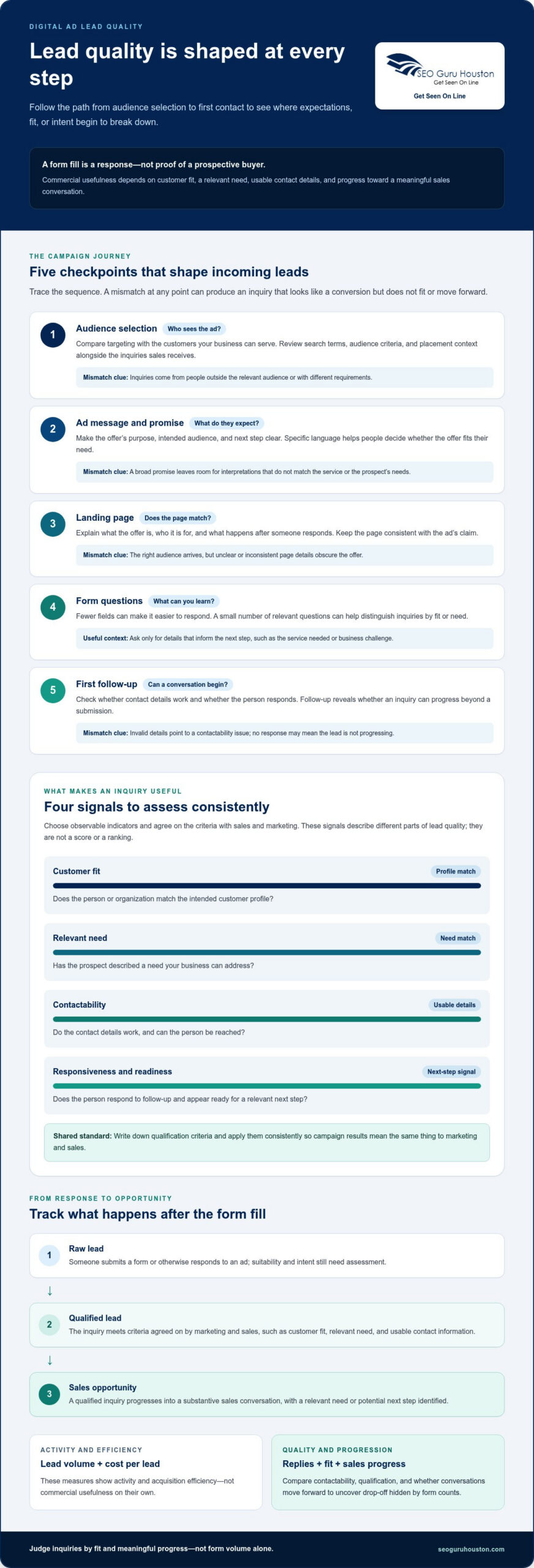
A digital ad lead is commercially useful when the person or organization fits your intended customer profile, has a need your business can address, can be contacted, and is ready to take a relevant next step. Those signals matter more than a form submission by itself. A completed form shows that someone responded to an offer; it doesn’t prove they’re a prospective buyer or that sales can start a meaningful conversation.

That distinction matters because lead volume and cost per lead measure activity and acquisition efficiency, not commercial usefulness. A campaign can generate more inquiries at a lower cost while attracting people outside your target market, people with no current need, or contacts who can’t be reached. To understand What is Lead Generation? in the broader marketing and sales funnel, consider how a response moves from initial interest toward a conversation and potential opportunity.

A practical lead-quality definition

  • Raw lead: A person or organization that submits a form or otherwise responds to an ad. Their suitability and intent still need to be assessed.
  • Qualified lead: An inquiry that meets criteria agreed on by marketing and sales, such as customer fit, relevant need, and usable contact information.
  • Sales opportunity: A qualified inquiry that progresses into a substantive sales conversation, with a relevant need or potential next step identified.

Which lead-quality signals matter to your business?

Choose indicators your team can observe and record, rather than relying on subjective labels like “good lead.” Check whether contact details work, whether the inquiry matches your intended customer profile, whether the person describes a relevant need, and whether they respond to follow-up. Each signal points to a different possible issue: invalid details suggest a contactability problem, poor fit suggests a targeting or message mismatch, and no expressed need may indicate low intent.

Marketing and sales should define a qualified inquiry together. Write down the criteria, then apply them consistently so campaign results mean the same thing to both teams.

Why more leads can still mean weaker ad performance

A rising form count can look like progress even as the share of relevant, reachable inquiries falls. For example, a campaign may attract more submissions but produce fewer replies, fewer prospects who match the target profile, or fewer conversations that move forward. Volume alone hides that drop-off. Compare responses with what happens after each one, and identify where prospects stop progressing.

Lead quality is the degree to which an inquiry fits your business and takes a meaningful step toward a relevant sales conversation. Use that as your standard when improving lead quality from digital ads. The aim isn’t simply to collect more names; it’s to attract and recognize inquiries with a credible path to business.

How Digital Ad Choices Shape the Quality of Incoming Leads

A lead’s path begins before anyone fills out a form. The audience selected, promise made in the ad, landing-page explanation, form questions, and first follow-up all shape who responds and what they expect. A mismatch at any point can bring in inquiries that look like conversions in an ad account but don’t fit the business or move toward a real conversation.

Lead quality reflects the alignment of every step from audience selection to first contact, not a single setting or channel. To diagnose campaigns across search, social, and other digital placements, follow the journey and pinpoint where expectations or intent stop matching.

Audience fit and ad messaging set expectations

Start by comparing campaign targeting with the customers your business can serve and the needs they bring. Broad targeting can expand reach, but it may also attract people with different requirements, people outside your relevant audience, or people who aren’t ready to act. Review search terms, audience criteria, and placement context alongside the inquiries sales receives.

Ad copy can pre-qualify interest by making the offer’s purpose, intended audience, and next step clear. For example, a general promise to “get more customers” leaves room for different interpretations. A specific description of the business need addressed helps people decide whether the offer fits. Keep the landing page consistent with that claim. If the ad promises one thing and the page emphasizes another, visitors may submit with mismatched expectations or leave without acting.

Landing pages and forms shape intent signals

After the click, the landing page should quickly explain what the offer is, who it’s for, and what happens after someone responds. Clear, relevant details help prospects self-select. They also make it easier to assess the campaign promise: if the right audience arrives but the page obscures the offer, the issue may be the post-click experience rather than targeting alone.

Forms involve a trade-off. Fewer fields can make it easier to respond, while a small number of relevant questions can help distinguish inquiries by need or fit. Ask only for information that informs the next step, such as the type of service needed or the business challenge involved. Unnecessary questions add friction without giving sales useful context.

To trace the journey, compare what the campaign promised with what prospects saw and what they were asked to provide. Then review the first contact: did the prospect recognize the offer, respond, and have a need aligned with it? This sequence helps separate audience mismatch from unclear messaging, form friction, or follow-up gaps. It gives your team a specific point to investigate instead of changing several campaign elements at once.

Improving lead quality from digital ads means tightening that alignment, then checking whether the inquiries that follow are a better fit. SEO Guru Houston’s PPC campaign management connects targeting, ad messaging, and conversion tracking to business goals.

Which Metrics Reveal Whether Digital Ad Leads Are Improving?

No single campaign metric shows whether advertising is creating better sales conversations. Lead volume and cost per lead describe the response and its acquisition efficiency. Contactability, qualification, and sales progression show what happens after that response reaches your team. Read the metrics together to see where performance is strengthening or breaking down.

Platform conversions alone can count responses, but they can’t establish whether those leads fit your business or progress into sales conversations. That takes consistent conversion tracking paired with sales feedback. The platform shows which ad interactions were recorded; your sales process adds the context needed to assess their commercial value.

Build a measurement view beyond cost per lead

Use shared definitions across campaigns, and compare results over the same reporting window. A lead counted as qualified in one campaign should meet the same criteria in another. Otherwise, apparent performance differences may reflect inconsistent labeling rather than a change in lead quality.

Metric What it signals Main limitation
Lead volume How many responses the campaign generated Doesn’t show fit, intent, or sales progress
Cost per lead How efficiently the campaign generated recorded leads Doesn’t reveal whether those leads are useful
Contactability Whether the team can reach the person who submitted an inquiry A reachable person may still be a poor fit
Qualification rate How many leads meet the agreed criteria Depends on consistent definitions and sales records
Sales progression Whether qualified leads advance into meaningful conversations or next steps Can take longer to observe and may reflect follow-up as well as campaign quality

Keep advertising response metrics separate from sales disposition data. A platform may record a form submission, while the sales team records whether the details were valid, the need was relevant, and the conversation progressed. Conversion tracking can connect campaign activity with meaningful milestones, but those milestones need clear definitions and reliable recording.

Use sales feedback to find weak points in the funnel

Give sales a concise set of consistent reasons for leads that don’t progress, such as unreachable, poor fit, no relevant need, or no response after contact. Record the stage and reason rather than relying on broad labels like “bad lead.” Then review patterns by campaign, audience, keyword, offer, or landing page where the available data supports that comparison.

Look for recurring signals before changing the campaign. If one audience produces more poor-fit inquiries, targeting or messaging may need review. If contact details are often incomplete, examine the form. If prospects fit but don’t advance, follow-up or the next step may be part of the issue.

Change one factor at a time where practical, and keep the comparison window and lead-stage criteria consistent. If targeting, offer, form, and follow-up all change together, you may improve results without knowing why. A disciplined measurement approach makes improving lead quality from digital ads a business decision grounded in campaign data and sales evidence.

Improving Lead Quality from Digital Ads: A 2026 Guide

How to Improve Lead Quality from Digital Ads: A Practical Test Plan

Don’t change targeting, copy, and forms all at once. If the results shift, you won’t know which change mattered. A focused test plan starts with evidence from the lead journey, identifies the likeliest failure point, and tests a matching intervention. That’s how improving lead quality from digital ads becomes a disciplined process, not a string of guesses.

  1. Define the failure. Describe the problem in observable terms, such as a rise in inquiries outside your intended customer profile, incomplete contact details, or qualified prospects who don’t respond. Use campaign records and sales feedback to identify the pattern.
  2. Inspect the journey. Follow the inquiry from audience or keyword through the ad, landing page, form, and first response. Note where the prospect’s expectations, information, or actions stop matching what your team needs to move the conversation forward.
  3. Choose one intervention. Select the change that addresses the strongest evidence. Write down why you chose it, what you expect to change, and which lead-quality signals you’ll review.
  4. Review the results. Compare the test with a defined baseline using the same quality criteria and reporting window. Look at sales feedback as well as ad-platform responses, then keep, revise, or roll back the change based on the evidence.

Choose a change that addresses the diagnosed problem

Match the adjustment to the failure point. For poor-fit inquiries, review audience and keyword relevance alongside ad wording. If prospects misunderstand what the offer includes, align the offer, ad copy, and landing-page message so each step sets the same expectation. For incomplete or unreachable inquiries, assess whether the form asks for essential details and whether the response process helps the team act on submissions.

Be precise. If sales reports inquiries that don’t match the intended customer profile, adding more form fields may create friction without fixing the source. If the audience appears relevant but submissions lack information needed for an appropriate response, test a useful question rather than broadly tightening targeting. Let the evidence determine which lever to adjust.

Test, review, and refine without chasing volume alone

Set a comparison period that gives both ad and sales outcomes time to appear. Keep lead definitions and reporting criteria consistent, and document the dates, campaign elements changed, rationale, and sales feedback. Where practical, adjust one major variable at a time. If several changes are necessary, record them clearly and avoid claiming that one specific change caused the outcome.

When the diagnosed issue sits on the post-click path, review the page’s message, form, and next step together. This high-converting landing page design guidance can help focus your review on whether the page supports the ad’s promise and captures useful lead details.

A test is useful even when it doesn’t improve results, provided it clarifies what is and isn’t working. SEO Guru Houston’s PPC campaign management connects advertising decisions with conversion tracking and business goals.

How SEO Guru Houston Connects PPC Management to Better Lead Decisions

Improving lead quality from digital ads takes more than attracting clicks. Campaign choices need to support a clear business goal, and results need to be assessed against what happens after an inquiry arrives. SEO Guru Houston’s PPC management brings campaign execution and measurement together, helping businesses evaluate ad responses with sales relevance in view.

What ongoing PPC management contributes to lead-quality work

Keyword bidding helps shape which searches a campaign competes for, while ad copy optimization clarifies the offer and sets expectations. Geographic targeting further defines where ads are shown. Together, these activities can improve campaign relevance by aligning targeting and messaging with the audience the business intends to reach.

Conversion tracking helps connect ad activity with defined actions, giving the team a more useful way to assess performance against business goals than clicks or form submissions alone. Changes to PPC ads or keywords have an immediate effect on the campaign, but that doesn’t guarantee an immediate change in lead quality or sales outcomes. Assess tracked responses alongside lead and sales feedback to understand the effect.

SEO Guru Houston’s PPC work includes keyword bidding, ad copy optimization, geographic targeting, conversion tracking, ongoing account management, monthly calls, and reporting. This ongoing process creates opportunities to review what the campaign is generating, identify where it may be falling short, and make informed adjustments. The goal is to increase qualified leads, not to promise a specific result.

Turn campaign evidence into a clear next step

Useful campaign reviews connect the data to a decision. If tracked responses are rising but sales feedback points to poor fit, the team can investigate whether keyword choices, targeting, or ad messaging need adjustment. If inquiries appear relevant but aren’t progressing, the review can consider the conversion path and the quality signals being tracked. Consistent reporting and monthly calls keep these discussions tied to campaign activity and business priorities.

With 950+ completed projects, 100+ B2B and B2C projects, and 12+ years of experience, SEO Guru Houston brings practical campaign experience to these decisions. For businesses focused on reaching and engaging other businesses, B2B demand generation can also help connect marketing activity with the goal of generating relevant prospects.

Ready to connect PPC activity with clearer lead-quality decisions? Discuss your digital advertising goals and identify what you want your campaign tracking and sales feedback to reveal.

Make Your Next Campaign Decision Count

Better advertising starts with a better question: what should the next campaign teach you about the people most likely to become customers? Choose one signal to improve, such as relevant inquiries progressing to conversations, and make it the focus of your next review. That keeps optimization grounded in the outcome your business needs, not activity that merely looks good in a dashboard.

Improving lead quality from digital ads is an ongoing discipline. As your team learns which messages attract the right prospects and what helps them take a meaningful next step, use those insights to sharpen future campaign decisions. Keep the feedback loop active, and each review can give you a clearer direction for testing and refining your approach.

Ready to put that focus into practice? Discuss your digital advertising goals and take the next step toward campaigns built around more meaningful sales conversations.

Frequently Asked Questions

Why are my digital ads generating leads that do not convert?

Ads may be attracting people whose needs, timing, or expectations don’t match what your business can offer. A campaign promising a broad outcome can draw interest from prospects looking for something different, while a useful inquiry may stall because the next step isn’t clear. For improving lead quality from digital ads, compare a sample of non-converting inquiries with your intended customer profile and note the specific mismatch before changing the campaign.

How can I tell whether my leads are low quality or my follow-up is too slow?

Compare the inquiry details with the first-contact record. If a lead has invalid contact information, an unrelated need, or a clear mismatch before anyone reaches out, investigate lead quality. If the inquiry fits but contact attempts happen late, go unanswered, or aren’t recorded consistently, follow-up may be contributing. Review individual records, not just totals, and check whether the same pattern appears across different campaigns or team members.

Can adding questions to a lead form improve lead quality?

Yes, if the answers help your team assess relevance or choose a useful next step. For example, asking which type of service a prospect needs may provide clearer context than collecting a detail no one uses. Extra questions can also make a form harder to complete. Add one question tied to a real decision, then compare the usefulness of submitted inquiries with form completion before deciding whether to keep it.

Should I optimize digital ads for leads or sales?

Use the deepest outcome you can measure consistently and in sufficient volume to guide campaign decisions. A sales-focused event is closer to business value, but incomplete or inconsistent records can mislead the system and your team. If sales outcomes are sparse, track a reliable qualified-inquiry stage while improving how sales dispositions are recorded. Move toward sales outcomes as the data becomes dependable, and keep checking lead fit.

How often should I review lead quality from an advertising campaign?

Review new inquiries regularly enough to catch issues before they become entrenched, then assess trends on a consistent schedule. A weekly check can surface missing details or a sudden shift in fit; a monthly comparison can give later-stage outcomes more time to emerge. Match the review rhythm to your sales cycle and lead volume, and avoid judging a change from a handful of very recent inquiries.

What is a good cost per lead if the leads are not converting?

There isn’t a useful cost-per-lead target without knowing whether inquiries become qualified prospects and sales conversations. A lower figure can still reflect weak commercial value if leads don’t fit, can’t be reached, or don’t progress. Track the cost of qualified leads and opportunities alongside cost per lead, using consistent definitions. If no inquiries convert, investigate lead disposition and follow-up before treating a cheaper lead as a better result.

How does conversion tracking help improve lead quality?

Conversion tracking records which campaign interactions lead to defined actions, so you can compare performance against more than clicks. For example, tracking a completed inquiry separately from a qualified inquiry helps reveal whether a campaign attracts responses that meet your criteria. Check that tracked events reflect real actions and aren’t duplicated or triggered by irrelevant visits. Pair platform records with sales outcomes to guide more informed campaign adjustments.

Can better landing page messaging reduce unqualified inquiries?

Clear landing-page messaging can help people decide whether an offer fits before they submit a form. State who the offer is intended for, what need it addresses, and what the next step involves. Keep those details consistent with the ad, and avoid broad claims that invite assumptions the business can’t meet. Then review whether inquiries better match the intended audience, rather than judging the page only by how many forms it generates.

Paid Search Management: Turn Ad Spend into a Growth Engine

What if your ad reports showed more than clicks and impressions? For companies investing in paid search management with SEO Guru Houston, the goal is to connect campaigns with qualified leads and sales, not simply keep ads running. Ad spend can climb while the business impact stays unclear. That’s a reason to look beyond activity and examine what happens after the click.

Effective oversight turns paid search into a measurable acquisition system. It connects targeting, search terms, bidding, conversion tracking, and landing pages, then uses performance data to guide ongoing decisions. The aim is not to treat every click as a win, but to learn which parts of the campaign contribute to business goals.

This article explains what ongoing paid search management involves, which metrics can show whether campaigns are advancing business goals, and how strategy and landing-page experience shape results. A useful report should help answer practical questions: Are the right prospects finding you? Are they taking action? Are those actions valuable to the business? With a coordinated approach, paid search becomes easier to evaluate, refine, and align with the outcomes your business needs.

Key Takeaways

  • Paid search management goes beyond launching ads: ongoing oversight connects campaign strategy, measurement, and optimization to business goals.
  • Align campaign objectives with the action you want customers to take, such as submitting a qualified inquiry or making a purchase.
  • Clicks and impressions show activity, but conversion and return measures help reveal whether campaigns are delivering meaningful business results.
  • Prepare for paid search management houston by clarifying your goals, target customers, offer, conversion path, and measurement access.
  • Relevant ads and well-matched landing pages work together to turn search intent into a stronger opportunity to convert.

What Paid Search Management Does Beyond Launching Ads

Launching an ad is a starting point, not a strategy. Paid search management is the ongoing work of planning campaigns, monitoring delivery, measuring results, and refining decisions so advertising supports a business objective. Effective paid search management houston connects each step, from the searches a campaign targets to the action a visitor takes after clicking.

A campaign can attract attention and still miss its goal. The offer may not match what people are searching for, tracking may fail to record meaningful actions, or the landing page may not address a visitor’s needs. Competition can also affect visibility. Management considers these factors together rather than treating clicks as the finish line.

What tasks are included in paid search management?

Ongoing oversight turns campaign data into practical decisions. Work commonly includes:

  • Planning and structure: Organize campaigns around business goals, search intent, and the actions you want visitors to take.
  • Targeting and messaging: Select relevant keywords and audiences, then shape ad copy around the searcher’s needs and the offer.
  • Monitoring and refinement: Review search terms, monitor budget use, adjust bids, and test campaign elements to identify opportunities and reduce irrelevant traffic.
  • Measurement: Use conversion tracking to understand which interactions matter and guide adjustments to targeting, ads, and budget priorities.

For example, if a campaign receives clicks but few qualified inquiries, increasing spend may not solve the problem. Reviewing search terms, ad promises, tracking, and the landing-page experience can show where the path to conversion is breaking down.

How is paid search different from SEO?

Paid search places ads in search results through advertising platforms, while SEO works to earn visibility in unpaid organic listings. Paid campaigns can begin serving after setup and platform approval, but placement does not guarantee qualified traffic or business results. SEO builds organic visibility over time through work on a site’s content and search presence.

The approaches can complement each other. Paid search data can show which queries attract relevant prospects, while organic performance can reveal topics and pages worth strengthening. Together, those signals can inform acquisition planning across channels. For broader context on how paid advertising fits into search marketing, see What is Search Engine Marketing (SEM)?

How Paid Search Campaign Management Works From Strategy to Optimization

A strong campaign follows a clear cycle: define the business outcome, build around search intent, launch with reliable measurement, and refine based on evidence. For paid search management houston, that process also means accounting for target customers, the offer, and campaign constraints before committing budget.

How does campaign setup establish a useful baseline?

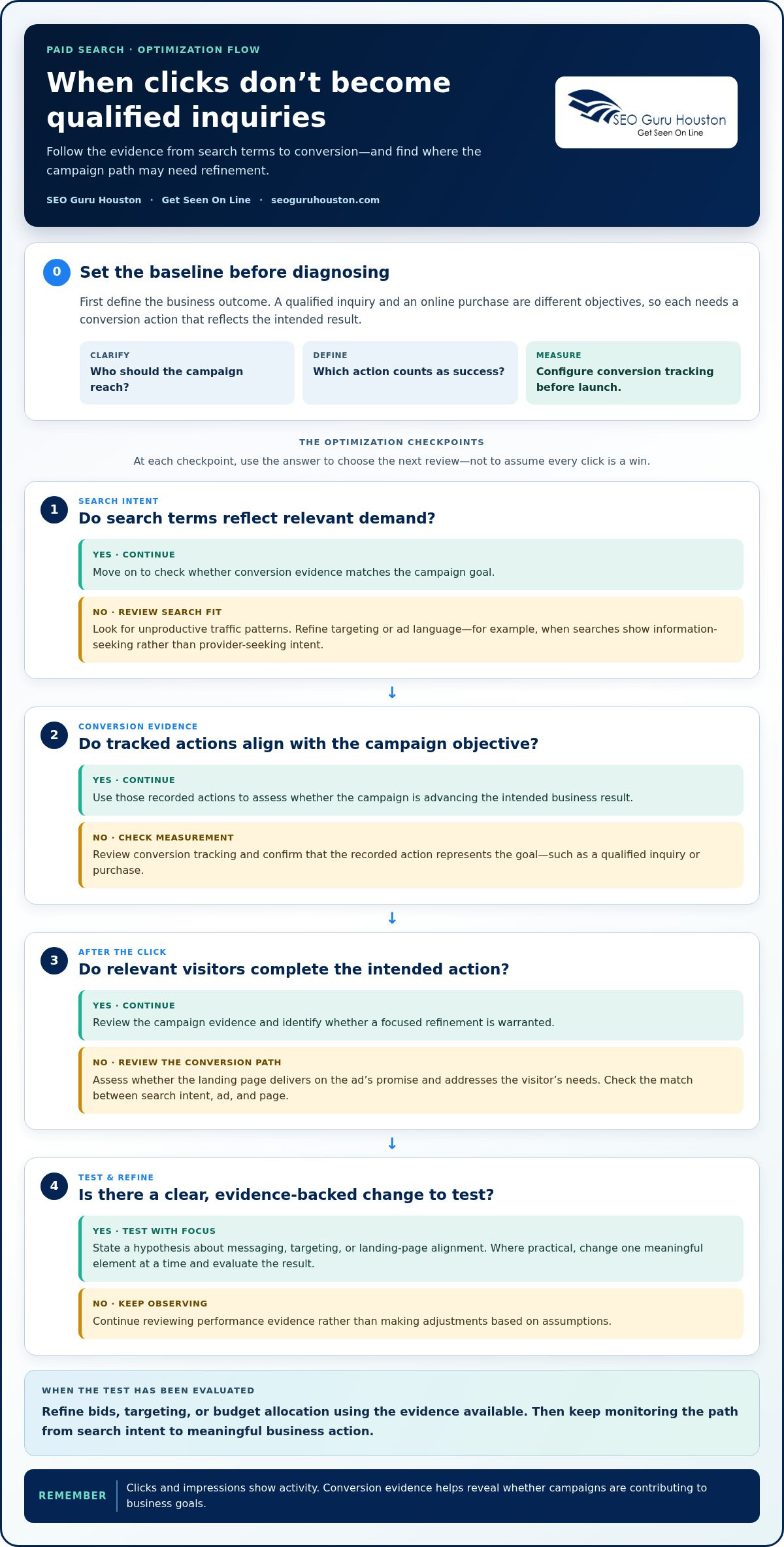
Setup should create a meaningful starting point, not just a collection of ads. First clarify who the campaign needs to reach, which action counts as success, and what limits or priorities will shape delivery. A qualified inquiry and an online purchase are different objectives, so each needs a conversion action that reflects the intended business result.

Next, organize keywords into related search themes. Someone looking for a specific service may have different intent from someone researching a general problem. Grouping those searches helps match ad messaging to what the person is seeking and directs visitors to a relevant page. Configure conversion measurement before launch so later decisions rely on recorded actions, not clicks alone.

What happens during ongoing campaign optimization?

Once ads are running, the management cycle turns observations into testable changes. A practical workflow includes:

  1. Review search terms: Identify queries that reflect relevant demand and patterns that attract unproductive traffic.
  2. Check conversion evidence: Assess whether tracked actions align with the campaign objective and business priorities.
  3. Test a focused change: Form a clear hypothesis about ad messaging, targeting, or landing-page alignment, then evaluate the result.
  4. Refine delivery: Adjust bids, targeting, or budget allocation based on the evidence available, not assumptions.

For example, if a service campaign draws searches from people seeking information rather than a provider, search-term findings may point to a need to refine targeting or ad language. If relevant visitors click but don’t complete the intended action, assess whether the landing page delivers on the ad’s promise. Where practical, change one meaningful element at a time so the impact is easier to interpret.

This is why campaign objectives need a business lens. The Strategic Objectives of Paid Search Advertising resource from Harvard Business Review offers further perspective on connecting paid search decisions with performance measures and customer value. SEO Guru Houston provides data-driven PPC campaign management that connects targeting, measurement, and optimization to growth objectives.

Which Paid Search Metrics Reveal Performance, and Which Can Mislead?

A campaign report can look busy without showing whether advertising is helping the business grow. Impressions, clicks, and click-through rate describe activity and engagement. To assess impact, connect those signals to conversions, lead quality, sales, and return. For paid search management houston, the right metrics depend on the campaign goal and how reliably outcomes are tracked.

Use this framework to separate activity from efficiency and business results:

Metric group What to review What it can tell you
Activity Impressions, clicks, click-through rate (CTR) Whether ads are appearing and attracting clicks. These metrics don’t prove visitors are qualified or generating revenue.
Efficiency Conversions, cost per conversion Whether tracked actions are happening and how much ad spend is associated with each action.
Business outcomes Lead quality, sales, return measures Whether conversions contribute to valuable opportunities, revenue, or other business goals.

How should businesses interpret clicks, conversions, and cost per lead?

A click is a visit from an ad. A conversion is a tracked action, such as a form submission or call. Cost per lead compares campaign spend with the number of leads recorded. Each metric answers a different question. A lower cost per lead may still indicate weak performance if fewer leads are qualified or progress to sales. Set targets using your business economics, not a universal benchmark.

Why do tracking and attribution matter?

Tracking connects online actions to campaign reporting; attribution helps interpret which interactions receive credit. Missing events can hide real inquiries, while duplicated events can inflate conversion totals. Before reacting to a performance change, confirm that forms and calls are recorded consistently and represent genuine business outcomes. Resources from the Paid Search Association can offer additional industry context, but validated business data should guide campaign decisions.

Platform metrics are useful signals, not the whole scorecard. Review them alongside sales-team feedback and lead outcomes. If clicks rise but qualified opportunities don’t, investigate search intent, the offer, and the path from ad to inquiry before increasing investment. Reliable measurement turns reporting into a decision tool, so campaign changes reflect business impact rather than surface-level activity.

Paid Search Management: Turn Ad Spend into a Growth Engine

How to Prepare Your Business for Better Paid Search Management

Campaigns are easier to steer when the business can clearly define what success looks like. Before launching, gather the decisions and access needed to connect advertising with real customer outcomes. This preparation gives a paid search strategy a stronger foundation, but it can’t guarantee campaign performance. Demand, competition, the offer, and the visitor experience all influence results.

What should you define before campaigns begin?

Use this checklist to turn business priorities into practical campaign inputs:

  • Business goal: Decide whether the campaign should drive qualified inquiries, purchases, or another meaningful action. Specify how that outcome will be recorded.
  • Best-fit customer: Describe the customers most likely to benefit, including the needs or search intent that signal a strong fit.
  • Service priorities and offer: Identify which services or products deserve focus and what makes the offer relevant to the intended audience.
  • Conversion path: Map the next step after an ad click, such as completing a form, calling, or making a purchase. Make sure the business can assess the quality of those outcomes.
  • Measurement access: Ensure campaign managers can access the relevant advertising and measurement tools, along with the business feedback needed to evaluate lead or sales quality.

Keep the ad and landing page aligned. If an ad promises information about a specific service, the destination should make that service easy to understand and provide a clear next step. A mismatch creates friction: the visitor clicks with one expectation, then lands on a page that doesn’t address it. A useful landing page continues the conversation started by the search and ad.

How can businesses assess campaign progress responsibly?

Set review criteria before results come in. Compare performance with the original objective, and allow enough time to gather evidence that supports a sound decision. A short-term change in clicks or leads may not show whether the campaign is improving, weakening, or experiencing normal variation.

Check measurement consistency before interpreting a shift. If reported form submissions change, first determine whether tracking still records them correctly. Then consider other explanations, such as changes in search demand, targeting, or the offer. Separate measurement problems from actual campaign performance.

Make each review answer a specific question: Are the inquiries a good fit? Does the landing page support the ad’s promise? Is the campaign reaching the intended customers? Prioritize a test that addresses the clearest gap, then assess the evidence before making another change. This disciplined approach helps paid search management houston stay connected to business priorities instead of reactive guesswork.

Explore data-driven paid search management to align campaign strategy, measurement, and conversion paths.

How SEO Guru Houston Connects Paid Search Management to Business Growth

Paid search should support a business goal, not operate as a separate stream of clicks. SEO Guru Houston’s PPC services use targeted, data-driven advertising to attract qualified traffic and evaluate campaign performance against meaningful conversion actions. Campaign decisions can focus on what the business needs, whether that’s relevant inquiries, purchase activity, or another defined outcome.

For paid search management houston, the connection between targeting, measurement, and the customer’s next step matters. Search terms reveal intent. Ad messaging responds to that intent. Conversion data helps show whether the resulting traffic contributes to business priorities. This approach makes campaign performance easier to assess and gives optimization a clearer purpose.

How can PPC and landing pages work together?

The post-click experience completes the path that begins in search. A person searches for a solution, sees an ad that speaks to that need, then expects the landing page to deliver on the ad’s promise. When the message and page align, visitors can understand the offer and find the next step more easily. When they don’t, even relevant traffic may lose momentum.

SEO Guru Houston’s website development and landing page design services can support that journey alongside PPC. A useful landing page makes the offer clear, answers relevant questions, and guides visitors toward the intended conversion action. For more ideas on the page experience, explore the published guide to high-converting landing page design.

When reviewing how ads and a website work together, identify where prospects lose momentum and which conversion actions matter most to the business.

What is the next step toward a more accountable campaign?

Start with three practical inputs: your growth goal, how you currently measure campaign outcomes, and the offerings that deserve priority. Clarify what makes an inquiry qualified or a sale valuable. Those details help connect campaign decisions to the results the business actually needs.

SEO Guru Houston brings PPC and demand generation together as connected growth support. Campaign insights can inform how the business attracts and engages prospects, while measurement helps keep the work accountable to defined objectives. The focus is not activity for its own sake. It’s a clearer path from search intent to meaningful action.

Explore paid search services and discuss your campaign objectives.

Make Every Search Campaign More Accountable

Paid search works best as an ongoing growth process, not a one-time ad launch. Clear objectives, relevant targeting, and dependable conversion tracking help connect campaign decisions to qualified inquiries, sales, and other outcomes that matter. Clicks and impressions are signals of activity, not proof of business impact.

For paid search management houston, the path from search to conversion deserves attention at every step. SEO Guru Houston provides targeted PPC services designed to drive qualified traffic, while website development and landing page design can support the experience after a visitor clicks. When ad messaging, measurement, and the landing page work toward the same goal, it’s easier to evaluate what contributes to growth.

Ready to connect your campaigns with your business priorities? Explore SEO Guru Houston’s paid search services and take a practical next step toward a more focused acquisition strategy. Clear goals and thoughtful optimization help make ad spend a stronger engine for growth.

Frequently Asked Questions

What is paid search management?

Paid search management is the ongoing work of planning, running, measuring, and improving ads that appear in search results. It can include campaign structure, keyword targeting, ad messaging, budget oversight, conversion tracking, and performance analysis. The goal is to align advertising with business objectives, such as qualified inquiries or purchases. Results depend on factors including the offer, competition, audience, tracking accuracy, and website experience.

How does paid search management improve campaign performance?

Paid search management creates a regular process for checking whether campaigns reach the intended audience and generate meaningful actions. Reviewing search terms can reveal irrelevant traffic, while testing ad messaging can show whether it resonates with prospective customers. Teams can also assess conversion tracking and adjust targeting or budget based on evidence. These practices support better-informed decisions, but they can’t guarantee a specific result.

Is paid search the same as PPC?

Paid search and PPC are closely related, but they describe different things. Paid search refers to advertising placements in search results. Pay-per-click describes a common pricing model where an advertiser pays when someone clicks an ad. Paid search campaigns are often managed through PPC platforms. To evaluate a campaign’s value, look beyond clicks and consider relevant conversions and business outcomes, such as qualified leads or sales.

Which metrics should I track in paid search campaigns?

Track metrics that connect campaign activity to your business goals. Impressions show how often ads appear, and clicks indicate visits from those ads. Conversions record whether visitors complete a defined action. Cost per conversion and lead quality add context about efficiency and usefulness. For a sales-focused campaign, connect advertising data to revenue where tracking allows. The right measures depend on what counts as valuable for your business.

Can paid search work without a dedicated landing page?

Yes, paid search can use an existing page, provided it matches the ad and makes the next step clear. A relevant service page may work if it addresses the visitor’s query and supports conversion. A dedicated landing page can offer a more focused experience for a specific audience or offer. Review page relevance, usability, and measurement to determine whether the destination supports the campaign’s objective.

How long does paid search take to show results?

Ads may begin serving after setup and platform approval, but meaningful evaluation takes longer than seeing initial clicks. Reliable tracking and enough relevant activity are needed to identify useful patterns. Timing varies with budget, competition, search demand, conversion volume, and the sales cycle. Avoid judging performance from early activity alone. Instead, assess progress against agreed business outcomes using consistent, dependable data.

Should I manage paid search in-house or work with an agency?

The right approach depends on your team’s expertise, available time, campaign complexity, and reporting needs. In-house management keeps campaign work close to the business, while an agency can provide dedicated strategy and ongoing optimization. Either approach needs clear goals, dependable conversion tracking, and feedback on lead quality. Evaluate the process by how well it connects campaign activity with business outcomes, not by clicks or reports alone.