Tag Archives: Digital Marketing

Understanding Your Monthly Digital Marketing Report: A Practical Guide

What if your monthly digital marketing report isn’t telling you whether marketing worked, but simply showing you what happened? If rows of traffic, leads, and campaign metrics feel disconnected, you’re not alone. Understanding your monthly digital marketing report means looking beyond totals to see which activity supports your business goals, where results are getting stuck, and what deserves attention next.

A useful report should make decisions clearer, not bury them under more numbers. This guide shows you how to identify metrics tied to lead generation and business outcomes, interpret changes without jumping to conclusions, and turn a monthly review into a focused plan. You’ll also see how SEO, paid advertising, and landing-page performance connect, while still needing channel-specific context. That matters when visits rise but inquiries don’t, or results across channels appear to conflict.

Use this practical approach to review performance, account for gaps in measurement, and prioritize next steps you can track. The goal is to finish each review knowing what’s working, what needs investigation, and what to change next.

Key Takeaways

  • Understanding your monthly digital marketing report starts with linking each metric to a business objective, not treating every number as equally important.
  • Separate visibility, engagement, conversions, lead quality, and business outcomes so sessions, clicks, and conversion rates tell a clearer story.
  • Compare performance against goals and relevant periods, accounting for campaign changes, seasonality, and conversion delays.
  • Turn findings into prioritized next steps by identifying likely causes, assigning ownership, and setting a clear way to review progress.
  • Assess SEO, PPC, inbound marketing, and website performance together to spot disconnects and guide a coordinated strategy.

What Does a Monthly Digital Marketing Report Actually Tell You?

A monthly digital marketing report summarizes marketing activity, performance, and progress toward defined objectives over a set period. Its job isn’t simply to show whether numbers went up or down. A useful report explains what changed, which activity may have contributed, and where the business should focus next.

A report is different from a live dashboard. A dashboard displays data as it updates, giving teams a current view of activity. A monthly report reviews a defined period and interprets the data in context, so readers can assess progress, notice patterns, and decide what to investigate. Digital marketing spans multiple channels, but the report should relate each channel’s performance to the same business objectives.

Activity metrics show what marketing did; outcome metrics show what that activity helped the business achieve. Clicks, for example, can indicate that an ad attracted attention. Qualified inquiries can show whether that attention moved closer to a business result. Both measures can be useful, but they answer different questions.

What belongs in a useful monthly report?

The right contents depend on your goals, active channels, and what measurement can reliably capture. A report might include:

  • An executive summary stating the main result, notable change, and priority for review.
  • Goal progress showing movement toward agreed objectives, such as generating inquiries or increasing relevant website visits.
  • Channel results explaining how SEO, paid advertising, or other active channels contributed, without treating their metrics as interchangeable.
  • Conversions and lead context connecting website actions to inquiries and, where available, their quality or business relevance.
  • Next actions identifying what to maintain, investigate, or improve in the next reporting period.

Numbers need context to be useful. The report should state the reporting dates, define key terms, and explain the comparison being used, such as the previous month or progress toward a target. If a conversion means a form submission, say so. If dates or definitions change between reports, apparent improvement or decline may reflect measurement differences rather than a real shift in performance.

Who should use the report, and how?

Different readers need different levels of detail. Owners can use the summary to assess whether marketing supports business priorities. Marketing leads can examine channel performance and decide what needs testing or adjustment. Sales teams can share whether incoming inquiries are relevant and where prospects appear to stall. Together, these perspectives connect campaign data with what happens after a lead arrives.

Start with the objective, not the dashboard’s most eye-catching metric. Ask what the business was trying to achieve, then review the relevant evidence and its limitations. A clear summary gives everyone a common starting point: what changed, why it may matter, and what decision is needed. That’s the practical core of understanding your monthly digital marketing report. It turns a review into direction, not just another meeting about numbers.

How to Read the Core Metrics in Your Monthly Marketing Report

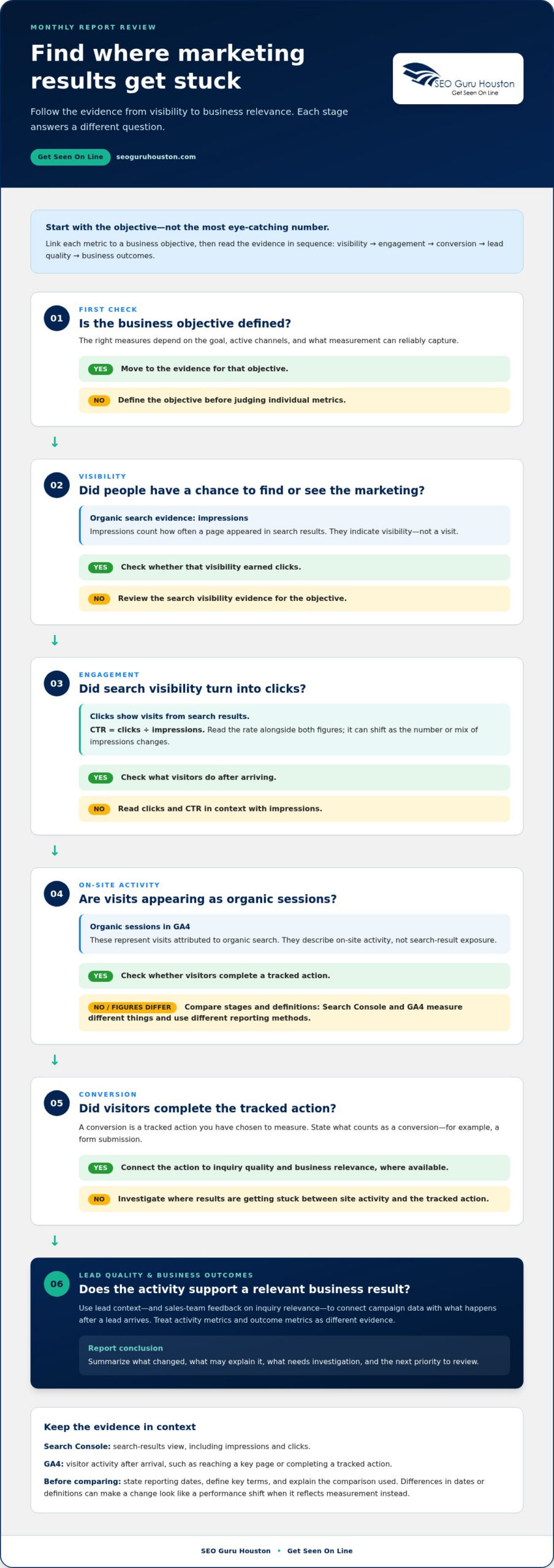
Metrics make sense as a sequence, not a scoreboard. Start with visibility: did people have a chance to find or see your marketing? Then look at engagement, conversion, lead quality, and business outcomes. Each stage answers a different question, and a change in one doesn’t automatically mean a change in the next.

A metric becomes meaningful when you connect it to a defined objective and the action you want it to explain. If the goal is to attract relevant search visitors, impressions alone won’t tell you whether people clicked or took a useful next step. If the goal is qualified inquiries, raw traffic is only an early signal.

Which SEO metrics show search visibility and engagement?

For organic search, distinguish these measures:

  • Impressions count how often a page appeared in search results. They indicate visibility, not a visit.
  • Clicks count visits from those search results. They show that a listing earned attention.
  • Click-through rate (CTR) is clicks divided by impressions. Read it alongside both figures, since the rate can shift as the number or mix of impressions changes.
  • Organic sessions in Google Analytics 4 (GA4) represent visits attributed to organic search. They describe on-site activity, not search-result exposure.

Google Search Console provides the search-results view, including impressions and clicks. GA4 shows what visitors do after they arrive, such as whether they continue to a key page or complete a tracked action. The figures may not match exactly because the tools measure different stages and use different reporting methods. Together, they help show whether visibility is turning into relevant site activity. For broader professional SEO services context, interpret search metrics against the strategy and audience the work is intended to reach.

Which paid and website metrics indicate campaign performance?

Read paid campaigns stage by stage. Ad impressions show exposure; clicks show visits generated by the ad. A conversion is a tracked action you’ve chosen to count, such as a submitted inquiry form. A conversion rate compares conversions with a defined set of interactions or visits, so check the report’s denominator before comparing rates. Cost per conversion relates advertising spend to the conversions recorded. It describes efficiency against that conversion definition, not lead quality or eventual revenue by itself.

Then examine the landing page. If ads earn clicks but visitors leave without taking the intended action, the issue may be the page experience, message match, or offer, not simply the ad. If conversions rise, check whether the inquiries are relevant and progressing toward business outcomes. Traffic growth matters only when it brings the right audience and supports meaningful action. Assess PPC management across ad delivery, landing-page behavior, and conversion quality, with each measure tied to its role in the campaign.

That’s the heart of understanding your monthly digital marketing report: follow the path from exposure to action, then test whether the action advances a business goal.

How to Judge Monthly Results Without Misreading the Numbers

A month-over-month change is a signal, not a verdict. To judge performance fairly, compare results with the stated goal, a relevant previous period, and the changes made to campaigns or the website. A rise in inquiries may look positive, but if the business goal is qualified opportunities, volume alone doesn’t show whether performance improved.

Keep comparisons consistent by using matching date ranges and the same metric definitions. Then check what changed during either period. Seasonality can affect demand; budget adjustments can alter reach; website updates may change visitor behavior; and tracking changes can shift what gets recorded. Conversions may also happen after the month in which a person first clicked or visited. Note these factors alongside the results instead of treating them as background noise.

How should you compare this month with earlier performance?

Separate short-term movement from longer-term patterns when enough comparable data exists. A single month can be affected by a campaign launch, a brief surge in demand, or a measurement issue. Note meaningful shifts in targeting, spend, landing pages, and tracking so you can distinguish a possible trend from a one-off change. Before deciding to scale, pause, or investigate, ask whether the movement aligns with the goal.

Use this framework to keep unlike measures in their proper roles:

Metric group What it helps you assess What it can’t prove alone
Activity metrics Marketing exposure and interaction, such as impressions, clicks, or visits That activity produced qualified leads or sales
Conversion metrics Whether visitors completed a defined action, such as submitting an inquiry That every conversion was valuable or became a customer
Business outcomes Lead quality, sales progression, or other outcomes tied to business goals Which channel caused the outcome without further context

What can attribution and lead quality reveal?

Attribution is a model for assigning credit to marketing touchpoints. One system may credit the last interaction before an inquiry, while another may show several interactions along the path. Totals can differ because systems use different definitions, data, and attribution rules. Treat attribution as a useful perspective, not proof that one channel caused a result. A channel may contribute earlier in the journey without receiving final credit.

Pair lead volume with the quality indicators available to your team: whether the inquiry is relevant, whether sales can progress the conversation, and whether opportunities advance. This matters in B2B marketing, where consideration may stretch across multiple interactions. Judge a B2B demand generation strategy with that longer journey in mind, rather than by a single month’s final-touch conversions.

For stronger digital marketing coordination, use the evidence to align channel activity with lead quality and sales feedback. That’s the discipline behind understanding your monthly digital marketing report: compare carefully, question what the data supports, and act on the clearest signal.
Understanding Your Monthly Digital Marketing Report: A Practical Guide

How to Turn Your Monthly Digital Marketing Report into an Action Plan

A report creates value when someone acts on what it reveals. Use a repeatable workflow to turn useful findings into owned tasks instead of letting them disappear into meeting notes. Keep the process focused: not every fluctuation deserves a change, and not every opportunity needs to be tackled at once.

  1. Revisit the goal. Confirm what the marketing activity was meant to support, such as relevant inquiries or stronger landing-page conversions.
  2. Identify meaningful changes. Look for results that matter to the goal, not simply the largest increase or decrease in the report.
  3. Investigate likely causes. Review campaign adjustments, audience or message changes, website experience, and tracking before deciding what the numbers mean.
  4. Prioritize the response. Address unreliable conversion measurement or a broken conversion path before moving to less urgent optimization ideas.
  5. Assign and review. Give each action an owner, a measurable indicator, and a review date. Record the result and decide whether to continue, revise, or stop the action.

This sequence turns understanding your monthly digital marketing report into a practical operating habit. It also helps the team avoid making several changes at once and losing track of which one may have influenced performance.

How do you prioritize findings and assign next steps?

Rank findings by their connection to business goals, the strength of the evidence, and how readily the team can act. A tracking error that makes conversions unreliable may need immediate attention. A possible landing-page improvement supported by limited evidence can be planned as a test. Make each action specific, assign an owner, and define how you’ll assess success.

Replace “improve the landing page” with a task someone can complete and assess, such as reviewing the form path and documenting where visitors abandon it. Name the responsible person, choose an indicator tied to the goal, and set a date to check what happened. Describe the expected signal, not a promised result. For example, the team might look for fewer form errors or a change in completed submissions, while recognizing that the outcome has to be measured.

How should teams use findings between monthly reviews?

Keep the action list active throughout the month. Check progress at agreed points, note blockers, and record campaign or website changes with their dates. That change log gives the next review context: without it, a shift in performance can be difficult to interpret or connect to work completed.

If findings point to friction in the conversion experience, assess the landing page as part of the campaign, not in isolation. Reviewing high-converting landing page design can help frame what to examine, from message alignment to the action visitors are asked to take. Coordinating SEO, PPC, and website work can also keep channel activity connected to lead generation.

A coordinated digital marketing approach can connect reporting insights with accountable next steps through integrated digital marketing support.

How Integrated Digital Marketing Services Make Reporting More Useful

A report can reveal that one channel attracts attention while another contributes to inquiries, but disconnected plans make it harder to act on that picture. Coordinated marketing gives teams a shared business objective and a clearer way to understand how channel activity fits together. SEO, PPC, inbound marketing, and website work can each play a distinct role while contributing to the same lead-generation goals.

Dashboards can organize data. They can’t decide which audience to prioritize, improve a landing page, or align a campaign with sales needs. That takes interpretation and execution. Understanding your monthly digital marketing report becomes more valuable when findings inform a strategy and the strategy shapes what the team does next.

When do disconnected channels make reports harder to act on?

If SEO is measured mainly by organic visits, PPC by clicks, and the website by form submissions, each channel may appear to have a separate definition of success. That makes it difficult to see how a potential customer moves from discovering a business to making an inquiry. Align channel-specific indicators with a shared lead or revenue goal to create a more useful view, without pretending every channel contributes in the same way. A coordinated B2B inbound marketing approach can help frame how useful content, visibility, and follow-up support longer buyer journeys.

For example, search visibility may bring a prospective customer to a service page, while paid advertising may reach another audience with a specific offer. The website and landing pages shape what visitors can do next. Reviewing these activities together can reveal where the journey is losing momentum, while channel-level context helps teams choose an appropriate response.

The agency provides SEO and PPC services designed to improve visibility and attract relevant traffic, alongside B2B and inbound marketing, website development, and landing page design. The right combination depends on the business objective and the gaps the reporting reveals. A report can help clarify those needs, but it doesn’t replace a deliberate plan.

What should a useful marketing partnership deliver?

A useful partnership starts with clear goals and reporting that explains what the measures mean. It connects results to context, interprets what the evidence suggests, and identifies prioritized recommendations. SEO and PPC decisions should be grounded in available performance data, while website and landing-page work should be considered when the visitor experience appears to limit progress. No dashboard or channel guarantees a particular outcome.

Look for a working process that keeps goals, measurement, and execution connected. Teams should be able to understand what changed, why it matters, who owns the next step, and how progress will be assessed. That’s how reporting becomes more than a monthly recap. It becomes a practical input to coordinated marketing decisions.

Explore digital marketing services to connect reporting insights with a coordinated strategy and identify a next step that aligns with your business goals.

Make Your Next Marketing Decision Count

Let each reporting cycle sharpen the questions you ask, not just document what has already happened. What should the next period teach you about your audience, your message, or the path from first visit to inquiry? Carry one clear learning goal into the next cycle, then use the evidence to refine your strategy. That’s how understanding your monthly digital marketing report becomes an ongoing advantage rather than a monthly task.

When findings point to gaps between visibility and action, connect the work behind those stages. SEO and PPC can support visibility and relevant traffic, while website development and landing page design integrated with demand generation can align the visitor experience with business goals. The right next move depends on what your reporting reveals.

Ready to turn marketing insights into coordinated execution? Explore digital marketing services and take the next step with a clearer direction. Keep asking sharper questions, learning from the evidence, and moving your marketing forward.

Frequently Asked Questions

Is one month of marketing data enough to judge campaign success?

Usually, one month is a useful checkpoint, not enough evidence for a final verdict. A small number of inquiries can make a conversion rate swing sharply, and a short reporting window may miss leads that are still progressing. Use the month to catch clear problems, such as a broken form, then assess performance over a longer, comparable period before making major strategic changes.

Can Google Analytics 4 and an advertising platform show different conversion totals?

Yes. The systems may count different actions, use different attribution rules, or assign conversions to different dates. For example, an ad platform may credit a conversion to an ad interaction, while Google Analytics 4 (GA4) reports it according to its configured event and attribution setup. Check that both tools use the same conversion definition and date range before treating a gap as a tracking error.

What is a good conversion rate for a digital marketing campaign?

There isn’t one conversion rate that’s good for every campaign. A rate depends on what counts as a conversion, the audience, channel, offer, and visitor intent. A newsletter signup and a qualified sales inquiry represent different levels of value. Define the action that matters, then compare the rate with your own historical performance and lead quality. A higher rate isn’t automatically better if the leads are less relevant.

How long can SEO take to show measurable movement in a monthly report?

SEO timing varies with the site’s starting point, competition, technical condition, and the work being done, so a fixed timetable can mislead. Look for relevant indicators at different stages: whether important pages are indexed, whether search impressions or clicks are changing, and whether organic visitors take useful actions. If a page has little search visibility, first check whether it can be crawled and indexed before judging its content performance.

Should every business use the same digital marketing metrics?

No. Choose metrics based on the business model and the decision the report needs to support. An online store may track completed purchases and average order value, while a B2B firm may focus on qualified inquiries and sales progression. A metric that helps one team allocate budget may distract another. Keep a stable core for comparison, then add channel or business-specific measures where they answer a distinct question.

Can a monthly report prove that marketing caused a sale?

A report can show evidence that marketing touchpoints preceded or assisted a sale, but it rarely proves that a single campaign caused it. Buyers may encounter several channels, speak with sales, and return later through a different route. Combine analytics with customer and sales records, and treat attribution as one view of the journey. Stronger causal evidence generally requires a carefully designed experiment or comparison.

How often should a team review performance between monthly reports?

Set a check-in rhythm that matches campaign activity and the speed of decisions. A brief weekly review can help catch tracking failures, unusual spend, or sudden drops in form submissions; deeper strategic evaluation can remain monthly. Avoid reacting to every daily fluctuation. Record significant changes as they happen, and make sure someone owns follow-up so urgent issues don’t wait for the next scheduled report.
When to Hire a Digital Marketing Agency: A 2026 Decision Guide

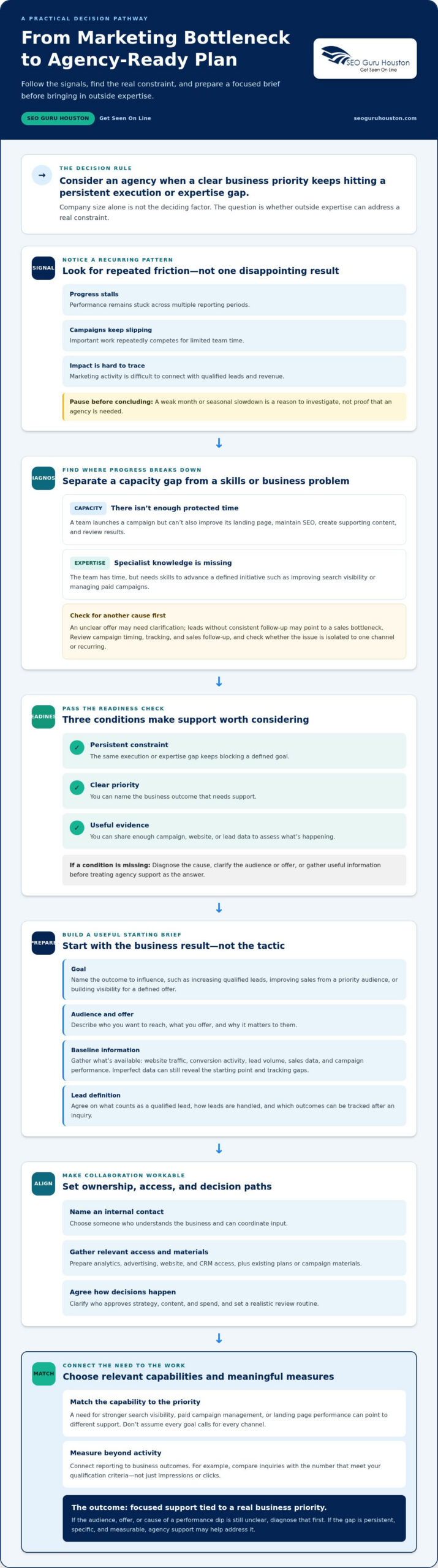
What if your next growth move isn’t adding another marketing channel, but getting the right expertise behind the ones you already use? If you’re asking when to hire a digital marketing agency, look at the gap between your goals and your team’s capacity to execute and measure. Campaigns that keep slipping, disconnected channel activity, and unclear links between marketing and qualified leads are signals worth investigating.

You don’t need to outsource every marketing decision to make progress. But when your team lacks the time or specialist skills to build a consistent strategy, outside support can turn scattered effort into focused work tied to business outcomes. The key is to set priorities, share useful information, and agree on how success will be measured.

This 2026 decision guide will help you recognize when agency support is timely, what to prepare before engaging a team, and how to make the investment accountable. You’ll learn how to assess readiness, match needs such as search visibility, paid campaigns, and landing page performance to relevant services, and set goals and measurement expectations before work begins.

Key Takeaways

  • Recognize when stalled progress, inconsistent execution, skill gaps, or limited capacity make outside expertise a strategic next step.
  • Before choosing channels or tactics, clarify your business goals, audience, offer, available data, and decision-makers.
  • Connect needs such as stronger search visibility or more qualified leads to relevant capabilities and meaningful measures of success.
  • Set a focused scope and document responsibilities, communication, decision rights, and reporting expectations before work begins.
  • Use a readiness checklist to decide when to hire a digital marketing agency, when to prepare first, or when your current team can keep moving forward.

When should you hire a digital marketing agency? Recognize the signals

Hiring an agency is a strategic decision, not an automatic milestone as your business grows. The right time is when a clear business priority keeps running into a persistent execution or expertise gap. A small team may be ready if it has a defined growth goal and needs specialist support. A larger company may not need an agency if its in-house team has the time and skills to deliver.

Look for a pattern rather than reacting to one disappointing result. Progress may stall across multiple reporting periods, important campaigns may repeatedly slip, or marketing activity may be difficult to connect to qualified leads and revenue. A temporary campaign dip or seasonal slowdown calls for diagnosis first. Check whether the change is limited to one channel or points to a recurring issue. Review campaign timing, tracking, and sales follow-up before deciding that outside help is the answer.

Which marketing problems signal a capacity or expertise gap?

A capacity gap appears when essential work repeatedly competes for the same limited hours. Your team might launch a campaign but lack time to improve its landing page, maintain SEO, create supporting content, and review results. A skills gap is different: the team has time, but not the specialist knowledge to advance a defined initiative, such as improving search visibility or managing paid campaigns. Because Digital marketing spans multiple channels and methods, identify the capability you need instead of assuming you need help with everything.

Separate execution problems from strategy or sales problems, too. If customers don’t understand the offer, more promotion may amplify the confusion. If leads arrive but aren’t followed up consistently, the bottleneck may be in sales rather than marketing. Pinpoint where progress breaks down before assigning the problem to an agency.

When is an agency premature or unnecessary?

Promotion works best when you can explain who the offer serves, what value it provides, and what action you want customers to take. If those fundamentals are unsettled, clarify them before scaling campaigns. Likewise, don’t treat one weak month as proof that you need an outside team. Review the underlying data, compare performance over an appropriate period, and look for a recurring constraint.

Focused internal execution may be the right choice when your team has the relevant skills, protected time, and a way to measure progress. Use this quick readiness check:

  • Persistent constraint: The same execution or expertise gap keeps blocking a defined goal.
  • Clear priority: You can name the business outcome that needs support.
  • Useful evidence: You can share enough campaign, website, or lead data to assess what’s happening.

If those conditions are present, agency support may help close a specific gap. If the audience, offer, or cause of a performance dip is still unclear, diagnose that first. The deciding factor isn’t company size. It’s whether outside expertise can address a real constraint tied to a business priority.

What should your business have in place before hiring an agency?

You don’t need a flawless marketing operation before bringing in outside expertise. You do need enough clarity to collaborate: what the business is trying to achieve, who it serves, what it offers, what information is available, and who can make decisions. This preparation keeps the work anchored to business outcomes rather than defaulting to channel activity.

Start with the result, not the tactic. “Grow the business” is an ambition; increasing qualified leads, improving sales from a priority audience, or building visibility for a defined offer gives the work a clearer direction. Once the outcome is clear, assess whether SEO, PPC, a landing page, or another approach fits the need. That sequence helps you evaluate when to hire a digital marketing agency without assuming every goal calls for every channel.

Set goals and establish a usable baseline

Write down the priority, the audience you want to reach, and the offer you want them to consider. Then gather the baseline information you already have: website traffic, conversion activity, lead volume, sales data, and campaign performance. The data doesn’t need to be perfect. It should help your team and agency understand the starting point and identify gaps in tracking.

Connect marketing measures to the sales process. Clarify what counts as a qualified lead, how leads are handled, and which outcomes the business can track after an inquiry. For example, compare the number of inquiries with the number that meet your qualification criteria. That context makes reporting more useful than a list of impressions or clicks alone.

Prepare the people, access, and decision process

Name an internal contact who understands the business and can coordinate input. Gather access to relevant analytics, advertising, website, and CRM accounts, along with existing plans or campaign materials. Decide who approves strategy, content, and spend, and agree on a realistic routine for reviews. Clear ownership prevents important decisions from stalling between teams.

Use this short preparation sequence before an agency conversation:

  • Goal: State the business outcome you want to influence.
  • Audience and offer: Describe who you serve and why the offer matters to them.
  • Data: Collect available performance and sales information, noting any gaps.
  • People: Identify the day-to-day contact and decision-makers.
  • Process: Clarify access, approval responsibilities, and review expectations.

Readiness means being prepared to share context, make timely decisions, and learn from evidence, not having every metric or process optimized in advance. If your priorities involve visibility, qualified traffic, or lead generation, reviewing SEO and PPC marketing support can help you identify capabilities that fit those goals.

How do you know agency support can deliver value, not just activity?

Agency support creates value when it closes a specific capability or capacity gap and ties the work to a business priority. Compare the options realistically: an internal team may know the product and customers deeply, while an agency can add specialist expertise or execution capacity. Either model still needs coordination, timely decisions, and clear accountability. The question of when to hire a digital marketing agency comes down to whether the added support can advance an outcome your team has defined, not simply produce more tasks.

Separate deliverables from results. Publishing content, launching ads, or building a landing page are deliverables. Qualified opportunities, sales, and stronger visibility for relevant searches are outcomes. Deliverables can be tracked directly; outcomes depend on factors such as the offer, execution, competition, customer behavior, and measurement quality. No channel or agency can guarantee a particular business result.

Which capabilities may be worth bringing in?

Business need Relevant capability Useful measures
Improve visibility for relevant searches SEO Organic impressions, relevant traffic, qualified inquiries
Reach people actively searching for an offer PPC Campaign traffic, conversion activity, cost per qualified lead
Turn campaign visits into inquiries Landing pages or website development Conversion rate, form submissions, qualified leads

What should meaningful reporting help you understand?

Good reporting explains what changed, what it may mean, and what action comes next. Google Analytics can help assess website visits and on-site behavior. Google Search Console can show search visibility and activity from organic results. CRM data can help connect inquiries to lead quality and sales progress. These sources answer different questions, so they’re most useful when interpreted together.

Separate leading indicators, such as impressions, clicks, and page conversions, from downstream outcomes like qualified opportunities and closed sales. Revenue attribution may be incomplete when customer journeys span channels or data is missing, so make limitations visible rather than overstating certainty. In regular reviews, expect a clear account of work completed, performance against agreed measures, decisions made, and next steps. That’s how you judge progress, not by the length of an activity report.

When to Hire a Digital Marketing Agency: A 2026 Decision Guide

How should you define scope, goals, and accountability before hiring?

A strong agency engagement starts with clear boundaries: which business priority needs attention, what work falls within scope, and how both sides will judge progress. Resist the urge to buy every channel at once. A focused first engagement makes it easier to coordinate work, interpret results, and decide what deserves investment next.

How do you choose a realistic first scope?

Start with the constraint you’ve diagnosed. If relevant searchers aren’t finding your business, SEO may fit the priority. If you need to capture existing demand through paid campaigns, PPC may be appropriate. If visitors arrive but struggle to take the next step, website development or a landing page could address the friction. Demand generation may fit when the challenge is creating and developing interest among potential buyers, while lifecycle and retention goals often call for dedicated email and CRM specialists like Vertical Brands.

Factor in your sales cycle, internal support, and ability to measure progress. A longer sales cycle may require tracking early engagement and lead quality before closed sales provide a useful signal. A campaign also needs internal owners who can supply business context, respond to inquiries, and make timely decisions. Connected services can make sense when one isolated tactic can’t address the full path from discovery to conversion. Keep the scope focused on the business problem, not a checklist of channels.

Which expectations should be agreed before work begins?

Put the working agreement in writing so the team and agency share the same definition of progress. Include the objective, baseline measures, deliverables, responsibilities, approval rights, communication cadence, and review intervals. Clarify who provides source materials, approves content, manages access, and decides whether to adjust campaign direction or spend.

Set a review framework that considers business outcomes alongside context. A change in traffic or lead volume matters, but so do lead quality, seasonality, sales follow-up, and changes to the offer. Agree on how results and limitations will be explained, what decisions each review should inform, and how strategic changes will be communicated. This creates accountability without treating a single metric as the whole story.

  • Objective: Name the business priority and the audience it serves.
  • Scope: Specify the work included and what falls outside the engagement.
  • Ownership: Assign agency and internal responsibilities, including approvals.
  • Measurement: Record the starting point, success indicators, and reporting rhythm.

Be wary of promises of guaranteed rankings, leads, or revenue. A clear scope can make work and decisions accountable, but outcomes depend on execution, market conditions, the offer, and reliable measurement. SEO Guru Houston provides SEO, PPC, web development, and demand generation services. Explore digital marketing services to see how these capabilities can support a focused plan.

When is it time to move forward with a digital marketing agency?

Move forward when four conditions align: your business has a clear goal, a persistent capability gap is holding back progress, relevant data can be shared, and leadership agrees on the priority. That combination gives an agency something concrete to work toward and your team a basis for evaluating the work. Company size alone doesn’t determine readiness.

Still unsure when to hire a digital marketing agency? Use this decision check:

  • Act now: You can name the business challenge, identify the expertise or capacity you’re missing, provide useful context or data, and get decisions from aligned leaders.
  • Prepare first: Your audience, offer, goal, or measurement is unclear. Resolve those questions before expanding activity.
  • Continue with current resources: Your team has the skills and protected time to address the priority, and current execution is consistent enough to assess.

Begin with the challenge, not a predetermined channel or package. A visibility problem may point toward SEO; a need to capture existing demand may call for PPC; a conversion bottleneck may involve the website or landing page. If the gap concerns reaching and developing potential business customers, B2B or inbound marketing may be relevant. The right scope follows the diagnosis.

What does a productive agency relationship require?

Strong collaboration depends on shared context: who your customers are, how your offer is positioned, how sales handles inquiries, and which business priorities matter most. The agency brings marketing expertise and execution capacity, while your team provides decisions and knowledge of the business. Progress is a cycle of strategy, implementation, measurement, and informed adjustment, not a handoff that replaces internal judgment.

What is the next step if your business is ready?

Prepare a concise brief before discussing scope. Include your goal, audience, offer, current marketing efforts, known constraints, available data, and the decisions or support your team can provide. Note whether the priority is search visibility, paid demand capture, B2B lead generation, inbound growth, or a website conversion challenge. This keeps the conversation focused on the business need and the capabilities that may address it.

With that brief in hand, you can discuss a tailored scope with SEO Guru Houston and define what progress should look like before work begins. Build a focused digital growth plan around a real business priority, clear responsibilities, and measures your team can use to make decisions.

Turn Your Marketing Priorities Into a Focused Plan

The decision about when to hire a digital marketing agency comes down to more than a growth target. Look for a clear business priority, a persistent gap your team can’t readily close, and the people, data, and decision-making support needed to act. Then define a focused scope and agree on how progress will be reviewed.

Agency support should connect expertise to business needs, not just increase the volume of marketing activity. SEO and PPC can support search visibility and qualified traffic, while B2B and inbound marketing, website development, landing pages, and demand generation can address other growth priorities. The right starting point depends on your goals, audience, and current constraints.

Ready to turn your next priority into a practical, accountable plan? Build a focused digital growth plan with SEO Guru Houston. Start with the challenge you need to solve, then move forward with clear responsibilities and measures.

Frequently Asked Questions

When should a small business hire a digital marketing agency?

A small business should consider agency support when it has a defined growth goal but lacks the time, specialist skills, or consistent execution to pursue it. First clarify your target audience, offer, and desired outcome. Then identify the specific gap external expertise would address, such as improving search visibility or managing paid campaigns. For example, specialists such as Big Voice – Digital Marketing Agency help growing SMEs focus on commercial outcomes rather than vanity metrics. Company size matters less than readiness and a clear business need when deciding when to hire a digital marketing agency.

How do I know if my business is ready to hire a marketing agency?

Your business is ready when you can explain its priority, target audience, and desired outcome, even if the strategy is still developing. Assign an internal decision-maker, make relevant website, campaign, or CRM data accessible, and confirm who follows up with leads. You don’t need perfect reporting. You do need enough context and internal coordination to collaborate, review progress, and make timely decisions as the work develops.

Can a digital marketing agency help if my business has no marketing strategy?

Yes, an agency can help shape a strategy, but your business should contribute knowledge of its customers, offer, competitive context, and commercial goals. If those fundamentals are unclear, make clarifying them part of the strategic work. Agree on a business priority and how progress will be assessed before launching campaigns. This helps prevent disconnected tactics and keeps expectations realistic while the strategy takes shape and is put into practice.

What should I expect when hiring a digital marketing agency?

Expect an initial alignment on business goals, audience, current marketing activity, responsibilities, and measurement. The agreed scope may include SEO, PPC, website development, landing pages, or demand generation, depending on the need. Set communication and review expectations early, including who approves work and how decisions are shared. Evaluate progress through clear reporting and business context, not activity counts alone. Results depend on execution, market conditions, and measurement.

Is it better to hire an agency or build an in-house marketing team?

The right choice depends on the expertise, time, and management capacity your business needs. An in-house team may offer close day-to-day knowledge of customers and operations, while an agency can add external specialist capabilities and execution support. Some businesses combine both. Compare the skills required, how consistently the work is getting done, and whether results can be measured. Choose the approach that best supports your priorities and available resources.

How much does it cost to hire a digital marketing agency?

Agency fees vary based on the work’s scope, services, complexity, and level of support, so there isn’t one useful figure for every business. Define the business outcome and work required before comparing proposals. Review responsibilities, deliverables, reporting, and measurement alongside the fee. A low price or a long list of promised activities doesn’t establish value on its own. Focus on whether the proposed scope addresses a clear business need.

What happens if I hire a digital marketing agency before my business is ready?

An unclear offer, misaligned goals, missing account access, or limited internal follow-through can slow work and make progress harder to assess. You don’t need a perfect foundation before engaging an agency, though. Identify the biggest readiness gap and decide whether it can be addressed within a defined scope. Agree on responsibilities, access, and how progress will be reviewed. Clear expectations help both sides address constraints rather than mistake them for campaign results.

In-House Marketing vs. Agency: Pros, Cons, and How to Choose

Weighing the in-house marketing vs agency pros and cons starts with a practical question: which capabilities should your business own, and where would specialist support make a bigger difference? The answer affects your control, execution capacity, and ability to connect marketing activity to measurable business goals.

Keeping marketing close to the business can help your team understand customers and respond to changing priorities. But a small team may struggle to cover every channel, while agency support without clear ownership can create extra coordination instead of better execution. The right model should fit your goals, workload, and internal expertise.

This guide compares in-house, agency, and hybrid marketing. You’ll learn how to evaluate control, specialist skills, capacity, and accountability, with practical examples involving SEO, PPC, and landing pages. You’ll also find a framework for assigning responsibilities and setting expectations for the work.

Key Takeaways

  • Compare the in-house marketing vs agency pros and cons across control, expertise, capacity, continuity, coordination, and accountability.
  • Assess actual team capacity, including hiring, onboarding, current workloads, and the time needed to manage marketing.
  • Start with business outcomes, then identify which skills and recurring tasks your team can realistically own.
  • Keep strategy ownership and business context internal while using specialist support where execution needs exceed your team’s capabilities.
  • Consider a hybrid model that combines internal priorities and approvals with external expertise in areas such as SEO, PPC, and landing pages.

In-House Marketing vs. Agency: What Each Model Actually Means

Every marketing model needs a clear strategy, skilled execution, and a way to measure progress. The in-house marketing vs agency pros and cons comparison is about how that work gets done, not whether marketing deserves investment.

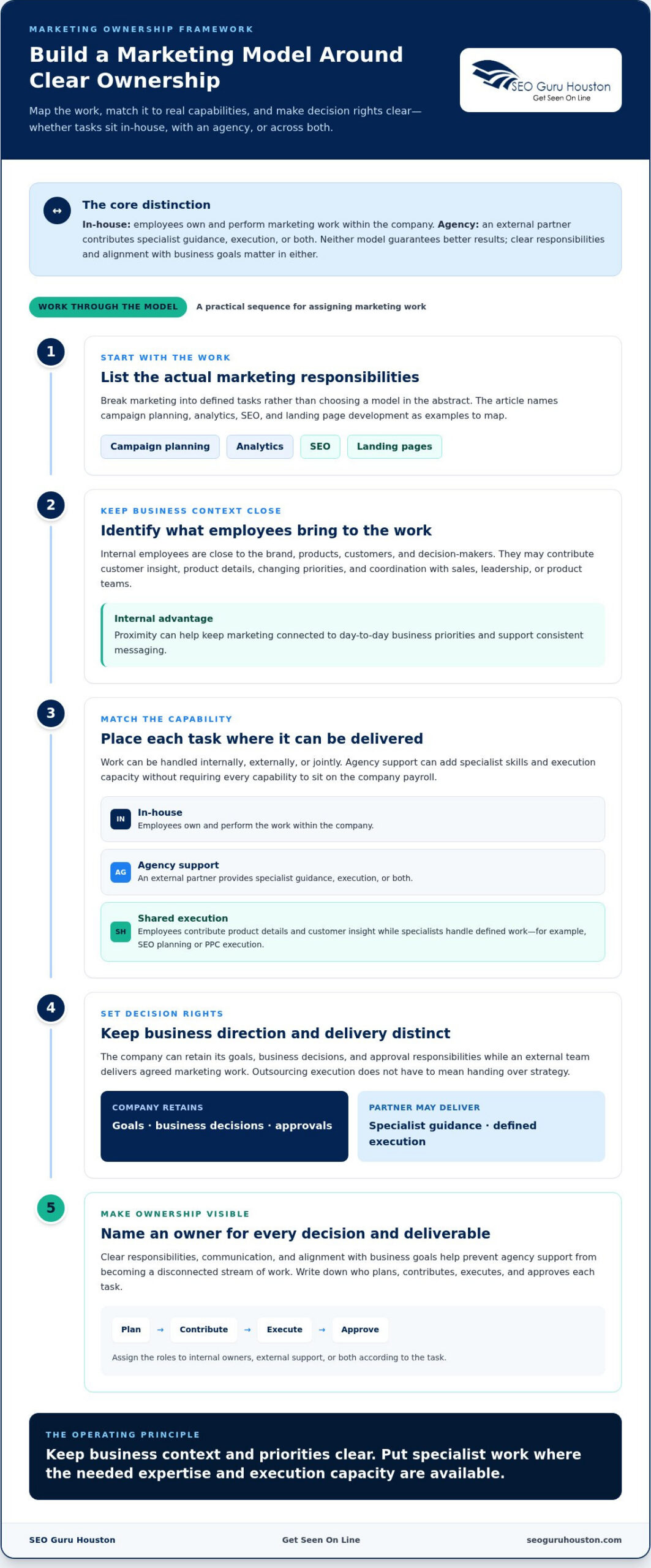
In-house marketing means employees own and perform marketing work within the company; agency marketing means an external partner contributes specialist guidance, execution, or both. An advertising agency is an outside organization that supports clients’ advertising and marketing efforts. Agency engagements can focus on one discipline or cover a wider range of work. Neither model guarantees better results. Clear responsibilities, communication, and alignment with business goals matter in either case.

What does an in-house marketing team typically handle?

Employees are close to the company’s brand, products, customers, and internal decision-makers. They may plan content, coordinate campaigns, monitor analytics, and work with sales, leadership, or product teams. That proximity can help keep marketing connected to day-to-day business priorities.

The team’s scope depends on its headcount, skills, and goals. A small team may focus on a few core activities, while a larger department may divide work across channels and specialisms. Internal knowledge is valuable, but it does not guarantee enough time or expertise to execute every task well.

What does an agency contribute to a marketing operation?

An agency can add specialist skills and execution capacity without requiring every capability to sit on the company payroll. Depending on the engagement, it may guide strategy, carry out defined work, or collaborate with employees—such as bringing in Branding TITANS™ to develop an overarching identity and mission. SEO, PPC, web development, and landing pages can be handled internally, externally, or jointly.

For example, employees can provide product details and customer insight while an external specialist handles SEO planning or PPC execution. The agency contributes expertise and delivery capacity; the company retains its business decisions, goals, and approval responsibilities. Clear ownership helps avoid the misconception that outsourcing execution means handing over strategy.

The practical distinction is where capabilities sit and who is accountable for each decision or deliverable. Map specific work, such as campaign planning, analytics, SEO, and landing page development, to internal owners and external support. This makes the in-house marketing vs agency pros and cons easier to assess and shows where specialist help could extend your team’s capacity.

In-House Marketing Pros and Cons: Control, Context, and Team Capacity

An internal team can move quickly because its members are close to the people, products, and decisions that shape marketing. But company knowledge and control do not guarantee effective campaigns. The practical question is whether employees have the time and skills to turn that context into consistent execution.

Where in-house marketing has an advantage

Employees work alongside product, sales, and leadership teams. They can hear customer feedback directly, understand changes in business priorities, and bring that insight into campaign planning. Their proximity can also support consistent messaging and simplify approvals, since they do not need an outside partner to learn the business from scratch.

That control is most valuable when the team has clear processes, enough capacity, and the expertise to deliver. An internal marketer may respond quickly to a product update, for example, but responsiveness is not the same as deep expertise in every channel. A team can know the brand well and still need specialist support for complex SEO work. A guide to professional SEO services can help clarify what that work involves.

Where an internal team can run into limits

One or two generalists may be responsible for content, campaign coordination, analytics, paid media, and search optimization. That breadth can leave little time for focused testing or ongoing improvement. Recruiting and developing specialist skills takes time, and onboarding, management, and employee retention all affect delivery. If a key employee leaves or priorities change, work may slow while responsibilities are reassigned.

The result can be a gap between planned marketing and what the team can reliably execute. Campaigns may launch late, optimization may be postponed, and activity across channels may become inconsistent. These problems are not inevitable with an in-house team. They are signs that workload and available expertise need closer attention.

Separate internal responsiveness from specialist depth when weighing the in-house marketing vs agency pros and cons. If your team understands the brand but has limited SEO capacity, external expertise can complement its work rather than replace its business insight. Harvard Business School Working Knowledge explores the strategic considerations involved in deciding whether to bring advertising expertise in-house.

Map recurring marketing tasks against the skills and time your team can consistently provide. If SEO execution is a bottleneck, specialist SEO support can extend capacity while internal stakeholders retain brand context and priorities.

Agency Marketing Pros and Cons: Specialist Skills Without Losing Accountability

An agency can add expertise and execution capacity, but outsourcing work does not mean surrendering business direction. Your company can retain ownership of goals, priorities, budgets, and approvals while an external team delivers agreed marketing work. Clear decision rights distinguish useful support from a disconnected stream of tasks.

Agency advantages: expertise, capacity, and execution

Specialists can bring focused experience in disciplines such as SEO, PPC, and web development. Their support can be useful when a launch, growth initiative, or uneven workload calls for skills your internal team does not use every day. For example, bringing in an agency partner like Insight Multimedia for web development or campaign execution provides specialized delivery capacity, while company stakeholders provide product knowledge and approve business priorities.

Agency value depends on measurable outcomes, not activity volume. A report full of tasks or clicks is not enough on its own. Agree on the business objective, relevant performance indicators, reporting cadence, and how results will guide next steps. Outcomes depend on the work, context, and constraints, so set expectations around what the engagement can influence and how progress will be assessed.

Agency drawbacks: coordination, context, and oversight

External specialists need timely information and access to the right decision-makers. If a brief leaves the target audience unclear, approvals stall, or the agency cannot get answers about a product change, execution may drift from business needs. Coordination also takes internal time. Assign someone to consolidate feedback, resolve competing priorities, and connect agency work to sales and leadership goals.

Give channel-specific work explicit owners. A PPC management plan, for instance, should clarify what the agency handles, what the company approves, and which indicators will be reported. Define how campaign changes, budget decisions, and performance reviews will be managed before activity begins.

Compare the trade-offs

Area Potential agency advantage What to manage
Expertise Focused skills across specialist channels Set priorities and define the work’s purpose
Control Execution support while internal leaders retain decisions Document approvals and decision rights
Capacity Additional delivery support for defined needs Align workload and scope with available resources
Continuity External support can sustain assigned work Keep records, access, and knowledge organized
Coordination Specialists can collaborate with internal teams Provide timely context and a clear point of contact
Accountability Regular reporting can make progress visible Connect metrics to goals and agreed actions

Evaluate how the partnership will work, not just which tasks it covers. A written scope, named owners, shared reporting, and scheduled reviews help preserve strategy ownership while making external execution accountable.

In-House Marketing vs. Agency: Pros, Cons, and How to Choose

How to Choose In-House Marketing vs. an Agency for Your Situation

Choose the operating model that closes the gap between your business goals and your team’s ability to execute. Start with the outcome you need, then decide who should own the strategy, deliver the work, and measure progress. This keeps the in-house marketing vs agency pros and cons grounded in capability rather than channel preference.

  1. Define the business outcome. Specify the change marketing needs to support, such as attracting more qualified traffic, improving lead quality, or contributing to pipeline growth. If coordinated pipeline goals are central, use B2B demand generation planning to connect marketing activity with sales priorities.
  2. Assess internal capacity honestly. List your team’s relevant skills, current workload, and available management time. Consider whether employees can sustain the work alongside existing responsibilities and whether they have the expertise for tasks that require specialist execution.
  3. Sort work by ownership and need. Separate strategic decisions, such as audience and priorities, from specialist execution and routine coordination. Rank tasks by business impact, urgency, complexity, and available internal skills. Identify whether each need is ongoing, project-based, or tied to a defined growth push.
  4. Assign clear accountability. For every priority task, name the person responsible for delivery, the decision-maker, the measure of progress, and how often results will be reviewed. Shared work still needs one clear owner for decisions and follow-through.
  5. Set expectations and review the model. Establish a baseline and choose KPIs that connect to the objective, such as qualified traffic, leads, conversion rates, or pipeline contribution. Name the reporting owner, set a review period, and agree how to adjust direction when the evidence calls for it.

Compare the full resource commitment

A fair comparison includes more than the person doing the work. Account for internal hiring and training, specialist skill gaps, employee workload, and the time required to brief and manage an external partner. Neither model guarantees savings. The right choice depends on the capabilities you need, how consistently you need them, and the internal effort required to support delivery.

For example, your team may own customer insight and pipeline priorities but lack the time or expertise to coordinate specialist execution. External support can fill that gap. If work is closely tied to daily internal decisions and your team has the skills and capacity, keeping execution in-house may fit better.

Use this process to create a practical ownership plan, then explore B2B demand generation support for coordinated marketing work tied to pipeline goals.

Build a Hybrid Marketing Model That Can Scale With Your Business

A hybrid model keeps business knowledge and strategic control close to your team while adding specialist execution where internal capacity or expertise is limited. Employees set priorities, provide product and customer insight, approve key decisions, and connect marketing activity to revenue goals. Agency specialists handle clearly defined work, such as SEO, PPC, or landing page execution, and report against agreed measures.

The model works when responsibilities are explicit. Treat the agency as an extension of your marketing operation, not a substitute for internal leadership. One internal point of contact should coordinate priorities, provide timely decisions, and keep both sides aligned.

Divide responsibilities clearly between employees and agency specialists

Use a responsibility matrix to name an owner for each part of the work. Adapt this starting point to your team and engagement:

  • Strategy and priorities: Internal leadership owns business goals; agency specialists contribute channel recommendations.
  • Execution: The agency delivers agreed specialist tasks; employees provide the context and inputs needed.
  • Approvals: Internal stakeholders make final decisions on brand, product, and business commitments.
  • Analytics: The agency manages or supports channel measurement; the internal owner connects findings to business context.
  • Reporting: The agency reports agreed metrics and actions; the internal point of contact leads review and follow-up.

Agree on what counts as a qualified lead, conversion, and successful campaign before reporting begins. Clarify how attribution will be interpreted, which data sources matter, and how often performance will be reviewed. Shared definitions reduce confusion and help the team decide what to adjust, continue, or stop.

Know when to expand, outsource, or rebalance

Consider hiring internally when work requires sustained ownership, close daily coordination, and ongoing decisions tied to company operations. Agency support can fit when specialist skills or flexible execution capacity are the immediate constraint. The right balance can change as goals, channel mix, workload, and internal capabilities evolve. Revisit responsibilities and measures rather than letting an old setup run by default.

The in-house marketing vs agency pros and cons discussion is most useful when it leads to a working plan: who owns each decision, what gets delivered, how success is measured, and when the team will reassess. That structure helps a business retain control without limiting execution to the skills already on staff.

For an approach that connects specialist marketing work to business priorities, explore our marketing services.

Make Your Marketing Model Work for Your Next Stage of Growth

The right choice is not automatically all in-house or all agency. Use the in-house marketing vs agency pros and cons to decide which work needs close company ownership and where specialist support can extend capacity. Keep business priorities, product insight, approvals, and revenue context clear, then connect each responsibility to measurable outcomes and regular reviews.

A hybrid approach can combine internal knowledge with focused execution. SEO, PPC, B2B marketing, and inbound marketing can work alongside web development and landing page design, with responsibilities shaped around your goals and team capabilities.

Turn your priorities into a practical plan with marketing support built around your growth goals. Define the work, ownership, and measures that matter, then review progress and adjust as your needs change.

Frequently Asked Questions

Is in-house marketing better than hiring an agency?

Neither model is universally better. The right fit depends on your goals, internal capabilities, workload, and need for specialist skills. An in-house team has close access to company knowledge and day-to-day decisions. An agency can add expertise and execution capacity for specific channels or projects. Compare who can own the strategy, complete the work consistently, and report against meaningful business outcomes. A hybrid model can combine internal direction with external support.

What are the main pros and cons of an in-house marketing team?

An in-house team can build deep product and customer knowledge, coordinate closely with colleagues, and respond quickly as priorities change. The trade-off is that hiring, onboarding, training, and retaining skilled employees takes time and management effort. A small team may also struggle to cover specialist channels alongside routine work. Assess whether employees have the expertise and available capacity to deliver consistently, rather than judging the model by internal control alone.

What are the advantages and disadvantages of a marketing agency?

A marketing agency can provide specialist expertise, flexible execution capacity, and an outside perspective without requiring every skill to sit internally. External teams need clear briefs, timely business context, access to decision-makers, and coordinated approvals. Set the scope, responsibilities, reporting expectations, and performance measures at the start. Outsourcing execution does not mean giving up strategy ownership: your company can retain goals, priorities, and final business decisions while specialists deliver agreed work.

How much does in-house marketing cost compared with an agency?

The comparison depends on the roles, expertise, and scope of work involved. For an internal team, consider compensation alongside recruitment, onboarding, benefits, training, software, and management time. For an agency, assess the agreed scope, deliverables, reporting, and any resources your team must provide. Neither option is automatically less expensive. Compare the total resources needed to meet your goals, including coordination time and the cost of capability gaps or inconsistent execution.

Can a small business use both an in-house team and an agency?

Yes. A small business can keep priorities, approvals, customer insight, and revenue context with an internal owner while assigning defined specialist tasks to an agency. Employees might set campaign goals and provide product information while external specialists support SEO, PPC, or landing page work. Name one internal point of contact, agree on deliverables and measures, and establish a regular review routine so shared work stays coordinated and accountable.

When should a company switch from in-house marketing to an agency?

Consider agency support when recurring marketing work exceeds your team’s available capacity, specialist skills are missing, or execution is repeatedly delayed. A full switch is not always necessary. Identify which tasks need outside expertise and which decisions should remain internal. Define the business outcome, assign an internal decision-maker, and agree on reporting measures before work begins. If the need involves sustained daily coordination and ownership, building internal capability may be a better fit.

Ready to decide which marketing work to own and where to add specialist support? Talk with our team about a growth plan.

Signs of a Bad SEO Company: 9 Red Flags to Watch for in 2026

What if the SEO reports landing in your inbox show plenty of activity but reveal nothing about leads, conversions, or revenue? That gap doesn’t automatically prove your SEO company is failing, but it does mean you need clearer evidence. The signs of a bad seo company often hide behind confident ranking promises, vague updates, and work you can’t verify.

You’re right to expect more than charts and claims. SEO takes time, rankings can shift, and no company can responsibly guarantee a top position. But a capable partner should be able to explain the strategy, show what work was completed, and connect search performance to meaningful business goals. This guide covers nine warning signs, from secretive tactics and missing account access to reports that overlook qualified traffic and conversions. You’ll learn how to assess the evidence, distinguish a genuine concern from a normal fluctuation, and choose a practical next step that protects search visibility and supports growth.

Key Takeaways

  • Recognize the signs of a bad seo company by looking for risky practices and claims that aren’t backed by clear, verifiable work.
  • Separate normal ranking fluctuations from recurring unexplained changes by considering your site’s conditions, competition, and the work being done.
  • Use a simple review process to check account access, goals, reports, completed work, and business outcomes.
  • Document specific concerns and use them to guide a focused discussion about deliverables and measurable next steps.
  • Look for a partnership that connects SEO activity to audience needs, qualified traffic, leads, and conversions.

What are the signs of a bad SEO company? Start with these warning signals

Unclear work, disappointing results, and confident claims can leave you wondering whether your SEO investment is moving the business forward. One concern alone doesn’t prove misconduct. Look for a pattern: repeated opacity, risky tactics, or activity that can’t be connected to your goals. Search engine optimization (SEO) improves a site’s visibility in search results, but the work should still be explainable and open to review.

Start with these warning signals:

  • Guaranteed rankings: A promise of a specific position or certain result treats search outcomes as controllable when they aren’t.
  • Unexplained tactics: The company refers to “secret methods” but won’t describe the work or its purpose, even at a high level.
  • Vague reporting: Updates show activity or ranking charts without explaining what changed, why it matters, or how performance relates to qualified traffic and leads.
  • Withheld account access: You can’t access your own Google Search Console, Google Analytics 4, or website administrator accounts.

A bad SEO company repeatedly hides its methods, uses risky practices, or can’t connect its work to your business goals. A temporary ranking change alone is not proof of poor service.

Which SEO promises should make you pause?

Be cautious of claims like “number one by next month” or “we guarantee page-one rankings.” An SEO company can set targets and explain the work intended to pursue them, but it can’t dictate search-engine decisions, competitors’ activity, or how a search result changes. Ambition is useful when it comes with a strategy, milestones, and honest uncertainty. A guaranteed position or exact timeline is different: it presents an uncertain outcome as certain.

“Secret methods” deserve scrutiny if the company won’t explain what it’s doing, which pages or issues the work addresses, or how progress will be assessed. A strategy may involve technical details, but the business purpose and deliverables shouldn’t be a mystery.

What does poor SEO communication look like?

A report that lists impressions, clicks, or rankings without interpretation leaves you guessing. Useful reporting explains what the metrics indicate and how search activity relates to your goals, such as qualified visits, inquiries, or conversions. Communication is also a concern when updates repeatedly go missing, no one clarifies who owns a task, or questions about completed work go unanswered.

Keep direct access to your analytics and search accounts. You need to review performance and retain continuity if the working relationship changes. If access is withheld, ask for a clear explanation and a way to regain control. Treat the issue as a reason to investigate the broader pattern, not as a verdict on its own.

Bad SEO company or normal delay? Separate red flags from search volatility

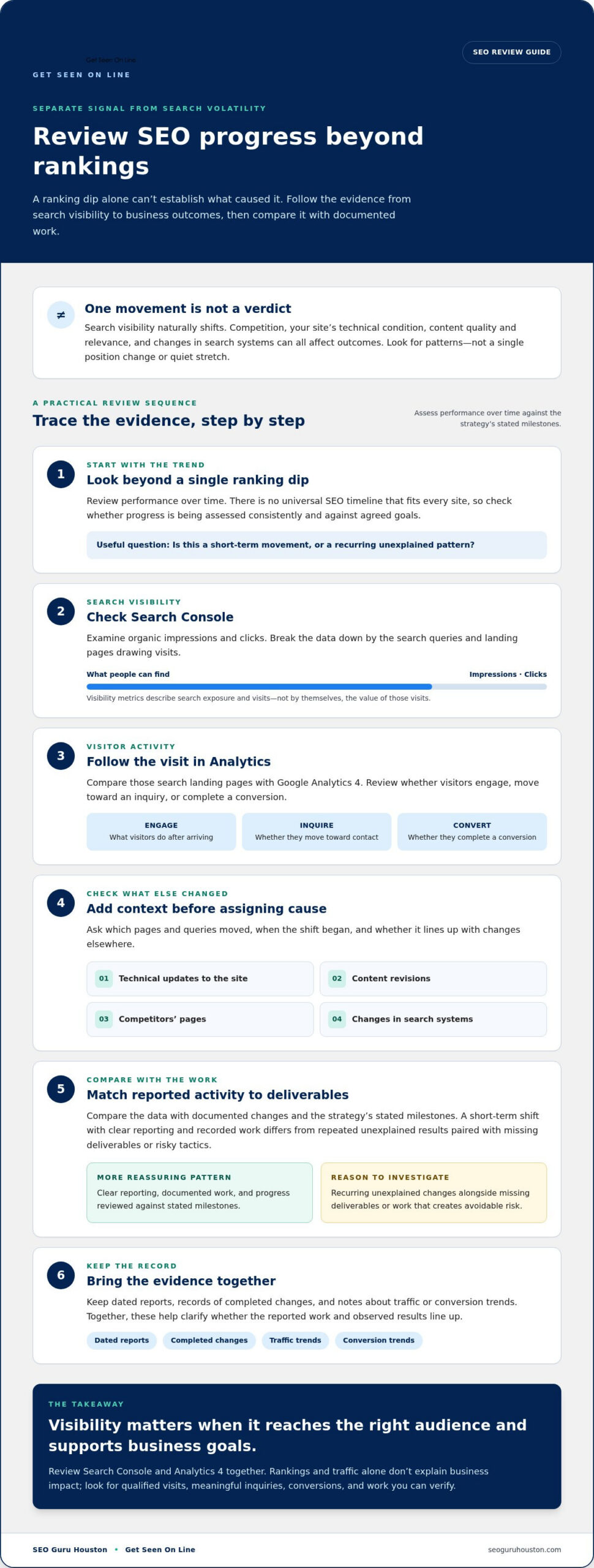
A ranking dip can feel like proof that something has gone wrong. But search visibility naturally shifts, and SEO outcomes depend on factors beyond an agency’s control, including competition, your site’s technical condition, and the quality and relevance of its content. One change in position, or a quiet stretch in traffic, can’t establish who or what caused it.

Look for a pattern instead. A short-term movement accompanied by clear reporting and documented work is different from recurring unexplained changes, risky tactics, or promised deliverables that never appear. Compare performance over time with the strategy’s stated milestones. There’s no universal timeline that fits every site, so focus on whether progress is being assessed consistently and the work is moving toward agreed goals.

Is a ranking drop proof your SEO company is failing?

No. Before drawing a conclusion, consider what else changed: a technical update, a content revision, shifts in competitors’ pages, or changes in search systems. Ask which pages and queries moved, when the shift began, and whether the change lines up with documented site or SEO work. The signs of a bad seo company are more persuasive when a pattern of unexplained results appears alongside missing deliverables or work that creates avoidable risk.

Keep evidence together: dated reports, records of completed changes, and notes about traffic or conversion trends. If you suspect deceptive or unfair business conduct rather than ordinary underperformance, the Federal Trade Commission (FTC) offers information about reporting such concerns in the United States.

Which SEO metrics reveal progress beyond rankings?

Use Google Search Console to examine organic impressions and clicks, including the queries and landing pages drawing search visits. Then compare those pages with Google Analytics 4 data to understand what visitors do after arriving: whether they engage, move toward an inquiry, or complete a conversion. Review these sources together, since neither rankings nor traffic alone explains the business impact.

Visibility metrics show whether people can find you; business-context metrics show whether that visibility is attracting the right audience and supporting growth. A rise in clicks to an irrelevant page may not help your goals, while a smaller stream of qualified visits can be valuable if it leads to meaningful inquiries. Assess trends alongside completed deliverables, and ask for a clear explanation when the data and reported work don’t line up.

If you’re reassessing your approach, explore how SEO strategy can support business goals by connecting search visibility with qualified traffic and conversions.

How to review an SEO company’s work, reports, and account access

Use a repeatable review, not a gut check. Start by confirming you can access the relevant accounts, then compare the SEO plan with its reports, completed tasks, and business outcomes. This makes it easier to identify gaps without assuming that a disappointing metric proves poor service.

  • Confirm access: Sign in to your business’s Google Search Console and Google Analytics 4 properties.
  • Define the goals: Identify the outcomes the strategy is meant to support, such as qualified organic visits, inquiries, or conversions.
  • Inspect the reports: Check the reporting period, metrics, findings, completed actions, and proposed next steps.
  • Match work to strategy: Compare reported tasks with visible content updates, site changes, and documented technical findings.
  • Assess outcomes: Consider trends in search visibility alongside landing-page performance and business results.

Google’s SEO Starter Guide provides context for claims about search fundamentals and practices. Use Google Search Central documentation to assess whether explanations align with published guidance, rather than accepting technical-sounding claims without evidence. Access to data makes a review possible, but it doesn’t prove the work is effective or appropriate. The signs of a bad seo company become clearer when access problems are part of a wider pattern of unclear work or unsubstantiated reporting.

What should an SEO report show?

A useful report identifies the period covered, the goals being tracked, work completed, findings, and next steps. It should explain changes in organic impressions and clicks in context, such as which landing pages gained or lost search visits and whether those visits led to measurable conversion actions. If lead quality can be assessed, include that context too. Rankings are one indicator, not the whole performance story.

Look for a clear connection between an action and its purpose. For example, a report that lists a page update should identify the page, summarize what changed, and explain what the team will monitor. If the report presents a metric without interpretation, ask how it relates to the strategy’s goals.

What account access and ownership should you review?

Confirm that your business can access its own Google Search Console and Google Analytics 4 properties. Also identify who controls the website, domain registration, tracking configuration, and other marketing accounts used in the work. Access arrangements can differ, but you should know who holds administrative control and how access can be maintained if the relationship changes.

Record missing access or unclear ownership before changing settings or removing users. Document which account is involved, who currently controls it, and what access you need. That creates a clear starting point for resolving the issue without disrupting tracking or site operations.

Signs of a Bad SEO Company: 9 Red Flags to Watch for in 2026

What to do when your SEO company shows these warning signs

Don’t make a major decision based on a vague concern. Build a clear record first, then use it to seek answers and decide whether the engagement can be corrected. Note the specific claim or issue, the date, the related report or message, any missing deliverable, and the account or access involved. Keep copies of reports and relevant site or campaign settings you can access.

Next, request a focused review meeting. Bring the agreed goals, documented work, and the evidence that raised concern. Ask for a plain-language explanation of what was completed, what remains, and how the next steps will address the issue. A credible corrective plan should name the root problem, assign actions, connect those actions to business goals, and set a review point. Vague reassurance isn’t a plan.

Prioritize account security and ownership. Confirm you can access your business accounts and understand who controls the website, domain, tracking, and marketing tools. Before removing access, changing technical settings, or ending the relationship, preserve records and make sure you won’t lose control of essential accounts or disrupt tracking. The signs of a bad seo company matter most when the company won’t address documented issues or repeatedly avoids accountability.

How should you raise concerns about SEO performance?

Keep the discussion specific and evidence-based. Instead of saying, “SEO isn’t working,” point to an agreed goal, a report period, a missing deliverable, or a change that needs explanation. Ask which completed actions support the strategy, what the current data suggests, and which priorities come next. After the meeting, write down commitments, owners, and review dates so you can assess progress against the same expectations.

When should you consider changing your SEO approach?

Consider a change if opacity continues, access concerns remain unresolved, or the work relies on tactics that conflict with Google Search guidance. Before a transition, preserve account access and document current site, tracking, and campaign settings. Avoid abrupt technical changes until you understand what they do and how they could affect search visibility. A careful handoff protects continuity while giving you a clearer basis for deciding what should change.

Ready to connect search visibility with qualified traffic and business goals? Explore SEO strategy and services to move toward a more focused growth plan.

What a trustworthy SEO partnership should deliver, and how to move forward

A strong SEO partnership doesn’t sell certainty. It gives you realistic expectations, a strategy you can understand, reporting that explains progress and setbacks, and communication that makes responsibilities clear. Most of all, its work connects to your audience and business goals, not just a list of completed tasks.

How can you recognize accountable SEO work?

Look for a plan that explains how technical improvements, content, and authority-building activities support your stated objectives. The right priorities depend on your site and audience, but each recommendation should have a clear purpose. Reporting should explain what the team decided, what changed, what the evidence suggests, and what comes next. If a result falls short, expect a reasoned explanation and an adjustment, not just another chart.

An accountable SEO partnership sets realistic expectations, explains its strategy, reports on evidence and outcomes, and takes responsibility for clear next steps. Use that standard alongside the warning signs you’ve reviewed. It helps distinguish a working relationship that needs better alignment from one that repeatedly avoids transparency.

How can SEO support broader business growth?

Search visibility can contribute to demand generation when it connects the right audience with useful pages designed to guide visitors toward a meaningful action. SEO can help people discover relevant content; a focused landing page can make the next step clear. Depending on your goals, PPC may complement organic search by supporting paid visibility. These channels should work toward shared business objectives, not operate as disconnected activity.

For more context on building search visibility, see Professional SEO Services: Dominating the 2026 Search Ecosystem. The broader relationship between search strategy and marketing goals is also explored in SEO MARKETING COMPANY: Dominate Search and Explode Your Revenue in 2026!

Choose a practical next step: define the outcomes that matter, review the evidence against them, and agree on a strategy with clear responsibilities and measurable priorities. If your current approach can’t meet that standard, use what you’ve documented to guide a more accountable growth plan.

Make your next SEO decision with confidence

The clearest signs of a bad seo company aren’t a single ranking dip or a slow month. Look for recurring patterns: promises presented as certainties, work you can’t verify, reports disconnected from business results, or restricted access to your own accounts. Review the evidence over time, and distinguish ordinary search movement from practices that deserve a closer look.

A stronger partnership gives you realistic expectations, an explainable strategy, transparent reporting, and clear next steps. Judge progress by more than rankings: consider whether SEO is attracting qualified visitors and supporting leads and conversions. When your goals call for it, SEO and PPC can work alongside website development and landing pages to support visibility and lead generation.

Start by defining the outcomes that matter, reviewing the work against those goals, and choosing a strategy you can understand and evaluate. Explore SEO strategies built around measurable business growth. Take control of your search strategy with evidence, clarity, and a focus on the customers you want to reach.

Frequently Asked Questions

What are the biggest signs of a bad SEO company?

Common signs of a bad seo company include guaranteed rankings, tactics the company refuses to explain, reports that don’t connect work to business goals, and restricted access to your accounts. Look for a recurring pattern rather than treating one missed update or ranking dip as proof. Ask for evidence of completed work, a clear explanation of the strategy, and reporting that relates search activity to qualified traffic, leads, or conversions.

Can an SEO company guarantee first-page Google rankings?

No company can control Google’s search results, so a guaranteed first-page position should make you cautious. A responsible SEO partner can set targets, explain the strategy, and track progress, but rankings depend on factors such as competition, your site, and search systems. Ask what actions support the target, how progress will be measured, and what the company will do if results differ from expectations.

How long should SEO take to show results?

There isn’t one reliable timeline for every SEO campaign. Progress depends on factors such as your site’s condition, competition, content, and the scope of the work. Rather than relying on a promised deadline, review the strategy’s stated milestones and evidence of completed tasks. Ask how progress will be evaluated over time, including search visibility, organic traffic, and meaningful outcomes like inquiries or conversions.

Is a sudden drop in rankings proof my SEO company did something wrong?

No. A single ranking drop doesn’t establish cause or responsibility. Technical changes, content updates, competitors, and search-system changes can all affect visibility. Review which pages and queries changed, when the shift began, and whether it aligns with documented work. Check Google Search Console for notifications about manual actions. A ranking change after a broad search update isn’t automatically a penalty; assess patterns, deliverables, and business outcomes before deciding what happened.

What should an SEO company include in its monthly report?

A useful report should identify the period covered, agreed goals, completed work, findings, and next steps. It should explain organic impressions and clicks in context, such as which landing pages changed and whether visitors took measurable actions. Rankings can provide useful context, but they shouldn’t stand alone. Look for clear reporting on qualified traffic, inquiries, or conversions where tracking allows, and ask for plain-language explanations of unexplained changes.

Should my business own its Google Search Console and Analytics accounts?

Yes. Your business should retain access to its Google Search Console and Google Analytics 4 properties so you can review search performance and website activity. Confirm that you can sign in and understand who has administrative access. Also clarify ownership and access for your website, domain, and tracking setup. An agency may help manage these accounts, but your ability to review the data shouldn’t depend on its reports alone.

What should I do if my SEO company refuses to explain its work?

Document the request, the response, relevant reports, and any missing deliverables. Ask for a plain-language summary of completed actions, their purpose, and the next priorities tied to your goals. Record commitments and review dates. If explanations remain vague or account access is restricted, preserve your records and confirm control of essential accounts before changing settings or ending access. Judge the response by whether it resolves the specific concern with verifiable evidence.

B2B Social Media Strategy: A Practical 2026 Guide

What if your social media presence helped buyers shortlist your company before they ever spoke with sales? Oktopost reported in June 2026 that 95% of B2B purchases go to a vendor already on the buyer’s day-one shortlist. A social media strategy for b2b companies should help earn that consideration, not just collect impressions. Yet it’s easy to spread a small team across too many platforms, publish without a clear audience, and struggle to connect engagement with opportunities or revenue.

You’re right to expect more from social than a steady stream of posts. The challenge is building a focused approach that supports how buying groups research, compare, and validate potential vendors, while giving your team a practical way to create and distribute useful content consistently.

This guide shows you how to prioritize platforms around your audience and business goals, shape an editorial focus, and establish a repeatable content workflow. You’ll also learn how to track meaningful pipeline signals alongside engagement, so you can assess social activity in the context of demand generation and broader digital marketing.

Key Takeaways

  • Build a social media strategy for b2b companies around business goals, buying-group needs, and clear measures of success.
  • Turn customer questions and sales objections into useful content themes your team can plan and publish consistently.
  • Choose channels based on audience fit, content strengths, and available effort, not platform hype.
  • Track qualified engagement as an early signal, then assess how social contributes to opportunities and revenue.
  • Coordinate marketing, sales, and subject-matter experts so social engagement leads to relevant conversations and helpful next steps.

What a B2B Social Media Strategy Must Accomplish

A social media strategy is more than a decision to post regularly. A B2B social media strategy is a set of connected decisions about business goals, buying groups, channels, content, resources, and measurement that guides how social supports growth. A publishing calendar tells your team what goes out and when. Strategy explains why it matters, whom it serves, and what outcome it should support.

That distinction keeps activity from becoming the goal. Posting frequency, impressions, and follower growth can help diagnose distribution, but they don’t prove social is moving the business forward. Define the outcomes first, such as helping the right buyers discover your company, building trust through useful expertise, supporting consideration, giving sales relevant material for conversations, or staying helpful to existing customers.

Start with business goals and buying-group needs

Choose one primary business objective before selecting platforms or formats. Then map the people involved in a purchase, including decision-makers, influencers, and others who shape evaluation. What do they need to understand? Which objections or risks slow a decision? A social media strategy for b2b companies becomes more focused when it answers real buying questions instead of assuming every audience wants the same message.

Separate assumptions from evidence. Compare what your team thinks buyers care about with patterns in sales conversations, CRM notes, and customer research. If prospects repeatedly ask how implementation works, for example, that may point to a useful content theme. Keep the objective specific enough to guide choices, but broad enough to address the buying group’s different information needs.

Set a realistic role for social media

Social can help buyers discover your expertise, encounter consistent messages, learn about a problem, and find relevant resources. It can also support sales conversations and customer retention when teams share useful, timely information. As a foundation, this overview of social media marketing explains the broader practice; a B2B strategy connects it to a defined audience and business purpose.

Keep expectations grounded. Organic social can influence a complex purchase without being the only source a buyer encounters, so it rarely deserves sole credit for a conversion. Measure its contribution alongside other touchpoints and demand-generation activity. A broader B2B demand generation framework can help show how social fits with channels and follow-up that support demand capture. The aim is not to claim every win for social. It’s to make social’s role clear, useful, and measurable.

Build a B2B Social Media Strategy Around Audience, Message, and Content

Once the business objective is clear, turn it into a plan your team can execute. A strong social media strategy for b2b companies connects what buyers need to know with what your business needs to accomplish. Use this sequence to keep the decisions connected:

  • 1. Goal: Choose the primary business objective and define what progress would look like.
  • 2. Audience: Identify the buying-group roles you need to reach and the questions each role asks.
  • 3. Message: State the audience’s problem, the outcome they want, and your informed point of view in plain language.
  • 4. Channel: Select platforms based on where your audience seeks information and which formats your team can sustain.
  • 5. Content: Match useful topics and formats to buyer needs and the goal.
  • 6. Workflow: Assign who contributes expertise, reviews claims, publishes, and responds.
  • 7. Measurement: Decide which signals you’ll review and how they relate to the business objective.

Translate buyer research into a clear message

Make the message specific enough to guide content, but not so broad it could belong to any company. Ask subject-matter experts and sales teams to surface recurring questions, misconceptions, and objections. Then check those ideas against sales conversations, CRM notes, and customer research. A useful post might explain a complex decision factor, address a common concern, or clarify what buyers should compare.

A B2B social content plan should reflect the questions buyers actually ask, so every post helps them make a better-informed decision. Keep claims precise. Verify statistics, customer evidence, and product statements before publishing, and don’t present an illustrative example as a customer result.

Create content pillars and a workable publishing system

Group ideas into a small set of recurring themes tied to audience needs and business priorities. For example, a team might organize content around expert insights, educational resources, customer proof approved for use, and carefully selected material from credible sources. Each type has a different job: original insight builds perspective, education answers questions, verified proof provides evidence, and curation adds useful context.

Choose formats to fit the message, not a trend. Expert commentary can unpack a timely issue; short video can make a process easier to understand; documents can organize a practical checklist; discussion prompts can invite relevant questions. Set a realistic production rhythm, name contributors and reviewers, and repurpose strong ideas thoughtfully rather than posting filler to meet a quota. For a complementary approach to connecting useful content with buyer needs, explore B2B inbound marketing.

Choose B2B Social Media Channels by Buyer Fit, Not Hype

The strongest channel isn’t automatically the one with the loudest buzz or the biggest reported audience. It’s the one your buying group uses for relevant information, where your team can contribute credibly and consistently. LinkedIn can support professional discovery and conversation, but that doesn’t make it the default choice for every B2B buyer. Validate assumptions against customer research, sales feedback, and the channels prospects mention during evaluation.

Assess platform fit before committing resources

Compare each channel against four practical questions: Are decision-makers and influencers there? Does the platform suit the content you can produce well? How much effort will consistent participation require? What business role could it support? The table is a starting point, not a universal ranking. Confirm fit with evidence from your own audience.

Channel Potential audience fit Content fit Relative effort Possible goal
LinkedIn Buyers who use professional networks for industry information and discussion Expert commentary, company perspectives, useful documents, conversation prompts Moderate, with regular input from knowledgeable contributors Discovery, credibility, and professional conversation
YouTube Buyers who seek in-depth explanations or demonstrations Educational explainers, interviews, walkthroughs High if planning, production, and review exceed team capacity Education and consideration
Reddit or specialist communities People who seek peer discussion or answers in topic-focused spaces Detailed responses, practical insights, careful participation Moderate to high, depending on the research and engagement required Listening, discovery, and trust through relevant participation

Effort depends on your team, not just the platform. A subject expert who enjoys explaining technical topics may make video a workable choice; a lean team without production capacity may get more from focused written contributions. Start with a manageable channel set. Expand only when buyer evidence supports it and you can maintain quality without weakening existing efforts. For teams that need external expertise to establish and maintain a consistent digital footprint, consulting marketing specialists like cornerstone-ms.co.uk can help bridge the resource gap.

Match channel roles to the wider buyer journey

Think of social as a route into useful information, not the whole journey. A post can introduce a problem or explain an idea; a relevant resource on your site can provide depth and a clear next step. Coordinate social distribution with search, paid campaigns, and conversion-focused landing pages so each touchpoint supports the same message. For campaign traffic, use the high-converting landing page guide to consider how the destination can support the action you want visitors to take.

Keep testing disciplined: define what evidence would justify continuing, adjusting, or adding a channel. That turns platform selection from guesswork into a practical decision within your social media strategy for b2b companies.

B2B Social Media Strategy: A Practical 2026 Guide

Launch, Measure, and Improve Your B2B Social Media Strategy

A social program becomes measurable when the team agrees on what it’s trying to change and how it will review progress. Use a simple launch sequence to establish that discipline before activity scales:

  • 1. Set a baseline. Record current performance for the channels and business indicators tied to your objective. Note how the data is defined and where it comes from.
  • 2. Assign ownership. Name who plans content, approves claims, publishes, monitors responses, and shares relevant activity with sales.
  • 3. Build the calendar. Schedule themes and formats your team can sustain, leaving room to respond to timely questions and conversations.
  • 4. Configure tracking. Use consistent UTM parameters on campaign links where appropriate, and confirm that the destination page and analytics setup can capture relevant visits. Record useful context in CRM records when the process supports it.
  • 5. Set a review cadence. Choose a regular interval for checking early signals and a longer window for assessing outcomes that take time to develop.
  • 6. Iterate with evidence. Keep what supports the objective, refine what shows promise, and stop activity that consumes effort without a clear role.

Choose KPIs that reflect the strategy’s objective

Match a small set of indicators to the goal, then define the measurement period and what counts. Qualified comments, relevant conversations, resource visits, or responses from target roles can serve as leading indicators. Reach and engagement help diagnose whether content is being seen and prompting a response, but they don’t automatically demonstrate pipeline contribution.

Opportunities, progression through CRM stages, and revenue are lagging outcomes. Review these alongside campaign data and sales feedback where available. UTM parameters can identify some visits or conversions associated with tagged links, but they can’t capture every influence: buyers may see a post, discuss it internally, and return through another channel. Social reporting can show contribution and patterns, but it isn’t proof that social alone generated the revenue.

Run focused experiments and adjust the plan

Test one meaningful variable at a time, such as the audience, format, message, or call to action. Write down the hypothesis, observation window, result, and decision before repeating the test. If you change several elements at once, it’s harder to tell what affected the outcome.

Use Google Analytics 4 and CRM reporting only when they’re configured, relevant to the question, and verified by your team. Keep measurement practical. If your team needs support connecting social media marketing with broader demand generation, explore coordinated marketing support.

Turn Your B2B Social Media Strategy Into Coordinated Demand Generation

Social earns more value when it connects to what happens next. A useful post can introduce a challenge, an educational resource can help a buyer explore it, and a sales conversation can address the questions that follow. Treat each interaction as part of a connected path, not a demand-generation result on its own.

Connect social content to a useful next step

Match the call to action to the reader’s readiness. Someone encountering your company for the first time may benefit from an educational guide; a buyer comparing options may need a detailed resource or a relevant conversation with your team. Avoid asking every reader for the same commitment. The next step should feel like a logical continuation of the content.

Make sure the destination page delivers on the post’s promise. It should clearly identify who the resource is for, what the visitor will find, and what they can do next. Coordinate social campaigns with inbound marketing so posts, useful resources, and follow-up support a consistent experience instead of treating every post as a standalone lead generator.

Make the handoff clear

Set expectations for what happens when someone engages. Marketing can identify relevant interactions and share context; sales can decide whether a direct response is appropriate; subject-matter experts can clarify technical questions or contribute accurate answers. Define who owns each handoff and what information to pass along, such as the content viewed, the question asked, or the buyer’s stated need. A timely, relevant response builds on the interaction without assuming every like or comment signals purchase intent.

Before assigning ownership, check your internal capacity across strategy, creative, publishing, analytics, and subject expertise. Keep the work in-house where responsibilities and time are clear. If coordinating channels or interpreting measurement exceeds that capacity, outside support may help align social media marketing with B2B marketing, demand generation, PPC, and website or landing-page services. The agency offers these services as potential parts of a coordinated digital approach.

Use this action checklist

  • Connect each content theme to a buyer need and a business priority.
  • Choose a next step that fits the reader’s readiness, then make the destination page clear and relevant.
  • Agree on how marketing, sales, and subject-matter experts will route and respond to meaningful engagement.
  • Review ownership and capacity before expanding channels or publishing commitments.
  • Assess social alongside other demand-generation activity, without assigning it sole credit for a complex conversion.

Ready to connect social activity with a broader B2B marketing plan? Build a stronger B2B digital marketing strategy with support aligned to your business goals.

Turn Your Social Strategy Into Measurable Momentum

A focused social media strategy for b2b companies starts with business goals and buyer needs, then turns them into channel choices and useful content your team can sustain. Prioritize platforms based on evidence, not hype. Measure qualified engagement as an early signal, then review how social activity connects with opportunities and revenue without claiming sole credit for complex buying decisions.

The next step is coordination. Connect social posts to relevant resources, align marketing and sales on useful follow-up, and make sure each channel supports the wider demand-generation journey. If your team needs help bringing those pieces together, the agency offers social media marketing, B2B marketing, demand generation, SEO, PPC, website development, and landing-page capabilities that can support a coordinated digital approach.

Build a stronger B2B digital marketing strategy around your audience and business goals. Start with a clear objective, keep learning from buyer signals, and give your team a practical plan to move forward with confidence.

Frequently Asked Questions

What is a social media strategy for a B2B company?

A B2B social media strategy connects business objectives with buyer audiences, channel choices, messaging, content, team responsibilities, and measurement. It defines what social should help accomplish and how the company will assess progress. Unlike a posting calendar, it explains why the company publishes, whom it serves, and how social supports the wider buying journey. For example, a strategy might use expert content to answer buyer concerns and guide interested readers to a relevant resource.

Which social media platform is best for B2B companies?

There’s no single best platform for every B2B company. LinkedIn may suit professional conversations and business-focused content, while YouTube may fit audiences that prefer video explanations. Other channels can make sense if buyers use them to research relevant topics. Choose based on evidence about your audience, the content your team can produce credibly, your business goals, and available capacity. Test assumptions with a focused effort before committing substantial resources to a channel.

How often should a B2B company post on social media?

Post at a pace your team can sustain while keeping content useful and relevant. The right frequency depends on audience expectations, available resources, and how much time it takes to create and review quality content. Set a realistic cadence rather than publishing simply to fill a calendar. Then assess whether the schedule helps you reach the intended audience and learn from performance. Adjust if consistency begins to compromise quality or strain team capacity.

How do B2B companies measure social media strategy results?

Start with the strategy’s objective, then choose a small set of indicators that show progress. Reach and engagement can reveal whether content attracts attention, while qualified visits, conversions, CRM activity, and sales feedback add business context. Use consistent tracking, including UTM parameters on campaign links where appropriate. Attribution has limits: social may influence a long buying journey without being the only measurable source. Review patterns across channels instead of assigning every outcome to one post.

Can social media generate leads for B2B companies?

Yes, social can contribute to B2B lead generation by helping relevant buyers discover useful expertise and take a meaningful next step. Its contribution depends on audience fit, messaging, content, the destination experience, and follow-up. Not every interaction indicates purchase intent, and not every lead is ready for sales. Define qualification criteria, connect campaign posts to relevant landing pages, and make sure appropriate CRM processes help your team track and respond to interest.

What content should B2B companies post on social media?

Share content that answers genuine buyer questions and demonstrates useful expertise. Options include expert commentary, educational resources, product or service explanations, short videos, event insights, and customer evidence when its facts are verified and use is approved. Organize topics into a few recurring themes tied to audience needs. Match each post’s format and next step to its purpose, and avoid unsupported claims. A practical explanation of a common sales objection can be more useful than a generic promotional update.

How long does it take for a B2B social media strategy to work?

There’s no universal timeline for a B2B social media strategy to work. Timing depends on your starting audience, sales cycle, content quality, publishing consistency, and ability to distribute content and follow up. Qualified engagement may show up before measurable pipeline influence. Establish a baseline, set review periods that reflect your buying cycle, and look for trends across activity rather than judging the plan by one post. Use what you learn to refine the strategy over time.

Website Redesign SEO Checklist 2026: Protect Rankings and Accelerate Revenue Growth

A website redesign without strict technical SEO architecture isn’t a refresh; it’s unforced revenue suicide. If you’re asking how to modernize your digital platform without watching hard-earned keyword rankings, backlink equity, and organic pipeline vanish overnight, your concern is entirely justified. Creative design teams frequently build visually stunning layouts while inadvertently breaking indexing protocols and content hierarchies. That’s why executing a proven website redesign seo checklist 2026 from day one is non-negotiable if you want to protect your digital market share.

You shouldn’t have to gamble your organic revenue to launch a faster, high-converting website. When you align development with technical search rigor, you don’t just prevent post-launch traffic collapses; you turn your redesign into a scalable demand generation asset. In this guide, we break down the exact pre-launch verification workflows, 301 redirect mapping frameworks, and modern Core Web Vitals thresholds you need to dominate competitors and launch with absolute confidence.

Key Takeaways

  • Baseline your legacy organic traffic, keyword rankings, and backlink equity before staging begins to eliminate performance blind spots.
  • Follow an airtight website redesign seo checklist 2026 to build precise 1:1 redirect maps that transfer authority without leaking equity.
  • Engineer your new templates around mobile-first technical infrastructure, meeting strict Interaction to Next Paint and rendering speed benchmarks.
  • Structure content hierarchies around semantic entity clarity to ensure full topical comprehension across modern AI search engines.
  • Execute rigorous staging authentication and immediate post-launch crawl audits to neutralize indexing errors before they threaten pipeline revenue.

Pre-Redesign Discovery: Auditing Existing Assets and Benchmarking Baseline Metrics

A redesign launched without forensic benchmarking guarantees unrecoverable organic traffic collapse. Visually stunning interfaces mean nothing if your search visibility tanks the moment new templates hit production. Modernizing your platform requires balancing foundational web design principles with an aggressive technical audit before touching a single wireframe. Following a rigorous website redesign seo checklist 2026 begins with uncovering what currently drives revenue, what builds authority, and what can be safely cut.

Comprehensive Site Crawl and URL Inventory

Never rely on a basic CMS export to map your digital footprint. Run a deep crawl using multiple crawler tools, cross-referencing server log files to uncover hidden access paths.

  • Extract every indexed asset: Catalog all live pages, active status codes, canonical tags, and core technical metadata across the domain.
  • Isolate orphan pages: Flag high-performing legacy pages that generate organic traffic despite missing from primary navigation menus.
  • Map technical debt: Uncover existing redirect loops, 404 response errors, and broken internal links before they contaminate your staging environment.

Benchmarking Organic Performance and High-Yield Keywords

Raw traffic numbers don’t show the whole picture; revenue attribution does. Document your baseline metrics page by page, tracking primary search terms, click-through rates, organic impressions, and commercial form completions. Tie each URL to the specific commercial intent driving inbound pipeline. Crucially, map page-level external backlinks. If a legacy URL holds high-authority referring domains, altering or deleting it without a calculated preservation plan destroys accumulated link equity instantly.

Content Pruning and Architecture Audit

Migrating every outdated article and duplicate landing page simply bloats your crawl budget and dilutes domain authority. A redesign gives you the strategic mandate to prune dead weight ruthlessly. Group content into four clear action buckets: preserve, consolidate, redirect, or prune. That is why elite professional seo services audit technical foundations to protect revenue before creative development begins. Building your new site architecture on a lean, high-performing foundation sets the stage for genuine organic growth.

Your site architecture dictates search crawler efficiency and user journey velocity. When structural hierarchies break, organic visibility collapses rapidly. Retaining legacy URL paths whenever possible is the safest way to avoid unnecessary equity redistribution. If changing URLs is unavoidable, a disciplined execution of your website redesign seo checklist 2026 prevents link decay and keeps search bots focused on high-priority assets.

Structuring Logical Topical Clusters and Navigational Hierarchies

Organize content into tightly grouped topic clusters rather than sprawling, disconnected directories. Every commercial service and supporting guide must sit within a clear topical parent-child relationship. Ensure your primary conversion assets remain reachable within three clicks from the homepage. When search engines crawl shallow click depths, crawl budget utilization improves and internal PageRank flows directly to core commercial pillars.

Constructing an Airtight 301 Redirect Mapping Matrix

Never rely on wildcard domain redirects or lazy mass routings to the homepage; Google treats irrelevant bulk redirects as soft 404 errors, stripping away accumulated ranking authority. Build a granular 1:1 redirect map that pairs every retired URL with its exact conceptual successor.

  • Audit status responses: Verify every legacy URL returns an immediate HTTP 301 status, avoiding temporary 302 or 307 headers.
  • Eliminate redirect chains: Flatten legacy multi-hop redirect chains into single direct jumps to prevent crawler drop-off.
  • Purge internal loops: Test server response codes systematically to guarantee zero circular redirect paths exist before staging review.

Updating Navigation Menus and Internal Linking Frameworks

Design modern header, footer, and sidebar menus with intent-driven anchor text rather than generic labels. Hardcode all internal navigation to link directly to final destination URLs, completely bypassing your 301 redirect engine. Pairing streamlined navigation with a high converting landing page design turns raw organic sessions into predictable pipeline. If managing complex technical architecture while overhauling front-end code feels overwhelming, partnering with proven search marketing specialists ensures zero equity leaks during the transition.

Technical SEO Infrastructure: Engineering Speed, Mobile-First, and Crawlability

Stunning front-end aesthetics collapse under the weight of bloated scripts and sluggish server infrastructure. If search engine bots hit render delays or execution timeouts, your visibility plummets regardless of visual appeal. Executing an uncompromising website redesign seo checklist 2026 demands that technical performance takes precedence before any styling frameworks are finalized.

Core Web Vitals and Page Experience Benchmarks

Passing page experience evaluations requires engineering your templates against rigid performance thresholds. Measure real-world field metrics relentlessly to keep Largest Contentful Paint (LCP) at or under 2.5 seconds, Cumulative Layout Shift (CLS) below 0.1, and Interaction to Next Paint (INP) strictly beneath 200 milliseconds across complete user sessions.

  • Accelerate server response: Deploy edge caching and multi-region Content Delivery Networks to achieve sub-second Time to First Byte (TTFB).
  • Modernize media delivery: Convert legacy graphic assets into compressed WebP or AVIF formats while enforcing explicit height and width dimensions to eliminate layout shifts.
  • Strip execution bloat: Minify CSS and defer non-critical JavaScript to eradicate render-blocking execution bottlenecks.
  • Streamline DOM structure: Reduce DOM depth to maximize mobile device processing efficiency and speed up interactive responsiveness.

Mobile-First Responsive Frameworks and Accessibility

Search crawlers evaluate your website strictly through a mobile smartphone lens. Desktop-only optimizations don’t move the needle. Your mobile viewports must maintain absolute content, internal link, and structured data parity with desktop layouts. Verify tap targets provide generous interactive spacing, typography remains legible without pinch-to-zoom gestures, and layout elements comply with accessibility standards to prevent user frustration.

Rendering, JavaScript Execution, and Indexation Control

Relying heavily on client-side JavaScript rendering introduces massive crawl delays and indexation blind spots. Search engines consume precious crawl budget when forced to render complex client-side scripts. Utilize server-side rendering (SSR) or static site generation for core commercial templates to feed bots pre-rendered HTML instantly. Enforce self-referential canonical tags across every unique template, configure parameter handling cleanly, and generate streamlined XML sitemaps containing only indexable 200-OK status URLs.

Website Redesign SEO Checklist 2026: Protect Rankings and Accelerate Revenue Growth

Modern search engines evaluate semantic topic context and entity relationships, not isolated keywords. Treating on-page optimization as an afterthought during a redesign ruins keyword footprint breadth. Web designers often strip out critical copy blocks or collapse descriptive headers into empty stylistic banners, confusing search models. Incorporating entity architecture into your website redesign seo checklist 2026 ensures search crawlers clearly connect your services to your broader corporate identity.

Metadata and Heading Hierarchy Preservation

Design overhauls must preserve semantic heading structures across every template. Keep exactly one clear H1 per URL, followed by logically ordered H2 and H3 subheadings that reflect topical progression. Craft concise, information-dense opening paragraphs that define your solutions within the first 60 words. This positioning satisfies immediate buyer search intent while claiming prime real estate in generative search snapshots. Rewrite stagnant title tags and meta descriptions to emphasize compelling value hooks, lifting click-through rates across updated SERPs.

Schema.org Markup and Semantic Entity Mapping

Structured data provides explicit semantic clues directly to search engine knowledge graphs. While Google retired FAQ rich results from search displays on May 7, 2026, structured JSON-LD remains foundational for establishing entity trust and machine comprehension. Research from Vynce Digital in July 2026 showed that 72% of first-page Google results utilize structured data, with roughly 41% of all web pages adopting JSON-LD.

  • Establish organizational identity: Deploy nested Organization schema referencing your official brand assets, key leadership, and verified corporate registry profiles.
  • Connect verified entities: Utilize sameAs arrays linking to Wikidata profiles and authoritative industry directories to resolve entity ambiguity.
  • Define offerings granularly: Implement Service and Product schema with specific operational attributes rather than generic marketing text.
  • Validate syntax pre-launch: Run every dynamic template through schema validation checkers to confirm zero broken properties or syntax errors.

Content Optimization for Buyer Intent and Demand Generation

Traffic without pipeline acceleration is a wasted investment. Every refreshed page must align directly with commercial intent, answering high-friction buying questions without unnecessary fluff. See how a leading b2b demand generation agency structures messaging to convert qualified organic visitors into measurable opportunities. Ready to dominate competitive search categories without risking your pipeline? Partner with our growth strategists to engineer an airtight technical foundation that drives sustainable market leadership.

The Staging, Launch, and Post-Launch QA Protocol: Safeguarding Organic Growth

The cutover window between staging and production represents the most volatile phase of your entire project. Even a minor deployment oversight can trigger catastrophic search visibility drops within hours. Implementing an airtight staging and cutover sequence within your website redesign seo checklist 2026 protects hard-won equity and ensures seamless operational execution when DNS records shift.

Staging Environment Security and Pre-Flight Validation

Search crawlers will index public test subdomains if you leave them open. Protect staging environments behind HTTP basic authentication or server-level IP whitelisting rather than relying solely on robots.txt disallow rules.

  • Enforce authentication gates: Restrict staging access to authorized teams to block search bots from indexing draft templates and generating duplicate content flags.
  • Execute synthetic pre-launch crawls: Crawl the authenticated staging environment to verify that internal navigation, canonical URLs, and schema markup match production specifications.
  • Validate redirect behavior: Test your redirect mapping table in a staging container to ensure immediate 301 responses with zero intermediate hops.

Launch-Day Cutover Checklist and DNS Migration

Launch day requires decisive, disciplined execution. As DNS updates propagate globally, execute a rapid verification sequence. Remove staging noindex meta tags immediately, ensure your production robots.txt file permits crawler access to all indexable paths, and confirm SSL certificates force sitewide HTTPS without mixed content warnings. Submit refreshed XML sitemaps to major webmaster consoles immediately to prompt rapid recrawling of critical commercial URLs.

Post-Launch Auditing, Log Analysis, and Volatility Management

Deployment marks the beginning of intensive monitoring, not the finish line. Inspect search console indexation coverage reports every 24 hours to catch crawl anomalies, soft 404s, and unexpected dropped URLs. Parse real-time server access logs daily to verify Googlebot is discovering and parsing updated templates cleanly. If you notice isolated ranking fluctuations, address them instantly by fine-tuning internal links. Once baseline visibility stabilizes, align your platform with an aggressive inbound marketing strategy for b2b to accelerate demand generation and turn technical stability into lasting revenue dominance.

Turn Your Digital Overhaul Into an Unstoppable Revenue Engine

A website overhaul isn’t merely a creative aesthetic refresh; it’s a high-stakes operational pivot that directly impacts your bottom line. When you execute an airtight website redesign seo checklist 2026, you insulate years of hard-won domain authority, maintain precise 1:1 redirect integrity, and deliver lightning-fast Core Web Vitals across every device. Modernizing your platform must expand your market share and accelerate conversion velocity, never jeopardize it.

Don’t leave your organic pipeline to chance or accept ranking drops as an inevitable cost of growth. Combining rigorous technical SEO architecture, high-converting landing page frameworks, and aggressive inbound demand generation funnels ensures your new digital asset drives measurable ROI from day one. Partner with seasoned digital strategists to safeguard your rankings and scale revenue today. Take decisive control of your digital visibility, outpace hesitant competitors, and build an enduring competitive advantage that turns searchers into sustainable revenue.

Frequently Asked Questions

How long does organic traffic typically fluctuate after a website redesign?

Expect organic volatility to persist for two to six weeks while search crawlers discover, re-index, and evaluate updated templates. The exact timeline depends on site size, crawl frequency, and domain authority. Following a methodical website redesign seo checklist 2026 minimizes this stabilization period. If traffic remains depressed beyond eight weeks, unaddressed technical debt, broken redirect chains, or stripped semantic content are usually the culprits.

Can a website redesign improve organic search rankings immediately?

Immediate ranking gains are rare because search engines require time to process systemic architectural shifts. However, substantial performance lifts frequently emerge within 30 to 60 days post-launch. When you resolve severe legacy crawling hurdles, accelerate server response times, and deploy clearer topic structures, crawlers reward the upgraded user experience. The key is treating technical SEO as a baseline growth engine rather than a decorative cosmetic patch.

What happens if we launch without setting up 301 redirects?

Launching without 301 redirects instantly triggers widespread 404 response errors, destroying your accumulated page authority and inbound backlink equity. Search engines treat missing pages as vanished content, de-indexing URLs and wiping out historical keyword rankings in days. Beyond ranking devastation, incoming referral and organic visitors land on dead pages, causing immediate bounce spikes, fractured conversion paths, and severe top-line revenue destruction across your entire digital sales pipeline.

How do we prevent search engines from indexing our staging website?

Implement HTTP basic password authentication or restrict access exclusively to approved corporate IP addresses. Never rely solely on a staging robots.txt file or meta noindex directives, as minor configuration slips can still expose test URLs to public crawling. Server-level authentication creates an impenetrable barrier, preventing search bots from discovering staging subdomains, creating duplicate content conflicts, or prematurely indexing unfinished development templates.

Is it safe to change URL structures and permalinks during a redesign?

It’s safe only when paired with meticulous 1:1 permanent redirect mapping, but keeping existing URLs is always the lower-risk choice. Whenever permalinks change, search algorithms must rediscover the new paths and reassign link equity. If structural alterations are necessary for site scalability, document every old path and verify that every redirect points directly to its closest relevant successor without passing through intermediate redirect hops.

Why do websites often lose significant traffic after a visual revamp?

Traffic drops occur when creative design decisions accidentally strip away vital technical SEO elements. Web design teams often replace keyword-rich, crawlable body text with visual widgets, delete high-ranking subpages, or alter heading hierarchies. Executing a structured website redesign seo checklist 2026 keeps development teams accountable to search equity. Without that technical governance, search bots find an unrecognizable page context, resulting in swift ranking demotions across core revenue terms.

How does modern Core Web Vitals optimization impact post-redesign performance?

Fast, responsive technical infrastructure directly impacts how search engines evaluate user experience signals sitewide. Meeting benchmarks for Largest Contentful Paint and Interaction to Next Paint ensures that mobile visitors browse without input delays or layout shifts. Sites delivering rapid response times reduce bounce rates and maximize crawl efficiency. Search crawlers prioritize stable, performant digital platforms, turning superior technical speed into a decisive competitive advantage post-launch.

Competitor Analysis for Digital Marketing Dominance

Stop treating your rivals as obstacles and start viewing them as unpaid research departments for your growth. You know the frustration of watching an aggressive competitor snatch away a lead that should have been yours while your own efforts at competitor analysis in digital marketing remain a secondary thought. It feels like you’re burning budget on strategies that have already been outpaced by the market. With zero-click searches reaching 68.01% in 2026, the margin for error has completely vanished. If you aren’t visible, you simply don’t exist.

To survive and scale, you need a strategic offensive. I’m going to give you the exact framework to dissect your rivals’ strategies and weaponize that intelligence to capture their market share. You’re here because you’re tired of being invisible and ready to take what’s yours. This guide is your map to moving from the sidelines to the center of the search results.

We’ll identify the specific gaps in their digital armor, build a prioritized list of keywords to steal from their top-performing pages, and lay out a definitive plan for market dominance. It’s time to stop guessing and start winning.

Key Takeaways

  • Shift from defensive “relevance” to offensive market dominance by treating rival strategies as a blueprint for your own growth.
  • Separate your physical business rivals from the digital search competitors who are actively siphoning your high-value traffic.
  • Execute a comprehensive competitor analysis in digital marketing by dissecting SEO technical health, backlink authority, and top-performing PPC creative.
  • Create a high-impact counter-offensive by targeting high-volume keywords where your rivals are weak and reverse-engineering their best landing pages.
  • Understand why a professional agency approach to market intelligence outmuscles basic DIY software to deliver a definitive battle plan for scaling.

Why Competitor Analysis in Digital Marketing is Your Survival Blueprint

In a digital landscape where nearly 68% of searches end without a single click, standing still is the same as retreating. Competitor analysis in digital marketing isn’t a passive research project or a quarterly box to check. It’s the systematic process of deconstructing your rivals’ strategies to identify exploitable gaps in their armor. If you’re merely trying to “stay relevant,” you’ve already lost the war. Real growth requires a relentless pursuit of market dominance, turning your competitors’ successes and failures into your own strategic advantage.

The cost of operating in the dark is staggering. Ignorance leads to thousands of dollars in wasted PPC spend on keywords your rivals have already optimized; it leaves your SEO rankings stagnant while others leapfrog your position. Digital competitive intelligence is the high-octane fuel for aggressive business growth.

The Shift from Invisibility to Prominence

Most businesses are blind to the “invisible” barriers keeping them from the top of the search results. You might be working hard, but if you aren’t analyzing your rivals, you’re guessing. There’s a massive difference between “monitoring” a competitor’s social media and performing a strategic deconstruction of their entire conversion funnel. By using a structured competitor analysis framework, you remove the guesswork from your marketing budget. Data tells you exactly where the market is moving, allowing you to pivot before your visibility drops. It’s about transforming from an invisible player into a dominant market force.

The ROI of Knowing Your Rival’s Next Move

Early detection is your best defense against market disruption. When you spot a competitor shifting their ad copy or targeting new long-tail keywords, you can adjust your own strategy to counter them immediately. This proactive approach saves thousands in ad spend that would otherwise be burned on outdated tactics. To truly scale traffic and capture market share, you need to integrate these insights into professional seo services that prioritize measurable progress. Knowing their next move doesn’t just protect your current position; it gives you the blueprint to dismantle theirs. Don’t wait for your market share to erode before you decide to act.

Identifying Your Real Digital Rivals: A Step-by-Step Framework

You cannot win a battle if you’re aiming at the wrong target. Most businesses waste valuable resources watching the competitor down the street while a global aggregator or a high-authority blog siphons off their most profitable leads. Effective competitor analysis in digital marketing demands that you look beyond the obvious. You must identify who is actually occupying the digital real estate you deserve.

  • Step 1: Distinguish your rivals. Separate your direct business competitors from “search competitors.” A search competitor might be a publisher or a directory that steals your traffic but doesn’t sell your product.
  • Step 2: Decode search intent. Identify who is winning the high-value, transactional keywords. Integrating these findings into a digital marketing plan framework ensures your strategy is built on market reality rather than assumptions.
  • Step 3: Analyze the “Guru” players. Every niche has authority figures who set the standard for content. Find them. Study their depth, their tone, and their technical site structure.
  • Step 4: Map the digital footprint. Select your top 3-5 rivals and document their backlink profiles, ad spend, and social engagement. This creates the baseline for your counter-offensive.

If you’re feeling overwhelmed by the sheer volume of data, partnering with strategic marketing experts can help you cut through the noise and focus on the metrics that drive revenue.

Direct vs. Indirect Competitors

A blog or a software directory is often a bigger search rival than your local peer. Aggregator sites dominate the SERPs because they have massive authority. You must prioritize tracking rivals who overlap with your most profitable “money” keywords. Don’t waste time on every small player; focus on the ones currently sitting in the top three positions for your target terms. Strategic deconstruction of these giants reveals the content depth required to compete.

Keyword Gap Analysis: Finding the Low-Hanging Fruit

Keyword gaps represent the specific terms your competitors rank for while you remain invisible. You need to hunt for “missed opportunities” in the mid-funnel stage where potential customers are actively comparing solutions. Once you identify these gaps, simply ranking isn’t enough. You must deploy high converting landing page design to capture that stolen traffic and turn it into a measurable return. This is how you weaponize competitor analysis in digital marketing to reclaim your market share and dominate your niche.

The Core Pillars: Analyzing SEO, PPC, and Social Authority

Winning the digital marketing war isn’t about excelling in a single channel. It’s about dominating the intersection. If you only look at keyword rankings, you’re missing the full picture of how your rivals capture and convert your potential leads. A high-impact competitor analysis in digital marketing requires a deep dive into three core pillars: SEO, PPC, and social authority. This isn’t just about collecting data. It’s about understanding the unified front your rivals use to push you out of the SERPs and dismantle their advantage piece by piece.

You must look beyond the surface level. A competitor might rank for a target term, but is their technical site health actually superior to yours? Do they have a backlink profile built on high-authority domains, or are they leaning on low-quality redirects? Answering these questions allows you to stop guessing and start building a strategy based on measurable market reality. Digital dominance is reserved for those who deconstruct the “why” behind their rivals’ visibility.

Deconstructing the Competitor SEO Strategy

Stop obsessing over individual rankings. Start auditing site architecture. A rival’s internal linking strategy often reveals exactly which pages they consider their primary revenue drivers. You need to identify their “content clusters,” which are groups of interlinked articles that establish topical authority in the eyes of search engines. Spotting “thin content” weaknesses in a rival’s blog is your fastest path to victory. If their posts are shallow or outdated, you can exploit that gap by producing comprehensive, authoritative content that provides more value to the user. By analyzing their technical foundations, you can build a site that search engines trust more than theirs.

PPC Intelligence: Stop Bleeding Your Budget

Why waste your own capital on trial-and-error testing when your competitors have already paid for the data? Use intelligence tools to identify the “proven winners”-keywords they have consistently bid on for over 12 months. If they’re still paying for that traffic, those terms are converting. Analyze their ad extensions and call-to-action (CTA) phrasing to see what triggers a click-through. You can stop the budget bleed by leveraging ppc management to execute a battle-tested strategy that targets their most profitable biddable terms. This proactive approach ensures you’re only spending on what works.

Reviewing the Tech Stack and Social Authority

Social authority isn’t about follower counts. It’s about engagement and trust. Evaluate where your rivals are building the most meaningful connections with their audience. Are they using video marketing to humanize their brand? Simultaneously, you must review their tech stack. If your rivals are using AI-driven automation for real-time bidding or content personalization, they are moving at a speed you can’t match with manual processes. Identifying their software advantages allows you to modernize your own toolkit and close the efficiency gap. Staying ahead of digital trends is a fundamental necessity for survival.

Competitor Analysis for Digital Marketing Dominance

Turning Intelligence into Action: Weaponizing Your Findings

Data without a battle plan is just noise. You have identified the gaps and mapped the digital footprint, but now you must execute with precision. Most guides on competitor analysis in digital marketing suggest “adjusting your plan,” which is far too passive for a business hungry for growth. You need a counter-offensive that targets high-volume keywords where your rivals are weak. If they’re ranking with thin content or outdated data, that traffic is rightfully yours for the taking. It’s time to stop observing and start capturing.

Reverse-engineer their best-performing landing pages to see why they convert. Look at their hook, their social proof, and their offer structure. Don’t just copy them; improve upon them. If they ignore a specific customer pain point in their messaging, make that gap your primary headline. By setting up real-time alerts, you can react instantly when a competitor launches a new campaign or runs out of ad budget. This level of agility transforms raw intelligence into a weapon for market dominance.

The Content Takeover Strategy

Producing “good” content is a waste of time. You need to create “Skyscraper” content that is 10x better than the current top result. This means adding video, interactive tools, and proprietary data where your competitors only have static text. For those in the industrial or professional sectors, a robust inbound marketing strategy for b2b is essential for this takeover. It allows you to build a moat around your authority that rivals cannot easily cross. If you want to dominate, you must provide the definitive resource for your niche.

Agile Marketing: Reacting to Rival Shifts

Speed is your greatest competitive advantage in the 2026 digital landscape. If a rival runs out of inventory or hits their monthly ad budget early, you should be ready to pivot your PPC spend and capture that orphaned demand. Maintain an assertive stance. Even when rivals attempt to copy your moves, your speed and technical depth will keep you steps ahead. This isn’t about being reactive; it’s about being strategically opportunistic. Ready to turn your rival’s data into your revenue? Claim your strategic advantage today and start your market capture.

Partner with a Guru: Scaling Your Growth Through Market Intelligence

Software subscriptions are easy to buy. Strategic insight is hard to earn. Many businesses fall into the trap of analysis paralysis because they have a mountain of data but no idea how to climb it. While DIY tools provide spreadsheets, they don’t provide the killer instinct required for market capture. Effective competitor analysis in digital marketing is only as valuable as the execution that follows. You need more than a dashboard; you need a veteran who understands how to turn technical metrics into financial returns.

SEO Guru Houston doesn’t just hand you a report. We provide a battle plan. We treat your business growth as a fundamental necessity, not an optional luxury. Our specialized B2B and industrial expertise gives you an unfair advantage over rivals who are still trying to figure out their own tech stacks. We identify the nuances they miss and exploit the vulnerabilities they haven’t even noticed yet. This is the difference between surviving the market and owning it.

Beyond the Data: Strategic Execution

Strategic execution is where most digital plans fail. We transform basic research into a high-performance b2b demand generation agency powerhouse. Having a dedicated strategist means your digital landscape is monitored around the clock. When a rival pivots, we’re already there to counter. Stop guessing with your marketing budget and start dominating with a professional audit that maps your path to prominence. It’s time to let the experts handle the heavy lifting of technical analysis while you focus on scaling your operations.

The SEO Guru Houston Guarantee of Transformation

The journey from invisibility to total prominence requires a high-performance coach. We bring the technical mastery and savvy business strategy needed to stay ahead of rapidly changing trends. We are committed to the success of our partners, providing the reliability of a seasoned veteran with a track record of measurable progress. Don’t settle for “affordable” services that deliver low-impact results. Take decisive action to secure your market share. Schedule your assertive market analysis today!

Claim Your Market Dominance Today

The digital landscape doesn’t reward those who wait. It rewards those who act with precision. You now have the framework to transform from an invisible player into a dominant market force. By identifying your real search rivals and deconstructing their SEO and PPC strategies, you’ve moved past simple monitoring into strategic warfare. Competitor analysis in digital marketing is no longer an optional research project; it is the fuel for your business survival. Success requires more than just data; it requires a killer instinct for market capture.

You’ve seen how to turn intelligence into a counter-offensive and how specialized B2B demand generation strategies build an unshakeable moat around your authority. Don’t let your rivals continue to optimize while you guess. It’s time to leverage results-oriented SEO and PPC expertise to reclaim your traffic and scale your ROI. Your ambition deserves a partner who treats market prominence as a fundamental necessity. Stop losing market share-get your professional competitor analysis now!

The window for market capture is open. Take the first step toward a total digital transformation and leave your rivals in the rearview. Your journey from invisibility to prominence starts with a single, assertive choice. We are ready to help you execute.

Frequently Asked Questions

What is the most important metric to track in digital competitor analysis?

Share of Voice (SOV) is the most critical metric because it represents your total market visibility relative to your rivals. While rankings are important, SOV tells you who is actually capturing the audience’s attention across SEO and PPC channels. Tracking this allows you to see if your competitor analysis in digital marketing is actually translating into market dominance. You must also monitor estimated traffic value to ensure you’re fighting for high-conversion terms rather than vanity metrics.

How often should I perform a competitor analysis in digital marketing?

You should perform a comprehensive competitor analysis in digital marketing at least once per quarter, but real-time monitoring is a fundamental necessity for survival. The digital landscape shifts too fast for annual reviews to be effective. Setting up automated alerts for rival ad spend changes or new content launches allows you to react within hours. This high-frequency approach ensures your strategy remains proactive rather than reactive, protecting your market share from aggressive newcomers.

Can I do competitor analysis without expensive software?

You can perform basic analysis using free resources like the Google Ads Transparency Center and manual SERP audits, but you’ll sacrifice precision and speed. Manual checks don’t reveal historical bidding data or hidden technical site health issues. Professional software is the standard because it automates the heavy lifting. If you want to scale without the high cost of multiple tool subscriptions, partnering with a specialized agency provides you with enterprise-tier intelligence without the overhead.

What is the difference between a direct and an indirect digital competitor?

A direct competitor sells the exact same product or service to your target audience. An indirect digital rival might sell something different but competes for the same search intent and user attention. For example, a blog or a directory site is an indirect rival that can steal your traffic even if they don’t sell your product. You must track both categories to ensure you aren’t losing visibility to high-authority publishers who dominate the top results.

How do I know which keywords my competitors are bidding on in PPC?

You can identify a rival’s biddable keywords by using specialized PPC intelligence tools that track auction data over time. The Google Ads Transparency Center also allows you to view active ad creatives and formats for any verified advertiser. By analyzing which terms they have bid on consistently for over 12 months, you can identify their most profitable winners. This prevents you from wasting your own budget on experimental keywords that don’t convert.

What should I do if a competitor is copying my digital strategy?

If a rival is copying your moves, you must accelerate your innovation cycle to stay ahead. Imitation is a sign that your strategy is working, but you can’t afford to be stagnant. Lean into your unique brand authority and proprietary data that they cannot replicate. Enhance your content with video and interactive elements that are harder to copy. This assertive stance ensures that even if they follow your lead, they are always one step behind.

Does competitor analysis help with my organic search engine optimization?

Competitor analysis is the foundation of a successful organic search strategy. It reveals the specific content gaps and technical weaknesses you can exploit to leapfrog their rankings. By identifying which topics drive their most valuable backlinks, you can build a more authoritative link-building plan. This process removes the guesswork from your SEO efforts, ensuring every piece of content you produce is designed to capture market share from a specific rival.

How do I find a competitor’s backlink profile?

You find a competitor’s backlink profile by using link auditing tools that crawl the web to map domain relationships. These tools show you every site linking to your rival, the authority of those domains, and the specific anchor text used. Analyzing this data allows you to identify high-value outreach opportunities for your own site. It also reveals if their authority is built on high-quality editorial links or easily replicable low-quality directories.

How to Improve Website Conversion Rates: The Assertive 2026 Strategy for Market Dominance

Your website isn’t a digital business card; it’s a high-stakes battlefield where you’re either capturing market share or surrendering it to the competition. You’ve likely poured significant capital into SEO and PPC, yet your analytics often reveal a graveyard of bounced sessions and ghosted landing pages. It’s frustrating to watch a marketing budget evaporate while your brand remains invisible to the high-value leads you deserve. If you’re tired of passive traffic and ready for measurable growth, we’re going to fix that immediately. This guide provides the definitive 2026 strategy on how to improve website conversion rates by treating your site as a high-performance engineering discipline rather than a design choice.

We’re handing you the psychological and technical blueprint required to transform a static brochure into an aggressive lead-generation engine. You’ll master the strategies needed to heighten lead quality, outshine your competitors, and secure a dominant ROI on every marketing dollar spent. We’ll break down the transition from digital invisibility to market prominence, focusing on the precision tactics that turn skeptics into loyal partners. It’s time to stop hoping for results and start demanding them through data-driven dominance.

Key Takeaways

  • Master the “Trust Stack” to engineer credibility and navigate the complex B2B decision-making process across multiple stakeholders.
  • Implement the 2026 Speed Mandate to ensure every millisecond of load time captures revenue instead of surrendering it to competitors.
  • Learn exactly how to improve website conversion rates by shifting from passive brochure design to a continuous, data-driven growth framework.
  • Deploy high-performance landing pages using the “Hero Section” blueprint to capture attention and force immediate user action.
  • Secure a dominant ROI on your SEO and PPC spend by transforming your digital presence into an aggressive lead-generation engine.

Stop Bleeding Leads: Why Website Conversion Rate is a Fundamental Business Necessity

If you’re driving thousands of visitors to a site that doesn’t convert, you aren’t marketing; you’re donating to Big Tech. Every dollar spent on PPC or SEO is a liability if your digital infrastructure is fundamentally broken. We define conversion rate optimization as the rigorous engineering discipline of maximizing the value of every single visitor who lands on your page. It isn’t about “tweaking” buttons or changing colors; it’s about business survival in an increasingly crowded marketplace.

Most B2B firms suffer from the “Leaky Bucket” syndrome. They keep pouring expensive traffic into the top of the funnel while leads pour out of technical cracks and messaging gaps at the bottom. Mastering how to improve website conversion rates is the only way to plug those holes and protect your investment. By 2026, the benchmark for a high-performing B2B website isn’t just a 2% or 3% rate. It’s about achieving technical dominance where every interaction is measured, optimized, and forced toward a conversion event.

The ROI of Conversion Dominance

Stop obsessing over vanity metrics like session counts or impressions. These are ego boosters that don’t pay the bills. Focus on sanity metrics. Lead quality and total sales volume are the only numbers that matter. Understanding how to improve website conversion rates is a strategic financial lever. If your site generates $1 million in revenue at a 1% conversion rate, doubling that rate to 2% doubles your bottom line without spending an extra cent on advertising. CRO is the most powerful financial lever in your 2026 digital arsenal.

Identifying Your Conversion Gaps

You can’t fix what you don’t measure. Use heatmaps and session recordings to witness exactly where users get frustrated and abandon ship. Often, the problem starts with the wrong traffic. This is where professional seo services become critical. They ensure you’re attracting high-intent users who are actually ready to buy. Common B2B conversion killers usually boil down to two things: sluggish load times and vague value propositions. If your visitor has to hunt for what you do, they’ve already left for a competitor who makes it clear. Be direct. Be fast. Be the obvious choice.

The Psychology of the B2B Buyer: Engineering Trust and Intent

B2B transactions aren’t impulse buys; they’re calculated risks involving multiple stakeholders and high-stakes budgets. If you want to know how to improve website conversion rates in this environment, you must stop selling and start engineering trust. Your website needs to survive a committee review. This means building a “Trust Stack” that combines technical depth with a visual presence that screams market dominance. Safe, generic corporate speak is a death sentence. Assertive positioning that addresses specific industrial challenges is what moves the needle. You’re not just a vendor; you’re a strategic necessity.

Understanding intent is the difference between a lead and a lurker. If you’re struggling with how to improve website conversion rates, you need to map user actions to their stage in the buying cycle. Micro-conversions, like downloading a technical spec sheet, signal research. Macro-conversions, like requesting a quote, signal a ready buyer. By implementing proven conversion rate optimization strategies, you can guide these users through a logical sequence that eliminates friction. Don’t leave the next step to chance; your competitors certainly won’t.

Capturing High-Value Intent

Not all traffic is created equal. A “just browsing” visitor needs different stimuli than someone with a deadline and an approved budget. Our approach as a b2b demand generation agency focuses on pre-qualifying leads before they even click. We create industrial-strength lead magnets that solve immediate pain points, ensuring that the traffic hitting your landing pages is already primed for action. If your content doesn’t solve a problem, it’s just noise.

The Power of Social Proof in Industrial Marketing

Standard reviews don’t cut it in the industrial sector. You need authority markers that prove you can handle the load. This involves a mix of technical case studies, industry certifications, and deep-dive whitepapers. Video testimonials are particularly potent; they humanize high-stakes transactions and provide the social proof required to bypass skepticism. Establishing this level of authority requires a comprehensive inbound marketing strategy for b2b that positions you as the undisputed expert in your field. This is how you transform a passive site into a high-performance engine.

Technical Dominance: Optimizing for Speed, Mobile, and AI Search Visibility

Technical performance is the silent killer of your digital ROI. If your site lags by even a fraction of a second, you aren’t just losing clicks; you’re actively funding your competitor’s growth. The 2026 Speed Mandate is absolute. Every millisecond of latency correlates directly to a drop in lead volume. Industrial decision-makers don’t have the patience for sluggish interfaces or broken elements. If you want to master how to improve website conversion rates, you must first secure a technical foundation that is beyond reproach. High-performance engineering is the only way to transform a slow, passive site into a high-speed lead generator.

The shift from mobile-first to mobile-only thinking is now a reality for the industrial sector. Procurement officers and engineers are increasingly vetting partners from the field or the factory floor. If your site doesn’t provide a seamless, high-velocity experience on a smartphone, you’re invisible. This requires a sophisticated high converting landing page design that prioritizes thumb-friendly navigation and instant information delivery. Your digital presence must be as rugged and reliable as the services you provide.

Eliminating Technical Friction

Friction is the enemy of action. We optimize Core Web Vitals not just to please Google’s algorithms, but to respect the user’s time. This means stripping away unnecessary scripts and heavy assets that bloat load times. Streamline your forms by following the “Less is More” rule for B2B lead generation; every additional field you require is another opportunity for a high-value lead to abandon the process. Ensure cross-browser and cross-device consistency to maintain a professional polish that reinforces your market authority. A glitchy form isn’t just a technical error; it’s a signal that your business lacks precision.

AI-Era Conversion Optimization

The 2026 search ecosystem is no longer dominated by links alone. AI agents like ChatGPT and Perplexity are now the primary gatekeepers of information. These models scan your site for specific conversion signals to determine if you’re a trustworthy recommendation. You must structure your data with advanced schema so these AI agents can accurately interpret and recommend your services. Increasing your “Share of Model” is just as important as your traditional search ranking. Technical dominance is the non-negotiable foundation of user trust in a machine-driven world. By aligning your technical signals with AI expectations, you ensure your brand remains at the forefront of the next generation of how to improve website conversion rates.

How to Improve Website Conversion Rates: The Assertive 2026 Strategy for Market Dominance

The Anatomy of a High-Performance Funnel: Landing Pages and Video Marketing

Stop treating your homepage like a catch-all for your marketing traffic. A homepage is designed for exploration and broad brand storytelling; a landing page is built for a single, aggressive purpose: conversion. If you’re wondering how to improve website conversion rates, the first step is separating these two functions. Sending paid traffic to a generic homepage is a guaranteed way to bleed your marketing budget. You need specialized funnels that align perfectly with specific search intent. This is where expert ppc management houston becomes a force multiplier, ensuring that every click lands on a page engineered for a specific business outcome.

The “Hero Section” is your digital handshake. You have less than three seconds to capture attention, communicate value, and prompt action. A high-performance hero section doesn’t hide the lead. It uses a bold, assertive headline that promises a specific transformation for the buyer. If your visitor has to scroll to find out what you do or how to contact you, you’ve already lost the battle. Every element on the page must serve the primary conversion goal. There is no room for distraction or fluff in a dominant B2B funnel.

Engineering the Perfect Landing Page

Human behavior is predictable. Most users follow an “F-Pattern” when scanning digital content, focusing their attention on the top and left sides of the screen. We place your primary Call to Action (CTA) and core value proposition directly in these high-visibility zones. Don’t settle for “safe” headlines that simply list features. Use language that denotes movement, precision, and proven success. Finally, stop guessing about what works. A/B testing allows us to move from “I think” to “I know” regarding user behavior. We test everything from button placement to headline phrasing to ensure your funnel is a finely tuned lead-generation machine.

Video: The Ultimate Conversion Catalyst

By 2026, professional website video marketing is no longer an optional luxury. It’s a fundamental requirement for high-stakes B2B transactions. Video humanizes your brand and builds the “Trust Stack” required to bypass skepticism. High-impact explainers, technical demos, and authority-building interviews allow you to communicate complex value propositions in seconds. However, technical precision is key. We integrate video using advanced optimization techniques to ensure engagement doesn’t come at the cost of site speed. If you’re ready to stop losing leads and start demanding results, it’s time to implement a high converting landing page design that forces action.

Scaling Your ROI: Implementing a Results-Oriented Conversion Strategy

Conversion optimization is not a project you finish; it’s a discipline you master. If you want to know how to improve website conversion rates at scale, you must move beyond the “set it and forget it” mentality. Dominating your market requires a continuous growth framework that treats every data point as a tactical advantage. You aren’t just looking for more clicks. You’re looking for market share. This is where the expertise of a data-driven seo marketing company becomes indispensable. They don’t just drive traffic; they engineer the environment where that traffic has no choice but to convert.

Scaling your ROI means interpreting analytics to make aggressive market moves. Most businesses drown in data but starve for insights. You need to identify the high-intent paths that lead to your most profitable contracts and double down on them immediately. Don’t waste time on segments that don’t produce. In the 2026 landscape, speed to insight is the ultimate competitive advantage. If you can’t see where the revenue is coming from, you’re flying blind while your competitors are using heat-seeking missiles.

Data-Driven Decision Making

Stop looking at bounce rates as an abstract number. Set up conversion tracking that actually reflects business growth, focusing on lead quality and sales velocity. Our “Guru” approach utilizes multi-channel attribution to understand the complex B2B journey across every touchpoint. We don’t just react to what happened yesterday; we use predictive analytics to anticipate buyer needs before they even type a query. This proactive stance ensures you’re always one step ahead. When you understand the “why” behind the click, you unlock the secret of how to improve website conversion rates across your entire digital footprint.

Partnering for Market Prominence

Trying to build a world-class CRO team in-house often leads to stagnation. The digital landscape moves too fast for internal generalists to keep up. A results-oriented agency is a fundamental necessity for scaling because they bring a track record of success across diverse industrial sectors. You need a partner who is obsessed with your revenue, not just your monthly reports. Moving from invisibility to prominence requires a comprehensive digital strategy that integrates SEO, PPC, and high-performance design into a single, cohesive engine.

The time for passive observation is over. Your competitors are already optimizing their funnels to steal your leads. Take decisive action today to dominate your market landscape. Transform your website from a liability into your most powerful sales asset. The roadmap to market dominance is clear; you just have to be bold enough to take the first step.

Command Your Market with a Conversion-First Strategy

The transition from a passive website to a high-velocity lead engine isn’t a design choice; it’s a strategic mandate for survival. You’ve seen the blueprint for technical dominance and the psychological triggers required to navigate complex B2B decision-making. By prioritizing speed, AI visibility, and high-impact video, you’re no longer just participating in the market. You’re defining it. Mastering how to improve website conversion rates is the single most effective way to multiply your marketing ROI and leave your competition behind.

Don’t let another high-value lead slip through a technical gap or a vague value proposition. Our specialized B2B and industrial expertise ensures your brand moves from invisibility to prominence with absolute precision. We deliver results-oriented PPC and SEO strategies coupled with high-performance landing page and video marketing solutions designed specifically for your bottom line. Stop losing revenue and start dominating your market with SEO Guru Houston today!

It’s time to stop settling for vanity metrics and start demanding measurable growth. Take the first step toward digital dominance and secure the results your business deserves.

Frequently Asked Questions

What is a good conversion rate for a B2B website in 2026?

A high-performing B2B website in 2026 should aim for a conversion rate between 5% and 10% for primary lead generation goals. While industry averages often hover around 2% to 3%, settling for average means losing market share. Your specific rate depends on lead quality and transaction value. Focus on maximizing visitor value through precision engineering rather than just chasing volume. Don’t let mediocre benchmarks dictate your growth.

How much does conversion rate optimization typically cost?

The cost of conversion rate optimization varies based on the complexity of your digital ecosystem and the scale of your traffic. It’s an investment in your infrastructure rather than a fixed expense. Professional strategies typically involve technical audits, A/B testing, and content refinement. Instead of looking at the price tag, evaluate the cost of your current leaky bucket where wasted marketing spend exceeds the price of expert optimization.

Can I improve my conversion rate without a full website redesign?

You don’t always need a full redesign to see massive gains in how to improve website conversion rates. Incremental, data-driven changes to your Trust Stack and hero sections often deliver immediate ROI. By optimizing your mobile interface, streamlining forms, and clarifying your value proposition, you can transform performance without the downtime of a complete overhaul. Small, technical adjustments frequently yield the highest percentage of growth for established brands.

How long does it take to see results from CRO efforts?

Technical fixes like site speed optimization can produce measurable results within days of implementation. More complex psychological adjustments and A/B testing cycles typically require 30 to 90 days to gather statistically significant data. This timeline ensures that your market moves are based on proven user behavior rather than temporary spikes. Continuous improvement is a long-term discipline that builds cumulative authority and revenue over time. Don’t expect magic; demand data.

What is the most important element on a high-converting landing page?

The headline in your Hero Section is the most critical element because it’s the first thing a visitor sees. It must move beyond listing features to promising a specific, assertive transformation for the buyer. If your headline fails to capture attention in three seconds, the rest of the page is irrelevant. Pair this with a singular, high-contrast Call to Action that forces the user to make a decisive move.

How does website speed specifically impact my conversion rate?

Speed is a non-negotiable foundation for user trust and conversion. Research shows that every millisecond of delay increases bounce rates and erodes your lead quality. Industrial decision-makers expect instant access to technical specs and demos. If your site lags, you’re signaling a lack of precision that high-value partners won’t tolerate. Faster sites don’t just rank better; they convert visitors who are ready to take immediate action. Speed is revenue.

Is video marketing really necessary for B2B conversion?

Professional website video marketing is a fundamental necessity for B2B dominance in 2026. Complex industrial solutions require more than just text to build credibility. You can deploy several high-impact formats:

  • Technical demos that prove performance
  • Explainer videos for complex value propositions
  • Authority-building interviews

Video humanizes your brand and serves as a powerful catalyst for trust, making it much easier to move stakeholders toward engagement.

What tools should I use to track my website conversion rates?

Effective tracking requires a combination of quantitative and qualitative data. You should implement a tech stack that includes:

  • Google Analytics 4 for high-level conversion paths
  • Heatmap software to visualize user friction
  • CRM integration to measure lead quality

This multi-channel approach provides the guru level of insight needed to understand exactly how to improve website conversion rates across every touchpoint of your funnel. Stop guessing and start measuring.

Houston SEO Pricing: The 2026 Guide to High-ROI Digital Investment

Most businesses treat their SEO budget as a line-item expense to be minimized; in a hyper-competitive digital landscape, that is a direct path to invisibility. If you are searching for the lowest possible cost, you are essentially paying for a seat on the sidelines while your competitors capture the market. It is time to stop viewing search visibility as an optional luxury and start seeing it as a fundamental necessity for your business survival and growth.

You have likely felt the sting of writing monthly checks to agencies that deliver colorful charts but zero impact on your bottom line. It is frustrating to deal with inconsistent reporting and technical jargon used to mask a lack of real progress. We understand that you are hungry for results, not excuses. This guide demystifies houston seo pricing by revealing the strategic framework used by high-performance firms to drive massive revenue growth.

We will provide a definitive framework to vet agencies and identify pricing models that prioritize market dominance over simple maintenance. You will discover how to align your investment with your growth targets and spot the red flags of low-impact providers. Let’s move your business from digital invisibility to absolute prominence.

Key Takeaways

  • Shift your perspective from viewing digital marketing as a monthly expense to a strategic investment in market dominance.
  • Understand the core technical and content components that determine houston seo pricing and how they correlate directly with lead generation.
  • Learn to distinguish between sustainable monthly retainers that drive growth and project-based fees designed for specific technical fixes.
  • Identify critical agency red flags such as guaranteed rankings or “secret” strategies that often mask a lack of real results.
  • Gain a clear framework for evaluating quotes to ensure every dollar spent contributes to rapid revenue scaling and industry leadership.

The Reality of Houston SEO Pricing: Investment vs. Liability

Stop viewing your marketing budget as a drain on resources. Professional SEO is the cost of acquiring market share. In a city where every competitor is fighting for the same digital real estate, your houston seo pricing reflects the speed at which you want to win. If you aren’t investing in visibility, you’re essentially funding your own irrelevance. Business survival in 2026 isn’t guaranteed by a website that just exists; it’s earned by a strategy that dominates. You must evaluate these costs through the lens of revenue growth rather than monthly expense. A high-performance strategy is an asset that pays dividends while a cheap plan is a weight that drags you down.

The Trap of Low-Cost SEO Services

Low-cost retainers are often a deceptive liability. When an agency quotes you $500 a month, they aren’t selling you growth; they’re selling you a checklist of automated tasks. These “budget” services frequently rely on outdated tactics that can trigger algorithmic penalties. Truly understanding what is search engine optimization involves recognizing the difference between building authority and taking dangerous shortcuts. Cheap SEO creates a ceiling for your brand. It leads to stagnation while your competitors scale their lead generation efforts. You lose more in missed opportunities and potential brand damage than you ever save in fees. The Cheap SEO Trap is a cycle of low investment leading to zero measurable growth.

Why 2026 Demands a Strategic Investment

The digital landscape has shifted. We’ve moved past simple keyword stuffing into the era of comprehensive demand generation. Your SEO strategy must be the core engine of your B2B funnel. It requires assertive, high-energy execution to cut through the noise of a saturated market. Professional houston seo pricing accounts for the technical expertise needed to turn a site into a high-performance asset. Passive maintenance is dead. You need a partner who understands that visibility is a fundamental necessity for survival. High-performance coaching focuses on the bottom line. It transforms your digital presence from a static brochure into a lead-generating machine that captures market share before your competitors even wake up. If you want to dominate, you have to play at a higher level.

Breaking Down the Components of Professional SEO Costs

Transparent pricing isn’t about listing a flat fee; it’s about accounting for the high-impact activities that move the needle for your business. When you evaluate houston seo pricing, you aren’t just paying for “SEO.” You’re investing in a sophisticated engine of visibility. This engine requires precision engineering across technical infrastructure, content authority, and market positioning. If your agency doesn’t explain exactly where your budget is going, they’re likely hiding a lack of effort. True market dominance is built on labor-intensive strategy, not automated shortcuts.

Technical and On-Page Excellence

Your website is your most valuable digital asset. It must perform with surgical precision. Professional pricing accounts for the continuous optimization of site speed, mobile responsiveness, and Core Web Vitals. These aren’t just technical metrics; they’re the foundation of user trust. High-performance agencies also prioritize high-converting landing page design. Traffic is useless if it doesn’t convert into leads. Because search algorithms evolve rapidly, technical audits must be a monthly staple of any premium service to prevent performance decay. A site that lags is a site that loses.

Content Strategy and Authority Building

Forget the generic “blogging” of the past. In 2026, market dominance requires expert-level B2B content marketing that establishes you as a thought leader. This involves a heavy investment in authoritative assets like white papers, interactive tools, and video marketing to capture attention in a crowded landscape. High-quality content is the bait, but market authority is the hook. This requires strategic link building and digital PR to earn backlinks from reputable sources. These endorsements are a major factor in monthly quotes because they require significant manual outreach and relationship building.

When setting your expectations, it’s helpful to look at digital advertising budget guidelines to understand how high-growth companies allocate resources. SEO is no longer a peripheral tactic; it’s the core of your inbound strategy. Maintaining momentum requires data-driven adjustments based on real-time performance analytics. This ongoing optimization ensures your investment scales alongside your revenue. When you analyze houston seo pricing, you must look for a partner who integrates these technical and authority-building components into a single, cohesive strategy. If you’re ready to stop guessing and start dominating, a comprehensive demand generation strategy is the only logical next step.

Pricing Models: Performance, Retainers, and ROI

Choosing the right engagement model is a strategic decision that dictates your market trajectory. Most businesses get stuck in a “pay-for-tasks” mindset. They want a list of blogs and a few backlinks. This is a mistake. High-performance houston seo pricing focuses on outcomes. You’re paying for a partner to engineer your dominance, not a clerk to check boxes. Whether it’s a retainer or a one-time project, the value lies in the strategy that connects your digital presence to your revenue goals. You need a model that scales with your ambition.

Evaluating the Monthly Retainer

The monthly retainer is the gold standard for businesses serious about long-term growth. It provides the stability needed for deep technical work and consistent content authority. In 2026, a high-performance retainer includes proactive demand generation and advanced lead tracking. It isn’t about “keeping the lights on.” It’s about aggressive expansion. You need transparent reporting that shows real movement in your pipeline, not just traffic spikes. If your agency isn’t showing you how their work converts into sales opportunities, you’re paying for a liability. Demand more than just maintenance; demand a roadmap to the top of your industry.

The ROI Framework: Calculating Your Return

Stop looking at SEO as a cost and start measuring its impact on your Customer Acquisition Cost (CAC). When you invest in houston seo pricing, you’re looking to lower your long-term CAC while increasing the Lifetime Value (LTV) of your clients. SEO ROI should be calculated over a 6-12 month horizon for accuracy. This timeline allows the technical and authority-building efforts to compound and deliver sustainable results. To accelerate this process, savvy businesses use data from their Houston PPC Services to identify high-converting keywords. This allows you to validate your strategy with real-time intent data before scaling your organic investment. Using paid data to fuel organic growth is a hallmark of a sophisticated marketing machine.

Project-based pricing works best for specific technical overhauls or website redesigns. It’s a sprint to fix the foundation. Performance-based models, or “pay-for-results,” might sound tempting, but they carry significant risks. These models often incentivize short-term hacks that can lead to long-term penalties. A strategy-first approach is always superior. It ensures that every dollar spent is building a sustainable asset that your competitors can’t easily replicate. You want a partnership built on shared growth, not a transactional arrangement that prioritizes quick, hollow wins. Focus on the long game to win the market.

Houston SEO Pricing: The 2026 Guide to High-ROI Digital Investment

How to Evaluate an SEO Quote Without Sacrificing Growth

Evaluating a proposal is about seeing past the jargon and identifying a partner who treats your growth as a fundamental necessity. If a quote for houston seo pricing focuses solely on technical maintenance, it’s a signal that they aren’t equipped for market dominance. You need a strategist who will challenge your assumptions and push for better results. Assertive agencies don’t just take orders; they provide the high-performance coaching required to win. Avoid any firm promising “guaranteed rankings” or “secret sauces.” These are red flags for low-impact, automated work that puts your brand at risk. No one owns Google, and true expertise is always transparent.

Vetting Agency Expertise

Experience in competitive B2B and industrial markets is non-negotiable. You shouldn’t trust an agency that can’t rank for its own high-value terms. Evaluating an agency’s own search visibility is the ultimate proof point. If they can’t dominate their own space, they certainly won’t dominate yours. Look for deep social proof and case studies that link their efforts to actual revenue scaling. Premium pricing is justified when the track record shows a consistent transformation from invisibility to prominence. Don’t settle for “SEO experts” who have never scaled a business in a high-stakes environment.

Comparing Apples to Apples

A higher quote isn’t an obstacle; it’s often an indicator of a more comprehensive scope of work. Cheap agencies omit essential services like deep technical audits, video marketing, and expert-level content creation. They sell you a “one-size-fits-all” package that ignores your specific revenue goals. A professional proposal integrates Houston B2B Marketing and demand generation into a single, cohesive engine. This alignment ensures that every dollar spent is an investment in capturing market share, not just a monthly expense. You must ensure the scope of work matches the scale of your ambition.

During the proposal phase, ask about their technical auditing process and how they handle algorithmic shifts. If they can’t explain their logic without hiding behind jargon, walk away. You need a master of technical nuances who is also a savvy business strategist. A customized strategy is the only way to navigate the rapidly changing digital landscape of 2026. If you’re tired of confusing jargon and ready for a strategy that drives measurable progress, it’s time to partner with an assertive SEO expert who prioritizes your bottom line.

SEO Guru: Assertive Strategies for Rapid Revenue Scaling

Market dominance isn’t an accident. It’s the result of a calculated, high-energy strategy that refuses to settle for second place. At SEO Guru Houston, we don’t offer passive maintenance packages that just keep your site indexed; we provide the assertive technical expertise required to transform your business from a digital footnote into a market leader. When you evaluate houston seo pricing, you’re choosing between an agency that checks boxes and a partner that scales revenue. Our approach is built on the reality that visibility is a fundamental necessity for your business survival. We move beyond the technical jargon to focus on what actually matters: your bottom line. You need a strategist who understands that every dollar spent must be an investment in your future dominance.

The SEO Guru Advantage

We prioritize high-quality lead generation over vanity metrics like impressions or clicks. Traffic that doesn’t convert is a waste of your resources. Our strategy hinges on the powerful synergy between technical SEO and high converting landing page design. By integrating these disciplines, we ensure that every visitor captured by our search efforts is funneled into a high-performance conversion path. We also leverage the data from our Houston PPC Services to create a feedback loop that accelerates your organic growth. This “guru” approach provides the specialized knowledge needed to stay ahead of rapidly changing search algorithms. We act as your high-performance coach. We guide you through the complexities of the digital landscape with precision and confidence. You aren’t just hiring a vendor; you’re gaining a savvy business strategist dedicated to your success.

Start Dominating Your Market Today

Stop bleeding your marketing budget on agencies that hide their lack of progress behind inconsistent reporting. The 2026 search landscape is too competitive for hesitation. You need to take decisive action to secure your position at the top of the search results before your competitors lock you out. Our results-oriented framework is designed for ambitious brands that are hungry for growth and tired of excuses. We align your houston seo pricing with measurable progress markers that correlate directly with your financial return. It’s time to stop being invisible and start being authoritative. Get your result-oriented SEO strategy from the experts at SEO Guru Houston and start capturing the market share you deserve. Your transformation from invisibility to prominence starts with a single, assertive step. Don’t wait for the market to move without you.

Secure Your Market Dominance Through Strategic Investment

The 2026 digital landscape doesn’t reward those who hesitate; it rewards those who take decisive action. You now understand that houston seo pricing is not a cost to be minimized but a strategic investment in your brand’s future. Stop viewing your marketing budget as a liability and start treating it as the high-performance engine for growth it’s meant to be. Success requires moving beyond technical maintenance to embrace an assertive, results-oriented strategy.

We specialize in B2B demand generation and high-converting web design to ensure your visibility translates directly into revenue. You need a partner who acts as a high-performance coach, guiding you from invisibility to prominence with surgical precision. Don’t let your competitors capture the leads that belong to you. It is time to stop bleeding budget on ineffective tactics and start scaling your authority.

Stop Losing Revenue and Start Dominating: Get Your SEO Strategy Now

Your business has the potential to lead your industry. Take the first step toward absolute market authority today.

Frequently Asked Questions

How much does professional SEO cost in 2026?

Professional costs vary based on your market competition and specific growth goals. In 2026, most businesses find that high-performance strategies require a significant monthly investment to move the needle. You’re paying for specialized expertise, deep technical audits, and authoritative content creation. Avoid agencies that promise rock-bottom rates. They usually deliver automated work that lacks the depth needed for market dominance. Focus on the value of the visibility being built rather than just the price tag.

Why is there such a wide range in SEO pricing quotes?

Variation in quotes usually reflects differences in the scope of work and the technical expertise of the agency. Some firms provide basic maintenance while high-performance partners build comprehensive demand generation machines. When you compare houston seo pricing, you’ll notice that premium quotes include deep technical optimization, video marketing, and high-quality link building. Lower quotes often omit these essential growth drivers, leading to stagnation rather than revenue scaling. You get what you pay for.

Is it better to pay for SEO monthly or as a one-time project?

Monthly retainers are the gold standard for businesses seeking long-term stability and compounding growth. SEO isn’t a task you can set and forget. It’s a continuous process of adaptation to algorithm shifts and competitor moves. One-time projects are effective for technical overhauls or site redesigns, but they can’t maintain market authority over time. A monthly commitment ensures your strategy remains assertive and results-oriented as search landscapes evolve and become more competitive.

Can I get high-quality SEO for under $1,000 a month?

High-quality, result-driven SEO is rarely sustainable at budget price points. To dominate a competitive search landscape, an agency must invest dozens of hours into content authority and technical precision. Pricing under $1,000 often forces agencies to use automated tools or low-level staff. This can lead to algorithmic penalties and brand damage. You’re better off investing in a targeted strategy that prioritizes quality over a “cheap” package that delivers no measurable progress for your bottom line.

What is the typical ROI for a professional SEO campaign?

ROI is calculated by measuring the reduction in customer acquisition costs against the increase in the lifetime value of your leads. While specific percentages vary by industry, a professional campaign should eventually become your most cost-effective lead generation source. It’s about building a digital asset that produces revenue long after the initial investment. Focus on how organic visibility supports your overall demand generation funnel to understand the true financial impact of your search strategy.

How long does it take to see results from an SEO investment?

Most businesses see meaningful progress within three to six months of starting an assertive campaign. SEO is a long-term play where technical fixes and content authority build momentum over time. Expect early wins in technical performance followed by steady growth in rankings and lead volume. If an agency promises instant results, they’re likely using risky tactics that won’t survive long-term scrutiny. Patience is required to build a foundation that supports absolute market dominance.

What services should be included in a standard SEO retainer?

A comprehensive retainer should integrate technical optimization, content marketing, and strategic link building. In 2026, you should also expect a focus on high-converting landing page design and lead tracking. Your partner should provide transparent reporting that links search metrics to business outcomes. If your retainer only covers basic blogging or keyword tracking, it’s missing the demand generation components necessary for true market dominance. Professional services must focus on the bottom line, not just vanity metrics.

Do I need to pay for PPC and SEO at the same time?

Running both strategies simultaneously creates a powerful synergy that accelerates your growth. PPC provides immediate visibility and valuable data on high-converting keywords. You can then use this data to fuel your houston seo pricing strategy and prioritize organic efforts. This integrated approach allows you to capture market share across both paid and organic channels. It isn’t a requirement, but it is a fundamental necessity for brands hungry for rapid revenue scaling and industry prominence.

B2B Marketing Agency Houston: Assertive Strategies for National Market Dominance

If your marketing budget feels like a black hole rather than a growth engine, you aren’t just losing money. You’re actively handing your hard-earned market share to competitors who are hungrier and more aggressive than you are. It’s a harsh reality in a global B2B eCommerce market valued at over $36 trillion in 2026. You likely agree that simple visibility is no longer a viable metric of success. It’s exhausting to watch rivals outrank you for high-intent keywords while your own team struggles with low-quality leads and zero attribution. This cycle ends today.

You’re about to discover how a premier b2b marketing agency houston transforms your marketing from a frustrating cost center into a high-octane revenue engine. We’ll show you how to dominate search results and generate high-quality leads at scale. This guide previews the assertive strategies needed to build a predictable pipeline and establish a clear, data-driven link between your marketing spend and your bottom line. It’s time to move from invisibility to absolute market prominence and secure the dominance your business deserves.

Key Takeaways

  • Shift from passive brand awareness to assertive market share capture to thrive in the 2026 search ecosystem.
  • Discover the architecture of a demand generation engine that scales national revenue through sustainable, multi-channel systems.
  • Learn the critical criteria for evaluating a b2b marketing agency houston based on technical mastership and industrial expertise.
  • Master the “Search Dominance” strategy by integrating SEO, PPC, and high-converting design into a single revenue-driving force.
  • Pivot your digital presence from invisibility to prominence by treating website development as a fundamental business necessity.

Beyond Brand Awareness: Why Your B2B Marketing Needs an Assertive Pivot

Stop settling for “awareness.” In a global Business-to-business (B2B) market valued at over $36 trillion in 2026, simply being known isn’t enough to secure your future. If your current strategy prioritizes vanity metrics like impressions over actual pipeline growth, you’re operating on a dangerous myth. Passive marketing is dead. The current search ecosystem rewards technical precision and aggressive demand capture, not just general visibility. Finding the right b2b marketing agency houston means looking for a partner that prioritizes revenue over fluff and understands that visibility without conversion is just a wasted budget.

To achieve true market dominance, you must bridge the massive gap between being seen and being the undisputed choice in your industry vertical. The complexity of modern industrial commerce requires a shift from scattered tactics to a unified, high-octane demand system. You don’t need more “creative essence” or abstract brand stories; you need a mechanical engine that produces predictable lead flow every single month.

The High Cost of Invisibility in B2B

Safe marketing is a slow death sentence. When you choose “safe” or passive strategies, you create a vacuum that aggressive competitors are more than happy to fill. They aren’t just outranking you; they’re stealing your future revenue. Business survival in 2026 hinges on technical marketing precision that forces your brand into the spotlight for high-intent keywords. Consider the risks of staying passive:

  • Competitors capturing high-intent traffic while you settle for generic brand terms.
  • Lower lead quality resulting from a lack of technical targeting and intent data.
  • A stagnant pipeline that fails to support national scaling efforts or long-term growth.

You need to stop acting like a secondary vendor waiting for a call and start positioning yourself as the definitive market authority. Invisibility is a choice, and it’s one your bottom line can’t afford if you plan to dominate your industry.

From Cost Center to Revenue Engine

It’s time to stop viewing marketing as an expense to be managed and start seeing it as a revenue engine to be fueled. A top-tier b2b marketing agency houston doesn’t just deliver clicks; it builds a scalable system that generates high-intent leads. Our “Guru” approach replaces abstract theories with high-energy, results-oriented strategies focused intensely on your financial return. We move your brand from the shadows of invisibility to the peak of prominence by aligning every tactic with measurable revenue growth.

If you want to dominate, you need a partner that speaks the language of industrial commerce and demands the same excellence from your digital presence that you do from your operations. This isn’t about maintaining the status quo. It’s about a fundamental necessity for growth that transforms your marketing spend into a high-performance asset. We don’t linger on clicks and impressions because we know they don’t pay the bills. We focus on the pipeline, the conversion, and the ultimate win.

The Demand Generation Engine: Building Systems That Scale National Revenue

A demand generation engine is not a single campaign or a collection of ads. It is a multi-channel system designed to create long-term interest and capture high-intent leads with surgical precision. If you are still relying on short-term lead generation bursts, you are building your future on sand. Lead gen is a transaction, but demand generation is a sustainable ecosystem. You need a structure that works 24/7 to educate your market and qualify prospects before they ever speak to a salesperson. This shift is a fundamental necessity for any business hungry for market dominance.

Relying on referrals or word-of-mouth is a strategy for a boutique shop, not a national powerhouse. It is unpredictable. It is unscalable. To dominate, you must control your own pipeline. By leveraging AI and automation, you can qualify B2B buyers while you sleep. This ensures your sales team only touches high-intent accounts that are ready to close. Partnering with an assertive b2b marketing agency houston allows you to stop hoping for growth and start engineering it.

Inbound Marketing Strategy for B2B Success

Authority is the only currency that matters in high-stakes B2B decisions. You must build a content ecosystem that establishes absolute authority in your industry. Utilizing a technical inbound marketing strategy for b2b allows you to turn cold traffic into committed revenue. This involves creating technical white papers and strategic video marketing that speaks directly to decision-makers. If your content doesn’t solve a high-level business problem, it’s just noise. We focus on movement and precision, ensuring every piece of content serves the bottom line.

Fixing the Leaky Pipeline

Most funnels are riddled with holes where high-intent buyers go cold. You might be getting clicks, but are you getting contracts? The average B2B buying committee in 2026 now involves 11.2 stakeholders for deals over $50,000. This means your engine must provide value at every single touchpoint to keep the deal moving. The difference between demand generation and lead generation lies in managing these complex sales cycles. A lead gen campaign might get you an email address, but a demand engine nurtures that prospect until they are ready to sign. Building a compounding growth engine means every dollar spent today makes tomorrow’s lead cheaper and better. It is about technical mastership combined with a bold, results-oriented strategy.

Evaluating a B2B Marketing Agency Houston: Results Over Fluff

Selecting a b2b marketing agency houston is a high-stakes decision that determines whether your business scales or stagnates. If you choose an agency that hides behind vague reports, you’re choosing invisibility. You need a partner that speaks the language of industrial commerce. They must understand that your sales cycle isn’t a simple click; it’s a complex, multi-stakeholder journey. Technical mastership goes far beyond basic SEO and PPC. It requires a “Guru” persona, an expert who guides your strategy with assertive confidence and refuses to accept mediocre results. This persona provides the specialized knowledge needed to navigate rapidly changing digital trends.

Ask one critical question: “How do you link my marketing spend to my CRM revenue?” If the answer is anything less than a direct, data-driven connection, you’re looking at a cost center, not a partner. You aren’t looking for a vendor to check boxes. You’re looking for a high-performance coach to drive your bottom line. Precision in measurement is the only way to transform your digital standing from a luxury into a fundamental necessity for growth.

The Checklist for Market Dominance

For businesses looking to scale beyond local markets, you can learn more about Alpha Agency and their specialized expertise in international media and advertising.

Market dominance isn’t an accident. It’s the result of strategic precision. When evaluating potential partners, use this checklist to separate the experts from the amateurs. High-impact results require more than just visibility; they require a comprehensive method to bridge the gap between where you are and where you need to be. Don’t settle for surface-level promises when your revenue is on the line.

  • Demand Generation Depth: Does the agency offer b2b demand generation agency services, or are they just repeating basic SEO tactics? Sustainable growth requires a system, not a one-off campaign.
  • Industrial Expertise: Do they have a proven track record in manufacturing and industrial lead generation? These niches require deep technical understanding, not generic marketing fluff.
  • PPC Precision: Can they demonstrate success in ppc management houston for high-CPC, high-intent keywords? Precision in paid search is the difference between a profit and a loss.

Agency vs. In-House: The 2026 Verdict

The digital landscape moves too fast for in-house-only teams to keep up. By the time an internal team masters a new AI search algorithm or a data privacy regulation change, the market has already shifted. A specialized b2b marketing agency houston provides cross-industry technical insights that an in-house team simply cannot replicate. We act as a high-performance extension of your sales team, injecting expertise and urgency into your pipeline. Integrating a specialized agency allows your internal staff to focus on closing deals while we ensure those deals never stop flowing. It’s a fundamental necessity for business survival and growth.

B2B Marketing Agency Houston: Assertive Strategies for National Market Dominance

Maximizing ROI: Integrating SEO, PPC, and High-Converting Design

National market dominance requires more than just a presence; it demands total search dominance. When you occupy both organic and paid real estate, you send a clear message to your industry that you are the authority. If your competitors are currently outranking you for high-intent keywords, you are bleeding potential revenue every hour. A premier b2b marketing agency houston understands that website development must be SEO-first to serve as a fundamental necessity for growth. We don’t just build sites; we build high-performance assets designed to capture and keep attention.

Integrating video marketing into your business website is another critical move for 2026. Video increases engagement and builds trust with high-stakes decision makers who don’t have time to read long blocks of text. When combined with high converting landing page design, these elements work together to lower your cost per lead and maximize your return on investment. You need a system where every technical nuance is optimized for conversion, moving prospects from curiosity to commitment with surgical precision.

Professional SEO Services as a Growth Engine

Stop looking for “affordable” options that yield mediocre results. You need professional seo services that function as a legitimate growth engine. Technical SEO is the bedrock of your digital visibility. Without a flawless technical foundation, even the best content will fail to rank. We focus on aggressive content authority, ensuring your brand dominates competitive search markets. This isn’t about general visibility. It’s about being the first and most authoritative answer to your prospects’ most pressing business challenges.

PPC Management for Rapid Scaling

If you want to scale your revenue quickly, you cannot wait months for organic results alone. Our assertive approach to Google Ads ensures you stop bleeding budget on low-intent clicks. We target industrial lead generation keywords that your competitors often miss, allowing you to capture high-value accounts with less friction. PPC is also a powerful tool for testing and validating new B2B market segments before committing to a full-scale SEO rollout. By partnering with an expert b2b marketing agency houston, you gain the technical mastership required to turn paid search into a predictable profit center. Ready to dominate your vertical? Start building your revenue engine today.

SEO Guru Houston: The Assertive Choice for National B2B Dominance

Choosing a b2b marketing agency houston is more than a simple procurement decision; it’s an investment in your company’s survival and future prominence. We position ourselves as the high-performance coach your business needs to break through stagnant plateaus. While other agencies focus on keeping you comfortable with vanity metrics, we focus on making you dominant. Our commitment is absolute. We move your brand from the shadows of invisibility to the peak of market prominence through technical mastership and relentless execution. This isn’t a luxury for your business. It’s a fundamental necessity for any organization that refuses to settle for second place in a $36 trillion global market.

Our technical nuances and business strategies reflect the reliability of a seasoned veteran. We’ve watched digital trends evolve and fade, but our focus on the bottom line never wavers. We don’t just understand the mechanics of search; we understand how those technical levers drive your entire revenue engine. You need to stop guessing which tactics might work and start scaling with a results-oriented partner that demands excellence from your digital presence. We bridge the gap between your current reality and your ultimate market potential with surgical precision.

Customized B2B Marketing Solutions

Every industrial or technical niche has its own unique gravity. A generic strategy will fail because it ignores the specific pressures and buyer behaviors of your vertical. We tailor our demand generation systems to fit your exact business model. Whether you’re selling complex machinery or high-stakes industrial services, our “Guru” methodology remains data-driven and intensely focused on your financial return. For B2B product sellers, we seamlessly integrate Amazon marketing services to capture buyers in every corner of the digital marketplace. This holistic approach ensures no revenue is left on the table. It’s about precision, movement, and proven success.

Ready for Market Dominance?

The digital landscape of 2026 doesn’t wait for the hesitant. If you delay your pivot, your competitors will entrench themselves in the search results you should own. The urgency is real. You must act before the next shift in AI search or data privacy regulations makes the climb even steeper. It’s time to evaluate your current standing and decide if you’re truly satisfied with your lead quality and pipeline predictability. We invite you to schedule a high-impact strategy session where we’ll identify the gaps in your current approach. Take the first step toward transforming your marketing from a cost center into a high-octane revenue engine. Dominate Your Market with SEO Guru Houston.

Secure Your National Market Dominance Now

The window for passive marketing has closed. To thrive in the 2026 industrial landscape, you must replace scattered tactics with a unified demand generation engine. You’ve learned that market prominence isn’t about general visibility; it’s about technical precision and occupying both organic and paid search territory. By integrating SEO, PPC, and conversion-focused design, you transform your digital presence from an optional luxury into a fundamental necessity for growth.

Choosing the right b2b marketing agency houston means finding a partner with a high-energy “Guru” methodology and proven expertise in industrial lead generation. We bring results-oriented confidence to every campaign, ensuring your marketing spend has a direct, data-driven link to your revenue. It’s time to stop watching competitors steal your market share and start engineering your own predictable pipeline with a team that values technical mastership over generic fluff.

Stop Losing Revenue: Partner with the Top B2B Marketing Agency Houston Experts Today!

Your journey from invisibility to industry leadership starts with a single decisive action. Take control of your revenue today and secure the dominance your business deserves.

Frequently Asked Questions

What is the difference between a B2B marketing agency and a lead generation firm?

A lead generation firm typically focuses on short-term, transactional tactics like cold outreach or buying lists. In contrast, a b2b marketing agency houston builds a comprehensive demand generation engine. We focus on multi-channel systems that create long-term interest and capture high-intent leads. While a lead gen firm might give you a list of names, we deliver a scalable revenue engine that integrates SEO, PPC, and technical content to ensure sustainable growth.

How long does it take to see a real ROI from B2B demand generation?

You should see measurable improvements in lead quality and search visibility within the first 90 days. However, transforming your marketing into a high-octane revenue engine typically takes six to twelve months of consistent optimization. This timeline allows for the compounding effects of technical SEO and demand generation to take hold. Real ROI is measured by a predictable pipeline and a clear, data-driven link between your marketing spend and actual CRM revenue.

Why is SEO still a fundamental necessity for B2B companies in 2026?

SEO remains a fundamental necessity because high-stakes decision makers still rely on search to research complex solutions. In 2026, search dominance means occupying both organic and paid real estate to establish absolute authority. Without a technical SEO foundation, your content remains invisible to prospects searching for high-intent keywords. A professional b2b marketing agency houston ensures your technical nuances are optimized so you don’t hand your market share to more aggressive competitors.

Can a B2B marketing agency help with industrial lead generation for niche markets?

Specialized agencies excel in industrial lead generation for niche markets because they understand the technical nuances of complex sales cycles. We don’t use generic marketing fluff. Instead, we use technical mastership to target specific decision makers in manufacturing and industrial verticals. By focusing on high-intent search phrases and creating authoritative content ecosystems, we help niche businesses move from invisibility to prominence in their specific industry segments.

What metrics should I track to ensure my B2B marketing agency is delivering results?

Stop looking at vanity metrics like clicks or impressions and focus on your pipeline value. You must track lead quality, specifically the conversion rate from Marketing Qualified Leads (MQLs) to Sales Qualified Leads (SQLs). Additionally, monitor your search dominance for high-intent keywords and the direct attribution of marketing spend to closed revenue. A results-oriented partner provides clear reports that link every digital tactic back to your bottom line and overall business growth.

How does high-converting landing page design impact my PPC budget?

High-converting landing page design is a critical lever for maximizing your PPC budget. If your landing pages are poorly optimized, you are essentially throwing money away on expensive clicks that never convert. By improving the conversion rate of your pages, you lower your cost per lead and increase the overall ROI of your campaigns. To see how professional design can enhance these outcomes, visit Marcy Design. We ensure your website development is SEO-first and conversion-focused to turn every paid visitor into a high-quality prospect.

Inbound marketing is superior for building long-term authority and demand, though an assertive strategy often uses both. Inbound tactics like technical white papers and SEO-driven content attract high-intent buyers who are actively seeking solutions. This approach builds a compounding growth engine that becomes more efficient over time. While outbound can provide quick reach, inbound marketing establishes the specialized status necessary to win in competitive national B2B markets.

What should I expect in the first 90 days of partnering with a B2B agency?

In the first 90 days, expect an intense focus on building your technical foundation and demand generation architecture. We conduct deep audits, optimize technical SEO, and launch high-impact PPC campaigns to capture immediate intent. You’ll see the deployment of a content ecosystem designed to establish authority in your niche. This initial phase is about identifying gaps in your current strategy and implementing the comprehensive method required for national market dominance.