Tag Archives: Google Ads

B2B Negative Keyword List: Exclude Irrelevant Google Ads Traffic

More clicks won’t help if the searches behind them have no chance of becoming customers. A negative keyword list for B2B is a set of words and phrases that tells Google Ads which searches to exclude, such as job-seeking or purely informational queries. The rule is simple: exclude a term when it consistently attracts traffic that doesn’t fit your offer or sales goals.

It’s tempting to block broad terms like “free,” “support,” or “training” straight away. But a term that wastes one campaign’s budget may signal real buying intent in another, so review each against your ideal customer and the purpose of the campaign. This guide shows how to build and organize a practical list, which employment, education, support, and other searches may be worth excluding, and where to apply negatives in Google Ads. You’ll also learn how to judge search terms by lead quality, not just clicks or cost, so you can cut irrelevant traffic without shutting out valuable prospects.

Key Takeaways

  • Judge search terms by whether they produce qualified leads and meaningful CRM outcomes, not just by clicks or cost.
  • Review generic negative keyword suggestions against your ideal customer profile before applying them; a term that blocks one campaign may attract useful prospects in another.
  • Consider employment, education, support, and location-related searches as potential exclusions, while checking whether each theme fits your offer.
  • Use account-level or shared lists for exclusions that apply broadly, and campaign- or ad-group-level negatives for terms that depend on context.
  • Keep refining exclusions as search behavior and campaign results change, so irrelevant traffic is filtered without blocking valuable intent.

1. How do you review search terms by lead quality, not cost?

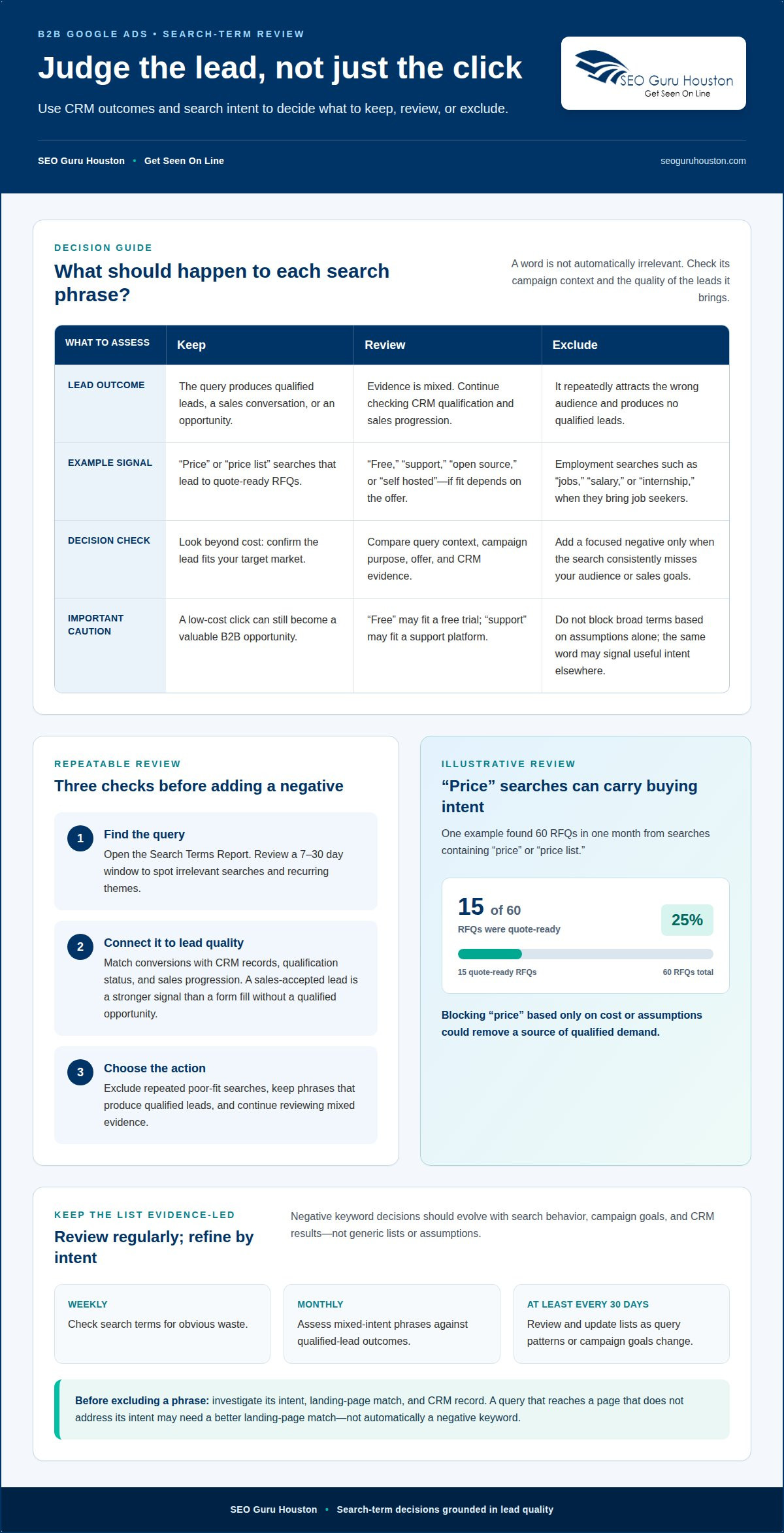
A low-cost click can still become a valuable B2B opportunity. Review Google Ads’ Search Terms Report alongside CRM outcomes, then judge each query by whether it produced a qualified lead, sales conversation, or opportunity. Cost matters, but it doesn’t tell you whether a prospect fits your target market.

Use a consistent decision process for every search phrase:

  1. Find the query. Open the Search Terms Report to see searches that triggered your ads. Review a 7-30 day window to spot irrelevant queries and recurring themes.
  2. Connect it to lead quality. Match conversions with CRM records, including qualification status and sales progression. A form fill without a qualified opportunity is a weaker signal than a lead accepted by sales.
  3. Choose the action. Exclude a phrase when it repeatedly attracts the wrong audience. Keep it when it produces qualified leads, and continue reviewing it when the evidence is mixed.

For example, one illustrative review found 60 RFQs in one month from searches containing “price” or “price list.” Of those, 15 were quote-ready RFQs, meaning 25% of RFQs from those searches were quote-ready. Blocking “price” based only on cost or assumptions could have removed a source of qualified demand. Apply the same logic to your own CRM outcomes before adding a negative.

Separate employment intent from buying intent. Searches containing “jobs,” “career,” “salary,” “internship,” or “resume” often come from job seekers, not potential customers. If the Search Terms Report repeatedly shows these phrases and they produce no qualified leads, add the relevant terms as negatives. Keep exclusions focused: the same word may also appear in a useful product or service query.

Software and technology searches need the same scrutiny. “Open source” and “self hosted” can be useful negatives for B2B SaaS campaigns when those options don’t match the product being promoted. But a technology provider offering open-source services could attract qualified buyers with the same phrase. Review query context, campaign target, and CRM evidence before excluding it.

Build a repeatable review cadence: check search terms weekly for obvious waste, then assess mixed-intent phrases monthly against qualified-lead outcomes. A negative keyword list for B2B should evolve with those findings, not with assumptions. If a phrase draws clicks but no qualified leads, investigate its intent, landing-page match, and CRM record before deciding whether exclusion is the right move.

2. What are negative keywords?

Negative keywords are words or phrases that prevent an ad from showing for searches containing those terms. Positive keywords help target searches; negative keywords define which searches to avoid. The distinction sounds simple, but applying a generic downloaded list without reviewing its terms can block relevant prospects while leaving wasted spend untouched.

Which negative keywords should B2B companies add to Google Ads? Start with search terms that clearly signal a different audience, such as “jobs,” “salary,” “course,” or “free,” then compare each term with your offer and campaign goal. A word isn’t automatically irrelevant just because it appears on a general B2B list. For example, “free” may be unwanted for a paid software campaign, but useful when promoting a free trial.

Google Ads offers broad, phrase, and exact match types for negative keywords. Broad negatives can exclude searches containing all the negative terms, phrase negatives apply when the phrase appears in the same order, and exact negatives target the matching search without additional terms. Choose the narrowest match that filters unwanted intent. For example, a broad exclusion for “support” could block a prospect researching a support platform.

Which B2B negative keywords should be excluded for jobs, free resources, and consumers? Consider “career,” “job openings,” “salary,” and “internship” for employment intent; “free,” “tutorial,” and “how to” for resource-seeking searches; and “personal,” “home,” or “for consumers” when those audiences don’t fit your target. Review the phrase in context first: a query for a free business guide may still reveal a potential buyer.

General B2B and B2C lists can help identify themes, but industry-specific terms need a separate review. A SaaS advertiser might test “open source” or “self hosted” as negatives when those options don’t match its product. A provider serving those needs could lose valuable traffic by excluding them. Before adding a downloaded list, compare every entry with your campaign structure, customer profile, and actual search queries.

How often should B2B advertisers review and update negative keyword lists? Review search terms regularly, including at least once every 30 days, and update exclusions as query patterns or campaign goals change. Keep recurring account-wide exclusions in shared negative keyword lists; use campaign-level lists for terms that apply only to one offer or audience. If a relevant query lands on a page that doesn’t address its intent, align the landing-page experience before treating the keyword as wasted traffic.

Location exclusions should reflect where a business can actually serve customers. If a campaign targets buyers in specific regions, searches naming places outside its service area may be irrelevant. Review the full query before excluding a location: a prospect might search for a supplier in one city while needing service in another. Exclude location terms only when they consistently attract leads the business cannot serve.

Support-related searches often come from existing users rather than new buyers. Terms such as “login,” “help desk,” “knowledge base,” “customer service,” “phone number,” “portal,” “complaints,” and “cancel” can signal account support or troubleshooting. They may be suitable negatives for a customer-acquisition campaign. But a company selling help-desk software could attract relevant prospects with “help desk,” so let the offer and search-term context guide each decision.

Education and training queries can signal research rather than purchasing intent. Look for phrases containing “course,” “school,” “university,” or “training.” A business selling professional training should not automatically exclude them; a software vendor seeking enterprise buyers might find introductory course queries less relevant. Distinguish people seeking instruction from organizations evaluating a commercial solution before changing which searches trigger ads.

Free-resource and DIY terms call for the same care. “Free,” “tutorial,” “how to,” and “DIY” may attract people who want to solve a problem without buying. Yet “free trial” or “free demo” could be an intentional conversion path. Software campaigns should also assess “open source” and “self hosted” against the product: exclude them when those options do not fit the offer, but retain them when they describe what the business provides.

Employment searches are easier to identify when the query explicitly signals hiring intent. Terms such as “jobs,” “careers,” “job openings,” “internships,” “recruiters,” “resumes,” and “salary” can help filter job seekers from customer prospects. Add relevant exclusions when those searches do not lead to buyer inquiries. A recruiting company, by contrast, may want employment-related traffic, so avoid using a blanket list.

Refine exclusions using conversion and CRM data, not assumptions. For each recurring search term, compare the query with its landing page, lead status, and sales outcome. If “login” produces support requests rather than new opportunities, it may belong on an acquisition campaign’s negative list. If “training” generates qualified business inquiries, keep it. This ongoing review protects reach while removing searches that attract the wrong audience.
B2B Negative Keyword List: Exclude Irrelevant Google Ads Traffic

4. Account-level, shared-list, campaign, and ad-group negatives

To add a negative keyword list to a Google Ads campaign, create or select a shared list, add the exclusions, then apply the list to the campaign. Use account-level exclusions only for terms that should block traffic across the account; narrower intent belongs at the campaign or ad-group level.

Think of negative keyword placement as a control system with three practical levels: shared lists, campaign-level negatives, and ad-group-level negatives. A shared list suits recurring terms irrelevant across campaigns, such as employment searches when the account targets buyers only. Campaign-level negatives fit exclusions tied to a particular offer or audience. Ad-group negatives resolve tighter conflicts, such as separating searches for “enterprise accounting software” from an ad group focused on small businesses.

Account-wide exclusions have broad consequences. The Google Ads account-level negative keyword list limit is 1,000 terms per account, so reserve this level for terms that almost never match your commercial intent. A term like “careers” may suit an account-wide list if none of its campaigns recruit. A word like “free” needs more caution because one campaign may promote a paid product while another offers a free trial.

Use campaign-level negatives when the same phrase has different relevance across campaigns. For example, a software company could exclude “self hosted” from a cloud-only campaign while retaining it in a campaign for self-hosted solutions. This aligns the exclusion with the actual offer instead of allowing a broad shared list to remove useful searches. Review affected campaigns before applying a shared list, especially when bidding uses conversion signals from several product lines.

At the ad-group level, exclude terms that create overlap between closely related themes. If separate ad groups target “CRM for healthcare” and “CRM for real estate,” negative terms can direct each search toward the more relevant group. Keep exclusions specific: a general negative such as “CRM” would block both groups, while a qualifying phrase tied to one industry can preserve the other ad group’s reach.

Before applying a list, define its scope, purpose, and owner. Label a shared list by function, such as “job seeker queries,” then record which campaigns use it. After making changes, review actual search terms for unexpected exclusions and shifts in relevant traffic. If a phrase has mixed intent, test it at campaign level before applying it account-wide. This structure makes it easier to reverse a negative when sales evidence changes, rather than searching through unrelated lists to find its source.

5. How negative keywords prevent irrelevant Google Ads traffic

Google Ads uses negative keywords to stop an ad from serving when a search query matches an excluded term. That filter can keep a B2B campaign from paying for clicks from people seeking jobs, basic courses, or unrelated consumer products. The goal isn’t to block every unfamiliar phrase. It’s to separate buyer intent from searches that don’t fit the offer.

Consider a company advertising enterprise accounting software. Searches for “accounting jobs” point to employment, while “accounting software for small business” may identify a different buyer segment. Adding “jobs” as a negative can filter the first query without excluding the second. Excluding “small business,” however, makes sense only if that audience is genuinely outside the campaign’s target.

The filter matters even more when a campaign uses Broad Match or AI-driven expansion. These methods give Google more freedom to identify related searches, bringing in both useful variations and irrelevant queries. A negative keyword list helps define boundaries around that broader reach. Review the query context before adding exclusions, since a shared word can appear in searches with very different intent.

Exclusions also affect the signals used by automated bidding. If ads repeatedly attract searches that produce low-quality conversions, those actions can muddy the conversion data bidding systems rely on. Excluding a clearly irrelevant theme can help focus that data on prospects who fit the offer. But an overly broad negative can remove qualified searches and reduce useful signals, too.

Use a practical review cycle: inspect Google Ads search queries, group them by intent, compare conversions with lead quality, then add only clear exclusions. For example, “free accounting course” may signal research or education traffic for a software vendor. “Free accounting software trial” could indicate product interest instead. The word “free” alone is not enough to judge intent; the complete query and campaign structure matter.

After making changes, watch for both wasted spend and unintended losses in reach. Clicks without sales do not, on their own, prove that a term should be excluded. Check whether the query matches the offer and whether the conversion was qualified. Review actual search behavior after each change, then adjust the negative’s scope if relevant queries disappear. This keeps the filter precise as new search patterns emerge.

Negative keywords can improve click-through and conversion rates by limiting mismatched impressions, but they cannot replace a relevant landing page or offer. A prospect searching for enterprise accounting software should land on a page that explains the business solution, not a generic course description. Align query intent, ad message, and landing-page content to turn better-targeted traffic into meaningful opportunities.

SEO Guru Houston

SEO Guru Houston helps national businesses connect Google Ads targeting with the quality of leads their sales teams need. When irrelevant searches keep triggering ads, professional PPC services can support a more focused campaign strategy, from reviewing search intent to refining exclusions. Specialized B2B marketing and inbound marketing strategies can also align paid search with broader demand-generation goals.

Turn to SEO Guru Houston when your negative keyword decisions need to fit your audience, campaign structure, and lead-generation priorities. A well-built landing page also helps ensure that qualified searchers find content aligned with their intent.

Contact SEO Guru Houston to discuss your national B2B advertising goals.

Make your next campaign decision count

Turn search-term reviews into a feedback loop between advertising and sales. When sales qualification reveals a mismatch, use that insight to refine your targeting and shape the next campaign test. A negative keyword list for B2B works best as part of that ongoing improvement, not as a fixed document forgotten after launch.

SEO Guru Houston can connect this work with Houston SEO Services, Houston PPC Services, and Houston B2B Marketing. That broader view helps keep paid search aligned with the audiences and growth goals your business is pursuing.

Ready to sharpen your B2B campaign strategy? Contact SEO Guru Houston to discuss your next step. Clearer targeting starts with a focused plan, and each thoughtful adjustment can move your campaigns toward stronger alignment with real business goals.

Frequently Asked Questions

What are negative keywords?

Negative keywords are exclusions that keep Google Ads from showing an ad for searches containing specified terms. For example, a business selling industrial software might exclude “dating” or “recipe” if those searches have no connection to its offer. The best exclusions reflect the actual audience and campaign purpose, not just words that seem unrelated at first glance.

How do you review search terms by lead quality, not cost?

Compare search queries with lead records and sales outcomes, not just spend or clicks. For example, distinguish sales-qualified inquiries from students, vendors, and people seeking employment, then look for patterns in the query wording. A phrase with modest spend may deserve to stay if it produces genuine opportunities, while a cheap query can still waste budget if it repeatedly attracts the wrong audience.

What is a negative keyword list in B2B advertising?

It’s a set of search terms a business excludes from campaigns aimed at other businesses. A company could consider filtering investor research, political searches, or adult-content queries when they don’t relate to its offer. The right list depends on the product, ideal customer, and campaign goal. Review each term before applying it, since a phrase that’s irrelevant to one B2B advertiser may matter to another.

How do negative keywords differ for B2B and B2C campaigns?

The difference is the audience and buying context, not a universal set of terms. B2B campaigns may filter job seekers, students, or individual consumers when those groups aren’t buyers. A B2C advertiser may have different exclusions based on its product and customer. For instance, “enterprise” could be unhelpful for a consumer-only offer but valuable for a business software campaign.

How to find negative keywords from Google Ads search term reports?

Open the Search Terms Report and review the queries that triggered ads. Group unrelated searches by theme, such as recruiting, coursework, or customer login, then compare those themes with campaign goals and lead outcomes. Look for repeated patterns instead of reacting to a single unfamiliar phrase. Add exclusions only when a query clearly conflicts with the offer or attracts the wrong audience.

How to organize B2B negative keywords into shared lists by campaign?

Keep exclusions that apply across the account in a shared list, such as employment searches when none of the campaigns recruit. Put offer-specific exclusions in the relevant campaign list, then use ad-group negatives to separate closely related themes. Give each list a clear purpose-based name and record which campaigns use it. This makes later reviews more precise.

What are common mistakes and risks when using negative keywords in B2B ads?

A common mistake is applying a downloaded list without checking every term against the offer. Broad exclusions can block valuable searches because the same word may signal different intent in different queries. For example, excluding “free” could remove searches for a free trial as well as resource seekers. Other risks include leaving lists unchanged as campaigns evolve and failing to notice when useful queries stop receiving impressions.
Lower Cost per Lead in Google Ads with Smarter Campaigns

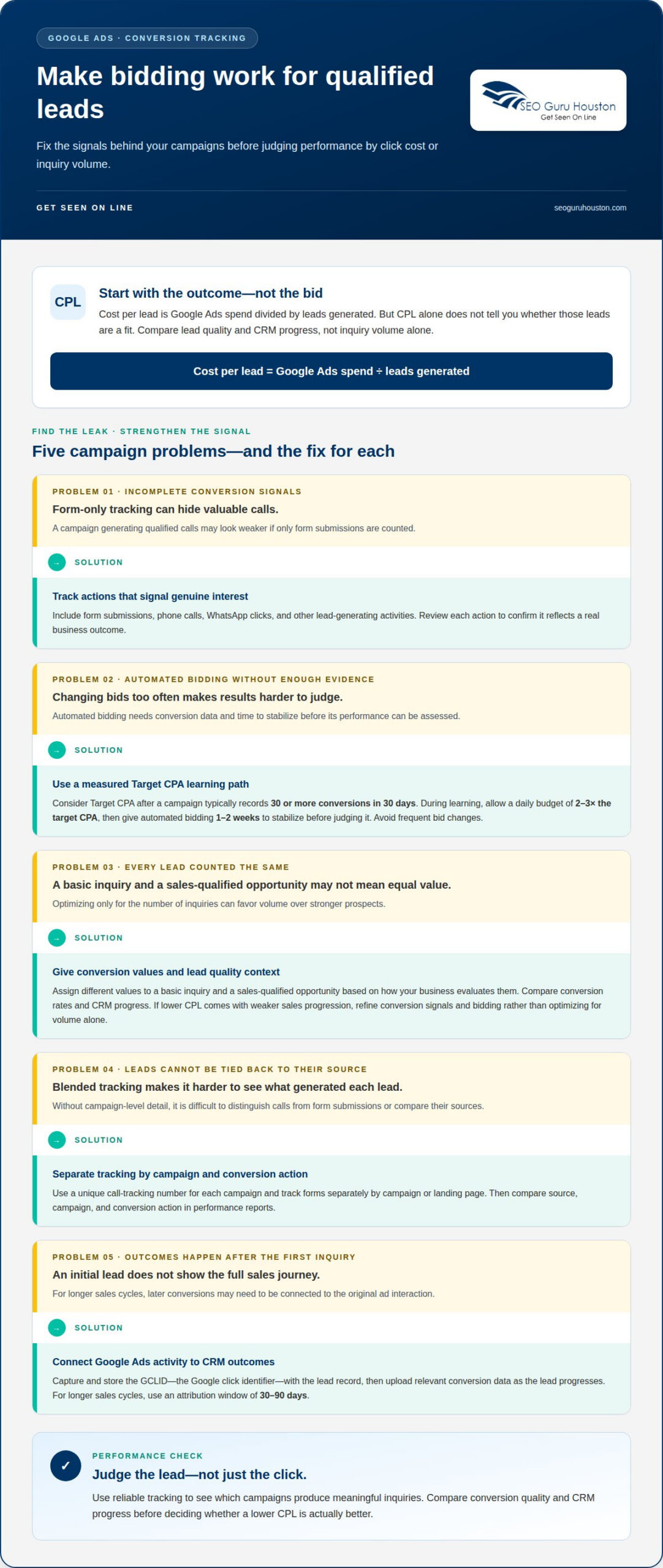
A cheaper click isn’t the goal; an affordable, qualified lead is. Calculate cost per lead by dividing Google Ads spend by the number of leads generated. To understand how to lower cost per lead in Google Ads, improve the traffic, ads, and landing pages that turn clicks into inquiries. CPL tells only part of the story if those leads aren’t a fit for your business.

Rising costs can make it tempting to cut bids or pause campaigns quickly. A better approach is to find where spend is leaking and strengthen the parts of the campaign that attract and convert suitable prospects. This guide explains how to calculate CPL, assess what a lead is worth, and refine bidding and conversion tracking without losing sight of lead quality.

You’ll also learn how to improve ad relevance, organize campaigns around services and intent, and use search-term reviews and negative keywords to reduce irrelevant clicks. With a clearer view of performance, you can focus on campaigns that generate valuable leads, not just more traffic.

Key Takeaways

  • Compare cost per lead with lead quality so you can prioritize campaigns that generate prospects likely to become customers.
  • Use reliable conversion tracking to see which ads and campaigns produce meaningful inquiries, then adjust bidding based on that evidence.
  • Align keywords, ad copy, and landing-page messaging to attract relevant clicks and make the next step clear.
  • Organize campaigns around distinct services, locations, and search intent to make performance easier to assess and optimize.
  • Review search terms regularly and exclude irrelevant queries that spend budget without bringing in suitable leads.

1. Bidding strategy and conversion tracking

Start with the conversion, not the bid. In Google Ads, track actions that signal genuine interest, such as form submissions, phone calls, WhatsApp clicks, and other lead-generating activities. If you track only form submissions, a campaign generating qualified calls may look weaker than it is. Review each conversion action to ensure it reflects a real business outcome.

Conversion values can help Smart Bidding distinguish leads with different potential. For example, assign different values to a basic inquiry and a sales-qualified opportunity, based on how your business evaluates them. That gives bidding signals more context than counting every form fill equally. For longer sales cycles, use an attribution window of 30-90 days so conversions that happen later can still be connected to the original ad interaction.

Make call tracking and form attribution specific enough to identify what generated each lead. Use a unique call-tracking number for each campaign, and track forms separately by campaign or landing page. Then compare the source, campaign, and conversion action in performance reports. Separate tracking makes it easier to distinguish campaigns that drive calls from those that generate form submissions.

For offline conversion tracking, connect Google Ads interactions with later CRM outcomes. Capture and store the GCLID, Google’s click identifier, with the lead record when someone submits a form or calls. As the lead progresses through the pipeline, upload the relevant conversion data to Google Ads. This connects campaign activity to milestones beyond the initial inquiry and helps bidding learn from outcomes closer to revenue.

Google Ads policies govern advertising and conversion tracking. Collect only the information needed to measure lead outcomes, and align notices and consent with the privacy requirements that apply to your audience. To assess lead quality, compare conversion rates and CRM progress, not just inquiry volume. If a lower CPL comes with fewer qualified opportunities or weaker sales progression, refine your conversion signals and bidding strategy instead of optimizing for volume alone.

2. Quality Score and ad-to-landing-page relevance

A relevant click is more valuable than a cheap click that leaves immediately. Quality Score is associated with how closely keywords, ads, and landing pages align. Improving those signals can strengthen campaign efficiency while bringing more suitable visitors to your offer. A Quality Score of 8-10 can reduce cost per click by as much as 50%, but the score isn’t a substitute for measuring actual leads.

Start by aligning the message. If a keyword targets emergency plumbing, the ad should promote emergency plumbing, and the landing page should explain that service. A visitor who lands on a broad company homepage has to search again for the offer. Match each ad group’s intent with a focused page, a clear service description, and one lead-generation call to action.

Optimize the page around the visitor’s decision. Put the service, location, and key benefit near the top so people can quickly confirm they’ve found the right page. Keep the form focused on essential qualifying details, and make the submit button easy to find. If the ad offers a quote request, make requesting a quote the obvious next step.

Mobile experience demands its own review. Open the landing page on a phone and test the full path: load, read, tap, and submit. Remove layout clutter, shorten unnecessary form fields, and make buttons easy to use on a small screen. A strong score won’t fix confusing copy or a broken form.

Use controlled tests to find which changes improve conversion rates. Change one meaningful element at a time, such as the headline, form length, or call-to-action wording. Compare completed leads, not just clicks. The recommended threshold is 100 conversions per variation for an A/B test, helping reduce the risk of acting on a small, unrepresentative sample. Keep the winning version only when it brings relevant prospects.

Review the whole journey together: search intent, keyword, ad promise, landing-page content, and completed conversion. If clicks rise but leads don’t, inspect the page’s message and form before changing bids. If the page needs a clearer structure or stronger conversion path, website development and landing pages can support that optimization work.

3. Campaign structure by service, location, and search intent

Give each service its own campaign to keep performance clear. For example, a roofing company can separate roof repairs from full replacements. Each campaign can then use relevant keywords, ads, and landing pages. This structure helps reveal which offer attracts qualified inquiries and prevents a strong service from being obscured by weaker results in blended reporting.

Separate campaigns by location when geography affects the offer or lead value. A business serving several communities can use focused geographic targeting instead of combining every area. Check location settings against the areas the business serves, then compare results. If one area brings clicks but few suitable leads, adjust its targeting or budget rather than changing every campaign.

Let search intent shape the ad groups within each service campaign. Someone searching for “roof repair company” may be ready to hire, while someone searching for “how roof repairs work” may be researching. Group closely related searches and tailor the ad to that intent. For e-commerce, organize campaigns around relevant product categories or shopping goals, then assess which categories generate valuable orders, not just traffic.

Scheduling can also sharpen targeting. Review when inquiries arrive and when your team can respond, then compare conversion quality across days and times. If a campaign receives inquiries outside operating hours, check whether those leads progress through the sales process. Use the results to refine ad schedules, rather than assuming every late or weekend click is wasted. Review location, device, and time segments together because one change can affect another.

Keep analysis ongoing, but base decisions on comparable periods and outcomes. Review campaign-level clicks, conversions, lead quality, and sales progression together. If a service campaign draws volume but few qualified prospects, inspect its search intent, geographic reach, and offer before shifting budget. Don’t merge campaigns just to simplify the account; that can hide which service or location needs attention.

Remarketing gives campaigns another way to reach people who showed interest but didn’t convert on their first visit. A visitor who viewed a service page can see a relevant follow-up ad, while someone who completed a lead form should be excluded from that audience. Remarketing campaigns typically achieve cost per lead 50-70% lower than cold-traffic campaigns. Treat this as a comparison to evaluate in your own account, and track lead quality alongside cost.

Lower Cost per Lead in Google Ads with Smarter Campaigns

4. Negative keyword lists and search-term audits

Research keywords around the searches that signal a real need. In Google Ads, review the search-term report to see the queries that triggered your ads, then compare each query with the service or product advertised. Keep relevant terms, add promising high-intent phrases, and exclude searches that clearly don’t fit. Long-tail keywords can have average cost per click up to 70% lower than broad, head terms.

Negative keywords prevent ads from showing for selected irrelevant searches, reducing clicks that consume budget without a realistic path to conversion. For example, a company that sells services but isn’t hiring could exclude “jobs”; it might also exclude “free,” “courses,” or unrelated locations when those searches don’t match its offer. Adding negative keywords can reduce wasted Google Ads spend by up to 30% in some accounts.

Build your negative keyword list from actual search behavior, not assumptions alone. Check the search-term report regularly, group irrelevant queries by theme, and add negatives at the campaign or account level where appropriate. A “jobs” exclusion may suit several service campaigns, while an unrelated-location exclusion may apply to just one geographic campaign. Review each exclusion against the ads it affects to avoid blocking useful searches.

Refine keyword targeting by starting with specific terms closely tied to your offer, then expand when search-term data supports it. Phrase and exact match can give advertisers more control over when ads appear. For instance, a home remodeling company can distinguish searches for “kitchen remodeling company” from general searches about kitchen design. Match each term to the service, location, and intent represented in the ad.

Don’t let high click volume disguise weak performance. In Google Ads, compare each keyword’s clicks, conversions, and cost per acquisition; pause a keyword or ad group when it attracts many clicks, few conversions, and a higher CPA. Before pausing, inspect its search terms and landing-page match. A broad query may be wasting spend, while a specific query could need a better ad or page.

Keep a change log with the date, keyword, action, and reason. After each weekly audit, compare relevant traffic and lead outcomes against the previous period. Campaigns using 200 or more negative keywords can see CPA up to 67% lower, but a large list isn’t a goal by itself. Add exclusions based on evidence, then review whether they remove waste without suppressing qualified searches.

5. Calculating cost per lead

Calculate Google Ads cost per lead by dividing total ad spend by the number of leads received. Use the same reporting period for both figures, and count leads consistently. Comparing monthly spend with leads from a different period produces a misleading result.

Then separate raw CPL from qualified CPL. The second measure shows what it costs to attract a prospect who fits your offer, rather than simply generate a contact.

What is a good Google Ads CPL in the US? There’s no universal target because industries, competition, lead quality, and sales conversion rates differ.

Connect CPL to sales outcomes before deciding whether it’s too high. Consider the hypothetical examples of a $50 lead converting at 20% and a $15 lead converting at 2%. A lower CPL can therefore deliver worse economics when fewer leads become customers.

Track averages over consistent periods and compare campaigns with similar services, locations, and lead definitions. An account-wide average can hide a costly campaign or make a strong one look weaker. Record spend, total leads, qualified leads, and resulting sales together. Then calculate raw and qualified CPL for each campaign using the same formula and time period.

Use the figures to set a working target from your own sales economics. Estimate how many qualified leads become customers, then compare the resulting acquisition cost with the value of a sale. If CPL rises, identify whether spend increased, lead volume fell, or lead quality changed. That diagnosis points toward the right optimization, rather than an arbitrary budget cut. For a stronger conversion path, improve your lead-generation landing pages so the page supports the offer and captures suitable inquiries.

SEO Guru Houston: Houston SEO Services

SEO Guru Houston helps businesses connect paid search strategy with broader efforts to attract and convert qualified prospects. If your Google Ads campaigns need closer analysis, our PPC services can support improvements to targeting, campaign structure, and lead measurement. For businesses building longer-term visibility alongside paid acquisition, our comprehensive SEO services can complement that approach.

When leads involve longer B2B decisions, specialized B2B marketing and inbound marketing frameworks can help align demand generation with how prospects research and evaluate solutions. The right next step depends on where your funnel needs attention, whether that’s campaign performance, organic visibility, or the path from first visit to sales inquiry. Contact SEO Guru Houston to discuss your marketing goals and discover strategies to lower cost per lead in Google Ads.

Turn Campaign Insights Into Your Next Growth Move

Make optimization a repeatable habit, not a one-time cleanup. Set regular review points, record each adjustment, and connect campaign decisions to the leads your sales team values. This discipline helps you identify which tests deserve more investment and which assumptions need another look. A practical process for how to lower cost per lead in Google Ads gives your team a consistent way to turn campaign insights into its next growth move.

SEO Guru Houston offers Houston PPC Services, alongside Houston SEO Services and Houston B2B Marketing. If you’re ready to build a stronger approach to how to lower cost per lead in Google Ads, bring your campaign goals and lead-generation priorities into the conversation. Together, you can identify where focused strategy may help your business move forward. Contact SEO Guru Houston today to discuss your next step.

Frequently Asked Questions

How Do I Calculate the Cost-Per-Lead and Why Does It Matter?

Divide Google Ads spend for a reporting period by the leads attributed to that spend. The result helps compare campaign efficiency, but it isn’t a complete measure of profitability. A campaign may produce fewer leads yet create more sales opportunities. Compare CPL with qualification and sales outcomes, using the same lead definition and reporting period so one campaign doesn’t look stronger simply because it counts more actions.

How do you calculate cost per lead and conversion rate in Google Ads?

Calculate CPL by dividing ad spend by leads. Conversion rate can show how often ad clicks lead to the action you’re tracking, so define that action consistently before comparing campaigns. Keep the conversion action consistent: don’t mix submitted inquiries and phone calls unless both count as leads in your reporting. For a useful comparison, align the date range and campaign scope for spend, clicks, and conversions before interpreting either metric.

How can you improve Google Ads conversion tracking for lead generation?

Define which actions count as leads, then test that each action records correctly before using the data for optimization. A form confirmation should register after a successful submission, not just when someone opens the form. Review phone-call and form records for duplicate counting, and connect CRM outcomes to the original ad interaction where possible. This gives you a clearer view of which campaigns generate genuine inquiries and which merely trigger trackable events.

How can match types and search terms be optimized to lower cost per lead?

Use phrase and exact match to focus on searches closely related to your offer, then inspect actual queries in Google Ads search-term reports. Keep terms that show relevant intent, add useful specific phrases, and exclude queries that don’t fit. For example, a business seeking service customers could filter out research or employment searches when those visitors aren’t prospects. Recheck exclusions to avoid accidentally blocking useful variations.

How do landing page changes improve Google Ads lead conversion rates?

How should you adjust bids, budgets, and bidding strategies to reduce cost per lead?

Base bid and budget changes on qualified-lead outcomes, not click volume alone. Avoid cutting every campaign after a brief dip; first identify whether the cause is weak search intent, limited conversion volume, or a change in lead quality. Set an efficiency goal for each campaign, make a focused adjustment, and allow enough time to assess its effect before changing the strategy again.

How can ad copy and assets improve lead quality and lower cost per lead?

Use ad copy to make the offer and intended audience clear before someone clicks. A B2B provider, for instance, can name the business audience and the specific service, helping discourage unrelated consumer inquiries. Choose ad assets that reinforce useful details, such as a relevant service or contact option. Review the search query, ad engagement, and resulting lead quality together; a higher click-through rate alone doesn’t prove the campaign attracts better prospects.

How do location, device, and schedule targeting affect Google Ads lead costs?

These settings shape which searches can trigger ads, so compare performance by location, device, and time before changing targeting. Mobile visitors may behave differently from desktop visitors, while leads from one service area may qualify more often than others. Review completed leads and sales progression in each segment, not just clicks. Refine the specific underperforming segment, and preserve targeting that brings suitable prospects.

Google Ads Strategy for B2B Services: How Much Should You Spend

A focused Google Ads strategy for B2B services then puts most of that budget behind high-intent search, while reserving spend for remarketing and experiments. The right allocation depends on whether your ads attract the decision-makers and qualified leads your business needs.

It makes sense to want a clear budget before investing. But spend alone won’t fix campaigns that target the wrong searches or send prospects to a landing page that doesn’t match the ad. This guide explains how to set goals, identify audiences, structure campaigns, and refine keywords and bidding. It also shows why persuasive ad copy and relevant landing pages matter: they help turn advertising spend into meaningful opportunities, not just clicks.

Key Takeaways

  • Set campaign goals around qualified business outcomes, then target the roles, companies, and audiences most likely to influence a purchase.
  • Use keyword research and search-term data to focus spend on relevant intent and exclude searches that attract poor-fit clicks.
  • Match campaign messages and assets to each stage of the buyer journey, from early research to solution evaluation.
  • Align ad copy, keywords, and landing-page content so prospects see a clear, relevant next step after clicking.
  • Use expert PPC services and B2B marketing strategies to connect campaign execution with demand generation and long-term business growth goals.

B2B campaign goals and audience identification

Start with the business outcome, not the campaign setting. A clear goal helps connect Google Ads spend to the prospects and actions that can advance a B2B sale.

Campaign Goal Setting

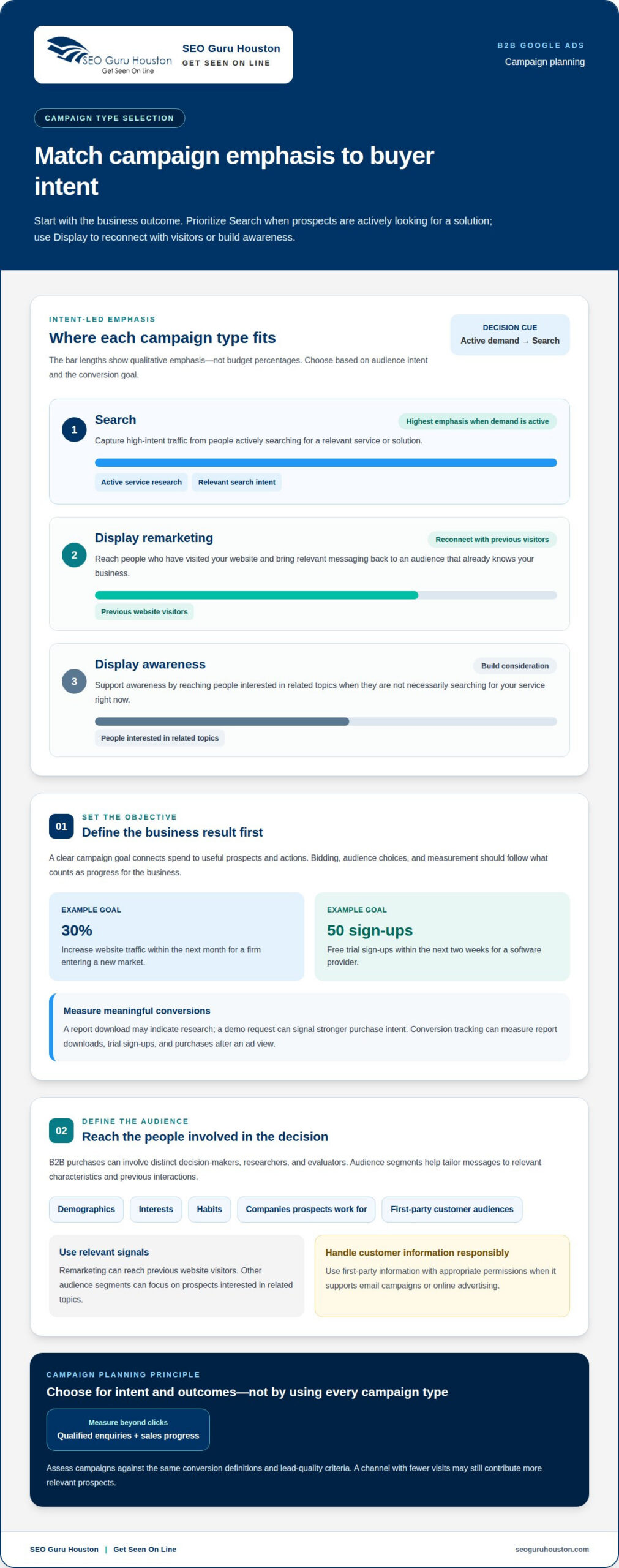
A campaign goal defines the business result advertising should support, such as qualified enquiries or relevant website visits. It matters because bidding, audience choices, and measurement all depend on what counts as progress. For example, a firm entering a new market might aim to increase website traffic by 30% within the next month. A software provider could instead aim for 50 free trial sign-ups within the next two weeks.

Choose a conversion that reflects genuine buyer interest, then distinguish it from lighter engagement. A report download may indicate research, while a demo request can signal stronger purchase intent. Google Ads conversion tracking can measure report downloads, trial sign-ups, and purchases after an ad view. Comparing these actions helps campaign managers assess keywords and ads against the outcomes that matter.

Audience Targeting Segments

Audience segments group potential buyers by relevant characteristics or prior interactions, including first-party audiences built from a business’s own customer information. This matters because B2B purchases often involve distinct decision-makers, researchers, and evaluators. Google Ads targeting can use demographics, interests, habits, and the companies potential customers work for, helping advertisers tailor messages to business audiences.

Use first-party information only with appropriate permissions when it supports email campaigns or online advertising. A company could offer a research report or invite-only webinar in exchange for customer details, then use those details to shape follow-up messaging. Remarketing can reach previous website visitors, while other audience segments can focus on prospects interested in related topics. Keep each message relevant to the audience’s demonstrated interest.

Campaign Type Selection

What Google Ads campaign types work best for B2B services? Search is suited to active service research, while Display can support remarketing and awareness. Select based on the audience’s intent and the conversion goal, rather than using every campaign type at once.

What Google Ads policies and compliance risks apply to B2B service advertisers? Follow Google Ads policies, describe services accurately, and handle customer information responsibly. If collected details will support email or advertising, use them with the appropriate permissions. Clear consent practices and truthful ad claims help reduce avoidable compliance risks.

Keyword research and competitor targeting

Keyword research connects B2B search intent with the services your campaigns promote. Use Keyword Planner, match types, and search-term reports to refine targeting and limit irrelevant clicks.

Keyword Discovery with Keyword Planner

Google Ads Keyword Planner is a research tool that shows keyword search frequency, competition, and bid costs. These signals help you compare phrases before assigning them to campaigns. For example, separate searches for “B2B payroll software” from broader phrases such as “payroll services” when your offer serves a specific business audience.

Start with the services you sell, then expand each into buyer-focused variations. A consultant might compare “supply chain consulting” with “supply chain audit services” to find language that better reflects a prospect’s need. Use the Planner’s estimates as research inputs, then assess whether each phrase matches your offer and landing page.

Search Match Types

Match types control how closely a person’s search must relate to a target keyword before an ad can appear. They matter because a narrow service phrase and a broad category phrase can attract different intent. Choose settings that balance reach and relevance, then review actual search queries to see how Google Ads interprets your keywords.

For example, a campaign targeting “commercial HVAC maintenance” should distinguish service-specific intent from searches about residential repairs or do-it-yourself advice. Broad targeting can surface related searches, while tighter matching focuses exposure on closer variations. Organize keywords by service theme so the ad copy and landing pages address the same need.

Negative Keywords and Search-Term Reports

Negative keywords prevent ads from appearing for searches that don’t fit your offer. Search-term reports show which queries triggered ads, giving you evidence to add exclusions or refine target keywords. This review matters because even a relevant keyword can attract poor-fit searches through related wording.

For instance, a B2B software provider might exclude “jobs” if employment seekers don’t represent prospective buyers. Review the report for queries about free templates, consumer products, or unrelated services, then add negatives where those searches don’t match the business. Search-term data can also reveal phrases worth testing in paid campaigns or considering for SEO content.

Competitor Targeting

Competitor targeting considers searches that mention competing brands or compare providers. It can reach prospects who know the category and are evaluating alternatives, but the ad and landing page should clearly explain your own offer. Group competitor-related terms separately from service keywords to see whether they attract qualified enquiries.

Review competitor names alongside comparison phrases, such as “alternatives to [brand]” or “[brand] versus [service type].” Assess each query for relevance before adding it, and use clear, factual messaging rather than implying an affiliation. Pair this analysis with a paid search campaign strategy that keeps keywords, ad copy, and landing-page content aligned.

Ad extensions and assets

Google Ads assets add useful details and actions to search ads. For B2B campaigns, choose assets that help decision-makers understand the offer and take a relevant next step.

Give Searchers More Relevant Options

Sitelinks and other Google Ads assets can provide extra information and options within search results. They can also increase an ad’s size, helping it stand out and giving prospects more reasons to click. A B2B consultancy, for example, could use sitelinks to direct different audiences toward relevant service information or a case study.

Keep each option aligned with the ad’s promise. If an ad promotes an operational audit, a sitelink to audit details supports that message better than a broad, unrelated page. Useful assets give prospects a clearer route to explore, while mismatched options can distract from the advertised service.

Use Lead Form Assets for Direct Enquiries

Google Ads lead form assets let potential customers submit their contact information directly within an ad. This can give a busy decision-maker a direct response path without first visiting a website. For example, a B2B provider promoting a consultation could use a lead form asset to capture interest from someone searching for that service.

Choose this format when an in-ad enquiry fits the campaign goal. Make the offer clear, and explain what the prospect is requesting. A lead form is not a substitute for useful service information: people should understand the next step before sharing their details. Compare its enquiries with other campaign actions to assess whether it attracts relevant prospects.

Match Assets to the Ad’s Message

Google Ads assets work best when their information reinforces the search ad and the prospect’s intent. For a software implementation campaign, relevant options might point to implementation details, a case study, or a contact path. Each asset should answer a useful follow-up question rather than repeat the same headline elsewhere.

Review the complete search result as a prospect would see it. Check that the ad, sitelinks, and other assets describe the same service and lead to coherent next steps. If the ad promises a specific business solution, an asset pointing to an unrelated offer breaks that connection.

Review Asset Performance

Use campaign reporting to assess which assets support meaningful actions. Compare lead form submissions with visits to relevant pages, then consider the quality of the enquiries each path generates. A larger ad may attract attention, but clicks alone don’t show whether the added information brought in suitable B2B prospects.

Update assets when their destination or message no longer reflects the campaign. For example, if a sitelink points to outdated service information, revise it to match the current offer. This keeps the experience consistent from search result to follow-up and makes each asset work toward the same business goal.

Google Ads Strategy for B2B Services: How Much Should You Spend

Buyer-journey campaign segmentation

B2B prospects need different information as they move from discovering a problem to assessing solutions and contacting a provider. Segment campaigns by that intent, then align the ad, offer, and next step. A research-focused visitor may value a case study, while an evaluator may be ready to compare solutions or request a demo.

Awareness: Reach Prospects Exploring a Problem

At the awareness stage, prospects may search for explanations rather than a specific provider. Search ads can connect relevant queries with useful resources, such as an industry report or case study. For example, a cybersecurity firm could promote a guide to common security challenges instead of pushing a sales meeting to every early-stage visitor.

Google Ads Search campaigns can generate micro-engagements, including resource downloads, case study exploration, and newsletter subscriptions. These actions offer ways to engage people who aren’t yet ready to become sales leads. Treat each as a distinct signal, and use relevant follow-up messaging to nurture interest over time.

Consideration: Help Buyers Evaluate Options

During consideration, prospects compare approaches and assess whether a solution fits their needs. Free trials, demos, testimonials, competitor analysis, and benchmarking can help them evaluate options. A B2B software company, for example, might use an ad leading to a product demo for active evaluators, while a comparison resource serves people still weighing alternatives.

Decision: Make the Next Step Clear

Decision-stage prospects are closer to contacting a provider or beginning a trial. Use focused Search ads for queries that indicate service or solution intent, and make the advertised action clear. For example, an ad promoting a software demo should lead directly to information about that demo, not a general company overview.

Tailor follow-up to the action taken. Someone who explored a case study may need a different prompt from someone who requested a demo. Keep campaign messages aligned with the prospect’s demonstrated interest, and make the path from ad to enquiry straightforward.

Connect Segments Without Blurring Intent

Buyer-journey segmentation works best when each campaign has a defined audience, message, and goal. Separate educational content from demo or trial campaigns so reporting shows which interactions support progress. A visitor who downloads a report can receive relevant nurturing, while a demo request should prompt a more direct sales follow-up.

Review campaign and conversion data together. If resource engagement rises but qualified enquiries don’t, examine the transition from content to the next offer. If demo campaigns attract mismatched prospects, revisit search intent and landing-page messaging. This keeps each stage accountable to the buying task it serves.

Landing pages, ad copy, and Quality Score

Ad relevance doesn’t stop at the click. Your B2B ad, landing page, and conversion path should tell one consistent story.

Landing Page and Ad Copy Alignment

Alignment means the ad promise, target keyword, and landing-page content all address the same buyer need. A decision-maker who clicks an ad for implementation support expects information about that service, not a broad company overview.

Build each page around the search intent and action you want. For example, an ad offering a software demo should lead to a page that explains the demo and makes the next step clear. Use matching language in the headline, supporting copy, and call to action. If the ad targets operations leaders, address their business problem rather than relying on generic claims.

Keep the page focused. A campaign for a specific B2B service can direct visitors to relevant proof, service details, and an enquiry form. Remove competing calls to action that send prospects toward unrelated offers. This creates a clearer route from search to conversion and helps your team understand which message brought the visitor in.

Keep the page focused. A campaign for a specific B2B service can direct visitors to relevant proof, service details, and an enquiry form. Remove competing calls to action that send prospects toward unrelated offers. This creates a clearer route from search to conversion and helps your team understand which message brought the visitor in. For teams upgrading their digital infrastructure to support paid campaigns, collaborating with a dedicated website development company Ghana such as Digital Reviews can help create high-performing pages that capture qualified buyer interest.

Quality Score

Quality Score is a Google Ads diagnostic that helps advertisers assess keyword, ad, and landing-page relevance. It can highlight where the experience feels disconnected to a searcher. Use it as a signal for investigation, not a substitute for measuring qualified leads and business outcomes.

For example, if a keyword about B2B consulting leads to an ad about general marketing, then a page about unrelated services, the message lacks continuity. Review the keyword, ad copy, and destination together. Make the page answer the question implied by the search, and ensure the ad describes the same offer accurately.

How do you set up conversion tracking and qualify leads from Google Ads? Track meaningful actions such as demo requests, report downloads, and purchases, then compare those conversions with lead quality. Connecting data sources can help campaign systems use relevant signals.

Lead qualification needs a clear definition shared by marketing and sales. For example, a demo request from a decision-maker at a target company may warrant different follow-up from an early-stage resource download. Record the actions and details that distinguish sales-ready enquiries, then assess campaign performance beyond form submissions.

Keep improving the full path, not just the ad. Test a focused headline against a service-specific page, review whether visitors complete the intended action, and refine the message when the page attracts the wrong enquiries. Improve your B2B landing pages by aligning each page with its ad promise and conversion goal.

SEO Guru Houston: Houston SEO Services

SEO Guru Houston helps B2B companies connect campaign strategy with broader search visibility and demand generation. Its Houston PPC Services support paid campaigns, while Houston B2B Marketing and Houston Inbound Marketing can align outreach with how business buyers research and evaluate solutions.

Turn to SEO Guru Houston when your ads need stronger alignment between audience targeting, landing pages, and qualified lead goals, or when paid search should work alongside organic visibility. Houston SEO Services can support that wider search strategy, while PPC focuses on reaching prospects through paid campaigns.

To discuss your B2B marketing goals, contact SEO Guru Houston or visit seoguruhouston.com.

Turn Campaign Learning Into Your Next Growth Move

Your next advantage comes from connecting advertising decisions to what happens after a prospect converts. Build a steady feedback loop between marketing and sales: review which enquiries progress, identify the needs behind qualified opportunities, and use those insights to sharpen future campaign decisions. That discipline makes a Google Ads strategy for B2B services more responsive to real buying signals, rather than simply optimizing for activity.

SEO Guru Houston offers Houston SEO Services, Houston PPC Services, and Houston B2B Marketing. These offerings can support businesses aligning paid search with broader visibility and B2B growth priorities. If your campaigns need a clearer path from ad engagement to business opportunities, consider discussing your goals and the challenges your team wants to address.

Contact SEO Guru Houston today to explore a practical next step for your marketing. Keep testing, keep learning, and build momentum around the prospects your business is ready to serve.

Frequently Asked Questions

How Much Should You Spend on B2B Google Ads?

Set spend according to the lead volume you can handle, your sales capacity, and the campaign data you need to learn. An initial allocation can direct 70% to high-intent search, 20% to remarketing, and 10% to experimental campaigns. Treat this as a starting distribution, then shift budget toward campaigns producing qualified enquiries. Review performance against sales outcomes, not just clicks, before increasing spend.

How to Build a B2B Google Ads Strategy?

Build the plan around a measurable business outcome, a defined buyer, and a clear conversion action. For example, a consulting firm could prioritize qualified assessment requests rather than general page visits. Connect that goal to relevant searches, campaign messages, and a dedicated landing page. Then review conversion and sales data together to distinguish useful leads from actions that show interest but don’t fit your market. For smaller or local enterprises navigating these campaign structures, partnering with a digital marketing agency like Sparkbridge Media can help align paid search with broader lead generation goals.

How should B2B service businesses structure Google Ads campaigns and ad groups?

Separate campaigns by service line, objective, or distinct audience need, then group closely related search terms together. A cybersecurity provider might create separate campaigns for incident response and security assessments, with ad groups reflecting specific search themes. This structure makes it easier to tailor ad language and landing pages, and to identify which service themes generate relevant enquiries without mixing results.

Which keywords and match types are most effective for B2B lead generation?

Prioritize keywords that clearly express a business need, such as “enterprise data migration services,” over broad terms like “data.” Choose match types based on how closely searches should relate to each phrase, then inspect actual queries. Add negative keywords for irrelevant intent, such as job searches when recruiting isn’t the goal. The best keyword set reflects your offer and the language prospective buyers use.

How do you target B2B decision-makers by location, industry, and company size in Google Ads?

What are typical Google Ads costs and cost per lead for B2B services in the US?

Costs vary with industry competition, keyword demand, audience intent, and deal size, so a single benchmark can mislead budget decisions. A highly specialized service may face a different auction from a broad business category. Track actual spend alongside qualified leads and sales progression. If leads are plentiful but poorly matched, refine targeting and landing-page expectations before treating a lower cost per lead as better performance.

How should B2B landing pages be designed to improve Google Ads conversion rates?

Give each page one clear purpose that matches the visitor’s search and the ad’s promise. For a technical assessment campaign, explain what the assessment covers, who it serves, and how to request it. Keep the enquiry form focused on information needed for follow-up, and make the next action easy to find. Review completed actions and lead relevance together, then improve the page where prospects drop off.

What bidding strategies and budgets should B2B advertisers use?

Choose bidding based on the campaign objective and the conversion data available. With only 5-6 conversions, automated bidding may underperform; consider Manual CPC until conversion volume builds. Once an advertiser has more than 30 conversions per month, the guidance recommends considering a switch from Maximize Conversions to Maximize Conversion Value. Pair the bid approach with a budget that supports the campaign’s target actions and sales capacity.

How to Work Effectively With a PPC Agency: A Practical Guide

Clicks can climb while your pipeline stays flat. Learning how to work effectively with a ppc agency means connecting campaign decisions to business goals, not just filling a dashboard with activity. A productive partnership depends on shared priorities, complete information, and timely approvals. Without those, even well-managed campaigns can lose momentum.

This guide explains how to build a focused, accountable relationship that connects paid campaigns to qualified leads and revenue. You’ll learn how to agree on goals and responsibilities, interpret reports, and make evidence-based decisions without unnecessary delays. We’ll also cover how useful conversion data, regular optimization, and focused landing pages help tie campaign activity to business outcomes.

Key Takeaways

  • Learn how to work effectively with a ppc agency by aligning campaign priorities with qualified leads, sales, and other business outcomes.
  • Prepare audience details, sales-cycle context, campaign history, and an approval process before work begins.
  • Choose performance indicators that fit the campaign objective, and look beyond clicks to understand lead quality and conversion value.
  • Use a recurring review process to turn evidence and timely feedback into clear tests, assigned actions, and documented learning.
  • Recognize when campaign insights point to opportunities in landing pages, website development, or demand generation.

Why Working Effectively With a PPC Agency Starts With Shared Business Goals

A campaign can generate clicks and still miss the mark if those visits don’t become valuable inquiries or sales. Before discussing keywords, bids, or ad copy, agree on the business result paid advertising should support. Pay-per-click (PPC) is an advertising model in which advertisers pay for clicks, but a click alone doesn’t show whether a campaign is moving your business forward.

That’s why how to work effectively with a ppc agency starts with a shared definition of success. Agree on the outcome, who owns each decision, and which reliable information will guide campaign changes. Platform metrics such as impressions, clicks, and click-through rate describe campaign activity. Qualified leads, sales, and conversion quality help show whether that activity matters to your business.

A productive PPC agency partnership turns shared business goals, clear responsibilities, and trustworthy campaign data into informed decisions. No campaign result is guaranteed.

What should a PPC agency partnership accomplish?

Start with a specific business objective. That might mean generating qualified leads, increasing online sales, or driving another clearly defined conversion. Then map how paid search fits into your wider marketing and sales process: which audience it should reach, what offer it should present, and what action a visitor should take next.

Make the success criteria observable to both teams. For example, assess a lead-generation campaign not only by form submissions, but also by whether those inquiries fit your target customer profile and progress through your sales process. Agree on how often to review results and which data sources to use. If the agency reports more conversions but your sales team says lead quality has declined, investigate the difference instead of treating the conversion increase as a win.

Which responsibilities belong to the client and agency?

The agency brings paid-campaign expertise; your team brings essential business knowledge. Define responsibilities early so work doesn’t stall over missing context, unclear approvals, or conflicting assumptions. Agree on ownership of account access, budget decisions, conversion definitions, and final approval of significant changes.

  • The agency plans campaigns, manages execution, analyzes performance, and recommends optimizations based on available evidence.
  • The client shares business priorities, product or service knowledge, audience details, and timely feedback on incoming leads.
  • Both teams agree on the budget, access permissions, what counts as a conversion, who approves changes, and how decisions are recorded.

Consider a campaign that attracts inquiries from people outside your target market. The agency can examine targeting, search terms, and messaging; your team can explain which inquiries are relevant and why. That feedback helps shape the next decision. Set an approval process with named owners and clear expectations for routine changes versus decisions that need additional review. When each side knows what to provide and decide, campaign strategy stays connected to business reality, not just platform activity.

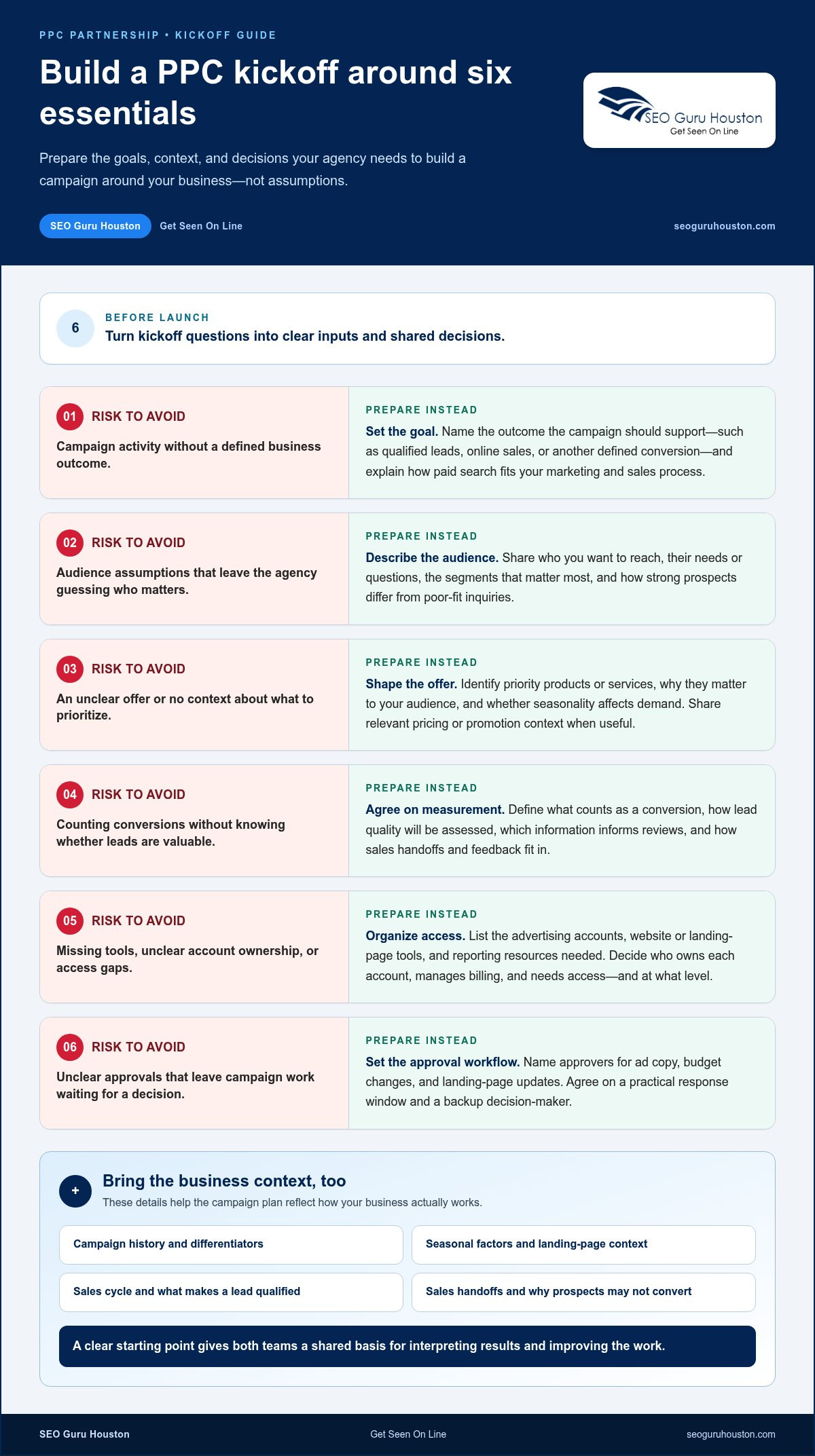
How to Set Up a PPC Agency Relationship for a Strong Start

A strong kickoff turns broad expectations into a usable campaign plan. Before launch, bring together the people, information, and decision process the agency needs to build around your business rather than fill gaps with assumptions. This preparation also gives both teams a clear starting point for interpreting results and improving the work.

  1. Set the goal. Identify the business outcome the campaign should support, such as qualified lead generation, online sales, or another defined conversion. Clarify how paid search fits into your marketing and sales process.
  2. Describe the audience. Share who you want to reach, what needs or questions bring them to you, and which audience segments matter most. Explain how strong prospects differ from poor-fit inquiries.
  3. Shape the offer. Explain which products or services to prioritize, why they matter to your audience, and whether seasonality affects demand. Share relevant pricing or promotion context when it helps shape the campaign plan.
  4. Agree on measurement. Define what counts as a conversion, how lead quality will be assessed, and which information the teams will use to review performance. Include the sales handoff and any available feedback from sales conversations.
  5. Organize access. List the advertising accounts, website or landing-page tools, and reporting resources needed for campaign work. Decide who owns each account, who manages billing, and what access level each team member needs.
  6. Set the approval workflow. Name the people who approve ad copy, budget changes, and landing-page updates. Agree on a practical response window and a backup decision-maker so work doesn’t stall when someone is unavailable.

What information should clients bring to a PPC kickoff?

Come prepared with business priorities, target customer details, differentiators, seasonal factors, and relevant campaign history. Explain your sales cycle: how an inquiry becomes a customer, what makes a lead qualified, where handoffs happen, and why prospects sometimes don’t convert. Share landing-page context, including what visitors are asked to do. Past campaign data can inform planning, but it doesn’t guarantee the same approach will perform the same way again.

For broader strategic context, the PPC management guide discusses connecting paid traffic with business priorities.

How should access, approvals, and communication be organized?

Choose one primary communication channel and a recurring meeting cadence that fits the campaign’s needs. Keep a shared record of priorities, blockers, decisions, owners, and follow-up actions. At each check-in, clarify what needs approval and who will provide it. This structure keeps campaign work moving and makes decisions easier to find than scattered email threads.

Effective collaboration depends on consistent preparation, not a perfect brief. A clear kickoff gives your PPC management team the context to plan and the feedback loop to refine its work. PPC management support can be part of a coordinated approach to paid campaigns.

How to Measure PPC Agency Performance Beyond Clicks

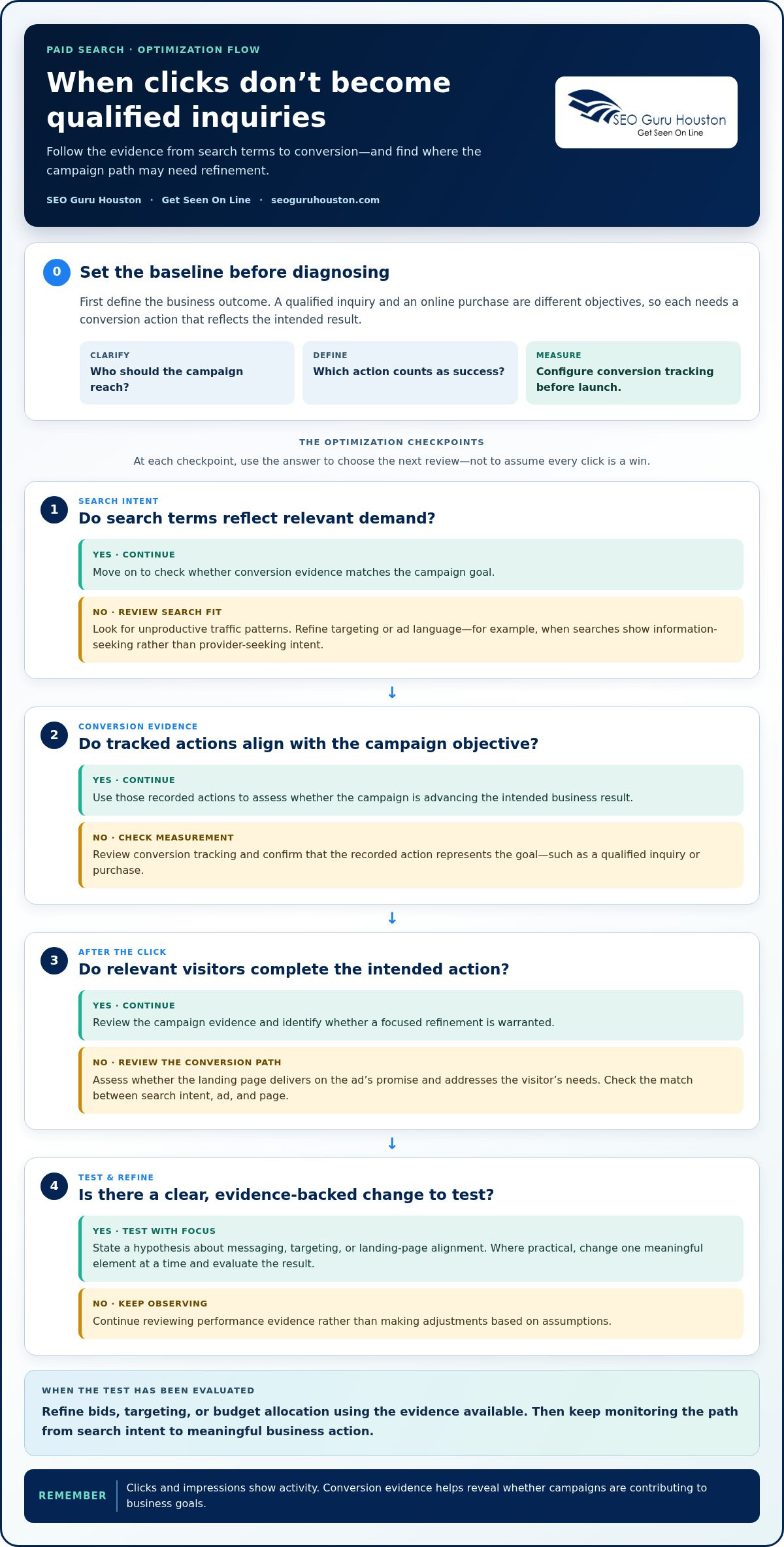
Clicks show that someone interacted with an ad. They don’t show whether that person became a qualified prospect or customer. Clicks alone can’t establish commercial effectiveness because they measure visits, not the value those visits create for the business. A useful review connects advertising activity to lead quality, sales, and the campaign’s agreed objective.

Before using a report to make budget decisions, check that its conversion definitions and underlying data are reliable. Confirm which actions count as conversions, whether duplicate or low-value actions are included, and whether the reporting period gives prospects enough time to progress. If tracking is incomplete or inconsistent, apparent performance changes may not reflect what’s happening in the business.

Which PPC metrics deserve attention in an agency report?

Interpret each metric according to what it can tell you. Impressions indicate visibility; clicks and click-through rate can help assess ad engagement. None proves that the campaign is creating valuable business outcomes. Conversions, conversion rate, and cost per conversion provide a closer view of response, but still need context. A form submission has different value if it comes from a target customer rather than a poor-fit inquiry.

  • Visibility and engagement: Impressions, clicks, and click-through rate help explain whether ads are being seen and attracting interactions.
  • Conversion activity: Conversions, conversion rate, and cost per conversion show how visitors respond, based on the actions being tracked.
  • Business value: Qualified leads, sales, and conversion quality help reveal whether campaign activity supports the sales model and business objective.

For longer sales cycles, platform reporting may capture an inquiry before its eventual outcome is known. Add marketing and sales feedback, such as whether leads fit the target customer profile or progress through the handoff process. That context helps the agency assess patterns the platform alone can’t explain.

How can reporting turn into useful decisions?

A strong report explains more than what changed. It connects a campaign adjustment to the evidence behind it, the interpretation of that evidence, and the recommended next action. For example, if conversions rise but sales feedback suggests lead quality has weakened, discuss whether targeting, ad messaging, the offer, or the post-click experience may be contributing.

Compare results with the campaign’s agreed goals and measurement definitions, then consider relevant historical context. Avoid treating a single metric or short reporting window as a complete verdict. If visitors engage with ads but don’t take the intended next step, examine the landing page as part of the conversion path. High-converting landing page design can support a clearer post-click experience, while reporting helps identify where friction may be occurring.

That’s how to work effectively with a ppc agency when performance data gets complicated: verify what’s being measured, bring business feedback into the analysis, and agree on a next step you can review. The goal isn’t a fuller dashboard. It’s a clearer basis for action.

How to Work Effectively With a PPC Agency: A Practical Guide

How to Keep PPC Agency Campaigns Improving Through Clear Feedback

Campaign optimization works best as a steady learning loop, not a string of last-minute reactions. The agency can analyze campaign signals, but your team sees what happens after an inquiry arrives. Share that feedback consistently so both teams can make more informed decisions about targeting, messaging, and the landing-page experience.

Use a simple review cycle: examine the evidence, agree on a test, assign an owner, then record what happened and what comes next. Separate planned experiments from urgent fixes. If a tracking issue or misleading claim needs immediate attention, address it directly and document the change. For routine optimization, avoid changing several major campaign elements at once. Otherwise, it may be difficult to tell which adjustment influenced the outcome.

How should clients give feedback on PPC leads and sales?

Make lead feedback consistent enough to reveal patterns, not just anecdotes. Agree on practical categories such as relevant, poor fit, sales-ready, or not yet ready, and share recurring objections or reasons prospects disengage. Set a regular schedule for passing along this information, such as including updates in campaign reviews. Protect sensitive customer information: share only the details needed for analysis, use appropriate access controls, and follow your organization’s privacy practices.

Specific feedback gives the agency something actionable. “The leads were weak” is hard to use. “Several inquiries came from people seeking a service we don’t provide” points to a possible mismatch in search targeting, ad language, or the landing-page offer. If relevant prospects repeatedly raise the same concern, the team can assess whether campaign messaging or page content should address it more clearly.

How can both teams make testing more disciplined?

Before launching a test, write down the question it’s meant to answer, the audience it affects, and what evidence would inform the next decision. For example, a team might test whether clearer qualification language attracts more suitable inquiries. Agree on who will implement the change, who will review lead feedback, and when you’ll assess what the evidence supports.

Keep a shared test record with the hypothesis, change, owner, review point, observations, and next action. Don’t label a test a success just because one metric moved. Check whether the movement aligns with the campaign objective and the quality of resulting leads. If the evidence is inconclusive, record that plainly and decide whether to continue, adjust, or close the test. “We can’t tell yet” is more useful than a confident conclusion based on noise.

This is how to work effectively with a ppc agency over time: make feedback timely, experiments interpretable, and decisions traceable. When campaign evidence points to the post-click experience as an area to investigate, coordinate landing-page updates with the agency so the ad promise and page experience stay aligned.

PPC management services can connect campaign analysis with practical optimization.

How to Build a Long-Term PPC Agency Partnership That Drives Growth

A useful agency relationship evolves with the business. Goals set at launch may need revisiting as offers change, new audiences become priorities, or sales capacity shifts. Keep the partnership grounded in shared priorities, candid feedback, and documented decisions. That record helps both teams understand why a campaign changed, what the evidence showed, and which business question deserves attention next.

Consistency matters, but it shouldn’t mean sticking with a strategy after the business has moved on. Revisit campaign priorities when your products or services, target customers, sales process, or objectives change. Use campaign data alongside marketing and sales feedback to identify the next useful question. Avoid adding campaigns or chasing more activity simply because it’s possible. Each change should connect to a business need.

When should a PPC strategy change as the business grows?

Reassess the strategy when an offer changes, a new audience becomes more important, or the sales team can handle a different volume or type of inquiry. Bring those updates to the agency with context: what changed, why it matters, and what you want to learn. Together, decide whether the campaign, its messaging, or its conversion path needs adjustment. Document the reason for each change so future reviews reflect the business decision behind it.

How can PPC connect with landing pages and demand generation?

A paid ad sets an expectation. The landing page should carry that message forward, make the next step clear, and match the offer that prompted the click. If ads attract relevant visitors but the page doesn’t explain the value or guide action, assess campaign performance alongside the post-click experience. PPC management, landing page design, and website development can work as connected parts of the visitor journey, with each considered in light of the campaign objective.

The relationship can extend beyond the initial conversion. Lead capture is one point in a broader demand-generation process: prospects may need useful follow-up and a clear handoff to sales before they’re ready to make a decision. For B2B teams, the B2B demand generation guide offers related context on connecting marketing activity with the process of developing prospects.

Our PPC management works alongside landing page design, website development, and demand generation, so teams can consider campaign traffic and the experience that follows as connected growth work. No single channel or change guarantees a particular outcome. The value comes from keeping business goals visible, sharing honest feedback, and using each review to make the next decision more deliberate.

That’s the practical answer to how to work effectively with a ppc agency over the long term: treat the relationship as an ongoing collaboration, not a set-and-forget arrangement. Our PPC management services can support paid campaigns as part of your broader business priorities.

Make Your Next PPC Decision Count

The strongest agency relationships don’t stand still. As your business shifts, use the next planning conversation to identify the constraint that matters most: reaching a more relevant audience, improving the page experience, or helping qualified prospects move forward. That focus gives both teams a practical direction for the next stage of growth.

Knowing how to work effectively with a ppc agency means treating paid campaigns as part of a broader business system, not an isolated channel. Our PPC management can connect with landing page design, website development, and demand generation to support a coordinated marketing effort. The right priorities depend on your goals and what your campaign data reveals.

Choose one business objective for your next discussion, then turn it into a clear question your marketing team can act on. Discuss your PPC campaign goals and take the next step toward a more focused partnership.

Frequently Asked Questions

What should I expect from a PPC agency each month?

Expect work and communication that match the agreed scope, not a guaranteed number of leads or sales. A useful monthly update identifies work completed, budget pacing, significant account issues, and decisions needed from your team. Check whether recommendations have owners and next steps. For example, if a campaign’s landing page needs a change, the update should explain what needs review and how it relates to the campaign objective.

How often should I communicate with my PPC agency?

Set communication frequency according to campaign complexity and how quickly your team can make decisions. A scheduled monthly review may suit a stable account, while a launch or major offer change can call for closer coordination. Agree on which channel to use for routine questions and how to flag urgent issues, such as a broken conversion form or an unexpected budget concern. The goal is useful contact, not meetings without decisions.

What information should I share with a PPC agency?

Share information that helps the agency distinguish a valuable opportunity from a poor fit: customer qualification criteria, product or service constraints, sales capacity, and common reasons prospects decline. Explain which customer types are most valuable without sharing unnecessary confidential details. A brief summary of a lead’s status or reason for disqualification may be enough to guide campaign decisions. Limit access to sensitive records and follow appropriate privacy practices.

How do I know whether my PPC agency is doing a good job?

Look for clear reasoning, accurate measurement, and follow-through tied to your agreed objective. Ask the agency to explain why it made a meaningful change, what evidence informed it, and what it will monitor next. Your team should also be able to see whether lead quality aligns with the audience you want. Knowing how to work effectively with a ppc agency means evaluating the quality of decisions as well as campaign outcomes, without treating short-term fluctuations as a full verdict.

Should a PPC agency guarantee leads or sales?

No agency should promise a specific number of leads or sales as a certainty. Results depend on factors beyond campaign management, including the offer, competition, website experience, tracking quality, and how promptly sales follows up. An agency can explain its strategy, define how progress will be assessed, and make informed adjustments. Treat guaranteed outcomes cautiously, especially if the promise doesn’t explain assumptions, lead qualification, or what happens when the stated target isn’t reached.

Who owns the Google Ads account when working with an agency?

Your business should retain ownership and administrative control of its advertising account, while the agency receives the access needed to manage campaigns. Clarify account access, billing responsibility, and who controls related assets such as conversion tracking before work begins. This arrangement keeps account history and business data accessible to your organization if staff or agency relationships change. Review user permissions periodically and remove access that’s no longer needed.

How long does it take for a PPC agency to improve campaign performance?

There’s no reliable universal timeline. The pace depends on the account’s starting condition, tracking accuracy, volume of meaningful conversions, and how long prospects take to become customers. Correcting a measurement issue may clarify reporting before the business impact of campaign changes is visible. Ask the agency to identify what it will review at each checkpoint and what evidence would support a decision. Treat early signals as learning, not a promise of future results.

Paid Search Management: Turn Ad Spend into a Growth Engine

What if your ad reports showed more than clicks and impressions? For companies investing in paid search management with SEO Guru Houston, the goal is to connect campaigns with qualified leads and sales, not simply keep ads running. Ad spend can climb while the business impact stays unclear. That’s a reason to look beyond activity and examine what happens after the click.

Effective oversight turns paid search into a measurable acquisition system. It connects targeting, search terms, bidding, conversion tracking, and landing pages, then uses performance data to guide ongoing decisions. The aim is not to treat every click as a win, but to learn which parts of the campaign contribute to business goals.

This article explains what ongoing paid search management involves, which metrics can show whether campaigns are advancing business goals, and how strategy and landing-page experience shape results. A useful report should help answer practical questions: Are the right prospects finding you? Are they taking action? Are those actions valuable to the business? With a coordinated approach, paid search becomes easier to evaluate, refine, and align with the outcomes your business needs.

Key Takeaways

  • Paid search management goes beyond launching ads: ongoing oversight connects campaign strategy, measurement, and optimization to business goals.
  • Align campaign objectives with the action you want customers to take, such as submitting a qualified inquiry or making a purchase.
  • Clicks and impressions show activity, but conversion and return measures help reveal whether campaigns are delivering meaningful business results.
  • Prepare for paid search management houston by clarifying your goals, target customers, offer, conversion path, and measurement access.
  • Relevant ads and well-matched landing pages work together to turn search intent into a stronger opportunity to convert.

What Paid Search Management Does Beyond Launching Ads

Launching an ad is a starting point, not a strategy. Paid search management is the ongoing work of planning campaigns, monitoring delivery, measuring results, and refining decisions so advertising supports a business objective. Effective paid search management houston connects each step, from the searches a campaign targets to the action a visitor takes after clicking.

A campaign can attract attention and still miss its goal. The offer may not match what people are searching for, tracking may fail to record meaningful actions, or the landing page may not address a visitor’s needs. Competition can also affect visibility. Management considers these factors together rather than treating clicks as the finish line.

What tasks are included in paid search management?

Ongoing oversight turns campaign data into practical decisions. Work commonly includes:

  • Planning and structure: Organize campaigns around business goals, search intent, and the actions you want visitors to take.
  • Targeting and messaging: Select relevant keywords and audiences, then shape ad copy around the searcher’s needs and the offer.
  • Monitoring and refinement: Review search terms, monitor budget use, adjust bids, and test campaign elements to identify opportunities and reduce irrelevant traffic.
  • Measurement: Use conversion tracking to understand which interactions matter and guide adjustments to targeting, ads, and budget priorities.

For example, if a campaign receives clicks but few qualified inquiries, increasing spend may not solve the problem. Reviewing search terms, ad promises, tracking, and the landing-page experience can show where the path to conversion is breaking down.

How is paid search different from SEO?

Paid search places ads in search results through advertising platforms, while SEO works to earn visibility in unpaid organic listings. Paid campaigns can begin serving after setup and platform approval, but placement does not guarantee qualified traffic or business results. SEO builds organic visibility over time through work on a site’s content and search presence.

The approaches can complement each other. Paid search data can show which queries attract relevant prospects, while organic performance can reveal topics and pages worth strengthening. Together, those signals can inform acquisition planning across channels. For broader context on how paid advertising fits into search marketing, see What is Search Engine Marketing (SEM)?

How Paid Search Campaign Management Works From Strategy to Optimization

A strong campaign follows a clear cycle: define the business outcome, build around search intent, launch with reliable measurement, and refine based on evidence. For paid search management houston, that process also means accounting for target customers, the offer, and campaign constraints before committing budget.

How does campaign setup establish a useful baseline?

Setup should create a meaningful starting point, not just a collection of ads. First clarify who the campaign needs to reach, which action counts as success, and what limits or priorities will shape delivery. A qualified inquiry and an online purchase are different objectives, so each needs a conversion action that reflects the intended business result.

Next, organize keywords into related search themes. Someone looking for a specific service may have different intent from someone researching a general problem. Grouping those searches helps match ad messaging to what the person is seeking and directs visitors to a relevant page. Configure conversion measurement before launch so later decisions rely on recorded actions, not clicks alone.

What happens during ongoing campaign optimization?

Once ads are running, the management cycle turns observations into testable changes. A practical workflow includes:

  1. Review search terms: Identify queries that reflect relevant demand and patterns that attract unproductive traffic.
  2. Check conversion evidence: Assess whether tracked actions align with the campaign objective and business priorities.
  3. Test a focused change: Form a clear hypothesis about ad messaging, targeting, or landing-page alignment, then evaluate the result.
  4. Refine delivery: Adjust bids, targeting, or budget allocation based on the evidence available, not assumptions.

For example, if a service campaign draws searches from people seeking information rather than a provider, search-term findings may point to a need to refine targeting or ad language. If relevant visitors click but don’t complete the intended action, assess whether the landing page delivers on the ad’s promise. Where practical, change one meaningful element at a time so the impact is easier to interpret.

This is why campaign objectives need a business lens. The Strategic Objectives of Paid Search Advertising resource from Harvard Business Review offers further perspective on connecting paid search decisions with performance measures and customer value. SEO Guru Houston provides data-driven PPC campaign management that connects targeting, measurement, and optimization to growth objectives.

Which Paid Search Metrics Reveal Performance, and Which Can Mislead?

A campaign report can look busy without showing whether advertising is helping the business grow. Impressions, clicks, and click-through rate describe activity and engagement. To assess impact, connect those signals to conversions, lead quality, sales, and return. For paid search management houston, the right metrics depend on the campaign goal and how reliably outcomes are tracked.

Use this framework to separate activity from efficiency and business results:

Metric group What to review What it can tell you
Activity Impressions, clicks, click-through rate (CTR) Whether ads are appearing and attracting clicks. These metrics don’t prove visitors are qualified or generating revenue.
Efficiency Conversions, cost per conversion Whether tracked actions are happening and how much ad spend is associated with each action.
Business outcomes Lead quality, sales, return measures Whether conversions contribute to valuable opportunities, revenue, or other business goals.

How should businesses interpret clicks, conversions, and cost per lead?

A click is a visit from an ad. A conversion is a tracked action, such as a form submission or call. Cost per lead compares campaign spend with the number of leads recorded. Each metric answers a different question. A lower cost per lead may still indicate weak performance if fewer leads are qualified or progress to sales. Set targets using your business economics, not a universal benchmark.

Why do tracking and attribution matter?

Tracking connects online actions to campaign reporting; attribution helps interpret which interactions receive credit. Missing events can hide real inquiries, while duplicated events can inflate conversion totals. Before reacting to a performance change, confirm that forms and calls are recorded consistently and represent genuine business outcomes. Resources from the Paid Search Association can offer additional industry context, but validated business data should guide campaign decisions.

Platform metrics are useful signals, not the whole scorecard. Review them alongside sales-team feedback and lead outcomes. If clicks rise but qualified opportunities don’t, investigate search intent, the offer, and the path from ad to inquiry before increasing investment. Reliable measurement turns reporting into a decision tool, so campaign changes reflect business impact rather than surface-level activity.

Paid Search Management: Turn Ad Spend into a Growth Engine

How to Prepare Your Business for Better Paid Search Management

Campaigns are easier to steer when the business can clearly define what success looks like. Before launching, gather the decisions and access needed to connect advertising with real customer outcomes. This preparation gives a paid search strategy a stronger foundation, but it can’t guarantee campaign performance. Demand, competition, the offer, and the visitor experience all influence results.

What should you define before campaigns begin?

Use this checklist to turn business priorities into practical campaign inputs:

  • Business goal: Decide whether the campaign should drive qualified inquiries, purchases, or another meaningful action. Specify how that outcome will be recorded.
  • Best-fit customer: Describe the customers most likely to benefit, including the needs or search intent that signal a strong fit.
  • Service priorities and offer: Identify which services or products deserve focus and what makes the offer relevant to the intended audience.
  • Conversion path: Map the next step after an ad click, such as completing a form, calling, or making a purchase. Make sure the business can assess the quality of those outcomes.
  • Measurement access: Ensure campaign managers can access the relevant advertising and measurement tools, along with the business feedback needed to evaluate lead or sales quality.

Keep the ad and landing page aligned. If an ad promises information about a specific service, the destination should make that service easy to understand and provide a clear next step. A mismatch creates friction: the visitor clicks with one expectation, then lands on a page that doesn’t address it. A useful landing page continues the conversation started by the search and ad.

How can businesses assess campaign progress responsibly?

Set review criteria before results come in. Compare performance with the original objective, and allow enough time to gather evidence that supports a sound decision. A short-term change in clicks or leads may not show whether the campaign is improving, weakening, or experiencing normal variation.

Check measurement consistency before interpreting a shift. If reported form submissions change, first determine whether tracking still records them correctly. Then consider other explanations, such as changes in search demand, targeting, or the offer. Separate measurement problems from actual campaign performance.

Make each review answer a specific question: Are the inquiries a good fit? Does the landing page support the ad’s promise? Is the campaign reaching the intended customers? Prioritize a test that addresses the clearest gap, then assess the evidence before making another change. This disciplined approach helps paid search management houston stay connected to business priorities instead of reactive guesswork.

Explore data-driven paid search management to align campaign strategy, measurement, and conversion paths.

How SEO Guru Houston Connects Paid Search Management to Business Growth

Paid search should support a business goal, not operate as a separate stream of clicks. SEO Guru Houston’s PPC services use targeted, data-driven advertising to attract qualified traffic and evaluate campaign performance against meaningful conversion actions. Campaign decisions can focus on what the business needs, whether that’s relevant inquiries, purchase activity, or another defined outcome.

For paid search management houston, the connection between targeting, measurement, and the customer’s next step matters. Search terms reveal intent. Ad messaging responds to that intent. Conversion data helps show whether the resulting traffic contributes to business priorities. This approach makes campaign performance easier to assess and gives optimization a clearer purpose.

How can PPC and landing pages work together?

The post-click experience completes the path that begins in search. A person searches for a solution, sees an ad that speaks to that need, then expects the landing page to deliver on the ad’s promise. When the message and page align, visitors can understand the offer and find the next step more easily. When they don’t, even relevant traffic may lose momentum.

SEO Guru Houston’s website development and landing page design services can support that journey alongside PPC. A useful landing page makes the offer clear, answers relevant questions, and guides visitors toward the intended conversion action. For more ideas on the page experience, explore the published guide to high-converting landing page design.

When reviewing how ads and a website work together, identify where prospects lose momentum and which conversion actions matter most to the business.

What is the next step toward a more accountable campaign?

Start with three practical inputs: your growth goal, how you currently measure campaign outcomes, and the offerings that deserve priority. Clarify what makes an inquiry qualified or a sale valuable. Those details help connect campaign decisions to the results the business actually needs.

SEO Guru Houston brings PPC and demand generation together as connected growth support. Campaign insights can inform how the business attracts and engages prospects, while measurement helps keep the work accountable to defined objectives. The focus is not activity for its own sake. It’s a clearer path from search intent to meaningful action.

Explore paid search services and discuss your campaign objectives.

Make Every Search Campaign More Accountable

Paid search works best as an ongoing growth process, not a one-time ad launch. Clear objectives, relevant targeting, and dependable conversion tracking help connect campaign decisions to qualified inquiries, sales, and other outcomes that matter. Clicks and impressions are signals of activity, not proof of business impact.

For paid search management houston, the path from search to conversion deserves attention at every step. SEO Guru Houston provides targeted PPC services designed to drive qualified traffic, while website development and landing page design can support the experience after a visitor clicks. When ad messaging, measurement, and the landing page work toward the same goal, it’s easier to evaluate what contributes to growth.

Ready to connect your campaigns with your business priorities? Explore SEO Guru Houston’s paid search services and take a practical next step toward a more focused acquisition strategy. Clear goals and thoughtful optimization help make ad spend a stronger engine for growth.

Frequently Asked Questions

What is paid search management?

Paid search management is the ongoing work of planning, running, measuring, and improving ads that appear in search results. It can include campaign structure, keyword targeting, ad messaging, budget oversight, conversion tracking, and performance analysis. The goal is to align advertising with business objectives, such as qualified inquiries or purchases. Results depend on factors including the offer, competition, audience, tracking accuracy, and website experience.

How does paid search management improve campaign performance?

Paid search management creates a regular process for checking whether campaigns reach the intended audience and generate meaningful actions. Reviewing search terms can reveal irrelevant traffic, while testing ad messaging can show whether it resonates with prospective customers. Teams can also assess conversion tracking and adjust targeting or budget based on evidence. These practices support better-informed decisions, but they can’t guarantee a specific result.

Is paid search the same as PPC?

Paid search and PPC are closely related, but they describe different things. Paid search refers to advertising placements in search results. Pay-per-click describes a common pricing model where an advertiser pays when someone clicks an ad. Paid search campaigns are often managed through PPC platforms. To evaluate a campaign’s value, look beyond clicks and consider relevant conversions and business outcomes, such as qualified leads or sales.

Which metrics should I track in paid search campaigns?

Track metrics that connect campaign activity to your business goals. Impressions show how often ads appear, and clicks indicate visits from those ads. Conversions record whether visitors complete a defined action. Cost per conversion and lead quality add context about efficiency and usefulness. For a sales-focused campaign, connect advertising data to revenue where tracking allows. The right measures depend on what counts as valuable for your business.

Can paid search work without a dedicated landing page?

Yes, paid search can use an existing page, provided it matches the ad and makes the next step clear. A relevant service page may work if it addresses the visitor’s query and supports conversion. A dedicated landing page can offer a more focused experience for a specific audience or offer. Review page relevance, usability, and measurement to determine whether the destination supports the campaign’s objective.

How long does paid search take to show results?

Ads may begin serving after setup and platform approval, but meaningful evaluation takes longer than seeing initial clicks. Reliable tracking and enough relevant activity are needed to identify useful patterns. Timing varies with budget, competition, search demand, conversion volume, and the sales cycle. Avoid judging performance from early activity alone. Instead, assess progress against agreed business outcomes using consistent, dependable data.

Should I manage paid search in-house or work with an agency?

The right approach depends on your team’s expertise, available time, campaign complexity, and reporting needs. In-house management keeps campaign work close to the business, while an agency can provide dedicated strategy and ongoing optimization. Either approach needs clear goals, dependable conversion tracking, and feedback on lead quality. Evaluate the process by how well it connects campaign activity with business outcomes, not by clicks or reports alone.

B2B Google Ads Agency Houston: The Assertive Blueprint for National Market Dominance

Your Google Ads account is either a precision-tuned revenue engine or a catastrophic drain on your bottom line. There is no middle ground in the hyper-competitive industrial markets of 2026. If you are tired of watching your budget bleed out on low-quality, non-converting clicks, you aren’t alone. It is a harsh reality where 90% of marketers struggle with attribution while stagnant lead volumes paralyze growth. You deserve more than a vendor that hides behind vanity metrics and vague promises of visibility.

You know that market dominance requires more than just showing up; it requires an assertive strategy that converts technical expertise into financial return. By partnering with a high-performance B2B Google Ads agency, you can finally bridge the gap between invisible spending and predictable lead flow. This article reveals the exact blueprint needed to transform your digital standing from a budget-bleeding expense into a precision-engineered demand generation engine. We will explore how to master high-performance tactics, eliminate wasted spend, and implement revenue-focused reporting that actually moves the needle for your business. It’s time to stop surviving and start dominating your specific industrial niche.

Key Takeaways

  • Stop settling for “set it and forget it” tactics that drain budgets and learn why modern Google Ads requires a strategic demand generation framework to survive the 2026 market.
  • Discover how an elite b2b google ads agency houston shifts focus from simple lead volume to high-impact demand generation for sustainable national growth.
  • Abandon vanity metrics like CTR and impressions to master the “Guru Growth Formula” that prioritizes revenue, Customer Lifetime Value, and actual acquisition costs.
  • Synchronize your ad spend with high-performance assets by using a 5-step process for integrating video marketing and high-converting landing pages into your funnel.
  • Follow a clear roadmap that scales your account from an initial audit to total niche market dominance through a high-performance coaching partnership.

Beyond the Click: The Reality of Modern Google Ads Management

Google Ads is not a traffic source. If you treat it as a simple pay-per-click exercise, you have already lost. True Modern Google Ads Management is a strategic demand generation framework. It is about engineering a system that captures high-intent prospects and forces them through your sales funnel. B2B markets in Houston are unforgiving. With Cost-Per-Clicks (CPCs) in energy and industrial sectors often exceeding $40, you cannot afford to guess. A top-tier b2b google ads agency houston understands that keyword bidding is only 10% of the battle. The rest is about data architecture, psychological triggers, and revenue-focused optimization.

The High Cost of Passive PPC Management

Passive management is a death sentence for your marketing budget. Relying on set it and forget it strategies or basic automated bidding without human oversight is a recipe for financial disaster. Google’s shift toward AI Max upgrades in late 2026 means the algorithm often prioritizes its own data goals over your profit margins. This creates Budget Bleed. It is the silent killer of growth-oriented B2B enterprises. Generic agencies brag about high impressions while your bank account remains stagnant. They optimize for clicks that never convert to revenue. You need a partner who sees through the vanity metrics and demands a return on every dollar spent.

Why 2026 Demands an Assertive Approach

The 2026 landscape is hyper-competitive and technically complex. Research shows that 79% of B2B buyers now use AI-driven search tools for research. This means your ads must work harder to stay relevant. You aren’t just competing with other businesses; you’re competing with sophisticated, rapidly evolving algorithms. Market dominance is no longer an optional luxury. It is a fundamental necessity for business survival. You need an assertive ppc management houston partner who moves beyond search-only tactics. A true b2b google ads agency houston integrates multi-channel demand generation to surround your prospects. Guru-level expertise is the only way to navigate these complex systems. Don’t settle for a vendor. Hire a high-performance coach who is as obsessed with your bottom line as you are. Success in this environment requires precision, speed, and a refusal to accept mediocre results.

The Architecture of Demand Generation: A Strategic Blueprint

Simple lead generation is a trap. It focuses on volume over value, filling your CRM with names that never intend to buy. An elite b2b demand generation agency doesn’t just look for contact info. It builds a system that identifies and nurtures high-value prospects before they even realize they’re ready for a sales call. In the industrial sector, a “lead” is often just noise. Demand generation is the signal. It creates a hunger for your specific solution, positioning your brand as the only logical choice in a crowded market.

Partnering with an assertive b2b google ads agency houston ensures your PPC account isn’t just a bucket for expensive clicks. It becomes a precision-engineered engine. We analyze high-intent search patterns to find buyers who are ready to commit. This isn’t about broad, generic keywords. It’s about technical precision. We look for the specific nuances that separate a casual researcher from a decision-maker. This is critical when you consider that 74% of B2B buying committees experience internal conflict during the decision process. You need a data-driven architecture to cut through that friction and drive consensus.

Inbound Marketing vs. Outbound Interruption

Google Ads is the ultimate inbound engine. It catches prospects exactly when they’re searching for answers to their most pressing business problems. When you combine this high-intent traffic with professional seo services, you own the search results page. You become the inevitable authority. Capturing existing demand is always more efficient than forcing an interruption. Your strategy must focus on being visible where the demand already lives. Since the 2026 market is saturated with AI-driven research tools, your inbound presence must be technically flawless to be discovered by modern buying committees.

Industrial Lead Generation at Scale

Manufacturing and industrial sales cycles are marathons. You won’t close a million-dollar contract with a single ad click. The Demand Gen framework accounts for this long-term reality by using multi-touch attribution to keep your brand top-of-mind for months. For businesses with complex product catalogs, specialized Amazon services can even complement a broader B2B digital strategy. This multi-channel approach ensures there are no gaps in your national reach. If you’re tired of chasing low-quality traffic, it’s time to refine your B2B marketing blueprint and start scaling your empire with precision.

Metrics That Matter: Moving from ROAS to Revenue

Clicks are a commodity. Impressions are a vanity project. If your current agency is bragging about a high Click-Through Rate (CTR) while your sales team is starving for quality leads, you’re being lied to. An assertive b2b google ads agency houston doesn’t hide behind superficial data. We focus on the “Guru Growth Formula,” which shifts the focus away from basic Return on Ad Spend (ROAS) and toward Customer Lifetime Value (CLV) and Customer Acquisition Cost (CAC). You need to know exactly how much profit each dollar of ad spend generates. Anything less is just expensive guesswork.

Assertive PPC management requires real-time revenue tracking to justify your investment. In the hyper-competitive industrial space, every single dollar must be a precision strike. This is where Conversion Rate Optimization (CRO) becomes your secret weapon. It isn’t enough to just get the click; you must maximize the value of that visitor once they arrive. By refining the user journey and removing friction, we transform your account from a cost center into a high-performance profit engine. Market dominance belongs to the businesses that can afford to acquire a customer because their funnel is more efficient than the competition’s.

The Fallacy of the Cheap Click

Low Cost-Per-Click (CPC) is often a siren song for failure. In manufacturing and technical B2B sectors, a cheap click is usually garbage traffic that will never convert. You want “Conversion-Ready Traffic.” These are the high-intent buyers who are ready to engage. We aggressively prune “junk” keywords that bloat your budget and provide zero ROI. If a keyword isn’t driving a qualified lead, it’s dead weight. We cut it. This isn’t about saving money; it’s about reallocating your capital to the high-performance segments that actually drive growth.

Calculating Real-World ROI

You deserve absolute transparency. If you can’t see a direct line from an ad click to a closed contract, your management is failing you. We provide a framework for measuring actual financial gain, not just digital noise. Our reporting uses a problem-solution framework to identify bottlenecks, such as a landing page that needs a stronger psychological hook, and we implement the fix immediately. A partnership with a leading b2b google ads agency houston means you get data-driven insights that prove your investment is building an empire. Don’t settle for “projected” results. Demand the truth about your revenue.

B2B Google Ads Agency Houston: The Assertive Blueprint for National Market Dominance

Funnel Synergy: Integrating Landing Pages and Video Marketing

A high-performance ad campaign is worthless if your destination page is a graveyard for conversions. You need total synchronization between your creative and your conversion assets. Our 5-step process ensures your ads and landing pages work in perfect harmony. First, we establish a 1:1 message match between the ad copy and the page headline. Second, we optimize for technical speed to prevent bounce rates. Third, we deploy high-impact visual authority through video. Fourth, we eliminate form friction by removing unnecessary fields. Fifth, we drive home an assertive call-to-action that leaves no room for hesitation. As a leading b2b google ads agency houston, we don’t just send traffic; we engineer the environment where that traffic becomes revenue.

Why Your Landing Page is the Real Bottleneck

If your landing page is cluttered, slow, or confusing, your ROI will vanish instantly. A great ad cannot fix a broken user experience. We utilize an “SEO-First” approach to web development, ensuring your pages are light, fast, and technically sound from the ground up. Mobile-first design is non-negotiable for modern industrial searchers who are often making decisions while on-site or in the field. You must design high converting landing pages that cater to these specific behaviors. Continuous A/B testing of both your copy and visual elements is the only way to scale your empire. If you aren’t testing, you’re guessing with your capital.

The Power of Website Video Marketing

Video is the ultimate trust accelerator in the B2B world. In complex industrial and manufacturing markets, seeing a Guru persona on screen builds immediate authority that text alone cannot match. Integrating professional Website Video Marketing increases time-on-page and significantly boosts conversion rates by simplifying complex technical value propositions. It humanizes your brand and positions you as a seasoned veteran in your niche. Video forces the user to stop scrolling and engage with your message. This psychological impact is critical for moving prospects through a long sales cycle. It builds the rapport necessary to turn a cold click into a high-value partnership. When you combine assertive video with precision-targeted ads, you create an unstoppable demand generation engine.

Stop settling for mediocre conversion rates and start dominating your market. Hire a b2b google ads agency houston that builds the entire funnel to maximize your financial return.

Scaling is not just about spending more money. It’s about maintaining acquisition efficiency while expanding your reach through a precision-engineered framework. A partnership with a top-tier b2b google ads agency houston is a high-performance coaching relationship. We don’t just manage accounts; we build empires. If you want to dominate your national market, you need a roadmap that moves from a technical audit to absolute prominence. You cannot afford to wait while your competitors capture the high-intent traffic that belongs to you.

Your digital presence must be a 360-degree force. This means integrating Amazon Services for technical product visibility and Social Media Marketing to surround your prospects on every platform they frequent. When your paid search is synchronized with a robust inbound marketing strategy for b2b, you stop chasing leads and start attracting them. You become the inevitable authority in your niche. This holistic approach ensures that your brand is visible, credible, and dominant across the entire digital ecosystem.

The Roadmap to Market Dominance

Scaling requires technical precision and a refusal to accept mediocre results. You cannot simply double your budget and expect double the revenue without losing efficiency. We follow a strict sequence to ensure success:

  • The Deep Audit: Identifying the “Budget Bleed” and technical errors that are currently killing your ROI.
  • Win-Zone Optimization: Doubling down on the high-intent keywords and audiences that drive real revenue.
  • Strategic Expansion: Moving into adjacent niches and national search markets using Guru secrets that exploit competitor weaknesses.

To maintain this momentum, you need an assertive search engine optimization agency partner. This ensures your organic and paid strategies work in a pincer movement to crush the competition. If you aren’t dominating both sides of the search results page, you’re leaving money on the table.

Securing Your Competitive Edge

Digital invisibility is a slow death for industrial enterprises. Many businesses fall into the trap of “affordable SEO” or cheap PPC management. These are budget-bleeding distractions that offer no real path to growth. High-ROI growth requires a partner who is as aggressive and results-oriented as you are. The 2026 market belongs to those who take decisive action now. This is your final directive: stop settling for mediocre results and hire the b2b google ads agency houston that understands the high-stakes reality of industrial commerce. Secure your revenue growth and claim your market leadership today.

Master Your Market: The Path to Absolute Digital Prominence

The era of passive advertising is over. To dominate your industrial niche, you must move beyond simple keyword bidding and embrace a strategic demand generation framework. We’ve shown you how to pivot from vanity metrics to real-world revenue and why high-performance funnel synergy is non-negotiable for 2026. Your business deserves a precision-engineered engine that converts clicks into closed contracts. Success requires a refusal to accept mediocre results.

Since 2017, we’ve specialized in high-impact national demand generation for B2B enterprises ready to scale. As an assertive b2b google ads agency houston, we don’t just manage accounts; we coach our partners toward total market leadership. Don’t let your competitors capture the high-intent traffic that belongs to you. It’s time to transform your digital standing from invisibility to prominence with a partner focused on your bottom line.

Stop Bleeding Budget and Start Scaling Your Revenue Today!

Success belongs to the decisive. Take the first step toward building your empire now.

Frequently Asked Questions

Is Google Ads still effective for B2B companies in 2026?

Google Ads remains the most powerful engine for capturing high-intent B2B buyers. In 2026, 79% of buyers use AI-driven search tools, making it vital to be visible exactly when they research solutions. Without a dominant presence, you’re effectively invisible to the market. It isn’t just about traffic; it is about intercepting demand at the precise moment of need.

Can I manage my own Google Ads campaigns to save money?

Managing your own campaigns is the fastest way to experience Budget Bleed. Unless you are a technical expert in 2026’s AI-driven bidding environments, you will waste capital on low-quality clicks. Professional management from a b2b google ads agency houston is a fundamental necessity for business survival. It transforms an expense into a precision-engineered revenue engine that pays for itself through measurable growth.

How much should a business realistically spend on Google Ads management?

A realistic budget depends on your specific growth goals and the competitiveness of your niche. You should view your ad budget and management fees as a strategic investment in market dominance rather than a simple expense. High-performance partnerships focus on revenue-driven metrics and transparent reporting to ensure every dollar spent drives measurable growth. If your spend isn’t actively scaling your empire, your strategy requires an immediate assertive overhaul.

What happens if my Quality Score is consistently low?

A low Quality Score is a technical emergency that forces you to pay more for every click. It signals a disconnect between your ads, keywords, and landing pages. This bottleneck kills your ROI and hands your market share to competitors. Correcting this requires an assertive audit and a total synchronization of your funnel assets to restore your competitive advantage and lower acquisition costs.

Is PPC better than SEO for a new business launch?

PPC is the superior choice for a new launch because it delivers immediate visibility and lead flow. While SEO is vital for long-term authority, it takes months to build momentum. Starting with a b2b google ads agency houston allows you to capture revenue today while your organic strategy matures. The most assertive businesses use both in a pincer movement to crush competition across the entire search page.

Can Google Ads help with industrial and manufacturing lead generation?

Google Ads is the ultimate tool for industrial lead generation because it targets the specific technical queries used by decision-makers. Manufacturing sales cycles are long and complex, but precision-targeted ads capture prospects at the start of that journey. By using a demand generation framework, you can nurture these leads through every stage of the funnel until they are ready to sign a contract.

How long does it take to see a measurable ROI from paid search?

You will see traffic immediately, but a measurable, scalable ROI typically takes 30 to 90 days. This period allows for the Deep Audit and the refinement of high-intent search patterns. A precision-tuned engine requires time to collect data and prune the junk keywords that bloat budgets. Once the system is optimized, your lead flow becomes a predictable and scalable asset for national growth.

What is the difference between demand generation and simple lead generation?

Simple lead generation is a vanity project that focuses on contact volume. It often fills your CRM with low-quality noise. Demand generation is a strategic framework that creates a hunger for your specific solution. It focuses on high-impact signals and ready buyers. True demand generation ensures that by the time a prospect contacts you, they are already convinced that you are the only logical choice.

PPC for B2B SaaS: 2026 Blueprint for Market Dominance

If your SaaS growth strategy is still optimized for form-fills instead of closed-won revenue, you’re essentially burning capital to fund your competitors’ market share. It’s frustrating to watch your Cost Per Acquisition climb while your sales team complains about leads that never had a chance of converting. You know that simply increasing spend isn’t the answer when the gap between a click and actual ARR feels like a canyon. This guide provides the definitive 2026 blueprint to master ppc for b2b saas, transforming your ad accounts from cost centers into high-velocity revenue engines that dominate the search results.

You’re going to learn how to leverage AI-optimized campaigns that have shown an 18% reduction in cost per lead and 22% better ROAS. We’ll explore the aggressive shift from simple lead volume to revenue velocity, the technical transition from SKAGs to Single Theme Ad Groups (STAGs), and the specific landing page strategies that drop bounce rates by half. Prepare to stop chasing clicks and start capturing market dominance. If you’re ready to scale your predictable pipeline and slash your CAC, it’s time to execute with precision.

Key Takeaways

  • Stop chasing vanity metrics and pivot your strategy toward “North Star” goals like cost per demo and actual ARR growth.
  • Modernize your technical foundation by replacing outdated SKAGs with Single Topic Ad Groups (STAGs) and leveraging first-party data for a cookieless world.
  • Master a full-funnel approach that captures high-intent demand on Google while using assertive LinkedIn targeting to reach key decision-makers.
  • Secure your ROI by prioritizing high-converting landing pages that transform expensive traffic into a predictable revenue engine.
  • Scale with confidence by integrating your strategy for ppc for b2b saas with technical SEO and demand generation for total market dominance.

Why Most B2B SaaS PPC Strategies Fail (and How to Pivot)

Most Software as a Service (SaaS) companies are addicted to lead volume. It feels productive to report 1,000 monthly leads, but if that traffic doesn’t convert to actual ARR, your marketing budget is just a donation to Google. Traditional ppc for b2b saas strategies are failing in 2026 because they prioritize vanity quantity over revenue quality. If you’re seeing high lead counts but stagnant pipeline, you’ve fallen into the Lead Volume Trap. You need a pivot from broad targeting to high-intent Buyer Persona mapping. This requires an assertive, data-first approach that treats every dollar as an investment in market dominance.

Is your current strategy building a moat or just bleeding cash? Most SaaS leaders can’t answer that because they lack clear attribution. You must identify the gap between what you spend and what you earn. If your PPC isn’t integrated with your CRM to track down-funnel conversions, you’re flying blind. This isn’t just about running ads; it’s about business survival. Winning in 2026 demands that you stop chasing clicks and start capturing intent with surgical precision.

Vanity Metrics vs. Revenue Velocity

High CTR and low CPC are secondary metrics that often mask a failing strategy. You can’t pay your developers with clicks. In the high-stakes world of ppc for b2b saas, your core KPI must be Revenue Velocity. Revenue Velocity is the measurable speed at which a prospect moves through your sales funnel to become realized revenue. Audit your account immediately. Look for budget leakage in broad keywords that attract “tire-kickers” rather than decision-makers. If your ads aren’t driving SQLs and increasing your pipeline value, they are actively draining your resources.

The Intent-First Framework

Winning requires categorizing search queries by intent. “Problem Aware” users are just starting their journey; “Solution Ready” users have their credit cards out. You must dominate the latter. Aggressive bidding on competitor terms is a fundamental necessity for growth. While competitor keywords often carry a higher CPC, research shows they deliver MQLs at a 39% lower cost than generic campaigns. This assertive positioning aligns your paid efforts with a high-performance b2b demand generation agency model. You aren’t just buying traffic; you’re building a competitive advantage. Stop settling for visibility when you could be securing dominance.

The 2026 Technical Foundation: First-Party Data and STAGs

If you’re still clinging to Single Keyword Ad Groups (SKAGs), you’re sabotaging your own algorithms. In 2026, ppc for b2b saas relies on data density. Single Topic Ad Groups (STAGs) have emerged as the superior evolution because they provide the volume necessary for machine learning to actually work. AI-optimized campaigns have shown a 22% improvement in Return on Ad Spend (ROAS) when they have enough data to identify patterns. By grouping keywords by theme rather than exact syntax, you give the platform the signal strength it needs to find your buyers.

The death of third-party cookies isn’t a future threat; it’s your current reality. First-party data is your only survival strategy. Relying on basic browser tracking will leave you blind to 40% of your customer journey. You need a technical foundation that includes enhanced conversions and server-side tracking to recapture that lost data. Most importantly, your CRM must be integrated with your ad platforms. Feeding “Closed-Won” revenue data back into the system allows the AI to bid for profit, not just for volume.

Implementing STAGs for SaaS Precision

Success starts with grouping keywords by intent and theme to maximize Ad Strength. When your ad copy and landing page align perfectly with a specific topic, your Quality Score climbs. The math is undeniable. Higher relevance scores drive down your CPA by reducing the penalty you pay for misaligned traffic. Research from June 2026 shows that campaigns aligning funnel stage with search intent achieve an average conversion rate of 11.3%. Don’t fall into the “set and forget” trap. That’s a death sentence for your SaaS margins. You must constantly prune underperforming themes to keep your account lean and aggressive.

Weaponizing Your First-Party Data

Your existing customer list is a goldmine for scaling. Upload these lists to build high-fidelity “Lookalike” audiences on LinkedIn and Google to find prospects who mirror your best accounts. Simultaneously, you must use exclusion lists to stop paying for clicks from current users who are simply trying to find your login page. This level of technical data hygiene is a hallmark of elite ppc management houston. If you want to dominate the market, you must be surgical with your spend. Predictive bidding only works if the data you feed it is clean and focused on revenue. If you aren’t sure if your tracking is capturing the full picture, it’s time to audit your server-side setup before your competitors outpace your data capabilities.

Platform Selection: Dominating the Full Funnel

Dominance isn’t achieved by being everywhere; it’s achieved by being exactly where your buyer is when they’re ready to act. You must balance “Demand Capture” on Google with “Demand Creation” on social platforms. If your budget is 100% focused on search, you’re fighting for a finite pool of prospects. If it’s 100% on social, you’re missing the immediate revenue from high-intent searches. A winning ppc for b2b saas strategy in 2026 splits spend based on your current market maturity and pipeline needs.

Google is your high-intent engine. You must master Bottom of Funnel (BOFU) keywords like “Best [Category] Software” while aggressively avoiding low-intent terms like “Free [Category] Tool” that attract non-paying users. Competitor conquesting is a fundamental necessity here. While the average CPC for these campaigns is high at $22.21, they deliver MQLs at a 39% lower cost than generic terms. Your professional seo services should inform this list, identifying the gaps where your organic presence is weak but the revenue potential is high.

Google Ads: The High-Intent Engine

Success on Google requires surgical precision with your keyword list. You’re bidding on intent, not just words. If you aren’t bidding on your competitors’ brand names, you’re leaving the most qualified traffic on the table for someone else to grab. This is about capturing the moment of search. Use your SEO data to find high-converting terms that are too competitive to rank for organically in the short term. This synergy ensures your brand remains prominent across the entire search engine results page.

LinkedIn and Reddit: Precision Social

LinkedIn and Reddit provide the precision social layer for ppc for b2b saas, allowing you to target by role rather than just intent. LinkedIn allows for assertive targeting of decision-makers by job title and company size. While the CPM is high, ranging from $45 to $120, the quality is unmatched. The cost per qualified meeting on LinkedIn typically sits between $1,200 and $4,800, a price worth paying for enterprise deals. However, don’t overlook Reddit in 2026. It’s the most undervalued platform for reaching technical buyers. Subreddit targeting allows you to speak directly to niche communities where prospects look for unfiltered advice.

Your ad copy must shift from generic corporate speak to a high-performance coach persona. Use UGC-style creatives, which outperform polished brand ads by 41% in click-through rate and 19% in conversion rate. Speak directly to the pain of high CPA and low-quality leads. If you want to dominate, your social ads shouldn’t look like ads; they should look like essential insights for business survival. Combining LinkedIn’s firmographic precision with Reddit’s community-driven trust creates a powerful engine for demand generation.

PPC for B2B SaaS: 2026 Blueprint for Market Dominance

Step-by-Step: Launching a High-ROI SaaS Campaign

Launching a successful campaign for ppc for b2b saas isn’t a guessing game. It’s a sequence of tactical strikes designed to move prospects from curiosity to commitment. First, you must define your “North Star” metric. If you’re still optimizing for Cost per Click, you’ve already lost the battle for efficiency. High-performance SaaS brands optimize for Cost per Demo or Cost per SQL. Once your goal is locked in, you must map your STAG structure to specific buyer stages. Top-of-funnel themes should educate, while bottom-of-funnel themes should sell. Deploy assertive, results-oriented ad copy that highlights the bottom line. Don’t just list features; show the financial transformation your software provides. Finally, commit to rigorous A/B testing. Does a “Free Trial” or a “Personalized Demo” drive more long-term ARR? You won’t know until you test the math.

The Landing Page: Where ROI is Won or Lost

Sending your hard-earned PPC traffic to your homepage is a cardinal sin that kills margins. Your homepage is a directory; your landing page is a closing tool. To dominate, you need a high converting landing page design that matches the specific intent of your STAGs. Research from June 2026 shows that landing pages matched to keywords have a 34% bounce rate, compared to 67% for generic homepages. You must include undeniable social proof, a single clear CTA, and frictionless forms that don’t exhaust the prospect. The SEO Guru secret is integrating video marketing. Pages with strategic video content can see 80% higher engagement, providing the technical demonstration your prospects need to convert. If your current pages aren’t converting, upgrade your landing page architecture before spending another dollar on ads.

Continuous Optimization and Scaling

Scaling requires discipline, not just a larger credit limit. Follow the 7-day rule. Do not touch the algorithm until you have at least a week of data, or you’ll trap your campaign in a perpetual “Learning Phase.” When you find a winner, scale your budget in 20% increments to avoid shocking the system. The Rule of 100 dictates that you should not declare an ad variation a winner until it has reached at least 100 conversions or enough impressions to ensure statistical significance. This methodical approach ensures your ppc for b2b saas strategy remains a predictable revenue engine. You aren’t just running ads; you’re managing a financial asset. Treat it with that level of precision.

Scaling to Dominance: The SEO Guru Houston Advantage

Scaling your SaaS requires more than just a larger ad budget. It demands an assertive, technical partner who treats your capital with the same intensity a high-performance coach treats an athlete’s potential. Generic agencies will sell you on “awareness” and “impressions,” but in the competitive landscape of 2026, those are luxuries you can’t afford. You need a fundamental necessity: a strategy that prioritizes business survival and aggressive growth. Waiting to optimize your ppc for b2b saas is the most expensive mistake you can make. Every day your campaigns underperform, your competitors are capturing the ARR that should be yours.

You’ve seen the data on STAGs and first-party data integration. Now, you must decide if you want to manage those complexities alone or leverage a veteran team that has already mastered the technical nuances. Moving from invisibility to prominence isn’t a slow crawl; it’s a series of decisive, data-backed strikes. We don’t just run ads. We build high-velocity revenue engines that turn your ad spend into a predictable pipeline.

Integrated Demand Generation

True market dominance happens at the intersection of immediate results and long-term equity. While PPC feeds the top of your funnel with instant traffic and data, your partnership with an elite seo marketing company builds a sustainable moat around your brand. This synergy ensures you aren’t just visible; you’re prominent. We position your SaaS as the authoritative leader in your vertical by using PPC data to inform SEO content strategies and vice versa. This “Guru” quality, specialized knowledge combined with decisive action, is what moves you from an industry participant to a market dominator.

Measuring What Matters

We don’t report on vanity metrics that look good in a slide deck but fail to show up in your bank account. Our reporting focuses exclusively on the metrics that drive your board meetings: SQLs, sales opportunities, and actual ARR. By connecting every ad dollar to a specific pipeline outcome, we eliminate the guesswork that plagues most SaaS marketing departments. If a keyword or campaign isn’t contributing to your revenue velocity, we kill it and reallocate that capital to what works. Stop guessing and start scaling with a results-oriented partner who is as committed to your bottom line as you are. The transformation from invisibility to prominence starts with a single, assertive decision to dominate your search results.

Execute Your Blueprint for 2026 Dominance

The window for mediocre marketing has closed. Dominating ppc for b2b saas in 2026 requires a radical shift from chasing vanity clicks to capturing high-velocity revenue. You’ve seen how technical mastery of STAGs and first-party data can slash your CAC and build a predictable pipeline. It’s time to stop treating your ad spend like a gamble and start managing it like the high-yield asset it is. Your competitors are already optimizing for intent; every day you wait is a day they secure more of your market share.

Success depends on the synergy between technical demand generation and high-converting landing page design. SEO Guru Houston acts as your high-performance coach to move you from invisibility to prominence. Our results-oriented social media and digital strategies are designed to turn your ad spend into a powerful growth engine. Don’t let your sales team settle for low-quality leads when market leadership is within reach. Dominante your market: Get a Result-Oriented PPC Strategy Now. You have the blueprint. Now, take the decisive action required to win.

Frequently Asked Questions

What is the average CAC for B2B SaaS PPC in 2026?

Average acquisition costs vary by vertical, but the cost per qualified meeting typically ranges from $1,200 to $4,800 on LinkedIn Ads. On Google Ads, the cost per sales qualified lead (SQL) sits between $280 and $1,400. Lowering your CAC requires a fundamental shift from lead volume to revenue velocity. Optimizing for qualified meetings instead of simple form-fills can reduce your cost per SQL by as much as 41%.

How much budget do I need to start a B2B SaaS PPC campaign?

Your starting budget depends on your specific vertical and competitive landscape. For example, competitor conquesting campaigns in the SaaS space carry an average CPC of $22.21, while generic campaigns average $6.27. To gather enough data for AI-driven optimization, you need a budget that allows for at least 100 conversions within a reasonable timeframe. Sufficient initial investment is a fundamental necessity for bypassing the learning phase and securing market dominance quickly.

Which is better for SaaS: Google Ads or LinkedIn Ads?

Neither is better in isolation; they serve different funnel stages. Google Ads is the high-intent engine used to capture prospects at the moment of search, especially for bottom-of-funnel terms. LinkedIn Ads allows for assertive targeting based on firmographics like job title and company size. A dominant ppc for b2b saas strategy integrates both platforms to balance demand capture with demand creation, ensuring you reach decision-makers across the entire buyer journey.

How do I track revenue attribution from my PPC ads?

Revenue attribution requires deep integration between your ad platforms and your CRM. You must implement server-side tracking and enhanced conversions to bypass the limitations of a cookieless world. By feeding “Closed-Won” data back into your bidding algorithms, you move beyond vanity metrics like CTR. This technical foundation allows you to attribute every ad dollar to actual ARR, ensuring your PPC spend functions as a high-velocity revenue engine.

What are STAGs and why should I use them for my SaaS?

Single Topic Ad Groups (STAGs) are the 2026 evolution of the outdated SKAG model. Instead of targeting one keyword per group, STAGs group keywords by a specific theme or intent. This approach provides the data density required for modern machine learning algorithms to optimize effectively. Using STAGs improves your Ad Strength and Quality Score by ensuring your copy and landing pages remain highly relevant to the searcher’s specific problem or solution.

Can PPC help with B2B demand generation or just lead gen?

PPC is a critical component of assertive demand generation, not just a tool for capturing leads. While lead gen focuses on immediate form-fills, demand generation uses targeted ads to educate the market and position your SaaS as the authoritative leader. By layering intent data with firmographic targeting, you create awareness among prospects who aren’t yet searching for a solution. This proactive approach builds long-term equity and ensures a steady pipeline.

How long does it take to see ROI from B2B SaaS PPC?

While you might see initial leads within days, significant ROI typically requires a full sales cycle to manifest in your ARR. You must follow the 7-day rule, allowing the algorithm to gather sufficient data before making major adjustments. Most high-performance campaigns reach their peak efficiency after three to six months of continuous optimization and scaling. Patience during the initial learning phase is essential for building a predictable and sustainable revenue engine.

Should I bid on my competitors’ brand names in Google Ads?

Bidding on competitor terms is a fundamental necessity for ppc for b2b saas growth. Competitor conquesting campaigns often deliver Marketing Qualified Leads (MQLs) at a 39% lower cost than generic campaigns, despite having a higher CPC. This assertive strategy allows you to intercept high-intent buyers who are already considering a solution. It’s a bold move that positions your software as the superior alternative at the exact moment a prospect is making a decision.

PPC Landing Page Optimization Houston: Dominating the 2026 Conversion Landscape

In 2026, a “pretty” landing page is the fastest way to bankrupt your marketing department. You already know the sting of watching a massive Google Ads budget vanish into a black hole of zero ROI transparency. It’s exhausting to pay for clicks that result in nothing but low-quality leads that waste your sales team’s time. You deserve a predictable, scalable lead generation engine that turns every dollar spent into a measurable financial advantage.

Stop wasting your ad spend on pages that look fine but fail to perform. This article reveals the assertive strategies required to turn expensive clicks into high-margin revenue through elite PPC landing page optimization. We’re moving beyond basic design to focus on the technical precision and psychological triggers that drive market dominance. You’ll learn exactly how to transform your digital presence from a liability into an aggressive asset. We will break down the precise framework for building high-performance pages that capture attention, filter out the noise, and maximize your $$$ return on every LinkedIn or Google campaign.

Key Takeaways

  • Stop treating clicks as victories and start viewing them as liabilities until they convert into high-margin revenue.
  • Capture attention in under 2.5 seconds by mastering the “Above the Fold” mandate and utilizing assertive, high-impact CTA placement.
  • Drastically reduce bounce rates through perfect “Message Match,” ensuring your PPC landing page optimization Houston strategy creates seamless continuity between ad intent and page content.
  • Future-proof your lead generation by evolving from simple A/B tests to advanced multivariate experimentation and AI-powered personalization.
  • Scale your ROI by integrating technical PPC management with custom landing page development to build a predictable, high-performance revenue engine.

The Post-Click Reality: Why PPC Traffic Without Optimization is a Sunk Cost

Google Ads is a transaction. You buy a visit. That’s the extent of the promise. If that visitor lands on a generic, slow, or confusing page, you’ve essentially handed your money to a tech giant as a donation. In the high-stakes industrial and B2B markets, this “Leaky Funnel” syndrome is the silent killer of growth. You’re paying premium prices for clicks, yet your landing page is acting like a sieve, letting high-intent prospects slip through the cracks because the experience doesn’t match the expectation.

By 2026, the cost of digital attention has reached a tipping point. Market volatility and increased competition mean you can no longer afford the luxury of “managing ads” as a standalone task. You must pivot to engineering conversions. This psychological shift is what separates the market leaders from those who merely survive. Professional PPC landing page optimization Houston isn’t just about changing button colors; it’s about building a high-performance machine that justifies every cent of your ad spend.

The Financial Impact of a 1% Conversion Difference

Mediocrity is the most expensive mistake you can make. Consider the ROI gap: a jump from a 2% conversion rate to a 3% conversion rate isn’t just a 1% gain. It’s a 50% increase in lead volume for the exact same ad spend. When your page fails to convert, your Cost Per Lead (CPL) doesn’t just rise; it explodes. “Good enough” design is the enemy here. It creates a ceiling on your growth that no amount of ad budget can break through. If you want market dominance, you need a page that works as hard as your sales team does.

Stop Bleeding Budget on Irrelevant Traffic

There’s a direct, technical connection between your landing page and your bank account. Ad platforms like Google and LinkedIn use a Quality Score or Relevance Score to determine what you pay. When you prioritize PPC landing page optimization Houston, you’re sending a signal of elite relevance. This results in several critical business advantages:

  • Lower Bid Costs: Higher relevance scores mean you can outrank competitors while paying less per click.
  • Better Ad Placement: Optimized pages earn the top-tier spots where the highest-quality traffic lives.
  • Reduced Bounce Rates: When the page delivers exactly what the ad promised, users stay and engage.

Stop treating your ad spend as an unavoidable expense. With the right optimization framework, that spend transforms into a high-performance investment that yields predictable, scalable revenue.

Anatomy of a High-Converting PPC Landing Page

Designing for conversion requires more than aesthetic appeal. It demands a surgical approach to user psychology. In the context of PPC landing page optimization Houston, your layout must act as a guided path toward a single, high-value action. Most local businesses fail because they clutter the experience with too many choices. Market leaders do the opposite. They eliminate friction and command attention from the first pixel to the final footer. Every element on the page must serve the bottom line, or it shouldn’t be there at all.

The Hero Section: Your 3-Second Elevator Pitch

You have exactly 2.5 seconds to prove you’re the solution. Your headline shouldn’t describe what you do; it must declare what the client gains. Instead of “We Provide Industrial SEO,” try “Scale Your Revenue with Predictable Lead Generation.” This outcome-focused approach stops the scroll and forces engagement. Below that, your sub-headline should neutralize the biggest objection immediately, whether it’s cost, time, or technical complexity. Integrating professional website video marketing is non-negotiable here. A high-impact video explains complex value propositions faster than any text block, keeping users on the page longer and driving higher engagement rates.

Trust Signals and Authority Builders

Trust isn’t granted; it’s engineered. In B2B and industrial sectors, generic praise is worthless. You need results-oriented data that mirrors the reader’s reality. Place your “guru-level” credentials, industry certifications, and local awards prominently to establish technical authority. If your current page lacks these high-performance elements, it’s time to audit your Houston B2B marketing strategy to identify where you’re losing money.

  • Specific Case Studies: Highlight ROI percentages and measurable growth rather than vague “satisfaction” claims.
  • Authority Logos: Display certifications and memberships that prove you’re a seasoned veteran in your niche.
  • Precision Data: Use numbers that denote measurable progress, such as “Reduced CPL by 38% for Industrial Clients.”

Generic testimonials like “Great service!” actually hurt your credibility. Replace them with specific statements that prove your track record. This level of precision builds the confidence required for a prospect to take decisive action. Remember, your landing page is your best salesperson. It doesn’t need to be “fine.” It needs to be dominant.

The Science of Message Match: Aligning Ad Intent with Page Reality

Message match is the psychological glue that holds your conversion funnel together. It is the seamless continuity between the promise made in your ad and the reality delivered on your page. When a prospect clicks an ad for “Precision CNC Machining,” they expect to see that exact phrase and solution immediately. If they land on a generic homepage, you’ve broken a promise. This “broken promise” effect is the single biggest contributor to high bounce rates. In the competitive arena of PPC landing page optimization Houston, you cannot afford to be vague. You must provide a 1-to-1 mapping between the searcher’s intent and your digital response.

Technical precision in ad grouping is worthless if it leads to a fragmented user experience. Every ad group requires a dedicated landing page. This isn’t just a best practice; it’s a fundamental necessity for survival. By aligning your copy, imagery, and offer with the specific keyword that triggered the click, you eliminate the cognitive load on the user. You aren’t just showing them a page; you’re confirming they’ve found the exact solution they were hunting for.

Solving the Searcher’s Entry Question

Every visitor arrives with a specific “Job to be Done.” Your page must answer their primary entry question in under three seconds. To achieve this, you must aggressively remove digital friction. This starts by stripping away standard navigation menus. A landing page is not a website; it is a focused conversion environment. If you give a user five links to click, you’ve given them four ways to leave without converting. Your Call-to-Action (CTA) must also match their intent level. A prospect searching for “emergency repair” wants a “Call Now” button, while someone researching “long-term maintenance contracts” requires a “Download Quote Guide” option.

Industrial and B2B Specific Optimization

The B2B buyer’s journey is a marathon, not a sprint. Unlike B2C impulse buys, industrial procurement involves multiple stakeholders and complex technical requirements. Your landing page must speak to the engineer, the procurement officer, and the CEO simultaneously. This is where an elite b2b demand generation agency provides a strategic advantage. We don’t just optimize for clicks; we optimize for the technical scrutiny of the industrial sector.

  • Address Procurement Needs: Include technical data sheets, lead time estimates, and compliance certifications.
  • Tailor Content for Manufacturing: Focus on scalability, reliability, and long-term ROI rather than short-term discounts.
  • Intent-Based Flow: Design the page to guide users through a logical sequence of technical validation followed by an assertive CTA.

When you master message match, you stop guessing and start engineering. This level of PPC landing page optimization Houston ensures that your ad spend isn’t a gamble, but a calculated move toward market prominence.

PPC Landing Page Optimization Houston: Dominating the 2026 Conversion Landscape

Advanced Conversion Rate Optimization (CRO) Strategies for 2026

Basic A/B testing is no longer enough to secure a competitive edge. In 2026, market leaders have shifted toward multivariate experimentation, testing dozens of variables simultaneously to find the winning combination of copy, layout, and technical triggers. This is the new standard for PPC landing page optimization Houston. You aren’t just looking for a “better” page; you’re engineering a dominant one. By utilizing heatmapping and session recordings, you can see through the user’s eyes, identifying exactly where they hesitate and why they abandon your funnel. Stop guessing and start observing.

Personalization is the next frontier. Leveraging AI allows for real-time landing page adjustments based on the visitor’s industry, location, or previous search behavior. If a prospect arrives from a high-intent industrial keyword, the page should dynamically surface the most relevant technical specifications and case studies. This level of precision eliminates generic “fluff” and speaks directly to the decision-maker’s immediate needs.

Technical Performance as a Conversion Factor

Speed is a currency. The 2026 speed mandate is simple: every millisecond of delay costs you thousands in lost opportunities. Technical performance is now a primary conversion factor, not just a backend metric. You must optimize for Core Web Vitals to ensure instant page delivery. Mobile-first design is mandatory, especially for the modern industrial decision-maker who is often reviewing vendors on the move. Reducing “Time to Interactive” ensures that impatient searchers can engage with your CTA the moment they land, rather than waiting for heavy scripts to load. If your page is slow, your strategy is broken.

Data-Driven Iteration Cycles

Dominance requires a continuous growth loop. You must set up assertive tracking for both macro-conversions, like form submissions, and micro-conversions, such as video views or scroll depth. Analyzing form abandonment is particularly critical. If users are dropping off at the third field, your friction is too high. Implementing conversion rate optimization as a permanent part of your marketing rhythm ensures that your lead generation engine never stagnates. Data doesn’t lie; it provides the blueprint for your next revenue jump.

Don’t let your competitors outpace you with superior technology. If you are ready to transform your digital presence into a high-margin revenue engine, it is time to partner with the experts at SEO Guru Houston to refine your strategy and dominate your niche.

Scaling Your ROI with Professional PPC and Landing Page Management

Attempting DIY optimization in the 2026 landscape is a recipe for rapid budget depletion. You aren’t just competing against other local businesses; you’re competing against sophisticated algorithms and high-performance competitors who treat every click as a strategic investment. Real growth requires a seamless synergy between assertive ppc management houston and technical landing page design. If these two pillars don’t communicate, your strategy is fragmented and your revenue is leaking.

Transitioning from “getting clicks” to “dominating market share” requires a partner who focuses on your bottom line. Vanity metrics like impressions and click-through rates are irrelevant if they don’t translate into high-margin revenue. You need a veteran who understands that PPC landing page optimization Houston is a fundamental necessity for business survival. We move beyond the surface level to engineer a lead generation engine that is both predictable and scalable. This is about moving from invisibility to prominence through calculated, technical precision.

The SEO Guru Houston Advantage

Our approach is built on technical expertise and a deep understanding of B2B and industrial commerce. We don’t just “run ads.” We integrate a comprehensive inbound marketing strategy for b2b to ensure long-term dominance. This holistic method turns technical nuances into measurable strategic advantages. We act as your high-performance coach, guiding you through the complexities of digital lead generation. By combining custom web development with aggressive demand generation, we ensure every dollar spent on Google or LinkedIn works twice as hard for your business.

Your Blueprint for Market Dominance

Achieving market dominance starts with a cold, hard look at your current performance. You must request a comprehensive audit of your PPC funnel to identify the gaps where you’re losing money. Our roadmap moves you from mere visibility to total revenue transformation. It’s time to stop settling for “fine” and start demanding results that reflect your ambition. Taking decisive action now is the only way to outpace your competition and secure your financial future. PPC landing page optimization Houston isn’t an optional luxury. It’s the engine of your growth. Are you ready to take command of your niche?

Command Your Market and Secure Your Revenue Future

In the 2026 digital landscape, the distance between a click and a customer is measured by technical precision and psychological alignment. You’ve seen how “fine” landing pages act as a liability, draining your budget while your competitors scale. Dominance requires more than just showing up; it demands an assertive approach to PPC landing page optimization Houston that engineers conversions at every touchpoint. By mastering message match, prioritizing elite technical performance, and leveraging advanced CRO cycles, you transform your ad spend from an expense into a high-performance asset.

You don’t have to navigate this transition alone. As expert B2B and industrial lead generation specialists, we provide the results-oriented PPC and web dev integration required to outpace your competition. It’s time to stop settling for vanity metrics and start focusing on the measurable progress that defines market leaders. Take the first step toward digital prominence. Your growth is waiting.

Stop Bleeding Budget and Start Scaling Your Revenue Today!

Frequently Asked Questions

What is the ideal conversion rate for a B2B PPC landing page in 2026?

Aim for a conversion rate between 5% and 10% for high-intent B2B campaigns. While the average often hovers around 2% to 3%, elite performers in the industrial sector reach double digits by aligning technical authority with a frictionless user experience. Don’t settle for industry averages. Your goal is market dominance, which requires a page that filters for high-margin revenue rather than just collecting generic email addresses.

How many CTA buttons should a high-converting landing page have?

You should feature one primary Call-to-Action (CTA) repeated strategically throughout the page. Multiple different offers create choice paralysis and kill your conversion momentum. Stick to a single objective, such as “Request a Technical Audit” or “Download the Spec Sheet.” Place this assertive button “Above the Fold,” in the middle of the content, and again at the footer to ensure the prospect can take action the moment they’re ready.

Does landing page speed really affect my PPC ad costs?

Page speed is a critical technical factor that directly dictates your Quality Score and actual cost-per-click. If your page takes longer than 2.5 seconds to load, Google and LinkedIn will penalize your ad rank and charge you more for every visit. Precision PPC landing page optimization Houston ensures your technical infrastructure is lean. This lowers your overhead and allows you to outbid competitors while maintaining a higher ROI on every dollar spent.

Should I use my website’s homepage as a PPC landing page?

Never use your homepage as a destination for paid traffic. Homepages are designed for exploration; landing pages are engineered for conversion. A homepage contains too many navigation links and generic messages that dilute the searcher’s specific intent. To maximize your financial return, you must drive traffic to a dedicated, distraction-free environment that mirrors the exact promise made in your ad copy. Anything less is a wasted click.

What is the difference between landing page optimization and standard SEO?

Landing page optimization focuses on converting paid traffic through intent-based design, while standard SEO focuses on earning organic visibility through content authority. While they share some technical overlap, LPO is an aggressive strategy to turn expensive clicks into leads. SEO is a long-term play for brand prominence. For total market dominance, you need an integrated approach that utilizes both to capture every segment of your target audience.

How often should I A/B test my PPC landing pages?

A/B testing should be a continuous growth loop rather than a one-time event. You must test high-impact elements like headlines and CTAs at least once every month to stay ahead of shifting market trends. Once you find a winner, move to multivariate experimentation to refine technical nuances. If you aren’t testing, you’re guessing. Guessing is the fastest way to deplete your marketing budget without seeing a measurable strategic advantage.

Is video marketing necessary for industrial B2B landing pages?

High-impact video marketing is a fundamental necessity for industrial B2B pages in 2026. Technical decision-makers often prefer a 60-second video over a 2,000-word whitepaper to understand complex value propositions. Video builds immediate trust and keeps prospects on your page longer, which signals high relevance to ad platforms. It’s an assertive way to showcase your expertise and move prospects from curiosity to commitment without the friction of heavy text blocks.

What are the most common mistakes in PPC landing page design?

The most fatal mistakes include slow load times, weak headlines that focus on features rather than outcomes, and “broken” message match. If your ad promises a solution but your page delivers a generic sales pitch, the user will bounce instantly. Many businesses also fail by asking for too much information in their lead forms. Keep your forms lean and your value proposition assertive to ensure you aren’t losing high-quality leads to digital friction.

Google Ads Management Houston: The Assertive Guide to Dominating Paid Search in 2026

Google Ads Management Houston: The Assertive Guide to Dominating Paid Search in 2026

Google Ads isn’t a bidding war; it’s an engineering challenge where the most assertive strategy wins. If you feel like you’re flushing your budget down a digital drain with high costs per click and zero conversions to show for it, you’re not alone. Many local businesses are currently struggling with confusing “Smart” settings and the July 2026 Google Ads Terms of Service update that grants the platform more control over your ad spend than ever before. Professional google ads management houston requires more than just setting a budget and hoping for the best. It demands a tactical approach that forces the algorithm to work for your bottom line instead of against it.

You deserve a clear blueprint for success that turns paid search into a predictable lead generation machine. In this guide, you’ll learn the exact framework for engineering high-performance campaigns that eliminate wasted spend and secure absolute market dominance over your competitors. We’re moving past abstract theories and diving deep into the technical nuances of the 2026 AI-driven landscape. We’ll show you how to master keywordless targeting, leverage high-quality conversion signals, and finally track real ROI from every dollar you invest.

Key Takeaways

  • Stop treating PPC as a passive expense. Learn why professional google ads management houston is a strategic orchestration of intent and data required for business survival in 2026.
  • Shift your focus from high-volume vanity metrics to high-intent buyer queries. Use our funnel categorization method to force market dominance and eliminate wasted spend.
  • Passive ad copy fails in aggressive search environments. Master the art of crafting assertive, results-oriented messaging that commands attention and drives higher click-through rates.
  • Stop the financial leaks in your current campaigns. Implement the exact blueprint needed to audit performance and deploy advanced conversion tracking to measure every dollar of ROI.
  • Position your business for transformation. High-performance coaching and specialized demand generation are the keys to moving from digital invisibility to market prominence.

Beyond the Click: Why Professional Google Ads Management Houston is a Fundamental Necessity

Google Ads is no longer a simple auction. It’s a high-stakes engineering environment where intent, creative assets, and raw data collide. If you treat your campaigns as an optional luxury, you’ve already lost. Professional google ads management houston is a fundamental necessity for survival in a market where your competitors are likely using sophisticated automation to outstrip your current efforts. You aren’t just buying traffic; you are orchestrating a complex system designed to capture market share before it ever reaches the competition.

“Set it and forget it” is a recipe for financial ruin. With Google’s July 2026 Terms of Service update, the platform now has broader authority to use AI to generate and optimize your campaign elements on your behalf. If you aren’t providing precise, assertive oversight, Google’s algorithms will prioritize their revenue over your ROI. Market dominance requires an aggressive, data-driven approach that forces every dollar to perform or be cut immediately. Anything less is just charity for Big Tech.

The 2026 Paid Search Landscape

The bidding environment has shifted from manual keyword matching to complex, intent-based targeting. Features like AI Max and Performance Max are the new standard. However, machine learning is only as good as the data it receives. To succeed, you must understand the fundamental concepts of online advertising while maintaining manual oversight of conversion signals. Without a human expert to steer the AI, your “Smart Campaigns” often become “Smart Spenders” for Google, not your business. Manual oversight is more critical now than ever because the machine needs clear, human-defined goals to avoid chasing worthless clicks.

The Real Cost of Poor Management

Amateur account structures often hide massive “budget bleed.” This happens when your ads show for irrelevant queries or when low Quality Scores force you to pay a premium for every click. If your Quality Score is low, you’re essentially paying a “stupid tax” to Google. Many Houston businesses opt for “cheap” management services that lack technical depth. This is the most expensive mistake you can make. Investing in expert google ads management houston ensures that your budget is laser-focused on high-intent leads rather than being scattered across low-value traffic. Cheap management costs you the leads you didn’t get, which is the ultimate price of failure.

Winning in 2026 demands a shift in perspective. You must view your ad account as a high-performance engine that requires constant tuning. When you move away from passive management toward an assertive, guru-led strategy, you stop hoping for leads and start engineering them. This is the difference between surviving in the Houston market and absolutely dominating it. A truly assertive approach to ppc management houston transforms your paid search campaigns from a cost center into a precision-guided revenue engine.

Engineering Your Strategy: How to Map Intent for Absolute Dominance

Stop chasing traffic and start chasing revenue. High-volume keywords are a vanity metric trap that burns through budgets without moving the needle. True dominance requires you to map the specific intent of your prospects before you place a single bid. Effective google ads management houston isn’t about being seen by everyone; it’s about being seen by the person ready to sign a contract. You need a strategic approach to PPC that prioritizes high-intent “buyer” queries over generic search terms.

The Guru method breaks keywords into three distinct tiers: Awareness, Consideration, and Decision. Most amateur managers dump every search term into one bucket and hope for the best. We don’t. We prioritize the Decision tier to secure immediate wins and measurable ROI. Simultaneously, we harvest competitor intelligence to uncover the specific terms your rivals are overpaying for. We then pivot to the gaps they’ve left wide open. This assertive maneuvering is a core component of professional google ads management houston that forces your competitors into a defensive position.

Keyword Selection for B2B and Industrial Markets

Industrial lead generation demands a different keyword philosophy than standard retail. You need to identify phrases that include technical specifications, material grades, or specific B2B service requirements. These long-tail queries have lower search volume but significantly higher conversion rates. As a specialized b2b demand generation agency, we know that capturing one high-value industrial lead is worth more than a thousand generic clicks. This level of precision is what separates a profitable campaign from a budget drain. For businesses looking to build a consistent pipeline, our comprehensive approach to b2b lead generation houston provides the assertive framework needed to turn your brand into a dominant market force.

The Power of Negative Keywords

You must build a fortress around your budget. This is done through aggressive negative keyword management. By proactively excluding irrelevant traffic, you ensure your ads only appear for searches that matter to your bottom line. We comb through search term reports to identify “tire-kickers,” job seekers, and researchers who are clicking your ads on your dime. Negative keywords are the ultimate shield for your ROI. If you want to see how we can tighten your current account, you can explore our strategic process to find and fix the leaks in your spend.

The Creative Edge: Crafting Ad Copy That Forces Conversions

Passive ad copy is a silent killer of ROI. In a saturated market, “good enough” is essentially invisible. High-performance google ads management houston requires messaging that commands attention and forces a decision. You aren’t just filling space; you’re winning a psychological battle in milliseconds. If your ads sound like everyone else’s, you’re effectively subsidizing your competitors by failing to stand out. Assertive, results-oriented language is the only way to boost Click-Through Rates (CTR) and signal to the algorithm that your content is the most relevant answer to a user’s query.

Dominance is built on trust and accuracy, not just loud claims. Effective messaging must adhere to the FTC’s online advertising rules to ensure your assertive claims remain grounded in truth and compliance. When you invest in professional google ads management houston, you’re buying more than just clicks; you’re buying a voice that cuts through the noise. We leverage every available pixel on the Search Engine Results Page (SERP). This includes utilizing all ad extensions, from sitelinks and callouts to structured snippets, to push your competitors further down the screen and claim your rightful real estate.

Writing Headlines That Demand Attention

The Guru formula for headlines is simple: Problem + Solution + Urgency. If you don’t address the pain point immediately, the user will scroll past. While Dynamic Keyword Insertion (DKI) can be a useful tool for relevance, it often lacks the punch of custom-crafted copy. We use a mix of both, but we never compromise on the narrative. A/B testing isn’t a one-time event; it’s a constant cycle of refinement. We test different emotional hooks to see which specific angle triggers a conversion, ensuring your budget is always backing the winning horse.

The Landing Page Connection

Your ad is only 50% of the battle. You can have the most compelling ad in Houston, but if the destination page is confusing or generic, you’ve wasted your money. Message match is non-negotiable. If your ad promises a specific industrial solution, your landing page must deliver that exact solution within seconds. This is why we prioritize high converting landing page design as a core component of our strategy. Every click is an investment, and the landing page is where that investment either matures into a lead or vanishes into the void.

Google Ads Management Houston: The Assertive Guide to Dominating Paid Search in 2026

The Guru Blueprint for Scaling ROI and Eliminating Waste

Data doesn’t lie, but it often hides the truth in poorly managed accounts. If you want to scale, you must first audit your current performance metrics to find the leaks that are draining your capital. Most businesses focus on cost-per-click, but that is an amateur mistake. We optimize for profit. High-performance google ads management houston means cutting losers without mercy and scaling winners aggressively. If a campaign isn’t hitting your target return on ad spend (ROAS), it doesn’t get a second chance; it gets deleted. You aren’t here to participate in the market; you’re here to own it.

Scaling requires surgical precision. You can’t just throw more money at a broken system and expect better results. We identify the specific campaigns that demonstrate a high lifetime value and pour resources into those channels. When you combine this aggressive scaling with professional seo services, you create a search ecosystem that is impossible for competitors to penetrate. This multi-channel synergy ensures that your brand dominates both paid and organic real estate, leaving no room for rivals to breathe.

Advanced Conversion Tracking

In 2026, standard browser-side tracking is no longer sufficient due to evolving privacy standards. We implement server-side tracking to ensure every conversion is captured accurately. This includes tracking phone calls, form fills, and even offline sales that originated from a digital click. Closed-loop reporting is essential for B2B growth. If you can’t trace a six-figure contract back to the specific ad that triggered it, your google ads management houston is flying blind. We provide the technical infrastructure to bridge that gap and prove your ROI with absolute certainty.

Scaling with Precision

Capturing the 97% of users who didn’t convert on their first visit is where the real money is made. We use aggressive Remarketing strategies to stay in front of your highest-value prospects until they are ready to pull the trigger. Scaling isn’t just about increasing a daily budget; it’s about refining your targeting to reach a more qualified audience. We analyze historical data to find the “sweet spot” where spend meets maximum efficiency. If you are ready to stop guessing and start growing, you should request a strategic audit of your current account to see exactly where your budget is being wasted.

Winning at this level requires a mindset shift. You must be willing to pivot quickly based on what the data tells you. We don’t fall in love with specific keywords or ad copy; we fall in love with results. This relentless focus on the bottom line is what allows our partners to scale from local players to industry leaders. Every dollar you spend is a soldier in your army. Make sure they are well-equipped, properly led, and fighting on the right battlefield.

Why SEO Guru Houston is the Fundamental Partner for Your Growth

Market dominance isn’t an accident. It’s the result of relentless engineering and a refusal to accept average results. If your current strategy feels like a series of disjointed tactics, you’re missing the strategic cohesion required to win in 2026. SEO Guru Houston functions as the high-performance coach your organization needs to navigate the complexities of modern search. We don’t just provide google ads management houston; we provide a fundamental framework for business survival and exponential growth. We move you from digital invisibility to a position of absolute prominence.

True power comes from integration. When you combine assertive PPC campaigns with high-converting landing pages and a dominant organic presence, you create a search ecosystem that is impenetrable. We bridge the gap between technical execution and savvy business strategy. Our approach ensures that your website isn’t just a digital brochure, but a high-impact demand generation engine. By aligning your SEO, PPC, and web development, we force the market to recognize your authority. This isn’t just about clicks. It’s about owning the entire conversation in your industry and leaving no room for competitors to breathe.

The SEO Guru Advantage

Our advantage lies in our track record within competitive industrial and B2B markets. Since 2017, we’ve focused on measurable progress and strategic advantage rather than abstract fluff. We understand the technical nuances of the July 2026 AI-driven bidding environments, but we always frame that expertise within the context of your financial return. You get the reliability of a seasoned veteran combined with the bold innovation of a market leader. We don’t just manage accounts; we partner with businesses that are ready to take decisive action and dominate their niche.

Take Decisive Action

Every day you spend with an unoptimized account is a day you’re handing market share to your rivals. The cost of waiting is far higher than the cost of excellence. You have a choice: remain a spectator or become the dominant force in Houston. Start your transformation today by partnering with an seo marketing company that understands the stakes. We provide the blueprint, the technical mastery, and the assertive coaching required to explode your revenue. The current market landscape rewards the bold and punishes the hesitant. It’s time to secure your strategic advantage and ensure your business doesn’t just survive, but thrives.

Secure Your Market Dominance in the 2026 Search Landscape

The window for passive participation in the Houston digital market has closed. To win in 2026, you must treat your ad spend as a strategic weapon rather than a line-item expense. We’ve explored how professional google ads management houston is built on precise intent mapping and assertive creative that commands attention. You now possess the blueprint to eliminate budget bleed by deploying advanced conversion tracking and cutting underperforming assets without hesitation.

Market leaders don’t wait for the algorithm to favor them; they engineer their own success through relentless optimization. As industrial lead generation experts, we bring high-energy, assertive management to every campaign we touch. Our proven ROI-driven strategies are designed specifically for businesses hungry for a total market transformation. It’s time to move from digital invisibility to absolute prominence.

Stop losing revenue and start dominating your market with SEO Guru Houston today!

Your growth is waiting for a decisive move. Take the first step toward total market ownership right now and watch your revenue explode. We are ready to help you win.

Frequently Asked Questions

How much does Google Ads management Houston typically cost?

Management fees in the Houston market typically range from 15% to 20% of your total monthly ad spend. Some agencies also utilize flat-fee retainers, which often start around $1,500 per month for budgets up to $10,000. You’re paying for the technical engineering required to prevent wasted spend and maximize ROI. Don’t view this as an optional expense; it’s an investment in a specialized skill set that protects your capital from being absorbed by Google’s default automation.

Can Google Ads work for B2B and manufacturing companies?

Google Ads is a fundamental necessity for B2B and manufacturing firms seeking high-value industrial contracts. Unlike broad consumer marketing, industrial PPC focuses on specific technical intent and long-tail queries. This allows you to capture buyers exactly when they are searching for specialized solutions. It’s about quality over quantity. One high-intent lead in the manufacturing sector can often justify your entire annual marketing budget when managed with an assertive strategy.

How long does it take to see results from a new PPC campaign?

You will see traffic and initial data within 24 hours of launching a campaign. However, achieving absolute market dominance through google ads management houston usually requires a 30 to 90 day optimization phase. During this period, we refine keyword intent, build negative lists, and A/B test ad copy to maximize your return. Real scaling happens once the algorithm has enough conversion data to identify your most profitable prospects with precision.

What is the difference between Google Ads and SEO?

Google Ads provides immediate visibility through paid placement, while SEO builds long-term authority in organic search results. Think of PPC as a high-performance engine that starts instantly and SEO as the fuel tank you fill over time for sustainable growth. For the best results, you need an integrated strategy. Using both allows you to dominate the SERP real estate, capturing prospects at every stage of the buyer’s journey before your competitors can.

What is a good conversion rate for a Google Ads campaign in 2026?

As of July 2026, the average conversion rate across all industries has reached 8.18%. If your current campaigns are performing below this benchmark, your account is likely leaking revenue. A “good” rate depends on your specific industry, but assertive management should always aim to outperform the national average. We focus on engineering high-converting landing pages to ensure your traffic doesn’t just click but actually converts into a measurable lead for your business.

Why is my Google Ads budget being spent so quickly with no leads?

Your budget is likely being drained by broad-match keywords and a lack of aggressive negative keyword lists. If you haven’t audited your search term reports lately, you’re probably paying for “tire-kickers” and irrelevant queries. This is why professional google ads management houston is critical for survival. We proactively block wasted spend and ensure every dollar is laser-focused on high-intent buyer queries that actually result in phone calls and form fills instead of empty clicks.

Is it better to manage Google Ads in-house or hire an agency?

Hiring an agency provides access to a “guru” level of technical expertise that is nearly impossible to replicate with a single in-house hire. Digital marketing moves too fast for one person to master every nuance of the 2026 AI-driven landscape. An agency brings a track record of success across multiple accounts and a high-performance coaching mindset. You get the benefit of a seasoned veteran without the overhead and training requirements of a full-time executive salary. For businesses ready to stop treating their campaigns like a digital slot machine, investing in professional ppc management houston is the decisive step that separates market leaders from perpetual also-rans.