The cheapest SEO proposal can become the most expensive choice if it delivers activity without progress. An affordable SEO company should make your investment work harder by prioritizing opportunities tied to your business goals, not by offering the longest task list for the lowest price.
It’s reasonable to want clear deliverables, a manageable budget, and evidence that the work is moving your business forward. But comparing headline prices alone won’t show whether an engagement includes the right mix of technical improvements, content strategy, and performance measurement. SEO also takes time, so expectations should account for meaningful milestones as well as longer-term growth.
This guide explains what a focused SEO engagement can include and how to compare proposals by scope, strategic fit, and measurable outcomes. You’ll learn how to connect SEO priorities with business objectives, evaluate progress beyond rankings, and choose an approach that can adapt as your needs change. The goal is to invest with confidence, protect your budget, and build a stronger foundation for sustainable growth.
Key Takeaways
- An affordable SEO company focuses on the work that fits your goals and resources, not simply the lowest quote.
- Assess your business objectives, website condition, competition, and capacity to determine which SEO priorities matter most.
- Compare proposals by scope clarity, prioritization, measurement, communication, and flexibility to understand where value comes from.
- Set your SEO direction by defining an outcome, establishing a baseline, choosing priorities, and tracking qualified demand and conversions.
- SEO can work alongside PPC, B2B and inbound marketing, and website improvements. The right mix depends on your growth priorities.
What Does an Affordable SEO Company Actually Mean?
Budget pressure is real. Every marketing dollar needs a job, and an SEO proposal full of unfamiliar tasks can make it hard to tell what you’re buying. But the lowest quote isn’t automatically the most affordable choice. If research, technical fixes, or performance tracking are missing, a low upfront cost may leave the problems limiting organic growth untouched.
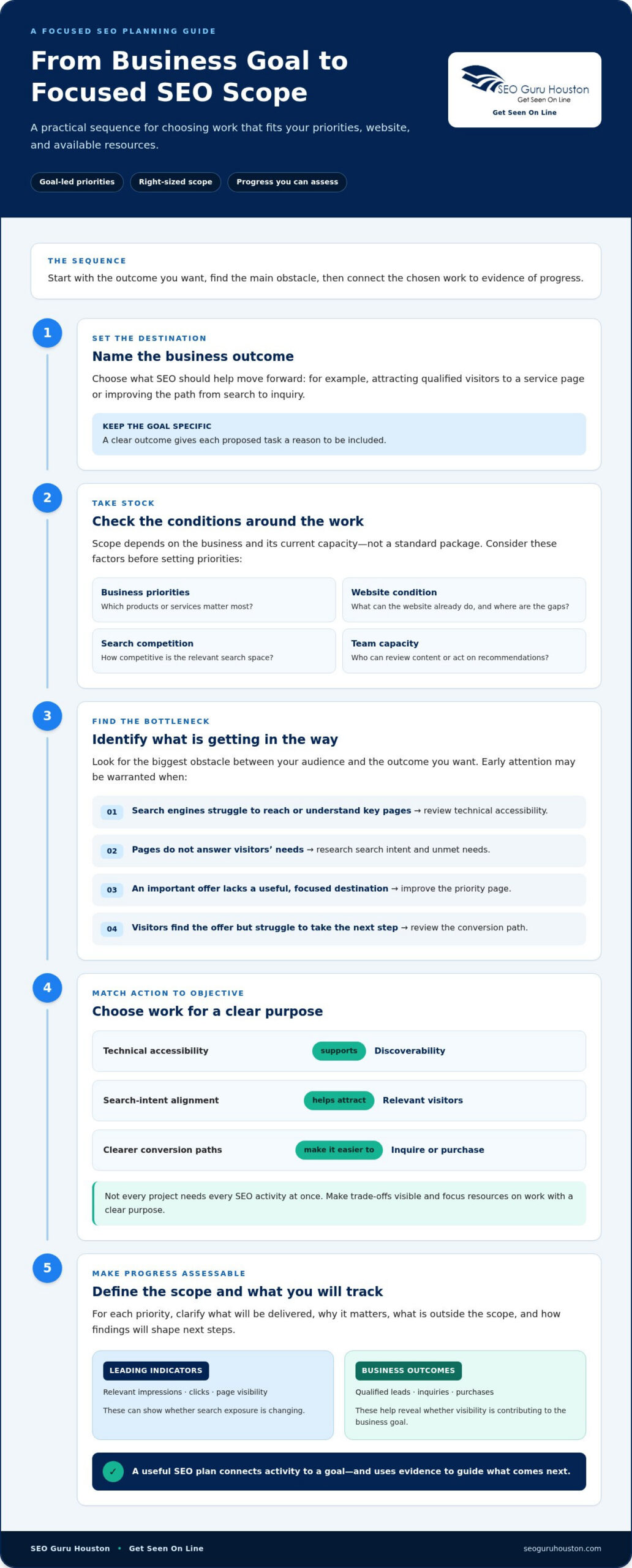
Affordability in SEO means a transparent, right-sized scope that connects available resources to measurable business priorities. Start with a clear outcome, such as attracting qualified visitors to a service page or improving the path from search to inquiry. Then identify the work most relevant to that outcome, specify what will be delivered, and define how progress will be assessed.
Search engine optimization (SEO) brings together activities that help improve a website’s visibility in search. A useful engagement turns that broad discipline into a focused plan. It isn’t a thin set of actions without a rationale, or an unexplained list of tasks that sounds comprehensive but isn’t tied to your business.
How Is Affordable SEO Different From Cheap SEO?
Affordable SEO prioritizes. Cheap SEO may simply remove the work needed to make informed decisions. A focused plan can concentrate on the most relevant pages and issues first while still grounding recommendations in research and tracking. Cutting those foundations makes it harder to evaluate the work because there’s no clear rationale or way to connect activity to progress.
Deliverable clarity matters more than a headline figure. You should understand what the work includes, why it matters, what falls outside the scope, and how findings will shape next steps. Imagine a company whose priority is generating more qualified inquiries for one service. A focused engagement might research search intent, improve that service page, and monitor relevant inquiry actions. A vague task list might promise assorted updates without explaining how they support the goal. The difference isn’t the number of tasks, but the reasoning behind them.
Who Can Benefit From a Focused SEO Engagement?
A focused engagement can suit a business that wants stronger organic visibility but needs to sequence marketing investments carefully. That might be a growing company with a defined service to promote, a business with limited capacity to create or update content, or a team strengthening its search foundation before expanding its efforts. The right starting point depends on the business, not a standard package.
Before setting scope, clarify the outcome and the resources available to support the work. Consider which products or services matter most, what the website can already do, and who can review content or act on recommendations. If your team can support only a narrow initiative, concentrating on a priority page may be more practical than spreading effort across the entire site. If capacity changes, priorities can change with it.
An affordable SEO company should make those trade-offs visible, not disguise them behind a low price or a long list of deliverables. A good-fit engagement gives your business a clear first move and a reasoned way to build from there.
What Shapes the Scope and Value of Affordable SEO Services?
SEO scope should reflect the business you’re trying to grow, not a standard checklist. A company seeking qualified inquiries for a specific service needs a different plan from an online retailer expanding product visibility. The website’s current condition, the competitiveness of its search space, and the time your team can contribute all affect what belongs in the plan and what should wait.
Think of the work in two layers. Foundational SEO addresses whether search engines can access and understand important pages, whether those pages match relevant search intent, and whether visitors can take a useful next step. Ongoing improvement may involve developing content for unmet needs, strengthening the site’s authority, and using performance data to refine priorities. A well-scoped engagement makes the transition between these layers clear. For a broader perspective on strategy, explore this guide to professional SEO services.
An affordable SEO company should explain why each priority fits your goals and what evidence will help assess its value. Not every project needs every SEO activity at once. The plan should make trade-offs visible so your resources go toward work with a clear purpose.
Which SEO Activities Deserve Early Attention?
Start with the website’s actual needs, not a generic checklist. Technical accessibility deserves attention if search engines struggle to reach or understand key pages. Search-intent research matters if visitors have needs your pages don’t answer. Improve priority pages when important services or products lack a useful, focused destination. Review conversion paths when people can find the offer but can’t easily take the next step.
Connect each activity to an objective: accessibility supports discoverability, intent alignment helps attract relevant visitors, and clearer conversion paths make it easier for those visitors to inquire or purchase. To decide what comes first, identify the biggest obstacle between your audience and the business outcome you want.
How Should SEO Performance Be Measured?
Use both leading indicators and business outcomes. Relevant impressions, clicks, and page visibility can show whether search exposure is changing. Qualified leads, inquiries, or purchases help reveal whether that visibility supports the business. Google Search Console can help you review search queries and page performance, while analytics data can show how visitors behave after landing on the site. Together, these sources provide context, not a promise of particular rankings or revenue.
SEO reporting should connect completed work to search visibility and meaningful business outcomes, so each review informs the next decision. A useful report explains what changed, what the data suggests, and what action follows instead of presenting metrics without interpretation.
- Goal: Name the business outcome the SEO work is meant to support.
- Baseline: Record relevant page, search, and conversion performance before changes.
- Review: Compare progress over time and adjust priorities as evidence or business needs change.
Connecting scope to measurement turns SEO from a collection of tasks into a growth strategy. If your priorities call for a broader view of search and digital growth, explore SEO strategy and marketing resources to see how related efforts can fit together.
Affordable SEO Company vs. Low-Cost Provider: How to Compare Value
A proposal’s total cost tells you what you’d pay, not what the work is designed to accomplish. Compare the reasoning behind the scope: which business priority it serves, how the work will be measured, and what happens as needs change. A focused engagement may fit a defined objective; a broader partnership may suit a business addressing several connected growth needs. Neither is automatically better because it costs less or covers more.
Use this comparison to look beyond labels. These are common patterns, not fixed rules. A bare-minimum scope can suit a narrow need when its limits are clear.
| What to compare | Focused engagement | Bare-minimum offer | Broader growth partnership |
|---|---|---|---|
| Scope clarity | Defines a specific objective, work areas, and boundaries. | May list limited tasks without explaining their purpose. | Connects SEO with related marketing or website work. |
| Prioritization | Concentrates effort on the most relevant opportunity. | May provide a fixed set of routine activities. | Can address several priorities, if they’re genuinely needed. |
| Measurement | Tracks indicators tied to the selected objective. | May report activity without explaining its significance. | Can connect performance across channels and conversion paths. |
| Communication | Explains progress, decisions, and next steps. | May offer limited context around completed tasks. | Coordinates updates across connected areas of work. |
| Flexibility | Can refocus as the priority evolves. | May have little room to adjust its preset scope. | Can shift emphasis among services as business needs change. |
What Should a Transparent SEO Proposal Explain?
A transparent proposal links four parts: the business objective, the work chosen to support it, the reporting used to review progress, and expectations for discussing what comes next. The connections matter. If a deliverable has no stated purpose, or a report tracks measures unrelated to the objective, it’s difficult to judge whether the work is useful. An affordable SEO company should make those connections understandable without promising a specific ranking or revenue result.
Look for explanations, not just labels. “Improve key pages” is hard to evaluate without knowing which pages, why they matter, and how progress will be reviewed. A clear scope makes assumptions and boundaries visible, helping you compare substance rather than headline price.
When Does a Broader Growth Partnership Make Sense?
SEO can bring relevant visitors to a website, but it can’t resolve every barrier to growth by itself. If a landing page makes it hard to take action, website improvements may support the path from visit to inquiry. If the business needs to reach demand sooner while organic visibility develops, PPC may complement SEO. A broader partnership makes sense when those needs are connected and your team can act on them.
More services aren’t automatically more valuable. The right combination depends on the goal, capacity, and gaps identified. For broader context on how SEO fits into digital marketing, read this SEO marketing company guide. If your priorities span search and website performance, SEO and digital growth strategy can provide a useful starting point.
How to Set an SEO Budget and Priorities That Fit Your Business
An SEO budget works best when it’s built around a business result, not a wish list of tasks. Start with what growth should look like, identify the current barriers, then assign resources to the work most likely to move the right measure. This grounds priorities in evidence and makes it easier to explain why some work comes first while other opportunities wait.
Use this sequence to turn a broad ambition into a workable plan:
- Define the business outcome. Choose a meaningful objective, such as attracting qualified inquiries for a particular service or increasing relevant organic visits to important product pages.
- Assess the baseline. Review current search visibility, website activity, conversion paths, and inquiry data. Use your own site’s performance as the reference point rather than assuming an industry benchmark applies.
- Prioritize the constraint. Identify what most limits progress. It might be a technical issue, an important page that doesn’t meet search intent, or a website experience that makes it hard to take action. Fund the work that addresses that obstacle first.
- Set measures. Pair an early indicator, such as relevant organic visits, with a business outcome, such as qualified inquiries. Define what counts and where the data comes from before work begins.
- Review and adjust. Compare results with the baseline, discuss what the evidence suggests, and revisit the plan when capacity, business goals, or customer needs change.
This sequence gives an affordable SEO company a practical framework for prioritizing effort without treating every possible task as equally urgent.
How Can You Set Useful SEO Objectives?
Make broad goals observable. “Grow online” is difficult to act on. “Increase relevant organic visits to the service page and track how many become qualified inquiries” gives the team a direction and a way to learn. Record the starting point and keep definitions consistent across review periods. If the meaning of a qualified inquiry changes, note that change so performance comparisons remain useful.
Don’t judge the plan on traffic volume alone. More visits may not matter if those visitors aren’t looking for what the business offers or don’t take a meaningful next step. Match each measure to the customer journey and the outcome the business values.
How Should You Balance SEO With Other Growth Channels?
SEO can build organic visibility over time, while paid search may support demand that needs attention sooner. Website and landing page improvements can help visitors understand an offer and act on it. The right mix depends on your objective, available resources, and how customers move from discovery to decision. Not every business needs every channel at once.
If search attracts the right audience but the page makes conversion difficult, focused landing page design may address a more urgent constraint than expanding traffic efforts. Reassess the mix as evidence and priorities evolve.
Build your next steps around a clear goal, an honest baseline, and measures that connect marketing activity to business progress. Explore SEO growth services to consider how a data-driven search strategy can support your priorities.
How an Integrated SEO Partner Turns Affordability Into Growth
SEO creates more value when it supports a clear business objective instead of operating as a disconnected list of tasks. Search visibility matters, but so does what visitors find when they arrive and whether the site helps them take a meaningful next step. Connecting those pieces helps direct effort toward the full path from discovery to inquiry.
An integrated approach can draw on SEO, PPC, B2B marketing, inbound marketing, and website development and landing page design. That doesn’t mean every business needs every capability. A company focused on organic discovery may prioritize SEO; one seeking paid-search visibility may add PPC. If relevant visitors reach a page that doesn’t explain the offer or guide action, web improvements may be the more immediate priority. The right combination follows the goal.
For an affordable SEO company, integration is about coordination, not piling services onto a plan. Search strategy can inform which pages deserve attention, landing page work can support the visitor’s next step, and lead-generation priorities can shape which outcomes to track. Each activity should have a role in the business objective.
When Can SEO, PPC, and Web Development Work Together?
Organic search and paid search can serve different needs. SEO supports a longer-term effort to build visibility for relevant searches, while PPC can support paid-search objectives. Their roles may complement each other, but they aren’t interchangeable and shouldn’t be assumed to deliver the same outcomes.
Website development and landing page design connect those traffic sources to the customer journey. For example, a business seeking qualified inquiries might align search content and paid-search messaging with a page that clearly presents the relevant service and next step. A company focused on a different audience or offer may need a different page or channel mix. The best sequence depends on the goal, site condition, and available resources. There’s no universal timeline or guaranteed result. Evaluate progress against the measures selected for the project.
What Should a Practical First Conversation Establish?
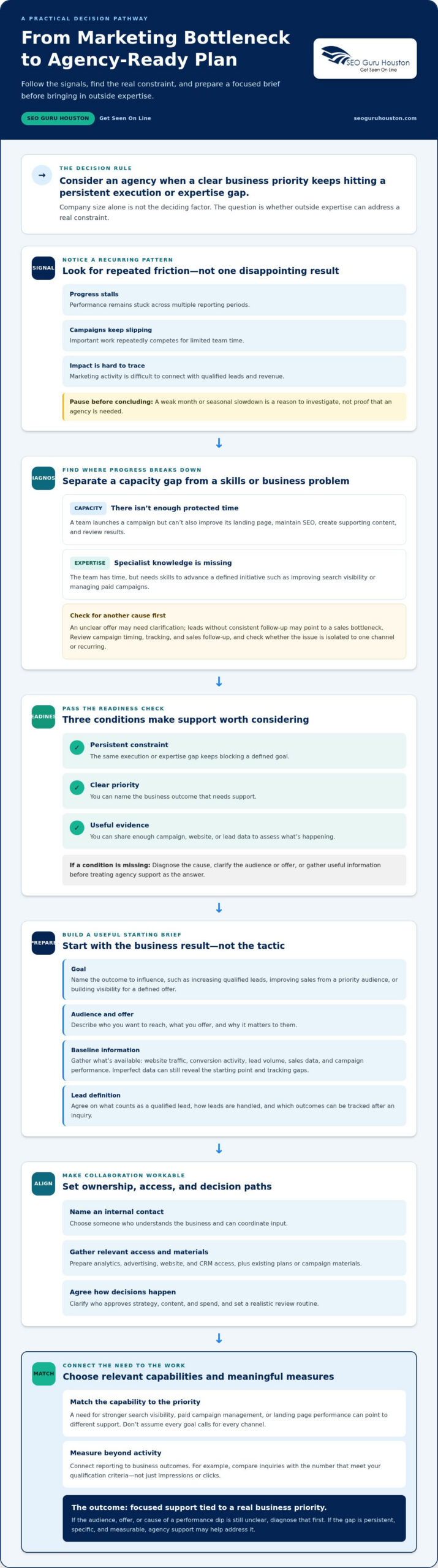
Start with the business need. What outcome matters most? Which audience are you trying to reach, what challenges currently interrupt their path to action, and what marketing resources can your team contribute? Answers help distinguish a search visibility challenge from a conversion issue or a need to coordinate demand generation across channels.
A useful discussion connects those answers to possible priorities and services. If the main obstacle is organic discoverability, SEO may lead. If the page experience is holding back inquiries, web work may deserve attention. If paid visibility is part of the objective, PPC may have a role. This keeps the plan focused instead of treating service breadth as a reason to use everything.
Bring your goals and current challenges into focus, then turn them into a practical growth direction. Discuss your SEO growth goals and take the next step with purpose.
Turn Your Next SEO Decision Into Forward Momentum
Your SEO plan doesn’t need to solve every growth challenge at once. It needs to give your team a clear next move, a way to assess whether that move is useful, and room to adapt as the business evolves. Treat each review as a decision point: keep investing in work that supports your objectives, refine what isn’t connecting, and shift focus when your priorities or capacity change.
That’s how an affordable SEO company engagement can become a practical growth tool rather than a fixed list of deliverables. Start with the business question that matters most, then build a focused plan around the answer. Progress comes from deliberate decisions and learning from the evidence, not from trying to do everything at once.
Ready to turn your priorities into a clear direction? Map out your next SEO priorities and take the next step with confidence. Your growth strategy can start focused and become stronger as your business moves forward.
Frequently Asked Questions
Can an affordable SEO company guarantee first-page rankings?
No. An affordable SEO company can research opportunities, improve relevant pages, and monitor search performance, but it can’t control search engine results or promise a specific position. Rankings shift with competition, search changes, and other factors beyond any agency’s control. Look for clear explanations of planned work and progress measures instead. For example, track whether priority pages gain relevant impressions and attract visitors who match your intended audience.
How long does it take to see results from SEO?
There’s no reliable universal timeline because progress depends on the site’s starting condition, competition, scope, and how quickly recommendations are implemented. Some changes, such as correcting a page access issue, may be observable before broader business outcomes become clear. Treat early movement as a signal to investigate, not proof of success. Compare performance with a baseline over consistent periods, and assess whether visibility is developing into relevant visits and meaningful actions.
What should an SEO report include?
A useful report should show work completed, pages or search themes affected, relevant performance changes, and recommended next actions. It should define the reporting period and clarify how key metrics are calculated. For example, a report might distinguish visitors to a priority service page from all organic visits, then show whether those visitors completed a tracked inquiry action. Context matters: numbers without interpretation don’t explain what to do next.
Can an SEO strategy change as my business goals change?
Yes. SEO priorities should respond when your business shifts focus, changes its offerings, or discovers that a different audience or page deserves attention. A company moving toward a new service line, for example, may need to reassess which pages and search topics receive effort. Keep previous goals and reporting definitions documented, then note why the plan changed. That preserves useful comparisons while making room for new priorities.
Does affordable SEO include content creation?
It can, but content creation should be explicitly defined in the engagement rather than assumed. Clarify whether the work involves content research, outlines, drafting, updating existing pages, or reviewing material your team provides. The right choice depends on the goal and your internal capacity. If a page already answers customer questions well, improving its clarity may be more useful than adding another article. Focus content investment on a real audience need.
Is SEO or PPC better when a business needs leads quickly?
PPC can support paid-search visibility for a near-term campaign, while SEO builds organic visibility through ongoing work and may take longer to influence business outcomes. Neither channel guarantees leads. Before directing more traffic to a site, check that the offer is clear, the landing page matches the ad or search intent, and inquiry tracking works. The best choice depends on urgency, budget capacity, customer journey, and whether the business can respond to demand.