
Tag Archives: marketing agency

When to Hire a Digital Marketing Agency: A 2026 Decision Guide

What if your next growth move isn’t adding another marketing channel, but getting the right expertise behind the ones you already use? If you’re asking when to hire a digital marketing agency, look at the gap between your goals and your team’s capacity to execute and measure. Campaigns that keep slipping, disconnected channel activity, and unclear links between marketing and qualified leads are signals worth investigating.

You don’t need to outsource every marketing decision to make progress. But when your team lacks the time or specialist skills to build a consistent strategy, outside support can turn scattered effort into focused work tied to business outcomes. The key is to set priorities, share useful information, and agree on how success will be measured.

This 2026 decision guide will help you recognize when agency support is timely, what to prepare before engaging a team, and how to make the investment accountable. You’ll learn how to assess readiness, match needs such as search visibility, paid campaigns, and landing page performance to relevant services, and set goals and measurement expectations before work begins.

Key Takeaways

  • Recognize when stalled progress, inconsistent execution, skill gaps, or limited capacity make outside expertise a strategic next step.
  • Before choosing channels or tactics, clarify your business goals, audience, offer, available data, and decision-makers.
  • Connect needs such as stronger search visibility or more qualified leads to relevant capabilities and meaningful measures of success.
  • Set a focused scope and document responsibilities, communication, decision rights, and reporting expectations before work begins.
  • Use a readiness checklist to decide when to hire a digital marketing agency, when to prepare first, or when your current team can keep moving forward.

When should you hire a digital marketing agency? Recognize the signals

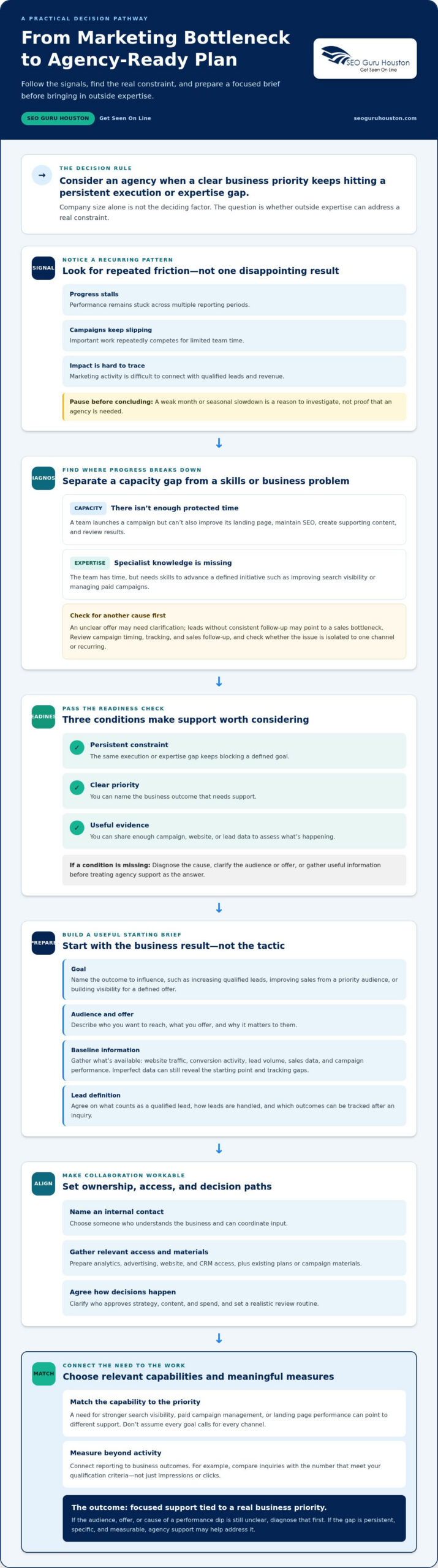
Hiring an agency is a strategic decision, not an automatic milestone as your business grows. The right time is when a clear business priority keeps running into a persistent execution or expertise gap. A small team may be ready if it has a defined growth goal and needs specialist support. A larger company may not need an agency if its in-house team has the time and skills to deliver.

Look for a pattern rather than reacting to one disappointing result. Progress may stall across multiple reporting periods, important campaigns may repeatedly slip, or marketing activity may be difficult to connect to qualified leads and revenue. A temporary campaign dip or seasonal slowdown calls for diagnosis first. Check whether the change is limited to one channel or points to a recurring issue. Review campaign timing, tracking, and sales follow-up before deciding that outside help is the answer.

Which marketing problems signal a capacity or expertise gap?

A capacity gap appears when essential work repeatedly competes for the same limited hours. Your team might launch a campaign but lack time to improve its landing page, maintain SEO, create supporting content, and review results. A skills gap is different: the team has time, but not the specialist knowledge to advance a defined initiative, such as improving search visibility or managing paid campaigns. Because Digital marketing spans multiple channels and methods, identify the capability you need instead of assuming you need help with everything.

Separate execution problems from strategy or sales problems, too. If customers don’t understand the offer, more promotion may amplify the confusion. If leads arrive but aren’t followed up consistently, the bottleneck may be in sales rather than marketing. Pinpoint where progress breaks down before assigning the problem to an agency.

When is an agency premature or unnecessary?

Promotion works best when you can explain who the offer serves, what value it provides, and what action you want customers to take. If those fundamentals are unsettled, clarify them before scaling campaigns. Likewise, don’t treat one weak month as proof that you need an outside team. Review the underlying data, compare performance over an appropriate period, and look for a recurring constraint.

Focused internal execution may be the right choice when your team has the relevant skills, protected time, and a way to measure progress. Use this quick readiness check:

  • Persistent constraint: The same execution or expertise gap keeps blocking a defined goal.
  • Clear priority: You can name the business outcome that needs support.
  • Useful evidence: You can share enough campaign, website, or lead data to assess what’s happening.

If those conditions are present, agency support may help close a specific gap. If the audience, offer, or cause of a performance dip is still unclear, diagnose that first. The deciding factor isn’t company size. It’s whether outside expertise can address a real constraint tied to a business priority.

What should your business have in place before hiring an agency?

You don’t need a flawless marketing operation before bringing in outside expertise. You do need enough clarity to collaborate: what the business is trying to achieve, who it serves, what it offers, what information is available, and who can make decisions. This preparation keeps the work anchored to business outcomes rather than defaulting to channel activity.

Start with the result, not the tactic. “Grow the business” is an ambition; increasing qualified leads, improving sales from a priority audience, or building visibility for a defined offer gives the work a clearer direction. Once the outcome is clear, assess whether SEO, PPC, a landing page, or another approach fits the need. That sequence helps you evaluate when to hire a digital marketing agency without assuming every goal calls for every channel.

Set goals and establish a usable baseline

Write down the priority, the audience you want to reach, and the offer you want them to consider. Then gather the baseline information you already have: website traffic, conversion activity, lead volume, sales data, and campaign performance. The data doesn’t need to be perfect. It should help your team and agency understand the starting point and identify gaps in tracking.

Connect marketing measures to the sales process. Clarify what counts as a qualified lead, how leads are handled, and which outcomes the business can track after an inquiry. For example, compare the number of inquiries with the number that meet your qualification criteria. That context makes reporting more useful than a list of impressions or clicks alone.

Prepare the people, access, and decision process

Name an internal contact who understands the business and can coordinate input. Gather access to relevant analytics, advertising, website, and CRM accounts, along with existing plans or campaign materials. Decide who approves strategy, content, and spend, and agree on a realistic routine for reviews. Clear ownership prevents important decisions from stalling between teams.

Use this short preparation sequence before an agency conversation:

  • Goal: State the business outcome you want to influence.
  • Audience and offer: Describe who you serve and why the offer matters to them.
  • Data: Collect available performance and sales information, noting any gaps.
  • People: Identify the day-to-day contact and decision-makers.
  • Process: Clarify access, approval responsibilities, and review expectations.

Readiness means being prepared to share context, make timely decisions, and learn from evidence, not having every metric or process optimized in advance. If your priorities involve visibility, qualified traffic, or lead generation, reviewing SEO and PPC marketing support can help you identify capabilities that fit those goals.

How do you know agency support can deliver value, not just activity?

Agency support creates value when it closes a specific capability or capacity gap and ties the work to a business priority. Compare the options realistically: an internal team may know the product and customers deeply, while an agency can add specialist expertise or execution capacity. Either model still needs coordination, timely decisions, and clear accountability. The question of when to hire a digital marketing agency comes down to whether the added support can advance an outcome your team has defined, not simply produce more tasks.

Separate deliverables from results. Publishing content, launching ads, or building a landing page are deliverables. Qualified opportunities, sales, and stronger visibility for relevant searches are outcomes. Deliverables can be tracked directly; outcomes depend on factors such as the offer, execution, competition, customer behavior, and measurement quality. No channel or agency can guarantee a particular business result.

Which capabilities may be worth bringing in?

Business need Relevant capability Useful measures
Improve visibility for relevant searches SEO Organic impressions, relevant traffic, qualified inquiries
Reach people actively searching for an offer PPC Campaign traffic, conversion activity, cost per qualified lead
Turn campaign visits into inquiries Landing pages or website development Conversion rate, form submissions, qualified leads

What should meaningful reporting help you understand?

Good reporting explains what changed, what it may mean, and what action comes next. Google Analytics can help assess website visits and on-site behavior. Google Search Console can show search visibility and activity from organic results. CRM data can help connect inquiries to lead quality and sales progress. These sources answer different questions, so they’re most useful when interpreted together.

Separate leading indicators, such as impressions, clicks, and page conversions, from downstream outcomes like qualified opportunities and closed sales. Revenue attribution may be incomplete when customer journeys span channels or data is missing, so make limitations visible rather than overstating certainty. In regular reviews, expect a clear account of work completed, performance against agreed measures, decisions made, and next steps. That’s how you judge progress, not by the length of an activity report.
When to Hire a Digital Marketing Agency: A 2026 Decision Guide

How should you define scope, goals, and accountability before hiring?

A strong agency engagement starts with clear boundaries: which business priority needs attention, what work falls within scope, and how both sides will judge progress. Resist the urge to buy every channel at once. A focused first engagement makes it easier to coordinate work, interpret results, and decide what deserves investment next.

How do you choose a realistic first scope?

Start with the constraint you’ve diagnosed. If relevant searchers aren’t finding your business, SEO may fit the priority. If you need to capture existing demand through paid campaigns, PPC may be appropriate. If visitors arrive but struggle to take the next step, website development or a landing page could address the friction. Demand generation may fit when the challenge is creating and developing interest among potential buyers, while lifecycle and retention goals often call for dedicated email and CRM specialists like Vertical Brands.

Factor in your sales cycle, internal support, and ability to measure progress. A longer sales cycle may require tracking early engagement and lead quality before closed sales provide a useful signal. A campaign also needs internal owners who can supply business context, respond to inquiries, and make timely decisions. Connected services can make sense when one isolated tactic can’t address the full path from discovery to conversion. Keep the scope focused on the business problem, not a checklist of channels.

Which expectations should be agreed before work begins?

Put the working agreement in writing so the team and agency share the same definition of progress. Include the objective, baseline measures, deliverables, responsibilities, approval rights, communication cadence, and review intervals. Clarify who provides source materials, approves content, manages access, and decides whether to adjust campaign direction or spend.

Set a review framework that considers business outcomes alongside context. A change in traffic or lead volume matters, but so do lead quality, seasonality, sales follow-up, and changes to the offer. Agree on how results and limitations will be explained, what decisions each review should inform, and how strategic changes will be communicated. This creates accountability without treating a single metric as the whole story.

  • Objective: Name the business priority and the audience it serves.
  • Scope: Specify the work included and what falls outside the engagement.
  • Ownership: Assign agency and internal responsibilities, including approvals.
  • Measurement: Record the starting point, success indicators, and reporting rhythm.

Be wary of promises of guaranteed rankings, leads, or revenue. A clear scope can make work and decisions accountable, but outcomes depend on execution, market conditions, the offer, and reliable measurement. SEO Guru Houston provides SEO, PPC, web development, and demand generation services. Explore digital marketing services to see how these capabilities can support a focused plan.

When is it time to move forward with a digital marketing agency?

Move forward when four conditions align: your business has a clear goal, a persistent capability gap is holding back progress, relevant data can be shared, and leadership agrees on the priority. That combination gives an agency something concrete to work toward and your team a basis for evaluating the work. Company size alone doesn’t determine readiness.

Still unsure when to hire a digital marketing agency? Use this decision check:

  • Act now: You can name the business challenge, identify the expertise or capacity you’re missing, provide useful context or data, and get decisions from aligned leaders.
  • Prepare first: Your audience, offer, goal, or measurement is unclear. Resolve those questions before expanding activity.
  • Continue with current resources: Your team has the skills and protected time to address the priority, and current execution is consistent enough to assess.

Begin with the challenge, not a predetermined channel or package. A visibility problem may point toward SEO; a need to capture existing demand may call for PPC; a conversion bottleneck may involve the website or landing page. If the gap concerns reaching and developing potential business customers, B2B or inbound marketing may be relevant. The right scope follows the diagnosis.

What does a productive agency relationship require?

Strong collaboration depends on shared context: who your customers are, how your offer is positioned, how sales handles inquiries, and which business priorities matter most. The agency brings marketing expertise and execution capacity, while your team provides decisions and knowledge of the business. Progress is a cycle of strategy, implementation, measurement, and informed adjustment, not a handoff that replaces internal judgment.

What is the next step if your business is ready?

Prepare a concise brief before discussing scope. Include your goal, audience, offer, current marketing efforts, known constraints, available data, and the decisions or support your team can provide. Note whether the priority is search visibility, paid demand capture, B2B lead generation, inbound growth, or a website conversion challenge. This keeps the conversation focused on the business need and the capabilities that may address it.

With that brief in hand, you can discuss a tailored scope with SEO Guru Houston and define what progress should look like before work begins. Build a focused digital growth plan around a real business priority, clear responsibilities, and measures your team can use to make decisions.

Turn Your Marketing Priorities Into a Focused Plan

The decision about when to hire a digital marketing agency comes down to more than a growth target. Look for a clear business priority, a persistent gap your team can’t readily close, and the people, data, and decision-making support needed to act. Then define a focused scope and agree on how progress will be reviewed.

Agency support should connect expertise to business needs, not just increase the volume of marketing activity. SEO and PPC can support search visibility and qualified traffic, while B2B and inbound marketing, website development, landing pages, and demand generation can address other growth priorities. The right starting point depends on your goals, audience, and current constraints.

Ready to turn your next priority into a practical, accountable plan? Build a focused digital growth plan with SEO Guru Houston. Start with the challenge you need to solve, then move forward with clear responsibilities and measures.

Frequently Asked Questions

When should a small business hire a digital marketing agency?

A small business should consider agency support when it has a defined growth goal but lacks the time, specialist skills, or consistent execution to pursue it. First clarify your target audience, offer, and desired outcome. Then identify the specific gap external expertise would address, such as improving search visibility or managing paid campaigns. For example, specialists such as Big Voice – Digital Marketing Agency help growing SMEs focus on commercial outcomes rather than vanity metrics. Company size matters less than readiness and a clear business need when deciding when to hire a digital marketing agency.

How do I know if my business is ready to hire a marketing agency?

Your business is ready when you can explain its priority, target audience, and desired outcome, even if the strategy is still developing. Assign an internal decision-maker, make relevant website, campaign, or CRM data accessible, and confirm who follows up with leads. You don’t need perfect reporting. You do need enough context and internal coordination to collaborate, review progress, and make timely decisions as the work develops.

Can a digital marketing agency help if my business has no marketing strategy?

Yes, an agency can help shape a strategy, but your business should contribute knowledge of its customers, offer, competitive context, and commercial goals. If those fundamentals are unclear, make clarifying them part of the strategic work. Agree on a business priority and how progress will be assessed before launching campaigns. This helps prevent disconnected tactics and keeps expectations realistic while the strategy takes shape and is put into practice.

What should I expect when hiring a digital marketing agency?

Expect an initial alignment on business goals, audience, current marketing activity, responsibilities, and measurement. The agreed scope may include SEO, PPC, website development, landing pages, or demand generation, depending on the need. Set communication and review expectations early, including who approves work and how decisions are shared. Evaluate progress through clear reporting and business context, not activity counts alone. Results depend on execution, market conditions, and measurement.

Is it better to hire an agency or build an in-house marketing team?

The right choice depends on the expertise, time, and management capacity your business needs. An in-house team may offer close day-to-day knowledge of customers and operations, while an agency can add external specialist capabilities and execution support. Some businesses combine both. Compare the skills required, how consistently the work is getting done, and whether results can be measured. Choose the approach that best supports your priorities and available resources.

How much does it cost to hire a digital marketing agency?

Agency fees vary based on the work’s scope, services, complexity, and level of support, so there isn’t one useful figure for every business. Define the business outcome and work required before comparing proposals. Review responsibilities, deliverables, reporting, and measurement alongside the fee. A low price or a long list of promised activities doesn’t establish value on its own. Focus on whether the proposed scope addresses a clear business need.

What happens if I hire a digital marketing agency before my business is ready?

An unclear offer, misaligned goals, missing account access, or limited internal follow-through can slow work and make progress harder to assess. You don’t need a perfect foundation before engaging an agency, though. Identify the biggest readiness gap and decide whether it can be addressed within a defined scope. Agree on responsibilities, access, and how progress will be reviewed. Clear expectations help both sides address constraints rather than mistake them for campaign results.
In-House Marketing vs. Agency: Pros, Cons, and How to Choose

Weighing the in-house marketing vs agency pros and cons starts with a practical question: which capabilities should your business own, and where would specialist support make a bigger difference? The answer affects your control, execution capacity, and ability to connect marketing activity to measurable business goals.

Keeping marketing close to the business can help your team understand customers and respond to changing priorities. But a small team may struggle to cover every channel, while agency support without clear ownership can create extra coordination instead of better execution. The right model should fit your goals, workload, and internal expertise.

This guide compares in-house, agency, and hybrid marketing. You’ll learn how to evaluate control, specialist skills, capacity, and accountability, with practical examples involving SEO, PPC, and landing pages. You’ll also find a framework for assigning responsibilities and setting expectations for the work.

Key Takeaways

  • Compare the in-house marketing vs agency pros and cons across control, expertise, capacity, continuity, coordination, and accountability.
  • Assess actual team capacity, including hiring, onboarding, current workloads, and the time needed to manage marketing.
  • Start with business outcomes, then identify which skills and recurring tasks your team can realistically own.
  • Keep strategy ownership and business context internal while using specialist support where execution needs exceed your team’s capabilities.
  • Consider a hybrid model that combines internal priorities and approvals with external expertise in areas such as SEO, PPC, and landing pages.

In-House Marketing vs. Agency: What Each Model Actually Means

Every marketing model needs a clear strategy, skilled execution, and a way to measure progress. The in-house marketing vs agency pros and cons comparison is about how that work gets done, not whether marketing deserves investment.

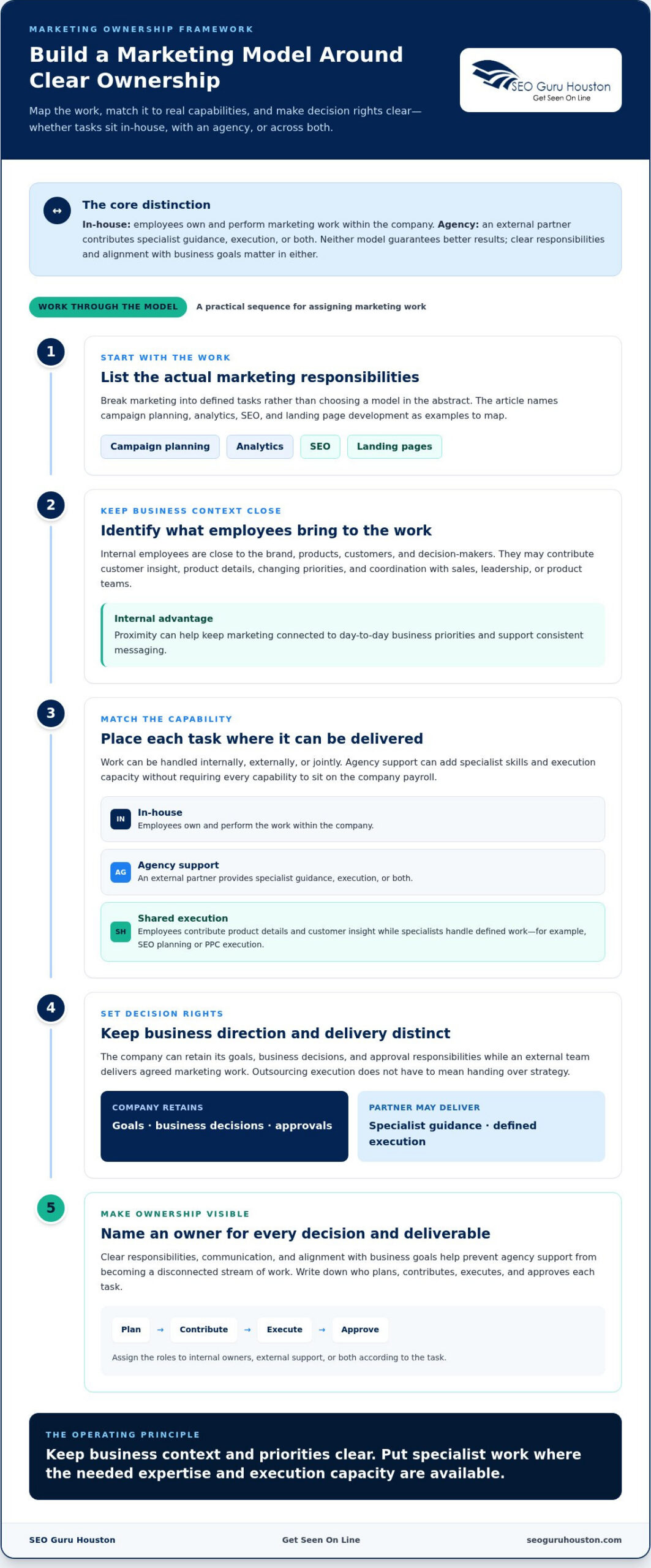
In-house marketing means employees own and perform marketing work within the company; agency marketing means an external partner contributes specialist guidance, execution, or both. An advertising agency is an outside organization that supports clients’ advertising and marketing efforts. Agency engagements can focus on one discipline or cover a wider range of work. Neither model guarantees better results. Clear responsibilities, communication, and alignment with business goals matter in either case.

What does an in-house marketing team typically handle?

Employees are close to the company’s brand, products, customers, and internal decision-makers. They may plan content, coordinate campaigns, monitor analytics, and work with sales, leadership, or product teams. That proximity can help keep marketing connected to day-to-day business priorities.

The team’s scope depends on its headcount, skills, and goals. A small team may focus on a few core activities, while a larger department may divide work across channels and specialisms. Internal knowledge is valuable, but it does not guarantee enough time or expertise to execute every task well.

What does an agency contribute to a marketing operation?

An agency can add specialist skills and execution capacity without requiring every capability to sit on the company payroll. Depending on the engagement, it may guide strategy, carry out defined work, or collaborate with employees—such as bringing in Branding TITANS™ to develop an overarching identity and mission. SEO, PPC, web development, and landing pages can be handled internally, externally, or jointly.

For example, employees can provide product details and customer insight while an external specialist handles SEO planning or PPC execution. The agency contributes expertise and delivery capacity; the company retains its business decisions, goals, and approval responsibilities. Clear ownership helps avoid the misconception that outsourcing execution means handing over strategy.

The practical distinction is where capabilities sit and who is accountable for each decision or deliverable. Map specific work, such as campaign planning, analytics, SEO, and landing page development, to internal owners and external support. This makes the in-house marketing vs agency pros and cons easier to assess and shows where specialist help could extend your team’s capacity.

In-House Marketing Pros and Cons: Control, Context, and Team Capacity

An internal team can move quickly because its members are close to the people, products, and decisions that shape marketing. But company knowledge and control do not guarantee effective campaigns. The practical question is whether employees have the time and skills to turn that context into consistent execution.

Where in-house marketing has an advantage

Employees work alongside product, sales, and leadership teams. They can hear customer feedback directly, understand changes in business priorities, and bring that insight into campaign planning. Their proximity can also support consistent messaging and simplify approvals, since they do not need an outside partner to learn the business from scratch.

That control is most valuable when the team has clear processes, enough capacity, and the expertise to deliver. An internal marketer may respond quickly to a product update, for example, but responsiveness is not the same as deep expertise in every channel. A team can know the brand well and still need specialist support for complex SEO work. A guide to professional SEO services can help clarify what that work involves.

Where an internal team can run into limits

One or two generalists may be responsible for content, campaign coordination, analytics, paid media, and search optimization. That breadth can leave little time for focused testing or ongoing improvement. Recruiting and developing specialist skills takes time, and onboarding, management, and employee retention all affect delivery. If a key employee leaves or priorities change, work may slow while responsibilities are reassigned.

The result can be a gap between planned marketing and what the team can reliably execute. Campaigns may launch late, optimization may be postponed, and activity across channels may become inconsistent. These problems are not inevitable with an in-house team. They are signs that workload and available expertise need closer attention.

Separate internal responsiveness from specialist depth when weighing the in-house marketing vs agency pros and cons. If your team understands the brand but has limited SEO capacity, external expertise can complement its work rather than replace its business insight. Harvard Business School Working Knowledge explores the strategic considerations involved in deciding whether to bring advertising expertise in-house.

Map recurring marketing tasks against the skills and time your team can consistently provide. If SEO execution is a bottleneck, specialist SEO support can extend capacity while internal stakeholders retain brand context and priorities.

Agency Marketing Pros and Cons: Specialist Skills Without Losing Accountability

An agency can add expertise and execution capacity, but outsourcing work does not mean surrendering business direction. Your company can retain ownership of goals, priorities, budgets, and approvals while an external team delivers agreed marketing work. Clear decision rights distinguish useful support from a disconnected stream of tasks.

Agency advantages: expertise, capacity, and execution

Specialists can bring focused experience in disciplines such as SEO, PPC, and web development. Their support can be useful when a launch, growth initiative, or uneven workload calls for skills your internal team does not use every day. For example, bringing in an agency partner like Insight Multimedia for web development or campaign execution provides specialized delivery capacity, while company stakeholders provide product knowledge and approve business priorities.

Agency value depends on measurable outcomes, not activity volume. A report full of tasks or clicks is not enough on its own. Agree on the business objective, relevant performance indicators, reporting cadence, and how results will guide next steps. Outcomes depend on the work, context, and constraints, so set expectations around what the engagement can influence and how progress will be assessed.

Agency drawbacks: coordination, context, and oversight

External specialists need timely information and access to the right decision-makers. If a brief leaves the target audience unclear, approvals stall, or the agency cannot get answers about a product change, execution may drift from business needs. Coordination also takes internal time. Assign someone to consolidate feedback, resolve competing priorities, and connect agency work to sales and leadership goals.

Give channel-specific work explicit owners. A PPC management plan, for instance, should clarify what the agency handles, what the company approves, and which indicators will be reported. Define how campaign changes, budget decisions, and performance reviews will be managed before activity begins.

Compare the trade-offs

Area Potential agency advantage What to manage
Expertise Focused skills across specialist channels Set priorities and define the work’s purpose
Control Execution support while internal leaders retain decisions Document approvals and decision rights
Capacity Additional delivery support for defined needs Align workload and scope with available resources
Continuity External support can sustain assigned work Keep records, access, and knowledge organized
Coordination Specialists can collaborate with internal teams Provide timely context and a clear point of contact
Accountability Regular reporting can make progress visible Connect metrics to goals and agreed actions

Evaluate how the partnership will work, not just which tasks it covers. A written scope, named owners, shared reporting, and scheduled reviews help preserve strategy ownership while making external execution accountable.

In-House Marketing vs. Agency: Pros, Cons, and How to Choose

How to Choose In-House Marketing vs. an Agency for Your Situation

Choose the operating model that closes the gap between your business goals and your team’s ability to execute. Start with the outcome you need, then decide who should own the strategy, deliver the work, and measure progress. This keeps the in-house marketing vs agency pros and cons grounded in capability rather than channel preference.

  1. Define the business outcome. Specify the change marketing needs to support, such as attracting more qualified traffic, improving lead quality, or contributing to pipeline growth. If coordinated pipeline goals are central, use B2B demand generation planning to connect marketing activity with sales priorities.
  2. Assess internal capacity honestly. List your team’s relevant skills, current workload, and available management time. Consider whether employees can sustain the work alongside existing responsibilities and whether they have the expertise for tasks that require specialist execution.
  3. Sort work by ownership and need. Separate strategic decisions, such as audience and priorities, from specialist execution and routine coordination. Rank tasks by business impact, urgency, complexity, and available internal skills. Identify whether each need is ongoing, project-based, or tied to a defined growth push.
  4. Assign clear accountability. For every priority task, name the person responsible for delivery, the decision-maker, the measure of progress, and how often results will be reviewed. Shared work still needs one clear owner for decisions and follow-through.
  5. Set expectations and review the model. Establish a baseline and choose KPIs that connect to the objective, such as qualified traffic, leads, conversion rates, or pipeline contribution. Name the reporting owner, set a review period, and agree how to adjust direction when the evidence calls for it.

Compare the full resource commitment

A fair comparison includes more than the person doing the work. Account for internal hiring and training, specialist skill gaps, employee workload, and the time required to brief and manage an external partner. Neither model guarantees savings. The right choice depends on the capabilities you need, how consistently you need them, and the internal effort required to support delivery.

For example, your team may own customer insight and pipeline priorities but lack the time or expertise to coordinate specialist execution. External support can fill that gap. If work is closely tied to daily internal decisions and your team has the skills and capacity, keeping execution in-house may fit better.

Use this process to create a practical ownership plan, then explore B2B demand generation support for coordinated marketing work tied to pipeline goals.

Build a Hybrid Marketing Model That Can Scale With Your Business

A hybrid model keeps business knowledge and strategic control close to your team while adding specialist execution where internal capacity or expertise is limited. Employees set priorities, provide product and customer insight, approve key decisions, and connect marketing activity to revenue goals. Agency specialists handle clearly defined work, such as SEO, PPC, or landing page execution, and report against agreed measures.

The model works when responsibilities are explicit. Treat the agency as an extension of your marketing operation, not a substitute for internal leadership. One internal point of contact should coordinate priorities, provide timely decisions, and keep both sides aligned.

Divide responsibilities clearly between employees and agency specialists

Use a responsibility matrix to name an owner for each part of the work. Adapt this starting point to your team and engagement:

  • Strategy and priorities: Internal leadership owns business goals; agency specialists contribute channel recommendations.
  • Execution: The agency delivers agreed specialist tasks; employees provide the context and inputs needed.
  • Approvals: Internal stakeholders make final decisions on brand, product, and business commitments.
  • Analytics: The agency manages or supports channel measurement; the internal owner connects findings to business context.
  • Reporting: The agency reports agreed metrics and actions; the internal point of contact leads review and follow-up.

Agree on what counts as a qualified lead, conversion, and successful campaign before reporting begins. Clarify how attribution will be interpreted, which data sources matter, and how often performance will be reviewed. Shared definitions reduce confusion and help the team decide what to adjust, continue, or stop.

Know when to expand, outsource, or rebalance

Consider hiring internally when work requires sustained ownership, close daily coordination, and ongoing decisions tied to company operations. Agency support can fit when specialist skills or flexible execution capacity are the immediate constraint. The right balance can change as goals, channel mix, workload, and internal capabilities evolve. Revisit responsibilities and measures rather than letting an old setup run by default.

The in-house marketing vs agency pros and cons discussion is most useful when it leads to a working plan: who owns each decision, what gets delivered, how success is measured, and when the team will reassess. That structure helps a business retain control without limiting execution to the skills already on staff.

For an approach that connects specialist marketing work to business priorities, explore our marketing services.

Make Your Marketing Model Work for Your Next Stage of Growth

The right choice is not automatically all in-house or all agency. Use the in-house marketing vs agency pros and cons to decide which work needs close company ownership and where specialist support can extend capacity. Keep business priorities, product insight, approvals, and revenue context clear, then connect each responsibility to measurable outcomes and regular reviews.

A hybrid approach can combine internal knowledge with focused execution. SEO, PPC, B2B marketing, and inbound marketing can work alongside web development and landing page design, with responsibilities shaped around your goals and team capabilities.

Turn your priorities into a practical plan with marketing support built around your growth goals. Define the work, ownership, and measures that matter, then review progress and adjust as your needs change.

Frequently Asked Questions

Is in-house marketing better than hiring an agency?

Neither model is universally better. The right fit depends on your goals, internal capabilities, workload, and need for specialist skills. An in-house team has close access to company knowledge and day-to-day decisions. An agency can add expertise and execution capacity for specific channels or projects. Compare who can own the strategy, complete the work consistently, and report against meaningful business outcomes. A hybrid model can combine internal direction with external support.

What are the main pros and cons of an in-house marketing team?

An in-house team can build deep product and customer knowledge, coordinate closely with colleagues, and respond quickly as priorities change. The trade-off is that hiring, onboarding, training, and retaining skilled employees takes time and management effort. A small team may also struggle to cover specialist channels alongside routine work. Assess whether employees have the expertise and available capacity to deliver consistently, rather than judging the model by internal control alone.

What are the advantages and disadvantages of a marketing agency?

A marketing agency can provide specialist expertise, flexible execution capacity, and an outside perspective without requiring every skill to sit internally. External teams need clear briefs, timely business context, access to decision-makers, and coordinated approvals. Set the scope, responsibilities, reporting expectations, and performance measures at the start. Outsourcing execution does not mean giving up strategy ownership: your company can retain goals, priorities, and final business decisions while specialists deliver agreed work.

How much does in-house marketing cost compared with an agency?

The comparison depends on the roles, expertise, and scope of work involved. For an internal team, consider compensation alongside recruitment, onboarding, benefits, training, software, and management time. For an agency, assess the agreed scope, deliverables, reporting, and any resources your team must provide. Neither option is automatically less expensive. Compare the total resources needed to meet your goals, including coordination time and the cost of capability gaps or inconsistent execution.

Can a small business use both an in-house team and an agency?

Yes. A small business can keep priorities, approvals, customer insight, and revenue context with an internal owner while assigning defined specialist tasks to an agency. Employees might set campaign goals and provide product information while external specialists support SEO, PPC, or landing page work. Name one internal point of contact, agree on deliverables and measures, and establish a regular review routine so shared work stays coordinated and accountable.

When should a company switch from in-house marketing to an agency?

Consider agency support when recurring marketing work exceeds your team’s available capacity, specialist skills are missing, or execution is repeatedly delayed. A full switch is not always necessary. Identify which tasks need outside expertise and which decisions should remain internal. Define the business outcome, assign an internal decision-maker, and agree on reporting measures before work begins. If the need involves sustained daily coordination and ownership, building internal capability may be a better fit.

Ready to decide which marketing work to own and where to add specialist support? Talk with our team about a growth plan.

Questions to Ask Before Hiring a Marketing Agency: A 2026 Guide

What if the best marketing agency isn’t the one with the slickest pitch, but the one that can explain how it makes decisions? The questions to ask before hiring a marketing agency should reveal more than a polished presentation. They should show whether its strategy connects your business goals to the right channels, measurable outcomes, and accountable execution.

Expect clear answers about what success means, how progress will be reported, what happens first, and who is responsible for each step. Without that clarity, marketing activity can pile up while its business impact remains hard to see.

This 2026 guide gives you focused questions to assess an agency’s strategy, measurement, delivery process, and fit with your team. You’ll learn how to evaluate whether SEO, PPC, websites, and demand generation support the same growth priorities, and how to set expectations for reporting and responsibilities before work begins. Go into the conversation ready to look beyond promises and assess the plan behind them.

Key Takeaways

  • Start with the business outcome you need, your target audience, and the barrier standing in the way, rather than leading with a channel request.
  • Use questions to ask before hiring a marketing agency to understand how research and audience insight shape channel choices and priorities.
  • Find out how campaign indicators connect to qualified leads, sales, or pipeline, and what reporting can and can’t show.
  • Clarify who leads and performs the work, how communication flows, and how issues are handled before signing.
  • Compare agencies across strategy, measurement, execution, communication, and business fit to make a decision based on clear reasoning.

Questions to Ask Before Hiring a Marketing Agency: Start With Your Goals

Start with the business result you need, the audience you want to reach, and what’s holding progress back. Don’t lead with “We need SEO” or “We want more social posts.” Those are possible tactics, not the underlying problem. A capable agency should first understand what your business needs to change, then explain which marketing priorities could help. If you’re still defining an agency’s role, this overview of what is a marketing agency provides helpful background.

Which business goal should the agency solve first?

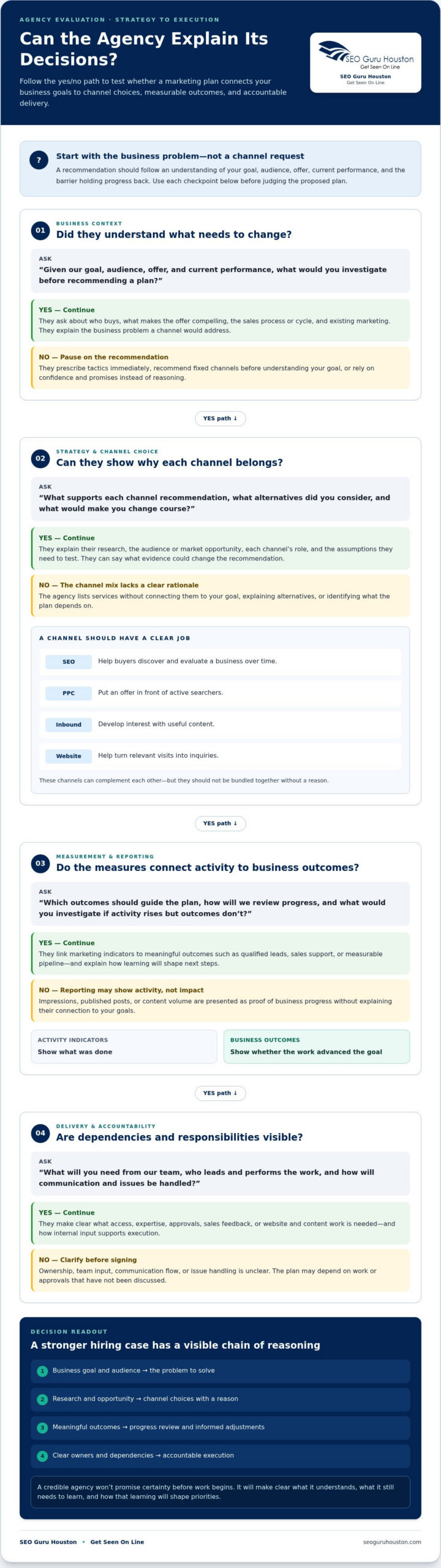
Ask: “Given our goal, audience, offer, and current performance, what would you investigate before recommending a plan?” The answer should show how the agency connects your business context to marketing decisions. For example, a company looking for more qualified sales conversations may need to clarify its ideal buyers, offer, and sales cycle before deciding whether SEO, PPC, inbound marketing, or another channel belongs in the plan.

Listen for questions about who buys, what makes the offer compelling, how long a sale takes, and what current performance reveals. A channel recommendation can make sense, but it should follow a clear explanation of the problem it addresses. Be cautious if the agency prescribes tactics immediately or relies on confidence and promises instead of reasoning.

Quick answer check:

  • Strong signal: The agency asks about your audience, offer, sales process, and existing marketing.
  • Strong signal: It explains the business problem a proposed channel would address.
  • Warning sign: It recommends a fixed set of channels before understanding your goal.

How will the agency define a successful partnership?

Ask: “Which outcomes should guide the plan, and how will we review progress?” The answer should connect marketing work to a business result, such as generating qualified leads, supporting sales, or building a measurable pipeline. Clarify how the agency will evaluate progress and use what it learns to set next steps.

Separate outcomes from activity. Impressions, published posts, and content volume can show what was done, but they don’t prove that the work advanced your business goal. Ask how those indicators relate to meaningful results and what the agency would investigate if activity increases but outcomes don’t.

“A useful agency brief names the business outcome, the audience it matters to, and the barrier marketing must help overcome.”

A credible answer won’t promise certainty before the work begins. It will make the logic visible: what the agency understands, what it still needs to learn, and how that knowledge will shape priorities. Among the questions to ask before hiring a marketing agency, this one helps reveal whether the pitch is built around your business or simply around a list of services.

Ask How the Marketing Agency Builds Strategy and Chooses Channels

A strategic recommendation should have a clear chain of reasoning: what the agency learned about your audience and market, which opportunity it sees, and why the proposed channels fit your goal and resources. Ask what research informs the plan, how the agency understands buyer needs and competitors, and what evidence could change its recommendation. The questions to ask before hiring a marketing agency should test the thinking behind the channel mix, not just the list of services.

How does the agency decide which channels deserve investment?

Ask: “What supports each channel recommendation, what alternatives did you consider, and what would make you change course?” Listen for a clear explanation of each channel’s role in the customer journey. SEO may help buyers discover and evaluate a business over time; PPC can put an offer in front of active searchers; inbound marketing can develop interest with useful content; and website or landing page work can help turn relevant visits into inquiries. Similarly, for creator and UGC initiatives, specialized partners like Indie Collaborates show how vetted influencer campaigns should connect directly to measurable performance. These channels can complement each other, but they shouldn’t be bundled together without a reason.

For a closer look at search strategy, explore this guide to professional SEO services.

What to assess Useful agency reasoning What to learn
Strategy Connects the audience, business goal, and market opportunity Why this plan fits your situation
Channel rationale Explains each channel’s job and alternatives considered Where attention and effort will go
Dependencies Identifies needed website changes, content, access, or approvals What must be ready for execution
Expected learning Names the assumptions to test and how findings inform adjustments How the strategy can evolve

What will the agency need from your team?

Ask what access, subject-matter expertise, approvals, and sales feedback the work depends on. A sound plan makes responsibilities visible. Your team may provide product knowledge or review content, while the agency uses that input to shape campaigns, pages, and lead-generation activity. Clarify how the plan will use existing assets and internal marketing capacity, so it builds on what’s already working rather than duplicating effort.

If business-to-business growth is a priority, this B2B demand generation guide offers a related perspective. A tailored digital plan works best when agency recommendations, internal expertise, and sales feedback support the same goals. Learn more about SEO Guru Houston’s digital marketing approach and how connected digital services can support planning.

Questions About Marketing Results, Reporting, and Proof

A marketing report should help you make decisions, not just display activity. Ask which indicators connect campaign work to qualified leads, sales, or pipeline, and how the agency will assess whether performance is moving in the right direction. The answer should distinguish early signals, such as relevant traffic or completed inquiries, from business outcomes that may take longer to emerge.

Channel metrics show what marketing activity produced; business outcomes show whether that activity mattered to the company.

What should a useful marketing report explain?

Ask what the report includes, how often you’ll review it, which data sources it uses, and who will interpret the findings. Depending on your setup, sources might include Google Analytics 4, Google Ads, and CRM data. A dashboard alone isn’t enough. Look for clearly defined metrics, trends over time, context for changes, and recommended actions.

Clarify attribution limits, too. A customer may interact with several channels before becoming a lead or buyer, and available tracking may not show every influence. Ask how the agency will account for that uncertainty rather than presenting one channel’s numbers as the complete story. If results differ from expectations, the agency should explain what it will investigate, such as lead quality, landing-page performance, campaign targeting, or tracking issues.

  • Clear definitions: You know what counts as a lead and how it’s qualified.
  • Useful context: The report explains what changed and why it may matter.
  • Next steps: Findings lead to specific questions, tests, or adjustments.

How can you assess case studies and performance claims?

Ask what the client’s starting point and objectives were, what timeframe the results covered, and which work the agency handled. A useful case study explains relevant context, including changes to the offer, website, sales process, or other marketing activity. Ask how results were measured and what the agency can reasonably attribute to its contribution.

Past performance can show how an agency thinks and works, but it can’t guarantee the same outcome for your business. Your audience, competition, resources, sales cycle, and starting conditions may differ. Treat a case study as evidence to examine, not a forecast. Among the questions to ask before hiring a marketing agency, this one helps distinguish transparent proof from a headline claim. Look for careful explanations, not promises based on someone else’s results.

Questions to Ask Before Hiring a Marketing Agency: A 2026 Guide

Ask About Execution, Communication, and Accountability Before You Sign

A sound strategy needs a working process behind it. Before signing, make sure you know who owns the work, how tasks move from plan to delivery, how updates and decisions are handled, and what happens when problems arise. These questions to ask before hiring a marketing agency help turn a promising pitch into clear expectations your team can use day to day.

  • Ownership: Who leads the account, who performs the work, and who makes decisions on each side?
  • Workflow: How do tasks, approvals, dependencies, and deadlines move from kickoff to completion?
  • Communication: How often will you meet, which channels will you use, and where will decisions be recorded?
  • Issue resolution: How will the team raise delays, performance concerns, or proposed scope changes?

Who owns the work and how will progress stay visible?

Ask who your day-to-day contact will be and which specialists will contribute. Then agree on a meeting rhythm, communication channels, approval windows, and the people authorized to make decisions. After each review, action items should have clear owners and next steps. Documented dependencies, such as your team supplying subject-matter input or approving a landing page, make it easier to catch delays before they stall execution.

What happens when priorities or performance change?

Ask how the team will use new evidence to adjust campaign priorities and explain changes to the plan. Clarify how a scope change is raised, how its impact on timing or workload is evaluated, and how it’s approved before work shifts. If results raise concerns, expect direct communication about what the team sees, what it’s investigating, and what happens next. Avoid arrangements where reporting changes without explanation or issues become a blame exercise.

Put the working model in writing before the engagement begins: contacts, responsibilities, review points, approval steps, and how changes are handled. That gives both teams a shared reference when priorities shift and makes accountability practical, not just a word in a pitch.

See how SEO Guru Houston’s digital marketing services bring strategy and execution together across SEO, PPC, websites, and demand generation.

Turn Your Marketing Agency Questions Into a Clear Hiring Decision

A confident presentation can make every agency sound capable. Base your decision on the quality of its reasoning and whether its approach fits your business. Use the same questions to ask before hiring a marketing agency in each conversation, then record specific evidence instead of relying on who made the strongest impression.

How do you compare answers without choosing the best presentation?

Score each agency across the same five areas: strategy, measurement, execution, communication, and business fit. You might rate each area from 1 to 3, where a low score means the answer lacked clarity and a high score means it was specific, relevant, and supported by clear reasoning. Add a brief note beside each score so your decision reflects what the agency actually explained.

  • Strategy: Did the recommendation connect to your goals and audience?
  • Measurement: Were outcomes and reporting explained in practical terms?
  • Execution: Were roles, workflow, and dependencies clear?
  • Communication: Did the agency explain how decisions and concerns will be handled?
  • Business fit: Did its proposed approach account for your resources and priorities?

Compare answers against the business outcomes you established, not against how polished the pitch felt. If an agency leaves an assumption unanswered, record it as a point to resolve in the proposed scope. That can prompt a useful discussion rather than automatically ruling out a potential partner. Look for clear logic, realistic expectations, and a defined route from planning to action.

What should happen after choosing a marketing agency?

Before work begins, make sure the agreed scope captures the goal, responsibilities, reporting approach, and review points. Use the kickoff to align on access, decision-makers, immediate priorities, and what your team needs to provide. Then agree on how progress will be reviewed and how new information can shape strategic adjustments. A shared plan gives both teams a practical starting point.

Ready to turn your priorities into a focused plan? Build a strategy for measurable digital growth with SEO Guru Houston. A strong partnership starts with a clear goal, a tailored digital strategy, and an accountable path forward.

Choose a Growth Partner With a Clear Plan

The questions to ask before hiring a marketing agency should help you see beyond the pitch. Look for a strategy grounded in your business goals, a measurement plan that connects marketing activity to meaningful outcomes, and a working process with clear ownership and communication.

Before you commit, make sure the proposed scope explains what the agency will do, what your team will contribute, and how you’ll review progress together. The right partnership isn’t built on confident promises. It’s built on sound reasoning, realistic expectations, and a plan that can adapt as you learn.

SEO Guru Houston connects specialized SEO and PPC services with website development, landing pages, and demand generation to support business growth. Discuss a digital strategy built around your growth goals and take the next step with clarity.

Frequently Asked Questions

What questions should I ask before hiring a marketing agency?

The questions to ask before hiring a marketing agency should reveal how it will understand your goals, choose channels, measure progress, and manage the work. Ask who will perform the work, what your team needs to provide, and how recommendations may change as new evidence emerges. Use the same core questions with each agency to compare clear reasoning and defined responsibilities instead of broad promises or presentation style.

How do I know if a marketing agency is right for my business?

A suitable agency should understand your audience, sales process, growth goals, and internal capacity before recommending an approach. In specialized sectors, this alignment is crucial; for example, luxury houses often turn to niche brand strategy consultancies like Omedia Paris because prestige audiences require distinct storytelling and positioning. Ask it to explain why its strategy fits your situation and how it will evaluate progress. Relevant experience can help you assess its capabilities, but it doesn’t guarantee the same results for your business. Consider the quality of its reasoning, communication, reporting plan, and ability to adapt as your needs and findings evolve.

What should a marketing agency include in its proposal?

A useful proposal connects your business goals to a defined strategy, recommended services, responsibilities, measurement, and a process for reviewing progress. It should state important assumptions and dependencies, such as access, approvals, or input from your team. Check that the proposal explains how findings will be reported and what decisions they’ll inform. These details give both sides a practical basis for agreeing on scope, priorities, and how the work will proceed.

How can I tell whether a marketing agency’s results are genuine?

Ask what the client’s starting point and objective were, how results were measured, what timeframe was involved, and which work the agency performed. Look for context about other factors that may have influenced the outcome, such as changes to the website or sales process. A case study can demonstrate experience, but it isn’t a forecast for your company. Credible explanations describe limitations and how the findings shaped later decisions.

Should I hire one agency for SEO and PPC?

It depends on your goals, audience, internal capacity, and how the channels need to work together. Ask how SEO and PPC each support the strategy, how performance will be assessed, and who coordinates the work. One agency may provide a more integrated plan, while a focused engagement may fit a narrower priority. Choose based on strategic fit, clear ownership, and the agency’s ability to connect channel activity to your business objectives.

How often should a marketing agency report results?

Set a reporting cadence that fits the campaign, the decisions you need to make, and the time required for meaningful data to emerge. Ask what regular updates will cover and how the team will flag urgent issues. A useful report explains results, context, and recommended next steps rather than presenting unexplained numbers. Agree on the format and schedule during planning, then revisit them if campaign activity or business priorities change.

What are red flags when hiring a marketing agency?

Be cautious if an agency guarantees outcomes outside its control, recommends tactics without explaining why, or reports activity without connecting it to business objectives. Unclear responsibilities and unanswered questions about assumptions can also create friction. These signs warrant specific follow-up, not necessarily an immediate decision. Ask how success will be measured, who owns each task, and how changes will be handled. Proceed when the answers give you enough clarity to define scope and expectations.