Tag Archives: Marketing Strategy

When to Hire a Digital Marketing Agency: A 2026 Decision Guide

What if your next growth move isn’t adding another marketing channel, but getting the right expertise behind the ones you already use? If you’re asking when to hire a digital marketing agency, look at the gap between your goals and your team’s capacity to execute and measure. Campaigns that keep slipping, disconnected channel activity, and unclear links between marketing and qualified leads are signals worth investigating.

You don’t need to outsource every marketing decision to make progress. But when your team lacks the time or specialist skills to build a consistent strategy, outside support can turn scattered effort into focused work tied to business outcomes. The key is to set priorities, share useful information, and agree on how success will be measured.

This 2026 decision guide will help you recognize when agency support is timely, what to prepare before engaging a team, and how to make the investment accountable. You’ll learn how to assess readiness, match needs such as search visibility, paid campaigns, and landing page performance to relevant services, and set goals and measurement expectations before work begins.

Key Takeaways

  • Recognize when stalled progress, inconsistent execution, skill gaps, or limited capacity make outside expertise a strategic next step.
  • Before choosing channels or tactics, clarify your business goals, audience, offer, available data, and decision-makers.
  • Connect needs such as stronger search visibility or more qualified leads to relevant capabilities and meaningful measures of success.
  • Set a focused scope and document responsibilities, communication, decision rights, and reporting expectations before work begins.
  • Use a readiness checklist to decide when to hire a digital marketing agency, when to prepare first, or when your current team can keep moving forward.

When should you hire a digital marketing agency? Recognize the signals

Hiring an agency is a strategic decision, not an automatic milestone as your business grows. The right time is when a clear business priority keeps running into a persistent execution or expertise gap. A small team may be ready if it has a defined growth goal and needs specialist support. A larger company may not need an agency if its in-house team has the time and skills to deliver.

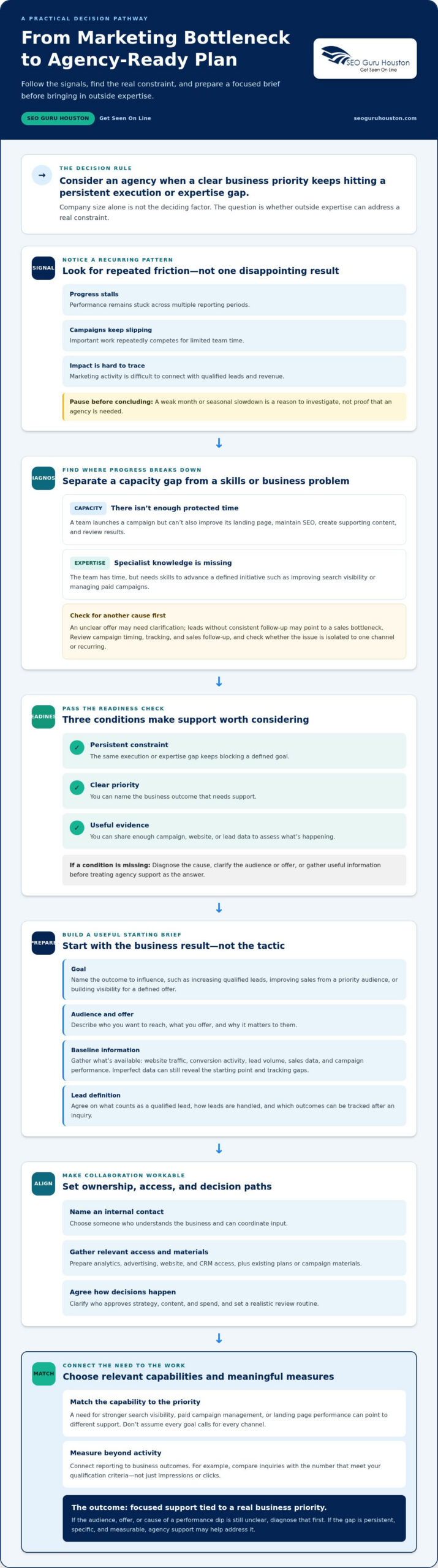
Look for a pattern rather than reacting to one disappointing result. Progress may stall across multiple reporting periods, important campaigns may repeatedly slip, or marketing activity may be difficult to connect to qualified leads and revenue. A temporary campaign dip or seasonal slowdown calls for diagnosis first. Check whether the change is limited to one channel or points to a recurring issue. Review campaign timing, tracking, and sales follow-up before deciding that outside help is the answer.

Which marketing problems signal a capacity or expertise gap?

A capacity gap appears when essential work repeatedly competes for the same limited hours. Your team might launch a campaign but lack time to improve its landing page, maintain SEO, create supporting content, and review results. A skills gap is different: the team has time, but not the specialist knowledge to advance a defined initiative, such as improving search visibility or managing paid campaigns. Because Digital marketing spans multiple channels and methods, identify the capability you need instead of assuming you need help with everything.

Separate execution problems from strategy or sales problems, too. If customers don’t understand the offer, more promotion may amplify the confusion. If leads arrive but aren’t followed up consistently, the bottleneck may be in sales rather than marketing. Pinpoint where progress breaks down before assigning the problem to an agency.

When is an agency premature or unnecessary?

Promotion works best when you can explain who the offer serves, what value it provides, and what action you want customers to take. If those fundamentals are unsettled, clarify them before scaling campaigns. Likewise, don’t treat one weak month as proof that you need an outside team. Review the underlying data, compare performance over an appropriate period, and look for a recurring constraint.

Focused internal execution may be the right choice when your team has the relevant skills, protected time, and a way to measure progress. Use this quick readiness check:

  • Persistent constraint: The same execution or expertise gap keeps blocking a defined goal.
  • Clear priority: You can name the business outcome that needs support.
  • Useful evidence: You can share enough campaign, website, or lead data to assess what’s happening.

If those conditions are present, agency support may help close a specific gap. If the audience, offer, or cause of a performance dip is still unclear, diagnose that first. The deciding factor isn’t company size. It’s whether outside expertise can address a real constraint tied to a business priority.

What should your business have in place before hiring an agency?

You don’t need a flawless marketing operation before bringing in outside expertise. You do need enough clarity to collaborate: what the business is trying to achieve, who it serves, what it offers, what information is available, and who can make decisions. This preparation keeps the work anchored to business outcomes rather than defaulting to channel activity.

Start with the result, not the tactic. “Grow the business” is an ambition; increasing qualified leads, improving sales from a priority audience, or building visibility for a defined offer gives the work a clearer direction. Once the outcome is clear, assess whether SEO, PPC, a landing page, or another approach fits the need. That sequence helps you evaluate when to hire a digital marketing agency without assuming every goal calls for every channel.

Set goals and establish a usable baseline

Write down the priority, the audience you want to reach, and the offer you want them to consider. Then gather the baseline information you already have: website traffic, conversion activity, lead volume, sales data, and campaign performance. The data doesn’t need to be perfect. It should help your team and agency understand the starting point and identify gaps in tracking.

Connect marketing measures to the sales process. Clarify what counts as a qualified lead, how leads are handled, and which outcomes the business can track after an inquiry. For example, compare the number of inquiries with the number that meet your qualification criteria. That context makes reporting more useful than a list of impressions or clicks alone.

Prepare the people, access, and decision process

Name an internal contact who understands the business and can coordinate input. Gather access to relevant analytics, advertising, website, and CRM accounts, along with existing plans or campaign materials. Decide who approves strategy, content, and spend, and agree on a realistic routine for reviews. Clear ownership prevents important decisions from stalling between teams.

Use this short preparation sequence before an agency conversation:

  • Goal: State the business outcome you want to influence.
  • Audience and offer: Describe who you serve and why the offer matters to them.
  • Data: Collect available performance and sales information, noting any gaps.
  • People: Identify the day-to-day contact and decision-makers.
  • Process: Clarify access, approval responsibilities, and review expectations.

Readiness means being prepared to share context, make timely decisions, and learn from evidence, not having every metric or process optimized in advance. If your priorities involve visibility, qualified traffic, or lead generation, reviewing SEO and PPC marketing support can help you identify capabilities that fit those goals.

How do you know agency support can deliver value, not just activity?

Agency support creates value when it closes a specific capability or capacity gap and ties the work to a business priority. Compare the options realistically: an internal team may know the product and customers deeply, while an agency can add specialist expertise or execution capacity. Either model still needs coordination, timely decisions, and clear accountability. The question of when to hire a digital marketing agency comes down to whether the added support can advance an outcome your team has defined, not simply produce more tasks.

Separate deliverables from results. Publishing content, launching ads, or building a landing page are deliverables. Qualified opportunities, sales, and stronger visibility for relevant searches are outcomes. Deliverables can be tracked directly; outcomes depend on factors such as the offer, execution, competition, customer behavior, and measurement quality. No channel or agency can guarantee a particular business result.

Which capabilities may be worth bringing in?

Business need Relevant capability Useful measures
Improve visibility for relevant searches SEO Organic impressions, relevant traffic, qualified inquiries
Reach people actively searching for an offer PPC Campaign traffic, conversion activity, cost per qualified lead
Turn campaign visits into inquiries Landing pages or website development Conversion rate, form submissions, qualified leads

What should meaningful reporting help you understand?

Good reporting explains what changed, what it may mean, and what action comes next. Google Analytics can help assess website visits and on-site behavior. Google Search Console can show search visibility and activity from organic results. CRM data can help connect inquiries to lead quality and sales progress. These sources answer different questions, so they’re most useful when interpreted together.

Separate leading indicators, such as impressions, clicks, and page conversions, from downstream outcomes like qualified opportunities and closed sales. Revenue attribution may be incomplete when customer journeys span channels or data is missing, so make limitations visible rather than overstating certainty. In regular reviews, expect a clear account of work completed, performance against agreed measures, decisions made, and next steps. That’s how you judge progress, not by the length of an activity report.
When to Hire a Digital Marketing Agency: A 2026 Decision Guide

How should you define scope, goals, and accountability before hiring?

A strong agency engagement starts with clear boundaries: which business priority needs attention, what work falls within scope, and how both sides will judge progress. Resist the urge to buy every channel at once. A focused first engagement makes it easier to coordinate work, interpret results, and decide what deserves investment next.

How do you choose a realistic first scope?

Start with the constraint you’ve diagnosed. If relevant searchers aren’t finding your business, SEO may fit the priority. If you need to capture existing demand through paid campaigns, PPC may be appropriate. If visitors arrive but struggle to take the next step, website development or a landing page could address the friction. Demand generation may fit when the challenge is creating and developing interest among potential buyers, while lifecycle and retention goals often call for dedicated email and CRM specialists like Vertical Brands.

Factor in your sales cycle, internal support, and ability to measure progress. A longer sales cycle may require tracking early engagement and lead quality before closed sales provide a useful signal. A campaign also needs internal owners who can supply business context, respond to inquiries, and make timely decisions. Connected services can make sense when one isolated tactic can’t address the full path from discovery to conversion. Keep the scope focused on the business problem, not a checklist of channels.

Which expectations should be agreed before work begins?

Put the working agreement in writing so the team and agency share the same definition of progress. Include the objective, baseline measures, deliverables, responsibilities, approval rights, communication cadence, and review intervals. Clarify who provides source materials, approves content, manages access, and decides whether to adjust campaign direction or spend.

Set a review framework that considers business outcomes alongside context. A change in traffic or lead volume matters, but so do lead quality, seasonality, sales follow-up, and changes to the offer. Agree on how results and limitations will be explained, what decisions each review should inform, and how strategic changes will be communicated. This creates accountability without treating a single metric as the whole story.

  • Objective: Name the business priority and the audience it serves.
  • Scope: Specify the work included and what falls outside the engagement.
  • Ownership: Assign agency and internal responsibilities, including approvals.
  • Measurement: Record the starting point, success indicators, and reporting rhythm.

Be wary of promises of guaranteed rankings, leads, or revenue. A clear scope can make work and decisions accountable, but outcomes depend on execution, market conditions, the offer, and reliable measurement. SEO Guru Houston provides SEO, PPC, web development, and demand generation services. Explore digital marketing services to see how these capabilities can support a focused plan.

When is it time to move forward with a digital marketing agency?

Move forward when four conditions align: your business has a clear goal, a persistent capability gap is holding back progress, relevant data can be shared, and leadership agrees on the priority. That combination gives an agency something concrete to work toward and your team a basis for evaluating the work. Company size alone doesn’t determine readiness.

Still unsure when to hire a digital marketing agency? Use this decision check:

  • Act now: You can name the business challenge, identify the expertise or capacity you’re missing, provide useful context or data, and get decisions from aligned leaders.
  • Prepare first: Your audience, offer, goal, or measurement is unclear. Resolve those questions before expanding activity.
  • Continue with current resources: Your team has the skills and protected time to address the priority, and current execution is consistent enough to assess.

Begin with the challenge, not a predetermined channel or package. A visibility problem may point toward SEO; a need to capture existing demand may call for PPC; a conversion bottleneck may involve the website or landing page. If the gap concerns reaching and developing potential business customers, B2B or inbound marketing may be relevant. The right scope follows the diagnosis.

What does a productive agency relationship require?

Strong collaboration depends on shared context: who your customers are, how your offer is positioned, how sales handles inquiries, and which business priorities matter most. The agency brings marketing expertise and execution capacity, while your team provides decisions and knowledge of the business. Progress is a cycle of strategy, implementation, measurement, and informed adjustment, not a handoff that replaces internal judgment.

What is the next step if your business is ready?

Prepare a concise brief before discussing scope. Include your goal, audience, offer, current marketing efforts, known constraints, available data, and the decisions or support your team can provide. Note whether the priority is search visibility, paid demand capture, B2B lead generation, inbound growth, or a website conversion challenge. This keeps the conversation focused on the business need and the capabilities that may address it.

With that brief in hand, you can discuss a tailored scope with SEO Guru Houston and define what progress should look like before work begins. Build a focused digital growth plan around a real business priority, clear responsibilities, and measures your team can use to make decisions.

Turn Your Marketing Priorities Into a Focused Plan

The decision about when to hire a digital marketing agency comes down to more than a growth target. Look for a clear business priority, a persistent gap your team can’t readily close, and the people, data, and decision-making support needed to act. Then define a focused scope and agree on how progress will be reviewed.

Agency support should connect expertise to business needs, not just increase the volume of marketing activity. SEO and PPC can support search visibility and qualified traffic, while B2B and inbound marketing, website development, landing pages, and demand generation can address other growth priorities. The right starting point depends on your goals, audience, and current constraints.

Ready to turn your next priority into a practical, accountable plan? Build a focused digital growth plan with SEO Guru Houston. Start with the challenge you need to solve, then move forward with clear responsibilities and measures.

Frequently Asked Questions

When should a small business hire a digital marketing agency?

A small business should consider agency support when it has a defined growth goal but lacks the time, specialist skills, or consistent execution to pursue it. First clarify your target audience, offer, and desired outcome. Then identify the specific gap external expertise would address, such as improving search visibility or managing paid campaigns. For example, specialists such as Big Voice – Digital Marketing Agency help growing SMEs focus on commercial outcomes rather than vanity metrics. Company size matters less than readiness and a clear business need when deciding when to hire a digital marketing agency.

How do I know if my business is ready to hire a marketing agency?

Your business is ready when you can explain its priority, target audience, and desired outcome, even if the strategy is still developing. Assign an internal decision-maker, make relevant website, campaign, or CRM data accessible, and confirm who follows up with leads. You don’t need perfect reporting. You do need enough context and internal coordination to collaborate, review progress, and make timely decisions as the work develops.

Can a digital marketing agency help if my business has no marketing strategy?

Yes, an agency can help shape a strategy, but your business should contribute knowledge of its customers, offer, competitive context, and commercial goals. If those fundamentals are unclear, make clarifying them part of the strategic work. Agree on a business priority and how progress will be assessed before launching campaigns. This helps prevent disconnected tactics and keeps expectations realistic while the strategy takes shape and is put into practice.

What should I expect when hiring a digital marketing agency?

Expect an initial alignment on business goals, audience, current marketing activity, responsibilities, and measurement. The agreed scope may include SEO, PPC, website development, landing pages, or demand generation, depending on the need. Set communication and review expectations early, including who approves work and how decisions are shared. Evaluate progress through clear reporting and business context, not activity counts alone. Results depend on execution, market conditions, and measurement.

Is it better to hire an agency or build an in-house marketing team?

The right choice depends on the expertise, time, and management capacity your business needs. An in-house team may offer close day-to-day knowledge of customers and operations, while an agency can add external specialist capabilities and execution support. Some businesses combine both. Compare the skills required, how consistently the work is getting done, and whether results can be measured. Choose the approach that best supports your priorities and available resources.

How much does it cost to hire a digital marketing agency?

Agency fees vary based on the work’s scope, services, complexity, and level of support, so there isn’t one useful figure for every business. Define the business outcome and work required before comparing proposals. Review responsibilities, deliverables, reporting, and measurement alongside the fee. A low price or a long list of promised activities doesn’t establish value on its own. Focus on whether the proposed scope addresses a clear business need.

What happens if I hire a digital marketing agency before my business is ready?

An unclear offer, misaligned goals, missing account access, or limited internal follow-through can slow work and make progress harder to assess. You don’t need a perfect foundation before engaging an agency, though. Identify the biggest readiness gap and decide whether it can be addressed within a defined scope. Agree on responsibilities, access, and how progress will be reviewed. Clear expectations help both sides address constraints rather than mistake them for campaign results.
In-House Marketing vs. Agency: Pros, Cons, and How to Choose

Weighing the in-house marketing vs agency pros and cons starts with a practical question: which capabilities should your business own, and where would specialist support make a bigger difference? The answer affects your control, execution capacity, and ability to connect marketing activity to measurable business goals.

Keeping marketing close to the business can help your team understand customers and respond to changing priorities. But a small team may struggle to cover every channel, while agency support without clear ownership can create extra coordination instead of better execution. The right model should fit your goals, workload, and internal expertise.

This guide compares in-house, agency, and hybrid marketing. You’ll learn how to evaluate control, specialist skills, capacity, and accountability, with practical examples involving SEO, PPC, and landing pages. You’ll also find a framework for assigning responsibilities and setting expectations for the work.

Key Takeaways

  • Compare the in-house marketing vs agency pros and cons across control, expertise, capacity, continuity, coordination, and accountability.
  • Assess actual team capacity, including hiring, onboarding, current workloads, and the time needed to manage marketing.
  • Start with business outcomes, then identify which skills and recurring tasks your team can realistically own.
  • Keep strategy ownership and business context internal while using specialist support where execution needs exceed your team’s capabilities.
  • Consider a hybrid model that combines internal priorities and approvals with external expertise in areas such as SEO, PPC, and landing pages.

In-House Marketing vs. Agency: What Each Model Actually Means

Every marketing model needs a clear strategy, skilled execution, and a way to measure progress. The in-house marketing vs agency pros and cons comparison is about how that work gets done, not whether marketing deserves investment.

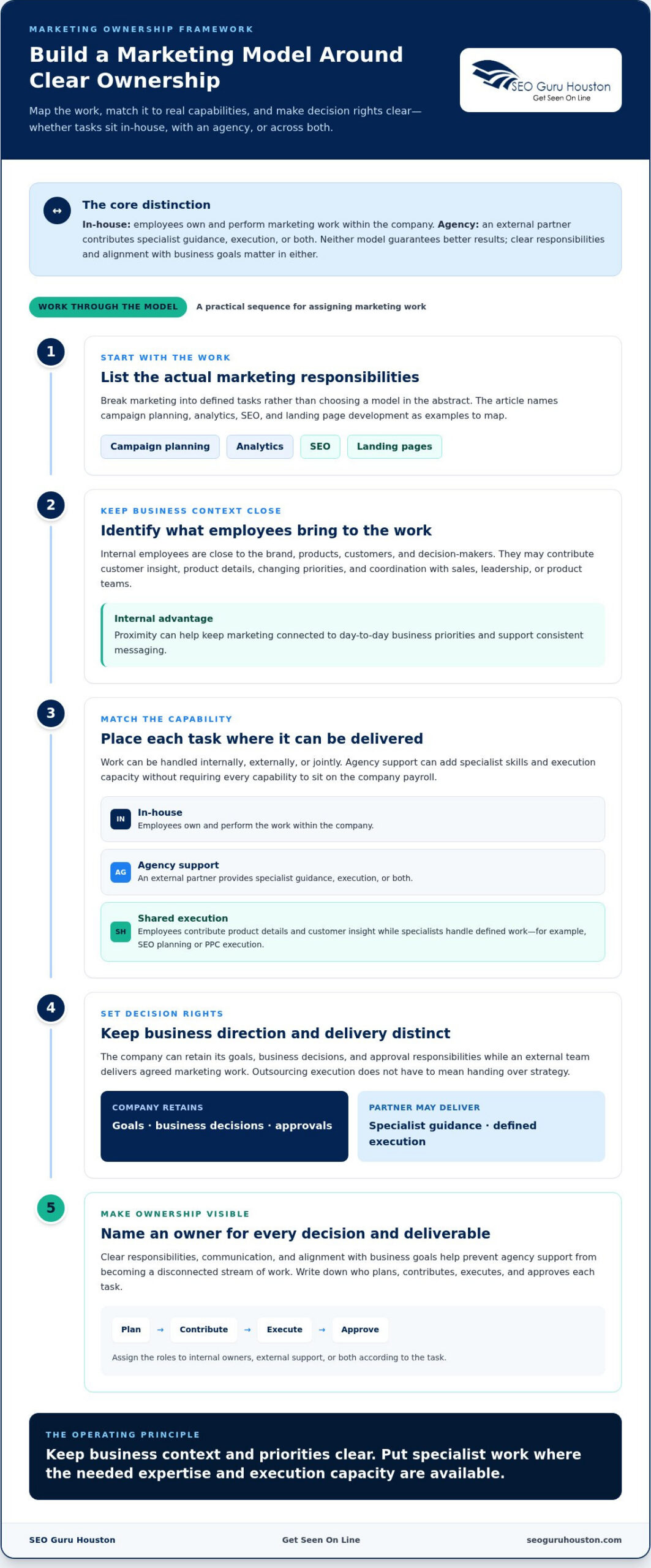
In-house marketing means employees own and perform marketing work within the company; agency marketing means an external partner contributes specialist guidance, execution, or both. An advertising agency is an outside organization that supports clients’ advertising and marketing efforts. Agency engagements can focus on one discipline or cover a wider range of work. Neither model guarantees better results. Clear responsibilities, communication, and alignment with business goals matter in either case.

What does an in-house marketing team typically handle?

Employees are close to the company’s brand, products, customers, and internal decision-makers. They may plan content, coordinate campaigns, monitor analytics, and work with sales, leadership, or product teams. That proximity can help keep marketing connected to day-to-day business priorities.

The team’s scope depends on its headcount, skills, and goals. A small team may focus on a few core activities, while a larger department may divide work across channels and specialisms. Internal knowledge is valuable, but it does not guarantee enough time or expertise to execute every task well.

What does an agency contribute to a marketing operation?

An agency can add specialist skills and execution capacity without requiring every capability to sit on the company payroll. Depending on the engagement, it may guide strategy, carry out defined work, or collaborate with employees—such as bringing in Branding TITANS™ to develop an overarching identity and mission. SEO, PPC, web development, and landing pages can be handled internally, externally, or jointly.

For example, employees can provide product details and customer insight while an external specialist handles SEO planning or PPC execution. The agency contributes expertise and delivery capacity; the company retains its business decisions, goals, and approval responsibilities. Clear ownership helps avoid the misconception that outsourcing execution means handing over strategy.

The practical distinction is where capabilities sit and who is accountable for each decision or deliverable. Map specific work, such as campaign planning, analytics, SEO, and landing page development, to internal owners and external support. This makes the in-house marketing vs agency pros and cons easier to assess and shows where specialist help could extend your team’s capacity.

In-House Marketing Pros and Cons: Control, Context, and Team Capacity

An internal team can move quickly because its members are close to the people, products, and decisions that shape marketing. But company knowledge and control do not guarantee effective campaigns. The practical question is whether employees have the time and skills to turn that context into consistent execution.

Where in-house marketing has an advantage

Employees work alongside product, sales, and leadership teams. They can hear customer feedback directly, understand changes in business priorities, and bring that insight into campaign planning. Their proximity can also support consistent messaging and simplify approvals, since they do not need an outside partner to learn the business from scratch.

That control is most valuable when the team has clear processes, enough capacity, and the expertise to deliver. An internal marketer may respond quickly to a product update, for example, but responsiveness is not the same as deep expertise in every channel. A team can know the brand well and still need specialist support for complex SEO work. A guide to professional SEO services can help clarify what that work involves.

Where an internal team can run into limits

One or two generalists may be responsible for content, campaign coordination, analytics, paid media, and search optimization. That breadth can leave little time for focused testing or ongoing improvement. Recruiting and developing specialist skills takes time, and onboarding, management, and employee retention all affect delivery. If a key employee leaves or priorities change, work may slow while responsibilities are reassigned.

The result can be a gap between planned marketing and what the team can reliably execute. Campaigns may launch late, optimization may be postponed, and activity across channels may become inconsistent. These problems are not inevitable with an in-house team. They are signs that workload and available expertise need closer attention.

Separate internal responsiveness from specialist depth when weighing the in-house marketing vs agency pros and cons. If your team understands the brand but has limited SEO capacity, external expertise can complement its work rather than replace its business insight. Harvard Business School Working Knowledge explores the strategic considerations involved in deciding whether to bring advertising expertise in-house.

Map recurring marketing tasks against the skills and time your team can consistently provide. If SEO execution is a bottleneck, specialist SEO support can extend capacity while internal stakeholders retain brand context and priorities.

Agency Marketing Pros and Cons: Specialist Skills Without Losing Accountability

An agency can add expertise and execution capacity, but outsourcing work does not mean surrendering business direction. Your company can retain ownership of goals, priorities, budgets, and approvals while an external team delivers agreed marketing work. Clear decision rights distinguish useful support from a disconnected stream of tasks.

Agency advantages: expertise, capacity, and execution

Specialists can bring focused experience in disciplines such as SEO, PPC, and web development. Their support can be useful when a launch, growth initiative, or uneven workload calls for skills your internal team does not use every day. For example, bringing in an agency partner like Insight Multimedia for web development or campaign execution provides specialized delivery capacity, while company stakeholders provide product knowledge and approve business priorities.

Agency value depends on measurable outcomes, not activity volume. A report full of tasks or clicks is not enough on its own. Agree on the business objective, relevant performance indicators, reporting cadence, and how results will guide next steps. Outcomes depend on the work, context, and constraints, so set expectations around what the engagement can influence and how progress will be assessed.

Agency drawbacks: coordination, context, and oversight

External specialists need timely information and access to the right decision-makers. If a brief leaves the target audience unclear, approvals stall, or the agency cannot get answers about a product change, execution may drift from business needs. Coordination also takes internal time. Assign someone to consolidate feedback, resolve competing priorities, and connect agency work to sales and leadership goals.

Give channel-specific work explicit owners. A PPC management plan, for instance, should clarify what the agency handles, what the company approves, and which indicators will be reported. Define how campaign changes, budget decisions, and performance reviews will be managed before activity begins.

Compare the trade-offs

Area Potential agency advantage What to manage
Expertise Focused skills across specialist channels Set priorities and define the work’s purpose
Control Execution support while internal leaders retain decisions Document approvals and decision rights
Capacity Additional delivery support for defined needs Align workload and scope with available resources
Continuity External support can sustain assigned work Keep records, access, and knowledge organized
Coordination Specialists can collaborate with internal teams Provide timely context and a clear point of contact
Accountability Regular reporting can make progress visible Connect metrics to goals and agreed actions

Evaluate how the partnership will work, not just which tasks it covers. A written scope, named owners, shared reporting, and scheduled reviews help preserve strategy ownership while making external execution accountable.

In-House Marketing vs. Agency: Pros, Cons, and How to Choose

How to Choose In-House Marketing vs. an Agency for Your Situation

Choose the operating model that closes the gap between your business goals and your team’s ability to execute. Start with the outcome you need, then decide who should own the strategy, deliver the work, and measure progress. This keeps the in-house marketing vs agency pros and cons grounded in capability rather than channel preference.

  1. Define the business outcome. Specify the change marketing needs to support, such as attracting more qualified traffic, improving lead quality, or contributing to pipeline growth. If coordinated pipeline goals are central, use B2B demand generation planning to connect marketing activity with sales priorities.
  2. Assess internal capacity honestly. List your team’s relevant skills, current workload, and available management time. Consider whether employees can sustain the work alongside existing responsibilities and whether they have the expertise for tasks that require specialist execution.
  3. Sort work by ownership and need. Separate strategic decisions, such as audience and priorities, from specialist execution and routine coordination. Rank tasks by business impact, urgency, complexity, and available internal skills. Identify whether each need is ongoing, project-based, or tied to a defined growth push.
  4. Assign clear accountability. For every priority task, name the person responsible for delivery, the decision-maker, the measure of progress, and how often results will be reviewed. Shared work still needs one clear owner for decisions and follow-through.
  5. Set expectations and review the model. Establish a baseline and choose KPIs that connect to the objective, such as qualified traffic, leads, conversion rates, or pipeline contribution. Name the reporting owner, set a review period, and agree how to adjust direction when the evidence calls for it.

Compare the full resource commitment

A fair comparison includes more than the person doing the work. Account for internal hiring and training, specialist skill gaps, employee workload, and the time required to brief and manage an external partner. Neither model guarantees savings. The right choice depends on the capabilities you need, how consistently you need them, and the internal effort required to support delivery.

For example, your team may own customer insight and pipeline priorities but lack the time or expertise to coordinate specialist execution. External support can fill that gap. If work is closely tied to daily internal decisions and your team has the skills and capacity, keeping execution in-house may fit better.

Use this process to create a practical ownership plan, then explore B2B demand generation support for coordinated marketing work tied to pipeline goals.

Build a Hybrid Marketing Model That Can Scale With Your Business

A hybrid model keeps business knowledge and strategic control close to your team while adding specialist execution where internal capacity or expertise is limited. Employees set priorities, provide product and customer insight, approve key decisions, and connect marketing activity to revenue goals. Agency specialists handle clearly defined work, such as SEO, PPC, or landing page execution, and report against agreed measures.

The model works when responsibilities are explicit. Treat the agency as an extension of your marketing operation, not a substitute for internal leadership. One internal point of contact should coordinate priorities, provide timely decisions, and keep both sides aligned.

Divide responsibilities clearly between employees and agency specialists

Use a responsibility matrix to name an owner for each part of the work. Adapt this starting point to your team and engagement:

  • Strategy and priorities: Internal leadership owns business goals; agency specialists contribute channel recommendations.
  • Execution: The agency delivers agreed specialist tasks; employees provide the context and inputs needed.
  • Approvals: Internal stakeholders make final decisions on brand, product, and business commitments.
  • Analytics: The agency manages or supports channel measurement; the internal owner connects findings to business context.
  • Reporting: The agency reports agreed metrics and actions; the internal point of contact leads review and follow-up.

Agree on what counts as a qualified lead, conversion, and successful campaign before reporting begins. Clarify how attribution will be interpreted, which data sources matter, and how often performance will be reviewed. Shared definitions reduce confusion and help the team decide what to adjust, continue, or stop.

Know when to expand, outsource, or rebalance

Consider hiring internally when work requires sustained ownership, close daily coordination, and ongoing decisions tied to company operations. Agency support can fit when specialist skills or flexible execution capacity are the immediate constraint. The right balance can change as goals, channel mix, workload, and internal capabilities evolve. Revisit responsibilities and measures rather than letting an old setup run by default.

The in-house marketing vs agency pros and cons discussion is most useful when it leads to a working plan: who owns each decision, what gets delivered, how success is measured, and when the team will reassess. That structure helps a business retain control without limiting execution to the skills already on staff.

For an approach that connects specialist marketing work to business priorities, explore our marketing services.

Make Your Marketing Model Work for Your Next Stage of Growth

The right choice is not automatically all in-house or all agency. Use the in-house marketing vs agency pros and cons to decide which work needs close company ownership and where specialist support can extend capacity. Keep business priorities, product insight, approvals, and revenue context clear, then connect each responsibility to measurable outcomes and regular reviews.

A hybrid approach can combine internal knowledge with focused execution. SEO, PPC, B2B marketing, and inbound marketing can work alongside web development and landing page design, with responsibilities shaped around your goals and team capabilities.

Turn your priorities into a practical plan with marketing support built around your growth goals. Define the work, ownership, and measures that matter, then review progress and adjust as your needs change.

Frequently Asked Questions

Is in-house marketing better than hiring an agency?

Neither model is universally better. The right fit depends on your goals, internal capabilities, workload, and need for specialist skills. An in-house team has close access to company knowledge and day-to-day decisions. An agency can add expertise and execution capacity for specific channels or projects. Compare who can own the strategy, complete the work consistently, and report against meaningful business outcomes. A hybrid model can combine internal direction with external support.

What are the main pros and cons of an in-house marketing team?

An in-house team can build deep product and customer knowledge, coordinate closely with colleagues, and respond quickly as priorities change. The trade-off is that hiring, onboarding, training, and retaining skilled employees takes time and management effort. A small team may also struggle to cover specialist channels alongside routine work. Assess whether employees have the expertise and available capacity to deliver consistently, rather than judging the model by internal control alone.

What are the advantages and disadvantages of a marketing agency?

A marketing agency can provide specialist expertise, flexible execution capacity, and an outside perspective without requiring every skill to sit internally. External teams need clear briefs, timely business context, access to decision-makers, and coordinated approvals. Set the scope, responsibilities, reporting expectations, and performance measures at the start. Outsourcing execution does not mean giving up strategy ownership: your company can retain goals, priorities, and final business decisions while specialists deliver agreed work.

How much does in-house marketing cost compared with an agency?

The comparison depends on the roles, expertise, and scope of work involved. For an internal team, consider compensation alongside recruitment, onboarding, benefits, training, software, and management time. For an agency, assess the agreed scope, deliverables, reporting, and any resources your team must provide. Neither option is automatically less expensive. Compare the total resources needed to meet your goals, including coordination time and the cost of capability gaps or inconsistent execution.

Can a small business use both an in-house team and an agency?

Yes. A small business can keep priorities, approvals, customer insight, and revenue context with an internal owner while assigning defined specialist tasks to an agency. Employees might set campaign goals and provide product information while external specialists support SEO, PPC, or landing page work. Name one internal point of contact, agree on deliverables and measures, and establish a regular review routine so shared work stays coordinated and accountable.

When should a company switch from in-house marketing to an agency?

Consider agency support when recurring marketing work exceeds your team’s available capacity, specialist skills are missing, or execution is repeatedly delayed. A full switch is not always necessary. Identify which tasks need outside expertise and which decisions should remain internal. Define the business outcome, assign an internal decision-maker, and agree on reporting measures before work begins. If the need involves sustained daily coordination and ownership, building internal capability may be a better fit.

Ready to decide which marketing work to own and where to add specialist support? Talk with our team about a growth plan.

Lead Capture Page Examples: 5 Types That Turn Visitors Into Prospects

What if the form that brings in the most leads is also the reason sales spends time on poor-fit prospects? When visitors reach your page but don’t submit, it’s tempting to shorten the form or copy another business’s layout. But effective lead capture page examples show that the right amount of friction depends on the offer, audience, and visitor’s readiness to act.

There’s more to a successful page than polished design. The offer should match the ad, search result, or email that brought visitors there. Ask for too much information too soon, and qualified prospects may leave. Ask for too little, and your team may struggle to identify which inquiries deserve attention.

This guide compares five page formats and explains where each fits, what it asks of visitors, and what to consider in its copy, form, and trust elements. Use it to match a page to your conversion goal, balance form completion with lead quality, and create a focused experience that turns the right visitors into actionable prospects.

Key Takeaways

  • See how five lead capture page examples align different offers with visitor readiness and a clear next step.
  • Compare form fields, calls to action, and qualification goals before choosing a page format.
  • Match the page promise to the message that brought visitors there, then focus the page on one primary conversion action.
  • Use testing and iteration to refine the page without losing sight of lead quality.
  • Learn when in-house resources may be enough and when coordinated design, development, traffic acquisition, and demand generation can help.

What Makes a Lead Capture Page Example Worth Copying?

A page can look polished and still miss its goal if the offer, form, and visitor’s reason for arriving don’t line up. A lead capture page is a focused page that offers something of value in exchange for a visitor’s contact or business information. It connects a relevant offer to a focused form and a clear conversion action, giving visitors a reason to share their details.

The best lead capture page examples aren’t templates to copy blindly. They show how the structure should change with the page’s goal, the audience’s readiness, and the value being offered. Someone exploring a topic may be open to downloading a practical guide, while a prospect comparing vendors may be ready to request a consultation or product demo. Match the next step to the visitor’s likely needs instead of sending everyone to the same form.

Lead capture page vs. landing page: what is the difference?

A lead capture page is a type of landing page built specifically to collect prospect details. The broader term also covers pages designed for other actions, such as selling a product or encouraging event registration. The Landing page overview also identifies “lead capture page” as another name for this focused format.

For example, a company promoting a webinar might send visitors to a dedicated registration page with the event details and signup form. A general website page might describe the webinar too, but its navigation and other links can draw attention toward unrelated content.

What should a strong lead capture page accomplish?

The headline and offer should reflect why visitors arrived. If an ad promises a product demonstration, explain what the demo helps them evaluate rather than switching to an unrelated offer. Make the next step obvious with one primary call to action and as few competing paths as practical.

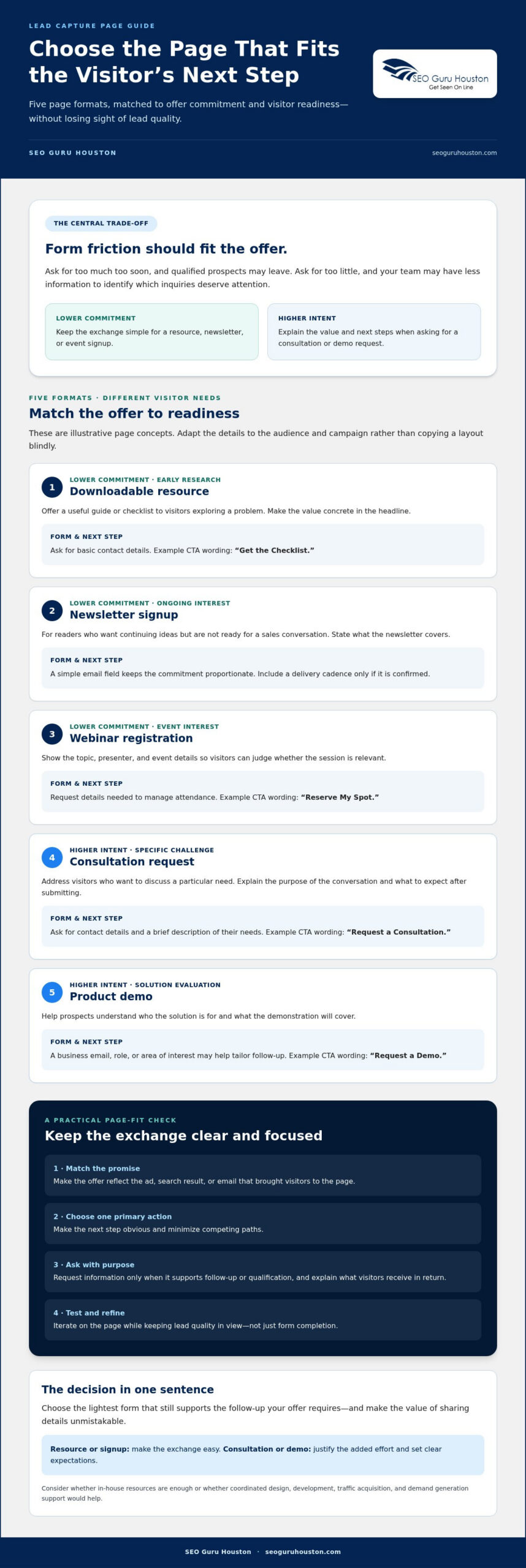
Then balance form friction with lead fit. A low-commitment resource may need only basic contact details, while a consultation request may justify asking about a business need or role. Request information only when it supports a clear follow-up or qualification purpose, and explain what visitors receive in return. The exchange should feel relevant and straightforward.

5 Lead Capture Page Examples for Different Offers and Buyer Stages

The right page format depends on what visitors are ready to do and what you’re asking them to share. These five concepts are illustrative, not client examples, case studies, or claims of proven results. Use them to shape a page around your offer, then adapt the details to your audience and campaign.

The more commitment an offer asks of a visitor, the more clearly the page should justify that effort and explain what happens next. Unbounce’s collection of lead capture page examples can offer additional design ideas, but the best model still depends on your offer and traffic source.

Examples for lower-commitment offers and early-stage visitors

  • Downloadable resource: For visitors researching a problem, offer a useful guide or checklist in exchange for basic contact details. A headline such as “Plan Your First Product Launch With This Step-by-Step Checklist” makes the value concrete. Keep the form concise and use a direct CTA such as “Get the Checklist.”
  • Newsletter signup: Invite readers who want ongoing ideas but aren’t ready for a sales conversation. State the subject matter, and include a delivery cadence only if it’s confirmed. A simple email field and “Sign Up” CTA keep the commitment proportionate.
  • Webinar registration: Feature the topic, presenter, and event details so visitors can judge the session’s relevance before sharing information. Ask for the details needed to manage attendance, and make the next step clear with a “Reserve My Spot” CTA.

These lower-commitment offers can attract people at different stages of interest. A short form reduces effort, but a signup alone doesn’t establish whether someone is a strong fit for a future sales conversation.

Examples for higher-intent prospects and considered purchases

  • Consultation request: Address visitors who want to discuss a specific challenge. Explain the purpose of the conversation and what to expect after submitting. Ask for contact details and a brief description of their needs, then use a CTA such as “Request a Consultation”—a structure used by platforms like adudesk.com to assess project scope before matching homeowners with vetted professionals.
  • Product demo: Help prospects evaluating a solution understand who it’s for and what the demonstration will cover. A form might ask for a business email, role, or area of interest if those details help tailor the follow-up. “Request a Demo” makes the next step clear.

Consultation and demo pages ask for a stronger signal of intent than a newsletter signup, so additional questions may be reasonable. Tie each field to a real qualification or follow-up need. Greater commitment doesn’t guarantee a better-fit lead. If page execution is a challenge, landing page design and development is one area of support to consider.

How to Compare Lead Capture Page Examples Before Choosing a Format

Don’t choose a page format just because it looks polished. Compare each option against the offer, the visitor’s likely readiness, and the information your team needs next. This makes the trade-off clear: the effort required from visitors should be proportionate to the value they expect to receive.

Create a comparison table with one row per format and columns for:

  • Offer: What does the visitor get?
  • Visitor readiness: Are they exploring a problem or evaluating a solution?
  • Form fields: What information is essential?
  • CTA: What action will the visitor take?
  • Qualification purpose: How will the details support follow-up or help assess fit?

Then check message match. A page reached from a search result, ad, email, or referral should continue the same conversation. If an ad promises a product demo, the headline should confirm that offer and the page should explain what the demonstration covers. This alignment helps visitors see that they’re in the right place. It also supports lead generation by connecting initial interest to a relevant next step.

For guidance on coordinating page structure and conversion elements, see this guide to high-converting landing page design.

How many form fields should a lead capture page use?

Start with the fields required to deliver the offer or take the promised next step. A resource download may only need contact information, while a consultation form could ask for a brief description of the visitor’s needs. Add qualification questions only when the answers will meaningfully improve follow-up or help assess fit.

Shorter forms can reduce submission friction, while extra fields can provide useful context. Test changes against completed submissions and downstream lead quality, not form completion alone. Removing a field may increase responses while leaving your team with less information to prioritize inquiries.

Which trust and conversion elements belong on the page?

Use testimonials, credentials, or client logos only when they’re verified and you have permission to display them. Set clear expectations near the form: what information you’re requesting, what happens after submission, and where visitors can find privacy information. Avoid unsupported promises about data handling or compliance.

Make the primary CTA prominent and specific. “Get the Guide” or “Request a Consultation” tells visitors what action they’re taking; generic wording like “Submit” does not. Keep supporting details focused on reducing uncertainty rather than adding competing actions.

Lead Capture Page Examples: 5 Types That Turn Visitors Into Prospects

How to Build and Test a Lead Capture Page That Converts

A strong page starts before the first design choice. Define who it’s for, what the offer delivers, and where visitors will come from. Then make every element support one measurable conversion action. The patterns in these lead capture page examples can help you choose a format, but testing with your own audience shows whether the page is doing its job.

Conversion rate measures how often visitors submit; business value depends on whether those submissions become relevant, qualified opportunities. Track both where measurement allows, so you don’t judge the page by volume alone.

A practical lead capture page build sequence

  1. Set the target: Identify the intended audience, offer, traffic source, and event that counts as a conversion, such as a completed registration or request.
  2. Build the message: Write a headline that matches the original ad, search result, email, or referral. Add accurate, relevant supporting proof, a form suited to the offer, and clear privacy information. Draft a confirmation message that tells people what happens next.
  3. Check the experience: Test the page on mobile and desktop. Make sure form labels are clear, the page is usable with a keyboard, text is easy to read, and the form works from start to confirmation. Check loading performance before launch.

Keep the page focused on one primary conversion action. If visitors arrive from a campaign promising a consultation, don’t make them guess whether the page is about a download or a demo. The page and campaign should make the same promise.

For more ideas on improving page performance, explore this conversion rate optimization guidance.

What should you test and measure after launch?

Start with a baseline. Track page visits, form starts, completed submissions, and qualified outcomes where available. These measures help show where visitors drop off and whether submitted leads progress beyond the form.

Test one meaningful variable at a time, such as the headline, CTA wording, or form length. Compare results across relevant traffic sources, since visitors arriving from search may behave differently from those responding to an email. Don’t treat a small or inconsistent sample as a clear winner; gather enough evidence to make a useful decision.

Connect submissions to sales acceptance or another defined quality signal when your measurement setup permits. If the page generates more submissions but fewer appropriate prospects, revisit the offer, targeting, or form questions. Use page data and lead outcomes together to guide the next iteration.

Need support aligning landing page development with your acquisition strategy? Explore landing page and demand generation support.

When to Get Expert Help With Lead Capture Page Design

Your team may be able to build a straightforward page in-house when the offer is clear, the form works reliably, and someone can monitor results. Specialist support may help when page issues involve design, development, analytics, and the campaigns sending visitors. The goal isn’t simply to make the page look better. It’s to identify what’s preventing the page and its traffic strategy from working together.

Signs your page needs more than a visual redesign

A fresh layout won’t fix a mismatch between visitor intent and the offer. Before changing colors or rearranging sections, check whether the ad or search result sets an expectation the headline doesn’t meet, whether the offer is hard to understand, or whether form steps create confusion. These are possibilities to investigate, not diagnoses. Review page behavior and visitor feedback before deciding what to change.

Also check whether your measurement connects visits and submissions to useful outcomes, such as sales acceptance or a qualified inquiry. If tracking stops at the form, you may know how many people submitted without knowing whether those leads were relevant. Separate confirmed problems, such as a broken form, from assumptions that need evidence. That distinction helps your team focus its time and budget.

How landing page design fits into a wider growth strategy

A capture page doesn’t operate on its own. SEO, PPC, inbound marketing, or demand generation may bring visitors with different questions and levels of intent. Someone arriving from an educational search may need a resource, while a person responding to a campaign about a specific solution may be ready for a more direct offer. Reflect that context in the page copy and offer.

Coordination takes more than visual design. Development needs to support a usable page and functioning form; acquisition strategy needs to attract the intended audience; and the offer needs to give visitors a clear reason to act. For B2B teams, a considered B2B demand generation strategy can help frame how page activity fits into broader prospect development. Professional support can connect these pieces, but it does not promise a particular conversion rate or sales result.

If your team is reviewing lead capture page examples but needs help turning the right format into a functioning part of its acquisition strategy, discuss landing page design and lead generation with a team that offers website development and landing pages alongside SEO, PPC, inbound marketing, and demand generation.

Turn the Right Page Format Into Your Next Step

The strongest lead capture page examples do more than look appealing. They align the offer with visitor intent, ask for information in proportion to the value promised, and make the next action unmistakable. Choose a format that fits your audience’s readiness, then test the message, form, and CTA against both submissions and lead quality.

Keep the full journey in view. The promise in an ad, search result, or email should carry through to the page, and the page’s results should connect to meaningful business outcomes. That’s how a landing page becomes part of a coordinated growth strategy rather than an isolated design project.

SEO Guru Houston offers landing page design and website development, alongside SEO, PPC, inbound marketing, and demand generation capabilities. If you’re ready to connect page design with the way you attract prospects, explore landing page design and lead generation support. Start with a clear offer and a focused next step, then improve the page using what you learn.

Frequently Asked Questions

What is a lead capture page?

A lead capture page is a focused web page that collects contact or qualifying information in exchange for an offer, such as a guide, consultation, webinar, or product demonstration. It should explain the value visitors receive, what happens after they submit, and which action to take. Measure success by completed forms and whether the resulting leads are relevant to your business.

What should a lead capture page include?

A lead capture page should include a clear headline, a relevant offer, concise supporting copy, a visible form, and a button that describes the action. Add only evidence you can verify and have permission to use, such as testimonials or client logos. Explain what happens after submission and provide appropriate privacy information. Keep unnecessary navigation and competing calls to action from distracting visitors from the page’s main goal.

How many fields should a lead capture form have?

Use the fewest fields needed to deliver the offer or support the next step. A simple download may need only basic contact details, while a consultation request may benefit from a few questions about the visitor’s needs. Each extra field can add effort, so compare completion rates with lead usefulness. Test changes with enough relevant traffic before deciding which form works best for your business.

Do lead capture pages need a thank-you page?

A confirmation experience helps visitors know their submission was received and what to expect next. It might provide the promised resource, explain how follow-up will happen, or offer a relevant next step without distracting from the original conversion. Use a dedicated thank-you page or an on-page confirmation, depending on how you deliver the offer. Check that your analytics records the intended conversion accurately.

What is a good conversion rate for a lead capture page?

There’s no single conversion rate that defines success for every page. Results depend on the offer, audience, traffic source, buying stage, form requirements, and how you count conversions. Establish a baseline using consistent analytics, then assess completed submissions alongside lead quality. Compare similar traffic sources and campaign conditions. Treat external benchmarks cautiously, since their audience and measurement methods may differ from yours.

Should a lead capture page have navigation?

A focused page often limits navigation so visitors can concentrate on its offer and primary action. Still, removing every route to important information can create uncertainty or make the page harder to use. Consider the audience, offer, and page purpose when deciding what to include. Visitors should be able to access necessary privacy details and understand who is making the offer. Test meaningful alternatives rather than assuming less navigation is always better.

How do you test a lead capture page?

Start with a hypothesis tied to a measurable issue, such as an unclear headline or a form that asks for unnecessary information. Where practical, change one major element at a time and define success before the test begins. Review completed submissions alongside qualified outcomes, compare relevant traffic, and collect enough data to make a sound decision. Don’t call a winner based on a small or inconsistent sample.

Social Media Marketing Agency Houston: The 2026 Growth Blueprint

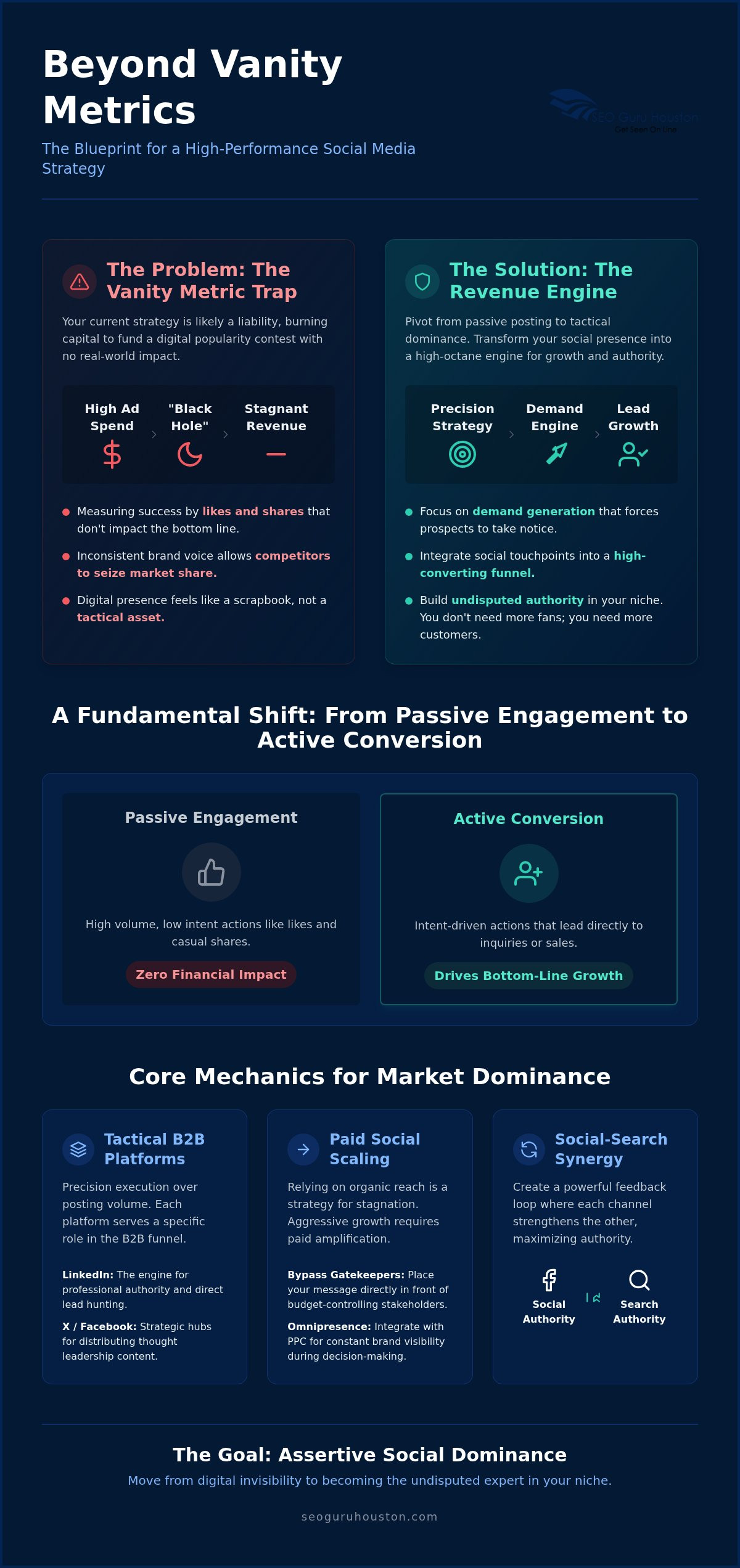
Your current social media strategy is likely a liability; it is certainly not the high-performance asset your business requires. If you are still measuring success by likes and shares while your conversion rates stagnate, you are essentially burning capital to fund a digital popularity contest. You understand the frustration of watching high ad spend disappear into a black hole of engagement that never impacts the bottom line. It is exhausting to manage an inconsistent brand voice while hungrier competitors aggressively seize your market share.

Choosing to work with a premier social media marketing agency represents a pivot from passive posting to tactical dominance. We are here to stop the budget waste and transform your digital presence into a high-octane revenue engine built for the 2026 landscape. You don’t need more awareness in a crowded market; you need demand generation that forces prospects to take notice. This blueprint outlines the exact path to achieving professional authority and measurable lead growth. We will show you how to move from digital invisibility to absolute prominence by focusing on precision-guided strategy instead of vanity metrics.

Key Takeaways

  • Identify the “Vanity Metric Trap” that drains your marketing budget and learn why likes don’t translate to liquidity.
  • Discover how a specialized social media marketing agency houston builds B2B authority through technical precision rather than just generic posting schedules.
  • Learn to integrate social touchpoints into a high-converting demand generation funnel that moves prospects from a scroll to a landing page.
  • Master a 5-step framework for vetting potential partners based on transparency and measurable business-outcome metrics instead of vague promises.
  • Adopt an assertive social dominance strategy that positions your brand as the undisputed expert in your specific niche.

Beyond Vanity Metrics: Why Your Current Social Media Strategy is Failing

You are likely tired of seeing a surge in “likes” while your revenue remains stagnant. It’s a common frustration for ambitious brands. You invest heavily in content and ad spend, yet the needle doesn’t move. This happens because most strategies treat social media as an optional luxury or a simple megaphone for brand awareness. That’s a fundamental mistake. To achieve market dominance, partnering with a high-performance social media marketing agency houston is a necessity. Social media is a tactical revenue driver, not a digital scrapbook. If your current approach doesn’t directly impact your bottom line, it’s failing you.

The Vanity Metric Trap: Likes vs. Revenue

A thousand likes might feel good, but they don’t pay the bills. If your engagement isn’t tied to a specific conversion path, it’s just noise. Passive engagement, where a user double-taps a post while scrolling, is fundamentally different from active conversion. A top-tier social media marketing agency houston focuses on the latter. Consider these points when evaluating your current strategy:

  • Passive Engagement: High volume, low intent, zero financial impact.
  • Active Conversion: Intent-driven actions that lead to inquiries or sales.
  • The “Quiet” Channel Reality: Channels with low follower counts often outperform “popular” ones if the audience is high-intent.

Evaluate your “active” leads compared to your “passive” followers. If the ratio is skewed toward likes rather than leads, your budget is feeding a trap that drains resources without delivering a return. You don’t need more fans; you need more customers.

Aligning Social Activity with Business Objectives

Stop posting for the sake of posting. Every piece of content must map to a specific stage in your sales funnel. Top-of-funnel content should spark demand, while bottom-of-funnel posts should drive immediate action. We prioritize demand generation over simple brand awareness because awareness alone doesn’t build authority. You need a strategy that positions you as the expert before the prospect even visits your site. Social ROI in the B2B sector is the measurable acceleration of a prospect through the sales cycle, specifically resulting in qualified lead acquisition and bottom-line growth.

The Mechanics of a High-Performance Social Media Marketing Agency

High performance isn’t a marketing buzzword; it’s a technical standard. While average firms “manage” your presence, an elite social media marketing agency houston engineers it for market dominance. This requires an assertive, proactive management style that moves beyond passive observation. You aren’t just waiting for people to find you; you’re actively positioning your brand where it cannot be ignored. You need a partner that understands how social signals like shares, dwell time, and mentions directly influence search engine visibility. This creates a powerful feedback loop where social authority builds search authority, and search authority reinforces social trust. If you aren’t leveraging this synergy, you’re operating at a significant disadvantage.

Tactical Execution Across B2B Platforms

In the 2026 landscape, LinkedIn serves as the primary engine for professional authority and direct lead hunting. It’s where high-value decision-makers reside and research potential partners. Meanwhile, platforms like X and Facebook act as strategic distribution hubs for industrial thought leadership. Success here isn’t about raw posting volume. The 2026 algorithms prioritize high-value content that generates meaningful dwell time and shares from industry experts. Your agency must understand these technical nuances to ensure your content actually reaches the intended audience rather than disappearing into a feed. This is about precision execution, not just creative flair.

The Critical Role of Paid Social in Scaling

Relying solely on organic reach is a strategy for stagnation. It’s insufficient for aggressive market dominance because the platforms have throttled non-paid visibility to near-zero for business pages. To scale rapidly, you must use precision-targeted ads to bypass traditional gatekeepers in the B2B sector. These ads allow you to place your message directly in front of the specific stakeholders who control the budgets. The impact is magnified when you integrate these social ads with high-performance ppc management. This multi-channel approach ensures your brand is omnipresent during the prospect’s decision-making process. If you’re ready to stop playing small and start dominating your niche, this technical synergy is non-negotiable. It transforms your social presence from a cost center into a predictable revenue generator.

Integrating Social Media into a Multi-Channel Demand Generation Funnel

Social media isn’t a standalone project. It’s a high-velocity catalyst for a broader b2b demand generation agency strategy. If you aren’t connecting your social touchpoints to high-converting landing pages, you’re just making noise. Every post must serve as a bridge. An assertive social media marketing agency houston ensures that your brand voice remains consistent across every digital channel. This alignment is what transforms a casual scroller into a high-intent prospect. You need a seamless flow that leads the target from a LinkedIn insight directly into your sales funnel. Without this integration, your social presence is just an expensive hobby.

Social Media as an Inbound Marketing Catalyst

Your social presence is the front line of your inbound marketing strategy for b2b. It isn’t about bragging; it’s about providing intense educational value that solves real-world pain points. Think of your brand as a high-performance coach. You guide your prospects through their technical challenges right there in the feed. When they see you providing solutions for free, their trust in your paid services skyrockets. This transformation from follower to qualified lead happens when you prioritize authority over fluff. A strategic social media marketing agency houston ensures your content acts as a precision tool for lead acquisition, not just a way to fill a feed.

Leveraging Video Marketing for Social Authority

Static images are losing their impact. You need website video marketing that is specifically adapted for social consumption. Professional, authoritative short-form technical videos establish your guru status in seconds. These aren’t generic commercials. They are high-impact clips that explain complex processes or demonstrate industrial expertise. By providing instant value, you force the algorithm to take notice. Short-form technical video increases dwell time by capturing immediate attention, which signals platform algorithms to prioritize your content and ultimately drives higher conversion rates at the bottom of the funnel. It’s about being the most useful voice in the room.

Social Media Marketing Agency Houston: The 2026 Growth Blueprint

Evaluating Your Next Partner: Metrics That Actually Matter for Growth

If you’ve hired an agency before and failed, you aren’t alone. Most firms sell abstract fluff because they can’t deliver measurable revenue. You don’t need a vendor to post pretty pictures; you need a social media marketing agency houston that acts as a high-performance growth partner. Stop accepting reports filled with impressions and start demanding accountability for every dollar spent. It’s time to vet your partners based on technical competency rather than generic star ratings. Use this 5-step framework to ensure your next partner is a revenue engine, not a budget drain:

  • Specialization Check: Do they understand the technical nuances of B2B and industrial sectors?
  • Framework Logic: Can they explain their demand generation process without using buzzwords?
  • Attribution Tools: Do they provide a dashboard that connects social clicks to CRM leads?
  • Proactive Strategy: Do they bring new ideas to the table, or do they just wait for your approval?
  • Outcome Focus: Is their primary KPI revenue growth or just “engagement”?

Vetting for Strategic Depth and Industry Expertise

You shouldn’t settle for an agency that treats your industrial brand like a lifestyle boutique. B2B social dominance requires deep strategic depth. Ask potential partners about their specific demand generation framework. A “vendor” will talk about posting schedules; a “growth partner” will talk about lead hunting and market share. If they can’t explain how their content specifically triggers a conversion event, they don’t have the expertise you need. You need a social media marketing agency houston that functions as an extension of your sales team, not just a creative department.

Transparency and Real-Time Reporting

Smoke and mirrors have no place in a high-performance marketing strategy. You must demand a dashboard that shows lead attribution in real time. If an agency only provides a PDF report at the end of the month, they’re likely hiding a lack of results. Monthly reports filled with “impressions” are useless if those impressions don’t lead to qualified inquiries. Demand accountability for every dollar of ad spend. You should see exactly how your social activity is feeding your funnel at any given moment. If you’re ready to move beyond abstract metrics, partner with an agency that prioritizes your bottom line over vanity stats. Progress must be measurable, or it simply isn’t progress.

The SEO Guru Method: Assertive Social Dominance

Ambition requires a partner that matches your drive. SEO Guru Houston isn’t just another social media marketing agency houston; we are high-performance coaches for brands hungry for market dominance. Choosing the right social media marketing agency houston is the first step toward reclaiming your market position and securing your digital future. We don’t believe in optional luxuries. We believe in fundamental necessities for business survival. Our approach integrates SEO, PPC, and social media into a single, cohesive engine designed to crush the competition. You don’t need a “trusted partner” who plays it safe. You need an assertive expert who knows how to navigate the rapidly changing digital trends of 2026. We move with precision. We act with authority. We deliver the bottom-line results that abstract agencies simply cannot reach.

Our Demand Generation and Lead Velocity Framework

Transitioning a prospect to a customer shouldn’t take forever. SEO Guru Houston uses a proprietary framework to accelerate lead velocity through platform-specific tactical hunts. While others wait for engagement, we actively hunt for high-value decision-makers on professional networks and social channels. Our technical expertise allows us to identify the exact moments when your target audience is most receptive to your message, turning cold prospects into warm inquiries with surgical precision. This assertive style produces results because it bypasses the noise of saturated markets. We focus on the technical nuances of algorithm priority, ensuring your content dominates the feed. Our method ensures that every social signal we generate reinforces your search visibility. It’s a feedback loop of authority. If you want to move from invisibility to prominence, you must adopt a strategy that prioritizes movement and precision over passive observation.

Direct Action: Your Trajectory to Market Dominance

Stagnation is the greatest risk your business faces in 2026. Every day you spend wasting budget on vanity metrics is a day your competitors gain ground. The digital landscape is unforgiving to those who hesitate. You have identified the gap in your current strategy. Now, you must bridge it. High ad spend with low conversion is a choice you no longer have to make. The 2026 market doesn’t reward those who wait for the perfect moment. It rewards those who create it through aggressive demand generation and relentless optimization. Transformation begins when you stop accepting mediocrity and start demanding financial return. SEO Guru Houston doesn’t linger on theories. We focus on execution. It’s time to take decisive action. We are ready to guide you, provided you are ready to win. Schedule Your Strategy Session today and begin your ascent to the top of your niche. Don’t let another quarter slip away into the void of “brand awareness.”

Seize Market Dominance in 2026

Social media isn’t an optional luxury; it’s a fundamental necessity for business survival and growth. You have learned that chasing vanity metrics like likes and shares is a budget-draining trap that yields zero ROI. True success in the B2B and industrial sectors requires an assertive, integrated strategy that connects social touchpoints directly to your revenue engine. By demanding transparency and technical precision, you move from digital invisibility to absolute prominence.

Partnering with a specialized social media marketing agency houston ensures your brand isn’t just part of the conversation; it leads it. As technical marketing gurus, we focus on results-oriented demand generation that turns passive followers into high-velocity leads. Don’t let your competitors dictate the pace of your industry while you wait for organic reach to return. It’s time to take decisive action and Scale Your Revenue with Assertive Social Strategy. You possess the blueprint for growth. Now you just need the high-performance execution to make it a reality. Your trajectory to the top of your niche starts today.

Frequently Asked Questions

How does a social media marketing agency drive actual revenue for B2B companies?

An elite social media marketing agency houston drives revenue by engineering a demand generation funnel that captures high-intent leads. We don’t just post content; we create tactical bridges between social touchpoints and conversion-optimized landing pages. By focusing on precision-targeted outreach and intense educational value, we accelerate your sales cycle. This reduces the time it takes for a prospect to become a customer, directly impacting your bottom line with measurable financial returns.

What is the difference between social media management and demand generation?

Social media management often focuses on the passive maintenance of your digital presence through regular posting and community interaction. Demand generation is an assertive strategy designed to create intense interest in your products or services. It uses technical marketing to identify and hunt for specific decision-makers within your niche. While management keeps the lights on, demand generation fuels the revenue engine by forcing prospects to take decisive action toward a purchase.

Why is an assertive social media strategy necessary in competitive markets?

In competitive markets, digital invisibility is a death sentence for your business growth. An assertive strategy is necessary to cut through the noise and seize market share from less aggressive competitors. You cannot wait for the market to find you; you must position your brand as a fundamental necessity. This proactive approach establishes authority immediately and ensures your message reaches stakeholders who control the budgets, making your dominance a mathematical certainty.

Can social media marketing help my website rank higher in search engines?

Yes, high-performance social activity creates a powerful feedback loop that enhances your search engine visibility. Social signals like shares, mentions, and increased dwell time on your site inform algorithms of your authority and relevance. When a social media marketing agency houston drives high-quality traffic to your pages, it reinforces your SEO efforts. This synergy ensures your brand remains omnipresent across both social feeds and search engine results pages for total market dominance.

How do you measure the ROI of a social media campaign in 2026?

We measure ROI by tracking hard business outcomes rather than abstract vanity metrics like likes or impressions. In the 2026 landscape, we utilize real-time dashboards to monitor lead attribution, customer acquisition costs, and total revenue generated from social touchpoints. You should demand accountability for every dollar of ad spend. If the data doesn’t show a clear path from a social interaction to a closed deal, the strategy is failing your bottom line.

What social media platforms are most effective for industrial and B2B brands?

LinkedIn remains the primary engine for professional authority and direct lead hunting in the B2B sector. Platforms like X and Facebook serve as strategic distribution hubs for industrial thought leadership and technical insights. Additionally, website video marketing adapted for social consumption is highly effective for establishing guru status. We focus on platforms where decision-makers conduct research, ensuring your assertive presence is felt exactly where the most significant financial decisions are made.

How long does it take to see measurable growth from a social media strategy?

Measurable growth begins with the immediate deployment of precision-targeted paid social ads, which bypass traditional gatekeepers. However, building total market dominance and organic authority typically requires a sustained effort over three to six months. This timeline allows the algorithms to recognize your brand as a high-value source of information. We prioritize lead velocity from day one, ensuring you see incremental progress while we scale your digital presence into a high-octane revenue engine.

B2B Digital Marketing Plan Template: The 2026 Assertive Blueprint for Market Dominance

88% of digital marketers are now using AI daily to drive a staggering 300% average ROI, yet most B2B firms are still flushing their ad spend down the drain on random acts of marketing. You’re likely exhausted by the technical complexity of the 2026 digital landscape and the lack of a proven b2b digital marketing plan template to align your activities with actual sales outcomes. It’s frustrating to watch your budget disappear into a black hole of low-quality leads while your competitors scale toward a $36 trillion B2B e-commerce market.

You don’t have to settle for invisibility or guesswork anymore. This guide provides the high-performance execution framework designed to transform your digital presence into a predictable revenue-generating engine. We’re going to strip away the fluff and build a roadmap for market dominance that includes demand generation frameworks, AI search integration, and reporting structures that command respect in the boardroom. It’s time to stop playing defense and start winning.

Key Takeaways

  • Stop the bleed on low-quality leads by mastering ICP deep-dives and brutal competitive gap analysis to identify market weaknesses.
  • Implement a high-performance b2b digital marketing plan template that transforms static documents into dynamic, revenue-generating execution engines.
  • Leverage professional SEO and aggressive PPC strategies to dominate the 2026 search ecosystem and capture high-intent traffic immediately.
  • Solve the complexity of dark social and multi-device journeys with advanced attribution modeling and a single source of truth for your data.
  • Secure your seat at the executive table with boardroom-ready reporting structures that prioritize bottom-line growth over vanity metrics.

Beyond the Document: Why Your 2026 B2B Marketing Plan Must Be an Execution Engine

A b2b digital marketing plan template isn’t a static PDF you bury in a shared drive. It’s a high-performance execution engine. In 2026, the divide between market dominators and struggling firms is defined by one thing: clarity of action. If you’re still committing “random acts of marketing”—launching sporadic LinkedIn posts or disjointed email blasts—you’re effectively subsidizing your competitors’ growth. Digital dominance isn’t a luxury for the Fortune 500; it’s a fundamental necessity for any business that wants to survive this decade. You need a “Guru” mindset that rejects abstract theories in favor of aggressive, bottom-line results.

The High Cost of a Passive Marketing Strategy

Invisibility is the fastest path to irrelevance. In competitive industrial and B2B sectors, a passive approach leads to rapid market share erosion. While your team debates “safe” corporate messaging, assertive competitors are capturing the high-intent traffic that should be yours. You can’t afford to wait for the market to come to you. You must go to the market with a strategy that commands attention and forces a response. This requires shifting away from outdated digital marketing strategies that focus on maintenance rather than growth. An Execution Engine is a dynamic, data-driven framework that continuously converts market intelligence into measurable revenue growth.

Shifting from Vanity Metrics to Revenue Realities

Stop reporting on “likes,” “shares,” or “impressions” as if they were currency. They aren’t. In the 2026 landscape, the only metrics that matter are pipeline velocity, cost per acquisition, and total contract value. Your marketing activities must have a direct, traceable link to sales outcomes. This is where demand generation beats simple lead generation every time. By building a plan focused on revenue realities, you ensure that every tactical move—from SEO to PPC—serves the ultimate goal of financial return.

  • Pipeline Velocity: Focus on how fast prospects move from the initial touchpoint to a closed-won deal.
  • Demand Generation: Create a hunger for your specific solution before the first sales call even happens.
  • Scalable Logic: Build a framework where you can increase spend and expect a predictable, non-linear increase in revenue.

If your current plan can’t answer these questions with hard data, it isn’t a plan. It’s a wish list. A professional b2b digital marketing plan template provides the rigid structure needed to turn those wishes into a predictable, scalable reality. You don’t need more “activity.” You need more impact.

Phase 1: Market Intelligence and High-Converting Funnel Architecture

Market dominance doesn’t happen by accident. It’s the result of superior intelligence and a funnel built like a fortress. If you’re using a generic b2b digital marketing plan template that treats every lead the same, you’ve already lost. In 2026, your strategy must be fueled by a deep understanding of Market Intelligence and High-Converting Funnel Architecture to stay ahead of the curve. You need to know exactly who your Ideal Customer Profile (ICP) is and, more importantly, exactly what keeps them up at 2:00 AM.

  • Step 1: ICP Deep-Dive. Move beyond job titles. Identify the specific business pressures and technical hurdles your personas face daily.
  • Step 2: Brutal Competitive Gap Analysis. Don’t just watch your competitors; dissect them. Find the keywords they’re ignoring and the service gaps they’re too slow to fill.
  • Step 3: Infrastructure Audit. Check your site for “conversion friction.” If it takes more than two clicks to find a solution, you’re losing revenue; technical experts like SEOSkinny can help audit and refine these digital touchpoints to eliminate friction and maximize conversion potential.
  • Step 4: Journey Mapping. The 2026 buyer journey is messy. Map out every touchpoint from the first search to the final advocate referral.

Defining Your Absolute Authority in the Market

Your value proposition must do more than inform; it must demand attention. In a sea of “me-too” services, your brand needs an emotional hook that resonates with professional B2B buyers. This starts with high converting landing page design. If your landing pages look like a 2015 brochure, you’re signaling to the market that you’re out of touch. Your foundation must be built on precision and authority. It’s about creating a presence that makes your competitors look like amateurs.

Building the Lead Generation Infrastructure

Data is the lifeblood of your execution engine. You must integrate your CRM with sophisticated marketing automation to ensure a seamless flow of information. A robust inbound marketing strategy for b2b is critical for capturing high-intent traffic before your competitors even know they’re in the market. Your tech stack should be lean, integrated, and focused entirely on accelerating pipeline velocity. To truly scale, you need a partner who understands how to turn these technical requirements into demand generation results that actually move the needle.

Phase 2: Deploying High-Energy Channels for Demand Generation and SEO

Intelligence is a paper tiger without the firepower to back it up. Now that you’ve mapped your funnel, you must deploy high-energy channels that force the market to acknowledge your presence. Your b2b digital marketing plan template must integrate SEO and PPC as a single, unified demand generation engine. In the 2026 landscape, where 47% of keywords now trigger AI Overviews, your strategy cannot just be about “ranking.” It must be about total footprint dominance. Professional SEO services provide the long-term compounding interest your brand needs to stay ahead of competitors who are still chasing yesterday’s algorithms.

Dominating the Search Ecosystem

Conquering the search results requires more than basic keyword stuffing. It demands an SEO marketing company mindset that treats search results as real estate to be conquered. High-performing B2B brands are shifting budgets toward video marketing to increase dwell time and build the trust necessary for high-value contracts. If your content doesn’t position you as the undisputed “Guru” in your niche, you’re just adding to the digital noise. You need to provide original research and technical insights that AI cannot replicate. This establishes the authority needed to turn a casual searcher into a loyal advocate.

High-Impact PPC and Paid Search Management

High-impact PPC is where you capture high-intent traffic immediately. Stop wasting your budget on broad terms that bring in window shoppers. We use an assertive approach to PPC management that targets buyers at the exact moment they’re ready to solve a problem. Paid search isn’t just for quick leads; it’s the ultimate validation tool for your long-term SEO investment. By identifying which keywords actually drive revenue, you can focus your organic efforts on the terms that matter most. Retargeting strategies then ensure your brand remains top-of-mind throughout the long, complex B2B sales cycle. Don’t let a prospect forget you just because they weren’t ready to buy on day one.

The synergy between paid visibility and organic authority creates a “surround sound” effect. When prospects see you at the top of the ads and the top of the organic results, your credibility doubles. This isn’t just marketing. It’s a strategic takeover of your industry’s digital landscape. You’re not just participating in the market; you’re defining it. Every click should be a step toward total market dominance.

B2B Digital Marketing Plan Template: The 2026 Assertive Blueprint for Market Dominance

Phase 3: Measuring What Matters—ROI, Attribution, and Scaling Logic

Stop measuring activities. Start measuring outcomes. If your b2b digital marketing plan template treats marketing as a cost center rather than a revenue engine, you’ve already lost the boardroom. You must establish a “Single Source of Truth” where marketing data and sales outcomes live in the same ecosystem. In the 2026 landscape, this is harder than ever. Research shows that while 88% of marketers use AI daily, only 19% are actually tracking AI-specific KPIs. Don’t be part of that gap. You need a data-driven framework that bridges the divide between a click and a contract.

Attribution in 2026 is a complex battlefield. Your prospects are moving through dark social channels like Slack communities and private DMs, making their journey nearly invisible to traditional tracking. They’re switching between mobile research and desktop demos across multiple devices. The Guru formula for ROI rejects simple “last-click” logic. We calculate return based on total pipeline contribution and the impact on total contract value (TCV). You’ll know it’s time to scale when your cost per acquisition remains stable while your pipeline velocity begins to accelerate. These are the signals of a high-performance machine.

The Metrics that Drive Executive Decisions

Executives don’t care about your click-through rate. They care about the relationship between Cost Per Lead (CPL) and Customer Acquisition Cost (CAC). A low CPL is a vanity metric if those leads never convert into paying customers. You must demonstrate exactly how much revenue marketing “touched” throughout the entire buyer journey. Measuring the velocity from the initial touchpoint to a signed contract reveals the true efficiency of your demand generation engine. This “Time to Conversion” metric is the ultimate indicator of your brand’s authority and its alignment with the sales team’s goals. For service-based firms ready to optimize these results, Tools N Tactics | Local SEO & Digital Marketing Solutions provides a Growth Partner Program that implements the integrated marketing engines required to drive scalable, high-performance growth.

Scaling isn’t just about throwing more money at a campaign. It’s about the strategic reinvestment of profits into high-yield digital channels that have already proven their worth. Many businesses fall into the “scaling trap” where efficiency plummets as soon as they increase their volume. To avoid this, you need the technical infrastructure and strategic oversight to maintain surgical precision at scale. Partnering with a b2b demand generation agency ensures you have the expertise to manage this rapid growth without sacrificing your ROI. You’re building a legacy, not just a campaign.

Ready to see the hard numbers behind your digital presence? Request a comprehensive demand generation audit to identify the exact levers you need to pull for market dominance.

The SEO Guru B2B Digital Marketing Template: Implementation and Next Steps

Dominance is a choice. This b2b digital marketing plan template is not a suggestion; it’s a mandate for survival in a 2026 market that rewards speed and punishes hesitation. Your executive summary is simple: we are moving from passive participation to aggressive market capture. Our vision is to own the search results and the buyer’s mindshare simultaneously. By linking every KPI to revenue growth rather than vanity metrics, you turn your marketing department into a high-performance profit center.

Your tactical roadmap follows a relentless 12-month rhythm. The first 90 days focus on infrastructure, fixing conversion friction, and launching aggressive PPC campaigns to capture immediate intent. Months four through eight are dedicated to building organic authority through professional SEO and original research that positions you as the niche “Guru.” The final stretch is about scaling what works and expanding your footprint into every corner of the digital ecosystem. Budgeting follows the 2026 Gartner benchmark of 7.7% of total revenue, with a heavy 25-30% allocation toward SEO and content to ensure long-term compounding returns.

How to Use This Template for Maximum Impact

Generic plans fail because they ignore the nuances of industrial and manufacturing sectors. You must customize this framework to speak the specific language of your niche’s pain points. Set 12-month growth targets that are uncomfortable but achievable with the right execution engine. To stay ahead of shifting algorithms and competitor moves, you must conduct quarterly “Guru Audits.” These aren’t just status updates; they are strategic pivots based on hard data and pipeline velocity. If a channel isn’t contributing to the bottom line, cut it and reinvest in the winners.

Taking Decisive Action

Speed to market is your greatest competitive advantage. While your competitors are stuck in committee meetings, you should be deploying landing pages and capturing leads. When pitching this plan to stakeholders, don’t talk about “brand awareness.” Talk about market share, pipeline contribution, and the cost of inaction. Show them the roadmap to a $36 trillion B2B e-commerce market and explain that this budget is the fuel for that journey. You don’t ask for permission to grow; you present the blueprint for how it’s going to happen.

Ready to dominate? Partner with SEO Guru Houston to execute your blueprint and turn your digital presence into a revenue-generating engine today.

Seize Your Market Dominance Now

The divide between market leaders and struggling firms in 2026 is defined by the transition from static planning to a high-performance execution engine. You’ve seen the roadmap. You understand why disjointed marketing activities are a budget killer and how a structured b2b digital marketing plan template aligns your technical SEO and aggressive PPC efforts with actual revenue outcomes. It’s time to stop settling for mere visibility and start demanding dominance through data-backed strategies that prioritize pipeline velocity over vanity metrics.

Success requires more than just a document; it demands the specialized expertise of a partner with a proven track record of industrial and B2B growth. We deliver the assertive, high-ROI management necessary to turn your digital presence into a non-stop lead generation machine. Don’t let your competitors capture the high-intent traffic that belongs to you. Take the first step toward total market prominence today.

Download Your Assertive B2B Marketing Blueprint and Scale Your Revenue!

You have the blueprint. Now, you just need the drive to execute. Let's start winning.

Frequently Asked Questions

What is a B2B digital marketing plan template?

It’s a structured execution framework that defines how a business will capture market share and generate revenue through digital channels. It moves beyond a simple document to become a dynamic roadmap for growth. It includes market intelligence, funnel architecture, and tactical execution steps. Using a professional b2b digital marketing plan template ensures that every marketing activity is linked to a specific business outcome rather than being a random act of marketing.

How is a B2B marketing plan different from a B2C plan?

B2B plans prioritize longer sales cycles and multiple decision-makers rather than impulsive consumer purchases. The focus shifts from emotional brand appeal to technical authority and ROI-driven messaging. You’re not just selling a product; you’re solving complex business problems. This requires a strategy built on demand generation and inbound marketing that nurtures leads over months. B2C plans often focus on immediate conversion and high-volume transactions, which doesn’t work for high-value industrial contracts.

What are the essential components of a 2026 B2B marketing plan?

A 2026-ready plan must integrate AI search optimization, advanced attribution modeling, and a high-converting digital infrastructure. Key pillars include deep ICP analysis, competitive gap assessments, and a unified SEO and PPC strategy. You need a tech stack that bridges the gap between marketing activity and sales outcomes. Without a single source of truth for your data, your plan will struggle to adapt to the technical complexities of the modern digital landscape.

How do I calculate the ROI of my B2B digital marketing strategy?

Calculate ROI by measuring total pipeline contribution and customer acquisition cost against total contract value. Don’t get distracted by vanity metrics like impressions or likes. Look at the time to conversion and how effectively your inbound efforts are shortening the sales cycle. A successful strategy shows a clear, non-linear increase in revenue as you scale your spend. It’s about bottom-line financial return, not just maintaining a digital presence.

How often should I update my B2B digital marketing template?

You should perform a Guru Audit every quarter to pivot based on real-time performance data and market shifts. While your core goals might stay the same for 12 months, the tactical execution must remain agile. The digital landscape moves too fast for annual reviews. Regularly updating your b2b digital marketing plan template allows you to reinvest profits into high-yield channels and cut underperforming tactics before they drain your budget.

Why do most B2B marketing plans fail to deliver results?

Most plans fail because they lack alignment between marketing activities and actual sales outcomes. They often focus on safe corporate messaging instead of assertive market positioning. If your plan is just a list of tasks without a clear revenue roadmap, it becomes a cost center. Failure also stems from a lack of technical expertise in professional SEO and PPC management, leading to wasted ad spend on low-quality leads that never convert.

Can I use this template for industrial or manufacturing marketing?

Yes, this framework is specifically designed for high-stakes industrial and manufacturing sectors where technical authority is paramount. These niches require a specialized approach to demand generation that addresses complex buyer pain points. The template helps you move from invisibility to prominence by showcasing your expertise through website video marketing and original research. It’s about proving you are the most reliable partner in a competitive national market where trust is the primary currency.

Should I hire an agency to implement my B2B marketing plan?

Hiring an expert agency is a strategic necessity if you want to scale rapidly without the scaling trap of dropping efficiency. Internal teams often struggle with the technical nuances of 2026 SEO and PPC management. An agency like SEO Guru Houston provides the assertive, data-backed execution needed for market dominance. You gain access to a track record of success and specialized knowledge that turns your marketing plan into a revenue-generating engine.

B2B Inbound vs Outbound: 2026 Market Dominance Guide

The “inbound vs outbound marketing for b2b” debate is officially dead. If you’re still treating these as separate silos, you’re bleeding revenue and handing your market share to the competition. You’ve likely felt the frustration of pouring budget into “fluff” content that never converts, or watching your sales team burn through cold lists with zero authority to back them up. It’s a high-stakes environment where stagnant pipeline growth is the first sign of an obsolete strategy. You don’t need more busy work; you need a high-performance engine that produces measurable results.

We know you’re hungry for market dominance and tired of a high cost-per-acquisition. This guide reveals how to fuse aggressive outbound tactics with authority-driven inbound strategies to stop the leaks and start scaling your enterprise. Recent data from Landbase shows that while inbound leads close at a 14.6% rate, outbound still generates 55% of all B2B leads. You can’t afford to ignore either side of the coin. We’re providing a clear framework for budget allocation and a demand generation strategy that turns invisible companies into industry leaders. It’s time to build a pipeline that actually closes.

Key Takeaways

  • Transition from fragmented silos to a unified “allbound” strategy that maximizes lead volume without sacrificing the quality of your pipeline.
  • Build a compounding authority engine through professional SEO that transforms your digital presence from an optional luxury into a fundamental business necessity.
  • Master the art of precision hunting by replacing mass-blasting with hyper-personalized outreach to penetrate high-value accounts in record time.
  • Discover the optimal budget allocation for inbound vs outbound marketing for b2b to ensure your marketing spend fuels scalable growth rather than “fluff” content.
  • Implement a strategic demand generation blueprint that fuses authority with aggression to dominate your market and eliminate wasted marketing spend.

B2B Marketing in 2026: Why the Inbound vs. Outbound Debate is Obsolete

The “versus” mindset is a relic of the past that’s actively gutting your growth potential. If you’re still choosing between one or the other, you’re leaving massive revenue on the table. In 2026, market leaders don’t pick a side; they build an integrated machine. Inbound marketing is about creating a magnetic pull through authority and value. It’s the long game where you become the trusted advisor before a prospect even knows your name. Conversely, outbound is the proactive pursuit of specific, high-value accounts that match your ideal customer profile. It’s the precision strike. You need both to dominate.

The 2026 reality is brutal for those who rely on outdated playbooks. Buyers are now 70% through their journey before they ever engage with a salesperson. They’ve already read your whitepapers, checked your LinkedIn reviews, and compared your technical specs. If you aren’t visible and authoritative during that first 70%, you’ve already lost the deal. This fundamental shift makes the old inbound vs outbound marketing for b2b debate completely obsolete. You must be present at every touchpoint or risk total invisibility.

The Shift in B2B Buyer Behavior

AI-driven search engines and decentralized social proof have fundamentally changed how buyers find solutions. Prospects are no longer passive recipients of information. They’re actively avoiding generic outreach that doesn’t provide immediate value. If your outreach feels like a template, it’s going straight to the trash. You must be visible where they’re looking, whether that’s in AI search results or industry-specific forums. This Digital Marketing Overview highlights how complex this ecosystem has become. Visibility is no longer a luxury; it’s a requirement for survival in a crowded marketplace.

Defining the Modern Demand Generation Engine

Modern marketing has moved beyond the vanity metric of “leads.” Your primary KPI must be revenue. Inbound and outbound serve as the two high-pressure cylinders of a single growth engine. Inbound builds the credibility that makes your outbound efforts effective. Outbound provides the immediate momentum that inbound often lacks in the early stages. When these forces combine, you create a $ result that competitors can’t touch. Stop thinking about “channels” and start thinking about the total revenue outcome.

Demand Generation is the strategic fusion of authority-driven inbound content and assertive outbound outreach to create a predictable, scalable revenue stream.

By leveraging inbound vs outbound marketing for b2b as a unified front, you stop hoping for growth and start engineering it. This isn’t just about being found; it’s about being chosen. You’re building an engine that captures attention and converts it into cold, hard cash.

Inbound Marketing: Building an Unstoppable Authority Engine

Content isn’t just about “being helpful” anymore. In the 2026 B2B ecosystem, your content is the foundation of trust and the primary driver of market dominance. If your strategy lacks authority, you’re essentially invisible to the 70% of buyers who research solutions before contacting sales. While a basic Inbound Marketing Definition focuses on attracting customers, we view it as a high-performance engine designed to crush the competition. Professional SEO isn’t a marketing expense; it’s a compounding asset that shortens your sales cycle by answering technical questions before they’re even asked.

The internal debate regarding inbound vs outbound marketing for b2b often misses the point of how authority functions. Inbound creates the gravitational pull that makes your brand the obvious choice. When your website functions as a high-converting lead generation machine, you stop chasing leads and start selecting partners. This transition from invisibility to prominence is what separates stagnant companies from market leaders. You don’t need more content; you need content that asserts your expertise and demands attention.

Strategic SEO and Content Authority

Generic blogs are dead. If your content doesn’t provide deep, technical insights, it won’t rank in an AI-driven search environment. You need pillar pages that dominate competitive search markets and signal absolute authority to both users and algorithms. This is where Professional SEO Services become a fundamental necessity. By focusing on high-intent keywords and technical excellence, you build a moat around your business that competitors can’t easily cross. It’s about precision, not volume.

High-Converting Landing Pages as Your 24/7 Sales Team

Your landing pages shouldn’t look like digital brochures. They need to be assertive blueprints that lead a prospect toward a specific revenue-generating action. Conversion rate optimization is the silent driver of your bottom line. If you’re driving traffic to a weak page, you’re lighting money on fire. Utilizing High Converting Landing Page Design ensures that every click has the highest possible chance of becoming a high-quality lead. It’s about turning passive visitors into active opportunities through strategic design and persuasive copy.

Building this engine is the first step toward scaling your B2B enterprise and securing long-term growth. Without a solid inbound foundation, your outbound efforts will always struggle to find traction in a skeptical market.

Outbound Marketing: Precision Hunting for High-Value Targets

If inbound is the magnet that attracts the crowd, outbound is the spear that strikes the target. While authority-driven content builds your long-term foundation, outbound marketing remains the fastest way to penetrate new markets and secure high-value accounts. For brands that need to dominate major industry events or conventions, high-impact solutions from VIP Outdoor Media ensure your message is impossible to ignore. You don’t have time to wait for the algorithm to find you when revenue targets are looming. In 2026, the successful “guru” approach to outbound isn’t about being a nuisance; it’s about acting as a high-performance coach who provides immediate solutions to critical business pains. Mass-blasting is a suicide mission for your brand reputation. Precision is the only path to dominance.

Paid search is your primary tool for forcing visibility in saturated markets. It allows you to capture high-intent buyers the exact moment they search for a solution. However, most businesses bleed budget on generic keywords that never convert. You need a data-driven approach that stops the waste and focuses on high-ROI opportunities. Implementing professional PPC Management is a fundamental necessity for stopping budget leaks. We don’t just buy clicks; we acquire market share by dominating the top of the search results with surgical precision.

Account-Based Marketing (ABM) as the Ultimate Outbound

ABM is how you target the “whales” of your industry. This isn’t marketing to a crowd; it’s marketing to a specific list of the top 1% of your market. We use a synergy of hyper-personalized video marketing and direct outreach to ensure your message isn’t just seen, but felt. Assertive follow-up is the non-negotiable growth engine here. If you stop after the first touch, you’ve already failed. Research shows that modern outbound has shifted from quantity to quality, focusing on personalized, data-driven outreach that treats every prospect like a strategic partner. This assertive stance ensures you’re not just another voice in the inbox; you’re the only solution they need.

B2B Inbound vs Outbound: 2026 Market Dominance Guide

The Comparison: Choosing Your Weapon or Building an Arsenal?

To implement this level of precision in your own outreach, you can learn more about Virtual Sales Limited and their expert approach to B2B appointment setting.

Stop treating inbound vs outbound marketing for b2b as a binary choice. It’s not a competition; it’s an arsenal. If you’re only using one, you’re fighting with one hand tied behind your back. Speed of results is the outbound advantage, providing the immediate velocity needed to hit quarterly targets. Long-term asset value is the inbound prize, building a foundation that reduces your dependency on paid channels over time. You don’t just pick a strategy. You engineer a revenue machine that utilizes both.

Industrial and manufacturing sectors require a unique balance. These buyers don’t make impulsive decisions; they buy based on technical specifications and proven reliability. This is where an “Inbound-Led Outbound” strategy wins. You use authority-driven content to warm up the market, making your cold outreach feel like a welcome consultation rather than an interruption. It’s about looking at the real ROI, which factors in both the immediate cost-per-lead and the total lifetime value of the account.

When to Prioritize Inbound

If your industry is plagued by skepticism, authority and trust are your primary barriers to entry. You must prioritize B2B Inbound Marketing when you need to build a defensive moat against competitors with massive advertising budgets. Inbound methods cost 62% less per lead on average, making them the superior choice for sustainable, long-term growth. It’s the strategy for those who want to be sought out as the definitive expert in their field.

When to Unleash Outbound

There are moments when waiting isn’t an option. You unleash outbound when rapid scaling is required for new product launches or during aggressive funding rounds. It’s the tool for breaking into “Fortress” accounts where decision-makers aren’t actively searching for solutions because they don’t yet realize a better way exists. This requires an assertive mindset. You don’t wait for the market to come to you; you go out and take your share of it with precision and persistence.

The real ROI of inbound vs outbound marketing for b2b is found in the “allbound” approach. To start building your integrated growth engine, you need a partner who understands strategic demand generation as a fundamental necessity for survival.

Strategic Demand Generation: How SEO Guru Houston Fuses Both for Growth

Market leadership in 2026 isn’t achieved through hope or guesswork. It’s engineered through a blueprint that combines the magnetic pull of authority with the surgical precision of aggressive outreach. We’ve moved past the simplistic inbound vs outbound marketing for b2b comparison to create a unified front. This isn’t just about having a website or an email list. It’s about building an integrated funnel that captures attention at the moment of intent and converts it into a closed deal. If you want to dominate your sector, you need a strategy that balances the long-term value of authority with the immediate impact of precision hunting.

Stop looking for a service provider and start looking for a growth partner. A service provider checks boxes; a growth partner builds a revenue engine. We act as a high-performance coach, identifying the tactical gaps in your current strategy and providing the technical expertise to bridge them. In a landscape where buyers are more skeptical than ever, your digital presence must be a fundamental necessity, not an optional luxury. We don’t settle for visibility. We demand prominence.

The Demand Generation Framework

Our framework aligns your SEO, PPC, and content into a single, high-pressure revenue engine. We don’t care about vanity metrics like “impressions” or “clicks” if they don’t lead to financial returns. By positioning your firm as a B2B Demand Generation Agency, we ensure every marketing dollar is focused on measurable progress. We use data to track the transition from a cold prospect to a loyal client, optimizing every touchpoint along the way. This integrated approach ensures that your inbound authority supports your outbound aggression, creating a compounding effect that competitors simply cannot match.

Your Next Move for Market Dominance

The diagnostic approach is the first step toward transformation. We identify exactly where your pipeline is leaking and implement the assertive lead generation strategies needed to fix it. Waiting is the most expensive mistake a B2B firm can make in this competitive environment. Every day you spend debating inbound vs outbound marketing for b2b is another day your competitors are taking your market share. You have the choice to remain invisible or to take decisive action. It’s time to build the arsenal that secures your future. Contact SEO Guru Houston to dominate your market today and turn your growth goals into a predictable reality.

Secure Your 2026 Market Dominance: The Allbound Mandate

The era of choosing sides is over. In 2026, your business survival depends on a unified strategy that leverages both the pull of authority and the push of precision outreach. We’ve shown you that while inbound builds the defensive moat of trust, outbound provides the offensive velocity required to capture high-value accounts. Relying on “fluff” content or generic mass-blasting is a recipe for stagnation. You need a high-performance engine that converts every touchpoint into measurable revenue.

Navigating inbound vs outbound marketing for b2b requires more than just tools; it requires a partner who understands the technical nuances of industrial and manufacturing sectors. As your ambition-focused growth partners, we specialize in high-ROI demand generation and expert B2B search strategy. Don’t let another quarter slip away with a leaking pipeline. It’s time to transform your digital presence from an optional luxury into an unstoppable revenue driver. Ready to dominate your market? Get an assertive B2B growth strategy from SEO Guru Houston today! Your path to prominence starts with a single, decisive move.

Frequently Asked Questions

What is the main difference between inbound and outbound marketing for B2B?

Inbound marketing attracts prospects through technical authority and value while outbound involves the proactive pursuit of specific high-value accounts. The main difference lies in the direction of engagement and the level of intent. Inbound builds a magnetic presence that captures buyers during their self-serve research phase. Outbound uses precision hunting to force visibility on accounts that match your ideal profile. Both are essential cylinders in a modern demand generation engine.

Is inbound marketing more cost-effective than outbound in the long run?

Inbound marketing is significantly more cost-effective over a long-term horizon. Research indicates that inbound methods cost 62% less per lead than traditional outbound tactics. This happens because high-quality content and professional SEO create compounding assets that continue to generate leads without additional spend. While outbound offers immediate results, inbound builds a defensive moat that reduces your long-term cost-per-acquisition and increases the lifetime value of every customer you close.

Can a B2B company survive using only inbound marketing in 2026?

Survival on inbound alone is a risky gamble in a competitive 2026 market. While 76% of companies use inbound strategies, relying solely on pull marketing leaves you vulnerable to competitors who are aggressively hunting your top prospects. You need outbound to penetrate Fortress accounts where decision-makers aren’t actively searching. A pure inbound approach often lacks the velocity required to hit aggressive revenue targets during product launches or rapid market expansions.

How do I know if my business needs more outbound or inbound focus?

Your business needs an outbound focus if you require immediate pipeline growth or are entering a niche market with few active searchers. Conversely, prioritize inbound if high cost-per-acquisition or a lack of brand trust is stalling your sales cycle. Evaluating your current digital standing is the first step. If your sales team is burning through cold lists with zero authority to back them up, you must double down on your inbound foundation.

What are the best outbound marketing channels for industrial B2B companies?

Industrial B2B companies find the most success with Account-Based Marketing (ABM) and precision-targeted paid search. Personalized video marketing and technical webinars are also high-impact outbound channels that establish immediate credibility. These methods allow you to reach the top 1% of your market with a message that resonates. Avoid mass-blasting; instead, use data-driven outreach to position your firm as a savvy business strategist rather than a nuisance.

How long does it take to see real revenue from a B2B inbound strategy?

Real revenue from a B2B inbound strategy typically takes 6 to 12 months to manifest as a consistent stream. This timeline accounts for the time search engines need to index your technical content and establish your site as an authority. However, high-converting landing pages can shorten this window by capturing intent-driven traffic immediately. It’s a fundamental necessity to view this as a long-term investment that builds compounding brand equity.

What is the ROI of combining inbound and outbound marketing?

Combining these methods creates an allbound synergy that can increase conversion rates by up to 21%. When you use inbound vs outbound marketing for b2b as a unified front, your outbound efforts become more effective because prospects already recognize your authority. This integrated strategy delivers higher quality leads that actually close. It moves your marketing from a fragmented expense to a strategic advantage that fuels predictable and scalable revenue growth.

How does AI change the inbound vs outbound marketing landscape?

AI has killed passive marketing and generic outreach. Search engines now prioritize deep, technical intent, making generic blogs a waste of budget. On the outbound side, AI allows for hyper-personalization at scale, meaning your prospects now expect every message to be relevant to their specific business pains. Staying ahead of these digital trends requires an assertive stance and a commitment to using advanced data for every lead generation tactic.

What is Demand Generation Marketing? The Assertive Growth Blueprint for 2026

If your sales team is fighting for every scrap of attention in a saturated market, your current strategy isn’t just failing; it’s obsolete. You’re likely exhausted by stagnant pipeline growth and the high cost of low-quality leads that never convert. It’s a brutal reality when 52% of marketers now rank driving a qualified pipeline as their absolute top priority. To survive, you must master what is demand generation marketing to shift from total invisibility to industry dominance. This isn’t an optional luxury. It’s the assertive groundwork that makes your eventual sales inevitable.

You already know that traditional lead gen is broken. You’re ready for a predictable engine that generates revenue and builds deep prospect trust long before the first sales call. This guide provides the blueprint for 2026 market control. We’ll explore how to combine SEO and PPC into a high-performance growth machine. We’ll also examine the shift from lead volume to pipeline quality and the specific tactics you need to lower your acquisition costs while scaling your brand’s authority to new heights. If you’re hungry for $$$ and market share, it’s time to build a strategy that actually delivers.

Key Takeaways

  • Learn exactly what is demand generation marketing and how to build a holistic engine that generates intense interest for your solutions.
  • Identify the critical distinction between tactical lead capture and strategic cultivation to stop wasting budget on low-quality inquiries.
  • Master the integration of SEO and PPC to dominate search intent and position your brand as the undisputed technical authority.
  • Shift your focus from vanity metrics to high-impact revenue indicators like pipeline velocity and measurable financial returns.
  • Discover the competitive advantage of an assertive marketing partner in maintaining the high-performance pace required for 2026 market dominance.

Defining Demand Generation: The Engine of Market Dominance

Demand generation isn’t just a marketing buzzword; it’s the fundamental engine for business survival. If you’re tired of cold calling and begging for attention, you need to understand what is demand generation marketing. It’s the strategic bridge between total invisibility and market prominence. Instead of chasing leads, you’re building a system that attracts them through intense interest and buzz. In 2026, dominance belongs to those who own the conversation before a prospect even identifies their own problem. You don’t wait for the market to move; you force the market to move toward you.

Why Demand Gen is Non-Negotiable in 2026

We’ve moved past the era of information scarcity. Your prospects are drowning in information overload. To cut through the noise, you need an assertive brand voice that demands attention. Demand generation creates a competitive moat around your business. It makes your brand the default choice. By consistently delivering high-value technical insights, you establish yourself as the Guru of your industry. This psychological positioning ensures that when a need arises, your name is the only one that matters. Competitors can’t cross a moat built on years of established trust and authority. If you aren’t building demand, you’re merely surviving on the scraps left by those who do.

The Core Objectives of a High-Performance Program

A results-oriented program focuses on three critical outcomes that drive revenue. First, you must establish absolute authority within your specific B2B niche. This isn’t about being a choice; it’s about being the only logical choice. Second, you must educate the market. Most of your future customers don’t know they have a problem yet. Your job is to move them from unaware to solution-ready through strategic, high-value touchpoints. Finally, you must reduce friction in the sales cycle. A high-performance engine pre-qualifies prospects through content, meaning your sales team spends less time explaining and more time closing. To achieve this, you’ll need to leverage professional seo services and targeted PPC to dominate search intent. This approach ensures your brand is visible exactly when and where your prospects are looking for answers. You’re not just creating awareness; you’re creating a predictable pipeline for growth.

Demand Generation vs. Lead Generation: Why the Distinction Matters

Stop treating lead generation and demand generation as interchangeable synonyms. They aren’t. While lead generation is a tactical exercise in data capture, understanding what is demand generation marketing requires a broader, more strategic perspective on market cultivation. If you only focus on the capture, you’re essentially trying to harvest a crop you never planted. This lead-only approach results in bleeding budgets and a sales floor cluttered with low-quality inquiries that go nowhere. Demand generation is the strategic cultivation that ensures your lead generation engine actually has high-quality fuel to burn, which can be supplemented by specialized providers like ClosrLeads to maintain short-term sales momentum.

Relying solely on lead generation is a recipe for stagnation. When you target cold prospects without any prior brand affinity, your customer acquisition cost (CAC) skyrockets. Without the foundation of demand generation, your PPC and SEO efforts become twice as expensive. You’re forced to outbid every competitor for the same tiny sliver of bottom-funnel intent. You’re trapped in a transactional cycle that rewards the deepest pockets rather than the best solutions. To break free, you must move toward a transformational market presence where prospects are pre-sold on your expertise before they even fill out a form. Many firms find that high-energy B2B marketing is the missing link that finally makes their lead capture profitable.

Comparison: Scope, Goals, and Outcomes

The differences between these two methodologies are found in their execution and their ultimate impact on your bottom line. To dominate your industry, you must master the balance between them.

  • Scope: Lead generation is narrow, focusing strictly on capturing specific contact information. Demand generation is broad, focusing on market education, psychological positioning, and owning the industry narrative.
  • Goals: Lead gen seeks short-term conversion targets to hit monthly quotas. Demand gen builds long-term brand equity and authority that competitors cannot replicate through simple ad spend.
  • Outcomes: A lead-only strategy produces erratic spikes and high churn. A demand-first strategy creates a predictable, high-velocity pipeline where prospects move faster through the sales cycle.

Don’t fall for the misconception that demand generation lacks measurable ROI. It’s actually the primary driver of revenue efficiency. By warming the market, you improve every downstream metric, from click-through rates to sales close rates. You aren’t just getting more leads; you’re getting leads that are ready to buy because they already trust your brand. This is how you move from fighting for scraps to total industry dominance.

The Pillars of a Result-Oriented Demand Generation Strategy

Implementing an assertive Lead Generation Solution ensures you stop fighting for scraps and start owning your market share through high-quality pipeline growth and improved ROI.

To truly grasp what is demand generation marketing, you must view it as a multi-pronged offensive rather than a single campaign. It is the coordinated execution of four critical pillars that move your brand from the shadows to center stage. If you miss even one of these components, your pipeline will leak revenue and your growth will stall. You need a strategy that doesn’t just ask for attention but commands it through technical superiority and relentless visibility. This is the only way to build a brand that prospects already trust before the first sales call.

Content as a Strategic Weapon

Content isn’t just filler; it’s a strategic weapon used to dismantle competitor influence. You need to create ‘un-ignorable’ assets that address the high-stakes, practical realities your prospects face every day. This is where your inbound marketing strategy for b2b proves its worth. By producing deep technical guides and industry-shifting insights, you turn passive traffic into a predictable revenue stream. An assertive content approach moves prospects through the ‘unaware’ phase at record speed. Don’t waste time on surface-level fluff that your competitors are already churning out. Be direct, be authoritative, and be the Guru your industry needs to solve its most complex problems.

The Technical Foundation: SEO and PPC Integration

Your growth engine requires a technical foundation that supports long-term scaling. Combining professional seo services with aggressive paid search management is the fastest way to dominate search intent. PPC acts as the catalyst, generating immediate demand and visibility while your organic presence builds. Meanwhile, SEO captures ‘problem-aware’ searchers who are looking for experts to guide them. This integration ensures you own the top results for every high-value keyword in your niche. Remember, even the best SEO strategy fails if it leads to a weak destination. Your high converting landing page design must be built to handle the pressure of elite traffic and convert interest into action.

Social media, specifically LinkedIn, provides the platform for high-energy brand building. It keeps you top-of-mind with decision-makers who aren’t yet in a buying cycle. Pair this with website video marketing to provide the immediate value that modern B2B audiences crave. Video bridges the gap between a faceless corporation and a trusted advisor. It humanizes your technical expertise and accelerates the trust-building process. In 2026, if they can’t see your value in under sixty seconds, they’ll find someone else who shows it better. High-performance demand generation leaves no room for hesitation.

What is Demand Generation Marketing? The Assertive Growth Blueprint for 2026

Measuring Success: Demand Generation Metrics That Drive Revenue

Stop celebrating clicks and impressions. If your marketing dashboard is filled with vanity metrics, you’re measuring activity, not impact. To understand what is demand generation marketing in a high-performance context, you must look at the hard numbers that correlate directly with financial growth. You need a system that tracks how effectively you are moving prospects from total anonymity to a closed deal. This requires a shift in focus toward metrics that actually matter to the C-suite; specifically, pipeline velocity and the total contribution to revenue.

Pipeline velocity is the heartbeat of your growth engine. It measures the speed at which prospects move through your funnel, from the moment they first engage with your brand to the moment they become a sales opportunity. A high-velocity pipeline indicates that your demand generation is working as intended. It’s educating and pre-qualifying prospects so they don’t linger in the ‘maybe’ zone. Over time, an effective strategy also drives down your Customer Acquisition Cost (CAC). By building brand authority before the sales conversation starts, you reduce the friction and the expensive manual labor required to close a deal. This is why partnering with a specialized b2b demand generation agency is a fundamental necessity for companies that want to scale efficiently.

The ROI of Brand Authority

Being the ‘first choice’ in your market isn’t just a status symbol; it’s a massive financial advantage. When prospects trust your brand before they even speak to a representative, your sales team sees a significant spike in close rates. They aren’t fighting to prove value. They’re simply finalizing the terms of a solution the prospect already wants. To track this, we look at Marketing Influenced Revenue. In 2026, Marketing Influenced Revenue is defined as the total dollar value of won deals where the prospect engaged with demand generation touchpoints prior to becoming a formal sales lead. This is the gold standard for measuring the true impact of your assertive growth blueprint.

Advanced Tracking in the AI Era

Modern tracking requires more than just basic analytics. You need data-driven insights that account for the complex, non-linear B2B buyer journey. This includes monitoring ‘Dark Social,’ which refers to the brand mentions and recommendations that happen in private Slack channels, podcasts, and direct messages. While these aren’t easily tracked by traditional models, they are powerful indicators of growing demand. You must use cross-channel attribution to see the full picture of how your SEO, PPC, and content efforts work together. If you’re ready to stop guessing and start growing, it’s time to implement a result-oriented tracking system that proves your marketing ROI every single month.

Scaling with an Assertive B2B Marketing Partner

Most internal marketing teams are built for maintenance, not for market war. They often lack the aggressive, high-performance coach pace required to keep up with the 2026 digital ecosystem. If you want to truly master what is demand generation marketing, you need a partner that lives and breathes technical strategy. A specialized agency stays ahead of rapidly shifting trends, ensuring you aren’t just reacting to the market but actively shaping it. This level of focus allows your internal team to handle operations while your partner builds the engine of dominance.

Success in 2026 requires the total integration of demand generation, SEO, and PPC into a single, cohesive growth engine. Treating these as separate silos is a recipe for wasted budget and fragmented messaging. When these elements work in harmony, they create a cumulative effect of authority and visibility that competitors cannot easily replicate. You must identify a partner that focuses on measurable progress and financial returns over abstract fluff. If they can’t show you how their strategy impacts your bottom line, they aren’t the right fit for an assertive growth plan.

The SEO Guru Approach

Our methodology is built on transformation. We don’t settle for minor improvements; we move your business from market invisibility to undisputed prominence. With a proven track record of success in highly competitive industrial and B2B markets, we provide direct, results-oriented strategies. We treat your growth as a fundamental necessity for business survival. By leveraging deep technical expertise, we ensure that every campaign is optimized for high-impact results and measurable financial gain. We don’t just provide a service; we act as the savvy business strategist your brand needs to win.

Next Steps for Market Dominance

Achieving total industry dominance requires more than just a theoretical understanding of what is demand generation marketing. It requires decisive action and a brutal evaluation of your current digital standing. Start by looking at your existing awareness and education strategies with a critical eye. Where are the gaps that allow prospects to slip through to your competitors? Once you identify these weaknesses, you must take immediate steps to bridge the gap between your current reality and your ambitious revenue goals. The market in 2026 moves fast. If you aren’t leading the conversation, you’re already falling behind. It’s time to build a predictable engine for growth that makes your sales inevitable.

Command Your Industry: The Path to 2026 Dominance

Market dominance is never an accident. It’s the result of precision engineering and strategic foresight. You now understand that mastering what is demand generation marketing is the only way to move from industry invisibility to total prominence. By shifting your focus from simple lead capture to holistic market cultivation, you create a moat that competitors cannot cross. You have the pillars. You have the metrics. Now, you need the execution.

The 2026 market doesn’t reward the hesitant. It rewards the bold. As high-energy, results-oriented B2B experts, we specialize in market dominance strategies for the most competitive industries. Our proven track record shows that technical expertise, when paired with an assertive growth mindset, leads to undeniable financial returns. Don’t let your pipeline stagnate while your rivals scale. Stop guessing and start scaling with an assertive B2B demand generation strategy. Your transformation from a participant to a market leader starts today. Take the leap and own your future.

Frequently Asked Questions

What is the primary difference between demand generation and lead generation?

Demand generation focuses on creating intense interest and awareness across a broad audience, while lead generation is the specific act of capturing contact information. If lead gen is the harvest, demand gen is the soil preparation and cultivation. You can’t capture high-quality leads if nobody knows or trusts your brand yet. Demand generation builds long-term authority and desire, ensuring that when you finally ask for a lead, the prospect is already pre-sold.

How long does it take to see results from a demand generation campaign?

Expect to see initial engagement shifts within three to six months, though total market dominance takes longer. This isn’t a short-term hack; it’s a fundamental business strategy for survival. While PPC can drive immediate traffic, the deep psychological trust required for B2B sales builds over time. You’ll notice improved click-through rates and shorter sales cycles as your brand authority scales. Consistency is the only way to turn these efforts into a predictable revenue engine.

Is demand generation only for large B2B enterprises?

No, demand generation is a necessity for any business hungry for growth, regardless of size. In fact, smaller firms often benefit more by using assertive strategies to punch above their weight class. By establishing yourself as a technical Guru in a specific niche, you can outmaneuver larger competitors who rely on bloated budgets rather than precision. Every company needs a strategy to move from invisibility to prominence to survive the 2026 market.

What are the most effective channels for demand generation in 2026?

The most effective channels integrate technical expertise with high-energy engagement. SEO and PPC remain the foundational pillars for capturing search intent. However, website video marketing and LinkedIn social strategies are now essential for building trust at scale. B2B buyers in 2026 demand immediate value and visual proof of expertise. Combining these channels into a single growth machine ensures you stay top-of-mind throughout the entire buyer journey and effectively teaches you what is demand generation marketing in practice.

Can you do demand generation without a large content budget?

You can succeed by focusing on quality and technical depth over sheer volume. Most firms waste money on fluff that nobody reads. Instead, create a few ‘un-ignorable’ assets that solve your prospects’ most painful problems. Use your technical expertise to build authority in a narrow niche. When you understand what is demand generation marketing, you realize that one high-impact technical guide or video is worth more than a hundred generic blog posts produced by competitors.

How do I measure the ROI of my demand generation efforts?

Measure success through pipeline velocity and Marketing Influenced Revenue rather than vanity metrics like impressions. You need to track how quickly prospects move from their first touchpoint to a closed deal. While clicks are nice, they don’t pay the bills. Look for a measurable reduction in your Customer Acquisition Cost (CAC) over time. If your sales team is closing deals faster and with less manual effort, your demand generation strategy is delivering a real financial return.

Why is sales and marketing alignment critical for demand generation success?

Alignment ensures that the demand you create actually translates into revenue. If marketing generates interest but sales isn’t prepared to handle pre-qualified prospects, the entire engine stalls. Both teams must agree on what defines a high-quality opportunity and how to nurture it. This synergy reduces friction in the sales cycle and ensures a seamless experience for the prospect. Without alignment, you’re just burning budget on activity that doesn’t scale or drive market dominance.

What role does SEO play in a modern demand generation strategy?

SEO is the technical foundation that ensures your brand is visible when prospects are searching for solutions. It’s not just about rankings; it’s about owning the narrative for high-value keywords. By dominating search results, you position your firm as the undisputed authority in your field. This organic visibility builds passive trust and feeds your lead generation engine with high-intent traffic. It’s a critical component of any assertive growth blueprint for those looking to dominate their market.

B2B Marketing Solutions: The Assertive Guide to Market Dominance in 2026

B2B Marketing Solutions: The Assertive Guide to Market Dominance in 2026

In the hyper-competitive industrial markets of 2026, being “good enough” is a death sentence for your bottom line. You already know the frustration of watching competitors capture the spotlight while your brand remains invisible despite a superior product. You’re likely exhausted by stagnant lead quality and a cost-per-acquisition that relentlessly eats your margins alive. It’s time to stop settling for lukewarm results and start demanding market dominance.

This guide reveals the high-impact b2b marketing solutions that bridge the gap between being an industry secret and becoming an undisputed market leader. We’re moving past abstract theories to focus on measurable revenue growth. You’ll discover a clear roadmap for demand generation designed to filter out the noise and deliver high-quality MQLs and SQLs that actually convert. We’ll explore how to build absolute market authority through precision-engineered Houston SEO services and aggressive inbound strategies. Prepare to transform your digital presence from a passive expense into a high-performance engine of growth. Success in this landscape requires decisive action and a commitment to total visibility.

Key Takeaways

  • Realize why aggressive marketing is a fundamental necessity for growth, moving your firm from an industry secret to a dominant force.
  • Master the b2b marketing solutions that create synergy across digital channels to drive measurable revenue and absolute visibility.
  • Pivot from simple lead generation to demand generation to capture the high-quality MQLs your sales team actually needs.
  • Deploy specialized strategies for industrial and technical sectors that eliminate the waste caused by “one-size-fits-all” marketing.
  • Execute a clear roadmap to establish authority and ensure your brand is the first choice in a crowded market.

What are B2B Marketing Solutions? The Foundation of Market Dominance

Stop thinking of marketing as a support role. In the current economic climate, high-performance b2b marketing solutions are the primary engine of your business growth. These solutions represent a comprehensive suite of digital strategies designed to do one thing: dominate your niche. While traditionalists might preach a slow and steady approach, that mindset will leave you behind in 2026. Market dominance requires an assertive, strategic framework that moves beyond simple lead capture. We’re talking about total market orchestration where every digital touchpoint reinforces your authority.

The reality of Business-to-business (B2B) marketing has shifted. It’s no longer just about having a professional website. It’s about owning the digital space where your high-value prospects live and search. If you aren’t visible during the research phase, you’re effectively out of business before the first meeting is even scheduled. You need to be where the demand is, or you don’t exist.

The Core Components of a Modern B2B Stack

To win, you need a stack that works in harmony. This isn’t a buffet where you pick and choose; it’s a high-performance machine. Each component must be calibrated for maximum impact.

  • Houston SEO Services: This is your long-term authority builder. It ensures that when a prospect searches for a solution, your brand is the first and only logical choice. Without search visibility, your expertise remains a secret.
  • Houston PPC Services: Use this for immediate, high-intent traffic. It allows you to skip the line and put your offer directly in front of buyers ready to sign today. It’s about precision and speed.
  • Content Marketing: This establishes absolute industry expertise. You don’t just provide a service. You provide the definitive answer to your client’s most complex problems through strategic website video marketing and authoritative guides.

Why 2026 Demands an Assertive Approach

The search market is hyper-competitive. Every one of your rivals is fighting for the same digital real estate. In this environment, “digitalize or be forgotten” isn’t a threat; it’s a business reality for modern enterprises. You cannot afford to be an invisible brand in a crowded industrial market. If you aren’t leading the conversation, someone else will.

Modern b2b marketing solutions must be aggressive. You need to move from total invisibility to undeniable prominence. This requires a shift in perspective. You aren’t just looking for clicks or vanity metrics. You’re building a fortress of market authority that makes your competition irrelevant. Success belongs to the bold. Are you ready to stop being an observer and start being the market leader? The choice is simple: adapt your strategy now or watch your market share evaporate.

The Roundup: Top B2B Marketing Solutions for Rapid Growth

You can’t win with a fragmented strategy. To see real financial gain, you need total synergy across every digital channel. Most b2b marketing solutions fail because they treat channels like isolated silos. Tools only collect data; it’s your assertive strategy and execution that turn that data into a strategic advantage. Stop looking for “silver bullets” and start building a high-performance revenue machine. Each solution you deploy should act as a lever, multiplying your reach and your ROI.

  • Data Integration: Connecting CRM data with marketing platforms for a 360-degree view of the buyer journey.
  • Channel Synergy: Ensuring your SEO, PPC, and social efforts reinforce the same core message and authority.
  • Performance Tracking: Maintaining a relentless focus on MQL to SQL conversion rates and revenue contribution.
  • Automated Lead Generation: Utilizing AI-driven systems like The Fraction to streamline client acquisition and maintain a consistent pipeline of high-quality leads.

Result-Oriented SEO and Content Authority

Long-term organic dominance isn’t optional for firms that want to lead. Utilizing professional seo services ensures your brand owns the search ecosystem before your competitors even wake up. Content marketing does the heavy lifting of building trust long before your sales team picks up the phone. B2B content authority is the ability to answer a prospect’s most difficult questions before they ask. This level of strategic B2B Branding creates a digital moat around your business that competitors simply can’t cross. It’s about being the only logical choice in the prospect’s mind.

Aggressive PPC and Paid Search Management

Stop bleeding your budget on low-intent keywords that lead nowhere. Aggressive Houston PPC services identify the high-value traffic ready to convert right now. It’s about data-driven precision to maximize your ROI and squeeze every cent of value out of your ad spend. If your landing page design isn’t optimized for conversion, you’re effectively throwing money away. Every click must have a destination specifically designed to close the deal and move the needle on your bottom line. We don’t just buy traffic; we buy customers through ruthless optimization.

Inbound Marketing: Turning Traffic into Revenue

Think of your inbound marketing strategy for b2b as a perpetual revenue engine. It’s about nurturing leads through the funnel with automated precision and technical excellence. High-energy social media marketing isn’t for vanity metrics; it’s a tool for aggressive brand building and maintaining a constant, authoritative presence in your prospect’s feed. When these b2b marketing solutions work together, the results are explosive. You’ll see better engagement, faster sales cycles, and higher lifetime value. If you’re ready to stop guessing and start scaling, it’s time to evaluate your current Houston B2B marketing stack for gaps in execution.

Demand Generation vs. Lead Generation: The Strategic Shift You Need

Stop settling for mediocre lead lists. The most common objection we hear from executives is, “We’re already doing lead generation.” If that’s your stance, you’re likely leaving millions on the table. Lead generation is a reactive tactic. It focuses on capturing the tiny fraction of the market currently searching for a fix. Demand generation, however, is an assertive, proactive strategy. It is about creating a market where none existed before. You aren’t just looking for leads; you’re building a movement around your expertise.

In 2026, relying solely on lead capture is a recipe for stagnation. You’re competing for the same 3% of active buyers as every other firm in your niche. This narrow focus drives up your cost-per-acquisition and dilutes your ROI. Dominant brands don’t just wait for intent; they manufacture it. They use comprehensive b2b marketing solutions to educate the market and position themselves as the only viable choice before the prospect even knows they have a problem. This is how you achieve absolute market authority.

Why Demand Generation is the Lifeblood of Growth

Capturing existing intent is easy, but it’s also expensive. Creating new demand is where the real wealth is generated. Demand generation builds a massive pipeline of future buyers who are primed to choose you when they’re finally ready to sign a contract. It is the difference between a one-time transaction and long-term market control. The ROI of demand generation is the cumulative effect of brand authority and market share. When you partner with a b2b demand generation agency, you stop chasing the market and start leading it.

The Inbound Marketing ROI Equation

You need to calculate the real impact of your marketing spend. Stop obsessing over vanity metrics like clicks or impressions. These numbers might look good in a slide deck, but they don’t drive revenue. You must focus on revenue metrics that reflect the bottom line. Demand generation fundamentally changes your financial math. By building trust early in the buyer’s journey, you significantly lower the long-term cost-per-lead. Your sales team will spend less time convincing skeptics and more time closing deals with believers. This is how high-performance b2b marketing solutions scale a business with precision and speed. It isn’t about doing more marketing; it’s about executing the strategy that actually drives the bottom line.

B2B Marketing Solutions: The Assertive Guide to Market Dominance in 2026

Specialized Solutions for Industrial and Manufacturing Sectors

Industrial sales aren’t impulse buys. They are high-stakes, technical, and involve long, complex cycles. Generic marketing fluff is useless here. You need b2b marketing solutions that speak the language of engineers and procurement officers. In the industrial sector, your digital presence is your resume. If it doesn’t scream technical excellence, you’ve already lost the bid before the conversation even starts. You cannot afford a passive strategy when your competitors are aggressively digitalizing their sales funnels.

Scaling national operations requires industrial lead generation that filters for quality, not just volume. You don’t need a thousand random clicks; you need ten high-value contracts. Website video marketing plays a pivotal role in this process. It allows you to provide complex product demonstrations that prove your capabilities instantly. It bridges the gap between a technical spec sheet and a physical facility walkthrough, giving prospects the confidence they need to move forward without a site visit.

Industrial B2B Marketing: Digitalize or Be Forgotten

Engineers don’t want sales pitches. They want data, tolerances, and reliability. Winning high-value industrial contracts starts with being visible the moment a procurement officer begins their search. You need an seo marketing company that understands technical specs and industrial buyer behavior. If your content doesn’t address the specific pain points of your niche, it’s just noise that prospects will ignore.

Strategic SEO for industrial firms involves targeting long-tail technical terms that competitors often overlook. It’s about owning the niche terminology that indicates a buyer is ready to commit. When your technical expertise is mirrored in your search rankings, you establish an immediate sense of trust. This isn’t just about traffic. It’s about positioning your firm as the undisputed authority in your field. If you aren’t on the first page, you aren’t in the running.

Manufacturing Marketing: The 2026 Competitive Edge

Showcasing manufacturing capabilities requires a digital platform that reflects your physical precision. High-performance web development is essential for industrial credibility. Your site must be fast, secure, and intuitive for users who need information quickly. In the manufacturing space, B2B social media, specifically LinkedIn, is where high-level partnerships are forged. It’s a tool for high-energy brand building that keeps your facility top-of-mind for decision-makers across the country.

Digital solutions allow you to display your capacity and quality control processes with total transparency. By integrating these tools, you turn your website into a 24/7 sales representative that never sleeps. If you’re ready to stop losing ground to more digital-savvy competitors, it’s time to deploy aggressive Houston B2B Marketing strategies that deliver measurable results. Dominance in manufacturing isn’t just about what you build; it’s about how you market your ability to build it better than anyone else.

Implementing the Guru Strategy: Your Roadmap to Market Dominance

Knowledge without execution is a waste of resources. You’ve seen the power of high-performance b2b marketing solutions, but now you need a battle plan. Market dominance isn’t an accident; it’s the result of a calculated, aggressive roadmap. If you’re ready to stop being invisible and start driving measurable revenue, follow this implementation process. This is the exact strategy we use at SEO Guru Houston to turn stagnant brands into market leaders. Success requires more than just intent. It requires a relentless commitment to technical excellence and strategic pressure.

Phase 1: The Digital Audit and Market Assessment

Stop guessing and start analyzing. You must identify the exact gaps in your current digital standing before you spend a single dollar on new campaigns. Are you losing traffic to competitors? Are your conversion rates failing to meet industry benchmarks? Evaluate your rivals’ strategies to find exploitable weaknesses that you can own. Set aggressive growth goals for 2026 that actually challenge your organization. Don’t settle for incremental gains when total dominance is on the table. A thorough audit is the only way to ensure your foundation is strong enough to support rapid scaling.

Phase 2: Executing the Multi-Channel Blitz

Once you have the data, execute a multi-channel blitz. This isn’t about doing one thing well; it’s about integrating Houston SEO Services, Houston PPC Services, and Houston B2B Marketing for a cumulative effect. Every ad must lead to a high-converting landing page designed to close the deal. You need to create a digital environment where your brand is unavoidable. Scaling what works and ruthlessly cutting what bleeds your budget is the only way to maintain a high ROI. This phase is about momentum and precision. If a channel isn’t contributing to the bottom line, kill it and reinvest in what drives revenue.

Phase 3: Continuous Optimization and Scaling

Optimization is the final hurdle. “Set it and forget it” is a recipe for failure in a fast-paced market. Use data-driven insights to refine your demand generation engine constantly. This is a living process that requires technical expertise and strategic vision. You must monitor your MQL to SQL pipeline with a hawk-like focus. As you gather more data, you can predict buyer behavior and stay two steps ahead of the competition. Are you ready to take the next step and transform your business? Ready to dominate your market? Let SEO Guru Houston build your B2B solution!

Claim Your Position as the Undisputed Market Leader

The window for passive growth has closed. To win in 2026, you must pivot from reactive lead capture to aggressive demand generation that dictates market reality. We’ve explored how integrating technical SEO with high-intent PPC creates a revenue engine that competitors can’t ignore. For those in industrial and manufacturing sectors, generic strategies are a liability; you need precision-engineered b2b marketing solutions that respect the technical complexity of your sales cycle.

It’s time to bridge the gap between being an industry secret and a market leader. With over 10 years of assertive B2B growth expertise and a proven track record in industrial niches, our results-oriented “Guru” methodology is designed for firms ready to scale. Don’t let another quarter slip away with stagnant leads and low ROI. Stop losing revenue and start dominating your market with SEO Guru Houston! You have the roadmap. Now, take the decisive action required to own your digital space and drive measurable financial returns. Success belongs to those who act first.

Frequently Asked Questions

What are the most effective B2B marketing solutions for 2026?

The most effective b2b marketing solutions for 2026 center on a unified digital ecosystem that combines aggressive Houston SEO Services with high-intent PPC. You need a strategy that captures immediate demand while building long-term authority. This isn’t about single tactics; it’s about total market orchestration. By integrating data-driven insights across all channels, you ensure your brand is the only logical choice for high-value prospects ready to sign.

How is B2B marketing different from B2C marketing in a digital landscape?

B2B marketing differs from B2C primarily through its technical complexity and the length of the sales cycle. You aren’t selling to impulsive individuals; you’re convincing committees of engineers and procurement officers. The stakes are higher, requiring deeper technical content and authoritative demonstrations. While B2C relies on emotional triggers, B2B dominance is built on proven reliability, technical specs, and long-term financial return for the client.

Can B2B marketing solutions work for small industrial businesses?

Absolutely. Small industrial firms often have the advantage of agility and deep specialization. Use b2b marketing solutions to dominate specific technical niches that larger competitors overlook. By focusing on long-tail technical keywords and specialized content, a small business can establish absolute authority in its field. Digitalization allows you to punch far above your weight class and capture national contracts that were previously out of reach.

How long does it take to see ROI from B2B inbound marketing?

While PPC delivers immediate traffic, a comprehensive inbound strategy typically shows significant ROI within six to twelve months. This timeframe allows for the cumulative effect of brand authority and search rankings to take hold. You’re building a sustainable revenue engine, not just buying temporary visibility. The long-term cost-per-lead drops significantly as your organic presence matures and your demand generation efforts begin to manufacture consistent market intent.

What is the difference between demand generation and lead generation?

Lead generation is a reactive process of capturing the small percentage of buyers currently in the market. Demand generation is the assertive strategy of creating a market that didn’t exist before. It involves educating prospects and building brand preference long before a purchase decision is made. One captures existing intent; the other manufactures it. To dominate your sector, you must move beyond simple capture and start driving the conversation.

Why do I need a specialized B2B marketing agency instead of a general one?

General agencies lack the technical depth required to speak to engineers and industrial buyers. You need a specialized partner that understands complex product specs and high-stakes procurement processes. A specialized B2B agency focuses on revenue metrics and industrial credibility rather than vanity metrics like social likes. Without this specialized knowledge, your marketing will feel generic and fail to build the trust necessary to close high-value contracts.

How much should a B2B company spend on digital marketing solutions?

Investment levels vary based on growth goals, but high-performance firms typically reinvest a percentage of their gross revenue into digital growth. It’s not about the cost; it’s about the return on ad spend and the lifetime value of the contracts you win. If your current spend isn’t driving measurable revenue, it’s an expense. When calibrated correctly, your marketing budget becomes a high-yield investment in your firm’s market dominance.

Is social media marketing effective for B2B manufacturing companies?

Social media is highly effective when used as a platform for high-energy brand building and technical authority. For manufacturers, LinkedIn is the primary tool for reaching decision-makers and showcasing facility capabilities. It isn’t for viral trends; it’s for staying top-of-mind with procurement officers and industry peers. Consistent, authoritative updates reinforce your market position and ensure you’re the first call when a new industrial project begins.

B2B Marketing for Tech Companies in Houston: The 2026 Dominance Blueprint

In 2026, being “good at tech” is no longer a competitive advantage; it’s the bare minimum for survival in today’s fiercely competitive landscape. If you aren’t aggressively positioning your brand to capture the immense economic impact generated by the tech sector, your competitors certainly are. You need a specific blueprint for b2b marketing for tech companies that doesn’t just participate in the market but ruthlessly dominates it.

You probably agree that managing complex sales cycles with a dozen stakeholders is exhausting, especially when your technical products are difficult to explain to the people holding the checkbook. It’s frustrating to watch your budget bleed out through unoptimized PPC campaigns that drive up your cost-per-lead without delivering real value. This stops now. You’re about to discover the assertive, high-ROI digital strategies, championed by SEO Guru Houston, required to turn your tech firm into a market-dominating powerhouse. This guide details the shift from passive lead collection to high-velocity demand generation and shows you how to establish absolute technical authority in your niche.

Key Takeaways

  • Adapt to the 2026 buyer who completes 70% of their research independently by shifting from passive word-of-mouth to an assertive digital presence.
  • Discover how to dominate high-intent engineering search terms and win high-stakes bidding wars with the technical pillars of b2b marketing for tech companies in houston.
  • Scale your revenue by implementing demand generation strategies that capture prospects before they even identify a specific technical problem.
  • Turn your technical website into an elite sales machine using SEO-first development and landing pages designed for psychological conversion.
  • Learn to evaluate growth partners based on data-driven ROI rather than “affordable” rates to secure your firm’s market-dominating position.

Why Passive B2B Marketing for Tech Companies is Obsolete in 2026

The “good old boy” network is failing. If you’re still relying on referrals to fuel your pipeline, you’re essentially handing your market share to the competition on a silver platter. In 2026, Houston has solidified its position as a top-tier tech hub, ranking as the No. 10 hub in North America. This means the sheer volume of local innovation has outpaced the capacity of traditional networking. Relying on passive strategies isn’t just risky; it’s a death sentence for growth. Modern Business-to-business (B2B) procurement has evolved. Buyers don’t want to be “sold” over a lunch meeting anymore. They want to find the solution themselves, vet your technical specs, and verify your authority before you even know they exist. This is why assertive b2b marketing for tech companies in houston is the only way to survive.

The data is undeniable. By the time a prospect reaches out to your sales team, they’ve already completed 70% of their research. They’ve read your case studies, compared your features against rivals, and judged your brand’s technical competence based on your digital footprint. If your website is just a digital brochure, you’re losing revenue you didn’t even know was on the table. Every day your site remains unoptimized, you’re experiencing an invisible revenue drain that bleeds your bottom line dry. You can’t afford to be invisible when the regional tech economy is generating over $21 billion in impact.

The Digital-First Tech Buyer Journey

Your prospects are CTOs, VPs of Engineering, and savvy procurement officers. These aren’t people who browse; they’re people who solve problems. They vet technical solutions at 2 AM. If your brand isn’t visible in those critical moments of high-intent search, you simply don’t exist to them. High-performance b2b marketing for tech companies in houston requires a 24/7 digital presence that acts as your most aggressive, non-stop salesperson. This digital presence shortens the complex B2B sales cycle by answering technical objections before they’re even voiced. It doesn’t take sick days. It doesn’t need a script. It simply presents the technical authority required to win the contract while your competitors are still waiting for the phone to ring.

From Marketing Cost-Center to Revenue Engine

Stop looking at marketing as a line-item expense. It’s time to treat it as a high-performance revenue engine. Most firms “spend” on ads and hope for the best. That’s a losing game. You must shift to “investing in growth” by identifying the massive gap between your current traffic and your true market potential. The Houston tech landscape is crowded and competitive. A “middle-of-the-road” strategy will get you middle-of-the-road results. You need a Guru approach that identifies intent before the buyer even realizes they have a problem. This isn’t about being seen; it’s about being the only logical choice for a company ready to dominate its niche.

The Technical Pillars of High-ROI Tech Marketing Strategies

Dominance in the Houston tech sector doesn’t happen by accident. It’s engineered. For firms specializing in software-as-a-service, industrial automation, or aerospace components, generic marketing is a waste of capital. You need a strategy that mirrors the precision of your own products. High-ROI b2b marketing for tech companies in houston relies on three core pillars: technical SEO, assertive paid search, and undisputed content authority. When these elements align, you don’t just participate in the market; you own it.

Establishing yourself as the “Guru” of your niche requires more than just a few blog posts. It demands a synergy of multi-channel visibility that targets the entire decision-making unit (DMU). From the engineer looking for latency specs to the CFO looking for a clear ROI, your digital presence must provide immediate, undeniable proof of your technical superiority. This is the only way to win in a city where the tech sector generates a $21.2 billion economic impact.

Search Engine Optimization for Technical Tech Niches

Most agencies stop at ranking for broad industry terms. We go deeper. Your buyers are searching for specific part numbers, software features, and engineering tolerances. If your site isn’t indexed for SKU-level details or “high-pressure sensor latency specs,” you’re handing high-intent leads to your competition. Technical SEO is the non-negotiable foundation of your digital dominance. It ensures your documentation and spec sheets are the first thing a CTO sees when they’re vetting a solution at 2 AM. This is where professional seo services become a strategic asset rather than an administrative expense. We optimize for the granular way tech buyers actually think.

Result-Oriented PPC and Paid Search Management

B2B bidding is high-stakes warfare. You aren’t just buying clicks; you’re buying access to the people holding the checkbook. In 2026, precision is everything. We utilize ppc management houston to target specific job titles, industries, and technical intents with surgical accuracy. Don’t let your budget disappear into the void of unoptimized, broad-match keywords that attract low-intent traffic. Instead, calculate your real ROI based on the lifetime value of a contract. Assertive paid search captures immediate intent, allowing you to outpace rivals who are still waiting for organic rankings to kick in. If you’re ready to stop guessing and start growing, it’s time to consult with a specialized Houston B2B Marketing partner to build your custom engine.

Demand Generation: Scaling Tech Revenue Beyond Simple Lead Gen

Lead generation is just the tip of the iceberg. If your strategy only targets the 5% of the market ready to sign a contract today, you’re fighting for scraps in a high-stakes bidding war. Modern b2b marketing for tech companies in houston requires a shift toward demand generation. This is the art of creating a need before the prospect even identifies a specific problem. While your competitors wait for a RFP to drop, you should be the one defining the requirements of that RFP. This proactive approach turns your brand from a reactive vendor into an essential strategic partner.

Nurturing the “hidden” 95% of the market is where the real revenue is won. These are the companies that need your solution but aren’t actively searching for it yet. By the time they start their search, they should already view you as the undisputed technical authority. Partnering with a specialized b2b demand generation agency allows you to build a long-term pipeline that delivers consistent, high-intent leads month after month. It’s about playing the long game with an assertive, short-term execution mindset.

The Inbound Engine for Technical Authority

Technical authority is not built on marketing fluff. It is built on data, engineering specs, and proven results. Your inbound marketing strategy for b2b must map directly to the complex tech funnel. CTOs and engineers aren’t looking for catchy slogans; they’re looking for technical whitepapers and industry reports that solve their specific pain points. When you provide a data-backed solution to a complex integration problem, you aren’t just “marketing.” You are establishing absolute authority. This content acts as a 24/7 consultant, educating your market and shortening the sales cycle before a salesperson even picks up the phone.

Converting High-Intent Traffic into Sales Meetings

Stop settling for a generic “Contact Us” form. High-performing tech websites use high-converting lead magnets that offer immediate value to the prospect. Whether it’s a proprietary ROI calculator or a technical configuration guide, your offer must be worth the exchange of a corporate email address. Once that lead is captured, you need lead scoring to prioritize high-value enterprise contracts. Don’t waste your sales team’s time on low-intent inquiries. Instead, use data-driven scoring to identify the prospects who are ready for a deep-dive technical demo. This bridges the gap between digital demand and your internal sales engine, ensuring every marketing dollar spent contributes directly to the bottom line.

B2B Marketing for Tech Companies in Houston: The 2026 Dominance Blueprint

High-Performance Execution: Turning Tech Websites into Sales Machines

Your website is not a digital business card. It’s your most lethal sales asset. If your development process didn’t start with a technical SEO audit, you’ve already lost the battle for visibility. In the competitive landscape of b2b marketing for tech companies in houston, your site must serve two masters: the detail-obsessed engineer and the bottom-line-focused executive. High-performance execution means building a platform that delivers granular technical documentation while simultaneously proving financial ROI. It’s a strategic engine designed to convert high-intent traffic into qualified sales opportunities with surgical precision. If your current site feels like a hurdle rather than a bridge, you’re hemorrhaging revenue every single day.

The Anatomy of a High-Converting Tech Landing Page

Conversion is a science, not an art. Every pixel on your page must have a clear, assertive purpose. High-impact high converting landing page design integrates trust signals like ISO certifications and industry awards alongside technical documentation that engineers crave. In 2026, speed is both a ranking factor and a trust factor. If your specs don’t load in under two seconds, your prospect is already looking at a competitor’s site. Don’t just list features; use interactive demos or ROI calculators to engage prospects instantly. This level of interactivity provides immediate value and qualifies the lead before they even submit a form. If you want a site that actually closes deals, you need professional landing page development that commands attention and drives action.

Video Marketing for Technical Trust

Complex tech solutions are notoriously difficult to explain in text. Video marketing solves this by allowing you to demonstrate a software walkthrough or a hardware stress test in under 60 seconds. This “show, don’t tell” approach builds emotional and technical trust in high-stakes B2B environments where the cost of failure is astronomical. By seeing your solution in action, prospects feel a level of certainty that a static PDF simply cannot provide. Integrating video into your broader b2b marketing for tech companies in houston strategy ensures that your technical authority is communicated across every touchpoint, from search results to LinkedIn feeds. Don’t let your technical complexity be a barrier to entry. Use video to make your expertise undeniable and your solution the only logical choice.

Choosing a Growth Partner: Why Assertive Strategy Wins in Houston

Cheap marketing is the most expensive mistake your tech firm will ever make. In a city where the regional tech sector generates a $21.2 billion economic impact, settling for an “affordable” agency isn’t just a poor financial choice; it’s a strategic failure that gifts your market share to competitors. You aren’t looking for a vendor to check boxes or post generic social updates. You need a high-ROI growth partner that understands the high-stakes, high-complexity world of b2b marketing for tech companies in houston. Dominance requires an assertive strategy that moves your firm from digital invisibility to absolute prominence. If you aren’t the first name a CTO sees during their critical research phase, you’re losing revenue you didn’t even know was on the table.

The gap between a mediocre agency and a specialized seo marketing company is measured in millions of dollars of lost pipeline. Generic marketers don’t understand your technical specs, your long sales cycles, or the dozen stakeholders involved in a single B2B purchase. You need a partner who treats your growth with the same urgency and precision as your internal engineering team. Taking decisive action today is the only way to secure your position as a market-dominating powerhouse in 2026.

Evaluating Your Tech Marketing Partner

Choosing a growth partner is a high-stakes decision that requires a “trust but verify” mindset. Don’t be afraid to ask the hard questions. Do they truly understand your tech stack and the nuances of your specific sales cycle? Are they providing transparent, data-driven reporting that tracks every marketing dollar directly to your bottom line? A true partner doesn’t hide behind vanity metrics like “impressions” or “clicks.” They focus on high-intent lead volume and technical authority. You need a team as ambitious and assertive as your own firm. If they aren’t pushing you to dominate your niche, they’re simply holding you back from your true market potential.

The SEO Guru Houston Advantage

Our Guru approach is built on a foundation of technical mastery and assertive business strategy. We don’t just “do SEO”; we engineer digital systems that capture and convert high-intent demand. We’ve spent years refining the blueprint for b2b marketing for tech companies in houston, ensuring our partners outpace the competition through precision and technical authority. This isn’t about incremental gains or vanity metrics. It’s about total market transformation. We turn your online presence from a passive liability into your most aggressive sales engine. Contact SEO Guru Houston today to begin your technical transformation. It’s time to stop being a participant in the Houston tech scene and start being the dominant force that dictates the market.

Secure Your Technical Dominance in the Houston Market

The window for passive growth has slammed shut. To thrive in North America’s tenth largest tech hub, your firm must pivot from a silent participant to an assertive market leader. You’ve discovered that technical SEO and high-performance demand generation are the required fuel for a modern revenue engine. You now know that your website must be a precision-engineered sales machine that commands respect from both engineers and C-suite decision makers. This is the non-negotiable standard for b2b marketing for tech companies in houston in 2026.

Don’t let your technical authority go unnoticed while rivals capture the regional economic impact. Leverage our specialized B2B tech expertise and results-oriented demand generation to transform your digital presence into your most lethal asset. Success requires more than just “trying” marketing; it requires a commitment to absolute dominance. Your journey from invisibility to prominence starts with one decisive move. We’ve shown you the blueprint. Now it’s time to execute.

Dominate the Tech Market-Get Your High-ROI Marketing Blueprint from SEO Guru Houston!

The market is waiting for a leader. It’s time to claim your spot at the top and build the future of your firm today.

Frequently Asked Questions

Does digital marketing really work for complex B2B tech products?

Digital marketing is the primary way modern technical buyers vet solutions. Since 70% of the buyer journey is completed anonymously online, your digital presence is your first and most important sales interaction. It works by providing the engineering specs and technical proof points that CTOs require to move a project forward.

How long does it take to see a measurable ROI from tech-focused SEO?

You should expect to see significant organic movement within 6 to 12 months. Tech-focused SEO is a compounding asset that builds long-term technical authority. While paid search offers immediate visibility, SEO secures your position as the undisputed leader in your niche by capturing high-intent technical queries.

Why is demand generation better than simple lead generation for tech firms?

Simple lead generation only captures the small fraction of the market ready to buy today. Demand generation is superior because it builds a massive pipeline by educating the 95% of prospects who aren’t yet aware of their specific problem. This is a core component of effective b2b marketing for tech companies in houston if you want to own the market.

What is the most effective social media platform for B2B tech companies?

LinkedIn is the undisputed champion for B2B tech firms. It allows for surgical targeting of job titles, specific companies, and technical interests. It’s the ideal environment for distributing the technical whitepapers and video demos that establish your firm as an authoritative “Guru” in your specific industry.

How much should a Houston tech company spend on digital marketing in 2026?

Most high-growth tech firms treat marketing as a strategic investment rather than a cost center. While specific budgets vary based on your aggressive growth goals, you should allocate enough to maintain a dominant share of voice in your niche. In a competitive hub like Houston, under-investing is a recipe for digital invisibility.

Do we need a full website redesign or just better SEO for our tech firm?

How do you track the ROI of digital marketing in a 12-month sales cycle?

Tracking ROI in a long cycle requires multi-touch attribution and lead scoring. You must track micro-conversions, such as technical document downloads and demo requests, to see how digital touchpoints influence the final contract. This data-driven approach ensures every marketing dollar is working toward a closed enterprise deal.

What role does video marketing play in the B2B tech buying process?

Video marketing builds technical trust faster than any other medium. It allows you to demonstrate complex software or hardware solutions in under 60 seconds, which is vital for b2b marketing for tech companies in houston. Showing your solution in action removes the psychological barriers to a high-stakes purchase and proves your technical claims instantly.

B2B Lead Generation Strategies 2026: The Assertive Blueprint for Market Dominance

In 2026, the performance gap between market leaders and the struggling majority has widened to a brutal 4.7x difference in cost-per-lead. If you’re still burning budget on broad-reach demand generation or gated content that nobody wants to download, you’re essentially subsidizing your competitors’ growth. The reality is that the median B2B cost-per-lead has hit $213. Passive approaches are a fast track to bankruptcy. You need an aggressive, precision-targeted approach to b2b lead generation strategies 2026 if you want to capture high-intent leads and achieve true market dominance.

We understand the frustration of watching MQL-to-closed-won rates hover at a meager 2.4% while your sales cycle stretches toward 200 days. It’s exhausting to fight for attention in a saturated digital market where buying committees now average 11.2 stakeholders. This guide is your high-energy roadmap to reversing those trends. You’ll learn how to leverage AI-driven demand capture and sophisticated inbound tactics to secure higher quality leads that actually close. We’re moving past the fluff to deliver a measurable ROI-focused strategy that turns your marketing department into a revenue-generating powerhouse.

Key Takeaways

  • Stop chasing low-value MQLs and pivot to High-intent Qualified Leads (HQLs) by abandoning outdated static gated content.
  • Master the latest b2b lead generation strategies 2026 by integrating SEO-first development and website video marketing to build unshakeable brand authority.
  • Transition from simple demand capture to aggressive demand creation, ensuring your brand is the primary choice before a buyer even starts their research.
  • Replace generic homepages with high-converting landing pages specifically designed to navigate and persuade complex buying committees.
  • Secure a measurable ROI by prioritizing professional strategic partnerships over low-cost alternatives that fail to deliver market prominence.

The 2026 B2B Landscape: Why Traditional Lead Gen is Failing

The B2B arena in 2026 is a graveyard for companies clinging to 2022 tactics. If your strategy relies on “spraying and praying” content to capture Marketing Qualified Leads (MQLs), you’re fighting a losing battle. The median MQL to closed-won rate has stagnated at a pathetic 2.4%. This massive inefficiency is why the industry is pivoting toward High-intent Qualified Leads (HQLs). We’re moving beyond the traditional definition of lead generation as a volume game. Today, it’s about precision. Static PDFs and gated whitepapers are officially dead. B2B buyers, now navigating committees of 11.2 stakeholders, refuse to trade their contact data for a generic ebook they can summarize with an AI tool in seconds.

The Rise of Answer Engine Optimization (AEO)

The Satiation Point: Why “More Content” is No Longer the Answer

The digital landscape is drowning in AI-generated noise. Producing “more content” is a strategy for the mediocre. Generic blogs are a drain on your resources and a stain on your brand authority. We’ve reached a satiation point where buyers only respond to high-energy, high-conviction insights. In a world where the gap between top and bottom performers has widened to 4.7x in cost-per-lead, being “good enough” is a death sentence. You must bridge the gap between invisibility and prominence with an assertive digital presence. This isn’t just about visibility; it’s about business survival. You need a strategy that commands attention and forces the market to recognize your expertise. Mastering b2b lead generation strategies 2026 means prioritizing strategic authority over sheer volume every single time.

Inbound Supremacy: Scaling Traffic with SEO and Video Authority

If your website is just a static digital brochure, it’s a liability. In the high-stakes world of b2b lead generation strategies 2026, your site must be a high-performance engine designed to capture intent at the exact moment it manifests. This requires a radical shift toward SEO-first development. You don’t just “do SEO” on top of a finished site; you build the site around the search intent of your most profitable customers. To understand the technical architecture required for this level of dominance, you need to leverage professional seo services that prioritize the 2026 search ecosystem. Assertive content marketing isn’t about volume. It’s about establishing absolute authority so that when a lead lands on your page, they know they’ve found the market leader.

High-Performance Video Marketing for B2B

Website video marketing is no longer an optional add-on for B2B brands; it’s the primary vehicle for building trust. With buyers completing up to 70% of their research before ever speaking to a sales rep, video acts as your proxy. It humanizes complex industrial or manufacturing brands that otherwise feel cold and corporate. By positioning your executives as industry “Gurus,” you move from being a vendor to a strategic partner. We recommend a hybrid approach to maximize your ROI:

  • Short-form video: Use these to hook attention on social platforms and drive aggressive traffic to your core domain.
  • Long-form technical deep-dives: Host these on your site to satisfy the 11.2 stakeholders on the buying committee who require technical proof of your expertise.

SEO-First Web Development

Speed is your first impression. If your site takes more than two seconds to load, you’ve already lost the lead. In 2026, SEO-first web development demands flawless mobile-first design and advanced schema markup that feeds directly into AI answer engines. Your website shouldn’t just sit there. It should function as a 24/7 sales coach, guiding users through interactive funnels that qualify them in real-time. Turning your digital presence into a high-converting machine is a fundamental necessity for business survival. Without this technical foundation, your b2b lead generation strategies 2026 and broader demand generation efforts will fail to produce a measurable ROI. If you’re ready to move from invisibility to prominence, prioritizing your technical SEO foundation is the first decisive step.

Demand Generation vs. Lead Generation: The Assertive Shift

Capturing demand is a survival tactic; creating demand is a dominance strategy. Most companies confuse the two, wasting their 9.1% marketing budget on capturing existing interest while ignoring the power of creating it. Lead generation is the reactive process of catching someone who is already looking for a solution. Demand generation is the proactive, strategic process of creating intense market desire for your specific brand before a buyer even enters the market. If you want to move from being a commodity to a necessity, you need to partner with a b2b demand generation agency that understands how to build this “must-have” perception. Integrating both creation and capture into your b2b lead generation strategies 2026 is the only way to crush your competition in a saturated landscape.

Aggressive PPC Management for Rapid Scaling

Stop bleeding your budget on broad, low-intent keywords. In 2026, the median B2B cost-per-lead has climbed to $213, meaning every wasted click is a direct hit to your bottom line. We utilize a “Problem-Solution” framework for Google Ads that speaks directly to the pain points of your target audience. Instead of bidding on generic terms, we target long-tail, high-intent industrial search phrases that indicate a buyer is ready to take action. Data-driven advertising isn’t just a buzzword; it’s a fundamental necessity. You must use precise intent data to ensure your ads appear in front of the 11.2 stakeholders on the buying committee at the exact moment they need a solution. This assertive approach to PPC ensures you’re not just buying traffic; you’re buying market share.

The Social Media Engine: High-Energy Brand Building

LinkedIn marketing has evolved past boring corporate updates and “we are hiring” posts. To dominate in 2026, your social presence must exude aggressive authority. Your profile shouldn’t just list services; it should validate your “Guru” status through high-energy thought leadership and undeniable social proof. Buyers are 57% to 70% through their research before they even contact you. This means your social media engine must do the heavy lifting of building trust and validating your expertise while you sleep. Use case studies and technical deep-dives to prove your track record of success. By the time a lead engages with your sales team, the modern B2B buyer journey should have already convinced them that you’re the only viable choice. This is how you transform social media from a vanity metric into a high-performance lead generation tool.

B2B Lead Generation Strategies 2026: The Assertive Blueprint for Market Dominance

Interactive Funnels and High-Converting Landing Page Design

Generic homepages are where leads go to die. If you’re sending paid traffic or high-intent SEO visitors to your main index, you’re essentially lighting your marketing budget on fire. In the high-stakes landscape of b2b lead generation strategies 2026, every click must land on a page engineered for a singular, aggressive outcome. You need a dedicated environment that speaks directly to the specific pain points of the 11.2 stakeholders involved in the modern buying committee. This is about moving from a passive digital presence to an active conversion machine that leaves no room for hesitation.

The Anatomy of a High-ROI Landing Page

A dominant B2B landing page isn’t just a collection of features; it’s a logical argument for your market superiority. We utilize a strategic balance of short, punchy declarations to grab attention and deep, logical explanations to satisfy technical scrutiny. Your layout must eliminate all friction by following the “One Goal” rule. If a visitor has to think about where to click next, you’ve already lost the lead. We use bold formatting and symbols to emphasize $$$ financial gain and measurable ROI, ensuring your value proposition is impossible to miss. To master this structure, follow our comprehensive guide on high converting landing page design to ensure your site is built for absolute dominance.

Interactive Content: Beyond the Static White Paper

The era of the boring, static white paper is over. Today’s high-intent leads demand “Engagement Engines” like ROI calculators, self-diagnostic tools, and interactive assessments. These aren’t just gadgets. They are sophisticated data collection tools that allow you to segment leads for assertive sales follow-up in real-time. Integrating these interactive elements into your b2b lead generation strategies 2026 allows you to capture intent data that traditional forms simply cannot reach. When a prospect engages with a custom calculator, they’re providing you with the exact technical requirements and budget constraints you need to close the deal. This level of trackable content experience is a fundamental necessity for business survival. It transforms your lead gen funnel from a guessing game into a precision-guided revenue stream.

Stop settling for mediocre conversion rates and start building a digital infrastructure that wins. Partner with a team that builds high-performance landing pages to bridge the gap between invisibility and prominence.

Executing the 2026 Blueprint: Partnering for Market Dominance

Success in the current digital landscape isn’t about luck; it’s about the relentless execution of a proven framework. We’ve outlined the three pillars of b2b lead generation strategies 2026: Intent, Authority, and Action. If you aren’t capturing high-intent signals, establishing unshakeable authority through video and AEO, and driving leads into interactive funnels, you’re already falling behind. The gap between those who dominate and those who disappear is growing. Bridging that gap requires more than just “trying harder.” It requires a comprehensive inbound marketing strategy for b2b that prioritizes ROI over vanity metrics. You can’t win a 2026 market war with 2020 weapons.

Why a Growth Partner is Non-Negotiable

The complexity of the 2026 search ecosystem makes “DIY” marketing a recipe for failure. Between managing Universal Opt-Out Mechanisms (UOOMs) and navigating the nuances of Agentic Search Optimization, there is simply too much at stake for guesswork. “Affordable” alternatives often end up being the most expensive choice you can make because they fail to deliver results. You don’t need a vendor; you need a Guru. A true growth partner stays ahead of rapidly changing digital trends so you can focus on scaling your operations. We provide the specialized technical expertise and business strategy required to turn your marketing spend into a high-performance investment. Measurable progress is the only metric that matters. If your current agency can’t show you a direct line from their efforts to your bottom line, it’s time to move on.

Take Decisive Action Today

The cost of inaction is absolute. In a high-performance market where your competitors are already leveraging AI-assisted SDR programs to slash meeting costs, every day you wait is a day you lose market share. You must identify the gaps in your current strategy immediately. Are you still relying on gated content that buyers ignore? Is your website a static brochure or a 24/7 sales machine? The first step toward transformation is a commitment to excellence. We don’t settle for invisibility, and neither should you. It’s time to move from the shadows of the search results to the prominence of market leadership. Implementing aggressive b2b lead generation strategies 2026 is a fundamental necessity for your business survival. The blueprint is in your hands; the next move is yours. Take the decisive action required to crush your competition and secure your future dominance.

Secure Your Market Dominance in 2026

The window for passive growth has closed. To win in this landscape, you must pivot from volume-based outreach to high-intent precision. We’ve shown you why traditional gated content is failing and how video authority builds the trust necessary to close complex deals. Mastering b2b lead generation strategies 2026 is about more than just traffic. It’s about owning the answers your prospects are searching for before they even know they need them.

You don’t have to navigate this technical shift alone. As results-oriented B2B marketing experts, we provide the data-driven demand generation strategies and mastery of technical SEO and AEO required to bridge the gap between invisibility and prominence. The competitive landscape won’t wait for you to catch up. Stop losing revenue and start dominating your market; contact SEO Guru Houston today! It’s time to transform your lead generation engine and claim your place as the definitive industry authority. Success is waiting for those ready to take decisive action.

Frequently Asked Questions

What is the most effective B2B lead generation strategy for 2026?

The most effective b2b lead generation strategies 2026 prioritize High-intent Qualified Leads (HQLs) over raw MQL volume. You must integrate SEO-first development with aggressive demand creation to capture buyers who are already 70% through their research. This assertive approach ensures you aren’t wasting budget on low-intent clicks. It’s about being visible exactly when the buying committee is ready to take action and move toward a purchase.

How does AI search (AEO) impact B2B lead generation?

Answer Engine Optimization (AEO) forces you to provide direct, authoritative answers instead of just chasing keywords. AI models like SearchGPT and Perplexity now synthesize information for users, meaning your content must be structured to be the primary source they cite. If you aren’t the definitive answer, you’re invisible. This shift requires a technical mastery of schema markup and high-authority content that AI agents can easily parse and credit.

Should I focus on lead generation or demand generation?

You can’t afford to choose between them; you must execute both. Demand generation builds the market desire that makes your brand the obvious choice before a search even begins. Lead generation then captures that intent through precision SEO and PPC. Creating a high-energy brand presence ensures your lead capture efforts are 4.7x more efficient than those of your competitors who ignore the demand creation phase.

Why is video marketing considered a fundamental necessity for B2B in 2026?

Video is the only medium that effectively humanizes complex industrial brands for an 11.2-person buying committee. It acts as a 24/7 sales coach, providing technical proof and executive thought leadership while your team is offline. With buyers self-educating more than ever, video bridges the trust gap faster than any text-based content. It’s a fundamental necessity for survival in a saturated market where attention is the most valuable currency.

What is the average ROI for professional B2B inbound marketing?

Professional inbound marketing delivers a significantly lower cost-per-lead than other channels in 2026. While the median B2B cost-per-lead has hit $213, organic content and SEO maintain a median CPL of just $98. Top-performing programs report an even lower CPL of $84. This measurable ROI proves that investing in high-authority inbound strategies is a strategic financial advantage that crushes traditional, unfocused advertising methods.

How do I choose the right B2B digital agency for my industrial business?

Is gated content still effective for B2B leads in 2026?

Static gated PDFs are officially dead and no longer convert at profitable rates. In 2026, you must replace them with interactive Engagement Engines like ROI calculators and self-diagnostic tools. These tools provide immediate value to the prospect while giving you the granular intent data needed for assertive sales follow-up. Interactive experiences are the new standard for high-quality lead capture because they respect the buyer’s time and provide instant utility.

How often should I update my B2B lead generation strategy?

Your b2b lead generation strategies 2026 require constant optimization, with a full strategic audit every quarter. Rapid shifts in AI behavior and new data privacy laws, such as those that took effect in Indiana and Kentucky on January 1, 2026, demand immediate adjustments. Staying ahead of these trends isn’t an optional luxury; it’s a requirement for maintaining your market prominence. You must adapt quickly or risk being left behind by more agile competitors.