Tag Archives: Paid Search

How to Build a Full-Funnel PPC Campaign Structure for B2B

Paid search can work for B2B, but a campaign built only to capture immediate leads can miss buyers who need time to evaluate a solution. The average B2B sales cycle involves 8 touchpoints, so a scalable ppc campaign structure for b2b should connect search intent, useful follow-up, and sales outcomes across the journey.

If clicks are coming in but qualified opportunities aren’t, the issue may be how campaigns are organized and measured, not simply how much you spend. B2B buying groups take time to research, compare options, and reach a decision. Your campaign needs to reflect that reality.

This guide shows you how to assess paid search for B2B, choose metrics that matter beyond clicks and form fills, and connect ad activity to conversions across longer sales cycles. Then you’ll learn how to organize campaigns around buyer intent and funnel stage, so you can identify what’s working and make smarter decisions about where to scale.

Key Takeaways

  • Match search, display, placements, keywords, and audience targeting to the buyers and intent you want to reach.
  • Look beyond clicks and form fills by tracking lead quality, pipeline progress, and revenue alongside campaign metrics.
  • Connect ad interactions to CRM outcomes so long sales cycles don’t make valuable campaigns look ineffective.
  • Build campaigns around funnel stage and buying intent, then use performance data to guide where to refine and scale.
  • Align ad messaging, landing pages, and follow-up so each touchpoint moves qualified prospects toward a decision.

Does paid search work for B2B?

Yes. B2B companies generate an average of $2 for every $1 invested in Google Ads, according to the market data in this brief. Gartner reports that complex B2B solutions typically involve buying groups of 6 to 10 decision-makers. Structure campaigns to reach their different questions, not just one lead form.

Google and Microsoft campaigns typically organize around search intent and keyword themes. LinkedIn Ads can target professional audiences by role and industry. Separate campaigns by buyer stage to tailor each message, then compare qualified outcomes across platforms.

Group keywords by intent first: brand, problem, solution, and comparison terms. Separate match types into different ad groups or campaigns when they need distinct budgets, messaging, or query controls. Mixing them too broadly can obscure which searches generate relevant leads.

Common risks include grouping unrelated services together, targeting too broadly, and judging success by clicks alone. A generic “business software” keyword may attract research traffic, while a solution-specific query can signal clearer intent. Review search terms and audience results to identify wasted spend.

  1. Define buyer personas before selecting placements. List each high-value persona by role, industry, and buyer stage. A finance leader comparing vendors needs different proof from an operations manager researching a workflow problem. Use those distinctions to choose search, display, or audience-based placements, and align each ad with a relevant landing page.
  2. Separate search campaigns by intent and theme. Build focused groups for brand terms, pain-point searches, solution categories, and competitor-comparison intent. Keep closely related keywords together, but separate themes when the offer or landing page changes. For example, “reduce invoice processing time” and “invoice automation platform” suggest related needs, but different stages of research.
  3. Match platform structure to its targeting strength. On Google Ads, organize around keyword themes and use available targeting such as demographics, location, device, and interests. Apply a similar search-intent structure in Microsoft Ads, then compare performance separately. On LinkedIn Ads, segment by role and industry, with distinct campaigns for awareness and active consideration.
  4. Use display and remarketing to reconnect. Build display audiences from meaningful site behavior, such as visiting a solution page or viewing a case study. Exclude converted leads when the message is no longer relevant. Remarketing campaigns often achieve conversion rates 50-100% higher than cold traffic campaigns, according to the market data in this brief.
  5. Review targeting and placements as one system. Check search terms, audience segments, and placement reports together. If an industry segment clicks but produces poor-fit leads, refine its message or targeting. Test search, display, and video formats against the same buyer need, then shift effort toward the placements that create sales-relevant engagement.

What metrics should be tracked in B2B paid ads?

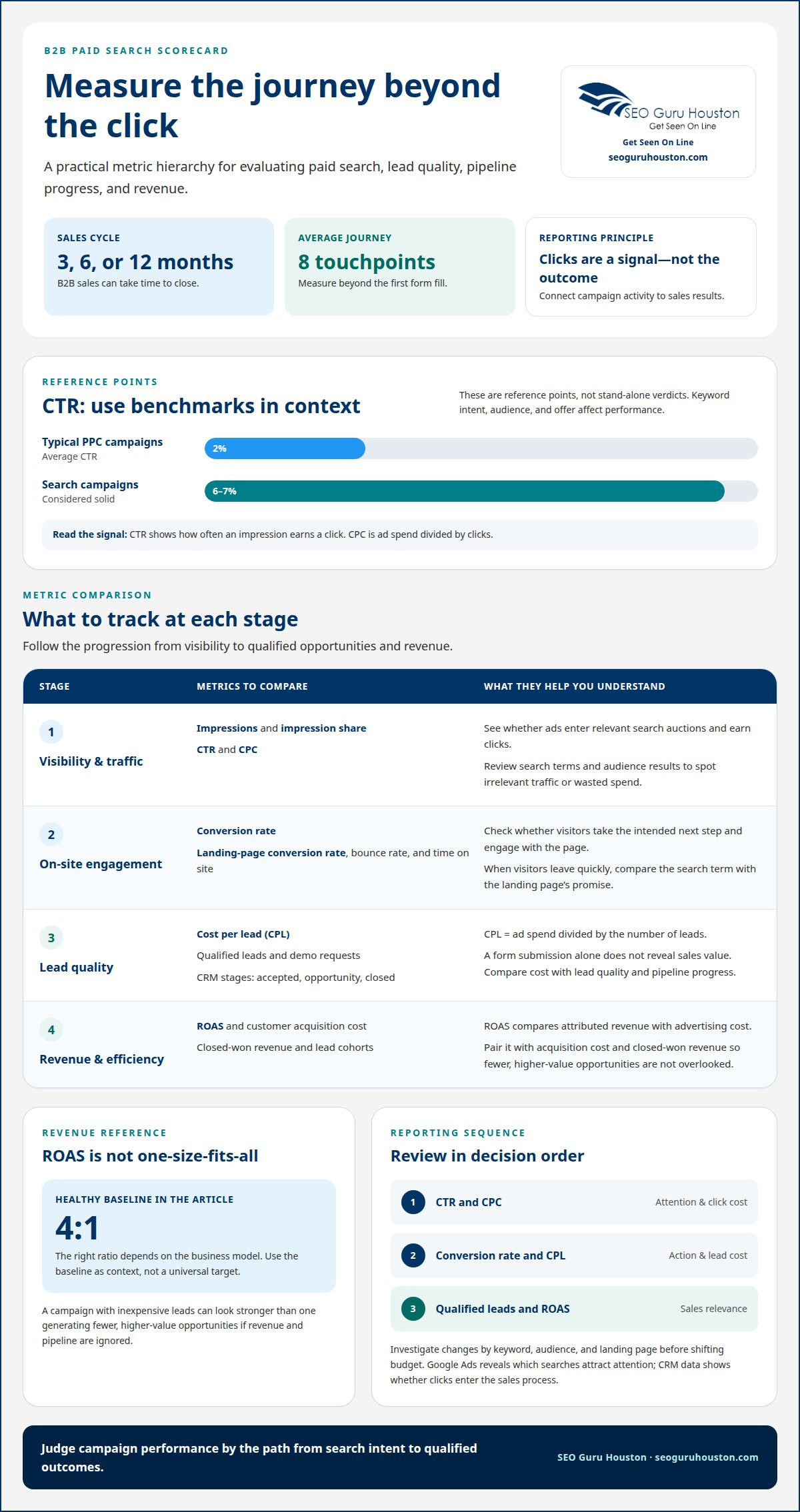
  1. Track the full path from impression to lead. Start with impressions and impression share to see whether Google Ads enters relevant Google Search auctions. Then measure click-through rate (CTR), cost per click (CPC), and conversion rate. CTR shows how often an impression earns a click; CPC is ad spend divided by clicks. A 6-7% CTR is considered solid for search campaigns, while the average CTR for typical PPC campaigns is 2%. Treat these as reference points, not isolated verdicts: keyword intent, audience, and offer all affect performance.
  2. Measure what happens after the click. Track landing-page conversion rate, bounce rate, and time on site to see whether visitors engage with the next step. If a campaign earns clicks but visitors leave quickly, compare the search term with the page’s promise. For example, an ad for a product demo should lead to a page that explains the demo and makes requesting one clear. Segment results by campaign, keyword, device, and demographics so strong averages don’t hide a weak audience or page.
  3. Separate lead volume from lead quality. Cost per lead (CPL) divides ad spend by the number of leads, but a form submission alone doesn’t reveal sales value. Track qualified leads and demo requests separately, then connect those records with CRM stages such as accepted, opportunity, and closed. Compare costs with lead quality and pipeline progress rather than treating an average as a universal target.
  4. Evaluate revenue against spend. Return on ad spend (ROAS) compares attributed revenue with advertising cost. A 4:1 ROAS is a healthy baseline, but the right ratio depends on the business model. Pair ROAS with customer acquisition cost and closed-won revenue; otherwise, a campaign generating inexpensive leads may appear stronger than one producing fewer, higher-value opportunities. Review results by campaign and lead cohort to identify which sources contribute to actual sales.
  5. Use a consistent review sequence. In each reporting cycle, compare CTR and CPC first, then conversion rate and CPL, followed by qualified leads and ROAS. Investigate changes by keyword, audience, and landing page before shifting budget. Google Ads data can show which searches attract attention; CRM data helps reveal whether those clicks enter the sales process. A clear metric hierarchy turns reports into decisions, not just dashboards.

Conversion tracking and attribution for long sales cycles

Track the journey beyond the first form fill. B2B sales can take 3, 6, or 12 months, with an average of 8 touchpoints.

  1. Set Up Conversion Tracking

    Record each meaningful action, from a landing-page inquiry to a sales-qualified lead and closed deal. Connect ad interactions with CRM stages so campaigns aren’t judged only by their earliest conversion. Check that each event fires once and maps to the right campaign. Don’t treat repeat visits or low-intent downloads as equivalent to sales opportunities. Digital marketing teams like Barlo Digital often emphasize starting with comprehensive tracking and measurement audits to ensure search data accurately reflects pipeline value.

  2. Preserve campaign context through the sales journey. Capture the campaign, keyword, and landing page associated with each lead, then retain that information as the record advances through sales stages. This lets you compare first-touch and later interactions without crediting every touch with a full conversion. For example, an initial search click may introduce a solution, while a later visit prompts a demo request.
  3. Assess Lead Quality and Conversion Costs

    Compare conversion volume with sales acceptance, opportunity creation, and closed revenue. Treat CTR and CPC as diagnostic signals, not final outcomes: strong click engagement can still produce poor-fit leads. Calculate cost per conversion for each meaningful milestone, then compare it with the resulting ROI. Don’t optimize for the cheapest form submission if those contacts rarely progress.

  4. Align the landing page with the tracked action. Keep the ad promise, page content, and conversion event consistent. A demo campaign should direct visitors to a page explaining the demo, with a clear call to action and a streamlined form. Track form completions separately from later qualification, so page tests improve lead generation without disguising low-quality submissions as success.
  5. Review attribution against actual sales outcomes. Compare platform-reported conversions with CRM opportunities and closed-won records by campaign and lead cohort. This shows why conversion counts need sales context: investigate lead sources, qualification, and follow-up before scaling spend.
  6. Use mature data to guide optimization. Long sales cycles delay revenue signals, so keep early indicators visible while opportunities progress. Review whether search terms reach the right accounts, whether landing pages generate qualified inquiries, and whether those leads advance. Use that evidence to refine targeting and messaging instead of making a major change after a brief spike in form submissions.
How to Build a Full-Funnel PPC Campaign Structure for B2B

Full-funnel PPC strategy for B2B buying journeys

Organize campaigns by buyer stage and audience, then match each segment with a relevant offer and message. Gartner research indicates approximately 80% of the B2B buying journey happens without direct vendor contact. A ppc campaign structure for b2b should therefore support independent research and guide prospects toward useful next steps.

  1. Map the B2B Buying Journey to Funnel Stages

    Define awareness, consideration, and decision stages by the questions buyers ask at each point. Awareness audiences may need educational content about a business problem; consideration audiences need solution comparisons; decision-stage prospects need a clear next step. Make sure these stages reflect the real buying process, not just website actions. A product-page visit, for example, signals interest but doesn’t establish readiness for a sales conversation.

  2. Assign PPC Roles Across the Funnel

    Give each campaign a distinct job, such as introducing a problem, helping buyers evaluate options, or generating qualified inquiries. Search can capture active research, while display and paid social can reconnect with relevant audiences between searches. LinkedIn can reach professional audiences by role and industry with stage-specific content. Don’t expect every campaign to produce an immediate sales-ready lead.

  3. Organize Campaigns by Stage and Audience

    Separate campaigns by funnel stage, audience, and offer so results remain actionable. For example, create distinct groups for operations leaders researching efficiency and finance leaders evaluating cost control. On LinkedIn, use professional audience attributes; on search, align keyword themes with the same buyer need. Keep campaign names consistent, such as “consideration, operations, efficiency,” and exclude converted leads from messages intended for first-time prospects.

  4. Tailor Ads to Each Funnel Stage

    Write awareness messaging around the business problem, not a hard sales pitch. For consideration, explain outcomes such as cost savings, efficiency gains, or risk reduction, then offer a useful comparison or guide. At the decision stage, make the next action clear and match the landing page to the ad. Use interests and audience signals to improve relevance, not as substitutes for clear intent or compelling messaging.

  5. Set a measurable planning goal. Connect stage-specific activity to a business outcome, then review how audiences advance. A sample B2B lead-generation goal is 75 qualified leads per month within four months, with cost per acquisition under $65. Treat this as a planning example, not a universal benchmark. Use the ppc campaign structure for b2b to assess whether each campaign supports that goal, then refine its audience or offer when engagement fails to progress.

Campaign structure designed to scale

The best ppc campaign structure for b2b separates campaigns by business goal, product or service, and buyer intent. There’s no fixed campaign or ad-group count; create separate Google Ads campaigns when products need distinct budgets, audiences, or outcomes, then group closely related keywords together.

  1. Separate Campaigns by Product or Service

    Build a separate Google Ads campaign for each product or service that needs its own budget, audience, or outcome. A company selling analytics software and implementation support, for example, could separate them because buyers search for different solutions. Give each campaign a matching landing page and conversion goal. Don’t combine offers just because they belong to the same company; mixed intent makes performance harder to interpret and scale.

  2. Set the Number of Campaigns and Ad Groups

    Start with the simplest structure that gives you useful control, then expand when performance or business needs call for it. Create an ad group for a tightly related keyword theme, such as “inventory analytics” and closely related searches, rather than grouping every product term together. Add campaigns when budget, geography, audience, or funnel goals need independent management. Avoid creating extra groups that split similar traffic without changing your decisions.

  3. Keep the campaign hierarchy consistent. Use a naming pattern that shows platform, product, intent, and audience. A Google Ads campaign might be labeled “Search | Analytics | Solution | Operations,” with ad groups for closely related search themes. Apply the same logic to Microsoft Ads while retaining platform-specific reporting. Clear names help teams find valuable traffic and understand each campaign’s purpose.
  4. Build for controlled expansion. Launch with core high-intent search campaigns, then add awareness or remarketing campaigns when you have a defined audience and relevant message. Keep search, display, and social activity distinct enough to compare results. For example, a display campaign for product-page visitors should have a different goal from search ads aimed at new prospects.
  5. Protect budget and learning signals. Avoid spreading limited traffic across near-identical campaigns. If two ad groups target the same keyword theme and landing page, combine them unless they need separate controls. Review search terms, audience fit, and conversion quality before adding another layer. Each campaign should address a business need, not simply make the account look more detailed.
  6. Scale what supports a purchase decision. Expand by adding a product line, buyer intent, or audience only when it creates a meaningful new opportunity. Keep awareness messaging distinct from decision-stage offers, and connect each route to the right page. A ppc campaign structure for b2b should make the next growth decision clear. To turn that structure into a practical growth plan, plan scalable PPC campaigns.

SEO Guru Houston: Houston SEO Services

SEO Guru Houston can help when your B2B campaigns need clearer structure, stronger measurement, or better alignment with sales goals. Its comprehensive PPC Services support paid-search planning, while B2B Marketing and Inbound Marketing services can connect campaign activity with broader demand generation.

Turn to SEO Guru Houston when campaigns target overlapping audiences, landing pages don’t match ad intent, or lead volume isn’t translating into qualified opportunities. PPC management includes campaign creation, ad copy optimization, keyword and geographic targeting, conversion tracking, ongoing account management, monthly calls, and reporting. Specialized SEO services can complement paid search by supporting visibility beyond ads.

Ready to discuss your campaign goals? Contact SEO Guru Houston or visit seoguruhouston.com.

Turn Your Campaign Plan Into a Growth System

Start with a business priority and turn it into a focused campaign plan. Decide which audience, offer, and sales outcome deserve attention first. Assign an owner to each decision so campaign changes have a clear purpose rather than becoming disconnected tests.

A durable ppc campaign structure for B2B should make the next move easier to see. Set criteria for expanding a campaign, refining its message, or pausing an approach. Then use those criteria consistently as new opportunities emerge. This creates a practical framework your team can adapt as products, audiences, and sales priorities change.

Bring marketing and sales into the planning process early. Agreeing on what makes an opportunity valuable helps both teams act on the same signals and keeps campaign decisions tied to business priorities.

SEO Guru Houston can help you turn your campaign priorities into a coordinated plan. Contact SEO Guru Houston today to discuss your next step. Build with focus, learn from each decision, and keep moving toward sustainable growth.

Frequently Asked Questions

What is the difference between B2C and B2B paid ads?

B2C paid ads often target individual consumers, while B2B ads address people evaluating purchases for an organization. That changes the message and the conversion path. A consumer ad might promote a product purchase; a B2B ad could offer a product walkthrough to a technical evaluator and business-case material to a budget owner. For teams executing across both sectors, performance marketing agencies such as peytondigital.com illustrate how data-driven strategies adjust to distinct buyer journeys. Build creative around the audience’s role in the decision, not just the company’s industry.

What Is B2B PPC?

B2B PPC is paid advertising where a business pays when someone clicks an ad promoting its products or services to other businesses. A software provider, for example, might use paid search to reach companies researching a specific operational challenge. The click is only the start: the campaign should connect the ad’s promise with a relevant next step, such as a consultation request or product information.

What about the middle of the funnel?

Middle-funnel campaigns help prospects compare approaches after recognizing a problem but before choosing a vendor. Offer useful decision-support content, such as a feature comparison, implementation overview, or case study. Someone who downloaded a guide, for example, could later see an ad addressing integration questions. Keep follow-up relevant to that earlier action, and don’t push for a sales conversation before the prospect has enough context.

How should B2B PPC budgets and bids be allocated across campaigns?

Prioritize campaigns by business value, audience relevance, and observed lead progression. Maintain coverage for high-intent searches that reach active buyers, then allocate testing budget to new audiences or messages with a clear learning goal. Review spend alongside qualified opportunities, not click volume alone. If a campaign attracts traffic but few relevant prospects, adjust its targeting or offer before increasing its budget.

Which conversion actions should B2B PPC campaigns track?

Track actions that show meaningful progress, from a completed inquiry form to a qualified opportunity or closed sale. Choose events based on how prospects engage with your business: a demo request may suit a complex software offer, while a detailed consultation request may fit a professional service. Keep low-commitment actions, such as content downloads, separate from actions that signal stronger buying intent.

How should B2B landing pages align with campaigns and ad groups?

Make sure each landing page matches the campaign’s promise and audience. An ad group focused on compliance software should lead to a page explaining that solution, not a general company homepage. Match headlines, proof points, and calls to action to the visitor’s likely question. Keep the form focused on information needed for follow-up, and remove competing links that distract from the intended action.
Google Ads Strategy for B2B Services: How Much Should You Spend

A focused Google Ads strategy for B2B services then puts most of that budget behind high-intent search, while reserving spend for remarketing and experiments. The right allocation depends on whether your ads attract the decision-makers and qualified leads your business needs.

It makes sense to want a clear budget before investing. But spend alone won’t fix campaigns that target the wrong searches or send prospects to a landing page that doesn’t match the ad. This guide explains how to set goals, identify audiences, structure campaigns, and refine keywords and bidding. It also shows why persuasive ad copy and relevant landing pages matter: they help turn advertising spend into meaningful opportunities, not just clicks.

Key Takeaways

  • Set campaign goals around qualified business outcomes, then target the roles, companies, and audiences most likely to influence a purchase.
  • Use keyword research and search-term data to focus spend on relevant intent and exclude searches that attract poor-fit clicks.
  • Match campaign messages and assets to each stage of the buyer journey, from early research to solution evaluation.
  • Align ad copy, keywords, and landing-page content so prospects see a clear, relevant next step after clicking.
  • Use expert PPC services and B2B marketing strategies to connect campaign execution with demand generation and long-term business growth goals.

B2B campaign goals and audience identification

Start with the business outcome, not the campaign setting. A clear goal helps connect Google Ads spend to the prospects and actions that can advance a B2B sale.

Campaign Goal Setting

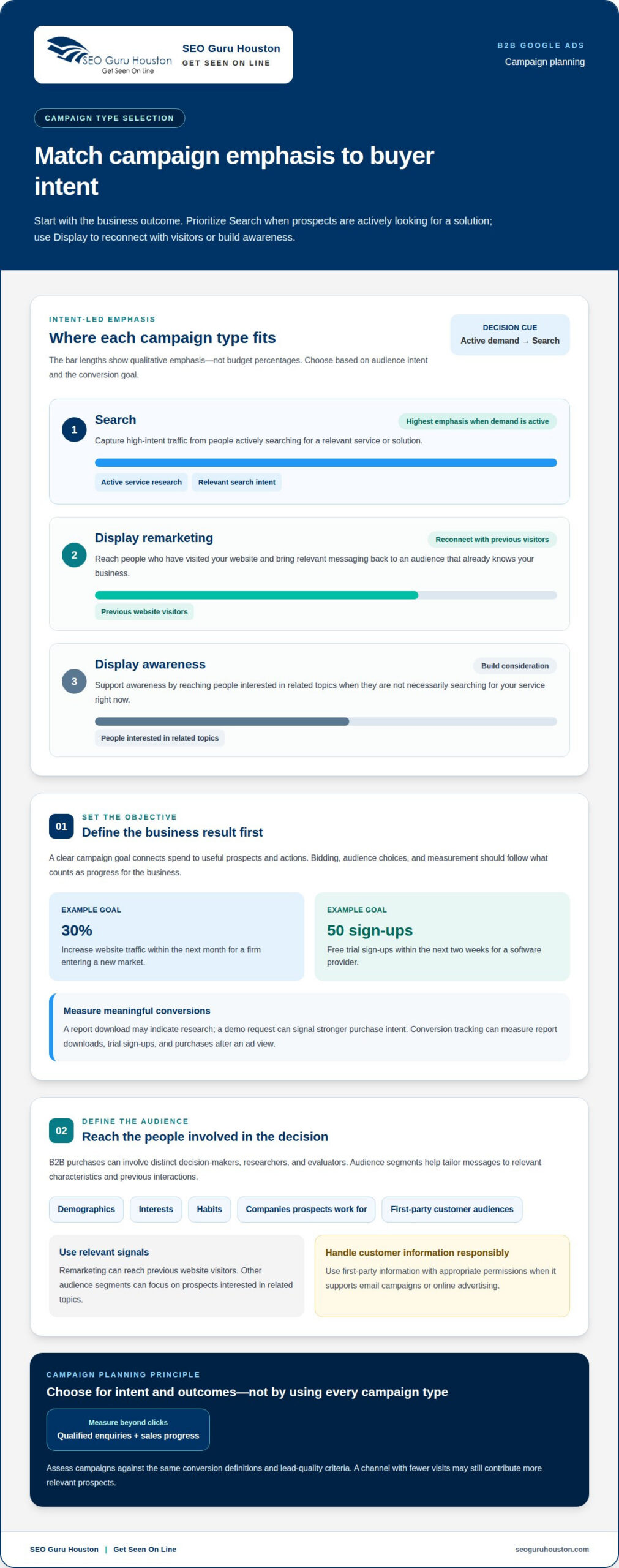
A campaign goal defines the business result advertising should support, such as qualified enquiries or relevant website visits. It matters because bidding, audience choices, and measurement all depend on what counts as progress. For example, a firm entering a new market might aim to increase website traffic by 30% within the next month. A software provider could instead aim for 50 free trial sign-ups within the next two weeks.

Choose a conversion that reflects genuine buyer interest, then distinguish it from lighter engagement. A report download may indicate research, while a demo request can signal stronger purchase intent. Google Ads conversion tracking can measure report downloads, trial sign-ups, and purchases after an ad view. Comparing these actions helps campaign managers assess keywords and ads against the outcomes that matter.

Audience Targeting Segments

Audience segments group potential buyers by relevant characteristics or prior interactions, including first-party audiences built from a business’s own customer information. This matters because B2B purchases often involve distinct decision-makers, researchers, and evaluators. Google Ads targeting can use demographics, interests, habits, and the companies potential customers work for, helping advertisers tailor messages to business audiences.

Use first-party information only with appropriate permissions when it supports email campaigns or online advertising. A company could offer a research report or invite-only webinar in exchange for customer details, then use those details to shape follow-up messaging. Remarketing can reach previous website visitors, while other audience segments can focus on prospects interested in related topics. Keep each message relevant to the audience’s demonstrated interest.

Campaign Type Selection

For B2B services, Search campaigns can capture high-intent traffic from people actively looking for a relevant solution. Display campaigns can support awareness or remarketing by reaching website visitors and people interested in related topics. Digital marketing agencies such as eastpioneers.com often combine these channels to help businesses attract leads and build a stronger online presence. The best fit depends on the goal: prioritize search when prospects are expressing demand, and use Display to reconnect or build consideration.

What Google Ads campaign types work best for B2B services? Search is suited to active service research, while Display can support remarketing and awareness. Select based on the audience’s intent and the conversion goal, rather than using every campaign type at once.

What Google Ads policies and compliance risks apply to B2B service advertisers? Follow Google Ads policies, describe services accurately, and handle customer information responsibly. If collected details will support email or advertising, use them with the appropriate permissions. Clear consent practices and truthful ad claims help reduce avoidable compliance risks.

Keyword research and competitor targeting

Keyword research connects B2B search intent with the services your campaigns promote. Use Keyword Planner, match types, and search-term reports to refine targeting and limit irrelevant clicks.

Keyword Discovery with Keyword Planner

Google Ads Keyword Planner is a research tool that shows keyword search frequency, competition, and bid costs. These signals help you compare phrases before assigning them to campaigns. For example, separate searches for “B2B payroll software” from broader phrases such as “payroll services” when your offer serves a specific business audience.

Start with the services you sell, then expand each into buyer-focused variations. A consultant might compare “supply chain consulting” with “supply chain audit services” to find language that better reflects a prospect’s need. Use the Planner’s estimates as research inputs, then assess whether each phrase matches your offer and landing page.

Search Match Types

Match types control how closely a person’s search must relate to a target keyword before an ad can appear. They matter because a narrow service phrase and a broad category phrase can attract different intent. Choose settings that balance reach and relevance, then review actual search queries to see how Google Ads interprets your keywords.

For example, a campaign targeting “commercial HVAC maintenance” should distinguish service-specific intent from searches about residential repairs or do-it-yourself advice. Broad targeting can surface related searches, while tighter matching focuses exposure on closer variations. Organize keywords by service theme so the ad copy and landing pages address the same need.

Negative Keywords and Search-Term Reports

Negative keywords prevent ads from appearing for searches that don’t fit your offer. Search-term reports show which queries triggered ads, giving you evidence to add exclusions or refine target keywords. This review matters because even a relevant keyword can attract poor-fit searches through related wording.

For instance, a B2B software provider might exclude “jobs” if employment seekers don’t represent prospective buyers. Review the report for queries about free templates, consumer products, or unrelated services, then add negatives where those searches don’t match the business. Search-term data can also reveal phrases worth testing in paid campaigns or considering for SEO content.

Competitor Targeting

Competitor targeting considers searches that mention competing brands or compare providers. It can reach prospects who know the category and are evaluating alternatives, but the ad and landing page should clearly explain your own offer. Group competitor-related terms separately from service keywords to see whether they attract qualified enquiries.

Review competitor names alongside comparison phrases, such as “alternatives to [brand]” or “[brand] versus [service type].” Assess each query for relevance before adding it, and use clear, factual messaging rather than implying an affiliation. Pair this analysis with a paid search campaign strategy that keeps keywords, ad copy, and landing-page content aligned.

Ad extensions and assets

Google Ads assets add useful details and actions to search ads. For B2B campaigns, choose assets that help decision-makers understand the offer and take a relevant next step.

Give Searchers More Relevant Options

Sitelinks and other Google Ads assets can provide extra information and options within search results. They can also increase an ad’s size, helping it stand out and giving prospects more reasons to click. A B2B consultancy, for example, could use sitelinks to direct different audiences toward relevant service information or a case study.

Keep each option aligned with the ad’s promise. If an ad promotes an operational audit, a sitelink to audit details supports that message better than a broad, unrelated page. Useful assets give prospects a clearer route to explore, while mismatched options can distract from the advertised service.

Use Lead Form Assets for Direct Enquiries

Google Ads lead form assets let potential customers submit their contact information directly within an ad. This can give a busy decision-maker a direct response path without first visiting a website. For example, a B2B provider promoting a consultation could use a lead form asset to capture interest from someone searching for that service.

Choose this format when an in-ad enquiry fits the campaign goal. Make the offer clear, and explain what the prospect is requesting. A lead form is not a substitute for useful service information: people should understand the next step before sharing their details. Compare its enquiries with other campaign actions to assess whether it attracts relevant prospects.

Match Assets to the Ad’s Message

Google Ads assets work best when their information reinforces the search ad and the prospect’s intent. For a software implementation campaign, relevant options might point to implementation details, a case study, or a contact path. Each asset should answer a useful follow-up question rather than repeat the same headline elsewhere.

Review the complete search result as a prospect would see it. Check that the ad, sitelinks, and other assets describe the same service and lead to coherent next steps. If the ad promises a specific business solution, an asset pointing to an unrelated offer breaks that connection.

Review Asset Performance

Use campaign reporting to assess which assets support meaningful actions. Compare lead form submissions with visits to relevant pages, then consider the quality of the enquiries each path generates. A larger ad may attract attention, but clicks alone don’t show whether the added information brought in suitable B2B prospects.

Update assets when their destination or message no longer reflects the campaign. For example, if a sitelink points to outdated service information, revise it to match the current offer. This keeps the experience consistent from search result to follow-up and makes each asset work toward the same business goal.

Google Ads Strategy for B2B Services: How Much Should You Spend

Buyer-journey campaign segmentation

B2B prospects need different information as they move from discovering a problem to assessing solutions and contacting a provider. Segment campaigns by that intent, then align the ad, offer, and next step. A research-focused visitor may value a case study, while an evaluator may be ready to compare solutions or request a demo.

Awareness: Reach Prospects Exploring a Problem

At the awareness stage, prospects may search for explanations rather than a specific provider. Search ads can connect relevant queries with useful resources, such as an industry report or case study. For example, a cybersecurity firm could promote a guide to common security challenges instead of pushing a sales meeting to every early-stage visitor.

Google Ads Search campaigns can generate micro-engagements, including resource downloads, case study exploration, and newsletter subscriptions. These actions offer ways to engage people who aren’t yet ready to become sales leads. Treat each as a distinct signal, and use relevant follow-up messaging to nurture interest over time.

Consideration: Help Buyers Evaluate Options

During consideration, prospects compare approaches and assess whether a solution fits their needs. Free trials, demos, testimonials, competitor analysis, and benchmarking can help them evaluate options. A B2B software company, for example, might use an ad leading to a product demo for active evaluators, while a comparison resource serves people still weighing alternatives.

Decision: Make the Next Step Clear

Decision-stage prospects are closer to contacting a provider or beginning a trial. Use focused Search ads for queries that indicate service or solution intent, and make the advertised action clear. For example, an ad promoting a software demo should lead directly to information about that demo, not a general company overview.

Tailor follow-up to the action taken. Someone who explored a case study may need a different prompt from someone who requested a demo. Keep campaign messages aligned with the prospect’s demonstrated interest, and make the path from ad to enquiry straightforward.

Connect Segments Without Blurring Intent

Buyer-journey segmentation works best when each campaign has a defined audience, message, and goal. Separate educational content from demo or trial campaigns so reporting shows which interactions support progress. A visitor who downloads a report can receive relevant nurturing, while a demo request should prompt a more direct sales follow-up.

Review campaign and conversion data together. If resource engagement rises but qualified enquiries don’t, examine the transition from content to the next offer. If demo campaigns attract mismatched prospects, revisit search intent and landing-page messaging. This keeps each stage accountable to the buying task it serves.

Landing pages, ad copy, and Quality Score

Ad relevance doesn’t stop at the click. Your B2B ad, landing page, and conversion path should tell one consistent story.

Landing Page and Ad Copy Alignment

Alignment means the ad promise, target keyword, and landing-page content all address the same buyer need. A decision-maker who clicks an ad for implementation support expects information about that service, not a broad company overview.

Build each page around the search intent and action you want. For example, an ad offering a software demo should lead to a page that explains the demo and makes the next step clear. Use matching language in the headline, supporting copy, and call to action. If the ad targets operations leaders, address their business problem rather than relying on generic claims.

Keep the page focused. A campaign for a specific B2B service can direct visitors to relevant proof, service details, and an enquiry form. Remove competing calls to action that send prospects toward unrelated offers. This creates a clearer route from search to conversion and helps your team understand which message brought the visitor in.

Quality Score

Quality Score is a Google Ads diagnostic that helps advertisers assess keyword, ad, and landing-page relevance. It can highlight where the experience feels disconnected to a searcher. Use it as a signal for investigation, not a substitute for measuring qualified leads and business outcomes.

For example, if a keyword about B2B consulting leads to an ad about general marketing, then a page about unrelated services, the message lacks continuity. Review the keyword, ad copy, and destination together. Make the page answer the question implied by the search, and ensure the ad describes the same offer accurately.

How do you set up conversion tracking and qualify leads from Google Ads? Track meaningful actions such as demo requests, report downloads, and purchases, then compare those conversions with lead quality. Connecting data sources can help campaign systems use relevant signals.

Lead qualification needs a clear definition shared by marketing and sales. For example, a demo request from a decision-maker at a target company may warrant different follow-up from an early-stage resource download. Record the actions and details that distinguish sales-ready enquiries, then assess campaign performance beyond form submissions.

Keep improving the full path, not just the ad. Test a focused headline against a service-specific page, review whether visitors complete the intended action, and refine the message when the page attracts the wrong enquiries. Improve your B2B landing pages by aligning each page with its ad promise and conversion goal.

SEO Guru Houston: Houston SEO Services

SEO Guru Houston helps B2B companies connect campaign strategy with broader search visibility and demand generation. Its Houston PPC Services support paid campaigns, while Houston B2B Marketing and Houston Inbound Marketing can align outreach with how business buyers research and evaluate solutions.

Turn to SEO Guru Houston when your ads need stronger alignment between audience targeting, landing pages, and qualified lead goals, or when paid search should work alongside organic visibility. Houston SEO Services can support that wider search strategy, while PPC focuses on reaching prospects through paid campaigns.

To discuss your B2B marketing goals, contact SEO Guru Houston or visit seoguruhouston.com.

Turn Campaign Learning Into Your Next Growth Move

Your next advantage comes from connecting advertising decisions to what happens after a prospect converts. Build a steady feedback loop between marketing and sales: review which enquiries progress, identify the needs behind qualified opportunities, and use those insights to sharpen future campaign decisions. That discipline makes a Google Ads strategy for B2B services more responsive to real buying signals, rather than simply optimizing for activity.

SEO Guru Houston offers Houston SEO Services, Houston PPC Services, and Houston B2B Marketing. These offerings can support businesses aligning paid search with broader visibility and B2B growth priorities. If your campaigns need a clearer path from ad engagement to business opportunities, consider discussing your goals and the challenges your team wants to address.

Contact SEO Guru Houston today to explore a practical next step for your marketing. Keep testing, keep learning, and build momentum around the prospects your business is ready to serve.

Frequently Asked Questions

How Much Should You Spend on B2B Google Ads?

Set spend according to the lead volume you can handle, your sales capacity, and the campaign data you need to learn. An initial allocation can direct 70% to high-intent search, 20% to remarketing, and 10% to experimental campaigns. Treat this as a starting distribution, then shift budget toward campaigns producing qualified enquiries. Review performance against sales outcomes, not just clicks, before increasing spend.

How to Build a B2B Google Ads Strategy?

Build the plan around a measurable business outcome, a defined buyer, and a clear conversion action. For example, a consulting firm could prioritize qualified assessment requests rather than general page visits. Connect that goal to relevant searches, campaign messages, and a dedicated landing page. Then review conversion and sales data together to distinguish useful leads from actions that show interest but don’t fit your market.

How should B2B service businesses structure Google Ads campaigns and ad groups?

Separate campaigns by service line, objective, or distinct audience need, then group closely related search terms together. A cybersecurity provider might create separate campaigns for incident response and security assessments, with ad groups reflecting specific search themes. This structure makes it easier to tailor ad language and landing pages, and to identify which service themes generate relevant enquiries without mixing results.

Which keywords and match types are most effective for B2B lead generation?

Prioritize keywords that clearly express a business need, such as “enterprise data migration services,” over broad terms like “data.” Choose match types based on how closely searches should relate to each phrase, then inspect actual queries. Add negative keywords for irrelevant intent, such as job searches when recruiting isn’t the goal. The best keyword set reflects your offer and the language prospective buyers use.

How do you target B2B decision-makers by location, industry, and company size in Google Ads?

What are typical Google Ads costs and cost per lead for B2B services in the US?

Costs vary with industry competition, keyword demand, audience intent, and deal size, so a single benchmark can mislead budget decisions. A highly specialized service may face a different auction from a broad business category. Track actual spend alongside qualified leads and sales progression. If leads are plentiful but poorly matched, refine targeting and landing-page expectations before treating a lower cost per lead as better performance.

How should B2B landing pages be designed to improve Google Ads conversion rates?

Give each page one clear purpose that matches the visitor’s search and the ad’s promise. For a technical assessment campaign, explain what the assessment covers, who it serves, and how to request it. Keep the enquiry form focused on information needed for follow-up, and make the next action easy to find. Review completed actions and lead relevance together, then improve the page where prospects drop off.

What bidding strategies and budgets should B2B advertisers use?

Choose bidding based on the campaign objective and the conversion data available. With only 5-6 conversions, automated bidding may underperform; consider Manual CPC until conversion volume builds. Once an advertiser has more than 30 conversions per month, the guidance recommends considering a switch from Maximize Conversions to Maximize Conversion Value. Pair the bid approach with a budget that supports the campaign’s target actions and sales capacity.

Improving Lead Quality from Digital Ads: A 2026 Guide

What if the leads your ads attract aren’t a targeting problem at all, but a measurement problem? If inquiries go silent, miss your ideal customer profile, or never become sales opportunities, a low cost per lead can hide a costly gap. Improving lead quality from digital ads starts with looking beyond form fills and asking whether campaigns are creating real sales conversations.

You already know that more inquiries don’t automatically mean more growth. The challenge is finding where the mismatch begins: audience targeting, ad messaging, the offer, the landing page form, or follow-up. This guide will help you define lead quality using business-relevant criteria, spot weak leads at each stage of the campaign journey, and use consistent conversion tracking and sales feedback to make better decisions.

We’ll explore how to align campaign goals with the customers you want, strengthen the path from click to inquiry, and assess performance based on meaningful outcomes rather than volume alone. The goal is a clearer connection between ad spend and qualified sales conversations, so your next campaign decision is based on evidence, not guesswork.

Key Takeaways

  • Judge a lead by fit, need, responsiveness, and readiness for a relevant sales conversation, not by form volume alone.
  • Trace the path from audience and ad promise through the landing page, form, and first contact to find where mismatched inquiries enter.
  • Compare contactability, qualification, and sales progression alongside lead volume and cost per lead. Each metric reveals a different part of campaign performance.
  • Improving lead quality from digital ads starts with identifying the specific failure point, then testing one evidence-based change at a time.
  • Connect PPC decisions to business goals with conversion tracking, ongoing account management, monthly calls, and reporting.

What Does Lead Quality from Digital Ads Actually Mean?

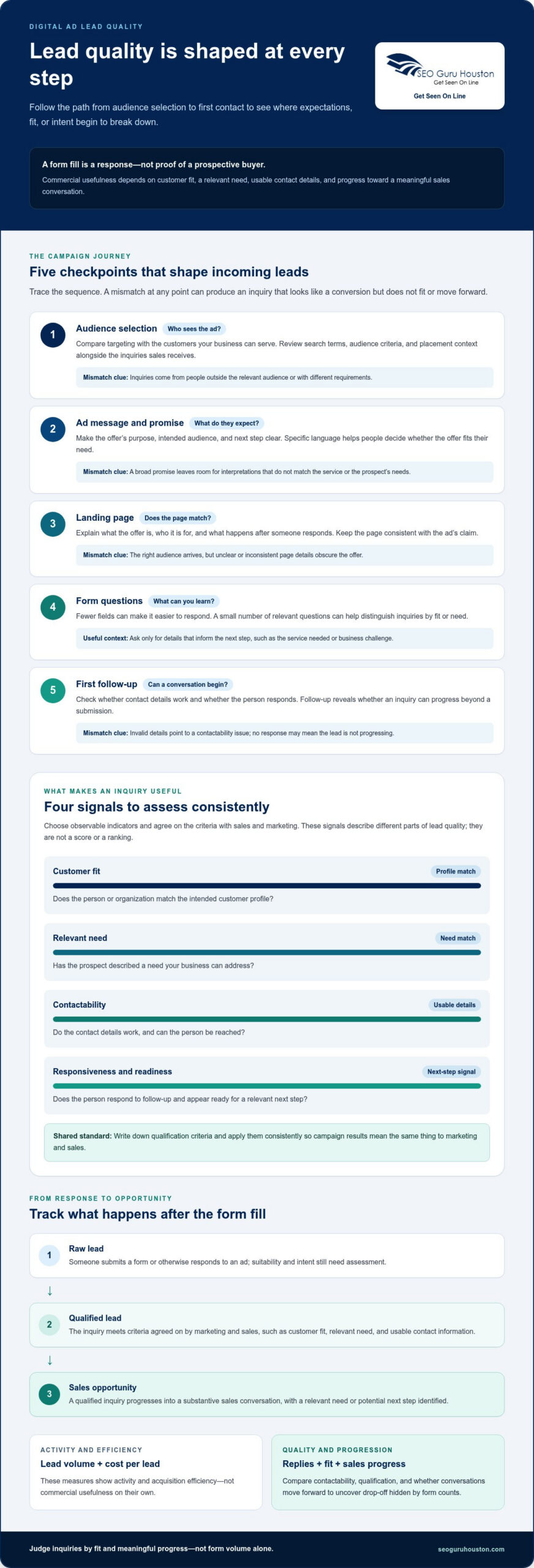
A digital ad lead is commercially useful when the person or organization fits your intended customer profile, has a need your business can address, can be contacted, and is ready to take a relevant next step. Those signals matter more than a form submission by itself. A completed form shows that someone responded to an offer; it doesn’t prove they’re a prospective buyer or that sales can start a meaningful conversation.

That distinction matters because lead volume and cost per lead measure activity and acquisition efficiency, not commercial usefulness. A campaign can generate more inquiries at a lower cost while attracting people outside your target market, people with no current need, or contacts who can’t be reached. To understand What is Lead Generation? in the broader marketing and sales funnel, consider how a response moves from initial interest toward a conversation and potential opportunity.

A practical lead-quality definition

  • Raw lead: A person or organization that submits a form or otherwise responds to an ad. Their suitability and intent still need to be assessed.
  • Qualified lead: An inquiry that meets criteria agreed on by marketing and sales, such as customer fit, relevant need, and usable contact information.
  • Sales opportunity: A qualified inquiry that progresses into a substantive sales conversation, with a relevant need or potential next step identified.

Which lead-quality signals matter to your business?

Choose indicators your team can observe and record, rather than relying on subjective labels like “good lead.” Check whether contact details work, whether the inquiry matches your intended customer profile, whether the person describes a relevant need, and whether they respond to follow-up. Each signal points to a different possible issue: invalid details suggest a contactability problem, poor fit suggests a targeting or message mismatch, and no expressed need may indicate low intent.

Marketing and sales should define a qualified inquiry together. Write down the criteria, then apply them consistently so campaign results mean the same thing to both teams.

Why more leads can still mean weaker ad performance

A rising form count can look like progress even as the share of relevant, reachable inquiries falls. For example, a campaign may attract more submissions but produce fewer replies, fewer prospects who match the target profile, or fewer conversations that move forward. Volume alone hides that drop-off. Compare responses with what happens after each one, and identify where prospects stop progressing.

Lead quality is the degree to which an inquiry fits your business and takes a meaningful step toward a relevant sales conversation. Use that as your standard when improving lead quality from digital ads. The aim isn’t simply to collect more names; it’s to attract and recognize inquiries with a credible path to business.

How Digital Ad Choices Shape the Quality of Incoming Leads

A lead’s path begins before anyone fills out a form. The audience selected, promise made in the ad, landing-page explanation, form questions, and first follow-up all shape who responds and what they expect. A mismatch at any point can bring in inquiries that look like conversions in an ad account but don’t fit the business or move toward a real conversation.

Lead quality reflects the alignment of every step from audience selection to first contact, not a single setting or channel. To diagnose campaigns across search, social, and other digital placements, follow the journey and pinpoint where expectations or intent stop matching.

Audience fit and ad messaging set expectations

Start by comparing campaign targeting with the customers your business can serve and the needs they bring. Broad targeting can expand reach, but it may also attract people with different requirements, people outside your relevant audience, or people who aren’t ready to act. Review search terms, audience criteria, and placement context alongside the inquiries sales receives.

Ad copy can pre-qualify interest by making the offer’s purpose, intended audience, and next step clear. For example, a general promise to “get more customers” leaves room for different interpretations. A specific description of the business need addressed helps people decide whether the offer fits. Keep the landing page consistent with that claim. If the ad promises one thing and the page emphasizes another, visitors may submit with mismatched expectations or leave without acting.

Landing pages and forms shape intent signals

After the click, the landing page should quickly explain what the offer is, who it’s for, and what happens after someone responds. Clear, relevant details help prospects self-select. They also make it easier to assess the campaign promise: if the right audience arrives but the page obscures the offer, the issue may be the post-click experience rather than targeting alone.

Forms involve a trade-off. Fewer fields can make it easier to respond, while a small number of relevant questions can help distinguish inquiries by need or fit. Ask only for information that informs the next step, such as the type of service needed or the business challenge involved. Unnecessary questions add friction without giving sales useful context.

To trace the journey, compare what the campaign promised with what prospects saw and what they were asked to provide. Then review the first contact: did the prospect recognize the offer, respond, and have a need aligned with it? This sequence helps separate audience mismatch from unclear messaging, form friction, or follow-up gaps. It gives your team a specific point to investigate instead of changing several campaign elements at once.

Improving lead quality from digital ads means tightening that alignment, then checking whether the inquiries that follow are a better fit. SEO Guru Houston’s PPC campaign management connects targeting, ad messaging, and conversion tracking to business goals.

Which Metrics Reveal Whether Digital Ad Leads Are Improving?

No single campaign metric shows whether advertising is creating better sales conversations. Lead volume and cost per lead describe the response and its acquisition efficiency. Contactability, qualification, and sales progression show what happens after that response reaches your team. Read the metrics together to see where performance is strengthening or breaking down.

Platform conversions alone can count responses, but they can’t establish whether those leads fit your business or progress into sales conversations. That takes consistent conversion tracking paired with sales feedback. The platform shows which ad interactions were recorded; your sales process adds the context needed to assess their commercial value.

Build a measurement view beyond cost per lead

Use shared definitions across campaigns, and compare results over the same reporting window. A lead counted as qualified in one campaign should meet the same criteria in another. Otherwise, apparent performance differences may reflect inconsistent labeling rather than a change in lead quality.

Metric What it signals Main limitation
Lead volume How many responses the campaign generated Doesn’t show fit, intent, or sales progress
Cost per lead How efficiently the campaign generated recorded leads Doesn’t reveal whether those leads are useful
Contactability Whether the team can reach the person who submitted an inquiry A reachable person may still be a poor fit
Qualification rate How many leads meet the agreed criteria Depends on consistent definitions and sales records
Sales progression Whether qualified leads advance into meaningful conversations or next steps Can take longer to observe and may reflect follow-up as well as campaign quality

Keep advertising response metrics separate from sales disposition data. A platform may record a form submission, while the sales team records whether the details were valid, the need was relevant, and the conversation progressed. Conversion tracking can connect campaign activity with meaningful milestones, but those milestones need clear definitions and reliable recording.

Use sales feedback to find weak points in the funnel

Give sales a concise set of consistent reasons for leads that don’t progress, such as unreachable, poor fit, no relevant need, or no response after contact. Record the stage and reason rather than relying on broad labels like “bad lead.” Then review patterns by campaign, audience, keyword, offer, or landing page where the available data supports that comparison.

Look for recurring signals before changing the campaign. If one audience produces more poor-fit inquiries, targeting or messaging may need review. If contact details are often incomplete, examine the form. If prospects fit but don’t advance, follow-up or the next step may be part of the issue.

Change one factor at a time where practical, and keep the comparison window and lead-stage criteria consistent. If targeting, offer, form, and follow-up all change together, you may improve results without knowing why. A disciplined measurement approach makes improving lead quality from digital ads a business decision grounded in campaign data and sales evidence.

Improving Lead Quality from Digital Ads: A 2026 Guide

How to Improve Lead Quality from Digital Ads: A Practical Test Plan

Don’t change targeting, copy, and forms all at once. If the results shift, you won’t know which change mattered. A focused test plan starts with evidence from the lead journey, identifies the likeliest failure point, and tests a matching intervention. That’s how improving lead quality from digital ads becomes a disciplined process, not a string of guesses.

  1. Define the failure. Describe the problem in observable terms, such as a rise in inquiries outside your intended customer profile, incomplete contact details, or qualified prospects who don’t respond. Use campaign records and sales feedback to identify the pattern.
  2. Inspect the journey. Follow the inquiry from audience or keyword through the ad, landing page, form, and first response. Note where the prospect’s expectations, information, or actions stop matching what your team needs to move the conversation forward.
  3. Choose one intervention. Select the change that addresses the strongest evidence. Write down why you chose it, what you expect to change, and which lead-quality signals you’ll review.
  4. Review the results. Compare the test with a defined baseline using the same quality criteria and reporting window. Look at sales feedback as well as ad-platform responses, then keep, revise, or roll back the change based on the evidence.

Choose a change that addresses the diagnosed problem

Match the adjustment to the failure point. For poor-fit inquiries, review audience and keyword relevance alongside ad wording. If prospects misunderstand what the offer includes, align the offer, ad copy, and landing-page message so each step sets the same expectation. For incomplete or unreachable inquiries, assess whether the form asks for essential details and whether the response process helps the team act on submissions.

Be precise. If sales reports inquiries that don’t match the intended customer profile, adding more form fields may create friction without fixing the source. If the audience appears relevant but submissions lack information needed for an appropriate response, test a useful question rather than broadly tightening targeting. Let the evidence determine which lever to adjust.

Test, review, and refine without chasing volume alone

Set a comparison period that gives both ad and sales outcomes time to appear. Keep lead definitions and reporting criteria consistent, and document the dates, campaign elements changed, rationale, and sales feedback. Where practical, adjust one major variable at a time. If several changes are necessary, record them clearly and avoid claiming that one specific change caused the outcome.

When the diagnosed issue sits on the post-click path, review the page’s message, form, and next step together. This high-converting landing page design guidance can help focus your review on whether the page supports the ad’s promise and captures useful lead details.

A test is useful even when it doesn’t improve results, provided it clarifies what is and isn’t working. SEO Guru Houston’s PPC campaign management connects advertising decisions with conversion tracking and business goals.

How SEO Guru Houston Connects PPC Management to Better Lead Decisions

Improving lead quality from digital ads takes more than attracting clicks. Campaign choices need to support a clear business goal, and results need to be assessed against what happens after an inquiry arrives. SEO Guru Houston’s PPC management brings campaign execution and measurement together, helping businesses evaluate ad responses with sales relevance in view.

What ongoing PPC management contributes to lead-quality work

Keyword bidding helps shape which searches a campaign competes for, while ad copy optimization clarifies the offer and sets expectations. Geographic targeting further defines where ads are shown. Together, these activities can improve campaign relevance by aligning targeting and messaging with the audience the business intends to reach.

Conversion tracking helps connect ad activity with defined actions, giving the team a more useful way to assess performance against business goals than clicks or form submissions alone. Changes to PPC ads or keywords have an immediate effect on the campaign, but that doesn’t guarantee an immediate change in lead quality or sales outcomes. Assess tracked responses alongside lead and sales feedback to understand the effect.

SEO Guru Houston’s PPC work includes keyword bidding, ad copy optimization, geographic targeting, conversion tracking, ongoing account management, monthly calls, and reporting. This ongoing process creates opportunities to review what the campaign is generating, identify where it may be falling short, and make informed adjustments. The goal is to increase qualified leads, not to promise a specific result.

Turn campaign evidence into a clear next step

Useful campaign reviews connect the data to a decision. If tracked responses are rising but sales feedback points to poor fit, the team can investigate whether keyword choices, targeting, or ad messaging need adjustment. If inquiries appear relevant but aren’t progressing, the review can consider the conversion path and the quality signals being tracked. Consistent reporting and monthly calls keep these discussions tied to campaign activity and business priorities.

With 950+ completed projects, 100+ B2B and B2C projects, and 12+ years of experience, SEO Guru Houston brings practical campaign experience to these decisions. For businesses focused on reaching and engaging other businesses, B2B demand generation can also help connect marketing activity with the goal of generating relevant prospects.

Ready to connect PPC activity with clearer lead-quality decisions? Discuss your digital advertising goals and identify what you want your campaign tracking and sales feedback to reveal.

Make Your Next Campaign Decision Count

Better advertising starts with a better question: what should the next campaign teach you about the people most likely to become customers? Choose one signal to improve, such as relevant inquiries progressing to conversations, and make it the focus of your next review. That keeps optimization grounded in the outcome your business needs, not activity that merely looks good in a dashboard.

Improving lead quality from digital ads is an ongoing discipline. As your team learns which messages attract the right prospects and what helps them take a meaningful next step, use those insights to sharpen future campaign decisions. Keep the feedback loop active, and each review can give you a clearer direction for testing and refining your approach.

Ready to put that focus into practice? Discuss your digital advertising goals and take the next step toward campaigns built around more meaningful sales conversations.

Frequently Asked Questions

Why are my digital ads generating leads that do not convert?

Ads may be attracting people whose needs, timing, or expectations don’t match what your business can offer. A campaign promising a broad outcome can draw interest from prospects looking for something different, while a useful inquiry may stall because the next step isn’t clear. For improving lead quality from digital ads, compare a sample of non-converting inquiries with your intended customer profile and note the specific mismatch before changing the campaign.

How can I tell whether my leads are low quality or my follow-up is too slow?

Compare the inquiry details with the first-contact record. If a lead has invalid contact information, an unrelated need, or a clear mismatch before anyone reaches out, investigate lead quality. If the inquiry fits but contact attempts happen late, go unanswered, or aren’t recorded consistently, follow-up may be contributing. Review individual records, not just totals, and check whether the same pattern appears across different campaigns or team members.

Can adding questions to a lead form improve lead quality?

Yes, if the answers help your team assess relevance or choose a useful next step. For example, asking which type of service a prospect needs may provide clearer context than collecting a detail no one uses. Extra questions can also make a form harder to complete. Add one question tied to a real decision, then compare the usefulness of submitted inquiries with form completion before deciding whether to keep it.

Should I optimize digital ads for leads or sales?

Use the deepest outcome you can measure consistently and in sufficient volume to guide campaign decisions. A sales-focused event is closer to business value, but incomplete or inconsistent records can mislead the system and your team. If sales outcomes are sparse, track a reliable qualified-inquiry stage while improving how sales dispositions are recorded. Move toward sales outcomes as the data becomes dependable, and keep checking lead fit.

How often should I review lead quality from an advertising campaign?

Review new inquiries regularly enough to catch issues before they become entrenched, then assess trends on a consistent schedule. A weekly check can surface missing details or a sudden shift in fit; a monthly comparison can give later-stage outcomes more time to emerge. Match the review rhythm to your sales cycle and lead volume, and avoid judging a change from a handful of very recent inquiries.

What is a good cost per lead if the leads are not converting?

There isn’t a useful cost-per-lead target without knowing whether inquiries become qualified prospects and sales conversations. A lower figure can still reflect weak commercial value if leads don’t fit, can’t be reached, or don’t progress. Track the cost of qualified leads and opportunities alongside cost per lead, using consistent definitions. If no inquiries convert, investigate lead disposition and follow-up before treating a cheaper lead as a better result.

How does conversion tracking help improve lead quality?

Conversion tracking records which campaign interactions lead to defined actions, so you can compare performance against more than clicks. For example, tracking a completed inquiry separately from a qualified inquiry helps reveal whether a campaign attracts responses that meet your criteria. Check that tracked events reflect real actions and aren’t duplicated or triggered by irrelevant visits. Pair platform records with sales outcomes to guide more informed campaign adjustments.

Can better landing page messaging reduce unqualified inquiries?

Clear landing-page messaging can help people decide whether an offer fits before they submit a form. State who the offer is intended for, what need it addresses, and what the next step involves. Keep those details consistent with the ad, and avoid broad claims that invite assumptions the business can’t meet. Then review whether inquiries better match the intended audience, rather than judging the page only by how many forms it generates.

How to Work Effectively With a PPC Agency: A Practical Guide

Clicks can climb while your pipeline stays flat. Learning how to work effectively with a ppc agency means connecting campaign decisions to business goals, not just filling a dashboard with activity. A productive partnership depends on shared priorities, complete information, and timely approvals. Without those, even well-managed campaigns can lose momentum.

This guide explains how to build a focused, accountable relationship that connects paid campaigns to qualified leads and revenue. You’ll learn how to agree on goals and responsibilities, interpret reports, and make evidence-based decisions without unnecessary delays. We’ll also cover how useful conversion data, regular optimization, and focused landing pages help tie campaign activity to business outcomes.

Key Takeaways

  • Learn how to work effectively with a ppc agency by aligning campaign priorities with qualified leads, sales, and other business outcomes.
  • Prepare audience details, sales-cycle context, campaign history, and an approval process before work begins.
  • Choose performance indicators that fit the campaign objective, and look beyond clicks to understand lead quality and conversion value.
  • Use a recurring review process to turn evidence and timely feedback into clear tests, assigned actions, and documented learning.
  • Recognize when campaign insights point to opportunities in landing pages, website development, or demand generation.

Why Working Effectively With a PPC Agency Starts With Shared Business Goals

A campaign can generate clicks and still miss the mark if those visits don’t become valuable inquiries or sales. Before discussing keywords, bids, or ad copy, agree on the business result paid advertising should support. Pay-per-click (PPC) is an advertising model in which advertisers pay for clicks, but a click alone doesn’t show whether a campaign is moving your business forward.

That’s why how to work effectively with a ppc agency starts with a shared definition of success. Agree on the outcome, who owns each decision, and which reliable information will guide campaign changes. Platform metrics such as impressions, clicks, and click-through rate describe campaign activity. Qualified leads, sales, and conversion quality help show whether that activity matters to your business.

A productive PPC agency partnership turns shared business goals, clear responsibilities, and trustworthy campaign data into informed decisions. No campaign result is guaranteed.

What should a PPC agency partnership accomplish?

Start with a specific business objective. That might mean generating qualified leads, increasing online sales, or driving another clearly defined conversion. Then map how paid search fits into your wider marketing and sales process: which audience it should reach, what offer it should present, and what action a visitor should take next.

Make the success criteria observable to both teams. For example, assess a lead-generation campaign not only by form submissions, but also by whether those inquiries fit your target customer profile and progress through your sales process. Agree on how often to review results and which data sources to use. If the agency reports more conversions but your sales team says lead quality has declined, investigate the difference instead of treating the conversion increase as a win.

Which responsibilities belong to the client and agency?

The agency brings paid-campaign expertise; your team brings essential business knowledge. Define responsibilities early so work doesn’t stall over missing context, unclear approvals, or conflicting assumptions. Agree on ownership of account access, budget decisions, conversion definitions, and final approval of significant changes.

  • The agency plans campaigns, manages execution, analyzes performance, and recommends optimizations based on available evidence.
  • The client shares business priorities, product or service knowledge, audience details, and timely feedback on incoming leads.
  • Both teams agree on the budget, access permissions, what counts as a conversion, who approves changes, and how decisions are recorded.

Consider a campaign that attracts inquiries from people outside your target market. The agency can examine targeting, search terms, and messaging; your team can explain which inquiries are relevant and why. That feedback helps shape the next decision. Set an approval process with named owners and clear expectations for routine changes versus decisions that need additional review. When each side knows what to provide and decide, campaign strategy stays connected to business reality, not just platform activity.

How to Set Up a PPC Agency Relationship for a Strong Start

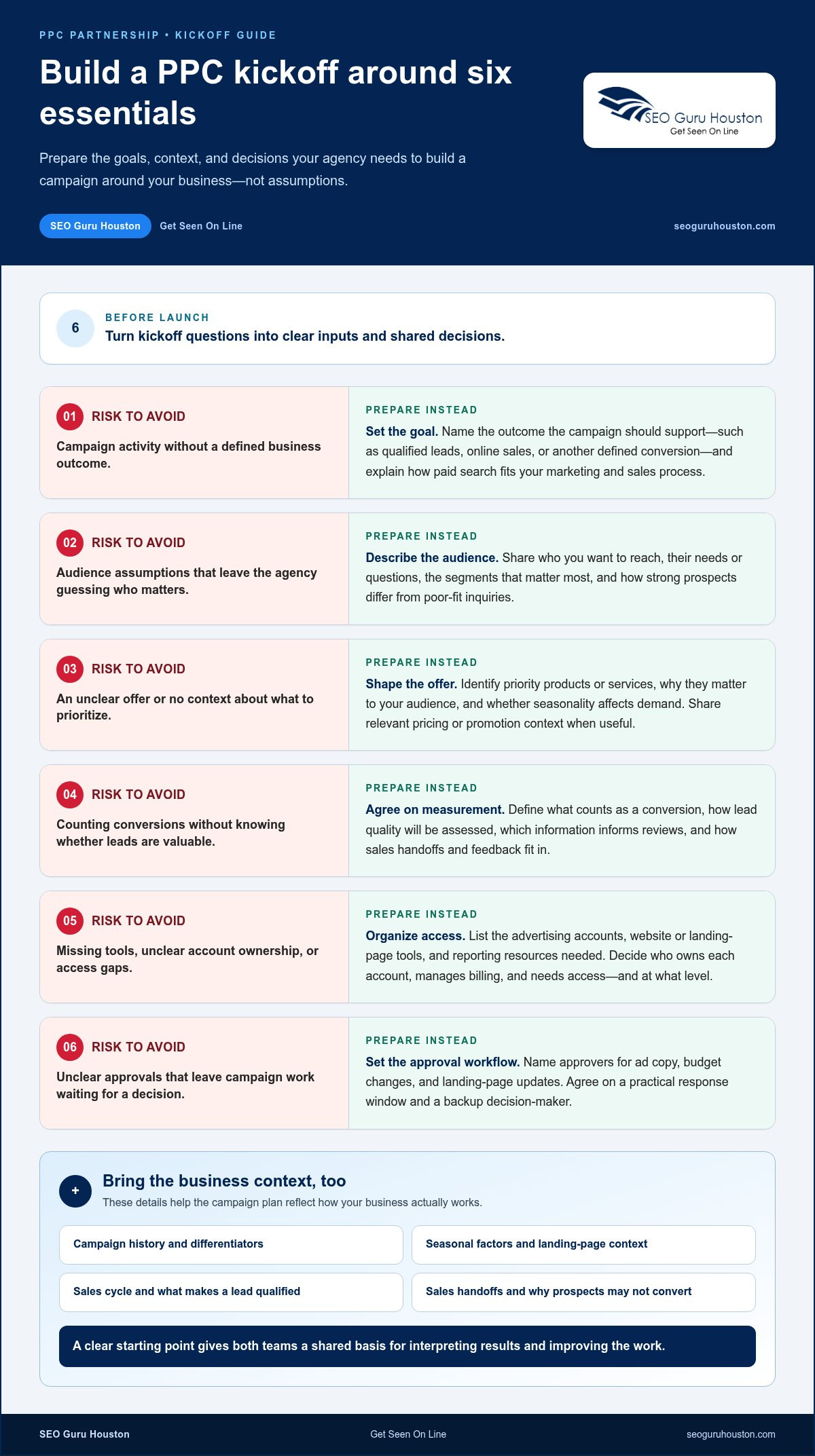
A strong kickoff turns broad expectations into a usable campaign plan. Before launch, bring together the people, information, and decision process the agency needs to build around your business rather than fill gaps with assumptions. This preparation also gives both teams a clear starting point for interpreting results and improving the work.

  1. Set the goal. Identify the business outcome the campaign should support, such as qualified lead generation, online sales, or another defined conversion. Clarify how paid search fits into your marketing and sales process.
  2. Describe the audience. Share who you want to reach, what needs or questions bring them to you, and which audience segments matter most. Explain how strong prospects differ from poor-fit inquiries.
  3. Shape the offer. Explain which products or services to prioritize, why they matter to your audience, and whether seasonality affects demand. Share relevant pricing or promotion context when it helps shape the campaign plan.
  4. Agree on measurement. Define what counts as a conversion, how lead quality will be assessed, and which information the teams will use to review performance. Include the sales handoff and any available feedback from sales conversations.
  5. Organize access. List the advertising accounts, website or landing-page tools, and reporting resources needed for campaign work. Decide who owns each account, who manages billing, and what access level each team member needs.
  6. Set the approval workflow. Name the people who approve ad copy, budget changes, and landing-page updates. Agree on a practical response window and a backup decision-maker so work doesn’t stall when someone is unavailable.

What information should clients bring to a PPC kickoff?

Come prepared with business priorities, target customer details, differentiators, seasonal factors, and relevant campaign history. Explain your sales cycle: how an inquiry becomes a customer, what makes a lead qualified, where handoffs happen, and why prospects sometimes don’t convert. Share landing-page context, including what visitors are asked to do. Past campaign data can inform planning, but it doesn’t guarantee the same approach will perform the same way again.

For broader strategic context, the PPC management guide discusses connecting paid traffic with business priorities.

How should access, approvals, and communication be organized?

Choose one primary communication channel and a recurring meeting cadence that fits the campaign’s needs. Keep a shared record of priorities, blockers, decisions, owners, and follow-up actions. At each check-in, clarify what needs approval and who will provide it. This structure keeps campaign work moving and makes decisions easier to find than scattered email threads.

Effective collaboration depends on consistent preparation, not a perfect brief. A clear kickoff gives your PPC management team the context to plan and the feedback loop to refine its work. PPC management support can be part of a coordinated approach to paid campaigns.

How to Measure PPC Agency Performance Beyond Clicks

Clicks show that someone interacted with an ad. They don’t show whether that person became a qualified prospect or customer. Clicks alone can’t establish commercial effectiveness because they measure visits, not the value those visits create for the business. A useful review connects advertising activity to lead quality, sales, and the campaign’s agreed objective.

Before using a report to make budget decisions, check that its conversion definitions and underlying data are reliable. Confirm which actions count as conversions, whether duplicate or low-value actions are included, and whether the reporting period gives prospects enough time to progress. If tracking is incomplete or inconsistent, apparent performance changes may not reflect what’s happening in the business.

Which PPC metrics deserve attention in an agency report?

Interpret each metric according to what it can tell you. Impressions indicate visibility; clicks and click-through rate can help assess ad engagement. None proves that the campaign is creating valuable business outcomes. Conversions, conversion rate, and cost per conversion provide a closer view of response, but still need context. A form submission has different value if it comes from a target customer rather than a poor-fit inquiry.

  • Visibility and engagement: Impressions, clicks, and click-through rate help explain whether ads are being seen and attracting interactions.
  • Conversion activity: Conversions, conversion rate, and cost per conversion show how visitors respond, based on the actions being tracked.
  • Business value: Qualified leads, sales, and conversion quality help reveal whether campaign activity supports the sales model and business objective.

For longer sales cycles, platform reporting may capture an inquiry before its eventual outcome is known. Add marketing and sales feedback, such as whether leads fit the target customer profile or progress through the handoff process. That context helps the agency assess patterns the platform alone can’t explain.

How can reporting turn into useful decisions?

A strong report explains more than what changed. It connects a campaign adjustment to the evidence behind it, the interpretation of that evidence, and the recommended next action. For example, if conversions rise but sales feedback suggests lead quality has weakened, discuss whether targeting, ad messaging, the offer, or the post-click experience may be contributing.

Compare results with the campaign’s agreed goals and measurement definitions, then consider relevant historical context. Avoid treating a single metric or short reporting window as a complete verdict. If visitors engage with ads but don’t take the intended next step, examine the landing page as part of the conversion path. High-converting landing page design can support a clearer post-click experience, while reporting helps identify where friction may be occurring.

That’s how to work effectively with a ppc agency when performance data gets complicated: verify what’s being measured, bring business feedback into the analysis, and agree on a next step you can review. The goal isn’t a fuller dashboard. It’s a clearer basis for action.

How to Work Effectively With a PPC Agency: A Practical Guide

How to Keep PPC Agency Campaigns Improving Through Clear Feedback

Campaign optimization works best as a steady learning loop, not a string of last-minute reactions. The agency can analyze campaign signals, but your team sees what happens after an inquiry arrives. Share that feedback consistently so both teams can make more informed decisions about targeting, messaging, and the landing-page experience.

Use a simple review cycle: examine the evidence, agree on a test, assign an owner, then record what happened and what comes next. Separate planned experiments from urgent fixes. If a tracking issue or misleading claim needs immediate attention, address it directly and document the change. For routine optimization, avoid changing several major campaign elements at once. Otherwise, it may be difficult to tell which adjustment influenced the outcome.

How should clients give feedback on PPC leads and sales?

Make lead feedback consistent enough to reveal patterns, not just anecdotes. Agree on practical categories such as relevant, poor fit, sales-ready, or not yet ready, and share recurring objections or reasons prospects disengage. Set a regular schedule for passing along this information, such as including updates in campaign reviews. Protect sensitive customer information: share only the details needed for analysis, use appropriate access controls, and follow your organization’s privacy practices.

Specific feedback gives the agency something actionable. “The leads were weak” is hard to use. “Several inquiries came from people seeking a service we don’t provide” points to a possible mismatch in search targeting, ad language, or the landing-page offer. If relevant prospects repeatedly raise the same concern, the team can assess whether campaign messaging or page content should address it more clearly.

How can both teams make testing more disciplined?

Before launching a test, write down the question it’s meant to answer, the audience it affects, and what evidence would inform the next decision. For example, a team might test whether clearer qualification language attracts more suitable inquiries. Agree on who will implement the change, who will review lead feedback, and when you’ll assess what the evidence supports.

Keep a shared test record with the hypothesis, change, owner, review point, observations, and next action. Don’t label a test a success just because one metric moved. Check whether the movement aligns with the campaign objective and the quality of resulting leads. If the evidence is inconclusive, record that plainly and decide whether to continue, adjust, or close the test. “We can’t tell yet” is more useful than a confident conclusion based on noise.

This is how to work effectively with a ppc agency over time: make feedback timely, experiments interpretable, and decisions traceable. When campaign evidence points to the post-click experience as an area to investigate, coordinate landing-page updates with the agency so the ad promise and page experience stay aligned.

PPC management services can connect campaign analysis with practical optimization.

How to Build a Long-Term PPC Agency Partnership That Drives Growth

A useful agency relationship evolves with the business. Goals set at launch may need revisiting as offers change, new audiences become priorities, or sales capacity shifts. Keep the partnership grounded in shared priorities, candid feedback, and documented decisions. That record helps both teams understand why a campaign changed, what the evidence showed, and which business question deserves attention next.

Consistency matters, but it shouldn’t mean sticking with a strategy after the business has moved on. Revisit campaign priorities when your products or services, target customers, sales process, or objectives change. Use campaign data alongside marketing and sales feedback to identify the next useful question. Avoid adding campaigns or chasing more activity simply because it’s possible. Each change should connect to a business need.

When should a PPC strategy change as the business grows?

Reassess the strategy when an offer changes, a new audience becomes more important, or the sales team can handle a different volume or type of inquiry. Bring those updates to the agency with context: what changed, why it matters, and what you want to learn. Together, decide whether the campaign, its messaging, or its conversion path needs adjustment. Document the reason for each change so future reviews reflect the business decision behind it.

How can PPC connect with landing pages and demand generation?

A paid ad sets an expectation. The landing page should carry that message forward, make the next step clear, and match the offer that prompted the click. If ads attract relevant visitors but the page doesn’t explain the value or guide action, assess campaign performance alongside the post-click experience. PPC management, landing page design, and website development can work as connected parts of the visitor journey, with each considered in light of the campaign objective.

The relationship can extend beyond the initial conversion. Lead capture is one point in a broader demand-generation process: prospects may need useful follow-up and a clear handoff to sales before they’re ready to make a decision. For B2B teams, the B2B demand generation guide offers related context on connecting marketing activity with the process of developing prospects.

Our PPC management works alongside landing page design, website development, and demand generation, so teams can consider campaign traffic and the experience that follows as connected growth work. No single channel or change guarantees a particular outcome. The value comes from keeping business goals visible, sharing honest feedback, and using each review to make the next decision more deliberate.

That’s the practical answer to how to work effectively with a ppc agency over the long term: treat the relationship as an ongoing collaboration, not a set-and-forget arrangement. Our PPC management services can support paid campaigns as part of your broader business priorities.

Make Your Next PPC Decision Count

The strongest agency relationships don’t stand still. As your business shifts, use the next planning conversation to identify the constraint that matters most: reaching a more relevant audience, improving the page experience, or helping qualified prospects move forward. That focus gives both teams a practical direction for the next stage of growth.

Knowing how to work effectively with a ppc agency means treating paid campaigns as part of a broader business system, not an isolated channel. Our PPC management can connect with landing page design, website development, and demand generation to support a coordinated marketing effort. The right priorities depend on your goals and what your campaign data reveals.

Choose one business objective for your next discussion, then turn it into a clear question your marketing team can act on. Discuss your PPC campaign goals and take the next step toward a more focused partnership.

Frequently Asked Questions

What should I expect from a PPC agency each month?

Expect work and communication that match the agreed scope, not a guaranteed number of leads or sales. A useful monthly update identifies work completed, budget pacing, significant account issues, and decisions needed from your team. Check whether recommendations have owners and next steps. For example, if a campaign’s landing page needs a change, the update should explain what needs review and how it relates to the campaign objective.

How often should I communicate with my PPC agency?

Set communication frequency according to campaign complexity and how quickly your team can make decisions. A scheduled monthly review may suit a stable account, while a launch or major offer change can call for closer coordination. Agree on which channel to use for routine questions and how to flag urgent issues, such as a broken conversion form or an unexpected budget concern. The goal is useful contact, not meetings without decisions.

What information should I share with a PPC agency?

Share information that helps the agency distinguish a valuable opportunity from a poor fit: customer qualification criteria, product or service constraints, sales capacity, and common reasons prospects decline. Explain which customer types are most valuable without sharing unnecessary confidential details. A brief summary of a lead’s status or reason for disqualification may be enough to guide campaign decisions. Limit access to sensitive records and follow appropriate privacy practices.

How do I know whether my PPC agency is doing a good job?

Look for clear reasoning, accurate measurement, and follow-through tied to your agreed objective. Ask the agency to explain why it made a meaningful change, what evidence informed it, and what it will monitor next. Your team should also be able to see whether lead quality aligns with the audience you want. Knowing how to work effectively with a ppc agency means evaluating the quality of decisions as well as campaign outcomes, without treating short-term fluctuations as a full verdict.

Should a PPC agency guarantee leads or sales?

No agency should promise a specific number of leads or sales as a certainty. Results depend on factors beyond campaign management, including the offer, competition, website experience, tracking quality, and how promptly sales follows up. An agency can explain its strategy, define how progress will be assessed, and make informed adjustments. Treat guaranteed outcomes cautiously, especially if the promise doesn’t explain assumptions, lead qualification, or what happens when the stated target isn’t reached.

Who owns the Google Ads account when working with an agency?

Your business should retain ownership and administrative control of its advertising account, while the agency receives the access needed to manage campaigns. Clarify account access, billing responsibility, and who controls related assets such as conversion tracking before work begins. This arrangement keeps account history and business data accessible to your organization if staff or agency relationships change. Review user permissions periodically and remove access that’s no longer needed.

How long does it take for a PPC agency to improve campaign performance?

There’s no reliable universal timeline. The pace depends on the account’s starting condition, tracking accuracy, volume of meaningful conversions, and how long prospects take to become customers. Correcting a measurement issue may clarify reporting before the business impact of campaign changes is visible. Ask the agency to identify what it will review at each checkpoint and what evidence would support a decision. Treat early signals as learning, not a promise of future results.

Paid Search Management: Turn Ad Spend into a Growth Engine

What if your ad reports showed more than clicks and impressions? For companies investing in paid search management with SEO Guru Houston, the goal is to connect campaigns with qualified leads and sales, not simply keep ads running. Ad spend can climb while the business impact stays unclear. That’s a reason to look beyond activity and examine what happens after the click.

Effective oversight turns paid search into a measurable acquisition system. It connects targeting, search terms, bidding, conversion tracking, and landing pages, then uses performance data to guide ongoing decisions. The aim is not to treat every click as a win, but to learn which parts of the campaign contribute to business goals.

This article explains what ongoing paid search management involves, which metrics can show whether campaigns are advancing business goals, and how strategy and landing-page experience shape results. A useful report should help answer practical questions: Are the right prospects finding you? Are they taking action? Are those actions valuable to the business? With a coordinated approach, paid search becomes easier to evaluate, refine, and align with the outcomes your business needs.

Key Takeaways

  • Paid search management goes beyond launching ads: ongoing oversight connects campaign strategy, measurement, and optimization to business goals.
  • Align campaign objectives with the action you want customers to take, such as submitting a qualified inquiry or making a purchase.
  • Clicks and impressions show activity, but conversion and return measures help reveal whether campaigns are delivering meaningful business results.
  • Prepare for paid search management houston by clarifying your goals, target customers, offer, conversion path, and measurement access.
  • Relevant ads and well-matched landing pages work together to turn search intent into a stronger opportunity to convert.

What Paid Search Management Does Beyond Launching Ads

Launching an ad is a starting point, not a strategy. Paid search management is the ongoing work of planning campaigns, monitoring delivery, measuring results, and refining decisions so advertising supports a business objective. Effective paid search management houston connects each step, from the searches a campaign targets to the action a visitor takes after clicking.

A campaign can attract attention and still miss its goal. The offer may not match what people are searching for, tracking may fail to record meaningful actions, or the landing page may not address a visitor’s needs. Competition can also affect visibility. Management considers these factors together rather than treating clicks as the finish line.

What tasks are included in paid search management?

Ongoing oversight turns campaign data into practical decisions. Work commonly includes:

  • Planning and structure: Organize campaigns around business goals, search intent, and the actions you want visitors to take.
  • Targeting and messaging: Select relevant keywords and audiences, then shape ad copy around the searcher’s needs and the offer.
  • Monitoring and refinement: Review search terms, monitor budget use, adjust bids, and test campaign elements to identify opportunities and reduce irrelevant traffic.
  • Measurement: Use conversion tracking to understand which interactions matter and guide adjustments to targeting, ads, and budget priorities.

For example, if a campaign receives clicks but few qualified inquiries, increasing spend may not solve the problem. Reviewing search terms, ad promises, tracking, and the landing-page experience can show where the path to conversion is breaking down.

How is paid search different from SEO?

Paid search places ads in search results through advertising platforms, while SEO works to earn visibility in unpaid organic listings. Paid campaigns can begin serving after setup and platform approval, but placement does not guarantee qualified traffic or business results. SEO builds organic visibility over time through work on a site’s content and search presence.

The approaches can complement each other. Paid search data can show which queries attract relevant prospects, while organic performance can reveal topics and pages worth strengthening. Together, those signals can inform acquisition planning across channels. For broader context on how paid advertising fits into search marketing, see What is Search Engine Marketing (SEM)?

How Paid Search Campaign Management Works From Strategy to Optimization

A strong campaign follows a clear cycle: define the business outcome, build around search intent, launch with reliable measurement, and refine based on evidence. For paid search management houston, that process also means accounting for target customers, the offer, and campaign constraints before committing budget.

How does campaign setup establish a useful baseline?

Setup should create a meaningful starting point, not just a collection of ads. First clarify who the campaign needs to reach, which action counts as success, and what limits or priorities will shape delivery. A qualified inquiry and an online purchase are different objectives, so each needs a conversion action that reflects the intended business result.

Next, organize keywords into related search themes. Someone looking for a specific service may have different intent from someone researching a general problem. Grouping those searches helps match ad messaging to what the person is seeking and directs visitors to a relevant page. Configure conversion measurement before launch so later decisions rely on recorded actions, not clicks alone.

What happens during ongoing campaign optimization?

Once ads are running, the management cycle turns observations into testable changes. A practical workflow includes:

  1. Review search terms: Identify queries that reflect relevant demand and patterns that attract unproductive traffic.
  2. Check conversion evidence: Assess whether tracked actions align with the campaign objective and business priorities.
  3. Test a focused change: Form a clear hypothesis about ad messaging, targeting, or landing-page alignment, then evaluate the result.
  4. Refine delivery: Adjust bids, targeting, or budget allocation based on the evidence available, not assumptions.

For example, if a service campaign draws searches from people seeking information rather than a provider, search-term findings may point to a need to refine targeting or ad language. If relevant visitors click but don’t complete the intended action, assess whether the landing page delivers on the ad’s promise. Where practical, change one meaningful element at a time so the impact is easier to interpret.

This is why campaign objectives need a business lens. The Strategic Objectives of Paid Search Advertising resource from Harvard Business Review offers further perspective on connecting paid search decisions with performance measures and customer value. SEO Guru Houston provides data-driven PPC campaign management that connects targeting, measurement, and optimization to growth objectives.

Which Paid Search Metrics Reveal Performance, and Which Can Mislead?

A campaign report can look busy without showing whether advertising is helping the business grow. Impressions, clicks, and click-through rate describe activity and engagement. To assess impact, connect those signals to conversions, lead quality, sales, and return. For paid search management houston, the right metrics depend on the campaign goal and how reliably outcomes are tracked.

Use this framework to separate activity from efficiency and business results:

Metric group What to review What it can tell you
Activity Impressions, clicks, click-through rate (CTR) Whether ads are appearing and attracting clicks. These metrics don’t prove visitors are qualified or generating revenue.
Efficiency Conversions, cost per conversion Whether tracked actions are happening and how much ad spend is associated with each action.
Business outcomes Lead quality, sales, return measures Whether conversions contribute to valuable opportunities, revenue, or other business goals.

How should businesses interpret clicks, conversions, and cost per lead?

A click is a visit from an ad. A conversion is a tracked action, such as a form submission or call. Cost per lead compares campaign spend with the number of leads recorded. Each metric answers a different question. A lower cost per lead may still indicate weak performance if fewer leads are qualified or progress to sales. Set targets using your business economics, not a universal benchmark.

Why do tracking and attribution matter?

Tracking connects online actions to campaign reporting; attribution helps interpret which interactions receive credit. Missing events can hide real inquiries, while duplicated events can inflate conversion totals. Before reacting to a performance change, confirm that forms and calls are recorded consistently and represent genuine business outcomes. Resources from the Paid Search Association can offer additional industry context, but validated business data should guide campaign decisions.

Platform metrics are useful signals, not the whole scorecard. Review them alongside sales-team feedback and lead outcomes. If clicks rise but qualified opportunities don’t, investigate search intent, the offer, and the path from ad to inquiry before increasing investment. Reliable measurement turns reporting into a decision tool, so campaign changes reflect business impact rather than surface-level activity.

Paid Search Management: Turn Ad Spend into a Growth Engine

How to Prepare Your Business for Better Paid Search Management

Campaigns are easier to steer when the business can clearly define what success looks like. Before launching, gather the decisions and access needed to connect advertising with real customer outcomes. This preparation gives a paid search strategy a stronger foundation, but it can’t guarantee campaign performance. Demand, competition, the offer, and the visitor experience all influence results.

What should you define before campaigns begin?

Use this checklist to turn business priorities into practical campaign inputs:

  • Business goal: Decide whether the campaign should drive qualified inquiries, purchases, or another meaningful action. Specify how that outcome will be recorded.
  • Best-fit customer: Describe the customers most likely to benefit, including the needs or search intent that signal a strong fit.
  • Service priorities and offer: Identify which services or products deserve focus and what makes the offer relevant to the intended audience.
  • Conversion path: Map the next step after an ad click, such as completing a form, calling, or making a purchase. Make sure the business can assess the quality of those outcomes.
  • Measurement access: Ensure campaign managers can access the relevant advertising and measurement tools, along with the business feedback needed to evaluate lead or sales quality.

Keep the ad and landing page aligned. If an ad promises information about a specific service, the destination should make that service easy to understand and provide a clear next step. A mismatch creates friction: the visitor clicks with one expectation, then lands on a page that doesn’t address it. A useful landing page continues the conversation started by the search and ad.

How can businesses assess campaign progress responsibly?

Set review criteria before results come in. Compare performance with the original objective, and allow enough time to gather evidence that supports a sound decision. A short-term change in clicks or leads may not show whether the campaign is improving, weakening, or experiencing normal variation.

Check measurement consistency before interpreting a shift. If reported form submissions change, first determine whether tracking still records them correctly. Then consider other explanations, such as changes in search demand, targeting, or the offer. Separate measurement problems from actual campaign performance.

Make each review answer a specific question: Are the inquiries a good fit? Does the landing page support the ad’s promise? Is the campaign reaching the intended customers? Prioritize a test that addresses the clearest gap, then assess the evidence before making another change. This disciplined approach helps paid search management houston stay connected to business priorities instead of reactive guesswork.

Explore data-driven paid search management to align campaign strategy, measurement, and conversion paths.

How SEO Guru Houston Connects Paid Search Management to Business Growth

Paid search should support a business goal, not operate as a separate stream of clicks. SEO Guru Houston’s PPC services use targeted, data-driven advertising to attract qualified traffic and evaluate campaign performance against meaningful conversion actions. Campaign decisions can focus on what the business needs, whether that’s relevant inquiries, purchase activity, or another defined outcome.

For paid search management houston, the connection between targeting, measurement, and the customer’s next step matters. Search terms reveal intent. Ad messaging responds to that intent. Conversion data helps show whether the resulting traffic contributes to business priorities. This approach makes campaign performance easier to assess and gives optimization a clearer purpose.

How can PPC and landing pages work together?

The post-click experience completes the path that begins in search. A person searches for a solution, sees an ad that speaks to that need, then expects the landing page to deliver on the ad’s promise. When the message and page align, visitors can understand the offer and find the next step more easily. When they don’t, even relevant traffic may lose momentum.

SEO Guru Houston’s website development and landing page design services can support that journey alongside PPC. A useful landing page makes the offer clear, answers relevant questions, and guides visitors toward the intended conversion action. For more ideas on the page experience, explore the published guide to high-converting landing page design.

When reviewing how ads and a website work together, identify where prospects lose momentum and which conversion actions matter most to the business.

What is the next step toward a more accountable campaign?

Start with three practical inputs: your growth goal, how you currently measure campaign outcomes, and the offerings that deserve priority. Clarify what makes an inquiry qualified or a sale valuable. Those details help connect campaign decisions to the results the business actually needs.

SEO Guru Houston brings PPC and demand generation together as connected growth support. Campaign insights can inform how the business attracts and engages prospects, while measurement helps keep the work accountable to defined objectives. The focus is not activity for its own sake. It’s a clearer path from search intent to meaningful action.

Explore paid search services and discuss your campaign objectives.

Make Every Search Campaign More Accountable

Paid search works best as an ongoing growth process, not a one-time ad launch. Clear objectives, relevant targeting, and dependable conversion tracking help connect campaign decisions to qualified inquiries, sales, and other outcomes that matter. Clicks and impressions are signals of activity, not proof of business impact.

For paid search management houston, the path from search to conversion deserves attention at every step. SEO Guru Houston provides targeted PPC services designed to drive qualified traffic, while website development and landing page design can support the experience after a visitor clicks. When ad messaging, measurement, and the landing page work toward the same goal, it’s easier to evaluate what contributes to growth.

Ready to connect your campaigns with your business priorities? Explore SEO Guru Houston’s paid search services and take a practical next step toward a more focused acquisition strategy. Clear goals and thoughtful optimization help make ad spend a stronger engine for growth.

Frequently Asked Questions

What is paid search management?

Paid search management is the ongoing work of planning, running, measuring, and improving ads that appear in search results. It can include campaign structure, keyword targeting, ad messaging, budget oversight, conversion tracking, and performance analysis. The goal is to align advertising with business objectives, such as qualified inquiries or purchases. Results depend on factors including the offer, competition, audience, tracking accuracy, and website experience.

How does paid search management improve campaign performance?

Paid search management creates a regular process for checking whether campaigns reach the intended audience and generate meaningful actions. Reviewing search terms can reveal irrelevant traffic, while testing ad messaging can show whether it resonates with prospective customers. Teams can also assess conversion tracking and adjust targeting or budget based on evidence. These practices support better-informed decisions, but they can’t guarantee a specific result.

Is paid search the same as PPC?

Paid search and PPC are closely related, but they describe different things. Paid search refers to advertising placements in search results. Pay-per-click describes a common pricing model where an advertiser pays when someone clicks an ad. Paid search campaigns are often managed through PPC platforms. To evaluate a campaign’s value, look beyond clicks and consider relevant conversions and business outcomes, such as qualified leads or sales.

Which metrics should I track in paid search campaigns?

Track metrics that connect campaign activity to your business goals. Impressions show how often ads appear, and clicks indicate visits from those ads. Conversions record whether visitors complete a defined action. Cost per conversion and lead quality add context about efficiency and usefulness. For a sales-focused campaign, connect advertising data to revenue where tracking allows. The right measures depend on what counts as valuable for your business.

Can paid search work without a dedicated landing page?

Yes, paid search can use an existing page, provided it matches the ad and makes the next step clear. A relevant service page may work if it addresses the visitor’s query and supports conversion. A dedicated landing page can offer a more focused experience for a specific audience or offer. Review page relevance, usability, and measurement to determine whether the destination supports the campaign’s objective.

How long does paid search take to show results?

Ads may begin serving after setup and platform approval, but meaningful evaluation takes longer than seeing initial clicks. Reliable tracking and enough relevant activity are needed to identify useful patterns. Timing varies with budget, competition, search demand, conversion volume, and the sales cycle. Avoid judging performance from early activity alone. Instead, assess progress against agreed business outcomes using consistent, dependable data.

Should I manage paid search in-house or work with an agency?

The right approach depends on your team’s expertise, available time, campaign complexity, and reporting needs. In-house management keeps campaign work close to the business, while an agency can provide dedicated strategy and ongoing optimization. Either approach needs clear goals, dependable conversion tracking, and feedback on lead quality. Evaluate the process by how well it connects campaign activity with business outcomes, not by clicks or reports alone.

How to Get More B2B Leads: The Assertive 2026 Strategy for Market Dominance

Your current marketing budget is likely burning through cash while your competitors seize the territory you’ve left unguarded. If you’re still chasing individual clicks instead of dominating the entire 11.2-person buying committee, you’re losing. Figuring out how to get more b2b leads isn’t about luck; it’s about engineering an assertive system that demands attention and converts it into capital. You’ve seen the stagnant lead volumes and felt the sting of low-quality prospects that never convert to sales. It’s a frustrating cycle that stops here.

It’s time to stop treating your digital strategy as an optional luxury and start viewing it as a fundamental necessity for survival. This article provides the high-energy, results-oriented framework to transform your lead generation from a cost center into a high-performance revenue engine. You’ll discover how to achieve market dominance through predictable pipeline growth and measurable financial returns. We’ll explore the shift toward demand generation and why SEO leads now maintain a 14.6% close rate, ensuring your investment finally delivers the dominance you’ve been hungry for. Get ready to stop guessing and start winning.

Key Takeaways

  • Audit your sales pipeline to identify hidden leaks that are currently draining your marketing budget and stalling your growth.
  • Discover the exact technical framework for how to get more b2b leads by establishing absolute authority through value-dense inbound assets.
  • Leverage aggressive paid search management to bypass the slow crawl of organic growth and inject immediate revenue into your business.
  • Transform your digital presence from a passive brochure into a conversion engine with landing page designs that prioritize measurable financial returns.
  • Learn to distinguish between low-cost vendors and high-performance growth partners that treat your market dominance as a non-negotiable requirement.

Stop Bleeding Revenue: Auditing Your Current B2B Lead Generation Pipeline

Most B2B firms are leaking money through a sieve they call a marketing funnel. You’re likely wondering how to get more b2b leads, but the real question is why you’re losing the ones you already have. Before you scale, you must audit. If your lead-to-close ratio is abysmal, pouring more traffic into a broken system is financial suicide. A comprehensive lead generation audit identifies where high-value prospects are dropping off and whether your current “leads” are actual buyers or just digital noise.

You cannot dominate a market you don’t measure. Establish your baseline metrics immediately. What is your Customer Acquisition Cost (CAC) versus the Lifetime Value (LTV) of that client? If you don’t know these numbers, you aren’t running a strategy; you’re gambling. You must evaluate the massive gap between your current visibility and actual market dominance. Are you a known leader, or a forgotten option? Dominance requires a predictable pipeline, not a series of lucky breaks. Look for these red flags during your audit:

  • Marketing Qualified Leads (MQLs) that never move to Sales.
  • High bounce rates on key industrial service pages.
  • Form submissions from non-decision makers or low-value accounts.
  • Stagnant lead volume despite increased advertising spend.

The High Cost of Marketing Invisibility

In 2026, being on page two of search results is effectively a business death sentence. B2B buyers are 70% through their journey before they ever talk to a human. If you’re invisible during that research phase, you’ve already lost. This isn’t just about rankings; it’s about the lost opportunity cost of every prospect who finds your competitor instead of you. Stop thinking about marketing as an expense. It’s an investment in growth that pays dividends in market share. If you aren’t visible, you don’t exist in the eyes of your most profitable potential partners.

Technical Flaws That Kill Conversions

Technical debt is the silent killer of the B2B pipeline. Slow load times and clunky user experiences drive modern buyers straight into the arms of your rivals. In 2026, a mobile-first B2B experience is non-negotiable. If your site doesn’t work perfectly on a smartphone, you’re alienating the very decision-makers you’re trying to reach. Fixing these technical flaws is the first step in learning how to get more b2b leads that actually convert into revenue. Check your CRM integration. If your sales team isn’t getting lead data in real-time, your speed-to-lead is dead on arrival. Research shows companies responding within five minutes are nine times more likely to convert. Don’t let a technical oversight destroy your ROI. Every second of delay is a dollar handed to your competition.

Engineering Authority: How to Get More B2B Leads Through Inbound Marketing

Passive content is a waste of your company’s resources. If you’re publishing generic blog posts and hoping for the best, you’re essentially invisible to high-value prospects. You need an assertive inbound marketing strategy for b2b that forces the market to recognize your expertise. This isn’t about “getting your name out there.” It’s about establishing absolute authority through technical, value-dense assets that solve complex industrial problems. When you master high-impact B2B lead generation tactics, you stop begging for attention and start commanding it from the decision-makers who matter most.

Building a demand generation engine allows your brand to work 24/7 without adding a single person to your headcount. This system captures high-intent search traffic at the exact moment of need. It’s a transition from hunting for prospects to becoming the destination they seek. Inbound leads cost 63% less than outbound leads, making this the most efficient way to scale your revenue. If you want to understand how to get more b2b leads that actually impact your bottom line, you must prioritize authority over volume.

SEO as a Fundamental Growth Engine

SEO isn’t a tactical add-on; it is a fundamental growth engine. By leveraging professional seo services, you create a long-term competitive moat that rivals find impossible to cross. The secret lies in targeting high-intent commercial keywords rather than informational fluff. You don’t need traffic from people looking for definitions. You need traffic from people looking for partners. Technical SEO ensures that search engines recognize your site as a secure, fast, and authoritative source. Because SEO leads have a close rate of 14.6%, compared to just 1.7% for outbound efforts, the financial return on a dominant search presence is undeniable.

Content That Commands Action

Thought leadership in 2026 must be backed by measurable data and technical precision. Modern B2B buyers consume an average of 13.4 pieces of content before they ever engage with a sales representative. If your whitepapers, case studies, and video marketing assets don’t provide immediate value, you’re losing them to a competitor who does. You must map your content to the Middle of the Funnel (MOFU) to move prospects toward a decisive action. High-quality content builds trust rapidly by proving you’ve solved their specific problems before. If you’re ready to engineer a pipeline that never sleeps, our Houston B2B Marketing specialists can help you deploy this assertive framework today.

Rapid Scaling: Leveraging High-Energy PPC and Paid Search Management

Organic SEO is your long-term moat, but waiting for it to mature while your competitors seize your market share is a tactical error. If you’re serious about learning how to get more b2b leads at scale, you must master the art of the immediate strike. High-energy ppc management houston is the fastest way to inject qualified prospects into your pipeline. It allows you to bypass the “wait and see” period of organic growth by placing your brand exactly where the demand is highest. You aren’t just buying clicks; you’re buying market visibility at the precise moment of intent.

Dominating the top of the search results requires assertive bidding strategies. With the average B2B Cost Per Click (CPC) on Google Ads reaching $3.33 in early 2026, you cannot afford to bleed budget on low-intent noise. Data-driven management ensures every dollar spent is an investment in high-intent buyers rather than a gamble on informational traffic. This isn’t about being “present” on the search results page. It’s about being the unavoidable first choice for decision-makers who are ready to act now. Precision is the difference between a high-performance revenue engine and a marketing cost center, and for those in the UAE, digital-agency.ae delivers the results-oriented strategies required to win.

The Synergy of SEO and Paid Search

PPC data is a goldmine for your long-term SEO strategy. It reveals exactly which commercial keywords convert into revenue before you spend months trying to rank for them organically. By appearing in both the paid and organic sections, you dominate the digital real estate of the SERP, projecting an image of absolute market leadership. Retargeting strategies are also vital. Since the average B2B buying committee has grown to 11.2 stakeholders for major deals, staying top-of-mind throughout a long sales cycle is a non-negotiable requirement for conversion. If you aren’t retargeting, you’re leaving money on the table.

Aggressive B2B Ad Copy That Converts

Decision-makers don’t respond to corporate fluff. They respond to results. Your ad copy must be assertive and laser-focused on a “Problem-Solution” framework. If your creative doesn’t immediately address a specific business pain, it’s invisible. We constantly test and optimize copy to drive down your Cost Per Acquisition (CPA), which averaged $116.13 for B2B industries as of May 2026. High-performance PPC management is a relentless pursuit of the lowest possible CPA and the highest measurable financial return. Stop settling for impressions and start demanding a predictable pipeline of sales-ready leads.

How to Get More B2B Leads: The Assertive 2026 Strategy for Market Dominance

The Conversion Engine: Why High-Performance Landing Pages Are Non-Negotiable

Your homepage is likely a beautiful, expensive failure. It tries to be everything to everyone and ends up converting no one. In the high-stakes world of industrial commerce, a homepage is a brochure; a landing page is a weapon. If you are struggling with how to get more b2b leads, the problem isn’t just your traffic; it’s your destination. You need a high converting landing page design that isolates a specific buyer pain and presents your solution as the only logical path forward.

Generic sites fail because they offer too many exits. A high-performance conversion engine removes friction by streamlining the path from ‘interested’ to ‘scheduled demo.’ Every unnecessary form field, footer link, or navigation menu is a leak in your revenue pipeline. You must isolate the visitor’s focus. To eliminate buyer anxiety, we deploy trust signals that actually carry weight: case studies with measurable ROI, industry certifications, and specific technical proof points. In 2026, buyers consume an average of 13.4 pieces of content before making a decision. Your landing page must be the final, most persuasive piece of that journey.

Design That Dictates Action

In 2026, Website Video Marketing is no longer an optional add-on. It’s a core component of trust-building. Research shows that 7 out of 10 B2B buyers watch videos throughout their entire sales journey. A well-placed video increases time-on-page and humanizes your brand before the first sales call even happens. Your Calls to Action (CTAs) must be assertive. Avoid weak language like ‘click here.’ Instead, use commands that reflect the value you provide, such as ‘Secure Your Market Dominance.’ High-performance web development ensures that these elements load instantly. Speed is a feature. If your page takes more than two seconds to load, your PPC ROI is already dead.

Conversion Rate Optimization (CRO) as a Habit

Market leaders don’t guess; they test. Conversion Rate Optimization must be a relentless habit, not a one-time project. While the median B2B landing page converts at 4.02% in 2026, top-tier performers reach 10% or higher. We use heatmaps to visualize exactly where your prospects are losing interest and where they are ready to engage. Are they skipping your technical specs? Is your lead form too intimidating? This ‘Guru’ approach involves constant iteration based on real user data, not subjective opinions. We refine the psychology of the page to ensure it speaks to the 11.2 stakeholders involved in the modern buying committee. If you’re ready to stop guessing and start converting, it’s time to invest in high-performance web development and landing pages that actually deliver.

Strategic Execution: Partnering with a B2B Growth Engine

Software alone won’t save your pipeline. While some competitors promise that a new tool or a “cold data list” is the silver bullet for your revenue woes, the reality is that tools are only as effective as the strategy driving them. To truly master how to get more b2b leads, you need a b2b demand generation agency that acts as a partner, not a passive vendor. A vendor fulfills a ticket; a partner engineers your market dominance. It’s the difference between someone who watches the clock and someone who watches your bottom line.

There is a massive gulf between an “affordable SEO company” and a high-ROI growth partner. One focuses on vanity metrics like impressions or keyword rankings that don’t correlate to cash flow. The other focuses on measurable financial returns and predictable pipeline growth. We develop a customized roadmap for your specific industrial or manufacturing niche because a generic strategy is a blueprint for mediocrity. You need a system built for the 11.2 stakeholders in your target buying committees, ensuring you’re visible and persuasive at every stage of their self-directed journey.

The SEO Guru Houston Advantage

We combine deep technical mastery with an aggressive business strategy. Our approach is that of a high-performance coach: direct, honest, and intensely focused on your financial success. We don’t linger on abstract theories or fluff. We move methodically through the technical nuances of your digital presence to ensure your standing is bulletproof. This results-oriented mindset is the catalyst for your business transformation from invisibility to prominence. We aren’t just experts in search engines; we are savvy business strategists who understand that visibility without conversion is a wasted investment.

Your Next Steps to Market Dominance

Are you ready to scale? The initial step toward market dominance is identifying your “Revenue Gaps”—the specific places where your current strategy is failing to capture available demand. Decisive action is the only thing separating you from your competitors. If you wait for the “perfect time,” you’re giving your rivals a head start in the race for 2026 market share. Stop guessing how to get more b2b leads and start executing a plan that forces growth.

Evaluation of your current digital standing is a fundamental necessity for survival. Our discovery process identifies exactly where you are losing prospects and how to bridge that gap with a comprehensive method. It’s time to stop treating your marketing as an optional luxury. Claim your market share before your competitors do. Get your assertive growth plan today and turn your marketing into a high-performance revenue engine that delivers measurable strategic advantage.

Claim Your Market Dominance and Secure Your Future

The window to secure your 2026 market share is closing fast. You’ve seen the roadmap to success: auditing your pipeline for hidden leaks, engineering absolute authority through inbound assets, and leveraging the rapid scaling power of high-energy PPC. These aren’t optional upgrades. They’re fundamental necessities for survival in an increasingly aggressive landscape. Dominance belongs to those who refuse to settle for stagnant volume and low-quality prospects.

Mastering how to get more b2b leads requires more than just tools; it demands an assertive strategy backed by technical mastery. At SEO Guru Houston, we provide results-oriented high-performance coaching and data-driven growth strategies tailored specifically for your business. Our deep expertise in industrial and manufacturing B2B niches ensures your digital presence becomes a high-performance revenue engine that delivers measurable financial returns.

Stop letting your competitors seize the territory you’ve worked hard to build. Take decisive action now to bridge the gap between where you are and where you deserve to be. Stop Losing Revenue and Start Dominating Your Market. Contact SEO Guru Houston Today!

Your transformation from invisibility to prominence starts with a single step. We’re ready to lead the way if you’re ready to win.

Frequently Asked Questions

How long does it take to see results from B2B lead generation?

Results depend entirely on the aggressiveness of your chosen channel. PPC management delivers qualified leads within days of campaign launch by capturing existing market demand instantly. Organic growth through SEO typically requires six to twelve months to build significant authority and momentum. To dominate your niche, you must use a hybrid approach that injects immediate revenue while engineering a long-term competitive moat.

What is the difference between lead generation and demand generation?

Demand generation builds awareness and establishes your brand as the undisputed authority through ungated, high-value content. Lead generation is the tactical process of capturing contact information from prospects who are ready to engage. In 2026, assertive firms use demand generation to educate the 11.2 stakeholders in a buying committee before deploying lead capture tactics to close the deal.

Is SEO or PPC better for getting B2B leads quickly?

PPC is the superior choice for speed. It allows you to bypass the organic “wait and see” period and place your brand at the top of search results immediately. While SEO offers a massive long-term ROI with a 14.6% close rate, PPC is the fundamental tool for rapid scaling. If you’re wondering how to get more b2b leads this week, PPC is your primary weapon.

How much should a B2B company spend on digital marketing in 2026?

The median B2B marketing budget currently sits at 9.1% of total company revenue. However, your investment should be dictated by your specific growth goals rather than generic industry averages. If you’re hungry for market dominance, your spend must reflect the competitive reality of your landscape. Treat marketing as a fundamental necessity for survival, not a discretionary expense to be trimmed.

Why are my B2B leads not converting into sales?

Slow response times and poor lead scoring are the most common killers of conversion. Companies that respond to an inbound lead within five minutes are nine times more likely to convert them. If your leads are “noise” rather than buyers, your landing pages likely lack the technical precision and assertive messaging required to filter for high-intent decision-makers. You need a conversion engine, not a digital brochure.

What are the most effective B2B lead generation channels for 2026?

Technical SEO, targeted paid search, and video marketing are the most effective drivers of growth today. Video is particularly vital, as 70% of B2B buyers now watch videos throughout their entire research journey. Combining these channels with an assertive inbound strategy ensures you remain visible and persuasive to every decision-maker involved in the purchase process. Don’t ignore the power of first-party data in this ecosystem.

How do I calculate the ROI of my B2B inbound marketing?

Calculate ROI by subtracting your total marketing investment from the revenue generated by those leads, then dividing by the cost of the investment. You must track Customer Acquisition Cost (CAC) against the Lifetime Value (LTV) of the client to see the real picture. Understanding how to get more b2b leads is a hollow victory if you can’t measure the financial return on every dollar spent.

Can a small business compete with larger firms in B2B lead generation?

Small businesses and startups can absolutely outmaneuver larger rivals by being more agile and technically precise. Large corporations are often slow to adapt to changing search trends and buyer behaviors. By dominating a specific niche with high-converting landing pages and an assertive content strategy—and staying informed through specialized platforms like Entrepreneurship SG—you can project the authority of a market leader. Success in 2026 is determined by the efficiency of your strategy, not the size of your headcount.

B2B PPC Agency Houston: The Assertive Blueprint for National Market Dominance in 2026

B2B PPC Agency Houston: The Assertive Blueprint for National Market Dominance in 2026

Did you know that 55% of PPC professionals struggle to measure the actual sales lift from their ad spend? If you’re feeling that same disconnect between your dashboard and your bank account, you aren’t alone. You’ve likely felt the sting of wasted budget on low-intent clicks and the frustration of “expert” reports that lack any real transparency. To win in the 2026 market, you need more than a vendor. You need a b2b ppc agency houston that delivers national impact, treating your capital like a strategic investment rather than a digital expense.

It’s time to stop settling for agencies that don’t grasp the nuances of complex B2B sales cycles. SEO Guru Houston promises to show you exactly how a high-performance strategy transforms inefficient spending into a precision-engineered engine for national growth. This blueprint covers everything from mastering the AI-driven auction to staying compliant with the latest data privacy laws in today’s complex regulatory environment. Prepare to move from digital invisibility to absolute market dominance. Let’s get to work.

Key Takeaways

  • Stop treating paid search as a digital expense. Learn how a specialized b2b ppc agency houston transforms ad spend into a tactical hunt for market share.
  • Spot the “Broad Match” traps. Identify the passive management habits that allow search platforms to drain your budget without delivering high-intent leads.
  • Master the 2026 AI-driven landscape by closing the competitive gap that leaves your brand invisible to national prospects during the research phase.
  • Integrate high-converting landing page design with your PPC strategy to ensure every click has a clear, measurable path to conversion.
  • Move beyond “set it and forget it” tactics. Adopt an assertive, business-first strategy that secures predictable revenue growth and national prominence.

What is a B2B PPC Agency Houston and Why Does Performance Matter?

A b2b ppc agency houston isn’t just a vendor that buys keywords. It’s a strategic growth partner that weaponizes the Pay-per-click (PPC) model to hunt for market share within complex business-to-business sales cycles. If your current strategy involves launching a campaign and checking it once a month, you’re essentially burning capital. In 2026, “set it and forget it” is a recipe for financial disaster. The auction moves too fast. The algorithms are too aggressive. You need an assertive blueprint that demands results from every dollar spent.

At SEO Guru Houston, we merge technical mastery with a high-energy, business-first mindset. While our expertise is rooted in the industrial and commercial heart of Houston, our impact is national. We don’t just help you participate in the market. We help you dominate it. This isn’t about getting clicks. It’s about securing predictable revenue growth in an increasingly crowded digital landscape where 55% of professionals struggle to measure actual sales lift from their ad spend. We treat your ad budget like a strategic investment that must yield a measurable return.

The Core Components of B2B Paid Search

Winning in the B2B space requires surgical precision. It starts with high-intent keyword research that ignores casual browsers and targets actual decision-makers. You don’t need volume; you need value. Your ad copy can’t be passive or generic. It must function as a punchy, assertive declaration of value that stops the scroll and forces engagement. Finally, we utilize bid management strategies that leverage advanced AI while maintaining strict human oversight. SEO Guru Houston doesn’t let the “black box” of Google Ads dictate your ROI. Our team monitors every signal to ensure your budget is protected against low-intent waste and irrelevant traffic.

Why 2026 Requires an Assertive Approach

The landscape has shifted. Google Ads has evolved from simple keyword matching to complex audience signals. Simply having a “presence” on the search results page is no longer enough to survive. You must own the search intent. If you aren’t the first, most authoritative answer to a prospect’s problem, you’re invisible. This b2b ppc agency houston focuses on closing the competitive gap. Transitioning from a market participant to a dominant force requires a strategy that isn’t afraid to take aggressive, data-backed risks to secure your lead flow. If you’re ready to stop being a spectator and start being the leader, you need a high-performance engine that converts every opportunity into growth.

The 2026 B2B Search Landscape: Dominating the National Battlefield

The 2026 B2B search landscape is a high-stakes battlefield where only the assertive survive. AI-driven algorithms have completely reshaped how lead quality is defined. With 96% of B2B marketers now leveraging AI for efficiency, the competition has never been more intense. If you aren’t visible during the critical research phase, you’ve already lost the deal. This “Competitive Gap” is the silent killer of growth. It’s the cost of being invisible while your prospects are hunting for solutions. A top-tier b2b ppc agency houston understands that national market dominance requires a level of aggression that local consumer campaigns simply don’t need.

Business survival in this environment isn’t about maintaining a presence. It’s about total dominance. You must own the intent behind every high-value search. This requires a shift from passive participation to a tactical hunt for market share. When you ignore the competitive nature of these auctions, you’re effectively handing your revenue to rivals who are willing to be more decisive. Assertive management is no longer an optional luxury; it’s a fundamental necessity for any firm hungry for national prominence.

AI and Machine Learning in PPC

Guiding the algorithm is the new primary skill of the digital strategist. You can’t just let the machine run wild. To find high-value industrial leads, you must feed the system the right data signals. Over-automation is a dangerous trap that leads to generic traffic and wasted spend. The “Guru” must remain in control, using technical mastery to steer AI toward profitable outcomes. Leveraging google ads management houston allows you to fuel your growth engine with precision rather than guesswork.

National Reach with Specialized Focus

Dominating a national market requires bypassing geographic limitations to find the perfect buyer persona. We target niche industrial sectors across the entire country, ensuring your message reaches decision-makers regardless of their location. This specialized focus allows you to establish absolute authority in competitive national search results. By adhering to the FTC’s advertising guidelines, we ensure your assertive campaigns remain compliant while crushing the competition. If you’re ready to start scaling your B2B lead flow, you need a partner that doesn’t blink in the face of national competition. We don’t just manage ads; we build empires.

Anatomy of a High-Performance B2B PPC Campaign

A high-performance campaign is a precision-engineered machine. It isn’t a collection of random ads or a hope-based strategy. It’s a tactical hunt for market share. If you want to scale nationally, you must understand every link in your B2B conversion funnel. As a b2b ppc agency houston, we see too many firms focus on vanity metrics like impressions while ignoring the actual bottom line. You need to dominate the SERP real estate. Use every available ad extension, from sitelinks to structured snippets, to push competitors out of sight and claim your rightful space at the top of the page.

Protecting your national ad budget is just as vital as spending it. Negative keywords aren’t just a list; they’re your shield against low-intent waste. Without a rigorous negative keyword strategy, you’re subsidizing the research of people who will never buy your services. This is especially true in 2026, where broad match algorithms can easily drain your budget on irrelevant queries. Assertive management means telling the platform exactly what you don’t want so you can focus entirely on what you do: qualified leads.

The Synergy of PPC and Conversion Rate Optimization

The click is only 50% of the battle. If your ad makes a bold, assertive promise, your landing page must deliver with surgical precision. This is why high converting landing page design is non-negotiable for business growth. We don’t just send traffic to a generic homepage. We send it to a dedicated environment built to convert. Continuous A/B testing isn’t a luxury; it’s the hallmark of a results-oriented agency that refuses to settle for average performance. We test headlines, forms, and CTA placements to ensure your ROI stays on an upward trajectory.

Advanced Targeting for Decision Makers

B2B cycles are long and complex. You aren’t selling impulse buys. You’re selling high-value solutions to sophisticated professionals. By integrating Harvard’s B2B marketing principles into our digital strategy, we focus on buyer behavior and market selection rather than just keywords. We use professional social signals to refine Google Ads targeting, ensuring your message hits the C-suite and the procurement officers. Integrating b2b lead generation houston tactics into your paid search keeps your brand top-of-mind during long sales cycles. This b2b ppc agency houston knows that retargeting is the key to winning the long game and securing national dominance.

B2B PPC Agency Houston: The Assertive Blueprint for National Market Dominance in 2026

Strategic Budget Protection: Avoiding the “Agency Trap”

Many businesses fall into the “affordable” agency trap, lured by low management fees that eventually lead to catastrophic budget waste. These agencies often hide behind vague reports and vanity metrics because they don’t understand the high-stakes reality of industrial commerce. A true b2b ppc agency houston must act as a guardian of your capital. Passive management is the fastest way to drain your resources. If your partner isn’t aggressively auditing search terms and refining audiences, they aren’t managing your growth. They’re simply watching you spend. You need a strategist who treats every dollar like a seed for future revenue.

The “Broad Match” trap is a prime example of this negligence. PPC platforms are increasingly becoming a “black box,” making it easier for Google’s algorithms to prioritize their revenue over your ROI. Passive agencies allow broad match keywords to pull in low-intent traffic, effectively subsidizing the platform’s bottom line with your ad budget. You need a partner that maintains technical mastery over these algorithms. Without assertive oversight, your budget will vanish into a sea of irrelevant queries. Is your agency managing your growth, or just watching your spend?

Transparency and Growth Metrics

Stop obsessing over impressions. They’re a vanity metric that doesn’t pay the bills. You need to focus on growth metrics like Cost Per Acquisition (CPA) and Return on Ad Spend (ROAS). Real-time data access is your right. It’s not a privilege granted by your agency. We provide absolute transparency because we have nothing to hide. Given that the Federal Trade Commission is intensifying enforcement on hidden fees and deceptive marketing in 2026, you deserve a partner that operates with total integrity. Regular strategy pivots are essential to stay ahead of changing market trends and regulatory shifts. If you’re ready for a change, it’s time to audit your current PPC performance with experts who prioritize your bottom line.

Managing Complex B2B Sales Cycles

B2B sales aren’t linear. They involve multiple stakeholders and long decision-making periods. Attribution modeling is the only way to understand which digital touchpoints actually lead to a multi-million dollar contract. The “Guru” secret to industrial lead generation is a tactical, long-term approach that accounts for this complexity. We don’t just look at the last click. We analyze the entire journey from initial awareness to the final handshake. This b2b ppc agency houston approach ensures you win the long game. ROI is the measurable engine of business transformation that proves your marketing is a profit center rather than a cost center.

The SEO Guru Houston Advantage: Dominating Your Market in 2026

Winning in the 2026 B2B landscape isn’t about being present. It’s about being dominant. If you aren’t hunting for market share with an assertive, all-in strategy, you’re just a participant waiting to be replaced. At SEO Guru Houston, we don’t settle for “cost-effective” fluff that lacks a clear path to revenue. We provide technical mastery and a business-first mindset that prioritizes your bottom line. As a premier b2b ppc agency houston, we build partnerships with market leaders who refuse to lose. Experience without assertive innovation is just stagnation. We move fast, break through the noise, and deliver the measurable ROI your business demands for national growth.

We don’t just manage accounts; we engineer growth engines. Our philosophy is built on the belief that your digital marketing should be a fundamental necessity for survival, not an optional luxury. SEO Guru Houston focuses on high-energy, results-oriented confidence to move your brand from invisibility to prominence. When the search auction becomes a “black box,” you need a partner that can interpret the data and focus on incrementality. We ensure your ads aren’t just seen, but that they stop the right decision-makers in their tracks and force action. For those interested in international benchmarks, you can explore Google Hirdetéskezelés to see how these high-energy methodologies are applied by leading European partners.

Unified Digital Dominance

High-performance growth doesn’t happen in a vacuum. Your PPC strategy must work in tandem with your organic presence to create a wall of digital authority. Our ppc management houston service is designed to support and accelerate your long-term professional seo services goals. When you integrate SEO, PPC, and a b2b demand generation agency strategy, you own the entire search ecosystem. This unified approach ensures that whether a prospect is looking for an immediate solution or researching for next year’s budget, your brand is the only logical choice. Choosing SEO Guru Houston means choosing measurable, aggressive progress over passive maintenance.

Take Control of Your Revenue

The cost of inaction grows every single day. While you hesitate, more aggressive competitors are claiming the high-intent keywords and audience signals that should belong to you. In the B2B world, losing ground isn’t just a minor setback; it’s a strategic failure. Stop guessing which tactics might work and start scaling with expert management that focuses on your bottom line. We invite you to a strategic consultation where we’ll map out your path to national dominance. It’s time to stop being a spectator and start being the leader. This b2b ppc agency houston is ready to take the wheel. Are you ready to lead?

Stop Participating and Start Dominating the 2026 Search Auction

National market prominence isn’t a result of luck. It’s the outcome of an assertive, precision-engineered blueprint. We’ve explored how a high-performance b2b ppc agency houston moves beyond vanity metrics to focus on measurable revenue growth. By protecting your budget from passive management traps and integrating high-converting landing pages, you transform every click into a strategic asset. You can’t afford to lose ground while your budget drains into low-intent waste.

Our Premier Google Partner expertise and specialized industrial B2B strategic blueprint provide the technical mastery your brand needs to scale. It’s time to leverage our high-energy, ROI-focused methodology to secure your position at the top of the search results. Stop settling for agencies that watch your spend instead of managing your growth. Take the lead and own your search intent before your competitors do.

Stop Bleeding Budget and Start Dominating-Contact SEO Guru Houston Now!

Your path to national dominance starts with a single decisive action. We’re ready to help you build your digital empire.

Frequently Asked Questions

What is a B2B PPC agency and how does it differ from a standard agency?

A B2B PPC agency focuses on complex sales cycles and high-value decision makers rather than short term impulse buys. Standard agencies often chase high volume traffic; we hunt for high intent leads that turn into multi-million dollar contracts. Our strategies account for longer research phases and multiple stakeholders, ensuring your spend targets the C-suite and procurement officers who actually hold the budget.

Why should a national B2B company hire a Houston-based PPC firm?

Houston is a global hub for industrial and commercial commerce, giving a b2b ppc agency houston a unique technical advantage in manufacturing and energy sectors. We apply this “boots on the ground” industrial expertise to national campaigns, ensuring your brand dominates the search results from coast to coast. Our team understands the technical nuances of your products better than a generic agency ever could.

How long does it take to see a measurable ROI from B2B paid search?

You will see data and lead flow almost immediately, but a mature, measurable ROI typically requires three to six months of assertive optimization. This timeframe allows us to gather enough data to refine audience signals and account for the naturally long B2B sales cycle. We focus on building a predictable revenue engine rather than chasing temporary spikes in traffic.

What is the difference between SEO and paid search management for B2B?

Paid search is your tactical hunting tool for immediate market share, while SEO is your long term authority play. PPC allows you to jump to the top of the SERP instantly to capture active searchers. SEO builds the foundational visibility that reduces your cost per lead over time. A dominant strategy requires both to work in a unified digital ecosystem.

How do you prevent ad budget waste on irrelevant, low-intent clicks?

We use a rigorous shield of negative keywords and strict audience targeting to block low-value traffic before it costs you a cent. Passive management is the primary cause of budget waste. We actively audit search terms to ensure you aren’t subsidizing casual research or irrelevant queries that never lead to a contract.

Do you specialize in industrial and manufacturing lead generation?

Yes, industrial lead generation is a core pillar of our high-performance methodology. We understand the specific language and search behaviors of engineers, plant managers, and industrial buyers. This specialized knowledge allows this b2b ppc agency houston to craft assertive ad copy that resonates with technical experts and drives qualified engagement.

Will I have full ownership and transparency of my Google Ads account?

You maintain 100% ownership of your Google Ads account and all the data within it. We believe transparency is a fundamental right, not a luxury. You will have real-time access to your dashboard, allowing you to see exactly where every dollar is spent and how it is performing against your growth goals.

How does PPC integrate with my overall B2B demand generation strategy?

PPC serves as the high-octane fuel for your demand generation engine by capturing prospects at the exact moment they need a solution. It accelerates your brand’s visibility while your long-term content and SEO strategies gain momentum. This integration ensures a smooth customer journey from the first high-intent search to the final sales consultation.

PPC Management Houston: The Assertive Blueprint for Market Dominance in 2026

PPC Management Houston: The Assertive Blueprint for Market Dominance in 2026

Stop treating your ad account like a digital slot machine. If you are still burning cash on irrelevant keywords and low-quality leads that refuse to close, your strategy isn’t just outdated; it’s professional negligence. In the hyper-competitive 2026 market, elite ppc management houston requires more than just setting and forgetting campaigns. It demands an assertive, data-driven offensive that turns every dollar into a precision-guided weapon for market dominance.

You already know the frustration of soaring cost-per-acquisition rates and the vague agency reporting that hides your true ROI. You are tired of hearing about vanity metrics like impressions when your business needs signed contracts and a predictable pipeline. This article shows you how to stop the budget bleed and transform paid search into a high-velocity revenue engine. We will break down the technical shifts in Google’s AI Max automation, the compliance realities of the Texas Responsible AI Governance Act, and the exact steps to secure a dominant lead pipeline for high-intent B2B keywords.

Key Takeaways

  • Stop treating PPC as a cost center and start using it as a precision-guided weapon for total market dominance.
  • Identify the technical pillars of elite ppc management houston, from advanced conversion tracking to assertive negative keyword sculpting.
  • Detect the red flags of “budget bleeder” agencies and learn how to vet a partner that delivers complete ROI transparency.
  • Discover the Alpha/Beta campaign blueprint for scaling your B2B demand generation without sacrificing your cost-per-acquisition.
  • Bridge the gap between invisibility and prominence by integrating technical PPC with high-performance landing pages and inbound strategy.

Why Mediocre PPC Management Houston is a Revenue Killer

Passive account management is the fastest way to incinerate your marketing budget. If your current agency treats your ad spend like a utility bill that just needs to be paid every month, you aren’t investing; you’re hemorrhaging. Assertive ppc management houston isn’t about minor bid adjustments or surface-level tweaks. It is a strategic offensive designed for total market capture. In high-stakes sectors, the “set it and forget it” mentality is a death sentence for your ROI. While your competitors are aggressively hunting for your share of the market, a passive strategy leaves you paying for the leftovers.

Relying exclusively on Google’s “Smart” automation is another common trap that leads to massive budget waste. These tools are designed to maximize Google’s revenue, not yours. Without expert human oversight to guide the machine learning, you’ll find your ads appearing for broad, irrelevant terms that have zero chance of converting into a B2B contract. Effective management requires aligning every click with your specific business growth goals. If a campaign isn’t directly contributing to your bottom line, it’s a liability that needs to be cut immediately.

The Trap of Vanity Metrics

High click-through rates (CTR) look great in a monthly report, but they mean absolutely nothing if those clicks don’t convert. Many agencies hide behind these vanity metrics to mask a lack of actual performance. You don’t need traffic; you need a predictable pipeline of qualified leads. In fact, “cheap” clicks often result in the most expensive lead acquisition costs because the traffic quality is so poor. We shift the focus from raw volume to lead quality and actual revenue. If you aren’t tracking the entire journey from click to closed deal, you aren’t managing your spend; you’re just guessing.

The 2026 Competitive Landscape

The auction dynamics for B2B keywords have shifted dramatically. With the rise of AI-driven search and Google’s Gemini-powered overviews, the space available for traditional ads is shrinking. This has driven the cost of entry in industrial search markets to record highs. Pay-per-click (PPC) is now a battlefield where only the most technically proficient survive. Business as usual is a guaranteed recipe for invisibility. To dominate in 2026, your ppc management houston partner must be a bold innovator that understands how to leverage first-party data and high-performance creative to outmaneuver the competition. Anything less is just a slow drain on your capital.

Technical mastery is the only thing standing between a profitable campaign and a catastrophic waste of capital. In 2026, elite ppc management houston relies on a sophisticated infrastructure that captures data at every stage of the funnel. You can’t dominate the search results if your conversion tracking is broken or surface-level. High-velocity revenue requires capturing every touchpoint in the B2B buyer journey, from the initial research query to the final offline contract signing. This data loop allows us to feed the algorithm exactly what it needs to find more of your best customers.

Ad copy must do more than just exist; it must command attention through psychological triggers. Whether you’re leveraging scarcity or establishing immediate authority, your messaging must align with truth-in-advertising standards while compelling high-intent users to act. This level of precision is exactly what separates elite google ads management houston from the amateur agencies that rely on generic templates. When your paid search strategy works in synergy with your organic authority, you create a pincer movement that captures the market from both ends.

Precision Audience Targeting

Stop bidding on broad categories and start targeting specific individuals. By leveraging your first-party data and CRM integration, we create laser-focused remarketing lists that follow your prospects until they’re ready to buy. We use in-market audience segmentation to find B2B searchers who are actively looking for your industrial solutions right now. Negative Keyword Sculpting is the strategic process of excluding irrelevant search terms to ensure your budget is exclusively spent on high-intent traffic. This assertive approach keeps your CPA low while your lead quality skyrockets. If you’re ready to stop guessing and start scaling, our team at SEO Guru Houston can audit your current audience architecture.

Landing Page Architecture

Sending paid traffic to your homepage is a rookie mistake that kills conversion rates. Your homepage is too general; it’s a “choose your own adventure” book when you need a straight line to a lead form. Successful ppc management houston requires high converting landing page design that removes distractions and focuses on a single call to action. With 91% of businesses now using video as a marketing tool, incorporating website video marketing is no longer optional. A 2026 study found that 82% of businesses report video has directly helped increase sales, making it a critical component of your on-page conversion strategy.

Evaluating PPC Management Houston: Partners vs. Budget Bleeders

Stop settling for a vendor when you need a high-performance growth partner. A typical vendor follows a checklist and collects a fee. A partner hunts for your ROI with the same intensity you do. In the high-stakes world of ppc management houston, the difference between these two archetypes is the difference between market dominance and total invisibility. If your current agency isn’t proactively suggesting strategic pivots based on live market data, they aren’t managing your account; they’re just babysitting a budget bleed.

Red flags are often hidden in plain sight. If you don’t have full administrative ownership of your Google Ads account, you are being held hostage. Many “budget” agencies use proprietary software to mask poor results or prevent you from seeing exactly where your money goes. This lack of transparency is a non-negotiable dealbreaker. While “affordable” PPC services might seem attractive on a balance sheet, they often cost the most in lost opportunity. Cheap management usually translates to automated, unmonitored campaigns that ignore the nuances of your specific industry.

The Transparency Benchmark

You deserve real-time access to your data. Demand a performance dashboard that shows you exactly how many leads are coming in and what they cost. The “Guru” approach to ppc management houston involves frequent strategic pivots. We don’t wait for a monthly meeting to tell you a campaign is failing. We identify the friction points in real-time and move the capital to where it performs. Agencies that hide behind “proprietary” reporting are usually trying to hide the fact that they’ve outsourced your account to a junior intern or an unguided algorithm.

Strategic Alignment

Does your agency actually understand your sales cycle? In industrial and B2B sectors, a lead might take six months to close. If your management partner is only looking at last-click conversions from the past thirty days, they’re missing the bigger picture. Assertive management requires a deep understanding of b2b lead generation houston and how paid search feeds into a longer, more complex buyer journey. We adapt to seasonal shifts and competitor moves with surgical precision. If a competitor launches a new promotion, we don’t just watch; we counter-attack. Your PPC strategy must be as agile as the market it inhabits.

PPC Management Houston: The Assertive Blueprint for Market Dominance in 2026

Strategic Scaling: Turning Paid Traffic into High-Velocity Demand

Scaling your ad spend without a proven framework is just an expensive way to fail. If you want the best ppc management houston has to offer, you need a partner that scales with surgical precision. We utilize an Alpha/Beta campaign structure to ensure your capital always works at its highest potential. The Alphas are your proven winners; these are the high-intent, exact-match keywords that consistently drive revenue. The Betas are your testing grounds, where we mine for new opportunities using broad match and audience signals without risking your core performance. This method isolates winners and eliminates the guesswork that plagues amateur accounts.

Scaling isn’t a volume knob; it’s a precision instrument. We use incremental bidding to increase spend by 10% to 20% while monitoring your cost-per-acquisition (CPA) in real-time. This prevents the algorithm from spiraling out of control and protects your margins. Once we’ve dominated the search results, we expand your reach into multi-channel demand generation across LinkedIn, YouTube, and the Display Network. By using your PPC data to inform your b2b demand generation agency strategy, you create a unified front that captures prospects wherever they live online. If your current results are stagnant, it’s time to scale your market share with a strategy built for 2026.

The Audit and Optimization Phase

  • Step 1: We perform a deep-dive audit of your historical data to find hidden waste, often discovering that 20% of keywords are eating 80% of the budget with zero returns.
  • Step 2: Our team restructures your account for maximum relevance, ensuring every ad group has a dedicated, high-performance landing page to boost your Quality Score.
  • Step 3: We implement aggressive A/B testing for ad creative and landing pages. We don’t guess what works; we let the data dictate our creative direction.

Dominating the Market Share

You can’t lead the market if you don’t know where you’re losing. We analyze “Impression Share” to identify exactly which competitors are stealing your traffic and why. For your “Must-Win” industry keywords, we deploy aggressive bidding strategies to ensure you maintain the top position. Optimizing your Quality Score is a financial imperative. A 1-point increase in your Quality Score can reduce your cost-per-click by up to 50%, effectively doubling your buying power without increasing your budget. Professional ppc management houston is about winning these technical battles so you can win the war for market dominance.

SEO Guru Houston: Your Partner in Market Dominance

You aren’t looking for another vendor to sit on your account and send a generic PDF every thirty days. You’re looking for a partner that treats your capital with the same intensity you do. At SEO Guru Houston, we don’t do “abstract.” We do technical precision and measurable revenue growth. Our reputation as the “Gurus” of ppc management houston comes from our refusal to accept mediocre results. We understand the high-stakes reality of industrial and B2B markets, where a single lead can be worth six or seven figures. If your current strategy isn’t built for that level of impact, you’re already behind.

True market dominance requires a unified front. We don’t just look at your ad account in a vacuum. We integrate your paid search with aggressive Houston SEO Services and high-performance Websites Dev & Landing Pages. This ensures that every click lands on a page designed to convert and every dollar spent feeds into a larger ecosystem of Houston B2B Marketing and demand generation. By aligning your PPC, organic authority, and Website Video Marketing, we create a pincer movement that leaves your competitors with no place to hide. This is how you transition from digital invisibility to market prominence.

The Guru Advantage

We eliminate the fluff and focus entirely on business outcomes. Our team doesn’t hide behind vanity metrics or proprietary software that masks poor performance. We offer absolute transparency because we have nothing to hide. Your budget is a high-stakes investment, and we manage it with surgical precision. Our track record in complex industrial sectors proves that we know how to navigate long sales cycles and high-intent keyword auctions. We don’t just bid on keywords; we capture market share. No abstract theories. Just technical precision and the financial return your business demands.

Your Blueprint for Growth Starts Here

The journey to dominance starts with a brutal assessment of your current digital standing. We identify the gaps where you are bleeding budget and the specific opportunities where your competitors are vulnerable. Our onboarding process moves quickly from a deep-dive audit to assertive execution. We don’t linger on theories; we build, we test, and we scale. If you are ready to stop being a passive observer in your industry and start dominating the search results, let’s build your revenue engine together. The 2026 market belongs to those who take decisive action. It’s time to choose elite ppc management houston and claim your spot at the top.

Secure Your Market Dominance for 2026

The 2026 digital auction won’t wait for your strategy to catch up. Passive management is a liability you can no longer afford if you want to stay visible in high-stakes B2B markets. You’ve seen how technical precision, from negative keyword sculpting to Alpha/Beta scaling, transforms a stagnant account into a high-velocity revenue engine. Don’t let your competitors capture the high-intent traffic while you are stuck analyzing vanity metrics. It’s time to align your paid search with actual business growth goals and stop the budget bleed for good.

As specialists in industrial lead generation and B2B demand generation, we provide the high-energy, results-oriented strategy you need to win. We don’t just manage clicks; we engineer market prominence. Stop settling for vague reports and start demanding absolute ROI transparency. The path from invisibility to prominence requires a partner who is a master of technical nuances and a savvy strategist. Stop losing revenue and start dominating your market with SEO Guru Houston today! Your blueprint for elite ppc management houston is ready. Let’s build your revenue engine and secure your future together.

Frequently Asked Questions

What is the typical ROI for professional PPC management in B2B?

ROI is measured by lead quality and contract value, not just vanity clicks. Professional management focuses on high-intent lead value and lowering the cost-per-acquisition (CPA). In 2026, successful B2B campaigns move beyond traffic volume to focus on high-performance investment returns. We target high-value contracts that turn every dollar spent into a precision-guided weapon for your bottom line.

How long does it take to see results from a new Google Ads campaign?

You can see traffic almost immediately, but peak efficiency usually takes 30 to 90 days of data collection. This learning phase allows the algorithm and our strategists to refine targeting based on actual user behavior. We prioritize assertive optimizations in the first few weeks to identify winning keywords and cut waste. We don’t wait for monthly reports to make high-impact changes.

Why is my current PPC agency failing to deliver high-quality leads?

Most agencies fail because they prioritize vanity metrics like raw traffic over lead quality. If your agency isn’t using negative keyword sculpting or advanced conversion tracking, you are likely paying for irrelevant clicks. High-quality ppc management houston requires a deep understanding of your sales funnel and the technical expertise to filter out low-intent searchers before they cost you money.

Should I use automated bidding or manual bidding for my PPC campaigns?

A hybrid approach is the most assertive strategy for 2026. While automated bidding offers efficiency, it requires expert human oversight to ensure it aligns with your specific business goals. We provide the technical guardrails to keep automation focused on high-intent auctions. This prevents the algorithm from wasting your budget on broad queries that don’t result in signed contracts.

How much should a business spend on PPC management services?

Management costs depend on account complexity and the level of strategic oversight required for your market. Instead of hunting for the cheapest vendor, focus on the value of a high-performance growth partner. Professional services should be viewed as an investment in your revenue engine. A partner that delivers measurable ROI is always more cost-effective than a budget bleeder that delivers nothing.

Can PPC management help with industrial lead generation?

Assertive ppc management houston is a fundamental necessity for industrial companies hunting for large contracts. We target technical, high-intent long-tail keywords used by professional buyers when they are ready to source. This precision ensures your budget isn’t wasted on consumer queries. We position your brand as the authoritative expert in your niche, capturing leads that competitors often miss.

What is the difference between lead generation and demand generation in PPC?

Lead generation captures contact info from prospects ready to buy now, while demand generation builds awareness before the search begins. Lead gen uses high-intent search terms to drive immediate forms or calls. Demand generation leverages video and display ads to educate your audience and create brand authority. Both are critical for a high-velocity revenue engine and require distinct bidding strategies.

How do you track conversions for phone calls and offline sales?

We use dynamic call tracking and CRM integration to attribute offline sales back to specific digital touchpoints. By assigning unique numbers to ad visitors, we can track exactly which keyword triggered a phone call. This level of transparency is non-negotiable for B2B companies with long sales cycles. It allows you to see the true ROI of your paid search spend without any guesswork.

Google Ads Management Houston: The Assertive Guide to Dominating Paid Search in 2026

Google Ads Management Houston: The Assertive Guide to Dominating Paid Search in 2026

Google Ads isn’t a bidding war; it’s an engineering challenge where the most assertive strategy wins. If you feel like you’re flushing your budget down a digital drain with high costs per click and zero conversions to show for it, you’re not alone. Many local businesses are currently struggling with confusing “Smart” settings and the July 2026 Google Ads Terms of Service update that grants the platform more control over your ad spend than ever before. Professional google ads management houston requires more than just setting a budget and hoping for the best. It demands a tactical approach that forces the algorithm to work for your bottom line instead of against it.

You deserve a clear blueprint for success that turns paid search into a predictable lead generation machine. In this guide, you’ll learn the exact framework for engineering high-performance campaigns that eliminate wasted spend and secure absolute market dominance over your competitors. We’re moving past abstract theories and diving deep into the technical nuances of the 2026 AI-driven landscape. We’ll show you how to master keywordless targeting, leverage high-quality conversion signals, and finally track real ROI from every dollar you invest.

Key Takeaways

  • Stop treating PPC as a passive expense. Learn why professional google ads management houston is a strategic orchestration of intent and data required for business survival in 2026.
  • Shift your focus from high-volume vanity metrics to high-intent buyer queries. Use our funnel categorization method to force market dominance and eliminate wasted spend.
  • Passive ad copy fails in aggressive search environments. Master the art of crafting assertive, results-oriented messaging that commands attention and drives higher click-through rates.
  • Stop the financial leaks in your current campaigns. Implement the exact blueprint needed to audit performance and deploy advanced conversion tracking to measure every dollar of ROI.
  • Position your business for transformation. High-performance coaching and specialized demand generation are the keys to moving from digital invisibility to market prominence.

Beyond the Click: Why Professional Google Ads Management Houston is a Fundamental Necessity

Google Ads is no longer a simple auction. It’s a high-stakes engineering environment where intent, creative assets, and raw data collide. If you treat your campaigns as an optional luxury, you’ve already lost. Professional google ads management houston is a fundamental necessity for survival in a market where your competitors are likely using sophisticated automation to outstrip your current efforts. You aren’t just buying traffic; you are orchestrating a complex system designed to capture market share before it ever reaches the competition.

“Set it and forget it” is a recipe for financial ruin. With Google’s July 2026 Terms of Service update, the platform now has broader authority to use AI to generate and optimize your campaign elements on your behalf. If you aren’t providing precise, assertive oversight, Google’s algorithms will prioritize their revenue over your ROI. Market dominance requires an aggressive, data-driven approach that forces every dollar to perform or be cut immediately. Anything less is just charity for Big Tech.

The 2026 Paid Search Landscape

The bidding environment has shifted from manual keyword matching to complex, intent-based targeting. Features like AI Max and Performance Max are the new standard. However, machine learning is only as good as the data it receives. To succeed, you must understand the fundamental concepts of online advertising while maintaining manual oversight of conversion signals. Without a human expert to steer the AI, your “Smart Campaigns” often become “Smart Spenders” for Google, not your business. Manual oversight is more critical now than ever because the machine needs clear, human-defined goals to avoid chasing worthless clicks.

The Real Cost of Poor Management

Amateur account structures often hide massive “budget bleed.” This happens when your ads show for irrelevant queries or when low Quality Scores force you to pay a premium for every click. If your Quality Score is low, you’re essentially paying a “stupid tax” to Google. Many Houston businesses opt for “cheap” management services that lack technical depth. This is the most expensive mistake you can make. Investing in expert google ads management houston ensures that your budget is laser-focused on high-intent leads rather than being scattered across low-value traffic. Cheap management costs you the leads you didn’t get, which is the ultimate price of failure.

Winning in 2026 demands a shift in perspective. You must view your ad account as a high-performance engine that requires constant tuning. When you move away from passive management toward an assertive, guru-led strategy, you stop hoping for leads and start engineering them. This is the difference between surviving in the Houston market and absolutely dominating it. A truly assertive approach to ppc management houston transforms your paid search campaigns from a cost center into a precision-guided revenue engine.

Engineering Your Strategy: How to Map Intent for Absolute Dominance

Stop chasing traffic and start chasing revenue. High-volume keywords are a vanity metric trap that burns through budgets without moving the needle. True dominance requires you to map the specific intent of your prospects before you place a single bid. Effective google ads management houston isn’t about being seen by everyone; it’s about being seen by the person ready to sign a contract. You need a strategic approach to PPC that prioritizes high-intent “buyer” queries over generic search terms.

The Guru method breaks keywords into three distinct tiers: Awareness, Consideration, and Decision. Most amateur managers dump every search term into one bucket and hope for the best. We don’t. We prioritize the Decision tier to secure immediate wins and measurable ROI. Simultaneously, we harvest competitor intelligence to uncover the specific terms your rivals are overpaying for. We then pivot to the gaps they’ve left wide open. This assertive maneuvering is a core component of professional google ads management houston that forces your competitors into a defensive position.

Keyword Selection for B2B and Industrial Markets

Industrial lead generation demands a different keyword philosophy than standard retail. You need to identify phrases that include technical specifications, material grades, or specific B2B service requirements. These long-tail queries have lower search volume but significantly higher conversion rates. As a specialized b2b demand generation agency, we know that capturing one high-value industrial lead is worth more than a thousand generic clicks. This level of precision is what separates a profitable campaign from a budget drain. For businesses looking to build a consistent pipeline, our comprehensive approach to b2b lead generation houston provides the assertive framework needed to turn your brand into a dominant market force.

The Power of Negative Keywords

You must build a fortress around your budget. This is done through aggressive negative keyword management. By proactively excluding irrelevant traffic, you ensure your ads only appear for searches that matter to your bottom line. We comb through search term reports to identify “tire-kickers,” job seekers, and researchers who are clicking your ads on your dime. Negative keywords are the ultimate shield for your ROI. If you want to see how we can tighten your current account, you can explore our strategic process to find and fix the leaks in your spend.

The Creative Edge: Crafting Ad Copy That Forces Conversions

Passive ad copy is a silent killer of ROI. In a saturated market, “good enough” is essentially invisible. High-performance google ads management houston requires messaging that commands attention and forces a decision. You aren’t just filling space; you’re winning a psychological battle in milliseconds. If your ads sound like everyone else’s, you’re effectively subsidizing your competitors by failing to stand out. Assertive, results-oriented language is the only way to boost Click-Through Rates (CTR) and signal to the algorithm that your content is the most relevant answer to a user’s query.

Dominance is built on trust and accuracy, not just loud claims. Effective messaging must adhere to the FTC’s online advertising rules to ensure your assertive claims remain grounded in truth and compliance. When you invest in professional google ads management houston, you’re buying more than just clicks; you’re buying a voice that cuts through the noise. We leverage every available pixel on the Search Engine Results Page (SERP). This includes utilizing all ad extensions, from sitelinks and callouts to structured snippets, to push your competitors further down the screen and claim your rightful real estate.

Writing Headlines That Demand Attention

The Guru formula for headlines is simple: Problem + Solution + Urgency. If you don’t address the pain point immediately, the user will scroll past. While Dynamic Keyword Insertion (DKI) can be a useful tool for relevance, it often lacks the punch of custom-crafted copy. We use a mix of both, but we never compromise on the narrative. A/B testing isn’t a one-time event; it’s a constant cycle of refinement. We test different emotional hooks to see which specific angle triggers a conversion, ensuring your budget is always backing the winning horse.

The Landing Page Connection

Your ad is only 50% of the battle. You can have the most compelling ad in Houston, but if the destination page is confusing or generic, you’ve wasted your money. Message match is non-negotiable. If your ad promises a specific industrial solution, your landing page must deliver that exact solution within seconds. This is why we prioritize high converting landing page design as a core component of our strategy. Every click is an investment, and the landing page is where that investment either matures into a lead or vanishes into the void.

Google Ads Management Houston: The Assertive Guide to Dominating Paid Search in 2026

The Guru Blueprint for Scaling ROI and Eliminating Waste

Data doesn’t lie, but it often hides the truth in poorly managed accounts. If you want to scale, you must first audit your current performance metrics to find the leaks that are draining your capital. Most businesses focus on cost-per-click, but that is an amateur mistake. We optimize for profit. High-performance google ads management houston means cutting losers without mercy and scaling winners aggressively. If a campaign isn’t hitting your target return on ad spend (ROAS), it doesn’t get a second chance; it gets deleted. You aren’t here to participate in the market; you’re here to own it.

Scaling requires surgical precision. You can’t just throw more money at a broken system and expect better results. We identify the specific campaigns that demonstrate a high lifetime value and pour resources into those channels. When you combine this aggressive scaling with professional seo services, you create a search ecosystem that is impossible for competitors to penetrate. This multi-channel synergy ensures that your brand dominates both paid and organic real estate, leaving no room for rivals to breathe.

Advanced Conversion Tracking

In 2026, standard browser-side tracking is no longer sufficient due to evolving privacy standards. We implement server-side tracking to ensure every conversion is captured accurately. This includes tracking phone calls, form fills, and even offline sales that originated from a digital click. Closed-loop reporting is essential for B2B growth. If you can’t trace a six-figure contract back to the specific ad that triggered it, your google ads management houston is flying blind. We provide the technical infrastructure to bridge that gap and prove your ROI with absolute certainty.

Scaling with Precision

Capturing the 97% of users who didn’t convert on their first visit is where the real money is made. We use aggressive Remarketing strategies to stay in front of your highest-value prospects until they are ready to pull the trigger. Scaling isn’t just about increasing a daily budget; it’s about refining your targeting to reach a more qualified audience. We analyze historical data to find the “sweet spot” where spend meets maximum efficiency. If you are ready to stop guessing and start growing, you should request a strategic audit of your current account to see exactly where your budget is being wasted.

Winning at this level requires a mindset shift. You must be willing to pivot quickly based on what the data tells you. We don’t fall in love with specific keywords or ad copy; we fall in love with results. This relentless focus on the bottom line is what allows our partners to scale from local players to industry leaders. Every dollar you spend is a soldier in your army. Make sure they are well-equipped, properly led, and fighting on the right battlefield.

Why SEO Guru Houston is the Fundamental Partner for Your Growth

Market dominance isn’t an accident. It’s the result of relentless engineering and a refusal to accept average results. If your current strategy feels like a series of disjointed tactics, you’re missing the strategic cohesion required to win in 2026. SEO Guru Houston functions as the high-performance coach your organization needs to navigate the complexities of modern search. We don’t just provide google ads management houston; we provide a fundamental framework for business survival and exponential growth. We move you from digital invisibility to a position of absolute prominence.

True power comes from integration. When you combine assertive PPC campaigns with high-converting landing pages and a dominant organic presence, you create a search ecosystem that is impenetrable. We bridge the gap between technical execution and savvy business strategy. Our approach ensures that your website isn’t just a digital brochure, but a high-impact demand generation engine. By aligning your SEO, PPC, and web development, we force the market to recognize your authority. This isn’t just about clicks. It’s about owning the entire conversation in your industry and leaving no room for competitors to breathe.

The SEO Guru Advantage

Our advantage lies in our track record within competitive industrial and B2B markets. Since 2017, we’ve focused on measurable progress and strategic advantage rather than abstract fluff. We understand the technical nuances of the July 2026 AI-driven bidding environments, but we always frame that expertise within the context of your financial return. You get the reliability of a seasoned veteran combined with the bold innovation of a market leader. We don’t just manage accounts; we partner with businesses that are ready to take decisive action and dominate their niche.

Take Decisive Action

Every day you spend with an unoptimized account is a day you’re handing market share to your rivals. The cost of waiting is far higher than the cost of excellence. You have a choice: remain a spectator or become the dominant force in Houston. Start your transformation today by partnering with an seo marketing company that understands the stakes. We provide the blueprint, the technical mastery, and the assertive coaching required to explode your revenue. The current market landscape rewards the bold and punishes the hesitant. It’s time to secure your strategic advantage and ensure your business doesn’t just survive, but thrives.

Secure Your Market Dominance in the 2026 Search Landscape

The window for passive participation in the Houston digital market has closed. To win in 2026, you must treat your ad spend as a strategic weapon rather than a line-item expense. We’ve explored how professional google ads management houston is built on precise intent mapping and assertive creative that commands attention. You now possess the blueprint to eliminate budget bleed by deploying advanced conversion tracking and cutting underperforming assets without hesitation.

Market leaders don’t wait for the algorithm to favor them; they engineer their own success through relentless optimization. As industrial lead generation experts, we bring high-energy, assertive management to every campaign we touch. Our proven ROI-driven strategies are designed specifically for businesses hungry for a total market transformation. It’s time to move from digital invisibility to absolute prominence.

Stop losing revenue and start dominating your market with SEO Guru Houston today!

Your growth is waiting for a decisive move. Take the first step toward total market ownership right now and watch your revenue explode. We are ready to help you win.

Frequently Asked Questions

How much does Google Ads management Houston typically cost?

Management fees in the Houston market typically range from 15% to 20% of your total monthly ad spend. Some agencies also utilize flat-fee retainers, which often start around $1,500 per month for budgets up to $10,000. You’re paying for the technical engineering required to prevent wasted spend and maximize ROI. Don’t view this as an optional expense; it’s an investment in a specialized skill set that protects your capital from being absorbed by Google’s default automation.

Can Google Ads work for B2B and manufacturing companies?

Google Ads is a fundamental necessity for B2B and manufacturing firms seeking high-value industrial contracts. Unlike broad consumer marketing, industrial PPC focuses on specific technical intent and long-tail queries. This allows you to capture buyers exactly when they are searching for specialized solutions. It’s about quality over quantity. One high-intent lead in the manufacturing sector can often justify your entire annual marketing budget when managed with an assertive strategy.

How long does it take to see results from a new PPC campaign?

You will see traffic and initial data within 24 hours of launching a campaign. However, achieving absolute market dominance through google ads management houston usually requires a 30 to 90 day optimization phase. During this period, we refine keyword intent, build negative lists, and A/B test ad copy to maximize your return. Real scaling happens once the algorithm has enough conversion data to identify your most profitable prospects with precision.

What is the difference between Google Ads and SEO?

Google Ads provides immediate visibility through paid placement, while SEO builds long-term authority in organic search results. Think of PPC as a high-performance engine that starts instantly and SEO as the fuel tank you fill over time for sustainable growth. For the best results, you need an integrated strategy. Using both allows you to dominate the SERP real estate, capturing prospects at every stage of the buyer’s journey before your competitors can.

What is a good conversion rate for a Google Ads campaign in 2026?

As of July 2026, the average conversion rate across all industries has reached 8.18%. If your current campaigns are performing below this benchmark, your account is likely leaking revenue. A “good” rate depends on your specific industry, but assertive management should always aim to outperform the national average. We focus on engineering high-converting landing pages to ensure your traffic doesn’t just click but actually converts into a measurable lead for your business.

Why is my Google Ads budget being spent so quickly with no leads?

Your budget is likely being drained by broad-match keywords and a lack of aggressive negative keyword lists. If you haven’t audited your search term reports lately, you’re probably paying for “tire-kickers” and irrelevant queries. This is why professional google ads management houston is critical for survival. We proactively block wasted spend and ensure every dollar is laser-focused on high-intent buyer queries that actually result in phone calls and form fills instead of empty clicks.

Is it better to manage Google Ads in-house or hire an agency?

Hiring an agency provides access to a “guru” level of technical expertise that is nearly impossible to replicate with a single in-house hire. Digital marketing moves too fast for one person to master every nuance of the 2026 AI-driven landscape. An agency brings a track record of success across multiple accounts and a high-performance coaching mindset. You get the benefit of a seasoned veteran without the overhead and training requirements of a full-time executive salary. For businesses ready to stop treating their campaigns like a digital slot machine, investing in professional ppc management houston is the decisive step that separates market leaders from perpetual also-rans.