
Tag Archives: SEO budget

Average B2B Marketing Budget in 2026: Benchmarks and a Smarter Plan

Which average B2B marketing budget should leadership trust when credible 2026 benchmarks disagree? Gartner puts marketing at 7.8% of company revenue, while The CMO Survey reports 9.0%. That gap reflects differences in survey populations and definitions, not a simple right-or-wrong answer. A revenue percentage alone can’t show whether your budget fits your growth targets, business model, or profitability goals.

You still need a defensible starting point, especially when leadership expects marketing spend to contribute to qualified demand and sales. This article explains what the available B2B benchmarks measure, why they vary, and how to build a budget around your priorities and resources. It also covers how to assess SEO, PPC, and other channel investments using clear goals, conversion tracking, and reporting. Treat averages as context, not a spending rule. The right plan connects investment to measurable business outcomes.

Key Takeaways

  • Use the average b2b marketing budget as a reference point, not a target to copy. Benchmark figures depend on who was surveyed and what spending they include.
  • Start with growth goals, sales priorities, and internal capacity before deciding how much to invest.
  • Match SEO, PPC, content, social media, and website work to audience intent and each channel’s role in the buying journey.
  • Make investments accountable with clear goals, owners, tracking, and a regular review cadence.
  • Consider where external SEO, PPC, or demand-generation expertise can extend your team’s capacity and support measurable progress.

Why the Average B2B Marketing Budget Is a Starting Point, Not a Target

The average b2b marketing budget can frame a planning conversation, but it can’t tell your company exactly what to spend. A B2B marketing budget is the planned investment in activities that support awareness, demand, and sales. It can cover far more than advertising, including employees, agency support, media, content, marketing technology, research, and website work.

That distinction matters. Total marketing investment and an advertising budget are not interchangeable. Advertising usually refers to paid placements, while a broader marketing budget may also include the people and resources needed to plan, create, distribute, and measure marketing. Before comparing benchmarks, check what each one counts. One study may include staff and technology; another may focus on media or a narrower set of costs. The percentages can look comparable while measuring different spending baskets.

What belongs in a B2B marketing budget?

Organize costs into six practical groups: personnel, external services, media, content, tools, and research. Personnel covers the internal team; external services can include agency or specialist support. Media covers paid placements, while content includes planning and production. Tools support marketing work, and research helps teams understand markets and buyers. Grouping costs this way makes gaps visible and helps you compare like with like.

Then separate committed operating costs from flexible campaign investment. Salaries, ongoing services, and essential tools may be difficult to change quickly. Campaigns, production projects, and media levels may offer more room to adjust. The distinction depends on your contracts and operating plan, so label each item rather than assuming every cost can be shifted.

Why B2B budgets need business context

B2B buying can involve extended evaluation and several stakeholders, but the process varies by sale. The nature of Business marketing (B2B) depends on the target market and how organizations buy. Your category, sales cycle, company stage, and growth ambition all affect which comparison is useful. An industry average can’t account for these differences on its own.

Start with the outcome. A company entering a market may need to build awareness and create demand. A business focused on retention may prioritize customer communication and expansion opportunities. A team pursuing efficiency may concentrate on conversion and measuring channel contribution. These goals don’t dictate fixed allocations, but they do change the job marketing needs to do.

Check capacity before increasing investment. If sales can follow up on more qualified inquiries, additional demand may support the plan. If sales coverage or delivery capacity is constrained, more lead volume may not translate into progress. Set the budget against what the business can pursue and serve, then assess whether marketing is helping advance that goal.

An average is a reference point, not a company-specific spending recommendation. Use it to ask better questions about scope, ambition, and capacity, then build a plan around the outcomes your organization needs.

Average B2B Marketing Budget Benchmarks: What the Available Figures Say

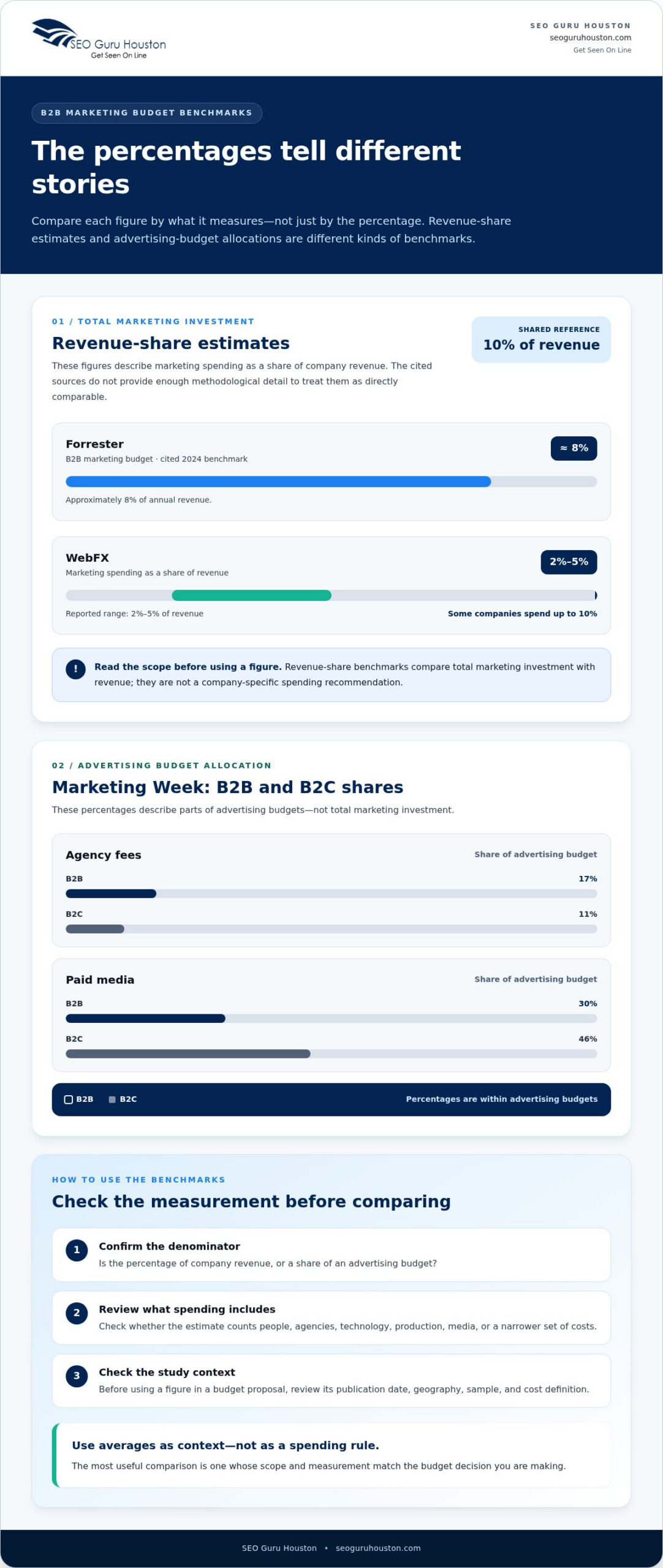
Published estimates can look like competing answers to one question, but they may measure different things. The average b2b marketing budget figures below are useful reference points when you understand their scope. The cited estimates include a Forrester figure and ranges attributed to WebFX, but they don’t provide enough methodological detail to treat them as directly comparable.

Source Budget definition Reported measure
Forrester B2B marketing budget as a share of annual revenue Approximately 8% of revenue, 2024 benchmark
WebFX Marketing spending as a share of revenue 2%-5% of revenue, with some companies spending up to 10%
Marketing Week Parts of advertising budgets, not total marketing investment Agency fees: 17% B2B versus 11% B2C; paid media: 30% B2B versus 46% B2C

How much do B2B companies spend on marketing?

The estimates cited here range from 2%-5% of revenue in the WebFX range, with some companies spending up to 10%, to approximately 8% in Forrester’s cited 2024 B2B benchmark. Don’t combine them into a new average or treat them as universal targets. Before using a figure in a budget proposal, review the original study’s publication date, geography, sample, and definition of included costs. The Forrester’s B2B Marketing Budget for 2026 report offers a current planning reference, but it shouldn’t be treated as proof of a separate historical estimate.

Keep the denominator in view. A revenue-share benchmark compares marketing investment with company revenue. A channel-allocation percentage describes how a marketing or advertising budget is divided. Revenue-share benchmarks describe total investment relative to revenue; channel-allocation percentages describe how a budget is distributed. Marketing Week’s agency-fee and paid-media figures belong in the second category, not beside total-budget estimates as if they measured the same thing.

Why published averages can point in different directions

Differences may reflect the study year, geography, company size, industry mix, or included costs. A survey of large enterprises may not describe smaller firms. A measure focused on advertising won’t capture the same spending as one that includes people, agencies, technology, and production. Check each source’s definition rather than assuming that a label such as “marketing budget” means the same thing across studies.

Use each estimate to frame questions, not settle the decision. If you’re translating a benchmark into a plan, SEO Guru Houston’s B2B marketing services connect channel choices with qualified demand and measurable outcomes.

How to Set a B2B Marketing Budget That Fits Your Growth Goals

Build the budget from the business plan, not from a percentage copied from another company. The average b2b marketing budget can offer context, but your investment needs to reflect what the business is trying to achieve, what it can support, and how marketing’s contribution will be measured. A clear process gives leadership a rationale for spending and a way to adjust the plan as conditions change.

Translate business goals into marketing requirements

Start by naming the outcome: more qualified pipeline, stronger visibility in a target market, improved lead-generation efficiency, or support for retention. Then map marketing’s role across the buying journey, from initial discovery to sales conversations. Consider sales follow-up capacity before creating more demand. If the team can’t respond to or progress additional qualified inquiries, increasing lead volume alone may not advance the goal.

  1. Define outcomes. Set business and sales objectives, then identify the marketing contribution that can support them. Separate outcomes such as qualified demand from activity measures such as campaign reach.
  2. Assess capacity. Review internal skills, available time, sales follow-up, and delivery constraints. Note which work the team can handle and where agency or specialist support may help.
  3. Model investment. Estimate the people, services, media, content, and tools required for each activity. Record assumptions so leadership can see what the plan depends on.
  4. Allocate resources. Protect essential commitments, then direct flexible campaign investment toward priorities with a clear role in the plan. Avoid spreading resources across channels without a reason.
  5. Review and adjust. Set review points and use campaign reporting and conversion tracking to assess progress. Revise the plan when evidence, business priorities, or available capacity changes.

Build and review a budget model

Separate fixed commitments from adjustable investment in your working model. Recurring personnel, agency services, or essential tools may need to be planned differently from campaign tests or media that can be scaled. For each line, record its purpose, owner, expected contribution, and assumptions. This makes trade-offs visible and shows leadership what must stay funded and what can be tested or changed.

Use scenarios to prepare for different levels of ambition without assuming one is automatically right. A conservative scenario protects core commitments and limits new tests. A planned scenario funds the activities required to meet agreed priorities. A growth-focused scenario expands validated work only where marketing and sales can support the added demand. Compare each scenario against resources and outcomes, not just its headline total.

A sound marketing budget connects business goals to available capacity and measurable outcomes. Review assumptions on a set cadence, then use conversion tracking and reporting to decide what to continue, refine, or pause. The result is a plan leadership can evaluate and adapt, not a static figure chosen because it matches an industry average.
Average B2B Marketing Budget in 2026: Benchmarks and a Smarter Plan

How to Allocate B2B Marketing Spend Across Channels and Measurement

Channel budgets work best when each investment has a defined job in the buying journey. Don’t divide spend evenly just to appear balanced. Use audience intent, buying stage, internal resources, and sales priorities to decide which channels need investment and what evidence will guide future decisions. The average b2b marketing budget won’t tell you whether your business needs more visibility, paid search, or stronger conversion paths.

Match investment to the job each channel must do

Think in roles, not a fixed channel formula. SEO can support visibility for relevant searches through keyword research and on-page work. SEO Guru Houston’s monthly SEO service includes keyword research, meta-data alteration, front-page content consultation, internal text-link review, Google Analytics implementation, and ranking/status reporting. PPC can reach people searching for specific solutions. SEO Guru Houston’s PPC service includes keyword bidding, ad placement to the right of search results, geographic targeting, conversion tracking, and reporting. Changes to PPC ads or keywords have an immediate effect. The service also includes campaign creation, ad copy optimization, keyword targeting, ongoing account management, and monthly calls. Advertisers pay for PPC when a user clicks an ad.

Content marketing can answer buyer questions and support evaluation, while social media can distribute ideas and keep a brand visible to its audience. Website and landing-page work gives interested prospects a clear next step and a focused place to learn or submit an inquiry.

Choose channels based on what buyers need at each stage. If prospects are actively searching, SEO and PPC may support discovery. If they need to understand a complex offer, useful content and a well-structured website can help them evaluate it. If a channel creates attention but there’s no suitable follow-up, revisit the plan before increasing its budget. For more detail on planning paid search, use this PPC management planning guide.

Measure outcomes without mistaking activity for impact

Track the path from investment to business result, but keep the stages distinct. Spend is the resource committed; impressions indicate exposure; traffic records visits; conversions capture defined actions; qualified leads reflect fit and sales relevance; and sales outcomes show progress beyond marketing response. A high number at one stage doesn’t automatically prove success at the next.

Use consistent definitions and reporting periods across channels. Agree on what counts as a conversion and a qualified lead, then review campaign tracking alongside sales feedback. Conversion tracking shows which interactions are recorded, while reporting helps compare activity and outcomes over time. Neither guarantees that every sale can be attributed to one channel; B2B buyers may encounter multiple touchpoints before speaking with sales.

Marketing Week’s comparison reports agency fees at 17% for B2B versus 11% for B2C, and paid media at 30% for B2B versus 46% for B2C. These figures describe portions of advertising budgets, not total marketing budgets or a recommended allocation. Read them as a reminder to scrutinize the balance between agency support, production, and media reach, then base your own mix on audience response and business objectives.

A channel plan needs qualified-demand goals, clear measurement, and the capacity to act on results. SEO Guru Houston’s B2B demand generation services connect channel roles with a broader growth plan.

Turn Your B2B Marketing Budget Into an Accountable Growth Plan

A budget becomes useful when every investment has a purpose, an owner, and a way to assess progress. Bring the plan together in one working document that connects business goals to channel roles and the resources needed to execute. This gives leadership a clear basis for review and gives marketing and sales a shared view of what the investment is meant to support.

For each priority, record:

  • Goal: The business outcome marketing is expected to support.
  • Channel role: How SEO, PPC, content, or lead-capture work contributes.
  • Owner and assumptions: Who is responsible, what resources are required, and what the plan depends on.
  • Measures and cadence: Which indicators will be tracked, who reviews them, and when adjustments will be considered.

Set measures that fit the goal. A visibility initiative and a lead-generation campaign won’t necessarily use the same success indicators. Agree on definitions with sales, track conversions, and review qualified demand alongside campaign activity. This makes it easier to spot where follow-up, channel execution, or the original assumption needs attention, without treating every result as attributable to one touchpoint.

What accountability should look like

Accountability is a regular working rhythm, not a report filed away after a campaign. SEO Guru Houston’s PPC service includes account management, monthly calls, conversion tracking, and reporting. Use these touchpoints to review progress against shared goals, discuss what tracking shows, and align next steps. Clear measurement supports better decisions, but it doesn’t guarantee rankings, a specific return, or a set volume of leads.

Where SEO Guru Houston can support execution

External expertise can help when internal capacity, channel knowledge, or execution time limits the plan. SEO Guru Houston connects keyword research, SEO, PPC, and lead-capture tactics to agreed marketing goals. Its professional team provides account management, conversion tracking, and reporting, with work aligned to increasing visibility and generating qualified leads. This B2B demand generation agency guide offers more context on connecting demand-generation activity to business priorities.

Experience provides context, not a promise of a particular outcome. SEO Guru Houston has completed 950+ completed projects, including 100+ B2B and B2C projects, and brings 12+ years of experience. Treat these proof points as background when considering whether outside execution support fits your plan, not as a forecast of results for your company.

Keep the plan active. If priorities change, capacity tightens, or reporting points to a different opportunity, revisit channel roles and assumptions rather than letting the budget run on autopilot. SEO Guru Houston’s results-focused B2B marketing services support planning grounded in goals, tracking, and accountable execution.

Make Your Next Budget Decision Count

Your next step isn’t to defend a number because it matches the average b2b marketing budget. Make the logic behind your investment easy to see: what the business needs, what marketing will do, and how the team will judge progress. That clarity turns budget conversations from requests for spend into decisions about priorities and execution.

Choose one business objective to anchor the plan. Confirm who owns each marketing activity, what sales needs to follow through, and when you’ll review the evidence. If the plan depends on new capabilities or additional execution capacity, identify that before campaigns are underway. Small, deliberate adjustments grounded in reporting can keep investment aligned as priorities shift.

SEO Guru Houston brings professional account management, conversion tracking, and reporting to marketing execution, supported by experience across B2B and B2C projects. Put your priorities into a plan built around measurable progress. Build a results-focused B2B marketing plan.

Frequently Asked Questions

What is the average B2B marketing budget as a percentage of revenue?

There isn’t one universal percentage for the average b2b marketing budget. The cited Forrester 2024 B2B benchmark is approximately 8%, while the WebFX range is 2%-5%, with some companies spending up to 10%. These are revenue-share estimates, not instructions. Before applying one, review the original study’s sample, geography, date, and included costs. Use it as context alongside your company’s goals and resources.

How much should a B2B company spend on marketing?

Set the amount by working backward from the outcomes the business needs and the activities required to support them. For example, if the priority is entering a new market, identify the research, visibility, and sales-support work involved before deciding what to fund. Document assumptions, separate ongoing commitments from adjustable campaigns, and agree on review measures. This gives leadership a rationale for revisiting the plan if priorities or capacity shift.

Is a revenue-based B2B marketing budget reliable?

Revenue is a useful reference, but it can’t account for every company’s growth goals, margins, market conditions, or past campaign performance. A business protecting profitability may make different choices from one investing to expand, even at a similar revenue level. Use the calculation as one planning input, then assess whether the proposed investment fits financial priorities and the company’s ability to convert demand.

What should a B2B marketing budget include?

Define the budget’s boundaries before comparing it with another company’s plan. Depending on the reporting method, it may include internal staffing, agency services, paid media, content production, research, and marketing tools. A media-only figure won’t reflect the resources needed to create campaigns or assess their performance. Label each category and clarify whether a figure represents total marketing investment or advertising spend, so decision-makers can interpret it correctly.

How should B2B marketing spend be divided between paid media and agency fees?

Don’t copy an allocation ratio without checking what it measures and whether it fits your objectives. Marketing Week reports B2B figures for agency fees and paid media, but these describe portions of advertising budgets, not a universal formula for total marketing spend. Consider the work your team can handle, the reach needed, production requirements, and how results will be assessed. Revisit the mix when campaign evidence or business needs change.

How do you measure whether a B2B marketing budget is working?

Agree on the business outcome and measurement definitions before launching work. Then evaluate indicators in context: a rise in website visits, for example, matters more if those visits lead to relevant inquiries and sales conversations. Track results across consistent reporting periods and compare campaign data with sales feedback. B2B buyers may interact with several channels, so attribution can be incomplete. Treat reported contribution as evidence for decisions, not automatic proof of cause.

Should a B2B business hire a marketing agency or build an in-house team?

Choose based on the skills, workload, and execution needs your plan creates. An in-house team may suit work that needs close day-to-day coordination, while an external agency can add specialist capacity or support campaigns the team can’t manage internally. Compare responsibilities, not just team labels: who will shape strategy, manage channels, track conversions, and report progress? A blended arrangement can also work if ownership and decision-making are clear.
Affordable SEO Company: How to Invest in Growth Without Overspending

The cheapest SEO proposal can become the most expensive choice if it delivers activity without progress. An affordable SEO company should make your investment work harder by prioritizing opportunities tied to your business goals, not by offering the longest task list for the lowest price.

It’s reasonable to want clear deliverables, a manageable budget, and evidence that the work is moving your business forward. But comparing headline prices alone won’t show whether an engagement includes the right mix of technical improvements, content strategy, and performance measurement. SEO also takes time, so expectations should account for meaningful milestones as well as longer-term growth.

This guide explains what a focused SEO engagement can include and how to compare proposals by scope, strategic fit, and measurable outcomes. You’ll learn how to connect SEO priorities with business objectives, evaluate progress beyond rankings, and choose an approach that can adapt as your needs change. The goal is to invest with confidence, protect your budget, and build a stronger foundation for sustainable growth.

Key Takeaways

  • An affordable SEO company focuses on the work that fits your goals and resources, not simply the lowest quote.
  • Assess your business objectives, website condition, competition, and capacity to determine which SEO priorities matter most.
  • Compare proposals by scope clarity, prioritization, measurement, communication, and flexibility to understand where value comes from.
  • Set your SEO direction by defining an outcome, establishing a baseline, choosing priorities, and tracking qualified demand and conversions.
  • SEO can work alongside PPC, B2B and inbound marketing, and website improvements. The right mix depends on your growth priorities.

What Does an Affordable SEO Company Actually Mean?

Budget pressure is real. Every marketing dollar needs a job, and an SEO proposal full of unfamiliar tasks can make it hard to tell what you’re buying. But the lowest quote isn’t automatically the most affordable choice. If research, technical fixes, or performance tracking are missing, a low upfront cost may leave the problems limiting organic growth untouched.

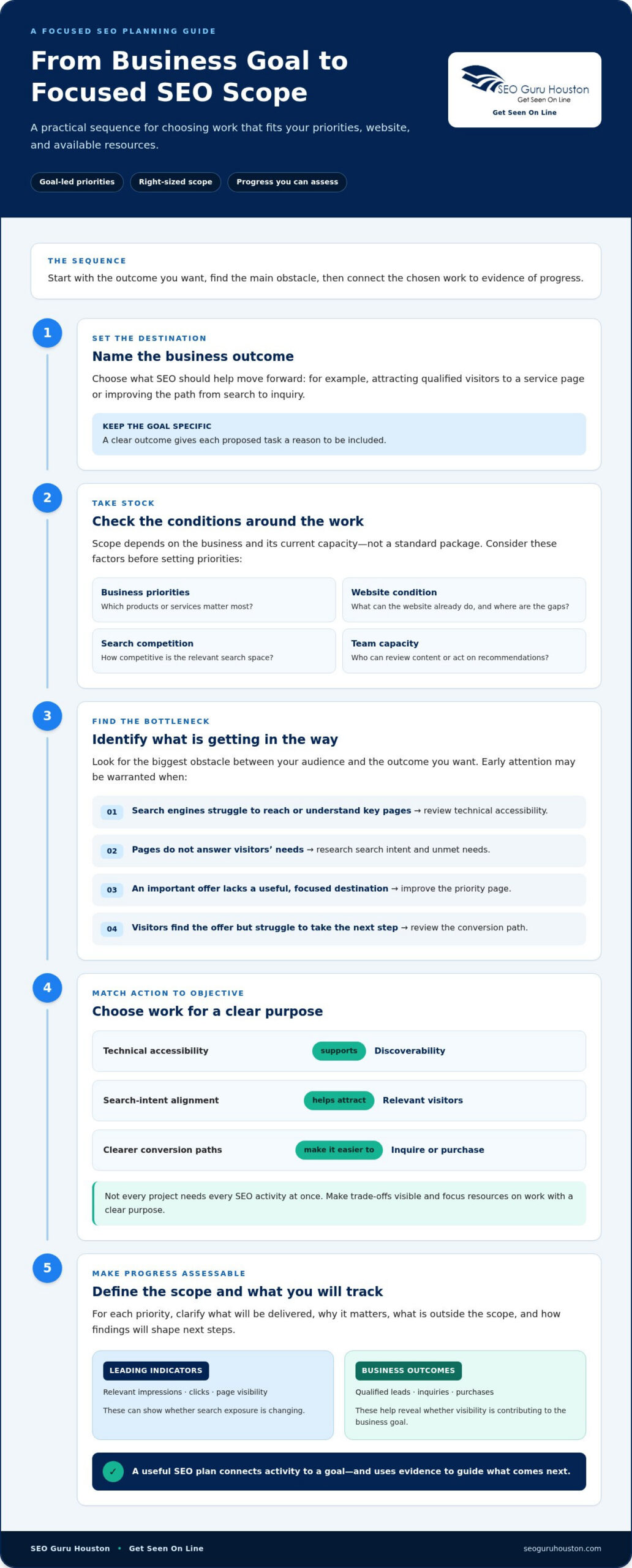
Affordability in SEO means a transparent, right-sized scope that connects available resources to measurable business priorities. Start with a clear outcome, such as attracting qualified visitors to a service page or improving the path from search to inquiry. Then identify the work most relevant to that outcome, specify what will be delivered, and define how progress will be assessed.

Search engine optimization (SEO) brings together activities that help improve a website’s visibility in search. A useful engagement turns that broad discipline into a focused plan. It isn’t a thin set of actions without a rationale, or an unexplained list of tasks that sounds comprehensive but isn’t tied to your business.

How Is Affordable SEO Different From Cheap SEO?

Affordable SEO prioritizes. Cheap SEO may simply remove the work needed to make informed decisions. A focused plan can concentrate on the most relevant pages and issues first while still grounding recommendations in research and tracking. Cutting those foundations makes it harder to evaluate the work because there’s no clear rationale or way to connect activity to progress.

Deliverable clarity matters more than a headline figure. You should understand what the work includes, why it matters, what falls outside the scope, and how findings will shape next steps. Imagine a company whose priority is generating more qualified inquiries for one service. A focused engagement might research search intent, improve that service page, and monitor relevant inquiry actions. A vague task list might promise assorted updates without explaining how they support the goal. The difference isn’t the number of tasks, but the reasoning behind them.

Who Can Benefit From a Focused SEO Engagement?

A focused engagement can suit a business that wants stronger organic visibility but needs to sequence marketing investments carefully. That might be a growing company with a defined service to promote, a business with limited capacity to create or update content, or a team strengthening its search foundation before expanding its efforts. The right starting point depends on the business, not a standard package.

Before setting scope, clarify the outcome and the resources available to support the work. Consider which products or services matter most, what the website can already do, and who can review content or act on recommendations. If your team can support only a narrow initiative, concentrating on a priority page may be more practical than spreading effort across the entire site. If capacity changes, priorities can change with it.

An affordable SEO company should make those trade-offs visible, not disguise them behind a low price or a long list of deliverables. A good-fit engagement gives your business a clear first move and a reasoned way to build from there.

What Shapes the Scope and Value of Affordable SEO Services?

SEO scope should reflect the business you’re trying to grow, not a standard checklist. A company seeking qualified inquiries for a specific service needs a different plan from an online retailer expanding product visibility. The website’s current condition, the competitiveness of its search space, and the time your team can contribute all affect what belongs in the plan and what should wait.

Think of the work in two layers. Foundational SEO addresses whether search engines can access and understand important pages, whether those pages match relevant search intent, and whether visitors can take a useful next step. Ongoing improvement may involve developing content for unmet needs, strengthening the site’s authority, and using performance data to refine priorities. A well-scoped engagement makes the transition between these layers clear. For a broader perspective on strategy, explore this guide to professional SEO services.

An affordable SEO company should explain why each priority fits your goals and what evidence will help assess its value. Not every project needs every SEO activity at once. The plan should make trade-offs visible so your resources go toward work with a clear purpose.

Which SEO Activities Deserve Early Attention?

Start with the website’s actual needs, not a generic checklist. Technical accessibility deserves attention if search engines struggle to reach or understand key pages. Search-intent research matters if visitors have needs your pages don’t answer. Improve priority pages when important services or products lack a useful, focused destination. Review conversion paths when people can find the offer but can’t easily take the next step.

Connect each activity to an objective: accessibility supports discoverability, intent alignment helps attract relevant visitors, and clearer conversion paths make it easier for those visitors to inquire or purchase. To decide what comes first, identify the biggest obstacle between your audience and the business outcome you want.

How Should SEO Performance Be Measured?

Use both leading indicators and business outcomes. Relevant impressions, clicks, and page visibility can show whether search exposure is changing. Qualified leads, inquiries, or purchases help reveal whether that visibility supports the business. Google Search Console can help you review search queries and page performance, while analytics data can show how visitors behave after landing on the site. Together, these sources provide context, not a promise of particular rankings or revenue.

SEO reporting should connect completed work to search visibility and meaningful business outcomes, so each review informs the next decision. A useful report explains what changed, what the data suggests, and what action follows instead of presenting metrics without interpretation.

  • Goal: Name the business outcome the SEO work is meant to support.
  • Baseline: Record relevant page, search, and conversion performance before changes.
  • Review: Compare progress over time and adjust priorities as evidence or business needs change.

Connecting scope to measurement turns SEO from a collection of tasks into a growth strategy. If your priorities call for a broader view of search and digital growth, explore SEO strategy and marketing resources to see how related efforts can fit together.

Affordable SEO Company vs. Low-Cost Provider: How to Compare Value

A proposal’s total cost tells you what you’d pay, not what the work is designed to accomplish. Compare the reasoning behind the scope: which business priority it serves, how the work will be measured, and what happens as needs change. A focused engagement may fit a defined objective; a broader partnership may suit a business addressing several connected growth needs. Neither is automatically better because it costs less or covers more.

Use this comparison to look beyond labels. These are common patterns, not fixed rules. A bare-minimum scope can suit a narrow need when its limits are clear.

What to compare Focused engagement Bare-minimum offer Broader growth partnership
Scope clarity Defines a specific objective, work areas, and boundaries. May list limited tasks without explaining their purpose. Connects SEO with related marketing or website work.
Prioritization Concentrates effort on the most relevant opportunity. May provide a fixed set of routine activities. Can address several priorities, if they’re genuinely needed.
Measurement Tracks indicators tied to the selected objective. May report activity without explaining its significance. Can connect performance across channels and conversion paths.
Communication Explains progress, decisions, and next steps. May offer limited context around completed tasks. Coordinates updates across connected areas of work.
Flexibility Can refocus as the priority evolves. May have little room to adjust its preset scope. Can shift emphasis among services as business needs change.

What Should a Transparent SEO Proposal Explain?

A transparent proposal links four parts: the business objective, the work chosen to support it, the reporting used to review progress, and expectations for discussing what comes next. The connections matter. If a deliverable has no stated purpose, or a report tracks measures unrelated to the objective, it’s difficult to judge whether the work is useful. An affordable SEO company should make those connections understandable without promising a specific ranking or revenue result.

Look for explanations, not just labels. “Improve key pages” is hard to evaluate without knowing which pages, why they matter, and how progress will be reviewed. A clear scope makes assumptions and boundaries visible, helping you compare substance rather than headline price.

When Does a Broader Growth Partnership Make Sense?

SEO can bring relevant visitors to a website, but it can’t resolve every barrier to growth by itself. If a landing page makes it hard to take action, website improvements may support the path from visit to inquiry. If the business needs to reach demand sooner while organic visibility develops, PPC may complement SEO. A broader partnership makes sense when those needs are connected and your team can act on them.

More services aren’t automatically more valuable. The right combination depends on the goal, capacity, and gaps identified. For broader context on how SEO fits into digital marketing, read this SEO marketing company guide. If your priorities span search and website performance, SEO and digital growth strategy can provide a useful starting point.

Affordable SEO Company: How to Invest in Growth Without Overspending

How to Set an SEO Budget and Priorities That Fit Your Business

An SEO budget works best when it’s built around a business result, not a wish list of tasks. Start with what growth should look like, identify the current barriers, then assign resources to the work most likely to move the right measure. This grounds priorities in evidence and makes it easier to explain why some work comes first while other opportunities wait.

Use this sequence to turn a broad ambition into a workable plan:

  1. Define the business outcome. Choose a meaningful objective, such as attracting qualified inquiries for a particular service or increasing relevant organic visits to important product pages.
  2. Assess the baseline. Review current search visibility, website activity, conversion paths, and inquiry data. Use your own site’s performance as the reference point rather than assuming an industry benchmark applies.
  3. Prioritize the constraint. Identify what most limits progress. It might be a technical issue, an important page that doesn’t meet search intent, or a website experience that makes it hard to take action. Fund the work that addresses that obstacle first.
  4. Set measures. Pair an early indicator, such as relevant organic visits, with a business outcome, such as qualified inquiries. Define what counts and where the data comes from before work begins.
  5. Review and adjust. Compare results with the baseline, discuss what the evidence suggests, and revisit the plan when capacity, business goals, or customer needs change.

This sequence gives an affordable SEO company a practical framework for prioritizing effort without treating every possible task as equally urgent.

How Can You Set Useful SEO Objectives?

Make broad goals observable. “Grow online” is difficult to act on. “Increase relevant organic visits to the service page and track how many become qualified inquiries” gives the team a direction and a way to learn. Record the starting point and keep definitions consistent across review periods. If the meaning of a qualified inquiry changes, note that change so performance comparisons remain useful.

Don’t judge the plan on traffic volume alone. More visits may not matter if those visitors aren’t looking for what the business offers or don’t take a meaningful next step. Match each measure to the customer journey and the outcome the business values.

How Should You Balance SEO With Other Growth Channels?

SEO can build organic visibility over time, while paid search may support demand that needs attention sooner. Website and landing page improvements can help visitors understand an offer and act on it. The right mix depends on your objective, available resources, and how customers move from discovery to decision. Not every business needs every channel at once.

If search attracts the right audience but the page makes conversion difficult, focused landing page design may address a more urgent constraint than expanding traffic efforts. Reassess the mix as evidence and priorities evolve.

Build your next steps around a clear goal, an honest baseline, and measures that connect marketing activity to business progress. Explore SEO growth services to consider how a data-driven search strategy can support your priorities.

How an Integrated SEO Partner Turns Affordability Into Growth

SEO creates more value when it supports a clear business objective instead of operating as a disconnected list of tasks. Search visibility matters, but so does what visitors find when they arrive and whether the site helps them take a meaningful next step. Connecting those pieces helps direct effort toward the full path from discovery to inquiry.

An integrated approach can draw on SEO, PPC, B2B marketing, inbound marketing, and website development and landing page design. That doesn’t mean every business needs every capability. A company focused on organic discovery may prioritize SEO; one seeking paid-search visibility may add PPC. If relevant visitors reach a page that doesn’t explain the offer or guide action, web improvements may be the more immediate priority. The right combination follows the goal.

For an affordable SEO company, integration is about coordination, not piling services onto a plan. Search strategy can inform which pages deserve attention, landing page work can support the visitor’s next step, and lead-generation priorities can shape which outcomes to track. Each activity should have a role in the business objective.

When Can SEO, PPC, and Web Development Work Together?

Organic search and paid search can serve different needs. SEO supports a longer-term effort to build visibility for relevant searches, while PPC can support paid-search objectives. Their roles may complement each other, but they aren’t interchangeable and shouldn’t be assumed to deliver the same outcomes.

Website development and landing page design connect those traffic sources to the customer journey. For example, a business seeking qualified inquiries might align search content and paid-search messaging with a page that clearly presents the relevant service and next step. A company focused on a different audience or offer may need a different page or channel mix. The best sequence depends on the goal, site condition, and available resources. There’s no universal timeline or guaranteed result. Evaluate progress against the measures selected for the project.

What Should a Practical First Conversation Establish?

Start with the business need. What outcome matters most? Which audience are you trying to reach, what challenges currently interrupt their path to action, and what marketing resources can your team contribute? Answers help distinguish a search visibility challenge from a conversion issue or a need to coordinate demand generation across channels.

A useful discussion connects those answers to possible priorities and services. If the main obstacle is organic discoverability, SEO may lead. If the page experience is holding back inquiries, web work may deserve attention. If paid visibility is part of the objective, PPC may have a role. This keeps the plan focused instead of treating service breadth as a reason to use everything.

Bring your goals and current challenges into focus, then turn them into a practical growth direction. Discuss your SEO growth goals and take the next step with purpose.

Turn Your Next SEO Decision Into Forward Momentum

Your SEO plan doesn’t need to solve every growth challenge at once. It needs to give your team a clear next move, a way to assess whether that move is useful, and room to adapt as the business evolves. Treat each review as a decision point: keep investing in work that supports your objectives, refine what isn’t connecting, and shift focus when your priorities or capacity change.

That’s how an affordable SEO company engagement can become a practical growth tool rather than a fixed list of deliverables. Start with the business question that matters most, then build a focused plan around the answer. Progress comes from deliberate decisions and learning from the evidence, not from trying to do everything at once.

Ready to turn your priorities into a clear direction? Map out your next SEO priorities and take the next step with confidence. Your growth strategy can start focused and become stronger as your business moves forward.

Frequently Asked Questions

Can an affordable SEO company guarantee first-page rankings?

No. An affordable SEO company can research opportunities, improve relevant pages, and monitor search performance, but it can’t control search engine results or promise a specific position. Rankings shift with competition, search changes, and other factors beyond any agency’s control. Look for clear explanations of planned work and progress measures instead. For example, track whether priority pages gain relevant impressions and attract visitors who match your intended audience.

How long does it take to see results from SEO?

There’s no reliable universal timeline because progress depends on the site’s starting condition, competition, scope, and how quickly recommendations are implemented. Some changes, such as correcting a page access issue, may be observable before broader business outcomes become clear. Treat early movement as a signal to investigate, not proof of success. Compare performance with a baseline over consistent periods, and assess whether visibility is developing into relevant visits and meaningful actions.

What should an SEO report include?

A useful report should show work completed, pages or search themes affected, relevant performance changes, and recommended next actions. It should define the reporting period and clarify how key metrics are calculated. For example, a report might distinguish visitors to a priority service page from all organic visits, then show whether those visitors completed a tracked inquiry action. Context matters: numbers without interpretation don’t explain what to do next.

Can an SEO strategy change as my business goals change?

Yes. SEO priorities should respond when your business shifts focus, changes its offerings, or discovers that a different audience or page deserves attention. A company moving toward a new service line, for example, may need to reassess which pages and search topics receive effort. Keep previous goals and reporting definitions documented, then note why the plan changed. That preserves useful comparisons while making room for new priorities.

Does affordable SEO include content creation?

It can, but content creation should be explicitly defined in the engagement rather than assumed. Clarify whether the work involves content research, outlines, drafting, updating existing pages, or reviewing material your team provides. The right choice depends on the goal and your internal capacity. If a page already answers customer questions well, improving its clarity may be more useful than adding another article. Focus content investment on a real audience need.

Is SEO or PPC better when a business needs leads quickly?

PPC can support paid-search visibility for a near-term campaign, while SEO builds organic visibility through ongoing work and may take longer to influence business outcomes. Neither channel guarantees leads. Before directing more traffic to a site, check that the offer is clear, the landing page matches the ad or search intent, and inquiry tracking works. The best choice depends on urgency, budget capacity, customer journey, and whether the business can respond to demand.