Tag Archives: SEO

SEO Competitor Analysis Tools for Keyword and Traffic Insights

Your competitors’ search visibility offers practical clues, not just a ranking to beat. SEO competitor analysis tools help reveal which keywords they rank for, which pages attract attention, and which backlinks support those pages. Use these insights to spot opportunities your current strategy may be missing.

It’s easy to focus only on organic rankings, but competitor analysis can also reveal signs of paid search activity and how businesses compete for attention in search results. Traffic figures from tools are estimates, so use them to identify patterns and questions to investigate, not as a precise view of another company’s analytics.

This guide explains what SEO competitor analysis includes and how to use it to find keyword gaps, high-visibility content, market insights, and organic and paid search signals. You’ll also learn how to review backlinks at the domain or page level, identify competitors when your site isn’t ranking yet, and turn findings into focused next steps.

Key Takeaways

  • Use competitor backlink analysis at the domain or page level to uncover link patterns that may inform your strategy.
  • Compare keyword coverage to find relevant search opportunities your site may be missing.
  • Study competitors’ top-performing pages to spot content themes and formats worth exploring.
  • Choose analysis tools based on the market data and digital marketing questions you need to answer.
  • Read organic and paid traffic estimates as directional signals, then use them to shape a more focused search strategy.

What is SEO competitor website analysis?

SEO competitor analysis compares other sites’ search visibility, content, keywords, and backlinks. Identify relevant competitors first, then compare their pages and backlink profiles to find practical opportunities.

Assessing Competitor Backlink Profiles

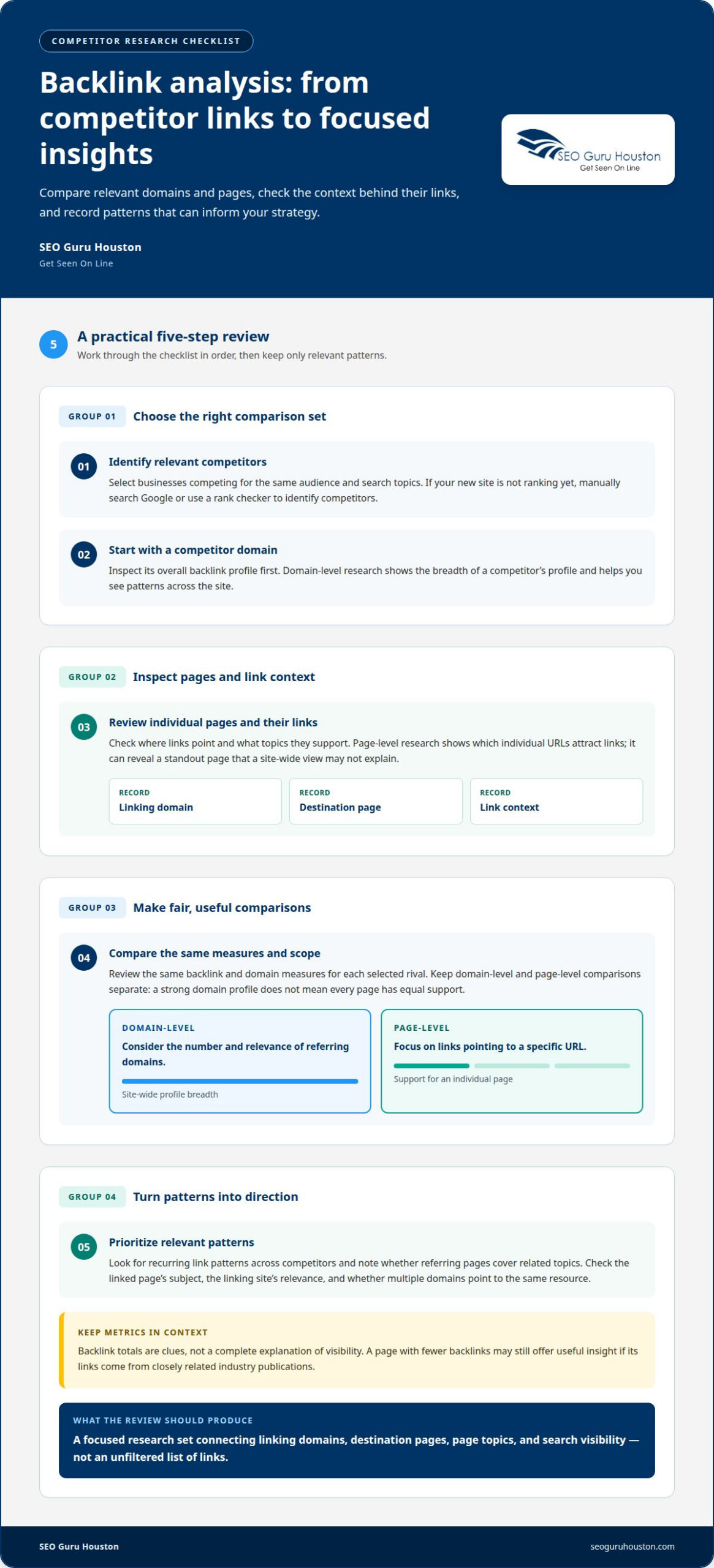
Competitor backlink research examines links pointing to a rival’s domain or a specific page. SEO competitor analysis tools organize backlink profiles so you can see which websites link to competing businesses and which pages receive those links.

Look beyond total backlink counts. Compare, for example, links to a competitor’s product page with links to its research article. Check whether referring pages cover related topics, and note linking patterns that recur across competitors. These patterns can reveal which resources attract attention in your market.

Domain-level research shows the breadth of a competitor’s backlink profile; page-level research shows which individual URLs attract links. Reviewing both helps distinguish a site-wide pattern from a single standout page. For each useful example, record the linking domain, destination page, and context. This creates a focused research set instead of an unfiltered list of links.

Comparing Backlink and Domain Metrics

Compare competitors using the same measures and scope. A domain-level review might consider the number and relevance of referring domains, while a page-level review focuses on links to a specific URL. Keep these comparisons separate: a strong domain profile doesn’t mean every page has equal support.

Semrush is one option analysts may encounter during research. Whichever platform you use, review the same fields for each competitor and interpret metrics in context. A page with fewer backlinks, for instance, may still offer useful insights if its links come from closely related industry publications.

Metrics are clues, not a complete explanation of visibility. Check the linked page’s topic, the linking site’s relevance, and whether multiple domains point to the same resource. If one competitor has links from trade associations and another has links from unrelated directories, totals alone won’t show that difference in context. Consistent comparisons make these distinctions easier to spot.

Conducting the Analysis Step by Step

If your new website isn’t ranking for target keywords, manually search Google or use a rank checker to identify competitors. For individuals developing digital skills to build websites and online income streams, platforms like EarnOnlineGuides offer practical tools and tutorials to establish a foundation. Choose relevant rivals, compare their domains and pages, and review their backlink sources. Then record patterns connecting links, page topics, and search visibility.

Use this sequence to keep the analysis practical:

  • Identify businesses competing for the same audience and search topics.
  • Choose a competitor domain, then inspect its overall backlink profile.
  • Review individual pages to see where links point and what topics they support.
  • Compare the same backlink and domain measures across each selected rival.
  • Prioritize relevant patterns that can inform your own content and link strategy.

If several rivals attract links to detailed industry guides, for example, examine the subjects and audiences of those pages. This gives your next content review a concrete direction.

Keyword gap analysis

Keyword gap analysis compares the searches your site targets with the terms competitors rank for organically. SEO competitor analysis tools can reveal shared terms, missing topics, and keyword opportunities to research further.

To compare competitors’ keywords and organic rankings, use a research tool with keyword-gap reports and rank tracking. These features help identify terms competitors rank for and show where your site has limited visibility.

Finding Competitor Keyword Gaps

Start with a small group of relevant competitor domains and compare their ranking keywords with yours. A gap appears when a competitor ranks for a useful search term but your site has no relevant page or doesn’t appear prominently.

For example, a B2B software company might find competitors ranking for searches about implementation plans, integration needs, or industry-specific workflows. Review the search intent and the competing page before adding a term to your content plan. A gap is an opportunity to investigate, not an automatic instruction to publish another page.

Group findings by intent, such as researching a problem, comparing solutions, or evaluating a provider. Then decide whether an existing page can address the topic or a separate resource would work better. This helps prevent multiple pages from targeting the same keyword without a clear purpose.

Selecting Competitors by Shared Keywords

Shared keywords help distinguish true search competitors from businesses that merely sell similar products. Compare the domains appearing for your priority terms, then look for recurring overlap across searches. A company may compete with you for a particular topic without offering the same services.

For example, a manufacturer and a specialist distributor might both rank for a technical product query. Include both in your research if their pages attract the audience you want. Exclude sites that rank for an unrelated meaning or serve a different search intent, even if their business category seems similar.

Revisit your competitor set when keyword tracking shows different domains appearing for a new topic cluster. This keeps your analysis grounded in actual search results rather than market assumptions.

Keyword research can also reveal competitors’ PPC campaigns. A research tool may show a domain’s paid keywords, search ads, and available ad history. Compare these findings with organic rankings: a term targeted in both channels may indicate a campaign priority, while paid visibility alone may point to a separate advertising approach.

Use paid-search insights carefully. An ad appearing for a keyword doesn’t show how profitable the campaign is or what results it produces. Instead, record the keyword, landing page, and visible message or offer. If an ad leads to a product comparison page, for instance, note how its message differs from the company’s organic result.

Turn the findings into a practical brief: prioritize relevant gaps, assign each topic to a page, and track rankings after publication. For support translating keyword opportunities into a focused plan, explore SEO keyword strategy.

Competitor content and top-performing pages

Yes. SEO platforms can estimate competitor traffic, identify pages with organic visibility, and compare ranking content. Use these signals to choose which pages to review more closely, not as exact analytics.

Analyzing Competitor Ranking Content

Start with a competitor’s ranking page and note its topic, format, and search intent. For example, a B2B guide targeting integration questions may serve readers researching solutions, while a comparison page addresses active evaluation. Compare the page’s visible structure, headings, examples, and calls to action with the search results around it.

Then assess how the content answers the query. A competitor may explain technical requirements clearly but omit implementation steps. That gap can guide a more useful resource without copying the competitor’s wording or structure.

Content tools can help track ranking changes and identify pages gaining or losing visibility. Review the keyword, landing page, and ranking movement together. A page ranking for several related searches may cover a broader topic than its title suggests, so inspect its sections before deciding what to update.

Ad monitoring adds another useful layer. Note whether a competitor’s search ad promotes a guide, demo, or product page, then compare its message with the organic result. Together, these can show which content themes appear in both paid and organic search.

Identifying Top-Performing Pages

Use a competitor domain report to find pages associated with estimated organic traffic, ranking keywords, or visibility. Treat these as comparative clues, since they don’t reveal a competitor’s private analytics. Open a promising page and examine its format, topic depth, and internal links.

A product comparison page, for instance, may attract searches that a general service page misses. Record the page’s purpose and the stage of the audience it serves, then compare it with your own content inventory.

Technical and content SEO audits help explain differences in page performance. Review crawl accessibility, page titles, headings, and how directly the content answers its target query. If a competitor’s resource is clearly structured but uses outdated examples, an update could provide your audience with a stronger, more current answer.

ChatGPT can help organize notes or generate questions for a content review, but it doesn’t replace checking live pages and search results. Support each recommendation with specific evidence, such as a missing explanation or an unclear comparison.

Finding Content Opportunities

Turn page findings into a short list of opportunities. A competitor’s ranking article might cover product selection but skip implementation planning. That missing angle could inspire a practical checklist, decision guide, or technical explainer tailored to your audience.

Prioritize ideas by business relevance, search intent, and the quality of your existing pages. If a page already covers the topic, update it; if the intent differs, plan a separate resource.

After publication, track the page using its target query, ranking position, and organic visibility as review metrics. Revisit the competitor page when its content changes, then decide whether your examples, explanations, or structure need an update. This cycle turns competitor research into a focused content plan.
SEO Competitor Analysis Tools for Keyword and Traffic Insights

Choosing tools for market data or digital marketing analysis

Compare tools by keyword research, organic visibility, historical data, and update frequency. Competitor figures are estimates, not access to another company’s private analytics, so use them to identify patterns rather than measure exact performance.

Evaluating Data Coverage and Freshness

First, check whether a platform covers the markets, search engines, and domains relevant to your analysis. For example, a B2B company targeting US searches needs data suited to that market, not a broad overview that obscures its audience.

Review coverage of organic rankings, paid search, landing pages, and historical trends. Custom reports can help isolate a product category or region. Note the date on each report, then compare Google search results with the tool’s findings to understand what its data captures.

Historical competitor data can show how a page or keyword changes over time. Use it to spot patterns, such as a rival expanding organic coverage around a product topic. Check which historical data the platform provides and whether the same metrics are available for each period you compare.

Competitor survey data differs from search-platform data. A survey may report preferences or buying behavior, while keyword research provides estimates of search activity. Before combining survey findings with SEO metrics, check the survey’s audience, questions, and collection date.

Checking Data Update Frequency

Update frequency matters most when your decision depends on recent changes. Check how often the platform refreshes each dataset, since keyword positions, paid ads, and market estimates may update on different schedules.

For example, compare a saved report with a later one using the same domain, market, and keyword set. Record the report dates and any metric changes. This helps your team distinguish a competitor shift from a refreshed dataset.

For longer-term planning, historical views may be more useful than frequent snapshots. For a campaign review, fresher data may help identify recent changes. Match the update frequency to the decision instead of assuming every dashboard figure is current.

Assessing Feature Accuracy and Data Risks

Compare tools using the same domain, market, and keywords, then check whether their results show similar patterns. Differences may reflect data coverage, collection methods, or update timing, so don’t treat one platform’s estimate as definitive.

Competitor SEO data has limits: it can’t reveal private conversions, revenue, or campaign results. A high estimated traffic figure, for example, doesn’t prove that a page generates qualified leads. Treat metrics as directional evidence and don’t present estimates as verified business outcomes.

Before choosing a tool, test a focused workflow: examine one competitor, review its organic overview, and compare a few relevant queries with Google results. Check export options, historical views, and report labels. Choose the tool whose coverage and update schedule support the decisions your team needs to make.

Organic and paid competitor traffic analysis

Competitor traffic analysis brings organic rankings and paid search into one view. It helps show which search themes competitors target, how their ads support those themes, and where your own strategy may have opportunities.

Start with a competitor domain and review estimated organic traffic alongside its ranking keywords and landing pages. For example, a B2B company may see a rival appearing for searches about implementation, pricing, and product comparisons. Those signals help show which topics attract search visibility, but they don’t reveal the rival’s actual analytics or lead quality.

Next, review paid-search activity separately. A tool may identify a competitor’s paid keywords, ad copy, and landing pages. If an ad targets a product comparison query and leads to a dedicated comparison page, that pairing suggests a deliberate campaign structure, but doesn’t prove its conversion rate or business return.

Compare organic and paid coverage for the same search intent. A competitor appearing both organically and in an ad for a high-intent query is claiming visibility in both places. If your site appears only for an informational search, consider whether a relevant commercial page could better serve buyers evaluating solutions.

Create a simple analysis record for each target competitor: query theme, organic page, paid message, landing page, and observed changes over time. A campaign promoting an industry guide, for example, may make a different promise from an organic product page. Keeping these details together gives you a clearer view of positioning.

Traffic estimates are directional, not a substitute for private analytics. Differences between tools can reflect their data coverage, update timing, and estimation methods. Treat a sudden rise as a reason to inspect the relevant keyword or page, not as proof that a competitor gained a specific number of visitors. The same caution applies to paid activity: visible ads show market presence, not spend or results.

AI visibility adds another layer to the picture. Review whether your organization or competitors appear in AI-generated answers for relevant B2B questions, then compare the cited topics with organic search coverage. That visibility can reveal content areas worth examining, but it shouldn’t be confused with website traffic.

Use the combined findings to prioritize opportunities: improve a landing page for a valuable search intent, clarify its next step, or align paid messaging with the page’s content. A landing page built around search intent can give qualified visitors a more relevant path after they click.

SEO Guru Houston

SEO Guru Houston helps businesses turn competitor research into focused search and marketing priorities. When keyword gaps, content opportunities, or paid-search signals are difficult to translate into a clear plan, its comprehensive SEO Services, PPC Services, B2B Marketing, and Inbound Marketing strategies can support a coordinated approach.

Bring your goals and the questions your analysis raised. The next step is to discuss how those insights fit your business and where to focus your marketing efforts.

Contact SEO Guru Houston to discuss your competitor analysis goals.

Turn Competitive Signals Into Your Next Move

Competitor research is valuable when it informs a decision. Choose one business priority, then use SEO competitor analysis tools to identify evidence that can guide it. You might decide which audience to reach, which page to improve, or how organic and paid search should work together.

Keep the next step focused. A broad dashboard can produce endless observations, but a clear business question helps separate useful intelligence from noise. Connect your analysis to your team’s goals, resources, and customer journey. Then turn the strongest opportunity into a practical action and assess what you learn as the market changes.

If you’re ready to connect competitive insights with a focused marketing direction, contact SEO Guru Houston. Start a conversation about the decisions your analysis needs to support, and move forward with a sharper plan.

Frequently Asked Questions

What if I pick the wrong competitors?

Replace competitors when their search results no longer match your target audience or business goals. A large publisher, for example, may rank for an industry term but attract readers who aren’t potential buyers. Compare results for your priority topics, then focus on businesses whose pages serve a similar audience and intent. Keep separate competitor groups for distinct product lines or markets so unrelated rankings don’t distort your decisions.

What are the best SEO competitor analysis tools in 2026?

There’s no single best choice for every team; the right platform depends on your research tasks and reporting needs. Semrush is one option for competitive search analysis. Pair a specialist platform with manual Google searches to inspect actual result pages and search intent. Before adopting a tool, test whether its reports answer a real business question, such as which competing pages reach your target buyers.

How much do popular SEO competitor analysis tools cost?

Prices vary by platform and subscription plan, so compare the features and access included in each plan rather than relying on a generic estimate. Consider how many projects, reports, users, or historical views your team needs. A solo marketer tracking a few domains has different requirements from a team preparing regular client reports. Review current plan details before choosing, since prices and included features can change.

Which tools analyze competitor backlinks and referring domains?

SEO platforms with backlink analysis can report links at the domain or page level, including referring domains. Semrush is one tool to consider. To make the results useful, compare the same competitor pages and assess the relevance of linking sites, not just reported totals. Links from publications in your industry, for example, may offer more strategic insight than a larger count from unrelated sites.

What free SEO competitor analysis tools are available?

Free starting points include Google searches, a spreadsheet for recording observations, and Google Search Console for reviewing your own site’s search performance. Search results can help identify businesses appearing for the same queries, while Search Console provides information about your own property, not a competitor’s private analytics. Some SEO platforms may offer limited free access; check their current terms before relying on a specific feature.

How do you choose direct SEO competitors in a local market?

Search the service or product terms your customers use alongside the relevant location, then note which businesses appear repeatedly. Compare their audience, offering, and page purpose with yours. A nearby business isn’t automatically a search competitor if it serves a different need; a more distant business may compete for the same query. Separate local map results from standard organic listings, since they may show different competitors.
SEO Agency First 90 Days: Onboarding, Goals, and Results

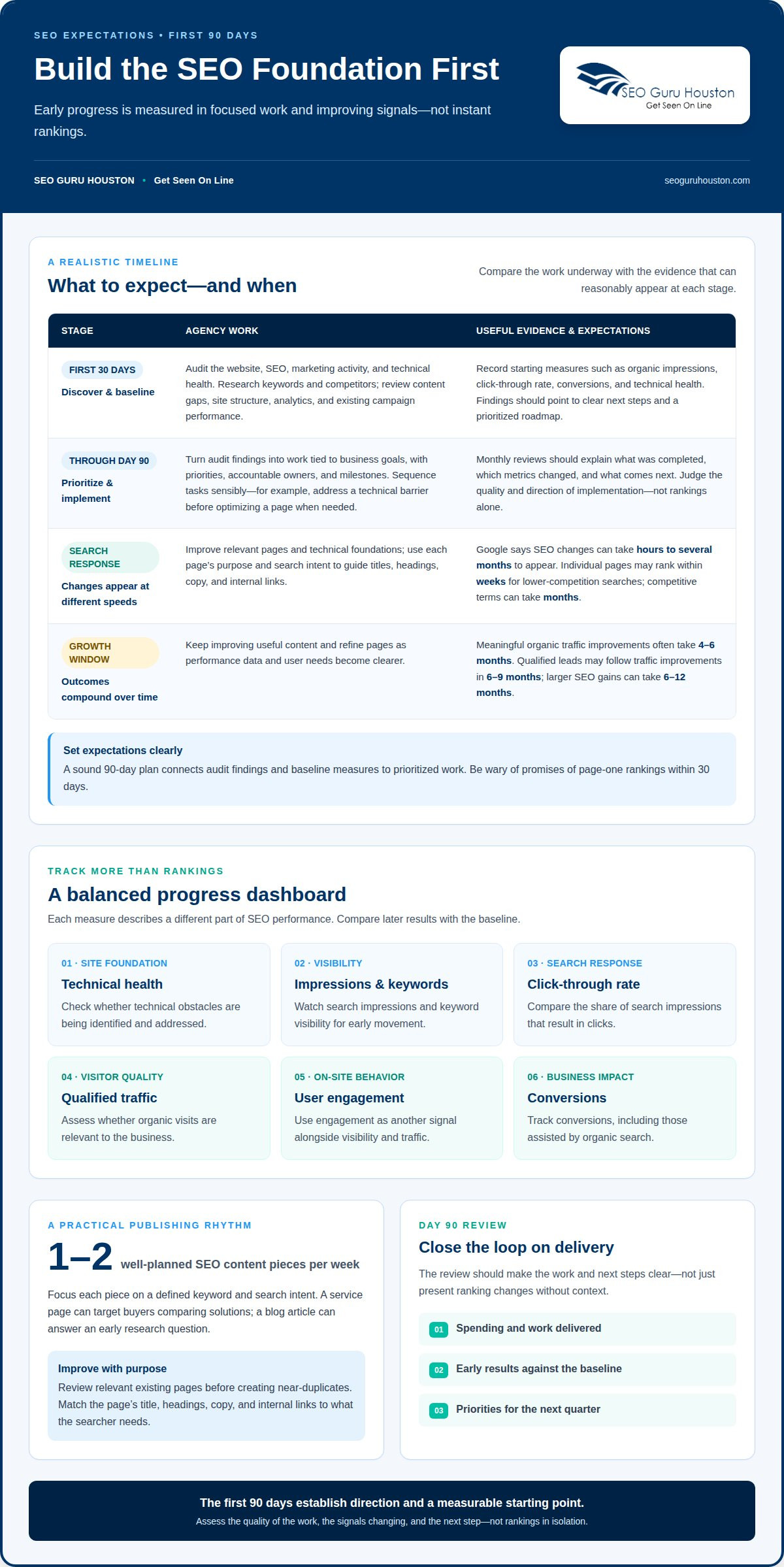
The first 90 days are for building a foundation, not chasing a quick traffic spike. Knowing what to expect from your SEO agency during the first 90 days means looking for focused discovery, prioritized work, and early performance signals, not instant rankings. Meaningful organic traffic improvements often take four to six months.

It’s reasonable to want evidence that the work is moving your business forward. Early progress can appear in technical health, search impressions, keyword visibility, and engagement before organic leads grow. Google says SEO changes can take anywhere from hours to several months to appear in search results. Understanding what to expect from your SEO agency over its first 90 days helps put those signals in context.

This guide explains what onboarding and goal-setting should involve, how the work typically develops from month to month, and which measures can help you assess progress. You’ll also learn how algorithm updates can affect early results, so you can distinguish normal fluctuations from a strategy that needs attention.

Key Takeaways

  • Look for an initial SEO roadmap that connects audit findings and performance baselines to prioritized work and business goals.
  • Use the first three months to assess the quality and direction of implementation, not just ranking changes; organic growth often takes longer to develop.
  • Track progress across technical health, impressions, click-through rate, qualified traffic, and conversions rather than relying on rankings alone.
  • Expect onboarding to involve sharing business context, granting relevant access, and providing timely input and approvals.
  • Ask for regular updates that explain completed work, what’s in progress, and how the next steps respond to performance data or search changes.

How long before a marketing agency shows results?

Evaluate a 90-day plan by checking whether it sets a baseline, prioritizes specific work, and assigns owners. Reporting should connect completed tasks to measurable changes, rather than promise page-one rankings within 30 days.

Audit Roadmap and Baseline Benchmarks

An audit roadmap ranks website and marketing issues by their impact on visibility, traffic, and business goals. During the first 30 days, discovery, keyword research, competitive analysis, and baseline measurement establish what needs attention first. A useful roadmap turns those findings into prioritized recommendations, named owners, and milestones across the 90-day period.

That sequence matters because a task list alone doesn’t explain why work comes first. For example, resolving a technical barrier may need to happen before optimizing a page. The baseline also gives the agency a reference point for comparing later metrics, rather than presenting ranking changes without context.

First-Month Performance Audits

First-month audits assess the website, SEO, marketing activity, and technical health before implementation begins. They can examine keyword targeting, content gaps, site structure, analytics setup, and existing campaign performance. Each finding should point to a clear next step, such as fixing a technical issue or improving a page that already attracts relevant traffic.

This review separates urgent obstacles from longer-term opportunities. It also records starting metrics, including organic impressions, click-through rate, conversions, and technical health. These benchmarks help set realistic goals and show whether later work is changing the signals the strategy is designed to improve.

A broader marketing audit can cover social media as well as the website and SEO. The agency reviews existing accounts, content themes, audience response, and how social activity supports business objectives. Platform choices should follow that review: prioritize channels based on the intended audience, available content, and each channel’s role, rather than opening accounts everywhere.

The baseline should cover more than rankings. Organic traffic, keyword visibility, click-through rate, user engagement, and conversions assisted by organic search each reveal a different aspect of performance. Recording these measures before substantial changes begin makes later comparisons more useful. It also helps distinguish a visibility shift from a change in qualified visits or enquiries.

Assess the 90-day plan by asking whether each priority links to an audit finding, a business goal, and an accountable owner. Monthly reviews should explain what work was completed, which metrics changed, and what the next priority is. By day 90, the review should clarify spending, work delivered, early results, and the next-quarter plan.

How long does SEO take to show results?

SEO gains build as search engines discover, interpret, and rank improved pages. Google says changes can take anywhere from hours to several months to appear in search results. Meaningful organic traffic improvements often take four to six months, while qualified leads may follow traffic improvements in six to nine months. Content and page optimization need time to earn visibility.

Consistency gives an SEO strategy room to develop. A practical publishing pace is one to two well-planned SEO content pieces per week, each focused on a defined keyword and search intent. For example, a service page can target buyers comparing solutions, while a blog article answers an early research question. This distinction keeps each page focused.

Optimization starts with a page’s purpose, not repeated keyword insertion. Match its title, headings, copy, and internal links to the query’s intent. A page targeting a comparison keyword should explain meaningful differences; a service page should clarify what the service does. Review existing pages first and improve relevant content before creating near-duplicates.

Blog content can build topical authority by addressing connected questions about a core service. A content cluster might include a main service page, a buying guide, and articles explaining common problems or decision criteria. Link these pages where it helps visitors move between related information. This structure gives readers a clearer path and makes the site’s subject coverage easier to understand.

Content production works best when research, drafting, review, and publishing follow a repeatable process. Prioritize topics by relevance, intent, and the site’s ability to provide useful detail. Link-building outreach can support authority when it earns relevant editorial references. It should complement useful pages, not replace them or rely on sudden volumes of low-quality links.

An AI search strategy also starts with content people can understand and use. Give each page a clear subject, direct explanations, descriptive headings, and evidence for factual claims. For instance, a detailed service page can answer common questions before a supporting article explores a specific use case. These practices improve clarity across search experiences without turning content into a list of keywords.

Expect early movement to differ by page and competition. Individual pages may rank within weeks for lower-competition searches, while competitive terms can take months; larger SEO gains can take six to twelve months. Use those timelines to interpret progress, then refine pages based on performance and user needs. For connected website and landing-page improvements, align each update with the page’s search intent.

How do algorithm updates impact SEO work during these first 90 days?

Google’s crawling, indexing, and ranking happen as distinct processes, so SEO changes don’t appear all at once. During the first 90 days, track technical progress and search signals alongside rankings, especially when algorithm updates affect visibility.

In the first month, ranking movement isn’t the main measure of progress. The agency should focus on implementing technical fixes, improving page accessibility, and ensuring search engines can process important content. Google says SEO changes can take anywhere from hours to several months to appear in search results. An update during this period can also cause performance to fluctuate, so compare trends with the work completed.

By month two, Google Search Console can show early signals from newly optimized pages. These may include more impressions, improved crawl activity, or previously unindexed pages appearing in coverage reports. Impressions mean a page appeared in search results; they don’t, on their own, show that visitors clicked or converted. Read them alongside click-through rate and relevant landing-page activity.

During days 61 to 90, compare results against targets set during the first month. Measurable movement may appear in some targeted metrics, such as organic impressions, click-through rate, qualified traffic, calls, and form submissions. Rankings still matter, but they don’t explain whether search visibility is reaching the right people or supporting business outcomes.

Local and national SEO differ mainly in their search audience and geographic scope. Local campaigns target searches tied to a place or service area, while national campaigns compete for broader, location-independent queries. That difference shapes keyword targeting, landing pages, and which competitors the strategy considers.

Algorithm updates call for context, not a rushed strategy change. A weekly report should show completed work, current tasks, next steps, and notable search changes. If visibility shifts, the agency can compare affected pages, queries, and dates with recent implementation work. This helps determine whether to monitor performance, investigate a technical issue, or refine a page.

Useful reporting connects each metric to a question. Are impressions growing for target queries? Are visitors clicking through? Do qualified visits lead to calls or form submissions? Are technical issues being resolved? These checks turn Google Search Console and analytics data into practical decisions, rather than an unexplained ranking screenshot.

At kickoff, align the campaign plan with business goals and define who owns implementation and approvals. Weekly updates keep decisions moving, while a 90-day review should explain what was spent, what work was delivered, and what results came back. That record also informs the next-quarter plan and helps distinguish normal search volatility from work that needs adjustment.

SEO Agency First 90 Days: Onboarding, Goals, and Results

Client welcome, access requests, and onboarding questions

A structured welcome turns a signed agreement into coordinated work. An SEO agency should send a welcome email within 24 hours after the contract is signed. It can introduce the main contact, outline the kickoff process, and explain which access and business details will help the team begin. A clear calendar gives everyone a shared view of upcoming discussions, reviews, and approvals.

Access requests should support specific tasks, not become an open-ended list. The agency may need appropriate access to Google Analytics, Google Search Console, and the website’s content management system. These tools help assess traffic, search performance, and page changes. Identify the right internal administrator for each platform and arrange suitable permissions before technical work begins.

Useful onboarding questions cover the business’s services, priority audiences, sales process, and seasonal demands. For example, the agency needs to know which enquiries become qualified opportunities, not just which pages attract visits. Product launches, service-area changes, and internal approval steps can also affect timelines. Sharing these details aligns search priorities with commercial needs.

Expect more collaboration during the first 30-60 days as research becomes implementation. The internal team supplies business context, sales insights, approvals, and input on priorities. If a page needs subject-matter review, assigning one knowledgeable reviewer can keep feedback focused. Delayed approvals can hold up content or website changes, so the calendar should show review dates and responsible owners.

Client responsibilities continue through all 90 days. The business should flag changes in offers, customer questions, and lead quality, then respond to requests for decisions or approvals. For example, if a new service becomes a priority, sharing its audience and sales value helps the agency assess the correct page and keyword focus. That input keeps the campaign connected to evolving business goals.

SEO also works alongside other marketing channels. If a company runs social media campaigns or inbound marketing, the agency can coordinate messaging and landing-page priorities with those activities. Questions from the sales team may reveal useful content topics; analytics can then help assess how visitors interact with those pages. Cross-channel coordination reduces conflicting messages and gives reporting more business context.

Agree on communication rhythms early. Formal check-ins at 30, 60, and 90 days create decision points for reviewing timelines, completed work, and obstacles. Weekly updates can summarize progress, pending approvals, and next steps. A concise three- to five-minute video update is another practical communication format. At each milestone, the conversation should connect activity to business priorities, not simply count deliverables.

Strong onboarding is shared work: the agency organizes access, analysis, and communication, while the business provides timely context and decisions. That partnership makes the first 90 days more productive and gives both teams a clear basis for evaluating the next phase.

Kickoff meeting and business-goal discovery

A useful kickoff turns business priorities into a focused SEO engagement. Discovery should connect the search strategy to the outcomes the business needs, not rankings alone.

Business-Goal Discovery

Business-goal discovery identifies which outcomes SEO should support and how the team will measure them. During kickoff, the agency explores priority services, target customers, sales cycles, and the actions that count as valuable leads. For example, a business may prioritize quote requests over general traffic. That distinction shapes campaign targets and keeps decisions tied to commercial value.

Brand Discovery During Onboarding

Brand discovery clarifies how the business describes its value, serves customers, and differs in a competitive market. The agency should learn the language customers use, which claims the brand can support, and which topics need expert review. A sales presentation, service guide, or customer FAQ can provide this context. Accurate brand knowledge keeps search content consistent and credible.

Discovery Shaping SEO Strategy

Discovery shapes SEO strategy by connecting business priorities with technical work, target queries, and suitable landing pages. If qualified enquiries matter more than broad awareness, the plan can prioritize high-intent service pages and supporting content. The agency then turns those choices into a 90-day roadmap with prioritized recommendations and owners. This makes the strategy easier to assess and execute.

Use the first month for discovery and strategy, not rushed execution without context. The agency can compare business goals with website structure, existing content, audience needs, and competitive search results. A documented SEO success plan should follow within 48 hours after the kickoff meeting. It should explain priorities, responsibilities, and the logic behind the first planned actions.

Good discovery also establishes how decisions will be made. Identify the people who approve content, provide subject expertise, and own website changes. If a technical recommendation depends on a developer, include that dependency in the roadmap. Clear ownership helps prevent a sound strategy from stalling between meetings, approvals, and implementation.

Transparency matters from the start. A red flag is going three weeks after kickoff without a written deliverable. Guaranteed rankings or promises of thousands of backlinks overnight also indicate a weak basis for planning. Expect the agency to explain its methods, data, and priorities in plain language, then adjust recommendations when business evidence changes.

Ready to turn business goals into a focused search plan? Discuss your SEO strategy and the priorities shaping your next engagement.

SEO Guru Houston

SEO Guru Houston helps businesses connect digital marketing activity to clear goals and measurable progress. Its SEO and PPC services can support search visibility and paid campaigns, while B2B marketing and inbound marketing align strategy with business audiences and lead generation.

Consider SEO Guru Houston when you need a coordinated approach to marketing priorities and performance measurement. Its SEO, PPC, and inbound marketing services can connect campaign work with business goals, while reporting helps guide the next phase. Contact SEO Guru Houston to discuss your goals and the progress you want to measure.

Turn Early Learning Into Your Next Growth Move

Use what to expect from your SEO agency in the first 90 days as a framework for deciding which signals matter to your business, which work deserves more investment, and where the strategy should adapt. Search visibility is not the end goal. Qualified demand and business progress are.

Make the next planning conversation candid and practical. Share the priorities that matter now, such as reaching a more valuable audience, improving lead quality, or supporting a longer sales cycle. Then align marketing activity with what the business can implement and measure. A focused plan gives the next stage direction without treating early assumptions as permanent.

SEO Guru Houston helps businesses shape digital marketing around their goals and market priorities. If you’re ready to map the next phase, start a conversation with SEO Guru Houston. Move forward with a clear target and a strategy built around your business.

Frequently Asked Questions

What should I expect in the first month working with an SEO agency?

Expect the first month to focus on understanding the site and business before major SEO changes. The agency may map priority services to search intent, identify technical blockers, and confirm who approves edits. For example, a company with several service pages may first decide which page represents its highest-value offer. Use the first review to clarify deliverables, decision owners, and how recommendations will be explained.

Can SEO results happen faster?

SEO results may appear faster when an existing page already has visibility or a technical issue is resolved, but timing depends on competition and search intent. Individual pages may rank within weeks for lower-competition searches, while competitive terms can take months. Treat a quick change as an early signal, not the full campaign result.

Does working with an SEO agency require developer support?

Developer support is needed when recommended changes involve code, templates, site speed, or publishing permissions the agency doesn’t control. Some content edits can be made in a content management system without a developer, while redirects or template changes often need technical implementation. Clarify who owns each task before work starts. For example, the agency can document the issue and acceptance criteria, while your developer applies and tests the change.

How Does a 3-Month SEO Plan Look?

A practical three-month plan moves from diagnosis to implementation and then refinement. In month one, the team sets priorities and performance baselines; in month two, it applies on-page and content improvements and begins authority-building activity; in month three, it reviews data, refines pages, and prepares the next plan. The sequence matters: later decisions should draw on evidence from earlier work, not a fixed task list.

How do I know if my SEO agency is making progress?

Look for a clear connection between completed work and the signals the campaign aims to improve. Compare organic impressions, click-through rate, qualified visits, and enquiries with earlier performance, using consistent date ranges. Then ask whether the changes are reaching relevant pages and search queries. Rising visits matter more when they involve people viewing priority services or submitting qualified forms, not simply browsing unrelated topics.

How involved should my internal team be during the first 90 days?

Your team should provide timely business context, subject expertise, and decisions that affect the campaign. A sales lead can explain which enquiries are valuable, while a service expert can review technical claims before content goes live. Assign owners for approvals and website changes, then share updates when priorities shift. This focused involvement helps the agency make decisions using real customer and operational knowledge.

What should an SEO agency do in the first 30 days?

During the first 30 days, an agency should investigate the website and search opportunity, then turn findings into an actionable plan. That work commonly includes keyword research, competitive analysis, technical review, content assessment, and performance baselines. The agency should explain why recommendations matter and how they relate to business goals. A useful early deliverable is a prioritized roadmap, rather than a list of unexplained issues.

What happens during an SEO agency’s 60-day and 90-day onboarding period?

By day 60, expect implementation to be underway, with website updates available for review, content in progress, and early data beginning to flow. By day 90, the agency should review work delivered and results observed, then outline the next quarter’s priorities. The review can also connect lead sources to enquiries and assess early cost per qualified lead when the available data supports that calculation.

Reduce Customer Acquisition Cost: Market Dominance Guide

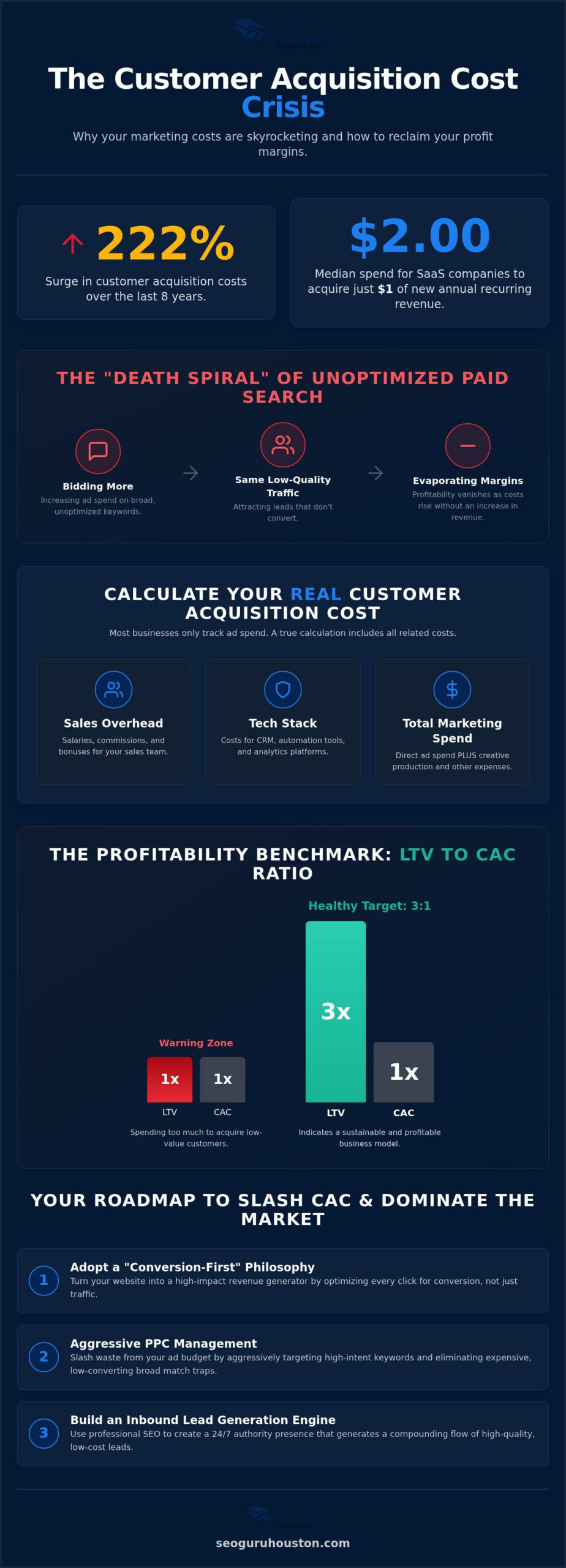
Customer acquisition costs have surged by a staggering 222% over the last eight years. Today, the median SaaS company spends $2.00 just to acquire $1 of new annual recurring revenue. This isn’t just a trend; it’s a crisis for businesses that don’t adapt. You’re likely feeling the pressure of skyrocketing PPC costs and low-quality leads that refuse to convert. If you’re struggling to track real ROI while your budget disappears, you need a definitive strategy for how to reduce customer acquisition cost before your margins vanish.

You’re right to feel the urgency. The era of inefficient, growth-at-all-costs marketing is dead. This guide provides the high-performance strategic framework you need to slash your CAC and explode your profit margins. We’re moving beyond abstract theory to deliver a comprehensive method for market dominance. It’s time to transform your digital presence from invisible to prominent.

We’ll break down the exact tactics for building a predictable lead flow through demand generation and precision landing pages. You’ll learn how to leverage data-driven strategies that turn high-intent traffic into loyal customers. Let’s stop the budget bleed and start scaling your business with the authority it deserves.

Key Takeaways

  • Identify the hidden drivers of the 2026 CAC crisis to stop the “Death Spiral” of unoptimized paid search spend.
  • Master how to reduce customer acquisition cost by adopting a “Conversion-First” philosophy that turns your website into a high-impact revenue generator.
  • Slash the fat from your PPC budget by aggressively targeting high-intent keywords and eliminating expensive broad match traps.
  • Forge a 24/7 inbound lead generation engine that uses professional SEO to create a compounding effect on your profit margins.
  • Follow a definitive five-step roadmap to transition from high-cost struggles to aggressive, predictable market dominance.

The CAC Crisis of 2026: Why Your Acquisition Costs are Skyrocketing

The digital landscape in 2026 is a battlefield. If you think your rising ad spend is just a temporary fluctuation, you’re dangerously mistaken. Customer acquisition costs have surged 222% over the last eight years because the old rules of engagement no longer apply. Relying on unoptimized paid search creates a “Death Spiral” where you bid more for the same low-quality traffic while your margins evaporate. This isn’t just a marketing problem; it’s a fundamental threat to your business survival. You can’t outspend a broken strategy.

Reducing these costs requires a tactical hunt for efficiency. You shouldn’t just be looking at your ad dashboard. You need to scrutinize every touchpoint in your funnel. Understanding how to reduce customer acquisition cost starts with acknowledging that passive marketing is a liability. If you aren’t dominating high-intent channels with precision, you’re simply funding your competitors’ growth. Utilizing professional ppc management is no longer optional; it’s a survival requirement for any brand that wants to scale profitably.

The Hidden Costs of Passive Marketing

Outdated SEO strategies are a silent killer for your bottom line. If your content doesn’t align with modern search intent or lacks technical authority, you’re missing thousands in organic opportunities every month. Invisibility in a saturated market is a choice, and it’s an expensive one. Many businesses fall into the trap of hiring “affordable” marketing services that promise the world for pennies. These low-cost providers often lack the technical depth to drive actual conversions, which results in a bloated CAC. True market dominance requires a commitment to professional seo services that turn searchers into buyers.

Calculating Your Real CAC: Beyond the Basics

Most businesses calculate Customer Acquisition Cost (CAC) by looking only at their direct ad spend. That’s a rookie mistake that hides the true health of your company. To find your real cost, you must include sales overhead, your entire tech stack, and creative production expenses.

  • Sales Overhead: You must account for salaries, commissions, and bonuses for your sales team.
  • Tech Stack: Include CRM costs, automation tools, and analytics platforms that facilitate the sale.
  • LTV Relationship: Aim for a Lifetime Value (LTV) to CAC ratio of at least 3:1. Anything less indicates you’re spending too much to acquire customers who aren’t worth the investment.

Blended CAC is the ultimate truth for business growth because it accounts for the total investment required across all channels to bring a customer through the door. If you want to master how to reduce customer acquisition cost, you must first be honest about what you’re actually spending. Stop hiding from the data and start hunting for the gaps in your conversion engine.

Optimizing the Conversion Engine: Turning Traffic into Revenue

Your website is likely the single biggest leak in your profit bucket. If you’re pouring thousands into paid ads but sending that traffic to a cluttered, slow, or generic homepage, you aren’t marketing; you’re gambling. A “Conversion-First” philosophy demands that every click lands on a page designed for one thing: the conversion. This is the most direct answer to how to reduce customer acquisition cost. By doubling your conversion rate, you effectively cut your CAC in half without spending an extra dime on media. Stop lighting money on fire by sending high-intent traffic to dead-end pages.

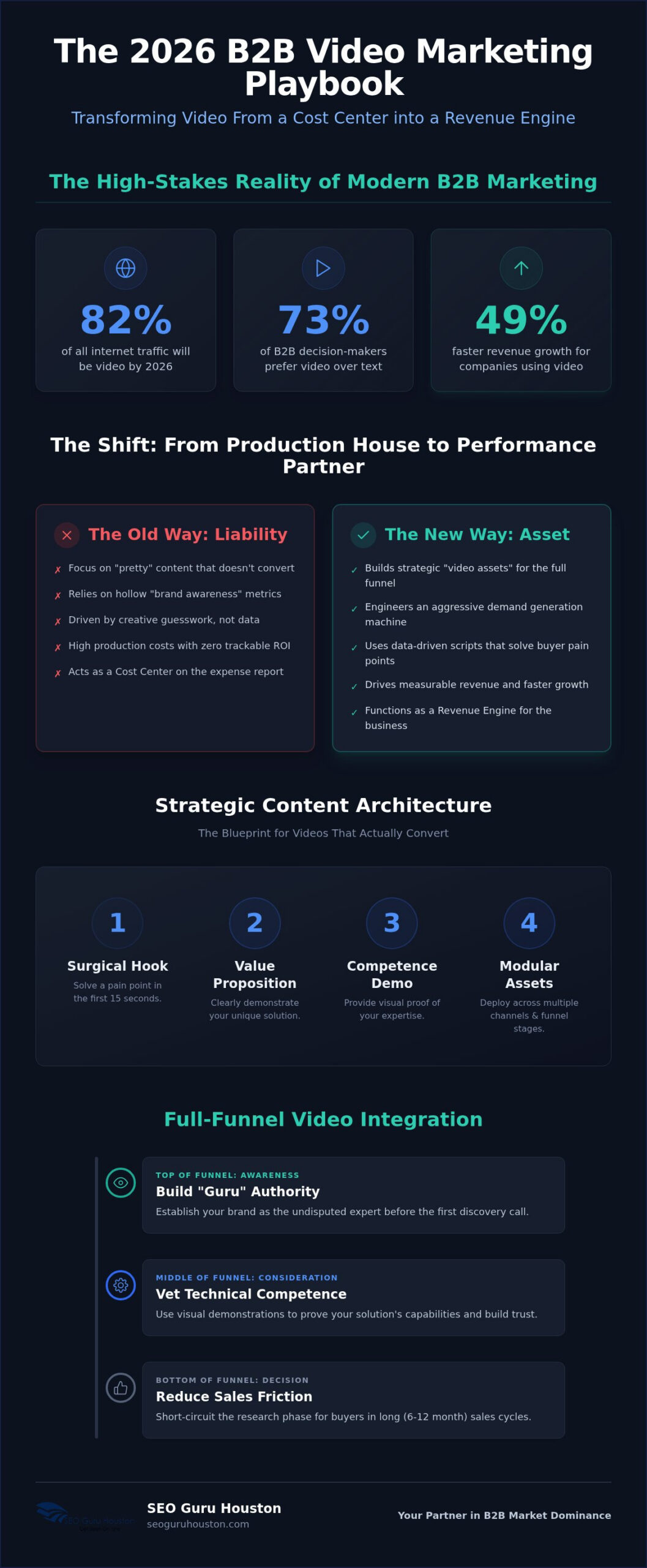
Professional website video marketing is a high-performance tool that slashes friction and builds instant trust. In a digital market where attention spans are measured in milliseconds, video explains complex value propositions faster than any block of text. It triggers the psychological “need for a solution” by humanizing your brand and demonstrating results. You need to turn skeptics into believers immediately. If you fail to capture attention and provide a clear path forward within the first three seconds, you’ve lost the lead and wasted the acquisition spend. High-quality leads don’t happen by accident; they are the result of a precision-engineered user journey.

High-Converting Landing Page Design: The Non-Negotiable

Success starts with high converting landing page design. Every element on the page must be intentional and assertive. Use clear, direct CTAs that tell the user exactly what to do next. Don’t ask for their business; direct them toward the solution. Mobile optimization is no longer an optional feature. Since the majority of commercial searches now occur on mobile devices, a clunky mobile experience is a death sentence for your ROI. If your site doesn’t load instantly on a 5G connection, your CAC will remain high while your competitors steal your market share.

Conversion Rate Optimization (CRO) as a CAC Killer

Conversion Rate Optimization (CRO) is a tactical hunt for missed revenue. Use A/B testing to compare headlines, form lengths, and button colors. These aren’t just cosmetic changes; they’re data-driven experiments that deliver measurable progress toward your bottom line. Heatmaps are another essential tool, showing exactly where users click and where they get stuck. If people are scrolling past your primary offer, you have a structural problem that needs immediate attention. The “Guru” tip is simple: fix the leaks in your funnel before you pour more cash into the top. It’s much cheaper to convert the traffic you already have than to buy more. For those ready to scale, investing in professional website development is the first step toward a dominant growth engine.

Aggressive PPC Management: Cutting the Fat from Your Paid Spend

Stop bleeding your budget on low-intent keywords and broad match traps that serve Google’s bottom line instead of yours. If you’re wondering how to reduce customer acquisition cost, you must start by auditing your paid search for waste. Broad match is a vanity metric trap; it brings traffic, but not the kind that converts into high-margin revenue. Professional ppc management is a fundamental necessity because it replaces guesswork with precision. You need a tactical approach that hunts for high-intent buyers while ruthlessly excluding tire-kickers who have no intention of closing.

Negative keyword lists are your strongest defense in protecting your ROI. By proactively blocking irrelevant queries, you ensure your ads only appear for the most profitable searches. Pair this with assertive, high-energy ad copy. Your ads shouldn’t just attract clicks; they should pre-qualify leads. If your copy is direct about who you serve and the specific problems you solve, you’ll naturally repel low-quality prospects before they cost you a single cent. It’s about quality over quantity every single time.

Paid Search vs. Demand Generation

Shift your mindset from simply buying clicks to aggressively generating demand. This means aligning your spend with high-value customer segments that possess a high lifetime value. You aren’t just looking for a transaction; you’re looking for market dominance. For those in the e-commerce space, dominating the results requires a specialized approach through amazon marketing services. Whether on Google or Amazon, the goal is to occupy the most valuable digital real estate where your customers are already hunting for solutions. Don’t wait for them to find you; occupy the space where they are already looking.

The ROI of Precision Targeting

Leverage first-party data to lower your cost per lead. In an era of increasing privacy changes and platform signal loss, relying on generic third-party data is a losing game. By using your own customer insights to inform your targeting, you bypass the inaccuracies of broad ad platforms and can achieve a 30-50% CAC advantage. Combine this with aggressive retargeting strategies. Bringing a warm prospect back to your site is significantly cheaper than finding a new one from scratch. This creates a powerful synergy with your SEO efforts; organic traffic feeds your retargeting pools, allowing you to close deals at a fraction of the initial cost. “Set it and forget it” PPC is a recipe for financial disaster. Consistent, daily optimization is the only way to maintain a competitive edge and keep your acquisition costs from spiraling out of control.

Reduce Customer Acquisition Cost: Market Dominance Guide

The Inbound Authority Play: Using SEO to Decimate CAC

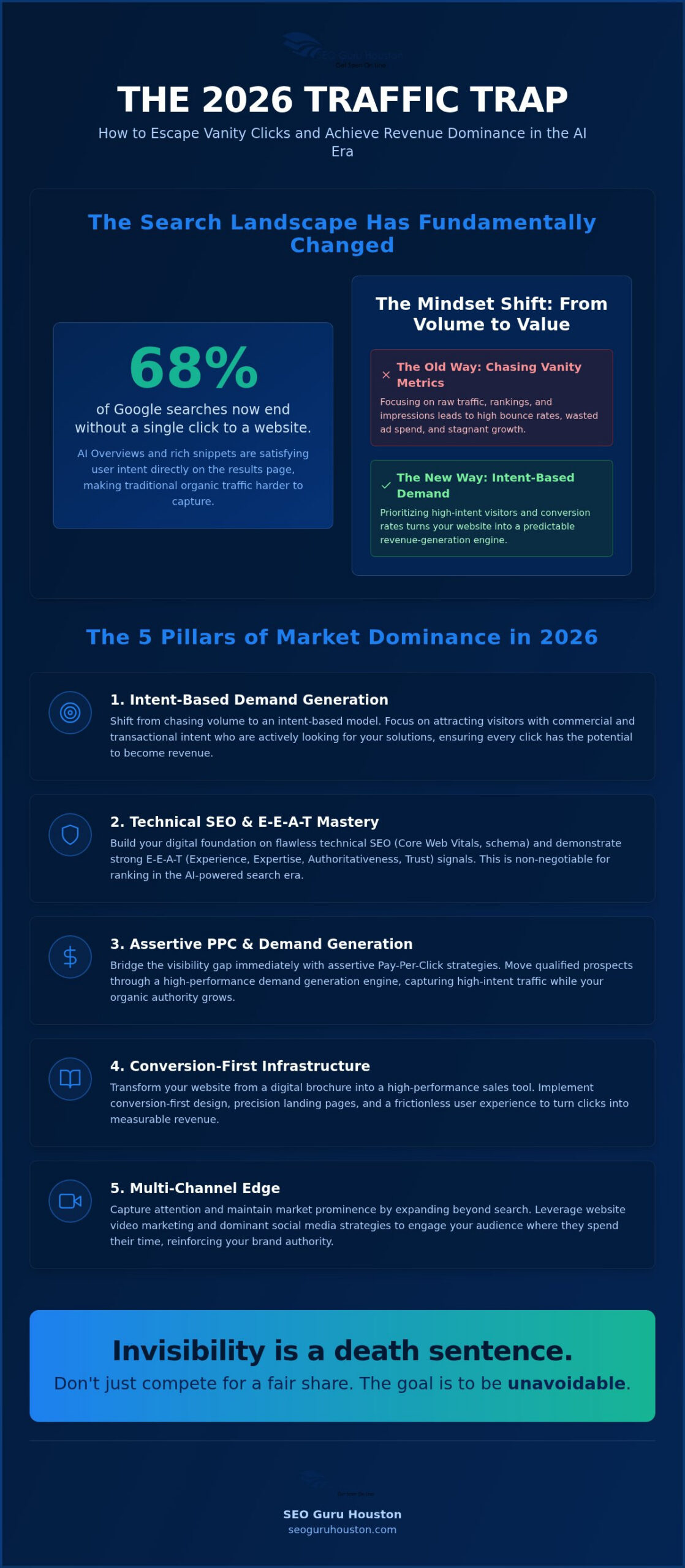
Stop thinking of SEO as a slow-burn luxury. It is a tactical weapon for margin expansion. While paid ads provide immediate visibility, they vanish the moment you stop paying the toll; organic search creates a compounding effect that decimates your long-term costs. Research shows that organic acquisition channels cost 30% to 50% less than paid channels. If you want to master how to reduce customer acquisition cost, you must shift your focus from renting traffic to owning it. High-performance professional seo services build a foundation of digital equity that pays dividends long after the initial investment.

Building an “Inbound Engine” means turning your website into a 24/7 lead generation machine. This isn’t about generic blog posts. It’s about establishing absolute authority in a market where skeptics are the default. When you dominate the search results for high-intent queries, you aren’t just getting a click; you’re gaining immediate brand trust. This trust shortens the sales cycle and reduces the friction that typically inflates acquisition costs. You need to occupy the search real estate that your competitors are currently renting at a premium.

B2B Inbound Marketing for Market Dominance

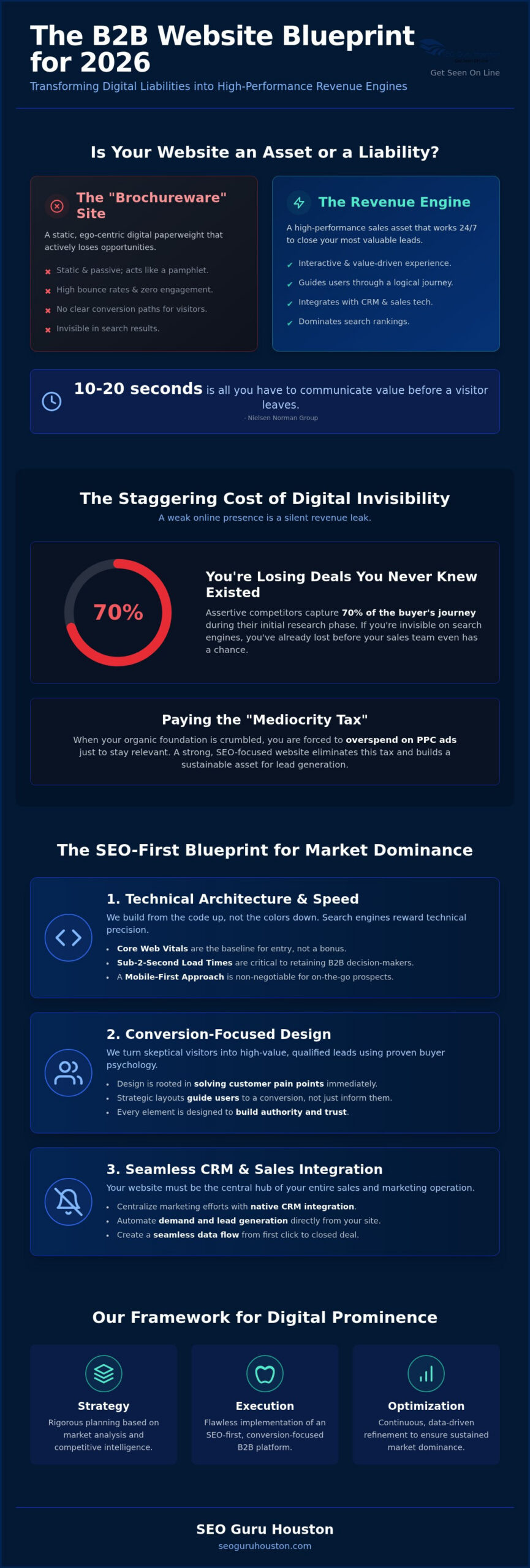
Implementing a comprehensive b2b inbound marketing strategy requires targeting every stage of the funnel. You can’t just focus on the bottom. Technical SEO ensures that your high-value assets are actually seen by search engines and users alike. Without a clean technical foundation, your best content remains invisible. Pair this with a backlink profile that screams industry leadership. High-authority links act as endorsements, signaling to both Google and your prospects that you are the definitive choice in your sector. This level of dominance makes your acquisition efforts predictable and scalable.

Authority Content: The Ultimate CAC Reducer

True market leaders don’t settle for surface-level summaries. You must create deep-dive guides that solve complex business problems for your target audience. This type of authority content does the heavy lifting for your sales team. Case studies are particularly effective here; they provide the social proof needed to move prospects through the funnel faster. Understanding how to reduce customer acquisition cost involves owning the most valuable search real estate and refusing to give it up. When you provide more value than anyone else, the market naturally gravitates toward you. It is time to stop chasing leads and start attracting them with a dominant B2B inbound marketing strategy.

Scaling for Market Dominance: Your CAC Reduction Roadmap

Scaling is where the pretenders are separated from the market leaders. If you attempt to grow on a foundation of inefficient spend, you’re only accelerating your financial collapse. Transitioning from a high-CAC struggle to a low-CAC scale requires a definitive 5-step blueprint. You must audit your real costs, optimize your conversion engine, refine your paid targeting, build organic authority, and then iterate for dominance. This isn’t a one-time fix; it’s a perpetual hunt for efficiency. Partnering with a b2b demand generation agency provides the technical expertise and strategic oversight necessary to execute this shift at speed.

Monitoring the right KPIs is critical. Stop obsessing over vanity metrics like impressions or clicks. Real market leaders focus on the LTV:CAC ratio, aiming for that 3:1 benchmark that investors demand. They watch the CAC payback period, which currently sits at a median of 6.8 months for established companies. If your metrics are heading in the wrong direction, you need to pivot immediately. Understanding how to reduce customer acquisition cost is about maintaining an aggressive mindset of constant optimization. You’re either expanding your territory or losing it to someone more agile.

Implementing the Demand Generation Framework

Success requires absolute alignment between your marketing and sales teams. A disjointed customer journey is an expensive journey. You must use data-driven insights to pivot your strategies in real-time based on actual lead quality, not just lead volume. This is where a high-performance coach becomes indispensable. You need someone who can look at your technical setup and identify the friction points you’ve grown blind to. If you want to know how to reduce customer acquisition cost while scaling revenue, you have to embrace the complexity of demand generation and own every stage of the funnel.

Taking Decisive Action

Waiting to optimize is a choice to lose money. Every day you delay, your competitors are refining their funnels and stealing your market share. The 60% increase in CAC since 2021 proves that the market doesn’t reward the hesitant. To lower your CAC this quarter, you must first clean your contact data to improve outbound efficiency. Second, kill every low-intent ad group that hasn’t converted in 30 days. Third, deploy a dedicated landing page for your highest-spend campaign. Ready to dominate? Partner with the SEO Guru Houston team today!

Dominate Your Market with Precision Efficiency

The digital landscape is ruthless to the inefficient. You now have the strategic framework required to dismantle high acquisition costs and reclaim your profit margins. By prioritizing a conversion-first website design and implementing aggressive PPC management, you move from simply buying clicks to generating high-value demand. We’ve established that mastering how to reduce customer acquisition cost isn’t just about spending less; it’s about investing smarter in the channels that offer compounding returns.

Success belongs to the bold who take decisive action. Stop settling for low-quality leads and unoptimized funnels that drain your resources. Our result-oriented digital marketing experts are ready to deploy high-performance B2B demand generation and expert SEO and PPC strategies to fuel your growth. The path from invisibility to market prominence is clear. It’s time to stop the budget bleed and start scaling with absolute confidence.

Stop Bleeding Budget and Dominate Your Market-Contact SEO Guru Houston Now!

Frequently Asked Questions

What is a good Customer Acquisition Cost for B2B?

A good CAC for B2B is defined by your Lifetime Value (LTV), with a target ratio of 3:1 being the industry gold standard. For B2B SaaS companies, the average cost for paid channels is approximately $341, while organic channels drop to $205. If your acquisition cost exceeds 33% of a customer’s total value, your margins are in danger. You must prioritize high-intent channels to keep this ratio healthy and sustainable.

How long does it take to see a reduction in CAC through SEO?

You should expect to see measurable progress within six to twelve months of implementing a professional SEO strategy. While technical optimizations can provide immediate efficiency gains, the compounding effect of high-authority content takes time to build. Once your organic engine matures, it creates a 24/7 lead generation stream that significantly lowers your blended CAC. This long-term equity is what separates market leaders from those constantly renting expensive ad space.

Can I reduce CAC without lowering my marketing budget?

Yes, you can reduce your acquisition costs by shifting your focus from spending to efficiency. Improving your conversion rates through high-performance landing pages allows you to acquire more customers for the same dollar amount. This strategy targets the middle of your funnel rather than just pouring more cash into the top. When you master how to reduce customer acquisition cost through conversion optimization, you effectively lower the cost per acquisition without sacrificing lead volume.

What is the fastest way to lower CAC in a competitive market?

The fastest way to lower your acquisition costs is to audit your existing PPC spend and eliminate low-intent keyword waste. Broad match traps often inflate budgets by 20% or more without delivering conversions. By aggressively implementing negative keyword lists and directing traffic to dedicated, conversion-optimized landing pages, you see an immediate improvement in ROI. This tactical hunt for efficiency provides the quick wins needed while your long-term organic strategies continue to gain momentum.

How does landing page design impact acquisition costs?

Landing page design is the single most influential factor in your conversion rate. If your page fails to load instantly or lacks an assertive call-to-action, your acquisition costs will skyrocket. A precision-engineered landing page reduces friction and builds instant trust, turning a higher percentage of clicks into leads. Doubling your conversion rate through professional design effectively cuts your CAC in half without requiring any additional investment in paid advertising or expensive traffic generation.

Why is my PPC CAC so much higher than my organic CAC?

Your PPC costs are higher because you are paying a premium for immediate visibility in a competitive auction. Ad platforms have seen a 60% increase in costs since 2021, and you are constantly fighting rising CPCs. Organic channels cost 30% to 50% less because they leverage compounding authority rather than a pay-to-play model. Learning how to reduce customer acquisition cost involves balancing these channels to ensure your expensive paid leads are offset by low-cost organic traffic.

Is it possible to scale lead volume while reducing CAC?

Scaling lead volume while reducing costs is the ultimate goal of a high-performance demand generation framework. This is achieved by diversifying your acquisition channels and improving the efficiency of your sales funnel. As you build organic authority and refine your PPC targeting, you reach a tipping point where your brand recognition lowers the friction of every new sale. This allows for aggressive expansion into new markets without the typical corresponding spike in acquisition expenses.

What role does video marketing play in lowering acquisition costs?

Professional website video marketing slashes acquisition costs by accelerating the trust-building process. Video can explain a complex value proposition in seconds, which significantly shortens the sales cycle and reduces the burden on your sales team. By increasing engagement and time-on-site, video content improves your overall conversion metrics. This high-impact medium turns cold prospects into warm leads faster than text alone, making it a fundamental necessity for businesses hungry for market dominance.

Small Business SEO Services: The Non-Negotiable Growth Engine for 2026

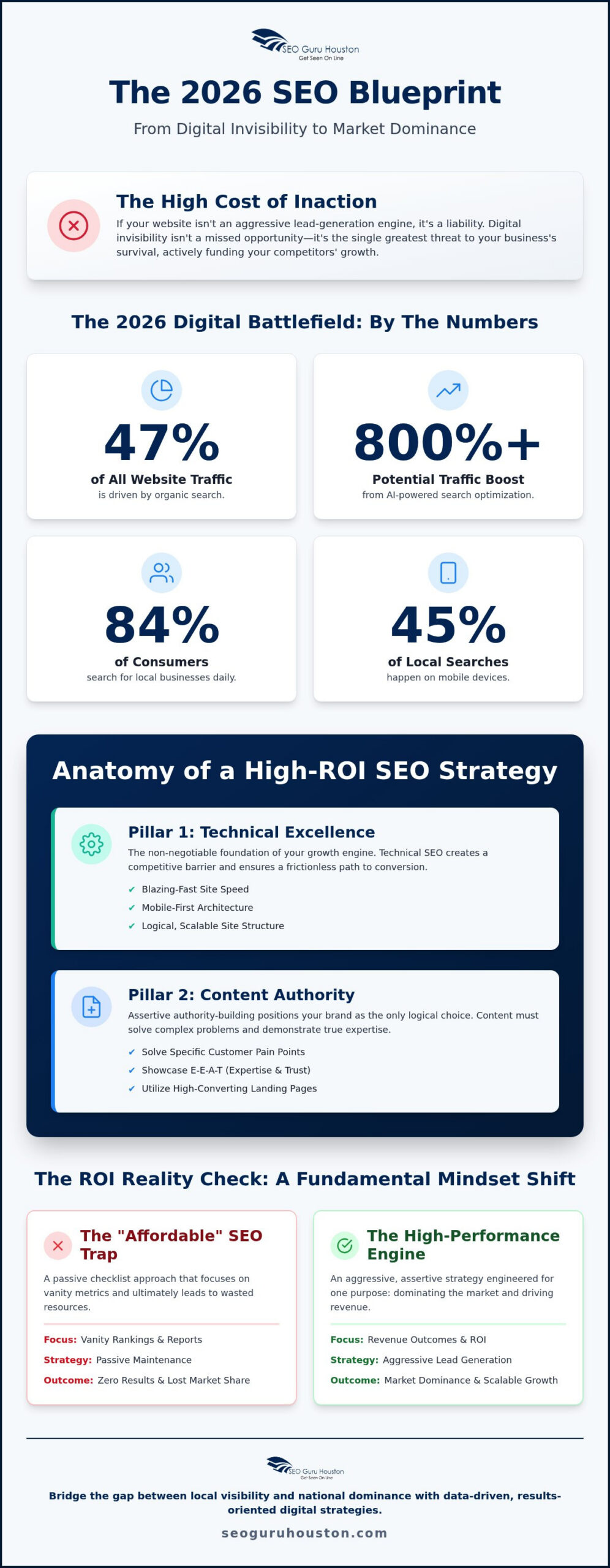
If your website isn’t actively hunting for market share, it’s nothing more than an expensive digital paperweight. You know your product is superior, yet you remain invisible while competitors capture the lion’s share of the digital market. It’s frustrating to get burned by low-cost agencies that deliver zero results and hide behind technical jargon you didn’t ask for. You need a strategy that translates directly into financial gain. By mastering small business SEO, you stop hoping for leads and start demanding them. Organic search drives nearly 47% of all website traffic in 2026. If you aren’t capturing that volume, you’re simply handing your revenue to the competition.

We agree that the digital landscape feels like a moving target, especially with AI-powered search platforms now capable of boosting traffic by over 800% for optimized sites. This article promises to strip away the fluff and show you how to transform your brand into a market-dominating revenue machine. We’ll preview the exact framework needed to navigate Generative Engine Optimization and precision targeting. Get ready to move from the sidelines to the center of the arena. It’s time to build a high-performance growth engine that doesn’t just survive; it dominates.

Key Takeaways

  • Reframe SEO from a passive digital checklist into an aggressive lead-generation engine that secures your market share against the threat of invisibility.
  • Master the “Content Authority” pillar by aligning technical site architecture with expert insights that solve specific customer pain points.
  • Discover why high-performance houston small business seo requires a growth partner focused on revenue outcomes rather than just monthly traffic reports.
  • Learn to implement a demand generation framework that uses high-converting landing pages to capture and scale assertive search behaviors.
  • Bridge the gap between local visibility and national industrial dominance using data-driven, results-oriented digital strategies.

Beyond Rankings: Why Small Business SEO is a Survival Necessity in 2026

In 2026, organic search drives nearly 47% of all website traffic. If you’re treating Search engine optimization (SEO) as a checkbox on a maintenance list, you’ve already lost the battle. High-performance houston small business seo is no longer about “ranking” for vanity terms. It is an assertive, high-stakes hunt for market share. Passive strategies that rely on hope are relics of the past. Today, you must deploy an aggressive lead-generation engine designed to intercept prospects at the exact moment of intent. Digital invisibility isn’t just a missed opportunity; it’s the single greatest threat to your business survival.

The Death of the “Good Enough” Digital Presence

A basic website is a digital brochure that nobody reads. In a market where 84% of consumers search for local businesses daily, “good enough” is a death sentence. Every day you remain on page two, you’re actively funding your competitor’s growth. You can calculate the cost of inaction by looking at your industry’s average lead value and multiplying it by the search volume you’re currently missing. If your site isn’t optimized for the 2026 search ecosystem, you’re essentially handing your revenue to the firm down the street. Small business SEO is a mandatory pillar of national demand generation that transforms your digital footprint from a liability into a high-performance asset.

From Invisibility to Absolute Market Dominance

Domination starts with a mindset shift. You don’t wait to be a market leader to rank like one. You rank like one to become the leader. When your brand appears at the top of search results, a psychological trigger occurs in the prospect’s mind. They equate visibility with authority and trust. This credibility is established before the first sales interaction even occurs. You need a high-performance strategist who understands business outcomes, not just a technician who tinkers with meta tags. The Guru perspective focuses on revenue-obsessed houston small business seo that bridges the gap between technical execution and rapid scaling. By adopting an assertive digital strategy, you ensure your brand isn’t just a participant in the market but the force that dictates it. Successful businesses in 2026 don’t wait for customers to find them; they build an infrastructure that makes finding them inevitable.

The Anatomy of a High-ROI Small Business SEO Strategy

A high-performance digital strategy isn’t a collection of random tactics. It’s a precision-engineered system designed for market conquest. In 2026, search engines don’t just look for keywords; they look for infrastructure and authority. If you want to dominate houston small business seo, you must stop thinking about rankings and start focusing on revenue. Your strategy needs to be a cohesive framework that captures intent and forces action. This requires a shift from passive maintenance to assertive, technical dominance.

Technical Excellence as a Competitive Barrier

Technical SEO is the foundation of your growth engine. If your site is slow, you’re losing money before the page even loads. Slow-loading websites are silent revenue killers. Google and other platforms prioritize speed and mobile-first design as non-negotiable standards. In 2026, 45% of consumers use Google as their primary tool for location-specific searches, almost exclusively on mobile devices. Your site architecture must be clean, logical, and built to support rapid national scaling. This isn’t just about passing a technical audit; it’s about creating a frictionless path to conversion. Savvy marketers use these technical foundations to attract traffic from search engines and ensure that traffic doesn’t bounce to a competitor.

Content That Commands Authority and Engagement

Generic blogging is a waste of resources. You need assertive authority building that positions your brand as the only logical choice. Content must solve complex customer pain points through expert, technical insights that demonstrate real-world experience. This is how you win in the age of E-E-A-T. Integrating high converting landing page design is essential to explode your engagement rates. You aren’t just writing for humans anymore. You’re optimizing for Large Language Models (LLMs) and AI search visibility. AI-powered platforms can increase website traffic by over 800% for sites that establish clear, structured authority. Target high-intent keywords that signal a customer is ready to pull the trigger immediately.

Every element of your strategy must feed into the demand generation funnel. SEO moves the user from a vague query to a definitive conversion. If your search presence doesn’t result in measurable leads, it’s failing your business. You need a strategy that bridges technical nuances with savvy business strategy to win at houston small business seo. For those ready to scale their impact, exploring professional Houston SEO services ensures every technical fix and content piece serves your bottom line. Stop settling for traffic and start demanding market share.

Affordable SEO vs. High-Performance Growth Partners: The ROI Reality Check

Cheap SEO is the most expensive mistake your business will ever make. If a provider offers you a “starter package” for a few hundred dollars, they aren’t building a growth engine; they’re managing your decline. Low-cost services rely on automated templates, offshore link farms, and outdated tactics that eventually trigger search engine penalties. You don’t need a vendor to check boxes. You need a growth partner who treats houston small business seo as a high-stakes investment in market share. The Guru warning is simple: if the service is too cheap, you are paying the price in lost revenue and missed opportunities. Domination requires resources, precision, and an assertive strategy that refuses to settle for page two.

Calculating the real ROI of your investment requires moving beyond surface-level spending. True ROI is measured by the delta between your total investment and the lifetime value of the leads generated. While foundational resources like the SBDC National Information Clearinghouse provide excellent overviews of getting noticed online, a high-performance partner weaponizes these basics to drive financial gain. You aren’t just buying traffic; you’re purchasing a predictable stream of revenue.

Vanity Metrics vs. Real-World Revenue Drivers

Ranking number one for a low-intent keyword is a vanity metric that wastes your budget. It might look good on a monthly report, but it doesn’t pay the bills. You need to distinguish between “empty traffic” and high-value conversions. Assertive strategy focuses on professional seo services that target qualified leads who are ready to buy. If your current agency spends more time talking about “impressions” than “sales,” it’s time to reevaluate your partnership. High-performance SEO isolates the queries that signal immediate intent and dominates those spaces with surgical precision.

The Long-Term Compound Value of Assertive Partnerships

Think of your digital presence as a compound interest account for your brand authority. Every technical fix and high-authority link builds a fortress around your market share. Month-to-month contracts often signal a lack of commitment; they suggest the provider isn’t confident in the long-term results they can deliver. You need a partner who understands the nuances of a b2b demand generation agency mindset. This approach ensures your houston small business seo efforts scale alongside your national ambitions. When you invest in high-caliber strategy, you aren’t just surviving the 2026 search ecosystem. You are owning it.

Small Business SEO Services: The Non-Negotiable Growth Engine for 2026

Implementing the Demand Generation Framework for Rapid Scaling

Rapid scaling doesn’t happen by accident. It requires a repeatable, data-driven framework that converts passive searchers into aggressive advocates for your brand. You must move beyond basic keyword targeting and start identifying high-value customer personas. These aren’t just demographic profiles; they are psychological blueprints of your ideal buyers. By understanding their assertive search behaviors, you can intercept them at the exact moment their pain points become unbearable. This is the core of houston small business seo that actually moves the needle. Stop guessing and start targeting the queries that indicate a high probability of conversion.

The Landing Page: Where Search Intent Meets the Sale

Sending high-intent traffic to your homepage is a tactical error. Your homepage is a generalist; high-intent SEO traffic needs a specialist. A dedicated destination removes distractions and focuses the user on a single, compelling action. This is why high converting landing page design is a non-negotiable requirement for market dominance. You need a layout that mirrors the user’s search intent perfectly. Use assertive CTAs that leave no room for ambiguity. Back your claims with heavy-hitting social proof and technical case studies. If your landing page doesn’t command immediate action, you’re just paying for your competitors to look better by comparison.

Video Marketing: The 2026 Engagement Multiplier

Engagement is the primary signal of quality in the 2026 search landscape. Website video marketing is the fastest way to build that engagement while reducing friction in the B2B sales process. Video content allows you to demonstrate expertise and authority in seconds. It’s a powerful tool for simplifying complex industrial solutions that would otherwise require pages of technical text. Integrating professional video into your inbound marketing strategy for b2b creates a psychological bond with the prospect. They see your face, hear your voice, and trust your process before they ever pick up the phone. Search engines notice when users linger to watch your content, rewarding you with higher authority and visibility.

Continuous Conversion Rate Optimization (CRO) is the final piece of the scaling puzzle. You must maximize every search visitor. Test your headlines; refine your lead capture forms; optimize your mobile site speed. If you’re ready to dominate your niche, it’s time to partner with a team that executes houston small business seo as a total demand generation system. Don’t just settle for traffic. Demand a revenue machine.

Dominating Your Market with SEO Guru Houston’s Result-Oriented Approach

SEO Guru Houston doesn’t operate like a passive agency. We are revenue-obsessed. Our philosophy is built on an aggressive, data-driven framework that bridges the gap between technical nuances and strategic, national business growth. If you want a vendor to manage your decline, look elsewhere. If you want a high-performance coach who treats your bottom line as the only metric that matters, you’re in the right place. We provide the assertive houston small business seo that transforms invisible brands into market-dominating forces. We don’t just fix websites; we build growth engines designed for national industrial dominance.

A Track Record of Assertive Success

We pride ourselves on discovering what high-value prospects actually search for. While others guess, we use data to uncover intent-heavy queries like “industrial lead generation” that signal a buyer is ready to commit. Positioning ourselves as a bold innovator isn’t a marketing gimmick. It’s a necessity in a 2026 landscape where digital trends shift overnight. The “Guru” in our name is a commitment to specialized knowledge. It means we stay ahead of AI search disruptions and algorithm shifts so you don’t have to. We’ve built a national track record of success by being more precise and more aggressive than the competition. When you partner with us, you gain access to a veteran team that understands the practical realities of commerce and scaling.

Your Assertive Blueprint for Market Dominance

Winning requires a structured path. Our results-oriented approach is built on three non-negotiable pillars:

  • Strategy: Identifying high-value personas and the assertive search behaviors that lead to revenue.
  • Execution: Deploying technical excellence, mobile-first optimization, and high-converting landing pages.
  • Scaling: Utilizing website video marketing and demand generation frameworks to capture national market share.

The time for hesitation is over. Every day you wait is another day your competitors solidify their hold on your potential customers. You have a choice: remain digitally invisible or take decisive action to claim your prominence. You’ve seen the data. You understand the stakes. High-performance houston small business seo is the engine that will drive your brand into a dominant 2026. Stop settling for a basic digital presence and start demanding financial return. Your market is waiting for a leader. Stop losing revenue and start dominating your search market today!

Claim Your Digital Prominence in 2026

The search ecosystem of 2026 demands more than just visibility; it requires absolute authority. You’ve seen how a high-performance demand generation framework turns search queries into revenue. By prioritizing technical excellence and high-converting landing page design, you move from being a participant to a market leader. Settling for low-cost, passive services is a gamble with your business survival. You need an assertive partner who treats houston small business seo as a non-negotiable foundation for national scaling.

As National B2B Demand Generation Experts, we bridge the gap between technical nuance and measurable financial gain. Our high-energy, results-oriented coaching philosophy ensures you aren’t just checking boxes but dominating your niche. We specialize in high-converting web development and ROI, delivering the strategic advantage your brand deserves. Don’t let your competitors capture the leads that belong to you. Take decisive action today to transform your digital footprint into a market-dominating revenue machine. It’s time to own your future.

Stop Guessing and Start Scaling: Get Your Assertive SEO Strategy Now!

Frequently Asked Questions

How much do small business SEO services typically cost in 2026?

Industry averages for single-location businesses generally range from $1,500 to $2,500 per month for entry-level packages. Established companies seeking mid-tier solutions often invest between $2,500 and $5,000 monthly to cover comprehensive link building and technical fixes. These figures reflect the resources required for assertive market conquest. While lower-cost starter plans exist, high-performance growth requires a budget that supports aggressive demand generation and expert content creation. Your investment must align with your revenue goals. To better understand how these professional budgets are structured, you can explore monthly management fees for SEO services from the team at Web Media Grp. to see how results-oriented agencies price their work.

Most businesses begin seeing measurable improvements in search visibility within 60 to 90 days of implementation. However, achieving a significant return on investment typically takes around six months of consistent, assertive strategy. This timeline allows search engines to index technical changes and recognize your growing brand authority. High-performance SEO is a compound interest account; the results accelerate as your foundation strengthens. Patience is required, but the eventual revenue lift justifies the initial lead time.

Can a small business really compete with national corporations in search results?

Small businesses can outmaneuver national corporations by leveraging agility and precision targeting. While large firms have massive budgets, they often lack the technical depth needed to dominate specific, high-intent niches. By focusing on expert insights and solving specific customer pain points, you build a level of authority that broad corporate content cannot match. This often involves leveraging niche platforms; for example, you can discover Aged Care Made Easy to see how specialized directories connect local providers with high-intent audiences. Assertive houston small business seo allows you to capture high-value traffic that big players often overlook due to their generalized approach.

A generic agency focuses on vanity metrics like keyword rankings and monthly traffic reports. In contrast, a demand generation partner is obsessed with your bottom line and financial gain. We bridge the gap between technical SEO and strategic business growth by focusing on lead quality and conversion. While a vendor might check boxes, a partner builds a high-performance engine designed to intercept prospects and force immediate sales action. It’s the difference between being seen and being profitable.

Is video marketing necessary for my small business website SEO in 2026?

Website video marketing is a non-negotiable engagement multiplier in 2026. Search engines prioritize sites where users linger, and professional video content is the fastest way to increase time-on-site. It reduces friction in the B2B sales process by building trust and demonstrating expertise in seconds. Integrating explainer videos into your inbound strategy signals quality to search algorithms while simultaneously warming up cold leads. If you aren’t using video, you’re leaving a massive engagement gap for competitors to fill.

What happens to my visibility if I stop investing in SEO services?

Digital invisibility is the immediate result of stopping your SEO investment. Search algorithms are constantly evolving, and your competitors aren’t pausing their hunt for your market share. When you stop, your technical foundation begins to decay and your content relevance drops. Rankings are not permanent; they are a reflection of active authority. If you stop feeding the engine, your traffic will stagnate and eventually plummet, handing your hard-earned revenue back to the competition.

How does AI search impact my small business website visibility?

AI search and Generative Engine Optimization (GEO) are reshaping how prospects find solutions. Optimizing your content to be cited in AI-generated summaries is now a critical survival tactic. AI-powered search platforms have been documented to increase website traffic by over 800% for sites that establish clear, structured authority. If your site isn’t optimized for these LLMs, you risk becoming invisible to users who rely on AI assistants for location-specific searches and technical recommendations.

Do I need to redesign my website to see significant results from SEO?

Not every project requires a total overhaul, but high-performance results often necessitate technical upgrades. If your current site is slow, lacks mobile-first design, or has a convoluted architecture, a redesign might be the only way to clear the path for growth. We focus on high-converting landing page design that integrates seamlessly with your demand generation framework. Significant results depend on a friction-free user experience that search engines reward through houston small business seo.

What is Demand Generation Marketing? The Assertive Growth Blueprint for 2026

If your sales team is fighting for every scrap of attention in a saturated market, your current strategy isn’t just failing; it’s obsolete. You’re likely exhausted by stagnant pipeline growth and the high cost of low-quality leads that never convert. It’s a brutal reality when 52% of marketers now rank driving a qualified pipeline as their absolute top priority. To survive, you must master what is demand generation marketing to shift from total invisibility to industry dominance. This isn’t an optional luxury. It’s the assertive groundwork that makes your eventual sales inevitable.

You already know that traditional lead gen is broken. You’re ready for a predictable engine that generates revenue and builds deep prospect trust long before the first sales call. This guide provides the blueprint for 2026 market control. We’ll explore how to combine SEO and PPC into a high-performance growth machine. We’ll also examine the shift from lead volume to pipeline quality and the specific tactics you need to lower your acquisition costs while scaling your brand’s authority to new heights. If you’re hungry for $$$ and market share, it’s time to build a strategy that actually delivers.

Key Takeaways

  • Learn exactly what is demand generation marketing and how to build a holistic engine that generates intense interest for your solutions.
  • Identify the critical distinction between tactical lead capture and strategic cultivation to stop wasting budget on low-quality inquiries.
  • Master the integration of SEO and PPC to dominate search intent and position your brand as the undisputed technical authority.
  • Shift your focus from vanity metrics to high-impact revenue indicators like pipeline velocity and measurable financial returns.
  • Discover the competitive advantage of an assertive marketing partner in maintaining the high-performance pace required for 2026 market dominance.

Defining Demand Generation: The Engine of Market Dominance

Demand generation isn’t just a marketing buzzword; it’s the fundamental engine for business survival. If you’re tired of cold calling and begging for attention, you need to understand what is demand generation marketing. It’s the strategic bridge between total invisibility and market prominence. Instead of chasing leads, you’re building a system that attracts them through intense interest and buzz. In 2026, dominance belongs to those who own the conversation before a prospect even identifies their own problem. You don’t wait for the market to move; you force the market to move toward you.

Why Demand Gen is Non-Negotiable in 2026

We’ve moved past the era of information scarcity. Your prospects are drowning in information overload. To cut through the noise, you need an assertive brand voice that demands attention. Demand generation creates a competitive moat around your business. It makes your brand the default choice. By consistently delivering high-value technical insights, you establish yourself as the Guru of your industry. This psychological positioning ensures that when a need arises, your name is the only one that matters. Competitors can’t cross a moat built on years of established trust and authority. If you aren’t building demand, you’re merely surviving on the scraps left by those who do.

The Core Objectives of a High-Performance Program

A results-oriented program focuses on three critical outcomes that drive revenue. First, you must establish absolute authority within your specific B2B niche. This isn’t about being a choice; it’s about being the only logical choice. Second, you must educate the market. Most of your future customers don’t know they have a problem yet. Your job is to move them from unaware to solution-ready through strategic, high-value touchpoints. Finally, you must reduce friction in the sales cycle. A high-performance engine pre-qualifies prospects through content, meaning your sales team spends less time explaining and more time closing. To achieve this, you’ll need to leverage professional seo services and targeted PPC to dominate search intent. This approach ensures your brand is visible exactly when and where your prospects are looking for answers. You’re not just creating awareness; you’re creating a predictable pipeline for growth.

Demand Generation vs. Lead Generation: Why the Distinction Matters

Stop treating lead generation and demand generation as interchangeable synonyms. They aren’t. While lead generation is a tactical exercise in data capture, understanding what is demand generation marketing requires a broader, more strategic perspective on market cultivation. If you only focus on the capture, you’re essentially trying to harvest a crop you never planted. This lead-only approach results in bleeding budgets and a sales floor cluttered with low-quality inquiries that go nowhere. Demand generation is the strategic cultivation that ensures your lead generation engine actually has high-quality fuel to burn, which can be supplemented by specialized providers like ClosrLeads to maintain short-term sales momentum.

Relying solely on lead generation is a recipe for stagnation. When you target cold prospects without any prior brand affinity, your customer acquisition cost (CAC) skyrockets. Without the foundation of demand generation, your PPC and SEO efforts become twice as expensive. You’re forced to outbid every competitor for the same tiny sliver of bottom-funnel intent. You’re trapped in a transactional cycle that rewards the deepest pockets rather than the best solutions. To break free, you must move toward a transformational market presence where prospects are pre-sold on your expertise before they even fill out a form. Many firms find that high-energy B2B marketing is the missing link that finally makes their lead capture profitable.

Comparison: Scope, Goals, and Outcomes

The differences between these two methodologies are found in their execution and their ultimate impact on your bottom line. To dominate your industry, you must master the balance between them.

  • Scope: Lead generation is narrow, focusing strictly on capturing specific contact information. Demand generation is broad, focusing on market education, psychological positioning, and owning the industry narrative.
  • Goals: Lead gen seeks short-term conversion targets to hit monthly quotas. Demand gen builds long-term brand equity and authority that competitors cannot replicate through simple ad spend.
  • Outcomes: A lead-only strategy produces erratic spikes and high churn. A demand-first strategy creates a predictable, high-velocity pipeline where prospects move faster through the sales cycle.

Don’t fall for the misconception that demand generation lacks measurable ROI. It’s actually the primary driver of revenue efficiency. By warming the market, you improve every downstream metric, from click-through rates to sales close rates. You aren’t just getting more leads; you’re getting leads that are ready to buy because they already trust your brand. This is how you move from fighting for scraps to total industry dominance.

The Pillars of a Result-Oriented Demand Generation Strategy

Implementing an assertive Lead Generation Solution ensures you stop fighting for scraps and start owning your market share through high-quality pipeline growth and improved ROI.

To truly grasp what is demand generation marketing, you must view it as a multi-pronged offensive rather than a single campaign. It is the coordinated execution of four critical pillars that move your brand from the shadows to center stage. If you miss even one of these components, your pipeline will leak revenue and your growth will stall. You need a strategy that doesn’t just ask for attention but commands it through technical superiority and relentless visibility. This is the only way to build a brand that prospects already trust before the first sales call.

Content as a Strategic Weapon

Content isn’t just filler; it’s a strategic weapon used to dismantle competitor influence. You need to create ‘un-ignorable’ assets that address the high-stakes, practical realities your prospects face every day. This is where your inbound marketing strategy for b2b proves its worth. By producing deep technical guides and industry-shifting insights, you turn passive traffic into a predictable revenue stream. An assertive content approach moves prospects through the ‘unaware’ phase at record speed. Don’t waste time on surface-level fluff that your competitors are already churning out. Be direct, be authoritative, and be the Guru your industry needs to solve its most complex problems.

The Technical Foundation: SEO and PPC Integration

Your growth engine requires a technical foundation that supports long-term scaling. Combining professional seo services with aggressive paid search management is the fastest way to dominate search intent. PPC acts as the catalyst, generating immediate demand and visibility while your organic presence builds. Meanwhile, SEO captures ‘problem-aware’ searchers who are looking for experts to guide them. This integration ensures you own the top results for every high-value keyword in your niche. Remember, even the best SEO strategy fails if it leads to a weak destination. Your high converting landing page design must be built to handle the pressure of elite traffic and convert interest into action.

Social media, specifically LinkedIn, provides the platform for high-energy brand building. It keeps you top-of-mind with decision-makers who aren’t yet in a buying cycle. Pair this with website video marketing to provide the immediate value that modern B2B audiences crave. Video bridges the gap between a faceless corporation and a trusted advisor. It humanizes your technical expertise and accelerates the trust-building process. In 2026, if they can’t see your value in under sixty seconds, they’ll find someone else who shows it better. High-performance demand generation leaves no room for hesitation.

What is Demand Generation Marketing? The Assertive Growth Blueprint for 2026

Measuring Success: Demand Generation Metrics That Drive Revenue

Stop celebrating clicks and impressions. If your marketing dashboard is filled with vanity metrics, you’re measuring activity, not impact. To understand what is demand generation marketing in a high-performance context, you must look at the hard numbers that correlate directly with financial growth. You need a system that tracks how effectively you are moving prospects from total anonymity to a closed deal. This requires a shift in focus toward metrics that actually matter to the C-suite; specifically, pipeline velocity and the total contribution to revenue.

Pipeline velocity is the heartbeat of your growth engine. It measures the speed at which prospects move through your funnel, from the moment they first engage with your brand to the moment they become a sales opportunity. A high-velocity pipeline indicates that your demand generation is working as intended. It’s educating and pre-qualifying prospects so they don’t linger in the ‘maybe’ zone. Over time, an effective strategy also drives down your Customer Acquisition Cost (CAC). By building brand authority before the sales conversation starts, you reduce the friction and the expensive manual labor required to close a deal. This is why partnering with a specialized b2b demand generation agency is a fundamental necessity for companies that want to scale efficiently.

The ROI of Brand Authority

Being the ‘first choice’ in your market isn’t just a status symbol; it’s a massive financial advantage. When prospects trust your brand before they even speak to a representative, your sales team sees a significant spike in close rates. They aren’t fighting to prove value. They’re simply finalizing the terms of a solution the prospect already wants. To track this, we look at Marketing Influenced Revenue. In 2026, Marketing Influenced Revenue is defined as the total dollar value of won deals where the prospect engaged with demand generation touchpoints prior to becoming a formal sales lead. This is the gold standard for measuring the true impact of your assertive growth blueprint.

Advanced Tracking in the AI Era

Modern tracking requires more than just basic analytics. You need data-driven insights that account for the complex, non-linear B2B buyer journey. This includes monitoring ‘Dark Social,’ which refers to the brand mentions and recommendations that happen in private Slack channels, podcasts, and direct messages. While these aren’t easily tracked by traditional models, they are powerful indicators of growing demand. You must use cross-channel attribution to see the full picture of how your SEO, PPC, and content efforts work together. If you’re ready to stop guessing and start growing, it’s time to implement a result-oriented tracking system that proves your marketing ROI every single month.

Scaling with an Assertive B2B Marketing Partner

Most internal marketing teams are built for maintenance, not for market war. They often lack the aggressive, high-performance coach pace required to keep up with the 2026 digital ecosystem. If you want to truly master what is demand generation marketing, you need a partner that lives and breathes technical strategy. A specialized agency stays ahead of rapidly shifting trends, ensuring you aren’t just reacting to the market but actively shaping it. This level of focus allows your internal team to handle operations while your partner builds the engine of dominance.

Success in 2026 requires the total integration of demand generation, SEO, and PPC into a single, cohesive growth engine. Treating these as separate silos is a recipe for wasted budget and fragmented messaging. When these elements work in harmony, they create a cumulative effect of authority and visibility that competitors cannot easily replicate. You must identify a partner that focuses on measurable progress and financial returns over abstract fluff. If they can’t show you how their strategy impacts your bottom line, they aren’t the right fit for an assertive growth plan.

The SEO Guru Approach

Our methodology is built on transformation. We don’t settle for minor improvements; we move your business from market invisibility to undisputed prominence. With a proven track record of success in highly competitive industrial and B2B markets, we provide direct, results-oriented strategies. We treat your growth as a fundamental necessity for business survival. By leveraging deep technical expertise, we ensure that every campaign is optimized for high-impact results and measurable financial gain. We don’t just provide a service; we act as the savvy business strategist your brand needs to win.

Next Steps for Market Dominance

Achieving total industry dominance requires more than just a theoretical understanding of what is demand generation marketing. It requires decisive action and a brutal evaluation of your current digital standing. Start by looking at your existing awareness and education strategies with a critical eye. Where are the gaps that allow prospects to slip through to your competitors? Once you identify these weaknesses, you must take immediate steps to bridge the gap between your current reality and your ambitious revenue goals. The market in 2026 moves fast. If you aren’t leading the conversation, you’re already falling behind. It’s time to build a predictable engine for growth that makes your sales inevitable.

Command Your Industry: The Path to 2026 Dominance

Market dominance is never an accident. It’s the result of precision engineering and strategic foresight. You now understand that mastering what is demand generation marketing is the only way to move from industry invisibility to total prominence. By shifting your focus from simple lead capture to holistic market cultivation, you create a moat that competitors cannot cross. You have the pillars. You have the metrics. Now, you need the execution.

The 2026 market doesn’t reward the hesitant. It rewards the bold. As high-energy, results-oriented B2B experts, we specialize in market dominance strategies for the most competitive industries. Our proven track record shows that technical expertise, when paired with an assertive growth mindset, leads to undeniable financial returns. Don’t let your pipeline stagnate while your rivals scale. Stop guessing and start scaling with an assertive B2B demand generation strategy. Your transformation from a participant to a market leader starts today. Take the leap and own your future.

Frequently Asked Questions

What is the primary difference between demand generation and lead generation?

Demand generation focuses on creating intense interest and awareness across a broad audience, while lead generation is the specific act of capturing contact information. If lead gen is the harvest, demand gen is the soil preparation and cultivation. You can’t capture high-quality leads if nobody knows or trusts your brand yet. Demand generation builds long-term authority and desire, ensuring that when you finally ask for a lead, the prospect is already pre-sold.

How long does it take to see results from a demand generation campaign?

Expect to see initial engagement shifts within three to six months, though total market dominance takes longer. This isn’t a short-term hack; it’s a fundamental business strategy for survival. While PPC can drive immediate traffic, the deep psychological trust required for B2B sales builds over time. You’ll notice improved click-through rates and shorter sales cycles as your brand authority scales. Consistency is the only way to turn these efforts into a predictable revenue engine.

Is demand generation only for large B2B enterprises?

No, demand generation is a necessity for any business hungry for growth, regardless of size. In fact, smaller firms often benefit more by using assertive strategies to punch above their weight class. By establishing yourself as a technical Guru in a specific niche, you can outmaneuver larger competitors who rely on bloated budgets rather than precision. Every company needs a strategy to move from invisibility to prominence to survive the 2026 market.

What are the most effective channels for demand generation in 2026?

The most effective channels integrate technical expertise with high-energy engagement. SEO and PPC remain the foundational pillars for capturing search intent. However, website video marketing and LinkedIn social strategies are now essential for building trust at scale. B2B buyers in 2026 demand immediate value and visual proof of expertise. Combining these channels into a single growth machine ensures you stay top-of-mind throughout the entire buyer journey and effectively teaches you what is demand generation marketing in practice.

Can you do demand generation without a large content budget?

You can succeed by focusing on quality and technical depth over sheer volume. Most firms waste money on fluff that nobody reads. Instead, create a few ‘un-ignorable’ assets that solve your prospects’ most painful problems. Use your technical expertise to build authority in a narrow niche. When you understand what is demand generation marketing, you realize that one high-impact technical guide or video is worth more than a hundred generic blog posts produced by competitors.

How do I measure the ROI of my demand generation efforts?

Measure success through pipeline velocity and Marketing Influenced Revenue rather than vanity metrics like impressions. You need to track how quickly prospects move from their first touchpoint to a closed deal. While clicks are nice, they don’t pay the bills. Look for a measurable reduction in your Customer Acquisition Cost (CAC) over time. If your sales team is closing deals faster and with less manual effort, your demand generation strategy is delivering a real financial return.

Why is sales and marketing alignment critical for demand generation success?

Alignment ensures that the demand you create actually translates into revenue. If marketing generates interest but sales isn’t prepared to handle pre-qualified prospects, the entire engine stalls. Both teams must agree on what defines a high-quality opportunity and how to nurture it. This synergy reduces friction in the sales cycle and ensures a seamless experience for the prospect. Without alignment, you’re just burning budget on activity that doesn’t scale or drive market dominance.

What role does SEO play in a modern demand generation strategy?

SEO is the technical foundation that ensures your brand is visible when prospects are searching for solutions. It’s not just about rankings; it’s about owning the narrative for high-value keywords. By dominating search results, you position your firm as the undisputed authority in your field. This organic visibility builds passive trust and feeds your lead generation engine with high-intent traffic. It’s a critical component of any assertive growth blueprint for those looking to dominate their market.

How to Increase Website Traffic: 2026 Growth Guide

Did you know that 68% of Google searches in 2026 now end without a single click to a website? If you’re constantly asking how to increase website traffic for my business while AI Overviews swallow your organic visibility, you’re facing a cutthroat market reality. Most brands are currently hemorrhaging marketing budgets on low-quality traffic that never converts. It’s an exhausting cycle of invisible search presence and wasted spend that leaves your growth stagnant. You don’t need more vanity hits. You need high-intent visitors who fuel your bottom line.

We agree that the 2026 algorithm shifts have made traditional tactics obsolete for serious competitors. This guide promises to stop the guesswork and show you how to flood your site with traffic that actually generates revenue. We’ll preview the technical precision required to master the $5.42 average CPC environment and leverage AI content signals for total market dominance. It’s time to move from invisibility to prominence with a strategy built for measurable ROI. Let’s get to work.

Key Takeaways

  • Shift from chasing vanity metrics to an intent-based demand generation model that prioritizes revenue over raw visitor volume.
  • Discover the specific technical SEO and E-E-A-T requirements of the 2026 AI era to learn how to increase website traffic for my business that actually converts.
  • Bridge the visibility gap immediately using assertive PPC strategies designed to move prospects through a high-performance demand generation engine.
  • Transform your website from a digital brochure into a high-performance sales tool by implementing conversion-first infrastructure and precision landing page design.
  • Leverage website video marketing and dominant multi-channel strategies to capture attention and maintain market prominence in a zero-click search environment.

Why Generic Traffic is a Vanity Metric in 2026

Stop chasing shadows. In 2026, raw numbers are a lie. You can drive 10,000 hits to your site today, but if they are “junk traffic” looking for a free definition, your business stays broke. This is the Traffic Trap. It’s a dangerous delusion where volume masks a lack of performance. True growth requires a shift from volume-based metrics to intent-based demand generation. If your visitors don’t convert into revenue, they are just a drain on your server and your sanity.

Professional intervention isn’t a luxury; it’s a fundamental necessity for market survival. If you’re asking how to increase website traffic for my business, you need to understand that the search landscape has fundamentally changed. You aren’t just fighting for attention; you’re fighting for a dominant market position against AI Overviews and zero-click search results. Ignoring this reality leads to “Invisible Business” syndrome, where your brand exists but remains irrelevant to your bottom line.

Intent Over Volume: The New Gold Standard

Not all visitors are created equal. Informational intent is nice for brand awareness, but commercial and transactional intent pay the bills. You must map your content to the buyer’s journey with surgical precision. If you flood your site with low-intent visitors, you actually hurt your long-term authority. Search engines see high bounce rates and low engagement, signaling that your site doesn’t satisfy the user’s needs. Success starts with understanding web traffic at a granular level. You need to distinguish between someone browsing for “what is SEO” and someone ready to buy professional B2B marketing services. One is a student; the other is a client. Focus on the latter.

The Cost of Invisibility in a Competitive Market

Invisibility is a death sentence. Every day you linger on page two, your competitors are winning the leads you deserve. The opportunity cost is staggering. Think about the lifetime value of a single lost client. Now multiply that by the hundreds of high-intent searches you’re missing every month. This isn’t just about a missing link; it’s about a missing future for your company. Your competitors aren’t smarter; they are just more visible where it matters most.

To win, you must make a psychological shift from “trying” to “dominating.” You don’t want a fair share of the market; you want the lion’s share. Dominance isn’t about being present; it’s about being unavoidable. When a high-intent prospect searches for your solution, your brand must be the definitive answer. Anything less is just noise. High-performance growth requires a commitment to being the authority in your niche, turning every click into a measurable step toward ROI. For those ready to scale aggressively, Peter Montoya provides the specialized SEO performance marketing and growth coaching required for total market dominance.

Mastering Search Engine Optimization for Absolute Dominance

You can’t dominate a market with a broken foundation. Technical SEO is the non-negotiable bedrock of your digital infrastructure. While many business owners look for savvy online marketing tactics, the reality is that 2026 algorithms demand surgical precision. If your site architecture is a mess, search engines won’t just ignore you; they’ll bury you. You need professional seo services to ensure your infrastructure can handle the volatility of the modern search ecosystem. Trust is the currency of the AI era, and your technical health is your first deposit.

Technical Precision: More Than Just Meta Tags

Speed is a survival factor. In 2026, Core Web Vitals and mobile-first indexing are the baseline. If your site takes more than two seconds to load, you’ve already lost the lead. Beyond speed, you must leverage structured data and schema markup. This helps AI-powered search engines understand your specific value proposition. A clean, logical site architecture ensures that crawl bots can index your most valuable pages without getting lost. If you’re serious about how to increase website traffic for my business, your technical setup must be flawless. AI search signals now evaluate editorial oversight and strategic intent, meaning your backend must prove you are a legitimate authority.

Content Authority: Writing for Humans and Algorithms

Ranking for a single keyword is a relic of the past. Today, you need to own the entire market conversation. Topic clusters and pillar pages allow you to establish undeniable authority across broad subject areas. An seo marketing company doesn’t rely on guesswork; we use data-driven content strategies to map out every touchpoint of your buyer’s journey. This is how you build E-E-A-T. Experience, Expertise, Authoritativeness, and Trustworthiness are the criteria Google uses to separate leaders from followers. Your content must provide original insights that AI cannot simply hallucinate.

Backlinks remain the ultimate votes of confidence. High-quality, relevant links from authoritative domains tell search engines that your brand is a trusted source. In a landscape filled with automated noise, a robust link profile is your competitive moat. If you want to stop being invisible, you must earn the respect of the web’s most established players. It’s about building a reputation that the algorithms cannot ignore. Ready to stop guessing? Partner with an agency that understands the technical nuances of high-performance SEO and start your transformation from invisible to prominent.

Precision Scaling with PPC and Demand Generation

SEO is your long-term moat, but aggressive PPC is the bridge that crosses the visibility gap today. If you’re asking how to increase website traffic for my business in a market where organic clicks are shrinking, you can’t wait months for results. You need immediate, high-intent visibility. With the average Google Ads CPC rising 12% in 2026 to $5.42, “trying out” ads is a recipe for financial disaster. You need a high-performance engine that converts expensive clicks into predictable revenue. Scaling requires precision, not just a bigger budget.

Stopping the “budget bleed” is the first priority. Most businesses lose 40% of their ad spend to poor targeting and “junk” search terms that don’t align with commercial intent. Success in 2026 means moving beyond basic lead generation. You need a comprehensive strategy from a b2b demand generation agency that focuses on creating market desire, not just chasing it. This is how you transform a volatile marketing expense into a scalable growth asset.

Paid Search Management: The Assertive Growth Engine

Google Ads in 2026 is a different beast. AI-powered features like generative asset creation and automated bidding are now the default settings. If you don’t have expert oversight, you’re essentially handing your credit card to an algorithm designed to maximize Google’s profit, not yours. Professional ppc management is required to navigate these automated waters and maintain editorial control. We focus on:

  • High-Precision Targeting: Bypassing the $33.92 average CPC in marketing or $71.64 in legal by finding untapped, high-intent long-tail opportunities.
  • Strategic Retargeting: Capturing the “lost” visitors who didn’t convert on their first visit, keeping your brand top-of-mind until they’re ready to act.
  • AI Disclosure Compliance: Ensuring all AI-generated visuals include mandatory “How This Ad Was Made” labels to avoid account suspension.

B2B Demand Generation: Creating Markets, Not Just Following Them

Traditional inbound marketing often fails because it waits for the customer to realize they have a problem. Demand generation is assertive. It identifies industrial and B2B decision-makers before they even hit the search bar. While demand capture focuses on users searching for specific solutions, demand creation builds the case for your brand’s necessity. In 2026, traffic from AI search platforms converts at 3.49%, which is 22% higher than traditional organic search. Our goal is to position your business as the cited authority in these AI Overviews, ensuring that when the market is ready to buy, they’re already looking for you.

How to Increase Website Traffic: 2026 Growth Guide

Conversion-First Infrastructure: Turning Clicks into Revenue

Traffic without conversion is just an expensive hobby. If you’re obsessing over how to increase website traffic for my business but neglecting your conversion architecture, you’re building your growth on sand. In 2026, the median website conversion rate across all industries sits at a meager 2.35%. That’s unacceptable for a business hungry for market dominance. To win, your website must function as a high-performance sales tool, not a static digital brochure. Conversion Rate Optimization (CRO) is the silent engine that determines whether your marketing budget is a waste or a wealth-builder. You must remove every ounce of friction and guide visitors toward decisive action with surgical precision.

Landing Page Excellence: The Blueprint for Conversion

A landing page isn’t just a place for someone to land; it’s where the deal is sealed. Successful brands utilize a high converting landing page design that commands immediate attention. This requires more than just “clean” aesthetics. It demands a psychological blueprint that triggers action through authoritative copy and logical flow. We don’t guess what works. We use AI-powered A/B testing that reaches statistical significance 31% faster than traditional methods. This discipline of constant improvement ensures your site evolves with your audience. Professional, assertive design beats generic templates every time because it’s built for your specific bottom line.

Inbound Marketing: The Long-Term Revenue Play

While PPC bridges the immediate visibility gap, a comprehensive inbound marketing strategy for b2b builds an indestructible revenue foundation. It’s about creating a trust-based digital ecosystem. You aren’t just capturing leads; you’re nurturing decision-makers through automated, high-value content sequences. This moves prospects from “just looking” to “ready to sign” without manual intervention. In a market where mobile conversion rates lag significantly behind desktop, your infrastructure must be optimized for every device and every stage of the buyer’s journey. High-quality inbound content proves your authority and justifies your premium position in the market.

Ready to stop losing leads to a mediocre website? Let’s transform your site into a revenue machine with our high-performance inbound marketing and specialized landing page services. Your growth depends on it.

The Multi-Channel Edge: Video and Social Dominance

In 2026, a single-channel strategy is a suicide mission. If you’re still asking how to increase website traffic for my business while ignoring the power of visual and social authority, you’re leaving your market share to the competition. Dominance requires an integrated digital marketing strategy where every channel feeds the other. You need a cumulative effect. One where your SEO authority is amplified by your social presence and cemented by the trust only video can build. This isn’t about being everywhere; it’s about being dominant where your high-intent buyers actually live.

Website Video Marketing: The Ultimate Trust Builder

Website video marketing is no longer optional. It’s the #1 engagement booster because it humanizes your technical expertise. Video content significantly increases time-on-site, which directly signals to search algorithms that your content is valuable and relevant. Every B2B site needs a strategic mix of explainers, case studies, and thought leadership. Professional production signals authority and precision. In contrast, low-quality DIY efforts often signal a lack of resources, which can damage your brand’s reputation in high-stakes industrial markets. When you integrate high-quality video, you aren’t just showing a product; you’re proving a solution.

Strategic Social Dominance for B2B

Stop “posting” and start dominating LinkedIn. In 2026, LinkedIn is a demand generation powerhouse, not a digital rolodex. With global social media ad spend projected to reach $338.75 billion, the noise is deafening. You must align your social messaging with your SEO and PPC goals to create a unified front. The average CPM for social ads sits between $4 and $10, making it a cost-effective way to stay top-of-mind. However, generic content is a waste of capital. Success requires an assertive presence that cuts through the noise.

The “Guru” method involves repurposing your high-authority pillar content into snackable social insights. This ensures you maintain multi-channel visibility without reinventing the wheel. When your social presence mirrors the technical authority of your website, you create a seamless experience for decision-makers. You aren’t just following the market; you’re creating it. This integrated approach is the most assertive answer to how to increase website traffic for my business: it’s about building a single, high-performance growth engine that leaves the competition in the dust.

Secure Your Market Dominance Now

The digital landscape of 2026 doesn’t reward participation; it rewards dominance. You’ve seen why chasing vanity metrics is a recipe for stagnation. Success requires a shift toward high-intent demand generation and a conversion-first infrastructure that turns every click into a measurable asset. If you’re still wondering how to increase website traffic for my business, the answer lies in the aggressive integration of technical SEO authority, high-precision PPC management, and strategic website video marketing. Invisibility is a choice. You can either settle for the crumbs your competitors leave behind or you can build a high-performance engine that commands the lion’s share of your market.

We specialize in moving brands from the shadows to prominence through expert B2B demand generation and high-ROI digital strategies. Don’t let another lead slip through a mediocre funnel. It’s time to stop losing revenue and start winning. Stop Losing Revenue and Start Dominating Your Market Today! We’re ready to help you transform your digital presence into a dominant revenue machine. Your future growth starts with a single, decisive action.

Frequently Asked Questions

How long does it take to see an increase in website traffic from SEO?

You should expect significant results within four to twelve months. SEO is a long-term compound interest play, not a quick fix. Your timeline depends on technical infrastructure and existing domain authority. If your site has a weak foundation, you must fix it first. In the 2026 search environment, editorial oversight and original content signals are mandatory for ranking. Patience is required, but the result is a dominant, sustainable market position.

Is paid search (PPC) better than organic SEO for quick growth?

PPC is undeniably faster for immediate visibility. While SEO builds a long-term moat, paid search allows you to bridge the gap and capture demand today. With the average CPC on the Google Search Network hitting $5.42 in 2026, you can’t afford to guess. Success requires assertive management to ensure you aren’t wasting budget on low-intent clicks. Use PPC for speed and SEO for lasting authority.

How much should I spend on digital marketing to see real ROI?

Your investment should be dictated by your growth targets and the lifetime value of your customers. Arbitrary budgets lead to mediocre results. High-performance marketing requires enough capital to compete in aggressive auctions, especially in industries where search costs are high. Focus on your return on ad spend rather than the raw cost. If your marketing isn’t generating a measurable ROI, you’re just subsidizing the platform’s profit.

Why is my website traffic increasing but my sales are staying the same?

You are likely caught in the Traffic Trap where you’re attracting low-intent visitors who have no intention of buying. High volume is a vanity metric if your conversion-first infrastructure is broken. If you’re researching how to increase website traffic for my business, you must prioritize intent over raw hits. Check your landing page design and user experience. If your site doesn’t guide visitors toward a decisive action, your traffic is just a server expense.

Do I really need professional video marketing for my business website?

Professional video is a fundamental necessity for business survival in 2026. It’s the most effective tool for building trust and keeping visitors on your site longer. High-quality video signals authority and technical expertise that grainy, DIY content simply can’t match. Since time-on-site is a major ranking signal, video directly impacts your search performance. If you want to dominate your niche, you need a visual strategy that proves your market leadership.

What is the difference between lead generation and demand generation?

What is the difference between lead generation and demand generation?

Small businesses can absolutely outmaneuver national brands by being more precise and agile. Large corporations often rely on generic authority, leaving gaps in specialized topic clusters. By focusing on technical excellence and deep expertise, you can win high-intent searches that the giants overlook. You don’t need a national budget to achieve a dominant position in your specific niche. Success is about strategic precision and out-executing the competition on a technical level.

How do I know if my current SEO agency is actually delivering results?

Your agency is delivering results if your revenue and high-quality lead flow are increasing. Stop looking at impressions or keyword movements as the primary success metrics. A real partner focuses on the bottom line and provides transparent data on ROI. If you’re asking how to increase website traffic for my business and they only offer vague reports without commercial context, they are failing you. Demand accountability and focus on measurable business growth.

B2B Website Design Houston: The Assertive Blueprint for 2026 Market Dominance

Your current website is likely a liability, not an asset, costing you more in lost opportunities than you spent to build it. For those seeking solutions in b2b website design houston and beyond, a “pretty” site is just a digital paperweight if it doesn’t close deals. You’ve probably noticed that high traffic doesn’t always equal high revenue. It’s frustrating to see your brand invisible in search while competitors with inferior products capture all the elite leads. If you’re tired of an outdated design that lacks authority, you’re not alone. Most B2B leaders feel the same pressure to modernize before the April 2027 ADA compliance deadlines hit or the competition pulls too far ahead.

This article provides the assertive blueprint you need to turn your site into a high-performance revenue engine. We’ll show you how to transform your digital presence by integrating sales tech stacks and automated lead generation. You’ll learn how to build a platform that functions as your most effective 24/7 salesperson; for those focused on scaling their digital infrastructure, aiassetman.com offers specialized guidance on developing high-value digital assets. At SEO Guru Houston, we’re moving past abstract theories to focus on measurable market dominance and seamless CRM integration. Let’s explore the strategic shifts required to dominate the 2026 landscape and ensure your digital presence finally reflects your real-world expertise.

Key Takeaways

  • Shift from a static brochure to a high-performance sales engine to dominate the winner-take-all B2B landscape of 2026.
  • Prioritize an SEO-first philosophy where technical architecture and site speed drive your b2b website design houston strategy.
  • Deploy conversion architecture rooted in buyer psychology to transform skeptical visitors into high-value, qualified leads.
  • Centralize your marketing efforts by integrating your website with CRM and demand generation tools for a seamless sales funnel.
  • Move from digital invisibility to prominence by following a rigorous framework of strategy, execution, and continuous optimization.

Why Professional B2B Website Design is a Fundamental Necessity in 2026

The 2026 digital marketplace is a brutal, winner-take-all environment where the gap between market leaders and the “invisible middle” has become a canyon. If your digital presence feels like a relic from 2020, you aren’t just falling behind; you’re actively handing your market share to assertive competitors. In this high-stakes arena, “good enough” design is a silent revenue leak that drains your marketing budget and kills your sales momentum. You can’t afford a website that just sits there. You need a platform that dominates. Strategic b2b website design houston isn’t a cosmetic upgrade. It’s a fundamental necessity for business survival and aggressive growth.

Visibility is the only precursor to profit that matters. If your prospects can’t find you, your technical expertise and superior service don’t exist. We see too many Houston firms treating their websites as an afterthought while wondering why their lead pipelines are dry. The reality is simple: your website is either a high-performance engine or it’s an expensive digital paperweight. There is no middle ground in a market that demands instant authority and technical precision.

Brochureware vs. High-Performance Revenue Engines

Most B2B websites are stuck in the “brochureware” era. They’re static, ego-centric, and focused on “About Us” sections that nobody reads. A failing site is easy to spot. It has high bounce rates, zero engagement, and a complete lack of clear conversion paths. Modern buyers don’t want a digital pamphlet; they want an interactive, value-driven experience that solves their specific pain points in seconds. Research from the Nielsen Norman Group shows that users typically leave a webpage within 10 to 20 seconds unless you communicate a clear value proposition immediately. High-performance revenue engines use demand generation principles to guide users through a logical journey. They prioritize user activation over passive reading. Your site must be the hub of your entire sales operation, not just a place to host your logo. Specialists like שי דוד משרד פרסום emphasize that this transition requires a deep focus on UI/UX and results-driven campaign management to be truly effective.

The Cost of Digital Invisibility

The financial impact of a weak digital presence is staggering. When you lack organic visibility, you’re forced to overspend on PPC just to stay relevant. You’re essentially paying a “mediocrity tax” because your organic foundation is crumbled. Assertive competitors are already using advanced b2b website design houston strategies to capture the 70 percent of the buyer’s journey that happens before a lead ever speaks to a salesperson. If you’re invisible during that research phase, you’ve lost the deal before you even knew it existed. A beautiful site that ranks on page four of Google is a vanity project, not a business tool. B2B web design is a strategic sales asset that functions as a tireless, high-performance closer for your most valuable leads.

The SEO-First Blueprint for B2B Website Design Houston

A website that looks stunning but ranks on page five is a failure. We build from the code up, not the colors down. Real b2b website design houston begins with a technical foundation that search engines can’t ignore. If your site’s architecture is a mess, your marketing spend is being lit on fire. Search engines in 2026 don’t care about your aesthetic preferences; they care about crawlability, semantic relevance, and technical precision. We treat SEO as the skeleton of your site, ensuring every header, tag, and line of code serves a singular purpose: market dominance.

Technical Architecture and Site Speed

Clean code is the difference between a site that scales and one that stagnates. In 2026, Core Web Vitals are the baseline for entry, not a bonus feature. If your pages take more than two seconds to load, you’ve already lost the busy B2B executive who has zero patience for lag. We utilize a mobile-first approach because your prospects are vetting your firm on the move. This technical rigor is powered by professional seo services that dictate how a site should be structured for maximum visibility. By stripping away bloated plugins and unoptimized scripts, we ensure your site is a lean, fast-moving asset that Google rewards with top-tier rankings. Speed isn’t just a metric; it’s a competitive advantage that keeps users from bouncing to a competitor’s faster platform.

Information Architecture for Complex Sales

B2B sales aren’t impulse buys. They are complex, multi-stage journeys involving multiple stakeholders. Your site navigation must reflect this reality. We map out an information architecture that guides a prospect from initial awareness to final decision without friction. This involves a strategic hierarchy of pillar pages and supporting content that establishes your brand as a topical authority. When search engines see a logical flow of information, they recognize your brand as a leader in your niche. We don’t just dump content on a page. We build a knowledge hub that answers the hard questions your prospects are asking. If you want to win, you need to evaluate your technical foundation and ensure it’s built for the long game. This structured approach ensures that both humans and bots can navigate your complex offerings with ease, turning your website into a reliable source of truth for your industry.

Conversion Architecture: Turning Visitors into High-Value Leads

Conversion Rate Optimization (CRO) is not a decorative layer you add at the end of a project. It’s a non-negotiable design element that dictates the success or failure of your entire digital strategy. In the competitive landscape of b2b website design houston, a site that doesn’t convert is just an expensive liability. We don’t guess what works; we engineer paths that lead directly to revenue. The B2B buyer is a different breed. They aren’t looking for a quick fix; they’re looking for a partnership that mitigates risk and delivers measurable ROI. Your design must speak to this logical, trust-starved mindset from the very first click.

This strategy requires more than just a contact page. It demands high converting landing page design tailored to specific buyer personas. If you aren’t optimizing for the decision-maker’s psychology, you’re leaving money on the table for your competitors to scoop up. We focus on high-energy trust signals and social proof to move prospects through the funnel with urgency and confidence.

Reducing Friction in the Sales Funnel

Friction is the silent killer of B2B leads. If your contact form has twelve fields, you’re effectively telling your prospects to go elsewhere. We eliminate unnecessary hurdles to boost completion rates and keep the momentum high. Strategic placement of CTAs is never a matter of “gut feeling.” We use heat-map data to understand exactly where users are looking and clicking, ensuring your most important offers are impossible to miss. Additionally, integrating website video marketing allows you to establish immediate authority. A sixty-second high-impact video can communicate more trust and expertise than three pages of dense text. It’s about making the path to engagement as smooth and persuasive as possible.

Trust Signals and Absolute Authority

Trust is the primary currency of high-ticket B2B transactions. You can’t just claim to be an expert; you have to prove it at every turn. We integrate case studies and technical whitepapers as powerful lead magnets that provide value while demonstrating your track record. Your brand imagery should radiate a professional, high-energy vibe that matches your real-world performance. Don’t settle for generic stock photos that scream “average.” Leverage your technical certifications, industry awards, and deep-rooted Houston expertise to build a fortress of credibility.

  • Case Studies: Show the tangible results you’ve delivered for other industry leaders.
  • Whitepapers: Provide deep-dive insights that solve complex problems for your prospects.
  • Certifications: Display your professional credentials prominently to mitigate buyer risk.

When you combine these elements with assertive b2b website design houston, you create a digital presence that doesn’t just ask for business-it commands it.

B2B Website Design Houston: The Assertive Blueprint for 2026 Market Dominance

Strategic Demand Generation and CRM Integration

Your website is the cockpit of your entire sales operation. It’s where your b2b demand generation agency strategy lives or dies. If your site isn’t talking to your CRM, you’re flying blind and wasting capital. In the competitive landscape of b2b website design houston, a pretty interface is secondary to a functional ecosystem that captures, scores, and routes leads without human intervention. We don’t build digital brochures; we build integrated sales machines that work while your team sleeps.

Seamless integration with platforms like HubSpot or Salesforce isn’t a luxury. It’s a fundamental requirement for tracking real ROI. You need to know exactly which whitepaper or case study triggered a high-value contract. Gated content plays a pivotal role here. It’s the filter that separates window shoppers from serious buyers. By exchanging high-value insights for contact data, you build a high-quality database that your sales team can actually close. If you can’t measure the dollar-for-dollar return on your inbound marketing, your website is failing you.

Building a 24/7 Lead Capture Ecosystem

We map your content to every stage of the buyer’s journey to ensure no lead is left behind. Top-of-Funnel (TOFU) assets build awareness, while Middle-of-Funnel (MOFU) and Bottom-of-Funnel (BOFU) content drive final decision-making. Your inbound marketing strategy for b2b must be woven into every page. We automate lead scoring based on site interactions. If a prospect visits your service page three times in one afternoon, your CRM should alert your sales team immediately. This isn’t just marketing; it’s an automated growth machine that prioritizes high-intent prospects for your sales force.

Data-Driven Scaling and Analytics

Stop looking at page views. They are vanity metrics that don’t pay the bills. Focus on conversion paths and the velocity of your sales pipeline. We set up advanced tracking to identify exactly where prospects drop off in the funnel. If a specific page is “leaky” and losing visitors, we identify the friction point and eliminate it. Data doesn’t lie, and it doesn’t care about design trends. We prioritize measurable progress over abstract concepts like “brand awareness.” If you want to stop guessing and start growing, it’s time to integrate your sales and marketing tech for maximum market impact.

Partnering for Dominance: The SEO Guru B2B Framework

Your digital presence is either a catalyst for growth or a weight around your neck. In a market where the top search results capture the vast majority of clicks, a high-performance website is a fundamental business necessity. SEO Guru Houston positions itself as the assertive growth partner for firms that aren’t satisfied with mediocrity. We don’t just offer b2b website design houston; we provide a technical sales framework designed to crush your competition. Our role is that of a high-performance coach, pushing your brand from the shadows of page four into the spotlight of market prominence.

The SEO Guru Houston Methodology: Assertive Growth

Our framework is built on four pillars: Strategy, Execution, Optimization, and Scaling. During the Strategy phase, we identify the specific technical gaps in your current approach and map out a blueprint for dominance. Execution is where our technical experts build your SEO-first architecture, ensuring site speed and crawlability are flawless from the first line of code. We then move into Optimization, using heat maps and CRM data to prune away friction and boost lead quality. Finally, Scaling allows us to replicate successful conversion patterns across your entire service line. This ROI-driven methodology ensures your website functions as a relentless, 24/7 salesperson focused entirely on your bottom line.

Taking Decisive Action for 2026

The window for securing 2026 market share is closing fast. Every day you delay a redesign is a day your competitors entrench themselves further in the search results. Decisive action is the hallmark of a market leader. You must evaluate your current digital standing against the harsh realities of the modern B2B buyer’s journey. Is your site fully compliant with upcoming accessibility standards? Does it load in under two seconds? Is it capturing elite leads or just generating bounces? If your current platform fails any of these tests, it’s time for a radical transformation.

Investing in an SEO-first digital presence isn’t just a marketing expense; it’s a strategic move to future-proof your revenue and establish absolute authority in your niche. We help you move past abstract theories and focus on measurable progress. Don’t wait for your lead pipeline to dry up before you act. It’s time to engage with a veteran strategist who has the track record and technical precision to lead your firm to dominance. Your competitors won’t wait, and neither should you.

Seize Your Digital Dominance for 2026

The 2026 market belongs to the assertive. You’ve seen how an SEO-first architecture and conversion-focused design create an unbreakable foundation for growth. Your website must be more than a placeholder; it’s the hub of your entire demand generation strategy. By integrating technical precision with buyer psychology, you move from digital invisibility to absolute authority. Don’t let your competitors capture the elite leads that should be yours. Effective b2b website design houston is a fundamental necessity for business survival and aggressive scaling.

As specialized B2B demand generation experts, we bring a high-energy, results-oriented strategy to every partnership. We have a proven track record in competitive search markets, helping ambitious firms turn stagnant sites into high-performance revenue engines. The blueprint for market dominance is in your hands. It’s time to execute with precision and purpose. Your future market share depends on the decisions you make today. Let’s get to work.

Stop Bleeding Revenue and Dominate Your Market Today!

Frequently Asked Questions

What is the difference between B2B and B2C website design?

B2B design prioritizes risk mitigation and long-term partnerships over impulse transactions. Unlike B2C sites that target individual emotions, B2B platforms must satisfy a committee of decision-makers through logical proof points. You need deep technical content, whitepapers, and case studies to build authority. The goal is to facilitate a complex sales cycle where trust and technical precision are the primary drivers of success.

How long does a professional B2B website redesign typically take?

A high-performance redesign typically takes between 12 to 24 weeks to execute properly. This timeline isn’t just for design; it includes technical audits, information architecture mapping, and CRM integration. Cutting corners on this process usually results in a “leaky” funnel that costs more in lost revenue. We focus on a methodical build that ensures your site is ready for market dominance from day one.

Why is an SEO-first approach critical for B2B companies in 2026?

Search engines in 2026 prioritize technical health and topical depth above all else. If your site isn’t built SEO-first, you’re essentially invisible to your most valuable prospects. An assertive b2b website design houston strategy ensures your code is clean and your content hierarchy is perfect. This technical foundation is essential to outrank competitors who make the mistake of focusing on aesthetics over search visibility.

What are the core features of a high-converting B2B website?

You need lightning-fast load times and a clear value proposition that appears above the fold. Trust signals like case studies, industry awards, and technical certifications are mandatory for building authority. Your site must also feature a seamless lead capture ecosystem that routes data directly to your sales team. Every element should work together to move a prospect from initial awareness to a qualified sales conversation.

How much should a B2B business invest in a professional website design?

View your website as a 24/7 high-performance salesperson rather than a static business expense. Your investment should align with your specific revenue goals and the complexity of your sales funnel. While basic sites exist for small operations, a true revenue engine requires a strategic budget that reflects its role as your primary growth driver. Focus on the long-term ROI rather than the initial setup cost.

Can a website redesign improve my sales team’s overall efficiency?

A strategic redesign automates the early stages of the buyer’s journey through intelligent lead scoring. By the time a lead reaches your sales team, they are already educated on your value and qualified as a fit. This significantly reduces the sales cycle and allows your closers to focus on high-intent prospects. It transforms your website into a tool that actively supports your sales force’s efficiency.

How do I measure the ROI of my B2B website design project?

Track lead conversion rates and the total value of the sales pipeline generated directly through the site. Compare your Customer Acquisition Cost (CAC) before and after the redesign to see the efficiency gains. If your site is built correctly, you’ll see a measurable decrease in cost per lead and a sharp increase in lead quality. This data allows you to scale your marketing with confidence.

What role does video marketing play in modern B2B website design?

Video is the fastest way to build authority and establish a human connection in 2026. High-impact videos can explain complex industrial processes or software solutions in seconds. Integrating b2b website design houston with professional video marketing keeps users on the page longer and boosts engagement. It’s a powerful tool for demonstrating technical expertise and moving prospects through the funnel with high-energy persuasion.

B2B Video Marketing Agency: Shattering the Status Quo for 2026 Market Dominance

What if your most expensive marketing asset is actually your biggest liability? In a market where 73% of B2B decision-makers favor short videos over whitepapers, sticking to the “safe” corporate video script is a recipe for invisibility. You’ve likely felt the sting of high production costs that result in zero trackable ROI. Partnering with a specialized b2b video marketing agency should be about engineering a revenue machine, not just making “pretty” content that your prospects ignore.

We agree that “brand awareness” is a hollow metric if it doesn’t move the needle on your bottom line. This guide promises to show you how to transform your content from a cost center into a high-velocity demand generation engine. You’ll learn the exact blueprint for deploying high-energy video strategies that drive measurable revenue and 49% faster growth. We are breaking down the 2026 framework for integrating technical SEO with cinematic authority to ensure your brand doesn’t just participate in the market; it dominates it.

Key Takeaways

  • Learn why shifting from passive brand awareness to aggressive demand generation is the only way to survive the competitive 2026 market.
  • Discover the technical “Strategic Content Architecture” that bridges the gap between high-end creative and measurable search performance.
  • Identify the critical flaws in traditional production and why choosing a results-focused b2b video marketing agency is the key to stopping budget leaks.
  • Understand how to integrate video across your entire inbound marketing funnel to convert skeptics into high-value B2B leads.
  • Master the “Video-First” methodology designed to position your brand as a high-authority leader in industrial and manufacturing sectors.

The High-Stakes Reality of B2B Video Marketing in 2026

Your brand is either the signal or the noise. In the hyper-competitive industrial and manufacturing sectors, the gap between visibility and obscurity is measured in video minutes. If you are still treating video as a secondary “nice-to-have” asset, you are effectively handing market share to more assertive competitors. A high-performance b2b video marketing agency doesn’t just create content; it builds a strategic demand generation engine that forces prospects to pay attention. By 2026, online videos are projected to constitute over 82% of all consumer internet traffic. If you aren’t leading that charge, you’re already behind.

B2B video marketing is no longer about simple brand awareness. It is about survival. In 2026, buyers don’t want to read a 20-page whitepaper to understand your value proposition. They want an immersive, video-first educational experience that proves you understand their specific industrial pains. Companies that use video have been linked to approximately 49% faster revenue growth than those that do not, according to Vidico research from June 2026. This isn’t a coincidence; it’s the result of meeting the buyer exactly where they are. When you partner with a specialized b2b video marketing agency, you’re investing in a system that turns passive viewers into high-intent leads.

Why Boring Corporate Videos Are Killing Your Conversions

Most corporate videos are a cure for insomnia. The standard “talking head” in a sterile office environment is a trap that signals a lack of innovation and puts prospects to sleep. This “safe” content fails to trigger the psychological responses required for trust in a high-stakes B2B environment. You need assertive, high-energy storytelling that positions your brand as the undisputed authority. Understanding various video advertising formats is just the baseline; the real victory comes from deploying content that resonates with the primal, decision-making part of your prospect’s brain. Video addresses the “chimp brain” by providing visual proof of competence, which builds trust faster than any text-based testimonial ever could.

The 2026 Buyer Journey: Video as the Primary Filter

The modern B2B buyer is a professional skeptic. They spend months vetting your solutions before they ever pick up the phone. Video serves as the ultimate friction-reducer in these 6 to 12 month sales cycles. It provides the educational depth decision-makers crave while humanizing technical expertise. By the time a prospect reaches out, they should already feel like they know your team and trust your process. Consider these roles video plays in the 2026 journey:

  • Vetting technical competence through visual demonstrations.
  • Short-circuiting the research phase for 73% of B2B decision-makers who prefer video over text.
  • Building a sense of “guru” authority before the first discovery call.

The 2026 mandate is simple: video is the primary filter through which all business credibility is measured.

Strategic Content Architecture: Beyond the “Pretty” Picture

A stunning video that fails to convert is just a line item on your expense report. You don’t need a cinematographer; you need a revenue engineer. A top-tier b2b video marketing agency understands that every frame must serve a strategic purpose within your broader growth engine. We focus on the anatomy of performance: a surgical hook, a clear value proposition, a technical demonstration of competence, and a definitive call to action. It’s about finding the precise balance between high-end production value and the authentic, raw authority that industrial buyers crave. If your content feels too “polished,” you risk looking like a generic corporate entity rather than an industry leader.

Data-driven scripts must replace creative guesswork. Every word spoken on camera should be the result of deep market research into your prospect’s specific frustrations. By treating your videos as modular “Video Assets,” you can deploy them across multiple funnel stages. A technical explainer that lives on a landing page can be sliced into high-energy snippets for LinkedIn, ensuring your message is consistent and omnipresent. This architecture turns a single production into a multi-channel weapon for market dominance.

Educational Authority vs. Empty Hype

Stop chasing viral metrics that don’t pay the bills. Your goal is to solve a specific market pain point within the first fifteen seconds of playback. This requires “Guru” level expertise during script development to ensure you aren’t just scratching the surface. You aren’t just selling a product; you’re pre-emptively crushing common sales objections before they ever reach your sales team. This is how you transform B2B Engagement With Video Marketing from a passive viewing activity into an active lead generation machine. When your content provides genuine utility, you move from being a vendor to a trusted advisor.

The Technical Side: Video SEO and Indexing

Creative brilliance means nothing if your content is invisible to the people who need it. This is where your b2b video marketing agency must act as a technical partner rather than just a creative shop. Video directly enhances professional SEO services by increasing page dwell time and securing rich snippets in search results. In 2026, you must utilize advanced schema markup and transcript optimization to ensure search engine algorithms can index your expertise accurately. If your agency doesn’t understand technical search, they’re leaving half of your potential revenue on the table. If you want to see how these technical nuances apply to your specific site, reviewing your current website video marketing setup is the first step toward recovery.

This level of technical SEO integration is what allows firms like Bullseye Marketing Consultants to deliver measurable results for niche sectors such as irrigation, where precision and industry knowledge are paramount.

Production vs. Performance: Why Most B2B Video Agencies Fail

Stop buying art. Start buying assets. Most agencies are obsessed with the lens; they’ll talk to you about 4K resolution and color grading while completely ignoring your sales pipeline. If your current agency spends more time discussing lighting than they do your cost per acquisition, you’re financing their creative hobby rather than your business growth. A beautiful video with zero distribution is a sunken cost. This is exactly where the typical b2b video marketing agency fails. They prioritize production over performance, leaving you with a cinematic masterpiece that no one actually sees.

The gap between a “videographer” and a “B2B marketing strategist” is a chasm that swallows marketing budgets. You don’t need someone who can just operate a camera. You need a partner with a “Performance-First” mindset who understands how to weaponize visual content for market dominance. Choosing an “affordable” partner often leads to the most expensive mistake a business can make: high-cost content with zero ROI. In the high-stakes world of 2026 industrial marketing, the only metric that justifies your spend is revenue growth. If the strategy doesn’t start with the bottom line, it shouldn’t start at all.

The ROI Metric: Tracking Video to the Bottom Line

Views are a vanity metric. If ten thousand people watch your video but none of them are qualified decision-makers, you’ve failed. You must move beyond surface-level data to track pipeline contribution and lead quality. High-performance video is a critical tool for conversion rate optimization, turning cold traffic into warm inquiries. A B2B CEO cares about three things: sales velocity, average deal size, and customer acquisition cost. Your video strategy must directly influence these KPIs by shortening the education cycle and building trust at scale. When video is integrated correctly, it doesn’t just look good; it pays for itself by accelerating the entire sales funnel.

The Agency Vetting Checklist for 2026

Don’t hire a generalist who “does a little of everything.” If an agency doesn’t understand the technical nuances of your manufacturing or industrial niche, they cannot speak the language of your buyers. They must demonstrate how their creative output integrates with your technical lead generation stack, including PPC management and search strategy. A specialized b2b video marketing agency should be able to map every video to a specific stage of the buyer journey. Before signing any contract, ask this one critical question: “How does this specific video asset integrate into our existing technical stack to drive a measurable, trackable return on our investment?” If they can’t answer with data, walk away.

B2B Video Marketing Agency: Shattering the Status Quo for 2026 Market Dominance

Full-Funnel Integration: The Demand Generation Engine

Video is not a standalone project; it is the connective tissue of your entire sales process. Most companies treat video as an isolated island, but a results-driven b2b video marketing agency understands that it must be the bridge between every stage of the buyer journey. This integration is the core of a modern inbound marketing strategy for B2B. Static content is increasingly easy to ignore, yet video demands attention in crowded LinkedIn feeds and overflowing inboxes. It serves as your secret weapon for high-converting landing pages. By 2026, the brands that dominate will be those that use video to humanize technical data and accelerate trust before a sales rep ever says “hello.”

Strategic deployment means using video where it has the highest impact on your bottom line. This includes embedding technical demos in email sequences to warm up cold prospects or using short-form authority clips to dominate social media marketing. You aren’t just making “content” anymore. You are building a persistent, multi-channel presence that positions your brand as the undisputed guru in your industrial or manufacturing niche. If your video isn’t fueling your demand generation engine, it’s just a vanity expense.

TOFU to BOFU: Mapping Video to the Buyer Journey

Stop guessing what your prospects want to see. Top-of-Funnel (TOFU) assets must be assertive thought leadership pieces designed to “stop the scroll” and establish immediate authority. Middle-of-Funnel (MOFU) is where the real vetting happens; this is where deep-dive technical explainers and case study transformations prove you can actually solve high-stakes problems. Finally, Bottom-of-Funnel (BOFU) video assets, such as personalized video proposals or “Why Us” closers, provide the definitive proof required to sign the deal. Each stage requires a different energy and a different technical focus.

Scaling with Video-Powered PPC

Static images are failing in hyper-competitive B2B niches. Video ads consistently outperform static assets because they communicate complex value propositions in seconds rather than paragraphs. By leveraging video for aggressive retargeting campaigns, you maintain a high-authority presence with prospects who have already entered your ecosystem. This methodology is a fundamental component of a high-performance B2B demand generation agency framework. You don’t just want traffic; you want a pipeline of qualified decision-makers ready to take action. If you are ready to stop wasting budget on invisible ads, it is time to build a demand generation engine that actually converts.

Partnering for Dominance: The SEO Guru Houston Strategy

Shattering the status quo isn’t just a tagline; it’s our operational standard. At SEO Guru Houston, we don’t produce “safe” corporate content that blends into the background. We are a b2b video marketing agency built on technical precision, assertive growth, and an obsession with your bottom line. Our approach is designed for leaders who are hungry for market dominance and refuse to settle for mediocrity. We treat video as a fundamental necessity for business survival, not an optional luxury. If you’re tired of seeing your competitors take the lead, you need a strategy that prioritizes high-velocity demand generation over abstract brand awareness.

Our “Video-First” methodology ensures that every asset we create is engineered to move the needle. We don’t work in silos. There is a powerful synergy between our comprehensive SEO services, our targeted PPC services, and our video production teams. This cross-functional expertise means your video content is optimized for search engines from day one, ensuring it reaches the decision-makers who actually sign the checks. We bridge the chasm between creative storytelling and technical execution to build a persistent, high-authority presence for your brand.

The Guru Advantage: Technical Mastery Meets Creative Boldness

We build videos designed specifically for search engine dominance. This isn’t just about aesthetics; it’s about understanding the complex algorithms that determine who gets seen and who stays invisible. Our track record in industrial and manufacturing sectors proves that we speak the technical language of your buyers. We offer a “No-Fluff” guarantee: every frame, every script line, and every call to action serves a specific strategic purpose. We eliminate the creative guesswork that plagues traditional agencies, replacing it with a data-driven framework that delivers measurable results.

Take Decisive Action: Your Path to Market Leadership

The cost of waiting is higher than you think. While you hesitate, your competitors are aggressively digitizing their sales force and capturing the attention of your prospects. You can’t afford to remain invisible in a video-first world. Starting a high-performance video project today is the only way to secure your position as a high-authority guru in your niche. Stop wasting your budget on boring content that prospects ignore and start deploying a strategy that drives revenue. It’s time to stop participating and start winning. Dominate your market with SEO Guru Houston and turn your video assets into your most powerful sales weapon.

Secure Your Market Dominance for 2026

The era of “safe” corporate video is over. If you aren’t deploying a video-first strategy, you’re effectively handing your market share to assertive competitors who are already digitizing their sales force. We’ve explored how strategic content architecture and full-funnel integration transform video from a cost center into a high-velocity revenue engine. Your choice of a b2b video marketing agency determines whether you just make noise or actually capture demand in a crowded digital landscape. It’s about moving from invisibility to prominence through technical mastery and creative boldness.

SEO Guru Houston specializes in competitive industrial markets, providing the technical expertise needed to fuse cinematic authority with integrated SEO and PPC solutions. We don’t just create visuals; we engineer results-oriented demand generation systems that feed your sales pipeline. It’s time to stop settling for obscurity and start commanding the attention your brand deserves. Stop losing revenue; partner with the assertive B2B video gurus at SEO Guru Houston today!

Take the lead now. Your transformation from a generic vendor to a high-authority market leader starts with a single, decisive move toward a video-powered future. Success favors those who act while others hesitate.

Frequently Asked Questions

What should I look for in a B2B video marketing agency?

Prioritize technical strategy and industrial expertise over mere creative flair. You need an agency that understands your specific B2B niche and can demonstrate how video integrates with your existing SEO and PPC stacks. They must focus on demand generation rather than just production. A true partner provides a clear roadmap for how each video asset will move the needle on your revenue.

How much does professional B2B video marketing cost in 2026?

Industry data indicates that professional marketing videos typically range from $1,000 to over $100,000 depending on complexity. Most mid-range agency projects fall between $15,000 and $40,000. You should focus on the potential for revenue growth rather than seeking the lowest price. Cheap content often results in zero trackable ROI, making it the most expensive mistake you can make.

Can video marketing really improve my B2B SEO rankings?

Video is a high-performance signal that significantly boosts your search engine authority. It increases on-page dwell time and allows your brand to capture valuable rich snippets in search results. When a specialized b2b video marketing agency utilizes technical schema markup and transcript optimization, your website becomes far more visible to decision-makers in competitive industrial and manufacturing search markets.

What is the difference between video production and video marketing?

Production is the act of filming and editing; marketing is the strategic distribution and conversion of that content. Production focuses on the aesthetic look of the asset. Marketing ensures that the asset reaches the right decision-makers at the precise moment they are ready to buy. Without a marketing strategy, even the most beautiful video is just a sunken cost.

How long does it take to see an ROI from B2B video content?

Initial engagement metrics appear immediately, but measurable revenue impact usually aligns with your standard sales cycle, often taking 3 to 6 months. High-energy video ads used in PPC campaigns can drive faster lead generation. Long-term SEO benefits compound over time as your video assets build authority and drive persistent traffic to your high-converting landing pages.

Is video marketing effective for industrial and manufacturing companies?

It is a fundamental necessity for these sectors because it humanizes complex technical processes and builds trust at scale. Industrial buyers use video to vet your technical competence long before they ever contact your sales team. 52% of B2B marketers identify video as their highest-ROI content type, making it the most effective tool for manufacturing growth in 2026.

What types of videos are most effective for B2B lead generation?

Technical demonstrations and case study transformations are the most effective assets for closing high-value deals. For attracting new prospects, assertive thought leadership pieces and “stop the scroll” social ads are essential. Every video must solve a specific market pain point immediately to be effective. If your content doesn’t provide instant utility, your prospects will simply ignore it.

How do we measure the success of our video marketing campaigns?

Houston SEO Services for Small Business: The Assertive Path to Market Dominance in 2026

Your business is currently invisible to thousands of high-intent buyers searching for your exact expertise right now. It’s a harsh reality; in the hyper-competitive 2026 market, being “somewhere on Google” is effectively the same as being nowhere. You’ve likely felt the sting of wasting your budget on low-quality providers who deliver plenty of technical jargon but zero actual growth. It’s frustrating to watch competitors with inferior products dominate search results simply because they’ve secured better houston seo services for small business than you have.

We agree that you shouldn’t have to decipher complex reports to see if your marketing is working. You deserve a strategy that translates directly into a predictable lead flow and dominant search visibility. This guide provides the precise, result-oriented framework you need to stop leaking revenue and transform from invisible to a market leader. We’ll break down the exact steps to bridge the gap between your current digital standing and total market dominance, ensuring you finally understand the clear ROI from your digital spend.

Key Takeaways

  • Stop the revenue leak by transforming your digital presence from an optional luxury into a fundamental mechanism for capturing existing market demand.
  • Build an unshakeable foundation for visibility by integrating technical SEO precision with high-impact content authority that establishes your brand as the definitive answer.
  • Accelerate your market share through a multi-channel approach that leverages PPC for instant momentum while compounding long-term SEO equity.
  • Avoid the “affordable SEO” trap by selecting houston seo services for small business that focus on assertive market dominance rather than low-quality, invisible maintenance.
  • Implement a result-oriented framework designed to convert technical search metrics into predictable lead flow and high-ROI business outcomes.

Why Small Business SEO is a Fundamental Necessity, Not an Option

In 2026, the digital marketplace is binary. You’re either a market leader or you’re invisible. There’s no middle ground for businesses that want to thrive. If you aren’t ranking on page one, you’re losing money every hour. It’s that simple. Think of search engines as the primary mechanism for capturing existing market demand. While other marketing channels push messages out, search captures people who are already pulling solutions in. Understanding the fundamental necessity of SEO is no longer about technical tips; it’s about business survival.

Every time a potential customer searches for your service and finds a competitor instead, you’ve suffered a revenue leak. This isn’t just a missed opportunity. It’s an active transfer of wealth from your bank account to theirs. Choosing high-impact houston seo services for small business is the only way to plug that leak. A revenue leak occurs when your technical foundation is weak or your content doesn’t align with local search patterns. In a city as competitive as Houston, being invisible on mobile search results is a death sentence for growth. You aren’t just losing a click; you’re losing the lifetime value of a customer.

The Shift from Traffic to Demand Generation

Raw traffic is a vanity metric that doesn’t pay the bills. You can have ten thousand visitors, but if they aren’t looking to buy, they’re just costing you server bandwidth. Assertive SEO focuses on demand generation. By identifying “ready-to-buy” search intent, we transform your website from a static digital brochure into a high-performance lead-generating asset. Our goal is to connect you with customers who have their credit cards out and a problem that needs solving immediately.

  • Identify intent-heavy keywords that signal a purchase decision.
  • Optimize for conversion, ensuring the traffic we capture actually turns into revenue.
  • Capture the specific local demand your competitors are currently stealing.

Why 2026 is the Year of Search Dominance

The search landscape in 2026 has evolved significantly. Algorithms now prioritize high-authority, expert-led content over generic filler. This shift actually favors the agile small business. While massive corporations struggle with bureaucratic content cycles, you can outmaneuver them through technical precision and local expertise. However, the rise of AI in search results means the barrier to entry is higher. AI-driven results now summarize information directly on the page. To win, your brand must be the definitive source that the AI cites. This requires a sophisticated blend of technical mastery and savvy business strategy that generic agencies simply cannot provide. If your strategy is passive, you’re already behind. It’s time to stop being a spectator and start being a dominant force.

The Anatomy of a High-ROI SEO Strategy for Small Enterprises

Market dominance isn’t an accident. It is the result of a calculated, high-ROI strategy that prioritizes business outcomes over vanity metrics. If you want your website to stop being a passive expense and start being a revenue engine, you need a framework that search engines cannot ignore. This isn’t about “doing a bit of SEO” on the side. It’s about a comprehensive assault on the search rankings using the best houston seo services for small business to capture every available lead in your niche.

Technical Nuance vs. Abstract Fluff

Most agencies hide behind abstract fluff because they lack the technical mastery to move the needle. In 2026, site speed, mobile-first indexing, and core web vitals are non-negotiable entry requirements. If your site takes three seconds to load, you’ve already lost the lead. We focus on professional seo services that dive deep into fixing crawl errors and server-side bottlenecks. Technical precision builds trust with Google’s bots, but more importantly, it creates a seamless, high-performance experience for your users.

Strategic Content that Establishes Absolute Authority

Keywords alone are dead. Search engines now prioritize topic clusters and semantic search patterns that demonstrate a deep understanding of user intent. Your content must address the searcher’s core questions, objections, and pain points with surgical precision. Topic Authority is the cumulative weight of your site’s expertise, established by owning every relevant sub-topic within your niche. This level of authority makes your brand the definitive answer to user queries, forcing competitors out of the top spots. When your content provides the most comprehensive solution, you don’t just rank; you dominate the conversation.

A high-ROI strategy also demands conversion optimization. Every click must have a clear, frictionless path to revenue. If you drive traffic to a page without a strategic call-to-action, you’re just entertaining the public for free. Finally, understand that “set it and forget it” is a recipe for failure. The digital landscape shifts daily. Continuous iteration and data-backed adjustments are what separate the winners from the also-rans. When choosing a growth partner, look for an agency that treats your growth with the same urgency you do. If you’re ready for a strategy that actually scales, it might be time to partner with a strategist who understands the industrial realities of the Houston market.

SEO vs. PPC: Orchestrating a Multi-Channel Growth Engine

Stop viewing SEO and PPC as competing departments. They are the twin cylinders of a high-performance revenue engine. While we build your long-term organic equity through houston seo services for small business, PPC provides the immediate tactical strike needed to capture market share today. The most successful brands in 2026 don’t choose between these channels; they orchestrate them to achieve a “Blended ROI” that dominates the entire search results page. If you aren’t visible in both the paid and organic sections, you’re leaving the door wide open for a more aggressive competitor to step in.

The intelligence gathered from assertive ppc management houston serves as a high-speed laboratory for your SEO efforts. Why spend six months trying to rank for a keyword that doesn’t actually convert? PPC allows us to test search intent in real-time. Once we identify the high-converting “money terms,” we pivot your organic strategy to dominate those positions permanently. This data-driven synergy ensures that every dollar spent on content is backed by proven financial performance.

Stopping the Budget Bleed in Paid Search

Most small businesses are effectively burning money in paid search because they ignore the landing page experience. Google rewards relevance. If your ad promises a solution but your landing page delivers a generic home screen, your Quality Score plummets and your cost-per-click skyrockets. We stop the budget bleed by synchronizing high-converting design with ad precision. By improving your landing page quality, we lower your acquisition costs while simultaneously providing the “user signal” data that boosts your organic rankings. It’s a virtuous cycle of efficiency.

Inbound Marketing: The Lifeblood of Sustainable Growth

Dominance isn’t just about the first click. It’s about the entire journey from stranger to advocate. Integrating a comprehensive inbound marketing strategy for b2b ensures that the traffic you fight for actually converts into a signed contract. We transform cold searchers into warm leads by providing the exact technical answers and social proof they need at each stage of the funnel. In 2026, video marketing and case studies aren’t optional extras; they’re the primary tools for establishing the trust required to close high-value deals. When your organic search visibility is backed by a robust nurturing sequence, your business becomes an unstoppable growth force that doesn’t rely on constant ad spend to survive.

Houston SEO Services for Small Business: The Assertive Path to Market Dominance in 2026

Avoiding the ‘Affordable SEO’ Trap: Choosing a Growth Partner

Cheap SEO is the most expensive mistake your business will ever make. In a high-stakes market like Houston, opting for “affordable” packages usually results in invisible rankings and a total lack of lead generation. You aren’t just losing the monthly fee you pay the agency; you’re losing the massive market share your competitors are aggressively seizing while you wait for “maintenance” to show results. When vetting houston seo services for small business, you must distinguish between a vendor who simply executes tasks and a growth partner who executes a strategy to win. If your current agency focuses on “work completed” rather than “revenue generated,” you’re currently funding a revenue leak.

Maintenance-only agencies are easy to spot. They send generic, automated reports filled with keyword movements that have no impact on your bank account. They don’t challenge your current digital standing or offer proactive insights into your competitors’ maneuvers. An assertive partner, however, acts as a high-performance coach. They identify the gaps in your sales funnel and push for technical and content improvements that force your brand to the top of the search results. You need a partner who is as hungry for your market dominance as you are.

Questions Every Small Business Must Ask an SEO Firm

Stop accepting surface-level answers. To find a partner that actually impacts your bottom line, ask these three critical questions during your next consultation:

  • How do you measure success beyond simple keyword rankings? Rankings are a means to an end. Success should be measured in qualified lead volume and conversion rates.
  • What is your process for integrating SEO with my overall sales goals? Search strategy cannot live in a vacuum. It must align with your P&L and your specific revenue targets for 2026.
  • Can you show a direct correlation between your efforts and revenue growth? If they can’t track a lead from the initial search query to a closed deal, they aren’t managing your growth; they’re managing your expectations.

The Difference Between a Vendor and a Growth Partner

Vendors execute tasks like writing a blog post or fixing a meta tag. Partners execute strategies that disrupt your industry. You need a seo marketing company that understands the industrial and commercial realities of the Houston landscape. A true partner provides transparency, accountability, and the technical nuance required to outmaneuver larger corporations. They don’t just report on what happened; they tell you what is going to happen next and how they plan to capture more demand. Stop settling for maintenance and start demanding a return on your digital spend. If you’re ready to stop being invisible and start dominating your niche, it’s time to partner with a strategist who plays to win.

Dominating the Digital Landscape with SEO Guru Houston

Houston is the fourth-largest city in the United States, with a metro population exceeding 7 million people. This scale creates a massive volume of local searches, but it also breeds intense competition. You don’t need a passive vendor to manage your decline. You need an authoritative expert who understands that high-impact houston seo services for small business are about capturing market share, not just tracking clicks. Survival is no longer the goal; absolute dominance is the only acceptable outcome for businesses that intend to thrive in 2026.

Our ‘Guru’ methodology rejects the standard agency model of abstract reporting and vague promises. Instead, we fuse deep technical nuances with an assertive business strategy designed specifically for the bottom line. We apply the same sophisticated tactics used by a high-performance b2b demand generation agency to the small business sector. This ensures your brand doesn’t just participate in the market. It dictates the terms of engagement. We move you from the shadows of page two into the spotlight of the top three positions where the real revenue lives.

Our Results-Oriented Framework

We don’t believe in one-size-fits-all packages. Our process begins with a surgical audit of your current digital standing to identify exactly where you’re leaking revenue. From there, we move into aggressive implementation and scaling. Our framework is comprehensive, integrating specialized solutions such as Amazon services and Website Video Marketing to create a multi-dimensional presence. We have a proven track record of transforming diverse business clients into market leaders by focusing on the metrics that actually matter: lead quality and financial return. If a tactic doesn’t contribute to your growth, we don’t do it.

Your Next Step Toward Market Dominance

The window of opportunity to capture 2026 market share is closing. Every hour you spend “evaluating” is another hour your competitors spend entrenching themselves at the top of the search results. It’s time to evaluate your current digital standing with a critical eye. Is your website a lead-generating asset or a digital brochure that nobody sees? Stop guessing about your ROI and start demanding results. The path from invisibility to prominence requires decisive action and an assertive partner who knows how to win. Don’t let another lead slip through the cracks. It’s time to stop the bleeding and start scaling with SEO Guru Houston today.

Claim Your Position at the Top of the SERP

The 2026 digital landscape doesn’t reward the hesitant. You’ve seen how “affordable” SEO is a trap that leads to total invisibility while an assertive strategy plugs revenue leaks and captures existing demand. By orchestrating technical precision with high-impact content authority, you transform your website from a passive expense into a high-performance revenue engine. This isn’t just about traffic; it’s about market dominance.

Securing the right houston seo services for small business is the only way to ensure your brand remains the definitive answer to every local query. We bring deep expertise in B2B demand generation and specialized industrial marketing results to the table. Our high-energy, results-oriented coaching focuses on your P&L rather than vanity metrics. You have the framework and the strategy. Now, you need the veteran partner to execute with surgical precision. Stop letting your competitors dictate the market terms and start leading the conversation.

Ready to Dominate? Get Your Assertive Growth Strategy from SEO Guru Houston!

Your transformation from invisible to prominent starts with a single decisive choice. Take that step today and build the dominant legacy your business deserves.

Frequently Asked Questions

What is the typical ROI for small business SEO services?

ROI is measured by the reduction in customer acquisition cost (CAC) and the increase in lifetime customer value. While initial costs are front-loaded, an assertive strategy eventually produces leads at a fraction of the cost of paid ads. By capturing organic demand, you build long-term business equity that continues to pay dividends long after the initial implementation. It’s about shifting from an expense mindset to a wealth-generation mindset.

How long does it take to see real revenue growth from SEO?

Measurable improvements typically appear within 60 to 90 days; however, significant revenue growth often requires a six-month commitment. This timeline allows search engines to crawl your technical updates and recognize your growing topic authority. In a competitive market like Houston, shortcutting this process only leads to fragile rankings. True market dominance is built on a foundation of consistent, data-backed optimization that compounds over time.

Can a small business realistically compete with national brands in search?

Yes, small businesses can outmaneuver national brands by leveraging hyperlocal SEO and neighborhood-level targeting. While giant corporations focus on broad, city-wide terms, you can dominate specific areas like Katy, The Woodlands, or Montrose with localized content. By optimizing your Google Business Profile, you can capture the 42% increase in direction requests that comes from high-quality profile photos and active local engagement.

What is the difference between lead generation and demand generation?

Lead generation focuses on capturing contact information from people already looking for a solution. Demand generation is the assertive process of building awareness and interest in your specific expertise before the search even begins. Our houston seo services for small business integrate both, ensuring you capture existing traffic while simultaneously positioning your brand as the only logical choice in your industry.

Why is professional SEO considered a fundamental necessity for growth?

Professional SEO is a necessity because it plugs the revenue leaks that occur when your business is invisible to high-intent buyers. In 2026, search engines are the primary way customers pull solutions into their lives. If you aren’t ranking, you are actively handing your market share to more aggressive competitors. It’s not an optional luxury; it’s the fundamental mechanism for business survival and growth.

How much should a small business invest in SEO to see results?

Your investment should be dictated by your growth goals and the level of competition in your specific Houston niche. A maintenance-only budget will result in invisible-only results. To see real progress, your spend must support technical precision, link building, and authoritative content creation. Rather than looking for the lowest price, focus on the investment level required to achieve a dominant, high-ROI search position.

What happens if I stop investing in SEO services?

Stopping SEO services causes a gradual decay in rankings as competitors move in to claim your territory. Search algorithms are dynamic; they reward fresh, authoritative content and consistent technical health. If you stop, you stop the data-backed iterations that keep you ahead of market trends. Eventually, your visibility will fade, and the cost to regain that lost ground will be significantly higher than the cost of maintaining dominance.

How does video marketing integrate with a small business SEO strategy?

Video marketing is the primary tool for establishing trust and increasing on-page conversion rates within your SEO strategy. High-quality video keeps users on your site longer, sending positive signals to search engines about your content’s relevance. It’s a critical component of houston seo services for small business, as businesses with engaging media on their profiles see 35% more click-throughs to their websites.

SEO Marketing: 2026 Buying Guide for Market Dominance

Are you still paying for SEO reports that look great in a boardroom but do absolutely nothing for your bottom line? It’s a common trap. Many businesses find themselves pouring capital into agencies that deliver technical jargon while their market share continues to shrink. You likely feel the pressure of the March and May 2026 Core Updates. These shifts have effectively wiped out low-quality content and rewarded only the most authoritative voices. If you feel like you’re guessing while your competitors are winning, you’re not alone.

This guide is designed to end that cycle. You’ll discover exactly how to identify and deploy high-performance seo marketing services that move the needle. We’re moving past vanity metrics to focus on what actually matters: predictable lead generation and revenue growth. We’ll preview the critical shift toward Generative Engine Optimization (GEO) and provide a transparent framework for vetting partners who can actually deliver the market dominance your business requires to survive in this aggressive digital climate.

Key Takeaways

  • Learn why chasing keywords is a dead strategy and how to pivot toward intent-based demand generation to survive the 2026 AI search landscape.
  • Identify the specific components of high-performance seo marketing services that integrate technical precision with authoritative B2B content to build a foundation for dominance.
  • Avoid the revenue-draining trap of low-cost agencies by vetting for strategic business alignment and clear ROI tracking rather than vanity metrics.
  • Master a proven 2026 buying framework to ensure your next proposal includes a comprehensive digital audit and a clear roadmap for both immediate wins and long-term growth.
  • Understand how to transform your digital presence from invisible to unavoidable by treating SEO as a fundamental engine for business survival and market leadership.

The 2026 Search Ecosystem: Why Passive SEO Marketing is a Business Risk

In 2026, the digital battlefield has no room for the timid. If your business isn’t dominating the search results, you’re effectively subsidizing your competitors’ growth. Modern seo marketing services are no longer about simple rankings; they are the integrated engine that drives your entire revenue cycle. This represents a fundamental shift from the old days of ‘keyword chasing’ to a sophisticated strategy built on intent-based demand generation. You aren’t just looking for clicks. You’re looking for the specific buyers who are ready to pull the trigger.

At its core, Search engine optimization (SEO) has evolved into a discipline of technical mastery and strategic insight. For national brands, this isn’t a luxury. It’s a survival requirement. The March and May 2026 Core Updates made one thing clear: if you don’t provide authoritative, expert-led content that answers real user needs, you will be silenced by the algorithm. Invisibility is the single greatest threat to your market share. If you aren’t seen, you don’t exist in the eyes of your most valuable prospects.

From Invisibility to Prominence: The Transformation Arc

Moving from a market follower to a dominant leader requires a radical transformation of your digital footprint. High-performance seo marketing services act as the catalyst for this change. When your brand consistently appears at the top of the search results, it creates an immediate psychological advantage. It signals authority. It signals trust. Your competitors are actively hoping you maintain a passive approach. They want you to stay hidden so they can continue to harvest the leads that rightfully belong to your business. Don’t give them that satisfaction. It’s time to shift from a defensive posture to an assertive one that demands attention.

The ROI of Assertive Search Engine Optimization

Stop viewing search visibility as a line-item expense. It’s an investment in your company’s long-term equity. Every high-value search term you don’t own represents a missed opportunity cost that compounds every single month. By deploying professional seo services, you’re building a digital asset that generates value around the clock without the recurring tax of paid advertising. We define SEO ROI as the ratio of organic revenue to total optimization spend. If that ratio isn’t aggressively positive, your strategy is failing you. It’s time to demand more from your digital presence and reclaim your position at the top of the food chain.

Anatomy of High-Performance SEO Marketing Services

If you treat your digital strategy like a cafeteria menu, you’ve already lost. High-performance seo marketing services require a synchronized approach where technical precision meets psychological warfare. It’s not enough to just ‘do SEO’ anymore. You must deploy an integrated growth engine that transforms every facet of your digital presence into a lead-generating machine. This starts with a foundation that search engines can’t ignore and ends with content that your competitors can’t replicate. Every technical tweak and every word of copy must serve one master: your bottom line.

Technical Mastery: More Than Just Meta Tags

Your site architecture is the foundation of your digital empire. In 2026, site speed and Core Web Vitals aren’t just ‘best practices’; they’re the gatekeepers of visibility. If your page takes more than two seconds to load, you’re hemorrhaging leads before they even see your offer. This is why search engine optimization agency expertise is vital. We build for maximum crawlability, ensuring search engines can map your authority without friction. For a deeper look at these fundamentals, Google’s SEO Starter Guide provides the baseline requirements that we then weaponize for your specific market. We integrate SEO-first web development from the first line of code to ensure your site is a high-speed vehicle for revenue.

Content as a Competitive Weapon

Generic industry fluff is a waste of your budget. To dominate, you need ‘Guru-level’ content that addresses the specific pain points of your Ideal Customer Profile (ICP). We use assertive messaging to position you as the only logical choice. This involves more than just text. Integrating website video marketing increases dwell time and builds immediate rapport. It’s about strategic demand generation, not just simple traffic generation. If your current content doesn’t make a bold claim, it’s invisible to the modern buyer. In a post-March 2026 update world, Google rewards original research and first-hand expertise. We help you establish that absolute authority.

Traffic is a vanity metric if it doesn’t convert into cash. Our approach integrates Conversion Rate Optimization (CRO) to ensure that every visitor is funneled toward a high-value action. We move beyond vanity metrics to track real business outcomes like revenue and lead quality. You deserve absolute transparency in your deliverables. If you’re tired of reports that don’t reflect your bank balance, it’s time to consult with a high-performance coach who understands the practical realities of industrial commerce.

Growth Partners vs. Service Providers: How to Evaluate SEO Firms

Stop treating your digital growth like a commodity. If you’re shopping for the lowest price on seo marketing services, you’re actually shopping for a decline in market share. Low-cost providers operate on volume, not value. They deliver generic reports that mask a lack of actual progress. This is the danger of ‘affordable’ SEO. It leads to long-term revenue loss because you’re missing out on high-intent traffic that your competitors are currently harvesting. You need an seo optimization company that understands your specific business model and the industrial realities of your commerce. If they don’t talk about your margins, they don’t understand your mission.

Red flags are everywhere in this industry. If a provider guarantees a #1 ranking or uses ‘black hat’ tactics that risk a Google penalty, walk away immediately. These are the marks of a service provider, not a partner. A growth partner is assertive, coach-like, and intensely focused on your bottom line. They don’t just work for you; they work with you to crush the competition. They identify the gaps in your current strategy and provide the decisive action needed to close them.

The Checklist for Market Dominance

Survival in 2026 requires an assertive, multi-channel approach. Does your current provider offer integrated Houston PPC services and social media marketing? If they’re working in a silo, they’re missing the bigger picture. You should be looking for strategic demand generation, not just a trickle of low-quality leads. Ask them how they’ve adjusted their tactics following the March and May 2026 Core Updates. If their answer is vague, they aren’t leading; they’re lagging. A dominant strategy requires a coach who stays ahead of the curve and anticipates algorithm shifts before they happen.

Transparency and Reporting: Demand the Truth

Don’t accept a report that focuses on ‘keyword rankings’ while your phone stays silent. Demand the truth about your revenue impact. Your seo marketing services should be tied directly to your bottom line. This requires regular, high-energy strategy sessions with your seo guru to pivot as market conditions shift. Evaluate their track record in competitive, national markets. Have they actually moved a business from invisibility to prominence? If they can’t show you the money, they don’t deserve yours. You need to see the clear connection between optimization spend and organic revenue growth.

SEO Marketing: 2026 Buying Guide for Market Dominance

The 2026 SEO Buying Framework: What Your Proposal Must Include

Stop accepting surface-level pitches. In the 2026 search ecosystem, a proposal for seo marketing services should look less like a brochure and more like a tactical battle plan. If an agency hands you a generic template, they’re already planning to fail you. You need a framework that identifies the exact path to revenue; not just a list of technical tasks. This starts with a deep dive into your current digital standing and ends with a transparent roadmap to market dominance. Every dollar you invest must be tied to a specific business outcome.

Demand a Strategic Gap Analysis

You need to know exactly where your competitors are vulnerable. This isn’t just about identifying broken links or missing alt tags. It’s about mapping your unique value proposition to the high-intent search queries your prospects are using right now. A generic audit is a waste of time because it treats your business like a commodity rather than a unique market force. If the data doesn’t highlight a gap you can exploit for immediate profit, it’s useless noise. We focus on identifying the “low-hanging fruit” that provides quick wins while building the foundation for long-term equity.

The Integration of Paid and Organic Strategy

Your seo marketing services shouldn’t exist in a vacuum. By leveraging PPC data, you can identify high-converting keywords in days rather than months. This allows you to prioritize your organic efforts for maximum impact. There is a powerful synergy between organic search and social media brand management that most agencies ignore. A siloed marketing approach is the fastest way to bleed your budget into the void. Integration is the only way to ensure every dollar spent is working toward a unified goal of market prominence.

Your proposal must include four non-negotiable pillars to ensure you aren’t wasting capital:

  • Step 1: A comprehensive audit of your current digital standing and competitor gaps.
  • Step 2: A clearly defined roadmap for both quick wins and long-term dominance.
  • Step 3: Integration plans for Websites Dev & Landing Pages to ensure maximum conversion.
  • Step 4: A transparent breakdown of deliverables, timelines, and revenue-based success metrics.

If your current provider can’t provide this level of detail, they’re guessing with your money. Ready to see what a real strategy looks like? Get your high-performance battle plan today and stop leaving your growth to chance.

Scaling Revenue with SEO Guru Houston: The Assertive Advantage

Market dominance is reserved for those who take decisive action. At SEO Guru Houston, we position ourselves as the high-performance coach your business needs to navigate the cutthroat digital landscape of 2026. We’re not here to offer a passive checklist or a menu of optional luxuries. Our commitment is to move your brand from total invisibility to market prominence through an integrated suite of seo marketing services, PPC, and high-converting web development. If you want to scale revenue, you need more than just a vendor; you need an assertive partner who treats your bottom line as the ultimate success metric.

Our approach is built on the reality of modern commerce. We understand that your business survival depends on your ability to outpace competitors who are likely already investing in aggressive growth strategies. By combining our expertise in Houston SEO Services with strategic demand generation and Amazon services, we ensure there are no gaps in your digital armor. We don’t just fix your website; we weaponize it to become your primary engine for revenue growth.

Specialized B2B and Industrial Expertise

Industrial lead generation requires a level of technical depth that generic agencies simply can’t reach. We identify the specific, high-intent search terms your customers actually use in the real world of industrial commerce. This goes beyond basic keyword research; it’s about understanding the psychology of the B2B buyer. By leveraging website video marketing, we drive engagement and build immediate rapport with busy decision-makers. Our B2B marketing solutions are built specifically for competitive, national industries where the stakes are high and the margins for error are razor-thin. We ensure your brand isn’t just seen, but respected as the authoritative leader in your category.

Your Blueprint for 2026 Growth

Your growth in 2026 depends on the seamless transition from technical audit to revenue-driving execution. Our assertive strategies don’t just generate clicks; they create a cumulative effect of credibility and expertise that makes your brand unavoidable. We move quickly because the market doesn’t wait for the timid. The time to dominate your market is now. Waiting for the next algorithm shift to react is a recipe for obsolescence. It’s time to stop guessing and start winning with a partner that possesses the specialized knowledge to guide you to the top of the food chain.

Ready to transform your digital presence and reclaim your market share? Take the assertive path and secure your digital future today.

Dominate search and explode your revenue with SEO Guru Houston!

Secure Your Digital Future: The Mandate for Dominance

The 2026 search landscape doesn’t tolerate mediocrity. As we’ve established, passive strategies are no longer just ineffective; they’re a direct liability to your business survival. You’ve seen the framework for success, from technical mastery to the integration of assertive demand generation. Deploying high-performance seo marketing services is the only way to transform your digital presence from invisible to unavoidable. It’s about moving beyond vanity metrics and focusing intensely on the bottom line.

We deliver expert Houston SEO and PPC results to clients nationwide. Our team specializes in strategic B2B demand generation and high-converting website and landing page design that turns traffic into tangible revenue. You don’t need another report; you need a growth engine that crushes the competition and builds long-term equity for your brand. The opportunity to claim your market share is here, but it requires decisive action. Don’t let your competitors harvest the leads that rightfully belong to you.

Stop losing revenue and start dominating your market today!

Your journey from invisibility to prominence starts with a single strategic choice. We’re ready to coach you to the top of the search results and beyond. Take the lead and don’t look back.

Frequently Asked Questions

What are SEO marketing services and how do they differ from simple SEO?

SEO marketing services represent a holistic, revenue-driven strategy that goes far beyond simple keyword optimization. While traditional SEO often focuses on technical fixes, these integrated services combine content strategy, demand generation, and technical web development to drive actual business growth. It’s the difference between merely appearing in search and dominating your market to secure a predictable stream of high-value leads. You’re building an asset, not just checking boxes.

How much should a business expect to invest in professional SEO services in 2026?

How long does it realistically take to see a return on investment from SEO marketing?

You should expect to see initial keyword movement within 2 to 3 months of launching a campaign. However, significant traffic and lead growth typically take 6 to 9 months to fully materialize. seo marketing services are an investment in long-term equity, not a quick-fix ad campaign. The assertive strategies we deploy build a cumulative effect that creates sustainable revenue growth well beyond the initial setup phase.

Can SEO marketing services help my business compete with much larger national brands?

Absolutely. Effective search strategies allow smaller businesses to outmaneuver national giants by dominating specific niches and demonstrating superior expertise. Large brands are often slow to adapt to algorithm shifts like the March 2026 Core Update. By focusing on original research and first-hand experience, you can establish an authoritative presence that Google rewards over generic, mass-produced content from larger, less agile competitors who rely on legacy status.

What is the difference between a lead generation agency and a demand generation agency?

Lead generation focuses on harvesting contact information, while demand generation builds the actual desire for your solution. A lead gen agency might get you a list of names, but a demand generation strategy ensures those prospects already trust your brand before they speak to a salesperson. We prioritize demand generation because it creates higher-quality leads that close faster and drive more significant long-term revenue for your industrial or B2B business.

Why is technical web development included in high-performance SEO marketing services?

Technical web development is the non-negotiable foundation of any successful search strategy. If your site architecture is flawed or your Core Web Vitals are failing, even the best content won’t rank. High-performance seo marketing services include development to ensure your site is built for maximum crawlability and lightning-fast speeds. To explore how these technical and branding services are bundled within a one-stop marketplace, check out BrandLume. This technical precision is what allows search engines to map your authority without friction, ensuring your site is a high-speed vehicle for revenue.

How often should I receive reports and strategy updates from my SEO marketing company?

You should demand more than just a monthly PDF of vanity metrics. A results-oriented partner provides regular, high-energy strategy sessions to pivot as market conditions shift. While technical reporting often happens monthly, the dialogue around revenue impact and competitor gaps should be ongoing. If your current provider isn’t proactively discussing your margins and market share, they aren’t acting as the high-performance coach your business survival requires to win.

Is it possible to integrate SEO with my existing Amazon marketing strategy?

Integration is essential for businesses looking to dominate both traditional search and e-commerce platforms. Specialized Amazon Services are designed to sync with your broader search strategy, ensuring consistent brand authority across all channels. By aligning your website content with your Amazon product listings, you create a unified digital presence that signals maximum trustworthiness to both search algorithms and potential buyers in highly competitive national markets.