Tag Archives: Technical SEO

Core Web Vitals Optimization for Faster, More Stable Pages

A page can load quickly and still frustrate visitors. The three Core Web Vitals measure loading performance with Largest Contentful Paint (LCP), responsiveness with Interaction to Next Paint (INP), and visual stability with Cumulative Layout Shift (CLS). A practical core web vitals optimization guide targets an LCP of 2.5 seconds or less, an INP below 200 milliseconds, and a CLS score below 0.1.

Those thresholds turn a vague “my site feels slow” concern into specific issues to investigate. Speed matters, but responsiveness and unexpected page movement can disrupt the experience even after content appears. Improving these signals can make important pages smoother and easier to use.

This guide explains what each metric measures, how layout shifts and delayed interactions affect visitors, and how image delivery influences loading performance. It also covers Core Web Vitals in Google Search, where they are one consideration among several, and the optimization work that can address underlying problems.

Key Takeaways

  • Understand how loading, responsiveness, and visual stability are measured, and what good performance looks like for each metric.
  • Spot common causes of layout shifts, including animations and transitions, and learn how to keep page elements stable as content loads.
  • See why Interaction to Next Paint replaced First Input Delay and what the change means for assessing real interactions.
  • Explore how image formats, sizing, and delivery affect loading speed, especially when an image is the page’s largest visible element.
  • Learn how real-user data and performance dashboards help connect Core Web Vitals improvements with page experience in Google Search.

Cumulative Layout Shift (CLS) – What is CLS?

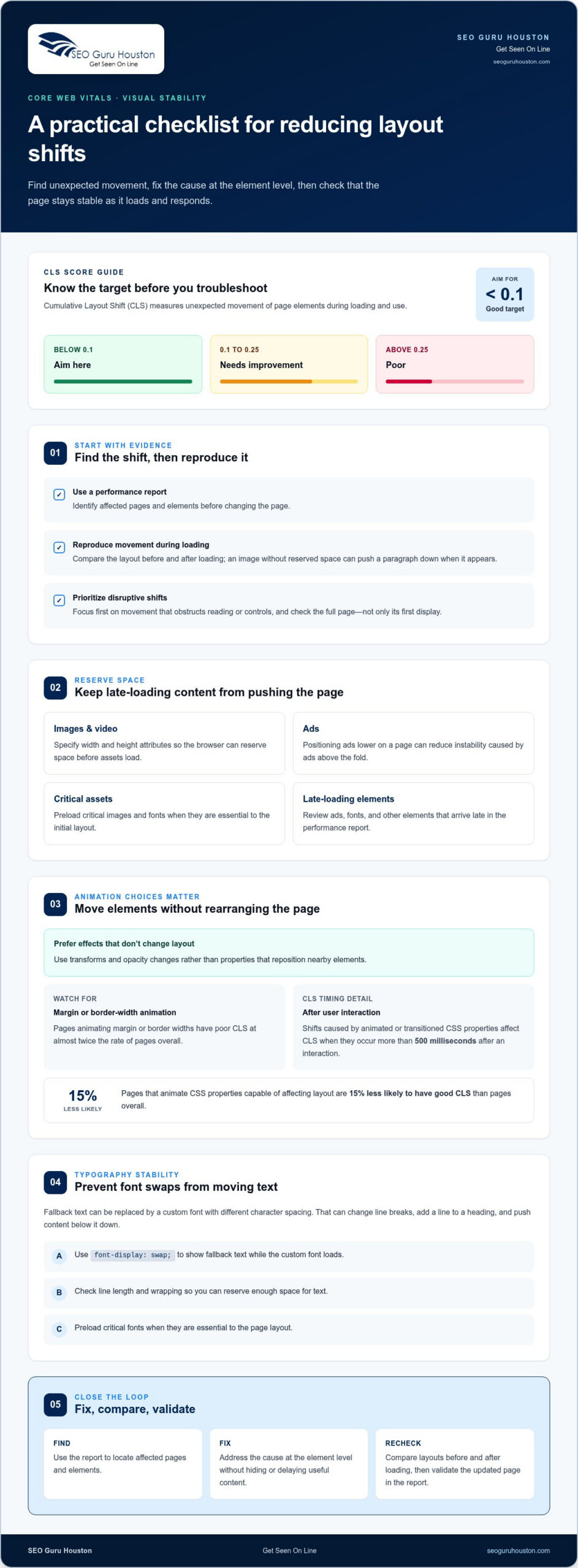
Cumulative Layout Shift (CLS) measures unexpected movement of page elements during loading and use. Aim for a CLS score below 0.1; scores from 0.1 to 0.25 need improvement, while scores above 0.25 are poor.

Animation and Transition Layout Shifts

Animation-related layout shifts happen when motion changes an element’s position or size and pushes other content around. They matter because a moving page can make visitors lose their place or click the wrong control. Layout shifts caused by animated or transitioned CSS properties affect CLS when they occur more than 500 milliseconds after a user interaction.

Choose animations that don’t change the page’s layout, such as transforms and opacity changes, instead of properties that reposition nearby elements. Pages that animate CSS properties capable of affecting layout are 15% less likely to have good CLS than pages overall. Pages animating margin or border widths have poor CLS at almost twice the rate of pages overall.

Font Loading and Layout Stability

Font loading can shift a layout if the browser first displays fallback text, then replaces it with a custom font whose characters occupy different space. That change can alter line breaks and move headings, paragraphs, and buttons. For example, a heading that wraps onto an extra line after a font swap can push the content below it down.

Use the CSS property font-display: swap; to show fallback text while a custom font loads. Check how the chosen font affects line length and wrapping so you can reserve enough space for text. Preloading critical fonts can prioritize assets essential to the page layout and help reduce movement during loading.

Cumulative Layout Shift Optimization

CLS optimization means finding unexpected movement and reducing it without hiding or delaying useful content. Start with a performance report to identify affected pages and elements, then reproduce the movement during loading. For example, an image without reserved space may push a paragraph down when it appears.

Fix the cause at the element level. Specify image and video width and height attributes so the browser can reserve space before those assets load. Positioning ads lower on a page can reduce instability caused by ads above the fold. Preload critical images and fonts when they are essential to the initial layout.

  • Reserve space for images and videos with explicit dimensions.
  • Keep animated effects from changing surrounding layout.
  • Review font swaps, ads, and other late-loading elements in the report.

Check visual stability across the page, not only on first display. A change to one element can affect nearby content, so compare the layout before and after loading. Prioritize shifts that obstruct reading or controls, then validate the updated page in the report.

What are the three Core Web Vitals metrics?

Core Web Vitals measure real-world loading performance, responsiveness, and visual stability. Largest Contentful Paint (LCP) tracks loading, Interaction to Next Paint (INP) evaluates responsiveness, and Cumulative Layout Shift (CLS) captures unexpected movement. Good targets are LCP within 2.5 seconds, INP below 200 milliseconds, and CLS below 0.1. A core web vitals optimization guide can help connect each metric to the page experience it represents.

To measure Core Web Vitals, open the report in Google Search Console to review groups of pages. Use PageSpeed Insights for page-level results and Chrome DevTools’ Performance panel to inspect a browser session. Search Console and Chrome User Experience Report data reflect real-world Chrome user experiences, while DevTools helps investigate issues in a controlled test.

On WordPress or another platform, compare affected URLs, test a representative page, then trace the issue to its theme, page builder, plugins, assets, or server. Where appropriate, disable or defer noncritical scripts and reduce unnecessary builder modules. Retest after each change to see what improved. A core web vitals optimization guide is most useful when you test its recommendations on the actual pages and templates visitors use.

The three metrics reveal different bottlenecks. A simple page may display its main content slowly if the server responds late. A page can load quickly yet feel unresponsive when JavaScript blocks the browser’s main thread. Or the layout can shift after loading, disrupting reading or interaction.

Google evaluates field performance at the 75th percentile of user experiences. That means the report reflects the slower end of real visits, not only a developer’s fastest test. The Chrome User Experience Report uses anonymized data collected from Chrome users, helping distinguish a lab-only issue from a problem visitors encounter across devices and network conditions.

PageSpeed Insights helps connect results to possible causes. Compare field data with lab diagnostics: field data reflects user experience, while a lab test provides a repeatable view of a page load. Test important templates, such as a product page and a lead form, because each may have different bottlenecks.

Performance dashboards are most useful when they track trends alongside affected page groups. In Search Console, check whether issues cluster around a template or URL type, then compare later reports after making changes. One test cannot show whether a fix improved the experience for real users.

Page builders and plugins can add scripts, styles, and requests that compete for browser time. On WordPress, review active plugins and remove unused features or scripts where safe. If TTFB stays above 400 milliseconds, address hosting before relying on frontend changes to improve LCP; a good TTFB target is below 0.8 seconds.

Shared WordPress hosting typically has a TTFB of 500 to 1500 milliseconds, compared with 100 to 300 milliseconds for managed WordPress hosting. Caching can reduce repeated server work, while a content delivery network can deliver assets to users in different locations. When template changes are needed, website development and landing page work can address the page structure behind recurring performance problems.

Interaction to Next Paint (INP): What Is It?

Interaction to Next Paint (INP) measures how quickly a page responds throughout a visitor’s interactions. A good INP is below 200 milliseconds; a score from 200 to 500 milliseconds needs improvement, and above 500 milliseconds is poor. Unlike a metric focused on one input, INP reflects the delay from interaction through the browser’s next visual update.

Google replaced First Input Delay (FID) with INP in March 2024. FID measured only the delay before a browser began processing a visitor’s first input. It did not account for later interactions or the time needed to process an event and render its visual response. INP provides a broader view by considering interactions such as clicking a menu, typing into a search field, or adding an item to a cart.

Consider a visitor selecting a filter. The browser may receive the click promptly, but a long JavaScript task can delay the filtered results appearing. INP includes that wait for the next paint. A page’s INP is 500 milliseconds if its slowest interaction takes half a second to process. This helps identify sluggish controls that a fast initial page display can conceal.

Start diagnosis by reproducing the slow interaction, then inspect the page’s main-thread work in Chrome DevTools. Browser tasks lasting more than 50 milliseconds are considered long tasks and can block responses to user actions. Look for expensive event handlers, repeated layout calculations, and scripts that run during the interaction. Break lengthy JavaScript work into smaller tasks, remove unnecessary processing, and avoid updating large sections of the page when one element changes.

Third-party scripts can compete for processing time. Review analytics, chat widgets, and advertising scripts, then load them asynchronously or limit their use where possible. For example, avoid recalculating search results on every keystroke if the interface can wait until typing pauses. Keep the response clear, such as by showing a loading state while results render.

Use real-user monitoring and the Core Web Vitals report in Search Console to identify patterns across page groups. Lab testing can help reproduce an interaction, while field data shows how visitors experience it across devices and network conditions. Prioritize the slowest meaningful interactions, then compare measurements after each code change.

Preloading helps with resources needed early, but it does not directly fix every INP problem. Prioritizing a critical script can help it arrive sooner, but competing resources can still delay interaction processing. Distinguish loading delays from JavaScript execution issues, then address the bottleneck affecting the visitor’s next action.
Core Web Vitals Optimization for Faster, More Stable Pages

Image format and responsive image optimization

For mobile users, prioritize the image that becomes the largest contentful paint element, then reduce its file size and loading delay. Serve appropriately sized images, use modern formats such as WebP, and lazy-load images outside the viewport while ensuring the primary visual is discoverable early.

Images often determine whether a mobile page feels ready. The 2024 Web Almanac reports that 73% of mobile pages have an image as their LCP element. Compress large files and serve WebP where appropriate; WebP media content is 34% smaller than the usual format. Match each image’s dimensions to its display size instead of sending a large desktop asset to a narrow screen.

Responsive image markup lets the browser choose a suitable source for the screen and layout. Use srcset to offer image variants and sizes to describe their expected display width. For example, a phone showing a small product thumbnail shouldn’t download the oversized file used for a full-width desktop banner. This reduces unnecessary data transfer.

Make the LCP image easy for the browser to discover in the initial HTML. Among pages whose LCP element was an image, 35% had image source URLs that weren’t discoverable in the initial HTML response. A further 7% obscured the LCP image behind a data-src attribute. Avoid hiding the primary image behind JavaScript-driven loading when it needs to appear early.

Prioritize images larger than 10,000 square pixels when investigating LCP. Use image preloading selectively for a critical, immediately visible visual, so the browser can request it sooner. Don’t preload every image: unnecessary requests compete for network capacity and can delay the resource that matters most.

Reserve layout space by setting image dimensions, then lazy-load below-the-fold images. Sixty-six percent of pages have at least one image without an explicit size, which can leave the browser unable to allocate space before loading. WordPress has supported native WebP images since version 5.8, and native lazy loading since version 5.5.

Image optimization is only part of resource optimization. Render-blocking CSS can delay the first display, while large JavaScript bundles and third-party scripts compete for browser time. Minify CSS and JavaScript, defer noncritical resources, and load below-the-fold images as they approach the viewport.

  • Compress images and select responsive variants for mobile display.
  • Keep the LCP image visible in initial HTML and prioritize it selectively.
  • Reserve image space and lazy-load visuals outside the viewport.

A content delivery network can serve image assets quickly to users in different locations. After changing formats, markup, or delivery, compare mobile field performance and inspect the LCP element again. This helps show whether the image itself, its discovery, or another resource is still delaying the visual result in Google Search.

Google treats page experience as part of a broader search picture, not a shortcut to rankings. Its core ranking systems seek to reward page experience, with Core Web Vitals among several considerations. A fast page still needs useful content that matches the search. Strong technical signals support the experience; they do not replace relevance or usefulness.

Core Web Vitals became a Google ranking factor in June 2021, with the change rolling out to desktop searches in February 2022. Those dates matter because they show this isn’t a passing dashboard trend. Google recommends good Core Web Vitals for Search success and user experience, but no single metric guarantees a particular position. SEO professionals like ARIFUR RAHMAN ARIF emphasize treating technical performance as one part of a sound search strategy, not a substitute for it.

The practical targets help teams decide what to fix. Aim for Largest Contentful Paint within 2.5 seconds, Interaction to Next Paint below 200 milliseconds, and Cumulative Layout Shift below 0.1. Google assesses user experiences at the 75th percentile, so a page’s fastest visit does not represent every visitor. A page that performs well only on a developer’s laptop may still struggle on slower mobile networks.

Use that percentile perspective to prioritize pages and templates. If a Search Console report groups URLs with similar performance, investigate their shared layout or components first. For example, a slow product template may affect many product pages; fixing shared image handling or scripts can address a pattern rather than one URL. Reassess field data after changes because real-world results reflect users’ devices and connections.

Page experience extends beyond the three metrics. After a page loads, visitors still need clear navigation, readable content, and a secure browsing experience. A visually stable page can still frustrate someone if its main content takes several seconds to appear. Review the full journey, from a Google Search result to the page’s key information and next interaction.

Keep the metrics in context. A good LCP score means the largest visible content appeared promptly; it does not prove every form or menu responds well. Likewise, a good Interaction to Next Paint result does not show that a page answers the visitor’s query. Pair Core Web Vitals data with the page’s purpose and user tasks, such as reaching a contact form or comparing service details.

Make the next action specific: connect a page group’s Search Console status to its template, then prioritize changes affecting loading, responsiveness, or stability. For a stronger search experience, build a performance-focused website strategy around the pages visitors need most.

SEO Guru Houston: Houston SEO Services

SEO Guru Houston helps businesses connect organic search priorities with the pages customers use to evaluate their services. If Core Web Vitals reports reveal recurring issues across important landing pages, our professional optimization strategies can align technical performance priorities with search visibility and page goals.

That work can support a broader growth strategy. Comprehensive digital marketing and B2B campaigns help businesses pursue different acquisition goals, while a well-structured website gives visitors a clearer path to useful information and next steps.

For a focused discussion about your website’s search priorities and core web vitals optimization guide implementation, contact SEO Guru Houston.

Turn Better Page Experience Into Your Next Step

Performance work creates the most value when it supports a clear business goal. Choose a priority page, connect its technical needs to the action you want visitors to take, and keep that focus as your site evolves. A core web vitals optimization guide can frame the work, but progress depends on applying the right changes to the pages that matter to your audience.

When technical improvements need to align with broader visibility and growth objectives, SEO Guru Houston offers search engine optimization, pay-per-click advertising, and B2B marketing. These services can support different acquisition strategies while your website gives visitors a smoother path to useful information and next steps.

Bring your priorities into focus and decide what better page experience should help your business achieve. Contact SEO Guru Houston to discuss how its digital marketing services fit your goals. Keep moving forward with a site built to serve both your audience and your growth strategy.

Frequently Asked Questions

FCP vs LCP: What Is the Difference?

First Contentful Paint (FCP) records when the browser first renders visible content, such as text or an image. Largest Contentful Paint (LCP) measures when the largest visible content element appears. FCP may occur while the main image or headline is still loading. Use both measurements to narrow down delays: slow FCP points to an early rendering issue, while a later LCP may point to the primary content element.

FID vs INP: What Changed?

Interaction to Next Paint (INP) replaced First Input Delay (FID) in Google’s Core Web Vitals in March 2024. FID measured delay before the browser began processing a visitor’s first interaction. INP assesses the responsiveness of interactions across a visit, including the delay until the next visual update. For example, a quick first click doesn’t reveal whether a later filter selection takes too long to display results.

First Input Delay (FID): What Is FID?

First Input Delay measured the time between a visitor’s first interaction and the browser beginning to process it. It focused on input delay, not the full time required to update the page afterward. An ideal FID was below 100 milliseconds; 100 to 300 milliseconds needed improvement, and above 300 milliseconds was poor. FID is now a legacy metric, so use INP when evaluating current Core Web Vitals.

Largest Contentful Paint (LCP): What Is LCP?

Largest Contentful Paint measures how long the largest visible content element takes to appear after a page starts loading. That element might be a prominent heading, an image, or another large content area. LCP helps identify whether the content visitors came to see appears promptly. For example, a page may show its logo quickly but still have a slow LCP if its main banner loads later.

What Is a Good LCP Score?

A good LCP is within the first 2.5 seconds after loading begins. A score from 2.5 to 4.0 seconds needs improvement, while a score greater than 4.0 seconds is poor. If a report flags LCP, identify which element was measured before changing code. A large image, delayed server response, or render-blocking resource can each affect when that element appears.

What Does Insufficient Real User Data in PageSpeed Insights Mean?

It means PageSpeed Insights lacks enough eligible real-world Chrome user data to show field results for that page or origin. It is not a performance score and does not establish whether the page is fast or slow. Use available lab diagnostics to investigate a specific test, then review field data later as it becomes available. Test important page templates, not just the homepage.

What Are Core Web Vitals, and What Are the Current LCP, INP, and CLS Thresholds?

Core Web Vitals measure real-world loading performance, responsiveness, and visual stability. Good targets are LCP within 2.5 seconds, INP below 200 milliseconds, and CLS below 0.1. LCP above 4.0 seconds, INP above 500 milliseconds, and CLS above 0.25 are poor. The middle ranges need improvement: LCP from 2.5 to 4.0 seconds, INP from 200 to 500 milliseconds, and CLS from 0.1 to 0.25.

How Do Field Data and Lab Data Differ When Evaluating Core Web Vitals?

Field data reflects real visits from Chrome users, while lab data comes from a controlled test that helps reproduce and diagnose page behavior. Field results show how people experience a page across their actual devices and network conditions. A lab test can help isolate a slow script or image, but one test does not represent every visitor. Compare both views to connect real-world patterns with specific technical causes.
Website Redesign SEO Checklist 2026: Protect Rankings and Accelerate Revenue Growth

A website redesign without strict technical SEO architecture isn’t a refresh; it’s unforced revenue suicide. If you’re asking how to modernize your digital platform without watching hard-earned keyword rankings, backlink equity, and organic pipeline vanish overnight, your concern is entirely justified. Creative design teams frequently build visually stunning layouts while inadvertently breaking indexing protocols and content hierarchies. That’s why executing a proven website redesign seo checklist 2026 from day one is non-negotiable if you want to protect your digital market share.

You shouldn’t have to gamble your organic revenue to launch a faster, high-converting website. When you align development with technical search rigor, you don’t just prevent post-launch traffic collapses; you turn your redesign into a scalable demand generation asset. In this guide, we break down the exact pre-launch verification workflows, 301 redirect mapping frameworks, and modern Core Web Vitals thresholds you need to dominate competitors and launch with absolute confidence.

Key Takeaways

  • Baseline your legacy organic traffic, keyword rankings, and backlink equity before staging begins to eliminate performance blind spots.
  • Follow an airtight website redesign seo checklist 2026 to build precise 1:1 redirect maps that transfer authority without leaking equity.
  • Engineer your new templates around mobile-first technical infrastructure, meeting strict Interaction to Next Paint and rendering speed benchmarks.
  • Structure content hierarchies around semantic entity clarity to ensure full topical comprehension across modern AI search engines.
  • Execute rigorous staging authentication and immediate post-launch crawl audits to neutralize indexing errors before they threaten pipeline revenue.

Pre-Redesign Discovery: Auditing Existing Assets and Benchmarking Baseline Metrics

A redesign launched without forensic benchmarking guarantees unrecoverable organic traffic collapse. Visually stunning interfaces mean nothing if your search visibility tanks the moment new templates hit production. Modernizing your platform requires balancing foundational web design principles with an aggressive technical audit before touching a single wireframe. Following a rigorous website redesign seo checklist 2026 begins with uncovering what currently drives revenue, what builds authority, and what can be safely cut.

Comprehensive Site Crawl and URL Inventory

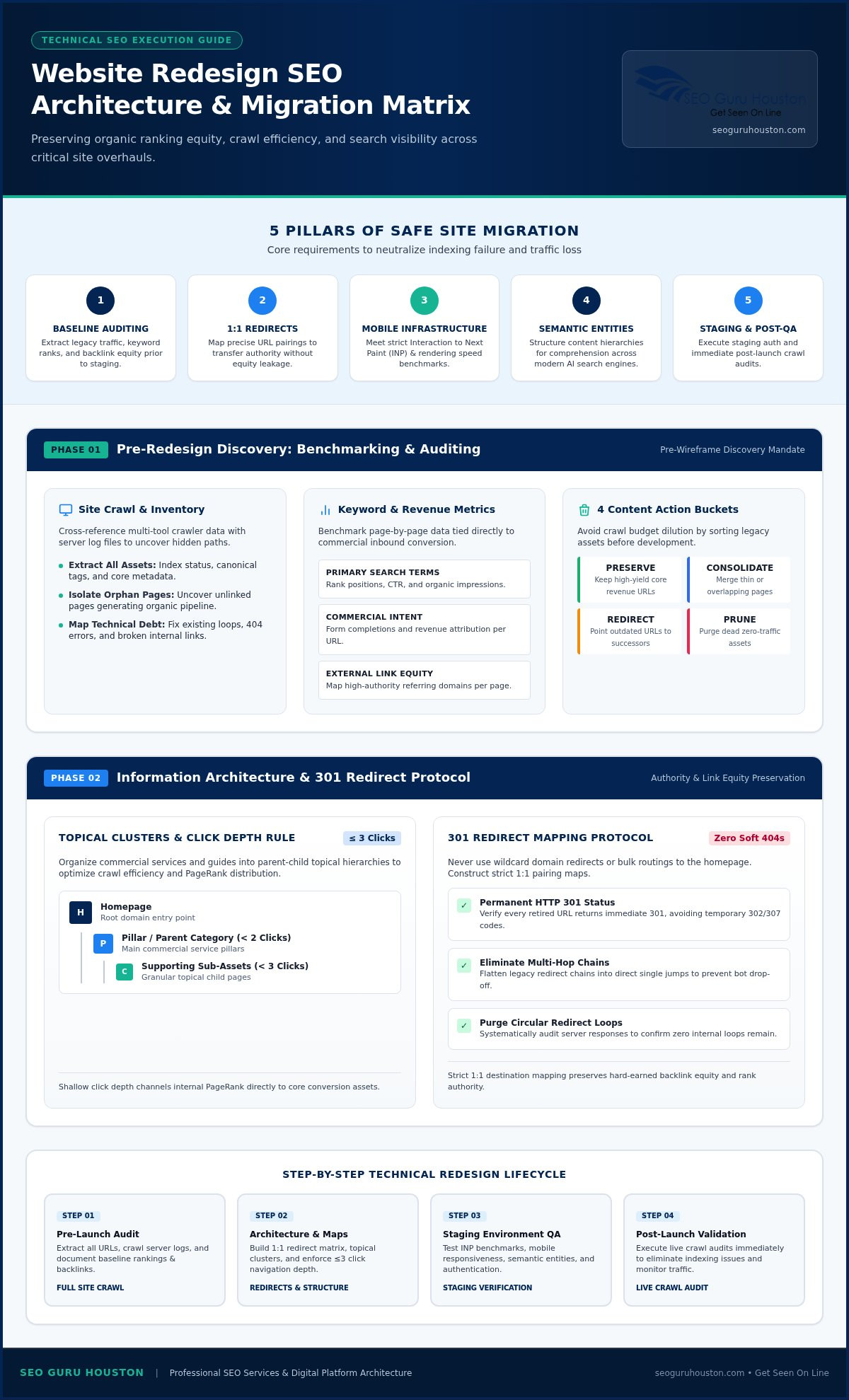
Never rely on a basic CMS export to map your digital footprint. Run a deep crawl using multiple crawler tools, cross-referencing server log files to uncover hidden access paths.

  • Extract every indexed asset: Catalog all live pages, active status codes, canonical tags, and core technical metadata across the domain.
  • Isolate orphan pages: Flag high-performing legacy pages that generate organic traffic despite missing from primary navigation menus.
  • Map technical debt: Uncover existing redirect loops, 404 response errors, and broken internal links before they contaminate your staging environment.

Benchmarking Organic Performance and High-Yield Keywords

Raw traffic numbers don’t show the whole picture; revenue attribution does. Document your baseline metrics page by page, tracking primary search terms, click-through rates, organic impressions, and commercial form completions. Tie each URL to the specific commercial intent driving inbound pipeline. Crucially, map page-level external backlinks. If a legacy URL holds high-authority referring domains, altering or deleting it without a calculated preservation plan destroys accumulated link equity instantly.

Content Pruning and Architecture Audit

Migrating every outdated article and duplicate landing page simply bloats your crawl budget and dilutes domain authority. A redesign gives you the strategic mandate to prune dead weight ruthlessly. Group content into four clear action buckets: preserve, consolidate, redirect, or prune. That is why elite professional seo services audit technical foundations to protect revenue before creative development begins. Building your new site architecture on a lean, high-performing foundation sets the stage for genuine organic growth.

Your site architecture dictates search crawler efficiency and user journey velocity. When structural hierarchies break, organic visibility collapses rapidly. Retaining legacy URL paths whenever possible is the safest way to avoid unnecessary equity redistribution. If changing URLs is unavoidable, a disciplined execution of your website redesign seo checklist 2026 prevents link decay and keeps search bots focused on high-priority assets.

Structuring Logical Topical Clusters and Navigational Hierarchies

Organize content into tightly grouped topic clusters rather than sprawling, disconnected directories. Every commercial service and supporting guide must sit within a clear topical parent-child relationship. Ensure your primary conversion assets remain reachable within three clicks from the homepage. When search engines crawl shallow click depths, crawl budget utilization improves and internal PageRank flows directly to core commercial pillars.

Constructing an Airtight 301 Redirect Mapping Matrix

Never rely on wildcard domain redirects or lazy mass routings to the homepage; Google treats irrelevant bulk redirects as soft 404 errors, stripping away accumulated ranking authority. Build a granular 1:1 redirect map that pairs every retired URL with its exact conceptual successor.

  • Audit status responses: Verify every legacy URL returns an immediate HTTP 301 status, avoiding temporary 302 or 307 headers.
  • Eliminate redirect chains: Flatten legacy multi-hop redirect chains into single direct jumps to prevent crawler drop-off.
  • Purge internal loops: Test server response codes systematically to guarantee zero circular redirect paths exist before staging review.

Updating Navigation Menus and Internal Linking Frameworks

Design modern header, footer, and sidebar menus with intent-driven anchor text rather than generic labels. Hardcode all internal navigation to link directly to final destination URLs, completely bypassing your 301 redirect engine. Pairing streamlined navigation with a high converting landing page design turns raw organic sessions into predictable pipeline. If managing complex technical architecture while overhauling front-end code feels overwhelming, partnering with proven search marketing specialists ensures zero equity leaks during the transition.

Technical SEO Infrastructure: Engineering Speed, Mobile-First, and Crawlability

Stunning front-end aesthetics collapse under the weight of bloated scripts and sluggish server infrastructure. If search engine bots hit render delays or execution timeouts, your visibility plummets regardless of visual appeal. Executing an uncompromising website redesign seo checklist 2026 demands that technical performance takes precedence before any styling frameworks are finalized.

Core Web Vitals and Page Experience Benchmarks

Passing page experience evaluations requires engineering your templates against rigid performance thresholds. Measure real-world field metrics relentlessly to keep Largest Contentful Paint (LCP) at or under 2.5 seconds, Cumulative Layout Shift (CLS) below 0.1, and Interaction to Next Paint (INP) strictly beneath 200 milliseconds across complete user sessions.

  • Accelerate server response: Deploy edge caching and multi-region Content Delivery Networks to achieve sub-second Time to First Byte (TTFB).
  • Modernize media delivery: Convert legacy graphic assets into compressed WebP or AVIF formats while enforcing explicit height and width dimensions to eliminate layout shifts.
  • Strip execution bloat: Minify CSS and defer non-critical JavaScript to eradicate render-blocking execution bottlenecks.
  • Streamline DOM structure: Reduce DOM depth to maximize mobile device processing efficiency and speed up interactive responsiveness.

Mobile-First Responsive Frameworks and Accessibility

Search crawlers evaluate your website strictly through a mobile smartphone lens. Desktop-only optimizations don’t move the needle. Your mobile viewports must maintain absolute content, internal link, and structured data parity with desktop layouts. Verify tap targets provide generous interactive spacing, typography remains legible without pinch-to-zoom gestures, and layout elements comply with accessibility standards to prevent user frustration.

Rendering, JavaScript Execution, and Indexation Control

Relying heavily on client-side JavaScript rendering introduces massive crawl delays and indexation blind spots. Search engines consume precious crawl budget when forced to render complex client-side scripts. Utilize server-side rendering (SSR) or static site generation for core commercial templates to feed bots pre-rendered HTML instantly. Enforce self-referential canonical tags across every unique template, configure parameter handling cleanly, and generate streamlined XML sitemaps containing only indexable 200-OK status URLs.

Website Redesign SEO Checklist 2026: Protect Rankings and Accelerate Revenue Growth

Modern search engines evaluate semantic topic context and entity relationships, not isolated keywords. Treating on-page optimization as an afterthought during a redesign ruins keyword footprint breadth. Web designers often strip out critical copy blocks or collapse descriptive headers into empty stylistic banners, confusing search models. Incorporating entity architecture into your website redesign seo checklist 2026 ensures search crawlers clearly connect your services to your broader corporate identity.

Metadata and Heading Hierarchy Preservation

Design overhauls must preserve semantic heading structures across every template. Keep exactly one clear H1 per URL, followed by logically ordered H2 and H3 subheadings that reflect topical progression. Craft concise, information-dense opening paragraphs that define your solutions within the first 60 words. This positioning satisfies immediate buyer search intent while claiming prime real estate in generative search snapshots. Rewrite stagnant title tags and meta descriptions to emphasize compelling value hooks, lifting click-through rates across updated SERPs.

Schema.org Markup and Semantic Entity Mapping

Structured data provides explicit semantic clues directly to search engine knowledge graphs. While Google retired FAQ rich results from search displays on May 7, 2026, structured JSON-LD remains foundational for establishing entity trust and machine comprehension. Research from Vynce Digital in July 2026 showed that 72% of first-page Google results utilize structured data, with roughly 41% of all web pages adopting JSON-LD.

  • Establish organizational identity: Deploy nested Organization schema referencing your official brand assets, key leadership, and verified corporate registry profiles.
  • Connect verified entities: Utilize sameAs arrays linking to Wikidata profiles and authoritative industry directories to resolve entity ambiguity.
  • Define offerings granularly: Implement Service and Product schema with specific operational attributes rather than generic marketing text.
  • Validate syntax pre-launch: Run every dynamic template through schema validation checkers to confirm zero broken properties or syntax errors.

Content Optimization for Buyer Intent and Demand Generation

Traffic without pipeline acceleration is a wasted investment. Every refreshed page must align directly with commercial intent, answering high-friction buying questions without unnecessary fluff. See how a leading b2b demand generation agency structures messaging to convert qualified organic visitors into measurable opportunities. Ready to dominate competitive search categories without risking your pipeline? Partner with our growth strategists to engineer an airtight technical foundation that drives sustainable market leadership.

The Staging, Launch, and Post-Launch QA Protocol: Safeguarding Organic Growth

The cutover window between staging and production represents the most volatile phase of your entire project. Even a minor deployment oversight can trigger catastrophic search visibility drops within hours. Implementing an airtight staging and cutover sequence within your website redesign seo checklist 2026 protects hard-won equity and ensures seamless operational execution when DNS records shift.

Staging Environment Security and Pre-Flight Validation

Search crawlers will index public test subdomains if you leave them open. Protect staging environments behind HTTP basic authentication or server-level IP whitelisting rather than relying solely on robots.txt disallow rules.

  • Enforce authentication gates: Restrict staging access to authorized teams to block search bots from indexing draft templates and generating duplicate content flags.
  • Execute synthetic pre-launch crawls: Crawl the authenticated staging environment to verify that internal navigation, canonical URLs, and schema markup match production specifications.
  • Validate redirect behavior: Test your redirect mapping table in a staging container to ensure immediate 301 responses with zero intermediate hops.

Launch-Day Cutover Checklist and DNS Migration

Launch day requires decisive, disciplined execution. As DNS updates propagate globally, execute a rapid verification sequence. Remove staging noindex meta tags immediately, ensure your production robots.txt file permits crawler access to all indexable paths, and confirm SSL certificates force sitewide HTTPS without mixed content warnings. Submit refreshed XML sitemaps to major webmaster consoles immediately to prompt rapid recrawling of critical commercial URLs.

Post-Launch Auditing, Log Analysis, and Volatility Management

Deployment marks the beginning of intensive monitoring, not the finish line. Inspect search console indexation coverage reports every 24 hours to catch crawl anomalies, soft 404s, and unexpected dropped URLs. Parse real-time server access logs daily to verify Googlebot is discovering and parsing updated templates cleanly. If you notice isolated ranking fluctuations, address them instantly by fine-tuning internal links. Once baseline visibility stabilizes, align your platform with an aggressive inbound marketing strategy for b2b to accelerate demand generation and turn technical stability into lasting revenue dominance.

Turn Your Digital Overhaul Into an Unstoppable Revenue Engine

A website overhaul isn’t merely a creative aesthetic refresh; it’s a high-stakes operational pivot that directly impacts your bottom line. When you execute an airtight website redesign seo checklist 2026, you insulate years of hard-won domain authority, maintain precise 1:1 redirect integrity, and deliver lightning-fast Core Web Vitals across every device. Modernizing your platform must expand your market share and accelerate conversion velocity, never jeopardize it.

Don’t leave your organic pipeline to chance or accept ranking drops as an inevitable cost of growth. Combining rigorous technical SEO architecture, high-converting landing page frameworks, and aggressive inbound demand generation funnels ensures your new digital asset drives measurable ROI from day one. Partner with seasoned digital strategists to safeguard your rankings and scale revenue today. Take decisive control of your digital visibility, outpace hesitant competitors, and build an enduring competitive advantage that turns searchers into sustainable revenue.

Frequently Asked Questions

How long does organic traffic typically fluctuate after a website redesign?

Expect organic volatility to persist for two to six weeks while search crawlers discover, re-index, and evaluate updated templates. The exact timeline depends on site size, crawl frequency, and domain authority. Following a methodical website redesign seo checklist 2026 minimizes this stabilization period. If traffic remains depressed beyond eight weeks, unaddressed technical debt, broken redirect chains, or stripped semantic content are usually the culprits.

Can a website redesign improve organic search rankings immediately?

Immediate ranking gains are rare because search engines require time to process systemic architectural shifts. However, substantial performance lifts frequently emerge within 30 to 60 days post-launch. When you resolve severe legacy crawling hurdles, accelerate server response times, and deploy clearer topic structures, crawlers reward the upgraded user experience. The key is treating technical SEO as a baseline growth engine rather than a decorative cosmetic patch.

What happens if we launch without setting up 301 redirects?

Launching without 301 redirects instantly triggers widespread 404 response errors, destroying your accumulated page authority and inbound backlink equity. Search engines treat missing pages as vanished content, de-indexing URLs and wiping out historical keyword rankings in days. Beyond ranking devastation, incoming referral and organic visitors land on dead pages, causing immediate bounce spikes, fractured conversion paths, and severe top-line revenue destruction across your entire digital sales pipeline.

How do we prevent search engines from indexing our staging website?

Implement HTTP basic password authentication or restrict access exclusively to approved corporate IP addresses. Never rely solely on a staging robots.txt file or meta noindex directives, as minor configuration slips can still expose test URLs to public crawling. Server-level authentication creates an impenetrable barrier, preventing search bots from discovering staging subdomains, creating duplicate content conflicts, or prematurely indexing unfinished development templates.

Is it safe to change URL structures and permalinks during a redesign?

It’s safe only when paired with meticulous 1:1 permanent redirect mapping, but keeping existing URLs is always the lower-risk choice. Whenever permalinks change, search algorithms must rediscover the new paths and reassign link equity. If structural alterations are necessary for site scalability, document every old path and verify that every redirect points directly to its closest relevant successor without passing through intermediate redirect hops.

Why do websites often lose significant traffic after a visual revamp?

Traffic drops occur when creative design decisions accidentally strip away vital technical SEO elements. Web design teams often replace keyword-rich, crawlable body text with visual widgets, delete high-ranking subpages, or alter heading hierarchies. Executing a structured website redesign seo checklist 2026 keeps development teams accountable to search equity. Without that technical governance, search bots find an unrecognizable page context, resulting in swift ranking demotions across core revenue terms.

How does modern Core Web Vitals optimization impact post-redesign performance?

Fast, responsive technical infrastructure directly impacts how search engines evaluate user experience signals sitewide. Meeting benchmarks for Largest Contentful Paint and Interaction to Next Paint ensures that mobile visitors browse without input delays or layout shifts. Sites delivering rapid response times reduce bounce rates and maximize crawl efficiency. Search crawlers prioritize stable, performant digital platforms, turning superior technical speed into a decisive competitive advantage post-launch.

Technical SEO Audit Checklist: The Assertive Blueprint for Market Dominance in 2026

Is your website a high-performance revenue engine, or is it a silent liability bleeding profit every time a search engine attempts to crawl it? You’ve likely invested heavily in content and design, yet you remain invisible while competitors dominate the rankings. It’s a common reality; even the best content is useless if technical bottlenecks prevent search engines from indexing it properly. This technical seo audit checklist is the definitive solution for leaders tired of confusing jargon that doesn’t translate to actual business outcomes.

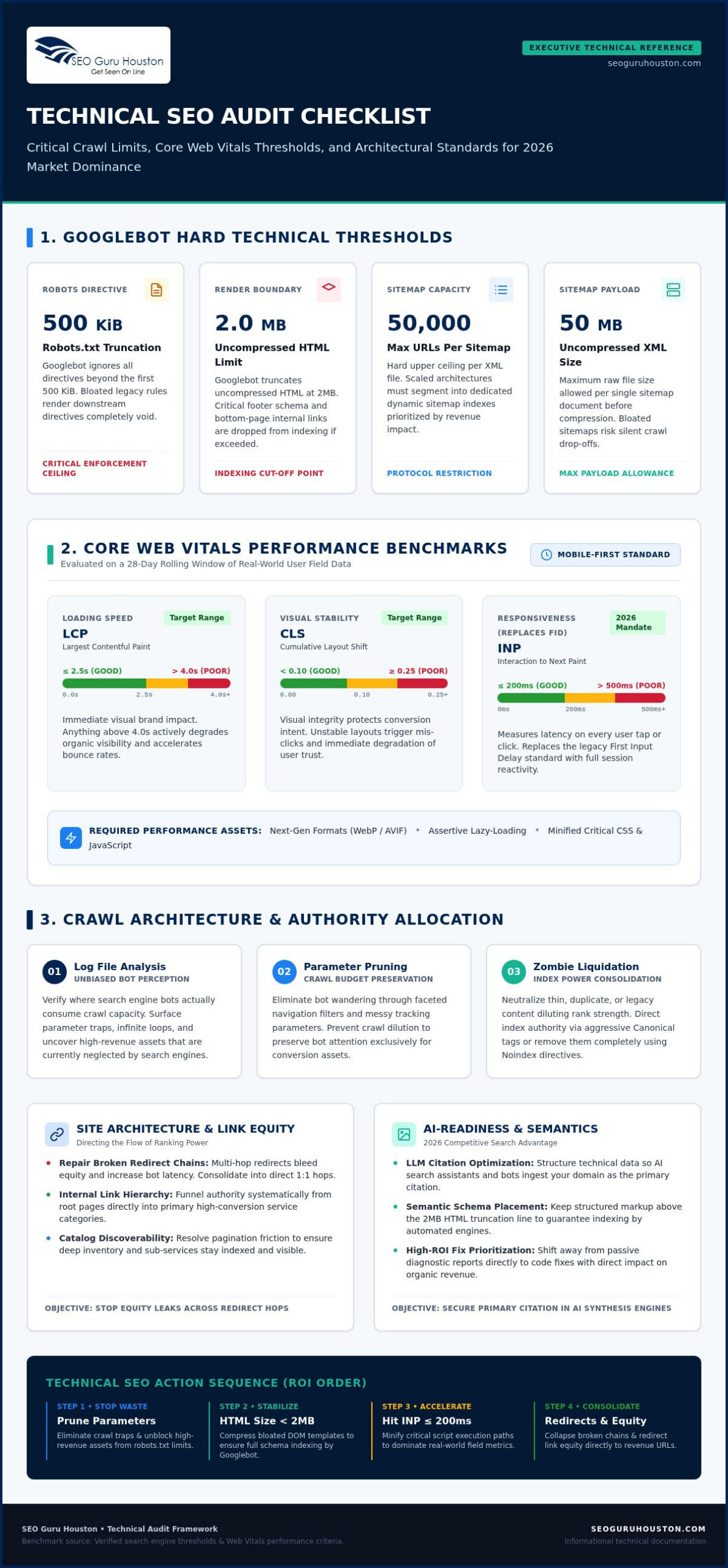
This is the end of the guesswork. You are about to gain an assertive blueprint for market dominance in 2026. We’re moving past basic fixes to tackle high-impact variables like Googlebot’s 2MB truncation threshold and the permanent shift to Interaction to Next Paint (INP) for responsiveness. You’ll receive a prioritized list of technical fixes designed to optimize your site for both human users and AI search engines. We are going to transform your digital presence from a passive brochure into a measurable, high-ROI growth machine that captures every available dollar of organic demand.

Key Takeaways

  • Master your crawl budget by using robots.txt to assertively direct search engines away from low-value pages and toward your high-conversion assets.
  • Treat site speed as a non-negotiable competitive advantage to ensure you aren’t gifting market share to faster competitors.
  • Eliminate revenue leaks by following this technical seo audit checklist to repair broken redirect chains and establish a logical, high-authority internal link hierarchy.
  • Secure your 2026 competitive edge by optimizing for LLM-readiness, ensuring your brand is the primary citation for AI search assistants and chatbots.
  • Shift from passive analysis to aggressive growth by prioritizing technical fixes that deliver the fastest measurable ROI and financial return.

The Foundation of Dominance: Crawlability and Indexing

Crawlability is the bedrock of your digital empire. If search engines can’t find your pages, your content is essentially non-existent. Every second a bot spends on a low-value page costs you money in lost opportunity. You must treat your crawl budget as a high-stakes investment. A successful strategy requires mastering search engine optimization fundamentals to ensure bots prioritize your high-conversion assets over digital clutter. This is the first pillar of any professional technical seo audit checklist intended for market leaders.

Your robots.txt file is a power play. It’s not a suggestion; it’s a directive. However, Googlebot ignores anything beyond the first 500 KiB of this file. If your file is bloated with legacy rules, you’re flying blind. Similarly, your XML sitemaps must move beyond basic lists. In 2026, dynamic sitemaps that prioritize high-revenue URLs are the standard for market dominance. Stick to the verified limits: 50,000 URLs and an uncompressed file size of 50MB per sitemap. Anything more is a waste of resources that search engines will simply ignore.

Crawl Budget Optimization for High-Traffic Sites

Stop letting search bots wander aimlessly through faceted navigation or messy tracking parameters. These traps dilute your authority and exhaust your crawl budget. You need to identify and prune these low-value parameters immediately. Leverage Log File Analysis to see exactly how search engines perceive your site. This data doesn’t lie. It reveals where bots are getting stuck and which high-revenue landing pages they’re ignoring. Your audit must prioritize frequent recrawling of pages that actually drive business growth.

Advanced Indexing Control and Canonicalization

Zombie pages are silent killers. These are thin, outdated, or duplicate pages that dilute your site’s ranking power and confuse search algorithms. Use Canonical tags as a weapon to consolidate link equity into your primary URLs. If a page doesn’t serve a clear business purpose, use Noindex directives to focus ranking power on your most important assets. Be aggressive with your uncompressed HTML size. Googlebot truncates content after the 2MB mark. If your code is bloated, your internal links and schema at the bottom of the page won’t be indexed. Solving pagination challenges ensures your full catalog of products and services remains discoverable and ready to rank.

The Speed of Money: Performance and Core Web Vitals

Speed isn’t just a technical metric; it’s a financial imperative. Every millisecond your site lingers during a load is an assertive gift to your competitors. If a user has to wait, they leave. It’s that simple. In the high-stakes environment of 2026, performance is the silent engine driving your conversion rates and organic visibility. A comprehensive technical seo audit checklist must prioritize speed as a non-negotiable foundation for market dominance.

Google’s judgment is based on the Google Core Web Vitals metrics and thresholds, which rely on a 28-day rolling window of real-world user data. You don’t get a pass because your local dev environment is fast. You need to dominate these field metrics to stay relevant. Mobile-first isn’t a trend anymore; it’s the only standard that matters. If your mobile performance isn’t flawless, you’re effectively invisible to a majority of your audience. High-converting Websites Dev & Landing Pages require a robust server-side environment to handle traffic surges without sacrificing speed.

Crushing Core Web Vitals Thresholds

Dominating user experience starts with meeting strict thresholds. Your Largest Contentful Paint (LCP) must be 2.5 seconds or less to ensure an instant brand impact. Anything over 4.0 seconds is considered poor and will tank your rankings. Cumulative Layout Shift (CLS) is about professional trust. Keep your score under 0.10 to prevent frustrating visual jumps that kill conversion rates. Finally, you must master Interaction to Next Paint (INP). With a target of 200 milliseconds or less, INP ensures your site feels high-energy and responsive to every click or tap. Audits still citing First Input Delay (FID) are obsolete; INP is the only responsiveness standard that counts today.

Advanced Performance Tactics for 2026

  • Next-Gen Assets: Use WebP or AVIF image formats combined with assertive lazy-loading to reduce initial payload without sacrificing visual quality.
  • Code Streamlining: Minify your critical CSS and JavaScript. Every unnecessary byte in the rendering path is a bottleneck that delays your time-to-interactive.
  • Edge Delivery: Utilize a high-performance Content Delivery Network (CDN) to ensure your site loads at lightning speeds nationally, regardless of the user’s distance from your primary server.

Your hosting environment is the silent engine of your success. Cheap, unoptimized hosting is a liability that no amount of front-end tweaking can fix. Professional execution ensures your infrastructure is built for growth, not just survival. If you’re ready to stop losing revenue to slow load times, it’s time to audit your stack against these 2026 standards.

Your site architecture is either a conduit for authority or a graveyard for link equity. If your structure is flat and disorganized, search engines can’t determine your true niche expertise. You need a logical hierarchy that directs power toward your high-value assets. This isn’t just about organization; it’s about establishing market dominance. A professional technical seo audit checklist must scrutinize how every internal link serves the bottom line and fuels growth.

Topical Authority through Strategic Siloing

Siloing is the assertive method of grouping related content to signal deep expertise. By creating thematic clusters, you help search engines understand your topical relevance. Use descriptive anchor text to reinforce this. Every link from a high-authority blog post should strategically point toward your high converting landing page design to maximize conversion potential. This ensures your most powerful backlinks fuel your most important service pages. Don’t let your link power dissipate across irrelevant pages.

Redirect Management and Site Hygiene

404 errors and broken redirect chains are revenue leaks. They frustrate users and signal neglect to search algorithms. Audit your 301 redirects to ensure they point to live, relevant content. Redirect loops are even worse. They exhaust your crawl budget and kill the user experience. Fix them immediately. Clean, keyword-rich URL paths are essential for both humans and bots. If a URL is messy, it’s a barrier to success. Regularly scan for broken outbound links to maintain professional site integrity.

Backlinks are expensive and difficult to acquire. Wasting that equity on low-value pages is a strategic failure. Your architecture should act as a funnel, concentrating authority where it generates the most ROI. If you aren’t auditing your link distribution monthly, you’re leaving money on the table. Dominance requires precision in how you direct the flow of digital power across your domain.

Technical SEO Audit Checklist: The Assertive Blueprint for Market Dominance in 2026

AI-Readiness and Content Semantics: The 2026 Competitive Edge

Keywords are no longer enough. To dominate in 2026, your website must function as a structured data source for both traditional algorithms and generative AI. This is where most brands fail. They focus on visible text while ignoring the semantic layer that search engines crave. An assertive technical seo audit checklist bridges this gap by turning your site into a recognized entity in the Knowledge Graph. If you aren’t optimizing for machine readability, you’re voluntarily handing your market share to competitors who are.

Advanced Schema Deployment

Schema markup is your direct line to the search engine’s brain. While many sites use basic JSON-LD, few deploy it with the precision required for market dominance. Focus on Organization, Product, and Service schema to establish your brand’s authority. You must stay current with recent deprecations; Google has pruned several rich result types, including How-To and most FAQ snippets. Don’t waste resources on dead schema. Instead, prioritize PriceSpecification and Author nodes to provide the granular data that fuels modern search results. Validating this structured data is essential. Even a single syntax error can render your entire schema block invisible to search bots.

Optimizing for AI Search and Discovery

AI search engines like SearchGPT and Perplexity don’t just crawl; they synthesize. If your content isn’t structured for easy extraction, these engines will ignore you. You must differentiate between training bots like GPTBot and citation bots like OAI-SearchBot. Blocking all AI agents is a strategic blunder. A recent cohort audit revealed that 41% of B2B websites inadvertently block AI search crawlers, resulting in a loss of up to 34% of potential citations in generative engines. Deploying an /llms.txt file at your domain root provides clean Markdown context that minimizes token waste and ensures your brand is the primary source for AI-generated summaries. This is a critical component of any 2026 technical seo audit checklist.

Success in this landscape requires a sophisticated blend of technical precision and strategic content mapping. You can’t afford to leave your AI visibility to chance. If you’re ready to secure your 2026 competitive edge, professional Digital Marketing and Lead Generation Services can ensure your brand remains at the forefront of this digital evolution. Stop guessing and start scaling with a strategy built for the future of search.

From Audit to Action: Implementing for Massive ROI

Data without decisive action is just expensive noise. Completing a technical seo audit checklist is only the first step; the real profit lies in the execution. Most businesses fail here because they treat technical fixes as a long-term “to-do” list rather than an urgent offensive strategy. If you aren’t prioritizing fixes based on their immediate impact on revenue, you’re wasting time. Market dominance requires a ruthless focus on the variables that move the needle today.

The 3-Tier Prioritization Framework

Success in 2026 demands a structured approach to implementation. You can’t fix everything at once, and you shouldn’t try. Use this framework to allocate your resources effectively:

  • Tier 1: Critical Blockers. These are the “fires” that stop search engines in their tracks. This includes resolving server errors, fixing indexation blocks, and securing your site against vulnerabilities. If bots can’t see you, nothing else matters.
  • Tier 2: Growth Drivers. Once the path is clear, focus on performance. This means crushing the Core Web Vitals thresholds we discussed earlier and refining your site architecture. These improvements directly correlate with higher conversion rates and better user retention.
  • Tier 3: Competitive Polish. This is where you pull ahead of the pack. Advanced schema deployment, entity optimization, and AI-readiness ensure you aren’t just ranking, but dominating the semantic search landscape.

Scaling Your Success with Expert Guidance

Technical SEO is high-stakes surgery, not a hobby for an internal IT generalist. One misconfigured line in a robots.txt file or a botched canonical tag can wipe out years of organic growth in hours. Professional execution is a fundamental necessity for business survival. A “guru” approach is required to navigate complex migrations and the nuances of the 28-day CrUX rolling window. You need a partner who measures success through leads and real revenue growth, not just abstract traffic numbers.

To achieve total search coverage, your technical foundation must be integrated with broader Professional SEO Services. This ensures your content and authority strategies are built on a rock-solid platform. For those ready for immediate market capture, pairing these fixes with PPC Management Services creates a dual-threat presence that leaves no revenue on the table. Stop guessing and start scaling. The blueprint is in your hands; now it’s time to lead.

Secure Your Market Dominance Before the Competition Wakes Up

Winning in the 2026 search ecosystem requires more than just good content; it demands a flawless technical foundation. You’ve seen how crawl budget optimization and AI-readiness separate market leaders from invisible entities. By following this technical seo audit checklist, you’re not just fixing errors. You’re building a high-performance revenue engine that captures every available lead.

We specialize in technical SEO and demand generation with a proven track record of scaling B2B and industrial brands. Our results-oriented approach is focused entirely on your measurable ROI. Don’t let invisible technical gaps bleed your marketing budget dry. It’s time to transform your site from a liability into your most powerful sales asset.

Stop Losing Revenue and Claim Your Market Dominance—Get Your Professional Audit Today!

The digital landscape moves fast, but with the right blueprint, you’ll move faster. Take decisive action now and watch your organic growth accelerate.

Frequently Asked Questions

What is a technical SEO audit and why does my business need one?

A technical SEO audit is a comprehensive evaluation of your website’s backend infrastructure. It identifies barriers that prevent search engines from crawling, indexing, and ranking your content. Your business needs this because even the best content is useless if it’s invisible. By identifying and fixing these deep-seated issues, you ensure your site functions as a high-performance revenue engine that captures every available lead in your market.

How often should I perform a comprehensive technical SEO audit?

You should perform a comprehensive audit at least once every quarter. Digital trends and search engine algorithms evolve at a breakneck pace. Regular checkups using a professional technical seo audit checklist allow you to catch silent errors before they sabotage your rankings. If you’re making frequent site updates or migrating content, monthly audits are a fundamental necessity for maintaining your competitive edge and market dominance.

Can technical SEO issues actually lead to a loss in revenue?

Yes, technical failures are direct revenue leaks. If your site takes too long to load or contains broken redirect chains, potential customers will bounce to a competitor. Search engines will also penalize your visibility, meaning your high-conversion landing pages never reach your target audience. You aren’t just losing rankings; you’re leaving actual dollars on the table by ignoring the backend health of your digital presence.

What are Core Web Vitals and why are they a non-negotiable in 2026?

Core Web Vitals are specific metrics Google uses to measure user experience, focusing on loading speed, interactivity, and visual stability. In 2026, these are non-negotiable because search engines prioritize sites that provide a seamless human experience. Failing to meet these thresholds, like the 200ms limit for Interaction to Next Paint (INP), tells Google your site is a liability, resulting in lower organic visibility and decreased trust from your visitors.

How long does it take to see results after fixing technical SEO issues?

You typically see measurable ROI within four to twelve weeks after implementation. While some performance improvements like faster load times provide an immediate boost to conversion rates, search engines require time to recrawl and re-evaluate your site. Consistency is key. Following a detailed technical seo audit checklist ensures that once these improvements take hold, your site is positioned for long-term growth rather than a temporary spike in traffic.

What is the difference between a technical audit and a content audit?

A technical audit examines the “pipes” of your website, such as crawlability, indexation, and server response codes. A content audit evaluates the quality, relevance, and engagement of the actual information on your pages. Think of it this way: the technical audit ensures the stage is built correctly, while the content audit ensures the performance is worth watching. You need both to establish yourself as a recognized authority.

Is a technical SEO audit necessary if I am already running PPC campaigns?

Absolutely. Technical SEO is the foundation for all other marketing, including PPC and demand generation. A technically sound website improves your landing page experience, which can lead to higher Quality Scores and lower costs per click. If your site is slow or broken, you’re essentially paying to send traffic to a dead end. Professional execution ensures your paid and organic strategies work together for maximum financial return.

Why should I hire a professional agency for a technical SEO audit?

Hiring a specialized agency provides the precision and “guru” level expertise required to navigate complex digital landscapes. Professional teams use advanced tools like Log File Analysis to see exactly how bots perceive your site. They identify subtle errors that an internal generalist might miss. This isn’t an optional luxury; it’s a strategic investment in professional execution that ensures no revenue is left on the table during your growth journey.

B2B SEO Services Houston: The Assertive Blueprint for 2026 Market Dominance

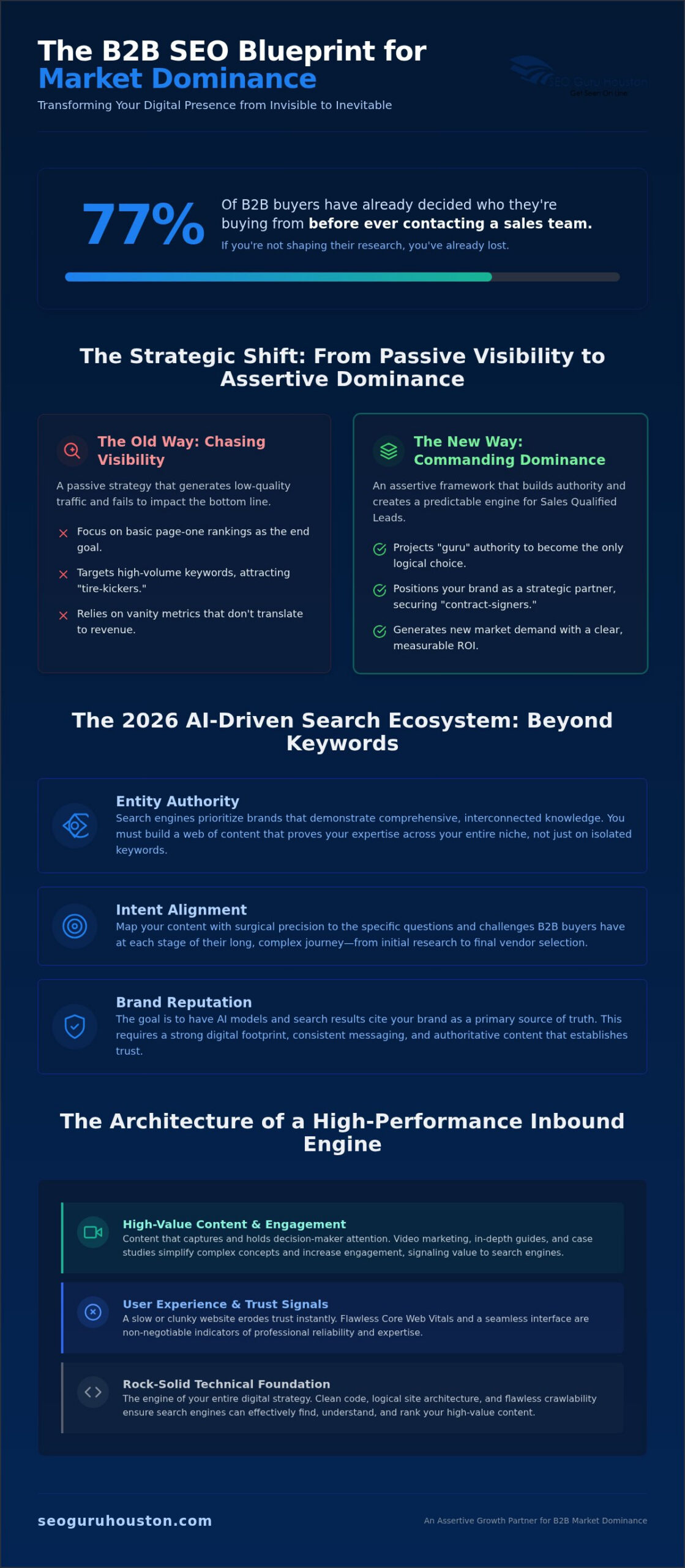
By the time a B2B buyer reaches out to your sales team, they’ve already decided who they’re buying from 77% of the time. If you aren’t the one shaping that decision, you’ve already lost the contract. It’s a bitter pill to swallow. You know your product is superior, yet you remain invisible to the high-value decision-makers who control the budgets. You’re likely tired of wasting capital on generic agencies that don’t understand the nuance of a complex industrial sales cycle. It’s time to stop settling for low-quality leads and start investing in b2b seo services houston that actually drive the bottom line $$$!

You want market dominance and a predictable engine for Sales Qualified Leads. This article provides the assertive blueprint you need to transform your digital presence from invisible to prominent. We’ll show you how to move beyond basic keywords to achieve absolute brand authority and clear ROI. Every strategy we discuss is designed to turn your website into a high-performance sales asset. Get ready to explore the transition to Answer Engine Optimization, the impact of AI on the 2026 landscape, and the tactical steps required to dominate your niche before the competition even knows what hit them.

Key Takeaways

  • Shift your strategy from simple visibility to brand prominence to capture the attention of high-value decision-makers throughout complex sales cycles.
  • Learn why technical precision and robust website development serve as the non-negotiable engine for effective b2b seo services houston.
  • Master the ROI framework of demand generation to move beyond capturing existing interest and start creating new market demand for your services.
  • Establish a high-performance inbound engine that seamlessly guides prospects from search discovery to high-converting landing pages.
  • Identify the essential qualities of an assertive growth partner who combines technical expertise with savvy business strategy to ensure market dominance.

Defining Modern B2B SEO Services in a Competitive Landscape

B2B search isn’t a game of participation; it’s a high-stakes hunt for market share. If your brand isn’t positioned directly in front of decision-makers during their complex, multi-stage sales cycles, you’re effectively invisible. Modern b2b seo services houston must act as a strategic framework that commands attention rather than just requesting it. Visibility alone is a vanity metric that looks good on a spreadsheet but fails to impact the balance sheet. You don’t need more eyes; you need the right eyes on a message that establishes your absolute dominance. B2B SEO is the intersection of technical precision and strategic demand generation.

In the complex world of Business-to-business (B2B) commerce, the buyer journey is rarely linear. It involves multiple stakeholders, months of research, and a deep-seated need for risk mitigation. A passive SEO strategy treats this process like a B2C transaction, focusing on high-volume keywords that bring in “tire-kickers” instead of “contract-signers.” An assertive strategy, however, aligns your search presence with the 2026 digital ecosystem to ensure you are the only logical choice when the final decision is made.

Visibility vs. Market Dominance

Being on page one is no longer the ultimate goal. If your content doesn’t project “guru” authority, a top ranking is just a missed opportunity. High-value prospects aren’t looking for vendors; they’re hunting for strategic partners who can solve their most expensive problems. You must identify the gap in your current strategy before it bleeds more revenue into your competitors’ pockets. Moving from a vendor mindset to a partner profile requires an emotional shift in your content and a technical shift in how you target the “winner-takes-all” search results. If you aren’t capturing the authority in your niche, you’re just a placeholder for the company that will.

The 2026 Search Ecosystem: Beyond Keywords

The era of simple keyword density is dead. By 2026, AI-driven search engines have pivoted entirely toward entity-based authority. This means Google and other platforms prioritize brands that demonstrate a comprehensive understanding of a topic rather than those that just repeat a phrase. For example, a search for the best SUVs for snow and ice on CarSeek succeeds because the platform provides deep, specialized knowledge that signals authority to both users and algorithms. Your business must adapt or risk becoming digitally irrelevant. Modern search engines analyze user intent with surgical precision, looking for signals that your brand is a reliable source of truth.

  • Entity Authority: Building a web of connected topics that prove your expertise.
  • Intent Alignment: Mapping content to specific stages of the B2B buyer journey.
  • Brand Reputation: Ensuring AI models cite your brand as a primary solution.

If your b2b seo services houston don’t account for these shifts, you’re playing a 2015 game in a 2026 market. You must evolve your strategy to meet buyers where they are actually searching, from LinkedIn to specialized AI answer engines, to maintain your competitive edge.

The Technical Architecture of High-Performance B2B SEO

Imagine building a skyscraper on a swamp. That’s what happens when you prioritize content without a rock-solid technical foundation. Technical SEO is the non-negotiable engine of your sales funnel. If your site doesn’t load instantly or fails to communicate clearly with search crawlers, your strategy is dead on arrival. High-performance b2b seo services houston require a proactive approach that goes beyond basic audits. You need a system that anticipates search engine updates and maintains peak performance under pressure. Investing in professional seo services ensures your infrastructure is built for scale, not just survival.

SEO-First Website Development

Your site architecture must serve two masters: search engine crawlers and C-suite executives. One needs clean code and logical hierarchies; the other needs immediate proof of value. Core Web Vitals aren’t just technical metrics. They are indicators of professional reliability. A slow, clunky interface erodes trust before a prospect even reads your first headline. Integrating video marketing for business websites is a powerful way to increase dwell time and engagement. It keeps decision-makers on your page while simplifying complex industrial concepts. This synergy between development and optimization creates a powerful inbound marketing engine that captures and holds attention.

Establishing Absolute Content Authority

Generic agencies often miss the nuance of industrial sectors. They write surface-level fluff that high-level buyers see right through. This is a critical failure. According to a 2025 report by 6sense, 94% of B2B buying groups rank their preferred vendors before ever making contact. If your content doesn’t answer complex industry questions with technical precision, you won’t make that list. Building a moat around your brand requires deep, data-driven insights that prove you are the expert in your niche. This level of authority is a core requirement of professional seo services. It ensures your b2b seo services houston strategy drives revenue, not just traffic.

If you’re ready to stop guessing and start scaling with a site that actually performs, it might be time to evaluate your current Houston B2B marketing strategy.

Lead Generation vs. Demand Generation: The ROI Framework

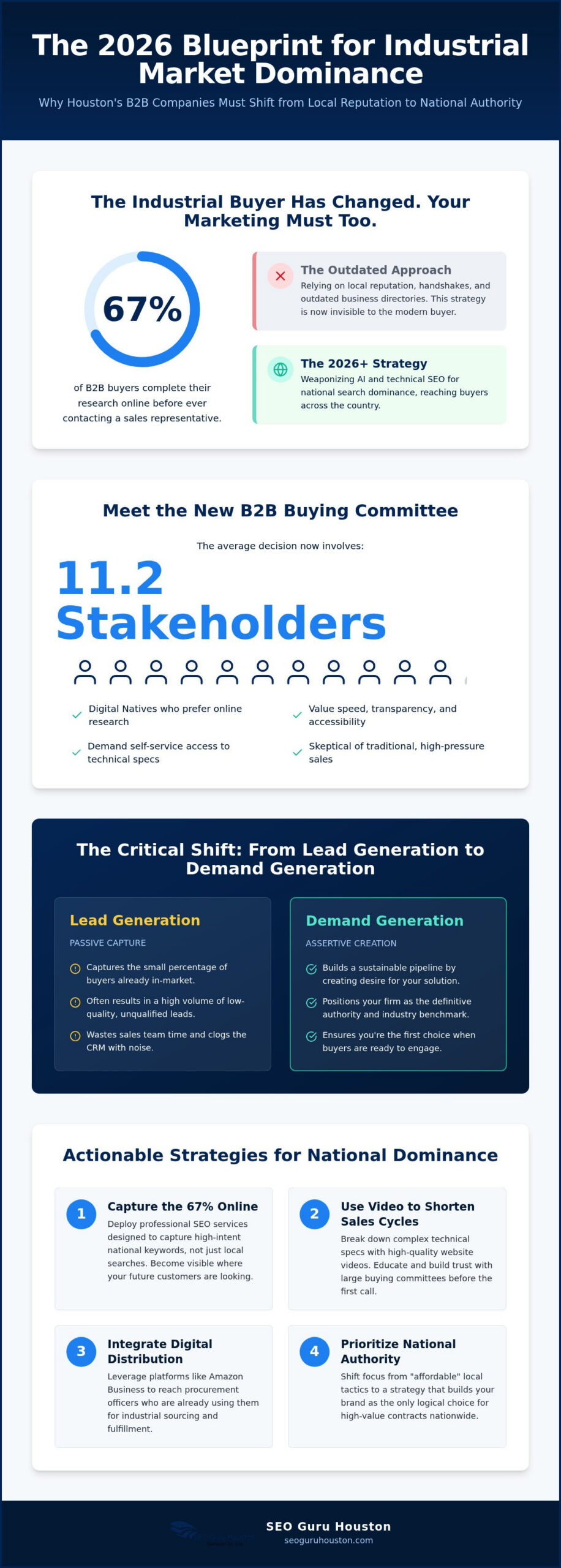
Stop wasting your marketing budget on vanity metrics that don’t convert. Most agencies promise “leads,” but they deliver low-quality contacts that never result in a signed contract. High-performance b2b seo services houston must pivot from passive lead collection to active revenue creation. This is where the distinction between capturing existing interest and creating new market demand becomes critical for your survival. You don’t just want a list of names; you want a pipeline of buyers who are already convinced of your value before they even speak to your sales team.

While traditional lead generation focuses on the bottom of the funnel, Demand Generation builds awareness and trust across the entire buyer journey. It’s about being the only name on the list before the prospect even fills out a form. Many executives object that “SEO takes too long,” but this is a fundamental misunderstanding of the process. When you partner with an assertive b2b demand generation agency, you aren’t just waiting for rankings; you’re actively shaping the market’s perception of your brand. A results-oriented approach ignores raw traffic and focuses exclusively on Sales Qualified Leads (SQLs) that move the needle.

Calculating the Real ROI of B2B Search

Vanity metrics like impressions and clicks are for amateurs. You need a framework that attributes revenue to specific search campaigns. By using a problem-solution framework, you can trace exactly which technical insights led to a high-value consultation. Every $1 spent on assertive SEO should be viewed as a high-yield investment, not a cost. This is the difference between a marketing expense and a strategic growth asset. If your current agency can’t show you a direct line from their work to your bank account, they’re just guessing with your money.

Targeting the Industrial and Manufacturing Decision-Maker

Industrial buyers are a different breed. They’re often “unreachable” through standard social ads or generic email blasts because they live in the world of technical specs and operational efficiency. Reaching them requires targeted inbound marketing that speaks their language with surgical precision. You must leverage technical search phrases that reflect high-intent industrial needs. When a manufacturing executive searches for a specific solution to a complex engineering bottleneck, your brand must appear as the definitive authority. This isn’t about being “found”; it’s about being recognized as the only partner capable of delivering the results they demand. High-quality b2b seo services houston ensure your technical expertise is front and center during these critical search moments.

B2B SEO Services Houston: The Assertive Blueprint for 2026 Market Dominance

Building a High-Performance Inbound Marketing Engine

Driving traffic is only half the battle. If your search discovery doesn’t lead directly to a high converting landing page design, you’re essentially paying for an audience that won’t buy. Most competitors treat digital marketing like a series of disconnected silos. They run SEO in one corner and social media in another. This fragmented approach is a recipe for mediocrity. To achieve 2026 market dominance, you need an assertive inbound marketing strategy that operates as a unified revenue machine. Every touchpoint must reinforce your authority and push the prospect toward a decisive action. High-quality b2b seo services houston provide the fuel, but your inbound engine provides the direction.

The Anatomy of a High-Converting B2B Landing Page

Generic designs fail because they don’t speak to the specific pains of industrial decision-makers. A C-suite executive doesn’t care about stock photos or abstract promises; they care about technical proof points and professional reliability. Your landing pages must feature several non-negotiable elements to succeed:

  • Trust Signals: Case studies and industry certifications that prove your track record.
  • Technical Proof Points: Data-driven insights that address complex engineering or operational bottlenecks.
  • Assertive CTAs: Direct calls to action that guide the prospect toward the next logical step in the funnel.

By applying conversion rate optimization (CRO), you turn existing traffic into a predictable engine for revenue. If your page doesn’t prove your “guru” status in the first five seconds, you’ve already lost the lead. You must bridge the gap between technical expertise and persuasive sales psychology to win in this landscape. To streamline this process, you can explore AI-Driven Lead Generation and Authority Building Systems that automate and enhance your authority in the eyes of potential clients.

Dominating the search market requires more than just organic rankings. You need to integrate Houston PPC services to fuel the SEO engine and drive immediate visibility. This creates a cumulative effect where your brand appears everywhere the buyer looks. Whether they are searching on Google, browsing LinkedIn, or researching industrial supplies via Amazon services, your presence must be inescapable. B2B social media isn’t just for “likes.” It’s a tool to reinforce the authority you’ve built through b2b seo services houston. When you combine these channels, you establish a high-energy brand presence that competitors simply cannot ignore. This holistic approach ensures you capture demand at every stage of the buyer journey, from initial awareness to final contract signature.

If you’re ready to stop being a spectator and start being a market leader, it’s time to build your Houston B2B Marketing engine with a partner who understands the bottom line.

Scaling Your Revenue with an Assertive Growth Partner

Ambition requires more than a checklist. If you want to dominate your market by 2026, you can’t rely on “affordable” agencies that treat your business like a support ticket. You need a “guru” who masters technical nuances while acting as a savvy business strategist. High-performance b2b seo services houston aren’t just about rankings; they’re about scaling your revenue through a ruthless commitment to the bottom line. It’s the difference between an expense that drains your budget and a high-ROI growth partner that fills your pipeline with Sales Qualified Leads. Scaling isn’t about doing more of the same; it’s about doing the right things with surgical precision.

Executing a blueprint for market dominance leaves no room for error. Most businesses fail because they hesitate when they should be taking decisive action. They settle for visibility when they should be demanding prominence. A true growth partner identifies the technical bottlenecks and strategic gaps that are currently bleeding your revenue. We don’t just provide a service; we provide a fundamental necessity for business survival in an increasingly competitive digital landscape. You must transition from invisibility to prominence starting today, or risk being left behind by more aggressive competitors.

The SEO Guru Houston Advantage

We don’t do abstract fluff. Our approach is that of a high-performance coach focused entirely on your business bottom line. We combine the reliability of a seasoned veteran with the boldness of an innovator to ensure your brand commands authority. While others talk about “impressions,” we focus on measurable progress and strategic advantage. We understand industrial and professional sectors because we’ve spent years in the trenches. You get precision, movement, and a track record of success that turns your website into a high-yield investment.

Your Next Steps to Market Dominance

The first step to winning is admitting where you’re losing. Evaluate your current digital standing with a critical eye. Where are the revenue-bleeding gaps in your existing funnel? Is your technical architecture actually supporting your sales goals, or is it a liability? Invisibility is a choice you make every day you don’t take decisive action. Gartner predicts that by 2028, 90% of B2B buying will be intermediated by AI agents. If you aren’t established as the authority now, you won’t even be in the conversation when those agents make their selections. It’s time to stop being a spectator in your own industry.

Contact SEO Guru Houston to dominate your market!

Secure Your Position as a Market Leader

The shift from passive search visibility to absolute market dominance isn’t just a strategy choice; it’s a fundamental necessity for business survival in 2026. You’ve seen how a rock-solid technical architecture and assertive demand generation outpace traditional lead gen methods. By aligning your digital presence with the high-stakes realities of industrial B2B sectors, you move from being a vendor to a strategic partner. Our proven track record shows that precision and movement are the only ways to capture the attention of unreachable decision-makers.

High-performance b2b seo services houston provide the technical nuances and savvy strategy required to turn your website into a high-yield investment. Don’t let your competition claim the authority that belongs to you. Every day you wait is a day of lost revenue and missed contracts. It’s time to take decisive action and build a moat around your brand that competitors simply cannot ignore. Your transformation from invisible to prominent starts with a single, bold decision. Let’s win together.

Stop losing revenue and start dominating your market; Contact SEO Guru Houston today!

Frequently Asked Questions

What is the difference between B2B SEO and B2C SEO?

B2B SEO targets high-level decision-makers and technical committees rather than impulsive individual consumers. While B2C SEO relies on high-volume, emotional triggers, b2b seo services houston prioritize technical precision and long-term trust. You aren’t just selling a product; you’re solving an expensive operational problem. This requires content that satisfies multi-stage research phases and addresses complex procurement requirements that simply don’t exist in the consumer market.

How long does it take to see a real ROI from B2B SEO services?

You should expect to see measurable movement within three to six months, but absolute market dominance typically requires a twelve-month commitment. SEO isn’t a quick fix; it’s a high-performance engine that builds cumulative power over time. If your technical foundation is solid, you’ll capture low-hanging fruit early. However, the real financial return comes when your brand becomes the default authority in your niche, making you the first choice for buying committees.

Why do industrial and manufacturing companies need a specialized SEO agency?

Industrial sectors operate on technical specs and operational efficiency, not abstract marketing fluff. Generic agencies often fail because they don’t understand the nuance of a complex engineering bottleneck. You need a partner who speaks the language of manufacturing and can translate technical expertise into search authority. A specialized agency ensures your content reaches the “unreachable” executive by addressing high-intent industrial needs that generalist firms completely overlook every single day.

What are the most important B2B SEO metrics to track in 2026?

Stop tracking vanity metrics like raw impressions. In 2026, the only metrics that matter are Sales Qualified Leads (SQLs), pipeline velocity, and entity-based authority. You must measure how effectively your content is cited by AI answer engines and how much revenue is directly attributed to search discovery. High-performance b2b seo services houston focus on financial return and strategic advantage. If a metric doesn’t correlate to a signed contract, it’s a distraction.

Can SEO really help with a complex, long-cycle B2B sales process?

SEO is the most effective tool for influencing long-cycle sales because it provides authoritative touchpoints at every stage of the research process. B2B buyers conduct extensive research before ever making contact. By appearing as the definitive expert during their initial discovery and deep-dive technical evaluations, you build the trust necessary to win the final contract. SEO ensures your brand remains top-of-mind throughout a six-to-eighteen-month sales cycle, effectively shortening the path to conversion.

How does demand generation differ from traditional lead generation?

Traditional lead generation is a passive attempt to capture existing interest, often resulting in low-quality contacts. Demand generation is an assertive strategy designed to create new market demand by establishing your brand as a fundamental necessity. It’s about educating the market on a problem they didn’t know they had and positioning your service as the only logical solution. This approach builds a predictable engine for high-value growth rather than just collecting a list of names.

Is PPC management necessary if we are already investing in B2B SEO?

PPC is a vital accelerator for your organic search engine. While organic rankings build long-term dominance, PPC provides immediate visibility and allows you to test high-intent keywords in real-time. This multi-channel integration creates a cumulative effect that makes your brand inescapable across the entire buyer journey. Using both ensures you capture demand today while building the authority to own the market tomorrow. It’s about holistic coverage that leaves no room for your competitors.

What should I look for when choosing a B2B SEO partner?

Look for a “guru” who combines technical mastery with savvy business strategy. You need a partner who understands your bottom line, not just your keyword rankings. Avoid agencies that offer generic packages; instead, seek an assertive coach who focuses on measurable progress and strategic advantage. The right partner acts as a bold innovator with the reliability of a seasoned veteran, ensuring your digital presence moves from invisibility to absolute prominence starting today.

Houston Industrial B2B Marketing: 2026 National Strategy

Your local reputation in the Houston ship channel is no longer enough to protect your market share against national competitors who are weaponizing AI and technical SEO. If you’re still relying on traditional handshakes and outdated directories for b2b marketing for industrial companies in houston, you’re essentially invisible to the 67% of buyers who now complete their journey through self-directed digital research. The industrial landscape in 2026 demands more than just a digital presence; it requires a calculated, assertive strike for national dominance.

You’ve likely felt the frustration of watching high-value leads stall out during a sales cycle that now involves an average of 11.2 stakeholders. It’s exhausting to explain complex technical specs to generalist agencies that simply don’t get it. We’re here to change that. This article provides the blueprint to transform your brand from a local player into a national authority with a predictable pipeline of high-value leads. You’ll learn how to navigate the Texas Data Privacy and Security Act, leverage immersive product experiences, and finally see a measurable ROI on your digital spend. It’s time to stop playing defense and start dominating the national market.

Key Takeaways

  • Stop relying on local reputation and start capturing the 67% of buyers who complete their research online before ever speaking to a sales rep.
  • Transition from passive lead capture to aggressive demand generation to build a predictable pipeline of high-value industrial leads.
  • Integrate Amazon Business into your distribution strategy to reach procurement officers who are already using the platform for industrial sourcing.
  • Use website video marketing to break down complex technical specs and shorten the sales cycle for large-scale buying committees.
  • Discover why effective b2b marketing for industrial companies in houston must prioritize national brand authority over “affordable” local SEO tactics.

Why B2B Marketing for Industrial Companies in Houston Requires a National Strategy

If you think your primary competition is the machine shop three miles down the road, you’ve already lost the 2026 market share battle. Houston remains the industrial heart of the South, but the supply chains you serve are sprawling and national. Local-only marketing is a fundamental threat to your growth because it caps your revenue potential at the city limits. In an era where 98% of manufacturers generate leads through digital channels, being the best in town doesn’t matter if a procurement officer in Chicago or Seattle can’t find you during their initial search.

You must transition from a regional supplier to a national authority. This shift requires an assertive, digital-first approach that replaces the dwindling returns of traditional trade shows with total search dominance. Strategic b2b marketing for industrial companies in houston isn’t about being a local option. It’s about being the only logical choice for high-value contracts across the entire United States. If you don’t claim that digital space, a competitor from another state will.

The Shift from Local Visibility to Market Dominance

Your competition is no longer across the street; it’s across the country. Every specialized firm with a high-performance website is now a direct threat to your bottom line. To win, you must deploy professional seo services designed to capture national search intent. If you aren’t ranking for the technical, high-intent keywords that define your specific niche, you’re handing market share to competitors who are more digitally aggressive. You need to identify the massive gap between your current local reach and your actual national market potential to start scaling effectively.

Industrial Buyers: A New Breed of Procurement

The procurement landscape has undergone a radical transformation. The average B2B buying committee has expanded to 11.2 stakeholders, many of whom are digital natives. These buyers don’t value traditional sales tactics as much as they value speed, transparency, and accessibility. Effective B2B marketing for industrial companies now demands a self-service model where technical specs and product data are available instantly. Visibility is the modern equivalent of credibility. If your brand doesn’t dominate search results, you simply don’t exist to this new breed of buyer. In the competitive world of b2b marketing for industrial companies in houston, prominence is the only way to build trust before the first phone call even happens.

Demand Generation vs. Lead Generation: Scaling Industrial Revenue

Stop settling for a high volume of low-quality leads that go nowhere. In technical sectors, “cheap” lead generation is a liability that wastes your sales team’s time and clogs your CRM with noise. Most generalist agencies don’t understand that a high volume of contact form submissions is worthless if the users don’t have the authority to sign a $500,000 contract. For effective b2b marketing for industrial companies in houston, you must shift your focus toward demand generation. While lead generation captures the small percentage of buyers currently in the market, an assertive b2b demand generation agency strategy builds a sustainable pipeline that survives economic shifts. It creates desire before the buyer even realizes they have a problem, ensuring you aren’t just fighting over scraps in a crowded market.

The Assertive Approach to Inbound Marketing

Hope isn’t a strategy. You can’t just publish a few generic blog posts and expect national market dominance. A high-performance inbound marketing strategy for b2b prioritizes the education of technical buyers who are naturally skeptical of traditional sales pitches. Demand generation is the process of creating intense market desire for a specific industrial solution. By positioning your firm as the definitive authority, you ensure that when procurement officers consult U.S. manufacturing resources for technical guidance, your brand is already the benchmark they use for comparison. This approach builds long-term brand equity that outlasts any single ad campaign.

Lead Scoring and Sales Alignment

Sales teams ignore 80% of marketing leads because those leads aren’t qualified for the complexities of industrial sales. You fix this by aligning marketing KPIs with closed revenue, not just vanity metrics like clicks or impressions. Aligning your marketing and sales teams isn’t an optional luxury; it’s a survival tactic. When your marketing team is rewarded for lead volume while sales is rewarded for revenue, you create a fundamental disconnect that kills growth.

Implement lead scoring that tracks technical engagement, such as downloads of CAD files, interactions with 3D configurators, or views of product demonstration videos. This ensures your sales force only spends time on high-intent prospects who are deep in the buying journey. If you’re tired of the friction between marketing and sales, it’s time to refine your demand generation framework to prioritize quality over quantity. True b2b marketing for industrial companies in houston requires this level of precision to scale from a local player into a national leader.

Digital Distribution: The Amazon Opportunity for Industrial B2B

If you think Amazon is only for consumer goods, you’re leaving millions in industrial revenue on the table. By 2026, Amazon Business has become a primary procurement tool for engineers and facility managers who value speed over traditional sales cycles. Ignoring this channel is a strategic failure. For effective b2b marketing for industrial companies in houston, you must meet your buyers where they are already spending their budgets. Integrating amazon marketing services houston into your broader strategy isn’t just an option; it’s a requirement for national market dominance. You can’t afford to be invisible in the one place where procurement officers are looking for instant technical fulfillment.

Direct Sales vs. Marketplace Presence

Your direct sales force is essential for complex, million-dollar contracts, but it’s an inefficient tool for transactional parts and recurring equipment orders. An optimized Amazon presence acts as a high-performance extension of your team, handling the “small” orders that keep your facility running while freeing up your sales reps for high-value targets. Amazon SEO also complements your primary website visibility by dominating more real estate on the search engine results pages. You aren’t just selling a product; you’re capturing market share through sheer digital volume.

Feature Traditional Distribution Amazon B2B Distribution
Speed Slow (Days/Weeks) Instant (Same/Next Day)
Margin Highest (Direct) Moderate (Transactional)
Reach Limited/Local Global/National

Amazon PPC for Industrial Parts and Equipment

Winning in 2026 requires aggressive bidding on high-intent industrial keywords. You need to dominate the “Buy Box” for critical components before your competitors even realize the demand exists. Amazon PPC provides a wealth of data that you can’t get anywhere else. Use these insights to inform your national SEO strategy; if a specific technical term is converting on Amazon, it belongs on your main website.

Protecting your brand and margins in a marketplace ecosystem requires a sophisticated touch. You don’t just “list” products; you engineer a presence that reflects your technical authority. This is a fundamental pillar of b2b marketing for industrial companies in houston that most local agencies completely ignore. If you want to scale, you have to be where the money is moving. Amazon Business is that place.

Houston Industrial B2B Marketing: 2026 National Strategy

High-Performance Funnels: Video and Web Development

Your website isn’t a digital brochure; it’s your most aggressive 24/7 national sales representative. In the high-stakes environment of b2b marketing for industrial companies in houston, a slow or confusing site is a silent revenue killer. Technical buyers and engineers aren’t looking for flashy animations or corporate fluff. They’re looking for precision, speed, and raw data. Since B2B buyers now consume an average of 13.4 pieces of content before contacting sales, your site must provide immediate technical value at every click. If your platform makes finding technical specs a chore, buyers will bounce to a competitor who respects their time. Eliminating friction in the Request for Quote (RFQ) process is the fastest way to turn national visibility into actual closed revenue.

Video Marketing for Technical Authority

Technical products often suffer from a communication gap that traditional text simply cannot bridge. Website video marketing is the ultimate solution for demonstrating product durability and complex real-world applications. While 52% of industrial marketers already report that video is their best-performing format, many Houston firms still treat it as a luxury rather than a necessity. Use high-impact demonstrations to show your equipment surviving the exact environments your customers face. This doesn’t just build trust; it signals authority to search engines by significantly increasing time-on-site. The “Guru” secret is simple: use video to humanize your technical expertise. It transforms your brand from a faceless vendor into a trusted partner before the first phone call occurs.

SEO-First Web Development

A “pretty” website that doesn’t rank is a vanity project, not a business asset. True market dominance requires a technical SEO foundation engineered from day one. This means optimizing for the long-tail keywords that matter, including specific part numbers, tolerances, and material applications that field engineers actually search for. Your site must also prioritize mobile-first performance. On-site managers and facility engineers often access your technical data from the shop floor or a remote field site. They need that information instantly, regardless of their device. If you’re ready to stop losing leads to technical friction, you need a high converting landing page design that speaks the language of engineering while driving assertive action.

Don’t let a weak digital funnel sabotage your national growth. It’s time to engineer a website that works as hard as your manufacturing line. Build your high-performance industrial funnel today.

SEO Guru Houston: Your Partner for Industrial Dominance

“Affordable” SEO is the most expensive mistake an industrial firm can make. If you’re paying for a discount service, you’re essentially paying to stay invisible while your competitors seize the national market. In the high-stakes world of b2b marketing for industrial companies in houston, you don’t need a passive vendor; you need a high-performance coach. SEO Guru Houston treats your marketing budget as a high-yield investment, not a cost. We don’t just “manage” your presence. We engineer your dominance. While we operate from Houston’s industrial heart, our reach is strictly national. We’ve mastered the technical nuances of specialized manufacturing, petrochemicals, and refining equipment to ensure your brand stands out to procurement officers across the entire United States.

The gap between invisibility and prominence is bridged by assertive action. Most agencies are afraid to be aggressive, but in a sector where 67% of the buyer’s journey is self-directed, being “polite” gets you ignored. We position your brand as the definitive authority, leveraging technical SEO and demand generation to force your way to the top of the search results. It’s time to stop wondering why your leads are stalling and start deploying the digital weaponry required to win.

The ROI of Assertive Marketing

While we dominate the industrial and manufacturing sectors, firms in the construction industry also require this level of technical marketing aggression; to see how these strategies are applied to the built environment, check out H&A Marketing.

Forget vanity metrics like impressions or clicks. We focus on the only number that matters: your bottom line. Our clients dominate competitive search markets because we employ strategic aggression. We identify the gaps where your competitors are weak and we strike with precision. In a sector where the median B2B marketing budget is 9.1% of revenue, you can’t afford to waste a single dollar on passive strategies. We align your digital presence with the technical reality of your products, ensuring that your pipeline is filled with high-value leads rather than unqualified noise. Our goal is measurable, financial transformation.

Your Next Steps to Market Leadership

Transformation starts with a brutal assessment of your current funnel. We don’t offer cookie-cutter packages or generic advice. Instead, we conduct a deep-dive audit to identify exactly where your national competitors are siphoning off your potential revenue. From there, we develop a custom strategy tailored to the 2026 market conditions, ensuring full compliance with the Texas Data Privacy and Security Act while maximizing your visibility. Decisive action is the only thing separating you from market leadership. If you’re ready to stop playing defense and start dominating the national market, it’s time to engage. Secure your market position today by partnering with the experts in b2b marketing for industrial companies in houston.

Claim Your National Industrial Authority Today

The industrial market of 2026 doesn’t reward those who play it safe. If you’re still treating b2b marketing for industrial companies in houston as a local endeavor, you’re essentially handing your national market share to the most aggressive bidders. You’ve seen how the shift toward demand generation and the strategic rise of Amazon Business have rewritten the rules of procurement. Your website and technical video content are now your most vital sales tools; they must be engineered for technical authority and absolute precision to satisfy today’s digital-first procurement committees.

Real growth requires more than just a passive digital presence. It demands a specialized partner with the industrial SEO and PPC expertise to push for national dominance. We don’t just manage accounts; we coach brands through a high-energy, results-oriented transformation. It’s time to stop watching from the sidelines and start deploying the assertive strategies that secure your position as a market leader. Your future as a national authority starts with one decisive move toward strategic dominance.

Stop losing revenue and start dominating your market—Contact SEO Guru Houston today!

Frequently Asked Questions

What is B2B marketing for industrial companies?

What is B2B marketing for industrial companies?

It’s the strategic process of promoting technical products and services to other businesses within the manufacturing, energy, and engineering sectors. It’s not about broad consumer appeal; it’s about targeting specialized buying committees with technical precision. To see how strategic PR can elevate your brand in these fields, check out BCM Public Relations. For those executing b2b marketing for industrial companies in houston, it means leveraging the city’s status as a global energy hub to capture national contracts through digital authority and technical expertise.

Industrial marketing deals with significantly longer sales cycles, higher contract values, and more complex technical specifications than standard B2B services. Buying committees in this sector now average 11.2 stakeholders, necessitating a strategy that speaks to engineers, procurement officers, and C-suite executives simultaneously. You aren’t just selling a service; you’re selling a critical component of a supply chain where failure isn’t an option.

Why do industrial companies need a specialized SEO strategy?

Generalist SEO agencies don’t understand the technical long-tail keywords, such as specific part numbers or material tolerances, that drive industrial searches. A specialized strategy ensures you rank for high-intent technical terms rather than high-volume vanity keywords. This precision is essential for b2b marketing for industrial companies in houston because it connects your specific technical capabilities with national buyers who are searching for exact engineering solutions.

How long does it take to see ROI from industrial demand generation?

While initial lead signals often appear within the first 90 days, a full ROI cycle typically aligns with your industry’s sales cycle, which can range from six to eighteen months. Demand generation is a long-term investment in market desire rather than a quick fix. By building technical authority and brand equity now, you create a predictable pipeline that eventually lowers your cost per acquisition and outlasts short-term market fluctuations.

Can Amazon actually work for industrial B2B suppliers?

Yes, Amazon Business is a massive opportunity for industrial suppliers to capture transactional orders and recurring parts procurement. Procurement officers increasingly favor the platform for its speed and transparency. If you integrate an optimized marketplace presence into your broader strategy, you reach buyers who have abandoned traditional RFQ processes for the convenience of digital marketplaces. It’s a critical channel for dominating the national industrial landscape.

What role does video play in industrial lead generation?

Video acts as a high-performance demonstration tool that simplifies complex technical specs and proves product durability in real-world environments. It’s the most effective way to engage skeptical technical buyers who want to see your equipment in action before initiating contact. High-quality video content also increases time-on-site, which signals your authority to search engines and significantly improves your overall conversion rates across the entire funnel.

Is a national strategy necessary if we only have one location?

Absolutely, because your buyers aren’t limited by your physical geography. Even if your facility is based in Houston, your potential clients are located in industrial hubs across the United States. A national strategy ensures that you aren’t invisible to 67% of buyers who conduct their research online. If you limit your marketing to a local radius, you’re voluntarily capping your revenue and letting national competitors steal your market share.

How do we measure the success of an industrial marketing campaign?

Success is measured by closed revenue and pipeline velocity, not just website traffic or social media likes. You must track technical engagement metrics, such as CAD file downloads and spec sheet views, to identify high-intent leads. Aligning your marketing KPIs with your sales team’s bottom line ensures that every dollar spent is contributing to measurable growth. True success is a predictable, scalable stream of high-value industrial contracts.

SEO for Manufacturing: 2026 Market Dominance Blueprint

Did you know that seo for manufacturing companies currently converts at three times the rate of Pay-Per-Click advertising? This isn’t just a statistic; it’s a mandate for survival in a market where 84% of industrial professionals use search engines to find their next partner. You’ve likely spent decades building a reputation for precision engineering, yet you’re watching competitors with inferior products snatch up the digital shelf. It’s frustrating to realize that while your shop floor is state-of-the-art, your digital presence is stuck in the era of paper catalogs and handshake-only deals. If you aren’t visible when a procurement manager searches for your capabilities, you simply don’t exist.

We agree that relying on outdated trade shows and referrals is no longer enough to fuel aggressive growth. This article provides the 2026 blueprint to reclaim your market share and transform your website into a high-performance lead generation engine. You’ll discover how to navigate the latest Google algorithm shifts, leverage technical authority to dominate AI-powered search results, and integrate demand generation to ensure your brand is the only logical choice for industrial buyers.

Key Takeaways

  • Capture high-intent traffic by aligning your digital content with the specific part numbers and material grades engineers and procurement managers actually search for.
  • Prioritize Request for Quote (RFQ) volume over vanity metrics by integrating high-converting landing page design into your search strategy.
  • Scale your market presence rapidly by combining seo for manufacturing companies with assertive demand generation and high-performance PPC management.
  • Solve complex crawlability issues for massive SKU catalogs to ensure every technical product you manufacture is visible to search engines.
  • Establish technical authority and trust through specialized website video marketing that showcases your facility’s capabilities to a global audience.

The 2026 Manufacturing Reality: Why Digital Presence is Your Only Competitive Edge

The industrial landscape of 2026 has no room for laggards. For decades, manufacturers relied on the smoke and mirrors of trade shows and the steady hum of referrals to keep the lights on. Those days are gone. Today, digitalization isn’t a “nice to have” feature for your marketing team; it’s a fundamental necessity for your company’s survival. If you aren’t visible where the buyers are looking, you are effectively giving your market share away to competitors who are likely producing inferior products but superior digital experiences.

Research shows that 84% of manufacturing industry professionals use search engines to find equipment, components, and services. This means your website must stop being a static, digital brochure and start functioning as a 24/7 automated sales machine. It needs to speak the language of engineers and procurement managers at 3 AM. Effective seo for manufacturing companies ensures that your technical specs and capabilities are the first things they see when they identify a critical supply chain gap. A robust strategy for seo for manufacturing companies isn’t just about traffic; it’s about high-intent conversion.

The Shift from Passive Visibility to Market Dominance

In the industrial sector, being on page two of search results is equivalent to being invisible. Engineers don’t have time to dig through dozens of pages. They want solutions, and they want them fast. This is where Search engine optimization (SEO) becomes your most potent weapon. It isn’t just about keywords; it’s about establishing absolute authority. By the time a salesperson picks up the phone, the prospect should already view your company as the gold standard in your niche. Professional SEO services bridge the gap between your engineering excellence and your digital reach, ensuring your expertise is found by those who need it most.

Winning the Long B2B Buying Cycle

The journey from identifying a need to signing a contract in manufacturing is rarely a straight line. It’s a complex, multi-touch journey that often spans 6 to 18 months. During this evaluation period, your brand must remain top-of-mind. If you don’t have a strategy to capture and nurture these leads through search, you’ll lose them to the firm that does. Your competitors are already aggressively investing in professional seo services to dominate the 2026 search ecosystem. They’re positioning themselves as the safe, authoritative choice while you’re still waiting for the next trade show. Don’t let your technical superiority be silenced by a weak digital presence; it’s time to pivot from passive observer to market dominator.

Decoding Industrial Search Intent: SEO for Engineers and Procurement Managers

Stop thinking about broad, generic keywords. Engineers and procurement managers don’t search for “industrial manufacturing” when they have a project on the line. They search for “tensile strength of 6061 aluminum” or “high-pressure hydraulic seals for subsea applications.” This technical specificity is the core of effective seo for manufacturing companies. You must dominate the precise queries that indicate a high-value project is in the planning phase. If you aren’t visible for the specific part numbers and material grades your prospects need, you’re invisible to the people who sign the checks.

There’s a massive difference between an informational query and a transactional one. An engineer might start their journey with “how to reduce friction in conveyor systems,” but they end it with a specific component SKU. If you only rank for the SKU, you miss the chance to influence the specification early on. If you only rank for the informational term, you’re just providing a free textbook for your competitors’ customers. You need a strategy that captures both to own the digital shelf. Ranking for solutions, not just products, is how you win the psychology of the modern industrial buyer.

Keyword Research for Technical Catalogs

Most agencies treat your product catalog like a retail clothing store. They’re wrong. Your keyword strategy must map directly to the technical pains of your target ICP. This requires identifying high-value, long-tail search terms that competitors are overlooking, such as specific tolerances or niche material grades. Balancing broad industry terms with these highly specific SKU-level queries allows you to capture high-intent traffic that is ready to convert. It’s about precision, not just volume.

Content that Speaks the Buyer’s Language

Technical buyers smell marketing fluff a mile away. They want data, not adjectives. Your content strategy should prioritize white papers, case studies, and detailed technical specs that provide measurable proof of your capabilities. Beyond simple rankings, engaging in community building for manufacturers can solidify your reputation as a thought leader. An assertive b2b demand generation agency doesn’t just write blog posts; they build an ecosystem of technical authority that forces the market to take notice. If you’re ready to stop being a hidden gem and start being a market leader, it’s time to evaluate how your current search strategy stacks up at seoguruhouston.com.

Beyond Rankings: Integrating Demand Generation and High-Converting Design

High rankings are a start, not a finish line. If your traffic isn’t converting into a Request for Quote (RFQ), your search strategy is failing. Many manufacturers celebrate a 50% increase in clicks while their sales pipeline remains stagnant. This is the vanity metric trap. In 2026, seo for manufacturing companies must be fused with aggressive conversion optimization to turn technical interest into hard revenue. Your website is the core of your industrial lead generation funnel. It should work as hard as your CNC machines.

Stop bleeding your marketing budget on low-converting pages that drive away skeptical engineers. A high-performance strategy requires a dual-pronged attack: organic SEO for long-term authority and PPC for immediate market capture. When these channels work in synergy, you dominate the search results page twice, squeezing out competitors and establishing immediate dominance. This isn’t just about visibility. It’s about surrounding your prospect with your brand’s technical authority at every stage of their research journey.

The Power of High-Converting Landing Page Design

The average website conversion rate in the manufacturing sector is a mere 2.1%. Settling for the average is a recipe for mediocrity. To dominate, you need high converting landing page design that aims for 10% or higher. These pages must reduce friction by providing instant access to technical validation, certifications, and social proof. Engineers don’t want fluff. They want to see your ISO certifications and past project performance within seconds of landing on your site. If they can’t find your specs, they’ll find your competitor.

Lead Generation vs. Demand Generation

Capturing existing leads is vital, but creating demand for your specialized manufacturing processes is how you scale. You must educate the market on why your specific tolerances or material capabilities are superior. Integrating a robust inbound marketing strategy for b2b allows you to nurture prospects who aren’t ready to buy today but will be in six months. This is the “Guru” approach. We move beyond the transactional “buy now” mindset and build a pipeline of loyal partners. Remember, leads contacted within five minutes are 21 times more likely to be qualified. Your digital engine must be fast, assertive, and relentless.

SEO for Manufacturing: 2026 Market Dominance Blueprint

The 2026 Industrial SEO Blueprint: SKUs, Authority, and Video

If your website architecture is a maze, Google’s crawlers will give up before they find your highest-margin products. For large-scale manufacturing sites, technical SEO isn’t a luxury; it’s a bottleneck. Managing a catalog with thousands of dynamic SKUs requires a surgical approach to crawl budget optimization. You must ensure that search engines prioritize your most critical pages rather than getting lost in a sea of low-value filter results. This is the bedrock of seo for manufacturing companies that actually scale. Without a clean technical foundation, your content is essentially invisible to the procurement managers who need it.

Building authority requires more than just technical fixes. You need a high-impact backlink profile from reputable industrial publications and trade associations. This signals to Google that your brand is a leader in its field. In the 2026 search landscape, where AI summaries often provide answers directly, being cited as an authoritative source is the only way to stay relevant. You want your specifications to be the data that AI models trust and cite. If you want to dominate your niche, you need a partner who understands these technical nuances. Take the first step toward digital prominence with Houston SEO Services that deliver measurable ROI.

Technical SEO for Large-Scale Manufacturing Sites

Solving crawl budget issues is critical for sites with massive, dynamic inventories. Every second a bot spends on a broken link or a redundant filter is a second wasted. Mobile-first performance is equally vital for engineers on the factory floor who use tablets to pull up technical drawings in real-time. If your site lags, you’ve lost the lead. Schema Markup in 2026 is the structured data language that allows AI-powered search engines to instantly verify your product’s technical specifications, pricing, and availability. Implementing Product Schema correctly ensures you win rich snippets, making your listing stand out with technical data right on the search results page.

Website Video Marketing: The Engagement Multiplier

Video has become the dominant medium for industrial storytelling because it’s the most effective way to show, not tell, your capabilities. It allows you to demonstrate complex machinery, proprietary processes, and facility tours without a single word of fluff. This is a critical component of modern seo for manufacturing companies. Optimizing your video content for both YouTube and Google Search visibility allows you to capture traffic from multiple entry points. By embedding high-quality videos on your product pages, you can drastically increase time-on-site and conversion rates. Industrial buyers are busy; a two-minute “how-it-works” video is often more persuasive than a ten-page PDF.

Stop Settling for Clicks: Partnering with an Assertive Manufacturing SEO Guru

If you’re shopping for the lowest price, you’ve already lost the race for market dominance. Cheap SEO is a liability. It clutters your site with low-intent traffic that wastes your sales team’s time and dilutes your brand authority. Partnering with a specialist who understands seo for manufacturing companies is the difference between a vanity project and a revenue engine. You don’t need a vendor who checks boxes; you need a high-performance coach who understands the technical nuances of your shop floor and the strategic requirements of your bottom line.

Software-only platforms and generic corporate agencies lack the industrial grit required to move the needle for complex B2B sectors. They focus on rankings for terms that don’t convert. We focus on the Request for Quote. SEO Guru Houston delivers results-oriented strategies tailored for industrial commerce, ensuring that your engineering excellence is matched by digital prominence. It’s time to stop being a best-kept secret and start being the first name a procurement manager sees. Transformation requires decisive action and a relentless focus on ROI.

A Track Record of Industrial Success

Our approach yields better results because we don’t treat your business like a local bakery or a retail boutique. We understand that manufacturing requires a deep dive into technical specifications, certifications, and long-cycle lead nurturing. This expertise extends into our ppc management houston services, where we target high-value search intent with surgical precision. If your current strategy has a gap between your technical capabilities and your lead volume, we are the bridge. We don’t just manage accounts; we drive market share.

Your Blueprint for Market Dominance Starts Here

Market dominance doesn’t happen by accident. It’s the result of a sequence of logical, assertive steps. We begin by evaluating your current digital standing with a comprehensive audit that exposes exactly where you’re losing ground to inferior competitors. From there, we implement a blueprint designed to scale your revenue and solidify your authority. We promise transformation, growth, and a partnership that values your financial return above all else. Stop guessing, stop settling for mediocre clicks, and start scaling with the Guru. Your competitors aren’t waiting; neither should you.

Reclaim Your Market Share and Dominate the 2026 Digital Shelf

The industrial landscape of 2026 does not reward those who wait for the next trade show. It rewards manufacturers who treat their digital presence with the same precision as their production lines. By optimizing massive SKU catalogs and integrating high-converting landing page designs, you transform a static site into a lead generation powerhouse. This is the new standard for seo for manufacturing companies that refuse to settle for page two invisibility. You have the technical superiority; now you need the digital reach to match it.

We provide specialized industrial lead gen expertise and a high-energy, results-oriented strategy designed for rapid scaling. Don’t let your competitors with inferior products win the digital shelf because they have a better search strategy. It’s time to bridge the gap between your engineering excellence and your market prominence through comprehensive demand generation integration. Your path to market prominence starts with a single decisive choice. Stop guessing and start winning with a partner who understands your bottom line.

Stop Losing Revenue: Get Your Assertive Manufacturing SEO Blueprint Today!

Industrial SEO Mastery: Frequently Asked Questions

Is SEO worth it for niche manufacturing companies with small target audiences?

SEO is absolutely essential for niche manufacturers because it captures the exact technical queries that indicate a high-value project. While your audience is smaller, their intent is significantly higher. Dominating specialized terms ensures you’re the first choice when an engineer needs a specific capability. It’s about being big in a small pond rather than invisible in a large one. Precision targeting beats broad traffic every single time.

How long does it take to see a real ROI from manufacturing SEO?

You should expect to see measurable traction within six to nine months, though full market dominance often takes a year of consistent effort. Manufacturing has a long buying cycle, so your strategy must mirror that timeline. However, by integrating assertive demand generation tactics, we can often accelerate lead flow while organic authority builds. Precision takes time, but the compounding returns on your bottom line are massive.

What is the difference between B2B lead generation and demand generation for manufacturers?

Lead generation captures the small percentage of the market ready to buy right now. Demand generation is the assertive strategy of educating the rest of the market on why your processes are superior. For seo for manufacturing companies, this means creating content that solves problems before a prospect even knows they need your specific part. You want to be the authority they trust before the RFQ is even drafted.

Do we need a new website for our SEO strategy to be successful?

A total rebuild isn’t always mandatory, but your technical foundation must be flawless to rank. If your current site is slow, non-mobile friendly, or has a broken architecture, no amount of content will save it. We perform deep technical audits to determine if a full website development project is necessary or if we can optimize your existing assets for rapid scaling and better conversion rates.

How do you handle SEO for companies with thousands of technical SKUs?

We manage massive catalogs through strategic technical SEO and robust Schema Markup implementation. This ensures Google’s bots don’t get lost in your SKU count and can accurately index every specification. By categorizing products into logical hierarchies and optimizing for long-tail technical terms, we turn a sprawling catalog into a searchable, high-converting database that procurement managers and engineers can navigate with ease.

Can SEO help us compete with larger, global manufacturing competitors?

You can absolutely outmaneuver global competitors by dominating specific technical niches where they are too broad to compete. Large corporations often have thin content across many categories. By providing deeper technical data, specialized videos, and targeted seo for manufacturing companies, you establish a level of authority that a generalist giant cannot match. Precision and expertise will always beat raw scale in industrial search results.

What role does video marketing play in industrial search rankings?

Video marketing is the ultimate engagement multiplier because it provides visual proof of your manufacturing capabilities. It allows you to showcase facility tours, stress tests, and proprietary machinery in a way that text cannot. This builds immediate trust with engineers who need to see your shop floor. Optimized video content also improves your time-on-site metrics, which signals to Google that your brand is the definitive authority.

How do we measure the success of an industrial SEO campaign?

We measure success by the growth of your sales-qualified leads and the total volume of Request for Quotes (RFQs). While keyword rankings and traffic are important indicators, they are vanity metrics if they don’t impact your bottom line. We track the entire funnel from the initial search query to the final contract to ensure your digital strategy is delivering a high-performance return on investment.

Industrial Lead Generation: The Assertive Blueprint for Texas-Scale Growth in 2026

If your growth strategy still hinges on the handshake at a trade show, you aren’t just behind; you are invisible. In 2026, the Texas manufacturing sector is a $2.6 trillion powerhouse, yet many enterprises are losing ground to aggressive competitors who have mastered industrial lead generation texas through digital dominance. It is a brutal reality. You know that the old ways of cold calling and generic agency “fluff” don’t cut it when you are trying to fill a high-precision pipeline. You’ve likely felt the frustration of long sales cycles and wasted budget on marketing teams that don’t know a CNC machine from a CRM.

This article provides the high-performance digital framework you need to transform your enterprise into a market-dominant lead-generation machine. You will discover how to move from digital invisibility to a state of total regional prominence. We are going to detail the exact blueprint for building a predictable pipeline of MQLs and SQLs while ensuring every marketing dollar spent delivers a measurable ROI. It is time to stop hoping for leads and start engineering them with the same precision you apply to your manufacturing floor.

Key Takeaways

  • Identify why relying on referrals and trade shows is a recipe for obsolescence in the hyper-competitive 2026 industrial landscape.
  • Engineering a three-stage assertive funnel isn’t an option; it’s a fundamental necessity for capturing high-value prospects.
  • Discover how to maximize ROI by shifting focus toward industrial lead generation texas strategies that prioritize inbound demand over expensive cold calling.
  • Implement a results-driven 5-step blueprint that leverages technical SEO and video marketing to turn your site into a search-ready asset.
  • Learn to spot the difference between generic agencies and a specialized growth partner designed to scale your pipeline at a Texas-sized scale.

What is Industrial Lead Generation and Why Most Strategies Fail in 2026?

Industrial lead generation isn’t a vague marketing concept. It’s a systematic engineering process designed to identify and nurture high-value prospects in heavy-hitting sectors like manufacturing and energy. To truly grasp What is Lead Generation for the modern industrialist, you must look at it as a pipeline for business survival. Relying on the “Old Guard” model of referrals, handshakes, and the occasional trade show is a dangerous game. It is a recipe for obsolescence. In a state where the economy exceeds $2.6 trillion, you need industrial lead generation texas strategies that produce “Texas-Scale” results. This isn’t just about local growth. It is about high-volume, high-impact dominance that ignores geographical limits and positions you as the clear market leader.

The Shift in the Industrial Buyer Journey

The procurement process is no longer a linear path controlled by your sales team. Industry data reveals that 70% of the industrial buyer’s journey now happens digitally before they ever speak to a salesperson. Your prospects are conducting “invisible” research. They are downloading whitepapers, watching technical demos, and scrutinizing your digital presence long before you receive an inquiry. In this environment, technical authority is the only currency that matters. If your digital footprint doesn’t project the same precision as your manufacturing floor, you are losing leads to competitors who look more capable on a screen. You can’t win if you aren’t visible where the research is happening.

Common Pitfalls: Why Your Current Funnel is Leaking Revenue

Most industrial firms are struggling because they’ve hired “affordable SEO” companies that don’t understand the difference between a retail customer and a procurement officer. These generic B2B strategies ignore the specific gatekeepers involved in complex industrial sales. Your funnel is likely leaking revenue through a dated digital interface or a site that fails to convert technical interest into actionable leads. High-performance Houston website development is the fundamental foundation for fixing these leaks. You can’t build a lead generation machine on a broken chassis. If you aren’t prioritizing industrial lead generation texas as a core business function, you are handing market share to your rivals. Stop wasting budget on agencies that don’t “get” industrial manufacturing and start investing in a high-ROI growth partnership that understands your bottom line.

Engineering the High-Performance Industrial Lead Gen Funnel

Building a digital ecosystem that facilitates industrial lead generation texas requires more than just a website; it requires a high-performance funnel. This isn’t an optional luxury. It’s a fundamental necessity for business survival in a market where the Texas GDP exceeds $2.6 trillion. A poorly engineered funnel is a liability that leaks revenue every single day. To achieve “Texas-scale” growth, you must build systems capable of handling rapid scaling without breaking. This means moving beyond reactive marketing and implementing a proactive engine that drives top-of-funnel growth through a relentless Search Discoverability layer. If your prospects can’t find you at the exact moment they identify a technical need, you’ve already lost the contract.

Your funnel must be broken down into three assertive stages: Demand Generation, Lead Capture, and Sales Enablement. Each stage serves a specific, technical purpose. If you’re ready to stop guessing and start growing, exploring a comprehensive Houston inbound marketing strategy is your next logical step. By aligning these stages, you transform your digital presence from a static brochure into a high-velocity lead-generation machine.

Demand Generation: Creating the Need Before the Search

Demand generation is the assertive process of creating awareness for a problem the market hasn’t yet identified, whereas lead generation focuses on capturing existing interest. You don’t wait for the search to happen. You use assertive content to educate procurement officers and engineers on inefficiencies they didn’t know they had. This shifts the power dynamic in your favor. You aren’t just another vendor; you’re the expert who identified the solution before the problem became a crisis. To master this, you need the backing of an elite B2B demand generation agency that understands the nuances of the industrial sector. It’s about building authority so that when a prospect finally hits a search engine, your name is the only one they trust.

Lead Capture: High-Converting Landing Page Design

Your homepage is not a landing page. Sending industrial traffic to a general homepage is one of the fastest ways to kill your ROI. High-performance industrial lead generation texas relies on high converting landing page design that speaks directly to a specific pain point. These pages are engineered for one thing: conversion. Every element must guide the visitor toward a high-value Lead Magnet. A Lead Magnet is a technical asset, such as a proprietary whitepaper or a specialized calculation tool, that provides immediate, high-impact value to an engineer or procurement officer. This exchange of value is the bridge between a casual visitor and a qualified lead. If your landing pages don’t project technical precision, your conversion rates will suffer.

Inbound vs. Outbound: The ROI Reality for Industrial Enterprises

If your sales floor still sounds like a high-pressure boiler room, you are operating on a legacy system. Aggressive outbound and cold calling are no longer the primary drivers of industrial lead generation texas. The ROI reality for 2026 favors those who own the digital narrative. Traditional industrial outbound is becoming prohibitively expensive. When you factor in the $110,000 to $160,000 annual cost of a single in-house Sales Development Representative, the math simply doesn’t add up for most growing enterprises. Inbound marketing isn’t just a strategic choice for industrial lead generation texas. It is the only way to build “Absolute Authority” in a market crowded with generic competitors.

The data is undeniable. Content marketing and organic search consistently deliver a cost-per-lead between $25 and $100. Compare that to trade shows and events, where costs often exceed $500 per lead. You aren’t just looking for a higher volume of inquiries. You are looking for market dominance. Inbound strategies allow you to stop chasing prospects and start attracting them by positioning your enterprise as the definitive solution to their technical challenges.

Why Inbound Wins the Long Game

Professional SEO services create a compounding effect that outbound tactics can’t match. Every piece of technical content you publish becomes a permanent asset that generates leads while you sleep. These leads are inherently better. They are “pre-qualified” because they’ve already consumed your data, validated your expertise, and decided you are worth the call. By adopting a “coach” persona, you move prospects from the research phase to the purchase phase through education. This transition builds a level of trust that a cold call could never achieve. You aren’t just selling; you’re leading the industry.

The Hybrid Approach: Accelerating Results with PPC

SEO is the marathon, but sometimes your growth targets require a sprint. You can bridge the gap between launch and organic dominance by utilizing assertive PPC management. This allows you to target high-intent industrial keywords and capture immediate demand from procurement officers who need solutions now. In 2026, aggressive Google Ads management is a requirement for rapid scaling. It puts your brand in front of decision-makers at the exact moment they are ready to buy. A hybrid model ensures your pipeline stays full while your organic authority builds the foundation for long-term market leadership.

Industrial Lead Generation: The Assertive Blueprint for Texas-Scale Growth in 2026

Implementing an Integrated SEO and Video Strategy for Dominance

Dominance in the Texas industrial sector requires more than just a functional website. It demands an integrated digital engine. To achieve consistent industrial lead generation texas, you must deploy a strategy that combines the technical precision of SEO with the persuasive power of video. Most competitors fail because they treat these as separate silos. You cannot afford that mistake. If you want to outperform the market, follow this 5-step blueprint to engineer your digital dominance:

  • Step 1: Technical SEO Audit. Transform your website into a high-performance search asset by fixing crawl errors and optimizing site speed.
  • Step 2: Keyword Mapping. Identify the “Hidden” buyer journey to capture prospects while they are still in the research phase.
  • Step 3: Video Integration. Deploy video marketing for business websites to simplify and explain complex industrial processes.
  • Step 4: Conversion Rate Optimization. Maximize the value of every single visitor by removing friction from the user experience.
  • Step 5: Data-Driven Scaling. Use real-time analytics to double down on the channels delivering the highest quality SQLs.

If your current strategy lacks this level of technical integration, it is time to partner with a high-performance growth coach who understands the industrial landscape. You need a system that works as hard as your manufacturing floor.

The Power of Website Video Marketing in Industrial Sales

A 60-second high-definition video can replace a 10-page technical whitepaper. In the industrial world, seeing is believing. Use video to demonstrate your “Texas-scale” manufacturing capabilities, showing your equipment in action and your precision in real-time. This content does more than just educate. It improves dwell time and boosts your SEO rankings simultaneously. When an engineer sees your facility performing at peak capacity through a professional lens, the trust gap vanishes. You aren’t just telling them you are the best; you are proving it.

Conversion Rate Optimization: The Silent Revenue Driver

Traffic is a vanity metric. If you are attracting thousands of visitors but failing to capture their data, you are throwing money away. This is why conversion rate optimization is the silent revenue driver of your business. Every element of your site must be engineered for conversion. For an industrial procurement officer, time is the most valuable resource. Your lead forms must be short, technical, and immediate. Stop making your prospects jump through hoops and start making it easy for them to become a lead. High-performance industrial lead generation texas is won or lost in these micro-interactions. If your site isn’t frictionless, you are handing leads to your competitors.

Scaling Your Industrial Pipeline with a Proven Growth Partner

Scaling a manufacturing or energy enterprise in the most competitive economy in the world isn’t a matter of luck. It’s a matter of engineering. In 2026, the complexity of the digital landscape means that a “set it and forget it” approach is a death sentence for growth. You need a “Guru” who acts as a high-performance coach, not just a service provider. Market dominance is a strategic choice made by leaders who refuse to settle for digital invisibility. If you want to achieve industrial lead generation texas at a scale that matches the state’s $2.6 trillion GDP, you must move beyond the “Old Guard” mindset and embrace an assertive, digital-first framework.

Scaling also requires a reliable supply chain. To ensure your physical goods move as fast as your digital leads, you can explore Freight Transportation and Logistics Services to support your distribution efforts across the state.

There is a massive gulf between an “affordable SEO company” and a high-ROI growth partner. An affordable agency often focuses on vanity metrics like clicks and impressions that don’t move the needle. A high-ROI partner focuses on the only metrics that matter: MQLs, SQLs, and closed contracts. With the Federal Reserve Bank of Dallas forecasting Texas employment to hit 14.4 million by the end of 2026, the sheer volume of opportunity is staggering. You don’t need more “digital noise.” You need a precision-engineered engine that converts your technical authority into measurable financial gain. Anything less is a waste of your marketing budget.

Why SEO Guru Houston is the Assertive Choice

We don’t deal in abstract theories or marketing “fluff.” Our methodology is high-energy, results-oriented, and intensely focused on your specific business outcomes. We specialize in transforming invisible industrial enterprises into market-dominant machines through our professional SEO services. Our track record is built on measurable progress and strategic advantage. We understand the technical nuances of your industry and the specific psychological triggers of your procurement officers. This expertise allows us to build a digital presence that doesn’t just look good; it performs under pressure. We are committed to the success of partners who are ready to take decisive action.

Your Next Steps Toward Market Dominance

The first step toward total transformation is an honest evaluation of your current digital standing. Is your website a search-ready asset or a leaking funnel? Are you successfully capturing the 70% of the buyer journey that now happens before a sales call? Before you attempt to scale your industrial lead generation texas, you need a comprehensive audit to identify the gaps in your current strategy. Decisive action is the only differentiator between the market leaders and the also-rans in 2026. It is time to stop hoping for growth and start securing it. Contact SEO Guru Houston to secure your 2026 growth blueprint.

Own Your Market Dominance in 2026

The time for passive growth has passed. In a market as aggressive as the Texas industrial sector, your digital presence is either a high-performance engine or a liability. We’ve outlined the shift in the buyer journey and the fundamental necessity of an assertive, digital-first funnel. By integrating professional SEO with high-impact video marketing, you stop being a vendor and start being the definitive authority your prospects trust. This isn’t just about more traffic. It’s about engineering a predictable pipeline of high-value leads that fuels your bottom line.

Success in industrial lead generation texas requires more than just a website. It requires a results-oriented partner who understands the nuances of manufacturing and energy. You have the blueprint to move from invisibility to prominence. Now, it’s time to take decisive action. Our high-performance coaching and specialized B2B demand generation expertise are designed to transform your enterprise into a market-dominant machine. The opportunity in 2026 is massive. Go out and claim your share of it.

Stop Guessing and Start Scaling: Get Your Industrial Growth Blueprint Today

Frequently Asked Questions

What is the typical ROI for industrial lead generation campaigns?

The ROI for industrial lead generation texas campaigns far exceeds traditional methods because digital channels like SEO and content marketing have a cost-per-lead as low as $25 to $100. Trade shows often cost over $500 per lead. By focusing on high-intent digital traffic, you eliminate the wasted budget associated with broad outbound tactics. It’s about engineering a system that yields measurable financial returns on every dollar invested.

How long does it take to see results from an industrial SEO strategy?

You should expect to see significant momentum within 90 days, but total market dominance through industrial SEO takes six to twelve months. It’s a marathon, not a sprint. Unlike PPC, which stops the moment you stop paying, SEO is a compounding asset. Over time, your cost-per-acquisition drops as your technical authority grows. It is the foundation of a sustainable, long-term growth strategy.

Why is video marketing considered essential for industrial businesses in 2026?

Video is essential because it demonstrates your technical manufacturing capabilities in a way text cannot. In 2026, a 60-second technical demo can replace a 10-page whitepaper. It builds immediate trust with procurement officers who need to see your facility’s precision. Video also improves your SEO rankings by increasing dwell time. It is the most efficient way to simplify complex industrial processes for a digital audience.

Can digital lead generation replace traditional trade shows?

Digital lead generation doesn’t just complement trade shows; it replaces the reliance on them by providing a predictable, year-round pipeline. Trade shows are expensive, localized, and temporary. A digital-first approach ensures your enterprise is visible to global buyers 24/7. While handshakes still matter, your digital authority is what gets you invited to the table in the first place. Stop waiting for the next event to find leads.

How do you target specific industrial decision-makers with PPC?

We target specific industrial decision-makers by combining high-intent technical keywords with precise firmographic data. This allows us to put your brand in front of procurement officers at the exact moment they identify a need. In 2026, aggressive PPC management is about more than just bidding. It’s about using data to exclude low-value traffic and focusing your budget on the leads most likely to convert into high-value contracts.

What is the difference between demand generation and lead generation in an industrial context?

Demand generation is the process of educating the market about a problem they didn’t know they had, while lead generation captures existing interest. In an industrial context, demand generation builds your absolute authority. You aren’t just waiting for someone to search for a solution. You are creating the need and positioning your brand as the only logical choice. Both are required for a high-performance industrial lead generation texas engine.

Is an assertive marketing tone appropriate for the industrial sector?

An assertive tone is highly appropriate because it projects the confidence and technical mastery required in the industrial sector. Buyers aren’t looking for “affordable” or “nice” vendors; they’re looking for market leaders who can deliver results. Being direct and results-oriented separates you from the “Old Guard” who still rely on outdated marketing. It tells your prospects that you are a savvy business strategist who understands their bottom line.

How does professional SEO help with long-cycle industrial sales?

Professional SEO supports long-cycle sales by providing continuous technical education during the invisible research phase. Since 70% of the buyer’s journey happens digitally before sales contact, your content must act as a 24/7 consultant. It nurtures prospects through complex procurement processes by answering their technical questions. This builds a foundation of trust that makes the final sales conversation much shorter and more effective.

Manufacturing Marketing Agency: The Assertive Guide to Industrial Dominance in 2026

Did you know that 57% of industrial buyers make a final purchase decision before they ever speak to a sales representative? If your brand is invisible during that critical research phase, you aren’t just losing leads; you’re handing market share to your competitors on a silver platter. You’ve likely felt the sting of working with a generalist manufacturing marketing agency that treats your complex technical specs like a consumer commodity. You’re finished with the “spray and pray” trade show models and long, stalled-out sales cycles that drain resources without delivering ROI.

It’s time to stop settling for digital brochures. This guide will show you how to transition from legacy sales tactics into a high-performance digital engine that captures demand and crushes industrial competition. We’ll break down the exact strategies needed to dominate the 2026 search ecosystem, focusing on technical SEO and aggressive demand generation. Get ready to move from invisibility to prominence and turn your website into your most productive sales asset. The era of digital-first procurement is here. You can either lead the charge or get left in the dust.

Key Takeaways

  • Understand why 80% of the industrial buying journey is now completed digitally and how to insert your brand into that “dark” funnel before competitors do.
  • Learn to dominate high-intent industrial keywords by building a technical SEO engine that targets specific engineering and procurement requirements.
  • Identify the critical difference between a generalist firm and a specialized manufacturing marketing agency that understands complex technical specs and factory floor language.
  • Shift your strategy from basic lead generation to a comprehensive demand generation model that builds long-term authority and nurtures complex sales cycles.
  • Follow a ruthless, step-by-step roadmap to audit your digital visibility and transform your website into a high-converting, 24/7 sales closer.

The Industrial Sales Evolution: Why Legacy Marketing is Bleeding Your Revenue

The handshake deal is dying. While your sales team waits for the phone to ring or preps for the next expensive trade show, your competitors are already closing deals behind your back. By 2026, the shift in Industrial marketing has become absolute. Research from Web Tonic™ indicates that 57% of industrial buyers make a definitive purchase decision before they even think about contacting a supplier. This means that by the time a prospect reaches out, the deal is often already won or lost. If you aren’t visible during this critical research phase, you’re effectively invisible to the market.

Relying on legacy tactics like relationship-only selling is no longer a scalable growth engine. It’s a revenue leak. A specialized manufacturing marketing agency doesn’t just “post on social media” or design pretty graphics. They build a technical, assertive demand generation engine that captures high-intent buyers while they’re still evaluating specs. The cost of invisibility is staggering. Every day you lack a dominant digital presence, your competitors intercept leads that should’ve been yours. They use data-driven SEO and precise targeting to win the war for industrial dominance while you’re still relying on an outdated Rolodex.

The Death of the ‘Relationship-Only’ Sales Model

Digital self-education has officially replaced the initial sales call. Today’s “silent buyer” is a technical expert who researches your specs, lead times, and reliability anonymously. They don’t want a lunch meeting or a cold call. They want high-value data that proves you can solve their specific engineering challenges. If your website doesn’t act as the primary educator in your niche, those buyers will move to a competitor who provides the answers they need instantly. You can’t rely on a golf game to close a deal that was lost six months ago in a Google search.

Digitalize or Be Forgotten: The Urgency of 2026

Millennial and Gen Z decision-makers now dominate procurement roles. They don’t value “the way we’ve always done it.” They value speed, transparency, and digital accessibility. A “digital brochure” website is no longer an asset; it’s a liability that signals your company is stuck in the past. Partnering with a results-oriented manufacturing marketing agency allows you to transition from passive marketing to assertive market dominance. You need a 24/7 sales engine that captures demand and forces the competition to play catch-up. Don’t let your legacy be the reason your revenue stalls.

Anatomy of a High-Performance Manufacturing Marketing Engine

Building a dominant market position requires more than just a functional website; it demands a finely tuned technical engine designed for precision. Many legacy manufacturers remain operations-oriented rather than market-oriented, prioritizing internal efficiencies while their digital presence decays. An assertive manufacturing marketing agency flips this script. We focus on building a demand generation engine that prioritizes the pipeline over vanity metrics. This isn’t about collecting “likes” or “impressions.” It’s about capturing the 2.6% conversion rate that high-intent SEO provides for B2B manufacturers, a figure that dwarfs the 0.7% average from traditional trade shows.

Technical SEO and Search Dominance

If your site isn’t optimized for specific part numbers, tolerances, and industrial applications, you’re effectively invisible. Technical SEO for manufacturers means dominating the long-tail specs that engineers actually type into search bars. You must establish absolute authority through a b2b content marketing agency approach that treats every spec sheet as a high-value sales asset. Don’t ignore the technical basics: site speed and mobile-first design are critical for users on the factory floor who need data instantly. If your page takes five seconds to load, your prospect has already bounced to a competitor’s site.

Industrial PPC and Paid Search Management

Stop bleeding your budget on irrelevant traffic. Precision targeting is the only way to win with Google Ads in 2026. We use aggressive strategies to capture immediate market share by bidding on high-intent commercial keywords that signal a buyer is ready to pull the trigger. LinkedIn advertising allows us to bypass the noise and target specific job titles like Procurement Managers and Lead Engineers directly. To maximize this spend, every click must lead to a high converting landing page design that forces engagement. This integrated approach ensures your ad spend translates into measurable revenue growth rather than just clicks.

The Amazon for Industrial Marketplace Shift

By 2026, the marketplace shift is undeniable. Manufacturers must treat Amazon Business as a core component of their digital strategy. It’s no longer just for consumer goods; industrial hubs are where buyers go for rapid, frictionless procurement. Optimizing your product listings within these marketplaces provides a wealth of data that informs your broader digital strategy. If you’re ready to modernize your approach, exploring professional Houston B2B marketing can help align your marketplace presence with your overall brand goals. Video marketing also plays a vital role here, simplifying complex industrial processes into digestible demonstrations that build trust faster than any white paper could.

The Generalist Trap: Why Your Agency Must Speak ‘Factory Floor’

Hiring a generalist firm is a fast track to mediocre results. Industrial buyers, particularly engineers and procurement officers, have a zero-tolerance policy for “fluff” content. If your marketing materials use vague buzzwords like “innovative solutions” without referencing specific tolerances, ASTM standards, or ISO certifications, you’ve already lost the room. A generalist manufacturing marketing agency often lacks the technical depth to understand your product’s unique value proposition. They treat a complex CNC machining center like a consumer gadget, and your audience sniffs out that lack of expertise instantly. This disconnect doesn’t just hurt your brand; it actively drives high-value prospects into the arms of competitors who actually speak their language.

You need a partner with a proven track record in industrial commerce. Vetting an agency’s technical literacy is a fundamental necessity before signing any contract. Ask them to explain the difference between additive and subtractive manufacturing or how they would approach marketing a specific nickel-based alloy. If they can’t handle a basic technical conversation, they certainly can’t build your market dominance. An assertive agency acts as a high-performance coach, pushing your brand to articulate its technical edge with precision and authority. They don’t just guess; they use specialized knowledge to bridge the gap between your engineering floor and the buyer’s office.

Translating Technical Specs into Search Intent

Generalist agencies fail at keyword research because they chase high-volume terms that bring in low-quality traffic. In niche manufacturing, the real money is in the “engineer-to-procurement” handoff. Engineers search for specific part numbers, material properties, and application specs during the design phase. If your content doesn’t rank for these technical nuances, you aren’t even in the running when procurement gets the approved vendor list. Technical accuracy in content is the bedrock of industrial trust and the primary catalyst for converting skeptical engineers into long-term partners.

Nurturing the Complex Buyer Journey

Manufacturing sales cycles are marathons, often lasting 6 to 18 months. You cannot rely on a single touchpoint to close a deal worth hundreds of thousands of dollars. An assertive strategy maps content to every stage of the journey, from initial awareness to final vendor selection. By implementing a robust inbound marketing strategy for b2b, you stay top-of-mind throughout this extended period. This requires tight CRM integration to track multi-touch conversions and ensure no lead stalls out. Your manufacturing marketing agency must be obsessed with the bottom line, using data to move prospects methodically through the funnel until the contract is signed.

Manufacturing Marketing Agency: The Assertive Guide to Industrial Dominance in 2026

Executing the 2026 Roadmap: From Invisibility to Market Authority

Dominance in the industrial sector doesn’t happen by accident. It requires the ruthless execution of a proven roadmap designed to crush the competition. If you’re still treating digital growth as a secondary task, you’ve already lost. By 2026, manufacturing marketing budgets have surged to 9.5% of total revenue, representing a 42% increase from previous years. This capital isn’t being spent on generic brand awareness; it’s being funneled into assertive strategies that capture market share. To win, you must stop acting like a passive supplier and start operating like a market leader. Your manufacturing marketing agency should be the architect of this transformation, moving you from digital invisibility to absolute authority.

The execution begins with a ruthless audit of your current visibility. You need to know exactly where you’re losing ground and which technical keywords your competitors are intercepting. Once the gaps are identified, the roadmap follows five critical steps:

  • Step 1: Conduct a comprehensive digital audit to expose every revenue leak in your current funnel.
  • Step 2: Build an SEO-first website that functions as a 24/7 sales closer, optimized for the high-intent specs engineers demand.
  • Step 3: Launch a b2b demand generation agency framework to build a sustainable pipeline of qualified opportunities.
  • Step 4: Scale your results through precision-targeted PPC and high-impact social media marketing on platforms like LinkedIn.
  • Step 5: Continuously optimize for conversion rates and ROI, ensuring every dollar spent contributes to the bottom line.

Phase 1: Foundation and Infrastructure

Your foundation must be built on an SEO-first architecture. It’s a fundamental necessity for survival in a procurement world where 98% of manufacturers now generate sales-qualified leads through digital channels. Integrating website video marketing is no longer optional; it is the most effective way to simplify complex processes and build immediate trust. We set up the analytics required to measure real business outcomes, not vanity metrics. If you want to see how these strategies translate into industrial dominance, it’s time to partner with the experts at SEO Guru Houston.

Phase 2: Aggressive Growth and Scaling

Once the infrastructure is solid, we shift to aggressive growth. This involves deploying high-energy content strategies to dominate niche search terms that your competitors have neglected. By leveraging specialized industrial b2b marketing agencies, you stay ahead of 2026 trends and technological shifts. We expand your reach into new markets through targeted digital demand generation, ensuring your brand is the first one procurement sees when a need arises. Precision and movement are the keys to scaling your success.

SEO Guru Houston: Transforming Manufacturers into Digital Powerhouses

Survival in the 2026 industrial market isn’t about hope; it’s about tactical superiority. You’ve seen the roadmap and you understand the stakes. Now you need the engine to drive it. Choosing an assertive manufacturing marketing agency is the single most important strategic decision you’ll make for your firm’s future. At SEO Guru Houston, we don’t view digital marketing as an optional line item. We treat it as a fundamental necessity for business survival and aggressive growth. Our approach is built on a high-energy, results-oriented confidence that replaces digital invisibility with market-leading prominence.

We bridge the gap between technical engineering nuances and savvy business strategy. Most agencies get lost in the “factory floor” jargon or, worse, ignore it entirely in favor of generic “brand awareness.” We do neither. We translate your complex specifications into a demand generation engine that captures high-intent buyers. Our commitment to measurable progress means we focus on the bottom line: your ROI, your visibility, and your financial return. We are the high-performance coach your business needs to move from the middle of the pack to the front of the line.

The Result-Oriented Growth Partner

Our track record in professional seo services is defined by precision and movement. We understand that in the manufacturing world, a lead is only as good as its technical qualification. That’s why our clients treat us as a core component of their operations rather than just a vendor. We don’t linger on abstract theories or vanity metrics like “impressions.” Instead, we obsess over the pipeline. We ensure your technical specs are seen by the right procurement officers at the exact moment they are ready to buy. We turn your digital presence into a powerhouse that works as hard as your production line.

Start Your Transformation Today

The first step toward industrial dominance is a ruthless, comprehensive digital audit. We identify where your current strategy is bleeding revenue and where your competitors are stealing your market share. Waiting until next quarter to address these gaps is a recipe for falling behind. In an environment where 57% of buyers have already decided before they call you, every day of invisibility is a day of lost profit. It’s time to take decisive action. Dominate your market with SEO Guru Houston and secure your position as a digital leader in 2026. The window for legacy tactics has closed. The era of assertive, technical dominance is here.

Claim Your Industrial Dominance in 2026

The transition from legacy sales tactics to a high-performance digital engine is no longer an optional upgrade; it’s a fundamental necessity for survival. You’ve learned that the modern procurement cycle is won by those who dominate search results with technical precision and assertive demand generation. By avoiding the generalist trap and building a website that acts as a 24/7 sales closer, you ensure your brand is the first choice for engineers and procurement officers. You’ve seen the roadmap. Now it’s time to execute with a manufacturing marketing agency that understands the weight of your technical specs and the urgency of your growth goals.

Success in 2026 belongs to the bold. We bring the expertise in B2B Demand Generation, high-performance PPC management, and result-oriented SEO strategies required to move your business from invisibility to prominence. Don’t let another quarter slip away while your competitors intercept your leads. Stop losing revenue and dominate your market with SEO Guru Houston. Your transformation into a digital powerhouse starts today. Let’s build your industrial legacy together.

Frequently Asked Questions

What exactly does a manufacturing marketing agency do?

A manufacturing marketing agency builds a technical, assertive demand generation engine designed to capture high-intent buyers during their anonymous research phase. They specialize in translating complex engineering specs into digital authority through technical SEO and high-converting web development. Unlike generalists, they prioritize ROI by targeting the 57% of buyers who make decisions before ever contacting your sales team. It’s about turning your technical expertise into a 24/7 sales closer.

How long does it take to see ROI from industrial SEO?

You should expect to see measurable progress within 6 to 12 months, though targeting specific high-intent keywords can deliver results sooner. Industrial SEO is a cumulative strategy that builds long-term market dominance rather than temporary spikes. Success depends on the competitiveness of your niche and the current state of your digital foundation. If you want immediate market share while your organic authority grows, integrating PPC management is a fundamental necessity for business survival.

Why is demand generation better than traditional lead generation for manufacturers?

Demand generation focuses on building a sustainable pipeline of educated buyers rather than just collecting a high volume of low-quality contact forms. Traditional lead generation often results in “trash” leads that stall out your sales team and waste resources. By creating technical content that solves specific engineering problems, you capture the 98% of manufacturers who now generate sales-qualified leads through digital channels. It’s about quality and long-term revenue contribution.

Can a digital agency really understand my highly technical product?

A specialized agency absolutely can, provided they have a track record in industrial commerce and deep technical literacy. We don’t just guess; we dive into your ASTM standards, tolerances, and ISO certifications to ensure your content is accurate and authoritative. If an agency can’t handle a deep technical conversation about your production line, they’ll never be able to persuade your skeptical engineering prospects. You need a partner who speaks the language of the factory floor.

Do manufacturers really need social media marketing in 2026?

Yes, manufacturers must leverage LinkedIn as their primary social channel to reach procurement gatekeepers and lead engineers. In 2026, 93% of manufacturing marketers report that LinkedIn is their most effective social media channel for driving engagement. Your prospects are using these platforms for technical research and vendor vetting every day. If you aren’t visible there, you’re handing market share to competitors who are actively engaging your target audience in their preferred digital spaces.

What is the difference between a generalist agency and an industrial marketing specialist?

The primary difference lies in the ability to navigate complex, 6 to 18-month sales cycles and understand technical specifications. Generalist agencies rely on “fluff” content and high-volume keywords that don’t convert in the industrial sector. A specialist manufacturing marketing agency understands the “engineer-to-procurement” handoff and builds strategies around the specific needs of technical decision-makers. They focus on precision and movement rather than abstract brand awareness that doesn’t impact the bottom line.

How much should a manufacturing company spend on digital marketing?

Most successful manufacturers are now investing approximately 9.5% of their total revenue into marketing, which is a 42% increase from 2024 levels. This budget should be focused on high-performance digital engines rather than outdated trade show models that deliver lower conversion rates. While specific costs vary based on your growth goals, the focus must remain on measurable progress and strategic advantage. Investing too little ensures your brand remains invisible in a digital-first procurement world.

What are the most important KPIs for a manufacturing marketing campaign?

You must focus on KPIs that reflect real business outcomes, such as pipeline value, MQL to SQL conversion rates, and total cost per acquisition. Vanity metrics like “impressions” or “likes” are irrelevant if they don’t lead to financial return. Track how your digital assets are nurturing leads through the long sales cycle and measure the revenue contribution of every channel. If your manufacturing marketing agency isn’t obsessed with your ROI, they aren’t the right partner for industrial dominance.

Why Your Business Demands a Powerhouse Search Engine Optimization Agency in 2026

With the global SEO market surging to $108.28 billion in 2026, the divide between market leaders and the digitally invisible has become a chasm. If your organic traffic has hit a ceiling while competitors dominate the new AI-powered search overviews, you’re likely feeling the sting of a wasted marketing budget. It’s frustrating to watch Google’s March 2026 core updates reward others while your site remains stagnant. You know that traditional tactics don’t cut it anymore, yet the path forward feels cluttered with technical jargon and empty promises.

This is where a powerhouse search engine optimization agency becomes your most critical asset for survival. You deserve a strategy that moves the needle on your bottom line, not just your vanity metrics. We’ll show you how to weaponize the latest 2026 frameworks to turn digital invisibility into absolute market dominance. You’ll discover the precise blend of AI-driven content and technical precision required to generate high-quality leads at scale. We are moving past abstract theories to focus on a growth framework that treats your visibility as a non-negotiable business requirement.

Key Takeaways

  • Shift your strategy from simple keyword rankings to total Search Experience Optimization to remain relevant in the 2026 search landscape.
  • Build a technical-first architecture that aligns with AI search patterns and commands immediate market dominance.
  • Understand why a powerhouse search engine optimization agency is the only way to transform stagnant traffic into high-quality lead generation.
  • Learn to spot the red flags of outdated, “affordable” SEO tactics that put your digital reputation and budget at risk.
  • Follow a proven five-step blueprint to scale your digital growth and secure a measurable return on your marketing investment.

The Evolution of Visibility: Why a Search Engine Optimization Agency is Non-Negotiable

The digital arena in 2026 is no place for the timid. If you’re still treating your search presence as a side project, you’re essentially handing market share to your most aggressive competitors. A modern search engine optimization agency is no longer just a service provider that tweaks meta tags; it’s a high-performance growth engine designed to drive measurable revenue. The era of “passive visibility,” where simply appearing on the first page was enough, is over. Today, you must aim for assertive dominance. This means owning the conversation across AI-generated overviews and traditional results alike.

Traditional SEO is dead. In its place, “Search Experience Optimization” has become the new standard. This framework prioritizes the entire user journey, ensuring that every interaction with your brand is fast, authoritative, and perfectly aligned with user intent. To understand the foundational shifts that led us here, you can review a comprehensive overview of SEO; however, the practical reality is that the 2026 digital shift requires a level of technical precision that internal teams rarely possess. You need an expert partner to navigate a landscape where Google holds nearly 90% of the market and updates its core algorithms with increasing frequency and complexity.

From Keyword Stuffing to AI-Driven Dominance

The journey from basic keyword tags to complex semantic search has been rapid. Following the major March 2026 core updates, search engines have become incredibly efficient at filtering out low-quality, unhelpful content. AI Overviews have fundamentally altered the user journey from the initial click to the final conversion. Users now expect immediate, cited answers at the top of their screens. An elite search engine optimization agency secures your brand’s future by ensuring your data is structured so that AI systems recognize you as the primary authority in your niche.

To understand how to better structure your site for these AI-driven environments, you can check out JustSEO for their latest industry analysis.

The High Cost of Digital Invisibility

Sitting on page two of search results isn’t just a missed opportunity; it’s a massive revenue leak. For B2B buyers who demand precision and speed, if you aren’t visible at the exact moment of intent, you don’t exist. This competitive disadvantage scales quickly as rivals capture high-intent traffic and build early-stage authority. Stop looking at professional SEO services as a monthly cost. It’s a strategic investment in your company’s future scalability. With 53% of all website traffic coming from organic search, the cost of being invisible is simply too high for any ambitious business to ignore.

The Architecture of Authority: How Elite SEO Companies Win in 2026

Winning in the 2026 search environment requires more than just luck; it demands a rigid architecture of authority. To understand the baseline of what search engine optimization is, one must look at the three pillars of success: Technical integrity, Authority building, and Intent alignment. If any one of these pillars is weak, your entire digital presence will crumble. A powerhouse search engine optimization agency ensures these foundations are superior to your competitors. It’s about building a digital fortress that search engines trust and users find irresistible.

Technical Precision and Generative Search Optimization

Your SEO optimization company must be technical-first. Period. In an era where AI agents like ChatGPT and Claude scrape the web for answers, your site’s schema markup acts as the direct feed to these systems. This process, known as Generative Search Optimization (GSO), is how you capture AI citations and remain relevant. If your technical data isn’t structured correctly, you won’t be featured in AI overviews. Core Web Vitals remain a non-negotiable foundation because a slow site is essentially invisible to modern algorithms. A professional search engine optimization agency audits for “revenue killers” like bloated scripts or broken indexing paths that stop your growth in its tracks.

Content as a Strategic Asset for Demand Generation

Content in 2026 has evolved beyond simple blogging. You need high-authority pillars that establish you as the undisputed leader in your industry. This is where professional SEO services prove their worth, especially when managing the complex journey of B2B buyer education. Buyers conduct extensive research before they ever contact a sales team. Your content must answer their deepest technical questions and solve their immediate pains. Video marketing is now a core component of search visibility, providing the high-energy engagement that text alone cannot achieve. High-converting landing pages are the final piece of this ecosystem; they ensure that the traffic you win actually turns into revenue. If you’re tired of stagnant results, it’s time to evaluate your technical standing and start dominating your market.

SEO Gurus vs. Amateurs: Identifying a Search Engine Optimization Company That Scales

Distinguishing between a high-performance search engine optimization agency and a low-tier vendor is the difference between scaling your revenue and flushing your marketing budget down the drain. The market is currently flooded with “affordable” firms that rely on automated templates and outdated strategies. In 2026, you don’t need a vendor to manage your account; you need a strategic partner who understands your P&L statement as well as they understand Google’s algorithm. A true search engine optimization agency acts as a growth coach, pushing you to dominate your niche through technical superiority and assertive market psychology. If your current firm isn’t talking about your bottom line, they’re likely just wasting your time.

The Red Flags of Stagnant Search Firms

Cheap SEO is the most expensive mistake your business can make. If an agency lacks deep technical knowledge or offers “guaranteed” rankings, it’s a massive warning sign. Google’s March 2026 spam and core updates were specifically designed to penalize the low-quality, unhelpful content these firms often produce. A “set it and forget it” approach is a death sentence in a market where AI-powered search overviews change weekly. You need an agile team that proactively adjusts your strategy rather than one that hides behind generic monthly reports. Amateurs focus on completing tasks; gurus focus on total business transformation.

Performance Metrics That Actually Impact the Bottom Line

Stop obsessing over vanity rankings for irrelevant keywords. Capturing market share is the only metric that matters. While 53% of website traffic comes from organic search, the quality of that traffic determines your ROI. An elite SEO guru prioritizes lead quality and conversion rates over raw traffic numbers. Currently, 73% of agencies include AI-assisted deliverables in their packages, but only a few know how to use them to drive actual revenue. Demand transparency in reporting. You should see exactly how your technical SEO, which should account for approximately 25% of your strategy, is directly contributing to your lead generation and digital growth. Decision-making must be data-driven, assertive, and focused on your financial return. Before committing to any partner, consult a comprehensive buying guide for SEO marketing services to ensure you’re vetting firms against the right performance benchmarks.

Why Your Business Demands a Powerhouse Search Engine Optimization Agency in 2026

Building Your Blueprint for Market Dominance

Market dominance is never an accident. It’s the result of a calculated battle plan. To move from digital invisibility to a position of power, your business needs a scalable blueprint. A powerhouse search engine optimization agency doesn’t just “do SEO”; it builds a high-performance growth engine. This transition requires a methodical approach that aligns your technical infrastructure with your commercial goals. B2B organizations currently allocate around 15% of their total marketing spend to SEO. If you aren’t seeing a massive return on that investment, your blueprint is broken. You need an assertive, five-step process to reclaim your territory.

  • Step 1: Comprehensive Digital Audit. Uncover the technical “revenue killers” hiding in your code.
  • Step 2: Strategic Keyword Mapping. Differentiate between “money makers” and “traffic fillers.”
  • Step 3: Technical Architecture Overhaul. Prepare your site for AI-driven search overviews.
  • Step 4: Authority Pillar Execution. Establish undisputed market leadership through expert content.
  • Step 5: Conversion Optimization. Ensure every visitor has a clear path to becoming a lead.

Auditing for Growth: Finding the Revenue Gaps

Most audits are surface-level checklists that offer zero business value. You need to identify the revenue gaps. This starts by separating high-intent keywords that drive sales from vanity terms that only inflate traffic numbers. A professional search engine optimization agency analyzes competitor weaknesses to find where they are losing grip on the market. You can then use this search data to inform your own product development, creating solutions that the market is already demanding. Stop guessing what your customers want. The data is already there; you just need to exploit it.

The Synergy of SEO, PPC, and Inbound Strategy

SEO shouldn’t live in a silo. It needs the immediate data from PPC to identify high-converting terms and the nurturing power of Inbound marketing to close the deal. This integrated approach is a core philosophy of a b2b demand generation agency. When you combine organic authority with paid precision, you achieve multi-channel digital dominance. This strategy is multiplied by high converting landing page design. If your landing pages aren’t designed to convert high-intent search traffic, you’re wasting every dollar spent on visibility. If you are ready to stop guessing and start winning, it’s time to claim your market dominance with a strategy built for 2026.

Partnering for Growth: Why SEO Guru Houston is Your Strategic Advantage

Stop settling for vendors that treat your business like a support ticket. You need a high-performance coach. SEO Guru Houston provides the assertive leadership your brand requires to crush the competition in 2026. We have been delivering results-oriented strategies since at least 2017, focusing specifically on Houston B2B Marketing and industrial lead generation. If you want to transform your digital presence, you must partner with a search engine optimization agency that understands the intersection of technical precision and market psychology. We don’t just aim for visibility. We aim for total market dominance.

Our approach is grounded in the practical realities of commerce. We recognize that stagnant organic traffic is a symptom of a deeper strategic failure. While others focus on abstract theories, we move methodically through the “why” and “how” of demand generation. We position our services not as an optional luxury but as a fundamental necessity for your business survival. If your goal is high-quality lead generation and a scalable digital growth framework, you need an expert who possesses specialized knowledge and a track record of success.

Our High-Energy Approach to Search Performance

Our culture is built on a foundation of technical depth and unrelenting ambition. We thrive in the most competitive search environments where others fail. Our “SEO-first” approach ensures that every project, from Websites Dev & Landing Pages to Website Video Marketing, is optimized for peak performance from day one. We also utilize powerful growth levers like Amazon Services to expand your reach across every relevant platform. This isn’t about checking boxes. It’s about building a scalable framework that captures market share and drives financial return. We are bold innovators who stay ahead of the rapidly changing 2026 digital trends.

Ready to Transition from Invisible to Elite?

The 2026 search landscape is unforgiving. You will either dominate your niche or disappear from the search results entirely. The March 2026 algorithm updates proved that only the most authoritative and technically sound sites will survive. It’s time to stop chasing “rankings” and start demanding measurable revenue. The “Guru” promise is simple: we provide the specialized knowledge and strategic guidance you need to win, provided you’re ready to take decisive action. Don’t let another quarter slip away with stagnant traffic and wasted budget. Evaluate your current standing today and choose the search engine optimization agency that treats your success as its primary mission.

The Future of Your Market Dominance Starts Now

The 2026 digital landscape doesn’t reward participation; it rewards dominance. It’s clear that the technical precision of Generative Search Optimization and a revenue-first architecture are no longer optional luxuries. If you’re still relying on stagnant traffic and vanity metrics, you’re falling behind your more assertive competitors. You need a search engine optimization agency that acts as a high-performance growth coach to navigate these complex algorithm shifts.

SEO Guru Houston stands ready as your strategic advantage. We specialize in expert B2B and industrial lead generation, combining technical SEO with aggressive demand generation strategies to ensure your business thrives. Stop settling for digital invisibility while your rivals capture high-intent buyers. It’s time to transform your search presence into a scalable revenue engine that delivers measurable progress.

Dominate Your Market—Contact the SEO Guru Houston Team Today!

Your business deserves the specialized knowledge of a veteran team that prioritizes your bottom line. We’re committed to guiding you from invisibility to prominence through results-oriented coaching. Let’s start building your market dominance today.

Frequently Asked Questions

What should I look for when hiring a search engine optimization agency in 2026?

Look for technical mastery and a deep understanding of Generative Search Optimization. You need a partner that prioritizes revenue over vanity metrics like raw traffic or keyword counts. An elite search engine optimization agency must demonstrate how they feed structured data to AI search engines to secure your brand’s authority. Demand a firm that acts as a growth coach and possesses a track record in competitive industrial markets.

How long does it take for an SEO optimization company to show real ROI?

Expect a six-month runway before you see significant, scalable traction in your revenue. While technical fixes can sometimes trigger immediate visibility bumps, building the authority required for market dominance takes consistent execution. A professional agency focuses on high-intent lead generation from day one to ensure the long-term growth framework is self-sustaining. Patience is required, but the financial return of organic dominance is unmatched by any other channel.

Is a search engine optimization company still necessary with the rise of AI search?

Yes, because AI search engines rely on the foundational authority and technical structure that only an expert agency can build. AI overviews don’t pull information from thin air; they cite sources they deem trustworthy and technically accessible. You need a search engine optimization agency to ensure your content is structured for these citations. Without a professional strategy, your business remains invisible to the very AI agents your customers use for research.

Can a search engine optimization agency help with B2B lead generation?

Absolutely. B2B lead generation is won by capturing high-intent searchers at the exact moment they need a technical solution. An elite agency aligns your content strategy with the complex B2B buyer journey, educating prospects and building trust before the first sales call. By dominating industrial keywords and optimizing for conversion, a powerhouse firm transforms your website into a 24/7 lead generation machine that outpaces traditional sales outreach.

What is the difference between a standard SEO firm and an assertive SEO guru?

Standard firms follow basic checklists and meta-tag templates that no longer work in 2026. An assertive SEO guru provides high-energy growth coaching and strategic depth that targets your competitors’ weaknesses. We focus on total market dominance and demand generation rather than just “ranking.” This guru-level expertise is characterized by a provocative assessment of the digital landscape and a deep commitment to your bottom line.

How does an SEO agency integrate with my existing PPC and marketing team?

Integration happens through shared data and a unified strategy to lower your overall customer acquisition cost. Your search engine optimization agency should use PPC data to identify high-converting keywords for organic targeting. Simultaneously, the organic authority built by the SEO team improves your PPC quality scores and landing page conversions. This synergy ensures your marketing budget isn’t wasted in silos but is instead focused on total market capture.

What are the technical requirements for a website to rank in 2026?

Your site must excel in Core Web Vitals 2.0, advanced schema markup, and a mobile-first architecture. These aren’t suggestions; they’re non-negotiable foundations for ranking in a modern search environment. Search engines prioritize sites that deliver a fast, seamless user experience and clear, machine-readable data. If your technical architecture is bloated or outdated, you’re essentially invisible to the algorithms, regardless of how good your content is.

Why is video marketing considered a part of modern SEO services?

Video marketing drives the high engagement metrics that search engines use to measure authority and relevance. In 2026, video is a primary content type featured in AI overviews and personalized search feeds. It allows you to deliver complex information quickly, which is essential for B2B buyer education. By integrating video into your search strategy, you capture more real estate on the search results page and increase the time users spend with your brand.

Professional SEO Services: Dominating the 2026 Search Ecosystem

Professional SEO Services: Dominating the 2026 Search Ecosystem

Is your organic traffic stuck in a 2023 time warp while the rest of the B2B world sprints toward 2026? Most brands are currently bleeding market share because they’re still playing by outdated rules in an AI-saturated search environment. You’ve likely felt the sting of stagnant traffic despite “doing SEO,” or felt the confusion of watching ChatGPT and AI Overviews swallow your visibility. It’s time to stop wasting budget on agencies that don’t speak the language of actual demand generation.

You deserve a strategy that translates directly into revenue and $$$ growth. This article explores how professional seo services transform digital invisibility into total market dominance through data-driven precision and technical excellence. We’re moving beyond vanity metrics to build a predictable pipeline of high-intent B2B leads. We will break down the 2026 search ecosystem, showing you exactly how to secure the top spot in a landscape where only the most authoritative, AI-ready websites survive. Get ready to turn your search presence into your most aggressive growth engine yet.

Key Takeaways

  • Align your digital assets with user intent to dominate both traditional search results and the new wave of AI discovery engines.
  • Stop viewing technical SEO as an optional upgrade; it’s the baseline infrastructure your business needs for national search dominance in 2026.
  • Utilize professional seo services to transform vanity traffic into a predictable pipeline of high-intent B2B leads that fuel your revenue engine.
  • Calculate the true ROI of your digital strategy and learn why “affordable” SEO providers often cost your business the most in lost opportunities.
  • Identify the technical and strategic markers of an SEO partner that understands the specific demands of the industrial and B2B sectors.

If your business isn’t visible on the first page of search results, you don’t exist to your potential customers. In 2026, the stakes are even higher. Search has evolved from a simple directory into a complex ecosystem of traditional engines and AI-driven discovery platforms. Professional SEO is no longer a luxury; it’s the fundamental engine for business survival. It’s the strategic process of aligning every digital asset you own with specific user intent across Google, Bing, and generative AI interfaces. You aren’t just competing for clicks anymore. You’re competing for authority.

To understand the depth of this discipline, one must look at the evolution of Search Engine Optimization (SEO). It’s moved far beyond the days of stuffing keywords into meta tags. Today, the industry has shifted toward “entity authority.” This means search engines don’t just look for words; they look for relationships between concepts, brands, and expertise. If you’re still chasing individual keywords, you’re losing. True professional seo services build your brand as an undeniable authority that AI models and human users can’t ignore. This shift requires a deep understanding of how search engines map your business to the specific problems your customers are trying to solve. Professional SEO is a revenue-focused discipline that engineers market dominance through high-intent lead generation rather than just checking boxes on a technical audit.

The 2026 Reality: Search vs. Generative Discovery

AI Overviews (SGE) and LLMs like ChatGPT have changed the game. These systems don’t just list links; they synthesize answers. Traditional SEO tactics that relied on thin content and backlink manipulation fail here because generative search values depth and verified expertise. You must position your brand as the “trusted answer” for the complex B2B queries that drive your industry. We don’t just optimize for clicks; we optimize for inclusion in the AI-generated summaries that dominate the top of the screen. If your content isn’t structured to feed these models, you’re invisible to a massive segment of your market.

From Invisibility to Prominence: The Transformation Path

Dominating the first page creates a psychological advantage that competitors simply cannot touch. When a prospect sees your brand at the top of every high-intent search, they perceive you as the market leader before they even click. This is the transformation from digital invisibility to prominence. For businesses looking to match their search visibility with powerful branding, Phoenix Design specializes in transforming SMEs into market leaders. Professional services bridge the gap between “vanity traffic” and “qualified leads” by focusing on the bottom line. You need an assertive, data-driven strategy to stay ahead of these rapidly changing trends and ensure your pipeline stays full. It’s about moving with precision and speed to capture demand before it’s even fully articulated by the buyer.

The Technical Pillars of National Search Dominance

Technical SEO is the bedrock of your digital infrastructure. Period. If your site’s foundation is cracked, your content won’t rank, no matter how good it is. In 2026, Google’s core algorithm updates in March and May have made user experience (UX) and mobile-first indexing non-negotiable. Site speed and Core Web Vitals aren’t “optimizations” anymore; they’re the baseline entry fee for the first page. If your site doesn’t load instantly, you’re invisible. You need a website architecture that supports rapid scaling and national reach without breaking under the pressure of high traffic volumes. This requires a ruthless focus on crawlability and indexation. If search bots can’t map your site efficiently, they’ll spend their crawl budget elsewhere.

Investing in professional seo services ensures your site isn’t just a pretty brochure, but a high-performance engine designed for market dominance. Don’t let a slow site kill your ROI before the race even starts.

Generative Engine Optimization (GEO) Essentials

AI discovery engines like ChatGPT and Google’s AI Overviews rely on your site’s structured data to understand your business. Generative Engine Optimization (GEO) is now the standard for brands that want to be cited in conversational queries. It’s about semantic richness. You must use advanced schema markup to build a knowledge graph for your brand that search engines can’t ignore. This ensures you’re the “trusted answer” for complex B2B searches. Following government SEO best practices ensures your site remains accessible and authoritative. If your data isn’t structured, AI won’t find you. It’s that simple. We use these technical pillars to bridge the gap between simple indexing and becoming a primary source for AI-generated answers.

High-Performance Web Development for SEO

Your website must be “SEO-first” from the very first line of code. You can’t bolt SEO onto a finished site and expect market dominance. High-performance development integrates video marketing and high-converting landing pages directly into the technical core. This ensures every page is optimized for both bots and humans. Integrating professional seo services into your development phase prevents costly re-works later. With mobile-first indexing being the global standard, your site must perform flawlessly across every device. If you’re ready to overhaul your technical foundation, it’s time to consult with an expert at seoguruhouston.com who understands the industrial landscape. We build for speed, precision, and profit. Stop settling for a site that just sits there. Make it work for your bottom line. Every millisecond of load time you shave off is a direct contribution to your conversion rate.

Demand Generation: Bridging the Gap Between Traffic and Revenue

Stop celebrating traffic spikes that don’t convert. If your analytics show a sea of visitors but your sales pipeline is bone dry, you’re chasing vanity metrics. In the high-stakes world of industrial and B2B commerce, traffic is just noise unless it fuels a robust demand generation engine. You need to target high-intent search phrases that indicate a buyer is ready to pull the trigger, not just “how-to” seekers looking for free info. This is the “SEO Guru” approach: identifying the specific technical and commercial queries that drive real revenue. We don’t just aim for visibility; we aim for market capture.

By utilizing professional seo services, you align your digital footprint with the exact pain points of your decision-makers. It’s about engineering a path from a search result to a signed contract. We don’t just want you to be found; we want you to be the only logical choice for your prospects. Establishing absolute authority in competitive national markets requires more than just keywords. It requires a strategic presence that dominates the conversation. Understanding the business value of SEO means recognizing it as a primary driver of long-term profitability and market share. If you aren’t using search to build demand, you’re leaving money on the table for your competitors.

Inbound Marketing and Content Authority

Solving the industrial lead generation puzzle requires content that speaks directly to engineers, procurement officers, and CEOs. You need technical white papers, case studies, and deep-dive guides that demonstrate undeniable expertise. This is where Houston Inbound Marketing comes into play. By creating link-worthy assets, you naturally build your domain’s power while nurturing prospects through the funnel. Don’t ignore B2B social media; it’s a powerful amplifier that pushes your authoritative content directly into the feeds of your target audience. This creates a cumulative effect of credibility that makes your brand impossible to ignore. To truly unify your sales and marketing efforts around a single revenue engine, partnering with a specialized b2b demand generation agency transforms disconnected tactics into a cohesive authority-based growth system.

PPC and SEO: The High-Energy Synergy

Speed wins. While organic growth takes time, Houston PPC Services provide the immediate data you need to refine your SEO strategy. This synergy allows you to dominate the SERP by owning both paid and organic real estate. When a prospect sees your brand in the sponsored section and at the top of the organic results, your credibility skyrockets. We use Search Engine Marketing as a holistic tool for rapid market capture. It’s about aggressive visibility. By running targeted ads, we identify high-converting keywords in real-time, allowing our professional seo services to double down on what actually moves the needle. You aren’t just guessing; you’re operating with surgical precision to maximize your ROI.

Professional SEO Services: Dominating the 2026 Search Ecosystem

ROI vs. Cost: Why ‘Affordable’ SEO Often Costs You the Most

If you think professional SEO is expensive, wait until you see the bill for an amateur mistake. Many businesses fall into the trap of “affordable” packages that offer nothing but generic reports and outdated tactics. These low-cost services are a liability. In 2026, where Google’s core updates ruthlessly prioritize high-quality, people-first content, cheap shortcuts result in manual penalties and digital invisibility. You aren’t just losing the money you paid the agency; you’re losing the massive revenue opportunities your competitors are currently seizing. Real ROI isn’t about the monthly retainer. It’s about the lifetime value of the high-intent leads you capture. An amateur mistake can burn your domain’s reputation for years, but a battle-tested seo guru strategy for dominating competitive search markets builds a legacy of market dominance.

Investing in professional seo services is a fundamental necessity for scaling your B2B or industrial operations. It’s a revenue engine, not a cost center. Data from 2026 shows that the median ROI for SEO is 748%, meaning for every $1 invested, the return is $7.48. When you consider that SEO leads have a close rate of 14.6% compared to just 1.7% for outbound marketing, the choice becomes clear. You need a partner that understands the technical precision required to win in a generative search environment. Before committing to any agency, use a proven framework to vet your options — the 2026 checklist for choosing an SEO optimization company that actually scales revenue gives you the surgical precision needed to separate profit-driving partners from budget-draining vendors. Stop viewing SEO as a line-item expense and start seeing it as your most aggressive growth tool.

The 90-Day Momentum Phase

Success doesn’t happen overnight, but it should happen methodically. In the first three months of a professional engagement, we move from deep technical cleanup to aggressive growth and visibility. Quick fixes are a myth in sustainable search dominance. We spend the first 90 days stabilizing your infrastructure, implementing advanced schema, and aligning your content with user intent. This foundation allows us to scale your presence across national markets without the risk of algorithm volatility. By day 91, your brand should be positioned as a primary authority in your sector.

Transparency and Data-Driven Accountability

Is your current agency reporting on rankings or on your bank account? A list of keywords on page one is useless if your phone isn’t ringing. We focus on tracking conversions and qualified B2B leads that link directly to your bottom line. You need clear, transparent reporting that proves ROI through revenue, not just vanity metrics. If you’re tired of vague promises and want to see how data-driven demand generation can transform your business, it’s time to secure an aggressive growth strategy today. We provide the accountability you need to justify every dollar of your marketing spend.

Executing Your Growth Strategy with a Result-Oriented SEO Partner

Scaling to a national scope requires a level of aggression that local SEO simply can’t match. You aren’t just competing with the shop down the street anymore. You’re fighting for dominance against established national players with massive budgets. This demands a sophisticated, multi-layered approach. Utilizing professional seo services at this level means engineering every pixel and every line of code for maximum authority. When evaluating your options, knowing exactly what separates a revenue-generating SEO optimization company from a generic agency is the critical first step toward securing your market position. It’s about taking decisive action today to secure your market position for the next decade. The gap between the leaders and the laggards is widening. You can’t afford to be on the wrong side of that divide.

The SEO Guru Houston Difference

We don’t do “safe.” We do results. Our assertive approach to Houston SEO Services and demand generation is built for brands that want to win, not just participate. We’ve spent years in high-stakes markets, from specialized Amazon services to complex industrial Houston B2B Marketing. We don’t care about “average” industry benchmarks. Your revenue is our only ultimate KPI. If our efforts aren’t moving the needle on your bank account, we aren’t doing our job. We treat your business like a high-stakes competition where second place is the first loser. We bring the technical nuance of a veteran and the bold innovation of a market leader to every campaign. Learn how an seo guru approach to competitive search markets in 2026 can give your brand the decisive edge it needs to outpace the competition.

Your Blueprint for Market Dominance

We build customized strategies tailored to your specific business goals. This isn’t a one-size-fits-all checklist. We integrate Website Video Marketing, high-performance Website Dev & Landing Pages, and Houston PPC Services into a single, cohesive funnel. This holistic approach ensures every touchpoint is optimized for conversion. You’ve seen how the search ecosystem is changing. You’ve seen why technical excellence is the new baseline. Now, it’s time to execute. Stop guessing and start scaling with SEO Guru Houston. Success belongs to the decisive. Don’t let your competitors own the future of your industry while you wait for a “better time” to start. The time for dominance is now.

Claim Your Digital Territory and Dominate 2026

The 2026 search ecosystem doesn’t reward participation; it rewards total dominance. You’ve learned that technical excellence and AI-ready infrastructure are no longer optional extras but the very foundation of your business survival. Real growth happens when you stop chasing vanity metrics and start engineering a demand generation engine that feeds your bottom line. By choosing professional seo services that integrate technical precision with aggressive B2B marketing, you position your brand as the undeniable authority in your industry.

Our team brings a proven track record in high-stakes B2B and industrial markets. We don’t just “do SEO”; we provide an assertive, results-first strategy that synchronizes PPC, web development, and search optimization into a single revenue-driving machine. It’s time to stop letting competitors dictate your market share. Take the decisive step toward prominence and transform your digital presence into your most powerful asset. You have the blueprint. Now, you need the expert execution to make it a reality.

Scale your revenue with the SEO Guru Houston team today! Your market leadership is waiting. Let’s start building your legacy of growth right now.

Frequently Asked Questions

What are professional SEO services and how do they differ from basic SEO?

Professional SEO services are a revenue-focused discipline that integrates technical precision with assertive demand generation. Basic SEO often stops at simple keyword research and meta tags. Professional services go much deeper, aligning your digital infrastructure with user intent and AI discovery engines to engineer total market dominance. It’s the difference between checking a technical box and building a high-performance growth engine for your brand.

How long does it take to see a real ROI from professional SEO?

Expect to see a positive return on investment within 6 to 12 months for most comprehensive campaigns. While you’ll often see technical improvements and early momentum within the first 90 days, sustainable market dominance requires consistent execution. It’s a long-term investment that builds cumulative authority. The payoff is a predictable pipeline of high-intent leads that far outlasts any temporary ad spend.

Is SEO still relevant with the rise of AI search and LLMs?

SEO is more critical now than ever because AI search engines and LLMs rely on your site’s authority to generate their answers. In 2026, data shows that 76% of information in AI Overviews is sourced from the top 10 organic results. If you aren’t ranking organically, you’re invisible to AI models. Professional seo services ensure your content is structured and authoritative enough to be the primary source for these systems.

Why should I choose a national SEO agency over a local one?

National agencies possess the aggressive strategy and technical sophistication required to compete in high-stakes markets. Local SEO often focuses on geographic proximity, but national dominance requires building absolute authority across diverse sectors. You need a partner that understands the industrial B2B landscape and has the resources to scale your visibility across the entire country. We bring the technical nuance of a veteran to every national campaign.

What is the difference between demand generation and simple lead generation in SEO?

Lead generation focuses on capturing contact info, but demand generation builds a brand that prospects specifically seek out. Simple lead gen often results in a high volume of low-quality contacts that don’t convert. Demand generation uses SEO to establish you as the market leader. This ensures that when prospects are ready to buy, your brand is their only logical choice. We focus on fueling your entire revenue funnel. For a deeper dive into how this works at scale, the assertive guide to B2B demand generation agency strategies for market dominance breaks down exactly how to transform your pipeline from a collection of cold contacts into a self-sustaining authority engine.

How much should a business expect to invest in high-quality SEO services?

Investment levels vary based on your market competitiveness and specific growth goals. High-quality professional seo services require significant resources for technical audits, content engineering, and authority building. Avoid “affordable” packages that lack the depth needed for real results. You should view this as a fundamental necessity for business survival and a primary driver of long-term profitability rather than a discretionary cost center.

What are the most important SEO metrics to track in 2026?

Focus on metrics that link directly to revenue, such as qualified B2B lead volume and conversion rates from organic search. While rankings and traffic matter, they’re vanity metrics if they don’t fuel your pipeline. Track your “share of voice” in AI discovery engines and your technical health scores, like Core Web Vitals. Your bank account is the ultimate KPI for any successful result-oriented strategy.

Can professional SEO help with my Amazon marketing and sales?

Yes, professional SEO is vital for dominating the Amazon ecosystem. This involves optimizing product listings with high-intent keywords and ensuring your brand’s authority extends beyond your own website. By integrating Amazon Services with your broader search strategy, you create a cohesive presence that captures demand wherever your customers are looking. It’s a holistic approach to digital commerce that ensures you don’t leave money on the table.