
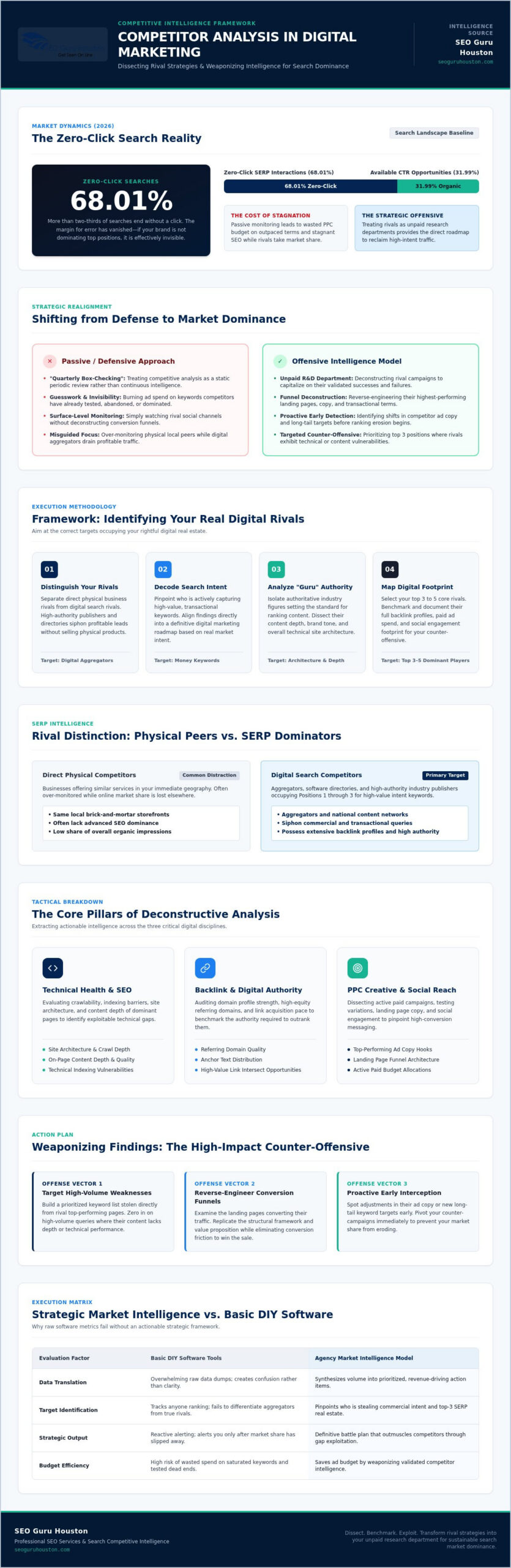
Stop treating your rivals as obstacles and start viewing them as unpaid research departments for your growth. You know the frustration of watching an aggressive competitor snatch away a lead that should have been yours while your own efforts at competitor analysis in digital marketing remain a secondary thought. It feels like you’re burning budget on strategies that have already been outpaced by the market. With zero-click searches reaching 68.01% in 2026, the margin for error has completely vanished. If you aren’t visible, you simply don’t exist.
To survive and scale, you need a strategic offensive. I’m going to give you the exact framework to dissect your rivals’ strategies and weaponize that intelligence to capture their market share. You’re here because you’re tired of being invisible and ready to take what’s yours. This guide is your map to moving from the sidelines to the center of the search results.
We’ll identify the specific gaps in their digital armor, build a prioritized list of keywords to steal from their top-performing pages, and lay out a definitive plan for market dominance. It’s time to stop guessing and start winning.
Key Takeaways
- Shift from defensive “relevance” to offensive market dominance by treating rival strategies as a blueprint for your own growth.
- Separate your physical business rivals from the digital search competitors who are actively siphoning your high-value traffic.
- Execute a comprehensive competitor analysis in digital marketing by dissecting SEO technical health, backlink authority, and top-performing PPC creative.
- Create a high-impact counter-offensive by targeting high-volume keywords where your rivals are weak and reverse-engineering their best landing pages.
- Understand why a professional agency approach to market intelligence outmuscles basic DIY software to deliver a definitive battle plan for scaling.
Why Competitor Analysis in Digital Marketing is Your Survival Blueprint
In a digital landscape where nearly 68% of searches end without a single click, standing still is the same as retreating. Competitor analysis in digital marketing isn’t a passive research project or a quarterly box to check. It’s the systematic process of deconstructing your rivals’ strategies to identify exploitable gaps in their armor. If you’re merely trying to “stay relevant,” you’ve already lost the war. Real growth requires a relentless pursuit of market dominance, turning your competitors’ successes and failures into your own strategic advantage.
The cost of operating in the dark is staggering. Ignorance leads to thousands of dollars in wasted PPC spend on keywords your rivals have already optimized; it leaves your SEO rankings stagnant while others leapfrog your position. Digital competitive intelligence is the high-octane fuel for aggressive business growth.
The Shift from Invisibility to Prominence
Most businesses are blind to the “invisible” barriers keeping them from the top of the search results. You might be working hard, but if you aren’t analyzing your rivals, you’re guessing. There’s a massive difference between “monitoring” a competitor’s social media and performing a strategic deconstruction of their entire conversion funnel. By using a structured competitor analysis framework, you remove the guesswork from your marketing budget. Data tells you exactly where the market is moving, allowing you to pivot before your visibility drops. It’s about transforming from an invisible player into a dominant market force.
The ROI of Knowing Your Rival’s Next Move
Early detection is your best defense against market disruption. When you spot a competitor shifting their ad copy or targeting new long-tail keywords, you can adjust your own strategy to counter them immediately. This proactive approach saves thousands in ad spend that would otherwise be burned on outdated tactics. To truly scale traffic and capture market share, you need to integrate these insights into professional seo services that prioritize measurable progress. Knowing their next move doesn’t just protect your current position; it gives you the blueprint to dismantle theirs. Don’t wait for your market share to erode before you decide to act.
Identifying Your Real Digital Rivals: A Step-by-Step Framework
You cannot win a battle if you’re aiming at the wrong target. Most businesses waste valuable resources watching the competitor down the street while a global aggregator or a high-authority blog siphons off their most profitable leads. Effective competitor analysis in digital marketing demands that you look beyond the obvious. You must identify who is actually occupying the digital real estate you deserve.
- Step 1: Distinguish your rivals. Separate your direct business competitors from “search competitors.” A search competitor might be a publisher or a directory that steals your traffic but doesn’t sell your product.
- Step 2: Decode search intent. Identify who is winning the high-value, transactional keywords. Integrating these findings into a digital marketing plan framework ensures your strategy is built on market reality rather than assumptions.
- Step 3: Analyze the “Guru” players. Every niche has authority figures who set the standard for content. Find them. Study their depth, their tone, and their technical site structure.
- Step 4: Map the digital footprint. Select your top 3-5 rivals and document their backlink profiles, ad spend, and social engagement. This creates the baseline for your counter-offensive.
If you’re feeling overwhelmed by the sheer volume of data, partnering with strategic marketing experts can help you cut through the noise and focus on the metrics that drive revenue.
Direct vs. Indirect Competitors
A blog or a software directory is often a bigger search rival than your local peer. Aggregator sites dominate the SERPs because they have massive authority. You must prioritize tracking rivals who overlap with your most profitable “money” keywords. Don’t waste time on every small player; focus on the ones currently sitting in the top three positions for your target terms. Strategic deconstruction of these giants reveals the content depth required to compete.
Keyword Gap Analysis: Finding the Low-Hanging Fruit
Keyword gaps represent the specific terms your competitors rank for while you remain invisible. You need to hunt for “missed opportunities” in the mid-funnel stage where potential customers are actively comparing solutions. Once you identify these gaps, simply ranking isn’t enough. You must deploy high converting landing page design to capture that stolen traffic and turn it into a measurable return. This is how you weaponize competitor analysis in digital marketing to reclaim your market share and dominate your niche.
The Core Pillars: Analyzing SEO, PPC, and Social Authority
Winning the digital marketing war isn’t about excelling in a single channel. It’s about dominating the intersection. If you only look at keyword rankings, you’re missing the full picture of how your rivals capture and convert your potential leads. A high-impact competitor analysis in digital marketing requires a deep dive into three core pillars: SEO, PPC, and social authority. This isn’t just about collecting data. It’s about understanding the unified front your rivals use to push you out of the SERPs and dismantle their advantage piece by piece.
You must look beyond the surface level. A competitor might rank for a target term, but is their technical site health actually superior to yours? Do they have a backlink profile built on high-authority domains, or are they leaning on low-quality redirects? Answering these questions allows you to stop guessing and start building a strategy based on measurable market reality. Digital dominance is reserved for those who deconstruct the “why” behind their rivals’ visibility.
Deconstructing the Competitor SEO Strategy
Stop obsessing over individual rankings. Start auditing site architecture. A rival’s internal linking strategy often reveals exactly which pages they consider their primary revenue drivers. You need to identify their “content clusters,” which are groups of interlinked articles that establish topical authority in the eyes of search engines. Spotting “thin content” weaknesses in a rival’s blog is your fastest path to victory. If their posts are shallow or outdated, you can exploit that gap by producing comprehensive, authoritative content that provides more value to the user. By analyzing their technical foundations, you can build a site that search engines trust more than theirs.
PPC Intelligence: Stop Bleeding Your Budget
Why waste your own capital on trial-and-error testing when your competitors have already paid for the data? Use intelligence tools to identify the “proven winners”-keywords they have consistently bid on for over 12 months. If they’re still paying for that traffic, those terms are converting. Analyze their ad extensions and call-to-action (CTA) phrasing to see what triggers a click-through. You can stop the budget bleed by leveraging ppc management to execute a battle-tested strategy that targets their most profitable biddable terms. This proactive approach ensures you’re only spending on what works.
Reviewing the Tech Stack and Social Authority
Social authority isn’t about follower counts. It’s about engagement and trust. Evaluate where your rivals are building the most meaningful connections with their audience. Are they using video marketing to humanize their brand? Simultaneously, you must review their tech stack. If your rivals are using AI-driven automation for real-time bidding or content personalization, they are moving at a speed you can’t match with manual processes. Identifying their software advantages allows you to modernize your own toolkit and close the efficiency gap. Staying ahead of digital trends is a fundamental necessity for survival.
Turning Intelligence into Action: Weaponizing Your Findings
Data without a battle plan is just noise. You have identified the gaps and mapped the digital footprint, but now you must execute with precision. Most guides on competitor analysis in digital marketing suggest “adjusting your plan,” which is far too passive for a business hungry for growth. You need a counter-offensive that targets high-volume keywords where your rivals are weak. If they’re ranking with thin content or outdated data, that traffic is rightfully yours for the taking. It’s time to stop observing and start capturing.
Reverse-engineer their best-performing landing pages to see why they convert. Look at their hook, their social proof, and their offer structure. Don’t just copy them; improve upon them. If they ignore a specific customer pain point in their messaging, make that gap your primary headline. By setting up real-time alerts, you can react instantly when a competitor launches a new campaign or runs out of ad budget. This level of agility transforms raw intelligence into a weapon for market dominance.
The Content Takeover Strategy
Producing “good” content is a waste of time. You need to create “Skyscraper” content that is 10x better than the current top result. This means adding video, interactive tools, and proprietary data where your competitors only have static text. For those in the industrial or professional sectors, a robust inbound marketing strategy for b2b is essential for this takeover. It allows you to build a moat around your authority that rivals cannot easily cross. If you want to dominate, you must provide the definitive resource for your niche.
Agile Marketing: Reacting to Rival Shifts
Speed is your greatest competitive advantage in the 2026 digital landscape. If a rival runs out of inventory or hits their monthly ad budget early, you should be ready to pivot your PPC spend and capture that orphaned demand. Maintain an assertive stance. Even when rivals attempt to copy your moves, your speed and technical depth will keep you steps ahead. This isn’t about being reactive; it’s about being strategically opportunistic. Ready to turn your rival’s data into your revenue? Claim your strategic advantage today and start your market capture.
Partner with a Guru: Scaling Your Growth Through Market Intelligence
Software subscriptions are easy to buy. Strategic insight is hard to earn. Many businesses fall into the trap of analysis paralysis because they have a mountain of data but no idea how to climb it. While DIY tools provide spreadsheets, they don’t provide the killer instinct required for market capture. Effective competitor analysis in digital marketing is only as valuable as the execution that follows. You need more than a dashboard; you need a veteran who understands how to turn technical metrics into financial returns.
SEO Guru Houston doesn’t just hand you a report. We provide a battle plan. We treat your business growth as a fundamental necessity, not an optional luxury. Our specialized B2B and industrial expertise gives you an unfair advantage over rivals who are still trying to figure out their own tech stacks. We identify the nuances they miss and exploit the vulnerabilities they haven’t even noticed yet. This is the difference between surviving the market and owning it.
Beyond the Data: Strategic Execution
Strategic execution is where most digital plans fail. We transform basic research into a high-performance b2b demand generation agency powerhouse. Having a dedicated strategist means your digital landscape is monitored around the clock. When a rival pivots, we’re already there to counter. Stop guessing with your marketing budget and start dominating with a professional audit that maps your path to prominence. It’s time to let the experts handle the heavy lifting of technical analysis while you focus on scaling your operations.
The SEO Guru Houston Guarantee of Transformation
The journey from invisibility to total prominence requires a high-performance coach. We bring the technical mastery and savvy business strategy needed to stay ahead of rapidly changing trends. We are committed to the success of our partners, providing the reliability of a seasoned veteran with a track record of measurable progress. Don’t settle for “affordable” services that deliver low-impact results. Take decisive action to secure your market share. Schedule your assertive market analysis today!
Claim Your Market Dominance Today
The digital landscape doesn’t reward those who wait. It rewards those who act with precision. You now have the framework to transform from an invisible player into a dominant market force. By identifying your real search rivals and deconstructing their SEO and PPC strategies, you’ve moved past simple monitoring into strategic warfare. Competitor analysis in digital marketing is no longer an optional research project; it is the fuel for your business survival. Success requires more than just data; it requires a killer instinct for market capture.
You’ve seen how to turn intelligence into a counter-offensive and how specialized B2B demand generation strategies build an unshakeable moat around your authority. Don’t let your rivals continue to optimize while you guess. It’s time to leverage results-oriented SEO and PPC expertise to reclaim your traffic and scale your ROI. Your ambition deserves a partner who treats market prominence as a fundamental necessity. Stop losing market share-get your professional competitor analysis now!
The window for market capture is open. Take the first step toward a total digital transformation and leave your rivals in the rearview. Your journey from invisibility to prominence starts with a single, assertive choice. We are ready to help you execute.
Frequently Asked Questions
What is the most important metric to track in digital competitor analysis?
Share of Voice (SOV) is the most critical metric because it represents your total market visibility relative to your rivals. While rankings are important, SOV tells you who is actually capturing the audience’s attention across SEO and PPC channels. Tracking this allows you to see if your competitor analysis in digital marketing is actually translating into market dominance. You must also monitor estimated traffic value to ensure you’re fighting for high-conversion terms rather than vanity metrics.
How often should I perform a competitor analysis in digital marketing?
You should perform a comprehensive competitor analysis in digital marketing at least once per quarter, but real-time monitoring is a fundamental necessity for survival. The digital landscape shifts too fast for annual reviews to be effective. Setting up automated alerts for rival ad spend changes or new content launches allows you to react within hours. This high-frequency approach ensures your strategy remains proactive rather than reactive, protecting your market share from aggressive newcomers.
Can I do competitor analysis without expensive software?
You can perform basic analysis using free resources like the Google Ads Transparency Center and manual SERP audits, but you’ll sacrifice precision and speed. Manual checks don’t reveal historical bidding data or hidden technical site health issues. Professional software is the standard because it automates the heavy lifting. If you want to scale without the high cost of multiple tool subscriptions, partnering with a specialized agency provides you with enterprise-tier intelligence without the overhead.
What is the difference between a direct and an indirect digital competitor?
A direct competitor sells the exact same product or service to your target audience. An indirect digital rival might sell something different but competes for the same search intent and user attention. For example, a blog or a directory site is an indirect rival that can steal your traffic even if they don’t sell your product. You must track both categories to ensure you aren’t losing visibility to high-authority publishers who dominate the top results.
How do I know which keywords my competitors are bidding on in PPC?
You can identify a rival’s biddable keywords by using specialized PPC intelligence tools that track auction data over time. The Google Ads Transparency Center also allows you to view active ad creatives and formats for any verified advertiser. By analyzing which terms they have bid on consistently for over 12 months, you can identify their most profitable winners. This prevents you from wasting your own budget on experimental keywords that don’t convert.
What should I do if a competitor is copying my digital strategy?
If a rival is copying your moves, you must accelerate your innovation cycle to stay ahead. Imitation is a sign that your strategy is working, but you can’t afford to be stagnant. Lean into your unique brand authority and proprietary data that they cannot replicate. Enhance your content with video and interactive elements that are harder to copy. This assertive stance ensures that even if they follow your lead, they are always one step behind.
Does competitor analysis help with my organic search engine optimization?
Competitor analysis is the foundation of a successful organic search strategy. It reveals the specific content gaps and technical weaknesses you can exploit to leapfrog their rankings. By identifying which topics drive their most valuable backlinks, you can build a more authoritative link-building plan. This process removes the guesswork from your SEO efforts, ensuring every piece of content you produce is designed to capture market share from a specific rival.
How do I find a competitor’s backlink profile?
You find a competitor’s backlink profile by using link auditing tools that crawl the web to map domain relationships. These tools show you every site linking to your rival, the authority of those domains, and the specific anchor text used. Analyzing this data allows you to identify high-value outreach opportunities for your own site. It also reveals if their authority is built on high-quality editorial links or easily replicable low-quality directories.

