Category Archives: Uncategorized

Industrial Digital Marketing: 2026 Growth Guide

Industrial buyers can rule out your company before your sales team knows they were looking. That’s why digital marketing for industrial companies must do more than attract traffic. It needs to make complex products easier to understand, build confidence across a buying committee, and turn research into sales-ready opportunities.

Long buying cycles and multiple decision-makers make that challenging. A website visit or form fill rarely tells the whole story, and marketing activity can look busy without moving qualified prospects forward. A focused strategy connects the dots, helping technical buyers find useful answers, evaluate your capabilities, and take the next step.

This guide shows you how to build that strategy for 2026. You’ll learn how to match channels to buyer needs and your team’s resources, connect search visibility and paid campaigns with conversion-focused pages, and use inbound marketing and demand generation to support lead progression. You’ll also see which pipeline and revenue indicators can reveal whether your efforts are creating meaningful business opportunities.

Key Takeaways

  • Digital marketing for industrial companies works best when it supports buyers from early research through supplier comparison and sales engagement.
  • Match each buying stage with useful content, credible proof, and a clear next step for technical buyers.
  • Choose SEO, PPC, content, email, social media, and website improvements according to their role in your strategy, not a one-size-fits-all channel mix.
  • Build a practical plan by defining business outcomes, researching buyers, auditing existing assets, and prioritizing the next steps.
  • Track leading indicators alongside pipeline and revenue outcomes so activity is not mistaken for business impact.

Why Digital Marketing for Industrial Companies Must Reach Buyers Before Sales Conversations

Industrial digital marketing is the coordinated use of online channels and content to help potential buyers discover a supplier, evaluate its capabilities, and progress toward a sales conversation. It connects a company’s website, search visibility, paid campaigns, and useful information to the questions buyers need answered at each stage. The approach builds on industrial marketing, where organizations select products and services to meet business needs rather than individual preferences.

That distinction matters. A straightforward purchase may be judged on convenience and price; an industrial purchase can require scrutiny of technical fit, operating requirements, procurement criteria, and business impact. The process varies by company, product, and buying group. A digital strategy should serve different buyer needs rather than assume every prospect follows the same path.

How industrial buyers research suppliers before contacting sales

Independent online research is one part of a broader supplier-evaluation process. Buyers may use websites and search results to identify potential suppliers, clarify specifications, compare capabilities, and prepare questions. Their research can continue alongside internal discussions, referrals, sales conversations, and practical assessments. A company’s website may be an early checkpoint, but it isn’t the entire decision.

Different stakeholders look for different evidence. For example:

  • Engineers may need specifications, operating details, compatibility information, or application examples.
  • Procurement teams may look for clear capabilities, product ranges, and information that helps compare suppliers.
  • Operations leaders may want to understand how a solution fits existing processes and business requirements.
  • Executives may focus on strategic fit, risk, and the rationale for moving forward.

Useful content makes these questions easier to investigate before a prospect is ready to speak with sales. It also gives sales teams a stronger starting point: conversations can build on shared information instead of beginning with basic explanations.

Why technical companies need more than a brochure website

A brochure-style website can introduce a company, but technical buyers often need more substance to assess whether its products or capabilities fit their requirements. Clear product descriptions, application details, capability information, and answers to common technical questions give visitors something concrete to evaluate. Keep terminology accurate, explain specialized terms where needed, and organize information so different stakeholders can find what matters to them.

Clarity supports credibility, but it doesn’t guarantee visibility, leads, or a sale. An informative site is also only one part of the system. A connected demand-generation strategy aligns useful content with channels that help buyers discover it, provides relevant next steps, and gives the sales team context for follow-up. That’s the difference between publishing information and supporting buyer progression. For digital marketing for industrial companies, the goal is not simply to appear online. It’s to make each digital touchpoint useful before, during, and after the first sales conversation.

Map the Industrial Buying Journey to Digital Touchpoints and Content

Industrial buyers don’t move from search to purchase in a straight line. A technical evaluator may investigate specifications while procurement compares suppliers and an operations leader weighs implementation needs. Map digital touchpoints to the questions buyers are asking, then give each one a useful next step. This turns digital marketing for industrial companies into a practical journey rather than a collection of disconnected posts and pages.

What industrial buyers need at each decision stage

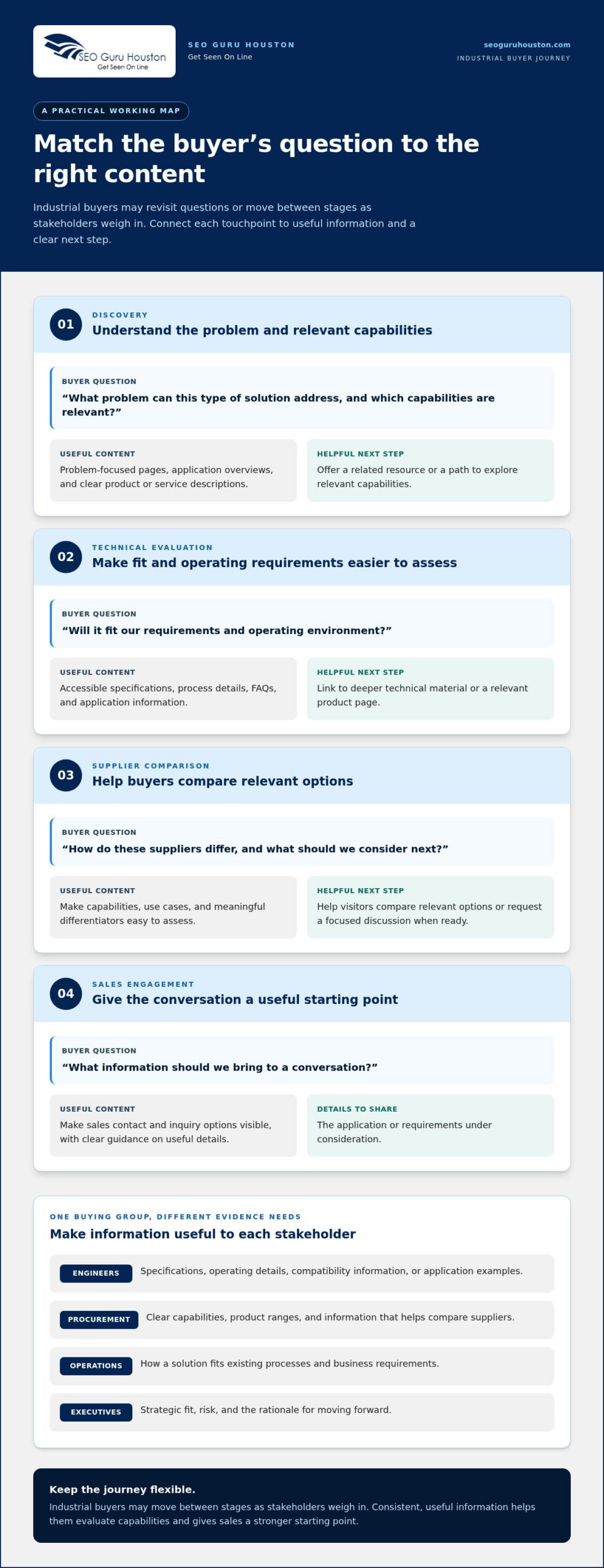
Use four stages as a working map, not a rigid funnel. People may revisit earlier questions or move between stages as stakeholders weigh in. For each stage, connect the buyer’s concern to relevant information, credible proof, and an appropriate next action:

  • Discovery: “What problem can this type of solution address, and which capabilities are relevant?” Publish problem-focused pages, application overviews, and clear service or product descriptions. Offer a related resource or a path to explore relevant capabilities.
  • Technical evaluation: “Will it fit our requirements and operating environment?” Organize specifications, process details, FAQs, and application information in accessible language. Link to deeper technical material or a relevant product page.
  • Supplier comparison: “How do these suppliers differ, and what should we consider next?” Make capabilities, use cases, and meaningful differentiators easy to assess. Help visitors compare relevant options or request a focused discussion when they’re ready.
  • Sales engagement: “What information should we bring to a conversation?” Make sales contact and inquiry options visible, with clear guidance about what details will help the discussion, such as the application or requirements under consideration.

These stages need consistent information. If a product page describes a capability one way and a downloadable resource describes it another, buyers have to resolve the mismatch themselves. Keep claims, terminology, and supporting details aligned across pages and materials.

How to support a multi-person buying committee

Stakeholder roles vary by sale, so use them as prompts for content planning, not as a checklist every deal must follow. Engineers may need technical detail; procurement may need supplier and product information; operations may focus on fit with existing processes; executives may need a concise view of business relevance. One well-structured page can serve several readers when it offers a clear overview alongside links to deeper detail.

Make the handoff between marketing and sales a two-way process. Sales can share recurring questions, objections, and the information prospects request before a conversation. Marketing can use those patterns to update pages and resources. If opportunities stall at technical review, identify which question remains unanswered, then improve the relevant content and give sales a useful follow-up resource.

Connected B2B demand generation can coordinate useful touchpoints across the journey, while B2B inbound marketing helps organize content around buyer needs. When pages and follow-up feel disconnected, coordinated B2B marketing and demand generation can bring those pieces into a clearer plan.

Choose Digital Marketing Channels for Industrial Companies by Their Job

More channels don’t automatically mean more qualified opportunities. Each should solve a buyer need and support a business goal, whether that’s being found during research, explaining a technical application, or helping an interested prospect take a next step. Choose a channel mix by matching buyer behavior and sales goals with your team’s expertise and current channel performance.

When SEO, PPC, and content support different buyer needs

SEO helps relevant pages appear for searches buyers use to research problems, applications, and suppliers. PPC can put selected offers in front of chosen searchers or audiences while campaigns are active. Technical content gives both channels something valuable to lead to: clear explanations of applications, capabilities, and considerations that help prospects evaluate options. Connect activity to meaningful outcomes, not clicks alone.

Channel Primary job and timing Useful measures
SEO Support discovery through relevant searches and useful answers over time. Relevant organic visits, inquiry quality, and assisted pipeline.
PPC Reach selected searches or audiences while campaigns run. Qualified conversions, cost per qualified opportunity, and pipeline contribution.
Technical content Explain applications and answer evaluation questions across the journey. Engagement with key resources, influenced opportunities, and recurring sales questions addressed.
Website improvements Make product and capability information easier to find and act on. Visits to priority pages, relevant actions, and conversion-path completion.
Email Share relevant information and sustain engagement with opted-in audiences. Meaningful clicks, replies, and progression of engaged opportunities.
Social media Distribute useful content and maintain visibility with relevant audiences. Engagement from target audiences, referral visits, and assisted conversions.

How websites, landing pages, email, and social media connect

Your website is the central destination for product and capability information. Use focused landing pages to connect a specific campaign or audience with a clear action, such as exploring an application or submitting an inquiry. Email can deliver related material to people who want to keep learning; social media can extend the reach of that material and bring interested readers back to relevant pages. Keep claims consistent at every step.

Don’t select channels by habit. Review what buyers search for, which questions sales hears repeatedly, where current opportunities originate, and what your team can produce and maintain well. Then test a focused combination and assess whether it reaches the right audience and contributes to qualified pipeline. A channel that earns attention but attracts poor-fit inquiries may need a sharper audience, message, or destination.

For digital marketing for industrial companies, the strongest mix depends on the business, buying process, and available resources. Coordinating SEO, PPC, content, website development, and demand generation can connect discovery with follow-up instead of leaving each channel to operate alone. Learn how B2B marketing and demand generation can be coordinated around those goals.
Industrial Digital Marketing: 2026 Growth Guide

Build an Industrial Digital Marketing Plan You Can Measure and Improve

A useful plan connects marketing activity to sales progress, then uses feedback to improve the next decision. Keep the process focused: choose a business outcome, understand buyer needs, assess what you already have, and invest in the channels your team can support. That’s a stronger starting point than launching campaigns simply because a channel is popular.

Set goals and measurement around sales progress

Build the plan in sequence. Each step should inform the next, so channel choices and performance reviews stay tied to real buyer needs.

  1. Define outcomes. Choose a goal such as improving visibility for priority searches, increasing engagement with technical resources, generating qualified inquiries, or advancing opportunities through the pipeline.
  2. Research buyers. Review the questions prospects ask, the capabilities they evaluate, and the information sales needs to move discussions forward.
  3. Audit assets. Check whether website pages, landing pages, content, and analytics support those needs. Note gaps, outdated information, and unclear conversion paths.
  4. Prioritize channels. Select a manageable set of channels that match buyer behavior, business goals, available expertise, and current performance.
  5. Review and adjust. Compare activity with sales feedback, identify bottlenecks, and decide what to improve before expanding the plan.

Separate leading indicators from business outcomes. Search visibility, relevant page visits, resource engagement, and inquiry volume can show whether marketing is reaching and engaging an audience. They don’t prove revenue. Track qualified inquiries, accepted opportunities, pipeline progression, and closed business as outcomes, using consistent definitions for each. Reliable analytics and clear campaign tracking help connect visits and conversions to the pages and channels that contributed.

Marketing and sales should agree on what makes an inquiry qualified, who owns follow-up, and how often they’ll review feedback. If form submissions rise but sales reports poor fit, investigate targeting, page messaging, and qualification questions before treating the volume as progress.

Prioritize a realistic first phase and improve it

Start with a focused buyer need and the channels best placed to address it. Assign clear owners for content accuracy, campaign management, website updates, and reporting. A high-converting landing page design blueprint can help teams plan the connection between a campaign’s message and its destination.

Set a regular review cadence that fits your sales cycle. Look for drop-offs between stages, unanswered buyer questions, and differences between raw inquiries and sales-accepted opportunities. Then make a specific adjustment, such as improving a page, refining campaign targeting, or creating content to address a recurring objection. Measure the effect before adding more activity.

To connect channel activity with sales progress, build a measurable industrial marketing plan with coordinated SEO, PPC, B2B marketing, demand generation, and website work.

Turn Industrial Digital Marketing Into a Connected Growth Program

Growth comes from connecting the steps, not simply adding more marketing activity. Start with buyer insight: identify the questions technical and business stakeholders ask, the evidence they need, and the points where opportunities tend to stall. Then select channels, create useful content, provide a relevant next action, and measure whether those efforts support sales progress. That sequence keeps digital marketing for industrial companies anchored to buyer needs and business priorities.

Coordination matters when separate efforts create gaps. SEO may bring a prospect to a technical page, while a PPC campaign sends another audience to a landing page. If those pages use different claims, offer no clear next step, or fail to connect with follow-up, each activity works in isolation. Align the message, destination, conversion action, and sales handoff so buyers encounter a coherent experience.

What coordinated digital execution can include

SEO and content can work together to make useful answers easier to find for relevant searches. PPC can direct selected audiences to focused landing pages with a clearly defined action, such as requesting information or exploring an application. Website development supports the destination with clear, organized product and capability information. Each element has a distinct job, but the experience should feel connected.

Inbound marketing and demand generation can organize these touchpoints around discovery and lead progression, while B2B marketing helps align messaging with business buyers. Marketing and sales can share recurring questions, qualification feedback, and follow-up context so content and campaigns respond to real conversations. SEO Guru Houston provides SEO, PPC, B2B marketing, inbound marketing, demand generation, and website and landing-page development. The right combination depends on your goals and existing gaps, not a promise of a particular result.

Choose next steps based on your current growth bottleneck

Don’t try to overhaul every channel at once. Find the break in the buyer journey, then focus the next phase there:

  • If discovery is weak, review search visibility and whether key pages clearly address buyer questions and relevant capabilities.
  • If traffic doesn’t convert, assess page clarity, the relevance of the information, and whether calls to action offer a logical next step.
  • If leads don’t progress, examine qualification criteria, follow-up ownership, and the feedback loop between marketing and sales.

Use the bottleneck to guide a focused plan. For example, a landing page receiving relevant visits but few inquiries may need a clearer value proposition or simpler conversion path. If inquiries arrive but stall, improving follow-up context may matter more than expanding campaign reach. Review the change against agreed measures, learn from sales feedback, and then decide what to improve next.

SEO Guru Houston brings search, paid campaigns, B2B and inbound marketing, demand generation, and website work together as parts of a digital growth strategy. A focused strategy discussion can help identify the right next step for your business. Explore digital marketing strategy options.

Make Your Next Marketing Move Count

The next step doesn’t need to be a full-scale overhaul. Choose one growth bottleneck, decide what progress would look like, and focus your team on a change you can assess. That discipline keeps digital marketing for industrial companies grounded in business priorities, while giving you a clearer basis for deciding what to improve or expand next.

Execution can be easier to coordinate when strategy and delivery connect. SEO, PPC, and B2B marketing can support discovery and audience reach; inbound marketing and demand generation can help organize engagement and lead progression. Website development and landing-page design can align the destination with the campaign. The right mix depends on your objectives and where buyers need a stronger experience.

SEO Guru Houston brings these capabilities together to help businesses plan connected digital marketing activity. Start a focused conversation about your goals, current challenges, and practical next move. Discuss a digital marketing strategy and take a confident step toward building a more connected growth program.

Frequently Asked Questions

How long does SEO take to produce results for an industrial company?

SEO timing depends on your site’s condition, search competition, content depth, and how quickly improvements are implemented, so there’s no reliable fixed ranking date. For digital marketing for industrial companies, review early signals such as whether important pages can be crawled, relevant search impressions, and qualified organic visits. Then assess whether those visits lead to useful inquiries and sales conversations. A technical page may begin earning relevant impressions before it contributes to a sales opportunity.

Can a small industrial company compete with larger manufacturers online?

Yes. A smaller company can focus its online presence on the applications and customer needs where its capabilities are most relevant. For example, a supplier might create a detailed page for a specific use case instead of trying to cover every product category. Specific educational content and focused search campaigns can help buyers assess that fit. Visibility and lead volume still depend on competition, buyer demand, and execution, not company size alone.

How can industrial companies reach several decision-makers in one buying committee?

Start with the roles that actually appear in your sales conversations, then document the questions each one raises. An engineer may request compatibility details, while a procurement contact may need product or supplier information. Create shareable resources for those distinct concerns, and keep claims consistent across pages and sales materials. After conversations, ask sales which resource helped and what questions remained. Use that feedback to refine content instead of relying on assumed stakeholder needs.

Is digital marketing useful for industrial distributors as well as manufacturers?

Yes. Distributors can use digital marketing to make relevant catalog, product, and service information easier for buyers to find and understand. The strategy should reflect the distributor’s role in the purchase, including the product range it carries, the customers it serves, and how prospects move from research to inquiry. A manufacturer’s content plan may not fit as-is. Adapt topics and calls to action to the distributor’s own sales process and buyer questions.

What should an industrial company do if digital campaigns generate leads that are not sales-ready?

Review lead fit before increasing campaign volume. Compare the audience and campaign message with the inquiries sales considers useful, then look for patterns such as requests outside your capabilities or confusion about what the offer includes. Adjust targeting, page copy, or form questions to set clearer expectations. Agree with sales on what counts as a qualified inquiry, and report that measure alongside total submissions so campaign decisions reflect opportunity quality.

Does industrial digital marketing require publishing content every week?

No. A steady publishing schedule matters less than having accurate, useful content for important buyer questions and keeping it current. Start by identifying the pages prospects rely on during research, such as product details, application guidance, or technical FAQs. Update them when product information or customer questions change. Add new resources at a pace your team can sustain, and make sure each one has a clear purpose and a way to reach its intended audience.
Common B2B Marketing Mistakes to Avoid: A 2026 Checklist

What if the biggest B2B marketing mistake isn’t a weak campaign, but a system that never connects buyer interest to revenue? Traffic can rise while pipeline stays flat, content can miss the questions decision-makers need answered, and sales can reject leads marketing celebrates. The common b2b marketing mistakes to avoid often stem from these connected breakdowns, not one isolated tactic.

If your team is generating activity without a clear view of its pipeline contribution, it’s worth examining what’s working and where prospects are dropping off. More channels, content, or technology won’t fix a strategy without a defined audience, relevant buyer-stage messaging, and shared standards for success.

This practical 2026 checklist will help you identify high-impact gaps across strategy, channels, measurement, and sales handoffs, then prioritize fixes using buyer behavior and pipeline evidence. You’ll also see how coordinated SEO, PPC, demand generation, and conversion-focused web work can support a more connected approach.

Key Takeaways

  • Trace marketing activity back to qualified pipeline to find where strategy and business outcomes diverge.
  • Map content and messaging to buyer questions, decision stages, and the needs of different stakeholders.
  • Assess whether channels and landing pages work together to attract, convert, and measure the right buyers.
  • Use the common b2b marketing mistakes to avoid checklist to prioritize fixes based on search intent, lead quality, and pipeline evidence.
  • Align lead definitions and handoffs between marketing and sales, then decide which gaps your team can address internally.

Common B2B Marketing Mistakes to Avoid Start with Misaligned Goals

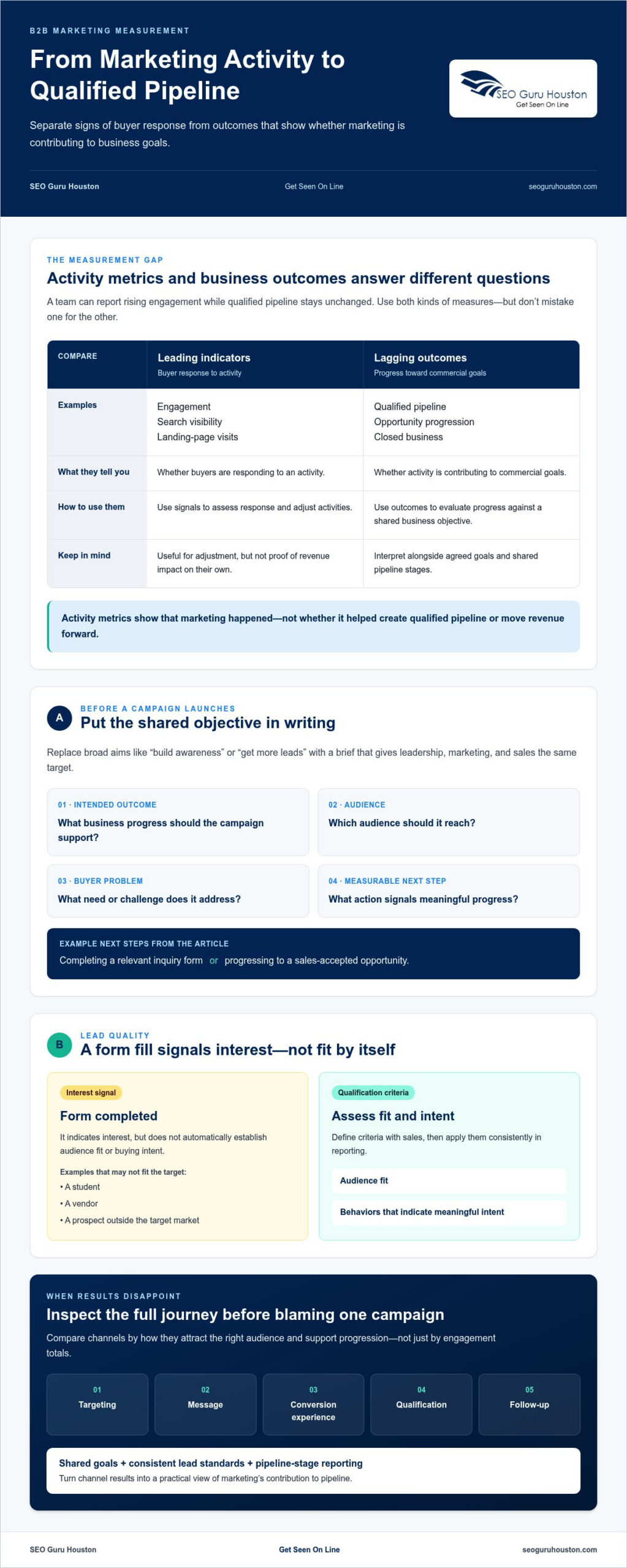
A marketing team can launch campaigns, publish content, and report rising engagement while qualified pipeline remains unchanged. That tension is a warning: activity and business progress aren’t the same thing. A B2B marketing mistake is a recurring gap between what buyers need, what a team does, and the business outcome that work is meant to support.

That gap often starts with goals. If leadership expects sales opportunities, marketing is measured on website visits, and sales judges success by accepted leads, each team can appear productive while pulling in a different direction. A shared understanding of Business-to-business (B2B) marketing keeps attention on the organizations and decision-makers involved, but the strategy still needs an agreed business objective.

Separate leading indicators from lagging outcomes. Engagement, search visibility, and landing-page visits can show whether buyers are responding to an activity. Qualified pipeline, opportunity progression, and closed business show whether that activity is contributing to commercial goals. Leading indicators help teams adjust, but they don’t prove revenue impact on their own.

Activity metrics show that marketing happened, not whether it helped create qualified pipeline or move revenue forward.

Mistake: Running campaigns without a documented business objective

“Build awareness” or “get more leads” sounds like a goal, but neither tells a team which audience to reach, what buyer need to address, or what action should follow. Before launching, document the intended outcome, audience, problem the campaign addresses, and measurable next step, such as completing a relevant inquiry form or progressing to a sales-accepted opportunity.

Then align leadership, marketing, and sales around the same outcome and definition. For example, a campaign designed to reach operations leaders evaluating a specific business challenge shouldn’t be judged only by clicks if its objective is to generate qualified conversations. A written brief gives channel teams a shared target and a basis for evaluating tradeoffs.

Mistake: Treating every lead and metric as equally valuable

A form fill signals interest, but it doesn’t automatically prove fit or buying intent. A student, a vendor, or a prospect outside the target market may complete the same form as a decision-maker with a relevant need. Define qualification criteria with sales, including audience fit and behaviors that indicate meaningful intent, then apply those criteria consistently in reporting.

Channel reports can still reveal useful differences, but connect them to shared pipeline stages. Compare search, paid campaigns, social activity, and landing-page actions by how they attract the right audience and support progression, not just by their engagement totals. If results disappoint, inspect the full journey: targeting, message, conversion experience, qualification, and follow-up. Don’t blame a single campaign before checking where buyer interest is being lost.

These are the first common b2b marketing mistakes to avoid because they shape every decision that follows. Clear objectives and shared measures turn reporting from a collection of channel wins into a practical view of marketing’s contribution to pipeline.

B2B Marketing Mistakes That Miss the Buyer’s Journey

B2B buyers don’t move from first exposure to purchase in a straight line, and one message rarely answers every question along the way. A buyer may first recognize a costly problem, explore possible approaches, compare vendors, and build internal agreement. Map those stages to real buyer questions. The modern B2B buying journey is a useful reference for understanding how research and evaluation shape a decision.

That journey also involves different stakeholders. A department leader may care about business impact, while a technical evaluator needs implementation details and security information. Finance may focus on cost and risk. Messaging aimed only at a broad audience can leave each person without the evidence needed to support a purchase.

Buyer-journey alignment means giving the right stakeholders useful answers and a clear next step at each stage, so interest can progress toward a qualified opportunity.

Mistake: Publishing content that does not help buyers decide

Thought leadership can introduce a problem or offer a point of view, but it may not resolve the practical questions buyers face before choosing a solution. Decision-support content should help prospects compare criteria, understand implementation demands, assess risks, and explain the business case to colleagues. A content audit can show whether your materials educate buyers only at the awareness stage or support evaluation too.

Build content around unresolved buyer questions, then give readers a relevant next step, such as exploring an approach in more depth or discussing their needs. A B2B inbound marketing guide can help frame how useful content attracts and supports prospects throughout their research.

Mistake: Sending every audience and campaign to the same experience

A click creates momentum only if the destination matches the promise that earned it. If an ad speaks to a specific problem but lands on a generic page, visitors have to work to connect the message to their needs. The same friction occurs when a high-intent searcher sees a broad introduction instead of clear service information, relevant proof, and an appropriate action.

Match each landing page to the audience’s intent, campaign message, and readiness. A visitor researching a challenge may need an informative resource; someone comparing solutions may need clear differentiators and a path to start a conversation. The landing-page design blueprint offers a useful framework for creating a focused experience.

SEO, paid media, and website conversion should reinforce one another. Search visibility can bring buyers to relevant information, paid campaigns can address defined needs, and tailored pages can make the next step clear. Review the search query, ad or content promise, landing-page behavior, and resulting lead quality as one sequence. This helps identify whether the problem is reach, relevance, or conversion before changing channels.

These common b2b marketing mistakes to avoid are easier to correct when teams plan around buyer questions instead of publishing and promoting in separate silos. Integrated B2B digital marketing support can connect search, campaigns, and conversion-focused web experiences within a more coherent strategy.

How Disconnected B2B Channels and Sales Handoffs Weaken Pipeline

A buyer rarely experiences your marketing as separate channel reports. They see a search result, an ad, a piece of content, a landing page, and eventually a conversation with sales. If those touchpoints target different audiences, make conflicting promises, or ask for an ill-timed action, interest can stall before it becomes pipeline.

Integration doesn’t mean every channel does the same job. SEO can help buyers discover solutions while researching a problem; PPC can capture active demand or test a focused message; content can answer questions and build confidence; and the website should make the next step clear. Choose channels based on audience intent, campaign objective, and whether you can measure useful progression, not on a universal ranking of which channel is “best.”

Use three checks across the journey: Audience: Does the touchpoint reach the right roles and organizations? Message: Does it address a consistent need without making unsupported promises? Conversion: Does it offer a next step that fits buyer readiness and can be tracked? Shared audience insights can sharpen messaging across SEO, PPC, and content. A B2B demand generation guide can help teams coordinate activity around pipeline progression rather than treating campaigns in isolation.

Mistake: Treating SEO, paid media, and content as competing silos

Organic search and paid media can support buyers at different moments. A prospect searching for general guidance may need an educational page, while a high-intent search may call for a focused solution page. Content can serve both by answering buyer questions and supplying useful context for campaigns. When teams share search-query insights, audience questions, and conversion signals, they can align language and direct visitors to an experience that fits their intent.

Evaluate each channel by its assigned role and contribution to the same journey. Don’t expect every organic visit to convert immediately or judge paid media only by click volume. Track whether the right prospects engage, take relevant actions, and progress toward qualified opportunities.

Mistake: Handing leads to sales without shared qualification and feedback

Marketing and sales need written agreement on what counts as a good-fit lead, which behaviors indicate intent, how leads are routed, and what follow-up is expected. Keep the criteria practical: target-company fit, relevant need, meaningful engagement, and an appropriate next action. Without shared definitions, sales may receive leads it considers premature while marketing sees no reason to adjust.

Close the loop with consistent feedback fields, such as accepted or rejected, reason for rejection, fit, intent, and current pipeline stage. If lead volume is healthy but few leads meet agreed criteria, investigate targeting and messaging. If qualified leads are generated but don’t receive timely or consistent follow-up, the breakdown may be in routing or sales execution. That distinction helps teams fix the actual leak instead of cutting a channel prematurely.

These common b2b marketing mistakes to avoid often sit between channels and teams, not inside one tactic. Integrated digital marketing support can help align channel strategy, web experiences, and demand generation.

Common B2B Marketing Mistakes to Avoid: A 2026 Checklist

Use This B2B Marketing Mistakes Checklist to Prioritize Fixes

Don’t change campaigns based on a single disappointing metric. Audit the path from business goal to sales outcome, then identify where evidence points to a breakdown. This sequence helps marketing and sales distinguish a targeting issue from a conversion problem or weak handoff, and gives the team a practical way to prioritize the common b2b marketing mistakes to avoid.

  1. Clarify the outcome. State the business result the marketing effort should support, such as qualified opportunities in a defined market. Check campaign briefs and reporting to see whether teams are optimizing toward that outcome or a proxy such as clicks.
  2. Inspect audience fit. Compare intended buyers with actual search queries, site visitors, form submissions, and CRM records. Look for signs that targeting or messaging attracts people who don’t match agreed company, role, or need criteria.
  3. Review the journey. Follow the route from discovery through landing-page actions and subsequent sales conversations. Check whether content answers buyers’ questions at each stage, and identify where engagement stops or intent changes.
  4. Assess channel roles. Review search visibility, paid campaign data, content engagement, and website conversion together. Confirm each channel has a clear purpose and that its measures show more than activity alone.
  5. Examine handoffs. Compare lead records with qualification rules, routing, sales follow-up, and pipeline stages. Look for rejected leads, missing feedback, or qualified prospects who fail to progress.

Audit the evidence before changing campaigns

A low conversion rate is a symptom, not a diagnosis. The cause might be mismatched search intent, an unclear offer, a weak landing-page experience, or incomplete tracking. Review analytics, CRM stages, campaign reports, search visibility, and sales feedback as one evidence set. If attribution is incomplete, label the gap clearly; don’t present a channel’s contribution as certain when the data can’t support that conclusion.

Choose fixes that can be tested and learned from

Rank potential changes by buyer impact, revenue relevance, confidence in the diagnosis, and implementation effort. Prioritize a well-supported barrier over a fashionable tactic. For each change, set a baseline, name an owner, record what will change, and choose a review signal, such as qualified form submissions or progression to a defined pipeline stage. If the evidence points to paid-search structure or measurement, PPC management can address those areas.

Cross-functional review checklist

  • Shared outcome and qualification definitions
  • Evidence reviewed across search, campaigns, website, and CRM
  • Root cause distinguished from visible symptom
  • Priority based on impact, confidence, and effort
  • Owner, baseline, change, and review signal recorded

Use this checklist in a joint marketing and sales review, then select a manageable set of changes to evaluate. A documented test creates learning the team can apply to the next decision, even when the first adjustment doesn’t produce the expected result. Measurable B2B marketing strategy support can help address connected gaps across channels, conversion, and demand generation.

Turn B2B Marketing Mistakes into a More Connected Growth Strategy

Improving marketing performance isn’t about adding another channel or chasing every new tactic. It’s about connecting the business objective to the audience, the buyer’s experience, execution, and the evidence used to learn what’s working. The common b2b marketing mistakes to avoid often share one root cause: teams make decisions in isolation, then struggle to explain how those decisions support growth.

Some gaps are manageable internally. Teams can clarify campaign goals, agree on lead definitions, review buyer questions, and improve feedback between marketing and sales. When a diagnosis spans search visibility, paid campaigns, content, landing pages, and measurement, coordinated cross-channel support can help bring the work together.

Match the response to the mistake you uncovered

Choose a response based on evidence, not habit. A visibility gap may call for SEO work that helps relevant buyers discover your business. If high-intent prospects aren’t being reached through paid search, PPC can help address demand capture. If visitors arrive but don’t take an appropriate next step, review the page’s message, content, and conversion path. Each channel has a role, and that role should fit buyer behavior and the business objective.

Inbound marketing can coordinate efforts to attract relevant buyers, educate them with useful content, and guide them toward an appropriate conversion. It doesn’t mean publishing more without a purpose. Connect the content plan to real buyer needs and ensure the website supports the next step. SEO, PPC, B2B marketing, and conversion-focused web work can operate as parts of one strategy rather than disconnected projects.

Build a focused plan for the next stage of growth

Turn the audit into a plan your teams can act on. Align the business objective and target audience first, then define channel roles, the conversion path, and the reporting needed to evaluate progress. Use buyer behavior and pipeline evidence to adjust the plan as you learn. If the team can address a gap with clear ownership and available expertise, start there. If the diagnosis requires coordinated strategy and execution across channels, a digital marketing partner can organize the work around shared priorities.

That’s the practical shift: diagnose before prescribing, connect each tactic to a buyer need, and measure progress against a business outcome. Our B2B marketing, SEO, PPC, demand generation, inbound marketing, and website and landing-page services bring related work together to address diagnosed needs through a coordinated approach.

Explore coordinated B2B digital marketing support to shape a connected strategy around the opportunities your audit uncovered.

Make Your Next Marketing Decision Count

The next stage of growth doesn’t require fixing everything at once. Choose one gap with clear evidence, make the change measurable, and use what you learn to guide the next move. That discipline turns the common b2b marketing mistakes to avoid into a sharper plan for reaching the right buyers and supporting decisions that matter to your business.

When progress depends on coordinating multiple channels, bring the work under one strategic direction. SEO, PPC, B2B marketing, inbound marketing, and demand generation can each play a distinct role, while website development and landing-page design help carry the buyer from discovery toward conversion. The right mix starts with your priorities, not a preset formula.

Discuss a focused digital growth strategy with our team and identify a practical next step for your business. Move forward with greater clarity, one evidence-based improvement at a time.

Frequently Asked Questions

What are the most common B2B marketing mistakes to avoid?

The common b2b marketing mistakes to avoid include setting goals that don’t connect to business priorities, measuring success by lead volume alone, and creating campaigns without a clear picture of the intended buyer. Other pitfalls include overlooking how different stakeholders evaluate a purchase and adopting tools without a defined role for them. Start by identifying which pattern is costing your team the most time or weakening its decision-making.

How can a B2B company tell whether its marketing is generating qualified leads?

Track whether leads meet agreed customer and buying criteria, then see how they progress through the CRM. Compare lead sources by the share that sales accepts, advances to an opportunity, or disqualifies, and record the reasons. Review patterns over time rather than judging a campaign from a small batch of inquiries. If source or stage data is missing, fix the reporting before claiming a channel is driving pipeline.

What is the difference between B2B lead generation and demand generation?

Lead generation focuses on capturing identifiable prospects, often through an action such as submitting a form or requesting information. Demand generation is broader: it builds awareness and interest in a solution or category, including among people who aren’t ready to share their details. A company may use educational content to develop demand, then offer a relevant next step to capture leads as buying intent becomes clearer.

How often should a B2B marketing team review its strategy?

Review performance regularly, but adjust the strategy when evidence or business priorities warrant it, not simply because a calendar date arrives. Check campaign delivery and emerging issues during routine team reviews, then hold broader marketing and sales strategy discussions on a planned recurring basis. Revisit the plan sooner if the target market, offer, sales process, or buyer behavior changes materially.

Can a small B2B team avoid these marketing mistakes without a large budget?

Yes. A smaller team can make disciplined choices without expanding its channel mix. Focus on a well-defined audience, answer a specific buyer question with existing expertise, and improve one high-value page before launching more activity. Use available analytics and CRM records to learn which inquiries progress. A focused plan helps protect limited time and resources, while a short list of priorities makes it easier to spot work that isn’t supporting the business goal.

How should marketing and sales agree on what counts as a qualified B2B lead?

Marketing and sales should define qualification together using observable criteria, such as whether the prospect fits the target account, has a relevant business need, and shows meaningful buying interest. Agree on which details belong in the CRM, what makes sales accept or reject a lead, and how rejection reasons will be recorded. Then revisit the criteria against actual opportunity outcomes so the definition reflects the buyers who become valuable customers.

Affordable SEO Company: How to Invest in Growth Without Overspending

The cheapest SEO proposal can become the most expensive choice if it delivers activity without progress. An affordable SEO company should make your investment work harder by prioritizing opportunities tied to your business goals, not by offering the longest task list for the lowest price.

It’s reasonable to want clear deliverables, a manageable budget, and evidence that the work is moving your business forward. But comparing headline prices alone won’t show whether an engagement includes the right mix of technical improvements, content strategy, and performance measurement. SEO also takes time, so expectations should account for meaningful milestones as well as longer-term growth.

This guide explains what a focused SEO engagement can include and how to compare proposals by scope, strategic fit, and measurable outcomes. You’ll learn how to connect SEO priorities with business objectives, evaluate progress beyond rankings, and choose an approach that can adapt as your needs change. The goal is to invest with confidence, protect your budget, and build a stronger foundation for sustainable growth.

Key Takeaways

  • An affordable SEO company focuses on the work that fits your goals and resources, not simply the lowest quote.
  • Assess your business objectives, website condition, competition, and capacity to determine which SEO priorities matter most.
  • Compare proposals by scope clarity, prioritization, measurement, communication, and flexibility to understand where value comes from.
  • Set your SEO direction by defining an outcome, establishing a baseline, choosing priorities, and tracking qualified demand and conversions.
  • SEO can work alongside PPC, B2B and inbound marketing, and website improvements. The right mix depends on your growth priorities.

What Does an Affordable SEO Company Actually Mean?

Budget pressure is real. Every marketing dollar needs a job, and an SEO proposal full of unfamiliar tasks can make it hard to tell what you’re buying. But the lowest quote isn’t automatically the most affordable choice. If research, technical fixes, or performance tracking are missing, a low upfront cost may leave the problems limiting organic growth untouched.

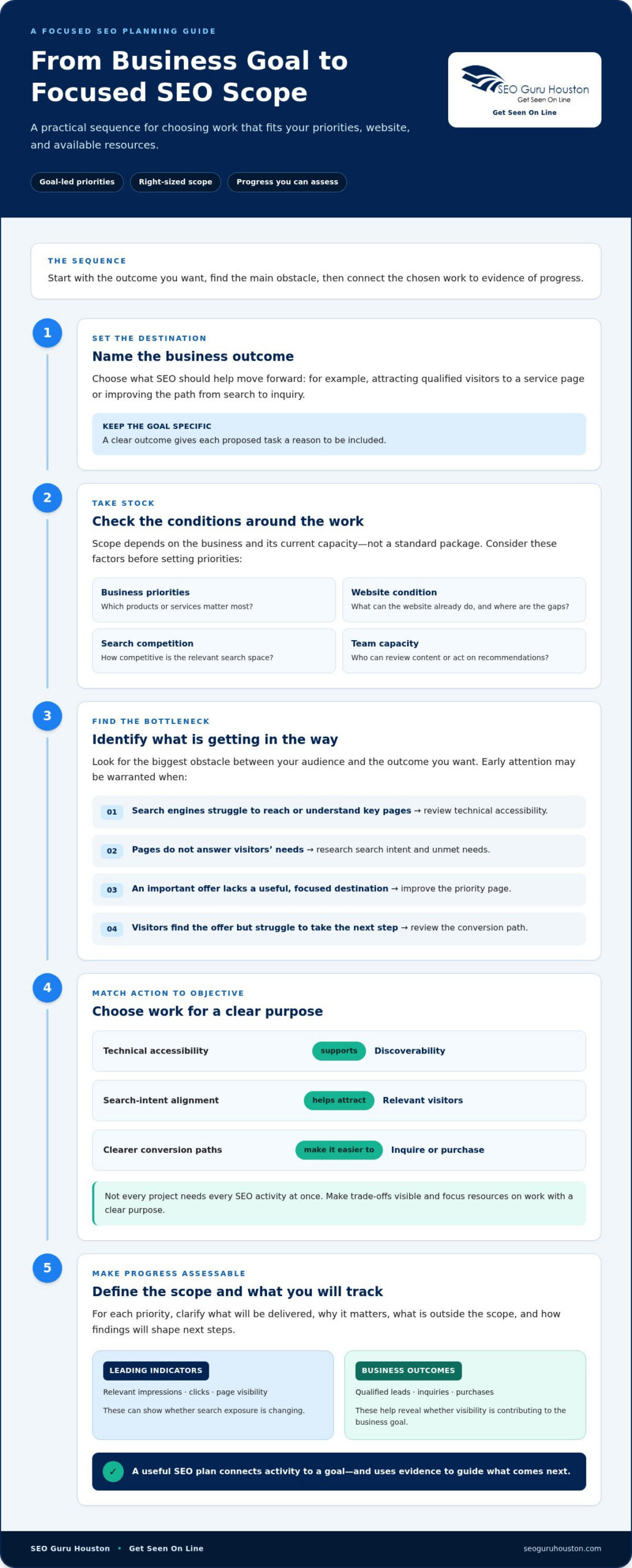
Affordability in SEO means a transparent, right-sized scope that connects available resources to measurable business priorities. Start with a clear outcome, such as attracting qualified visitors to a service page or improving the path from search to inquiry. Then identify the work most relevant to that outcome, specify what will be delivered, and define how progress will be assessed.

Search engine optimization (SEO) brings together activities that help improve a website’s visibility in search. A useful engagement turns that broad discipline into a focused plan. It isn’t a thin set of actions without a rationale, or an unexplained list of tasks that sounds comprehensive but isn’t tied to your business.

How Is Affordable SEO Different From Cheap SEO?

Affordable SEO prioritizes. Cheap SEO may simply remove the work needed to make informed decisions. A focused plan can concentrate on the most relevant pages and issues first while still grounding recommendations in research and tracking. Cutting those foundations makes it harder to evaluate the work because there’s no clear rationale or way to connect activity to progress.

Deliverable clarity matters more than a headline figure. You should understand what the work includes, why it matters, what falls outside the scope, and how findings will shape next steps. Imagine a company whose priority is generating more qualified inquiries for one service. A focused engagement might research search intent, improve that service page, and monitor relevant inquiry actions. A vague task list might promise assorted updates without explaining how they support the goal. The difference isn’t the number of tasks, but the reasoning behind them.

Who Can Benefit From a Focused SEO Engagement?

A focused engagement can suit a business that wants stronger organic visibility but needs to sequence marketing investments carefully. That might be a growing company with a defined service to promote, a business with limited capacity to create or update content, or a team strengthening its search foundation before expanding its efforts. The right starting point depends on the business, not a standard package.

Before setting scope, clarify the outcome and the resources available to support the work. Consider which products or services matter most, what the website can already do, and who can review content or act on recommendations. If your team can support only a narrow initiative, concentrating on a priority page may be more practical than spreading effort across the entire site. If capacity changes, priorities can change with it.

An affordable SEO company should make those trade-offs visible, not disguise them behind a low price or a long list of deliverables. A good-fit engagement gives your business a clear first move and a reasoned way to build from there.

What Shapes the Scope and Value of Affordable SEO Services?

SEO scope should reflect the business you’re trying to grow, not a standard checklist. A company seeking qualified inquiries for a specific service needs a different plan from an online retailer expanding product visibility. The website’s current condition, the competitiveness of its search space, and the time your team can contribute all affect what belongs in the plan and what should wait.

Think of the work in two layers. Foundational SEO addresses whether search engines can access and understand important pages, whether those pages match relevant search intent, and whether visitors can take a useful next step. Ongoing improvement may involve developing content for unmet needs, strengthening the site’s authority, and using performance data to refine priorities. A well-scoped engagement makes the transition between these layers clear. For a broader perspective on strategy, explore this guide to professional SEO services.

An affordable SEO company should explain why each priority fits your goals and what evidence will help assess its value. Not every project needs every SEO activity at once. The plan should make trade-offs visible so your resources go toward work with a clear purpose.

Which SEO Activities Deserve Early Attention?

Start with the website’s actual needs, not a generic checklist. Technical accessibility deserves attention if search engines struggle to reach or understand key pages. Search-intent research matters if visitors have needs your pages don’t answer. Improve priority pages when important services or products lack a useful, focused destination. Review conversion paths when people can find the offer but can’t easily take the next step.

Connect each activity to an objective: accessibility supports discoverability, intent alignment helps attract relevant visitors, and clearer conversion paths make it easier for those visitors to inquire or purchase. To decide what comes first, identify the biggest obstacle between your audience and the business outcome you want.

How Should SEO Performance Be Measured?

Use both leading indicators and business outcomes. Relevant impressions, clicks, and page visibility can show whether search exposure is changing. Qualified leads, inquiries, or purchases help reveal whether that visibility supports the business. Google Search Console can help you review search queries and page performance, while analytics data can show how visitors behave after landing on the site. Together, these sources provide context, not a promise of particular rankings or revenue.

SEO reporting should connect completed work to search visibility and meaningful business outcomes, so each review informs the next decision. A useful report explains what changed, what the data suggests, and what action follows instead of presenting metrics without interpretation.

  • Goal: Name the business outcome the SEO work is meant to support.
  • Baseline: Record relevant page, search, and conversion performance before changes.
  • Review: Compare progress over time and adjust priorities as evidence or business needs change.

Connecting scope to measurement turns SEO from a collection of tasks into a growth strategy. If your priorities call for a broader view of search and digital growth, explore SEO strategy and marketing resources to see how related efforts can fit together.

Affordable SEO Company vs. Low-Cost Provider: How to Compare Value

A proposal’s total cost tells you what you’d pay, not what the work is designed to accomplish. Compare the reasoning behind the scope: which business priority it serves, how the work will be measured, and what happens as needs change. A focused engagement may fit a defined objective; a broader partnership may suit a business addressing several connected growth needs. Neither is automatically better because it costs less or covers more.

Use this comparison to look beyond labels. These are common patterns, not fixed rules. A bare-minimum scope can suit a narrow need when its limits are clear.

What to compare Focused engagement Bare-minimum offer Broader growth partnership
Scope clarity Defines a specific objective, work areas, and boundaries. May list limited tasks without explaining their purpose. Connects SEO with related marketing or website work.
Prioritization Concentrates effort on the most relevant opportunity. May provide a fixed set of routine activities. Can address several priorities, if they’re genuinely needed.
Measurement Tracks indicators tied to the selected objective. May report activity without explaining its significance. Can connect performance across channels and conversion paths.
Communication Explains progress, decisions, and next steps. May offer limited context around completed tasks. Coordinates updates across connected areas of work.
Flexibility Can refocus as the priority evolves. May have little room to adjust its preset scope. Can shift emphasis among services as business needs change.

What Should a Transparent SEO Proposal Explain?

A transparent proposal links four parts: the business objective, the work chosen to support it, the reporting used to review progress, and expectations for discussing what comes next. The connections matter. If a deliverable has no stated purpose, or a report tracks measures unrelated to the objective, it’s difficult to judge whether the work is useful. An affordable SEO company should make those connections understandable without promising a specific ranking or revenue result.

Look for explanations, not just labels. “Improve key pages” is hard to evaluate without knowing which pages, why they matter, and how progress will be reviewed. A clear scope makes assumptions and boundaries visible, helping you compare substance rather than headline price.

When Does a Broader Growth Partnership Make Sense?

SEO can bring relevant visitors to a website, but it can’t resolve every barrier to growth by itself. If a landing page makes it hard to take action, website improvements may support the path from visit to inquiry. If the business needs to reach demand sooner while organic visibility develops, PPC may complement SEO. A broader partnership makes sense when those needs are connected and your team can act on them.

More services aren’t automatically more valuable. The right combination depends on the goal, capacity, and gaps identified. For broader context on how SEO fits into digital marketing, read this SEO marketing company guide. If your priorities span search and website performance, SEO and digital growth strategy can provide a useful starting point.

Affordable SEO Company: How to Invest in Growth Without Overspending

How to Set an SEO Budget and Priorities That Fit Your Business

An SEO budget works best when it’s built around a business result, not a wish list of tasks. Start with what growth should look like, identify the current barriers, then assign resources to the work most likely to move the right measure. This grounds priorities in evidence and makes it easier to explain why some work comes first while other opportunities wait.

Use this sequence to turn a broad ambition into a workable plan:

  1. Define the business outcome. Choose a meaningful objective, such as attracting qualified inquiries for a particular service or increasing relevant organic visits to important product pages.
  2. Assess the baseline. Review current search visibility, website activity, conversion paths, and inquiry data. Use your own site’s performance as the reference point rather than assuming an industry benchmark applies.
  3. Prioritize the constraint. Identify what most limits progress. It might be a technical issue, an important page that doesn’t meet search intent, or a website experience that makes it hard to take action. Fund the work that addresses that obstacle first.
  4. Set measures. Pair an early indicator, such as relevant organic visits, with a business outcome, such as qualified inquiries. Define what counts and where the data comes from before work begins.
  5. Review and adjust. Compare results with the baseline, discuss what the evidence suggests, and revisit the plan when capacity, business goals, or customer needs change.

This sequence gives an affordable SEO company a practical framework for prioritizing effort without treating every possible task as equally urgent.

How Can You Set Useful SEO Objectives?

Make broad goals observable. “Grow online” is difficult to act on. “Increase relevant organic visits to the service page and track how many become qualified inquiries” gives the team a direction and a way to learn. Record the starting point and keep definitions consistent across review periods. If the meaning of a qualified inquiry changes, note that change so performance comparisons remain useful.

Don’t judge the plan on traffic volume alone. More visits may not matter if those visitors aren’t looking for what the business offers or don’t take a meaningful next step. Match each measure to the customer journey and the outcome the business values.

How Should You Balance SEO With Other Growth Channels?

SEO can build organic visibility over time, while paid search may support demand that needs attention sooner. Website and landing page improvements can help visitors understand an offer and act on it. The right mix depends on your objective, available resources, and how customers move from discovery to decision. Not every business needs every channel at once.

If search attracts the right audience but the page makes conversion difficult, focused landing page design may address a more urgent constraint than expanding traffic efforts. Reassess the mix as evidence and priorities evolve.

Build your next steps around a clear goal, an honest baseline, and measures that connect marketing activity to business progress. Explore SEO growth services to consider how a data-driven search strategy can support your priorities.

How an Integrated SEO Partner Turns Affordability Into Growth

SEO creates more value when it supports a clear business objective instead of operating as a disconnected list of tasks. Search visibility matters, but so does what visitors find when they arrive and whether the site helps them take a meaningful next step. Connecting those pieces helps direct effort toward the full path from discovery to inquiry.

An integrated approach can draw on SEO, PPC, B2B marketing, inbound marketing, and website development and landing page design. That doesn’t mean every business needs every capability. A company focused on organic discovery may prioritize SEO; one seeking paid-search visibility may add PPC. If relevant visitors reach a page that doesn’t explain the offer or guide action, web improvements may be the more immediate priority. The right combination follows the goal.

For an affordable SEO company, integration is about coordination, not piling services onto a plan. Search strategy can inform which pages deserve attention, landing page work can support the visitor’s next step, and lead-generation priorities can shape which outcomes to track. Each activity should have a role in the business objective.

When Can SEO, PPC, and Web Development Work Together?

Organic search and paid search can serve different needs. SEO supports a longer-term effort to build visibility for relevant searches, while PPC can support paid-search objectives. Their roles may complement each other, but they aren’t interchangeable and shouldn’t be assumed to deliver the same outcomes.

Website development and landing page design connect those traffic sources to the customer journey. For example, a business seeking qualified inquiries might align search content and paid-search messaging with a page that clearly presents the relevant service and next step. A company focused on a different audience or offer may need a different page or channel mix. The best sequence depends on the goal, site condition, and available resources. There’s no universal timeline or guaranteed result. Evaluate progress against the measures selected for the project.

What Should a Practical First Conversation Establish?

Start with the business need. What outcome matters most? Which audience are you trying to reach, what challenges currently interrupt their path to action, and what marketing resources can your team contribute? Answers help distinguish a search visibility challenge from a conversion issue or a need to coordinate demand generation across channels.

A useful discussion connects those answers to possible priorities and services. If the main obstacle is organic discoverability, SEO may lead. If the page experience is holding back inquiries, web work may deserve attention. If paid visibility is part of the objective, PPC may have a role. This keeps the plan focused instead of treating service breadth as a reason to use everything.

Bring your goals and current challenges into focus, then turn them into a practical growth direction. Discuss your SEO growth goals and take the next step with purpose.

Turn Your Next SEO Decision Into Forward Momentum

Your SEO plan doesn’t need to solve every growth challenge at once. It needs to give your team a clear next move, a way to assess whether that move is useful, and room to adapt as the business evolves. Treat each review as a decision point: keep investing in work that supports your objectives, refine what isn’t connecting, and shift focus when your priorities or capacity change.

That’s how an affordable SEO company engagement can become a practical growth tool rather than a fixed list of deliverables. Start with the business question that matters most, then build a focused plan around the answer. Progress comes from deliberate decisions and learning from the evidence, not from trying to do everything at once.

Ready to turn your priorities into a clear direction? Map out your next SEO priorities and take the next step with confidence. Your growth strategy can start focused and become stronger as your business moves forward.

Frequently Asked Questions

Can an affordable SEO company guarantee first-page rankings?

No. An affordable SEO company can research opportunities, improve relevant pages, and monitor search performance, but it can’t control search engine results or promise a specific position. Rankings shift with competition, search changes, and other factors beyond any agency’s control. Look for clear explanations of planned work and progress measures instead. For example, track whether priority pages gain relevant impressions and attract visitors who match your intended audience.

How long does it take to see results from SEO?

There’s no reliable universal timeline because progress depends on the site’s starting condition, competition, scope, and how quickly recommendations are implemented. Some changes, such as correcting a page access issue, may be observable before broader business outcomes become clear. Treat early movement as a signal to investigate, not proof of success. Compare performance with a baseline over consistent periods, and assess whether visibility is developing into relevant visits and meaningful actions.

What should an SEO report include?

A useful report should show work completed, pages or search themes affected, relevant performance changes, and recommended next actions. It should define the reporting period and clarify how key metrics are calculated. For example, a report might distinguish visitors to a priority service page from all organic visits, then show whether those visitors completed a tracked inquiry action. Context matters: numbers without interpretation don’t explain what to do next.

Can an SEO strategy change as my business goals change?

Yes. SEO priorities should respond when your business shifts focus, changes its offerings, or discovers that a different audience or page deserves attention. A company moving toward a new service line, for example, may need to reassess which pages and search topics receive effort. Keep previous goals and reporting definitions documented, then note why the plan changed. That preserves useful comparisons while making room for new priorities.

Does affordable SEO include content creation?

It can, but content creation should be explicitly defined in the engagement rather than assumed. Clarify whether the work involves content research, outlines, drafting, updating existing pages, or reviewing material your team provides. The right choice depends on the goal and your internal capacity. If a page already answers customer questions well, improving its clarity may be more useful than adding another article. Focus content investment on a real audience need.

Is SEO or PPC better when a business needs leads quickly?

PPC can support paid-search visibility for a near-term campaign, while SEO builds organic visibility through ongoing work and may take longer to influence business outcomes. Neither channel guarantees leads. Before directing more traffic to a site, check that the offer is clear, the landing page matches the ad or search intent, and inquiry tracking works. The best choice depends on urgency, budget capacity, customer journey, and whether the business can respond to demand.

Understanding Your Monthly Digital Marketing Report: A Practical Guide

What if your monthly digital marketing report isn’t telling you whether marketing worked, but simply showing you what happened? If rows of traffic, leads, and campaign metrics feel disconnected, you’re not alone. Understanding your monthly digital marketing report means looking beyond totals to see which activity supports your business goals, where results are getting stuck, and what deserves attention next.

A useful report should make decisions clearer, not bury them under more numbers. This guide shows you how to identify metrics tied to lead generation and business outcomes, interpret changes without jumping to conclusions, and turn a monthly review into a focused plan. You’ll also see how SEO, paid advertising, and landing-page performance connect, while still needing channel-specific context. That matters when visits rise but inquiries don’t, or results across channels appear to conflict.

Use this practical approach to review performance, account for gaps in measurement, and prioritize next steps you can track. The goal is to finish each review knowing what’s working, what needs investigation, and what to change next.

Key Takeaways

  • Understanding your monthly digital marketing report starts with linking each metric to a business objective, not treating every number as equally important.
  • Separate visibility, engagement, conversions, lead quality, and business outcomes so sessions, clicks, and conversion rates tell a clearer story.
  • Compare performance against goals and relevant periods, accounting for campaign changes, seasonality, and conversion delays.
  • Turn findings into prioritized next steps by identifying likely causes, assigning ownership, and setting a clear way to review progress.
  • Assess SEO, PPC, inbound marketing, and website performance together to spot disconnects and guide a coordinated strategy.

What Does a Monthly Digital Marketing Report Actually Tell You?

A monthly digital marketing report summarizes marketing activity, performance, and progress toward defined objectives over a set period. Its job isn’t simply to show whether numbers went up or down. A useful report explains what changed, which activity may have contributed, and where the business should focus next.

A report is different from a live dashboard. A dashboard displays data as it updates, giving teams a current view of activity. A monthly report reviews a defined period and interprets the data in context, so readers can assess progress, notice patterns, and decide what to investigate. Digital marketing spans multiple channels, but the report should relate each channel’s performance to the same business objectives.

Activity metrics show what marketing did; outcome metrics show what that activity helped the business achieve. Clicks, for example, can indicate that an ad attracted attention. Qualified inquiries can show whether that attention moved closer to a business result. Both measures can be useful, but they answer different questions.

What belongs in a useful monthly report?

The right contents depend on your goals, active channels, and what measurement can reliably capture. A report might include:

  • An executive summary stating the main result, notable change, and priority for review.
  • Goal progress showing movement toward agreed objectives, such as generating inquiries or increasing relevant website visits.
  • Channel results explaining how SEO, paid advertising, or other active channels contributed, without treating their metrics as interchangeable.
  • Conversions and lead context connecting website actions to inquiries and, where available, their quality or business relevance.
  • Next actions identifying what to maintain, investigate, or improve in the next reporting period.

Numbers need context to be useful. The report should state the reporting dates, define key terms, and explain the comparison being used, such as the previous month or progress toward a target. If a conversion means a form submission, say so. If dates or definitions change between reports, apparent improvement or decline may reflect measurement differences rather than a real shift in performance.

Who should use the report, and how?

Different readers need different levels of detail. Owners can use the summary to assess whether marketing supports business priorities. Marketing leads can examine channel performance and decide what needs testing or adjustment. Sales teams can share whether incoming inquiries are relevant and where prospects appear to stall. Together, these perspectives connect campaign data with what happens after a lead arrives.

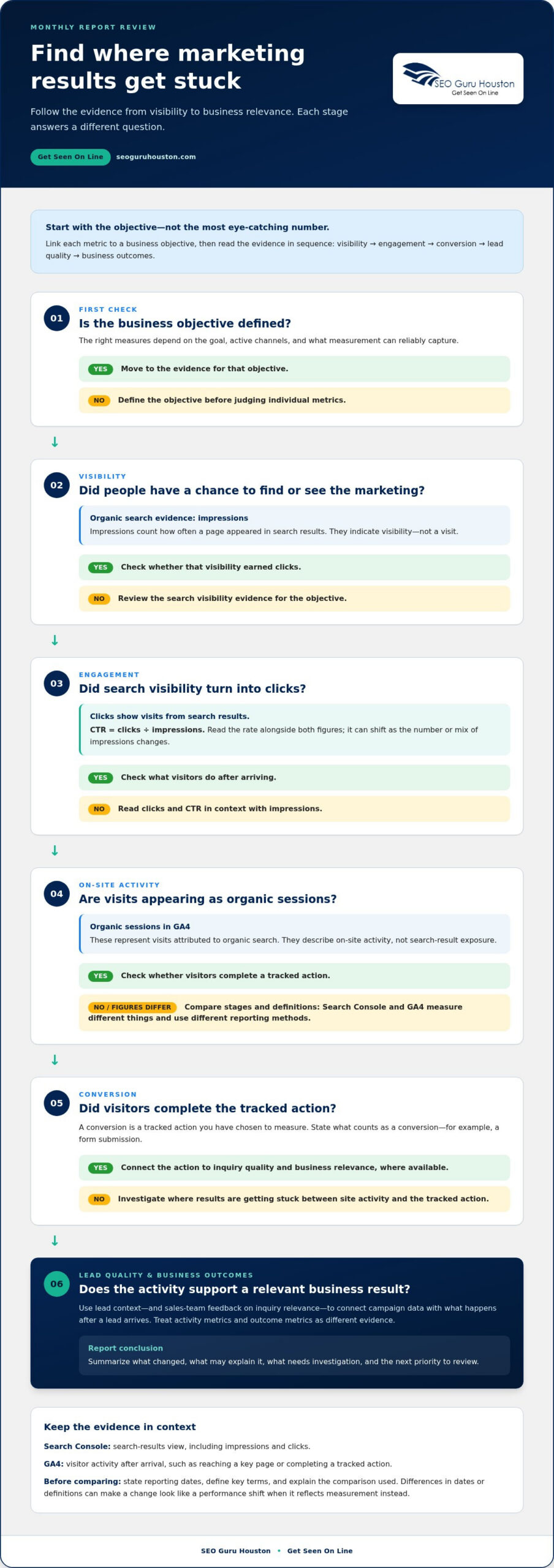
Start with the objective, not the dashboard’s most eye-catching metric. Ask what the business was trying to achieve, then review the relevant evidence and its limitations. A clear summary gives everyone a common starting point: what changed, why it may matter, and what decision is needed. That’s the practical core of understanding your monthly digital marketing report. It turns a review into direction, not just another meeting about numbers.

How to Read the Core Metrics in Your Monthly Marketing Report

Metrics make sense as a sequence, not a scoreboard. Start with visibility: did people have a chance to find or see your marketing? Then look at engagement, conversion, lead quality, and business outcomes. Each stage answers a different question, and a change in one doesn’t automatically mean a change in the next.

A metric becomes meaningful when you connect it to a defined objective and the action you want it to explain. If the goal is to attract relevant search visitors, impressions alone won’t tell you whether people clicked or took a useful next step. If the goal is qualified inquiries, raw traffic is only an early signal.

Which SEO metrics show search visibility and engagement?

For organic search, distinguish these measures:

  • Impressions count how often a page appeared in search results. They indicate visibility, not a visit.
  • Clicks count visits from those search results. They show that a listing earned attention.
  • Click-through rate (CTR) is clicks divided by impressions. Read it alongside both figures, since the rate can shift as the number or mix of impressions changes.
  • Organic sessions in Google Analytics 4 (GA4) represent visits attributed to organic search. They describe on-site activity, not search-result exposure.

Google Search Console provides the search-results view, including impressions and clicks. GA4 shows what visitors do after they arrive, such as whether they continue to a key page or complete a tracked action. The figures may not match exactly because the tools measure different stages and use different reporting methods. Together, they help show whether visibility is turning into relevant site activity. For broader professional SEO services context, interpret search metrics against the strategy and audience the work is intended to reach.

Which paid and website metrics indicate campaign performance?

Read paid campaigns stage by stage. Ad impressions show exposure; clicks show visits generated by the ad. A conversion is a tracked action you’ve chosen to count, such as a submitted inquiry form. A conversion rate compares conversions with a defined set of interactions or visits, so check the report’s denominator before comparing rates. Cost per conversion relates advertising spend to the conversions recorded. It describes efficiency against that conversion definition, not lead quality or eventual revenue by itself.

Then examine the landing page. If ads earn clicks but visitors leave without taking the intended action, the issue may be the page experience, message match, or offer, not simply the ad. If conversions rise, check whether the inquiries are relevant and progressing toward business outcomes. Traffic growth matters only when it brings the right audience and supports meaningful action. Assess PPC management across ad delivery, landing-page behavior, and conversion quality, with each measure tied to its role in the campaign.

That’s the heart of understanding your monthly digital marketing report: follow the path from exposure to action, then test whether the action advances a business goal.

How to Judge Monthly Results Without Misreading the Numbers

A month-over-month change is a signal, not a verdict. To judge performance fairly, compare results with the stated goal, a relevant previous period, and the changes made to campaigns or the website. A rise in inquiries may look positive, but if the business goal is qualified opportunities, volume alone doesn’t show whether performance improved.

Keep comparisons consistent by using matching date ranges and the same metric definitions. Then check what changed during either period. Seasonality can affect demand; budget adjustments can alter reach; website updates may change visitor behavior; and tracking changes can shift what gets recorded. Conversions may also happen after the month in which a person first clicked or visited. Note these factors alongside the results instead of treating them as background noise.

How should you compare this month with earlier performance?

Separate short-term movement from longer-term patterns when enough comparable data exists. A single month can be affected by a campaign launch, a brief surge in demand, or a measurement issue. Note meaningful shifts in targeting, spend, landing pages, and tracking so you can distinguish a possible trend from a one-off change. Before deciding to scale, pause, or investigate, ask whether the movement aligns with the goal.

Use this framework to keep unlike measures in their proper roles:

Metric group What it helps you assess What it can’t prove alone
Activity metrics Marketing exposure and interaction, such as impressions, clicks, or visits That activity produced qualified leads or sales
Conversion metrics Whether visitors completed a defined action, such as submitting an inquiry That every conversion was valuable or became a customer
Business outcomes Lead quality, sales progression, or other outcomes tied to business goals Which channel caused the outcome without further context

What can attribution and lead quality reveal?

Attribution is a model for assigning credit to marketing touchpoints. One system may credit the last interaction before an inquiry, while another may show several interactions along the path. Totals can differ because systems use different definitions, data, and attribution rules. Treat attribution as a useful perspective, not proof that one channel caused a result. A channel may contribute earlier in the journey without receiving final credit.

Pair lead volume with the quality indicators available to your team: whether the inquiry is relevant, whether sales can progress the conversation, and whether opportunities advance. This matters in B2B marketing, where consideration may stretch across multiple interactions. Judge a B2B demand generation strategy with that longer journey in mind, rather than by a single month’s final-touch conversions.

For stronger digital marketing coordination, use the evidence to align channel activity with lead quality and sales feedback. That’s the discipline behind understanding your monthly digital marketing report: compare carefully, question what the data supports, and act on the clearest signal.

Understanding Your Monthly Digital Marketing Report: A Practical Guide

How to Turn Your Monthly Digital Marketing Report into an Action Plan

A report creates value when someone acts on what it reveals. Use a repeatable workflow to turn useful findings into owned tasks instead of letting them disappear into meeting notes. Keep the process focused: not every fluctuation deserves a change, and not every opportunity needs to be tackled at once.

  1. Revisit the goal. Confirm what the marketing activity was meant to support, such as relevant inquiries or stronger landing-page conversions.
  2. Identify meaningful changes. Look for results that matter to the goal, not simply the largest increase or decrease in the report.
  3. Investigate likely causes. Review campaign adjustments, audience or message changes, website experience, and tracking before deciding what the numbers mean.
  4. Prioritize the response. Address unreliable conversion measurement or a broken conversion path before moving to less urgent optimization ideas.
  5. Assign and review. Give each action an owner, a measurable indicator, and a review date. Record the result and decide whether to continue, revise, or stop the action.

This sequence turns understanding your monthly digital marketing report into a practical operating habit. It also helps the team avoid making several changes at once and losing track of which one may have influenced performance.

How do you prioritize findings and assign next steps?

Rank findings by their connection to business goals, the strength of the evidence, and how readily the team can act. A tracking error that makes conversions unreliable may need immediate attention. A possible landing-page improvement supported by limited evidence can be planned as a test. Make each action specific, assign an owner, and define how you’ll assess success.

Replace “improve the landing page” with a task someone can complete and assess, such as reviewing the form path and documenting where visitors abandon it. Name the responsible person, choose an indicator tied to the goal, and set a date to check what happened. Describe the expected signal, not a promised result. For example, the team might look for fewer form errors or a change in completed submissions, while recognizing that the outcome has to be measured.

How should teams use findings between monthly reviews?

Keep the action list active throughout the month. Check progress at agreed points, note blockers, and record campaign or website changes with their dates. That change log gives the next review context: without it, a shift in performance can be difficult to interpret or connect to work completed.

If findings point to friction in the conversion experience, assess the landing page as part of the campaign, not in isolation. Reviewing high-converting landing page design can help frame what to examine, from message alignment to the action visitors are asked to take. Coordinating SEO, PPC, and website work can also keep channel activity connected to lead generation.

A coordinated digital marketing approach can connect reporting insights with accountable next steps through integrated digital marketing support.

How Integrated Digital Marketing Services Make Reporting More Useful

A report can reveal that one channel attracts attention while another contributes to inquiries, but disconnected plans make it harder to act on that picture. Coordinated marketing gives teams a shared business objective and a clearer way to understand how channel activity fits together. SEO, PPC, inbound marketing, and website work can each play a distinct role while contributing to the same lead-generation goals.

Dashboards can organize data. They can’t decide which audience to prioritize, improve a landing page, or align a campaign with sales needs. That takes interpretation and execution. Understanding your monthly digital marketing report becomes more valuable when findings inform a strategy and the strategy shapes what the team does next.

When do disconnected channels make reports harder to act on?

If SEO is measured mainly by organic visits, PPC by clicks, and the website by form submissions, each channel may appear to have a separate definition of success. That makes it difficult to see how a potential customer moves from discovering a business to making an inquiry. Align channel-specific indicators with a shared lead or revenue goal to create a more useful view, without pretending every channel contributes in the same way. A coordinated B2B inbound marketing approach can help frame how useful content, visibility, and follow-up support longer buyer journeys.

For example, search visibility may bring a prospective customer to a service page, while paid advertising may reach another audience with a specific offer. The website and landing pages shape what visitors can do next. Reviewing these activities together can reveal where the journey is losing momentum, while channel-level context helps teams choose an appropriate response.

The agency provides SEO and PPC services designed to improve visibility and attract relevant traffic, alongside B2B and inbound marketing, website development, and landing page design. The right combination depends on the business objective and the gaps the reporting reveals. A report can help clarify those needs, but it doesn’t replace a deliberate plan.

What should a useful marketing partnership deliver?

A useful partnership starts with clear goals and reporting that explains what the measures mean. It connects results to context, interprets what the evidence suggests, and identifies prioritized recommendations. SEO and PPC decisions should be grounded in available performance data, while website and landing-page work should be considered when the visitor experience appears to limit progress. No dashboard or channel guarantees a particular outcome.

Look for a working process that keeps goals, measurement, and execution connected. Teams should be able to understand what changed, why it matters, who owns the next step, and how progress will be assessed. That’s how reporting becomes more than a monthly recap. It becomes a practical input to coordinated marketing decisions.

Explore digital marketing services to connect reporting insights with a coordinated strategy and identify a next step that aligns with your business goals.

Make Your Next Marketing Decision Count

Let each reporting cycle sharpen the questions you ask, not just document what has already happened. What should the next period teach you about your audience, your message, or the path from first visit to inquiry? Carry one clear learning goal into the next cycle, then use the evidence to refine your strategy. That’s how understanding your monthly digital marketing report becomes an ongoing advantage rather than a monthly task.

When findings point to gaps between visibility and action, connect the work behind those stages. SEO and PPC can support visibility and relevant traffic, while website development and landing page design integrated with demand generation can align the visitor experience with business goals. The right next move depends on what your reporting reveals.

Ready to turn marketing insights into coordinated execution? Explore digital marketing services and take the next step with a clearer direction. Keep asking sharper questions, learning from the evidence, and moving your marketing forward.

Frequently Asked Questions

Is one month of marketing data enough to judge campaign success?

Usually, one month is a useful checkpoint, not enough evidence for a final verdict. A small number of inquiries can make a conversion rate swing sharply, and a short reporting window may miss leads that are still progressing. Use the month to catch clear problems, such as a broken form, then assess performance over a longer, comparable period before making major strategic changes.

Can Google Analytics 4 and an advertising platform show different conversion totals?

Yes. The systems may count different actions, use different attribution rules, or assign conversions to different dates. For example, an ad platform may credit a conversion to an ad interaction, while Google Analytics 4 (GA4) reports it according to its configured event and attribution setup. Check that both tools use the same conversion definition and date range before treating a gap as a tracking error.

What is a good conversion rate for a digital marketing campaign?

There isn’t one conversion rate that’s good for every campaign. A rate depends on what counts as a conversion, the audience, channel, offer, and visitor intent. A newsletter signup and a qualified sales inquiry represent different levels of value. Define the action that matters, then compare the rate with your own historical performance and lead quality. A higher rate isn’t automatically better if the leads are less relevant.

How long can SEO take to show measurable movement in a monthly report?

SEO timing varies with the site’s starting point, competition, technical condition, and the work being done, so a fixed timetable can mislead. Look for relevant indicators at different stages: whether important pages are indexed, whether search impressions or clicks are changing, and whether organic visitors take useful actions. If a page has little search visibility, first check whether it can be crawled and indexed before judging its content performance.

Should every business use the same digital marketing metrics?

No. Choose metrics based on the business model and the decision the report needs to support. An online store may track completed purchases and average order value, while a B2B firm may focus on qualified inquiries and sales progression. A metric that helps one team allocate budget may distract another. Keep a stable core for comparison, then add channel or business-specific measures where they answer a distinct question.

Can a monthly report prove that marketing caused a sale?

A report can show evidence that marketing touchpoints preceded or assisted a sale, but it rarely proves that a single campaign caused it. Buyers may encounter several channels, speak with sales, and return later through a different route. Combine analytics with customer and sales records, and treat attribution as one view of the journey. Stronger causal evidence generally requires a carefully designed experiment or comparison.

How often should a team review performance between monthly reports?

Set a check-in rhythm that matches campaign activity and the speed of decisions. A brief weekly review can help catch tracking failures, unusual spend, or sudden drops in form submissions; deeper strategic evaluation can remain monthly. Avoid reacting to every daily fluctuation. Record significant changes as they happen, and make sure someone owns follow-up so urgent issues don’t wait for the next scheduled report.

How to Work Effectively With a PPC Agency: A Practical Guide

Clicks can climb while your pipeline stays flat. Learning how to work effectively with a ppc agency means connecting campaign decisions to business goals, not just filling a dashboard with activity. A productive partnership depends on shared priorities, complete information, and timely approvals. Without those, even well-managed campaigns can lose momentum.

This guide explains how to build a focused, accountable relationship that connects paid campaigns to qualified leads and revenue. You’ll learn how to agree on goals and responsibilities, interpret reports, and make evidence-based decisions without unnecessary delays. We’ll also cover how useful conversion data, regular optimization, and focused landing pages help tie campaign activity to business outcomes.

Key Takeaways

  • Learn how to work effectively with a ppc agency by aligning campaign priorities with qualified leads, sales, and other business outcomes.
  • Prepare audience details, sales-cycle context, campaign history, and an approval process before work begins.
  • Choose performance indicators that fit the campaign objective, and look beyond clicks to understand lead quality and conversion value.
  • Use a recurring review process to turn evidence and timely feedback into clear tests, assigned actions, and documented learning.
  • Recognize when campaign insights point to opportunities in landing pages, website development, or demand generation.

Why Working Effectively With a PPC Agency Starts With Shared Business Goals

A campaign can generate clicks and still miss the mark if those visits don’t become valuable inquiries or sales. Before discussing keywords, bids, or ad copy, agree on the business result paid advertising should support. Pay-per-click (PPC) is an advertising model in which advertisers pay for clicks, but a click alone doesn’t show whether a campaign is moving your business forward.

That’s why how to work effectively with a ppc agency starts with a shared definition of success. Agree on the outcome, who owns each decision, and which reliable information will guide campaign changes. Platform metrics such as impressions, clicks, and click-through rate describe campaign activity. Qualified leads, sales, and conversion quality help show whether that activity matters to your business.

A productive PPC agency partnership turns shared business goals, clear responsibilities, and trustworthy campaign data into informed decisions. No campaign result is guaranteed.

What should a PPC agency partnership accomplish?

Start with a specific business objective. That might mean generating qualified leads, increasing online sales, or driving another clearly defined conversion. Then map how paid search fits into your wider marketing and sales process: which audience it should reach, what offer it should present, and what action a visitor should take next.

Make the success criteria observable to both teams. For example, assess a lead-generation campaign not only by form submissions, but also by whether those inquiries fit your target customer profile and progress through your sales process. Agree on how often to review results and which data sources to use. If the agency reports more conversions but your sales team says lead quality has declined, investigate the difference instead of treating the conversion increase as a win.

Which responsibilities belong to the client and agency?

The agency brings paid-campaign expertise; your team brings essential business knowledge. Define responsibilities early so work doesn’t stall over missing context, unclear approvals, or conflicting assumptions. Agree on ownership of account access, budget decisions, conversion definitions, and final approval of significant changes.

  • The agency plans campaigns, manages execution, analyzes performance, and recommends optimizations based on available evidence.
  • The client shares business priorities, product or service knowledge, audience details, and timely feedback on incoming leads.
  • Both teams agree on the budget, access permissions, what counts as a conversion, who approves changes, and how decisions are recorded.

Consider a campaign that attracts inquiries from people outside your target market. The agency can examine targeting, search terms, and messaging; your team can explain which inquiries are relevant and why. That feedback helps shape the next decision. Set an approval process with named owners and clear expectations for routine changes versus decisions that need additional review. When each side knows what to provide and decide, campaign strategy stays connected to business reality, not just platform activity.

How to Set Up a PPC Agency Relationship for a Strong Start

A strong kickoff turns broad expectations into a usable campaign plan. Before launch, bring together the people, information, and decision process the agency needs to build around your business rather than fill gaps with assumptions. This preparation also gives both teams a clear starting point for interpreting results and improving the work.

  1. Set the goal. Identify the business outcome the campaign should support, such as qualified lead generation, online sales, or another defined conversion. Clarify how paid search fits into your marketing and sales process.
  2. Describe the audience. Share who you want to reach, what needs or questions bring them to you, and which audience segments matter most. Explain how strong prospects differ from poor-fit inquiries.
  3. Shape the offer. Explain which products or services to prioritize, why they matter to your audience, and whether seasonality affects demand. Share relevant pricing or promotion context when it helps shape the campaign plan.
  4. Agree on measurement. Define what counts as a conversion, how lead quality will be assessed, and which information the teams will use to review performance. Include the sales handoff and any available feedback from sales conversations.
  5. Organize access. List the advertising accounts, website or landing-page tools, and reporting resources needed for campaign work. Decide who owns each account, who manages billing, and what access level each team member needs.
  6. Set the approval workflow. Name the people who approve ad copy, budget changes, and landing-page updates. Agree on a practical response window and a backup decision-maker so work doesn’t stall when someone is unavailable.

What information should clients bring to a PPC kickoff?

Come prepared with business priorities, target customer details, differentiators, seasonal factors, and relevant campaign history. Explain your sales cycle: how an inquiry becomes a customer, what makes a lead qualified, where handoffs happen, and why prospects sometimes don’t convert. Share landing-page context, including what visitors are asked to do. Past campaign data can inform planning, but it doesn’t guarantee the same approach will perform the same way again.

For broader strategic context, the PPC management guide discusses connecting paid traffic with business priorities.

How should access, approvals, and communication be organized?

Choose one primary communication channel and a recurring meeting cadence that fits the campaign’s needs. Keep a shared record of priorities, blockers, decisions, owners, and follow-up actions. At each check-in, clarify what needs approval and who will provide it. This structure keeps campaign work moving and makes decisions easier to find than scattered email threads.

Effective collaboration depends on consistent preparation, not a perfect brief. A clear kickoff gives your PPC management team the context to plan and the feedback loop to refine its work. PPC management support can be part of a coordinated approach to paid campaigns.

How to Measure PPC Agency Performance Beyond Clicks

Clicks show that someone interacted with an ad. They don’t show whether that person became a qualified prospect or customer. Clicks alone can’t establish commercial effectiveness because they measure visits, not the value those visits create for the business. A useful review connects advertising activity to lead quality, sales, and the campaign’s agreed objective.

Before using a report to make budget decisions, check that its conversion definitions and underlying data are reliable. Confirm which actions count as conversions, whether duplicate or low-value actions are included, and whether the reporting period gives prospects enough time to progress. If tracking is incomplete or inconsistent, apparent performance changes may not reflect what’s happening in the business.

Which PPC metrics deserve attention in an agency report?

Interpret each metric according to what it can tell you. Impressions indicate visibility; clicks and click-through rate can help assess ad engagement. None proves that the campaign is creating valuable business outcomes. Conversions, conversion rate, and cost per conversion provide a closer view of response, but still need context. A form submission has different value if it comes from a target customer rather than a poor-fit inquiry.

  • Visibility and engagement: Impressions, clicks, and click-through rate help explain whether ads are being seen and attracting interactions.
  • Conversion activity: Conversions, conversion rate, and cost per conversion show how visitors respond, based on the actions being tracked.
  • Business value: Qualified leads, sales, and conversion quality help reveal whether campaign activity supports the sales model and business objective.

For longer sales cycles, platform reporting may capture an inquiry before its eventual outcome is known. Add marketing and sales feedback, such as whether leads fit the target customer profile or progress through the handoff process. That context helps the agency assess patterns the platform alone can’t explain.

How can reporting turn into useful decisions?

A strong report explains more than what changed. It connects a campaign adjustment to the evidence behind it, the interpretation of that evidence, and the recommended next action. For example, if conversions rise but sales feedback suggests lead quality has weakened, discuss whether targeting, ad messaging, the offer, or the post-click experience may be contributing.

Compare results with the campaign’s agreed goals and measurement definitions, then consider relevant historical context. Avoid treating a single metric or short reporting window as a complete verdict. If visitors engage with ads but don’t take the intended next step, examine the landing page as part of the conversion path. High-converting landing page design can support a clearer post-click experience, while reporting helps identify where friction may be occurring.

That’s how to work effectively with a ppc agency when performance data gets complicated: verify what’s being measured, bring business feedback into the analysis, and agree on a next step you can review. The goal isn’t a fuller dashboard. It’s a clearer basis for action.

How to Work Effectively With a PPC Agency: A Practical Guide

How to Keep PPC Agency Campaigns Improving Through Clear Feedback

Campaign optimization works best as a steady learning loop, not a string of last-minute reactions. The agency can analyze campaign signals, but your team sees what happens after an inquiry arrives. Share that feedback consistently so both teams can make more informed decisions about targeting, messaging, and the landing-page experience.

Use a simple review cycle: examine the evidence, agree on a test, assign an owner, then record what happened and what comes next. Separate planned experiments from urgent fixes. If a tracking issue or misleading claim needs immediate attention, address it directly and document the change. For routine optimization, avoid changing several major campaign elements at once. Otherwise, it may be difficult to tell which adjustment influenced the outcome.

How should clients give feedback on PPC leads and sales?

Make lead feedback consistent enough to reveal patterns, not just anecdotes. Agree on practical categories such as relevant, poor fit, sales-ready, or not yet ready, and share recurring objections or reasons prospects disengage. Set a regular schedule for passing along this information, such as including updates in campaign reviews. Protect sensitive customer information: share only the details needed for analysis, use appropriate access controls, and follow your organization’s privacy practices.

Specific feedback gives the agency something actionable. “The leads were weak” is hard to use. “Several inquiries came from people seeking a service we don’t provide” points to a possible mismatch in search targeting, ad language, or the landing-page offer. If relevant prospects repeatedly raise the same concern, the team can assess whether campaign messaging or page content should address it more clearly.

How can both teams make testing more disciplined?

Before launching a test, write down the question it’s meant to answer, the audience it affects, and what evidence would inform the next decision. For example, a team might test whether clearer qualification language attracts more suitable inquiries. Agree on who will implement the change, who will review lead feedback, and when you’ll assess what the evidence supports.

Keep a shared test record with the hypothesis, change, owner, review point, observations, and next action. Don’t label a test a success just because one metric moved. Check whether the movement aligns with the campaign objective and the quality of resulting leads. If the evidence is inconclusive, record that plainly and decide whether to continue, adjust, or close the test. “We can’t tell yet” is more useful than a confident conclusion based on noise.

This is how to work effectively with a ppc agency over time: make feedback timely, experiments interpretable, and decisions traceable. When campaign evidence points to the post-click experience as an area to investigate, coordinate landing-page updates with the agency so the ad promise and page experience stay aligned.

PPC management services can connect campaign analysis with practical optimization.

How to Build a Long-Term PPC Agency Partnership That Drives Growth

A useful agency relationship evolves with the business. Goals set at launch may need revisiting as offers change, new audiences become priorities, or sales capacity shifts. Keep the partnership grounded in shared priorities, candid feedback, and documented decisions. That record helps both teams understand why a campaign changed, what the evidence showed, and which business question deserves attention next.

Consistency matters, but it shouldn’t mean sticking with a strategy after the business has moved on. Revisit campaign priorities when your products or services, target customers, sales process, or objectives change. Use campaign data alongside marketing and sales feedback to identify the next useful question. Avoid adding campaigns or chasing more activity simply because it’s possible. Each change should connect to a business need.

When should a PPC strategy change as the business grows?

Reassess the strategy when an offer changes, a new audience becomes more important, or the sales team can handle a different volume or type of inquiry. Bring those updates to the agency with context: what changed, why it matters, and what you want to learn. Together, decide whether the campaign, its messaging, or its conversion path needs adjustment. Document the reason for each change so future reviews reflect the business decision behind it.

How can PPC connect with landing pages and demand generation?

A paid ad sets an expectation. The landing page should carry that message forward, make the next step clear, and match the offer that prompted the click. If ads attract relevant visitors but the page doesn’t explain the value or guide action, assess campaign performance alongside the post-click experience. PPC management, landing page design, and website development can work as connected parts of the visitor journey, with each considered in light of the campaign objective.

The relationship can extend beyond the initial conversion. Lead capture is one point in a broader demand-generation process: prospects may need useful follow-up and a clear handoff to sales before they’re ready to make a decision. For B2B teams, the B2B demand generation guide offers related context on connecting marketing activity with the process of developing prospects.

Our PPC management works alongside landing page design, website development, and demand generation, so teams can consider campaign traffic and the experience that follows as connected growth work. No single channel or change guarantees a particular outcome. The value comes from keeping business goals visible, sharing honest feedback, and using each review to make the next decision more deliberate.

That’s the practical answer to how to work effectively with a ppc agency over the long term: treat the relationship as an ongoing collaboration, not a set-and-forget arrangement. Our PPC management services can support paid campaigns as part of your broader business priorities.

Make Your Next PPC Decision Count

The strongest agency relationships don’t stand still. As your business shifts, use the next planning conversation to identify the constraint that matters most: reaching a more relevant audience, improving the page experience, or helping qualified prospects move forward. That focus gives both teams a practical direction for the next stage of growth.

Knowing how to work effectively with a ppc agency means treating paid campaigns as part of a broader business system, not an isolated channel. Our PPC management can connect with landing page design, website development, and demand generation to support a coordinated marketing effort. The right priorities depend on your goals and what your campaign data reveals.

Choose one business objective for your next discussion, then turn it into a clear question your marketing team can act on. Discuss your PPC campaign goals and take the next step toward a more focused partnership.

Frequently Asked Questions

What should I expect from a PPC agency each month?

Expect work and communication that match the agreed scope, not a guaranteed number of leads or sales. A useful monthly update identifies work completed, budget pacing, significant account issues, and decisions needed from your team. Check whether recommendations have owners and next steps. For example, if a campaign’s landing page needs a change, the update should explain what needs review and how it relates to the campaign objective.

How often should I communicate with my PPC agency?

Set communication frequency according to campaign complexity and how quickly your team can make decisions. A scheduled monthly review may suit a stable account, while a launch or major offer change can call for closer coordination. Agree on which channel to use for routine questions and how to flag urgent issues, such as a broken conversion form or an unexpected budget concern. The goal is useful contact, not meetings without decisions.

What information should I share with a PPC agency?

Share information that helps the agency distinguish a valuable opportunity from a poor fit: customer qualification criteria, product or service constraints, sales capacity, and common reasons prospects decline. Explain which customer types are most valuable without sharing unnecessary confidential details. A brief summary of a lead’s status or reason for disqualification may be enough to guide campaign decisions. Limit access to sensitive records and follow appropriate privacy practices.

How do I know whether my PPC agency is doing a good job?

Look for clear reasoning, accurate measurement, and follow-through tied to your agreed objective. Ask the agency to explain why it made a meaningful change, what evidence informed it, and what it will monitor next. Your team should also be able to see whether lead quality aligns with the audience you want. Knowing how to work effectively with a ppc agency means evaluating the quality of decisions as well as campaign outcomes, without treating short-term fluctuations as a full verdict.

Should a PPC agency guarantee leads or sales?

No agency should promise a specific number of leads or sales as a certainty. Results depend on factors beyond campaign management, including the offer, competition, website experience, tracking quality, and how promptly sales follows up. An agency can explain its strategy, define how progress will be assessed, and make informed adjustments. Treat guaranteed outcomes cautiously, especially if the promise doesn’t explain assumptions, lead qualification, or what happens when the stated target isn’t reached.

Who owns the Google Ads account when working with an agency?

Your business should retain ownership and administrative control of its advertising account, while the agency receives the access needed to manage campaigns. Clarify account access, billing responsibility, and who controls related assets such as conversion tracking before work begins. This arrangement keeps account history and business data accessible to your organization if staff or agency relationships change. Review user permissions periodically and remove access that’s no longer needed.

How long does it take for a PPC agency to improve campaign performance?

There’s no reliable universal timeline. The pace depends on the account’s starting condition, tracking accuracy, volume of meaningful conversions, and how long prospects take to become customers. Correcting a measurement issue may clarify reporting before the business impact of campaign changes is visible. Ask the agency to identify what it will review at each checkpoint and what evidence would support a decision. Treat early signals as learning, not a promise of future results.

Amazon DSP Advertising Guide: How to Plan, Compare, and Measure Campaigns

Amazon DSP works best not as a replacement for Sponsored Ads, but as an audience and measurement layer that can extend your media plan beyond active searches. The two approaches are easy to blur, especially when campaigns use different audiences, placements, and formats. Treating them as interchangeable can make goals and results harder to interpret. This amazon dsp advertising guide explains where each approach fits and how they can work together.

If you’re deciding which audiences to target, how to structure a campaign, or how to connect ad activity with business outcomes, start by setting objectives and measurement criteria before launch. That gives you a basis for evaluating results instead of relying on guesswork after the budget is spent. This guide covers how Amazon DSP works, when it can complement Sponsored Ads, how to compare access models, and which signals can help assess performance. You’ll be better prepared to plan a measurable campaign and connect Amazon advertising to your wider marketing goals.

Key Takeaways

  • Use Amazon DSP to reach relevant audiences across eligible placements, with campaign choices tied to a clear business objective.
  • Plan campaigns in sequence: define the goal, audience, creative, delivery approach, and measurement plan.
  • Compare Amazon DSP with Sponsored Ads by audience strategy, placement context, and each channel’s role in the customer journey.
  • This amazon dsp advertising guide explains how to distinguish delivery metrics from business outcomes and choose KPIs before launch.
  • Use a readiness checklist to clarify your destination, budget controls, and measurement needs before deciding how to execute.

What Is Amazon DSP Advertising, and What Role Does It Play?

Amazon DSP is a programmatic platform for buying digital advertising placements and reaching audiences across eligible Amazon-owned and third-party environments. Instead of relying mainly on a shopper’s search terms, advertisers can use audience signals to serve display, video, and other available ad formats. This distinguishes DSP from keyword-led Sponsored Ads, which commonly appear in shopping contexts when customers search or browse products. The Demand-Side Platform (DSP) model automates the purchase of eligible ad impressions according to campaign settings.

Think of DSP as an audience-reach layer in a broader Amazon marketing plan, not a default replacement for Sponsored Ads. It can help a brand reach people before they search, reconnect with relevant audiences later, or support both stages with different messages. Inventory and features depend on the market, account eligibility, and buying arrangement. Plan around the inventory and controls available to your campaign instead of assuming every format or environment is accessible.

How does demand-side platform advertising work?

Programmatic buying uses automated bidding to compete for eligible ad impressions. The advertiser sets campaign inputs, including the objective, audience, creative, placements, and budget controls. The platform evaluates opportunities and bids according to that setup. Auction mechanics, inventory, and controls vary by placement and platform configuration, so selecting an audience does not mean the same ad will appear everywhere.

For a practical starting point, define who you want to reach and what response matters before choosing creative. A prospecting campaign might introduce a product category to a relevant audience, while remarketing could show a follow-up message to people who have already engaged. Treat these as separate campaign jobs, each with its own message and success criteria.

Which goals can Amazon DSP support?

DSP campaigns can be planned around awareness, consideration, or conversion, depending on available formats, audiences, and campaign setup. Awareness introduces a brand to relevant people; consideration encourages deeper product or brand exploration; conversion focuses on a defined action. These are planning objectives, not guaranteed results. Choose measures that match the goal and interpret performance in the context of the customer journey.

For example, a brand seeking new prospects could prioritize relevant reach and exposure, then use a separate remarketing campaign to reconnect with people who showed interest. The first campaign builds awareness; the second encourages an already-engaged audience to take a next step. Keeping those purposes distinct makes performance easier to assess and gives each creative a clear role.

This distinction is central to an effective amazon dsp advertising guide: DSP buys access to audiences across eligible placements, while Sponsored Ads commonly capture shopping intent within Amazon contexts. Use DSP when audience reach or re-engagement supports your objectives, and coordinate it with Sponsored Ads when both channels can serve different moments in the journey. Before launch, confirm the eligible inventory and capabilities for the campaign’s market and buying arrangement. Then set clear expectations for what each activity is designed to accomplish.

How to Plan an Amazon DSP Campaign From Audience to Creative

A campaign becomes more focused when every choice follows from a business objective. Before selecting audiences or formats, decide what the advertising needs to accomplish and how you’ll recognize progress. Then connect that goal to campaign structure, creative, the destination customers will visit, and a measurement plan. This sequence ties media activity to the wider Amazon marketing plan instead of treating each ad as a standalone tactic.

Set the objective, audience, and campaign structure

Start with one primary objective, such as introducing a product to potential customers or encouraging an interested audience to take a next step. Define the business outcome it should support, then identify relevant audience groups using available shopping or engagement signals. Targeting options can vary by account, market, and buying arrangement, so base the plan on current campaign capabilities rather than assumptions.

Organize prospecting and remarketing separately. Their audiences have different levels of familiarity, so they need different messages and should not be judged by identical expectations. Use this planning sequence:

  1. Set the objective. State the business goal and the primary outcome you’ll use to evaluate it.
  2. Define audience groups. Specify who the campaign should reach and which signals make each group relevant.
  3. Separate campaign roles. Keep prospecting distinct from remarketing so you can assess reach to new audiences separately from follow-up with engaged people.
  4. Choose delivery inputs. Match eligible placements, format, and budget controls to the audience and objective.
  5. Set measurement criteria. Choose a primary KPI and supporting indicators before launch, then review them against the campaign’s intended role.

For example, a prospecting campaign for a product category might introduce the brand to relevant shoppers, while remarketing could focus on people who have already interacted with the brand or product. The available audience signals and controls depend on the campaign setup.

Match creative and landing experience to audience intent

Creative should meet people where they are in the customer journey. An awareness message needs to communicate the product or brand clearly. A consideration message can explain a meaningful point of difference. A conversion-focused ad should make the next step easy to understand. Select formats based on the message and eligible inventory, not novelty alone.

Review the customer journey from ad to destination before launch. If an ad promotes a product, make sure the product is available and its detail page supports the promise with accurate, useful information. For off-Amazon campaigns, check that the destination page is relevant, functional, and consistent with the ad. A mismatch can undermine the experience even when the audience and creative are well chosen.

Test with discipline. Change one meaningful variable at a time, such as the headline, visual, or call to action, while keeping other elements consistent. That makes results easier to interpret and helps distinguish a creative effect from changes in audience or delivery. This amazon dsp advertising guide’s planning approach works best when testing and measurement are designed together.

When campaign strategy, execution, and destination experience need to work as one, explore Amazon marketing services as part of a coordinated growth plan.

Amazon DSP vs. Sponsored Ads: Choose the Right Channel Mix

Choose the channel based on the moment you need to influence. Sponsored Ads commonly connect products with active shopping intent, while Amazon DSP can support audience-based reach across eligible Amazon-owned and third-party placements. They address different media needs, so the decision is not simply which channel is better. Consider whether your plan needs to capture demand, build awareness beyond search, or coordinate both.

Use this comparison as a starting point. Specific formats, placements, targeting options, and reporting can vary by market, account, and campaign setup.

Consideration Sponsored Ads Amazon DSP
Typical objective Promote product discovery and reach shoppers showing relevant shopping intent. Build broader audience reach, support consideration, or re-engage eligible audiences.
Audience approach Often connects ads with search queries or shopping activity, depending on ad type and settings. Uses audience-based buying, with targeting options dependent on current campaign capabilities.
Placement context Commonly appears in Amazon shopping contexts, such as search results and product pages. Can include eligible Amazon-owned and third-party environments, depending on inventory and setup.
Measurement considerations Assess performance against the campaign objective, including relevant clicks and attributed sales. Consider delivery and audience measures alongside outcomes such as product consideration and attributed conversions.

When should a brand prioritize Sponsored Ads?

Prioritize Sponsored Ads when capturing active product searches is the immediate need. They can suit campaigns built around specific products, search intent, and product discovery. First check that the advertised catalog is available and its listings are clear, accurate, and ready to turn interest into consideration. Then assess results against the campaign’s defined objective instead of assuming every campaign should use the same success measure.

When can Amazon DSP add a complementary layer?

Consider DSP when your strategy needs to reach relevant audiences beyond active search moments or reconnect with eligible audiences who have already engaged. It is not automatically necessary or superior. Its role depends on the objective, available inventory, audience options, and your capacity to measure the campaign. Keep its purpose distinct from Sponsored Ads, and avoid counting the same outcome twice in reporting.

The channels can complement each other when their roles, budgets, and reporting are coordinated. For example, Sponsored Ads may focus on shoppers searching for a product, while DSP supports awareness among broader audiences or remarketing to eligible previous engagers. Set separate objectives and budget controls, then use a shared reporting view to understand how each channel contributes to the customer journey. That is the practical decision framework at the heart of an amazon dsp advertising guide: choose media for its job, not simply because it is available.

Amazon DSP Advertising Guide: How to Plan, Compare, and Measure Campaigns

How to Measure Amazon DSP Performance and Address Common Concerns

Measurement starts before launch. Set one primary KPI that reflects the campaign’s business objective, then choose secondary metrics to explain what may be helping or hindering progress. A reach campaign should not be judged by the same standard as a conversion-focused effort. Define the reporting period and attribution settings in advance, too, so the team compares results consistently rather than changing the rules after seeing the numbers.

Separate delivery signals from outcomes. Impressions, reach, frequency, and spend describe how a campaign ran. Qualified visits, product consideration, and attributed conversions indicate responses or actions. Both matter, but delivery alone does not prove business impact, and an attributed conversion does not by itself establish that an ad caused a sale.

Which KPIs should an Amazon DSP campaign track?

Match measures to the campaign’s job. For awareness, monitor reach and frequency to understand audience exposure. For consideration, review engagement and relevant product signals, such as detail page views where available. For conversion objectives, assess attributed conversions alongside spend and delivery context. Keep the primary KPI focused, then use secondary indicators to diagnose performance rather than treating every metric as equally important.

Before launch, write down what each KPI means, its data source, and the decision it will inform. This makes later reporting more useful.

How can advertisers test incrementality and reduce waste?

Establish a baseline and, where data and platform options allow, compare campaign results with an appropriate holdout or another comparison method. During optimization, review frequency, audience overlap, creative fatigue, and placement quality. These checks can reveal saturation or weak delivery, but changes should follow evidence and remain aligned with the campaign objective.

Document limitations before drawing conclusions. Seasonality, price changes, inventory, promotions, and other marketing activity can affect results alongside advertising. Where available and appropriate, deeper cross-channel analysis can help assess how exposures relate to outcomes, but the method and its limits should be clear in the report.

Attribution is a measurement lens, not conclusive proof of incremental impact. It assigns credit according to defined rules; it does not necessarily show what would have happened without the ad. Campaign windows and attribution settings affect which interactions qualify for credit and therefore can change reported results. For Amazon Store ads, including DSP, Amazon’s shopping-signal enhanced last-touch model took effect on January 1, 2026, replacing the previous 14-day view-through window.

Keep reporting grounded by reading delivery, customer response, and attributed outcomes together, then qualifying conclusions according to the measurement method. For a campaign plan built around objectives and measurable growth, explore Amazon advertising support.

Turn Amazon DSP Strategy Into a Measurable Growth Plan

A campaign is ready when its objective, execution, and measurement plan connect to a business outcome. Before committing media, make sure your team can explain who it wants to reach, what the audience should see, where interested customers will go, and how performance will inform the next decision. This makes Amazon DSP a governed part of your marketing strategy rather than a standalone media test.

What should a team prepare before launching?

Use this readiness checklist to find gaps before campaign delivery begins:

  • Goal: State the business objective and define the primary success measure.
  • Audience: Document the intended audience, relevant signals, and the role of prospecting or remarketing.
  • Product and creative: Gather accurate product information and creative that matches the campaign’s objective and audience intent.
  • Destination: Confirm the product detail page or landing page is relevant, available, and consistent with the ad promise.
  • Budget governance: Set spending guardrails, approval responsibilities, and the process for reviewing or adjusting investment.
  • Measurement plan: Record primary and supporting KPIs, attribution settings, reporting cadence, and known limitations.

Assign owners before launch. Decide who approves creative, monitors delivery, reviews results, and authorizes optimization. Agree on a reporting cadence and what conditions would trigger a change, such as delivery outside agreed guardrails or a gap between the campaign objective and observed performance. Clear ownership keeps decisions timely and makes results easier to interpret.

How can specialist support connect campaign strategy to growth?

In-house execution can work when your team has the time, platform knowledge, creative resources, and measurement process to manage the campaign consistently. Specialized Amazon campaign support can add capacity when planning, audience strategy, creative coordination, or performance analysis competes with other priorities. The right model depends on your team’s capabilities and the work required, not on the assumption that every advertiser needs the same level of support.

Our Amazon-specific marketing can be aligned with PPC and demand generation around shared business objectives and the customer journey. This coordination helps clarify how Amazon advertising fits alongside other paid activity and demand-building efforts. Landing-page design and web development can also support a consistent post-click experience when a campaign sends customers to a website. Strategy, execution, market conditions, and measurement all shape results, so set expectations around what the campaign can test and learn rather than treating outcomes as guaranteed.

Use this amazon dsp advertising guide to turn campaign decisions into a plan your team can govern and assess. Ready to connect Amazon advertising with broader growth goals? Build a stronger Amazon marketing strategy.

Make Your Next Amazon Campaign More Intentional

Your next step is not necessarily to launch another campaign. Decide what your current plan needs to learn, then align the people, budget, and reporting around that priority. Use this amazon dsp advertising guide as a starting point for a focused working session: identify the business question, agree on how you’ll evaluate it, and assign clear ownership for acting on what the data shows.

That planning can connect Amazon-specific marketing with PPC and demand generation, so each effort supports shared business outcomes rather than competing for attention. Our digital marketing services bring these capabilities together with a focus on strategy, execution, and measurable growth. Campaign outcomes still depend on strategy, implementation, market conditions, and measurement, so build learning and optimization into the plan.

Ready to turn your next decision into a coordinated growth plan? Build a smarter Amazon advertising strategy. Move forward with clarity and make every campaign choice serve a defined purpose.

Frequently Asked Questions

What is Amazon DSP advertising?

Amazon DSP advertising is the programmatic buying of eligible digital ad placements to reach selected audiences. It can support awareness, consideration, or conversion goals, depending on campaign setup and current capabilities. Unlike keyword-led Sponsored Ads, DSP can help reach people outside an active product search. In this amazon dsp advertising guide, think of DSP as one part of a coordinated plan, not a shortcut to guaranteed sales.

Is Amazon DSP only for companies that sell on Amazon?

No. Selling products on Amazon is not the only possible strategic context for Amazon DSP, though access, inventory, and features depend on current policies and campaign arrangements. For example, a business seeking to introduce its brand to relevant audiences may assess DSP even if its main conversion destination is its own website. Before planning, clarify account eligibility and whether the intended campaign can use its chosen audience, placement, and destination.

How is Amazon DSP different from Amazon Sponsored Ads?

Sponsored Ads commonly connect product discovery with shopping intent, while DSP supports programmatic, audience-based reach across eligible placements. A brand promoting a newly launched product might use Sponsored Ads to appear in relevant shopping contexts and evaluate DSP to reach audiences earlier in their decision process. Start the comparison with the job each campaign must do, then consider audience, placement, and measurement. Confirm current product names and capabilities during planning.

Can a small or growing brand use Amazon DSP?

Potentially, if the campaign’s objectives, resources, audience strategy, and measurement needs make it a sensible fit. Company size alone does not determine suitability. A growing brand should first assess whether product listings are ready, whether it has usable creative, who will manage delivery, and what outcome the investment needs to demonstrate. If those inputs are unclear, strengthen the plan before committing rather than treating DSP access as the goal.

How much does Amazon DSP advertising cost?

There is no single cost that applies to every Amazon DSP campaign. Spend can vary with the buying arrangement, campaign setup, audience, eligible inventory, and management needs. Budget planning should also account for creative production and measurement, not just media delivery. Start with the business objective and define spending limits and evaluation criteria before launch. Then assess current platform terms and the full campaign requirements for your plan.

How long does it take to see results from Amazon DSP?

Timing depends on the objective, audience, delivery, creative, measurement window, and outcome being assessed. Delivery indicators can show whether a campaign is serving before conversion patterns are clear. For example, an awareness effort may be reviewed through exposure measures, while a sales-focused effort requires enough time and data to assess attributed actions. Set review intervals before launch and avoid firm conclusions from a small or incomplete data set.

What should I measure in an Amazon DSP campaign?

Choose metrics that answer the campaign’s business question. For awareness, review reach and frequency. For consideration, look at engagement or relevant product-interest signals. For conversion, assess attributed outcomes alongside spend and delivery. A useful reporting note records campaign dates, attribution settings, and external influences such as promotions or price changes. This context helps teams interpret the data without claiming that an ad alone caused the result.

How to Optimize Amazon Product Listings for SEO in 2026

More keywords won’t automatically make an Amazon listing easier to find or more persuasive. Sellers often know their product needs better visibility, but the next steps can feel unclear: which search terms belong in the title, bullets, or backend fields, and how can the copy stay natural? Optimizing amazon product listings for seo works best when relevance and shopper clarity go together, not when keywords are repeated for their own sake.

This guide gives you a practical process to improve both. You’ll learn how to research and group relevant search terms, place them where they make sense, and shape a product detail page around the questions shoppers need answered. You’ll also learn to distinguish a discoverability problem from a conversion problem, then measure listing changes against meaningful outcomes. The goal is a clearer, more relevant listing and a disciplined way to assess whether your edits are helping.

Key Takeaways

  • Build a keyword map before editing so each relevant search term has a clear, useful place in the listing.
  • Make every listing element serve a purpose: help shoppers understand the product, assess its fit, and decide what to do next.
  • When optimizing amazon product listings for seo, prioritize relevance and readable copy over repeating the same phrases across fields.
  • Capture a baseline, update a focused group of related listing elements, and allow a suitable comparison period.
  • Separate discoverability signals from clicks, conversion, and sales to identify what needs attention next.

What Amazon Product Listing SEO Does, and What It Cannot Guarantee

Amazon listing SEO makes a product easier to discover through relevant searches and helps shoppers find useful information once they reach its detail page. That means aligning the listing’s language with the product and the way customers search, then clearly explaining what the product does, who it suits, and what buyers should know before choosing it. Keywords can help describe relevance, but they can’t replace a clear product page.

General SEO concepts offer a useful foundation. What is Search Engine Optimization? explains the broader goal of improving a page’s visibility in search. Amazon adds a marketplace context: shoppers are searching for products and comparing offers they can purchase, not simply looking for information on a topic. So optimizing amazon product listings for seo means considering both whether a listing matches a search and whether its content helps a shopper make a confident decision.

How Amazon search visibility differs from general web SEO

A website may use SEO to attract visitors researching a question, service, or product category. On Amazon, a shopper may search for a specific product type, compare several detail pages, and weigh each offer before buying. The listing must communicate product relevance, while its images, copy, price, availability, and other offer details can shape the shopper’s decision. Treat marketplace visibility and purchase performance as related but distinct questions. Appearing for a query doesn’t guarantee a click, and a click doesn’t guarantee a sale.

Why discoverability alone does not complete the job

Imagine a shopper searching for an adjustable laptop stand. A listing that includes the phrase but leaves compatibility, adjustment options, or key dimensions unclear may attract attention without resolving the buyer’s concerns. If the details are accurate and relevant, making them easy to find helps shoppers assess fit. Strong copy answers real questions; it doesn’t simply make room for more search terms.

Amazon listing SEO balances search relevance with product-page clarity, helping the right shoppers find a listing and understand why it fits their needs. Use that standard to review every field: does the wording accurately describe the product, and does it help a customer decide? If a phrase reads awkwardly or promises more than the product information supports, repetition won’t make it persuasive.

Keep expectations grounded. Optimization can support discoverability and improve the usefulness of a detail page, but it can’t guarantee a particular search position, traffic level, click-through rate, or sale. Results can also be affected by factors beyond listing copy, including the offer and shopper response. Treat changes as informed tests, not promises of a fixed outcome.

Amazon’s category requirements and available listing fields or research features can vary and change. Before editing, review current Seller Central guidance for the product’s category and the fields available to your account. This helps prevent an optimization plan from relying on outdated requirements or unavailable features.

How to Research and Map Amazon Keywords Before Editing a Listing

Start with research, not a rewrite. A focused keyword map helps you decide which phrases accurately describe the product, what shoppers likely mean by them, and where each term can fit naturally. This sequence makes optimizing amazon product listings for seo a deliberate process instead of a race to insert every phrase you find.

Build a relevant keyword set from shopper language

First, define the product plainly: its type, intended use, audience, and distinguishing attributes. Then gather the words shoppers use through Amazon search suggestions and relevant research features available in Seller Central. Treat these as clues, not automatic instructions. Keep terms that match the product and the shopper’s likely goal. Remove duplicates, unrelated searches, unsupported claims, and phrases that imply a feature the product doesn’t have.

  • 1. Define the product. Write a simple, factual description of what it is and what it does. Record only attributes supported by the product itself.
  • 2. Collect shopper language. Explore relevant Amazon search suggestions and Seller Central research features where available. Note variations in product type, use, audience, and attribute wording.
  • 3. Group terms by need. Sort phrases into themes such as core product, intended use, audience, and useful attributes. Prioritize accurate product fit and clear purchase intent over search volume alone.
  • 4. Map terms to fields. Choose the clearest primary phrase for the title if it reads naturally. Use bullets and description content to explain relevant benefits and use cases. Check current Seller Central guidance before entering backend search terms, since requirements can vary.

Illustrative example: For a generic insulated water bottle, a relevant set might include “insulated water bottle,” “reusable bottle,” and phrases about keeping drinks cold, if those claims are accurate for the product. Group the first phrases as product-type language and the last as a benefit. The main product phrase could inform the title, while a bullet explains the verified insulation benefit. Exclude a term for a feature the bottle doesn’t have, even if it seems related.

Map search terms to listing fields

Give every selected phrase a job. Put the most direct product identification where shoppers can quickly understand what’s being offered. Use supporting fields to answer questions about fit, materials, compatibility, or use, but only when those details are accurate and relevant. Backend fields can accommodate suitable terms that don’t fit naturally in visible copy; they aren’t a place to stash unrelated phrases. Review current category-specific Seller Central rules before publishing.

A simple worksheet can keep the process consistent: record each phrase, its shopper intent, its relevance to the product, and its planned field. If several terms express the same need, choose the clearest wording rather than forcing every variation into the listing. For sellers seeking strategic support beyond their own research, Amazon marketing support can help connect keyword choices with broader listing goals.

Which Listing Elements Matter Most for Amazon SEO and Shopper Decisions?

Each listing element has a different job. Some help identify the product, some answer buyer questions, and others help shoppers judge what they’ll receive. Prioritize the fields that address the clearest gap rather than editing everything at once. Also distinguish listing content from offer conditions: price and availability can affect a shopper’s choice, but they aren’t copy edits.

Title, bullets, and description: make relevance easy to understand

Use the title to identify the product and include its core search language naturally. Bullets should make verified features and customer benefits easy to scan, while the description can add context or clarify use. Avoid repeating the same phrase across every field. For each edit, ask whether it improves product understanding or simply adds another keyword.

Listing element Shopper purpose Optimization priority
Title Identify the product quickly and establish its main relevance. High. Make the product type clear and use accurate, natural wording.
Bullets Scan key features, benefits, and product-fit details. High. Lead with useful, specific information that the product supports.
Description Understand additional context, use, or details. Medium. Add information that helps a decision; don’t restate every phrase.
Images See the product and assess visible features or scale. High for shopper clarity. Keep visuals accurate and consistent with the offer.
A+ Content Explore supplementary brand and product information. Consider it where available and useful; verify current access and rules.
Backend search terms Support relevant terms that don’t fit naturally in visible copy. Use selectively. Follow current Seller Central instructions and avoid redundancy.
Price and availability Assess the offer and whether the product can be purchased. Review separately from listing copy; these are offer conditions, not text fields.

Images, A+ Content, and backend terms: support the full listing

Accurate images let shoppers inspect what the written copy describes and compare relevant details. A+ Content can provide additional brand or product context, but eligibility, access, and content rules can vary. Backend terms aren’t a workaround for weak visible copy. Include only relevant terms that comply with current Amazon guidance.

Limits, field names, category requirements, and feature access can change. Verify current rules in Seller Central before publishing, especially for titles and backend terms. Don’t assume a field is available or that a character limit applies uniformly across categories.

Use the element that matches the problem. If shoppers may not recognize the product, review the title. If they can identify it but key benefits or fit remain unclear, strengthen the bullets, description, or supporting content. If the listing communicates the product well but the offer itself is less competitive, review price and availability separately. Repeating keywords everywhere won’t solve these gaps. Optimizing amazon product listings for seo means making each field relevant, readable, and useful for the decision it supports.

How to Optimize Amazon Product Listings for SEO in 2026

How to Optimize an Amazon Listing Step by Step Without Guesswork

A reliable optimization process starts with evidence, not a full-page rewrite. Record what the listing says now, identify the most likely obstacle, make a focused change, and review the result against your starting point. This sequence makes optimizing amazon product listings for seo easier to manage, especially when several people share responsibility for product content.

Create a baseline and prioritize the first improvements

Before editing, save the current title, bullets, description, images, and any other fields you plan to change. Note available indicators for search visibility, listing visits, clicks, and sales, along with the dates covered. Use reporting available in your Seller Central account, and check current documentation for metric names and definitions. Then diagnose the clearest gap: weak relevance, missing or confusing product information, or limited shopper response.

  • 1. Capture the starting point. Save the live listing and record relevant performance indicators for a defined date range. Note offer conditions, such as price or availability, that could affect comparisons.
  • 2. Choose a priority. If the product is hard to identify, refine relevant language in the title. If shoppers may not understand fit or benefits, improve the content that answers those questions. Focus on accurate, meaningful changes rather than cosmetic wording.
  • 3. Revisit your keyword map. Match selected phrases to the field where they fit naturally. Remove terms that don’t describe the product or help explain its value.
  • 4. Edit a focused group of related elements. Update only what’s needed to address the diagnosed issue. When practical, avoid changing unrelated fields at the same time so later comparisons are easier to interpret.
  • 5. Log the change. Record the edit, the date it went live, the reason for it, and the outcome you expect to observe.

Implement edits and evaluate them responsibly

Keep product facts accurate and follow current marketplace requirements as you publish. After an edit, allow a suitable observation period for the indicators you’re tracking to become useful. Compare like with like where possible, and account for seasonality, promotions, price changes, availability shifts, or other listing updates during the same period. If several variables changed together, don’t credit one wording change with the full result.

Use a simple change log to preserve context: “Updated bullets to clarify compatibility; monitor relevant visits and orders; offer price unchanged.” This makes the next decision more disciplined. If the chosen indicator improves but sales don’t, investigate the offer and shopper experience rather than adding more keywords. If no meaningful movement appears, revisit the diagnosis before making another targeted change.

For a related perspective on improving product pages, explore this Amazon listing optimization guide. For support applying a structured approach across your Amazon marketing, discuss your Amazon listing strategy.

How to Measure Amazon Listing SEO and Choose Your Next Move

A listing change is only useful if you can learn from it. Measure the path from search exposure to purchase, and don’t treat every weak result as a keyword problem. Discoverability indicators, shopper response, sales, and offer conditions describe different parts of the journey. Separating them gives you a clearer next step than watching sales alone.

Read performance signals without overclaiming

Use reporting tools and metrics currently available to your seller account. Names, access, and definitions can change, so check current Seller Central documentation before comparing figures or building a report. Compare equivalent date ranges where possible, and note promotions, inventory interruptions, price changes, and other offer shifts that could influence results. If a reporting feature isn’t available to your account, don’t assume a substitute measures the same thing.

Search exposure shows whether shoppers may be seeing your listing; conversion shows what happens after shoppers arrive. Use that distinction to locate the likely bottleneck, then interpret available measures in context:

  • Discoverability: If relevant search exposure is limited, review whether the listing clearly matches the product and the searches you’re targeting. Confirm that the terms are accurate and placed appropriately.
  • Clicks and visits: If shoppers see the offer but don’t select it, assess how clearly the title and main image communicate what’s being sold. Consider the competitive context rather than assuming a keyword change is needed.
  • Conversion: If shoppers visit but purchases remain weak, look for unanswered questions, unclear product details, or a mismatch between the listing and the offer. Review price, availability, and other offer conditions separately from the copy.
  • Sales: Read sales alongside traffic and conversion indicators. A change in sales alone doesn’t identify which part of the customer journey changed.

Choose the next move based on evidence. Retain an edit when relevant indicators improve without a clear trade-off. Refine it when the direction is promising but a specific page element still appears unclear or underperforming. Investigate when signals conflict, the comparison period included major offer changes, or the reporting doesn’t support a confident conclusion. Avoid declaring a single edit the cause when other variables changed at the same time.

When expert support can strengthen the optimization process

Coordinating keyword choices, listing content, and performance analysis can become challenging across multiple products or teams. SEO Guru Houston’s Amazon-specific marketing services can support sellers who want a more connected view of those decisions. To coordinate listing improvements with a wider marketplace strategy, explore Amazon marketing services.

Make Your Next Listing Improvement Count

Your next step doesn’t need to be a sweeping overhaul. Choose one product page with a clear opportunity, then turn what you learn into a repeatable standard for the rest of your catalog. That’s how optimizing amazon product listings for seo becomes an ongoing business practice, not a one-time rewrite. Each disciplined improvement can sharpen how your product is presented and give your team a stronger basis for its next decision.

If you want to connect listing work with a broader growth plan, SEO Guru Houston brings Amazon-specific marketing together with SEO, PPC, and web development expertise. This support can help align marketplace priorities with the rest of your digital strategy while keeping the shopper experience in focus. Explore Amazon marketing services and take a focused next step toward stronger product pages. Keep testing thoughtfully, learning from the evidence, and building momentum.

Frequently Asked Questions

How do I optimize an Amazon product listing for SEO?

Start by confirming every product fact, including size, material, compatibility, and intended use. Then match shopper search phrases to the fields where they read naturally: product identification in the title, decision-making details in bullets, and added context in the description. For example, don’t describe a charger as compatible with a device unless that claim is accurate. Save the original listing and available account data so later adjustments have a useful point of comparison.

What is the most important part of an Amazon listing for SEO?

No single field guarantees a ranking, so prioritize the weakest part of the specific listing. A shopper who can’t identify the item may need a clearer title; someone who understands the product but can’t assess fit may need better bullets, images, or description details. Backend terms can support discoverability under current Amazon requirements, but they can’t replace useful visible content. Diagnose the shopper’s likely question before choosing what to edit.

How many keywords should I use in an Amazon product listing?

There’s no universal keyword count that fits every product and category. Build a relevant set from the language shoppers use, then include a phrase only where it accurately describes the item or helps explain its use. A phrase that adds no new meaning can make copy repetitive. Check Seller Central for current field requirements, especially for backend terms, where formatting and eligibility may differ from customer-facing content.

Do backend keywords help Amazon product listings rank?

Backend search terms can provide relevant product information, but they don’t replace clear customer-facing content or guarantee a ranking change. Use them only for phrases that genuinely apply and follow the instructions currently shown in Seller Central. For example, an alternate term may be useful if shoppers use it for the same product type, while a phrase suggesting an unsupported feature should be left out. Review available account data after edits rather than assuming an effect.

Does Amazon A+ Content improve SEO?

A+ Content can give eligible brands more ways to explain a product and help shoppers understand its features, but don’t assume it directly improves organic rank. Treat it as a content option for answering questions that standard copy may not address well, such as how a product is used or what distinguishes it. Verify current access and publishing rules in Seller Central, then assess available shopper and sales indicators after the content is live.

How long does Amazon SEO take to work?

There’s no universal timeline or guaranteed ranking change after an optimization. A result may depend on whether Amazon processes the update, category conditions, shopper demand, inventory, and changes to the offer. Record when each edit goes live and allow a suitable period to observe relevant account data. Compare similar periods where possible, and avoid stacking frequent changes, since that can make it harder to identify which adjustment may have influenced performance.

Can I use the same keywords in my Amazon title and backend search terms?

Place keywords in a way that follows current Amazon guidance and keeps the title clear. Repeating an identical phrase in multiple fields may add little value, but don’t assume one rule covers every category or field. Keep visible copy natural and accurate, then check Seller Central’s current backend instructions before entering terms. Never use repetition to imply a feature, compatibility, or benefit the product doesn’t actually provide.

How can I tell whether my Amazon listing optimization is working?

Compare available search visibility measures with listing clicks, conversion, and sales to see where the customer journey may be changing. For instance, more visits without more orders may point to a different issue than limited exposure. Keep a record of the listing version, edit dates, and changes to price, inventory, or promotions. Use current Seller Central reporting where available, compare appropriate periods, and decide whether to retain, refine, or investigate the update.

Creating Customer Testimonial Videos: A Practical Guide to Stories That Build Trust

A buyer-ready testimonial starts with evidence, not a camera. The strongest approach to creating customer testimonial videos isn’t a polished script or expensive setup. It’s choosing a real customer story that answers questions prospective buyers are already asking.

An interview can feel awkward, overly promotional, or demanding on your team’s time and equipment. A clear plan makes the conversation more natural and production more manageable. Focus on the customer’s challenge, why they chose your solution, and what they experienced afterward, then let them explain it in their own words.

This guide walks you through a repeatable process, from selecting a customer and preparing questions to recording, editing, publishing, and evaluating the video. You’ll learn how to shape a credible story around buyer concerns and use it across your website, landing pages, sales conversations, and demand generation. The goal isn’t video for its own sake. It’s proof that helps the right buyers take a confident next step.

Key Takeaways

  • Start with a buyer question and a customer story that answers it with specific, credible details.
  • Make the interview feel natural by agreeing on the story, sharing prompts, and setting expectations before recording.
  • Choose remote or in-person recording based on the control and production complexity your project needs.
  • When creating customer testimonial videos, edit for a clear story and make shorter cuts without changing the customer’s meaning.
  • Give each video a defined audience, destination, and next action so it can support a repeatable marketing workflow.

Why creating customer testimonial videos starts with the buyer’s decision

A customer testimonial video is a customer-led account of a real experience, told in the customer’s own words. It isn’t a brand-written ad with a customer delivering polished praise. Prospects need to hear what happened, what the customer considered, and why the experience might be relevant to someone like them. The Wikipedia article on testimonials offers a comprehensive understanding of their role in marketing.

Generic compliments such as “great service” or “easy to work with” sound positive, but leave a buyer’s real questions unanswered. Specifics make a story useful: what challenge prompted the customer to look for a solution, what alternatives or concerns they weighed, and what changed after making a decision. A video can’t establish that every viewer will have the same experience. It can give prospects enough context to judge whether the customer’s situation resembles their own.

Start by naming the doubt you want the story to address. Is a buyer unsure how a solution fits an existing workflow? Do they want to understand what implementation involved or why a customer chose one approach over another? One video can’t credibly answer every question. Give it a clear job and let the customer’s firsthand account do the work. Production polish helps, but it can’t replace relevance, detail, and a coherent story.

Choose the customer story that answers a buyer question

Look for a customer whose experience matches the audience and use case you want to reach. Then identify a moment they can describe from direct experience: a challenge that triggered their search, a concern that shaped their decision, or an outcome they can explain clearly. For example, if prospects are worried about fitting a new service into a busy process, feature a customer who can describe the steps they took and what they needed to know before deciding.

Connect the story to a known objection or information gap from sales conversations, customer questions, or feedback. Use a simple selection test: can this person explain the problem, decision, and experience in concrete terms that would help a similar buyer assess their options? If the story offers only broad praise, refine the angle or choose a different customer before recording.

Set a focused goal before recording

Choose one primary audience and one stage of the buying journey. Someone discovering a problem needs different context from a prospect comparing solutions. Decide whether the video should explain a challenge, show how a solution was used, or build confidence in a choice. That focus guides the questions, the final edit, and where the video belongs, such as a relevant website page or landing page.

Define a useful next action without promising a particular result. You might want viewers to explore a related service page, discuss their needs with your team, or review another resource. Keep the story honest and the goal specific. That’s the foundation of creating customer testimonial videos that support a real buyer decision instead of adding content without a clear purpose.

How to plan a customer testimonial interview that feels natural

A relaxed interview comes from a clear purpose, thoughtful preparation, and enough room for the customer to speak naturally. Share the topic, expected time commitment, recording format, and intended uses in advance. That gives the customer a chance to prepare without turning their answers into a script.

Use this sequence to keep the process focused:

  • 1. Agree on the story. Confirm the buyer question the video should address and the experience the customer can speak about firsthand.
  • 2. Prepare prompts. Draft open-ended questions and a few follow-ups. Avoid supplying polished claims or asking the customer to repeat marketing language.
  • 3. Confirm logistics. Align on the date, format, participants, and expected time. Confirm names, titles, pronunciation, and any sensitive information to leave out.
  • 4. Record conversationally. Listen for useful specifics, pause when needed, and ask for clarification if an answer is vague or missing context.

Build interview questions around a simple story arc

Let the conversation move from the customer’s original challenge to the decision and firsthand experience. Ask, “What prompted you to look for a solution?” then “What options did you consider, and what shaped your decision?” Follow with, “Can you share a specific example of how you used it?” and “What changed afterward?” Close by asking who might find the experience relevant and what they’d want that audience to know.

Keep questions neutral. “What stood out to you?” invites an honest answer; “How much did you love the service?” pushes toward praise. Follow-ups such as “Can you walk me through that?” or “What did that look like in practice?” help turn general statements into details a viewer can evaluate.

Help customers feel prepared without scripting their answers

Send a short briefing that explains the audience, topic, format, time commitment, and planned uses. Reassure the customer that they don’t need to memorize anything. Agree beforehand on how to say names, job titles, and company names, and identify confidential details to avoid. During the interview, allow pauses and retakes. Invite clarification instead of steering the customer toward a prewritten claim.

Before recording and publication, document permission to capture and use the customer’s name, image, and comments. Review current FTC guidance on endorsements, testimonials, and disclosures for the specific situation, especially if there’s a relationship or arrangement viewers may need to understand. The Small Business Administration offers insights into maximizing the marketing impact of customer testimonials, including practical considerations for shaping a testimonial strategy.

A simple interview plan keeps production aligned with the buyer journey and the video’s eventual destination. As you plan a broader website video marketing strategy, connect each interview’s purpose to the page and next step it should support.

Remote or in-person recording: choose the right testimonial video setup

The right setup captures a clear, comfortable account without adding complexity the story doesn’t need. Before choosing equipment, consider how much production control you need, how easily the customer can participate, and what the video needs to show. A customer describing a decision may work well remotely. A story that depends on a workplace setting or product demonstration may benefit from in-person filming.

Three common approaches offer different tradeoffs:

  • Remote self-recording: The customer records independently with a smartphone or webcam. It’s convenient and gives them control over timing, but framing, sound, and lighting can vary.
  • Guided remote interview: The customer joins a live conversation while an interviewer provides prompts and simple direction. It offers convenience while helping keep the story focused, though connection quality and the customer’s recording environment still matter.
  • In-person filming: A planned shoot offers more control over the setting, camera, and sound. It also involves more coordination, including scheduling, location access, and equipment planning.

Match the camera to the intended use, not to the idea that more gear always means a better testimonial. A smartphone may be suitable if it records clear video and can be positioned steadily. A webcam can work for a straightforward interview in a well-lit, quiet space. A dedicated camera may offer greater control when the scene or finished video calls for it. In every case, prioritize clear audio, stable framing, suitable light, and an uncluttered background. Viewers should focus on the customer’s account, not distractions in the shot.

When remote recording fits the customer and project

Remote recording can make participation easier when customer schedules or locations make travel difficult. Before the interview, test the connection and check the camera angle, sound, and light. Position the camera near eye level, reduce background noise, and make sure the customer is framed comfortably. An interviewer can guide the conversation with simple cues, such as pausing between answers or adjusting the camera, without taking over the customer’s story.

When in-person filming adds value

Choose in-person filming when the setting, a demonstration, or several participants add useful context that a remote conversation can’t capture as clearly. Plan for location access, scheduling, and equipment so the shoot doesn’t become a burden for the customer. Keep the story’s purpose central: extra production helps only if it makes the experience easier to understand.

If a customer feels uneasy on camera, make the process less intimidating. Start with an informal conversation, record shorter segments, or consider an audio-first approach if it fits the intended use. Let the customer pause or restart a response. In creating customer testimonial videos, the best setup is a practical one that protects the customer’s comfort and keeps their account clear.

Creating Customer Testimonial Videos: A Practical Guide to Stories That Build Trust

Edit, publish, and measure customer testimonial videos

Editing should sharpen the customer’s story, not reshape it into a brand script. Keep enough context for viewers to understand the original challenge, preserve specific details that make the experience useful, and end with a concise conclusion. Remove repeated points, long pauses, and side conversations, but don’t cut a qualification or key detail in a way that changes the customer’s meaning.

Keep a full-length version as the source asset, then create shorter cuts for placements where a focused excerpt makes sense. A short edit might highlight one buyer concern or a specific part of the customer’s experience. Review each cut against the original: does it still accurately represent what the customer said, and can viewers understand the point without missing context? Accurate captions also help people follow the story when they aren’t listening to the audio.

Adapt the testimonial for each channel

Give the video a descriptive title that identifies the customer’s problem or use case instead of a vague label such as “Customer Story.” Publish it where the story helps answer a relevant question: on a related website page or landing page, in sales materials, or on a social channel. Match the call to action to the content. A viewer who has just watched a customer explain a use case may benefit from a related next step, not an unrelated offer.

For a landing page, place the testimonial near the information it supports and make the page’s next step clear. Thoughtful high-converting landing page design can connect the customer’s story with relevant details and a useful action. Keep the title, captions, surrounding copy, and destination consistent so the video feels like part of the buyer experience, not an isolated asset.

Evaluate whether the video supports the buyer journey

Before publishing, record a baseline and define what you want to learn. Avoid assuming that a change in leads or sales came from one video alone. Where tracking permits, compare engagement and conversion behavior across placements, and look at signals that relate to the video’s job:

  • Qualified engagement: Are relevant viewers watching or interacting with the story?
  • Video completion: Are viewers reaching the key detail or conclusion?
  • Assisted conversions: Does the video appear in the path of people who take a useful next step?
  • Sales-team usage: Do team members share it, and does it help address prospect questions?

Pair measurement with feedback. Ask sales teams which questions prospects raise after seeing the video and whether the story helps explain the customer’s use case. Use those observations to refine placement, messaging, or future story selection. For a connected approach, explore website video marketing as part of the broader website and demand generation experience.

Turn customer testimonial videos into a repeatable growth asset

A testimonial becomes a growth asset when it has a clear role beyond being published. Build a workflow you can repeat, and connect every story to an audience, a buying question, a destination, and a measurable next action. That keeps creating customer testimonial videos tied to the buyer journey instead of turning production into a one-off project.

Use a simple operating checklist:

  • Select: Choose a customer story that speaks to a distinct buyer need or concern.
  • Prepare: Agree on the story, intended audience, questions, and where the video may appear.
  • Record: Capture the customer’s experience in a format that suits the story and their comfort.
  • Review: Check the edit for accuracy, context, and approved use before publication.
  • Publish: Place the video beside content that helps viewers understand the relevant problem or solution.
  • Learn: Review engagement, next-step activity, and sales-team feedback to guide future stories.

For each video, document the intended audience, the question it answers, the page or channel where it belongs, and the action a viewer can take. This brief helps marketing and sales use the same story consistently and makes it easier to see whether the video is reaching the right people.

Make customer stories part of a wider B2B strategy

Pair a testimonial with educational content that explains the surrounding problem, then make it available to sales teams for conversations where the customer’s experience adds relevant context. Build a range of stories around distinct buyer needs, such as ease of adoption, a particular use case, or confidence in the decision. Avoid publishing several videos that all make the same general point. A connected B2B demand generation strategy can help align these stories with the information buyers need at different stages.

Choose a production approach that matches your team

Self-managed production gives an internal team direct editorial control, but requires time to coordinate customers, recording, and review. Software-assisted collection can make it easier to gather customer responses, though the team still needs to guide story selection and quality checks. Specialist video marketing support may suit teams with limited internal capacity or more involved publishing needs. Compare each approach by time, customer experience, editorial control, and the work your team can realistically own.

Website video marketing can connect testimonial stories to relevant website pages, landing pages, and demand-generation activity as part of a broader digital strategy. To shape how customer videos fit into your site experience, explore website video marketing.

Make your next customer story count

Choose one unanswered buyer question and make it the starting point for your next testimonial. That focus gives your team a practical way to turn a customer conversation into useful proof, then learn from how prospects and sales teams respond. Keep refining the process as you discover which stories help buyers understand their options.

For stronger impact, treat video as part of the experience around it, not a standalone asset. A testimonial can work alongside a relevant website page, landing page, inbound marketing content, or demand generation effort, with each supporting a different step in the buyer’s decision. Website video marketing can connect those pieces into a more cohesive digital strategy.

Explore website video marketing and consider how website development, landing-page design, inbound marketing, and demand generation can support customer stories across your buyer journey. Start with one clear question, one genuine voice, and one useful next step.

Frequently Asked Questions

How do you create a customer testimonial video?

Start by choosing a real customer whose experience can help a specific audience evaluate your solution. Confirm the story’s focus and intended use, then arrange an interview or recording format that suits the customer. After recording, edit for clarity, check factual details with the customer, and publish the video where it can support a relevant decision. A simple written brief can keep marketing, sales, and the customer aligned from the start.

What questions should I ask in a customer testimonial interview?

Ask questions that invite a firsthand account, such as “What was happening before you started looking for a solution?” and “What nearly stopped you from moving forward?” Follow up with requests for examples: “Can you describe a moment when that mattered?” Avoid questions that assume the customer was satisfied or achieved a particular result. Neutral prompts give customers room to share useful details, including limitations or unexpected parts of their experience.

How long should a customer testimonial video be?

Make the video long enough to explain the customer’s situation and experience, but no longer than the story needs. A short social post may call for a single focused insight, while a website story for buyers comparing options may need more context. Review the edit by asking whether each section helps viewers understand the customer’s perspective. If a detail adds no useful information, consider removing it or saving it for another cut.

Can you create a testimonial video remotely?

Yes. A remote testimonial can be recorded through a live video interview or by asking the customer to record independently. Before filming, check that the recording device has enough battery and storage, notifications are silenced, and the customer knows how to pause or restart. If the internet connection is unreliable, recording locally on the customer’s device and transferring the file afterward may help avoid interruptions during the interview.

How do you make a customer testimonial video feel authentic?

Let the customer speak in their own language rather than asking them to memorize promotional lines. Share the topic in advance, but leave room for answers you didn’t anticipate. Keep edits faithful to the full response, and don’t remove context that changes its meaning. You can also invite the customer to describe a tradeoff, learning curve, or detail that surprised them. Honest nuance often sounds more credible than flawless praise.

Where should you use customer testimonial videos?

Place each video where its story answers a relevant question. A customer describing a specific use case may fit on the corresponding service page, while a story about evaluating options could support a sales follow-up or consideration-stage email. Social channels can help share a focused excerpt with an audience already interested in the topic. Match the surrounding message to the video so viewers know why it’s relevant and what to explore next.

Do customers need to approve a testimonial video before publication?

Build a customer review into your process before publishing. Confirm that the customer understands where the video may appear and has approved the use of their name, role, company details, and likeness. Let them flag factual errors or sensitive information in the edit, while preserving the integrity of their statements. If the customer has a business relationship or received something of value, review current endorsement guidance and any disclosure considerations before release.

How do you measure the impact of a customer testimonial video?

Measure the video against its purpose, not views alone. For a video intended to help prospects explore a service, review relevant page engagement and whether viewers take the next step. For sales enablement, ask team members whether they shared it and what questions followed. Compare results across placements when tracking allows, and note other changes that could influence performance. This gives you useful evidence without assuming the video caused every outcome.

Paid Search Management: Turn Ad Spend into a Growth Engine

What if your ad reports showed more than clicks and impressions? For companies investing in paid search management with SEO Guru Houston, the goal is to connect campaigns with qualified leads and sales, not simply keep ads running. Ad spend can climb while the business impact stays unclear. That’s a reason to look beyond activity and examine what happens after the click.

Effective oversight turns paid search into a measurable acquisition system. It connects targeting, search terms, bidding, conversion tracking, and landing pages, then uses performance data to guide ongoing decisions. The aim is not to treat every click as a win, but to learn which parts of the campaign contribute to business goals.

This article explains what ongoing paid search management involves, which metrics can show whether campaigns are advancing business goals, and how strategy and landing-page experience shape results. A useful report should help answer practical questions: Are the right prospects finding you? Are they taking action? Are those actions valuable to the business? With a coordinated approach, paid search becomes easier to evaluate, refine, and align with the outcomes your business needs.

Key Takeaways

  • Paid search management goes beyond launching ads: ongoing oversight connects campaign strategy, measurement, and optimization to business goals.
  • Align campaign objectives with the action you want customers to take, such as submitting a qualified inquiry or making a purchase.
  • Clicks and impressions show activity, but conversion and return measures help reveal whether campaigns are delivering meaningful business results.
  • Prepare for paid search management houston by clarifying your goals, target customers, offer, conversion path, and measurement access.
  • Relevant ads and well-matched landing pages work together to turn search intent into a stronger opportunity to convert.

What Paid Search Management Does Beyond Launching Ads

Launching an ad is a starting point, not a strategy. Paid search management is the ongoing work of planning campaigns, monitoring delivery, measuring results, and refining decisions so advertising supports a business objective. Effective paid search management houston connects each step, from the searches a campaign targets to the action a visitor takes after clicking.

A campaign can attract attention and still miss its goal. The offer may not match what people are searching for, tracking may fail to record meaningful actions, or the landing page may not address a visitor’s needs. Competition can also affect visibility. Management considers these factors together rather than treating clicks as the finish line.

What tasks are included in paid search management?

Ongoing oversight turns campaign data into practical decisions. Work commonly includes:

  • Planning and structure: Organize campaigns around business goals, search intent, and the actions you want visitors to take.
  • Targeting and messaging: Select relevant keywords and audiences, then shape ad copy around the searcher’s needs and the offer.
  • Monitoring and refinement: Review search terms, monitor budget use, adjust bids, and test campaign elements to identify opportunities and reduce irrelevant traffic.
  • Measurement: Use conversion tracking to understand which interactions matter and guide adjustments to targeting, ads, and budget priorities.

For example, if a campaign receives clicks but few qualified inquiries, increasing spend may not solve the problem. Reviewing search terms, ad promises, tracking, and the landing-page experience can show where the path to conversion is breaking down.

How is paid search different from SEO?

Paid search places ads in search results through advertising platforms, while SEO works to earn visibility in unpaid organic listings. Paid campaigns can begin serving after setup and platform approval, but placement does not guarantee qualified traffic or business results. SEO builds organic visibility over time through work on a site’s content and search presence.

The approaches can complement each other. Paid search data can show which queries attract relevant prospects, while organic performance can reveal topics and pages worth strengthening. Together, those signals can inform acquisition planning across channels. For broader context on how paid advertising fits into search marketing, see What is Search Engine Marketing (SEM)?

How Paid Search Campaign Management Works From Strategy to Optimization

A strong campaign follows a clear cycle: define the business outcome, build around search intent, launch with reliable measurement, and refine based on evidence. For paid search management houston, that process also means accounting for target customers, the offer, and campaign constraints before committing budget.

How does campaign setup establish a useful baseline?

Setup should create a meaningful starting point, not just a collection of ads. First clarify who the campaign needs to reach, which action counts as success, and what limits or priorities will shape delivery. A qualified inquiry and an online purchase are different objectives, so each needs a conversion action that reflects the intended business result.

Next, organize keywords into related search themes. Someone looking for a specific service may have different intent from someone researching a general problem. Grouping those searches helps match ad messaging to what the person is seeking and directs visitors to a relevant page. Configure conversion measurement before launch so later decisions rely on recorded actions, not clicks alone.

What happens during ongoing campaign optimization?

Once ads are running, the management cycle turns observations into testable changes. A practical workflow includes:

  1. Review search terms: Identify queries that reflect relevant demand and patterns that attract unproductive traffic.
  2. Check conversion evidence: Assess whether tracked actions align with the campaign objective and business priorities.
  3. Test a focused change: Form a clear hypothesis about ad messaging, targeting, or landing-page alignment, then evaluate the result.
  4. Refine delivery: Adjust bids, targeting, or budget allocation based on the evidence available, not assumptions.

For example, if a service campaign draws searches from people seeking information rather than a provider, search-term findings may point to a need to refine targeting or ad language. If relevant visitors click but don’t complete the intended action, assess whether the landing page delivers on the ad’s promise. Where practical, change one meaningful element at a time so the impact is easier to interpret.

This is why campaign objectives need a business lens. The Strategic Objectives of Paid Search Advertising resource from Harvard Business Review offers further perspective on connecting paid search decisions with performance measures and customer value. SEO Guru Houston provides data-driven PPC campaign management that connects targeting, measurement, and optimization to growth objectives.

Which Paid Search Metrics Reveal Performance, and Which Can Mislead?

A campaign report can look busy without showing whether advertising is helping the business grow. Impressions, clicks, and click-through rate describe activity and engagement. To assess impact, connect those signals to conversions, lead quality, sales, and return. For paid search management houston, the right metrics depend on the campaign goal and how reliably outcomes are tracked.

Use this framework to separate activity from efficiency and business results:

Metric group What to review What it can tell you
Activity Impressions, clicks, click-through rate (CTR) Whether ads are appearing and attracting clicks. These metrics don’t prove visitors are qualified or generating revenue.
Efficiency Conversions, cost per conversion Whether tracked actions are happening and how much ad spend is associated with each action.
Business outcomes Lead quality, sales, return measures Whether conversions contribute to valuable opportunities, revenue, or other business goals.

How should businesses interpret clicks, conversions, and cost per lead?

A click is a visit from an ad. A conversion is a tracked action, such as a form submission or call. Cost per lead compares campaign spend with the number of leads recorded. Each metric answers a different question. A lower cost per lead may still indicate weak performance if fewer leads are qualified or progress to sales. Set targets using your business economics, not a universal benchmark.

Why do tracking and attribution matter?

Tracking connects online actions to campaign reporting; attribution helps interpret which interactions receive credit. Missing events can hide real inquiries, while duplicated events can inflate conversion totals. Before reacting to a performance change, confirm that forms and calls are recorded consistently and represent genuine business outcomes. Resources from the Paid Search Association can offer additional industry context, but validated business data should guide campaign decisions.

Platform metrics are useful signals, not the whole scorecard. Review them alongside sales-team feedback and lead outcomes. If clicks rise but qualified opportunities don’t, investigate search intent, the offer, and the path from ad to inquiry before increasing investment. Reliable measurement turns reporting into a decision tool, so campaign changes reflect business impact rather than surface-level activity.

Paid Search Management: Turn Ad Spend into a Growth Engine

How to Prepare Your Business for Better Paid Search Management

Campaigns are easier to steer when the business can clearly define what success looks like. Before launching, gather the decisions and access needed to connect advertising with real customer outcomes. This preparation gives a paid search strategy a stronger foundation, but it can’t guarantee campaign performance. Demand, competition, the offer, and the visitor experience all influence results.

What should you define before campaigns begin?

Use this checklist to turn business priorities into practical campaign inputs:

  • Business goal: Decide whether the campaign should drive qualified inquiries, purchases, or another meaningful action. Specify how that outcome will be recorded.
  • Best-fit customer: Describe the customers most likely to benefit, including the needs or search intent that signal a strong fit.
  • Service priorities and offer: Identify which services or products deserve focus and what makes the offer relevant to the intended audience.
  • Conversion path: Map the next step after an ad click, such as completing a form, calling, or making a purchase. Make sure the business can assess the quality of those outcomes.
  • Measurement access: Ensure campaign managers can access the relevant advertising and measurement tools, along with the business feedback needed to evaluate lead or sales quality.

Keep the ad and landing page aligned. If an ad promises information about a specific service, the destination should make that service easy to understand and provide a clear next step. A mismatch creates friction: the visitor clicks with one expectation, then lands on a page that doesn’t address it. A useful landing page continues the conversation started by the search and ad.

How can businesses assess campaign progress responsibly?

Set review criteria before results come in. Compare performance with the original objective, and allow enough time to gather evidence that supports a sound decision. A short-term change in clicks or leads may not show whether the campaign is improving, weakening, or experiencing normal variation.

Check measurement consistency before interpreting a shift. If reported form submissions change, first determine whether tracking still records them correctly. Then consider other explanations, such as changes in search demand, targeting, or the offer. Separate measurement problems from actual campaign performance.

Make each review answer a specific question: Are the inquiries a good fit? Does the landing page support the ad’s promise? Is the campaign reaching the intended customers? Prioritize a test that addresses the clearest gap, then assess the evidence before making another change. This disciplined approach helps paid search management houston stay connected to business priorities instead of reactive guesswork.

Explore data-driven paid search management to align campaign strategy, measurement, and conversion paths.

How SEO Guru Houston Connects Paid Search Management to Business Growth

Paid search should support a business goal, not operate as a separate stream of clicks. SEO Guru Houston’s PPC services use targeted, data-driven advertising to attract qualified traffic and evaluate campaign performance against meaningful conversion actions. Campaign decisions can focus on what the business needs, whether that’s relevant inquiries, purchase activity, or another defined outcome.

For paid search management houston, the connection between targeting, measurement, and the customer’s next step matters. Search terms reveal intent. Ad messaging responds to that intent. Conversion data helps show whether the resulting traffic contributes to business priorities. This approach makes campaign performance easier to assess and gives optimization a clearer purpose.

How can PPC and landing pages work together?

The post-click experience completes the path that begins in search. A person searches for a solution, sees an ad that speaks to that need, then expects the landing page to deliver on the ad’s promise. When the message and page align, visitors can understand the offer and find the next step more easily. When they don’t, even relevant traffic may lose momentum.

SEO Guru Houston’s website development and landing page design services can support that journey alongside PPC. A useful landing page makes the offer clear, answers relevant questions, and guides visitors toward the intended conversion action. For more ideas on the page experience, explore the published guide to high-converting landing page design.

When reviewing how ads and a website work together, identify where prospects lose momentum and which conversion actions matter most to the business.

What is the next step toward a more accountable campaign?

Start with three practical inputs: your growth goal, how you currently measure campaign outcomes, and the offerings that deserve priority. Clarify what makes an inquiry qualified or a sale valuable. Those details help connect campaign decisions to the results the business actually needs.

SEO Guru Houston brings PPC and demand generation together as connected growth support. Campaign insights can inform how the business attracts and engages prospects, while measurement helps keep the work accountable to defined objectives. The focus is not activity for its own sake. It’s a clearer path from search intent to meaningful action.

Explore paid search services and discuss your campaign objectives.

Make Every Search Campaign More Accountable

Paid search works best as an ongoing growth process, not a one-time ad launch. Clear objectives, relevant targeting, and dependable conversion tracking help connect campaign decisions to qualified inquiries, sales, and other outcomes that matter. Clicks and impressions are signals of activity, not proof of business impact.

For paid search management houston, the path from search to conversion deserves attention at every step. SEO Guru Houston provides targeted PPC services designed to drive qualified traffic, while website development and landing page design can support the experience after a visitor clicks. When ad messaging, measurement, and the landing page work toward the same goal, it’s easier to evaluate what contributes to growth.

Ready to connect your campaigns with your business priorities? Explore SEO Guru Houston’s paid search services and take a practical next step toward a more focused acquisition strategy. Clear goals and thoughtful optimization help make ad spend a stronger engine for growth.

Frequently Asked Questions

What is paid search management?

Paid search management is the ongoing work of planning, running, measuring, and improving ads that appear in search results. It can include campaign structure, keyword targeting, ad messaging, budget oversight, conversion tracking, and performance analysis. The goal is to align advertising with business objectives, such as qualified inquiries or purchases. Results depend on factors including the offer, competition, audience, tracking accuracy, and website experience.

How does paid search management improve campaign performance?

Paid search management creates a regular process for checking whether campaigns reach the intended audience and generate meaningful actions. Reviewing search terms can reveal irrelevant traffic, while testing ad messaging can show whether it resonates with prospective customers. Teams can also assess conversion tracking and adjust targeting or budget based on evidence. These practices support better-informed decisions, but they can’t guarantee a specific result.

Is paid search the same as PPC?

Paid search and PPC are closely related, but they describe different things. Paid search refers to advertising placements in search results. Pay-per-click describes a common pricing model where an advertiser pays when someone clicks an ad. Paid search campaigns are often managed through PPC platforms. To evaluate a campaign’s value, look beyond clicks and consider relevant conversions and business outcomes, such as qualified leads or sales.

Which metrics should I track in paid search campaigns?

Track metrics that connect campaign activity to your business goals. Impressions show how often ads appear, and clicks indicate visits from those ads. Conversions record whether visitors complete a defined action. Cost per conversion and lead quality add context about efficiency and usefulness. For a sales-focused campaign, connect advertising data to revenue where tracking allows. The right measures depend on what counts as valuable for your business.

Can paid search work without a dedicated landing page?

Yes, paid search can use an existing page, provided it matches the ad and makes the next step clear. A relevant service page may work if it addresses the visitor’s query and supports conversion. A dedicated landing page can offer a more focused experience for a specific audience or offer. Review page relevance, usability, and measurement to determine whether the destination supports the campaign’s objective.

How long does paid search take to show results?

Ads may begin serving after setup and platform approval, but meaningful evaluation takes longer than seeing initial clicks. Reliable tracking and enough relevant activity are needed to identify useful patterns. Timing varies with budget, competition, search demand, conversion volume, and the sales cycle. Avoid judging performance from early activity alone. Instead, assess progress against agreed business outcomes using consistent, dependable data.

Should I manage paid search in-house or work with an agency?

The right approach depends on your team’s expertise, available time, campaign complexity, and reporting needs. In-house management keeps campaign work close to the business, while an agency can provide dedicated strategy and ongoing optimization. Either approach needs clear goals, dependable conversion tracking, and feedback on lead quality. Evaluate the process by how well it connects campaign activity with business outcomes, not by clicks or reports alone.

Ironpaper Agency Alternatives: 5 Options to Compare in 2026

The strongest Ironpaper alternative isn’t necessarily the agency with the longest service list. It’s the one equipped to address the growth bottleneck holding your pipeline back. Comparing ironpaper agency alternatives means looking beyond labels to service fit, execution responsibilities, and how marketing activity connects to revenue.

Agency differences can be hard to pin down. One may specialize in demand generation, another in paid media or marketing technology, while a broader team can connect search, campaigns, and landing pages. Much like evaluating software and digital tools on comparison platforms like Alternative Radar, paying for capabilities that don’t match your priorities is unlikely to improve the metrics that matter.

This guide compares five alternatives by their stated focus and potential fit, including an integrated option spanning SEO, PPC, B2B marketing, demand generation, and website development. Use the comparisons to identify whether pipeline quality, channel performance, or conversion is your main sticking point. Then define the success measures and responsibilities that will make a first phase useful.

Key Takeaways

  • Start with your growth goal and identify the bottleneck before comparing agency names or service menus.
  • Use consistent criteria to assess service scope, operating fit, measurable outcomes, and reporting expectations.
  • Compare ironpaper agency alternatives by their stated strengths, from demand generation and paid media to SEO and website conversion support.
  • Record baseline measures before reviewing proposed strategies so you can judge progress against business priorities, not just activity.
  • Build a focused first-phase plan with clear responsibilities, success measures, and review points.

Why Look for Ironpaper Agency Alternatives? Start With the Growth Problem

Comparing agencies is about more than choosing a familiar name. You need to understand whether a team’s capabilities fit your priorities, what work falls within its scope, and how the engagement will connect to commercial outcomes. Ironpaper is positioned as a specialized B2B growth agency for companies with long, complex sales cycles, integrating account-based marketing, demand generation, and sales enablement to support qualified pipeline growth. Treat that model as a point of comparison, not a verdict on the agency’s quality.

The distinction matters. A business may need stronger strategic direction, more hands-on campaign execution, a missing marketing channel, or clearer performance reporting. Those are different problems, and a mismatch in one area doesn’t prove poor quality overall. Use the same criteria for every option: capabilities, intended use case, measurement approach, collaboration model, and clarity about scope and performance.

What buyers may want beyond an agency name

Service coverage varies. One agency may focus on SEO and content, another on paid media, while a third may also support landing pages and website conversion. Strategy ownership is distinct from execution: a team might set campaign direction, manage day-to-day activity, or handle ongoing optimization across both. Decide which responsibilities your team needs covered before comparing proposals.

Look beyond traffic and form submissions, too. Business-to-business (B2B) marketing serves organizational buyers, where relevance to the account and buying process can matter as much as lead volume. A rise in inquiries, for example, means little if those inquiries rarely match your target customers or progress toward sales conversations. Compare how each agency connects channel activity to lead quality and pipeline relevance.

When an alternative may be a better fit

A channel gap calls for expertise in the missing channel. An underperforming funnel may point to a need for coordinated campaigns, stronger landing-page conversion, or closer alignment between marketing and sales. If reporting is unclear, prioritize a plan that defines what will be measured and how results will guide decisions. Identify the constraint before building a shortlist.

Agency fit is the alignment between a team’s capabilities, your growth goals, and the measures used to judge progress. Use that standard to assess ironpaper agency alternatives rather than choosing a different name for its own sake. A useful comparison clarifies who owns strategy and execution, how the work supports qualified pipeline, and whether reporting gives your team a practical basis for decisions.

How to Evaluate Ironpaper Agency Alternatives Before Comparing Names

A strong shortlist starts with a shared definition of success, not a polished pitch deck. Use this five-step framework to compare ironpaper agency alternatives against the same business needs:

  1. Define the growth goal. Specify the business outcome, such as increasing qualified opportunities or improving conversion from inquiry to sales conversation.
  2. Identify the bottleneck. Determine whether the constraint is organic visibility, paid acquisition, lead quality, website conversion, or the handoff to sales.
  3. Set the scope. Clarify who owns strategy, campaign execution, creative or content, analytics, and ongoing optimization.
  4. Establish metrics. Record current performance before reviewing forecasts or dashboards. Align on the data sources, time period, and definitions behind each measure.
  5. Assess operating fit. Align on decision-making, communication, responsibilities, and review points. Guidance on hiring independent contractors can help frame questions about external working arrangements, though the relationship depends on the engagement.

Set a baseline first. If each agency measures success from a different starting point, proposed strategies and reporting views won’t be directly comparable.

Match agency capabilities to your immediate bottleneck

For organic visibility, examine technical SEO, content strategy, and whether organic visits become qualified conversions. This professional SEO services guide offers more context for assessing search scope. For paid acquisition, look at campaign structure, alignment between ads and landing pages, and conversion tracking. For B2B pipeline, assess demand generation, lead qualification, and reporting on the handoff to sales.

Keep the scope practical. Match the agency’s responsibilities to the work your team needs done, then define who makes optimization decisions and how changes will be evaluated.

Set measurable expectations without relying on hype

Separate leading indicators from business outcomes. Impressions, rankings, click-through rates, and form submissions can show what’s happening in a channel. Qualified opportunities and pipeline progression help show how activity relates to commercial goals. Define who owns analytics, experimentation, and optimization, and how results will be reviewed.

Activity metrics show what marketing did; pipeline outcomes show whether that activity is connected to business progress. Attribution has limits: tracking can record channel interactions and conversions, but it doesn’t always prove that one channel alone caused a sale. Treat attribution as evidence for better decisions, not automatic proof of causation. For a practical next step, explore integrated SEO and lead generation planning as a way to connect channel scope with measurable priorities.

5 Ironpaper Agency Alternatives to Compare for Different Growth Needs

Use this shortlist to compare service focus and potential fit, not to treat the agencies as interchangeable or rank them. Compare each agency’s stated scope and responsibilities against the business constraint you identified. The details that matter most are the work included, ownership of execution, and how lead quality and results are measured.

Agency Documented service focus Potential fit Details to verify
SEO Guru Houston SEO, PPC, B2B and inbound marketing, demand generation, website development, and landing pages. Businesses looking to connect search, paid campaigns, B2B lead generation, and website conversion work. Compare the proposed channel and conversion scope, including how lead quality will be reported.
WebFX Broad digital marketing services, including SEO, paid media, and website-related work. Teams seeking support across multiple digital channels rather than a single marketing discipline. Assess which services are assigned to the team and how reporting and channel coordination are structured.
Directive Performance marketing with a focus on B2B and technology-oriented organizations. Businesses prioritizing measurable acquisition and demand programs for complex offerings. Compare the channels, funnel stages, and pipeline measures included in the engagement.
New North B2B marketing and demand-generation programs. B2B teams looking for marketing support aligned with lead generation and sales processes. Assess how strategy, campaign execution, technology, and sales handoff responsibilities are divided.
SmartSites Digital marketing services that include SEO, paid advertising, and website design. Businesses focused on search visibility, paid acquisition, or improving their web presence. Compare how the proposed work connects channel activity to qualified leads and business outcomes.

SEO Guru Houston: integrated search and lead-generation capabilities

SEO Guru Houston brings together SEO, PPC, B2B marketing, inbound marketing, and demand generation, alongside website development and landing-page design. This combination lets teams assess search visibility, paid traffic, and the destination experience as connected parts of a lead-generation path. The B2B demand generation guide offers more context for evaluating pipeline-focused capabilities. Set the scope around your priorities and agreed success measures rather than assuming a particular outcome.

Compare each agency against the constraint

WebFX may be worth comparing for broad digital channel coverage, while Directive may suit a performance-focused B2B evaluation. New North belongs on a shortlist centered on B2B marketing and demand generation. SmartSites can be considered for a mix of search marketing, paid advertising, and website work. These are starting points for comparison, not substitutes for reviewing the work and responsibilities described in each proposed scope.

For all five ironpaper agency alternatives, compare the same essentials: the work included, who owns optimization, how qualified leads are assessed, and how channel activity connects to pipeline reporting. That turns a list of agency names into a decision grounded in your growth needs.

Ironpaper Agency Alternatives: 5 Options to Compare in 2026

Compare Agency Fit by SEO, Paid Media, B2B Pipeline, and Web Conversion

Compare each shortlisted agency against the same four questions: What business problem will it address? Which services are included? How will progress be measured? How often will performance and next steps be reviewed? This keeps proposals tied to your priorities instead of letting channel activity or presentation style drive the decision.

SEO, paid media, and landing pages can work as connected parts of the customer journey. Organic content and paid ads can attract people searching for relevant solutions; a well-matched landing page can make the next step clear. Assess that connection without treating it as a promise of a specific result. Agree on the conversion actions to track and how the team will use those signals to improve campaign decisions.

Which alternative fits an SEO or paid acquisition priority?

If organic visibility is the priority, examine technical SEO, content planning, and how the agency evaluates qualified organic conversions, not just rankings or visits. For paid acquisition, look at campaign structure, keyword or audience intent, ad-to-page relevance, and conversion tracking. A click is useful context only when you can understand what happens after it.

Compare whether the agency can connect search intent to relevant page content and measurable actions. Useful measures may include qualified lead volume, conversion actions, and the proportion of inquiries that match your target audience. Review these alongside traffic, not instead of it. For practical ideas on page experience, see this high-converting landing page design guide.

Which alternative fits a B2B pipeline or website priority?

For a pipeline-focused need, assess how an agency plans demand generation and inbound programs, defines lead qualification, and reports on handoffs to sales. Consider how marketing and sales feedback informs campaign adjustments. For a website priority, compare development and landing-page capabilities against your funnel: does the work support the pages, information, and conversion actions buyers need at each stage? When upgrading core digital platforms or e-commerce infrastructure, specialist web development agencies such as c-meonline.com demonstrate how focused site design and user experience directly facilitate those conversion paths.

Channel performance only makes sense in context: connect each click, inquiry, and conversion to its place in the sales funnel. A reporting rhythm should show channel signals and downstream lead quality, with review points that give teams time to act on the data. For businesses looking to connect SEO, PPC, B2B marketing, and web conversion, explore integrated digital marketing support.

Choose an Ironpaper Alternative and Build a Clear First-Step Plan

A shortlist only creates value when it leads to a decision you can explain and a plan your team can execute. Before selecting among ironpaper agency alternatives, document the business goal, define the work required, compare the evidence, agree on success measures, and choose one starting priority. A focused first phase keeps attention on the constraint that matters most instead of spreading effort across every possible channel.

Create a concise agency comparison scorecard

Score each agency against the same criteria, based on your stated needs. Keep evidence separate from assumptions so stakeholders can see how the decision was reached.

  • Service fit: Does the proposed scope address your priority, such as SEO, PPC, B2B marketing, or website conversion?
  • Strategic clarity: Does the plan connect specific work to the business objective?
  • Measurement: Are baseline data, performance indicators, and reporting responsibilities defined?
  • Communication: Are collaboration expectations, decision speed, and review points clear?
  • Execution: Are task ownership, optimization decisions, and access to performance information established?

Give each score a short evidence note, such as a scope detail or a defined reporting process. Mark assumptions separately. A polished proposal may be persuasive, but it isn’t enough without a credible measurement and operating plan that explains who does the work and how decisions will be made.

Turn the decision into measurable momentum

Once you select a starting priority, record the baseline and agree on which indicators will be reviewed during the first phase. For SEO, that could include search visibility and qualified organic actions. For PPC, define campaign conversions and lead quality. For B2B marketing, clarify how leads are qualified and handed off. For web work, specify the pages and conversion actions in scope. Connect each measure to the business objective it supports.

Put responsibilities and reporting cadence in writing. Decide who supplies data, who reviews performance, how often the team meets, and when the initial approach will be assessed. This makes collaboration tangible and gives both sides a shared basis for refining the work.

For a practical next step, explore SEO Guru Houston’s digital marketing services across SEO, PPC, B2B marketing, demand generation, website development, and landing pages. Choose the priority first, then align the scope and measures around it.

Choose the Agency That Moves Your Priority Forward

The right choice among ironpaper agency alternatives starts with your growth constraint, not a familiar name or an expansive service list. Define the outcome you need, compare agencies on relevant capabilities and execution responsibilities, then agree on baseline measures before work begins.

Keep the evaluation grounded in business impact. SEO and PPC can support discovery and acquisition, while B2B, inbound, and demand-generation capabilities can align activity with pipeline needs. Website development and landing-page services can address the experience between a campaign and a conversion. Choose a focused first priority, clarify ownership, and set reporting and review points that help your team act on what the data shows.

Ready to connect your marketing priorities to a practical plan? Explore SEO, PPC, B2B, and website marketing services to see how these capabilities can support your next step. Make the decision with purpose, measure what matters, and keep building momentum.

Frequently Asked Questions

What are the best Ironpaper agency alternatives in 2026?

The best option depends on your priorities, such as SEO, paid acquisition, B2B demand generation, or website conversion. SEO Guru Houston is one alternative, with SEO, PPC, B2B marketing, and web capabilities. Rather than relying on a universal ranking of ironpaper agency alternatives, identify your growth bottleneck and compare each agency’s stated services, responsibilities, and measurement approach against it.

Is SEO Guru Houston an alternative to Ironpaper?

Yes. SEO Guru Houston is a digital marketing agency offering SEO, PPC, B2B marketing, inbound marketing, demand generation, website development, and landing-page services. It’s an option to compare when those capabilities align with your growth needs, such as improving organic visibility or connecting paid campaigns with lead-generation activity. Compare scope, working process, measurement plan, and responsibilities rather than assuming its approach or results are identical to Ironpaper’s.

How do I choose an Ironpaper alternative for B2B marketing?

Start with the business outcome you need and identify the bottleneck affecting pipeline progress. Compare each agency’s B2B strategy, demand-generation capabilities, approach to lead qualification, sales handoff, and reporting. Assess how the proposed program connects channel activity to pipeline indicators, such as qualified opportunities. Keep documented evidence separate from assumptions. The strongest fit is the agency whose capabilities and measurement plan address your organization’s priorities.

Can an SEO agency also support PPC and lead generation?

Yes, some agencies offer integrated SEO, PPC, and lead-generation services, while others focus on fewer channels. Compare the stated scope and how campaigns, landing pages, analytics, and lead handling fit together. SEO Guru Houston offers SEO, PPC, B2B marketing, demand generation, and website services. Those capabilities give buyers relevant points of comparison, but agencies may combine these services differently or assign them to different teams.

What should I compare when evaluating marketing agencies?

Compare service fit, strategic recommendations, measurement, reporting, communication, and execution responsibilities. Define your business goals and establish baseline metrics before weighing proposed tactics. Look beyond activity counts to qualified conversions and relevant pipeline measures, while recognizing that attribution has limitations. A consistent scorecard helps reveal trade-offs between agencies and makes your decision more defensible. Focus on evidence and clear ownership, not vague claims or unsupported rankings.

How can I tell whether a marketing agency is driving pipeline growth?

Agree on definitions for leads, qualified opportunities, and pipeline before work begins. Review campaign and source data alongside CRM outcomes, sales feedback, and conversion rates. Track leading indicators as well as business measures, and document assumptions about attribution. No single metric proves that marketing caused a sale. Strong reporting explains what the evidence shows, where its limits are, and which decisions the team will make based on it.

Are Ironpaper alternatives suitable for both SEO and paid advertising?

Some agencies provide both organic search and paid advertising, but their capabilities and depth vary. Compare technical SEO, content planning, campaign management, conversion tracking, and landing-page alignment rather than relying on broad service labels. Review the stated scope against your priorities. SEO Guru Houston offers SEO and PPC services alongside website and lead-generation capabilities, making those services relevant comparison points for teams seeking connected search and acquisition support.

© Copyright 2001 - 2026 seoguruhouston All Rights Reserved.

Call ButtonCall Button