
If your website is still acting like a digital brochure, it’s not an asset; it’s a liability that’s actively bleeding your market share. You’re likely watching traffic climb while your CRM stays silent, wondering exactly what makes a good b2b website in an era where 80% of the buying journey happens before a prospect even says hello. It’s frustrating to invest in visibility only to realize your site can’t close the gap between a click and a contract. You need a platform that doesn’t just look professional but actually forces the needle to move.
We’re moving past the age of “pretty” design and into the era of agentic commerce and high-velocity demand generation. This guide delivers the assertive blueprint you need to transform a static URL into a 24/7 sales powerhouse. You’ll discover the non-negotiable technical frameworks and psychological triggers that turn passive visitors into qualified leads. We’re stripping away the fluff to focus on the technical precision and strategic authority required to dominate the 2026 digital landscape. Get ready to stop chasing traffic and start engineering revenue.
Key Takeaways
- Learn how to pivot from a static digital brochure to a high-velocity revenue engine that actively qualifies leads and shortens your sales cycle.
- Identify the technical non-negotiables, including sub-2-second load speeds, that prevent your site from bleeding potential revenue to faster competitors.
- Discover what makes a good b2b website by aligning your authority-building content with the modern, self-service buyer journey.
- Master the conversion architecture and high-energy CTAs needed to transform anonymous traffic into a consistent stream of high-intent leads.
- Build a future-proof digital presence that integrates with aggressive demand generation strategies to ensure long-term market dominance.
What Makes a Good B2B Website? Defining the Revenue Engine
A B2B website isn’t a digital business card; it’s a high-performance machine. In the competitive Business-to-business (B2B) landscape, your digital presence is either a strategic asset that qualifies leads or it’s a liability that’s bleeding your budget. Most companies settle for a “Digital Brochure” that sits passive and static. Real market leaders build a “Revenue Engine” that’s active, data-driven, and designed to shorten sales cycles by delivering value at every click. If you’re wondering what makes a good b2b website, the answer starts with its ability to force a conversion. It doesn’t just sit there. It works.
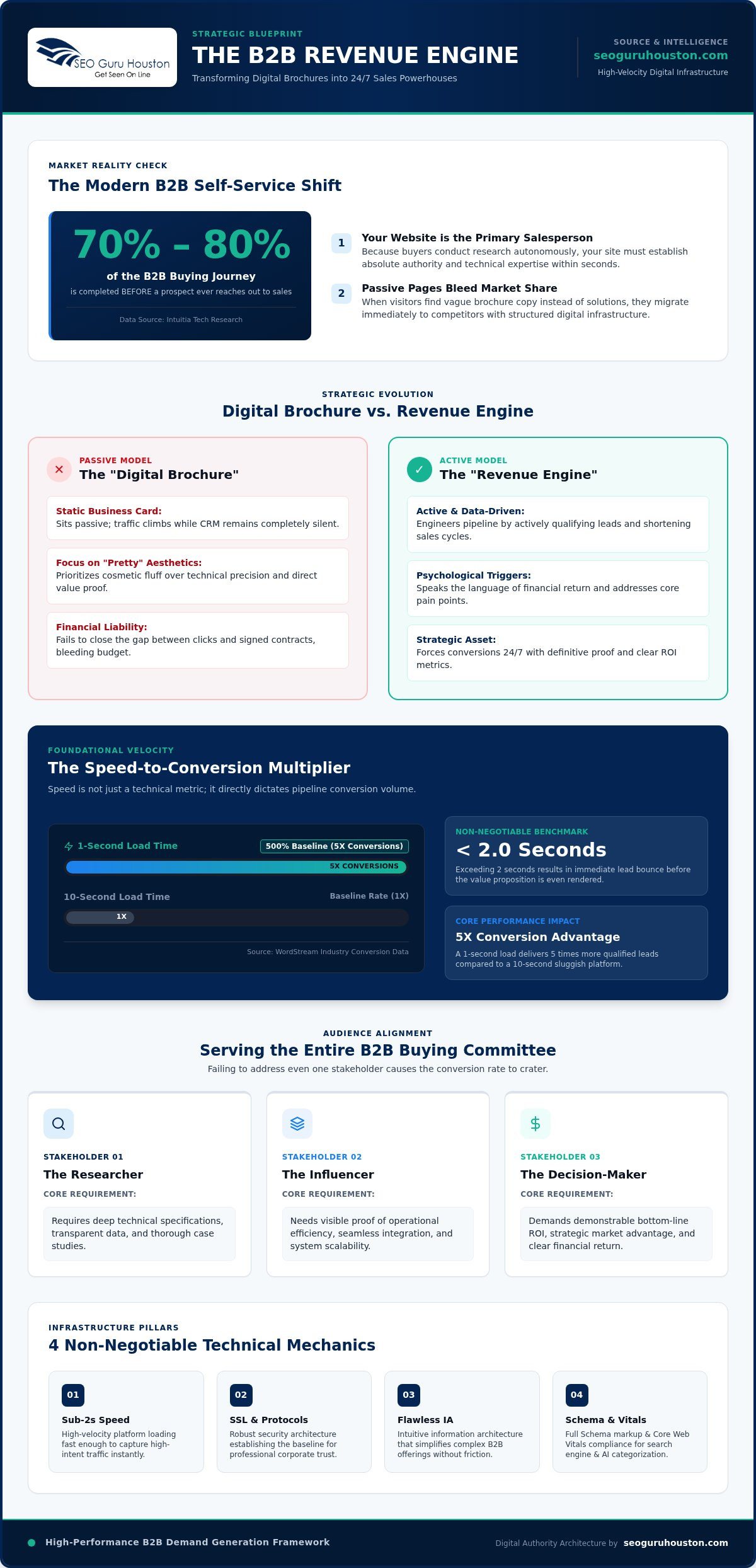
The reality of 2026 is that the buyer has changed. According to research from Intuitia Tech, 70% to 80% of the B2B buying journey is completed before a prospect ever reaches out to your sales team. This means your website is your primary salesperson. It must establish absolute authority within seconds. If a visitor can’t immediately see your technical expertise and strategic advantage, they’ll find it with a competitor who took their digital infrastructure seriously. Dominance isn’t an accident; it’s engineered through a site that speaks the language of results.
The Shift from Passive Presence to Active Demand Generation
Your website needs to do the heavy lifting that used to require a dozen sales calls. We’re moving beyond simple lead collection and into a b2b demand generation agency mindset. This means every page must use psychological triggers to move stakeholders through the funnel. You aren’t just asking them to “Contact Us.” You’re providing the proof they need to justify a high-stakes purchase. A good site qualifies the visitor by addressing pain points directly and presenting a definitive solution that makes your service a fundamental necessity for their survival.
Identifying the Core Stakeholders of Your Digital Presence
You aren’t designing for one person. What makes a good b2b website is its capacity to serve the entire buying committee. You need to provide technical transparency for the researcher, proof of efficiency for the influencer, and clear ROI for the final decision-maker. If you don’t speak the language of financial return, you’re just adding noise to the market. Trust is built through results, not fluff.
- The Researcher: Needs deep technical specs and case studies.
- The Influencer: Needs to see how your solution integrates and scales.
- The Decision-Maker: Needs to see the bottom-line impact and strategic advantage.
Fail to address even one of these stakeholders, and your conversion rate will crater.
Foundational Mechanics: Speed, Security, and Seamless UX
Speed isn’t just a technical metric; it’s a conversion killer. If your site takes more than two seconds to load, you’ve already lost the lead before they even see your value proposition. Data from WordStream shows a B2B site that loads in 1 second can see 5 times more conversions than a site that takes 10 seconds. When you evaluate what makes a good b2b website, you have to look under the hood. High-velocity growth requires a high-velocity platform. Anything less is just an expensive way to frustrate your prospects.
Trust begins with a secure browsing environment. An SSL certificate and robust security protocols aren’t optional extras; they’re the baseline for professional credibility. Beyond security, your information architecture must be flawless. B2B offerings are often complex, but your navigation shouldn’t be. You need to organize your services so intuitively that a decision-maker can find exactly what they need without a map. If your high-performance digital infrastructure isn’t built on these pillars, your marketing efforts will never scale.
Technical Optimization for Search Dominance
Search engines don’t care about your aesthetic; they care about your code. Integrating professional seo services into your initial development is the only way to ensure market dominance. You need Schema markup to help AI and search engines categorize your B2B services accurately. By 2026 standards, hitting the benchmark for Core Web Vitals is mandatory for maintaining visibility. It’s about precision. Your site must be clean, crawlable, and technically superior to every competitor in your space.
User-Centric Design That Drives Action
Friction is the enemy of revenue. We implement the “3-click rule” to ensure any stakeholder can reach critical data or a conversion point within three actions. Your visual hierarchy should act as a silent guide, leading the eye away from fluff and toward high-value declarations. Mobile responsiveness is equally critical, as 80% of B2B buyers now use mobile devices during their purchasing journey. What makes a good b2b website in an enterprise context also includes ADA compliance; accessibility is a standard for national brands that refuse to leave money on the table.
- Sub-2-Second Load Times: The non-negotiable standard for B2B retention.
- Mobile-First Logic: Dominating the 80% of buyers researching on the go.
- UX ROI: Every $1 invested in UX can return up to $100 according to UXtweak research.
Precision in design leads directly to precision in lead volume.
Establishing Absolute Authority Through Strategic B2B Content
Content is the digital manifestation of your expertise. In a market where buyers interact with an average of 13 pieces of content before engaging, your site must act as the ultimate guide. A fluff-filled blog won’t cut it. You need a b2b inbound marketing strategy that attacks specific industry pain points with surgical precision. If your content doesn’t solve a problem, it’s just digital noise. You’re not just providing information; you’re providing a roadmap to market dominance.
When evaluating what makes a good b2b website, look at the depth of its technical resources. White papers, webinars, and deep-dive technical articles aren’t just downloads. They’re proof of technical mastery. These assets serve as the authoritative voice that leads a prospect through the complex consideration stage, turning skepticism into trust through sheer competence. You must position your brand as the only logical choice in a sea of mediocre alternatives.
The Power of Website Video Marketing
Video is the highest-engagement medium available for complex solutions. It humanizes your brand and simplifies intricate industrial processes that text often fails to capture. Strategic Website Video Marketing focuses on placement and purpose. Use high-impact hero videos to establish immediate authority, then follow up with product-specific deep dives for the technical researchers. Video doesn’t just increase time-on-site; it builds immediate credibility by showing your solutions in action. It’s the most efficient way to bridge the gap between technical complexity and buyer understanding.
Case Studies: The Ultimate Proof of Transformation
Stop telling people what you do. Start showing them what you’ve achieved for others. Effective case studies move the needle because they provide social proof grounded in reality. We structure these using a Challenge, Solution, Result framework to ensure the narrative is clear and compelling. Use bold typography and symbols to emphasize financial gains and ROI metrics. A decision-maker doesn’t care about your feature list. They care about the measurable efficiency you delivered for a similar firm. This focus on outcomes is exactly what makes a good b2b website in the eyes of a high-value stakeholder.
Conversion Architecture: Turning Traffic into Qualified Leads
Traffic is vanity; conversions are sanity. If your site generates hits but no hand-raisers, your architecture is broken. Understanding what makes a good b2b website requires looking at how you ask for the business. Passive “Contact Us” buttons are for companies comfortable with second place. You need high-energy declarations that demand action. Research from WordStream indicates that personalized calls-to-action convert 202% better than standard ones. If you aren’t personalizing the ask, you’re leaving double the revenue on the table. It’s time to stop whispering and start leading.
The core of this strategy is high converting landing page design. These aren’t just pages; they are focused environments where distractions go to die. Every element must push the visitor toward a single objective. This is where demand generation happens. You trade high-value intellectual property, such as proprietary data or industrial frameworks, for contact information. This isn’t just a lead magnet; it’s a value exchange that positions you as the expert before the first sales call even happens.
Form optimization requires a ruthless balance. Ask for too much data, and you kill the conversion. Ask for too little, and you waste your sales team’s time with unqualified noise. Use conditional logic to keep forms short while capturing the high-intent data necessary for a sophisticated demand generation strategy. It’s about surgical precision, not just volume. You want a pipeline full of buyers, not browsers.
Strategic CTA Placement and Messaging
Context is everything. A visitor in the awareness stage shouldn’t be hit with a “Buy Now” button. You must map your CTAs to the buyer’s journey. Use urgency and value-driven language like “Secure Your Market Position” instead of generic words like “Download.” A/B testing is the non-negotiable process here. If you aren’t constantly refining your conversion points based on real data, you’re guessing with your company’s future. Stop guessing and start scaling your lead volume with precision.
Trust Signals and Social Proof
Friction is the psychological barrier between a visitor and a form submission. You crush that barrier with trust signals. Client logos, industry certifications, and specific awards are fundamental. They act as silent endorsements. Place your strongest testimonials near high-friction points, like the final field of a lead form. Absolute transparency in your results is your biggest competitive advantage. When you show exactly how you move the needle, you remove the risk of engagement. This level of conversion-focused detail is exactly what makes a good b2b website a dominant force in its industry.
Market Dominance: Building a Future-Proof B2B Presence
Market dominance isn’t a destination; it’s a constant state of evolution. If you treat your digital presence as a “set it and forget it” project, you’re essentially handing your market share to the competition. A stagnant site is a liability that hides revenue leaks you don’t even know exist. What makes a good b2b website in the long term is its ability to adapt based on hard data, not gut feelings. You need to leverage heatmaps and advanced analytics to identify exactly where prospects are falling out of your funnel. When you see the friction, you crush it. Maintenance isn’t just about fixing bugs; it’s about optimizing for a 9,900% UX ROI that forces the market to react to you.
The ultimate goal is a platform that stands as the undisputed leader in your national industry. This requires a shift from simple maintenance to a strategy of continuous improvement. With B2B website maintenance costs ranging from $5,000 to $500,000 annually depending on pipeline complexity, you must ensure every dollar spent is an investment in scalability. You aren’t just building for today; you’re building a fortress that can withstand shifting algorithms and changing buyer behaviors.
Integrating SEO and PPC for Maximum Visibility
Isolation is the enemy of efficiency. Your digital strategy must be a unified front. When you work with a top-tier seo marketing company, they don’t just look at rankings; they align design with search intent. This organic foundation must be supercharged by a sophisticated ppc management strategy. Paid traffic provides immediate data on which keywords actually convert, allowing you to refine your organic content and landing pages with surgical precision. This feedback loop creates a compounding effect, lowering your acquisition costs while expanding your total search footprint. You don’t just want to be found; you want to own the entire results page.
Scaling Your B2B Digital Strategy
Ultimately, what makes a good b2b website is its capacity to scale without breaking. As you move toward international or enterprise-level expansion, your architecture must be ready to handle increased load and complex integrations. 96% of marketers have already adopted agentic AI for autonomous campaign decisions; if your site isn’t technically prepared for this level of automation, you’re already obsolete. You need a high-performance coach who understands these technical nuances and can guide your transition from invisibility to prominence. Stop settling for a site that just exists. It’s time to build a revenue engine that dominates. Take decisive action now and force your competitors to play catch-up.
Dominate Your Market with a High-Velocity Revenue Engine
Your digital presence is the battlefield where market share is won or lost. We’ve established that what makes a good b2b website isn’t just aesthetic appeal; it’s the technical precision of sub-2-second load times and a conversion architecture that forces action. If your site isn’t actively qualifying leads and shortening your sales cycle, it’s a liability you can no longer afford. The 2026 buyer demands a seamless, authority-driven experience. Anything less is an open invitation for your competitors to take the lead.
Transformation requires moving from invisibility to prominence through result-oriented technical mastery. You need a national-scale digital strategy that integrates high-converting funnels with aggressive demand generation. Stop settling for a passive brochure and start engineering a platform that works as hard as your top sales performers. The path to market dominance is clear for those ready to take decisive action. Ready to transform your website into a revenue engine? Contact SEO Guru Houston today! We’re ready to help you scale with precision and win.
Frequently Asked Questions
What is the most important feature of a B2B website?
The most important feature is a conversion-centric architecture that aligns perfectly with the modern self-service buyer journey. While aesthetics matter, your site must prioritize technical performance and clear, outcome-focused messaging to qualify leads effectively. It needs to act as a 24/7 sales engine, providing the specific data and social proof required for stakeholders to make informed decisions. A site that doesn’t force a conversion is just an expensive digital brochure.
How often should a B2B website be redesigned for optimal performance?
A B2B website should undergo a major strategic redesign every two to three years to stay ahead of rapidly shifting digital trends. However, the most successful firms adopt a continuous improvement model, using monthly data from heatmaps and A/B testing to refine the user experience. Waiting years to update your infrastructure creates revenue leaks. You must treat your site as a living asset that evolves alongside agentic AI and changing buyer expectations.
Why is SEO-first development critical for B2B lead generation?
SEO-first development is critical because it ensures your technical infrastructure is crawlable and authoritative from day one. Integrating search optimization into the initial build prevents the need for costly retroactive fixes. When evaluating what makes a good b2b website, technical precision in Schema markup and Core Web Vitals is non-negotiable. This approach guarantees that your high-value content actually reaches the 80% of buyers who conduct independent research before contacting a sales team.
What is the difference between B2B and B2C website design?
The primary difference lies in the complexity of the buyer journey and the number of stakeholders involved. B2C sites focus on emotional, immediate impulse buys, while B2B design must serve a multi-person buying committee with technical depth and financial justification. Your site must speak the language of ROI and long-term strategic advantage. It requires a structured flow that guides researchers, influencers, and decision-makers through a logical sequence of trust-building and technical transparency.
How do I measure the ROI of my B2B website?
Measuring ROI requires looking beyond vanity metrics like page views and focusing on qualified lead volume and pipeline velocity. You must track how many anonymous visitors convert into high-intent hand-raisers and eventually into closed revenue. Use advanced analytics to calculate the cost per lead and compare it to the lifetime value of the customer. A profitable site demonstrates a clear reduction in customer acquisition costs while increasing the total volume of high-margin opportunities.
Does a B2B website really need video marketing?
Video marketing is a fundamental necessity for explaining complex industrial processes and humanizing high-stakes brands. It provides the highest engagement levels of any medium, often increasing time-on-site and building immediate credibility. Strategic video placement, such as hero videos that establish authority or product deep dives, helps bridge the gap between technical complexity and buyer understanding. If you aren’t using video, you’re missing the most efficient way to communicate value to modern, mobile-first stakeholders.
What are the biggest mistakes companies make with their B2B websites?
The biggest mistakes include treating the site as a static brochure, ignoring sub-2-second load times, and using vague, jargon-heavy messaging. Many firms fail to provide clear conversion paths, leaving visitors confused about the next step. Another critical error is ignoring mobile responsiveness, which alienates the 80% of buyers researching on the go. Settling for a passive presence is the ultimate failure when considering what makes a good b2b website in a competitive landscape.
How long does it take to see results from a high-performance B2B site?
Technical improvements like site speed and UX refinements often yield immediate boosts in conversion rates for existing traffic. However, significant organic growth typically takes three to six months as search engines recognize your increased authority and technical precision. For rapid scaling, you should integrate your high-performance site with a robust PPC strategy to drive high-intent traffic instantly. The combination of a dominant platform and aggressive demand generation accelerates your path to market prominence.

