
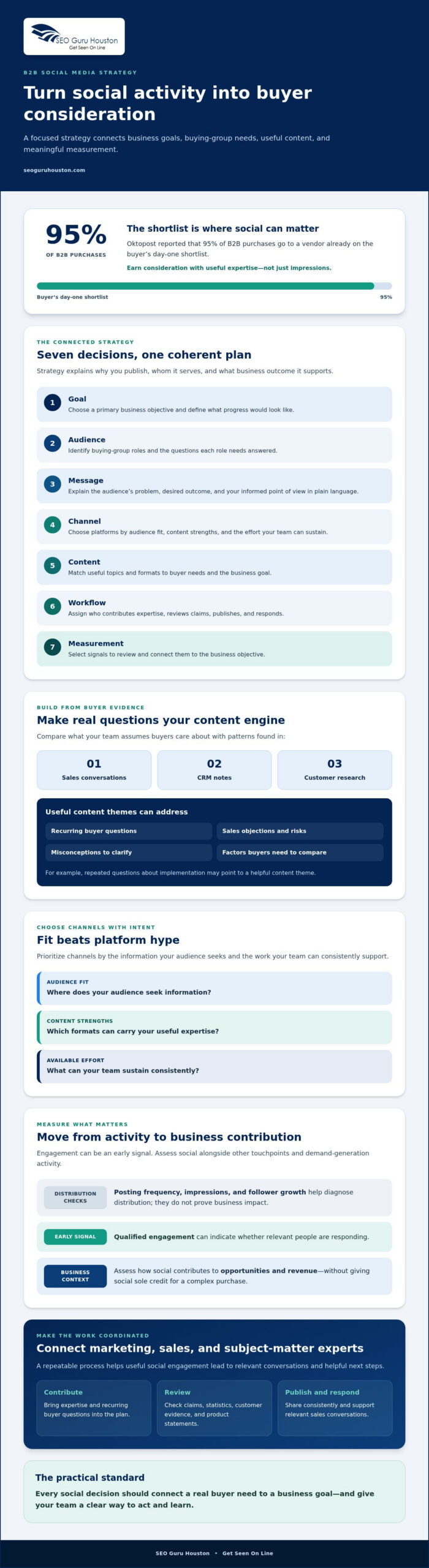
What if your social media presence helped buyers shortlist your company before they ever spoke with sales? Oktopost reported in June 2026 that 95% of B2B purchases go to a vendor already on the buyer’s day-one shortlist. A social media strategy for b2b companies should help earn that consideration, not just collect impressions. Yet it’s easy to spread a small team across too many platforms, publish without a clear audience, and struggle to connect engagement with opportunities or revenue.
You’re right to expect more from social than a steady stream of posts. The challenge is building a focused approach that supports how buying groups research, compare, and validate potential vendors, while giving your team a practical way to create and distribute useful content consistently.
This guide shows you how to prioritize platforms around your audience and business goals, shape an editorial focus, and establish a repeatable content workflow. You’ll also learn how to track meaningful pipeline signals alongside engagement, so you can assess social activity in the context of demand generation and broader digital marketing.
Key Takeaways
- Build a social media strategy for b2b companies around business goals, buying-group needs, and clear measures of success.
- Turn customer questions and sales objections into useful content themes your team can plan and publish consistently.
- Choose channels based on audience fit, content strengths, and available effort, not platform hype.
- Track qualified engagement as an early signal, then assess how social contributes to opportunities and revenue.
- Coordinate marketing, sales, and subject-matter experts so social engagement leads to relevant conversations and helpful next steps.
What a B2B Social Media Strategy Must Accomplish
A social media strategy is more than a decision to post regularly. A B2B social media strategy is a set of connected decisions about business goals, buying groups, channels, content, resources, and measurement that guides how social supports growth. A publishing calendar tells your team what goes out and when. Strategy explains why it matters, whom it serves, and what outcome it should support.
That distinction keeps activity from becoming the goal. Posting frequency, impressions, and follower growth can help diagnose distribution, but they don’t prove social is moving the business forward. Define the outcomes first, such as helping the right buyers discover your company, building trust through useful expertise, supporting consideration, giving sales relevant material for conversations, or staying helpful to existing customers.
Start with business goals and buying-group needs
Choose one primary business objective before selecting platforms or formats. Then map the people involved in a purchase, including decision-makers, influencers, and others who shape evaluation. What do they need to understand? Which objections or risks slow a decision? A social media strategy for b2b companies becomes more focused when it answers real buying questions instead of assuming every audience wants the same message.
Separate assumptions from evidence. Compare what your team thinks buyers care about with patterns in sales conversations, CRM notes, and customer research. If prospects repeatedly ask how implementation works, for example, that may point to a useful content theme. Keep the objective specific enough to guide choices, but broad enough to address the buying group’s different information needs.
Set a realistic role for social media
Social can help buyers discover your expertise, encounter consistent messages, learn about a problem, and find relevant resources. It can also support sales conversations and customer retention when teams share useful, timely information. As a foundation, this overview of social media marketing explains the broader practice; a B2B strategy connects it to a defined audience and business purpose.
Keep expectations grounded. Organic social can influence a complex purchase without being the only source a buyer encounters, so it rarely deserves sole credit for a conversion. Measure its contribution alongside other touchpoints and demand-generation activity. A broader B2B demand generation framework can help show how social fits with channels and follow-up that support demand capture. The aim is not to claim every win for social. It’s to make social’s role clear, useful, and measurable.
Build a B2B Social Media Strategy Around Audience, Message, and Content
Once the business objective is clear, turn it into a plan your team can execute. A strong social media strategy for b2b companies connects what buyers need to know with what your business needs to accomplish. Use this sequence to keep the decisions connected:
- 1. Goal: Choose the primary business objective and define what progress would look like.
- 2. Audience: Identify the buying-group roles you need to reach and the questions each role asks.
- 3. Message: State the audience’s problem, the outcome they want, and your informed point of view in plain language.
- 4. Channel: Select platforms based on where your audience seeks information and which formats your team can sustain.
- 5. Content: Match useful topics and formats to buyer needs and the goal.
- 6. Workflow: Assign who contributes expertise, reviews claims, publishes, and responds.
- 7. Measurement: Decide which signals you’ll review and how they relate to the business objective.
Translate buyer research into a clear message
Make the message specific enough to guide content, but not so broad it could belong to any company. Ask subject-matter experts and sales teams to surface recurring questions, misconceptions, and objections. Then check those ideas against sales conversations, CRM notes, and customer research. A useful post might explain a complex decision factor, address a common concern, or clarify what buyers should compare.
A B2B social content plan should reflect the questions buyers actually ask, so every post helps them make a better-informed decision. Keep claims precise. Verify statistics, customer evidence, and product statements before publishing, and don’t present an illustrative example as a customer result.
Create content pillars and a workable publishing system
Group ideas into a small set of recurring themes tied to audience needs and business priorities. For example, a team might organize content around expert insights, educational resources, customer proof approved for use, and carefully selected material from credible sources. Each type has a different job: original insight builds perspective, education answers questions, verified proof provides evidence, and curation adds useful context.
Choose formats to fit the message, not a trend. Expert commentary can unpack a timely issue; short video can make a process easier to understand; documents can organize a practical checklist; discussion prompts can invite relevant questions. Set a realistic production rhythm, name contributors and reviewers, and repurpose strong ideas thoughtfully rather than posting filler to meet a quota. For a complementary approach to connecting useful content with buyer needs, explore B2B inbound marketing.
Choose B2B Social Media Channels by Buyer Fit, Not Hype
The strongest channel isn’t automatically the one with the loudest buzz or the biggest reported audience. It’s the one your buying group uses for relevant information, where your team can contribute credibly and consistently. LinkedIn can support professional discovery and conversation, but that doesn’t make it the default choice for every B2B buyer. Validate assumptions against customer research, sales feedback, and the channels prospects mention during evaluation.
Assess platform fit before committing resources
Compare each channel against four practical questions: Are decision-makers and influencers there? Does the platform suit the content you can produce well? How much effort will consistent participation require? What business role could it support? The table is a starting point, not a universal ranking. Confirm fit with evidence from your own audience.
| Channel | Potential audience fit | Content fit | Relative effort | Possible goal |
|---|---|---|---|---|
| Buyers who use professional networks for industry information and discussion | Expert commentary, company perspectives, useful documents, conversation prompts | Moderate, with regular input from knowledgeable contributors | Discovery, credibility, and professional conversation | |
| YouTube | Buyers who seek in-depth explanations or demonstrations | Educational explainers, interviews, walkthroughs | High if planning, production, and review exceed team capacity | Education and consideration |
| Reddit or specialist communities | People who seek peer discussion or answers in topic-focused spaces | Detailed responses, practical insights, careful participation | Moderate to high, depending on the research and engagement required | Listening, discovery, and trust through relevant participation |
Effort depends on your team, not just the platform. A subject expert who enjoys explaining technical topics may make video a workable choice; a lean team without production capacity may get more from focused written contributions. Start with a manageable channel set. Expand only when buyer evidence supports it and you can maintain quality without weakening existing efforts.
Match channel roles to the wider buyer journey
Think of social as a route into useful information, not the whole journey. A post can introduce a problem or explain an idea; a relevant resource on your site can provide depth and a clear next step. Coordinate social distribution with search, paid campaigns, and conversion-focused landing pages so each touchpoint supports the same message. For campaign traffic, use the high-converting landing page guide to consider how the destination can support the action you want visitors to take.
Keep testing disciplined: define what evidence would justify continuing, adjusting, or adding a channel. That turns platform selection from guesswork into a practical decision within your social media strategy for b2b companies.
Launch, Measure, and Improve Your B2B Social Media Strategy
A social program becomes measurable when the team agrees on what it’s trying to change and how it will review progress. Use a simple launch sequence to establish that discipline before activity scales:
- 1. Set a baseline. Record current performance for the channels and business indicators tied to your objective. Note how the data is defined and where it comes from.
- 2. Assign ownership. Name who plans content, approves claims, publishes, monitors responses, and shares relevant activity with sales.
- 3. Build the calendar. Schedule themes and formats your team can sustain, leaving room to respond to timely questions and conversations.
- 4. Configure tracking. Use consistent UTM parameters on campaign links where appropriate, and confirm that the destination page and analytics setup can capture relevant visits. Record useful context in CRM records when the process supports it.
- 5. Set a review cadence. Choose a regular interval for checking early signals and a longer window for assessing outcomes that take time to develop.
- 6. Iterate with evidence. Keep what supports the objective, refine what shows promise, and stop activity that consumes effort without a clear role.
Choose KPIs that reflect the strategy’s objective
Match a small set of indicators to the goal, then define the measurement period and what counts. Qualified comments, relevant conversations, resource visits, or responses from target roles can serve as leading indicators. Reach and engagement help diagnose whether content is being seen and prompting a response, but they don’t automatically demonstrate pipeline contribution.
Opportunities, progression through CRM stages, and revenue are lagging outcomes. Review these alongside campaign data and sales feedback where available. UTM parameters can identify some visits or conversions associated with tagged links, but they can’t capture every influence: buyers may see a post, discuss it internally, and return through another channel. Social reporting can show contribution and patterns, but it isn’t proof that social alone generated the revenue.
Run focused experiments and adjust the plan
Test one meaningful variable at a time, such as the audience, format, message, or call to action. Write down the hypothesis, observation window, result, and decision before repeating the test. If you change several elements at once, it’s harder to tell what affected the outcome.
Use Google Analytics 4 and CRM reporting only when they’re configured, relevant to the question, and verified by your team. Keep measurement practical. If your team needs support connecting social media marketing with broader demand generation, explore coordinated marketing support.
Turn Your B2B Social Media Strategy Into Coordinated Demand Generation
Social earns more value when it connects to what happens next. A useful post can introduce a challenge, an educational resource can help a buyer explore it, and a sales conversation can address the questions that follow. Treat each interaction as part of a connected path, not a demand-generation result on its own.
Connect social content to a useful next step
Match the call to action to the reader’s readiness. Someone encountering your company for the first time may benefit from an educational guide; a buyer comparing options may need a detailed resource or a relevant conversation with your team. Avoid asking every reader for the same commitment. The next step should feel like a logical continuation of the content.
Make sure the destination page delivers on the post’s promise. It should clearly identify who the resource is for, what the visitor will find, and what they can do next. Coordinate social campaigns with inbound marketing so posts, useful resources, and follow-up support a consistent experience instead of treating every post as a standalone lead generator.
Make the handoff clear
Set expectations for what happens when someone engages. Marketing can identify relevant interactions and share context; sales can decide whether a direct response is appropriate; subject-matter experts can clarify technical questions or contribute accurate answers. Define who owns each handoff and what information to pass along, such as the content viewed, the question asked, or the buyer’s stated need. A timely, relevant response builds on the interaction without assuming every like or comment signals purchase intent.
Before assigning ownership, check your internal capacity across strategy, creative, publishing, analytics, and subject expertise. Keep the work in-house where responsibilities and time are clear. If coordinating channels or interpreting measurement exceeds that capacity, outside support may help align social media marketing with B2B marketing, demand generation, PPC, and website or landing-page services. The agency offers these services as potential parts of a coordinated digital approach.
Use this action checklist
- Connect each content theme to a buyer need and a business priority.
- Choose a next step that fits the reader’s readiness, then make the destination page clear and relevant.
- Agree on how marketing, sales, and subject-matter experts will route and respond to meaningful engagement.
- Review ownership and capacity before expanding channels or publishing commitments.
- Assess social alongside other demand-generation activity, without assigning it sole credit for a complex conversion.
Ready to connect social activity with a broader B2B marketing plan? Build a stronger B2B digital marketing strategy with support aligned to your business goals.
Turn Your Social Strategy Into Measurable Momentum
A focused social media strategy for b2b companies starts with business goals and buyer needs, then turns them into channel choices and useful content your team can sustain. Prioritize platforms based on evidence, not hype. Measure qualified engagement as an early signal, then review how social activity connects with opportunities and revenue without claiming sole credit for complex buying decisions.
The next step is coordination. Connect social posts to relevant resources, align marketing and sales on useful follow-up, and make sure each channel supports the wider demand-generation journey. If your team needs help bringing those pieces together, the agency offers social media marketing, B2B marketing, demand generation, SEO, PPC, website development, and landing-page capabilities that can support a coordinated digital approach.
Build a stronger B2B digital marketing strategy around your audience and business goals. Start with a clear objective, keep learning from buyer signals, and give your team a practical plan to move forward with confidence.
Frequently Asked Questions
What is a social media strategy for a B2B company?
A B2B social media strategy connects business objectives with buyer audiences, channel choices, messaging, content, team responsibilities, and measurement. It defines what social should help accomplish and how the company will assess progress. Unlike a posting calendar, it explains why the company publishes, whom it serves, and how social supports the wider buying journey. For example, a strategy might use expert content to answer buyer concerns and guide interested readers to a relevant resource.
Which social media platform is best for B2B companies?
There’s no single best platform for every B2B company. LinkedIn may suit professional conversations and business-focused content, while YouTube may fit audiences that prefer video explanations. Other channels can make sense if buyers use them to research relevant topics. Choose based on evidence about your audience, the content your team can produce credibly, your business goals, and available capacity. Test assumptions with a focused effort before committing substantial resources to a channel.
How often should a B2B company post on social media?
Post at a pace your team can sustain while keeping content useful and relevant. The right frequency depends on audience expectations, available resources, and how much time it takes to create and review quality content. Set a realistic cadence rather than publishing simply to fill a calendar. Then assess whether the schedule helps you reach the intended audience and learn from performance. Adjust if consistency begins to compromise quality or strain team capacity.
How do B2B companies measure social media strategy results?
Start with the strategy’s objective, then choose a small set of indicators that show progress. Reach and engagement can reveal whether content attracts attention, while qualified visits, conversions, CRM activity, and sales feedback add business context. Use consistent tracking, including UTM parameters on campaign links where appropriate. Attribution has limits: social may influence a long buying journey without being the only measurable source. Review patterns across channels instead of assigning every outcome to one post.
Can social media generate leads for B2B companies?
Yes, social can contribute to B2B lead generation by helping relevant buyers discover useful expertise and take a meaningful next step. Its contribution depends on audience fit, messaging, content, the destination experience, and follow-up. Not every interaction indicates purchase intent, and not every lead is ready for sales. Define qualification criteria, connect campaign posts to relevant landing pages, and make sure appropriate CRM processes help your team track and respond to interest.
What content should B2B companies post on social media?
Share content that answers genuine buyer questions and demonstrates useful expertise. Options include expert commentary, educational resources, product or service explanations, short videos, event insights, and customer evidence when its facts are verified and use is approved. Organize topics into a few recurring themes tied to audience needs. Match each post’s format and next step to its purpose, and avoid unsupported claims. A practical explanation of a common sales objection can be more useful than a generic promotional update.
How long does it take for a B2B social media strategy to work?
There’s no universal timeline for a B2B social media strategy to work. Timing depends on your starting audience, sales cycle, content quality, publishing consistency, and ability to distribute content and follow up. Qualified engagement may show up before measurable pipeline influence. Establish a baseline, set review periods that reflect your buying cycle, and look for trends across activity rather than judging the plan by one post. Use what you learn to refine the strategy over time.

