
What if your ad reports showed more than clicks and impressions? For companies investing in paid search management with SEO Guru Houston, the goal is to connect campaigns with qualified leads and sales, not simply keep ads running. Ad spend can climb while the business impact stays unclear. That’s a reason to look beyond activity and examine what happens after the click.
Effective oversight turns paid search into a measurable acquisition system. It connects targeting, search terms, bidding, conversion tracking, and landing pages, then uses performance data to guide ongoing decisions. The aim is not to treat every click as a win, but to learn which parts of the campaign contribute to business goals.
This article explains what ongoing paid search management involves, which metrics can show whether campaigns are advancing business goals, and how strategy and landing-page experience shape results. A useful report should help answer practical questions: Are the right prospects finding you? Are they taking action? Are those actions valuable to the business? With a coordinated approach, paid search becomes easier to evaluate, refine, and align with the outcomes your business needs.
Key Takeaways
- Paid search management goes beyond launching ads: ongoing oversight connects campaign strategy, measurement, and optimization to business goals.
- Align campaign objectives with the action you want customers to take, such as submitting a qualified inquiry or making a purchase.
- Clicks and impressions show activity, but conversion and return measures help reveal whether campaigns are delivering meaningful business results.
- Prepare for paid search management houston by clarifying your goals, target customers, offer, conversion path, and measurement access.
- Relevant ads and well-matched landing pages work together to turn search intent into a stronger opportunity to convert.
What Paid Search Management Does Beyond Launching Ads
Launching an ad is a starting point, not a strategy. Paid search management is the ongoing work of planning campaigns, monitoring delivery, measuring results, and refining decisions so advertising supports a business objective. Effective paid search management houston connects each step, from the searches a campaign targets to the action a visitor takes after clicking.
A campaign can attract attention and still miss its goal. The offer may not match what people are searching for, tracking may fail to record meaningful actions, or the landing page may not address a visitor’s needs. Competition can also affect visibility. Management considers these factors together rather than treating clicks as the finish line.
What tasks are included in paid search management?
Ongoing oversight turns campaign data into practical decisions. Work commonly includes:
- Planning and structure: Organize campaigns around business goals, search intent, and the actions you want visitors to take.
- Targeting and messaging: Select relevant keywords and audiences, then shape ad copy around the searcher’s needs and the offer.
- Monitoring and refinement: Review search terms, monitor budget use, adjust bids, and test campaign elements to identify opportunities and reduce irrelevant traffic.
- Measurement: Use conversion tracking to understand which interactions matter and guide adjustments to targeting, ads, and budget priorities.
For example, if a campaign receives clicks but few qualified inquiries, increasing spend may not solve the problem. Reviewing search terms, ad promises, tracking, and the landing-page experience can show where the path to conversion is breaking down.
How is paid search different from SEO?
Paid search places ads in search results through advertising platforms, while SEO works to earn visibility in unpaid organic listings. Paid campaigns can begin serving after setup and platform approval, but placement does not guarantee qualified traffic or business results. SEO builds organic visibility over time through work on a site’s content and search presence.
The approaches can complement each other. Paid search data can show which queries attract relevant prospects, while organic performance can reveal topics and pages worth strengthening. Together, those signals can inform acquisition planning across channels. For broader context on how paid advertising fits into search marketing, see What is Search Engine Marketing (SEM)?
How Paid Search Campaign Management Works From Strategy to Optimization
A strong campaign follows a clear cycle: define the business outcome, build around search intent, launch with reliable measurement, and refine based on evidence. For paid search management houston, that process also means accounting for target customers, the offer, and campaign constraints before committing budget.
How does campaign setup establish a useful baseline?
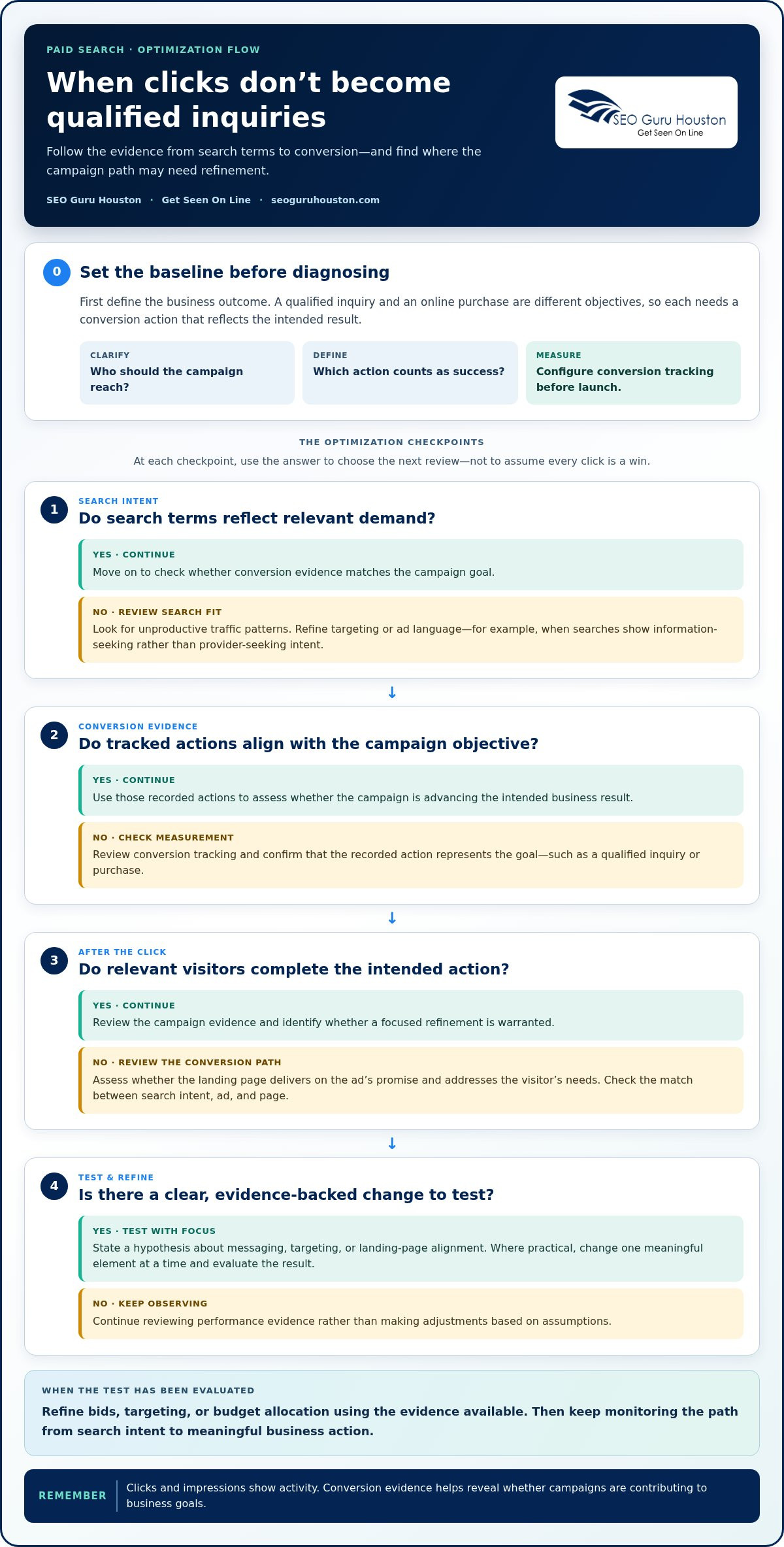
Setup should create a meaningful starting point, not just a collection of ads. First clarify who the campaign needs to reach, which action counts as success, and what limits or priorities will shape delivery. A qualified inquiry and an online purchase are different objectives, so each needs a conversion action that reflects the intended business result.
Next, organize keywords into related search themes. Someone looking for a specific service may have different intent from someone researching a general problem. Grouping those searches helps match ad messaging to what the person is seeking and directs visitors to a relevant page. Configure conversion measurement before launch so later decisions rely on recorded actions, not clicks alone.
What happens during ongoing campaign optimization?
Once ads are running, the management cycle turns observations into testable changes. A practical workflow includes:
- Review search terms: Identify queries that reflect relevant demand and patterns that attract unproductive traffic.
- Check conversion evidence: Assess whether tracked actions align with the campaign objective and business priorities.
- Test a focused change: Form a clear hypothesis about ad messaging, targeting, or landing-page alignment, then evaluate the result.
- Refine delivery: Adjust bids, targeting, or budget allocation based on the evidence available, not assumptions.
For example, if a service campaign draws searches from people seeking information rather than a provider, search-term findings may point to a need to refine targeting or ad language. If relevant visitors click but don’t complete the intended action, assess whether the landing page delivers on the ad’s promise. Where practical, change one meaningful element at a time so the impact is easier to interpret.
This is why campaign objectives need a business lens. The Strategic Objectives of Paid Search Advertising resource from Harvard Business Review offers further perspective on connecting paid search decisions with performance measures and customer value. SEO Guru Houston provides data-driven PPC campaign management that connects targeting, measurement, and optimization to growth objectives.
Which Paid Search Metrics Reveal Performance, and Which Can Mislead?
A campaign report can look busy without showing whether advertising is helping the business grow. Impressions, clicks, and click-through rate describe activity and engagement. To assess impact, connect those signals to conversions, lead quality, sales, and return. For paid search management houston, the right metrics depend on the campaign goal and how reliably outcomes are tracked.
Use this framework to separate activity from efficiency and business results:
| Metric group | What to review | What it can tell you |
|---|---|---|
| Activity | Impressions, clicks, click-through rate (CTR) | Whether ads are appearing and attracting clicks. These metrics don’t prove visitors are qualified or generating revenue. |
| Efficiency | Conversions, cost per conversion | Whether tracked actions are happening and how much ad spend is associated with each action. |
| Business outcomes | Lead quality, sales, return measures | Whether conversions contribute to valuable opportunities, revenue, or other business goals. |
How should businesses interpret clicks, conversions, and cost per lead?
A click is a visit from an ad. A conversion is a tracked action, such as a form submission or call. Cost per lead compares campaign spend with the number of leads recorded. Each metric answers a different question. A lower cost per lead may still indicate weak performance if fewer leads are qualified or progress to sales. Set targets using your business economics, not a universal benchmark.
Why do tracking and attribution matter?
Tracking connects online actions to campaign reporting; attribution helps interpret which interactions receive credit. Missing events can hide real inquiries, while duplicated events can inflate conversion totals. Before reacting to a performance change, confirm that forms and calls are recorded consistently and represent genuine business outcomes. Resources from the Paid Search Association can offer additional industry context, but validated business data should guide campaign decisions.
Platform metrics are useful signals, not the whole scorecard. Review them alongside sales-team feedback and lead outcomes. If clicks rise but qualified opportunities don’t, investigate search intent, the offer, and the path from ad to inquiry before increasing investment. Reliable measurement turns reporting into a decision tool, so campaign changes reflect business impact rather than surface-level activity.
How to Prepare Your Business for Better Paid Search Management
Campaigns are easier to steer when the business can clearly define what success looks like. Before launching, gather the decisions and access needed to connect advertising with real customer outcomes. This preparation gives a paid search strategy a stronger foundation, but it can’t guarantee campaign performance. Demand, competition, the offer, and the visitor experience all influence results.
What should you define before campaigns begin?
Use this checklist to turn business priorities into practical campaign inputs:
- Business goal: Decide whether the campaign should drive qualified inquiries, purchases, or another meaningful action. Specify how that outcome will be recorded.
- Best-fit customer: Describe the customers most likely to benefit, including the needs or search intent that signal a strong fit.
- Service priorities and offer: Identify which services or products deserve focus and what makes the offer relevant to the intended audience.
- Conversion path: Map the next step after an ad click, such as completing a form, calling, or making a purchase. Make sure the business can assess the quality of those outcomes.
- Measurement access: Ensure campaign managers can access the relevant advertising and measurement tools, along with the business feedback needed to evaluate lead or sales quality.
Keep the ad and landing page aligned. If an ad promises information about a specific service, the destination should make that service easy to understand and provide a clear next step. A mismatch creates friction: the visitor clicks with one expectation, then lands on a page that doesn’t address it. A useful landing page continues the conversation started by the search and ad.
How can businesses assess campaign progress responsibly?
Set review criteria before results come in. Compare performance with the original objective, and allow enough time to gather evidence that supports a sound decision. A short-term change in clicks or leads may not show whether the campaign is improving, weakening, or experiencing normal variation.
Check measurement consistency before interpreting a shift. If reported form submissions change, first determine whether tracking still records them correctly. Then consider other explanations, such as changes in search demand, targeting, or the offer. Separate measurement problems from actual campaign performance.
Make each review answer a specific question: Are the inquiries a good fit? Does the landing page support the ad’s promise? Is the campaign reaching the intended customers? Prioritize a test that addresses the clearest gap, then assess the evidence before making another change. This disciplined approach helps paid search management houston stay connected to business priorities instead of reactive guesswork.
Explore data-driven paid search management to align campaign strategy, measurement, and conversion paths.
How SEO Guru Houston Connects Paid Search Management to Business Growth
Paid search should support a business goal, not operate as a separate stream of clicks. SEO Guru Houston’s PPC services use targeted, data-driven advertising to attract qualified traffic and evaluate campaign performance against meaningful conversion actions. Campaign decisions can focus on what the business needs, whether that’s relevant inquiries, purchase activity, or another defined outcome.
For paid search management houston, the connection between targeting, measurement, and the customer’s next step matters. Search terms reveal intent. Ad messaging responds to that intent. Conversion data helps show whether the resulting traffic contributes to business priorities. This approach makes campaign performance easier to assess and gives optimization a clearer purpose.
How can PPC and landing pages work together?
The post-click experience completes the path that begins in search. A person searches for a solution, sees an ad that speaks to that need, then expects the landing page to deliver on the ad’s promise. When the message and page align, visitors can understand the offer and find the next step more easily. When they don’t, even relevant traffic may lose momentum.
SEO Guru Houston’s website development and landing page design services can support that journey alongside PPC. A useful landing page makes the offer clear, answers relevant questions, and guides visitors toward the intended conversion action. For more ideas on the page experience, explore the published guide to high-converting landing page design.
When reviewing how ads and a website work together, identify where prospects lose momentum and which conversion actions matter most to the business.
What is the next step toward a more accountable campaign?
Start with three practical inputs: your growth goal, how you currently measure campaign outcomes, and the offerings that deserve priority. Clarify what makes an inquiry qualified or a sale valuable. Those details help connect campaign decisions to the results the business actually needs.
SEO Guru Houston brings PPC and demand generation together as connected growth support. Campaign insights can inform how the business attracts and engages prospects, while measurement helps keep the work accountable to defined objectives. The focus is not activity for its own sake. It’s a clearer path from search intent to meaningful action.
Explore paid search services and discuss your campaign objectives.
Make Every Search Campaign More Accountable
Paid search works best as an ongoing growth process, not a one-time ad launch. Clear objectives, relevant targeting, and dependable conversion tracking help connect campaign decisions to qualified inquiries, sales, and other outcomes that matter. Clicks and impressions are signals of activity, not proof of business impact.
For paid search management houston, the path from search to conversion deserves attention at every step. SEO Guru Houston provides targeted PPC services designed to drive qualified traffic, while website development and landing page design can support the experience after a visitor clicks. When ad messaging, measurement, and the landing page work toward the same goal, it’s easier to evaluate what contributes to growth.
Ready to connect your campaigns with your business priorities? Explore SEO Guru Houston’s paid search services and take a practical next step toward a more focused acquisition strategy. Clear goals and thoughtful optimization help make ad spend a stronger engine for growth.
Frequently Asked Questions
What is paid search management?
Paid search management is the ongoing work of planning, running, measuring, and improving ads that appear in search results. It can include campaign structure, keyword targeting, ad messaging, budget oversight, conversion tracking, and performance analysis. The goal is to align advertising with business objectives, such as qualified inquiries or purchases. Results depend on factors including the offer, competition, audience, tracking accuracy, and website experience.
How does paid search management improve campaign performance?
Paid search management creates a regular process for checking whether campaigns reach the intended audience and generate meaningful actions. Reviewing search terms can reveal irrelevant traffic, while testing ad messaging can show whether it resonates with prospective customers. Teams can also assess conversion tracking and adjust targeting or budget based on evidence. These practices support better-informed decisions, but they can’t guarantee a specific result.
Is paid search the same as PPC?
Paid search and PPC are closely related, but they describe different things. Paid search refers to advertising placements in search results. Pay-per-click describes a common pricing model where an advertiser pays when someone clicks an ad. Paid search campaigns are often managed through PPC platforms. To evaluate a campaign’s value, look beyond clicks and consider relevant conversions and business outcomes, such as qualified leads or sales.
Which metrics should I track in paid search campaigns?
Track metrics that connect campaign activity to your business goals. Impressions show how often ads appear, and clicks indicate visits from those ads. Conversions record whether visitors complete a defined action. Cost per conversion and lead quality add context about efficiency and usefulness. For a sales-focused campaign, connect advertising data to revenue where tracking allows. The right measures depend on what counts as valuable for your business.
Can paid search work without a dedicated landing page?
Yes, paid search can use an existing page, provided it matches the ad and makes the next step clear. A relevant service page may work if it addresses the visitor’s query and supports conversion. A dedicated landing page can offer a more focused experience for a specific audience or offer. Review page relevance, usability, and measurement to determine whether the destination supports the campaign’s objective.
How long does paid search take to show results?
Ads may begin serving after setup and platform approval, but meaningful evaluation takes longer than seeing initial clicks. Reliable tracking and enough relevant activity are needed to identify useful patterns. Timing varies with budget, competition, search demand, conversion volume, and the sales cycle. Avoid judging performance from early activity alone. Instead, assess progress against agreed business outcomes using consistent, dependable data.
Should I manage paid search in-house or work with an agency?
The right approach depends on your team’s expertise, available time, campaign complexity, and reporting needs. In-house management keeps campaign work close to the business, while an agency can provide dedicated strategy and ongoing optimization. Either approach needs clear goals, dependable conversion tracking, and feedback on lead quality. Evaluate the process by how well it connects campaign activity with business outcomes, not by clicks or reports alone.

