
The DIY SEO vs hiring a professional decision doesn’t have to be permanent. You can begin with the work your team can manage, then bring in professional support as your site, competition, or workload grows, or shift more tasks in-house when your needs change.
Compare the time, expertise, and ongoing effort each approach requires, not just the upfront spend. Your team may be able to handle basic content and on-page tasks, while technical SEO, competitive strategy, and link building can call for specialist knowledge. Either way, search visibility takes consistent work, and rankings are never guaranteed.
This guide compares the time, expertise, and potential returns involved in DIY SEO versus hiring a professional, so you can choose an approach that fits your business. You’ll learn when in-house SEO is practical, where professional support can help, and how a hybrid approach can keep work moving without making your team responsible for everything.
Key Takeaways
- Choose DIY, professional support, or a hybrid approach based on your team’s skills, available time, and SEO priorities.
- Factor in the opportunity cost of the hours your team spends learning, planning, and executing SEO.
- Consider professional expertise for complex technical work, competitive strategy, and link building.
- Set realistic expectations: SEO takes sustained effort, and meaningful returns may take time to develop.
- You can shift between in-house and professional support as your business needs and capabilities change.
DIY SEO vs Hiring a Professional: Which Is Right for You?
DIY SEO can suit businesses with time for basic content and on-page tasks, while technical work may require specialist expertise. Mistakes with link building, website migrations, or robots.txt settings can suppress rankings for months. A provider using outdated tactics can also put search visibility at risk.
Benefits and Risks of Hiring an SEO
A professional can bring experience in technical SEO, competitive strategy, schema, link building, and conversion tracking. That differs from DIY work, where the business owner handles research and execution alongside other responsibilities. The tradeoff is reliance on the provider’s judgment: outdated tactics or poorly managed site changes can cause setbacks, so clear reporting and access controls matter.
DIY SEO Learning Curve and Challenges
DIY SEO gives your business direct control over content and priorities, but learning search engine optimization takes time and experimentation. SEO covers on-page, off-page, and technical work. Your team may manage blog posts or image alt text, then reach a point where diagnosing crawling issues or planning for a competitive search market requires more expertise.
DIY Mistakes and Search Penalties
DIY errors can do more than limit opportunities. Poor link building, migration mistakes, or an incorrect robots.txt setting can suppress rankings for months. Tactics that conflict with Google’s published SEO guidelines can also put visibility at risk. These problems may be difficult to diagnose without technical experience or a clear record of site changes.
Hiring help changes the risks, but does not remove them. A provider using outdated methods or making poorly documented changes can create problems your business must resolve. No SEO provider can guarantee a number-one Google ranking. Assess the strategy, work, and reporting rather than a promised position.
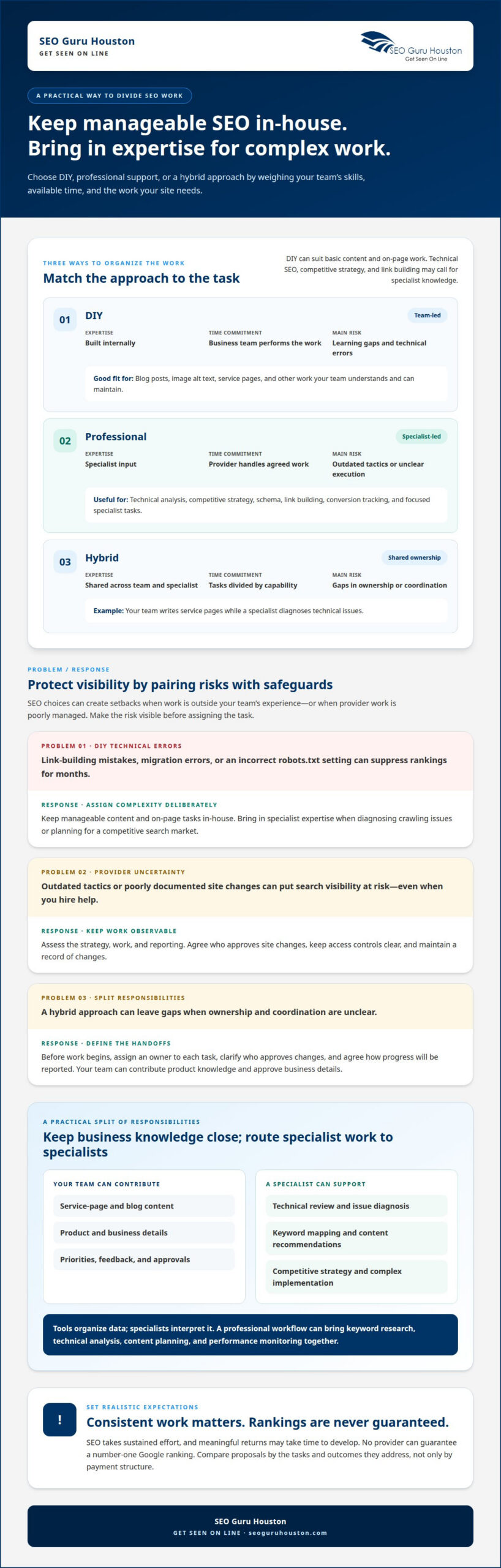
| Option | Expertise | Time commitment | Main risk |
|---|---|---|---|
| DIY | Built internally | Business team performs the work | Learning gaps and technical errors |
| Professional | Specialist input | Provider handles agreed work | Outdated tactics or unclear execution |
| Hybrid | Shared across team and specialist | Tasks divided by capability | Gaps in ownership or coordination |
For example, a small business might write service pages in-house and ask a specialist to diagnose technical issues. This keeps content close to the business while assigning complex work to someone with relevant experience. Before work begins, agree on who approves site changes, who owns each task, and how progress will be reported.
Choose an approach that fits your team’s expertise and capacity: keep manageable content tasks in-house, use professional support for complex technical work, or combine the two with clear ownership.
Agency expertise, tools, and time savings
A professional can bring specialized SEO knowledge and a repeatable process, while DIY work keeps execution with your team. The right fit depends on the tasks involved and the effort your staff can sustain. For example, a business with strong writing capacity may create content in-house and assign technical analysis to a specialist.
Agency Expertise and Tools
A professional SEO workflow can bring keyword research, technical analysis, content planning, and performance monitoring together. Tools organize data; specialists interpret it. They can connect a drop in search visibility with a site change and prioritize what to investigate. Compared with DIY work, professional support adds focused experience and capacity, while your team retains control over priorities and approvals.
Agency Costs and Niche Knowledge
Professional SEO services can be structured around ongoing work, defined projects, or specific tasks. The right scope depends on what your business needs, such as continued optimization or a focused review. A specialist familiar with your field may understand customer language and search intent faster, but the workload still depends on your site, competition, and implementation needs.
Compare proposals by the work they include, not only by their payment structure. A business facing technical problems may need analysis and implementation, while another may need keyword mapping and content recommendations. The scope, specialist experience, and level of support determine what the engagement involves. Keep the comparison focused on the outcomes and tasks each proposal addresses.
Professional support can save internal time by shifting research, analysis, and implementation to people focused on SEO. For example, a specialist can coordinate keyword mapping, page recommendations, technical review, and reporting, while your staff contributes product knowledge and approves business details. This can reduce internal workload, but still depends on timely feedback and accurate information from your team.
Agencies also differ in niche knowledge and how they deliver work. A firm familiar with a complex B2B buying journey may plan content differently from one focused on local service searches. Clarify deliverables, ownership of technical changes, and how progress will be reported. Clear responsibilities help prevent recommendations from getting separated from implementation.
A freelancer may suit a defined task, such as preparing a content plan, while an agency can coordinate several disciplines under a broader scope. DIY SEO remains practical for work your team understands and can maintain. A hybrid approach assigns routine content to your staff and specialist analysis or implementation to professional support.
If SEO recommendations require substantial site changes, website development and landing pages can be part of the broader implementation picture. Choose a model by matching the work required to the expertise and time your team can reliably provide.
The opportunity cost of business owners’ time
For a small business, DIY SEO can include creating useful content, improving pages, maintaining a Google Business Profile, and monitoring performance. It also means learning SEO and addressing technical problems as they arise. The practical question is whether your team can sustain those tasks alongside running the business.
A professional can handle technical SEO, strategy, link building, schema work, citation management, and conversion tracking. Local SEO work can include reviewing a Google Business Profile’s categories and details, improving its description, and aligning it with relevant local pages. This helps connect profile and page information with nearby customer searches.
Time is the hidden cost. Those figures illustrate how to value time, not a universal business calculation. The relevant comparison is what those hours could produce elsewhere.
Owners may spend 15 to 20 hours a week learning SEO updates or correcting technical errors. If that effort delays sales follow-up, service delivery, or hiring, the true tradeoff includes missed attention to core operations.
For DIY work, the suggested availability is 10-15 hours per month for learning and execution. That time can support a small, focused plan, such as publishing local service content and maintaining profile details. If technical fixes repeatedly interrupt that schedule, professional support can take over complex work while the owner stays involved in business-specific content.
A small local business may handle much of its SEO when competition is limited and its needs are straightforward. Basic on-page optimization, a well-maintained Google Business Profile, and consistent local content can support visibility in a defined geographic area. Greater competition, a site migration, or persistent technical issues can make professional support more practical.
Google changes how search results appear, so local SEO requires ongoing attention rather than a one-time profile setup. A professional can connect profile information, local landing pages, and conversion tracking, then use performance data to prioritize improvements. For example, your business can assess whether search visits lead to calls or form inquiries.
Make the decision practical: list the SEO tasks, estimate the hours they require, and identify which ones your team can handle consistently. Keep content or profile updates in-house when they fit available capacity. Assign technical diagnosis and strategy to a professional when they take time away from customer service or sales.
SEO budget and return-on-investment timelines
Set an SEO budget based on the work your business needs, the team available to support it, and the outcomes you plan to measure. Compare the scope and responsibilities alongside the investment.
DIY SEO may show initial progress within a few months, with more substantial improvements in 6-12 months. Measurable SEO return on investment typically takes 6 to 12 months, so compare approaches over a meaningful period rather than judging them by early ranking changes alone.
Professional SEO Budget and Commitment
Professional SEO works best as a sustained effort, not a series of disconnected changes. A commitment of at least 6-12 months allows time for implementation and evaluation. If a full retainer does not fit your budget, consider a one-time audit or hourly consultation, then prioritize recommendations by business impact and available internal capacity.
Professional SEO proposals can differ in technical scope, deliverables, reporting, and implementation responsibilities. Compare what each one actually covers. One may provide technical recommendations, while another may also handle implementation and ongoing content planning. Match the proposed work to your site’s needs, competition, and team skills rather than treating the payment structure as a measure of value.
Before committing, map proposed tasks to a business goal. A local service business might prioritize qualified inquiries, while a B2B company may focus on leads that fit its sales process. This makes it easier to judge whether the work and reporting align with the marketing outcome you need.
DIY and Professional SEO Timelines
DIY work can start immediately, but progress depends on consistent execution and your team’s ability to set priorities. Professional support follows the same search engine processes, with specialists focused on planning and implementation. Either way, results depend on your site’s condition, competition, and how quickly agreed changes are completed.
When comparing proposals, connect each deliverable to a business objective, such as qualified leads or sales inquiries. Check whether the scope explains implementation, reporting, and how progress will be measured. A proposal focused only on rankings may not show whether search traffic contributes to business goals.
| Approach | Budget consideration | Timeline consideration | Best fit |
|---|---|---|---|
| DIY SEO | Staff time, learning, and execution | Progress relies on consistent internal effort | Teams with relevant skills and capacity |
| Professional SEO | Scope, expertise, and agreed deliverables | Ongoing work supports measurement over time | Businesses needing specialist execution |
| Hybrid SEO | Internal ownership plus targeted expertise | Timing depends on task division | Teams able to manage selected tasks |
Set a baseline before work begins by recording organic traffic, leads, and conversions. Review these alongside ranking and visibility changes. For example, a service business can track whether organic visits lead to calls or form submissions, then use the results to refine priorities.
Align your plan with the skills available in-house. A team confident in content can keep that work while assigning technical fixes or strategy to a professional. Choose an approach that connects a realistic budget, clear responsibilities, and measurable marketing goals.
Benefits of hiring an SEO professional
A professional can turn scattered SEO tasks into a plan tied to business goals. For example, an SEO specialist can match a keyword to the page that best answers its search intent, then identify whether the page needs stronger content, technical SEO, or clearer conversion paths. This connects organic visibility with the actions your business wants visitors to take.
Specialist review can uncover technical SEO obstacles that are easy to miss during routine content work. A professional can examine crawling, indexing, site structure, and page performance, then prioritize potential fixes. During a website redesign, early SEO input can help preserve useful URLs and shape search-friendly page structures.
SEO strategy also benefits from a wider view of search competition. A professional can compare your pages with customer questions, identify content gaps, and recommend which topics to address first. For instance, a company with several similar service pages may need clearer distinctions so each page serves a different search intent.
Specialists can coordinate sustained work such as link building, citation management, schema, and conversion tracking. These tasks involve different processes and ways to measure progress. A professional can connect technical changes or content updates with performance data, helping your business see which work supports organic traffic and qualified inquiries.
Hiring help does not mean handing over every decision. Your business still provides accurate service details, customer insights, and approval for important changes. Define who handles content, who implements technical recommendations, and how results are reported. For example, your team can provide subject expertise while a specialist structures pages around relevant keywords.
Professional support can be especially useful when SEO intersects with another business project. A site migration, new service launch, or move into a competitive niche can affect page structure and organic visibility. Bringing SEO into planning helps teams account for search needs before changes go live, rather than treating optimization as a repair job afterward.
Useful reporting explains actions and outcomes, not just ranking screenshots. A professional can track organic visits, leads, and conversions alongside keyword movement, then adjust priorities based on those signals. Since no provider can guarantee a number-one Google ranking, clear explanations of the work and its purpose matter more than promises about position.
For a website project that needs search-focused structure, discuss SEO-ready website development as part of the planning process. A professional’s value comes from aligning technical decisions, content, and measurement with the business’s goals.
SEO Guru Houston
SEO Guru Houston helps businesses nationwide decide where professional support can strengthen their search strategy and where internal work can continue. Its comprehensive SEO services address companies that need expert direction and execution, while PPC management, B2B marketing, and inbound marketing strategies can support broader digital growth goals for any market.
Consider professional help when technical work, competition, or limited team capacity is slowing progress. A focused conversation can clarify your priorities, current approach, and the work that fits your business, without requiring you to hand over every SEO task. Your team can contribute the business knowledge and content only it can provide.
For a next step, contact SEO Guru Houston to discuss your SEO needs.
Make your next SEO move with purpose
The right SEO approach can change as your business grows. Treat the choice between DIY SEO and hiring a professional as flexible: keep work your team handles well, and bring in expertise when strategy or implementation requires more capacity.
Before choosing your next step, identify the outcome that matters most, such as stronger organic visibility, more qualified leads, or better support for a B2B sales process. Then align the work with that goal. SEO Guru Houston offers Houston SEO Services, Houston PPC Services, and Houston B2B Marketing to support businesses pursuing those outcomes.
You don’t need to solve every search challenge alone or outsource every task. Start with a clear priority, a realistic division of responsibilities, and a plan to measure business impact. Contact SEO Guru Houston to discuss an approach that fits your goals. Build momentum one informed decision at a time.
Frequently Asked Questions
Can I switch from DIY to an agency later on, or vice versa?
Yes. You can change your approach as your team’s needs and skills evolve. If you move from DIY work to professional support, share a record of site changes, content plans, and performance tracking. If work moves in-house, document active projects, account access, and outstanding recommendations. A clear handoff helps preserve continuity and reduce duplicated or missed tasks.
Do you need an SEO?
SEO is relevant when people use search engines to find the products or services your business provides and you want your site to appear for relevant queries. The right level of support depends on your goals and internal capacity. For example, a business with a new website may need strategic direction, while an established team may need help diagnosing an indexing issue.
SEO Agency or DIY SEO: Which Path to Higher Rankings?
Neither approach guarantees higher rankings. The stronger choice is the one that consistently addresses your site’s needs. DIY work can fit a team with relevant skills and time, while a professional can bring experience in strategy and implementation. Look beyond rankings: qualified organic visits, useful engagement, and inquiries can show whether search visibility supports business goals.
Should You Consider an SEO Agency?
Consider professional support if search work has stalled, your team cannot diagnose a technical issue, or a major website change is approaching. Before a redesign, for example, SEO input can help preserve important pages and plan redirects. A professional can also coordinate content and technical recommendations when several people or teams contribute to the website.
Should You Hire an SEO Expert vs DIY?
Hire an SEO professional when a task requires experience your team lacks or when trial and error could disrupt important pages. Keep straightforward work in-house if your staff understands the subject and can maintain it. A practical split might have a specialist review site architecture while your team supplies accurate product details and approves customer-facing language.
So What’s the Best Choice for Your SEO?
The best approach is one your business can sustain and evaluate. Identify the current bottleneck, whether it is strategy, technical implementation, content, or reporting. Then assign the work to someone with the right skills and capacity. A business with strong subject knowledge but limited technical expertise may benefit from shared ownership rather than an all-in-house or all-external approach.
How much does DIY SEO cost a business?
Google does not charge for a website to appear in organic search results, but DIY SEO still uses resources. Your business may pay for tools or courses, and employees spend time learning, planning, and completing tasks. For a clearer estimate, list the work involved, identify any paid resources, and account for staff time that could otherwise go to sales, service, or operations.
How much do SEO agencies and consultants charge in the United States?
The scope and support involved in professional SEO work depend on your site, competition, and business priorities. Compare proposals by their deliverables, such as technical analysis, content planning, implementation, and reporting. Match that work to your needs rather than judging its value by the payment structure alone.

