
Which average B2B marketing budget should leadership trust when credible 2026 benchmarks disagree? Gartner puts marketing at 7.8% of company revenue, while The CMO Survey reports 9.0%. That gap reflects differences in survey populations and definitions, not a simple right-or-wrong answer. A revenue percentage alone can’t show whether your budget fits your growth targets, business model, or profitability goals.
You still need a defensible starting point, especially when leadership expects marketing spend to contribute to qualified demand and sales. This article explains what the available B2B benchmarks measure, why they vary, and how to build a budget around your priorities and resources. It also covers how to assess SEO, PPC, and other channel investments using clear goals, conversion tracking, and reporting. Treat averages as context, not a spending rule. The right plan connects investment to measurable business outcomes.
Key Takeaways
- Use the average b2b marketing budget as a reference point, not a target to copy. Benchmark figures depend on who was surveyed and what spending they include.
- Start with growth goals, sales priorities, and internal capacity before deciding how much to invest.
- Match SEO, PPC, content, social media, and website work to audience intent and each channel’s role in the buying journey.
- Make investments accountable with clear goals, owners, tracking, and a regular review cadence.
- Consider where external SEO, PPC, or demand-generation expertise can extend your team’s capacity and support measurable progress.
Why the Average B2B Marketing Budget Is a Starting Point, Not a Target
The average b2b marketing budget can frame a planning conversation, but it can’t tell your company exactly what to spend. A B2B marketing budget is the planned investment in activities that support awareness, demand, and sales. It can cover far more than advertising, including employees, agency support, media, content, marketing technology, research, and website work.
That distinction matters. Total marketing investment and an advertising budget are not interchangeable. Advertising usually refers to paid placements, while a broader marketing budget may also include the people and resources needed to plan, create, distribute, and measure marketing. Before comparing benchmarks, check what each one counts. One study may include staff and technology; another may focus on media or a narrower set of costs. The percentages can look comparable while measuring different spending baskets.
What belongs in a B2B marketing budget?
Organize costs into six practical groups: personnel, external services, media, content, tools, and research. Personnel covers the internal team; external services can include agency or specialist support. Media covers paid placements, while content includes planning and production. Tools support marketing work, and research helps teams understand markets and buyers. Grouping costs this way makes gaps visible and helps you compare like with like.
Then separate committed operating costs from flexible campaign investment. Salaries, ongoing services, and essential tools may be difficult to change quickly. Campaigns, production projects, and media levels may offer more room to adjust. The distinction depends on your contracts and operating plan, so label each item rather than assuming every cost can be shifted.
Why B2B budgets need business context
B2B buying can involve extended evaluation and several stakeholders, but the process varies by sale. The nature of Business marketing (B2B) depends on the target market and how organizations buy. Your category, sales cycle, company stage, and growth ambition all affect which comparison is useful. An industry average can’t account for these differences on its own.
Start with the outcome. A company entering a market may need to build awareness and create demand. A business focused on retention may prioritize customer communication and expansion opportunities. A team pursuing efficiency may concentrate on conversion and measuring channel contribution. These goals don’t dictate fixed allocations, but they do change the job marketing needs to do.
Check capacity before increasing investment. If sales can follow up on more qualified inquiries, additional demand may support the plan. If sales coverage or delivery capacity is constrained, more lead volume may not translate into progress. Set the budget against what the business can pursue and serve, then assess whether marketing is helping advance that goal.
An average is a reference point, not a company-specific spending recommendation. Use it to ask better questions about scope, ambition, and capacity, then build a plan around the outcomes your organization needs.
Average B2B Marketing Budget Benchmarks: What the Available Figures Say
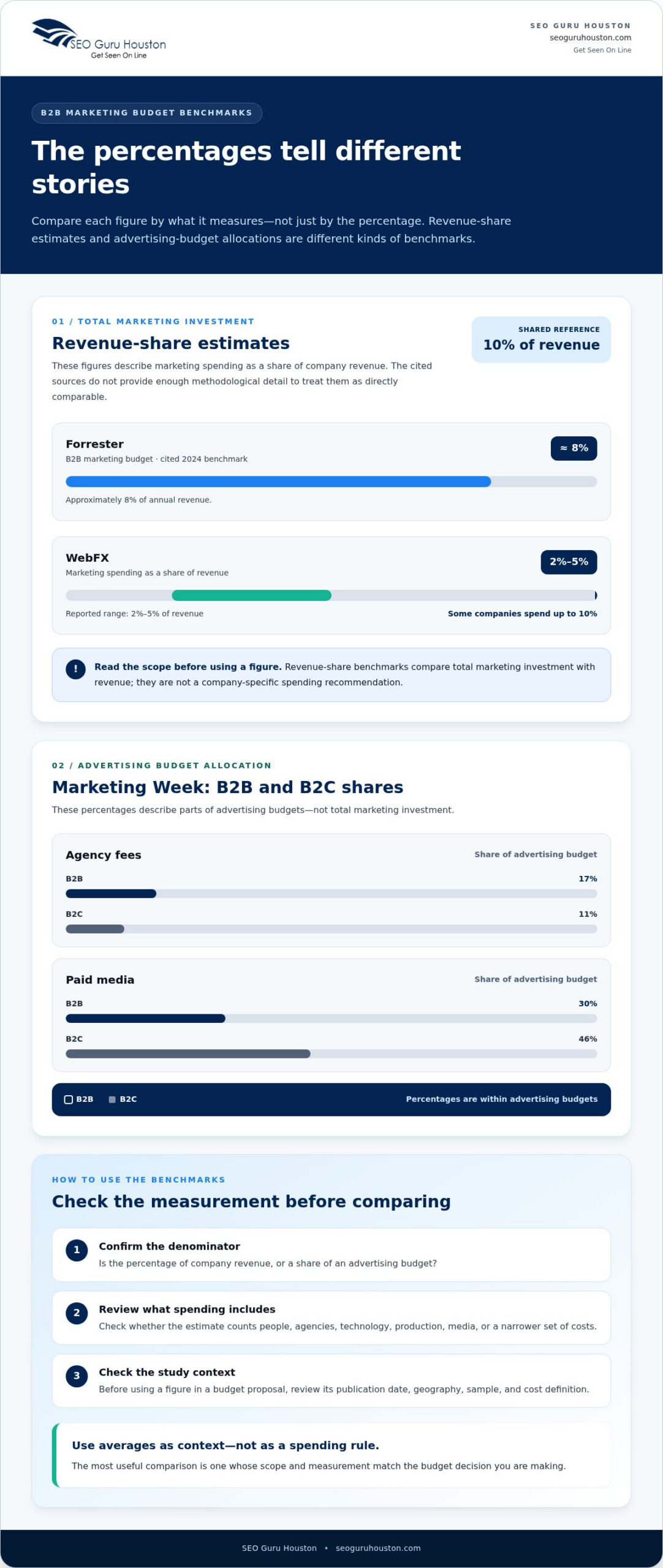
Published estimates can look like competing answers to one question, but they may measure different things. The average b2b marketing budget figures below are useful reference points when you understand their scope. The cited estimates include a Forrester figure and ranges attributed to WebFX, but they don’t provide enough methodological detail to treat them as directly comparable.
| Source | Budget definition | Reported measure |
|---|---|---|
| Forrester | B2B marketing budget as a share of annual revenue | Approximately 8% of revenue, 2024 benchmark |
| WebFX | Marketing spending as a share of revenue | 2%-5% of revenue, with some companies spending up to 10% |
| Marketing Week | Parts of advertising budgets, not total marketing investment | Agency fees: 17% B2B versus 11% B2C; paid media: 30% B2B versus 46% B2C |
How much do B2B companies spend on marketing?
The estimates cited here range from 2%-5% of revenue in the WebFX range, with some companies spending up to 10%, to approximately 8% in Forrester’s cited 2024 B2B benchmark. Don’t combine them into a new average or treat them as universal targets. Before using a figure in a budget proposal, review the original study’s publication date, geography, sample, and definition of included costs. The Forrester’s B2B Marketing Budget for 2026 report offers a current planning reference, but it shouldn’t be treated as proof of a separate historical estimate.
Keep the denominator in view. A revenue-share benchmark compares marketing investment with company revenue. A channel-allocation percentage describes how a marketing or advertising budget is divided. Revenue-share benchmarks describe total investment relative to revenue; channel-allocation percentages describe how a budget is distributed. Marketing Week’s agency-fee and paid-media figures belong in the second category, not beside total-budget estimates as if they measured the same thing.
Why published averages can point in different directions
Differences may reflect the study year, geography, company size, industry mix, or included costs. A survey of large enterprises may not describe smaller firms. A measure focused on advertising won’t capture the same spending as one that includes people, agencies, technology, and production. Check each source’s definition rather than assuming that a label such as “marketing budget” means the same thing across studies.
Use each estimate to frame questions, not settle the decision. If you’re translating a benchmark into a plan, SEO Guru Houston’s B2B marketing services connect channel choices with qualified demand and measurable outcomes.
How to Set a B2B Marketing Budget That Fits Your Growth Goals
Build the budget from the business plan, not from a percentage copied from another company. The average b2b marketing budget can offer context, but your investment needs to reflect what the business is trying to achieve, what it can support, and how marketing’s contribution will be measured. A clear process gives leadership a rationale for spending and a way to adjust the plan as conditions change.
Translate business goals into marketing requirements
Start by naming the outcome: more qualified pipeline, stronger visibility in a target market, improved lead-generation efficiency, or support for retention. Then map marketing’s role across the buying journey, from initial discovery to sales conversations. Consider sales follow-up capacity before creating more demand. If the team can’t respond to or progress additional qualified inquiries, increasing lead volume alone may not advance the goal.
- Define outcomes. Set business and sales objectives, then identify the marketing contribution that can support them. Separate outcomes such as qualified demand from activity measures such as campaign reach.
- Assess capacity. Review internal skills, available time, sales follow-up, and delivery constraints. Note which work the team can handle and where agency or specialist support may help.
- Model investment. Estimate the people, services, media, content, and tools required for each activity. Record assumptions so leadership can see what the plan depends on.
- Allocate resources. Protect essential commitments, then direct flexible campaign investment toward priorities with a clear role in the plan. Avoid spreading resources across channels without a reason.
- Review and adjust. Set review points and use campaign reporting and conversion tracking to assess progress. Revise the plan when evidence, business priorities, or available capacity changes.
Build and review a budget model
Separate fixed commitments from adjustable investment in your working model. Recurring personnel, agency services, or essential tools may need to be planned differently from campaign tests or media that can be scaled. For each line, record its purpose, owner, expected contribution, and assumptions. This makes trade-offs visible and shows leadership what must stay funded and what can be tested or changed.
Use scenarios to prepare for different levels of ambition without assuming one is automatically right. A conservative scenario protects core commitments and limits new tests. A planned scenario funds the activities required to meet agreed priorities. A growth-focused scenario expands validated work only where marketing and sales can support the added demand. Compare each scenario against resources and outcomes, not just its headline total.
A sound marketing budget connects business goals to available capacity and measurable outcomes. Review assumptions on a set cadence, then use conversion tracking and reporting to decide what to continue, refine, or pause. The result is a plan leadership can evaluate and adapt, not a static figure chosen because it matches an industry average.
How to Allocate B2B Marketing Spend Across Channels and Measurement
Channel budgets work best when each investment has a defined job in the buying journey. Don’t divide spend evenly just to appear balanced. Use audience intent, buying stage, internal resources, and sales priorities to decide which channels need investment and what evidence will guide future decisions. The average b2b marketing budget won’t tell you whether your business needs more visibility, paid search, or stronger conversion paths.
Match investment to the job each channel must do
Think in roles, not a fixed channel formula. SEO can support visibility for relevant searches through keyword research and on-page work. SEO Guru Houston’s monthly SEO service includes keyword research, meta-data alteration, front-page content consultation, internal text-link review, Google Analytics implementation, and ranking/status reporting. PPC can reach people searching for specific solutions. SEO Guru Houston’s PPC service includes keyword bidding, ad placement to the right of search results, geographic targeting, conversion tracking, and reporting. Changes to PPC ads or keywords have an immediate effect. The service also includes campaign creation, ad copy optimization, keyword targeting, ongoing account management, and monthly calls. Advertisers pay for PPC when a user clicks an ad.
Content marketing can answer buyer questions and support evaluation, while social media can distribute ideas and keep a brand visible to its audience. Website and landing-page work gives interested prospects a clear next step and a focused place to learn or submit an inquiry.
Choose channels based on what buyers need at each stage. If prospects are actively searching, SEO and PPC may support discovery. If they need to understand a complex offer, useful content and a well-structured website can help them evaluate it. If a channel creates attention but there’s no suitable follow-up, revisit the plan before increasing its budget. For more detail on planning paid search, use this PPC management planning guide.
Measure outcomes without mistaking activity for impact
Track the path from investment to business result, but keep the stages distinct. Spend is the resource committed; impressions indicate exposure; traffic records visits; conversions capture defined actions; qualified leads reflect fit and sales relevance; and sales outcomes show progress beyond marketing response. A high number at one stage doesn’t automatically prove success at the next.
Use consistent definitions and reporting periods across channels. Agree on what counts as a conversion and a qualified lead, then review campaign tracking alongside sales feedback. Conversion tracking shows which interactions are recorded, while reporting helps compare activity and outcomes over time. Neither guarantees that every sale can be attributed to one channel; B2B buyers may encounter multiple touchpoints before speaking with sales.
Marketing Week’s comparison reports agency fees at 17% for B2B versus 11% for B2C, and paid media at 30% for B2B versus 46% for B2C. These figures describe portions of advertising budgets, not total marketing budgets or a recommended allocation. Read them as a reminder to scrutinize the balance between agency support, production, and media reach, then base your own mix on audience response and business objectives.
A channel plan needs qualified-demand goals, clear measurement, and the capacity to act on results. SEO Guru Houston’s B2B demand generation services connect channel roles with a broader growth plan.
Turn Your B2B Marketing Budget Into an Accountable Growth Plan
A budget becomes useful when every investment has a purpose, an owner, and a way to assess progress. Bring the plan together in one working document that connects business goals to channel roles and the resources needed to execute. This gives leadership a clear basis for review and gives marketing and sales a shared view of what the investment is meant to support.
For each priority, record:
- Goal: The business outcome marketing is expected to support.
- Channel role: How SEO, PPC, content, or lead-capture work contributes.
- Owner and assumptions: Who is responsible, what resources are required, and what the plan depends on.
- Measures and cadence: Which indicators will be tracked, who reviews them, and when adjustments will be considered.
Set measures that fit the goal. A visibility initiative and a lead-generation campaign won’t necessarily use the same success indicators. Agree on definitions with sales, track conversions, and review qualified demand alongside campaign activity. This makes it easier to spot where follow-up, channel execution, or the original assumption needs attention, without treating every result as attributable to one touchpoint.
What accountability should look like
Accountability is a regular working rhythm, not a report filed away after a campaign. SEO Guru Houston’s PPC service includes account management, monthly calls, conversion tracking, and reporting. Use these touchpoints to review progress against shared goals, discuss what tracking shows, and align next steps. Clear measurement supports better decisions, but it doesn’t guarantee rankings, a specific return, or a set volume of leads.
Where SEO Guru Houston can support execution
External expertise can help when internal capacity, channel knowledge, or execution time limits the plan. SEO Guru Houston connects keyword research, SEO, PPC, and lead-capture tactics to agreed marketing goals. Its professional team provides account management, conversion tracking, and reporting, with work aligned to increasing visibility and generating qualified leads. This B2B demand generation agency guide offers more context on connecting demand-generation activity to business priorities.
Experience provides context, not a promise of a particular outcome. SEO Guru Houston has completed 950+ completed projects, including 100+ B2B and B2C projects, and brings 12+ years of experience. Treat these proof points as background when considering whether outside execution support fits your plan, not as a forecast of results for your company.
Keep the plan active. If priorities change, capacity tightens, or reporting points to a different opportunity, revisit channel roles and assumptions rather than letting the budget run on autopilot. SEO Guru Houston’s results-focused B2B marketing services support planning grounded in goals, tracking, and accountable execution.
Make Your Next Budget Decision Count
Your next step isn’t to defend a number because it matches the average b2b marketing budget. Make the logic behind your investment easy to see: what the business needs, what marketing will do, and how the team will judge progress. That clarity turns budget conversations from requests for spend into decisions about priorities and execution.
Choose one business objective to anchor the plan. Confirm who owns each marketing activity, what sales needs to follow through, and when you’ll review the evidence. If the plan depends on new capabilities or additional execution capacity, identify that before campaigns are underway. Small, deliberate adjustments grounded in reporting can keep investment aligned as priorities shift.
SEO Guru Houston brings professional account management, conversion tracking, and reporting to marketing execution, supported by experience across B2B and B2C projects. Put your priorities into a plan built around measurable progress. Build a results-focused B2B marketing plan.
Frequently Asked Questions
What is the average B2B marketing budget as a percentage of revenue?
There isn’t one universal percentage for the average b2b marketing budget. The cited Forrester 2024 B2B benchmark is approximately 8%, while the WebFX range is 2%-5%, with some companies spending up to 10%. These are revenue-share estimates, not instructions. Before applying one, review the original study’s sample, geography, date, and included costs. Use it as context alongside your company’s goals and resources.
How much should a B2B company spend on marketing?
Set the amount by working backward from the outcomes the business needs and the activities required to support them. For example, if the priority is entering a new market, identify the research, visibility, and sales-support work involved before deciding what to fund. Document assumptions, separate ongoing commitments from adjustable campaigns, and agree on review measures. This gives leadership a rationale for revisiting the plan if priorities or capacity shift.
Is a revenue-based B2B marketing budget reliable?
Revenue is a useful reference, but it can’t account for every company’s growth goals, margins, market conditions, or past campaign performance. A business protecting profitability may make different choices from one investing to expand, even at a similar revenue level. Use the calculation as one planning input, then assess whether the proposed investment fits financial priorities and the company’s ability to convert demand.
What should a B2B marketing budget include?
Define the budget’s boundaries before comparing it with another company’s plan. Depending on the reporting method, it may include internal staffing, agency services, paid media, content production, research, and marketing tools. A media-only figure won’t reflect the resources needed to create campaigns or assess their performance. Label each category and clarify whether a figure represents total marketing investment or advertising spend, so decision-makers can interpret it correctly.
How should B2B marketing spend be divided between paid media and agency fees?
Don’t copy an allocation ratio without checking what it measures and whether it fits your objectives. Marketing Week reports B2B figures for agency fees and paid media, but these describe portions of advertising budgets, not a universal formula for total marketing spend. Consider the work your team can handle, the reach needed, production requirements, and how results will be assessed. Revisit the mix when campaign evidence or business needs change.
How do you measure whether a B2B marketing budget is working?
Agree on the business outcome and measurement definitions before launching work. Then evaluate indicators in context: a rise in website visits, for example, matters more if those visits lead to relevant inquiries and sales conversations. Track results across consistent reporting periods and compare campaign data with sales feedback. B2B buyers may interact with several channels, so attribution can be incomplete. Treat reported contribution as evidence for decisions, not automatic proof of cause.
Should a B2B business hire a marketing agency or build an in-house team?
Choose based on the skills, workload, and execution needs your plan creates. An in-house team may suit work that needs close day-to-day coordination, while an external agency can add specialist capacity or support campaigns the team can’t manage internally. Compare responsibilities, not just team labels: who will shape strategy, manage channels, track conversions, and report progress? A blended arrangement can also work if ownership and decision-making are clear.

