
What if the keyword with the fewest searches could bring in your best-fit customer? In B2B, search volume alone can’t tell you whether a query reflects casual curiosity or a buyer actively comparing solutions. A useful b2b keyword research guide starts with buyer intent and business value, not a spreadsheet sorted from most searches to least.
Keyword research that connects to your products and sales process is worth the effort. But multiple decision-makers, long buying cycles, and varied customer language can make it hard to know which topics deserve your team’s time. A repeatable process helps connect search terms to buyer needs and qualified pipeline.
This guide explains how to gather ideas from search data and customer conversations, assess intent and business relevance, and organize keywords by funnel stage. You’ll also learn how to prioritize topics, turn your keyword map into useful content and conversion-focused pages, and measure whether your strategy is attracting the right audience. The goal isn’t more traffic for its own sake. It’s search visibility that supports demand generation and gives buyers a clearer path to evaluate your solution.
Key Takeaways
- Use your products, customer problems, differentiators, and sales-team language to build a keyword list grounded in real buyer needs.
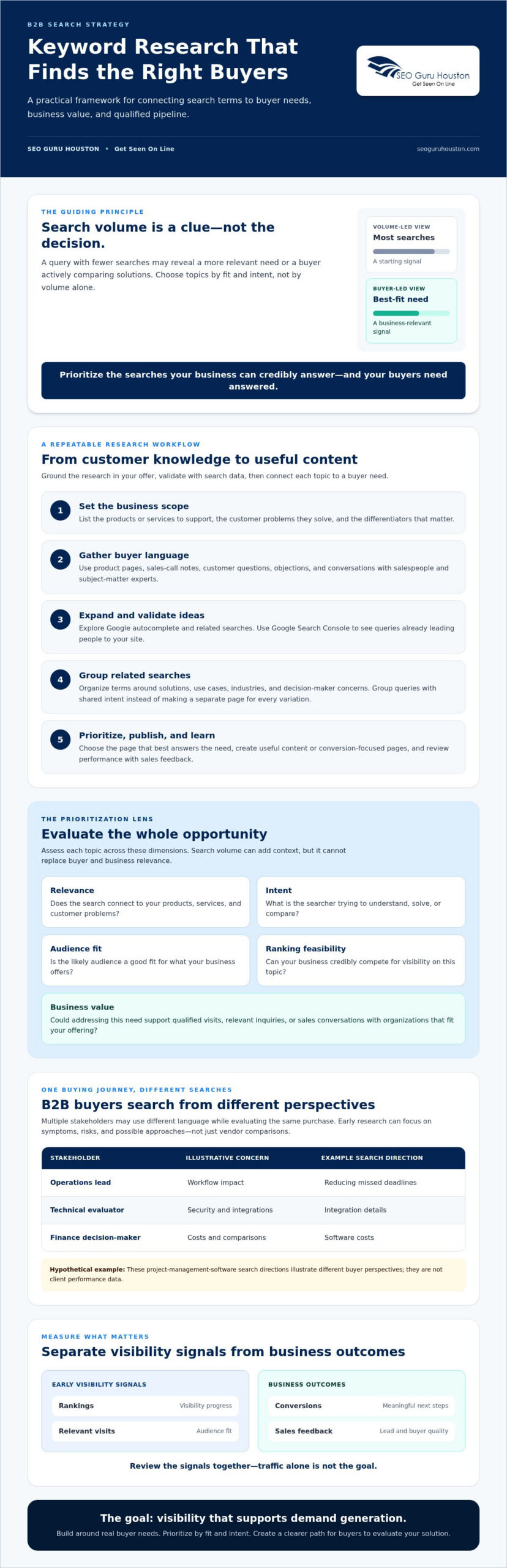
- This b2b keyword research guide shows how to assess terms by relevance, intent, audience fit, ranking feasibility, and business value, not search volume alone.
- Group related queries by shared intent and choose the page that best answers the buyer’s need instead of creating a separate page for every variation.
- Turn prioritized topics into content and conversion-focused pages that support search visibility and demand generation.
- Review rankings, relevant visits, conversions, and sales feedback together. Distinguish early visibility signals from business outcomes.
What B2B keyword research reveals about your buyers and market
B2B keyword research is the process of discovering and evaluating the searches business buyers use, then connecting those searches to customer needs and company goals. Put simply, B2B keyword research identifies relevant searches, interprets the intent behind them, and prioritizes the ones that support business objectives. That’s the difference between collecting terms and building a strategy.
A keyword tool can estimate how often people search a phrase, but that estimate doesn’t tell you who’s searching, what problem they’re trying to solve, or whether your business can help. A broad, high-volume query may attract students or people looking for general information. A lower-volume phrase describing a specific operational challenge could signal a better-fit prospect. Use volume as context, not as a verdict. Foundational concepts such as Keyword research explain how terms and search intent relate, but B2B research must also account for your products and sales process.
How B2B keyword research differs from consumer keyword research
One business purchase can involve several stakeholders, each searching from a different perspective. A technical evaluator might look for integration details, a department leader may investigate workflow impact, and a finance decision-maker may compare total costs. Their searches may look unrelated in a keyword export, yet all can belong to the same buying journey. B2B consideration can also begin well before vendor comparisons, with queries focused on symptoms, risks, and possible approaches.
Hypothetical example: A company considering project management software might have an operations lead searching for ways to reduce missed deadlines, an IT specialist checking security and integrations, and a finance leader comparing software costs. These are illustrative searches, not client performance data. Research that captures only “project management software” misses the distinct questions shaping the purchase.
Which business outcomes should keyword research support?
Start with outcomes the business can act on, such as qualified organic visits, relevant inquiries, and sales conversations with organizations that fit your offering. Raw impressions can show that a page appeared in search results, but they don’t establish whether the right audience engaged or took a meaningful next step.
SEO and demand generation can use the same research for different purposes. SEO can use intent and topic relevance to guide search-focused pages and content. Demand generation can use buyer questions to shape educational materials and conversion-focused landing pages across the journey. Together, they help teams decide what to publish and what to measure. A practical b2b keyword research guide asks not only “How many searches?” but also “Who needs this, why now, and what business goal does the answer support?”
How to conduct B2B keyword research step by step
A reliable workflow starts with what your business knows, then uses search data to test and expand that knowledge. This keeps the research connected to your offer instead of letting a tool dictate your content plan. Use these steps to create a keyword set your team can explain, validate, and act on.
Build seed topics from business and customer knowledge
- Set the business scope. List the products or services you want to support, the customer problems they address, and the differentiators that matter. This gives the research a clear boundary.
- Gather buyer language. Review product pages, sales call notes, customer questions, and common objections. Ask salespeople and subject-matter experts how buyers describe their challenges, desired outcomes, and concerns. Customer conversations can reveal ideas that tools may not surface. Neil Patel’s overview of B2B keyword research also emphasizes looking beyond volume to buyer intent and real-world language.
- Group the seed topics. Organize phrases around solutions, use cases, industries, and decision-maker concerns. For example, a cybersecurity provider might separate topics about cloud access controls from questions about compliance reporting or implementation. Keep the initial list focused on areas your business can credibly address.
Expand and validate keyword ideas
- Find query variations. Use Google autocomplete and related searches to discover how people phrase questions. Google Search Console can show queries that already lead people to your site, while keyword platforms can suggest additional terms and estimate search demand. Treat each source as research input, not an instruction.
- Check the live results. Search important phrases and examine what appears. Are results mostly explainers, comparison pages, product pages, or something else? The format and focus of ranking pages offer clues about the intent Google currently associates with a query. Compare that intent with the buyer need you identified.
- Validate and document. Remove terms that don’t fit your offer or audience, flag uncertain assumptions, and note which topics need more input from customers or the sales team. Record each keyword’s source, research date, and intended audience or stage. This makes the work easier to reproduce and refresh.
This b2b keyword research guide process turns scattered ideas into a defensible working list. From there, connect your research to the wider marketing plan. For a broader view of how keyword insights can support demand generation, explore B2B demand generation strategies.
How to prioritize B2B keywords beyond search volume
Search volume is an estimate, not a forecast of qualified traffic or revenue. Use it to understand potential demand, but don’t let it outweigh whether a query matches your offering and the people you serve. A specific, lower-volume search can deserve priority if it reflects a clear business need your company can credibly address.
Compare candidate terms against the same criteria. The example below is hypothetical, not performance data. Ratings are directional, so document your team’s reasoning rather than treating them as universal scores.
| Criteria | “Project management software” | “Project management software for engineering teams” |
|---|---|---|
| Relevance | Broad category match | Strong if the offer serves engineering teams |
| Intent | Could be research or evaluation | More specific solution exploration |
| Audience fit | Unclear without more context | Defined audience, if it matches the target market |
| Ranking feasibility | Review the strength and focus of current results | Check whether relevant pages can compete for this niche |
| Business value | Depends on whether broad interest aligns with the offer | Potentially strong when it maps to a real use case |
How to assess search intent and buying stage
Classify each query by what the searcher wants to do: learn about a topic, understand a problem, explore possible solutions, or compare vendors. Informational, problem-aware, solution-aware, and vendor-comparison labels are useful clues, not fixed funnel assignments. Search the phrase and inspect the results. Guides may indicate a need for explanation, while comparison pages or product pages can signal evaluation. Then write down the buyer question the page should answer. That question matters more than assigning a funnel stage by assumption.
How to weigh relevance, competition, and business value
Ask whether your company has the expertise and offering to satisfy the query. Next, review ranking pages for relevance, depth, and apparent authority. A keyword platform’s difficulty score can help with triage, but it can’t determine whether your page is competitive or your business is a credible fit.
Compare broad and long-tail terms using the same criteria, then explain any ratings or weighting in plain language. Sales, marketing, and subject-matter experts should challenge assumptions, especially around audience fit and commercial value. There’s no universal scoring formula. Prioritize the term your team can justify based on buyer need, business relevance, and a realistic path to serving the searcher. That’s the practical edge of a b2b keyword research guide: a prioritization method based on evidence, not volume alone.
How to organize B2B keywords into topics and content priorities
A strong keyword list becomes useful when it tells your team what page to create, what that page should answer, and how it supports a broader topic. Group queries by shared intent and the page that can best meet the need. A topic cluster connects related content around a central subject. It doesn’t mean publishing a separate page for every wording variation.
How to map keywords to pages and content formats
Assign each planned page one primary query theme, then add closely related questions it can answer without drifting from its purpose. Match the format to what searchers need: an explainer for foundational questions, a comparison for evaluating options, a service page for a specific offering, or a case study when you have a relevant, substantiated example. Page goals matter too. A conversion-focused landing page should make the next step clear and align with visitor intent, as outlined in this guide to conversion-focused landing page design.
Before commissioning new content, review existing pages and their target themes. If two pages answer the same question for the same audience, they may compete for visibility or divide attention. Consider whether to refine one page, combine overlapping material, or clarify each page’s distinct purpose. Don’t split a topic into multiple URLs just because a keyword tool lists several close variations.
How to create a practical B2B keyword roadmap
Prioritize topics by business relevance, audience need, content readiness, and strategic dependencies. A page that depends on a clear service description or expert input may need that foundation first. Track each topic in a shared roadmap so decisions stay visible and actionable:
- Topic and target audience: Who needs this information?
- Intent and page type: What question should the page answer, and in what format?
- Owner and next action: Who will move it forward, and what needs to happen next?
Review the roadmap with marketing, sales, and subject-matter experts. Their feedback can reveal missing questions, duplicated plans, or topics that aren’t a good fit. This turns a b2b keyword research guide into a working content plan, not a static spreadsheet. For a coordinated approach to attracting and educating prospects, explore how B2B inbound marketing can support content planning.
How to measure, refresh, and activate your B2B keyword research
A keyword map earns its place when it guides decisions and improves with use. Build a review loop that connects search visibility to what happens after a visit, while keeping the limits of your data in view. Rankings and clicks can show whether your content is being found. They can’t, by themselves, prove that a keyword generated revenue.
Which signals help evaluate keyword performance?
Use Google Search Console to review impressions, clicks, the queries bringing people to your site, and the landing pages appearing for those searches. Treat these as leading indicators of visibility and organic engagement, not business outcomes. Then use analytics and CRM data, where available, to examine relevant visits, meaningful page actions, inquiries, and lead quality. Agree on what counts as a qualified inquiry and how teams will report it before drawing conclusions.
Attribution depends on tracking quality, sales-cycle length, and shared reporting definitions. A prospect may discover a topic through search, return through another channel, and engage with sales later. Report what your data supports, such as organic visits to a page or inquiries associated with a tracked journey. Don’t assign revenue to a keyword without evidence connecting the search activity to the outcome.
When should you refresh your B2B keyword map?
Revisit priorities when offerings or positioning change, sales teams hear new customer language, competitors shift their content, or search results begin favoring different page types. Before adding more content, compare planned topics with existing page performance. A page may already attract relevant queries and need improvement, while another topic may lack a suitable destination.
- Review: Compare visibility, relevant visits, conversion signals, and sales feedback against the page’s purpose.
- Decide: Keep the target, update the page, consolidate overlapping coverage, or investigate a newly emerging need.
- Record: Note the change, evidence, decision, owner, and next action so the research informs the next content and demand generation cycle.
Make this loop part of your working process, not a one-time spreadsheet exercise. A practical b2b keyword research guide helps teams learn from both search behavior and sales conversations, then adjust priorities accordingly. For support connecting search visibility with broader marketing goals, explore SEO and digital growth services.
Turn Your Keyword Research Into a Clear Growth Plan
A useful b2b keyword research guide does more than generate a list of search terms. It helps you connect buyer questions to your products, prioritize keywords by intent and business relevance, and organize related searches into content with a clear purpose.
Keep the process active. Use search visibility, relevant visits, conversion signals, and sales feedback to refine your priorities, while avoiding revenue claims that aren’t supported by reliable evidence. The result is a stronger foundation for content and demand generation decisions, not a promise of automatic growth.
SEO and PPC, B2B marketing, inbound marketing, and demand generation can work alongside keyword insights to support visibility and buyer engagement. Website and landing page development can help shape conversion-focused journeys around what prospects are searching for. To discuss how SEO, PPC, B2B marketing, and web development can support your marketing priorities, explore SEO and digital growth services. Keep listening to buyers, testing your assumptions, and turning each insight into a smarter next step.
Frequently Asked Questions
What is B2B keyword research?
B2B keyword research identifies and evaluates the search terms business buyers use, then connects those queries to buyer intent and business goals. It considers the different questions people may ask while researching, evaluating, and selecting a business solution. A practical b2b keyword research guide uses search data alongside customer and sales-team insights, so keyword priorities reflect real buyer needs rather than search volume alone.
How do you do keyword research for a B2B company?
Start with your offerings, customer problems, differentiators, and the language buyers use in sales conversations. Turn those insights into seed topics, then expand them with Google autocomplete, related searches, Search Console, and keyword platforms. Review live search results to understand intent and suitable page formats. Document each topic’s audience, intent, source, and next step, then validate your priorities with sales and subject-matter experts.
How many keywords should a B2B page target?
There’s no fixed number. Give each page one primary query theme and include closely related terms or questions when they share the same intent and can be answered naturally on that page. For example, one service page may address several ways buyers describe the same need. If a query represents a distinct audience or purpose, it may deserve a separate page. Prioritize usefulness and clarity over hitting a keyword count.
Should B2B keyword research focus on high-volume keywords?
No. Search volume is an estimate of demand, not proof that a query will attract qualified prospects. A broad term may bring visitors whose needs don’t match your offering, while a specific, lower-volume phrase may closely reflect a buyer’s problem or solution requirements. Consider relevance, intent, audience fit, ranking feasibility, and business value alongside volume. Let customer evidence and product fit shape priorities, not a volume sorting order.
How do you find B2B long-tail keywords?
Look for detailed phrases in sales call notes, customer questions, support conversations, and common objections. Expand those ideas with Google autocomplete, related searches, Search Console queries, and keyword platforms. Long-tail searches often describe a specific use case, industry, problem, or decision-maker concern. Check the results page to confirm what searchers appear to want, then prioritize terms your business can credibly address, even if tools report limited volume.
How often should you update B2B keyword research?
Refresh your research when a meaningful change could affect buyer needs or search intent. Triggers include a shift in your offerings or positioning, new language from sales conversations, competitor changes, or noticeably different search results. Also compare planned topics with existing page performance before commissioning more content. Record what changed, why you updated a priority, and what action follows. This keeps the keyword map useful without treating updates as busywork.
How can you tell whether a B2B keyword can attract qualified leads?
Check whether the query matches your offering, target audience, and the expertise you can demonstrate. Review its intent and current search results, then ask sales whether the underlying need appears in real buyer conversations. After publishing, examine relevant visits, inquiries, and lead quality using analytics and CRM data where available. Tracking limitations and long sales cycles matter, so don’t credit revenue to a keyword unless your evidence supports that connection.

