
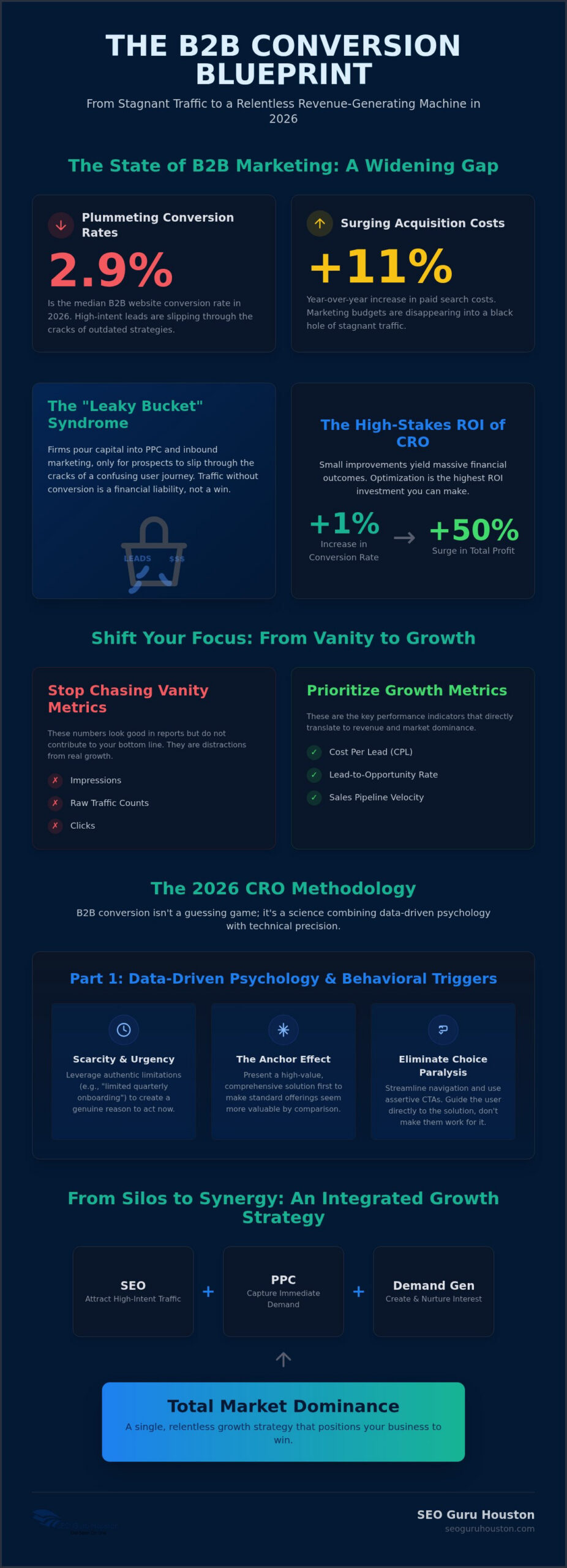
The median B2B website conversion rate has plummeted to just 2.9% in 2026, while paid search costs have surged by 11% year-over-year. If you feel like your marketing budget is disappearing into a black hole of stagnant traffic and confusing user journeys, you aren’t alone. Most b2b website conversion strategies are outdated relics that ignore the reality of a modern 11-person buying committee. You don’t need more vanity metrics. You need a website that works as hard as your top-performing sales representative.
We agree that watching high-intent leads slip through the cracks is unacceptable for any leader hungry for growth. This blueprint is your masterclass in high-performance conversion. You’ll learn to eliminate friction, track every sales-driving element, and slash your customer acquisition costs. We are moving beyond basic UX into a total framework for market dominance. From AI-assisted search optimization to high-converting landing pages, this is your path to turning a stagnant site into a relentless revenue-generating machine. It is time to stop surviving and start dominating.
Key Takeaways
- Stop treating traffic as a vanity metric and start viewing it as a financial liability if it fails to convert into measurable revenue.
- Master the psychology of the modern B2B buyer by implementing b2b website conversion strategies that leverage neuromarketing triggers and technical precision.
- Execute a high-performance audit using quantitative heatmaps and qualitative session recordings to identify exactly where your funnel is leaking revenue.
- Integrate SEO, PPC, and demand generation into a single, relentless growth strategy that positions your business for total market dominance.
Stop Bleeding Revenue: Why Traffic Without Conversion is a Business Failure
Traffic is not a win. It is a cost. If your website attracts thousands of visitors but fails to generate a single qualified lead, you aren’t growing; you’re bleeding. Every visitor who bounces is a lost opportunity and a wasted investment in your visibility. Conversion rate optimization (CRO) is the systematic process of turning these anonymous visitors into revenue-generating leads. It’s the difference between a vanity project and a high-performance sales engine.
Many firms suffer from “Leaky Bucket” syndrome. They pour massive amounts of capital into PPC services or inbound marketing, only for those prospects to slip through the cracks of a confusing user journey. Traffic is a liability if it fails to convert into measurable financial gain. CRO is the bridge between digital visibility and financial dominance.
The High Cost of Stagnant Conversion Rates
Small numbers dictate big outcomes. In the high-stakes world of industrial commerce, a mere 1% increase in your conversion rate can lead to a 50% surge in total profit. This isn’t magic; it’s math. When you optimize your funnel, your fixed costs remain the same while your revenue scales. Conversely, a friction-filled user experience does more than just lose a lead. It damages your brand reputation. In 2026, buyers have zero patience for digital incompetence. A low conversion rate is an open invitation for your competitors to step in and seize your market share. Don’t hand them the keys to your kingdom.
Vanity Metrics vs. Growth Metrics
Stop obsessing over clicks. Impressions and raw traffic counts are vanity metrics that look good on a slide deck but do nothing for your bank account. Growth metrics, such as qualified leads and closed-won sales, are the only numbers that matter. High-performance b2b website conversion strategies prioritize the depth of engagement over the breadth of traffic. Market leaders in 2026 understand that 100 high-intent visitors are infinitely more valuable than 10,000 accidental browsers. Evaluate your current ROI. If your visitor count is climbing but your revenue is flat, your strategy is broken. Effective b2b website conversion strategies fix the disconnect between interest and action.
To dominate your market, you must focus on these key growth indicators:
- Cost Per Lead (CPL): How much you spend to acquire a potential buyer.
- Lead-to-Opportunity Rate: The percentage of leads that are actually sales-ready.
- Sales Pipeline Velocity: How quickly a lead moves from first touch to signed contract.
The 2026 CRO Methodology: Data-Driven Psychology Meets Technical Precision
B2B conversion isn’t a guessing game; it’s a science. In 2026, the most effective b2b website conversion strategies leverage neuromarketing to tap into the subconscious triggers of your buying committee. While your prospects think they’re making a purely rational decision, their brains are processing authority signals and psychological shortcuts at lightning speed. This is why a comprehensive B2B conversion rate optimization playbook is essential. You aren’t just changing a layout. You’re engineering a persuasive environment that demands action.
CRO isn’t a one-time fix. It’s an aggressive, continuous testing cycle that pits your current results against a relentless pursuit of better. In a hyper-competitive market, your authority signals, such as case studies, technical whitepapers, and verifiable results, must be front and center to overcome buyer skepticism. If you aren’t constantly refining these touchpoints, you’re leaving money on the table.
Behavioral Triggers and Cognitive Biases
Your website must guide the buyer’s brain toward a decision without friction. Leveraging scarcity and urgency is a powerful move, provided it remains authentic. Mentioning limited quarterly onboarding capacity creates a genuine reason to act now without appearing desperate. You should also utilize the Anchor Effect. By presenting a high-value, comprehensive solution first, your standard offerings gain perceived value through comparison. Finally, you must eliminate choice paralysis. If your navigation is a maze of fifteen options, you’re forcing your user to work. Streamline your paths and use assertive CTAs that tell the visitor exactly how to win. Don’t ask them to learn more. Tell them to Secure Your Market Position.
Technical Optimization for Maximum Trust
Psychology is useless if your site is slow. In 2026, a 100ms delay can decimate your conversion rate. Speed isn’t just a technical metric; it is a trust signal. If your website feels sluggish, a prospect assumes your service is too. This technical precision requires professional SEO services as the foundation. Without a technically sound site, your acquisition efforts are doomed to fail. Your architecture must be mobile-first and prioritize a thumb-driven user journey. If a busy executive can’t navigate your value proposition with one hand while on the move, they’ll find a competitor who makes it easier. Implementing these b2b website conversion strategies ensures your digital presence is a high-performance engine, not a static brochure. You can integrate these high-performance tactics into your B2B marketing strategy to ensure your funnel stays full of qualified opportunities.
Optimization vs. Acquisition: Why CRO is Your Highest ROI Investment
Most businesses waste their budgets chasing more traffic while their conversion rates remain stagnant. This is a strategic blunder. Acquisition is a recurring cost; optimization is a permanent asset. If you double your traffic, you likely double your marketing spend. If you double your conversion rate through aggressive b2b website conversion strategies, you double your revenue while keeping your acquisition costs flat. CRO is the force multiplier that makes every marketing dollar work ten times harder. It is the only way to combat the 11% year-over-year increase in CPCs we are seeing in 2026.
The Math of Market Dominance
Let’s look at the numbers. Imagine two competitors. Competitor A focuses on 2% traffic growth every month but ignores their 1% conversion rate. Competitor B implements high-performance b2b website conversion strategies to hit a 4% conversion rate. Competitor B wins every time. Why? Because they’ve lowered their Customer Acquisition Cost (CAC) and increased their Lifetime Value (LTV) by capturing more high-intent prospects from the same pool of traffic. This efficiency allows for more aggressive bidding in ppc management, essentially pricing the competition out of the market. High-converting sites don’t just survive; they dominate.
This approach ensures your sales team isn’t wasting time on low-quality inquiries. By optimizing the funnel, you achieve several critical business outcomes:
- Enhanced Lead Quality: Filter out tire-kickers and focus your sales team on ‘ready-to-buy’ prospects.
- Reduced CAC: Pay less for every closed deal by maximizing the value of existing traffic.
- Increased LTV: Better user journeys lead to higher initial trust and long-term retention.
Future-Proofing Your Sales Funnel
In 2026, the digital landscape is more competitive than ever. Search algorithms now prioritize engagement depth and low bounce rates as primary ranking signals. If users land on your page and leave immediately because of a confusing journey, your visibility will tank. An optimized user journey builds brand authority and trust before your sales team even picks up the phone. By using CRO data, such as heatmap interactions and form completion rates, you can stay ahead of rapidly shifting digital trends. You aren’t just fixing a website; you’re building a resilient sales machine that adapts to buyer behavior in real-time. This is about more than just numbers. It is about establishing a dominant market position that competitors cannot touch.
Executing a High-Performance Audit: Identifying Friction in Your Funnel
Stop assuming you know why your prospects are leaving. A high-performance audit is the only way to replace intuition with cold, hard data. Effective b2b website conversion strategies start with quantitative analysis. By deploying heatmaps, you can see exactly where users are dropping off or ignoring your most valuable content. But the ‘where’ is only half the battle. You need qualitative feedback through session recordings and surveys to identify the ‘why.’ When you watch a frustrated user struggle with a broken link or an ambiguous button, you’ve found a leak in your revenue bucket.
Once friction points are located, you must move into hypothesis development. Don’t just make changes; create assertive tests that challenge the status quo. This leads to rigorous testing, where A/B and multivariate experiments validate your growth theories. If a change doesn’t measurably increase your lead volume, discard it. If it does, bake it into your permanent architecture. This is a relentless cycle of improvement that market leaders use to stay ahead.
The Landing Page Litmus Test
Your landing page has three seconds to promise a transformation. If a visitor can’t understand your value proposition in that window, they are gone. Your call-to-action (CTA) must be assertive, high-contrast, and impossible for the user to miss. It should tell the visitor exactly what to do next without any ambiguity. If your CTA is a passive ‘Learn More’ button, you are losing leads. For a deep dive into the technical architecture that drives these results, review our guide on high converting landing page design.
Eliminating Form and Navigation Friction
Friction kills sales. Every extra field you add to a contact form can cost you approximately 10% in conversions. Follow the ‘Less is More’ rule: only ask for what you absolutely need to qualify the lead. For complex B2B services where data is required, use multi-step forms. These increase the perceived ease of completion by breaking the process into digestible chunks. Combine this with real-time validation to reduce user frustration and abandonment. If your form is a barrier instead of a bridge, your b2b website conversion strategies are failing. You need a frictionless path to profit.
Ready to stop guessing and start growing? Optimize your landing pages for maximum conversion and take control of your market share today.
Partnering for Dominance: Assertive Conversion Growth and Demand Generation
Market dominance is never an accident. It is the result of a relentless, integrated offensive that treats digital marketing as a high-stakes competition. Most agencies provide generic advice or surface-level reports. We act as your high-performance coach, guiding you through the technical nuances and strategic pivots required for total prominence. This isn’t about doing “some” SEO or running a few ads. It is about the seamless integration of SEO, PPC, and CRO into a single, unstoppable growth machine. When these elements work in unison, your b2b website conversion strategies move from being a theoretical goal to a daily reality of lead generation.
We have zero interest in abstract fluff or vanity metrics that look good on a spreadsheet but fail to move the needle. Our focus remains fixed on measurable progress and financial return. If a tactic doesn’t lower your acquisition costs or increase your pipeline velocity, it doesn’t belong in your strategy. It is time to move beyond digital invisibility. You have the opportunity to transform your website from a quiet brochure into the most aggressive sales asset in your industry. Absolute market prominence is within reach, provided you are ready to stop observing and start executing.
The Inbound Marketing Advantage
Demand generation is a waste of capital if your core website cannot convert the interest you create. To win in 2026, you must align your inbound marketing strategy for b2b with specific, aggressive conversion goals. Content authority is your primary tool for moving skeptical prospects from initial awareness to a final purchase decision. High-value whitepapers, technical case studies, and video insights serve as the psychological fuel for your funnel. Without a high-converting core, your demand generation efforts are just expensive noise. Your content must do more than inform; it must persuade and command action at every touchpoint.
Taking Decisive Action for Growth
There is a massive difference between an “affordable agency” and a high-ROI growth partner. An affordable agency saves you money in the short term while costing you millions in lost opportunities. A high-ROI partner focuses on the bottom line, ensuring that every dollar spent returns multiples in revenue. Waiting to implement these b2b website conversion strategies is the most expensive mistake your business can make. Every day you delay is another day your competitors are capturing the leads that should have been yours. The cost of inaction is far higher than the investment in excellence.
Stop guessing about why your traffic isn’t turning into profit. Start scaling your business with a professional conversion audit that identifies every leak in your funnel. It is time to take control of your digital standing and claim your position as a market leader. Your path to dominance begins with a single, decisive move toward optimization.
Secure Your Legacy: Command Your Market with High-Performance Conversion
The era of passive digital brochures is over. In 2026, your website is either a high-performance revenue engine or a financial liability. We have dismantled the myth that traffic alone dictates success. By mastering data-driven psychology and eliminating technical friction, you transform stagnant visitors into high-value opportunities. Implementing aggressive b2b website conversion strategies is no longer an optional upgrade; it is the fundamental requirement for business survival in a hyper-competitive landscape.
You now have the blueprint to stop bleeding revenue and start scaling with precision. Whether it is through specialized B2B demand generation or a high-energy, results-oriented strategy, the path to prominence requires decisive action. We have a proven track record in competitive markets and are ready to help you bridge the gap between invisibility and total market dominance. Don’t let your competitors capture the leads you’ve already paid for.
Stop losing revenue and start dominating your market today! It is time to turn your digital presence into a relentless growth machine.
Frequently Asked Questions
What is a good conversion rate for B2B industries in 2026?
A good conversion rate for B2B websites in 2026 typically falls between 2% and 5% for blended traffic. While the median rate sits at 2.9%, top-quartile performers often achieve results 2.5 to 3 times higher than the industry average. These high-performing b2b website conversion strategies often leverage AI-assisted search, which converts at approximately 4.2%. Aiming for these benchmarks ensures your digital presence is a competitive asset rather than a stagnant cost.
How long does it take to see measurable results from CRO?
You can often see measurable shifts in user behavior within 30 to 60 days of implementing a rigorous testing cycle. While technical fixes like page speed optimization provide immediate trust signals, psychological triggers and A/B testing require sufficient traffic volume to reach statistical significance. Dominance isn’t achieved overnight. It requires a relentless commitment to iterative testing. We focus on short-term wins that fund long-term market prominence through continuous funnel refinement.
Can I perform CRO myself or do I need a professional agency?
While basic changes are possible internally, achieving market dominance requires a professional agency with deep technical and psychological expertise. DIY efforts often lack the sophisticated heatmapping, session recording, and multivariate testing tools necessary for a high-performance audit. A growth partner acts as a coach, integrating SEO, PPC, and CRO into a single strategy. Waiting to optimize is the most expensive mistake you can make; professional intervention ensures you stop bleeding revenue immediately.
What is the difference between A/B testing and multivariate testing?
A/B testing compares two distinct versions of a single page element, while multivariate testing analyzes multiple variables simultaneously to see which combination performs best. A/B testing is ideal for identifying major friction points quickly. Multivariate testing is a more complex approach that dictates the precise synergy between headlines, images, and CTAs. Both are essential components of assertive b2b website conversion strategies designed to maximize your total financial return.
How does conversion rate optimization affect my SEO rankings?
Conversion rate optimization directly boosts your SEO rankings by improving critical engagement metrics like dwell time and bounce rates. In 2026, search algorithms prioritize websites that provide a frictionless user journey and high-value interactions. When your site converts effectively, it signals to search engines that your content is authoritative and relevant. This creates a powerful feedback loop where higher rankings drive more traffic, which then converts at a superior rate.
What are the most common friction points on a B2B website?
The most common friction points include page load times exceeding three seconds, excessive form fields, and ambiguous calls-to-action. Every additional field in a contact form can decrease your conversion rate by 10%. Confusing navigation paths also cause choice paralysis, leading prospects to abandon their research. Eliminating these barriers is a fundamental necessity for business survival. A streamlined, thumb-driven mobile architecture is now a requirement for engaging busy executive buying committees.
Is CRO expensive to implement for a mid-sized business?
Implementation costs for CRO should be viewed as a high-ROI investment rather than a traditional expense. Because optimization lowers your Customer Acquisition Cost (CAC) and increases Lifetime Value (LTV), it effectively pays for itself by making your existing marketing spend work harder. Mid-sized businesses often see the highest relative gains because they have enough traffic to test accurately but enough agility to pivot quickly. It is the most cost-effective path to market dominance.
What tools are essential for a high-performance CRO audit in 2026?
A high-performance audit in 2026 requires a suite of tools focused on both quantitative and qualitative data. Essential technology includes heatmap generators to track user movement, session recording software to identify friction, and AI-driven personalization platforms. These tools allow you to move beyond abstract theories and make decisions based on documented user behavior. Combining these insights with technical speed audits ensures your website remains a relentless revenue-generating machine in a hyper-competitive landscape.

