
What if the biggest B2B marketing mistake isn’t a weak campaign, but a system that never connects buyer interest to revenue? Traffic can rise while pipeline stays flat, content can miss the questions decision-makers need answered, and sales can reject leads marketing celebrates. The common b2b marketing mistakes to avoid often stem from these connected breakdowns, not one isolated tactic.
If your team is generating activity without a clear view of its pipeline contribution, it’s worth examining what’s working and where prospects are dropping off. More channels, content, or technology won’t fix a strategy without a defined audience, relevant buyer-stage messaging, and shared standards for success.
This practical 2026 checklist will help you identify high-impact gaps across strategy, channels, measurement, and sales handoffs, then prioritize fixes using buyer behavior and pipeline evidence. You’ll also see how coordinated SEO, PPC, demand generation, and conversion-focused web work can support a more connected approach.
Key Takeaways
- Trace marketing activity back to qualified pipeline to find where strategy and business outcomes diverge.
- Map content and messaging to buyer questions, decision stages, and the needs of different stakeholders.
- Assess whether channels and landing pages work together to attract, convert, and measure the right buyers.
- Use the common b2b marketing mistakes to avoid checklist to prioritize fixes based on search intent, lead quality, and pipeline evidence.
- Align lead definitions and handoffs between marketing and sales, then decide which gaps your team can address internally.
Common B2B Marketing Mistakes to Avoid Start with Misaligned Goals
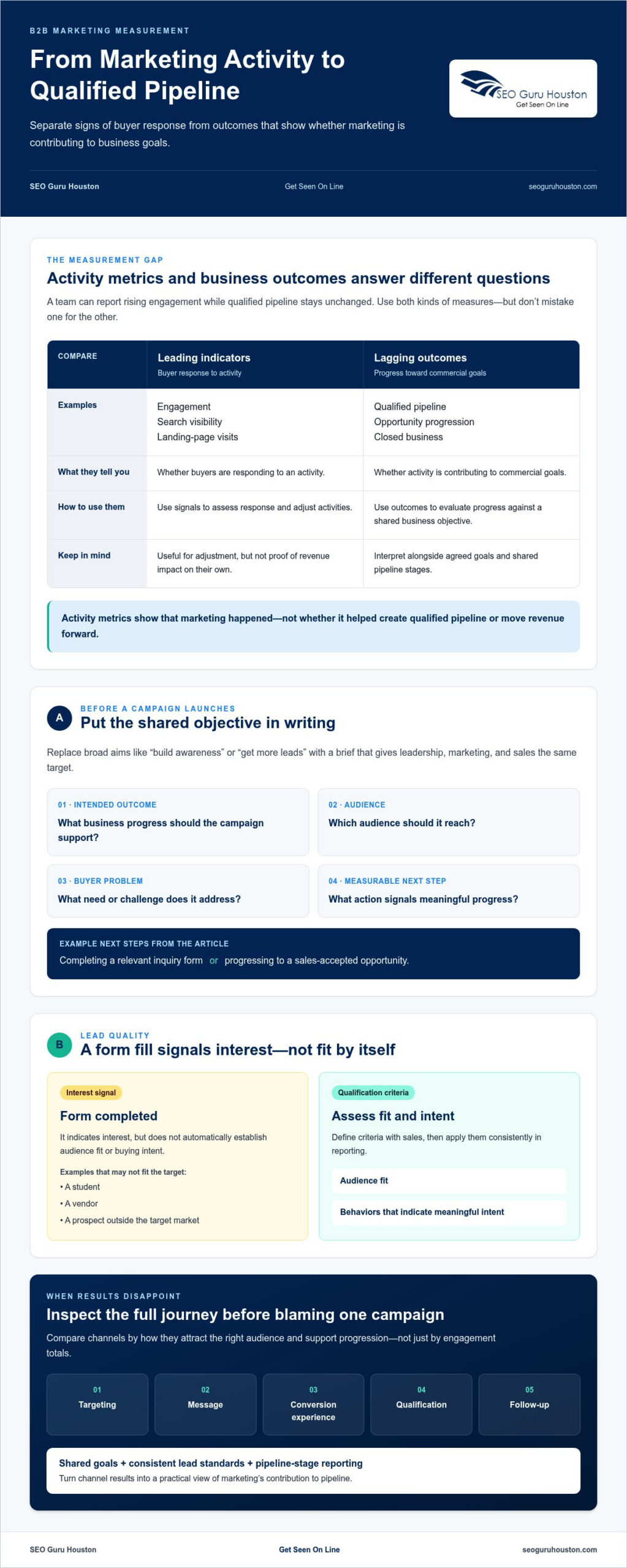
A marketing team can launch campaigns, publish content, and report rising engagement while qualified pipeline remains unchanged. That tension is a warning: activity and business progress aren’t the same thing. A B2B marketing mistake is a recurring gap between what buyers need, what a team does, and the business outcome that work is meant to support.
That gap often starts with goals. If leadership expects sales opportunities, marketing is measured on website visits, and sales judges success by accepted leads, each team can appear productive while pulling in a different direction. A shared understanding of Business-to-business (B2B) marketing keeps attention on the organizations and decision-makers involved, but the strategy still needs an agreed business objective.
Separate leading indicators from lagging outcomes. Engagement, search visibility, and landing-page visits can show whether buyers are responding to an activity. Qualified pipeline, opportunity progression, and closed business show whether that activity is contributing to commercial goals. Leading indicators help teams adjust, but they don’t prove revenue impact on their own.
Activity metrics show that marketing happened, not whether it helped create qualified pipeline or move revenue forward.
Mistake: Running campaigns without a documented business objective
“Build awareness” or “get more leads” sounds like a goal, but neither tells a team which audience to reach, what buyer need to address, or what action should follow. Before launching, document the intended outcome, audience, problem the campaign addresses, and measurable next step, such as completing a relevant inquiry form or progressing to a sales-accepted opportunity.
Then align leadership, marketing, and sales around the same outcome and definition. For example, a campaign designed to reach operations leaders evaluating a specific business challenge shouldn’t be judged only by clicks if its objective is to generate qualified conversations. A written brief gives channel teams a shared target and a basis for evaluating tradeoffs.
Mistake: Treating every lead and metric as equally valuable
A form fill signals interest, but it doesn’t automatically prove fit or buying intent. A student, a vendor, or a prospect outside the target market may complete the same form as a decision-maker with a relevant need. Define qualification criteria with sales, including audience fit and behaviors that indicate meaningful intent, then apply those criteria consistently in reporting.
Channel reports can still reveal useful differences, but connect them to shared pipeline stages. Compare search, paid campaigns, social activity, and landing-page actions by how they attract the right audience and support progression, not just by their engagement totals. If results disappoint, inspect the full journey: targeting, message, conversion experience, qualification, and follow-up. Don’t blame a single campaign before checking where buyer interest is being lost.
These are the first common b2b marketing mistakes to avoid because they shape every decision that follows. Clear objectives and shared measures turn reporting from a collection of channel wins into a practical view of marketing’s contribution to pipeline.
B2B Marketing Mistakes That Miss the Buyer’s Journey
B2B buyers don’t move from first exposure to purchase in a straight line, and one message rarely answers every question along the way. A buyer may first recognize a costly problem, explore possible approaches, compare vendors, and build internal agreement. Map those stages to real buyer questions. The modern B2B buying journey is a useful reference for understanding how research and evaluation shape a decision.
That journey also involves different stakeholders. A department leader may care about business impact, while a technical evaluator needs implementation details and security information. Finance may focus on cost and risk. Messaging aimed only at a broad audience can leave each person without the evidence needed to support a purchase.
Buyer-journey alignment means giving the right stakeholders useful answers and a clear next step at each stage, so interest can progress toward a qualified opportunity.
Mistake: Publishing content that does not help buyers decide
Thought leadership can introduce a problem or offer a point of view, but it may not resolve the practical questions buyers face before choosing a solution. Decision-support content should help prospects compare criteria, understand implementation demands, assess risks, and explain the business case to colleagues. A content audit can show whether your materials educate buyers only at the awareness stage or support evaluation too.
Build content around unresolved buyer questions, then give readers a relevant next step, such as exploring an approach in more depth or discussing their needs. A B2B inbound marketing guide can help frame how useful content attracts and supports prospects throughout their research.
Mistake: Sending every audience and campaign to the same experience
A click creates momentum only if the destination matches the promise that earned it. If an ad speaks to a specific problem but lands on a generic page, visitors have to work to connect the message to their needs. The same friction occurs when a high-intent searcher sees a broad introduction instead of clear service information, relevant proof, and an appropriate action.
Match each landing page to the audience’s intent, campaign message, and readiness. A visitor researching a challenge may need an informative resource; someone comparing solutions may need clear differentiators and a path to start a conversation. The landing-page design blueprint offers a useful framework for creating a focused experience.
SEO, paid media, and website conversion should reinforce one another. Search visibility can bring buyers to relevant information, paid campaigns can address defined needs, and tailored pages can make the next step clear. Review the search query, ad or content promise, landing-page behavior, and resulting lead quality as one sequence. This helps identify whether the problem is reach, relevance, or conversion before changing channels.
These common b2b marketing mistakes to avoid are easier to correct when teams plan around buyer questions instead of publishing and promoting in separate silos. Integrated B2B digital marketing support can connect search, campaigns, and conversion-focused web experiences within a more coherent strategy.
How Disconnected B2B Channels and Sales Handoffs Weaken Pipeline
A buyer rarely experiences your marketing as separate channel reports. They see a search result, an ad, a piece of content, a landing page, and eventually a conversation with sales. If those touchpoints target different audiences, make conflicting promises, or ask for an ill-timed action, interest can stall before it becomes pipeline.
Integration doesn’t mean every channel does the same job. SEO can help buyers discover solutions while researching a problem; PPC can capture active demand or test a focused message; content can answer questions and build confidence; and the website should make the next step clear. Choose channels based on audience intent, campaign objective, and whether you can measure useful progression, not on a universal ranking of which channel is “best.”
Use three checks across the journey: Audience: Does the touchpoint reach the right roles and organizations? Message: Does it address a consistent need without making unsupported promises? Conversion: Does it offer a next step that fits buyer readiness and can be tracked? Shared audience insights can sharpen messaging across SEO, PPC, and content. A B2B demand generation guide can help teams coordinate activity around pipeline progression rather than treating campaigns in isolation.
Mistake: Treating SEO, paid media, and content as competing silos
Organic search and paid media can support buyers at different moments. A prospect searching for general guidance may need an educational page, while a high-intent search may call for a focused solution page. Content can serve both by answering buyer questions and supplying useful context for campaigns. When teams share search-query insights, audience questions, and conversion signals, they can align language and direct visitors to an experience that fits their intent.
Evaluate each channel by its assigned role and contribution to the same journey. Don’t expect every organic visit to convert immediately or judge paid media only by click volume. Track whether the right prospects engage, take relevant actions, and progress toward qualified opportunities.
Mistake: Handing leads to sales without shared qualification and feedback
Marketing and sales need written agreement on what counts as a good-fit lead, which behaviors indicate intent, how leads are routed, and what follow-up is expected. Keep the criteria practical: target-company fit, relevant need, meaningful engagement, and an appropriate next action. Without shared definitions, sales may receive leads it considers premature while marketing sees no reason to adjust.
Close the loop with consistent feedback fields, such as accepted or rejected, reason for rejection, fit, intent, and current pipeline stage. If lead volume is healthy but few leads meet agreed criteria, investigate targeting and messaging. If qualified leads are generated but don’t receive timely or consistent follow-up, the breakdown may be in routing or sales execution. That distinction helps teams fix the actual leak instead of cutting a channel prematurely.
These common b2b marketing mistakes to avoid often sit between channels and teams, not inside one tactic. Integrated digital marketing support can help align channel strategy, web experiences, and demand generation.
Use This B2B Marketing Mistakes Checklist to Prioritize Fixes
Don’t change campaigns based on a single disappointing metric. Audit the path from business goal to sales outcome, then identify where evidence points to a breakdown. This sequence helps marketing and sales distinguish a targeting issue from a conversion problem or weak handoff, and gives the team a practical way to prioritize the common b2b marketing mistakes to avoid.
- Clarify the outcome. State the business result the marketing effort should support, such as qualified opportunities in a defined market. Check campaign briefs and reporting to see whether teams are optimizing toward that outcome or a proxy such as clicks.
- Inspect audience fit. Compare intended buyers with actual search queries, site visitors, form submissions, and CRM records. Look for signs that targeting or messaging attracts people who don’t match agreed company, role, or need criteria.
- Review the journey. Follow the route from discovery through landing-page actions and subsequent sales conversations. Check whether content answers buyers’ questions at each stage, and identify where engagement stops or intent changes.
- Assess channel roles. Review search visibility, paid campaign data, content engagement, and website conversion together. Confirm each channel has a clear purpose and that its measures show more than activity alone.
- Examine handoffs. Compare lead records with qualification rules, routing, sales follow-up, and pipeline stages. Look for rejected leads, missing feedback, or qualified prospects who fail to progress.
Audit the evidence before changing campaigns
A low conversion rate is a symptom, not a diagnosis. The cause might be mismatched search intent, an unclear offer, a weak landing-page experience, or incomplete tracking. Review analytics, CRM stages, campaign reports, search visibility, and sales feedback as one evidence set. If attribution is incomplete, label the gap clearly; don’t present a channel’s contribution as certain when the data can’t support that conclusion.
Choose fixes that can be tested and learned from
Rank potential changes by buyer impact, revenue relevance, confidence in the diagnosis, and implementation effort. Prioritize a well-supported barrier over a fashionable tactic. For each change, set a baseline, name an owner, record what will change, and choose a review signal, such as qualified form submissions or progression to a defined pipeline stage. If the evidence points to paid-search structure or measurement, PPC management can address those areas.
Cross-functional review checklist
- Shared outcome and qualification definitions
- Evidence reviewed across search, campaigns, website, and CRM
- Root cause distinguished from visible symptom
- Priority based on impact, confidence, and effort
- Owner, baseline, change, and review signal recorded
Use this checklist in a joint marketing and sales review, then select a manageable set of changes to evaluate. A documented test creates learning the team can apply to the next decision, even when the first adjustment doesn’t produce the expected result. Measurable B2B marketing strategy support can help address connected gaps across channels, conversion, and demand generation.
Turn B2B Marketing Mistakes into a More Connected Growth Strategy
Improving marketing performance isn’t about adding another channel or chasing every new tactic. It’s about connecting the business objective to the audience, the buyer’s experience, execution, and the evidence used to learn what’s working. The common b2b marketing mistakes to avoid often share one root cause: teams make decisions in isolation, then struggle to explain how those decisions support growth.
Some gaps are manageable internally. Teams can clarify campaign goals, agree on lead definitions, review buyer questions, and improve feedback between marketing and sales. When a diagnosis spans search visibility, paid campaigns, content, landing pages, and measurement, coordinated cross-channel support can help bring the work together.
Match the response to the mistake you uncovered
Choose a response based on evidence, not habit. A visibility gap may call for SEO work that helps relevant buyers discover your business. If high-intent prospects aren’t being reached through paid search, PPC can help address demand capture. If visitors arrive but don’t take an appropriate next step, review the page’s message, content, and conversion path. Each channel has a role, and that role should fit buyer behavior and the business objective.
Inbound marketing can coordinate efforts to attract relevant buyers, educate them with useful content, and guide them toward an appropriate conversion. It doesn’t mean publishing more without a purpose. Connect the content plan to real buyer needs and ensure the website supports the next step. SEO, PPC, B2B marketing, and conversion-focused web work can operate as parts of one strategy rather than disconnected projects.
Build a focused plan for the next stage of growth
Turn the audit into a plan your teams can act on. Align the business objective and target audience first, then define channel roles, the conversion path, and the reporting needed to evaluate progress. Use buyer behavior and pipeline evidence to adjust the plan as you learn. If the team can address a gap with clear ownership and available expertise, start there. If the diagnosis requires coordinated strategy and execution across channels, a digital marketing partner can organize the work around shared priorities.
That’s the practical shift: diagnose before prescribing, connect each tactic to a buyer need, and measure progress against a business outcome. Our B2B marketing, SEO, PPC, demand generation, inbound marketing, and website and landing-page services bring related work together to address diagnosed needs through a coordinated approach.
Explore coordinated B2B digital marketing support to shape a connected strategy around the opportunities your audit uncovered.
Make Your Next Marketing Decision Count
The next stage of growth doesn’t require fixing everything at once. Choose one gap with clear evidence, make the change measurable, and use what you learn to guide the next move. That discipline turns the common b2b marketing mistakes to avoid into a sharper plan for reaching the right buyers and supporting decisions that matter to your business.
When progress depends on coordinating multiple channels, bring the work under one strategic direction. SEO, PPC, B2B marketing, inbound marketing, and demand generation can each play a distinct role, while website development and landing-page design help carry the buyer from discovery toward conversion. The right mix starts with your priorities, not a preset formula.
Discuss a focused digital growth strategy with our team and identify a practical next step for your business. Move forward with greater clarity, one evidence-based improvement at a time.
Frequently Asked Questions
What are the most common B2B marketing mistakes to avoid?
The common b2b marketing mistakes to avoid include setting goals that don’t connect to business priorities, measuring success by lead volume alone, and creating campaigns without a clear picture of the intended buyer. Other pitfalls include overlooking how different stakeholders evaluate a purchase and adopting tools without a defined role for them. Start by identifying which pattern is costing your team the most time or weakening its decision-making.
How can a B2B company tell whether its marketing is generating qualified leads?
Track whether leads meet agreed customer and buying criteria, then see how they progress through the CRM. Compare lead sources by the share that sales accepts, advances to an opportunity, or disqualifies, and record the reasons. Review patterns over time rather than judging a campaign from a small batch of inquiries. If source or stage data is missing, fix the reporting before claiming a channel is driving pipeline.
What is the difference between B2B lead generation and demand generation?
Lead generation focuses on capturing identifiable prospects, often through an action such as submitting a form or requesting information. Demand generation is broader: it builds awareness and interest in a solution or category, including among people who aren’t ready to share their details. A company may use educational content to develop demand, then offer a relevant next step to capture leads as buying intent becomes clearer.
How often should a B2B marketing team review its strategy?
Review performance regularly, but adjust the strategy when evidence or business priorities warrant it, not simply because a calendar date arrives. Check campaign delivery and emerging issues during routine team reviews, then hold broader marketing and sales strategy discussions on a planned recurring basis. Revisit the plan sooner if the target market, offer, sales process, or buyer behavior changes materially.
Can a small B2B team avoid these marketing mistakes without a large budget?
Yes. A smaller team can make disciplined choices without expanding its channel mix. Focus on a well-defined audience, answer a specific buyer question with existing expertise, and improve one high-value page before launching more activity. Use available analytics and CRM records to learn which inquiries progress. A focused plan helps protect limited time and resources, while a short list of priorities makes it easier to spot work that isn’t supporting the business goal.
How should marketing and sales agree on what counts as a qualified B2B lead?
Marketing and sales should define qualification together using observable criteria, such as whether the prospect fits the target account, has a relevant business need, and shows meaningful buying interest. Agree on which details belong in the CRM, what makes sales accept or reject a lead, and how rejection reasons will be recorded. Then revisit the criteria against actual opportunity outcomes so the definition reflects the buyers who become valuable customers.

