
A supposedly boring industry can produce compelling content when it starts with real customer questions, not forced gimmicks. A content strategy for boring industries should combine audience insight, an authentic brand voice, perspectives from industry insiders, and useful ideas rooted in everyday problems. A practical starting point is to list 50 questions customers might ask about your product or service, then turn the strongest answers into clear, valuable content.
Some industries may seem to have fewer obvious stories to tell. Yet technical details, recurring customer frustrations, buying decisions, and the people behind the work all offer useful angles. The key is to make each piece relevant to your audience and true to your business.
This article explains how to understand your audience, build a distinctive and credible voice, and bring customers or industry insiders into the conversation. You’ll also get a structured way to generate and organize ideas, giving writers clear direction while leaving room for fresh, useful stories.
Key Takeaways
- Study how your audience gets information and what it cares about, then use those insights to shape relevant topics and formats.
- Show personality through a consistent, credible voice. Humor and entertaining angles work best when they still fit your business and audience.
- Invite customers and industry insiders to contribute practical perspectives that deepen trust and bring fresh experience to your content.
- Document your audience, voice, priorities, and unresolved decisions so creative work stays aligned with a clear strategy.
- Find new angles by reframing everyday industry questions, connecting related topics, and curating useful insights from trusted sources.
1. Understanding audience demographics and media habits
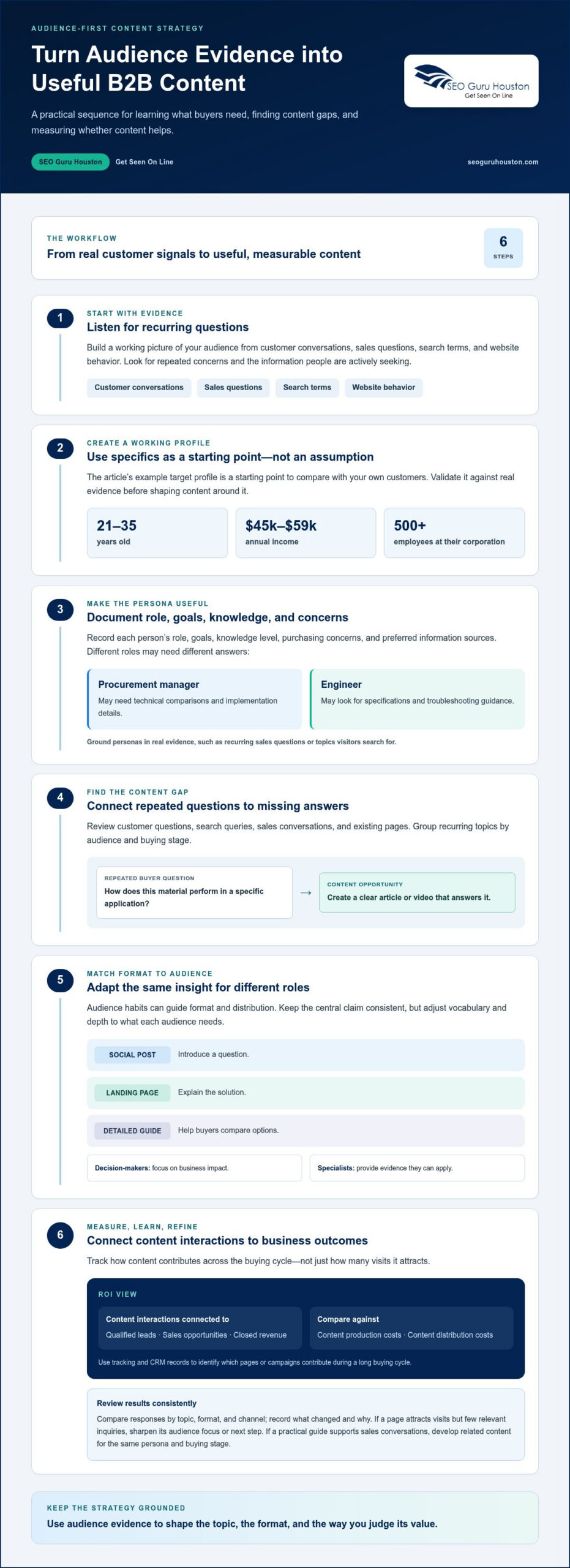
A content strategy for boring industries starts with a specific audience, not a broad assumption about who might buy. Build a working profile from customer conversations, sales questions, search terms, and website behavior. For example, the target profile described here includes people aged 21 to 35 years, earning $45,000 to $59,000, and employed by corporations with more than 500 employees. Treat that profile as a starting point, then compare it with your own customers.
Turn the profile into a practical persona by documenting the person’s role, goals, knowledge level, purchasing concerns, and preferred information sources. A procurement manager may need technical comparisons and implementation details, while an engineer may look for specifications and troubleshooting guidance. Base each persona on real evidence, such as recurring sales questions or topics visitors search for on your site.
How do you identify audience needs and content gaps in a niche industry? Review customer questions, search queries, sales conversations, and existing pages, then group recurring topics by audience and buying stage. If buyers repeatedly ask how a material performs in a specific application but your site offers no clear explanation, that gap could become a useful article or video.
Audience habits can shape both format and distribution. Check which pages attract attention, whether visitors arrive through search or social platforms, and which formats prompt useful responses. An operations leader may prefer a concise process guide, while a technical audience may value a detailed comparison. Test formats, keep the tactics audiences respond to, and revise those they ignore.
Make industry topics interesting by connecting them to audience interests without forcing an unrelated trend. A manufacturer might explain material durability through an environmental angle, or connect a local business story to local sports. A familiar reference, such as a popular book, can also clarify a technical idea. Any connection should strengthen the explanation, not distract from the product or customer problem.
Adapt the same core insight for different roles and formats. A social post can introduce a question, a landing page can explain the solution, and a detailed guide can help buyers compare options. Keep the central claim consistent, but adjust the vocabulary, depth, and next step. Decision-makers need to understand the business impact; specialists need evidence they can apply to their work.
How do you measure content marketing ROI in B2B industries? Connect content interactions to qualified leads, sales opportunities, and closed revenue, then compare the resulting value with content production and distribution costs. Use tracking and CRM records to see which pages or campaigns contribute during a long buying cycle, rather than judging a technical guide by visits alone.
Review results on a consistent schedule. Compare responses by topic, format, and channel, and record what changed and why. If an article attracts visits but few relevant inquiries, sharpen its audience focus or next step. If a practical guide supports sales conversations, develop related content for the same persona and buying stage.
2. Balancing personality and authenticity
Technical accuracy earns trust, but a brand’s personality gives readers a reason to remember it. In 2014, content marketing was dubbed “The Year of the Story.” That idea still applies to industrial topics: explain what a product changes for a real person, not just what it contains. A maintenance company, for example, can pair an equipment guide with a technician’s account of spotting a recurring issue.
Choose three voice attributes, such as practical, candid, and curious, and define each with an example. “Practical” might mean explaining a process in plain language; “candid” means acknowledging a genuine limitation instead of hiding it in vague copy. A brief voice guide gives writers a shared reference and keeps the brand’s personality consistent across blog posts, sales pages, and social updates.
Use humor with judgment. A light joke about a familiar workplace headache can make a post approachable, but humor about safety, customer losses, or a serious technical failure can undermine credibility. Before publishing, check that the humor supports the point, suits the audience, and sounds like the people who do the work. Cut it if it distracts from the useful information.
Show the people behind the expertise. A project manager can explain why a process changed, a technician can clarify a common misconception, and a founder can describe the principle behind a business decision. Use specific details. “We care about quality” is generic; describing how a team handles a difficult handoff demonstrates that value through an example.
Personality also comes through in structure. Replace a stiff introduction with a clear problem, use descriptive subheadings, and close with a useful next step. An article about equipment maintenance might open with signs of an overlooked issue, then offer a simple inspection checklist. This professional structure makes the writing easier to follow and more engaging.
Keep the brand recognizable across topics without making every piece sound identical. An occasional entertaining post can reinforce the voice while staying relevant to the business. A manufacturer, for instance, could share a brief behind-the-scenes account of how a team solved an unusual production challenge. Track comments, shares, and meaningful inquiries to learn which tones and formats prompt responses, then refine future content.
Consistency matters across channels, too. A social post can be punchier than a technical guide, but both should reflect the same values and level of candor. A focused social media marketing approach can help carry that voice into audience conversations, rather than treating each post as a disconnected announcement.
3. Publishing guest posts from customers or industry insiders
A customer or industry insider can explain a difficult problem in language readers recognize. Invite a plant manager to describe how an equipment issue disrupted production, or ask a distributor to explain a recurring buyer misconception. Firsthand details add context that internal experts may overlook. Choose contributors for relevant experience, not job titles alone.
Start with a focused invitation. Name the intended audience, the question the post should answer, and the practical takeaway for readers. For example, ask a maintenance lead to explain how teams identify early signs of wear. Provide a short outline with prompts, but let the contributor bring examples and terminology from their daily work.
Strong guest content can reveal problems customers may not describe in formal interviews. Ask contributors to walk through a recent challenge: what happened, what made it difficult, and what information helped. A supplier might explain why a specification was misunderstood during purchasing. Remove confidential details, then shape the story around a lesson other buyers can use.
Put education first in every draft. A controls engineer could clarify the difference between a sensor fault and a wiring issue, while noting when readers need qualified technical help. Keep explanations precise, define industry terms, and use a practical example for each major point. Readers should get a useful resource, not a disguised product pitch.
Give readers a practical next step. A logistics customer might share a checklist for preparing a shipment, while an industry analyst could explain what data to gather before comparing suppliers. Add a clear summary and relevant links to your own guides. People arriving from search should understand the advice without insider knowledge.
Before publication, edit for clarity, accuracy, and your established voice. Preserve the contributor’s perspective, but remove unexplained acronyms and unsupported claims. Confirm names, product references, and technical details with the author. Then promote the finished post through the contributor’s professional network, email updates, and relevant social channels. A useful post can earn attention from Google and readers when its subject matches a real search need.
Keep the relationship active after publication. Thank the contributor, share audience questions, and invite a follow-up as the topic develops. An older blog post can also become a short video, even if the original was published two years earlier. Repurposing the insight creates another format and a fresh reason to reconnect with the contributor and audience.
A follow-up can turn interest into action: the company in the article estimates that converting a customer by phone gives it about a 75% chance of closing the sale. Keep the next step relevant to the advice, rather than forcing a pitch.
Balance material that moves beyond the brand’s core topic with posts that reinforce it, so readers stay connected without feeling pestered. The gym partnership in the example offers customers a 10% coupon in exchange for promoting a vehicle hail-damage guide. Brands can also link to and share material from industry sources, curating useful content from others to reinforce their authority.
4. Separating strategy clarity from creative content
Set the strategy before brainstorming headlines. Document what the organization does, who it serves, where revenue comes from, and which audience needs the content should address. Then define voice attributes, channel priorities, and useful outcomes in plain language. A pump manufacturer, for example, might focus on helping facility teams compare maintenance approaches. Clear direction gives creative work a target without dictating every sentence.
What content formats work best for traditionally boring industries? Try practical formats such as evergreen guides, local stories, short videos, and link-worthy resources. A comparison guide can explain technical choices, while a short video can demonstrate a process. Match each format to the audience’s question and the content’s purpose, then track responses, including comments and qualified inquiries.
Plan a monthly mix of one local piece, two evergreen pieces, and one link-worthy asset. A local piece could explain a regional operating challenge, while evergreen articles could answer recurring maintenance questions. The asset might be a checklist, calculator, or original visual guide that others may reference. This mix adds variety while keeping the publishing plan manageable and focused.
A link-worthy resource earns attention by making a useful idea easier to understand or share. For a building supplier, that might be a material selection chart or a clear guide to common project decisions. A contest can also invite participation when it fits the audience. One hail-related example offered a $500 prize to the local homeowner submitting the largest hailstone during the season. The prize was tied directly to the subject.
Videos make complex processes visible. Film a technician explaining a routine inspection, then add captions and a concise written summary for readers who prefer text. A B2B marketer can also repurpose material from a blog post written two years earlier into a short-form video. Keep the central advice accurate, refresh dated details, and adapt the opening to the video audience.
Give writers creative freedom within clear boundaries. Specify the intended reader, voice attributes, core message, and required evidence, then let writers choose the story and presentation. Explicit guidance helps writers and campaign teams interpret the strategy consistently. Flag unresolved decisions, such as a messaging framework still in development, rather than letting each new piece invent its own direction.
How much does a content marketing strategy cost for a small B2B business? The price depends on scope, research, production formats, and distribution needs, and is provided after a quote request. A focused plan may prioritize a few useful formats, while a broader program requires more research and ongoing production.
Review the plan against audience response and business relevance. If a guide prompts thoughtful comments or helps sales answer recurring questions, use that signal to shape the next topic. Content creation becomes more efficient when every piece has a defined purpose, while reader conversations keep the strategy connected to real needs.
5. Content idea generation for less exciting industries
Start with customer questions, not a brainstorm about what sounds exciting. Write down 50 questions buyers ask about a product, process, or decision. A filtration company might list questions about choosing a filter, spotting wear, or comparing materials. Group similar answers, then choose topics that solve real problems and support business goals.
Use a content idea matrix to explore each question through generalization, specification, similarity, and time. A question about equipment maintenance could become a general guide, a model-specific explanation, a comparison with another method, or a seasonal checklist. This framework turns one useful insight into distinct digital content instead of repeating the same article under a new title.
How can B2B companies make technical or complex topics engaging? Start with a familiar problem, explain the technical point in plain language, and show its practical effect. For example, explain how a vehicle’s fuel warning relates to driver decisions, then support the answer with clear details.
Which SEO keywords and topics should boring-industry businesses target? Focus on phrases that reflect customer questions, product applications, comparisons, and troubleshooting needs. Match each keyword with a useful answer, such as a solar company explaining how home-buying decisions affect energy planning.
Useful ideas can come from connections beyond the core product. A content piece about buying a house earned 99 links in the solar energy industry. In auto maintenance, an article about car iterations and how far drivers can travel after the gas light comes on earned 151 linking root domains. Both examples connect an industry subject to a decision people already understand.
What are examples of successful content marketing in boring industries? A blender campaign was associated with a 700% increase in total blender sales between 2006 and 2008. Industrial marketers can also find an audience through a niche newsletter with a mailing list of 10,000 people, as Ross Simmonds has noted.
In regulated industries, key risks include inaccurate claims, unclear qualifications, and advice readers could mistake for guidance about their personal situation. Build review into the workflow: verify technical statements, document evidence, and send sensitive drafts through appropriate internal review before publication.
How do you build a content strategy for an industrial or regulated business? Document what the organization does, where its revenue comes from, who its audience is, and which questions the content should answer. Record shared decisions and unresolved issues, then connect each topic to an audience need and business goal.
Use these steps to build a practical topic pipeline, then turn the strongest ideas into a focused B2B content and demand-generation plan.
SEO Guru Houston: Houston SEO Services
SEO Guru Houston can help turn useful industry knowledge into a clear digital strategy that reaches the right buyers nationwide. If your content answers customer questions but struggles to earn search visibility, professional SEO services can support a focused approach to relevant topics and search intent. For complex business audiences, specialized B2B marketing and inbound marketing methodologies can connect educational content with broader demand generation goals.
Identify where your strategy needs support: audience targeting, search visibility, or a clearer path from useful information to qualified inquiries across your target markets. SEO Guru Houston can align those priorities with your content program and overarching marketing objectives.
Contact SEO Guru Houston to discuss how a clearer content strategy can support your business goals.
Turn Your Next Idea Into a Clear Plan
A content strategy for boring industries becomes valuable when it guides regular decisions, not just when it sits in a document. Choose one audience need, assign responsibility for addressing it, and decide how you’ll judge whether the content is useful. This gives your next idea a purpose before production begins, while leaving room to adjust based on feedback from readers and sales teams.
SEO Guru Houston can support the next stage with Houston SEO Services, Houston PPC Services, and Houston B2B Marketing. These offerings can help connect content priorities with search visibility, paid campaigns, and business-to-business marketing goals. Bring a clear picture of the audience you want to reach and the questions your content should answer.
Ready to turn your ideas into a more focused marketing plan? Explore your next steps with SEO Guru Houston. Your industry already has useful knowledge to share. Put it to work with purpose, and keep building from there.
Frequently Asked Questions
What is content strategy for boring industries?
A content strategy is a documented plan for turning specialized knowledge into information that helps a defined audience make decisions. A commercial flooring supplier, for example, could plan articles about durability, installation considerations, and facility maintenance. Each topic needs a clear reader, purpose, and suitable format. The strategy helps teams choose what to create, maintain a consistent message, and connect useful information to business priorities.
How often should companies in niche industries publish content?
Choose a publishing cadence your team can sustain while keeping information accurate and useful. A monthly planning cycle can coordinate new articles, updates, and distribution without making every week a deadline. For example, a manufacturer could publish a guide when customers repeatedly ask about a specification, then update existing pages when product details change. Review audience response regularly and adjust the schedule to match capacity and demand.

