
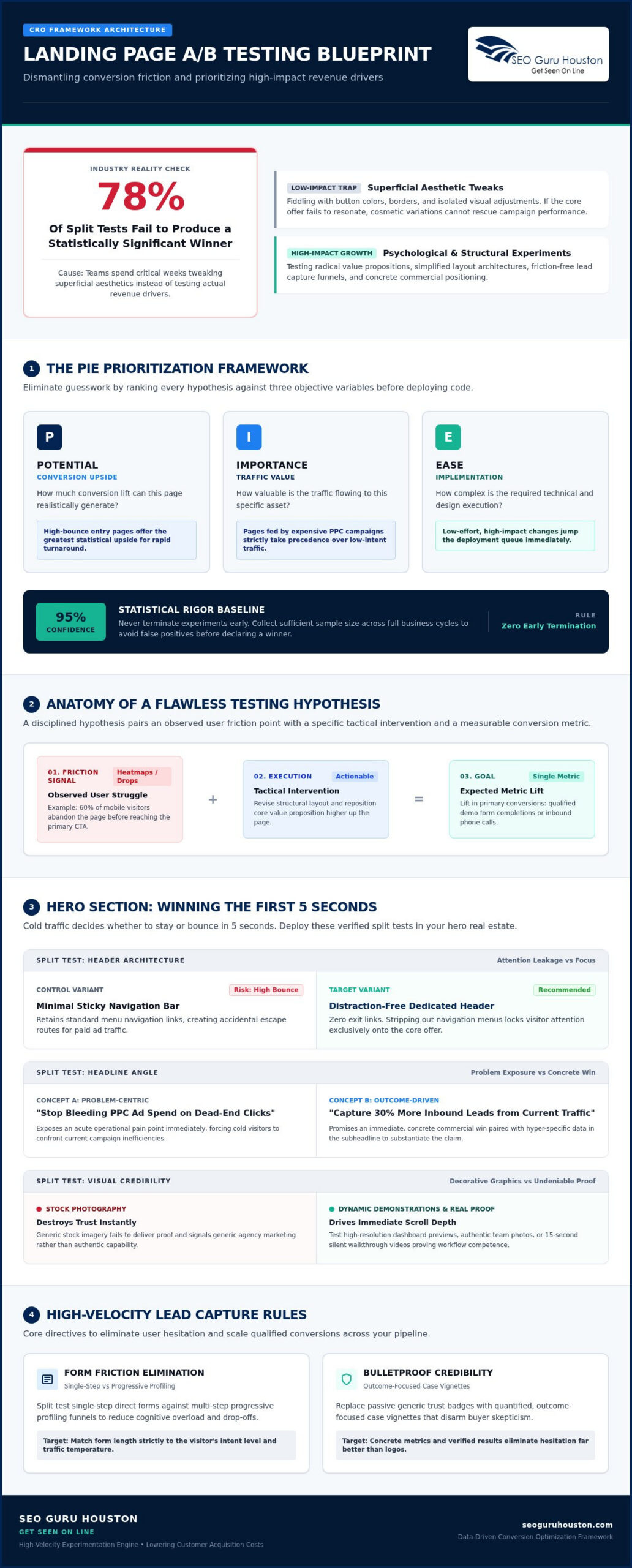
A staggering 78% of split tests fail to produce a statistically significant winner. Why? Most teams waste critical weeks tweaking superficial button colors instead of testing real revenue drivers. If you want to stop burning ad spend on visitors who bounce immediately, you need high-impact landing page a/b testing ideas that systematically dismantle conversion friction and sharpen your core offer.
You already know how frustrating it feels to watch customer acquisition costs climb across competitive PPC and paid social channels while minor design tweaks fail to move the needle. Running isolated, low-stakes experiments won’t deliver market dominance. You need a proven, repeatable framework that transforms underperforming pages into aggressive lead generators.
In this guide, you’ll discover battle-tested split-test concepts that directly cut acquisition costs, eliminate user hesitation, and maximize your paid traffic ROI. We’ll outline the exact experimentation roadmap top performers use to achieve double-digit conversion lifts and scale sustainable business growth.
Key Takeaways
- Prioritize structural and psychological experiments over trivial aesthetic tweaks to drive real, measurable conversion lifts.
- Deploy actionable landing page a/b testing ideas across your hero section to hook cold traffic within the first five seconds.
- Eliminate form friction by split-testing single-step captures against multi-step progressive profiling funnels.
- Replace generic trust badges with quantified, outcome-focused case vignettes that disarm buyer skepticism.
- Transform one-off split tests into a high-velocity experimentation engine that continuously lowers customer acquisition costs.
The CRO Prioritization Matrix: Stop Guessing and Start Testing High-Impact Elements
Conversion rate optimization is not an interior decorating exercise. It’s an aggressive revenue engine designed to squeeze maximum pipeline value out of every single paid click. Treating optimization as cosmetic guesswork burns budget while competitors capture market share. True conversion acceleration requires systematic rigor, beginning with the core principles of A/B testing to validate behavioral shifts before deploying code.
To eliminate wasted cycles, every hypothesis must pass through a strict prioritization model: the PIE framework. By ranking ideas against three objective variables, you strip emotion out of the optimization roadmap:
- Potential: How much conversion lift can this page realistically generate? High-bounce pages usually offer the highest upside.
- Importance: How valuable is the incoming traffic? Pages fed by expensive PPC campaigns take precedence over low-intent organic traffic.
- Ease: How complex is the technical implementation? Low-effort, high-impact changes always jump the queue.
Never pull the plug on an experiment early. Premature test termination creates false positives. Aim for a standard 95% statistical confidence baseline and collect sufficient sample size across full business cycles before declaring a winner.
Why Minor Cosmetic Tests Waste Valuable Campaign Momentum
Swapping a green CTA button for an orange one rarely produces sustainable revenue growth. These cosmetic adjustments fail because they ignore the primary psychological blockers preventing visitors from converting. Instead of fiddling with button borders, invest your traffic into testing radical value propositions, simplified layout architectures, and distinct commercial positioning. If your core offer fails to resonate, button color won’t save it.
The Anatomy of a Flawless A/B Testing Hypothesis
Strong experiments require disciplined hypotheses. A high-performing hypothesis always pairs an observed user struggle with a clear tactical intervention and an expected metric change. Review session recordings and scroll heatmaps to spot where friction spikes. If 60% of mobile users abandon your page before reaching the primary call to action, your structural layout demands immediate revision.
Tie every test variant directly to a single primary conversion metric, such as demo form submissions or qualified inbound phone calls. Connecting disciplined experimentation directly to high converting landing page design transforms scattered testing into a scalable revenue driver. Generating high-impact landing page a/b testing ideas is simple once you let real user friction dictate your roadmap.
Above-the-Fold A/B Testing Ideas: Winning the First Five Seconds
Your hero section dictates whether visitors engage or instantly bounce. If your above-the-fold real estate fails to communicate immediate, unambiguous value, your paid ad spend evaporates. The most high-leverage landing page a/b testing ideas focus ruthlessly on this entry screen. Start by testing your layout discipline: pit a distraction-free dedicated campaign header with zero exit links against a minimal sticky navigation bar. Stripping out extraneous menu items keeps user attention locked strictly on your core offer.
Headline Formula Battles: Problem-Centric vs. Outcome-Driven Messaging
Headlines make or break initial retention. Test a problem-centric headline that exposes an acute operational pain against an outcome-driven headline promising a concrete commercial win. For example, test an urgent problem statement (“Stop Bleeding PPC Ad Spend on Dead-End Clicks”) against a direct value proposition (“Capture 30% More Inbound Leads from Your Current Traffic”). Pair both variations with a subheadline featuring hyper-specific data to substantiate your claim immediately.
Visual Asset Split Tests: Static Graphics vs. Dynamic Demonstrations
Stock photography destroys credibility instantly. Replace decorative images with assets that deliver undeniable proof. Split test high-resolution dashboard previews against authentic photos of your actual team delivering results. Alternatively, test a 15-second silent walkthrough video demonstrating your product or process in action against a static graphic. Dynamic demonstrations often trigger deeper scroll depth by proving capability within the first five seconds of page load.
Call-to-Action Positioning: Single Hero Focus vs. Progressive Micro-Commitments
Demanding a full consultation immediately introduces friction for cold visitors. Test a single aggressive CTA (“Schedule Your Enterprise Demo”) against a low-threat micro-commitment (“Calculate Your Growth ROI”). Additionally, experiment with first-person, action-oriented button copy like “Claim My Strategy Roadmap” instead of sterile commands like “Submit Form.”
When you align your top-of-funnel messaging with precise visitor intent, conversions surge. Refining these entry points is vital, and deploying high-converting Websites Dev & Landing Pages gives your paid campaigns the commercial leverage they need to dominate.
Form and Friction Experiments: Engineering Maximum Lead Capture
Your lead form is the ultimate conversion chokepoint. You can hook prospects with a flawless headline and compelling visual proof, but an intimidating form will collapse your pipeline instantly. Finding winning landing page a/b testing ideas requires confronting form friction head-on. Every extra input field introduces cognitive drag, yet stripping out every barrier floods your sales team with junk inquiries. The goal is simple: capture high-intent leads efficiently without sacrificing lead quality.
Single-Step Simplicity vs. Multi-Step Micro-Commitment Funnels
Testing single-step forms against interactive multi-step funnels exposes how prospects prefer to share information. Presenting nine open fields upfront immediately triggers defense mechanisms. In contrast, multi-step forms use the psychological principle of commitment and consistency. By placing low-friction, non-threatening qualifying choices on step one (such as selecting an industry or primary business goal), users build momentum before reaching the final contact details screen.
- Single-Step Layouts: Best suited for transactional, low-consideration offers like simple whitepapers or resource downloads.
- Multi-Step Funnels: Superior for complex B2B services, custom quotes, and consultations where progressive profiling reduces perceived workload.
Field Reduction vs. Radical Qualification
Shorter forms do not always mean higher revenue. While research shows three-field forms convert 25% better than nine-field variations, and reducing fields from 11 to four can boost raw conversion volume by 120%, context matters. An email-only capture form might inflate top-of-funnel conversion rates while starving your sales reps of critical pipeline context.
Test radical qualification against basic capture. Run an experiment requiring business email, annual budget, and direct phone number against a streamlined three-field form. Track the downstream outcome: does the shorter form generate more closed deals, or does the qualified variation save your sales team hundreds of wasted hours on unqualified prospects? Measure deal velocity, not just form completions.
CTA Button Copy and Micro-Copy Security Reassurance
Default buttons labeled “Submit” or “Send Message” signal passive effort and zero value. Test assertive, benefit-driven button copy like “Get Instant Pricing” or “Launch My Growth Audit” to remind prospects of the payoff. Pair your button with clear risk-reversal micro-copy immediately underneath, such as “No credit card required” or “Guaranteed 24-hour response.” Eliminating last-second hesitation at the final click protects your paid media investments from costly eleventh-hour drop-offs.
Social Proof and Objection Demolition: Building Bulletproof Credibility
Unsubstantiated marketing claims destroy conversions on contact. When cold traffic lands on your page, skepticism runs high. Visitors actively search for reasons not to trust you. Strategic landing page a/b testing ideas must tackle this credibility gap by proving real commercial impact. If your trust assets consist only of unverified quotes or random award badges, you are bleeding pipeline revenue every single day.
Quantified Case Results vs. General Client Endorsements
Vague praise like “Great team to work with!” carries zero commercial weight. Test generic praise against quantified case vignettes featuring hard business numbers. Showcase explicit client outcomes, such as a 42% lift in qualified pipeline or a 35% reduction in customer acquisition costs, paired with the client’s verified headshot, company title, and brand logo. Hard metrics eliminate ambiguity and force prospects to respect your capability.
- Logo Walls: Test whether recognizable enterprise partner logos perform better above the fold or grouped below your primary value proposition.
- Micro-Case Callouts: Test three-sentence result cards highlighting the exact problem, implementation, and verified financial return against standard quotes.
Contextual Proof Placement: Dispersed Signals vs. Dedicated Sections
Burying all customer endorsements into a single dedicated section at the bottom of the page is a critical mistake. Most visitors bounce before reaching the page footer. Instead, test dispersing micro-testimonials right beside high-friction action triggers. Placing a verified client quote directly beneath a demo booking form directly addresses buyer hesitation at the point of decision.
Aligning these proof mechanisms with your broader b2b demand generation agency strategy ensures every inbound lead encounters relentless validation from ad click to final submission.
Interactive Social Proof: Video Testimonials vs. Text Scrollers
Video testimonials provide unassailable authenticity, but they can slow page speed if poorly executed. Split test short, 45-second client interview clips against easily scannable quote cards. Monitor mobile engagement closely during this test; desktop users may pause to watch a case study, while mobile users on cellular connections often abandon slow-loading media assets.
Ready to turn underperforming traffic into predictable pipeline? Partner with our demand generation experts to build and scale bulletproof conversion engines that outpace your competition.
Building a Permanent Experimentation Engine to Maximize Paid Campaign ROI
Conversion rate optimization is not an annual checkup or a one-time audit. It’s an aggressive operational discipline. Treating split testing as an occasional, isolated project guarantees stagnant performance while customer acquisition costs continue to climb across paid channels. Scaling your bottom line demands a continuous experimentation engine that relentlessly uncovers, prioritizes, and executes winning landing page a/b testing ideas across your entire marketing funnel.
Aligning Traffic Temperature with Landing Page Architecture
Sending cold search traffic to the exact same page layout as warm retargeting visitors sabotages conversion rates. Cold prospects need immediate clarity, problem validation, and undeniable proof. Warm prospects already recognize your brand and respond far better to concise, offer-focused pages with friction-free forms. Synchronizing your post-click architecture with aggressive ppc management ensures complete message harmony between the target keyword and your page headline. Misaligned intent kills momentum before the user even reads your first paragraph.
Establishing an Agile Testing Cadence and Knowledge Repository
Execution velocity dictates how fast you capture market share. To maintain momentum, structure your experimentation roadmap around consistent operational rhythms:
- Bi-Weekly Testing Sprints: Evaluate test performance every two weeks to analyze sample sizes, retire clear underperformers, and deploy new variations without delay.
- Documented Failure Archives: Systematically log every losing variation. Understanding why an angle failed prevents teams from recycling dead messaging.
- Cross-Funnel Rollouts: When an experiment yields a decisive lift, immediately push that winning headline formula or form architecture to secondary service pages.
Accelerating Conversion Performance with Dedicated Strategic Guidance
Executing high-level split tests while running day-to-day operations creates paralyzing internal bottlenecks. Standalone testing software won’t save you if your team lacks the bandwidth to interpret user data and engineer high-converting layouts. Real commercial scale happens when you fuse relentless paid traffic acquisition with elite conversion design. If you want to outpace competitors and maximize ROI across every marketing channel, Partner with SEO Guru Houston to deploy battle-tested landing page a/b testing ideas that turn paid traffic into scalable, predictable revenue.
Transform Your Landing Pages into Relentless Revenue Drivers
Market dominance isn’t built on guesswork or superficial tweaks. Winning the paid traffic battle requires eliminating conversion friction where it actually hurts: above-the-fold value alignment, form intimidation, and credibility barriers. When you systematically deploy high-impact landing page a/b testing ideas, you stop burning ad spend and start compounding measurable pipeline value.
Your competitors are actively bidding on your target keywords. Outpacing them demands a disciplined full-funnel integration connecting high-intent traffic directly to qualified pipeline. SEO Guru Houston operates as a data-driven digital marketing agency delivering aggressive commercial ROI through battle-tested landing page and CRO execution across competitive verticals. You don’t have to settle for inconclusive tests or sluggish growth rates. Stop bleeding ad spend and scale your revenue with SEO Guru Houston. Take decisive action today and turn your landing pages into unstoppable conversion engines.
Frequently Asked Questions
How long should an A/B test run before declaring a statistical winner?
Run your experiments for at least two full business cycles, which typically takes two to four weeks. Never terminate a test after three days just because an early variation shows a temporary conversion spike. Testing across full weekly cycles accounts for distinct weekend and weekday visitor behaviors. Always collect sufficient sample sizes and hit a standard 95% statistical confidence threshold before rolling out your winning variation permanently.
What is the minimum amount of traffic required to conduct landing page split testing?
You need enough traffic to generate at least several hundred conversions per variation for meaningful statistical validity. If your page receives fewer than 1,000 monthly visitors, standard split testing often takes months to reach reliable conclusions. In low-traffic scenarios, test radical structural shifts or gather direct qualitative feedback rather than testing micro-elements. Paid campaigns provide the fastest testing ground because consistent ad clicks fill sample pools rapidly.
Should I test multiple elements simultaneously with multivariate testing instead of A/B testing?
Use standard A/B testing unless you command hundreds of thousands of monthly visitors. Multivariate testing evaluates multiple page variables simultaneously, but it fractures traffic into exponential micro-segments. That dilution slows down your testing cycle and delays critical business decisions. For mid-market teams, deploying high-impact landing page a/b testing ideas one clear hypothesis at a time delivers actionable insights much faster while maintaining statistical clarity.
Can running landing page A/B tests hurt my search engine optimization rankings?
No, running split tests will not hurt your search rankings if you implement proper technical protocols. Search engines actively encourage testing when you handle page variations correctly. Always use canonical tags pointing back to the original control page if you split traffic across separate URLs. If you use script-based testing tools, ensure they load quickly and avoid deceptive cloaking practices that violate search engine guidelines.
How do I choose whether to test copy changes or visual design elements first?
Prioritize value proposition copy changes before redesigning visual assets. Clarity in your core offer drives conversion performance far more aggressively than updated color schemes or layout flourishes. If your headline fails to hook user interest or address an acute operational pain point, sleek visuals won’t rescue the page. Test your fundamental offer and objection-busting copy first, then test supporting graphics and layout arrangements.
What should I do if an A/B test produces completely inconclusive results?
Inconclusive results mean your test variation was too subtle to trigger a meaningful shift in visitor behavior. Over 75% of split tests fail to produce a decisive winner. When this happens, archive the test and pivot to bolder landing page a/b testing ideas. Don’t waste weeks testing minor variations of a dead concept. Review your session recordings and test an entirely different structural or messaging angle.
How does mobile landing page optimization differ when executing A/B tests?
Mobile split tests must focus ruthlessly on screen economy and friction elimination. Mobile visitors convert at roughly half the rate of desktop users despite generating the majority of web traffic. When running mobile tests, evaluate sticky bottom-anchored CTAs, collapsible accordion sections to reduce endless scrolling, and streamlined multi-step forms. Keep page assets ultra-light, as a single second of mobile load delay severely depresses conversions.

