
Longer content doesn’t automatically rank higher. To understand how to rank higher than my competitors, target relevant searches where your business can offer a stronger, more useful answer, then make it easy for local customers to find and use your site. Keyword difficulty matters as much as content length.
It’s natural to think that publishing more pages or writing longer articles will help you move ahead. But a page earns visibility by matching search intent and meeting people’s needs, not by adding words for their own sake. Choose realistic opportunities and build pages that serve them well.
You’ll learn how to use competition levels to prioritize keywords, create useful local landing pages, align content with search intent, improve site performance, and strengthen your business listings. Each step helps you focus your effort where it can make a practical difference in local search.
Key Takeaways
- Build location-specific pages around the services and local questions your customers actually search for, rather than repeating the same copy across every page.
- Match each page’s content and title tag to the searcher’s intent; longer copy alone won’t make a page more competitive.
- Improve mobile usability and site performance so visitors can quickly find the information and contact options they need.
- Keep your business details accurate and consistent across your website, Google Business Profile, and relevant directories.
- Prioritize achievable keywords, especially searches where competitors rank well but your pages are close to becoming visible.
1. Hyperlocal content and location-specific landing pages
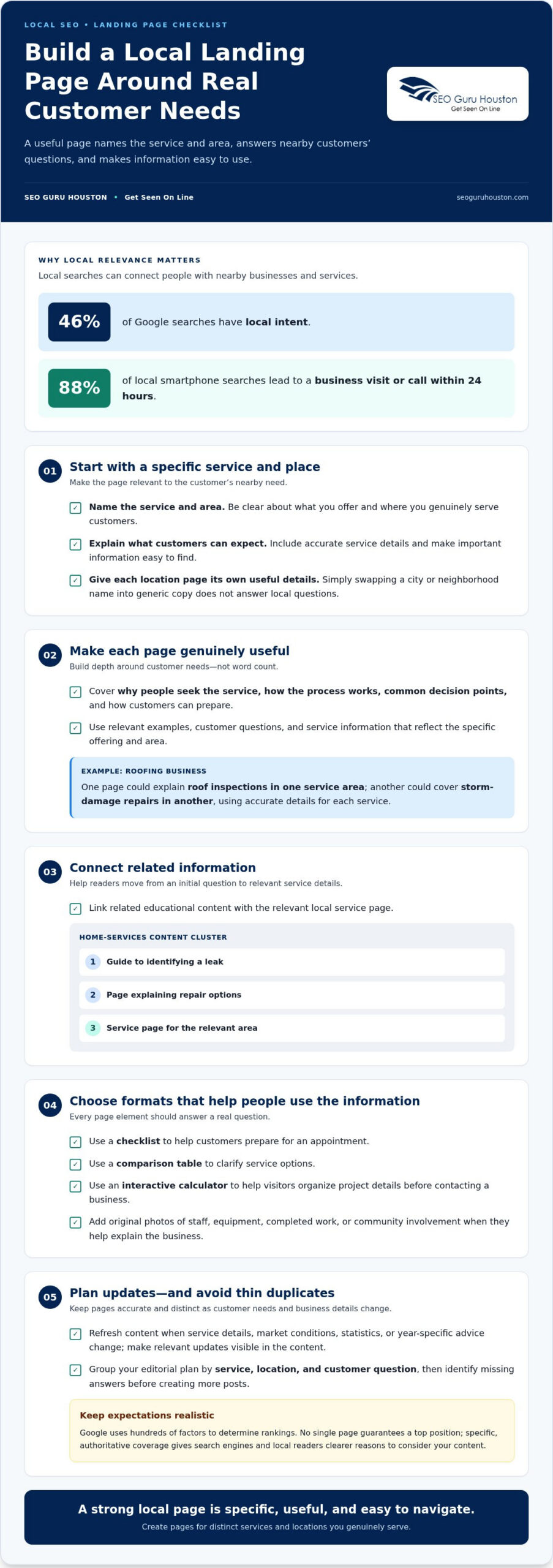
Local relevance starts with a page that answers a nearby customer’s specific need. 46% of Google searches have local intent, and 88% of local smartphone searches lead to a business visit or call within 24 hours. Give those searchers a clear path: name the service and area, explain what customers can expect, and make the next step easy to find. A page that simply swaps a city name into generic copy won’t provide that detail.
Create a dedicated landing page for each distinct service and location you genuinely serve. For example, a roofing company could explain roof inspections in one service area and storm-damage repairs in another, while a specialized travel service such as dumbablack.com can highlight distinct regional routes and private transfers using accurate details about each offering. Include locally relevant examples, customer questions, and service information. Keep each page useful on its own, rather than publishing near-identical pages that differ only by neighborhood name.
Build depth around customer needs, not word count. A strong local page can cover the reasons people seek the service, what the process involves, common decision points, and how to prepare. Then connect it to related educational content. For example, a home-services business might create a guide to identifying a leak, a page explaining repair options, and a service page for the relevant area. This cluster shows topical coverage and helps visitors move from research to action.
Choose a format that makes the information easier to use. A checklist can help customers prepare for an appointment; a comparison table can clarify service options; an interactive calculator can help them organize project details before contacting a business. Add original photos of staff, equipment, completed work, or community involvement where they help explain the business. Each element should answer a real question, not exist merely to make a page look busy.
Plan updates alongside publication. Refresh pages when service details, market conditions, statistics, or year-specific advice change, and make the update visible in the relevant content. A useful editorial plan might group pages by service, location, and customer question, then identify missing answers before creating more posts. Google uses hundreds of factors to determine rankings, so no single page guarantees a top position. But authoritative, specific coverage gives search engines and local readers clearer reasons to consider your content.
2. Search intent and title-tag click-through rates
A page can target the right keywords and still miss the reader’s intent. Search a target phrase and study the results: are the top results service pages, guides, videos, listings, or comparisons? Someone searching for “emergency plumber” is unlikely to need a detailed history of plumbing. Use a format that answers the query, and write a title tag that accurately describes the page.
Google considers many factors when ranking pages. Relevance, useful content, and signals from across the web all shape visibility; no single title or trick controls position. Title tags still matter because they tell searchers what a page covers. Write a distinct, specific title that naturally includes the topic and clearly describes the result. Don’t promise information the page doesn’t provide.
For keyword gap analysis, compare the searches your site targets with the searches competitors visibly address. Group keywords by intent, then note where your page is missing, mismatched, or less helpful. If competitors answer “how to choose a landscaper” with practical criteria and your page only lists services, add the missing decision guidance. Google Search Console shows queries already generating impressions for your site; review them alongside current search results to find useful content opportunities.
Competitor-analysis tools can help uncover ranking keywords, page topics, and changes in visibility. Start with Google Search Console for your own query and page data; consider paid platforms if you need broader competitor estimates or research workflows. Compare tools by the keyword data, competitor tracking, user seats, and exports they include, since features and pricing vary. Choose one based on the analysis you’ll actually use.
How long does ranking take? Initial local SEO improvements can appear within 30-60 days, while significant ranking improvements typically take 3-6 months, depending on competition and consistent optimization. Review performance regularly, refine titles when they don’t accurately reflect the page, and update content as search needs change.
3. How do site speed and mobile optimization affect my ranking?
A slow website adds friction before visitors can read, call, or request information. Aim for a load time under two seconds when competing in search. A one-second delay affects website rankings and conversions, so speed optimization supports both visibility and visitor experience. Competitor sites loading in under two seconds can feel far more responsive than pages taking four or five seconds.
Start technical SEO work by measuring real page performance, then fix the biggest bottlenecks. Compress oversized images, remove unused scripts, and reduce unnecessary page elements. Strong server infrastructure also plays a crucial role in lowering response times, leading many regional businesses to optimize through fast web hosting in Dubai. Test key pages, not just the homepage: a service page with a large gallery or embedded tools may load differently. Recheck after each change to see whether the visitor experience improved.
Mobile responsiveness matters because customers often browse on phones, where limited screen space makes usability problems obvious. Open your important pages on a mobile device and test the full journey. Can someone read the service details, tap the phone number, complete a form, and find the location without pinching or horizontal scrolling? Make buttons easy to tap, text readable, and navigation simple. A dealership, for example, should make inventory, service details, and contact options easy to find.
Check mobile page speed separately from desktop performance. A page that appears fast on a powerful computer may struggle on a phone with a slower connection. Prioritize the content visitors need first, defer nonessential scripts, and use appropriately sized images. Then test forms and menus on different screen sizes. A broken mobile form can cost a lead even when the page loads.
Structured data and HTTPS support a sound technical foundation. Use JSON-LD to describe eligible page content, such as an article’s headline, author, and organization. This helps search crawlers interpret a page, but structured data doesn’t guarantee a special search appearance. Keep markup accurate and aligned with visible content. HTTPS encrypts the connection between a website and its visitors; make sure pages load securely and internal links don’t send users to outdated HTTP versions.
Use a practical review cycle: test speed, inspect mobile usability, correct security warnings, and validate structured data after site changes. A redesign may improve navigation but introduce oversized images or scripts that slow key pages. Technical SEO isn’t a one-time launch task. Track performance on important landing pages and prioritize fixes that help visitors take their next step.
4. Consistent business citations and directory listings
For local visibility, Google considers relevance and proximity alongside trust signals. A complete Google Business Profile can connect your business with relevant nearby searches, but it can’t erase distance or guarantee a higher position. Treat your profile and directory listings as consistent records: customers should see matching business names, addresses, phone numbers, hours, and service details.
Start with a profile audit. Open Google Business Profile and compare every field with your website and current business records. Check the business name, address, phone number, hours, categories, services, and photos. If your hours change for a holiday, update the profile and website together. If your business moves or changes phone numbers, correct important directory listings too, rather than leaving outdated details across the web.
Keep your Google Business Profile active with accurate details and current photos. Add service information that matches your actual offerings, and replace outdated images when the location, team, or customer-facing environment changes. Answer common profile questions clearly. Reviews also contribute to local trust: online reviews account for approximately 15% of local ranking factors. Encourage genuine feedback after completed work, and respond professionally without scripting customers’ opinions.
What SEO tactics can cause Google penalties? Manipulative practices such as keyword stuffing, cloaking, paid links intended to distort rankings, or fake business listings can undermine trust and expose a site to search-quality enforcement. Keep directory entries truthful, and don’t create duplicate profiles to target nearby areas.
5. Choosing keywords by competition level
Don’t make the most competitive search term your first target. Less-contested keywords may offer more achievable opportunities. A focused keyword strategy compares search intent, competitor positions, and the pages you already have. The goal isn’t to chase every term. Identify searches where your content can offer stronger relevance and a better answer.
Begin with a keyword gap analysis. List the searches that bring visitors to your site, then compare them with queries competitors appear for. Look for terms that match your services but lack a useful page on your website. For example, a commercial cleaning business might find competitors ranking for “office floor cleaning” while its own pages only discuss general janitorial services. That missing topic could merit a dedicated, helpful page.
Next, prioritize opportunities by current ranking position. Focus on terms where a competitor ranks in positions 1–5 while your relevant page appears in positions 11–30. These searches can reveal a page that already has topical relevance but needs clearer coverage, stronger intent alignment, or better internal links. Compare the pages side by side: note which customer questions they answer, what format they use, and where your content leaves useful details out.
Don’t confuse search volume with business value. A broad keyword may attract traffic from people who aren’t ready to buy, while a specific local phrase may signal a clear need. Assess each term by asking whether it describes a service you provide, matches a real customer question, and can support a useful page. Then map each keyword to one primary page, so several pages don’t compete for the same query.
Use a simple scoring sheet to make choices consistent. Record the keyword, intent, competitor position, your page position, business relevance, and the content gap. Give priority to terms with strong relevance and a realistic path to improvement. Recheck competitor rankings monthly to spot movement, then adjust major strategy decisions quarterly using performance data and competitive changes.
Higher rankings for highly competitive keywords may take 6-12 months of sustained effort. Build toward those terms by covering related customer questions and strengthening the pages that support them. If you’re deciding how to rank higher than my competitors, start with the clearest opportunity, not the biggest keyword. A page that serves a specific search well can build the foundation for broader outranking efforts.
SEO Guru Houston: Houston SEO Services
SEO Guru Houston helps businesses put search strategy into action through SEO services, keyword research, competitive research, website traffic analysis, and local SEO campaigns. Turn to the team when your pages, keyword priorities, site performance, or business listings need a coordinated plan rather than disconnected fixes. The work can focus on relevant search opportunities, stronger visibility, and content aligned with customer intent.
For businesses that need complementary support, Houston PPC Services, Houston B2B Marketing, and Houston Inbound Marketing can address other parts of digital growth. The right approach depends on your goals, audience, and current marketing priorities.
Ready to discuss your search visibility? Contact SEO Guru Houston to start the conversation.
Turn Your Search Strategy Into Your Next Growth Move
If you need support connecting that work to broader growth goals, SEO Guru Houston offers Houston SEO Services, Houston PPC Services, and Houston B2B Marketing. The right focus depends on your audience, current online visibility, and the goals your business needs to pursue.
Bring your priorities into a conversation and decide what to tackle first. Contact SEO Guru Houston to discuss your search strategy and next steps. With a focused plan and steady execution, you can build stronger visibility and move your business forward.
Frequently Asked Questions
Does longer content always rank better than shorter content?
No. Content performs when it satisfies search intent, whether that takes a concise answer or a detailed guide. For a query about a business’s opening hours, a clear hours page is more useful than an extended article. For a complex purchasing decision, readers may need comparisons, explanations, and examples. Match the page’s depth to the task, then remove sections that don’t help readers decide or act.
How do site speed and mobile optimization affect my ranking?
Speed and mobile usability can influence whether visitors stay, read, and take action, while performance is one part of a wider ranking picture. Test a page on an actual phone, including its menu, forms, and tap-to-call links. A service page that loads but hides its contact button below a large banner still creates friction. Prioritize fixes that help visitors reach the information or action they need.
How important are backlinks when comparing my site to a competitor?
Backlinks can support a site’s authority, but they shouldn’t replace useful pages, sound technical foundations, or relevant local information. Compare links by their context and relevance, not just by a domain-authority score, which can be manipulated. Look for genuine mentions from organizations, publications, or partners connected to your industry. Avoid buying links designed to manipulate rankings; focus on earning references through useful resources and legitimate business relationships.
Which reasons influence competitor rankings the most?
Competitors can rank higher because their pages better match a search, cover a topic more thoroughly, or earn stronger trust signals. Local results also reflect relevance and the searcher’s proximity. Compare the actual page, not just the domain: a competitor may have a focused service page while your site has only a broad overview. Identify the gap, then address what matters most to the searcher’s task.
Why are your competitors outranking you and what keywords are they ranking for?
Competitors may have pages that answer more specific searches, cover topics more fully, or align more clearly with customer intent. To see which keywords they rank for, compare their visible pages in search results with your own and review your query data in Google Search Console. Note the exact page and query pairing. A competitor’s ranking term is an opportunity only if it fits your services and audience.
How to analyze competitors’ SEO keywords and backlinks?
Start by selecting a few direct competitors, then record the pages appearing for searches relevant to your business. Group their keywords by intent, such as learning, comparing, or contacting a provider. For backlinks, examine the referring page and why it links to the competitor. A relevant industry resource may reveal a useful outreach or content opportunity; a large link count alone doesn’t show whether a link helps your strategy.
How to find high-intent keywords competitors are missing?
Look for searches that signal a decision or immediate need, then compare them with competitors’ page coverage. Search phrases that include a service, problem, or location can reveal specific needs, such as “commercial roof leak repair” rather than “roofing.” Check whether your business offers that service and whether your site answers the query clearly. Build a page only when it can provide accurate, useful information for that search.
How to improve on-page SEO and content quality to outrank competitors?
Choose one clear purpose for the page, then align its title, main heading, introduction, and supporting sections with that purpose. Add details that help readers decide, such as service limitations, preparation steps, or a practical comparison. Link to related pages where useful. Before publishing, remove repeated claims and confirm that every important statement matches the service your business provides.

