
What if the leads your ads attract aren’t a targeting problem at all, but a measurement problem? If inquiries go silent, miss your ideal customer profile, or never become sales opportunities, a low cost per lead can hide a costly gap. Improving lead quality from digital ads starts with looking beyond form fills and asking whether campaigns are creating real sales conversations.
You already know that more inquiries don’t automatically mean more growth. The challenge is finding where the mismatch begins: audience targeting, ad messaging, the offer, the landing page form, or follow-up. This guide will help you define lead quality using business-relevant criteria, spot weak leads at each stage of the campaign journey, and use consistent conversion tracking and sales feedback to make better decisions.
We’ll explore how to align campaign goals with the customers you want, strengthen the path from click to inquiry, and assess performance based on meaningful outcomes rather than volume alone. The goal is a clearer connection between ad spend and qualified sales conversations, so your next campaign decision is based on evidence, not guesswork.
Key Takeaways
- Judge a lead by fit, need, responsiveness, and readiness for a relevant sales conversation, not by form volume alone.
- Trace the path from audience and ad promise through the landing page, form, and first contact to find where mismatched inquiries enter.
- Compare contactability, qualification, and sales progression alongside lead volume and cost per lead. Each metric reveals a different part of campaign performance.
- Improving lead quality from digital ads starts with identifying the specific failure point, then testing one evidence-based change at a time.
- Connect PPC decisions to business goals with conversion tracking, ongoing account management, monthly calls, and reporting.
What Does Lead Quality from Digital Ads Actually Mean?
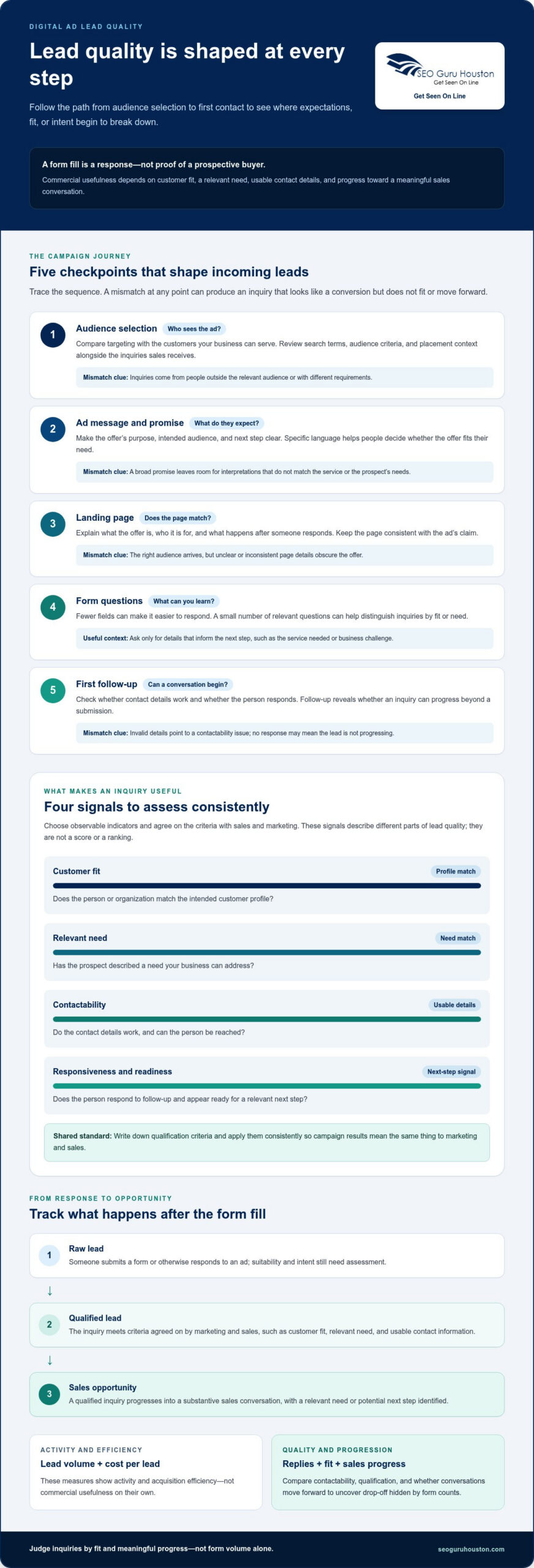
A digital ad lead is commercially useful when the person or organization fits your intended customer profile, has a need your business can address, can be contacted, and is ready to take a relevant next step. Those signals matter more than a form submission by itself. A completed form shows that someone responded to an offer; it doesn’t prove they’re a prospective buyer or that sales can start a meaningful conversation.
That distinction matters because lead volume and cost per lead measure activity and acquisition efficiency, not commercial usefulness. A campaign can generate more inquiries at a lower cost while attracting people outside your target market, people with no current need, or contacts who can’t be reached. To understand What is Lead Generation? in the broader marketing and sales funnel, consider how a response moves from initial interest toward a conversation and potential opportunity.
A practical lead-quality definition
- Raw lead: A person or organization that submits a form or otherwise responds to an ad. Their suitability and intent still need to be assessed.
- Qualified lead: An inquiry that meets criteria agreed on by marketing and sales, such as customer fit, relevant need, and usable contact information.
- Sales opportunity: A qualified inquiry that progresses into a substantive sales conversation, with a relevant need or potential next step identified.
Which lead-quality signals matter to your business?
Choose indicators your team can observe and record, rather than relying on subjective labels like “good lead.” Check whether contact details work, whether the inquiry matches your intended customer profile, whether the person describes a relevant need, and whether they respond to follow-up. Each signal points to a different possible issue: invalid details suggest a contactability problem, poor fit suggests a targeting or message mismatch, and no expressed need may indicate low intent.
Marketing and sales should define a qualified inquiry together. Write down the criteria, then apply them consistently so campaign results mean the same thing to both teams.
Why more leads can still mean weaker ad performance
A rising form count can look like progress even as the share of relevant, reachable inquiries falls. For example, a campaign may attract more submissions but produce fewer replies, fewer prospects who match the target profile, or fewer conversations that move forward. Volume alone hides that drop-off. Compare responses with what happens after each one, and identify where prospects stop progressing.
Lead quality is the degree to which an inquiry fits your business and takes a meaningful step toward a relevant sales conversation. Use that as your standard when improving lead quality from digital ads. The aim isn’t simply to collect more names; it’s to attract and recognize inquiries with a credible path to business.
How Digital Ad Choices Shape the Quality of Incoming Leads
A lead’s path begins before anyone fills out a form. The audience selected, promise made in the ad, landing-page explanation, form questions, and first follow-up all shape who responds and what they expect. A mismatch at any point can bring in inquiries that look like conversions in an ad account but don’t fit the business or move toward a real conversation.
Lead quality reflects the alignment of every step from audience selection to first contact, not a single setting or channel. To diagnose campaigns across search, social, and other digital placements, follow the journey and pinpoint where expectations or intent stop matching.
Audience fit and ad messaging set expectations
Start by comparing campaign targeting with the customers your business can serve and the needs they bring. Broad targeting can expand reach, but it may also attract people with different requirements, people outside your relevant audience, or people who aren’t ready to act. Review search terms, audience criteria, and placement context alongside the inquiries sales receives.
Ad copy can pre-qualify interest by making the offer’s purpose, intended audience, and next step clear. For example, a general promise to “get more customers” leaves room for different interpretations. A specific description of the business need addressed helps people decide whether the offer fits. Keep the landing page consistent with that claim. If the ad promises one thing and the page emphasizes another, visitors may submit with mismatched expectations or leave without acting.
Landing pages and forms shape intent signals
After the click, the landing page should quickly explain what the offer is, who it’s for, and what happens after someone responds. Clear, relevant details help prospects self-select. They also make it easier to assess the campaign promise: if the right audience arrives but the page obscures the offer, the issue may be the post-click experience rather than targeting alone.
Forms involve a trade-off. Fewer fields can make it easier to respond, while a small number of relevant questions can help distinguish inquiries by need or fit. Ask only for information that informs the next step, such as the type of service needed or the business challenge involved. Unnecessary questions add friction without giving sales useful context.
To trace the journey, compare what the campaign promised with what prospects saw and what they were asked to provide. Then review the first contact: did the prospect recognize the offer, respond, and have a need aligned with it? This sequence helps separate audience mismatch from unclear messaging, form friction, or follow-up gaps. It gives your team a specific point to investigate instead of changing several campaign elements at once.
Improving lead quality from digital ads means tightening that alignment, then checking whether the inquiries that follow are a better fit. SEO Guru Houston’s PPC campaign management connects targeting, ad messaging, and conversion tracking to business goals.
Which Metrics Reveal Whether Digital Ad Leads Are Improving?
No single campaign metric shows whether advertising is creating better sales conversations. Lead volume and cost per lead describe the response and its acquisition efficiency. Contactability, qualification, and sales progression show what happens after that response reaches your team. Read the metrics together to see where performance is strengthening or breaking down.
Platform conversions alone can count responses, but they can’t establish whether those leads fit your business or progress into sales conversations. That takes consistent conversion tracking paired with sales feedback. The platform shows which ad interactions were recorded; your sales process adds the context needed to assess their commercial value.
Build a measurement view beyond cost per lead
Use shared definitions across campaigns, and compare results over the same reporting window. A lead counted as qualified in one campaign should meet the same criteria in another. Otherwise, apparent performance differences may reflect inconsistent labeling rather than a change in lead quality.
| Metric | What it signals | Main limitation |
|---|---|---|
| Lead volume | How many responses the campaign generated | Doesn’t show fit, intent, or sales progress |
| Cost per lead | How efficiently the campaign generated recorded leads | Doesn’t reveal whether those leads are useful |
| Contactability | Whether the team can reach the person who submitted an inquiry | A reachable person may still be a poor fit |
| Qualification rate | How many leads meet the agreed criteria | Depends on consistent definitions and sales records |
| Sales progression | Whether qualified leads advance into meaningful conversations or next steps | Can take longer to observe and may reflect follow-up as well as campaign quality |
Keep advertising response metrics separate from sales disposition data. A platform may record a form submission, while the sales team records whether the details were valid, the need was relevant, and the conversation progressed. Conversion tracking can connect campaign activity with meaningful milestones, but those milestones need clear definitions and reliable recording.
Use sales feedback to find weak points in the funnel
Give sales a concise set of consistent reasons for leads that don’t progress, such as unreachable, poor fit, no relevant need, or no response after contact. Record the stage and reason rather than relying on broad labels like “bad lead.” Then review patterns by campaign, audience, keyword, offer, or landing page where the available data supports that comparison.
Look for recurring signals before changing the campaign. If one audience produces more poor-fit inquiries, targeting or messaging may need review. If contact details are often incomplete, examine the form. If prospects fit but don’t advance, follow-up or the next step may be part of the issue.
Change one factor at a time where practical, and keep the comparison window and lead-stage criteria consistent. If targeting, offer, form, and follow-up all change together, you may improve results without knowing why. A disciplined measurement approach makes improving lead quality from digital ads a business decision grounded in campaign data and sales evidence.
How to Improve Lead Quality from Digital Ads: A Practical Test Plan
Don’t change targeting, copy, and forms all at once. If the results shift, you won’t know which change mattered. A focused test plan starts with evidence from the lead journey, identifies the likeliest failure point, and tests a matching intervention. That’s how improving lead quality from digital ads becomes a disciplined process, not a string of guesses.
- Define the failure. Describe the problem in observable terms, such as a rise in inquiries outside your intended customer profile, incomplete contact details, or qualified prospects who don’t respond. Use campaign records and sales feedback to identify the pattern.
- Inspect the journey. Follow the inquiry from audience or keyword through the ad, landing page, form, and first response. Note where the prospect’s expectations, information, or actions stop matching what your team needs to move the conversation forward.
- Choose one intervention. Select the change that addresses the strongest evidence. Write down why you chose it, what you expect to change, and which lead-quality signals you’ll review.
- Review the results. Compare the test with a defined baseline using the same quality criteria and reporting window. Look at sales feedback as well as ad-platform responses, then keep, revise, or roll back the change based on the evidence.
Choose a change that addresses the diagnosed problem
Match the adjustment to the failure point. For poor-fit inquiries, review audience and keyword relevance alongside ad wording. If prospects misunderstand what the offer includes, align the offer, ad copy, and landing-page message so each step sets the same expectation. For incomplete or unreachable inquiries, assess whether the form asks for essential details and whether the response process helps the team act on submissions.
Be precise. If sales reports inquiries that don’t match the intended customer profile, adding more form fields may create friction without fixing the source. If the audience appears relevant but submissions lack information needed for an appropriate response, test a useful question rather than broadly tightening targeting. Let the evidence determine which lever to adjust.
Test, review, and refine without chasing volume alone
Set a comparison period that gives both ad and sales outcomes time to appear. Keep lead definitions and reporting criteria consistent, and document the dates, campaign elements changed, rationale, and sales feedback. Where practical, adjust one major variable at a time. If several changes are necessary, record them clearly and avoid claiming that one specific change caused the outcome.
When the diagnosed issue sits on the post-click path, review the page’s message, form, and next step together. This high-converting landing page design guidance can help focus your review on whether the page supports the ad’s promise and captures useful lead details.
A test is useful even when it doesn’t improve results, provided it clarifies what is and isn’t working. SEO Guru Houston’s PPC campaign management connects advertising decisions with conversion tracking and business goals.
How SEO Guru Houston Connects PPC Management to Better Lead Decisions
Improving lead quality from digital ads takes more than attracting clicks. Campaign choices need to support a clear business goal, and results need to be assessed against what happens after an inquiry arrives. SEO Guru Houston’s PPC management brings campaign execution and measurement together, helping businesses evaluate ad responses with sales relevance in view.
What ongoing PPC management contributes to lead-quality work
Keyword bidding helps shape which searches a campaign competes for, while ad copy optimization clarifies the offer and sets expectations. Geographic targeting further defines where ads are shown. Together, these activities can improve campaign relevance by aligning targeting and messaging with the audience the business intends to reach.
Conversion tracking helps connect ad activity with defined actions, giving the team a more useful way to assess performance against business goals than clicks or form submissions alone. Changes to PPC ads or keywords have an immediate effect on the campaign, but that doesn’t guarantee an immediate change in lead quality or sales outcomes. Assess tracked responses alongside lead and sales feedback to understand the effect.
SEO Guru Houston’s PPC work includes keyword bidding, ad copy optimization, geographic targeting, conversion tracking, ongoing account management, monthly calls, and reporting. This ongoing process creates opportunities to review what the campaign is generating, identify where it may be falling short, and make informed adjustments. The goal is to increase qualified leads, not to promise a specific result.
Turn campaign evidence into a clear next step
Useful campaign reviews connect the data to a decision. If tracked responses are rising but sales feedback points to poor fit, the team can investigate whether keyword choices, targeting, or ad messaging need adjustment. If inquiries appear relevant but aren’t progressing, the review can consider the conversion path and the quality signals being tracked. Consistent reporting and monthly calls keep these discussions tied to campaign activity and business priorities.
With 950+ completed projects, 100+ B2B and B2C projects, and 12+ years of experience, SEO Guru Houston brings practical campaign experience to these decisions. For businesses focused on reaching and engaging other businesses, B2B demand generation can also help connect marketing activity with the goal of generating relevant prospects.
Ready to connect PPC activity with clearer lead-quality decisions? Discuss your digital advertising goals and identify what you want your campaign tracking and sales feedback to reveal.
Make Your Next Campaign Decision Count
Better advertising starts with a better question: what should the next campaign teach you about the people most likely to become customers? Choose one signal to improve, such as relevant inquiries progressing to conversations, and make it the focus of your next review. That keeps optimization grounded in the outcome your business needs, not activity that merely looks good in a dashboard.
Improving lead quality from digital ads is an ongoing discipline. As your team learns which messages attract the right prospects and what helps them take a meaningful next step, use those insights to sharpen future campaign decisions. Keep the feedback loop active, and each review can give you a clearer direction for testing and refining your approach.
Ready to put that focus into practice? Discuss your digital advertising goals and take the next step toward campaigns built around more meaningful sales conversations.
Frequently Asked Questions
Why are my digital ads generating leads that do not convert?
Ads may be attracting people whose needs, timing, or expectations don’t match what your business can offer. A campaign promising a broad outcome can draw interest from prospects looking for something different, while a useful inquiry may stall because the next step isn’t clear. For improving lead quality from digital ads, compare a sample of non-converting inquiries with your intended customer profile and note the specific mismatch before changing the campaign.
How can I tell whether my leads are low quality or my follow-up is too slow?
Compare the inquiry details with the first-contact record. If a lead has invalid contact information, an unrelated need, or a clear mismatch before anyone reaches out, investigate lead quality. If the inquiry fits but contact attempts happen late, go unanswered, or aren’t recorded consistently, follow-up may be contributing. Review individual records, not just totals, and check whether the same pattern appears across different campaigns or team members.
Can adding questions to a lead form improve lead quality?
Yes, if the answers help your team assess relevance or choose a useful next step. For example, asking which type of service a prospect needs may provide clearer context than collecting a detail no one uses. Extra questions can also make a form harder to complete. Add one question tied to a real decision, then compare the usefulness of submitted inquiries with form completion before deciding whether to keep it.
Should I optimize digital ads for leads or sales?
Use the deepest outcome you can measure consistently and in sufficient volume to guide campaign decisions. A sales-focused event is closer to business value, but incomplete or inconsistent records can mislead the system and your team. If sales outcomes are sparse, track a reliable qualified-inquiry stage while improving how sales dispositions are recorded. Move toward sales outcomes as the data becomes dependable, and keep checking lead fit.
How often should I review lead quality from an advertising campaign?
Review new inquiries regularly enough to catch issues before they become entrenched, then assess trends on a consistent schedule. A weekly check can surface missing details or a sudden shift in fit; a monthly comparison can give later-stage outcomes more time to emerge. Match the review rhythm to your sales cycle and lead volume, and avoid judging a change from a handful of very recent inquiries.
What is a good cost per lead if the leads are not converting?
There isn’t a useful cost-per-lead target without knowing whether inquiries become qualified prospects and sales conversations. A lower figure can still reflect weak commercial value if leads don’t fit, can’t be reached, or don’t progress. Track the cost of qualified leads and opportunities alongside cost per lead, using consistent definitions. If no inquiries convert, investigate lead disposition and follow-up before treating a cheaper lead as a better result.
How does conversion tracking help improve lead quality?
Conversion tracking records which campaign interactions lead to defined actions, so you can compare performance against more than clicks. For example, tracking a completed inquiry separately from a qualified inquiry helps reveal whether a campaign attracts responses that meet your criteria. Check that tracked events reflect real actions and aren’t duplicated or triggered by irrelevant visits. Pair platform records with sales outcomes to guide more informed campaign adjustments.
Can better landing page messaging reduce unqualified inquiries?
Clear landing-page messaging can help people decide whether an offer fits before they submit a form. State who the offer is intended for, what need it addresses, and what the next step involves. Keep those details consistent with the ad, and avoid broad claims that invite assumptions the business can’t meet. Then review whether inquiries better match the intended audience, rather than judging the page only by how many forms it generates.

