
A filled form is only the start; the right targeting and a low-friction form turn LinkedIn ads for B2B lead generation into a stronger path to qualified pipeline. Build audiences around professional attributes such as job title, company, industry, seniority, and skills. Then use LinkedIn Lead Gen Forms to pre-fill profile details, making it easier for prospects to share their information in a single click.
It makes sense to focus on audience fit and form completion, because a high lead count alone can hide poor-quality prospects. This guide explains how to define your ideal customer profile, target decision-makers, and optimize form fields without sacrificing useful qualification details. You’ll also learn how to assess lead quality beyond the initial submission and measure campaign performance through the pipeline, from clicks and conversions to sales outcomes. The goal is simple: make every campaign decision serve better-fit leads and clearer ROI.
Key Takeaways
- Define your ideal customer profile before building an audience, then focus targeting on the professional attributes that signal buying relevance.
- Make Lead Gen Forms easy to complete while keeping only the fields that help your team qualify and follow up with prospects.
- Look beyond lead volume: evaluate whether submissions fit your audience and progress toward meaningful sales conversations.
- Track campaign performance through the pipeline so you can identify where leads stall and which changes may improve results.
- Use a mix of content and ad formats to keep your brand relevant as B2B buyers research their options.
1. ICP definition and LinkedIn audience targeting
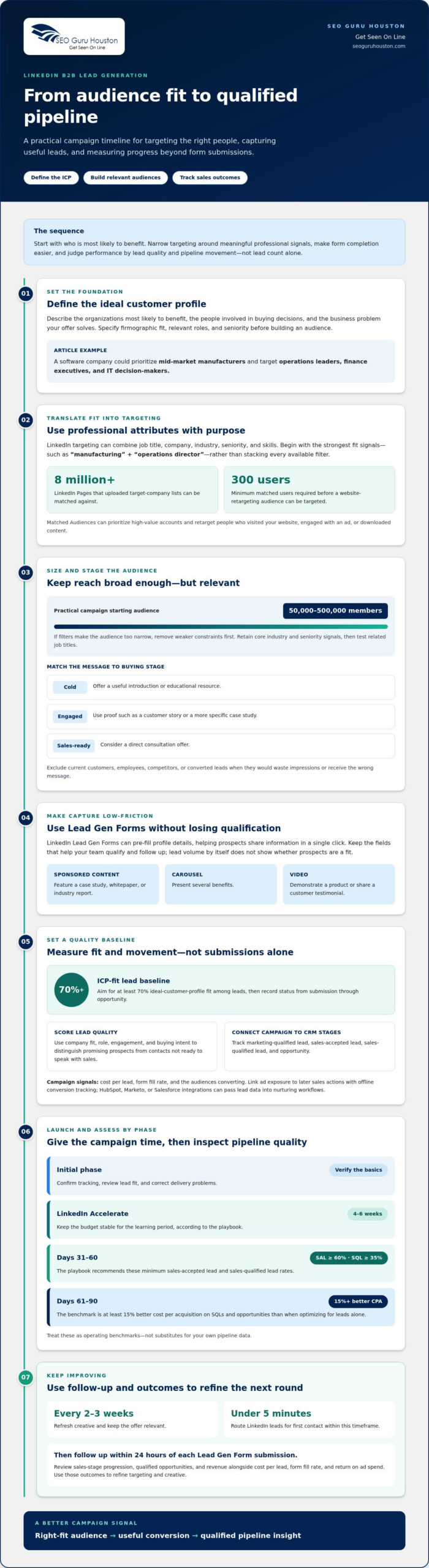
Strong LinkedIn ads for B2B lead generation start with a precise ideal customer profile (ICP), not a broad industry label. Define the organizations most likely to benefit, then identify the people involved in their buying decisions. For example, a software company might prioritize mid-market manufacturers and target operations leaders, finance executives, and IT decision-makers. Specify firmographic fit, relevant roles, seniority, and the business problem your offer addresses.
Translate that ICP into LinkedIn’s professional targeting criteria. Advertisers can select job title, company, industry, seniority, and skills, then combine attributes to narrow relevance. Start with the strongest fit signals, such as “manufacturing” plus “operations director,” instead of stacking every possible filter. LinkedIn can match uploaded target-company lists against more than 8 million LinkedIn Pages, helping account-based campaigns reach decision-makers at named organizations.
Use Matched Audiences to prioritize high-value accounts and build retargeting groups from people who visited your website, engaged with an ad, or downloaded content. Website retargeting requires at least 300 matched users before the audience can be targeted. Keep prospecting and retargeting distinct: a first-touch audience may need an educational resource, while people who already engaged can receive a more specific case study or demo offer.
Audience size matters. A practical campaign starting point is 50,000-500,000 members, as recommended in the guidance summarized here. If your filters make the audience too narrow, remove weaker constraints before expanding beyond your ICP. For example, retain the target industry and seniority, but test related job titles. Exclude current customers, employees, competitors, or converted leads where those groups would waste impressions or receive the wrong message.
Map audiences to buying stages before choosing creative. Cold prospects need a useful introduction; engaged visitors may respond to proof, such as a customer story; sales-ready accounts may be ready for a direct consultation offer. This staged approach supports demand generation without assuming every prospect is equally close to buying.
How do LinkedIn ads compare with Google Ads and Meta ads for B2B leads? LinkedIn’s professional attributes and company targeting help focus on roles and accounts, while Google Ads can reach people expressing search intent. Meta ads commonly use broader demographic and interest signals, so the strongest channel depends on whether account fit, active search, or broader discovery matters most.
What LinkedIn advertising policies and targeting restrictions apply to lead generation? Use LinkedIn’s available professional attributes and eligible Matched Audiences, and ensure each audience meets platform requirements. In particular, website retargeting needs 300 matched users; campaign content and targeting must also follow LinkedIn’s advertising policies.
2. Lead quality, pipeline measurement, and campaign optimization
Lead volume can look strong while sales receives few useful opportunities. Set a quality baseline before launch: aim for at least 70% ideal-customer-profile fit among leads, then record each lead’s status from submission through opportunity. A simple scoring model can weigh company fit, role, engagement, and buying intent. Use those criteria to distinguish promising prospects from contacts who downloaded an asset but aren’t ready to speak with sales.
Build conversion tracking around the campaign objective, not clicks alone. LinkedIn Lead Gen Forms reporting includes cost per lead, form fill rate, and the audiences converting. Connect those metrics to CRM stages such as marketing-qualified lead, sales-accepted lead, sales-qualified lead, and opportunity. Offline conversion tracking can link ad exposure to later sales actions, while integrations with HubSpot, Marketo, or Salesforce can pass lead data into nurturing workflows.
Choose creative that fits both the offer and the buying stage. Sponsored Content can feature a case study, whitepaper, or industry report; carousel ads can present several benefits, while video can demonstrate a product or share a customer testimonial. Lead Gen Forms reduce manual entry, but results still depend on audience fit and a useful offer. Test creative variations and compare qualified pipeline, not just click-through rate.
Its ad auction uses advertiser bids, and Campaign Manager supports daily or lifetime budgets that you can change as results develop. Start with a budget aligned to the test’s audience and conversion goal; avoid frequent changes that make it harder to compare performance. LinkedIn Accelerate campaigns should receive 4-6 weeks of stable budget to learn, according to the playbook.
Use a staged launch. During the initial phase, confirm tracking, review lead fit, and correct delivery problems. During days 31-60, the playbook recommends an SAL rate of at least 60% and an SQL rate of at least 35%. By days 61-90, it recommends achieving at least 15% better CPA on SQLs and opportunities than when optimizing for leads alone. Treat these as operating benchmarks, not substitutes for your own pipeline data.
How do you improve conversion and lead quality? Refresh creative every 2-3 weeks, keep the offer relevant, and use lead scoring to prioritize follow-up. Route LinkedIn leads for first contact in under five minutes, then follow up within 24 hours of each Lead Gen Form submission.
How should you measure campaigns? Review cost per lead and form fill rate alongside lead quality, sales-stage progression, and return on ad spend. Track whether leads become sales-accepted leads, qualified opportunities, and revenue, then use those outcomes to refine targeting, creative, and bids.
Common risks include judging success by lead count, neglecting follow-up, and letting irrelevant impressions consume budget. Keep the wasted impression rate below 5%, and use retargeting, including website and video engagement, to support the pipeline. About 30% of assisted pipeline in a LinkedIn B2B campaign should come from retargeting, according to the playbook.
Need a clearer demand generation plan connecting paid campaigns to pipeline? Explore demand generation strategy as a way to align audience, offer, and follow-up.
3. CTR, conversion rate, CPL, lead quality, and ROAS
Use click-through rate (CTR) to diagnose whether an ad earns attention, not to declare a campaign successful. Cold-prospecting LinkedIn content ads should aim for at least 0.5% CTR. Single-image ads paired with Lead Gen Forms typically see 0.4-0.8% CTR. Compare each campaign with its format and audience, since a relevant decision-maker click matters more than an unqualified click.
Conversion rate reveals what happens after the click. Calculate it by dividing completed actions by the relevant visits, then multiplying by 100. For a Lead Gen Form campaign, track both form opens and completed submissions to spot friction. A form-fill rate of 10-20% is a target for cold audiences, while warm audiences can aim for 20-40%. If clicks are healthy but completions lag, review the offer, form fields, and message match.
LinkedIn reports that Lead Gen Form campaigns increase conversions by 2-3x compared with standard Sponsored Content campaigns. That comparison can help guide a test, but assess your own audience and conversion path. Test one clear variable at a time, such as the offer or creative, and compare completed forms and qualified leads. Keep campaign objectives, attribution settings, and reporting periods consistent so the result reflects the change you tested.
Cost per lead (CPL) is campaign spend divided by submitted leads. LinkedIn’s guide reports that its cost per lead is 28% lower than Google AdWords. Use that comparison as context, not a substitute for your account’s actual results. A low CPL can still mask weak fit, so segment leads by company, role, and sales qualification. For example, compare the CPL of all form submissions with the CPL of sales-qualified leads.
Lead quality connects advertising metrics to revenue potential. Score fit and intent using signals such as target-company match, decision-making responsibility, and engagement with a high-value asset. Then assess how leads progress into sales conversations and opportunities. An audience that generates fewer submissions but more qualified opportunities may be more valuable than a larger, less relevant group.
Return on ad spend (ROAS) compares revenue attributed to ads with campaign spend. Calculate it by dividing attributed revenue by advertising cost, using the same attribution approach across campaigns. For a longer B2B sales cycle, monitor qualified pipeline and closed revenue alongside immediate form conversions. This prevents early engagement from being mistaken for final business impact.
Review metrics as a connected sequence: CTR indicates attention, conversion rate shows response, CPL measures acquisition efficiency, and lead quality tests fit. ROAS connects the path to revenue. When results weaken, identify the stage first. Low CTR may point to an audience or creative issue; low form completion suggests friction in the offer or form; high lead volume with a weak pipeline calls for stronger qualification and follow-up.
4. Lead Gen Forms and form-field optimization
LinkedIn Lead Gen Forms reduce friction by pre-filling professional details from a member’s profile. Depending on available profile information, fields can include name, contact details, company, seniority, job title, and location. Members can submit with one click instead of typing each answer, making the form useful for mobile users responding to Sponsored Content or a Message Ad.
Keep the form focused on the information sales needs to act. A practical starting point is four fields for most B2B forms. For example, request name, work email, company, and job title when those details support lead routing and qualification. Each extra question asks for more effort, so add a field only when its answer changes follow-up, qualification, or audience segmentation.
Match the form to the offer. Someone requesting an introductory guide may only need to provide basic work details, while a consultation request may justify a qualifying question about business needs. Keep the question direct and easy to answer. For example, offer a short set of choices about the prospect’s main challenge instead of asking for a lengthy description.
Set expectations before the click. Explain in the ad what the prospect will receive, who the offer is for, and what happens after submission. Then use the thank-you page to deliver the promised resource or direct the person to a relevant website destination. A downloadable eBook, case study, or product information page can clarify the next step.
LinkedIn Lead Gen Forms reporting shows cost per lead, form fill rate, and which audiences convert. Review these measures together: a high fill rate matters only when submissions fit your target accounts and provide actionable details. Leads can be downloaded from Campaign Manager or sent to a CRM or marketing automation platform. Connecting the data to HubSpot, Marketo, or Salesforce supports timely routing and nurturing.
Test changes deliberately. Compare one form version with another, changing a single element such as the offer description, field selection, or call to action. Track both completed submissions and downstream lead quality, then keep the version that contributes stronger prospects. LinkedIn’s guide reports that Bynder increased leads by 400% using Lead Gen Forms, but that case study is not a forecast for every campaign.
Use a 10% form completion rate as a target, then diagnose performance against your own audience and offer. If completion is weak, check whether the ad promise matches the form, whether each requested detail is essential, and whether the thank-you page gives a clear next step. Small edits to those elements can make the path from LinkedIn impression to useful lead more direct.
5. How do LinkedIn ads generate B2B leads?
LinkedIn ads put a business offer in front of professionals researching solutions and guide interested members toward a next step. A typical path moves from a relevant impression to content engagement, a form submission, and sales follow-up. Strong campaigns connect each step, keeping the ad promise, landing experience, and follow-up message consistent.
Sponsored Content appears in members’ feeds and can promote whitepapers, case studies, or industry reports. A carousel can present related ideas, such as a business challenge, its impact, and a practical solution. Video ads can feature a short product demonstration or customer testimonial. Match the format to the asset: a report suits a detailed learning offer, while a demo can show how a product works.
LinkedIn Message Ads can deliver personalized messages to members’ inboxes for account-based marketing. Dynamic Ads use profile data to create personalized experiences, while Spotlight Ads can direct people to a landing page. Follower Ads serve a different purpose: growing a Company Page audience. Choose the format for the action you want, rather than treating every ad type as interchangeable.
For a named-account campaign, pair a useful asset with company and role relevance. For example, a manufacturer could promote an operations case study to decision-makers at selected manufacturing accounts. Prospects who engage can later see a more focused offer. LinkedIn retargeting can reach people who visited a website, engaged with an ad, or downloaded content, helping the campaign continue the conversation.
Content helps buyers evaluate options before they’re ready to speak with sales. LinkedIn’s lead generation guide says a typical B2B buyer consumes 7 to 10 pieces of content before making a choice. Plan a sequence that offers distinct value, such as an industry report, a practical case study, and a product demonstration. Each asset should answer a different question and make the next step clear.
Buying decisions involve more than one person. LinkedIn research found that 3.1 to 4.6 groups can influence a B2B purchase decision. Build messages for the roles involved, such as finance, technical, and operational stakeholders, and give each group a reason to engage. A campaign that speaks to only one contact may miss other voices shaping the purchase.
Ultimately, LinkedIn ads for B2B lead generation work by combining professional targeting, relevant content, and a clear conversion path. Map each creative to an audience need, then connect form submissions and content engagement with suitable sales follow-up. Plan your LinkedIn lead generation approach around the pipeline you want to build.
SEO Guru Houston: Houston SEO Services
SEO Guru Houston can help when LinkedIn campaigns need to connect with a broader B2B acquisition strategy. Its B2B marketing and PPC services support businesses aligning paid campaigns with audience needs, landing pages, and pipeline goals. SEO services can complement that work by building organic visibility for prospects researching solutions beyond an ad click.
Turn to SEO Guru Houston when campaign activity generates leads but it is unclear how channels contribute to sales opportunities. SEO, PPC, and inbound marketing can bring targeting, content, and follow-up into sharper focus, while supporting buyer education across relevant touchpoints.
Contact SEO Guru Houston to discuss how these services can fit your B2B marketing goals.
Turn Campaign Insight Into Your Next Growth Move
The next step is to make every marketing channel support the same business goal. Treat each LinkedIn campaign as part of a wider path: the message creates interest, your website builds understanding, and a relevant next step helps prospects continue their research. That perspective keeps LinkedIn advertising for B2B lead generation connected to the conversations and opportunities your business wants to create.
SEO Guru Houston can support that broader strategy through B2B marketing, PPC, and SEO services. These offerings can help align paid visibility with B2B audience needs and organic discovery, giving your team a clearer foundation for reaching prospective customers across their research journey.
Ready to shape a more connected approach to B2B growth? Contact SEO Guru Houston to discuss your marketing goals and the next steps that fit your business. Build with focus, learn from each campaign, and keep moving toward stronger opportunities.
Frequently Asked Questions
How to target B2B audiences on LinkedIn by job title, company, and industry?
Build a LinkedIn audience by combining the role, organization, and sector that define a qualified prospect. For example, target procurement leaders at healthcare companies, then compare that segment with operations leaders at the same companies. Keep audience groups distinct so reporting shows which combination attracts stronger prospects. Exclude existing customers or converted leads when the offer is aimed at new business, and refine targeting with sales feedback.
What is the average cost per lead for LinkedIn B2B ads in the United States?
LinkedIn B2B cost per lead varies with the auction, audience competition, ad format, offer, and conversion rate, so one average won’t predict your campaign’s result. A narrow audience of senior decision-makers may cost more to reach than a broader group, while a stronger offer can improve form completions. Track spend against qualified leads and sales opportunities, not submissions alone, to understand whether the campaign’s acquisition cost supports your pipeline goals.
How to set up LinkedIn Lead Gen Forms step by step?
Create a LinkedIn Page and access Campaign Manager, then build a Sponsored Content or Message Ad campaign with a Lead Gen Form. Choose only the fields needed to qualify leads, keeping most forms to four fields or fewer, and add a thank-you page. Download leads from Campaign Manager or connect the form to a CRM or marketing automation platform.

