
Your CEO doesn’t care about your click-through rates or your social media impressions. While you’re celebrating a 6.6% search CTR, the boardroom is looking at a balance sheet where B2B acquisition costs have hit record highs in 2026. If you can’t translate your activity into financial velocity, you’re not a growth driver; you’re just an expensive line item. It’s frustrating to watch high-performing campaigns get dismissed because the data stays trapped in silos that nobody upstairs understands. You know the value is there, but if the reporting doesn’t speak the language of the C-suite, it doesn’t exist.
We’re going to fix that. This guide will help you master the high-impact marketing kpis for executive reporting that turn marketing spend into a measurable revenue engine. You’ll move past vanity metrics to secure absolute executive buy-in and transform your department from a cost center into a profit powerhouse. We’re providing a streamlined reporting framework that takes ten seconds to digest and gives you the leverage to demand a higher budget for 2027. We’ll cover the Boardroom Five metrics, from LTV:CAC ratios to pipeline velocity, ensuring your strategy is seen as a fundamental necessity for market dominance.
Key Takeaways
- Stop wasting boardroom time with vanity metrics like clicks; learn to translate every marketing action into a direct financial signal that the CFO respects.
- Master the “Boardroom Five” framework to establish the definitive marketing kpis for executive reporting that prove long-term business viability and financial velocity.
- Streamline your reporting with a three-tier dashboard architecture that filters out 90% of the noise, delivering a strategic overview executives can digest in seconds.
- Leverage AI-driven predictive performance to shift the conversation from historical spending to future revenue generation, catching budget bleed before it impacts your bottom line.
- Discover how to bridge the gap between technical execution and executive-level ROI reporting to secure the massive budget increases required for 2027 market dominance.
Why Most Marketing KPIs Fail in the Boardroom
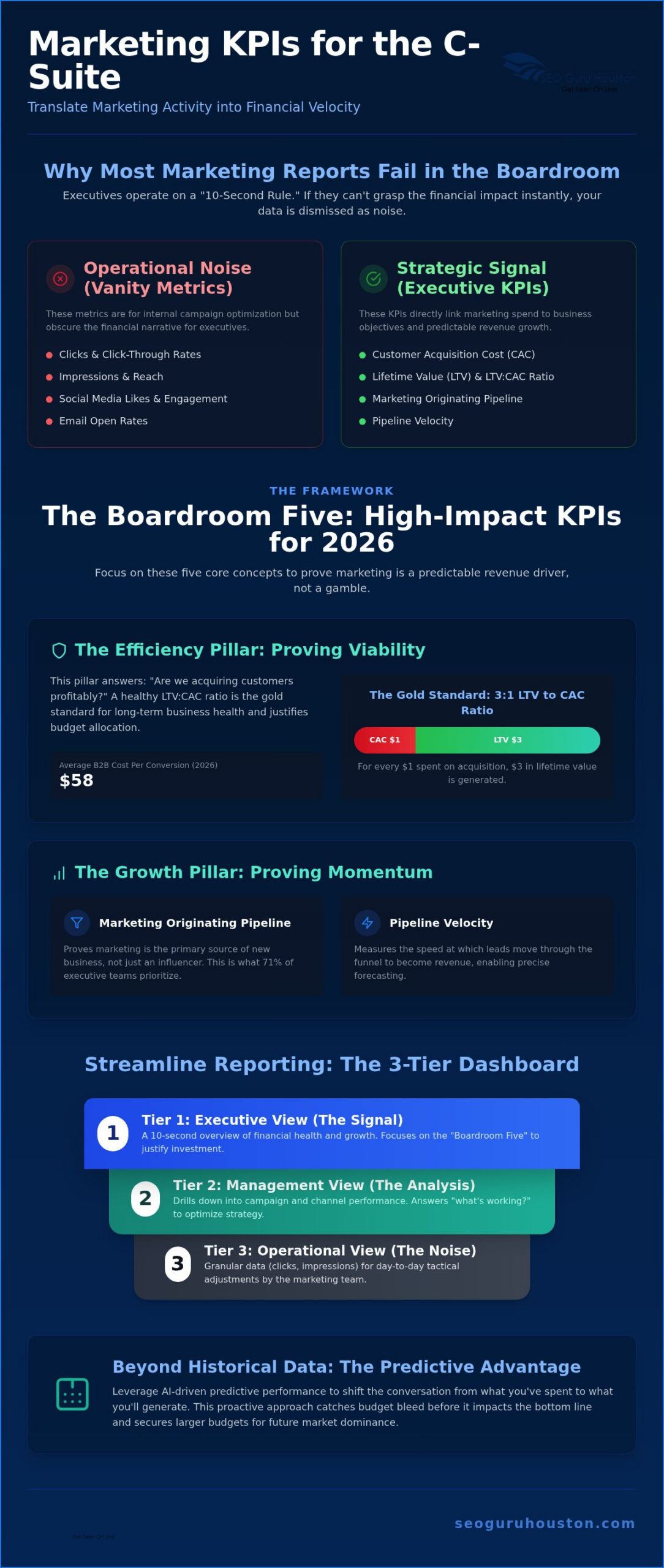
If you walk into a board meeting talking about impressions or engagement rates, you’ve already lost the room. In 2026, executives don’t have time for the “Vanity Metric Trap.” According to Gartner, 83% of executive teams now expect marketing to demonstrate clear ROI and business impact through data-driven dashboards. Your CEO doesn’t care about a 3.5% click-through rate; they care about how that activity translates into cash flow. When you dump a 50-page data report on their desk, you aren’t being thorough. You’re being ignored. Effective marketing kpis for executive reporting are filtered strategic signals that cut through the noise to show financial velocity.
The 2026 reality is brutal. Fragmented data silos and evolving privacy laws have made simple tracking a relic of the past. To survive this landscape, you must stop acting like a cost center. You need to be recognized as a high-performance growth engine. This requires a reporting framework that aligns every dollar of spend directly with revenue growth.
The Psychology of the C-Suite
The C-suite operates on the “10-second rule.” If an executive can’t understand the financial impact of your slide in ten seconds, they’ll dismiss it. They prioritize financial velocity, which is the speed at which your marketing spend turns into realized revenue. They don’t want tactical updates; they want to know if the engine is working. Poor reporting creates a perception of waste. In a high-cost B2B market, that perception leads directly to budget cuts and missed opportunities for 2027.
Metrics vs. Strategic KPIs
Don’t confuse operational noise with strategic signal. Your internal team needs granular data to optimize daily campaigns, but your board needs a narrative to justify the investment. A Key Performance Indicator (KPI) is a measurable value that demonstrates how effectively a company is achieving key business objectives. While HubSpot reports that 71% of executive teams prioritize pipeline generation and revenue influence, many marketers still lead with engagement metrics that provide zero insight into the bottom line. You must separate the “how” from the “how much.”
- Operational Noise: Clicks, likes, impressions, and open rates.
- Strategic Signal: Customer Acquisition Cost (CAC), pipeline velocity, and revenue influence.
- The Goal: Use marketing kpis for executive reporting to prove that marketing is a predictable revenue driver, not a gamble.
The Boardroom Five: High-Impact KPIs for 2026
Executives ignore data dumps because they lack a narrative. To secure buy-in, you must distill your performance into the “Boardroom Five.” These are the high-impact marketing kpis for executive reporting that translate technical execution into financial results. Forget impressions; we are talking about metrics that dictate your 2027 budget. If you can’t show how your activity moves the needle on the balance sheet, your strategy is invisible to the C-suite.
The Efficiency Pillar: CAC and LTV
Efficiency is about survival. In 2026, WordStream reports that the average B2B cost per conversion is approximately $58. If your Customer Acquisition Cost (CAC) exceeds your revenue velocity, you’re burning cash. A healthy 3:1 LTV:CAC ratio remains the gold standard for long-term viability. It proves that for every dollar you spend, you are creating three dollars of future value. If you want to scale these numbers without breaking the bank, partnering with a specialized B2B Demand Generation Agency is the fastest way to compress your CAC payback period. Your CFO wants to see that every dollar spent returns to the company in months, not years. Reducing this window is the most aggressive move you can make to justify a higher spend.
The Growth Pillar: Pipeline and Velocity
Growth is measured by the pipeline you build, not just the traffic you influence. While many marketers lean on “Marketing Influenced” revenue, 71% of executive teams now prioritize pipeline generation as the most critical metric. You need to track Marketing Originating Pipeline to prove that your campaigns are the primary source of new business. Calculating pipeline velocity allows you to forecast revenue with surgical precision. It measures how quickly a lead moves through your funnel to become cash. Referencing essential marketing KPIs from Harvard Business School can help you refine these definitions for your specific industry. Attribution modeling is no longer a luxury; it’s a requirement to prove marketing’s role in the complex B2B sales cycle of 2026.
In 2026, Share of Search has become the ultimate proxy for brand health and market dominance. It correlates directly with market share, providing a real-time look at how much of the conversation you own compared to your rivals. If your Share of Search is dropping, your future revenue is at risk. Mastering these metrics ensures you aren’t just spending a budget; you are investing in a competitive advantage. If you are ready to dominate, it’s time to refine your demand generation strategy to focus on these high-impact signals.
Architecting the Executive Dashboard: Noise vs. Signal
Executives don’t have time to hunt for insights. If your dashboard requires a tutorial, you’ve already failed. To win in 2026, you must implement a three-tier reporting framework that separates the daily grind from the strategic signal. Your operational layer is for the team. Your tactical layer is for the managers. But your executive layer? That’s a command center. It should only contain the top 10% of your data, filtered through a lens of financial impact. If a metric doesn’t directly explain revenue movement, it doesn’t belong on the final slide.
Visualizing this narrative requires moving beyond stagnant bar charts. High-performance teams are now using “Financial Velocity” maps. These visualizations show the speed of capital as it moves from your initial marketing spend into realized revenue. While automation tools like Domo or Qlik provide the necessary data plumbing, they can’t provide the “Guru” layer of human insight. A machine can show you a dip in conversion, but it can’t explain the strategic pivot needed to fix it. You must provide the context that translates raw numbers into a business case for market dominance.
The 10-Second Executive Dashboard
Designing for instant comprehension is a fundamental necessity. We recommend the “Red-Yellow-Green” status methodology. It’s the universal language of the C-suite. At a glance, an executive should know exactly where the strategy stands. Your reporting must answer three questions: What happened? What does it mean for the bottom line? What are we doing next? This level of clarity requires perfect alignment with your conversion assets. If your marketing kpis for executive reporting are built on flawed data, your credibility is at risk. This is why high converting landing page design is critical. If your landing pages aren’t capturing the right signals from the start, your dashboard is nothing more than a polished lie.
Attribution Modeling in a Privacy-First Era
The 2026 privacy landscape has made third-party tracking a relic of the past. First-party data is now your only reliable source for high-stakes reporting. You must own your data ecosystem to maintain accurate conversion numbers, which is why high-quality web design st louis is essential for capturing every lead interaction. For B2B enterprises, multi-touch attribution is no longer optional. The sales cycle is too complex for “last-click” models to hold any weight in the boardroom. You need to show how six different touchpoints over four months converged to create a high-value client. When you can prove exactly how each dollar of spend contributed to the final sale, you stop being a cost center and start being a growth driver. This is how you secure the trust and the budget needed for 2027.
Looking at last month’s data is like driving while staring at the rearview mirror. In 2026, the boardroom has no patience for post-mortems. They want to know what happens next. You need to shift the conversation from “What did we spend?” to “What will we earn?” This transition requires integrating AI-driven marketing kpis for executive reporting that transform raw data into a crystal ball for revenue. For healthcare organizations, specialized agencies like Future Marketing para Saúde provide the industry-specific context needed to turn patient data into actionable forecasts. Predictive lead scoring is the new standard. By analyzing historical conversion paths, AI can assign a probability of closure to every lead in your CRM. This turns your reporting from a simple list of names into a weighted revenue forecast, allowing you to report on pipeline quality long before the deals actually close. If you can’t forecast the revenue impact of today’s leads, you’re not reporting; you’re just documenting history.
Leveraging AI for Anomaly Detection
Budget bleed is the silent killer of marketing credibility. If a campaign misfires or a platform algorithm shifts, you can’t afford to wait for the monthly audit to find out. AI-driven anomaly detection acts as a proactive defense mechanism, catching irregularities in real-time. This is especially critical for high-stakes PPC Management where automated alerts prevent programmatic waste before it turns into a disaster. When you present these reports, you aren’t just showing performance. You’re demonstrating a secure, automated environment where the company’s investment is shielded from market volatility. Proving that your tech stack is a proactive defense mechanism builds immense trust with the CFO.
The Future of Forecasting
Strategic planning sessions in 2026 demand “What-If” scenario models. Executives need to see how a 10% increase in spend affects the bottom line over the next twelve months. By using historical data to predict seasonal fluctuations in B2B demand, you can build a growth model based on current marketing velocity. Integrating these predictive marketing kpis for executive reporting is how you secure buy-in for experimental high-growth channels. When you can forecast ROI with documented accuracy, the C-suite stops seeing your department as a cost center and starts seeing it as a high-yield investment. It’s about moving from defensive reporting to offensive strategy. To achieve this level of precision, you need a partner that understands how to translate technical data into financial outcomes. Explore our demand generation services to start building your 2027 growth model today.
SEO Guru Houston: Bridging the Gap Between Tech and ROI
You don’t need another agency that hides behind clicks and impressions. You need an assertive partner that understands market dominance is built on financial velocity. At SEO Guru Houston, we’ve spent years refining an approach that translates complex digital activity into the strategic signals your board demands. We don’t just execute campaigns; we architect growth engines. Invisibility is a choice, and in the high-stakes B2B landscape of 2026, it’s a choice your company can’t afford. Our B2B demand generation strategies are engineered to feed your executive dashboard with high-impact data that proves marketing is your most powerful revenue driver.
We stop the revenue leak by prioritizing the bottom line in every SEO and PPC initiative. While other firms might celebrate a spike in traffic, we’re looking at the quality of the pipeline and the speed of the conversion. We speak the language of the C-suite because we know that marketing kpis for executive reporting are only valuable if they justify your 2027 budget. If you’re hungry for prominence, you need a partner that treats your marketing spend with the same financial rigor as your CFO.
Our Reporting Philosophy
Our philosophy is built on total transparency combined with strategic coaching. We don’t just send a report; we ensure your board understands the cumulative value of your digital assets. We build custom executive reports that focus on strategic advantage and financial return, eliminating the operational noise that clutters typical dashboards. This result-oriented growth is the core of our professional SEO services. We provide the “Guru” layer of human insight that turns raw numbers into a persuasive business case for continued investment. You’ll never have to explain “what this means” again because the ROI will be undeniable.
Take Decisive Action for 2026
Don’t let your marketing department be dismissed as a cost center. It’s time to transform your strategy into a high-performance growth engine that commands respect in the boardroom. The margin for error in 2026 is zero. Rising acquisition costs and fragmented data require a sophisticated reporting framework that aligns your digital strategy with your financial goals. Contact SEO Guru Houston today to start building a reporting structure that secures your seat at the table. If you’re ready for market dominance, let’s build your 2026 marketing kpis for executive reporting together. The path from invisibility to prominence starts with a single decisive action.
Secure Your Market Dominance in 2027
The era of hiding behind engagement metrics is over. In 2026, your survival depends on your ability to translate every marketing action into a clear financial signal. By mastering the Boardroom Five and architecting a dashboard that prioritizes signal over noise, you move from being a cost center to a high-performance growth engine. You’ve learned how to leverage predictive AI to catch budget bleed and forecast revenue velocity with surgical precision. These are the definitive marketing kpis for executive reporting that turn technical execution into absolute boardroom buy-in.
Don’t let your hard work be dismissed because of fragmented data silos or poor visualization. You need a partner that speaks the language of the C-suite and has a proven track record of market dominance. Our results-oriented SEO and PPC specialists are B2B demand generation experts dedicated to your financial success. It’s time to align your digital strategy with your revenue goals and stop settling for invisibility. You have the blueprint; now you need the execution.
Stop Bleeding Budget and Start Scaling: Get Your Custom ROI Strategy Now!
Take the lead today and build the future your business deserves.
Frequently Asked Questions
What are the most important marketing KPIs for executive reporting in 2026?
The Boardroom Five are the most critical marketing kpis for executive reporting in 2026. These include Customer Acquisition Cost (CAC), the LTV:CAC ratio, Marketing-Originating Pipeline, Pipeline Velocity, and Share of Search. These metrics move past vanity numbers like clicks to show how marketing spend translates into financial velocity. By focusing on these five signals, you provide the C-suite with the data they need to justify your 2027 budget and long-term growth strategy.
How often should I present marketing reports to the executive team?
You should present a comprehensive strategic report once a month, with a high-level executive summary delivered quarterly. While your team monitors live dashboards daily, the C-suite doesn’t have time for tactical noise. Monthly reporting allows enough data to accumulate to show meaningful trends in your marketing kpis for executive reporting. This cadence ensures you remain aligned with the company’s financial goals without overwhelming the board with irrelevant operational updates.
What is the difference between a marketing dashboard and an executive report?
A marketing dashboard is a live tool used for daily operational and tactical adjustments by your internal team. In contrast, an executive report is a filtered strategic narrative designed for the C-suite. It removes 90% of the data noise to focus on the top 10% of metrics that impact revenue. While dashboards track the “how,” executive reports explain the “how much” and the “what next” regarding financial return.
How do I calculate the LTV:CAC ratio for B2B marketing?
Calculate the LTV:CAC ratio by dividing the total gross profit you expect from a customer over the duration of your relationship by the total cost spent to acquire them. In 2026, a 3:1 ratio is the benchmark for B2B success. If your ratio is lower, your acquisition costs are too high or your retention is failing. This metric is the gold standard for proving that your demand generation efforts are creating sustainable value.
What is pipeline velocity and why does the board care about it?
Pipeline velocity measures the speed at which your leads move through the sales funnel to become realized revenue. The board cares about this because it allows them to forecast quarterly revenue with surgical precision. If your velocity slows, your future cash flow is at risk. By reporting on this metric, you demonstrate that you aren’t just generating leads; you’re driving the momentum that keeps the company’s financial engine running at peak performance.
Can AI really predict marketing performance for my executive reports?
AI is now a fundamental necessity for accurate reporting. It uses anomaly detection to catch budget bleed in PPC campaigns and predictive lead scoring to weight the quality of your pipeline. This technology shifts your boardroom conversation from historical post-mortems to future revenue forecasts. By integrating AI-driven insights, you can present a 12-month growth model that secures buy-in for experimental high-growth channels and aggressive market dominance strategies.
How do I handle negative marketing data when reporting to the CEO?
Never hide negative data; own it with a strategic pivot. Use the Red-Yellow-Green methodology to highlight the issue instantly. Explain what happened, what it means for the bottom line, and exactly what your team is doing next to correct the course. Executives respect transparency and decisive action. Turning a failure into a proactive defense mechanism builds more credibility than a polished report that ignores obvious budget leaks or declining conversion rates.
Why should I prioritize first-party data in my 2026 reporting strategy?
Privacy laws in 2026 have made third-party data unreliable for high-stakes decision-making. First-party data, gathered directly from your own assets like high-converting landing pages, is the only source of truth left. Prioritizing this data ensures your attribution models are accurate and your ROI reporting is based on verified customer interactions. It protects your reporting from platform volatility and provides the board with the confidence they need to scale your budget.

