
What if the best marketing agency isn’t the one with the slickest pitch, but the one that can explain how it makes decisions? The questions to ask before hiring a marketing agency should reveal more than a polished presentation. They should show whether its strategy connects your business goals to the right channels, measurable outcomes, and accountable execution.
Expect clear answers about what success means, how progress will be reported, what happens first, and who is responsible for each step. Without that clarity, marketing activity can pile up while its business impact remains hard to see.
This 2026 guide gives you focused questions to assess an agency’s strategy, measurement, delivery process, and fit with your team. You’ll learn how to evaluate whether SEO, PPC, websites, and demand generation support the same growth priorities, and how to set expectations for reporting and responsibilities before work begins. Go into the conversation ready to look beyond promises and assess the plan behind them.
Key Takeaways
- Start with the business outcome you need, your target audience, and the barrier standing in the way, rather than leading with a channel request.
- Use questions to ask before hiring a marketing agency to understand how research and audience insight shape channel choices and priorities.
- Find out how campaign indicators connect to qualified leads, sales, or pipeline, and what reporting can and can’t show.
- Clarify who leads and performs the work, how communication flows, and how issues are handled before signing.
- Compare agencies across strategy, measurement, execution, communication, and business fit to make a decision based on clear reasoning.
Questions to Ask Before Hiring a Marketing Agency: Start With Your Goals
Start with the business result you need, the audience you want to reach, and what’s holding progress back. Don’t lead with “We need SEO” or “We want more social posts.” Those are possible tactics, not the underlying problem. A capable agency should first understand what your business needs to change, then explain which marketing priorities could help. If you’re still defining an agency’s role, this overview of what is a marketing agency provides helpful background.
Which business goal should the agency solve first?
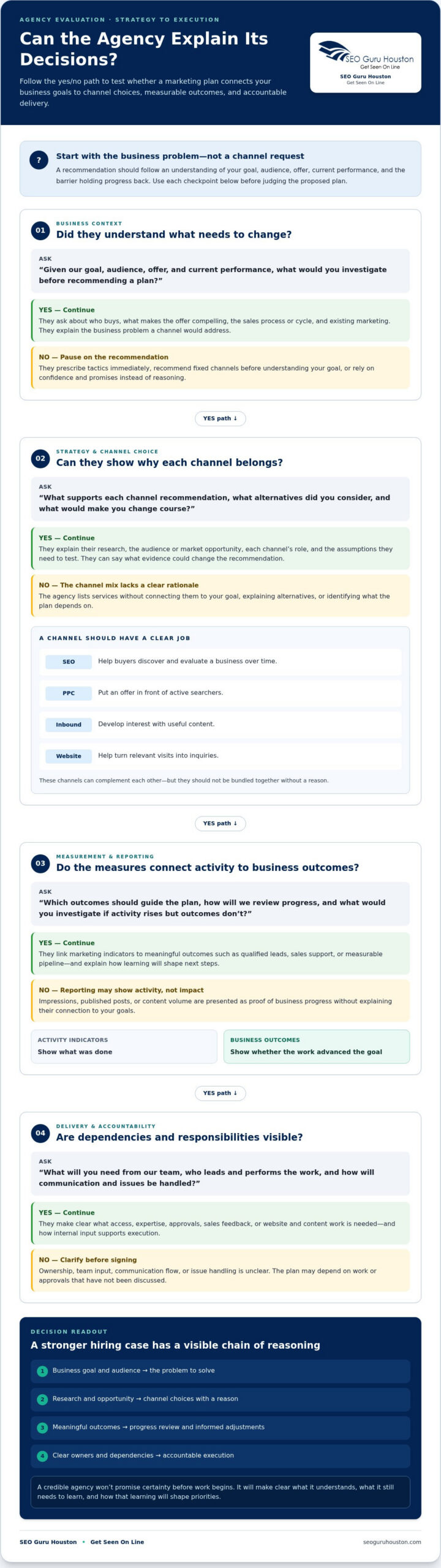
Ask: “Given our goal, audience, offer, and current performance, what would you investigate before recommending a plan?” The answer should show how the agency connects your business context to marketing decisions. For example, a company looking for more qualified sales conversations may need to clarify its ideal buyers, offer, and sales cycle before deciding whether SEO, PPC, inbound marketing, or another channel belongs in the plan.
Listen for questions about who buys, what makes the offer compelling, how long a sale takes, and what current performance reveals. A channel recommendation can make sense, but it should follow a clear explanation of the problem it addresses. Be cautious if the agency prescribes tactics immediately or relies on confidence and promises instead of reasoning.
Quick answer check:
- Strong signal: The agency asks about your audience, offer, sales process, and existing marketing.
- Strong signal: It explains the business problem a proposed channel would address.
- Warning sign: It recommends a fixed set of channels before understanding your goal.
How will the agency define a successful partnership?
Ask: “Which outcomes should guide the plan, and how will we review progress?” The answer should connect marketing work to a business result, such as generating qualified leads, supporting sales, or building a measurable pipeline. Clarify how the agency will evaluate progress and use what it learns to set next steps.
Separate outcomes from activity. Impressions, published posts, and content volume can show what was done, but they don’t prove that the work advanced your business goal. Ask how those indicators relate to meaningful results and what the agency would investigate if activity increases but outcomes don’t.
“A useful agency brief names the business outcome, the audience it matters to, and the barrier marketing must help overcome.”
A credible answer won’t promise certainty before the work begins. It will make the logic visible: what the agency understands, what it still needs to learn, and how that knowledge will shape priorities. Among the questions to ask before hiring a marketing agency, this one helps reveal whether the pitch is built around your business or simply around a list of services.
Ask How the Marketing Agency Builds Strategy and Chooses Channels
A strategic recommendation should have a clear chain of reasoning: what the agency learned about your audience and market, which opportunity it sees, and why the proposed channels fit your goal and resources. Ask what research informs the plan, how the agency understands buyer needs and competitors, and what evidence could change its recommendation. The questions to ask before hiring a marketing agency should test the thinking behind the channel mix, not just the list of services.
How does the agency decide which channels deserve investment?
Ask: “What supports each channel recommendation, what alternatives did you consider, and what would make you change course?” Listen for a clear explanation of each channel’s role in the customer journey. SEO may help buyers discover and evaluate a business over time; PPC can put an offer in front of active searchers; inbound marketing can develop interest with useful content; and website or landing page work can help turn relevant visits into inquiries. These channels can complement each other, but they shouldn’t be bundled together without a reason.
For a closer look at search strategy, explore this guide to professional SEO services.
| What to assess | Useful agency reasoning | What to learn |
|---|---|---|
| Strategy | Connects the audience, business goal, and market opportunity | Why this plan fits your situation |
| Channel rationale | Explains each channel’s job and alternatives considered | Where attention and effort will go |
| Dependencies | Identifies needed website changes, content, access, or approvals | What must be ready for execution |
| Expected learning | Names the assumptions to test and how findings inform adjustments | How the strategy can evolve |
What will the agency need from your team?
Ask what access, subject-matter expertise, approvals, and sales feedback the work depends on. A sound plan makes responsibilities visible. Your team may provide product knowledge or review content, while the agency uses that input to shape campaigns, pages, and lead-generation activity. Clarify how the plan will use existing assets and internal marketing capacity, so it builds on what’s already working rather than duplicating effort.
If business-to-business growth is a priority, this B2B demand generation guide offers a related perspective. A tailored digital plan works best when agency recommendations, internal expertise, and sales feedback support the same goals. Learn more about SEO Guru Houston’s digital marketing approach and how connected digital services can support planning.
Questions About Marketing Results, Reporting, and Proof
A marketing report should help you make decisions, not just display activity. Ask which indicators connect campaign work to qualified leads, sales, or pipeline, and how the agency will assess whether performance is moving in the right direction. The answer should distinguish early signals, such as relevant traffic or completed inquiries, from business outcomes that may take longer to emerge.
Channel metrics show what marketing activity produced; business outcomes show whether that activity mattered to the company.
What should a useful marketing report explain?
Ask what the report includes, how often you’ll review it, which data sources it uses, and who will interpret the findings. Depending on your setup, sources might include Google Analytics 4, Google Ads, and CRM data. A dashboard alone isn’t enough. Look for clearly defined metrics, trends over time, context for changes, and recommended actions.
Clarify attribution limits, too. A customer may interact with several channels before becoming a lead or buyer, and available tracking may not show every influence. Ask how the agency will account for that uncertainty rather than presenting one channel’s numbers as the complete story. If results differ from expectations, the agency should explain what it will investigate, such as lead quality, landing-page performance, campaign targeting, or tracking issues.
- Clear definitions: You know what counts as a lead and how it’s qualified.
- Useful context: The report explains what changed and why it may matter.
- Next steps: Findings lead to specific questions, tests, or adjustments.
How can you assess case studies and performance claims?
Ask what the client’s starting point and objectives were, what timeframe the results covered, and which work the agency handled. A useful case study explains relevant context, including changes to the offer, website, sales process, or other marketing activity. Ask how results were measured and what the agency can reasonably attribute to its contribution.
Past performance can show how an agency thinks and works, but it can’t guarantee the same outcome for your business. Your audience, competition, resources, sales cycle, and starting conditions may differ. Treat a case study as evidence to examine, not a forecast. Among the questions to ask before hiring a marketing agency, this one helps distinguish transparent proof from a headline claim. Look for careful explanations, not promises based on someone else’s results.
Ask About Execution, Communication, and Accountability Before You Sign
A sound strategy needs a working process behind it. Before signing, make sure you know who owns the work, how tasks move from plan to delivery, how updates and decisions are handled, and what happens when problems arise. These questions to ask before hiring a marketing agency help turn a promising pitch into clear expectations your team can use day to day.
- Ownership: Who leads the account, who performs the work, and who makes decisions on each side?
- Workflow: How do tasks, approvals, dependencies, and deadlines move from kickoff to completion?
- Communication: How often will you meet, which channels will you use, and where will decisions be recorded?
- Issue resolution: How will the team raise delays, performance concerns, or proposed scope changes?
Who owns the work and how will progress stay visible?
Ask who your day-to-day contact will be and which specialists will contribute. Then agree on a meeting rhythm, communication channels, approval windows, and the people authorized to make decisions. After each review, action items should have clear owners and next steps. Documented dependencies, such as your team supplying subject-matter input or approving a landing page, make it easier to catch delays before they stall execution.
What happens when priorities or performance change?
Ask how the team will use new evidence to adjust campaign priorities and explain changes to the plan. Clarify how a scope change is raised, how its impact on timing or workload is evaluated, and how it’s approved before work shifts. If results raise concerns, expect direct communication about what the team sees, what it’s investigating, and what happens next. Avoid arrangements where reporting changes without explanation or issues become a blame exercise.
Put the working model in writing before the engagement begins: contacts, responsibilities, review points, approval steps, and how changes are handled. That gives both teams a shared reference when priorities shift and makes accountability practical, not just a word in a pitch.
See how SEO Guru Houston’s digital marketing services bring strategy and execution together across SEO, PPC, websites, and demand generation.
Turn Your Marketing Agency Questions Into a Clear Hiring Decision
A confident presentation can make every agency sound capable. Base your decision on the quality of its reasoning and whether its approach fits your business. Use the same questions to ask before hiring a marketing agency in each conversation, then record specific evidence instead of relying on who made the strongest impression.
How do you compare answers without choosing the best presentation?
Score each agency across the same five areas: strategy, measurement, execution, communication, and business fit. You might rate each area from 1 to 3, where a low score means the answer lacked clarity and a high score means it was specific, relevant, and supported by clear reasoning. Add a brief note beside each score so your decision reflects what the agency actually explained.
- Strategy: Did the recommendation connect to your goals and audience?
- Measurement: Were outcomes and reporting explained in practical terms?
- Execution: Were roles, workflow, and dependencies clear?
- Communication: Did the agency explain how decisions and concerns will be handled?
- Business fit: Did its proposed approach account for your resources and priorities?
Compare answers against the business outcomes you established, not against how polished the pitch felt. If an agency leaves an assumption unanswered, record it as a point to resolve in the proposed scope. That can prompt a useful discussion rather than automatically ruling out a potential partner. Look for clear logic, realistic expectations, and a defined route from planning to action.
What should happen after choosing a marketing agency?
Before work begins, make sure the agreed scope captures the goal, responsibilities, reporting approach, and review points. Use the kickoff to align on access, decision-makers, immediate priorities, and what your team needs to provide. Then agree on how progress will be reviewed and how new information can shape strategic adjustments. A shared plan gives both teams a practical starting point.
Ready to turn your priorities into a focused plan? Build a strategy for measurable digital growth with SEO Guru Houston. A strong partnership starts with a clear goal, a tailored digital strategy, and an accountable path forward.
Choose a Growth Partner With a Clear Plan
The questions to ask before hiring a marketing agency should help you see beyond the pitch. Look for a strategy grounded in your business goals, a measurement plan that connects marketing activity to meaningful outcomes, and a working process with clear ownership and communication.
Before you commit, make sure the proposed scope explains what the agency will do, what your team will contribute, and how you’ll review progress together. The right partnership isn’t built on confident promises. It’s built on sound reasoning, realistic expectations, and a plan that can adapt as you learn.
SEO Guru Houston connects specialized SEO and PPC services with website development, landing pages, and demand generation to support business growth. Discuss a digital strategy built around your growth goals and take the next step with clarity.
Frequently Asked Questions
What questions should I ask before hiring a marketing agency?
The questions to ask before hiring a marketing agency should reveal how it will understand your goals, choose channels, measure progress, and manage the work. Ask who will perform the work, what your team needs to provide, and how recommendations may change as new evidence emerges. Use the same core questions with each agency to compare clear reasoning and defined responsibilities instead of broad promises or presentation style.
How do I know if a marketing agency is right for my business?
A suitable agency should understand your audience, sales process, growth goals, and internal capacity before recommending an approach. Ask it to explain why its strategy fits your situation and how it will evaluate progress. Relevant experience can help you assess its capabilities, but it doesn’t guarantee the same results for your business. Consider the quality of its reasoning, communication, reporting plan, and ability to adapt as your needs and findings evolve.
What should a marketing agency include in its proposal?
A useful proposal connects your business goals to a defined strategy, recommended services, responsibilities, measurement, and a process for reviewing progress. It should state important assumptions and dependencies, such as access, approvals, or input from your team. Check that the proposal explains how findings will be reported and what decisions they’ll inform. These details give both sides a practical basis for agreeing on scope, priorities, and how the work will proceed.
How can I tell whether a marketing agency’s results are genuine?
Ask what the client’s starting point and objective were, how results were measured, what timeframe was involved, and which work the agency performed. Look for context about other factors that may have influenced the outcome, such as changes to the website or sales process. A case study can demonstrate experience, but it isn’t a forecast for your company. Credible explanations describe limitations and how the findings shaped later decisions.
Should I hire one agency for SEO and PPC?
It depends on your goals, audience, internal capacity, and how the channels need to work together. Ask how SEO and PPC each support the strategy, how performance will be assessed, and who coordinates the work. One agency may provide a more integrated plan, while a focused engagement may fit a narrower priority. Choose based on strategic fit, clear ownership, and the agency’s ability to connect channel activity to your business objectives.
How often should a marketing agency report results?
Set a reporting cadence that fits the campaign, the decisions you need to make, and the time required for meaningful data to emerge. Ask what regular updates will cover and how the team will flag urgent issues. A useful report explains results, context, and recommended next steps rather than presenting unexplained numbers. Agree on the format and schedule during planning, then revisit them if campaign activity or business priorities change.
What are red flags when hiring a marketing agency?
Be cautious if an agency guarantees outcomes outside its control, recommends tactics without explaining why, or reports activity without connecting it to business objectives. Unclear responsibilities and unanswered questions about assumptions can also create friction. These signs warrant specific follow-up, not necessarily an immediate decision. Ask how success will be measured, who owns each task, and how changes will be handled. Proceed when the answers give you enough clarity to define scope and expectations.

