
Retargeting fails when every past visitor sees the same ad. If your campaigns generate impressions but few qualified conversions, the problem may not be your budget. It may be that your follow-up ignores what people viewed, how close they are to taking action, and whether they’ve already converted. Strong retargeting campaign best practices start with relevance, not repetition.
It’s easy to see why retargeting feels like a sure thing: these people already know your business. But broad audience lists, intrusive ad frequency, and unclear attribution can waste spend and wear down trust. Effective retargeting is a lifecycle-specific follow-up system, not a loop of generic ads to everyone who visited your site.
This practical checklist will help you build intent-based audience segments, set sensible exclusions and exposure limits, match messages to each stage, and measure outcomes beyond impressions and clicks. You’ll also see where privacy-conscious data practices and focused landing pages fit. The goal is to bring the right prospects back with a useful next step, then use performance evidence to improve the campaign.
Key Takeaways
- Set a campaign objective first so each retargeting effort supports a clear stage of the customer lifecycle.
- Use observable actions and recency to shape audience segments, then match each group with a relevant next message.
- Choose channels and creative based on campaign purpose, and verify current platform capabilities before launch.
- Apply these retargeting campaign best practices to review events, consent behavior, exclusions, destination pages, and conversion tracking.
- Assess performance against meaningful business outcomes, and use a structured self-audit to identify where additional expertise could help.
Retargeting Campaign Best Practices Start With a Clear Goal
Retargeting works best when it has a specific job. It’s paid advertising aimed at eligible people who previously interacted with your brand or content, with the goal of guiding them toward a relevant next step. For a neutral introduction to the concept, see Behavioral retargeting. Methods and audience options vary by platform, so verify current tracking, consent, and targeting requirements before building a campaign.
What is a retargeting campaign, and when should you use one?
Prospecting introduces your business to people who haven’t interacted with it. Retargeting follows up with people who have, such as someone who viewed a product, started but didn’t submit a form, read relevant content, or purchased before. Each action signals a different level of familiarity, not a guaranteed intention to convert.
Use the previous interaction to decide the campaign’s role. Ads might help a content reader explore a service, encourage a form starter to complete an inquiry, or introduce a past customer to a relevant next offer. Retargeting can support consideration, conversion, repeat purchase, or lead nurturing. An interaction alone doesn’t make someone eligible: tracking availability, audience size, platform settings, and applicable platform rules all affect who can be reached and how often.
Set one measurable campaign objective before choosing ads
Start with the next meaningful action, not the ad format. If the goal is lead generation, define a qualified inquiry in terms your team can apply consistently. If the goal is repeat purchase, specify the purchase event you’ll measure. Impressions and clicks can help diagnose delivery and engagement, but they don’t prove the campaign is creating valuable business outcomes.
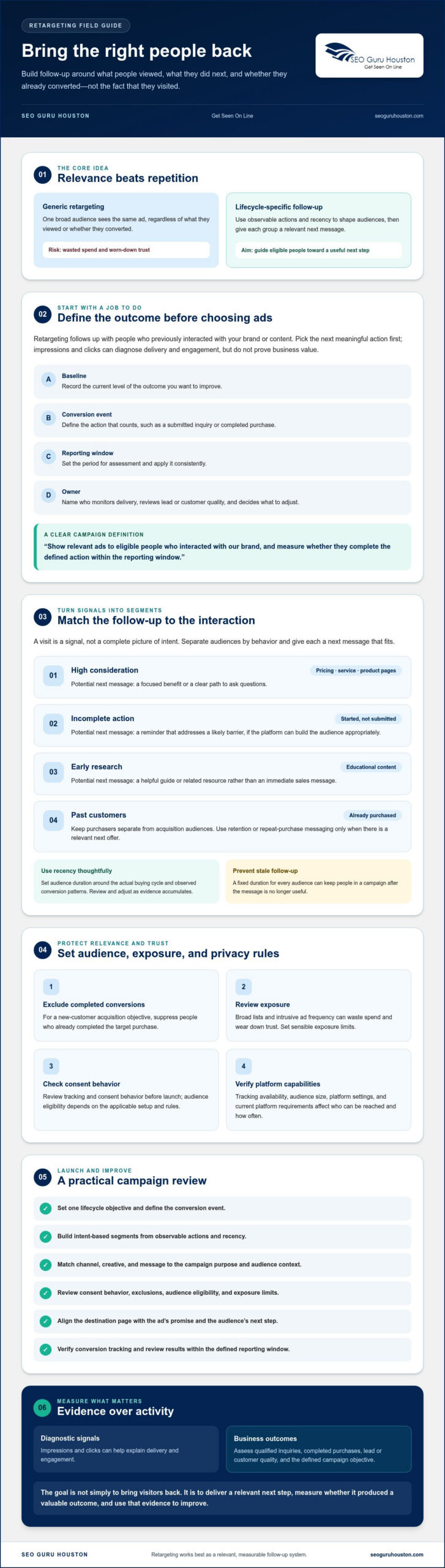
Before launch, document four things:
- Baseline: Record the current level of the outcome you want to improve.
- Conversion event: Specify the action that counts, such as a submitted inquiry or completed purchase.
- Reporting window: Set the period you’ll use to assess results, and apply it consistently.
- Owner: Name who will monitor delivery, review lead or customer quality, and decide what to adjust.
These retargeting campaign best practices give your team a clear way to judge performance instead of mistaking reach for impact. Keep the definition concise: “We’ll show relevant ads to eligible people who previously interacted with our brand, and measure whether they complete [defined action] within [reporting window].”
Build Retargeting Audiences Around Intent and Customer Lifecycle
A site visit is a signal, not a complete picture of intent. Someone who visited a pricing page may be closer to an inquiry than someone who read a general article. Someone who already purchased may need a retention message, not another ad urging them to buy for the first time. Strong retargeting campaign best practices turn these differences into clear audience and messaging rules.
Which retargeting audience segments should you create first?
Begin with actions that connect to a meaningful next step. Group eligible visitors by behavior, then choose a follow-up that fits what they did:
- High consideration: People who viewed pricing, service details, or product pages may need a focused benefit or a clear path to ask questions.
- Incomplete action: Form starters who didn’t submit may need a reminder that addresses a likely barrier, if the platform can build this audience appropriately.
- Early research: Readers of educational content may respond better to a helpful guide or related resource than an immediate sales message.
- Past customers: Separate purchasers from acquisition audiences. Consider retention or repeat-purchase messaging only when there’s a relevant next offer.
Set audience duration around your actual buying cycle and observed conversion patterns. Review how long it typically takes people to act, then adjust the inclusion window as evidence accumulates. A fixed duration for every audience can keep people in a campaign after the message is no longer useful. For lead-stage follow-up, align advertising with the broader progression from first engagement to sales readiness. This B2B demand generation guide offers a useful framework for thinking about that journey.
Use exclusions and privacy-conscious audience rules
Exclusions help keep your campaign relevant. If the objective is acquiring new customers, suppress people who have already completed the target purchase or inquiry. If those customers warrant follow-up, create a separate audience and define a distinct retention goal. Review exclusions as offers and objectives change, rather than letting old rules run unchecked.
Before activating any audience, confirm that your tracking and consent behavior, data use, and platform settings meet applicable requirements. Platform policies and audience capabilities can change, so verify them before launch. Collect only the data needed to define and evaluate the audience, and document its source, inclusion criteria, exclusions, and review owner. This record makes it easier to spot stale segments and maintain consistent controls.
Give each segment a next action and matching creative. Don’t show an educational-content reader the same message as a pricing-page visitor. If audience rules, paid campaign management, or the destination page need a closer review, explore paid campaign planning support.
Choose Retargeting Channels, Creative, and Frequency by Context
The right channel depends on who you can reach, what action you want, and which format can make the next step clear. Search, display, social, and video each have different audience requirements and creative strengths. Platform capabilities change, so verify current audience options, placements, measurement access, and frequency controls before launch. Don’t spread budget across every channel by default.
How do you choose a retargeting channel?
Compare audience availability, intent, creative fit, and measurement before committing. A channel belongs in the plan only if it can reach an eligible audience and support the campaign objective. Use one testable hypothesis at a time, such as whether a concise social message helps pricing-page visitors request more information.
| Channel | Strength | Limitation | Suitable context |
|---|---|---|---|
| Search | Can meet people as they search for relevant information. | Audience targeting and delivery options vary by platform. | Re-engaging eligible visitors who return to search with related intent. |
| Display | Visual reminders can extend reach across supported placements. | Broad exposure can feel repetitive without careful audience and frequency management. | Reinforcing consideration with a clear, recognizable message. |
| Social | Supports feed-friendly creative and messaging suited to the platform. | Available audiences, formats, and controls can change. | Following up with eligible visitors using a relevant next step. |
| Video | Can explain a product, service, or process through motion and sound. | Requires suitable creative and an audience the platform can reach. | Addressing questions that need more explanation than a short ad can provide. |
Create relevant ads without causing ad fatigue
Build the message around the visitor’s previous action and likely next question. A pricing-page visitor may need a clear way to compare options; someone who watched an explainer may benefit from a deeper resource. Keep the ad and destination page aligned so the promise doesn’t disappear after the click. This high-converting landing page design guide covers how to maintain that consistency.
Rotate distinct creative concepts, not just minor wording changes. Where frequency controls are available, set them deliberately, then review exposure alongside engagement, conversions, and negative feedback. If people see the ad repeatedly but stop responding, refresh the message, narrow the audience, or pause delivery. These retargeting campaign best practices keep exposure tied to usefulness rather than repetition. If channel selection, PPC campaign management, or landing-page alignment needs a structured review, explore paid campaign support.
Use This Retargeting Campaign Checklist to Launch and Optimize
A disciplined pre-launch review can catch broken events, mismatched messages, and wasted spend before they distort your results. Use this sequence to check the full path, from audience setup to the action you expect people to take. Platform interfaces and tracking requirements change, so verify current settings before activation.
What should you check before launching a retargeting campaign?
Work through each step in order. An audience appearing in an ad platform doesn’t prove that every setting is correct.
- Confirm the objective. Name the business action the campaign should support and how you’ll recognize a qualified outcome.
- Review audience rules. Check inclusion criteria, exclusions, eligibility, and whether the audience is large enough for the platform to serve ads.
- Verify tracking and consent behavior. Test relevant tags and events, and confirm tracking behaves as intended when a visitor’s consent choices change.
- Test the conversion path. Complete the journey yourself, from ad link to landing page to submission or purchase. Check for firing events, broken links, and discrepancies between platform and analytics reporting.
- Inspect the experience. Make sure ad claims match the destination page, the next action is clear, and the page works on mobile.
- Record the launch details. Document the baseline, conversion event, reporting window, budget owner, and person responsible for optimization.
Quick reference: Approve the campaign only after its objective, audience eligibility, exclusions, consent behavior, tags and events, destination page, mobile experience, and conversion tracking have been checked and documented.
How should you measure and improve campaign performance?
Review business outcomes alongside delivery signals. Track qualified inquiries or purchases along with reach, frequency, engagement, and conversion events. Compare results with the baseline you recorded, and note how attribution is configured. Ad platforms and analytics tools may report different totals because they use different tracking and attribution methods. A reported conversion can show an attributed relationship, but attribution alone doesn’t prove the ad caused the action.
Set a recurring review schedule that fits campaign volume. At each review, look for delivery problems, audience saturation, changes in lead or customer quality, and gaps between platform reporting and internal records. If performance shifts, change one major variable at a time, such as the creative or audience rule, and log the change, date, and outcome. That makes each test more informative than changing several settings at once.
These retargeting campaign best practices turn launch QA into an ongoing improvement process. If you need support coordinating PPC campaign management with tracking and landing-page development, review paid campaign management options.
Make Retargeting a Measurable Part of Your Growth Strategy
Retargeting earns its place when it supports a broader growth plan, not when it runs as a disconnected stream of ads. Connect paid campaigns to demand generation and a landing page designed around the action you want visitors to take. That alignment helps teams assess whether follow-up advertising is contributing to qualified inquiries, sales progression, or customer retention.
When should you manage retargeting in-house or seek support?
An internal team may be well placed to manage campaigns when it has the capacity to maintain them, understands relevant platform settings, can produce and refresh creative, and trusts its measurement process. If one or more of those pieces is missing, outside expertise may help close the gap. The decision is about capability and workload, not company size.
Before engaging a partner, clarify who will manage audience strategy, tracking coordination, creative testing, reporting, and communication. Ask what work is included, what access your team will have, how often results will be reviewed, and how recommendations will be documented. Look for a clear process and scope, not just promised outcomes. A broader PPC management guide can also help frame retargeting within paid campaign planning.
Turn the checklist into a campaign improvement plan
Don’t try to fix everything at once. Choose the largest verified gap, whether it’s audience quality, message relevance, or measurement confidence. Then write down the action, its owner, the evidence you’ll use to assess it, and a review date. For example, if the landing page doesn’t deliver the next step promised in an ad, assign someone to address that mismatch before changing several campaign settings.
Retargeting campaign best practices matter most when they become a repeatable operating habit. Connect each improvement to a business outcome, review what the evidence can and can’t tell you, and carry useful findings into the next campaign cycle. If your priorities are clear and you’d like support with PPC management, demand generation, or landing-page development, explore PPC and digital growth support.
Turn Retargeting Insights Into Your Next Growth Move
Retargeting delivers more value when it’s part of a connected growth strategy, not a standalone stream of reminders. The retargeting campaign best practices in this checklist point to a practical standard: make each follow-up relevant, respect audience choices, and judge performance by meaningful business outcomes.
Your next move doesn’t need to be a full campaign overhaul. Use your audit to identify the most important gap, assign an owner, and set a date to review progress. Then build on what the evidence shows. A well-defined audience, clear message, and useful destination page can work together to move prospects toward action.
If you want help connecting paid advertising with demand generation and landing-page development, PPC management and related campaign support are available. Explore PPC and digital growth support and consider what fits your priorities.
Keep testing thoughtfully, protect the prospect experience, and make each campaign decision count. Better results start with a clear next step.
Frequently Asked Questions
What are the best practices for a retargeting campaign?
Start with one business objective, then build eligible audience segments around relevant interactions and lifecycle stages. Match each segment with a useful message and destination page, and exclude people for whom the ad is no longer relevant. Check tracking and consent behavior before launch. The strongest retargeting campaign best practices also include reviewing qualified outcomes, exposure, and engagement regularly, then making measured adjustments instead of relying on impressions alone.
How long should a retargeting campaign run?
Run a campaign long enough to gather useful performance evidence, but don’t assume one duration fits every business. Base audience membership windows on your buying cycle and observed conversion patterns. A considered business purchase may take longer than a straightforward online order. Set a review date, check whether people are still converting within the chosen window, and adjust or pause if the audience becomes stale or the campaign no longer supports its objective.
How often should someone see a retargeting ad?
There isn’t one frequency that works for every audience, platform, and campaign. Set exposure limits where the platform offers them, then monitor frequency alongside engagement, conversions, and negative feedback. If people keep seeing an ad but stop responding, the message may be repetitive or no longer relevant. Consider refreshing the creative, narrowing the audience, or pausing delivery. Check platform controls regularly, since available settings can change.
Can retargeting work without third-party cookies?
Yes. Retargeting can use eligible first-party signals, such as customer information or activity collected directly through a business’s own properties, when platform settings and applicable requirements permit. Google’s Privacy Sandbox includes the Protected Audience API, designed to support remarketing and custom audience use cases without tracking individuals across sites. Reach and measurement may differ by platform, browser, and audience, so verify current capabilities and consent behavior before activation.
What is the difference between retargeting and remarketing?
The terms are often used interchangeably for follow-up marketing to people who have already interacted with a brand. Some marketers use “retargeting” more specifically for paid ads shown to previous visitors, while “remarketing” can also refer to follow-up through channels such as email. Naming conventions vary between platforms and teams. For campaign planning, define the audience, channel, and intended next action rather than relying on the label alone.
How do you measure whether a retargeting campaign is working?
Measure the business action the campaign was designed to support, such as a qualified inquiry or completed purchase. Review that outcome alongside reach, frequency, engagement, and conversion tracking, and compare results with a suitable baseline. Keep the attribution window and reporting method consistent. Attribution can show that a platform credited an ad with a conversion, but it doesn’t by itself prove the ad caused the outcome. Check lead or customer quality as well.
Should retargeting ads exclude people who already converted?
Usually, yes, when the campaign’s goal is to acquire a new inquiry or purchase. Exclude people who have completed that action so they don’t keep seeing an ad that no longer fits their needs. If past customers are eligible for a useful follow-up, such as a relevant repeat-purchase message, create a separate audience and objective. Review exclusions as campaign goals change, and confirm the platform can apply the audience rules as intended.

