
Tag Archives: Amazon Seller Tips

How to Optimize Amazon Product Listings for SEO in 2026

More keywords won’t automatically make an Amazon listing easier to find or more persuasive. Sellers often know their product needs better visibility, but the next steps can feel unclear: which search terms belong in the title, bullets, or backend fields, and how can the copy stay natural? Optimizing amazon product listings for seo works best when relevance and shopper clarity go together, not when keywords are repeated for their own sake.

This guide gives you a practical process to improve both. You’ll learn how to research and group relevant search terms, place them where they make sense, and shape a product detail page around the questions shoppers need answered. You’ll also learn to distinguish a discoverability problem from a conversion problem, then measure listing changes against meaningful outcomes. The goal is a clearer, more relevant listing and a disciplined way to assess whether your edits are helping.

Key Takeaways

  • Build a keyword map before editing so each relevant search term has a clear, useful place in the listing.
  • Make every listing element serve a purpose: help shoppers understand the product, assess its fit, and decide what to do next.
  • When optimizing amazon product listings for seo, prioritize relevance and readable copy over repeating the same phrases across fields.
  • Capture a baseline, update a focused group of related listing elements, and allow a suitable comparison period.
  • Separate discoverability signals from clicks, conversion, and sales to identify what needs attention next.

What Amazon Product Listing SEO Does, and What It Cannot Guarantee

Amazon listing SEO makes a product easier to discover through relevant searches and helps shoppers find useful information once they reach its detail page. That means aligning the listing’s language with the product and the way customers search, then clearly explaining what the product does, who it suits, and what buyers should know before choosing it. Keywords can help describe relevance, but they can’t replace a clear product page.

General SEO concepts offer a useful foundation. What is Search Engine Optimization? explains the broader goal of improving a page’s visibility in search. Amazon adds a marketplace context: shoppers are searching for products and comparing offers they can purchase, not simply looking for information on a topic. So optimizing amazon product listings for seo means considering both whether a listing matches a search and whether its content helps a shopper make a confident decision.

How Amazon search visibility differs from general web SEO

A website may use SEO to attract visitors researching a question, service, or product category. On Amazon, a shopper may search for a specific product type, compare several detail pages, and weigh each offer before buying. The listing must communicate product relevance, while its images, copy, price, availability, and other offer details can shape the shopper’s decision. Treat marketplace visibility and purchase performance as related but distinct questions. Appearing for a query doesn’t guarantee a click, and a click doesn’t guarantee a sale.

Why discoverability alone does not complete the job

Imagine a shopper searching for an adjustable laptop stand. A listing that includes the phrase but leaves compatibility, adjustment options, or key dimensions unclear may attract attention without resolving the buyer’s concerns. If the details are accurate and relevant, making them easy to find helps shoppers assess fit. Strong copy answers real questions; it doesn’t simply make room for more search terms.

Amazon listing SEO balances search relevance with product-page clarity, helping the right shoppers find a listing and understand why it fits their needs. Use that standard to review every field: does the wording accurately describe the product, and does it help a customer decide? If a phrase reads awkwardly or promises more than the product information supports, repetition won’t make it persuasive.

Keep expectations grounded. Optimization can support discoverability and improve the usefulness of a detail page, but it can’t guarantee a particular search position, traffic level, click-through rate, or sale. Results can also be affected by factors beyond listing copy, including the offer and shopper response. Treat changes as informed tests, not promises of a fixed outcome.

Amazon’s category requirements and available listing fields or research features can vary and change. Before editing, review current Seller Central guidance for the product’s category and the fields available to your account. This helps prevent an optimization plan from relying on outdated requirements or unavailable features.

How to Research and Map Amazon Keywords Before Editing a Listing

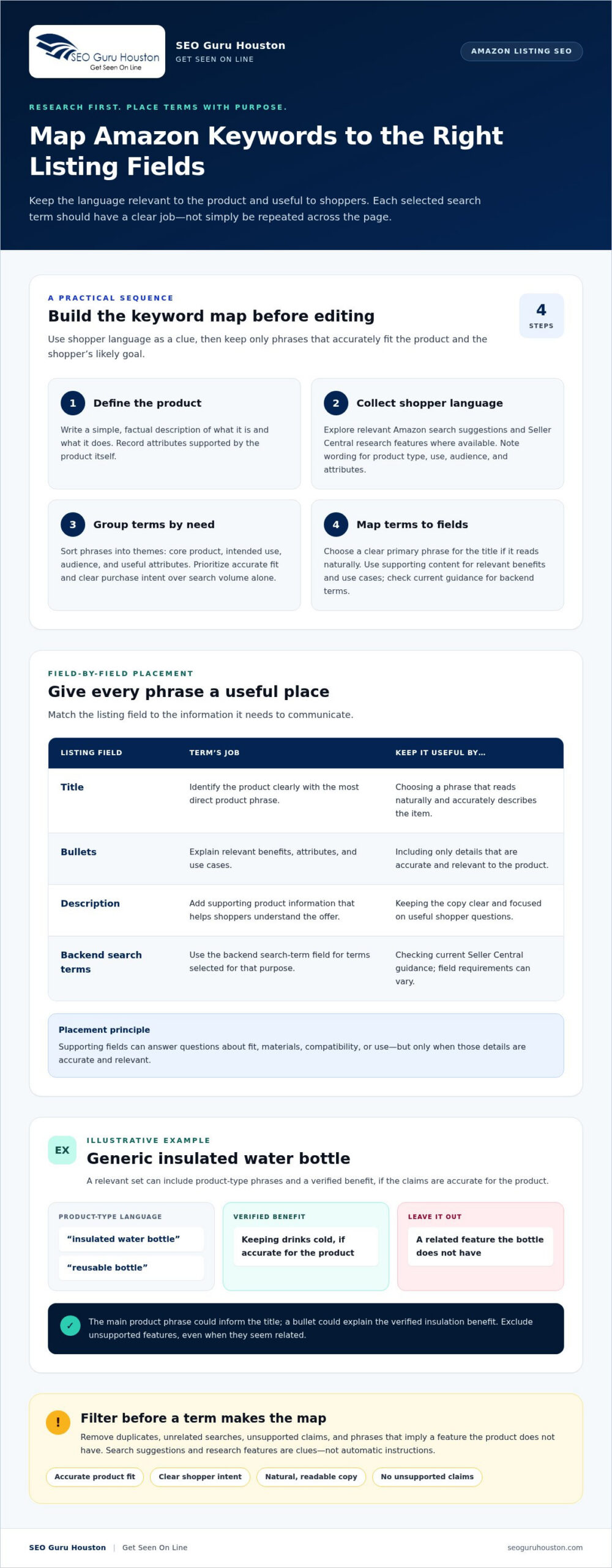
Start with research, not a rewrite. A focused keyword map helps you decide which phrases accurately describe the product, what shoppers likely mean by them, and where each term can fit naturally. This sequence makes optimizing amazon product listings for seo a deliberate process instead of a race to insert every phrase you find.

Build a relevant keyword set from shopper language

First, define the product plainly: its type, intended use, audience, and distinguishing attributes. Then gather the words shoppers use through Amazon search suggestions and relevant research features available in Seller Central. Treat these as clues, not automatic instructions. Keep terms that match the product and the shopper’s likely goal. Remove duplicates, unrelated searches, unsupported claims, and phrases that imply a feature the product doesn’t have.

  • 1. Define the product. Write a simple, factual description of what it is and what it does. Record only attributes supported by the product itself.
  • 2. Collect shopper language. Explore relevant Amazon search suggestions and Seller Central research features where available. Note variations in product type, use, audience, and attribute wording.
  • 3. Group terms by need. Sort phrases into themes such as core product, intended use, audience, and useful attributes. Prioritize accurate product fit and clear purchase intent over search volume alone.
  • 4. Map terms to fields. Choose the clearest primary phrase for the title if it reads naturally. Use bullets and description content to explain relevant benefits and use cases. Check current Seller Central guidance before entering backend search terms, since requirements can vary.

Illustrative example: For a generic insulated water bottle, a relevant set might include “insulated water bottle,” “reusable bottle,” and phrases about keeping drinks cold, if those claims are accurate for the product. Group the first phrases as product-type language and the last as a benefit. The main product phrase could inform the title, while a bullet explains the verified insulation benefit. Exclude a term for a feature the bottle doesn’t have, even if it seems related.

Map search terms to listing fields

Give every selected phrase a job. Put the most direct product identification where shoppers can quickly understand what’s being offered. Use supporting fields to answer questions about fit, materials, compatibility, or use, but only when those details are accurate and relevant. Backend fields can accommodate suitable terms that don’t fit naturally in visible copy; they aren’t a place to stash unrelated phrases. Review current category-specific Seller Central rules before publishing.

A simple worksheet can keep the process consistent: record each phrase, its shopper intent, its relevance to the product, and its planned field. If several terms express the same need, choose the clearest wording rather than forcing every variation into the listing. For sellers seeking strategic support beyond their own research, Amazon marketing support can help connect keyword choices with broader listing goals.

Which Listing Elements Matter Most for Amazon SEO and Shopper Decisions?

Each listing element has a different job. Some help identify the product, some answer buyer questions, and others help shoppers judge what they’ll receive. Prioritize the fields that address the clearest gap rather than editing everything at once. Also distinguish listing content from offer conditions: price and availability can affect a shopper’s choice, but they aren’t copy edits.

Title, bullets, and description: make relevance easy to understand

Use the title to identify the product and include its core search language naturally. Bullets should make verified features and customer benefits easy to scan, while the description can add context or clarify use. Avoid repeating the same phrase across every field. For each edit, ask whether it improves product understanding or simply adds another keyword.

Listing element Shopper purpose Optimization priority
Title Identify the product quickly and establish its main relevance. High. Make the product type clear and use accurate, natural wording.
Bullets Scan key features, benefits, and product-fit details. High. Lead with useful, specific information that the product supports.
Description Understand additional context, use, or details. Medium. Add information that helps a decision; don’t restate every phrase.
Images See the product and assess visible features or scale. High for shopper clarity. Keep visuals accurate and consistent with the offer.
A+ Content Explore supplementary brand and product information. Consider it where available and useful; verify current access and rules.
Backend search terms Support relevant terms that don’t fit naturally in visible copy. Use selectively. Follow current Seller Central instructions and avoid redundancy.
Price and availability Assess the offer and whether the product can be purchased. Review separately from listing copy; these are offer conditions, not text fields.

Images, A+ Content, and backend terms: support the full listing

Accurate images let shoppers inspect what the written copy describes and compare relevant details. A+ Content can provide additional brand or product context, but eligibility, access, and content rules can vary. Backend terms aren’t a workaround for weak visible copy. Include only relevant terms that comply with current Amazon guidance.

Limits, field names, category requirements, and feature access can change. Verify current rules in Seller Central before publishing, especially for titles and backend terms. Don’t assume a field is available or that a character limit applies uniformly across categories.

Use the element that matches the problem. If shoppers may not recognize the product, review the title. If they can identify it but key benefits or fit remain unclear, strengthen the bullets, description, or supporting content. If the listing communicates the product well but the offer itself is less competitive, review price and availability separately. Repeating keywords everywhere won’t solve these gaps. Optimizing amazon product listings for seo means making each field relevant, readable, and useful for the decision it supports.
How to Optimize Amazon Product Listings for SEO in 2026

How to Optimize an Amazon Listing Step by Step Without Guesswork

A reliable optimization process starts with evidence, not a full-page rewrite. Record what the listing says now, identify the most likely obstacle, make a focused change, and review the result against your starting point. This sequence makes optimizing amazon product listings for seo easier to manage, especially when several people share responsibility for product content.

Create a baseline and prioritize the first improvements

Before editing, save the current title, bullets, description, images, and any other fields you plan to change. Note available indicators for search visibility, listing visits, clicks, and sales, along with the dates covered. Use reporting available in your Seller Central account, and check current documentation for metric names and definitions. Then diagnose the clearest gap: weak relevance, missing or confusing product information, or limited shopper response.

  • 1. Capture the starting point. Save the live listing and record relevant performance indicators for a defined date range. Note offer conditions, such as price or availability, that could affect comparisons.
  • 2. Choose a priority. If the product is hard to identify, refine relevant language in the title. If shoppers may not understand fit or benefits, improve the content that answers those questions. Focus on accurate, meaningful changes rather than cosmetic wording.
  • 3. Revisit your keyword map. Match selected phrases to the field where they fit naturally. Remove terms that don’t describe the product or help explain its value.
  • 4. Edit a focused group of related elements. Update only what’s needed to address the diagnosed issue. When practical, avoid changing unrelated fields at the same time so later comparisons are easier to interpret.
  • 5. Log the change. Record the edit, the date it went live, the reason for it, and the outcome you expect to observe.

Implement edits and evaluate them responsibly

Keep product facts accurate and follow current marketplace requirements as you publish. After an edit, allow a suitable observation period for the indicators you’re tracking to become useful. Compare like with like where possible, and account for seasonality, promotions, price changes, availability shifts, or other listing updates during the same period. If several variables changed together, don’t credit one wording change with the full result.

Use a simple change log to preserve context: “Updated bullets to clarify compatibility; monitor relevant visits and orders; offer price unchanged.” This makes the next decision more disciplined. If the chosen indicator improves but sales don’t, investigate the offer and shopper experience rather than adding more keywords. If no meaningful movement appears, revisit the diagnosis before making another targeted change.

For a related perspective on improving product pages, explore this Amazon listing optimization guide. For support applying a structured approach across your Amazon marketing, discuss your Amazon listing strategy.

How to Measure Amazon Listing SEO and Choose Your Next Move

A listing change is only useful if you can learn from it. Measure the path from search exposure to purchase, and don’t treat every weak result as a keyword problem. Discoverability indicators, shopper response, sales, and offer conditions describe different parts of the journey. Separating them gives you a clearer next step than watching sales alone.

Read performance signals without overclaiming

Use reporting tools and metrics currently available to your seller account. Names, access, and definitions can change, so check current Seller Central documentation before comparing figures or building a report. Compare equivalent date ranges where possible, and note promotions, inventory interruptions, price changes, and other offer shifts that could influence results. If a reporting feature isn’t available to your account, don’t assume a substitute measures the same thing.

Search exposure shows whether shoppers may be seeing your listing; conversion shows what happens after shoppers arrive. Use that distinction to locate the likely bottleneck, then interpret available measures in context:

  • Discoverability: If relevant search exposure is limited, review whether the listing clearly matches the product and the searches you’re targeting. Confirm that the terms are accurate and placed appropriately.
  • Clicks and visits: If shoppers see the offer but don’t select it, assess how clearly the title and main image communicate what’s being sold. Consider the competitive context rather than assuming a keyword change is needed.
  • Conversion: If shoppers visit but purchases remain weak, look for unanswered questions, unclear product details, or a mismatch between the listing and the offer. Review price, availability, and other offer conditions separately from the copy.
  • Sales: Read sales alongside traffic and conversion indicators. A change in sales alone doesn’t identify which part of the customer journey changed.

Choose the next move based on evidence. Retain an edit when relevant indicators improve without a clear trade-off. Refine it when the direction is promising but a specific page element still appears unclear or underperforming. Investigate when signals conflict, the comparison period included major offer changes, or the reporting doesn’t support a confident conclusion. Avoid declaring a single edit the cause when other variables changed at the same time.

When expert support can strengthen the optimization process

Coordinating keyword choices, listing content, and performance analysis can become challenging across multiple products or teams. SEO Guru Houston’s Amazon-specific marketing services can support sellers who want a more connected view of those decisions. To coordinate listing improvements with a wider marketplace strategy, explore Amazon marketing services.

Make Your Next Listing Improvement Count

Your next step doesn’t need to be a sweeping overhaul. Choose one product page with a clear opportunity, then turn what you learn into a repeatable standard for the rest of your catalog. That’s how optimizing amazon product listings for seo becomes an ongoing business practice, not a one-time rewrite. Each disciplined improvement can sharpen how your product is presented and give your team a stronger basis for its next decision.

If you want to connect listing work with a broader growth plan, SEO Guru Houston brings Amazon-specific marketing together with SEO, PPC, and web development expertise. This support can help align marketplace priorities with the rest of your digital strategy while keeping the shopper experience in focus. Explore Amazon marketing services and take a focused next step toward stronger product pages. Keep testing thoughtfully, learning from the evidence, and building momentum.

Frequently Asked Questions

How do I optimize an Amazon product listing for SEO?

Start by confirming every product fact, including size, material, compatibility, and intended use. Then match shopper search phrases to the fields where they read naturally: product identification in the title, decision-making details in bullets, and added context in the description. For example, don’t describe a charger as compatible with a device unless that claim is accurate. Save the original listing and available account data so later adjustments have a useful point of comparison.

What is the most important part of an Amazon listing for SEO?

No single field guarantees a ranking, so prioritize the weakest part of the specific listing. A shopper who can’t identify the item may need a clearer title; someone who understands the product but can’t assess fit may need better bullets, images, or description details. Backend terms can support discoverability under current Amazon requirements, but they can’t replace useful visible content. Diagnose the shopper’s likely question before choosing what to edit.

How many keywords should I use in an Amazon product listing?

There’s no universal keyword count that fits every product and category. Build a relevant set from the language shoppers use, then include a phrase only where it accurately describes the item or helps explain its use. A phrase that adds no new meaning can make copy repetitive. Check Seller Central for current field requirements, especially for backend terms, where formatting and eligibility may differ from customer-facing content.

Do backend keywords help Amazon product listings rank?

Backend search terms can provide relevant product information, but they don’t replace clear customer-facing content or guarantee a ranking change. Use them only for phrases that genuinely apply and follow the instructions currently shown in Seller Central. For example, an alternate term may be useful if shoppers use it for the same product type, while a phrase suggesting an unsupported feature should be left out. Review available account data after edits rather than assuming an effect.

Does Amazon A+ Content improve SEO?

A+ Content can give eligible brands more ways to explain a product and help shoppers understand its features, but don’t assume it directly improves organic rank. Treat it as a content option for answering questions that standard copy may not address well, such as how a product is used or what distinguishes it. Verify current access and publishing rules in Seller Central, then assess available shopper and sales indicators after the content is live.

How long does Amazon SEO take to work?

There’s no universal timeline or guaranteed ranking change after an optimization. A result may depend on whether Amazon processes the update, category conditions, shopper demand, inventory, and changes to the offer. Record when each edit goes live and allow a suitable period to observe relevant account data. Compare similar periods where possible, and avoid stacking frequent changes, since that can make it harder to identify which adjustment may have influenced performance.

Can I use the same keywords in my Amazon title and backend search terms?

Place keywords in a way that follows current Amazon guidance and keeps the title clear. Repeating an identical phrase in multiple fields may add little value, but don’t assume one rule covers every category or field. Keep visible copy natural and accurate, then check Seller Central’s current backend instructions before entering terms. Never use repetition to imply a feature, compatibility, or benefit the product doesn’t actually provide.

How can I tell whether my Amazon listing optimization is working?

Compare available search visibility measures with listing clicks, conversion, and sales to see where the customer journey may be changing. For instance, more visits without more orders may point to a different issue than limited exposure. Keep a record of the listing version, edit dates, and changes to price, inventory, or promotions. Use current Seller Central reporting where available, compare appropriate periods, and decide whether to retain, refine, or investigate the update.
Amazon Storefront Design Houston: Assertive Strategies for Marketplace Dominance

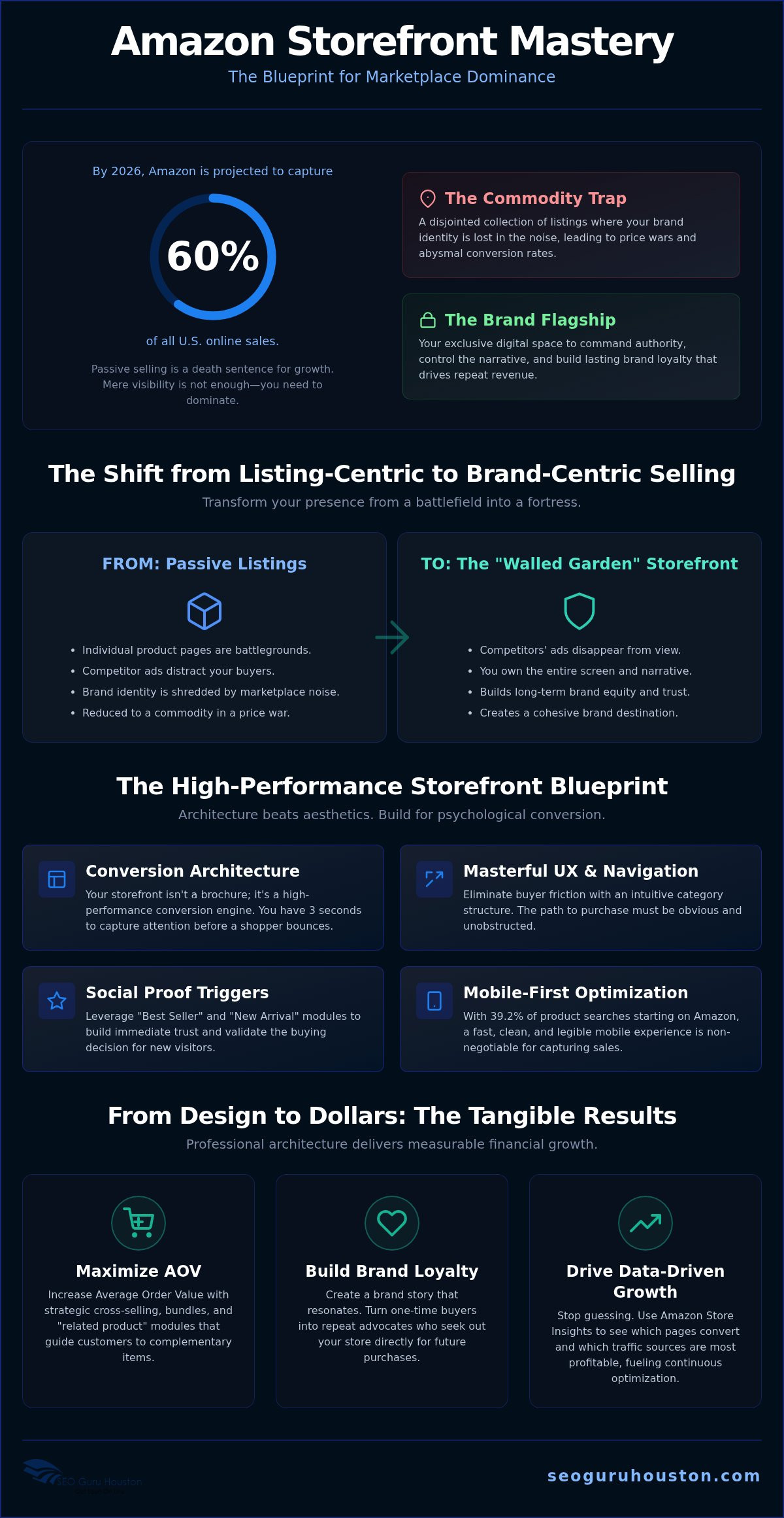
If your Amazon presence is just a collection of listings, you aren’t a real brand; you’re just a commodity waiting to be undercut. It’s frustrating to watch high traffic numbers result in abysmal conversion rates while your identity gets swallowed by the noise. With Amazon projected to capture 60% of all U.S. online sales by 2026, managing a complex catalog shouldn’t feel like a losing battle. You already know that basic templates won’t cut it in this environment. This is where professional amazon storefront design houston strategies become your most lethal weapon for marketplace dominance.

We’ll show you how to transform a stagnant storefront into a high-octane revenue engine that commands authority. You’re about to learn the exact architectural strategies needed to increase average order value, drive cross-selling, and build the kind of brand loyalty that generates repeat $$$ automatically. Stop settling for mere visibility when you can secure total market control. This isn’t about looking pretty; it’s about building a psychological conversion funnel that wins every single time.

Key Takeaways

  • Learn why a professional storefront is your brand’s exclusive flagship and why passive selling is a death sentence for growth in 2026.
  • Master the blueprint for high-performance amazon storefront design houston that prioritizes conversion architecture over simple aesthetics.
  • Discover how to synchronize your product listings and brand store to create a seamless “hook and closer” sales funnel.
  • Leverage Amazon Store Insights to move beyond “set it and forget it” and unlock continuous, data-driven revenue growth.
  • Understand why assertive marketing services are the non-negotiable engine required to dominate the 2026 marketplace landscape.

Why Amazon Storefront Design Houston is a Fundamental Necessity for Growth

Think of your Amazon Storefront as your brand’s digital flagship. It’s the only space in the massive online marketplace where you own the entire screen. Passive selling is dead. If you’re just listing products and hoping for the best, you’re already losing. By 2026, Amazon is projected to account for 60% of all U.S. online sales. You can’t afford to be invisible in that volume of traffic. You need to dominate.

Most sellers fall into the “Invisibility Trap.” They have superior products but inferior presentation. Their brand identity gets shredded by the noise of a thousand competitors. An assertive amazon storefront design houston strategy fixes this immediately. It moves your business from a disjointed collection of SKUs to a cohesive brand pillar. This is a core part of a modern inbound marketing strategy. It works for B2B industrial equipment and B2C consumer goods alike. Stop being a commodity. Start being a destination.

The Shift from Listing-Centric to Brand-Centric Selling

Individual product pages are battlegrounds. Competitor ads are everywhere, distracting your buyers at the moment of purchase. A professional storefront creates a “walled garden.” Once a customer enters your store, your competitors’ Sponsored Product ads disappear from their view. You own the narrative. This is how you build long-term brand equity. You must leverage Amazon Brand Registry to unlock these high-performance design tools. It’s about taking control. It’s about protecting your traffic and ensuring your message is the only one they hear. It’s a fundamental necessity for survival.

Measurable Benefits of Professional Architecture

Don’t confuse design with decoration. We’re talking about architecture. A well-structured storefront uses strategic cross-selling modules to drive up your Average Order Value (AOV). If a customer buys a primary product, the architecture should lead them naturally to the accessories. This isn’t just about a single sale. It’s about driving brand loyalty and turning one-time buyers into repeat advocates. Use your storefront data to refine your overall demand generation tactics. You can see which pages convert and which sources drive the most profitable traffic. This is precision marketing at its finest.

  • Maximize AOV: Use bundles and related product modules to increase every transaction.
  • Build Loyalty: Create a brand story that resonates and keeps customers coming back.
  • Data-Driven Decisions: Stop guessing. Use Store Insights to fuel your growth.

The Blueprint for a High-Performance Amazon Storefront Architecture

Stop treating your storefront like a digital brochure. It’s a high-performance conversion engine. If your layout doesn’t mirror the principles of a high-converting landing page, you’re leaving money on the table. A comprehensive e-commerce plan requires more than just uploading high-resolution photos. It demands a blueprint designed for psychological dominance. In the world of amazon storefront design houston, architecture beats aesthetics every time. Beauty doesn’t pay the bills; conversions do.

You have exactly three seconds to capture a shopper’s attention before they bounce back to the search results. In a hyper-competitive marketplace where 39.2% of product searches begin directly on Amazon, you can’t afford a slow start. This is especially true for mobile-first shoppers. They demand instant clarity and lightning speed. If your storefront takes too long to load or looks cluttered on a smartphone, you’ve already lost the sale to a competitor who prioritized mobile UX.

Navigation and User Experience (UX) Mastery

Buyer friction is the silent killer of ROI. You need an intuitive category structure that eliminates confusion and guides the customer exactly where they need to go. Use “Best Seller” and “New Arrival” modules to trigger immediate action. These aren’t just widgets; they’re social proof markers that validate the buying decision instantly. Combine these with search-friendly headers to ensure your brand is discoverable. This aligns your storefront with broader professional SEO services, ensuring your brand remains visible and authoritative.

  • Intuitive Flow: Organize your catalog so the path to purchase is obvious and unobstructed.
  • Social Proof: Highlight top-rated products to build immediate trust with new visitors.
  • Mobile Optimization: Ensure every tile and text block is legible on smaller screens.

Visual Storytelling and Assertive Branding

Ditch the generic white-background shots for your storefront’s hero sections. Use high-energy lifestyle imagery that positions your products as the definitive solution to the customer’s problem. Your copy must move from dry technical specs to benefit-driven, assertive language that commands attention. Visual Authority is the bridge between curiosity and a completed purchase. For Houston-based sellers who want their physical merchandise to match this high-end digital aesthetic, you can check out Embroidery By Shotzy for premium custom branding. When you combine this visual power with strategic video marketing, you increase dwell time and build the emotional engagement necessary for long-term loyalty. Video is the closest thing to a physical product demo in a digital space; use it to close the deal.

Stop treating your product listings and your brand store as separate silos. They are the two halves of a singular, high-velocity sales engine. While your listings act as the “hook” to capture initial search intent, your amazon storefront design houston is the “closer” that solidifies brand authority. Relying solely on listings makes you an easy target. Competitors will use “conquesting” ads to hijack your traffic right on your own product page. You need a comprehensive architecture to keep them out. You need to own the entire customer experience.

When you start selling products online, you quickly realize that search results are a battlefield. A+ Content serves as the critical bridge here. It transforms a dry spec sheet into a compelling brand narrative. Verified data shows that utilizing premium A+ content can lead to a 40% conversion lift. This isn’t just a minor tweak; it’s a massive strategic advantage. It turns a casual browser into a brand follower who trusts your expertise.

The Funnel Effect: From Search to Storefront

The customer journey is rarely linear. A shopper might find you through a specific search query, but they won’t trust you until they see your full brand ecosystem. Use the “Visit the Store” link strategically to pull shoppers away from competitor-saturated search results. This is where our Amazon marketing tactics and Houston PPC services become lethal. We drive traffic directly to high-converting store sub-pages, bypassing the noise and putting the focus entirely on your value proposition. You aren’t just winning a click; you’re winning a customer.

Protecting Your Brand Real Estate

Your storefront is your only true “walled garden” on the platform. On a standard listing, Amazon forces “Related Products” modules onto your page. These are essentially invitations for your customers to leave and buy from someone else. A professional storefront eliminates these distractions entirely. It provides a cohesive experience that mirrors your professional website development. You aren’t just selling a single SKU. You’re providing a comprehensive brand environment that maximizes the ROI of every single click. This is how you scale.

  • Eliminate Distractions: Remove competitor ads from the buyer’s view.
  • Boost Conversion: Use A+ Content to drive a 40% lift in sales.
  • Control the Narrative: Mirror your off-platform brand identity for maximum trust.

Amazon Storefront Design Houston: Assertive Strategies for Marketplace Dominance

Maximizing ROI Through Data-Driven Storefront Optimization

Setting up a storefront is only the beginning. If you think your work ends once the page goes live, you’ve already lost the race to your competitors. Marketplace dominance is a moving target. You must commit to continuous optimization to maintain your edge. Professional amazon storefront design houston isn’t a static asset; it’s a living, breathing conversion machine that requires constant tuning. Stop settling for “good enough” when your data is screaming for improvement.

Amazon Store Insights provides the raw data you need to stop guessing and start winning. This tool identifies which sub-pages are your heavy hitters and which traffic sources are delivering the highest quality leads. Don’t just look at the numbers. Interrogate them. If one page has high traffic but low conversion, your architecture is failing the customer at the final hurdle. A/B testing your hero images, headlines, and call-to-action buttons allows you to squeeze every possible percentage point out of your traffic. Even a 1% increase in conversion can represent thousands of dollars in annual revenue. This level of scrutiny is what separates basic listings from elite amazon storefront design houston projects.

Analyzing Traffic and Conversion Metrics

The “Orders per Visitor” metric is the ultimate truth of your design. It tells you exactly how effective your brand story is at compelling action. If your visitors aren’t buying, your layout is likely creating friction. Identify the drop-off points in your navigation flow. Are shoppers getting lost in your multi-product catalog? For B2B brands, use external traffic data to measure the success of your broader inbound marketing strategy. When you drive high-intent industrial buyers from social or search directly to your store, the data should reflect a seamless transition from curiosity to purchase.

Iterative Design for Market Dominance

Buyer behavior shifts fast. Your storefront must reflect changing market trends and seasonal demand to remain relevant. Stale designs suggest a stale brand. Implement “Social Proof” modules, such as customer testimonials or “As Seen In” badges, to build instant trust with skeptical buyers. This iterative approach ensures you aren’t just reacting to the market; you’re leading it. Conversion Rate Optimization is the relentless pursuit of turning traffic into revenue. If you’re ready to stop leaving money on the table, it’s time to partner with an agency that understands the technical nuances of Amazon Services and demand generation.

  • Orders per Visitor: The primary KPI for storefront effectiveness.
  • Traffic Source Analysis: Identify which channels drive the highest ROI.
  • A/B Testing: Never stop testing headlines and imagery for maximum lift.
  • Seasonal Agility: Update your design to match buyer intent throughout the year.

Accelerate Your Growth with Assertive Amazon Marketing Services

Success on Amazon isn’t accidental. It’s the result of aggressive, calculated maneuvers that leave your competitors in the rearview mirror. By 2026, the marketplace will be even more crowded, making professional Amazon marketing services the non-negotiable engine of your business growth. If you aren’t moving forward with a dedicated strategy, you’re retreating. Achieving marketplace dominance requires more than just a basic setup; it demands a high-performance amazon storefront design houston strategy that integrates technical mastery with a savvy business mindset. We don’t just build pages; we architect revenue engines.

The “Guru” advantage lies in our ability to combine deep technical nuances with a relentless focus on your bottom line. We understand that visibility is worthless if it doesn’t lead to prominence and profit. Whether you’re managing a complex B2B industrial catalog or a high-volume B2C brand, our approach ensures your Amazon presence isn’t an island. We integrate your marketplace success into a total digital dominance plan, leveraging everything from Houston Inbound Marketing to precision demand generation. Stop settling for being a choice. It’s time to become the only logical solution for your customers.

Choosing a Result-Oriented Growth Partner

Don’t fall for the trap of the “affordable SEO company.” In the world of high-stakes e-commerce, cheap usually means expensive in the long run due to lost opportunities and stagnant sales. You need a high-ROI growth partner that treats your brand with assertive urgency. Evaluate your potential partners based on their track record of delivering measurable financial returns, not just vanity metrics like impressions or clicks. If your agency isn’t acting as a high-performance coach, pushing you toward market leadership, they’re holding you back. You deserve a partner who is as committed to your financial victory as you are.

Next Steps to Marketplace Dominance

Your journey to the top begins with a comprehensive brand audit. We don’t guess; we analyze. We identify the gaps in your current architecture and the untapped potential in your product line before we ever touch a design tool. This audit ensures that your amazon storefront design houston project is built on a foundation of data-driven reality. From there, we synchronize your store with your broader Social Media Marketing and external traffic strategies to create a unified brand ecosystem. The marketplace waits for no one. Stop bleeding revenue and start dominating the Amazon marketplace today.

  • Strategic Integration: Align your Amazon store with your total digital marketing efforts.
  • Assertive Urgency: Work with a partner that values speed and measurable ROI.
  • Technical Mastery: Leverage the latest 2026 platform tools to stay ahead of trends.
  • Financial Focus: Every design choice is filtered through the lens of profitability.

Secure Your Brand’s Marketplace Dominance

Dominating Amazon in 2026 requires moving past disjointed listings and embracing a full-scale brand architecture. You’ve learned that a professional storefront acts as your digital flagship; it protects your customers from competitor noise and drives up Average Order Value through strategic architecture. Data isn’t just for tracking. It’s the fuel for continuous optimization that keeps your brand ahead of shifting buyer behaviors. Implementing a high-performance amazon storefront design houston strategy is no longer an optional luxury; it’s a fundamental requirement for business survival and revenue expansion.

Stop settling for invisibility while your competitors capture your market share. Our specialized Houston PPC and Amazon expertise deliver proven, result-oriented strategies that turn traffic into loyalty. We bring an assertive, high-energy approach to every project to ensure your growth is both measurable and relentless. You have the products; now you need the platform to sell them properly. Maximize Your Amazon Revenue Now and transform your storefront into a high-octane growth engine. The marketplace waits for no one. Secure your lead today.

Frequently Asked Questions

How much does Amazon storefront design typically cost?

Professional design costs vary based on your catalog’s complexity and specific architectural needs. In 2026, industry data shows a range from $550 for basic setups to over $5,000 for high-performance, multi-page architectures. You shouldn’t view this as an expense; it’s a capital investment in your brand’s digital infrastructure. Cutting corners on your storefront design is essentially handing your market share to competitors who are willing to invest in professional excellence.

Do I need Amazon Brand Registry to have a storefront?

Yes, Amazon Brand Registry is a non-negotiable requirement for creating a storefront. This program verifies your intellectual property and unlocks the advanced design modules necessary for a professional presence. Beyond storefront access, it provides critical brand protection tools and detailed analytics. If you haven’t secured your Brand Registry yet, you’re effectively locked out of the most powerful conversion tools on the platform. Decisive action here is the first step toward marketplace dominance.

Can an Amazon Storefront improve my organic search rankings?

While a storefront doesn’t directly change the A9 algorithm’s ranking factors, it significantly boosts the performance signals that do. High-quality amazon storefront design houston increases dwell time and conversion rates, which are critical metrics for organic visibility. When Amazon sees that your traffic stays on your pages and actually buys, they reward you with better search placement. It’s a virtuous cycle where better design leads to better data and higher rankings.

How long does it take to design and launch a professional storefront?

Launching a high-performance storefront typically takes between two to four weeks depending on your catalog’s complexity. This timeline includes the strategic audit, asset creation, and the technical build-out. Speed is important, but precision is paramount. We focus on getting it right the first time so you don’t waste traffic on a sub-optimal experience. Don’t rush the architecture; a well-built funnel pays dividends for years, while a rushed job just bleeds potential revenue.

What are the most important sections to include in an Amazon Store?

Your store must prioritize high-converting modules over generic filler. You need a compelling hero section, a “Best Sellers” grid for social proof, and lifestyle video modules to build emotional engagement. Including a “New Arrivals” section keeps your brand fresh for repeat buyers. Every section should serve a specific purpose in the buyer’s journey, moving them from initial curiosity to a completed purchase. If a section doesn’t contribute to your goals, delete it.

Can I drive external traffic from social media to my Amazon Storefront?

Driving external traffic from social media to your storefront is one of the most effective ways to scale. By using “Store Source Tags,” you can track exactly which social campaigns are generating sales. This bypasses the search results page entirely, landing your customers in your “walled garden” where competitors can’t distract them. It’s a lethal strategy when combined with professional Amazon marketing services, allowing you to own the customer journey from discovery to checkout.

How often should I update my Amazon Storefront design?

You should update your storefront design at least once per quarter to align with seasonal demand and new product launches. Stale content tells shoppers your brand is inactive. In 2026, the pace of e-commerce is accelerating, and brands that stay static get left behind. Regular refreshes allow you to A/B test new imagery and copy based on the latest Store Insights data. Treat your storefront like a physical flagship; it needs regular maintenance to stay relevant.

What is the difference between a storefront and A+ content?

Storefronts and A+ Content serve different roles in your sales funnel. A storefront is a multi-page destination that represents your entire brand identity across all products. In contrast, A+ Content lives on individual product detail pages to close the sale for a specific SKU. You need both to dominate. While A+ Content handles the technical “buy now” decision, your amazon storefront design houston builds the long-term brand loyalty that leads to repeat purchases.

Amazon PPC Management Agency: The Assertive Blueprint for Marketplace Dominance in 2026

In 2026, Amazon advertising isn’t just an expense; it’s a high-stakes hunt for market share where only the most assertive, data-driven brands survive. If you’re watching your margins shrink while Amazon’s ad revenue climbs toward $94 billion, you already know the old tactics are dead. Average CPCs have surged past $1.20, and new machine-learning attribution models make tracking real ROI a constant challenge. Partnering with a specialized amazon ppc management agency is no longer an optional luxury. It is a fundamental necessity for any seller hungry for category dominance.

You’re likely tired of seeing your ad spend vanish into a black box without clear results or transparency. You deserve predictable, scalable growth that actually hits your bottom line. This blueprint will show you exactly how to master Amazon’s evolving algorithms and transform your advertising into an aggressive growth engine. We will explore the critical shift from simple keyword matching to sophisticated customer-behavior targeting and show you how to fuse PPC with organic ranking for a complete marketplace takeover. It’s time to stop playing defense and start winning.

Key Takeaways

  • Understand why manual bidding and basic software fail in the 2026 landscape and how a high-performance partner secures your market share.
  • Learn to move beyond simple volume metrics toward high-intent ASIN targeting that protects your margins while aggressively scaling winners.
  • Discover the framework for evaluating an amazon ppc management agency based on technical execution and data transparency rather than just account management fluff.
  • Unlock the power of integrated video marketing and listing optimization to ensure your ad spend converts at peak efficiency.
  • See how total marketplace dominance requires a seamless fusion of paid advertising and professional organic SEO strategies.

What is an Amazon PPC Management Agency and Why is it a Fundamental Necessity?

In the hyper-competitive marketplace of 2026, an amazon ppc management agency isn’t just a group that adjusts bids once a week. It’s a high-performance partner built to execute aggressive growth strategies. The days of “DIY” management are over. Why? Because Amazon’s algorithm has evolved from simple keyword matching to a complex customer-behavior recommendation engine. If you’re trying to manage this yourself or using basic software, you’re likely leaving money on the table. You need more than a tool; you need a strategist who treats your ad spend like a high-stakes investment.

Think of Pay-per-click (PPC) as the “Amazon Tax” you must pay to play. When managed correctly, it becomes your most powerful asset for total market takeover. If you aren’t winning at PPC, you are losing organic visibility. Amazon’s algorithm rewards sales velocity above almost everything else. If your competitors are outspending you and capturing that velocity, your organic rank will plummet. You don’t just need ads; you need a strategy that transforms ad spend into a permanent organic advantage, moving your listings from invisible to category leaders.

The Shift from Management to Market Dominance

Simple bid adjustments are a relic of the past. In 2026, success requires navigating a complex ecosystem of dynamic bidding, portfolio-based budgets, and machine-learning attribution. A top-tier amazon ppc management agency positions your brand for authority rather than just survival. They move beyond lowering ACoS at all costs, which often leads to stagnation, and focus on maximizing total sales and market share. This assertive approach ensures every dollar spent is a tactical move toward dominating your niche.

Key Ad Types Every Modern Agency Must Master

To win in 2026, you must deploy a multi-pronged attack across various ad formats. Each serves a specific purpose in your growth engine:

  • Sponsored Products: The foundation of sales velocity. These drive immediate revenue and are critical for protecting your core keywords.
  • Sponsored Brands & Video Ads: These are essential for high-impact engagement. With video ads now integrated into Prime Video and Twitch, they are the key to building brand authority.
  • Sponsored Display & DSP: Reaching customers off-Amazon is no longer optional. As of January 1, 2026, the new machine-learning attribution models have made these tools vital for identifying and influencing genuine purchase intent.

Relying on outdated methods or basic automation is a recipe for failure. The complexity of the 2026 landscape demands a partner with the technical expertise and the assertive mindset to push your brand to the top. Are you ready to stop defending your position and start taking territory?

The Anatomy of a Results-Oriented Amazon PPC Strategy

A strategy without precision is just a donation to Amazon’s balance sheet. You need a blueprint that treats every dollar as a tactical strike. A professional amazon ppc management agency focuses on high-intent profitability rather than just chasing vanity metrics like impressions. In 2026, where average CPCs have climbed to between $1.00 and $1.25, you cannot afford to bid blindly. You need to know exactly which clicks convert and which ones are just draining your budget. This is the difference between simply spending a budget and strategically investing it.

Aggressive Keyword and ASIN Harvesting

We don’t just wait for customers to find you; we go where they are. This involves identifying the specific searches your buyers actually complete and targeting competitor ASINs to steal market share directly on their turf. If a competitor is weak on price, delivery speed, or listing quality, we strike. Continuous testing allows us to uncover hidden, high-ROI niches that others overlook. This isn’t just about volume. It’s about capturing the most profitable segments of your market through relentless experimentation.

Bid Management for Maximum Margin Protection

Winning the click is easy; winning the click while preserving profit is the real challenge. Many sellers struggle with high advertising cost of sales because they rely on “set-it-and-forget-it” strategies. That is a recipe for budget bleeding. Our approach utilizes AI-driven tools alongside human strategic oversight to ensure bids are optimized in real-time. This balance protects your margins while allowing you to aggressively scale your winning campaigns without losing control of your costs.

Data-driven decision making requires looking at the big picture. We use TACoS (Total ACoS) as the ultimate metric of success because it accounts for the “Halo Effect.” This is the phenomenon where your PPC spend directly fuels your organic keyword rankings. When you drive sales through ads, Amazon’s algorithm recognizes the velocity and rewards your listing with higher organic placement. This creates a virtuous cycle of growth that scales your business far beyond the initial ad spend. Choosing an amazon ppc management agency with this results-oriented mindset ensures your business doesn’t just survive but leads the category. If you want to see how these integrated strategies can transform your bottom line, exploring our professional seo services is a great way to start building total digital dominance.

Evaluating an Amazon PPC Agency: The 2026 Comparison Framework

Selecting an amazon ppc management agency is one of the most critical business decisions you’ll make this year. Many agencies operate as simple “account managers” who merely report on what happened last month. That’s not enough. You need a technical powerhouse that acts as a high-performance coach. A true partner doesn’t just manage; they execute. They should be deep in the trenches of your Campaign Manager every single day, adjusting for the 8-12% CPC increases seen across the marketplace since 2025. Stop settling for monthly check-ins and start demanding daily technical execution.

Transparency is your greatest weapon against wasted spend. Demand data that connects every cent of ad spend to real revenue and net margin. Strategic mastery is required to compete with Amazon’s private labels, which often enjoy preferential placement and data advantages. If your agency cannot explain how they are using the latest 2026 DSP attribution models to influence genuine purchase intent, they are behind the curve. A holistic approach is mandatory. A true partner ensures your high converting landing page design and product listings are perfectly synced with your ad traffic to prevent high bounce rates and wasted clicks.

Guru vs. Budget Bleeder: Red Flags to Watch For

Identify the “budget bleeders” before they drain your capital. Watch out for these warning signs:

  • ACoS Obsession: Beware of agencies that focus only on ACoS while ignoring total sales growth. Low ACoS is useless if your market share is shrinking.
  • Long-Term Lock-ins: Avoid contracts without clear performance milestones. Results should earn your loyalty, not a legal document.
  • Software Smoke Screens: Many claim “proprietary software” is their edge. Often, this is just a mask for a lack of actual human strategy and oversight.

The 5 Questions You Must Ask During a Consultation

To evaluate your potential amazon ppc management agency, put them in the hot seat with these specific queries:

  • How do you handle keyword cannibalization between organic and paid placements to ensure we aren’t paying for clicks we would have gotten for free?
  • What is your specific process for protecting my brand from “trolls” and competitors who are bidding on my brand name?
  • Our team integrates Amazon Brand Registry to deploy advanced video assets and A+ Content that aggressively boosts conversion rates across your entire catalog.
  • How frequently will we communicate regarding real-time shifts in competitor bidding behavior?
  • Do I maintain 100% ownership of the advertising account and all historical data if we ever part ways?

You deserve a partner who is as hungry for your market dominance as you are. If they aren’t providing assertive, data-backed answers to these questions, they aren’t the right fit for a brand that intends to lead its category in 2026. For brands operating in the Houston market specifically, our amazon marketing services houston buying guide provides a definitive technical roadmap for choosing the right partner and achieving predictable, scalable ROI.

Amazon PPC Management Agency: The Assertive Blueprint for Marketplace Dominance in 2026

Advanced Tactics: Maximizing ROI and Scaling Rapidly

Basic Sponsored Products are merely the cost of entry in 2026. If you want to crush your competition, you must deploy high-impact tools that most sellers are too timid to touch. An assertive amazon ppc management agency moves beyond the basics to leverage every technical advantage in the Amazon ecosystem. This includes a heavy focus on video marketing, which has become the primary driver of engagement. Why? Because movement stops the scroll. Integrating video marketing for business websites into your Amazon strategy is no longer optional; it is the fundamental engine of high-converting listings.

Dominating with Sponsored Brands Video

Movement creates an immediate psychological hook. In a sea of static search results, a high-energy video ad earns the click by demonstrating value in seconds. We don’t just “make videos.” We craft scroll-stopping assets designed for the 2026 mobile-first shopper. By measuring the specific ROI of these video-driven conversions, we can aggressively scale the winners. This is how you transition from an invisible brand to a category leader with undeniable sales velocity.

Brand Defense and Marketplace Protection

Total dominance requires absolute control over your own branded search results. If you aren’t bidding on your own name, your competitors certainly are. We use Sponsored Brands and Brand Registry synergy to build a defensive wall around your catalog. This prevents competitors from poaching your hard-earned customers right at the point of purchase. Integrating Brand Registry allows for absolute marketplace authority, giving us the tools to report “trolls” and maintain a clean, high-converting storefront. This assertive protection is critical for national brands that cannot afford to lose market share to aggressive copycats.

Scaling rapidly also means looking off-platform. Amazon DSP is the secret weapon for brands ready for national prominence. With agency minimums typically ranging from $10,000 to $15,000 per month, it’s a high-stakes arena that requires expert navigation. We utilize the latest January 1, 2026 attribution models and the July 7, 2026 Omnichannel Metrics update to track how these ads influence in-store and off-Amazon sales. Precision is the only way to protect your margins while scaling at speed. If you are ready to stop playing small and start dominating your niche, partner with our results-oriented team today to ignite your growth.

Why SEO Guru Houston is Your Strategic Amazon Growth Partner

In the high-stakes marketplace of 2026, playing it safe is the fastest way to become invisible. You don’t need a vendor to simply monitor your account; you need a strategic ally who understands that aggressive growth is a fundamental necessity for survival. SEO Guru Houston operates as a premier amazon ppc management agency with a national reach and a high-energy, results-oriented philosophy. We don’t just manage spend. We weaponize it. Our team has a proven track record of taking brands from the depths of the search results and installing them as category leaders through relentless technical execution and assertive strategy.

True marketplace dominance requires a multi-front assault. While our PPC strategies drive immediate sales velocity and protect your brand from poaching, we know that long-term authority comes from a unified digital presence. By integrating our professional seo services, we ensure your organic rankings and paid visibility work in a feedback loop. This synergy captures the “Halo Effect” mentioned earlier, where every ad dollar spent contributes to a permanent increase in your organic footprint. We don’t settle for isolated wins; we aim for total search ecosystem control.

The Guru Difference: Ambition Meets Technical Precision

We position ourselves as the high-performance coaches of the Amazon world. This means we are intensely focused on your bottom line rather than just vanity metrics. While other agencies might celebrate a low ACoS that actually leads to stagnant market share, we prioritize your Total ACoS (TACoS) and net profitability. Our technical precision allows us to navigate the 2026 landscape of machine-learning attribution and rising CPCs with ease. We stay ahead of rapidly changing digital trends so you don’t have to, ensuring your brand is always the one setting the pace in your category.

Ready to Scale? Take Decisive Action Today

The cost of inaction in 2026 is devastatingly high. Every moment you spend with a subpar strategy is a moment your competitors are using to steal your market share and capture your customers. If you’re tired of lacklustre transparency and shrinking margins, it’s time to change the game. We offer a comprehensive Amazon account audit to identify exactly where your current strategy is bleeding budget and where the hidden opportunities for growth lie. Don’t wait for the competition to pass you by. Take the first step toward reclaiming your category. Dominate Amazon and explode your revenue with SEO Guru Houston!

Ignite Your Growth and Seize Category Leadership

Success on Amazon in 2026 is reserved for those who refuse to play defense. You’ve seen how high-intent ASIN harvesting and the strategic “Halo Effect” can turn ad spend into a permanent organic advantage. You also have the framework to distinguish a technical powerhouse from a mere account manager. The complexity of today’s marketplace demands more than basic software; it requires the assertive oversight of a dedicated amazon ppc management agency that treats your bottom line as its highest priority.

SEO Guru Houston brings national expertise and results-oriented strategies to brands ready to stop surviving and start dominating. We don’t just manage your budget. We optimize every cent for maximum impact in high-competition niches. It’s time to transform your invisibility into undeniable authority. Stop Bleeding Ad Spend and Dominate Amazon; Contact the Gurus Today! Your journey from invisibility to category prominence starts with a single decisive action. Let’s build your dominance together.

Frequently Asked Questions

How much does an Amazon PPC management agency typically cost?

Agency costs are typically structured as flat monthly retainers, a percentage of your monthly ad spend, or a hybrid model that includes a base fee plus a performance bonus. The specific structure often depends on your catalog size and the aggressiveness of your growth targets. You shouldn’t look for the lowest price but rather the partner that maximizes your net margin. A results-oriented agency ensures your investment drives market share rather than just covering administrative overhead.

What is a good ACoS for Amazon PPC in 2026?

A “good” ACoS is entirely dependent on your product’s profit margins and its current lifecycle stage. For established products in 2026, a healthy ACoS typically hovers between 20% and 35% to maintain profitability. If you’re in an aggressive launch phase, you might intentionally push higher to capture sales velocity. Your amazon ppc management agency should help you define these targets based on your specific financial goals and category competition levels.

Can an agency help with Amazon Brand Registry and listing protection?

Absolutely, as listing protection is a cornerstone of brand authority. An assertive agency leverages Brand Registry to build a defensive perimeter around your search results. This includes reporting unauthorized sellers and using Sponsored Brands to prevent competitors from poaching your traffic. We integrate these tools to ensure your storefront remains a high-converting asset that is safe from “trolls” and aggressive copycats looking to steal your market share.

How long does it take to see results from a new Amazon PPC strategy?

You can expect to see initial data trends within the first 14 to 30 days of a new strategy. However, reaching peak optimization and scalable growth usually takes about three months of consistent testing. Amazon’s machine-learning models require this time to gather enough shopping signals to dial in your attribution. Patience is required while the data matures, but the goal is always a predictable and aggressive trajectory toward marketplace prominence.

Is it better to use an agency or automated Amazon PPC software?

Software is a tool, but an agency is your high-performance coach. While AI-driven automation is a baseline requirement in 2026, it lacks the savvy business intuition needed to pivot during a competitor’s aggressive blitz. A professional amazon ppc management agency uses advanced tools to handle real-time bidding while providing the human oversight necessary to protect your margins. Don’t let a “set-it-and-forget-it” algorithm bleed your budget dry without a strategic hand at the wheel.

Do I need an agency if I only have a few products (ASINs)?

Catalog size doesn’t dictate the need for expertise; market competition does. If you operate in a high-stakes niche with only a few ASINs, the precision of your ad spend is even more critical. There is no room for error when your entire revenue stream depends on a few key listings. An agency ensures those products dominate their sub-categories by utilizing every technical advantage available, from video ads to off-platform demand generation.

What is the difference between ACoS and TACoS, and why does it matter?

ACoS measures the efficiency of your ad spend, but TACoS (Total Advertising Cost of Sales) measures the health of your entire business. While ACoS tells you if an individual campaign is profitable, TACoS reveals how your advertising is influencing your total revenue. In 2026, we prioritize TACoS because it accounts for the organic growth sparked by your paid sales velocity. If your TACoS is shrinking while total sales grow, you are winning the marketplace.

How does PPC spend affect my Amazon organic search rankings?

Paid spend is the primary engine for organic ranking growth through sales velocity. Every sale generated by an ad signals to Amazon’s algorithm that your product is relevant and high-converting. This creates the “Halo Effect” where aggressive PPC spend pushes your listing higher in organic search results. It’s a virtuous cycle. The more you win through ads, the more free traffic you capture through top-tier organic placements.