Tag Archives: Amazon SEO

Amazon A+ Content Practices for More Helpful Product Pages

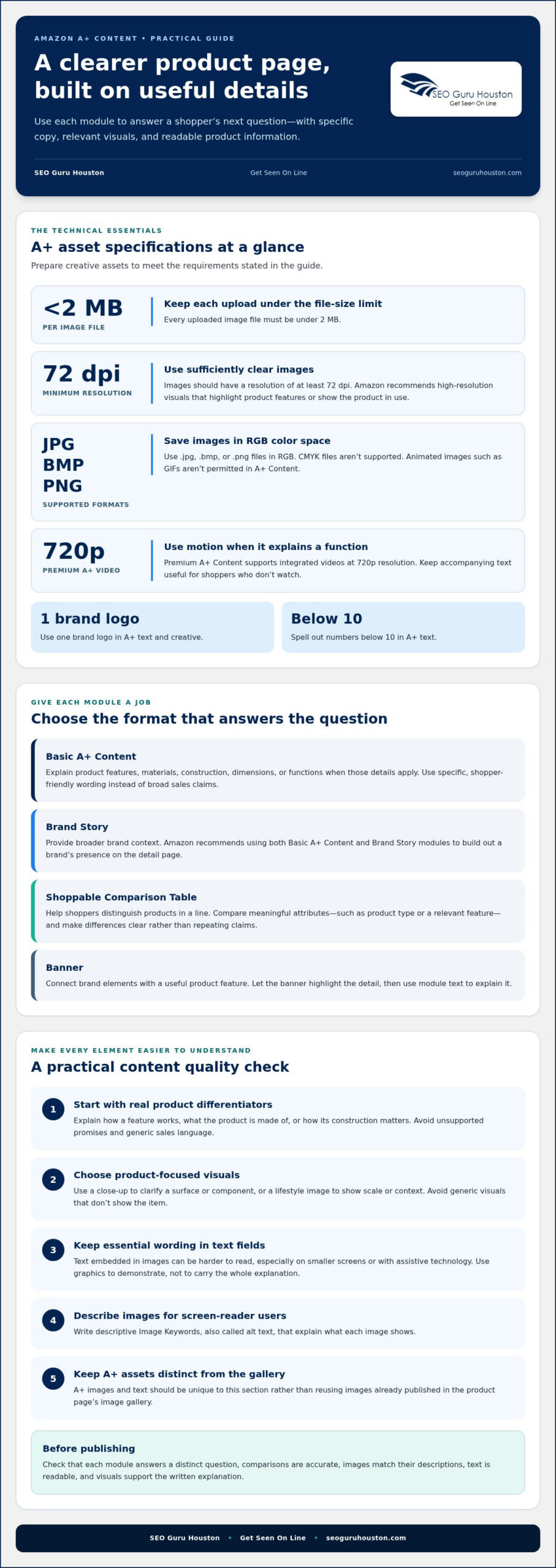
Helpful A+ pages make product details easier to understand, not harder to find. The most effective Amazon A+ content best practices are to explain features in specific, customer-friendly language, use clear product-focused images, and place key information in text fields rather than burying it in graphics. Each uploaded image file must be under 2 MB.

It’s easy to focus on polished visuals and overlook the questions shoppers need answered: how a product is made, what a feature does, or how options compare. A+ Content works best when each image and module clarifies a specific detail instead of repeating the listing or adding generic sales copy.

This guide explains how to choose useful modules, organize product information, prepare images and alt text, and make comparisons easy to scan. You’ll find practical ways to create product pages that communicate clearly and help shoppers make informed decisions.

Key Takeaways

  • Explain product features and construction in specific, shopper-friendly language instead of relying on broad sales claims.
  • Choose product-focused images that clarify details, and keep each uploaded image file under 2 MB.
  • Use module text fields for key information, and write descriptive image text to support shoppers using screen readers.
  • Consider a comparison table to help customers understand differences across your product line.
  • Review how Amazon marketing and SEO can work together to strengthen product-page visibility and usefulness.

Amazon a+ content best practices

Amazon A+ Content lets registered brand owners add storytelling, enhanced product images, and customized text placements to product detail pages. Treat each module as an answer to a shopper’s next question, not another advertisement. Effective Amazon A+ content best practices start with identifying product questions, then matching each answer to the clearest text or visual format.

Start with the product’s real differentiators. Explain its materials, construction, dimensions, or functions when those details apply. For example, replace “built for convenience” with a clear explanation of how a feature works. Friendly, informative wording helps shoppers understand the product without broad sales claims or unsupported promises.

Choose modules with distinct purposes. Amazon recommends using both Basic A+ Content and Brand Story modules to build out a brand’s presence on the detail page. Basic A+ can explain product features; Brand Story can provide broader brand context. A banner can pair brand elements with a product feature, while module text gives shoppers details they can read and scan.

Use the shoppable Comparison Table when customers need to distinguish products in a line. Compare meaningful attributes, such as product type or a relevant feature, rather than filling columns with repeated claims. Make each comparison clear enough to support a decision. If products serve different purposes, spell out those differences instead of suggesting one option suits everyone.

Prepare creative assets to meet Amazon’s stated technical requirements before uploading:

  • Keep every image file under 2 MB, with a resolution of at least 72 dpi.
  • Use .jpg, .bmp, or .png files in RGB color space; CMYK files aren’t supported.
  • Leave out animated images such as GIFs, which aren’t permitted in A+ Content.
  • Use one brand logo, and spell out numbers below 10 in A+ text.
  • Write descriptive Image Keywords, also called alt text, that explain each image for screen-reader users.

Make every image count. Amazon recommends high-resolution visuals that highlight product features or show the product in use. A close-up can clarify a surface or component; a lifestyle image can demonstrate scale or context. Avoid generic visuals that don’t show the item. Keep A+ images and text unique to this section rather than reusing gallery images.

Put essential wording in module text fields. Text embedded in an image may be harder to read, especially on smaller screens or for customers using assistive technology. Use graphics to demonstrate, not to carry the entire explanation. For example, pair a labeled product detail with a text module explaining what it does and why it may matter to a shopper.

Premium A+ Content supports integrated videos at 720p resolution. Use video when motion can clarify a product function or demonstrate how a feature works. Keep the accompanying text useful for shoppers who don’t watch. Video should add an explanation, not replace product details that customers need to compare options or understand the item.

Before publishing, review the page from a shopper’s perspective. Check that each module answers a distinct question, comparisons are accurate, and images match their descriptions. Confirm the text is readable and the visuals support the written explanation. These steps turn A+ modules into a coherent product guide rather than a collection of disconnected brand assets.

Give every module a clear role in answering likely shopper questions. Amazon recommends using banner images to highlight product features and brand elements in A+ Content, so choose a banner that connects the brand presentation to a useful product detail. Explain product features and construction specifically, using helpful, friendly language instead of general sales-focused text. Keep the wording focused on the product and how its features work, so shoppers can assess the information without relying on broad promotional language. For product lines with alternatives, Amazon recommends the shoppable Comparison Table module to highlight features and help customers make purchase decisions. Use the table to make distinctions easy to understand, not to repeat claims.

Creative choices and file preparation also affect how clearly the page communicates. Amazon recommends high-resolution images that highlight product features or show the product in use, and advises avoiding generic images that do not showcase the product. Choose visuals that directly support the accompanying explanation, then check the supported file formats: Amazon A+ Content supports .jpg, .bmp, and .png image files in RGB color space; CMYK color space is not supported. Keep the A+ presentation distinct from the gallery: Amazon A+ images and text must be unique to A+ and should not reuse images already published in the product page’s image gallery. Distinct copy and relevant visuals give each module a clear purpose on the detail page.

Amazon A+ Content Practices for More Helpful Product Pages

SEO Guru Houston: Houston SEO Services

SEO Guru Houston offers Amazon Services to help businesses align product-page content with a broader marketing strategy. Turn to this support when aligning listing content with product positioning, brand messaging, and customer discovery across channels. Clear A+ modules can explain product value, while a coordinated strategy helps keep messaging consistent wherever shoppers encounter the brand.

Comprehensive digital marketing services can support search visibility beyond Amazon, while targeted PPC services and inbound marketing strategies address other parts of the digital customer journey. The right mix depends on your goals, audience, and existing marketing activity. Start by identifying where your product information is unclear or disconnected, then define what your Amazon presence needs to accomplish.

Contact SEO Guru Houston to discuss your Amazon marketing needs and implement proven amazon a+ content best practices for your brand.

Turn Clear Product Pages Into a Stronger Strategy

Treat each product page as part of a larger customer journey. Use shopper questions and product feedback to guide future updates, then keep the language and positioning consistent wherever customers discover your brand. Amazon A+ content best practices are most useful when the page supports a clear business goal, not just a visual refresh.

SEO Guru Houston offers Houston SEO Services, Houston PPC Services, and Houston B2B Marketing. These services can support businesses working to connect product marketing with broader search, advertising, or business-to-business goals. The right focus starts with understanding which audience you need to reach and what you want your digital marketing to accomplish.

Ready to discuss how Amazon marketing fits into your broader strategy? Contact SEO Guru Houston to explore a practical next step for your business. Build with purpose, keep improving, and give every product page a clear job to do.

Ways to Increase Amazon FBA Sales With Better Listings

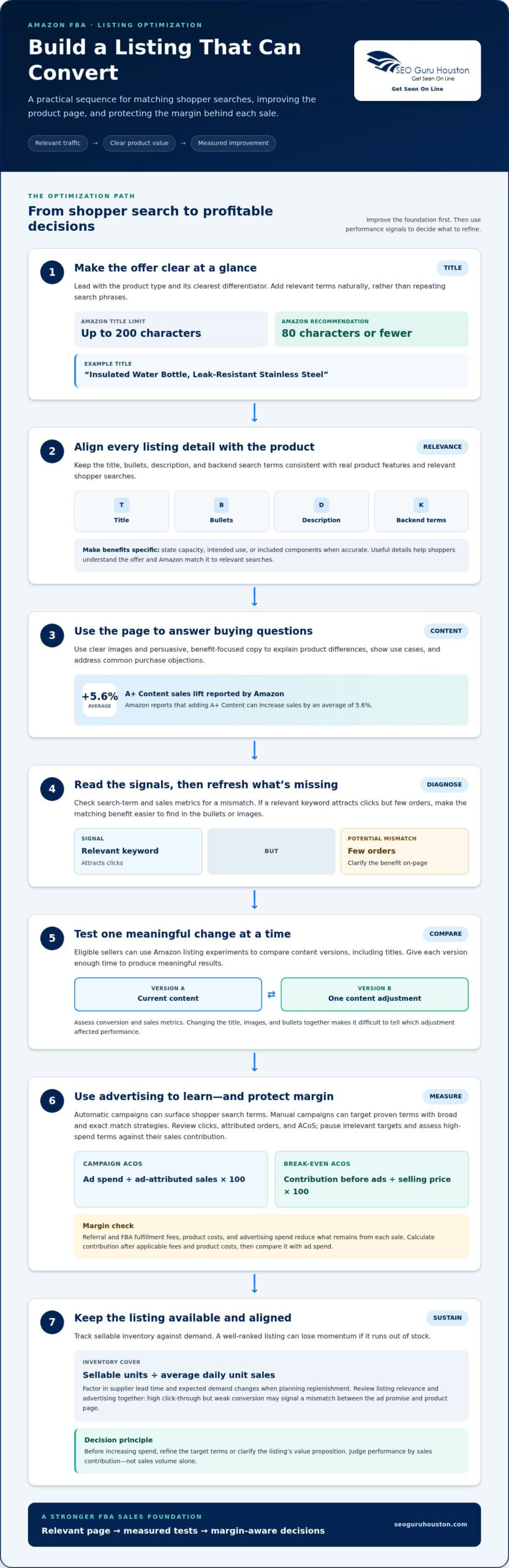
More traffic won’t fix a listing that fails to convert, and more orders won’t help if advertising eats the margin. To understand how to increase sales on Amazon FBA, strengthen the product page, target relevant searches, price competitively, and build buyer confidence through genuine reviews. Keep break-even ACoS in view: calculate it by dividing contribution before ads by the selling price, then multiplying by 100.

When sales stall, it’s easy to focus on ad spend, but growth often starts with the listing. Clear images, persuasive copy, relevant keywords, and a shopper-appropriate price give every campaign a stronger foundation.

This guide explains how to improve listings, attract traffic, choose keywords, assess pricing, and encourage reviews while protecting profitability. It also shows how to measure performance and make informed adjustments instead of relying on guesswork.

Key Takeaways

  • Make product pages easier to find and more persuasive with clear titles, useful images, and benefit-focused copy.
  • Use your Amazon Storefront and relevant external channels to bring qualified shoppers to your listings.
  • Review competitor pricing and promotions while protecting your contribution margin and break-even ACoS.
  • Research search terms from relevant products, then use them naturally in listings and advertising campaigns.
  • Build buyer confidence with strong product quality and compliant review requests, then use feedback to improve your listing.

1. Product listing optimization

Your listing must match the shopper’s search and answer their buying questions fast. Start with the product title: Amazon allows up to 200 characters and recommends 80 characters or fewer. Lead with the product type and its clearest differentiator, then add relevant keywords naturally. A title such as “Insulated Water Bottle, Leak-Resistant Stainless Steel” is more useful than a string of repeated search terms.

To improve product ranking and organic visibility, align the title, bullets, description, and backend search terms with the product’s actual features and relevant shopper searches. Describe benefits specifically, including capacity, intended use, or included components when accurate. Relevant details help shoppers understand the offer and Amazon match the listing to appropriate searches.

Refresh listing content when search-term or sales metrics show a mismatch. For example, if a relevant keyword attracts clicks but few orders, make the corresponding benefit easier to find in the bullets or images. Amazon reports that adding A+ Content can increase sales by an average of 5.6%. Use that space to clarify product differences, explain use cases, and address common purchase objections.

Test changes rather than guessing. Eligible sellers can use Amazon listing experiments to compare content versions, including titles. Give each title version enough time to produce meaningful results before comparing them. Change one meaningful element at a time, then assess conversion and sales metrics. If you change the title, images, and bullets together, you won’t know which adjustment affected performance.

Use advertising to test relevance as well as generate traffic. Automatic campaigns can surface search terms shoppers use; manual campaigns can then target proven terms using broad and exact match strategies. Control spend by reviewing clicks, attributed orders, and ACoS, which equals ad spend divided by ad-attributed sales, multiplied by 100. Pause irrelevant targets and assess high-spend terms against their sales contribution.

Amazon referral and FBA fulfillment fees, product costs, and advertising spend all reduce the amount left from each sale. Calculate your contribution after applicable fees and product costs, then compare it with ad spend. This sets a practical margin limit for campaign decisions, rather than measuring success by sales volume alone.

Avoid lost FBA sales by tracking sellable inventory against demand. Divide sellable units by average daily unit sales to calculate inventory cover, then factor in supplier lead time and expected demand changes when planning replenishment. Even a well-ranked listing can lose momentum if it runs out of stock.

Review listing relevance and advertising together. A high click-through rate but weak conversion may signal a mismatch between the ad promise and the product page. Before increasing spend, refine the target terms or clarify the listing’s value proposition.

2. Amazon Storefront and external traffic

An Amazon Storefront gives your brand a curated destination within Amazon, beyond an individual product detail page. Use it to group related products, introduce product ranges, and guide shoppers to relevant options. For example, a kitchen brand could organize cookware by cooking task, helping visitors find a suitable product. Keep each page focused: too many choices can obscure the next step.

Build the Storefront around how customers shop, not your internal catalog structure. Create clear categories, use concise product explanations, and feature items available to buy. Then review Amazon traffic and sales metrics by product or page. If visitors reach a category but don’t continue to a product, simplify the layout or make the grouping more intuitive. This gives the Storefront a measurable role in your sales strategy.

External traffic can introduce your products to shoppers who haven’t found them through Amazon search. Social media gives brands a place to demonstrate a product in context, answer common questions, and direct interested viewers to the relevant Amazon page. The research reports that 27% of customers use social media for product discovery and 67% of consumers buy products through social platforms. Treat those figures as a reason to test relevant content, not as a promise of results for any individual brand.

Choose a specific audience and message before publishing. A home organization brand, for example, might show a storage product solving a particular household problem and link to its Amazon listing. Keep the post and destination consistent: if social content promotes a specific size or feature, make it easy to find on the Amazon page. Track referral traffic and attributed orders to identify useful visits, rather than judging performance by views alone.

Amazon’s Brand Referral Bonus averages 10% of the sales price for sales generated by directing traffic to Amazon listings. Include that program in your external-traffic planning, and assess the resulting sales alongside the campaign’s costs. Amazon DSP campaigns can also run outside the Amazon ecosystem, using audience segmentation and shopper retargeting to reach defined groups. These options can help brands expand beyond organic marketplace discovery, but campaign targeting still needs a clear audience and relevant product message.

Coordinate every traffic push with inventory. A successful social post or external campaign can send more shoppers to a listing, so align promotion timing with sellable stock and replenishment plans. After each campaign, compare the channel, promoted product, visits, and orders. Keep the content that brings qualified shoppers; revise weak messages or destinations. If social content is part of your growth plan, social media marketing can help connect campaign messaging with the customer journey.

3. Competitive pricing and promotions

A competitive price can improve conversion, but copying a competitor without checking your own economics can be costly. Compare similar products by features, pack size, and customer value, then decide where your offer fits. Amazon’s launch guidance recommends comparing competitor prices to assess positioning. Revisit the comparison when a competing listing changes its offer or your product costs shift.

Price also matters for the Featured Offer, formerly called the Buy Box. Somewhere between 80% and 90% of Amazon purchases are made through the Featured Offer. A compelling price can help your offer compete for that placement, but selection isn’t controlled by price alone. Amazon announced changes to its separate Featured Offer eligibility step beginning in July 2026; removing that step doesn’t guarantee selection.

Choose a promotion to match its purpose. A coupon can make an offer more noticeable, while a limited-time deal creates a defined buying window. Amazon Lightning Deals run for 4 to 12 hours. Amazon promotes 7-Day Deals on its Deals page for 7 days, and these deals are limited to Brand Registered businesses. Plan campaign timing around inventory and demand, so an effective promotion doesn’t outpace available stock.

For repeat purchases, Amazon suggests offering customers a 10% discount on their next purchase as one way to encourage another order. Use a discount where a follow-up purchase makes sense, such as a replenishable product. Compare resulting orders with full-price sales and watch whether shoppers return after the offer ends. Promotions should strengthen customer value, not train every buyer to wait for a lower price.

Measure each test against a clear comparison. Record the regular price, promotional dates, units sold, conversion, and contribution after costs. Compare results with a similar period without the offer, accounting for differences in inventory or traffic. If ranking or visibility rises during a discount, check whether sales remain steady afterward. This helps distinguish a short-lived promotional spike from lasting demand.

Coordinate pricing and campaigns. If a Featured Offer change, coupon, and Lightning Deal run together, it can be difficult to tell what drove results. Test one major pricing change at a time, then use the outcome to refine future promotions. Protect margin first, and scale campaigns that bring qualified orders and repeat business.

Ways to Increase Amazon FBA Sales With Better Listings

4. Amazon keyword research and long-tail keywords

Start with shoppers’ language, not assumptions about how they describe your product. Write down its core use, audience, material, and key differentiator, then combine those attributes into focused search phrases. For a stainless-steel lunch container, research terms related to meal prep, leak resistance, and office lunches. Each phrase should accurately describe the item and reflect a likely buying need.

Amazon Brand Analytics can help sellers examine shopper searches and product comparisons to identify sales opportunities. Compare search behavior with your orders and listing performance. Look for relevant queries that attract attention but don’t lead to purchases, then check whether your product or page addresses the need. Use the finding to refine positioning, add useful detail, or prioritize a better-matched keyword.

Build a competitor set from 5-10 best-selling ASINs in your category, then examine how their products are described. Note the shared terms that accurately apply to your offer, and separate them from claims or features your product doesn’t have. For example, if shoppers value compact storage, use a phrase such as “space-saving lunch container” only when it describes your product honestly.

Long-tail keywords are specific phrases that reveal a shopper’s intended use or preference. “Lunch container” describes a broad category; “stainless-steel lunch container for meal prep” narrows the search. Add relevant phrases to listing content where they read naturally. Don’t force every variation into the title. Clear copy helps shoppers understand the offer and keeps keyword use relevant to the product.

Use advertising search-term results to test whether researched phrases attract qualified shoppers. Automatic campaigns can uncover relevant queries, while broad and exact manual targeting can gather data on selected terms. Review search terms, clicks, and orders together. Move relevant converting phrases into focused targeting, and exclude irrelevant queries that spend without matching the product. This makes keyword research an ongoing part of your seller strategy, not a one-time launch task.

Revisit keywords when customer demand or your product range changes. A new size, bundle, or use case may call for different search language, while discounts can shift attention toward value-focused terms. If an influencer demonstrates a product for a particular activity, check whether shoppers search for that use case before adding it to your listing copy. Let Amazon Brand Analytics, advertising results, and product accuracy guide each update.

5. Amazon product reviews and Vine

Reviews help shoppers judge whether a product matches its claims before buying. An Amazon survey found that 54.4% of customers read at least four product reviews before making a purchase decision. That makes review quality and relevance important to conversion, especially when shoppers compare similar products. Treat feedback as evidence about the buying experience, not simply a star-rating target.

Use Amazon’s Request a Review button for each order to invite customer feedback through Amazon’s process. Keep the request neutral; don’t ask buyers for positive reviews or offer coupons, discounts, or other incentives in exchange for favorable sentiment. The FTC Consumer Reviews and Testimonials Rule took effect on October 21, 2024, and addresses fake or false reviews and incentives conditioned on a specific review sentiment.

Amazon Vine is another route for eligible products to receive feedback from Vine reviewers. One new seller enrolled 10 product units during launch, but that example isn’t a required enrollment amount or a sales forecast. Vine reviews may take time: an Amazon representative stated that they typically arrive 22 or more days after reviewers request a product. Plan your launch with that timing in mind, rather than expecting immediate reviews.

Use early feedback to improve what shoppers see and receive. If reviews repeatedly mention unclear sizing, revise the relevant listing details. If customers misunderstand an included component, clarify the description and product images. Address product quality issues at their source: a promotional campaign may bring more purchases, but it won’t fix a gap between the product and its claims.

Reliable shipping and quality products can support positive feedback. As an FBA seller, keep inventory available and ensure the product arrives as described. Monitor review themes alongside returns, conversion, and profit. Complaints about damage call for operational attention; repeated setup questions may signal missing instructions or unclear listing content.

Don’t treat review volume as the only measure of progress. Look for specific comments about fit, durability, packaging, or intended use, then decide which changes are actionable. For example, if buyers praise portability but ask about cleaning, make care information easier to find. Keep updates factual, and don’t edit claims simply to pursue a higher rating.

Build a review process into each launch: request reviews through Amazon’s tool, monitor incoming feedback, and resolve recurring product or information problems. Use Vine as one possible launch tactic, not a substitute for customer experience. To connect review insights with listing and advertising improvements, strengthen your Amazon sales strategy.

SEO Guru Houston: Houston SEO Services

SEO Guru Houston helps sellers connect Amazon listing improvements with broader visibility and traffic goals. Its Amazon Services and PPC services fit businesses looking to coordinate marketplace marketing with paid campaigns. Comprehensive SEO services and inbound marketing can support broader discovery and customer acquisition beyond an individual product page.

Turn to SEO Guru Houston when listing updates, keyword targeting, advertising, and customer acquisition need a coordinated strategy. The right approach depends on your products, audience, and marketing priorities, so start by identifying the growth challenge you want to address.

Contact SEO Guru Houston to discuss your Amazon marketing goals, or visit seoguruhouston.com.

Turn your next sales decision into a growth plan

A practical plan for how to increase sales on Amazon FBA starts by identifying the constraint that currently limits growth. Choose the business priority that matters most, assign responsibility for acting on it, and review performance before making another major change. This makes your next move deliberate and helps you learn from the outcome.

Think beyond individual listing adjustments, too. If your growth priorities include broader visibility, paid acquisition, or business-to-business demand, SEO Guru Houston offers Houston SEO Services, Houston PPC Services, and Houston B2B Marketing. These capabilities can support a wider marketing strategy alongside your Amazon efforts.

Bring your goals and current challenges into a focused conversation, then decide which next step best fits your business. Contact SEO Guru Houston today to discuss your marketing priorities. Keep moving with purpose, measure what matters, and build on each informed decision.

Frequently Asked Questions

What Is Break-Even ACoS?

Break-even ACoS is the advertising cost percentage that uses all contribution available before advertising. Calculate it by dividing contribution before ads by the selling price, then multiplying by 100. For example, if you know the amount left after product costs and selling fees, compare that contribution with the sale price. A target below break-even ACoS leaves room for other expenses and profit.

What Is TACoS?

TACoS, or total advertising cost of sales, compares ad spend with total sales, including both ad-attributed and organic sales. Calculate it by dividing total ad spend by total sales, then multiplying by 100. Use TACoS alongside ACoS: if advertising spend stays steady while total sales grow, the relationship can show whether sales beyond directly attributed ad orders are contributing.

What Is Unit Session Percentage?

Unit Session Percentage measures units ordered relative to listing sessions. Divide units ordered by sessions, then multiply by 100. It helps distinguish a traffic problem from a conversion problem: if sessions increase but the percentage falls, visitors may not find the product or offer compelling. Review search-term relevance, product options, and shopper questions before increasing traffic further.

How do I optimize Amazon FBA product listings for more sales?

A practical approach to how to increase sales on Amazon FBA is to make the listing answer buyers’ questions before they order. For a desk lamp, clarify whether the bulb is included, show its controls, and accurately explain its intended use. Check that each variation leads to the correct detail page. Review customer questions and returns for recurring misunderstandings, then update the content causing confusion.

How can sellers use coupons, deals, and promotions to increase Amazon sales?

Match each offer to a clear goal, such as introducing a new product or encouraging a trial purchase. Before activating a coupon, identify the eligible product and estimate how discounted orders affect contribution. After the offer ends, compare purchase patterns with the preceding period. If demand drops immediately, the deal may have attracted price-sensitive buyers rather than built lasting interest.

How do pricing strategies and competitor research improve Amazon sales?

Competitor research helps sellers understand how shoppers may assess an offer, but comparisons should account for meaningful differences. If you’re considering how to increase sales on Amazon FBA, compare pack size, product specifications, and included components before reacting to a lower price. Track how your own price changes relate to orders and conversion. A competitor’s temporary discount alone isn’t a reason to reduce your price.

How can Amazon sellers improve product images, titles, bullet points, and A+ Content?

Give each listing element a distinct job. Use the title to identify the item clearly, bullets to explain practical benefits, and images to show details shoppers can’t assess from text alone. A+ Content can organize comparisons or explain product use. For a kitchen tool, a comparison chart can show which model suits different cooking tasks without repeating the title.

What are the risks of using external traffic and social media to drive Amazon sales?

External traffic can attract visitors whose expectations don’t match the product page, weakening conversion and wasting campaign effort. A popular post can also drive demand beyond available inventory. Keep the social message consistent with the Amazon listing, direct each post to the relevant product, and monitor orders and stock. Don’t judge a campaign by engagement alone; assess whether it attracts likely buyers.

How to Optimize Amazon Product Listings for SEO in 2026

More keywords won’t automatically make an Amazon listing easier to find or more persuasive. Sellers often know their product needs better visibility, but the next steps can feel unclear: which search terms belong in the title, bullets, or backend fields, and how can the copy stay natural? Optimizing amazon product listings for seo works best when relevance and shopper clarity go together, not when keywords are repeated for their own sake.

This guide gives you a practical process to improve both. You’ll learn how to research and group relevant search terms, place them where they make sense, and shape a product detail page around the questions shoppers need answered. You’ll also learn to distinguish a discoverability problem from a conversion problem, then measure listing changes against meaningful outcomes. The goal is a clearer, more relevant listing and a disciplined way to assess whether your edits are helping.

Key Takeaways

  • Build a keyword map before editing so each relevant search term has a clear, useful place in the listing.
  • Make every listing element serve a purpose: help shoppers understand the product, assess its fit, and decide what to do next.
  • When optimizing amazon product listings for seo, prioritize relevance and readable copy over repeating the same phrases across fields.
  • Capture a baseline, update a focused group of related listing elements, and allow a suitable comparison period.
  • Separate discoverability signals from clicks, conversion, and sales to identify what needs attention next.

What Amazon Product Listing SEO Does, and What It Cannot Guarantee

Amazon listing SEO makes a product easier to discover through relevant searches and helps shoppers find useful information once they reach its detail page. That means aligning the listing’s language with the product and the way customers search, then clearly explaining what the product does, who it suits, and what buyers should know before choosing it. Keywords can help describe relevance, but they can’t replace a clear product page.

General SEO concepts offer a useful foundation. What is Search Engine Optimization? explains the broader goal of improving a page’s visibility in search. Amazon adds a marketplace context: shoppers are searching for products and comparing offers they can purchase, not simply looking for information on a topic. So optimizing amazon product listings for seo means considering both whether a listing matches a search and whether its content helps a shopper make a confident decision.

How Amazon search visibility differs from general web SEO

A website may use SEO to attract visitors researching a question, service, or product category. On Amazon, a shopper may search for a specific product type, compare several detail pages, and weigh each offer before buying. The listing must communicate product relevance, while its images, copy, price, availability, and other offer details can shape the shopper’s decision. Treat marketplace visibility and purchase performance as related but distinct questions. Appearing for a query doesn’t guarantee a click, and a click doesn’t guarantee a sale.

Why discoverability alone does not complete the job

Imagine a shopper searching for an adjustable laptop stand. A listing that includes the phrase but leaves compatibility, adjustment options, or key dimensions unclear may attract attention without resolving the buyer’s concerns. If the details are accurate and relevant, making them easy to find helps shoppers assess fit. Strong copy answers real questions; it doesn’t simply make room for more search terms.

Amazon listing SEO balances search relevance with product-page clarity, helping the right shoppers find a listing and understand why it fits their needs. Use that standard to review every field: does the wording accurately describe the product, and does it help a customer decide? If a phrase reads awkwardly or promises more than the product information supports, repetition won’t make it persuasive.

Keep expectations grounded. Optimization can support discoverability and improve the usefulness of a detail page, but it can’t guarantee a particular search position, traffic level, click-through rate, or sale. Results can also be affected by factors beyond listing copy, including the offer and shopper response. Treat changes as informed tests, not promises of a fixed outcome.

Amazon’s category requirements and available listing fields or research features can vary and change. Before editing, review current Seller Central guidance for the product’s category and the fields available to your account. This helps prevent an optimization plan from relying on outdated requirements or unavailable features.

How to Research and Map Amazon Keywords Before Editing a Listing

Start with research, not a rewrite. A focused keyword map helps you decide which phrases accurately describe the product, what shoppers likely mean by them, and where each term can fit naturally. This sequence makes optimizing amazon product listings for seo a deliberate process instead of a race to insert every phrase you find.

Build a relevant keyword set from shopper language

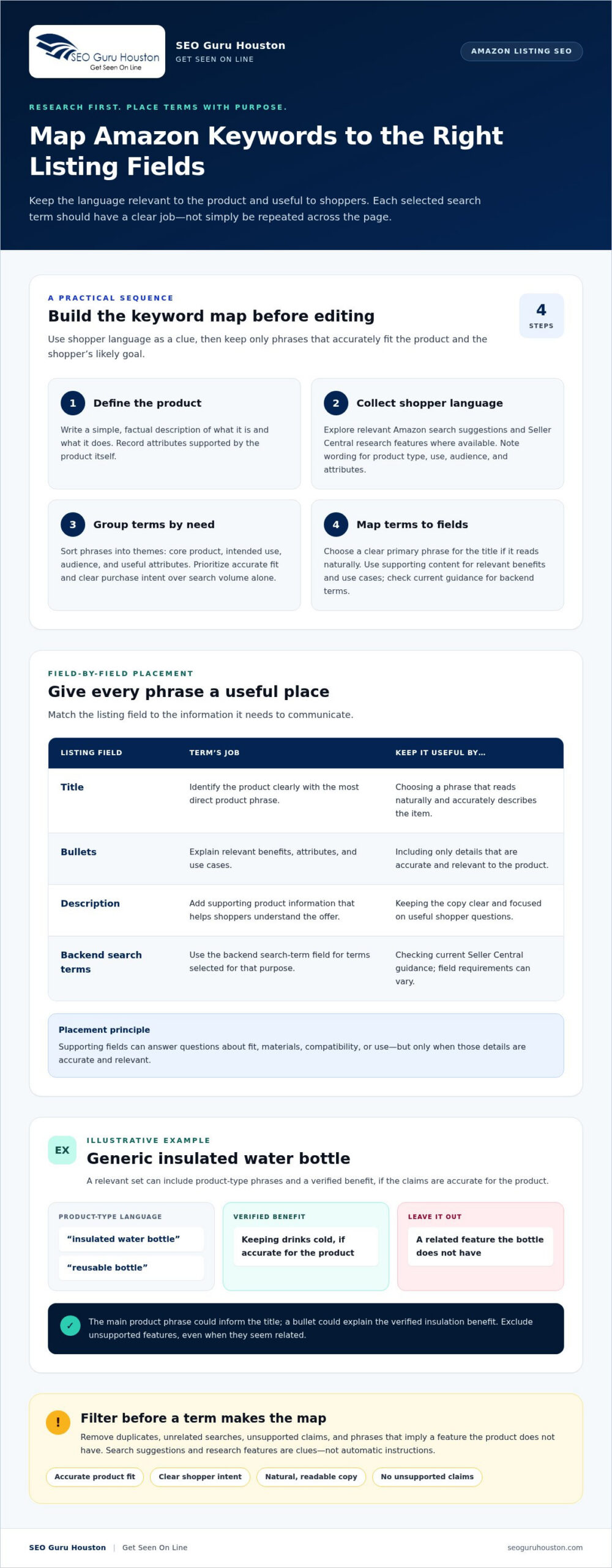
First, define the product plainly: its type, intended use, audience, and distinguishing attributes. Then gather the words shoppers use through Amazon search suggestions and relevant research features available in Seller Central. Treat these as clues, not automatic instructions. Keep terms that match the product and the shopper’s likely goal. Remove duplicates, unrelated searches, unsupported claims, and phrases that imply a feature the product doesn’t have.

  • 1. Define the product. Write a simple, factual description of what it is and what it does. Record only attributes supported by the product itself.
  • 2. Collect shopper language. Explore relevant Amazon search suggestions and Seller Central research features where available. Note variations in product type, use, audience, and attribute wording.
  • 3. Group terms by need. Sort phrases into themes such as core product, intended use, audience, and useful attributes. Prioritize accurate product fit and clear purchase intent over search volume alone.
  • 4. Map terms to fields. Choose the clearest primary phrase for the title if it reads naturally. Use bullets and description content to explain relevant benefits and use cases. Check current Seller Central guidance before entering backend search terms, since requirements can vary.

Illustrative example: For a generic insulated water bottle, a relevant set might include “insulated water bottle,” “reusable bottle,” and phrases about keeping drinks cold, if those claims are accurate for the product. Group the first phrases as product-type language and the last as a benefit. The main product phrase could inform the title, while a bullet explains the verified insulation benefit. Exclude a term for a feature the bottle doesn’t have, even if it seems related.

Map search terms to listing fields

Give every selected phrase a job. Put the most direct product identification where shoppers can quickly understand what’s being offered. Use supporting fields to answer questions about fit, materials, compatibility, or use, but only when those details are accurate and relevant. Backend fields can accommodate suitable terms that don’t fit naturally in visible copy; they aren’t a place to stash unrelated phrases. Review current category-specific Seller Central rules before publishing.

A simple worksheet can keep the process consistent: record each phrase, its shopper intent, its relevance to the product, and its planned field. If several terms express the same need, choose the clearest wording rather than forcing every variation into the listing. For sellers seeking strategic support beyond their own research, Amazon marketing support can help connect keyword choices with broader listing goals.

Which Listing Elements Matter Most for Amazon SEO and Shopper Decisions?

Each listing element has a different job. Some help identify the product, some answer buyer questions, and others help shoppers judge what they’ll receive. Prioritize the fields that address the clearest gap rather than editing everything at once. Also distinguish listing content from offer conditions: price and availability can affect a shopper’s choice, but they aren’t copy edits.

Title, bullets, and description: make relevance easy to understand

Use the title to identify the product and include its core search language naturally. Bullets should make verified features and customer benefits easy to scan, while the description can add context or clarify use. Avoid repeating the same phrase across every field. For each edit, ask whether it improves product understanding or simply adds another keyword.

Listing element Shopper purpose Optimization priority
Title Identify the product quickly and establish its main relevance. High. Make the product type clear and use accurate, natural wording.
Bullets Scan key features, benefits, and product-fit details. High. Lead with useful, specific information that the product supports.
Description Understand additional context, use, or details. Medium. Add information that helps a decision; don’t restate every phrase.
Images See the product and assess visible features or scale. High for shopper clarity. Keep visuals accurate and consistent with the offer.
A+ Content Explore supplementary brand and product information. Consider it where available and useful; verify current access and rules.
Backend search terms Support relevant terms that don’t fit naturally in visible copy. Use selectively. Follow current Seller Central instructions and avoid redundancy.
Price and availability Assess the offer and whether the product can be purchased. Review separately from listing copy; these are offer conditions, not text fields.

Images, A+ Content, and backend terms: support the full listing

Accurate images let shoppers inspect what the written copy describes and compare relevant details. A+ Content can provide additional brand or product context, but eligibility, access, and content rules can vary. Backend terms aren’t a workaround for weak visible copy. Include only relevant terms that comply with current Amazon guidance.

Limits, field names, category requirements, and feature access can change. Verify current rules in Seller Central before publishing, especially for titles and backend terms. Don’t assume a field is available or that a character limit applies uniformly across categories.

Use the element that matches the problem. If shoppers may not recognize the product, review the title. If they can identify it but key benefits or fit remain unclear, strengthen the bullets, description, or supporting content. If the listing communicates the product well but the offer itself is less competitive, review price and availability separately. Repeating keywords everywhere won’t solve these gaps. Optimizing amazon product listings for seo means making each field relevant, readable, and useful for the decision it supports.

How to Optimize Amazon Product Listings for SEO in 2026

How to Optimize an Amazon Listing Step by Step Without Guesswork

A reliable optimization process starts with evidence, not a full-page rewrite. Record what the listing says now, identify the most likely obstacle, make a focused change, and review the result against your starting point. This sequence makes optimizing amazon product listings for seo easier to manage, especially when several people share responsibility for product content.

Create a baseline and prioritize the first improvements

Before editing, save the current title, bullets, description, images, and any other fields you plan to change. Note available indicators for search visibility, listing visits, clicks, and sales, along with the dates covered. Use reporting available in your Seller Central account, and check current documentation for metric names and definitions. Then diagnose the clearest gap: weak relevance, missing or confusing product information, or limited shopper response.

  • 1. Capture the starting point. Save the live listing and record relevant performance indicators for a defined date range. Note offer conditions, such as price or availability, that could affect comparisons.
  • 2. Choose a priority. If the product is hard to identify, refine relevant language in the title. If shoppers may not understand fit or benefits, improve the content that answers those questions. Focus on accurate, meaningful changes rather than cosmetic wording.
  • 3. Revisit your keyword map. Match selected phrases to the field where they fit naturally. Remove terms that don’t describe the product or help explain its value.
  • 4. Edit a focused group of related elements. Update only what’s needed to address the diagnosed issue. When practical, avoid changing unrelated fields at the same time so later comparisons are easier to interpret.
  • 5. Log the change. Record the edit, the date it went live, the reason for it, and the outcome you expect to observe.

Implement edits and evaluate them responsibly

Keep product facts accurate and follow current marketplace requirements as you publish. After an edit, allow a suitable observation period for the indicators you’re tracking to become useful. Compare like with like where possible, and account for seasonality, promotions, price changes, availability shifts, or other listing updates during the same period. If several variables changed together, don’t credit one wording change with the full result.

Use a simple change log to preserve context: “Updated bullets to clarify compatibility; monitor relevant visits and orders; offer price unchanged.” This makes the next decision more disciplined. If the chosen indicator improves but sales don’t, investigate the offer and shopper experience rather than adding more keywords. If no meaningful movement appears, revisit the diagnosis before making another targeted change.

For a related perspective on improving product pages, explore this Amazon listing optimization guide. For support applying a structured approach across your Amazon marketing, discuss your Amazon listing strategy.

How to Measure Amazon Listing SEO and Choose Your Next Move

A listing change is only useful if you can learn from it. Measure the path from search exposure to purchase, and don’t treat every weak result as a keyword problem. Discoverability indicators, shopper response, sales, and offer conditions describe different parts of the journey. Separating them gives you a clearer next step than watching sales alone.

Read performance signals without overclaiming

Use reporting tools and metrics currently available to your seller account. Names, access, and definitions can change, so check current Seller Central documentation before comparing figures or building a report. Compare equivalent date ranges where possible, and note promotions, inventory interruptions, price changes, and other offer shifts that could influence results. If a reporting feature isn’t available to your account, don’t assume a substitute measures the same thing.

Search exposure shows whether shoppers may be seeing your listing; conversion shows what happens after shoppers arrive. Use that distinction to locate the likely bottleneck, then interpret available measures in context:

  • Discoverability: If relevant search exposure is limited, review whether the listing clearly matches the product and the searches you’re targeting. Confirm that the terms are accurate and placed appropriately.
  • Clicks and visits: If shoppers see the offer but don’t select it, assess how clearly the title and main image communicate what’s being sold. Consider the competitive context rather than assuming a keyword change is needed.
  • Conversion: If shoppers visit but purchases remain weak, look for unanswered questions, unclear product details, or a mismatch between the listing and the offer. Review price, availability, and other offer conditions separately from the copy.
  • Sales: Read sales alongside traffic and conversion indicators. A change in sales alone doesn’t identify which part of the customer journey changed.

Choose the next move based on evidence. Retain an edit when relevant indicators improve without a clear trade-off. Refine it when the direction is promising but a specific page element still appears unclear or underperforming. Investigate when signals conflict, the comparison period included major offer changes, or the reporting doesn’t support a confident conclusion. Avoid declaring a single edit the cause when other variables changed at the same time.

When expert support can strengthen the optimization process

Coordinating keyword choices, listing content, and performance analysis can become challenging across multiple products or teams. SEO Guru Houston’s Amazon-specific marketing services can support sellers who want a more connected view of those decisions. To coordinate listing improvements with a wider marketplace strategy, explore Amazon marketing services.

Make Your Next Listing Improvement Count

Your next step doesn’t need to be a sweeping overhaul. Choose one product page with a clear opportunity, then turn what you learn into a repeatable standard for the rest of your catalog. That’s how optimizing amazon product listings for seo becomes an ongoing business practice, not a one-time rewrite. Each disciplined improvement can sharpen how your product is presented and give your team a stronger basis for its next decision.

If you want to connect listing work with a broader growth plan, SEO Guru Houston brings Amazon-specific marketing together with SEO, PPC, and web development expertise. This support can help align marketplace priorities with the rest of your digital strategy while keeping the shopper experience in focus. Explore Amazon marketing services and take a focused next step toward stronger product pages. Keep testing thoughtfully, learning from the evidence, and building momentum.

Frequently Asked Questions

How do I optimize an Amazon product listing for SEO?

Start by confirming every product fact, including size, material, compatibility, and intended use. Then match shopper search phrases to the fields where they read naturally: product identification in the title, decision-making details in bullets, and added context in the description. For example, don’t describe a charger as compatible with a device unless that claim is accurate. Save the original listing and available account data so later adjustments have a useful point of comparison.

What is the most important part of an Amazon listing for SEO?

No single field guarantees a ranking, so prioritize the weakest part of the specific listing. A shopper who can’t identify the item may need a clearer title; someone who understands the product but can’t assess fit may need better bullets, images, or description details. Backend terms can support discoverability under current Amazon requirements, but they can’t replace useful visible content. Diagnose the shopper’s likely question before choosing what to edit.

How many keywords should I use in an Amazon product listing?

There’s no universal keyword count that fits every product and category. Build a relevant set from the language shoppers use, then include a phrase only where it accurately describes the item or helps explain its use. A phrase that adds no new meaning can make copy repetitive. Check Seller Central for current field requirements, especially for backend terms, where formatting and eligibility may differ from customer-facing content.

Do backend keywords help Amazon product listings rank?

Backend search terms can provide relevant product information, but they don’t replace clear customer-facing content or guarantee a ranking change. Use them only for phrases that genuinely apply and follow the instructions currently shown in Seller Central. For example, an alternate term may be useful if shoppers use it for the same product type, while a phrase suggesting an unsupported feature should be left out. Review available account data after edits rather than assuming an effect.

Does Amazon A+ Content improve SEO?

A+ Content can give eligible brands more ways to explain a product and help shoppers understand its features, but don’t assume it directly improves organic rank. Treat it as a content option for answering questions that standard copy may not address well, such as how a product is used or what distinguishes it. Verify current access and publishing rules in Seller Central, then assess available shopper and sales indicators after the content is live.

How long does Amazon SEO take to work?

There’s no universal timeline or guaranteed ranking change after an optimization. A result may depend on whether Amazon processes the update, category conditions, shopper demand, inventory, and changes to the offer. Record when each edit goes live and allow a suitable period to observe relevant account data. Compare similar periods where possible, and avoid stacking frequent changes, since that can make it harder to identify which adjustment may have influenced performance.

Can I use the same keywords in my Amazon title and backend search terms?

Place keywords in a way that follows current Amazon guidance and keeps the title clear. Repeating an identical phrase in multiple fields may add little value, but don’t assume one rule covers every category or field. Keep visible copy natural and accurate, then check Seller Central’s current backend instructions before entering terms. Never use repetition to imply a feature, compatibility, or benefit the product doesn’t actually provide.

How can I tell whether my Amazon listing optimization is working?

Compare available search visibility measures with listing clicks, conversion, and sales to see where the customer journey may be changing. For instance, more visits without more orders may point to a different issue than limited exposure. Keep a record of the listing version, edit dates, and changes to price, inventory, or promotions. Use current Seller Central reporting where available, compare appropriate periods, and decide whether to retain, refine, or investigate the update.

Amazon Product Listing Optimization: The 2026 Blueprint for Market Dominance

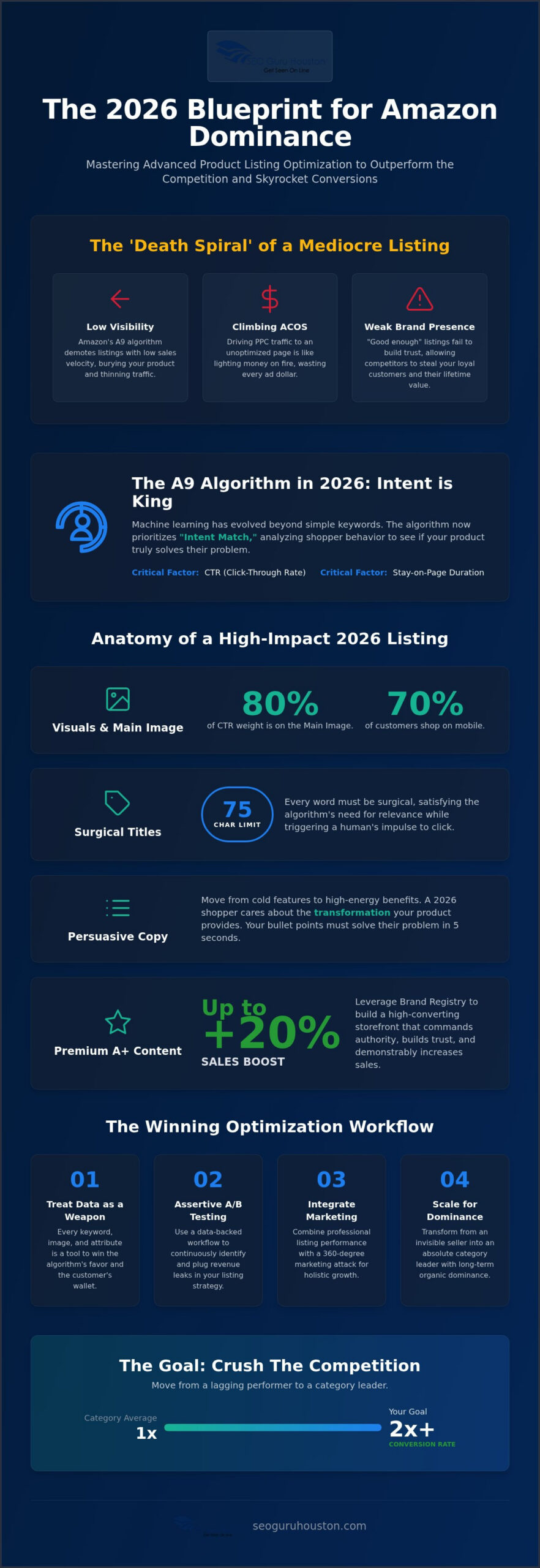
In 2026, a mediocre Amazon listing isn’t just a missed opportunity; it’s a slow-motion business suicide. You’ve likely watched your ACOS climb while your organic visibility sinks, leaving your brand buried under competitors who mastered the new 75-character title limit and assertive amazon product listing optimization months ago. It’s exhausting to fight for scraps while you’re still guessing what the current A9 algorithm actually wants from your product data. This is a brutal market that rewards precision and punishes hesitation.

This is where the guesswork ends. You’re about to master the strategies required to crush the competition and skyrocket your conversion rates to 2x the category average. We’ll break down the 2026 blueprint for market dominance, from leveraging the new searchable Item Highlights field to securing Premium A+ content that can boost sales by up to 20%. We’ll also explore how to navigate the 3.5% fuel and logistics surcharge while protecting your bottom line. This is your definitive guide to transforming from an invisible seller into an absolute category leader.

Key Takeaways

  • Reverse the “Death Spiral” of low visibility by treating your product data as a competitive weapon rather than a simple administrative task.
  • Master the strategic placement of high-intent keywords within the 2026 title constraints and Item Highlights to dominate your amazon product listing optimization.
  • Unlock the power of Premium A+ Content and Brand Registry to build a high-converting storefront that commands authority and boosts sales by up to 20%.
  • Implement a data-backed optimization workflow that uses assertive A/B testing to identify and plug revenue leaks in your current listing strategy.
  • Scale your market share by integrating professional listing performance with a 360-degree marketing attack designed for long-term organic dominance.

Beyond the Basics: Why Generic Amazon Listings are Revenue Killers

Stop treating your Amazon presence like a digital filing cabinet. In the hyper-competitive landscape of 2026, amazon product listing optimization isn’t an optional luxury or a simple data entry task; it’s a tactical siege on the marketplace. If you’re still approaching your listing with a “set it and forget it” mentality, you’re essentially handing your market share to the competition. High-performance brands recognize that every word, every image, and every backend attribute is a weapon designed to win the algorithm’s favor and the customer’s wallet.

The greatest threat to your brand growth is invisibility. When your conversion rates lag behind the category average, you enter the “Death Spiral.” This is a brutal feedback loop where Amazon’s algorithm notices your lack of sales velocity and systematically demotes your organic ranking. As your visibility drops, your traffic thins, and your ability to recover becomes exponentially more expensive. You can’t just spend your way out of a bad listing with PPC; you need a foundation that converts at a high level to prove your worth to the system. This is why professional Search engine optimization (SEO) principles are now the bedrock of Amazon success.

The Evolution of the Amazon A9 Algorithm in 2026

Machine learning has fundamentally changed the rules of engagement. By 2026, the algorithm has moved beyond primitive exact-match keywords to prioritize “intent match.” It analyzes complex patterns in shopper behavior to determine if your product truly solves the user’s problem. Metrics like click-through rate (CTR) and stay-on-page duration are now critical ranking factors. If your 2024 strategy relied on high-volume keywords without considering relevance, that approach is already obsolete. You must align your content with the specific psychological triggers that drive a 2026 shopper to click and buy. The machines are watching how humans interact with your brand, and they’re rewarding the listings that provide the most seamless experience.

The Real Cost of Mediocrity

Mediocrity is the most expensive mistake you can make in the Amazon ecosystem. When you drive traffic to a non-optimized landing page, you’re effectively lighting your ad spend on fire. Every bounce is a wasted dollar and a signal to the algorithm that your product isn’t a winner. Beyond the immediate financial loss, “good enough” listings suffer from a weak brand presence that fails to build trust. In a marketplace where shoppers have infinite choices, a lack of professional polish allows competitors to steal your loyal customers. You aren’t just losing a single sale; you’re losing the long-term lifetime value of a customer who no longer sees you as an authority in your niche. Masterful amazon product listing optimization is the only way to protect your margins and secure your territory.

The Anatomy of a High-Impact Listing: Keywords, Copy, and Conversion

A high-impact listing isn’t a technical manual; it’s a high-energy sales pitch. If your visuals don’t stop the scroll, your keywords simply won’t matter. Your main image carries 80% of the weight in the click-through rate (CTR) battle. In 2026, mobile-first optimization is mandatory because over 70% of your customers are shopping on handheld devices. If your listing looks cluttered or your text is unreadable on a smartphone, you’ve already lost the sale. You must design for the thumb, not the desktop.

Persuasive copywriting is about moving from cold features to high-energy benefit statements. Stop listing technical specs and start selling a transformation. A 2026 shopper doesn’t care about the material of your product as much as they care about the time it saves them or the status it confers. If you fail to hit the reader’s emotional core immediately, they’ll bounce to a competitor who does. This level of precision is the cornerstone of effective amazon product listing optimization.

Mastering the Title and Bullet Siege

Effective titles in 2026 must be surgical. With the strict 75-character limit implemented in July, every word must fight for its place. You need to satisfy the algorithm’s need for relevance while triggering a human’s impulse to click. Indexation is the definitive gateway to organic traffic, ensuring the algorithm recognizes your product as a relevant match for specific search queries. Once they click, your bullets must deliver a “Benefit-First” structure. Solving the customer’s problem in five seconds is the only way to maintain momentum. If the shopper doesn’t see a solution to their pain point within the first two bullets, they’re gone.

Backend Search Terms and Hidden Metadata

The invisible side of your amazon product listing optimization strategy is where you capture the traffic your competitors ignore. You have a 250-character limit in the backend search terms field. Use it wisely. Don’t repeat words already in your title or “Item Highlights.” Instead, leverage Spanish keywords and common misspellings to tap into massive, unserved audiences. This isn’t about keyword stuffing; it’s about expanding your reach. Fill out every “Subject Matter” and “Intended Use” field to tell the algorithm exactly where your product belongs. This hidden metadata is the secret to niche relevance and long-tail dominance. Mastering these technical nuances is the difference between a hobby and a high-performance business. If you’re ready to stop guessing, our Amazon services provide the tactical precision required to dominate.

Leveraging Brand Registry and A+ Content for Absolute Authority

Amazon Brand Registry is the non-negotiable foundation for any brand seeking more than just survival. In the 2026 marketplace, selling without a registered trademark (®) is a liability. This program doesn’t just provide a badge; it unlocks the full arsenal of amazon product listing optimization tools required to defend your territory. If you aren’t enrolled, you’re effectively fighting with one hand tied behind your back while competitors use advanced analytics and protection tools to systematically dismantle your market share.

A+ Content transforms a static page into a high-converting storefront. While basic A+ Content can increase sales by up to 8%, securing Premium A+ Content can skyrocket your conversions by up to 20%. To qualify for this elite status in 2026, you must have a published Brand Story across all listings and at least five approved A+ submissions within the last 12 months. This is about more than aesthetics. It’s about using every pixel to justify your price point and crush buyer hesitation before it starts.

The Strategic Advantage of A+ Content

Comparison tables are your most effective tool for keeping customers within your brand ecosystem. Instead of letting shoppers click away to a competitor’s product page to compare features, you provide that data right on your listing. This keeps the transaction focused on your catalog. High-energy lifestyle imagery allows you to justify premium pricing by showing your product in action, solving real-world problems. Additionally, detailed A+ modules set accurate expectations, which directly reduces return rates. When customers know exactly what they’re buying, your brand health remains pristine.

Brand Protection and Global Dominance

Winning the “Buy Box” battle is impossible without the assertive enforcement tools provided by Brand Registry. You can’t allow unauthorized resellers to bleed your margins or tarnish your reputation with inferior service. Use your Amazon Storefront as a dedicated destination for external traffic from social media or email campaigns, creating a controlled, high-conversion environment. This isn’t just about protection; it’s about global dominance. By integrating video marketing directly into your listing, you’ll explode engagement rates and leave static competitors in the dust. You have the tools to protect your intellectual property and scale your visibility. Use them.

Amazon Product Listing Optimization: The 2026 Blueprint for Market Dominance

The Guru’s Optimization Workflow: Testing, Iterating, and Scaling

Optimization is not a one-time event; it’s a relentless cycle of refinement. To achieve market dominance in 2026, you must adopt a high-performance workflow that moves beyond intuition and relies on cold, hard data. Phase 1 begins with a Baseline Audit. You must identify exactly where your listing is bleeding revenue. Is it a low click-through rate on your main image, or are customers bouncing because your “Item Highlights” fail to answer their core questions? Once you’ve identified the leak points, you move into the offensive phase of amazon product listing optimization.

Rigorous A/B Testing for Market Dominance

You must test one variable at a time to achieve statistically significant results. If you change your title and your price simultaneously, you’ll never know which move actually drove the result. Start with your main image. This is the fastest way to lower your customer acquisition cost (CAC). A 2026 shopper decides to click in milliseconds; your image must be the most professional and informative in the search results. Next, conduct price elasticity testing. Don’t just race to the bottom. Find the “sweet spot” where you maximize both volume and margin. This assertive approach ensures you aren’t leaving money on the table.

The Review Loop: Social Proof as a Conversion Engine

Social proof is the ultimate conversion multiplier. For new product launches in 2026, leveraging Amazon Vine is a fundamental necessity to jumpstart your review velocity and secure early organic ranking stability. However, the real “guru” move is analyzing your competitors’ negative reviews. These complaints are a goldmine for identifying “Gap Keywords” and pain points that other brands have ignored. By addressing these gaps in your own listing, you position your brand as the superior alternative. This feedback loop turns customer dissatisfaction into your strategic advantage. If your current strategy feels stagnant, it’s time to partner with an expert who understands these technical nuances. Our Amazon services provide the data-backed roadmap you need to scale.

Scaling is the final phase of the blueprint. Once you’ve perfected your domestic listing, you must expand into international marketplaces. This isn’t a simple translation task. It requires localized amazon product listing optimization that respects regional search habits and cultural nuances. Dominance isn’t just about winning one category; it’s about owning the global marketplace through precision and persistent iteration.

Partnering for Growth: Why Professional Amazon Optimization is Non-Negotiable

Success on Amazon in 2026 isn’t about checking boxes; it’s about tactical dominance. There’s a massive gulf between basic “listing services” that simply upload data and a high-performance growth partner that engineers revenue. A freelancer might get your product live, but a veteran strategist builds a scalable asset that survives algorithm shifts and aggressive competitor poaching. For B2B manufacturers, this specialized approach is even more critical. You aren’t just selling a unit; you’re managing complex specifications and high-volume procurement expectations that require a sophisticated 360-degree attack.

To win, you must integrate your organic amazon product listing optimization with a robust strategy for Amazon Marketing Services. Invisibility is a choice. If you aren’t leveraging professional expertise to bridge the gap between your technical data and your sales performance, you’re leaving your brand’s future to chance. The marketplace moves too fast for “good enough.” You need a partner who views your account through the lens of measurable ROI and long-term financial return.

Synergy Between Organic SEO and Amazon PPC

Your ad spend is only as effective as the page it lands on. When you invest in elite amazon product listing optimization, you’re directly lowering your PPC Advertising Cost of Sales (ACOS). A high-converting listing signals to the algorithm that your traffic is valuable, which often leads to lower bid costs and better ad placements. Additionally, your PPC data is a goldmine for organic discovery. We use your highest-converting ad keywords to refine your title and backend metadata, creating a virtuous cycle of visibility and profit. See our guide on Amazon PPC Management for more on how we synchronize these two forces for maximum impact.

The ROI of Assertive Management

Maintenance is just another word for slow failure. Market leaders don’t just maintain their positions; they aggressively expand them. The long-term value of owning your category on the world’s largest retailer is worth millions in brand equity and sustainable cash flow. Transitioning from a “standard seller” to a category authority requires decisive action and a commitment to technical excellence. Stop guessing why your competitors are winning and start executing a plan that puts you on top. The marketplace waits for no one. It’s time to stop bleeding revenue. Contact SEO Guru Houston for a professional Amazon audit and claim your spot at the top of the search results today.

Claim Your Territory in the 2026 Amazon Marketplace

The era of passive selling is dead. You’ve seen how the 2026 A9 updates and strict title limits have redefined the landscape. Success now requires a surgical approach to amazon product listing optimization that blends technical indexation with high-energy conversion psychology. If you aren’t aggressively iterating your A+ content and leveraging every byte of backend metadata, you’re essentially handing your market share to a more prepared competitor.

Don’t let your brand become a casualty of the “Death Spiral.” You need more than a listing; you need a high-performance engine that drives sustainable organic growth and crushes the competition. We bring specialized B2B and industrial expertise to every account, ensuring your results-oriented growth strategy is built for the long haul. It’s time to transform your visibility into absolute market dominance and secure the financial return your brand deserves.

Dominate the Marketplace: Get Your Amazon Optimization Blueprint from SEO Guru Houston

Your future as a category leader starts with a single decisive move. Take action today and lead your market into 2027 and beyond.

Frequently Asked Questions

What is Amazon product listing optimization?

It’s the strategic process of enhancing every element of a product page to maximize search visibility and conversion rates. This includes title refinement, bullet point persuasion, and backend metadata management. In 2026, it’s a fundamental necessity for business survival. You aren’t just filling out forms; you’re building a competitive weapon to crush rivals and claim absolute market share. This requires a surgical approach to data and psychology.

How long does it take to see results from Amazon SEO?

You should expect to see initial indexing changes within 24 to 48 hours, but meaningful organic ranking shifts typically take three to six weeks. This timeline depends on your sales velocity and the competitiveness of your category. Persistent iteration is key. If you don’t see a significant lift in conversion within the first month, your data likely needs more assertive testing to find the right intent match.

Is Amazon Brand Registry required for listing optimization?

While you can technically edit a listing without it, Brand Registry is a non-negotiable requirement for high-performance brands. It unlocks advanced tools like A+ Content, Brand Stories, and the ability to upload video marketing assets. Without these features, your amazon product listing optimization remains incomplete. You’ll struggle to defend your territory from unauthorized resellers and lose the ability to build long-term customer loyalty through visual storytelling.

Can I optimize my Amazon listing without professional help?

You can certainly attempt it, but the cost of a “good enough” listing is often wasted ad spend and lost revenue. Professional optimization requires deep technical expertise in machine learning and conversion psychology. Most sellers lack the time or tools to conduct the rigorous A/B testing needed for market dominance. Partnering with a seasoned veteran ensures your listing is a precision-engineered sales tool rather than a generic data entry task.

How does the Amazon A9 algorithm work in 2026?

In 2026, the A9 algorithm prioritizes “intent match” and shopper behavior signals over simple keyword frequency. It analyzes metrics like click-through rate, stay-on-page duration, and conversion history to determine relevance. The system is designed to reward products that provide a seamless customer experience. If your content doesn’t align with what the shopper actually wants to find, the algorithm will systematically demote your organic rank to protect the user experience.

What is the difference between Amazon SEO and Amazon PPC?

Amazon SEO focuses on long-term organic visibility through content and metadata refinement, while Amazon PPC involves paying for immediate traffic through sponsored placements. They’re two halves of the same coin. Strategic amazon product listing optimization lowers your PPC ACOS by improving the conversion rate of paid visitors. Conversely, PPC data provides the high-converting keyword insights you need to refine your organic strategy for a total 360-degree marketplace attack.

How often should I update my Amazon product listings?

You should review your listing data at least once per quarter, but high-volume categories require monthly audits. The marketplace is volatile. Competitors change their strategies, and Amazon frequently updates its policies, such as the 75-character title limit introduced in 2026. If you treat your listing as a static document, you’re inviting irrelevance. Regular testing of main images and pricing strategies is the only way to maintain category leadership.

Does A+ content help with my organic ranking on Amazon?

A+ Content doesn’t directly impact the indexing of keywords, but it indirectly skyrockets your organic ranking by increasing your conversion rate. When more shoppers buy your product after viewing your enhanced brand content, the algorithm notices the increased sales velocity. This positive feedback loop signals that your product is a winner. This leads the system to reward you with higher visibility and more prominent placement in the search results.

Amazon SEO Services Houston: The Assertive Blueprint for Marketplace Dominance in 2026

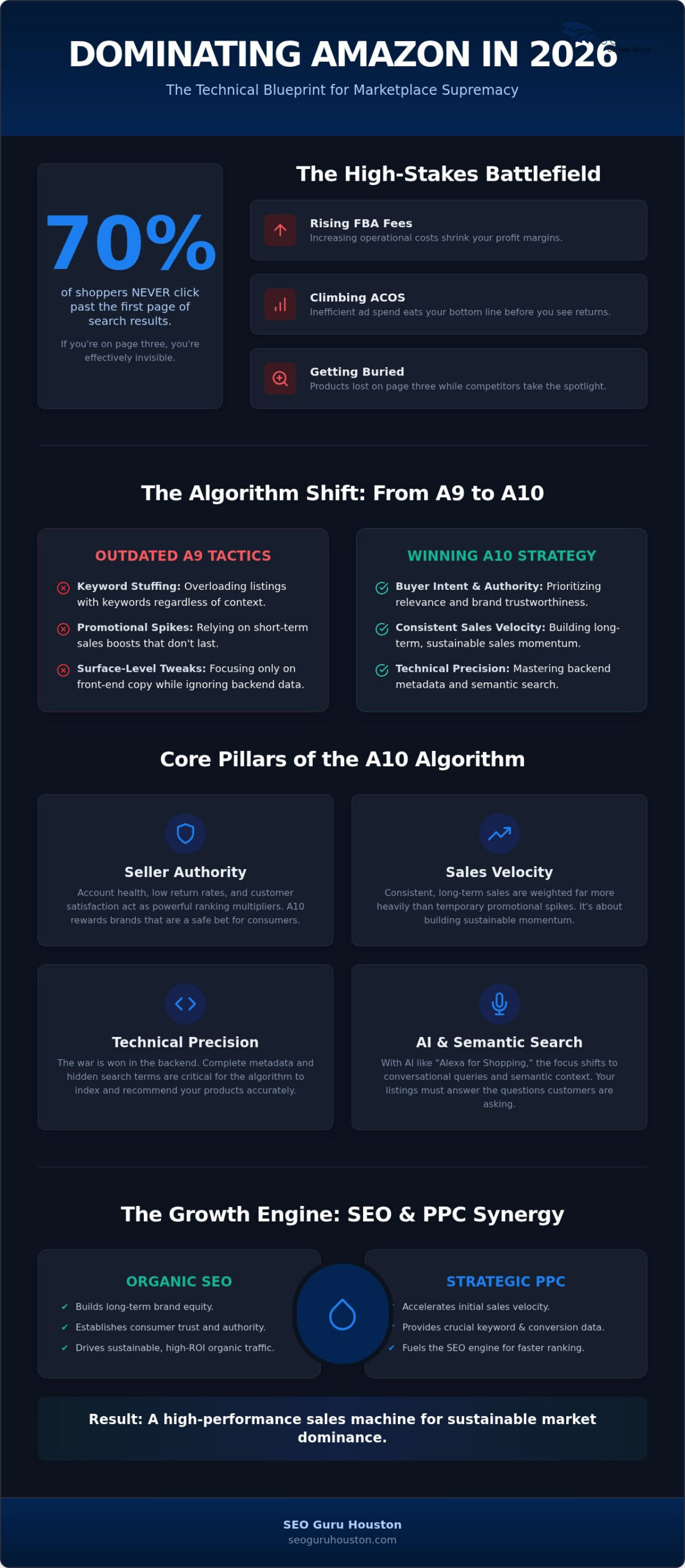
In 2026, Amazon isn’t a retail platform; it’s a zero-sum battlefield where your profit margins go to die if you’re not armed with technical precision. You’ve likely felt the sting of rising FBA fees and a climbing ACOS that eats your bottom line before you even see a return. It’s exhausting to watch your products get buried on page three while inferior competitors take the spotlight. You know that playing it safe is no longer an option, which is why finding the right amazon seo services houston is a fundamental necessity for your brand’s survival and growth.

This article provides the assertive blueprint you need to crush the competition and dominate the marketplace. We’ll show you how to move from invisibility to prominence by mastering the latest shifts in the A10 algorithm and AI-driven search. You’ll discover the exact methods for high-ROI scaling and sustainable organic rankings that keep you ahead of the curve. Get ready to explore the transition to Alexa for Shopping and the technical optimizations that turn a struggling listing into a high-performance sales machine.

Key Takeaways

  • Master the technical nuances of the A10 algorithm to prioritize relevance and authority over outdated keyword stuffing tactics.
  • Understand why professional amazon seo services houston are a fundamental necessity for brands aiming to crush the competition in 2026.
  • Leverage the synergy between SEO and PPC to accelerate sales velocity and fuel sustainable, high-ROI organic growth.
  • Transform product listings into high-converting assets by focusing on precision imagery, strategic bullet points, and compelling A+ content.
  • Transition from invisibility to market prominence by adopting an assertive, data-driven strategy focused on measurable financial returns.

The Battle for Page One: Why Professional Amazon SEO is a Fundamental Necessity

Amazon in 2026 is a brutal, zero-sum environment. If you aren’t winning the battle for page one, you’re invisible to the millions of shoppers ready to buy. It’s that simple. Market dominance isn’t an accident; it’s the result of technical precision and an assertive stance against your competition. Organic ranking remains the ultimate lever for long-term profitability because it builds brand equity without the constant drain of rising ad costs. You must stop viewing your listings as static descriptions and start seeing them as the fuel for a high-performance sales engine. Securing elite amazon seo services houston ensures your brand doesn’t just participate in the market but actively dictates its direction.

Success requires a psychological shift. You aren’t just “listing products” anymore. You’re deploying a strategic asset designed to capture market share. By applying the fundamental principles of SEO to the specific mechanics of the A10 algorithm, you position your brand as the definitive authority in your niche. High-performance brands don’t wait for customers to find them. They demand attention through superior placement and data-driven optimization.

The Cost of Invisibility in a Saturated Market

The “Page One or Bust” reality is more intense than ever. Industry data confirms that over 70% of shoppers never click past the first page of search results. If your products are buried on page three, you’re effectively out of business. “Good enough” listings are a liability that bleeds your marketing budget through inefficient PPC spend. High organic rankings do more than just drive traffic; they establish immediate consumer trust. Shoppers associate top-tier placement with quality and reliability. When you secure those top spots, you’re not just buying clicks. You’re earning the confidence of the marketplace.

Amazon Marketing Services Houston: Scaling National Brands

Professional management is no longer an optional luxury for those serious about growth. Transitioning from a standard seller to a market leader requires specialized knowledge that moves faster than the algorithm updates. This is where amazon seo services houston become a fundamental necessity for your business. You need a high-performance coach who understands the technical nuances of sales velocity and conversion triggers. Amazon SEO is the core engine of marketplace revenue. Without it, you’re just guessing. With it, you’re scaling a national brand with surgical precision and assertive strategy.

Decoding the A10 Algorithm: Technical Precision for 2026 Rankings

The A10 algorithm isn’t just a minor update; it’s a fundamental shift in how Amazon evaluates your brand’s worth. While the older A9 system focused heavily on internal advertising and simple keyword density, A10 prioritizes buyer intent and seller authority. This shift aligns with broader e-commerce trends for 2026, where AI layers like “Alexa for Shopping” analyze conversational queries and semantic context. If you want to dominate the marketplace, you need amazon seo services houston that focus on technical precision rather than surface-level tweaks.

The “Guru” perspective requires looking at the data points your competitors ignore. Most sellers focus on front-facing copy, but the real war is won in the backend metadata and the technical completeness of your listing’s attributes. In 2026, the algorithm penalizes incomplete data because it hinders the AI’s ability to accurately recommend your product. Precision isn’t just about what you show the customer. It’s about what you show the machine.

Sales Velocity and Customer Authority

Amazon weights consistent, long-term sales velocity far more heavily than temporary promotional spikes. It’s about reliability. Your account health and seller authority now act as a multiplier for every product you launch. If your return rates are high or your customer satisfaction signals are weak, even the best keywords won’t save your ranking. Maintaining momentum in high-competition categories requires a strategy that balances organic conversion with external traffic signals. A10 rewards brands that prove they’re a safe bet for the consumer.

Backend Indexing and Semantic Search

Forget keyword stuffing; it’s a relic of the past. Mastering hidden search terms in 2026 involves deep semantic relevance and complete attribute data. Amazon’s AI uses the COSMO knowledge graph to understand product relationships and user intent with surgical accuracy. A10 prioritizes buyer intent over simple keyword matching by analyzing how well your product fulfills the specific needs of a conversational query. This level of technical depth is why expert amazon seo services houston are no longer optional for businesses that want to scale.

A10 also places massive weight on traffic coming from outside the platform. High-converting external links from social media or demand generation campaigns signal to Amazon that your brand has authority beyond their ecosystem. This off-Amazon validation is the secret weapon for moving from page three to the top spot. If you’re ready to master these technical nuances, you can partner with a strategist who understands the difference between selling and dominating.

The Synergy of Amazon SEO and PPC Management: A Result-Oriented Growth Engine

Running your Amazon presence with a fragmented strategy is a recipe for financial leakage. If you’re treating SEO and PPC as separate silos, you’re wasting valuable capital. The most successful brands in 2026 understand that these two engines must work in perfect synchronization to achieve true marketplace dominance. While organic optimization builds the foundation, PPC provides the high-octane fuel needed to accelerate your sales velocity. This creates a powerful “Flywheel Effect” where paid conversions directly signal authority to the A10 algorithm, pushing your organic rankings higher. Expert amazon seo services houston don’t just “manage” listings; they orchestrate an integrated growth engine that turns every dollar spent into a strategic advantage.

The data doesn’t lie. When you use paid traffic to validate your product’s relevance for specific terms, Amazon’s algorithm takes notice. This isn’t about buying rank. It’s about proving to the platform that your product is the best solution for a customer’s query. Assertive budget management means you stop guessing and start investing in proven winners. If you aren’t using your PPC data to refine your organic strategy, you’re leaving money on the table for your competitors to grab.

Data-Driven Advertising and Local Search Optimization

Success requires a shift from defensive bidding to aggressive market capture. By applying established PPC management Houston principles to the Amazon ecosystem, you can identify “Gold Mine” keywords that your competitors are overlooking. These are high-intent terms where the conversion rate justifies an assertive spend. Stop bleeding cash on broad, low-conversion terms that do nothing but inflate your ego and deflate your bank account. Use your advertising reports as a diagnostic tool. The data from your paid campaigns is a roadmap for your organic strategy. If a keyword converts at a high rate in your PPC campaigns, it belongs in your title and backend metadata immediately.

Calculating the Real ROI of Integrated Campaigns

Stop obsessing over ACOS. While Advertising Cost of Sales is a useful metric, it doesn’t tell the whole story of your business’s health. Professional Amazon marketing services Houston focus on TACOS (Total Advertising Cost of Sales) to measure net profitability. This holistic view accounts for the organic lift generated by your paid efforts. If your ad spend is driving organic growth, your total cost of sales should decrease over time as a percentage of overall revenue. This is the blueprint for scaling. You only increase spend when you can prove it’s driving a sustainable increase in organic rank. By partnering with a high-performance coach, you ensure that your amazon seo services houston are focused on the only metric that matters: the bottom line. Dominance isn’t about spending the most; it’s about spending with the most precision.

Amazon SEO Services Houston: The Assertive Blueprint for Marketplace Dominance in 2026

High-Impact Listing Optimization: The Blueprint for Converting Browsers into Buyers

Ranking on page one is only half the battle. If your listing doesn’t convert, you’re essentially paying for traffic that your competitors will eventually harvest. In the high-stakes environment of 2026, your product page must function as a high-performance sales engine that addresses objections before they even form in a buyer’s mind. This requires moving beyond basic descriptions to an assertive optimization strategy. High-impact amazon seo services houston focus on the psychological triggers that turn a casual browser into a loyal customer. From the precision of your title to the depth of your social proof, every element must be engineered for maximum conversion.

Your product images are the primary driver of Click-Through Rate (CTR). In a sea of similar results, your main image is your only chance to grab attention. If it looks amateur, you’ve already lost. High-performance brands use 3D rendering and lifestyle photography to create a visual narrative that justifies premium pricing. This visual authority, combined with aggressive review management, builds a foundation of trust that the A10 algorithm rewards with even higher visibility.

Title and Bullet Point Engineering

Crafting a title in 2026 is a balancing act between satisfying the AI assistant and the human eye. You need to include your primary keywords for indexing while ensuring the copy remains punchy and readable. The “Guru” method for bullet points focuses on benefits over features. Don’t just list technical specifications. Explain how those specs solve the customer’s problem. Mobile-first shoppers now make up the majority of the marketplace, meaning your most important information must appear in the first two bullets before the text is truncated. If you don’t capture interest in the first five seconds, they’re scrolling to the next option.

A+ Content and Brand Storytelling

Brand-registered sellers cannot afford to ignore the power of visual storytelling. By applying high converting landing page design principles within the Amazon ecosystem, you create an immersive experience that keeps shoppers on your page. A+ content is mandatory for brand-registered sellers who want to protect their market share and reduce return rates. It allows you to showcase your brand’s unique value proposition and cross-sell other products in your catalog. This level of professional presentation is a fundamental necessity for anyone seeking market dominance. If you’re ready to transform your listings into high-converting assets, it’s time to get an assertive audit of your current Amazon presence and stop leaving money on the table. Choosing the right amazon seo services houston means choosing a partner who understands that every word on your page must serve the bottom line.

Choosing a Growth Partner: Why SEO Guru Houston is the Definitive Authority

Success in the 2026 Amazon marketplace isn’t about finding a service provider to check boxes; it’s about securing a high-performance coach who understands that your business survival depends on dominance. Most agencies offer passive management that leaves your brand stagnant in the face of rising costs and algorithm shifts. We don’t. At SEO Guru Houston, we provide an assertive strategy backed by technical mastery that transforms invisibility into market prominence. When you invest in amazon seo services houston, you aren’t just buying optimization. You’re securing a strategic partnership designed to crush your competition and scale your revenue with surgical precision.

Our approach is unique because we don’t look at Amazon in a vacuum. We integrate your marketplace success into a broader b2b demand generation agency framework. This ensures that your brand captures and converts demand across every digital touchpoint. If you’re ready to take decisive action, the path from being a buried listing on page three to becoming a recognized market leader starts with a partner who possesses the specialized knowledge required for this zero-sum war.

Results-Oriented Confidence and Market Dominance

We focus on your bottom line. Vanity metrics like impressions or clicks are meaningless if they don’t result in measurable financial gain. Our commitment is to move you from a standard “seller” to the definitive “guru” in your niche. This requires partnering with a professional seo services firm that understands the complexities of national scaling and the technical nuances of the A10 algorithm. We don’t just react to trends; we anticipate them. By applying high-energy, results-oriented strategies, we ensure your amazon seo services houston investment delivers a high-ROI that fuels long-term brand equity. We are intensely focused on your growth because your prominence is the only metric of our success.

Your Blueprint for 2026 Market Dominance

The path to dominance requires a logical sequence of aggressive steps. If you’re hungry for growth, you can’t afford to linger on abstract theories or outdated tactics. You need a method that bridges the gap between your current standing and your most ambitious business goals. We provide that bridge through technical precision and assertive marketing. The 2026 marketplace rewards the bold and penalizes the hesitant. It’s time to stop watching your competitors take your market share and start dictating the terms of the battle. Are you ready to lead? Your transformation begins when you decide to Dominate the Marketplace with SEO Guru Houston. Let’s build your empire together.

Secure Your Marketplace Dominance Today

The 2026 Amazon landscape belongs to those who refuse to settle for invisibility. You’ve seen how technical mastery of the A10 algorithm and the integration of high-performance PPC can transform your brand from a struggling seller into a market leader. It’s time to stop bleeding profits on inefficient marketing and start building a high-ROI sales engine that dictates the terms of your niche. Professional amazon seo services houston are the fundamental necessity your business needs to scale with surgical precision. We provide the specialized technical expertise and results-oriented coaching required to move you from the shadows to the top of page one. Our focus on national reach and B2B scaling ensures that your brand doesn’t just participate but dominates. Don’t let your competitors capture the market share that belongs to you. Take decisive action now to bridge the gap between your current standing and your ultimate business goals. It’s time to move from invisibility to prominence with a partner who understands the bottom line.

Scale Your Brand and Dominate Amazon with SEO Guru Houston

Frequently Asked Questions

What is the difference between Amazon SEO and Google SEO?

Amazon’s search engine is purely transactional; its primary goal is to convert a search into a purchase. While Google prioritizes informational relevance and backlink authority, Amazon rewards sales velocity and conversion rates. You aren’t just optimizing for a click; you’re optimizing for the “buy” button. This requires a technical focus on listing completeness and backend metadata that satisfies the A10 algorithm’s demand for immediate purchase intent and seller reliability.

How long does it take to see results from Amazon SEO services?

Yes, PPC is a fundamental necessity even if you occupy the top organic spot. It serves as a defensive shield against competitors who bid on your brand terms to steal your traffic. More importantly, paid sales contribute to your total sales velocity, which is a critical ranking factor in 2026. Stopping your ad spend often results in a slow decay of organic standing. You must use advertising to maintain the “Flywheel Effect” across the marketplace.

What is the Amazon A10 algorithm and why does it matter in 2026?

The A10 algorithm is the current standard for Amazon’s search engine, shifting focus toward seller authority and off-platform traffic signals. It integrates AI through “Alexa for Shopping” to understand conversational queries and semantic intent. This matters because old-school keyword stuffing is now a liability. You must provide exhaustive product attribute data and drive high-converting external traffic to prove your brand’s relevance to the platform’s sophisticated AI layers.

Can professional SEO help lower my ACOS on Amazon?

Professional optimization lowers your ACOS by drastically improving your listing’s conversion rate and traffic relevance. When your product page perfectly aligns with a shopper’s intent, your Click-Through Rate (CTR) increases and your wasted ad spend drops. Expert amazon seo services houston ensure that your PPC campaigns only target terms your listing is technically engineered to convert. Better SEO makes every advertising dollar work harder for your bottom line.

How does A+ content impact my product conversion rates?

A+ content increases conversion rates by providing a visual narrative that answers buyer objections and justifies premium pricing. It moves beyond flat text to create an immersive brand experience that builds immediate consumer trust. By using assertive design principles, you keep shoppers on your page longer and reduce the likelihood of them switching to a cheaper competitor. It’s a mandatory tool for any brand-registered seller aiming for market prominence and reduced return rates.

Why should I hire an agency instead of managing Amazon in-house?

Hiring an agency provides a high-performance coach with technical depth that in-house generalists rarely possess. The Amazon ecosystem moves too quickly for a single employee to master algorithm shifts, fee increases, and new advertising features simultaneously. An assertive agency brings a proven track record across various categories, allowing you to bypass costly trial-and-error phases. You’re investing in the speed and precision required to achieve and maintain national marketplace dominance.

What metrics should I track to measure Amazon marketing success?

You must prioritize TACOS (Total Advertising Cost of Sales) and organic keyword ranking over vanity metrics like simple impressions. Monitor your unit session percentage and sales velocity to gauge the health of your sales engine. Tracking your “share of voice” in your specific category reveals whether you’re winning the visibility war against your competitors. These metrics provide the only accurate picture of your net profitability and long-term brand equity in the 2026 marketplace.

Amazon Marketing Services Houston: 2026 Buying Guide

Amazon in 2026 isn’t a passive storefront; it’s a high-stakes combat sport where mediocre strategies are rewarded with rising ACOS and total invisibility. You’ve likely felt the sting of the latest A10 algorithm shifts as your profit margins get squeezed by competitors who seem to have cracked the code. If you’re tired of watching your TACOS spiral while your brand fades into the background, you aren’t alone. Scaling a national brand requires more than just basic listing updates. It demands the right amazon marketing services houston to turn your product pages into high-performance conversion machines.

Stop guessing which levers to pull and start scaling with a definitive framework designed for market dominance. This guide eliminates the noise and provides a technical roadmap for choosing a partner that delivers predictable, scalable ROI from Amazon PPC. We’ll explore the critical vetting process for an agency that understands industrial-grade growth and how to transform your digital presence into a category leader. It’s time to move from surviving the algorithm to owning it.

Key Takeaways

  • Stop treating your Amazon presence as a passive storefront and start treating it as a high-conversion funnel to survive 2026’s aggressive algorithm shifts.
  • Leverage the four pillars of dominance—aggressive PPC for rapid scaling and technical SEO for organic growth—to capture market share from competitors.
  • Cut through the noise when evaluating amazon marketing services houston by demanding specialized technical expertise and a focus on real revenue growth over vanity metrics.
  • Align your Amazon efforts with your broader inbound marketing strategy to create a seamless transition from local visibility to national category dominance.
  • Follow a proven, four-step sequence—Audit, Optimize, Launch, and Scale—to systematically move your brand from invisibility to a position of market authority.

Why Amazon Marketing Services are a Fundamental Necessity in 2026

Success on Amazon in 2026 requires a radical departure from the “set it and forget it” mentality of the past decade. The marketplace has matured into a hyper-competitive arena where basic product listings are essentially invisible. Amazon Marketing Services represents the comprehensive ecosystem of technical SEO, aggressive PPC management, and sophisticated brand positioning required to win. It is the strategic application of data to capture market share. If you aren’t leveraging a holistic approach to Amazon’s marketplace platform, you’re leaving your revenue to chance. Effective amazon marketing services houston act as the critical bridge between soul-crushing ACOS and sustainable profitability.

High-performance brands recognize that the gap between a simple listing and a thriving business is technical expertise. You need a partner that treats your presence as a high-conversion funnel. Passive participation is no longer an option. In 2026, you must either dominate your category or prepare to be displaced by those who will.

The Shift from Listing to Dominating

Rankings aren’t handed out; they’re earned through relentless optimization and sales velocity. In 2026, the A10 algorithm prioritizes brands that demonstrate consistent conversion and bring external traffic to the platform. Keyword stuffing is a relic of the past. Today, you must dominate your category by proving your relevance to the algorithm every single hour. Utilizing professional amazon marketing services houston ensures your brand maintains the high-velocity movement required to stay on page one. It’s about shifting your mindset from “lead generation” to “demand generation.” You don’t just want to show up when people search; you want to create the desire that makes them search for your brand specifically.

Identifying the Gap in Your Current Strategy

Look at your current performance metrics and ask a hard question: Is your current agency managing your decline or driving your growth? There’s a massive, often invisible cost associated with weak PPC management and poor listing optimization. Every click that doesn’t convert is a double loss. You lose the immediate ad spend and you lose favor with the algorithm. Assertive brands are out-investing passive competitors because they have the data to back up their aggression. They know that a well-optimized listing is an asset that appreciates over time. If your strategy feels stagnant, you’re likely falling behind. High-performance coaching and technical precision are the only ways to bridge the gap between being a participant and being a dominant market leader. Don’t let your margins be eaten by inefficiency when a results-oriented strategy is within reach.

The Four Pillars of Amazon Marketplace Dominance

Dominance on the Amazon platform is never an accident. It’s the result of a coordinated, four-pillar framework designed to squeeze every ounce of value from the marketplace. While competitors treat PPC and SEO as separate tasks, a true amazon marketing services houston partner integrates them into a single, aggressive funnel. This is how you move from participating in a category to owning it. Implementing comprehensive amazon marketing services houston allows you to scale without the guesswork by focusing on the metrics that actually move the needle.

Amazon PPC Management: The Blueprint for Profitability

In 2026, manual bidding is a death sentence for your margins. You need an Amazon PPC management agency that leverages AI-driven strategies to out-maneuver the competition in real-time. The goal isn’t just to lower ACOS. It’s to optimize for TACOS (Total Advertising Cost of Sale). This metric tracks your total business health by measuring ad spend against total revenue. If your agency isn’t talking about TACOS, they aren’t managing your growth; they’re managing your ad spend. Rapid scaling requires data acquisition that only aggressive, high-velocity campaigns can provide. Winners use PPC to buy data, which they then use to dominate organic search.

Amazon Product Listing Optimization: Converting Clicks into Cash

A click without a conversion is just a donation to Amazon. Your product listings must function as high-performance landing pages that dismantle every possible objection. This starts with technical SEO to win the organic long-game, but it culminates in the creative. Integrating video marketing for business websites techniques into your Amazon product videos is now a baseline requirement. High-performance creative and A+ content crush conversion barriers by showing, not just telling. If your listing doesn’t look like a premium brand, you’ll be treated like a commodity. Every bullet point and image must serve a strategic purpose in the conversion funnel.

Operational Precision and Scale

Beyond ads and listings, the final pillars focus on high-performance creative and proactive account management. Compliance and operational complexity are the silent killers of Amazon success. One suppressed listing or account warning can derail months of progress. You need a “guru” who anticipates these shifts before they happen. Proactive management handles the messy reality of inventory health and TOS compliance so you can focus on the bottom line. By combining these four pillars, you create a system that is greater than the sum of its parts. If you’re ready to see how this framework applies to your brand, exploring professional Amazon services is the first step toward category dominance.

How to Evaluate an Amazon Seller Marketing Agency

Choosing an agency isn’t about finding a vendor; it’s about selecting a high-performance coach for your brand’s financial future. Most businesses settle for a partner based on proximity or a flashy pitch deck. This is a fatal mistake. When vetting amazon marketing services houston, you must look past vanity metrics like impressions and clicks. These numbers feel good in a meeting but don’t pay the bills. You need a partner obsessed with ROI and real revenue growth. An assertive agency will focus on how every dollar spent translates into market share and category dominance. If they can’t show you the direct line between their actions and your profit, walk away.

Demand a “guru” persona. Generic marketing fluff won’t save you from a suppressed listing or an aggressive competitor. You need specialized technical knowledge that understands the nuances of the A10 algorithm and complex B2B requirements. If an agency can’t explain the “why” behind their strategy with technical precision, they aren’t experts; they’re just account managers. Transparency in data reporting is non-negotiable. You deserve a clear view of your performance without the sugar-coating often found in “low-cost” agency reports. High-performance brands require high-performance data.

Questions Your Amazon Agency Must Answer

Don’t let an agency hide behind vague promises. Put them on the spot. Ask: “How do you balance organic growth with paid spend to protect my margins?” A competent partner won’t guess. They’ll show you how their PPC strategy feeds their SEO efforts to lower your overall TACOS. Ask about their specific process for A/B testing listing elements. An assertive agency will have a definitive, data-backed answer that proves they are constantly iterating for better results. They treat your budget with the same urgency you do. If they don’t have a structured testing protocol, they’re just guessing with your money.

The Difference Between Management and Partnership

“Set it and forget it” agencies are a fundamental threat to your business survival. In the 2026 marketplace, stagnation equals decline. A true partner understands how your Amazon presence fits into the broader digital ecosystem, including professional seo services that drive external traffic. Beware of “low-cost” agencies that bleed your budget through inefficiency. They might save you money on monthly fees, but they’ll cost you a fortune in lost opportunities and wasted ad spend. When you invest in premium amazon marketing services houston, you aren’t buying a service; you’re buying a results-oriented engine for national scaling. You need a strategist who is as committed to your bottom line as you are.

Strategic Implementation: Scaling from Local Presence to National Dominance

Scaling a brand on Amazon is a calculated sequence of aggressive moves. You don’t just “get lucky” on page one. You engineer your way there through a rigorous process of Audit, Optimize, Launch, and Scale. Most businesses treat their Amazon presence as a silo, but in 2026, your success depends on how well you integrate these efforts into your broader inbound marketing strategy for b2b. When you leverage professional amazon marketing services houston, you’re building a demand generation engine that fuels growth both on and off the platform. This isn’t just about selling products; it’s about capturing market authority.

The Audit: Identifying Your Market Reality

Every successful campaign begins with a cold, hard look at the data. We perform a competitive gap analysis to identify exactly where your rivals are vulnerable and where they’re overspending. In 2026, you cannot rely on outdated benchmarks. You must evaluate your current conversion rates against real-time industry data to see the truth of your standing. This allows us to establish a baseline for “Texas-scale” results in a national marketplace. We find the technical gaps in your competitors’ listings and exploit them to give you the upper hand before the first ad dollar is even spent.

The Scale: Dominating Competitive Search Markets

Once the foundation is solid, it’s time to accelerate. Scaling requires more than just internal Amazon traffic. High-energy social media marketing campaigns can drive external traffic to your listings, which the A10 algorithm rewards with massive ranking boosts. We apply the same principles found in high converting landing page design to your Amazon Storefront and A+ content. This creates a cumulative effect where every sale increases your organic visibility, further lowering your TACOS over time. If you’re ready to stop guessing and start dominating, it’s time to audit your Amazon performance today and see where the real growth opportunities live. Our amazon marketing services houston are designed for brands that refuse to settle for second place.

Partnering with SEO Guru Houston: The Assertive Advantage

Partnering with SEO Guru Houston isn’t a casual business arrangement. It’s a strategic alliance designed for brands that refuse to play small. We don’t just manage listings; we engineer market dominance. Our team positions itself as the authoritative expert in amazon marketing services houston because we understand the technical nuances that others ignore. We’re committed to a total transformation of your digital presence. If your brand is currently invisible, we’ll move it to prominence using a results-oriented framework that prioritizes your bottom line over vanity metrics. In the high-stakes environment of 2026, a “guru” approach isn’t a luxury. It’s a fundamental necessity for survival and growth.

Success on Amazon requires a partner who treats your business with the same urgency you do. We don’t offer optional luxuries; we provide the strategic engine required for your business to thrive in a hyper-competitive landscape. Our focus remains intensely locked on your financial return and measurable progress. You need more than a vendor. You need a high-performance coach who is ready to push your brand toward its full potential.

Our Results-Oriented Methodology

Our methodology combines technical SEO mastery with savvy business strategy. We don’t linger on abstract theories. Instead, we move methodically through the “why” and “how” of our processes. When you invest in our amazon marketing services houston, you’re buying into a battle-tested system. Our assertive, coach-like communication style ensures that every partner is aligned with the ultimate goal: financial return. From aggressive PPC management to high-performance video marketing, our comprehensive suite of services is built for precision. We bridge the gap between your current strategy and your market potential by treating your Amazon account like a high-conversion engine, not a static product catalog.

Take Decisive Action Now

The 2026 marketplace is unforgiving to those who wait. Every day you spend with an inferior strategy is a day you lose market share to more assertive competitors. It’s time to evaluate your current standing. Are you a leader in your category, or are you just a follower waiting for the algorithm to change? Decisive action is the only path to prominence. Don’t let your margins be eaten by rising ACOS while you struggle to keep up with algorithm shifts. You need a partner who stays ahead of the trends and delivers measurable progress. It’s time to stop guessing and start scaling. Scale your Amazon brand with SEO Guru Houston today! We are ready to take your brand from invisibility to dominance. The question is: are you ready to take the lead?

Secure Your Category Dominance Today

The 2026 Amazon landscape doesn’t tolerate hesitation. You’ve seen how the four pillars of dominance, from aggressive PPC to technical SEO, create a barrier that competitors simply can’t breach. It’s not just about surviving the A10 algorithm; it’s about forcing it to work in your favor. By integrating your Amazon efforts with a broader B2B demand generation strategy, you transform a simple storefront into a national revenue engine. Stagnation is a choice, but market dominance is the only goal that matters for your bottom line.

You need a partner that brings a specialized Amazon growth framework to the table. Most agencies manage clicks, but we manage dominance. If you’re ready to stop watching your margins disappear into rising ACOS, it’s time to leverage the best amazon marketing services houston has to offer. Our results-oriented PPC management is designed to scale your brand with surgical precision. It’s time to move from invisibility to prominence and claim the market share your brand deserves.

Ready to Dominate Amazon? Schedule Your Assertive Growth Audit with SEO Guru Houston!

Frequently Asked Questions

What are Amazon Marketing Services and how do they differ from traditional SEO?

Amazon Marketing Services is a closed-loop ecosystem designed to drive sales velocity within the world’s largest retail platform. Traditional SEO focuses on broad search engines like Google to build long-term information authority. AMS combines aggressive PPC management with technical listing optimization to capture high-intent buyers. It’s about immediate conversion and retail dominance rather than just general visibility. You need a strategy that specifically triggers the Amazon algorithm to reward your brand with page-one real estate.

How much should I expect to invest in Amazon PPC for a new product launch?

Your investment depends entirely on category competition and your desired market share. For a successful 2026 launch, you must allocate enough budget to buy the data required for rapid scaling. This isn’t about a fixed price; it’s about aggressive bidding to achieve the initial sales velocity that triggers organic rankings. Assertive brands treat this spend as a fundamental necessity for data acquisition rather than just a simple advertising cost.

Can an Amazon marketing agency help with B2B industrial lead generation?

Yes, Amazon has evolved into a powerful demand generation engine for B2B and industrial sectors. Professional amazon marketing services houston bridge the gap between retail sales and industrial lead flow. By capturing high-intent search traffic on the platform, you feed your broader sales funnel and establish authority where industrial buyers are already sourcing components. It is a strategic move to capture buyers at the exact moment they are looking for solutions.

What is the A10 algorithm and how does it affect my product rankings in 2026?

The A10 algorithm prioritizes sales velocity, conversion rates, and external traffic over simple keyword density. In 2026, it heavily weights “off-Amazon” traffic that drives users to your listing. If you aren’t bringing in outside demand from social media or your website, your organic rank will likely stagnate. You must prove your relevance to the algorithm through consistent performance and high-velocity movement across the entire digital ecosystem.

How long does it take to see a measurable ROI from professional Amazon services?

Measurable improvements in conversion and click-through rates typically appear within the first 30 to 60 days. However, achieving a scalable, predictable ROI usually requires a full 90-day cycle of auditing, optimizing, and scaling. This timeline allows for the data-driven iteration required to lower your TACOS while maintaining high sales volume. Real growth is a methodical process of using technical precision to out-maneuver your competitors over time.

Why is video marketing considered a ‘non-negotiable’ for Amazon listings now?

Video is the most effective tool for dismantling buyer objections and increasing dwell time on your listing. In a marketplace where consumers skim text, a high-performance video captures attention and proves product value in seconds. It’s a fundamental necessity for conversion because listings with video consistently outperform those with static images alone. If you don’t have video, you’re essentially handing your market share to competitors who do.

Should I hire an Amazon seller marketing agency or build an in-house team?

Hiring a specialized agency provides immediate access to a “guru” level of technical expertise that is difficult to replicate internally. Agencies offer a track record of success across multiple categories and stay ahead of rapid algorithm shifts. For brands focused on national dominance, an agency provides the assertive advantage needed to out-pace competitors. You get the benefit of a seasoned veteran without the massive overhead and training time of an in-house department.

What metrics should I track to ensure my Amazon agency is delivering growth?

Focus on TACOS (Total Advertising Cost of Sale) and organic ranking movement for your primary keywords. While ACOS is important for individual campaign health, TACOS tells the true story of your overall brand profitability. A results-oriented amazon marketing services houston partner will also report on conversion rate improvements and your “share of voice” within your specific category. If your agency isn’t obsessed with these bottom-line numbers, they aren’t driving your growth.