Tag Archives: content strategy

Build a B2B Demand Generation Content Strategy for Pipeline Growth

Pipeline growth starts before a prospect is ready to talk to sales. The main goal of B2B demand generation is to build awareness and trust across the buyer journey, then turn that interest into qualified opportunities. A strong B2B demand generation content strategy supports that goal with useful content at each stage, not just lead capture.

It’s easy to focus on the leads coming in now. But buyers also need clear, relevant information while they’re still identifying a problem, comparing approaches, and building internal agreement. Content that meets them at those moments can make your business easier to understand and consider.

This guide explains how to build a strategy around buyer needs, map content to awareness, consideration, and decision stages, and activate it across channels such as search, social media, email, and paid advertising. You’ll also learn how to align sales and marketing around qualified opportunities and measure content’s contribution to the pipeline. The aim is practical: create a connected system that earns attention, supports buying decisions, and gives demand generation a clear path to growth.

Key Takeaways

  • Build ideal customer profiles and buyer personas around real needs, roles, and buying triggers so your content speaks to the people involved in a purchase.
  • Align sales and marketing on qualified-lead definitions, shared measures, and a smooth handoff to keep promising opportunities moving.
  • Activate useful content across search, social, email, and paid channels, adapting each asset to the audience and platform.
  • Use demand generation to build awareness and trust before prospects are ready to buy, then connect that interest to relevant next steps.
  • Map content to awareness, consideration, and decision stages so buyers get the right information as their needs evolve.

1. Why Has Content Become the Foundation of Modern Demand Generation?

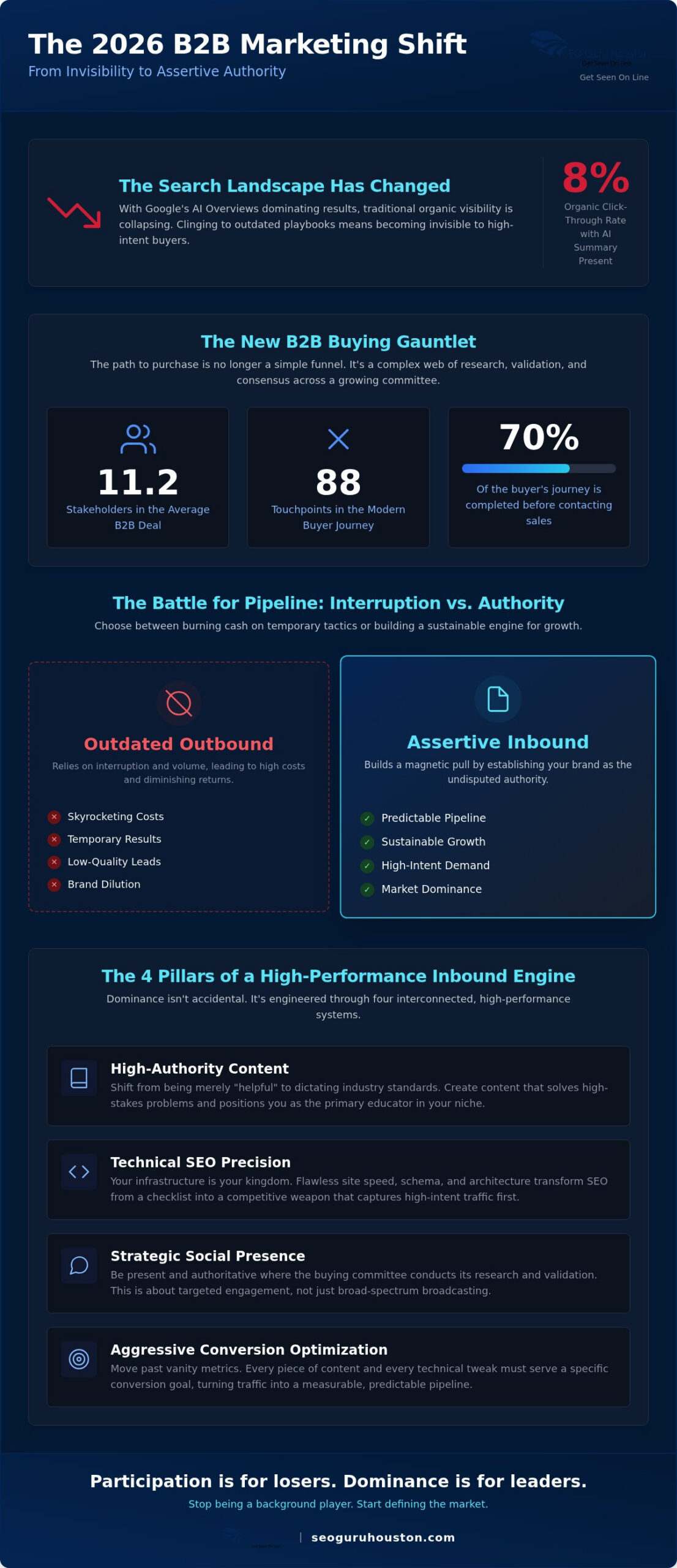
Content gives buyers useful information before a sales conversation begins. That matters because B2B purchasing often involves several stakeholders, each evaluating different risks and requirements. A 2025 benchmark puts buying groups at an average of 11 stakeholders. A clear content program helps a business build awareness across that group, rather than relying only on lead capture when someone is ready to talk.

Start by defining an ideal customer profile around company fit, then create buyer personas for the people inside those companies. Record their roles, priorities, pain points, triggers, and jobs-to-be-done. For example, a finance leader may need evidence of cost control, while an operations leader needs to understand implementation demands. B2B purchasing decisions involve around 6-10 decision-makers, and more than a dozen individuals may express distinct needs. These details make lead generation programs more relevant and help teams choose topics buyers actually need.

Next, map content to the buyer journey. At awareness, explain the problem and its business impact through educational articles. During consideration, compare approaches and answer technical questions with guides or webinars. At decision, use case studies and clear product information to help stakeholders assess fit. Voice of the Buyer 2026 reports that 58% of buyers prioritize alignment with their use case or technical requirements when shortlisting vendors. Each asset should answer a specific question and point to a useful next step.

Independent research also shapes buyer confidence. In 2025, 61% of B2B buyers preferred sales-rep-free experiences while conducting their own research. Content must therefore stand on its own: explain claims clearly, address objections, and give different stakeholders material they can share internally. Forrester reported in 2024 that 86% of B2B purchases stall and result in no decision. Useful content can help a buying group build understanding and agreement before that momentum disappears.

For example, a persona-led program could pair an awareness article about a costly workflow problem with a consideration guide comparing possible solutions. A decision-stage case study could then show how a similar organization evaluated its options. Use this practical planning rule for every asset: match it to a stage, a stakeholder need, and a clear next action.

2. How can a company develop a successful B2B content marketing strategy?

Build the plan around shared decisions, not separate departmental calendars. Sales hears objections in conversations; marketing sees audience engagement across channels. Bring both teams together to connect those signals and choose content themes that address real buyer questions. For organizations seeking senior leadership to drive this collaboration, engaging fractional CMO services London can provide the strategic oversight needed to unite both functions. A useful starting point is a monthly planning session where sales shares recurring objections and marketing matches each one to a relevant asset.

Agree on what qualifies as a lead before launching campaigns. Document the company fit, role, problem, and intent signals that make an opportunity relevant. Then define the handoff: what context accompanies a lead, who follows up, and how sales shares feedback. This prevents a campaign download from being mistaken for sales readiness without evidence of need or fit.

Align content with the audience and its decision stage. An early-stage operations leader may need a practical explanation of a process problem. A technical evaluator may need implementation details, while a finance stakeholder needs a business case. Create a version of the core message for each role, but keep the central claim consistent. The result should be one coherent idea tailored to each stakeholder’s responsibilities.

Map the buying group before assigning content. A CRM record can connect target accounts with their contacts, roles, interactions, and open questions. Use that view to spot gaps: if a champion engages with a guide but the technical evaluator still needs answers, create material to support that review. Account-based marketing can use CRM data to tailor messaging for high-value accounts and their decision-makers.

Measure performance through a connected set of indicators: content engagement, qualified opportunities, pipeline contribution, and revenue outcomes. Use campaign and CRM records to connect interactions with account progression, then review attribution rules jointly so teams interpret influence consistently. In the Tenth Edition State of Marketing, 83% of marketers reported a clear view into their impact on the sales pipeline. Treat that visibility as a reason to define shared reporting, not as proof that one asset caused a sale.

Run a regular review to improve the plan. Marketing can bring engagement patterns; sales can bring call feedback and stalled-deal reasons. Together, decide which topics need a new format, which messages need revision, and where a buyer lacks useful information. For teams seeking help coordinating content with pipeline priorities, B2B marketing support can be a relevant next step.

3. Content activation across ABX, outreach, and paid channels

Content creates demand only when target buyers can find and use it. Build an activation plan around account priorities, buyer intent, and channel behavior. In an account-based experience (ABX), coordinate content across the account’s interactions, not just one contact’s clicks. For a target account researching workflow issues, a useful sequence could pair a search-focused article with a LinkedIn insight and tailored sales outreach.

Give each channel a distinct role. Organic search helps buyers discover educational material while investigating a problem. LinkedIn can distribute industry reports and whitepapers to professional audiences. Email can provide relevant follow-up based on a person’s expressed interests. Paid advertising can extend reach to selected audiences or promote a high-value asset. Keep the message consistent, but adapt its format and opening to each channel.

Plan organic and paid distribution together. First, identify the asset’s audience, funnel stage, and intended action. Then select channels that match how that audience consumes information. For example, publish an educational article organically, use paid promotion to reach relevant account roles, and send an email with a deeper guide to engaged readers. LinkedIn is described as a leading channel for reaching B2B executives and senior stakeholders.

Social engagement needs a repeatable cadence. Small B2B teams can publish two to three organic posts per week on LinkedIn or another channel their ideal customers use. A single webinar can also become five LinkedIn posts, each highlighting a distinct takeaway or question. This repurposing gives the original content more entry points without copying the same promotional message into every post.

Use paid media to extend useful content, not to disguise a weak offer. Match the promotion to buyer intent: an educational asset suits problem-aware audiences, while a case study can support active evaluation. Set campaign measures before launch, such as target-account engagement, meaningful asset interactions, and qualified follow-up. The 81% of buyers are more likely to engage with brands that have a strong, cohesive professional social presence figure points to the importance of consistency across organic and paid activity.

Events create opportunities for direct interaction. Before a webinar or industry event, promote a clear topic through social posts, email, and paid placements where appropriate. During the event, capture audience questions and engagement signals. Afterward, share relevant resources and tailor follow-up to expressed intent rather than sending every attendee the same message.

Review performance across channels, not in isolated dashboards. Compare which assets attract target accounts, support meaningful engagement, and contribute to pipeline conversations. Then focus distribution on the channels and formats that prompt useful buyer actions. This discipline turns content activation into a coordinated system, with each touchpoint helping the next work harder.

Build a B2B Demand Generation Content Strategy for Pipeline Growth

4. What is the main goal of B2B demand generation?

The goal is to create sustained interest and move suitable accounts toward qualified opportunities. That work begins before a buyer is actively comparing vendors. Demand generation helps people recognize a problem, explore possible responses, and develop enough understanding to consider a next step. A b2b demand generation content strategy supports this by connecting useful information with the buyer’s changing needs, rather than treating every interaction as an immediate sales lead.

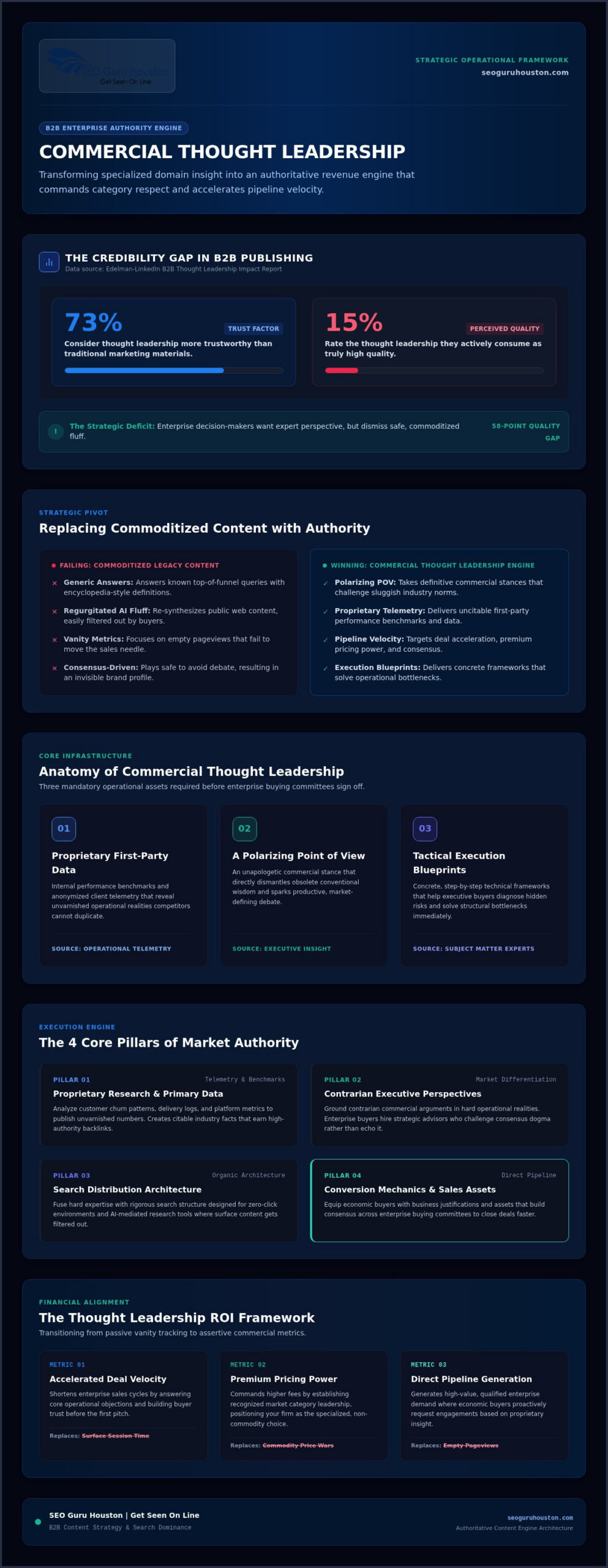
Content marketing supplies information buyers use during the process, but it isn’t the entire demand-generation program. Articles, guides, reports, and expert perspectives can explain a challenge or clarify a solution. Thought leadership can build authority and awareness without directly generating a lead—a core focus for creative consultancies like I Got Creative that help entrepreneurs craft strategic, value-driven messaging. For example, a report that helps a team identify a process weakness can be valuable even if readers don’t submit a form.

Demand generation also nurtures accounts before they’re ready to buy. A buyer who encounters a useful explanation today may return later with specific questions. Build a sequence that responds to those changing needs: start with accessible educational material, then offer deeper insights as interest develops. A second b2b demand generation content strategy consideration is keeping follow-up relevant to the account’s behavior, rather than sending every contact the same campaign.

Marketing automation can help keep follow-up relevant. Set up personalized email communications based on the resources a contact engages with and the topics they explore. Someone reading about an operational challenge could receive an implementation guide next. A contact evaluating possible approaches might benefit from a case study. The goal is to make the next useful resource easier to find, not to automate messages for their own sake.

Evaluate the program by the progress it supports. Track meaningful content engagement, account progression, qualified opportunities, and contributions to pipeline or revenue. If a report attracts interest but doesn’t lead to further exploration, review its audience, topic, and next step. This analysis helps teams distinguish content that builds awareness from work that captures active intent or supports ongoing nurturing. Demand generation succeeds when these functions work together throughout the buyer relationship.

5. Demand generation framework and funnel stages

A useful framework turns funnel stages into decisions about what to publish, promote, and measure. Start with five demand-generation phases: demand creation, demand capture, revival, acceleration, and expansion. For each phase, define the audience, buyer question, content asset, and next action. This makes the framework operational, not just a diagram. Teams can see where a buying group needs new insights and where existing content already supports progress.

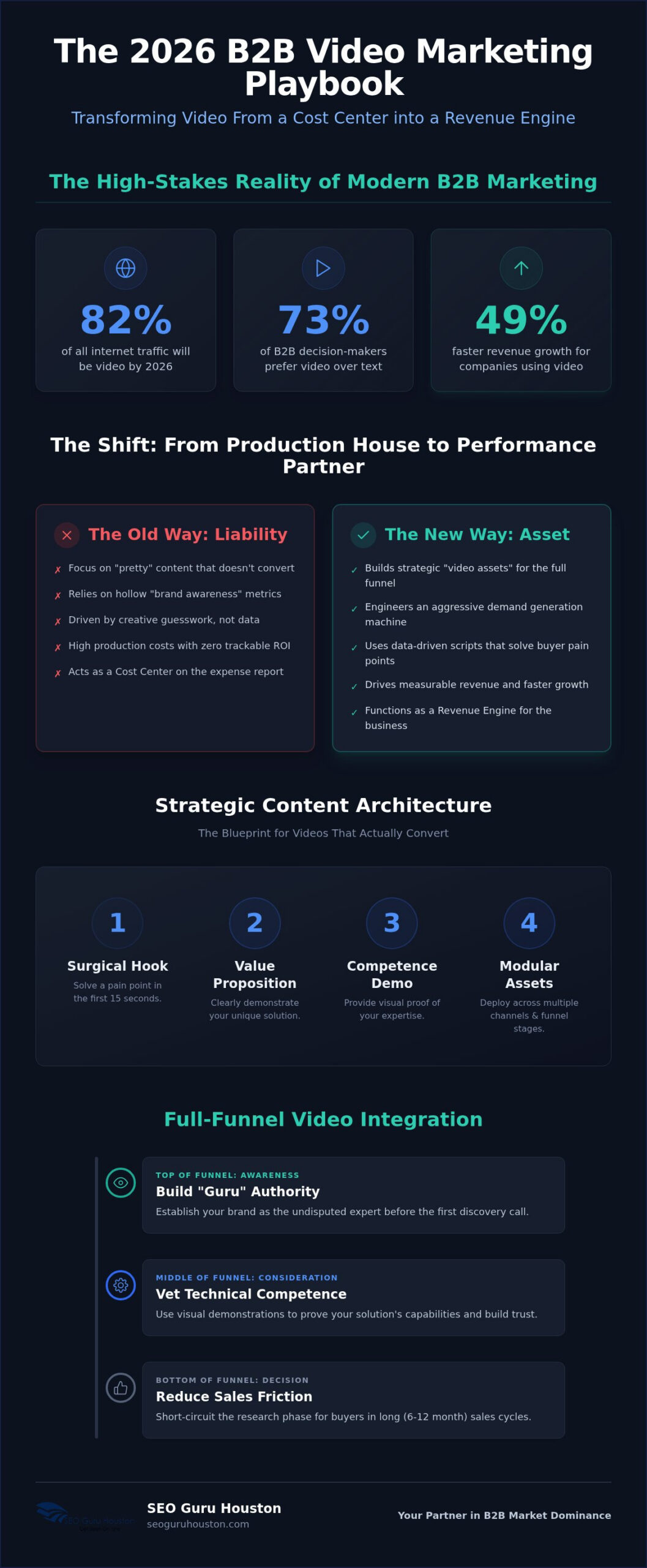
At the awareness stage, buyers need help naming a problem and understanding its impact. Use educational articles, short videos, or checklists that explain a challenge in plain language. For example, an article about delayed reporting can describe symptoms and possible causes without pushing for an immediate sales conversation. Focus on the reader’s question, then offer a related resource to deepen understanding.

During consideration, buyers compare approaches and assess whether a solution fits their needs. Use detailed guides, webinars, comparison tools, or expert interviews to explain trade-offs and implementation questions. A useful asset should help a stakeholder bring informed insights to an internal discussion. At the decision stage, case studies, product demonstrations, and practical implementation information can help the buying group assess evidence and reduce uncertainty.

Choose formats by the work buyers need to do, not by a calendar template. A technical evaluator may prefer a detailed guide, while an executive may need a concise summary of business impact. Case studies are preferred by 78% of B2B decision-makers during evaluation. Webinars are trusted by 58% of B2B decision-makers. Use these formats where they answer genuine evaluation questions, then judge performance by relevant engagement and account progression.

Balance gated and ungated content according to an asset’s value. Keep foundational articles and practical explainers ungated to support discovery and sharing. Gate a substantial guide or webinar when registration creates a useful follow-up opportunity, and make the value clear before requesting details. Avoid placing every useful insight behind a form: buyers need enough accessible information to decide whether deeper engagement is worthwhile.

Finally, review the funnel as a connected system. If awareness content attracts readers but few explore related material, improve the next step or link to a stronger consideration asset. If decision-stage case studies draw attention but opportunities stall, ask sales which evaluation questions remain unanswered. Update the asset map based on those observations, then assign owners for revisions and distribution. This feedback loop keeps the framework aligned with real buying behavior.

SEO Guru Houston: B2B Marketing Support

SEO Guru Houston can help connect your content plan with the channels buyers use to research and evaluate solutions. Its SEO services can strengthen search visibility for useful resources, while PPC services can promote content to relevant audiences. B2B marketing can align content with pipeline priorities, and inbound marketing can support attracting and nurturing business prospects. The right mix depends on your audience, funnel priorities, and content gaps. To discuss your demand generation goals, contact SEO Guru Houston.

Turn Your Content Plan Into the Next Growth Move

Choose one pipeline priority and use it to guide every content decision. It might be reaching a new audience, improving the path from first interaction to sales conversation, or helping active opportunities resolve a specific concern. Set the priority, identify the buyer behavior that would signal progress, and give the team a clear review point.

A practical B2B demand generation content strategy should keep evolving as buyer questions, sales feedback, and channel performance change. Treat each campaign as a learning cycle: publish with intent, observe meaningful engagement, and use what you learn to sharpen the next asset. Consistency matters, but so does the willingness to adjust when the content isn’t helping buyers take a useful next step.

Ready to put your priorities into action? Start a conversation with SEO Guru Houston about the direction you want your demand generation to take. Build with purpose, learn from the response, and keep moving your pipeline forward.

Frequently Asked Questions

What is the main goal of B2B demand generation?

The goal is to create sustained interest that can develop into qualified business opportunities. Help potential buyers understand a problem before they actively evaluate vendors, then give them useful ways to explore solutions. For example, a company entering a new market could publish educational material that clarifies an overlooked operational challenge, helping future buyers recognize a need before a sales conversation begins.

How can a company develop a successful B2B content marketing strategy?

Start with evidence from customer conversations, sales calls, and recurring support questions. Choose a business priority, then create an editorial brief for each asset: intended reader, question answered, proof required, and next step. If prospects often ask about implementation risk, for example, produce a practical explainer covering dependencies and common decision points. Review responses with sales and revise topics as buyer questions change.

How can B2B marketers boost demand?

Make useful expertise easier to discover, share, and discuss. Turn customer questions into educational resources, then ask subject-matter experts to add practical insight rather than generic claims. A software company, for instance, could publish a clear guide to diagnosing a process bottleneck and invite prospects to discuss their challenges. Consistent distribution through relevant professional channels helps the material reach people before they enter an active buying cycle.

Why Has Content Become the Foundation of Modern Demand Generation?

Content lets buyers learn and compare ideas without starting with a sales meeting. A well-organized resource library can answer questions at different levels, from basic terminology to implementation concerns. A new visitor might find a plain-language explainer, while a returning reader can access a detailed evaluation guide. This continuity helps a brand remain useful across separate research sessions and internal discussions.

How Does Content Build Buyer Confidence Throughout the Buying Journey?

Confidence grows when content explains both the value and the practical realities of a decision. Use transparent examples, clear evidence, and specific answers to common objections. A case study is more useful when it describes the original challenge, the approach taken, and lessons learned, rather than offering only praise. Pair that evidence with implementation guidance so buyers can judge its relevance and share informed details with colleagues.

How Does Content Support Every Buying Committee Member?

Give each stakeholder material tied to their decision responsibilities. A technical evaluator may need architecture details, while a finance reviewer needs a clear explanation of business impact. The internal champion benefits from a concise resource they can forward to colleagues. Create a shared core message, then adapt the supporting details to each role. This helps the buying group discuss one solution using information relevant to everyone involved.

How can I improve content consumption in B2B marketing?

Make every asset easy to scan and use. Lead with the key takeaway, organize sections around buyer questions, and provide a clear next resource. A long research report, for example, can include an executive summary and descriptive section headings so readers can find relevant findings. Repurpose its core insights into shorter formats, but preserve context so each version remains accurate and useful.

How do you use intent data for B2B demand generation campaigns?

Use intent signals to guide relevance, not to assume a buyer is ready to purchase. Review patterns such as repeated visits to related resources, engagement with a product-focused page, or questions raised during a webinar. Combine those signals with account fit and known interactions before choosing follow-up content. For example, send a technical guide after repeated interest in implementation topics, then use subsequent engagement to shape the next step.

Content Strategy for Boring Industries That Finds Fresh Angles

A supposedly boring industry can produce compelling content when it starts with real customer questions, not forced gimmicks. A content strategy for boring industries should combine audience insight, an authentic brand voice, perspectives from industry insiders, and useful ideas rooted in everyday problems. A practical starting point is to list 50 questions customers might ask about your product or service, then turn the strongest answers into clear, valuable content.

Some industries may seem to have fewer obvious stories to tell. Yet technical details, recurring customer frustrations, buying decisions, and the people behind the work all offer useful angles. The key is to make each piece relevant to your audience and true to your business.

This article explains how to understand your audience, build a distinctive and credible voice, and bring customers or industry insiders into the conversation. You’ll also get a structured way to generate and organize ideas, giving writers clear direction while leaving room for fresh, useful stories.

Key Takeaways

  • Study how your audience gets information and what it cares about, then use those insights to shape relevant topics and formats.
  • Show personality through a consistent, credible voice. Humor and entertaining angles work best when they still fit your business and audience.
  • Invite customers and industry insiders to contribute practical perspectives that deepen trust and bring fresh experience to your content.
  • Document your audience, voice, priorities, and unresolved decisions so creative work stays aligned with a clear strategy.
  • Find new angles by reframing everyday industry questions, connecting related topics, and curating useful insights from trusted sources.

1. Understanding audience demographics and media habits

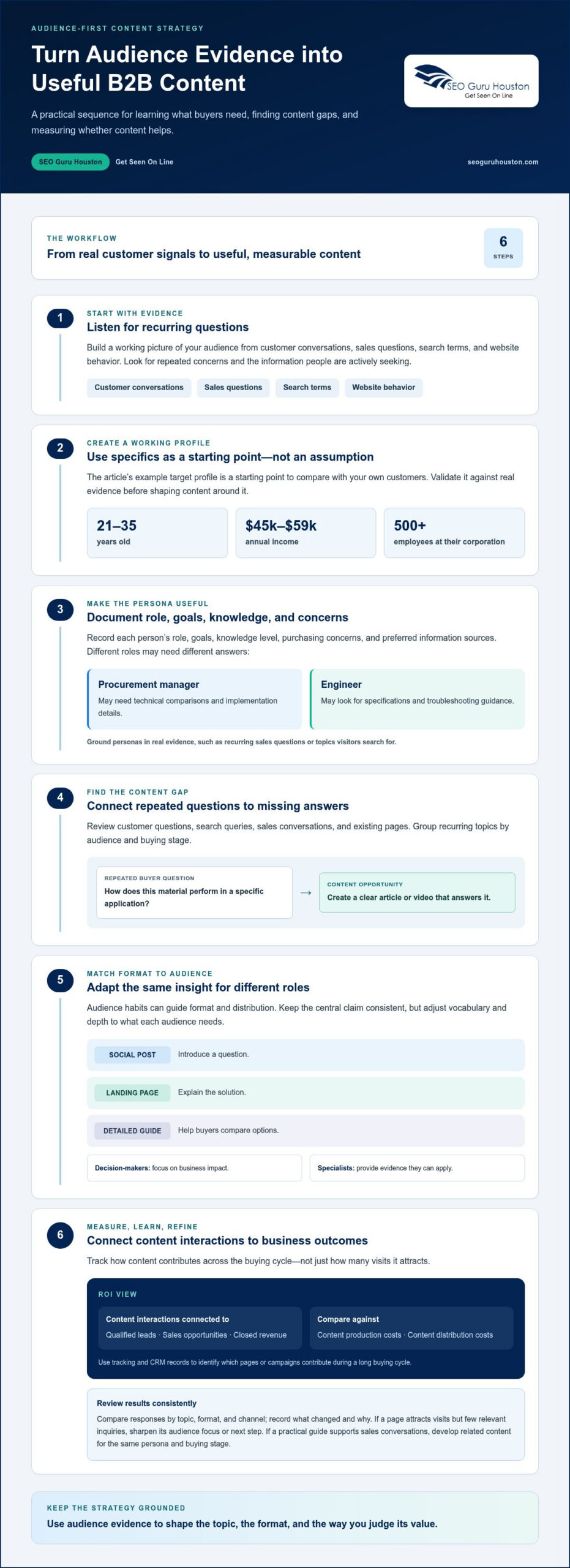
A content strategy for boring industries starts with a specific audience, not a broad assumption about who might buy. Build a working profile from customer conversations, sales questions, search terms, and website behavior. For example, the target profile described here includes people aged 21 to 35 years, earning $45,000 to $59,000, and employed by corporations with more than 500 employees. Treat that profile as a starting point, then compare it with your own customers.

Turn the profile into a practical persona by documenting the person’s role, goals, knowledge level, purchasing concerns, and preferred information sources. A procurement manager may need technical comparisons and implementation details, while an engineer may look for specifications and troubleshooting guidance. Base each persona on real evidence, such as recurring sales questions or topics visitors search for on your site.

How do you identify audience needs and content gaps in a niche industry? Review customer questions, search queries, sales conversations, and existing pages, then group recurring topics by audience and buying stage. If buyers repeatedly ask how a material performs in a specific application but your site offers no clear explanation, that gap could become a useful article or video.

Audience habits can shape both format and distribution. Check which pages attract attention, whether visitors arrive through search or social platforms, and which formats prompt useful responses. An operations leader may prefer a concise process guide, while a technical audience may value a detailed comparison. Test formats, keep the tactics audiences respond to, and revise those they ignore.

Make industry topics interesting by connecting them to audience interests without forcing an unrelated trend. A manufacturer might explain material durability through an environmental angle, or connect a local business story to local sports. A familiar reference, such as a popular book, can also clarify a technical idea. Any connection should strengthen the explanation, not distract from the product or customer problem.

Adapt the same core insight for different roles and formats. A social post can introduce a question, a landing page can explain the solution, and a detailed guide can help buyers compare options. Keep the central claim consistent, but adjust the vocabulary, depth, and next step. Decision-makers need to understand the business impact; specialists need evidence they can apply to their work.

How do you measure content marketing ROI in B2B industries? Connect content interactions to qualified leads, sales opportunities, and closed revenue, then compare the resulting value with content production and distribution costs. Use tracking and CRM records to see which pages or campaigns contribute during a long buying cycle, rather than judging a technical guide by visits alone.

Review results on a consistent schedule. Compare responses by topic, format, and channel, and record what changed and why. If an article attracts visits but few relevant inquiries, sharpen its audience focus or next step. If a practical guide supports sales conversations, develop related content for the same persona and buying stage.

2. Balancing personality and authenticity

Technical accuracy earns trust, but a brand’s personality gives readers a reason to remember it. In 2014, content marketing was dubbed “The Year of the Story.” That idea still applies to industrial topics: explain what a product changes for a real person, not just what it contains. A maintenance company, for example, can pair an equipment guide with a technician’s account of spotting a recurring issue.

Choose three voice attributes, such as practical, candid, and curious, and define each with an example. “Practical” might mean explaining a process in plain language; “candid” means acknowledging a genuine limitation instead of hiding it in vague copy. A brief voice guide gives writers a shared reference and keeps the brand’s personality consistent across blog posts, sales pages, and social updates.

Use humor with judgment. A light joke about a familiar workplace headache can make a post approachable, but humor about safety, customer losses, or a serious technical failure can undermine credibility. Before publishing, check that the humor supports the point, suits the audience, and sounds like the people who do the work. Cut it if it distracts from the useful information.

Show the people behind the expertise. A project manager can explain why a process changed, a technician can clarify a common misconception, and a founder can describe the principle behind a business decision. Use specific details. “We care about quality” is generic; describing how a team handles a difficult handoff demonstrates that value through an example.

Personality also comes through in structure. Replace a stiff introduction with a clear problem, use descriptive subheadings, and close with a useful next step. An article about equipment maintenance might open with signs of an overlooked issue, then offer a simple inspection checklist. This professional structure makes the writing easier to follow and more engaging.

Keep the brand recognizable across topics without making every piece sound identical. An occasional entertaining post can reinforce the voice while staying relevant to the business. A manufacturer, for instance, could share a brief behind-the-scenes account of how a team solved an unusual production challenge. Track comments, shares, and meaningful inquiries to learn which tones and formats prompt responses, then refine future content.

Consistency matters across channels, too. A social post can be punchier than a technical guide, but both should reflect the same values and level of candor. A focused social media marketing approach can help carry that voice into audience conversations, rather than treating each post as a disconnected announcement.

3. Publishing guest posts from customers or industry insiders

A customer or industry insider can explain a difficult problem in language readers recognize. Invite a plant manager to describe how an equipment issue disrupted production, or ask a distributor to explain a recurring buyer misconception. Firsthand details add context that internal experts may overlook. Choose contributors for relevant experience, not job titles alone.

Start with a focused invitation. Name the intended audience, the question the post should answer, and the practical takeaway for readers. For example, ask a maintenance lead to explain how teams identify early signs of wear. Provide a short outline with prompts, but let the contributor bring examples and terminology from their daily work.

Strong guest content can reveal problems customers may not describe in formal interviews. Ask contributors to walk through a recent challenge: what happened, what made it difficult, and what information helped. A supplier might explain why a specification was misunderstood during purchasing. Remove confidential details, then shape the story around a lesson other buyers can use.

Put education first in every draft. A controls engineer could clarify the difference between a sensor fault and a wiring issue, while noting when readers need qualified technical help. Keep explanations precise, define industry terms, and use a practical example for each major point. Readers should get a useful resource, not a disguised product pitch.

Give readers a practical next step. A logistics customer might share a checklist for preparing a shipment, while an industry analyst could explain what data to gather before comparing suppliers. Add a clear summary and relevant links to your own guides. People arriving from search should understand the advice without insider knowledge.

Before publication, edit for clarity, accuracy, and your established voice. Preserve the contributor’s perspective, but remove unexplained acronyms and unsupported claims. Confirm names, product references, and technical details with the author. Then promote the finished post through the contributor’s professional network, email updates, and relevant social channels. A useful post can earn attention from Google and readers when its subject matches a real search need.

Keep the relationship active after publication. Thank the contributor, share audience questions, and invite a follow-up as the topic develops. An older blog post can also become a short video, even if the original was published two years earlier. Repurposing the insight creates another format and a fresh reason to reconnect with the contributor and audience.

A follow-up can turn interest into action: the company in the article estimates that converting a customer by phone gives it about a 75% chance of closing the sale. Keep the next step relevant to the advice, rather than forcing a pitch.

Balance material that moves beyond the brand’s core topic with posts that reinforce it, so readers stay connected without feeling pestered. The gym partnership in the example offers customers a 10% coupon in exchange for promoting a vehicle hail-damage guide. Brands can also link to and share material from industry sources, curating useful content from others to reinforce their authority.

Content Strategy for Boring Industries That Finds Fresh Angles

4. Separating strategy clarity from creative content

Set the strategy before brainstorming headlines. Document what the organization does, who it serves, where revenue comes from, and which audience needs the content should address. Then define voice attributes, channel priorities, and useful outcomes in plain language. A pump manufacturer, for example, might focus on helping facility teams compare maintenance approaches. Clear direction gives creative work a target without dictating every sentence.

What content formats work best for traditionally boring industries? Try practical formats such as evergreen guides, local stories, short videos, and link-worthy resources. A comparison guide can explain technical choices, while a short video can demonstrate a process. Match each format to the audience’s question and the content’s purpose, then track responses, including comments and qualified inquiries.

Plan a monthly mix of one local piece, two evergreen pieces, and one link-worthy asset. A local piece could explain a regional operating challenge, while evergreen articles could answer recurring maintenance questions. The asset might be a checklist, calculator, or original visual guide that others may reference. This mix adds variety while keeping the publishing plan manageable and focused.

A link-worthy resource earns attention by making a useful idea easier to understand or share. For a building supplier, that might be a material selection chart or a clear guide to common project decisions. A contest can also invite participation when it fits the audience. One hail-related example offered a $500 prize to the local homeowner submitting the largest hailstone during the season. The prize was tied directly to the subject.

Videos make complex processes visible. Film a technician explaining a routine inspection, then add captions and a concise written summary for readers who prefer text. A B2B marketer can also repurpose material from a blog post written two years earlier into a short-form video. Keep the central advice accurate, refresh dated details, and adapt the opening to the video audience.

Give writers creative freedom within clear boundaries. Specify the intended reader, voice attributes, core message, and required evidence, then let writers choose the story and presentation. Explicit guidance helps writers and campaign teams interpret the strategy consistently. Flag unresolved decisions, such as a messaging framework still in development, rather than letting each new piece invent its own direction.

How much does a content marketing strategy cost for a small B2B business? The price depends on scope, research, production formats, and distribution needs, and is provided after a quote request. A focused plan may prioritize a few useful formats, while a broader program requires more research and ongoing production.

Review the plan against audience response and business relevance. If a guide prompts thoughtful comments or helps sales answer recurring questions, use that signal to shape the next topic. Content creation becomes more efficient when every piece has a defined purpose, while reader conversations keep the strategy connected to real needs.

5. Content idea generation for less exciting industries

Start with customer questions, not a brainstorm about what sounds exciting. Write down 50 questions buyers ask about a product, process, or decision. A filtration company might list questions about choosing a filter, spotting wear, or comparing materials. Group similar answers, then choose topics that solve real problems and support business goals.

Use a content idea matrix to explore each question through generalization, specification, similarity, and time. A question about equipment maintenance could become a general guide, a model-specific explanation, a comparison with another method, or a seasonal checklist. This framework turns one useful insight into distinct digital content instead of repeating the same article under a new title.

How can B2B companies make technical or complex topics engaging? Start with a familiar problem, explain the technical point in plain language, and show its practical effect. For example, explain how a vehicle’s fuel warning relates to driver decisions, then support the answer with clear details.

Which SEO keywords and topics should boring-industry businesses target? Focus on phrases that reflect customer questions, product applications, comparisons, and troubleshooting needs. Match each keyword with a useful answer, such as a solar company explaining how home-buying decisions affect energy planning.

Useful ideas can come from connections beyond the core product. A content piece about buying a house earned 99 links in the solar energy industry. In auto maintenance, an article about car iterations and how far drivers can travel after the gas light comes on earned 151 linking root domains. Both examples connect an industry subject to a decision people already understand.

What are examples of successful content marketing in boring industries? A blender campaign was associated with a 700% increase in total blender sales between 2006 and 2008. Industrial marketers can also find an audience through a niche newsletter with a mailing list of 10,000 people, as Ross Simmonds has noted.

In regulated industries, key risks include inaccurate claims, unclear qualifications, and advice readers could mistake for guidance about their personal situation. Build review into the workflow: verify technical statements, document evidence, and send sensitive drafts through appropriate internal review before publication.

How do you build a content strategy for an industrial or regulated business? Document what the organization does, where its revenue comes from, who its audience is, and which questions the content should answer. Record shared decisions and unresolved issues, then connect each topic to an audience need and business goal.

Use these steps to build a practical topic pipeline, then turn the strongest ideas into a focused B2B content and demand-generation plan.

SEO Guru Houston: Houston SEO Services

SEO Guru Houston can help turn useful industry knowledge into a clear digital strategy that reaches the right buyers nationwide. If your content answers customer questions but struggles to earn search visibility, professional SEO services can support a focused approach to relevant topics and search intent. For complex business audiences, specialized B2B marketing and inbound marketing methodologies can connect educational content with broader demand generation goals.

Identify where your strategy needs support: audience targeting, search visibility, or a clearer path from useful information to qualified inquiries across your target markets. SEO Guru Houston can align those priorities with your content program and overarching marketing objectives.

Contact SEO Guru Houston to discuss how a clearer content strategy can support your business goals.

Turn Your Next Idea Into a Clear Plan

A content strategy for boring industries becomes valuable when it guides regular decisions, not just when it sits in a document. Choose one audience need, assign responsibility for addressing it, and decide how you’ll judge whether the content is useful. This gives your next idea a purpose before production begins, while leaving room to adjust based on feedback from readers and sales teams.

SEO Guru Houston can support the next stage with Houston SEO Services, Houston PPC Services, and Houston B2B Marketing. These offerings can help connect content priorities with search visibility, paid campaigns, and business-to-business marketing goals. Bring a clear picture of the audience you want to reach and the questions your content should answer.

Ready to turn your ideas into a more focused marketing plan? Explore your next steps with SEO Guru Houston. Your industry already has useful knowledge to share. Put it to work with purpose, and keep building from there.

Frequently Asked Questions

What is content strategy for boring industries?

A content strategy is a documented plan for turning specialized knowledge into information that helps a defined audience make decisions. A commercial flooring supplier, for example, could plan articles about durability, installation considerations, and facility maintenance. Each topic needs a clear reader, purpose, and suitable format. The strategy helps teams choose what to create, maintain a consistent message, and connect useful information to business priorities.

How often should companies in niche industries publish content?

Choose a publishing cadence your team can sustain while keeping information accurate and useful. A monthly planning cycle can coordinate new articles, updates, and distribution without making every week a deadline. For example, a manufacturer could publish a guide when customers repeatedly ask about a specification, then update existing pages when product details change. Review audience response regularly and adjust the schedule to match capacity and demand.

Building a B2B Content Calendar: A Practical 2026 Guide

What if your B2B content calendar did more than tell the team what to publish next? Building a b2b content calendar around dates alone can keep posts moving, but it won’t solve reactive publishing, disconnected topics, or unclear ownership. A useful calendar connects buyer questions to business priorities and helps you assess whether content is supporting the work it was created to do.

Consistency matters, but publishing regularly without direction can produce assets that sales can’t use and buyers don’t need. A practical calendar gives marketing, sales, and subject-matter experts a shared plan, with clear owners, deadlines, approvals, distribution steps, and performance measures.

This guide shows you how to build that system for 2026. You’ll connect business goals and buyer needs to focused themes, formats, and production tasks, then set up a manageable workflow and measurement loop. The result is a calendar that can coordinate demand generation, organic search, paid promotion, and landing pages around a shared objective. You’ll also learn how to use performance insights to make more informed content decisions over time.

Key Takeaways

  • Build your calendar around one or two business priorities, then connect each asset to a specific audience need.
  • When building a b2b content calendar, prioritize ideas by strategic fit, buyer importance, search opportunity, sales usefulness, and team effort.
  • Keep the workflow manageable by assigning one accountable owner to each production stage and defining reviewers clearly.
  • Choose measures that match each asset’s purpose, separating publishing reliability from audience engagement and business outcomes.
  • Use performance insights to refine future topics and distribution, without assuming content alone caused revenue.

What a B2B content calendar should do beyond scheduling posts

A basic publishing list answers one question: “What goes live, and when?” A strategic calendar also clarifies who needs each asset, what decision it supports, who owns the work, and how the team will distribute and assess it. A B2B content calendar organizes content decisions as well as publishing dates.

That distinction separates filling slots from building a useful system. An editorial calendar offers a foundation for scheduling content, but building a b2b content calendar around business goals means connecting each planned asset to objectives, buyer questions, sales needs, and channel activity. Marketing, sales, and subject-matter experts should be able to see what’s planned and understand why it matters.

How a content calendar supports a complex B2B buying journey

Buyers need different information as they recognize a problem, compare options, and prepare to make a decision. Awareness content might explain a challenge. Evaluation content could compare approaches or trade-offs. Decision-stage material might help a stakeholder assess implementation considerations. Map each asset to the question it answers, rather than assigning a generic funnel label and stopping there.

Different stakeholders may also have different concerns. A technical evaluator may need to understand how a solution works, while a finance leader may focus on cost justification and risk. Plan for these distinct needs without assuming every person in a buying group needs the same asset. Helpful content can support demand generation and sales conversations, but no single piece should be treated as a guaranteed lead source.

What belongs in the calendar, and what does not

Include the information the team needs to make decisions and move work forward:

  • Audience, topic, and intent: who the asset serves, what it covers, and the buyer question or business objective behind it.
  • Format and channel: whether it’s an article, case study, or another asset, and where it will be published or distributed.
  • Owner, status, and deadline: who’s accountable, where the work stands, and when the next milestone is due.
  • Success measure: the indicator that fits the asset’s purpose, such as engagement, sales use, or qualified conversion activity.

Make the workload visible. Label early ideas as tentative and separate them from confirmed commitments, so a brainstorm doesn’t look like a production promise. Keep detailed instructions, source material, and review notes in linked briefs. The calendar should be easy to scan; the brief should guide execution. Together, they create a clear path from buyer need to published and distributed content.

How to build a B2B content calendar from business goals

Start with a business priority, not a list of topics. If the priority is improving visibility for a key solution, the calendar may need search-focused educational content. If sales needs help addressing recurring objections, plan assets that explain those concerns to the relevant stakeholders. Building a b2b content calendar this way gives every planned item a clear purpose and prevents the team from scheduling disconnected ideas just to fill slots.

Set objectives and map buyer questions

Translate one or two business priorities into content objectives, such as increasing awareness, supporting evaluation, or equipping sales conversations. Gather input from sales, subject-matter experts, customer-facing teams, and existing analytics. Look for recurring questions, objections, search patterns, and gaps in customer research. These signals can help you validate themes before turning them into production commitments.

Use this workflow to turn those insights into a plan:

  • Set the objective: Identify the business priority and the content outcome that can support it.
  • Identify the audience: Specify the role, account type, or stakeholder group the content is for.
  • Map needs: Capture the audience’s questions and concerns at relevant journey stages.
  • Select topics: Choose themes that address those needs and fit the priority.
  • Assign the work: Select a feasible format and channel, then name an owner and reviewer.
  • Review the plan: Confirm capacity, distribution, and a suitable measure before making a commitment.

Every planned asset should name its audience and purpose, so the team knows whose question it answers and which business priority it supports. This makes it easier to decide whether an idea belongs in the calendar now, later, or not at all. For a sales-oriented perspective on planning content that drives sales, consider how buyer questions and sales needs can guide topic choices.

Turn priority themes into briefs and calendar entries

Choose the format and channel based on the audience’s needs, the asset’s purpose, and what the team can deliver. A complex topic may call for an in-depth article. A sales team may need a concise resource to share during evaluation. When useful, connect channels to the same objective, such as supporting organic search with paid promotion or a relevant landing page.

Each calendar entry should identify the owner, subject-matter reviewer, deadline, distribution plan, and success measure. Link it to a brief that captures the angle, evidence to source, call to action, and search intent. This keeps the calendar scannable while giving the people creating the asset enough direction to do the work. Teams coordinating content with broader demand generation can also explore B2B marketing support.

How to prioritize B2B content ideas without overloading the team

A calendar fails when it commits the team to more work than it can produce. Publishing dates don’t create capacity. Before adding an idea, weigh its value against the effort needed to research, draft, review, approve, and distribute it. Building a b2b content calendar means making trade-offs, not treating every promising topic as an immediate assignment.

Choose a prioritization model that fits available capacity

For quick, explainable decisions, use an impact-and-effort matrix. Prioritize ideas with strong audience and business value that the team can realistically deliver. Defer high-effort topics when their benefits are unclear. A weighted score can help compare a larger backlog, but only if the team agrees on the criteria, evidence, and decision owner. A precise-looking score shouldn’t disguise guesswork.

Use a shared set of questions to assess each idea. The ratings below are illustrative, not universal benchmarks. Adjust them to your business priorities and available evidence.

Criterion Topic A: recurring buyer objection Topic B: emerging market trend
Audience importance High, raised in sales conversations Medium, audience relevance needs validation
Strategic fit High, supports a current priority Medium, adjacent to the priority
Search opportunity Medium, confirm with search data Unknown, research needed
Sales usefulness High, addresses a known question Low to medium, usefulness unclear
Effort Medium, requires subject review High, requires new research

Topic A may be the stronger near-term choice, but verify the assumptions rather than treating the example as a rule. Protect capacity for revisions, subject-matter review, approvals, and distribution. A plan that accounts only for drafting is likely to slip as soon as feedback is needed.

Compare channels and formats against the job to be done

Balance evergreen content that answers lasting questions with timely topics tied to launches or changing buyer concerns. Repurpose useful material when it suits the audience and channel, and check that the plan covers awareness, evaluation, and decision needs without forcing an asset into every stage. Search-focused articles can support discoverability; a landing page can serve a specific conversion journey. Email, social media, or video can work when they fit audience access and team capability.

Prioritize the asset first, then select the channel mix that supports its purpose. For a wider view of coordinating content and channels, see this guide to B2B inbound marketing strategy.

Building a B2B Content Calendar: A Practical 2026 Guide

Manage a B2B Content Calendar from Brief to Publication

A calendar becomes useful when it shows how work moves, not just when an asset is due. Building a b2b content calendar means mapping each item from idea to brief, draft, subject-matter review, editing, approval, publication, and distribution. Assign one accountable owner to every stage. Contributors can help, but when ownership is shared without being clear, no one may know who should move the work forward.

Set responsibilities, approvals, and realistic deadlines

Clarify who owns strategy, drafting, subject expertise, editing, final approval, publishing, and promotion. One person may cover several roles on a small team; what matters is making ownership visible. Choose reviewers based on the asset’s subject and risk. A technical claim may need an expert’s review, while a sensitive or regulated claim may require additional approval before publication.

Work backward from the publish date. Allow time for drafting, fact-checking, subject review, editing, approvals, and accessibility checks. Set a review window that fits the team’s workload, then define what happens if feedback is late. The owner might follow up, escalate to the designated approver, or reset the date. A clear process prevents silent delays from becoming missed deadlines.

Set a planning cadence the team can sustain. Some teams may plan themes well ahead and confirm individual assets closer to production; others may need a shorter horizon. Review upcoming work often enough to catch capacity changes, but avoid adding meetings that create more overhead than clarity.

Use a calendar format the team will actually maintain

A spreadsheet, project-management tool, or marketing platform can all work. Choose based on how people collaborate, manage approvals, and access briefs. The tool matters less than having a single source of truth. Standardize fields, status labels, owner names, and file naming so the team can quickly see what’s planned, blocked, or ready to publish.

Keep the calendar scannable and link each entry to the brief and working draft. If an asset needs a focused conversion destination, connect its distribution plan to high-converting landing page design guidance. For editorial work that supports broader pipeline programs, use the same planning principles to coordinate content with demand generation.

Need help aligning content operations with demand generation? Explore B2B marketing support as you refine your process.

How to measure and improve your B2B content calendar

A calendar that tracks only what shipped tells you whether the team published, not whether the content served its purpose. Measure execution separately from audience response and business outcomes. That distinction makes a missed deadline visible without mistaking a high publishing volume for marketing impact.

Choose metrics that match the content objective

Before an asset goes live, decide what evidence you’ll use to assess it and where that evidence will come from. Choose measures that fit the job the content is meant to do:

  • Attract an audience: Review organic visibility, relevant search queries, clicks, and engagement in the analytics tools available to your team.
  • Support consideration: Look at meaningful actions, such as visits to a related page, resource requests, or engagement with the asset, alongside sales feedback about its usefulness.
  • Assist a buying decision: Where tracking allows, review qualified actions and assisted conversions, then check whether sales conversations reflect the questions the content was designed to answer.
  • Keep production on track: Monitor whether assets move through stages on time and where approvals or reviews tend to stall.

Set limits on reporting before drawing conclusions. A CRM, web analytics, search performance data, and sales feedback each show different parts of the journey. Document what each source can and can’t tell you, and use consistent tracking where appropriate. If a prospect interacted with several touchpoints, don’t claim one article caused the sale. Treat attribution as evidence of contribution, not proof of sole causation.

Turn performance reviews into the next planning cycle

Review progress and results at a cadence that fits your publishing volume and sales cycle. A small team with a handful of active assets may need a different rhythm than a team publishing across several channels. Focus on decisions, not dashboards for their own sake. Which audience questions keep coming up? Which journey stages lack useful content? Which assets need an update because information, search performance, or buyer needs have changed?

For each review, choose a next action: refresh content that remains valuable but needs updating, repurpose a strong idea for another relevant format, consolidate overlapping assets, or retire material that no longer serves a clear need. Record the decision and owner in the calendar, then carry those insights into the next planning cycle. That feedback loop makes building a b2b content calendar an ongoing improvement process, rather than a one-time scheduling exercise.

If in-house capacity limits execution, consider whether specialist support in SEO, paid promotion, or landing pages could help connect content with broader demand generation goals.

Turn Your Content Calendar Into a Growth Engine

A strong calendar does more than keep publication dates visible. It connects business priorities to buyer questions, gives every asset a clear owner and purpose, and helps the team focus on work it can deliver well. Building a b2b content calendar also means making room to assess what happens next, from audience engagement to qualified actions and sales feedback.

Keep improving the system. Use performance insights to refresh useful assets, fill gaps in the buyer journey, and make smarter choices about future topics and channels. The goal isn’t to publish more for the sake of output. It’s to make content a coordinated part of demand generation.

SEO, PPC, inbound marketing, and demand generation services, along with website development and landing page design, can help connect content with broader marketing activity. Explore B2B marketing support and take the next step toward a coordinated demand generation strategy.

Frequently Asked Questions

What should a B2B content calendar include?

A B2B content calendar should include the details needed to plan, assign, publish, and evaluate each asset. Track its audience, topic, purpose, format, channel, owner, status, deadline, distribution plan, and success measure. Link to a brief for detailed instructions instead of squeezing them into the calendar. When building a b2b content calendar, keep fields consistent and easy to scan so the team can quickly see priorities and workload.

How far ahead should a B2B content calendar be planned?

Plan far enough ahead to align content with business priorities, while keeping near-term production flexible. One approach is to set broad themes annually, coordinate campaigns quarterly, develop briefs closer to production, and manage immediate tasks weekly. Treat these as planning horizons, not fixed rules. The right timeline depends on publishing pace, review requirements, team capacity, and how often business priorities or buyer needs change.

Who should be involved in building a B2B content calendar?

Involve people who understand business priorities, buyer questions, subject accuracy, and execution. Marketing can coordinate the calendar; sales and customer-facing teams can share recurring objections and information needs; subject-matter experts can validate technical details. Assign one accountable owner to each asset or workflow stage, and select reviewers based on the content’s subject and risk. Not every contributor needs to attend every planning discussion.

How do you prioritize B2B content ideas?

Compare each idea by audience importance, fit with current business priorities, search opportunity, usefulness to sales, and production effort. Use an impact-and-effort matrix for quick decisions, or a weighted score if the team agrees on criteria and evidence. Prioritize ideas with a clear audience need and purpose that your team can deliver. Keep lower-confidence or resource-intensive ideas in a backlog until they’re validated or capacity opens up.

What is the difference between a content strategy and a content calendar?

A content strategy defines why content is needed, who it serves, what business objectives it supports, and how success will be assessed. A content calendar turns those decisions into planned work by recording topics, formats, channels, owners, deadlines, and status. The strategy sets direction; the calendar helps the team act on it. Without strategic direction, a calendar can become a list of publishing dates disconnected from buyer or business needs.

How can a small B2B team maintain a content calendar?

Keep the calendar lean and plan only work the team can realistically produce. Use a shared spreadsheet or project tool, limit fields to those that support decisions, and give each asset one clear owner. Focus on a small set of business priorities, reuse strong material when it suits another channel, and leave room for reviews and updates. A brief recurring check-in can surface blockers and help adjust deadlines before work stalls.

Which metrics should a B2B content calendar track?

Track operational measures, audience response, and business indicators separately. Operational measures include on-time publication and workflow delays. Audience measures may include organic visibility, relevant engagement, and visits. For assets intended to support consideration, review qualified actions, sales feedback, and assisted conversions where tracking allows. Match metrics to each asset’s purpose, identify reporting sources in advance, and avoid claiming that a single piece of content caused revenue.

B2B Keyword Research Guide: Find Search Terms That Drive Revenue

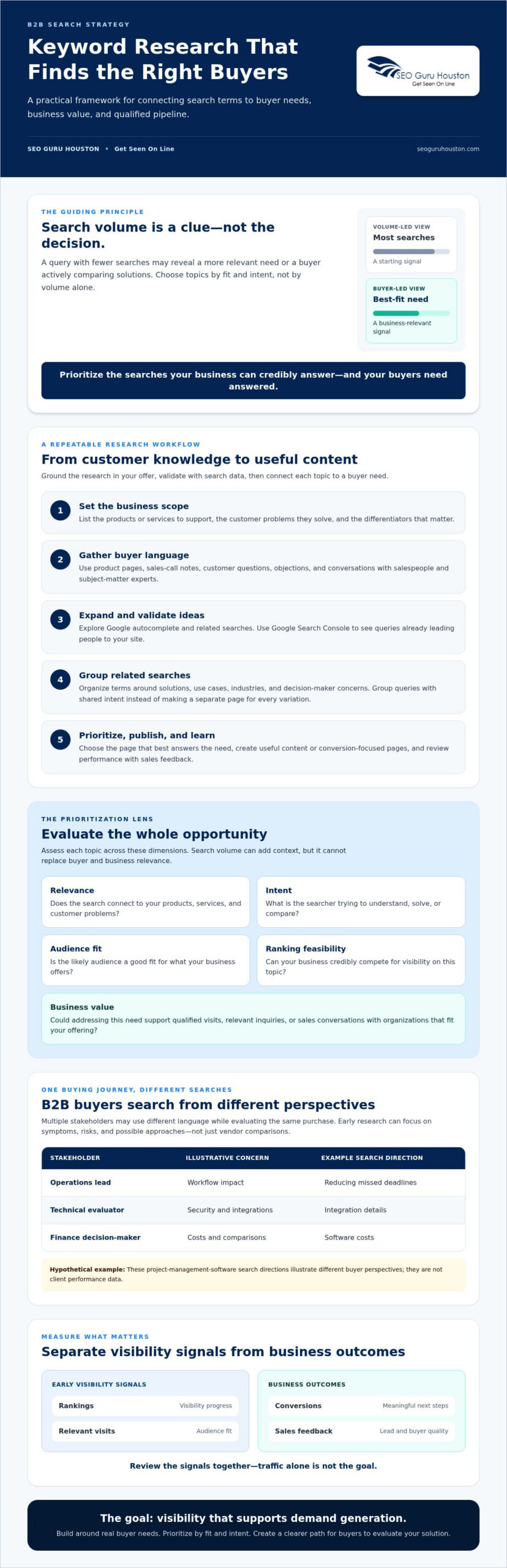
What if the keyword with the fewest searches could bring in your best-fit customer? In B2B, search volume alone can’t tell you whether a query reflects casual curiosity or a buyer actively comparing solutions. A useful b2b keyword research guide starts with buyer intent and business value, not a spreadsheet sorted from most searches to least.

Keyword research that connects to your products and sales process is worth the effort. But multiple decision-makers, long buying cycles, and varied customer language can make it hard to know which topics deserve your team’s time. A repeatable process helps connect search terms to buyer needs and qualified pipeline.

This guide explains how to gather ideas from search data and customer conversations, assess intent and business relevance, and organize keywords by funnel stage. You’ll also learn how to prioritize topics, turn your keyword map into useful content and conversion-focused pages, and measure whether your strategy is attracting the right audience. The goal isn’t more traffic for its own sake. It’s search visibility that supports demand generation and gives buyers a clearer path to evaluate your solution.

Key Takeaways

  • Use your products, customer problems, differentiators, and sales-team language to build a keyword list grounded in real buyer needs.
  • This b2b keyword research guide shows how to assess terms by relevance, intent, audience fit, ranking feasibility, and business value, not search volume alone.
  • Group related queries by shared intent and choose the page that best answers the buyer’s need instead of creating a separate page for every variation.
  • Turn prioritized topics into content and conversion-focused pages that support search visibility and demand generation.
  • Review rankings, relevant visits, conversions, and sales feedback together. Distinguish early visibility signals from business outcomes.

What B2B keyword research reveals about your buyers and market

B2B keyword research is the process of discovering and evaluating the searches business buyers use, then connecting those searches to customer needs and company goals. Put simply, B2B keyword research identifies relevant searches, interprets the intent behind them, and prioritizes the ones that support business objectives. That’s the difference between collecting terms and building a strategy.

A keyword tool can estimate how often people search a phrase, but that estimate doesn’t tell you who’s searching, what problem they’re trying to solve, or whether your business can help. A broad, high-volume query may attract students or people looking for general information. A lower-volume phrase describing a specific operational challenge could signal a better-fit prospect. Use volume as context, not as a verdict. Foundational concepts such as Keyword research explain how terms and search intent relate, but B2B research must also account for your products and sales process.

How B2B keyword research differs from consumer keyword research

One business purchase can involve several stakeholders, each searching from a different perspective. A technical evaluator might look for integration details, a department leader may investigate workflow impact, and a finance decision-maker may compare total costs. Their searches may look unrelated in a keyword export, yet all can belong to the same buying journey. B2B consideration can also begin well before vendor comparisons, with queries focused on symptoms, risks, and possible approaches.

Hypothetical example: A company considering project management software might have an operations lead searching for ways to reduce missed deadlines, an IT specialist checking security and integrations, and a finance leader comparing software costs. These are illustrative searches, not client performance data. Research that captures only “project management software” misses the distinct questions shaping the purchase.

Which business outcomes should keyword research support?

Start with outcomes the business can act on, such as qualified organic visits, relevant inquiries, and sales conversations with organizations that fit your offering. Raw impressions can show that a page appeared in search results, but they don’t establish whether the right audience engaged or took a meaningful next step.

SEO and demand generation can use the same research for different purposes. SEO can use intent and topic relevance to guide search-focused pages and content. Demand generation can use buyer questions to shape educational materials and conversion-focused landing pages across the journey. Together, they help teams decide what to publish and what to measure. A practical b2b keyword research guide asks not only “How many searches?” but also “Who needs this, why now, and what business goal does the answer support?”

How to conduct B2B keyword research step by step

A reliable workflow starts with what your business knows, then uses search data to test and expand that knowledge. This keeps the research connected to your offer instead of letting a tool dictate your content plan. Use these steps to create a keyword set your team can explain, validate, and act on.

Build seed topics from business and customer knowledge

  1. Set the business scope. List the products or services you want to support, the customer problems they address, and the differentiators that matter. This gives the research a clear boundary.
  2. Gather buyer language. Review product pages, sales call notes, customer questions, and common objections. Ask salespeople and subject-matter experts how buyers describe their challenges, desired outcomes, and concerns. Customer conversations can reveal ideas that tools may not surface. Neil Patel’s overview of B2B keyword research also emphasizes looking beyond volume to buyer intent and real-world language.
  3. Group the seed topics. Organize phrases around solutions, use cases, industries, and decision-maker concerns. For example, a cybersecurity provider might separate topics about cloud access controls from questions about compliance reporting or implementation. Keep the initial list focused on areas your business can credibly address.

Expand and validate keyword ideas

  1. Find query variations. Use Google autocomplete and related searches to discover how people phrase questions. Google Search Console can show queries that already lead people to your site, while keyword platforms can suggest additional terms and estimate search demand. Treat each source as research input, not an instruction.
  2. Check the live results. Search important phrases and examine what appears. Are results mostly explainers, comparison pages, product pages, or something else? The format and focus of ranking pages offer clues about the intent Google currently associates with a query. Compare that intent with the buyer need you identified.
  3. Validate and document. Remove terms that don’t fit your offer or audience, flag uncertain assumptions, and note which topics need more input from customers or the sales team. Record each keyword’s source, research date, and intended audience or stage. This makes the work easier to reproduce and refresh.

This b2b keyword research guide process turns scattered ideas into a defensible working list. From there, connect your research to the wider marketing plan. For a broader view of how keyword insights can support demand generation, explore B2B demand generation strategies.

How to prioritize B2B keywords beyond search volume

Search volume is an estimate, not a forecast of qualified traffic or revenue. Use it to understand potential demand, but don’t let it outweigh whether a query matches your offering and the people you serve. A specific, lower-volume search can deserve priority if it reflects a clear business need your company can credibly address.

Compare candidate terms against the same criteria. The example below is hypothetical, not performance data. Ratings are directional, so document your team’s reasoning rather than treating them as universal scores.

Criteria “Project management software” “Project management software for engineering teams”
Relevance Broad category match Strong if the offer serves engineering teams
Intent Could be research or evaluation More specific solution exploration
Audience fit Unclear without more context Defined audience, if it matches the target market
Ranking feasibility Review the strength and focus of current results Check whether relevant pages can compete for this niche
Business value Depends on whether broad interest aligns with the offer Potentially strong when it maps to a real use case

How to assess search intent and buying stage

Classify each query by what the searcher wants to do: learn about a topic, understand a problem, explore possible solutions, or compare vendors. Informational, problem-aware, solution-aware, and vendor-comparison labels are useful clues, not fixed funnel assignments. Search the phrase and inspect the results. Guides may indicate a need for explanation, while comparison pages or product pages can signal evaluation. Then write down the buyer question the page should answer. That question matters more than assigning a funnel stage by assumption.

How to weigh relevance, competition, and business value

Ask whether your company has the expertise and offering to satisfy the query. Next, review ranking pages for relevance, depth, and apparent authority. A keyword platform’s difficulty score can help with triage, but it can’t determine whether your page is competitive or your business is a credible fit.

Compare broad and long-tail terms using the same criteria, then explain any ratings or weighting in plain language. Sales, marketing, and subject-matter experts should challenge assumptions, especially around audience fit and commercial value. There’s no universal scoring formula. Prioritize the term your team can justify based on buyer need, business relevance, and a realistic path to serving the searcher. That’s the practical edge of a b2b keyword research guide: a prioritization method based on evidence, not volume alone.

B2B Keyword Research Guide: Find Search Terms That Drive Revenue

How to organize B2B keywords into topics and content priorities

A strong keyword list becomes useful when it tells your team what page to create, what that page should answer, and how it supports a broader topic. Group queries by shared intent and the page that can best meet the need. A topic cluster connects related content around a central subject. It doesn’t mean publishing a separate page for every wording variation.

How to map keywords to pages and content formats

Assign each planned page one primary query theme, then add closely related questions it can answer without drifting from its purpose. Match the format to what searchers need: an explainer for foundational questions, a comparison for evaluating options, a service page for a specific offering, or a case study when you have a relevant, substantiated example. Page goals matter too. A conversion-focused landing page should make the next step clear and align with visitor intent, as outlined in this guide to conversion-focused landing page design.

Before commissioning new content, review existing pages and their target themes. If two pages answer the same question for the same audience, they may compete for visibility or divide attention. Consider whether to refine one page, combine overlapping material, or clarify each page’s distinct purpose. Don’t split a topic into multiple URLs just because a keyword tool lists several close variations.

How to create a practical B2B keyword roadmap

Prioritize topics by business relevance, audience need, content readiness, and strategic dependencies. A page that depends on a clear service description or expert input may need that foundation first. Track each topic in a shared roadmap so decisions stay visible and actionable:

  • Topic and target audience: Who needs this information?
  • Intent and page type: What question should the page answer, and in what format?
  • Owner and next action: Who will move it forward, and what needs to happen next?

Review the roadmap with marketing, sales, and subject-matter experts. Their feedback can reveal missing questions, duplicated plans, or topics that aren’t a good fit. This turns a b2b keyword research guide into a working content plan, not a static spreadsheet. For a coordinated approach to attracting and educating prospects, explore how B2B inbound marketing can support content planning.

How to measure, refresh, and activate your B2B keyword research

A keyword map earns its place when it guides decisions and improves with use. Build a review loop that connects search visibility to what happens after a visit, while keeping the limits of your data in view. Rankings and clicks can show whether your content is being found. They can’t, by themselves, prove that a keyword generated revenue.

Which signals help evaluate keyword performance?

Use Google Search Console to review impressions, clicks, the queries bringing people to your site, and the landing pages appearing for those searches. Treat these as leading indicators of visibility and organic engagement, not business outcomes. Then use analytics and CRM data, where available, to examine relevant visits, meaningful page actions, inquiries, and lead quality. Agree on what counts as a qualified inquiry and how teams will report it before drawing conclusions.

Attribution depends on tracking quality, sales-cycle length, and shared reporting definitions. A prospect may discover a topic through search, return through another channel, and engage with sales later. Report what your data supports, such as organic visits to a page or inquiries associated with a tracked journey. Don’t assign revenue to a keyword without evidence connecting the search activity to the outcome.

When should you refresh your B2B keyword map?

Revisit priorities when offerings or positioning change, sales teams hear new customer language, competitors shift their content, or search results begin favoring different page types. Before adding more content, compare planned topics with existing page performance. A page may already attract relevant queries and need improvement, while another topic may lack a suitable destination.

  • Review: Compare visibility, relevant visits, conversion signals, and sales feedback against the page’s purpose.
  • Decide: Keep the target, update the page, consolidate overlapping coverage, or investigate a newly emerging need.
  • Record: Note the change, evidence, decision, owner, and next action so the research informs the next content and demand generation cycle.

Make this loop part of your working process, not a one-time spreadsheet exercise. A practical b2b keyword research guide helps teams learn from both search behavior and sales conversations, then adjust priorities accordingly. For support connecting search visibility with broader marketing goals, explore SEO and digital growth services.

Turn Your Keyword Research Into a Clear Growth Plan

A useful b2b keyword research guide does more than generate a list of search terms. It helps you connect buyer questions to your products, prioritize keywords by intent and business relevance, and organize related searches into content with a clear purpose.

Keep the process active. Use search visibility, relevant visits, conversion signals, and sales feedback to refine your priorities, while avoiding revenue claims that aren’t supported by reliable evidence. The result is a stronger foundation for content and demand generation decisions, not a promise of automatic growth.

SEO and PPC, B2B marketing, inbound marketing, and demand generation can work alongside keyword insights to support visibility and buyer engagement. Website and landing page development can help shape conversion-focused journeys around what prospects are searching for. To discuss how SEO, PPC, B2B marketing, and web development can support your marketing priorities, explore SEO and digital growth services. Keep listening to buyers, testing your assumptions, and turning each insight into a smarter next step.

Frequently Asked Questions

What is B2B keyword research?

B2B keyword research identifies and evaluates the search terms business buyers use, then connects those queries to buyer intent and business goals. It considers the different questions people may ask while researching, evaluating, and selecting a business solution. A practical b2b keyword research guide uses search data alongside customer and sales-team insights, so keyword priorities reflect real buyer needs rather than search volume alone.

How do you do keyword research for a B2B company?

Start with your offerings, customer problems, differentiators, and the language buyers use in sales conversations. Turn those insights into seed topics, then expand them with Google autocomplete, related searches, Search Console, and keyword platforms. Review live search results to understand intent and suitable page formats. Document each topic’s audience, intent, source, and next step, then validate your priorities with sales and subject-matter experts.

How many keywords should a B2B page target?

There’s no fixed number. Give each page one primary query theme and include closely related terms or questions when they share the same intent and can be answered naturally on that page. For example, one service page may address several ways buyers describe the same need. If a query represents a distinct audience or purpose, it may deserve a separate page. Prioritize usefulness and clarity over hitting a keyword count.

Should B2B keyword research focus on high-volume keywords?

No. Search volume is an estimate of demand, not proof that a query will attract qualified prospects. A broad term may bring visitors whose needs don’t match your offering, while a specific, lower-volume phrase may closely reflect a buyer’s problem or solution requirements. Consider relevance, intent, audience fit, ranking feasibility, and business value alongside volume. Let customer evidence and product fit shape priorities, not a volume sorting order.

How do you find B2B long-tail keywords?

Look for detailed phrases in sales call notes, customer questions, support conversations, and common objections. Expand those ideas with Google autocomplete, related searches, Search Console queries, and keyword platforms. Long-tail searches often describe a specific use case, industry, problem, or decision-maker concern. Check the results page to confirm what searchers appear to want, then prioritize terms your business can credibly address, even if tools report limited volume.

How often should you update B2B keyword research?

Refresh your research when a meaningful change could affect buyer needs or search intent. Triggers include a shift in your offerings or positioning, new language from sales conversations, competitor changes, or noticeably different search results. Also compare planned topics with existing page performance before commissioning more content. Record what changed, why you updated a priority, and what action follows. This keeps the keyword map useful without treating updates as busywork.

How can you tell whether a B2B keyword can attract qualified leads?

Check whether the query matches your offering, target audience, and the expertise you can demonstrate. Review its intent and current search results, then ask sales whether the underlying need appears in real buyer conversations. After publishing, examine relevant visits, inquiries, and lead quality using analytics and CRM data where available. Tracking limitations and long sales cycles matter, so don’t credit revenue to a keyword unless your evidence supports that connection.

Thought Leadership Content Strategy: The Assertive Guide to Market Dominance in 2026

According to the Edelman-LinkedIn B2B Thought Leadership Impact Report, 73% of decision-makers consider thought leadership more trustworthy than traditional marketing materials, yet only 15% rate what they consume as high quality. Closing that massive credibility gap requires an assertive thought leadership content strategy that treats domain expertise as an immediate revenue driver rather than a vanity publishing exercise.

You already know the frustration of pumping out safe, commoditized articles that generate empty pageviews without moving the sales needle. It’s exhausting to fight for ten minutes on a calendar with busy executives, only to watch bolder competitors capture category mindshare with decisive, market-defining points of view.

It’s time to take control of the conversation. You’re about to master how to transform specialized executive insight into an authoritative content engine that commands industry respect and accelerates pipeline revenue. Ahead, we break down the four operational pillars of market authority, battle-tested methods for extracting internal expert knowledge, and the exact distribution frameworks required to dominate executive networks in 2026.

Key Takeaways

  • Learn how an assertive thought leadership content strategy replaces commoditized blog posts with market-defining perspectives that command executive authority.
  • Master the four foundational pillars separating category leaders from reactive followers: proprietary research, executive perspectives, search distribution, and conversion mechanics.
  • Replace vanity traffic metrics with an aggressive ROI framework focused on deal velocity, premium pricing power, and direct pipeline generation.
  • Execute a repeatable 5-step blueprint to audit competitor whitespace and systematically extract deep technical insight from your busiest subject matter experts.
  • Convert strategic brand narratives into high-impact sales assets that build consensus across enterprise buying committees and close deals faster.

What Is a Thought Leadership Content Strategy in 2026?

A modern thought leadership content strategy is not a vanity publishing initiative, nor is it a corporate public relations campaign. It is an intentional commercial framework engineered to establish decisive market authority and accelerate enterprise pipeline. Too many mid-market B2B companies mistakenly believe establishing authority requires licensing third-party editorial journalism or funding multi-million-dollar research programs. In reality, real authority stems from taking definitive stances on pressing commercial challenges, framing unrecognized risks, and offering operational frameworks that competitors simply cannot duplicate.

Legacy content models focus on answering known top-of-funnel queries with generic advice. That model is dead. Today, modern buyers ruthlessly disqualify vendors who push safe, commoditized definitions. To capture executive mindshare, brands must study how recognized industry thought leaders dismantle conventional wisdom, shifting their perspective from passive educational publishing to aggressive, point-of-difference market education.

The Anatomy of Commercial Thought Leadership

Building an authoritative revenue engine requires three non-negotiable operational assets:

  • Proprietary First-Party Data: Internal performance benchmarks and anonymized client telemetry that reveal unvarnished operational realities.
  • A Polarizing Point of View: An unapologetic commercial stance that directly challenges sluggish industry norms and sparks productive debate.
  • Tactical Execution Blueprints: Concrete, step-by-step frameworks that help executive buyers solve structural operational bottlenecks immediately.

When enterprise buying committees evaluate six-figure contracts, they do not read surface-level fluff. They look for proven partners who demonstrate rigorous commercial clarity. Authoritative positioning directly bridges the gap between high-level brand awareness and qualified demand generation, giving economic buyers the exact business justification they need to sign off on your deal.

Why Commoditized Content Fails Modern B2B Buyers

Automated generative tools have flooded search engines with synthetic, regurgitated answers. Consequently, enterprise executives have developed an aggressive filter against surface-level listicles and basic educational explainers. If your content sounds like a digital encyclopedia, decision-makers assume your execution capabilities are equally average.

Standing out in zero-click search environments and AI-mediated research tools demands original perspectives that algorithms cannot synthesize from existing public web pages. An assertive thought leadership content strategy plants a flag in the market. It positions your firm as the obvious, specialized category leader before an executive prospect ever formally requests a proposal.

The 4 Core Pillars of an Authoritative B2B Content Engine

Most publishing programs fail because they treat content creation and search distribution as disconnected disciplines. Competitors focus solely on primary surveys or rely entirely on sporadic social media activity. That leaves a massive competitive opening. A dominant thought leadership content strategy fuses hard data, executive vision, organic search architecture, and direct conversion mechanics into a self-sustaining revenue engine that systematically captures category leadership nationally.

Pillar 1: Proprietary Industry Data and Primary Research

Surveys are useful, but your internal telemetry is an untapped goldmine. Analyze your platform metrics, customer benchmarks, and annual service delivery logs to uncover hidden market dynamics. When you publish unvarnished numbers on customer churn patterns, implementation bottlenecks, or cost inefficiencies, you produce citable industry facts. Trade publications and competing analysts have no choice but to reference your findings, earning high-authority backlinks and cementing your brand as the primary market source.

Pillar 2: The Contrarian Point of View

Safe advice breeds invisible brands. Enterprise buyers do not hire partners who merely agree with the consensus; they look for strategic advisors who challenge obsolete industry dogma. Ground your contrarian arguments in real-world operational results. If popular wisdom says to cut top-of-funnel investments during economic uncertainty, show the operational cost of going dark. As highlighted by Harvard Business Review, cut-and-paste opinions are obsolete, making genuine operational expertise the only sustainable baseline for executive credibility. Bold positioning naturally filters out price-sensitive commodity buyers while attracting sophisticated buyers who value decisive guidance.

Pillars 3 & 4: Intent Distribution and Conversion Architecture

Brilliant insights are worthless if they sit in unindexed PDF files or disappear down social feeds within forty-eight hours. Market leaders structure their ideas into permanent organic assets that capture sustained executive search intent across every stage of the evaluation cycle.

  • Semantic Intent Architecture: Map deep-dive executive viewpoints to high-intent commercial keywords. Connect high-level market predictions to bottom-of-funnel capability pages through tight contextual internal linking.
  • Executive Conversion Mechanics: Remove friction by replacing generic newsletter subscription boxes with direct access to diagnostic tools, technical briefs, and executive briefings.

Pairing strategic insight with high converting landing page design transforms passive readers into scheduled enterprise sales calls. If your distribution architecture lacks the technical precision to route high-intent executive traffic into measurable sales pipeline, exploring specialized enterprise demand generation support can bridge that critical conversion gap.

Thought Leadership vs. Traditional Content Marketing: The ROI Framework

Traditional content marketing relies on a volume game. Teams publish dozens of basic keyword-targeted articles each month, hoping to capture broad search traffic and convert visitors through gated eBooks. That playbook is broken. Chasing sheer search volume attracts student researchers, entry-level practitioners, and competitors, but it rarely moves the needle for high-value enterprise sales. A commercially focused thought leadership content strategy abandons the volume trap to prioritize deep audience qualification and rapid deal velocity.

Enterprise sales cycles drag on because complex buying committees harbor unspoken objections regarding risk, implementation feasibility, and operational disruption. Assertive thought leadership tackles these friction points head-on before a prospect ever speaks to your sales team. By publicly dismantling the hidden costs of legacy solutions and laying out clear roadmaps for change, you educate buyers early. You enter the sales cycle as a trusted strategic advisor rather than a desperate vendor pitching generic features.

Metrics That Matter: Pipeline Velocity vs. Vanity Pageviews

Stop reporting impressions, social shares, and raw pageviews to executive leadership. Boardrooms care about revenue. Dominant content programs measure performance using hard commercial indicators:

  • Sales Cycle Compression: Tracking how quickly prospects advance through pipeline stages after consuming your strategic frameworks.
  • RFP Win Rates and Pricing Power: High-authority positioning commands respect. Gartner notes that 67% of B2B buyers prefer an entirely rep-free buying experience; when content handles the heavy lifting, close rates and contract sizes naturally increase.
  • Direct Pipeline Attribution: Monitoring first-touch and multi-touch qualified inbound revenue tied directly to executive whitepapers and technical teardowns.

Building Defensible Moats with Inbound Demand

Generic blog content offers zero competitive protection. Automated search scrapers can summarize basic listicles in seconds, robbing your website of clicks and visibility. Original proprietary frameworks, contrarian executive stances, and rigorous field insights create an impenetrable intellectual moat. Competitors cannot replicate genuine frontline discoveries.

Integrating these high-caliber perspectives into a structured inbound marketing strategy for b2b compounds your organic reach over time. Every authoritative asset acts as a permanent commercial beacon. It captures high-intent decision-makers, defends against competitive poaching, and builds an enduring foundation for measurable business growth.

Thought Leadership Content Strategy: The Assertive Guide to Market Dominance in 2026

How to Build and Execute Your Thought Leadership Strategy

Executing a dominant thought leadership content strategy doesn’t require bloated consulting retainers or disruptive corporate retreats. It requires an agile, disciplined operational engine that extracts frontline practitioner knowledge and systematically transforms it into market-defining pipeline assets.

Steps 1 & 2: Market Interrogation and Narrative Positioning

Start by interrogating market search queries to uncover critical knowledge gaps your competitors are too timid to address. Look at where industry advice remains vague, outdated, or overly cautious. Next, run monthly customer advisory interviews to isolate the expensive, operational bottlenecks enterprise buyers battle behind closed doors.

Use these insights to build distinct editorial pillars that reinforce your core methodology. Anchor every narrative theme within a dedicated b2b demand generation agency framework to ensure high-level brand positioning feeds qualified commercial intent.

Step 3: The Frictionless Subject Matter Expert Extraction System

According to the Content Marketing Institute, at 37% of B2B organizations, fewer than 5% of internal subject matter experts actively contribute to marketing assets. Busy leaders don’t have time to write 3,000-word essays. Force them to draft copy from scratch, and your production calendar will collapse.

Fix this breakdown with a frictionless extraction protocol:

  • Schedule 30-Minute Monthly Interviews: Interview technical founders, engineers, and product specialists using targeted commercial prompts.
  • Record and Transcribe Conversations: Capture authentic industry jargon, battle-tested operational stories, and unfiltered technical opinions.
  • Synthesize Raw Transcripts: Ghostwrite authoritative, insight-dense strategic arguments that protect executive calendars while preserving their authentic voice.

Steps 4 & 5: Multi-Format Production and Distribution Flywheel

Draft your long-form flagship guides with dual-intent architecture: dense enough to sway executive buying committees and technically structured for organic search dominance. Once published, deconstruct that core intellectual property across multiple channels. Convert key arguments into high-impact LinkedIn frameworks, short executive video summaries, and focused newsletter breakdowns.

Partnering with a proven seo marketing company ensures your authoritative assets achieve maximum crawlability, high search rankings, and generative engine visibility. Stop letting valuable internal expertise sit dormant on internal servers. Claim your market authority and engineer a content distribution engine that drives aggressive pipeline growth today.

Transforming Industry Insight into Scalable Revenue

Sporadic publishing schedules will never build category dominance. If your company treats content creation as an ad-hoc marketing chore, you leave enterprise revenue on the table. Transforming specialized insight into commercial pipeline requires shifting from reactive blogging to an always-on revenue engine. A winning thought leadership content strategy bridges the gap between deep intellectual capital and tangible commercial evaluation, ensuring every published perspective steers executive prospects directly toward your capabilities.

Institutionalizing Authority Across Owned Web Properties

Relying solely on external platforms leaves your business vulnerable to algorithmic whim. Build your digital headquarters into an unassailable center of gravity. Organize your domain around comprehensive resource hubs that solve complex enterprise dilemmas from multiple strategic angles.

Connect these deep-dive thought pieces to high-converting commercial pages using purposeful internal linking. When high-level strategic teardowns route qualified traffic directly into bottom-of-funnel solutions, you turn academic interest into commercial momentum. Enforce non-negotiable editorial standards across every asset: zero fluff, verifiable frontline data, and actionable strategic execution. Compromise on quality, and you compromise executive trust.

Accelerating Market Dominance with Strategic Execution

Scaling this operational infrastructure requires decisive action across your entire digital footprint:

  • Prune Commoditized Content: Ruthlessly audit your existing library. Strip out low-value listicles, generic definitions, and outdated posts that dilute your authoritative stance.
  • Syndicate with Commercial Precision: Pair organic search architecture with targeted paid distribution to place your strategic viewpoints squarely in front of active enterprise buying committees.
  • Align Narrative with Commercial ROI: Treat every guide, benchmark report, and executive breakdown as an active sales enablement asset designed to validate high-ticket purchase decisions.

Category leaders don’t wait for market demand to materialize; they actively shape it. Executing an aggressive thought leadership content strategy secures valuable organic search positions while positioning your firm as the indisputable benchmark in your space. When you align specialized technical knowledge with an assertive distribution engine, you don’t just participate in industry conversations. You dictate them.

Turn Executive Insight into Measurable Market Authority

Market dominance isn’t won by playing safe or churning out generic blog posts that enterprise buyers ignore. Category leaders win by taking decisive commercial stances, deploying proprietary operational data, and transforming specialized practitioner insight into an unassailable demand engine. A rigorous thought leadership content strategy doesn’t just educate your target market; it commands executive respect, dismantles buying friction upfront, and systematically shortens complex sales cycles.

The window to capture uncontested category mindshare is wide open, but only for organizations willing to lead with conviction. At SEO Guru Houston, we engineer data-backed SEO and content architectures built to dominate competitive enterprise search landscapes. Our proven national B2B demand generation frameworks bridge the gap between technical search visibility and measurable pipeline growth, ensuring your intellectual capital translates directly into bottom-line returns. Scale your inbound revenue with SEO Guru Houston and start commanding the market dominance your expertise deserves.

Frequently Asked Questions

What is the primary difference between thought leadership and content marketing?

The primary difference lies in commercial intent and intellectual originality. Traditional content marketing answers existing tactical search queries to harvest informational traffic. An assertive thought leadership content strategy re-architects how buyers view their problems, introducing proprietary viewpoints that position your methodology as the only logical choice. Content marketing educates entry-level practitioners on basic tactics; thought leadership influences senior executives who control enterprise budgets and make decisive vendor selections.

How do we measure the actual ROI of a thought leadership content strategy?

Measure thought leadership ROI through sales velocity, RFP selection rates, and closed-won revenue rather than superficial pageviews. Track inbound attribution by asking prospects where they first discovered your perspective. Monitor pipeline cycle duration to evaluate whether strategic pieces resolve operational objections before initial calls. When high-value buyers reference your research in procurement evaluations and accept premium pricing, your thought leadership content strategy is directly driving bottom-line profitability.

How often should an enterprise publish thought leadership content to see measurable results?

Quality and strategic depth vastly outweigh raw publishing frequency in enterprise B2B markets. One comprehensive, research-backed flagship asset per month, supported by weekly executive commentary across professional channels, generates stronger commercial traction than daily low-effort posts. Buyers don’t need endless noise. They require defensible frameworks that solve structural problems. Consistency matters, but publishing half-baked opinions just to fill an arbitrary editorial calendar destroys executive credibility. Focus on substance over volume.

Can small or mid-market B2B companies successfully compete against industry giants in thought leadership?

Yes, agile mid-market firms consistently outmaneuver industry giants by adopting sharper, unfiltered market stances. Large enterprises are often paralyzed by corporate bureaucracy and risk-averse legal departments, resulting in bland, consensus-driven messaging. Nimble mid-market firms can move decisively, publishing contrarian operational truths and frontline telemetry that corporate giants won’t dare touch. By dominating specific niche problems with uncompromising technical depth, smaller companies establish definitive authority and win high-ticket contracts over sluggish incumbents.

How do we extract insights from busy C-suite executives who lack time to write?

Use a monthly journalistic interview protocol instead of asking executives to write drafts from scratch. Schedule a focused 30-minute monthly recorded discussion where a skilled interviewer prompts the executive on recent client wins, emerging market threats, and common buyer mistakes. Transcribe the session to capture authentic terminology and cadence. Your content marketing team then structures that raw technical insight into polished long-form assets and social dispatches, requiring only a ten-minute final review from the executive.

What role does search engine optimization play in an executive thought leadership strategy?

Search engine optimization transforms transient thought leadership perspectives into permanent, compounding commercial assets. Without deliberate search architecture, executive insights disappear down social feeds within days. Proper technical SEO aligns your original arguments with high-intent commercial queries, ensuring decision-makers find your frameworks whenever they actively research solutions. Optimizing your core ideas for search engines and generative answer platforms ensures continuous inbound visibility without relying on perpetual ad spend or relentless social posting.

How do we identify contrarian viewpoints that resonate without alienating prospective clients?

Target broken industry conventions and ineffective legacy workflows rather than criticizing specific people or prospects. Focus on standard industry practices that silently drain capital, waste executive time, or produce mediocre outcomes. Validate your critique with proprietary performance data or operational case studies showing why traditional methods fail. When you articulate the hidden costs of legacy thinking with analytical clarity, you don’t alienate enterprise buyers; you prove you possess the foresight to fix expensive organizational blind spots.

B2B Video Marketing Agency: Shattering the Status Quo for 2026 Market Dominance

What if your most expensive marketing asset is actually your biggest liability? In a market where 73% of B2B decision-makers favor short videos over whitepapers, sticking to the “safe” corporate video script is a recipe for invisibility. You’ve likely felt the sting of high production costs that result in zero trackable ROI. Partnering with a specialized b2b video marketing agency should be about engineering a revenue machine, not just making “pretty” content that your prospects ignore.

We agree that “brand awareness” is a hollow metric if it doesn’t move the needle on your bottom line. This guide promises to show you how to transform your content from a cost center into a high-velocity demand generation engine. You’ll learn the exact blueprint for deploying high-energy video strategies that drive measurable revenue and 49% faster growth. We are breaking down the 2026 framework for integrating technical SEO with cinematic authority to ensure your brand doesn’t just participate in the market; it dominates it.

Key Takeaways

  • Learn why shifting from passive brand awareness to aggressive demand generation is the only way to survive the competitive 2026 market.
  • Discover the technical “Strategic Content Architecture” that bridges the gap between high-end creative and measurable search performance.
  • Identify the critical flaws in traditional production and why choosing a results-focused b2b video marketing agency is the key to stopping budget leaks.
  • Understand how to integrate video across your entire inbound marketing funnel to convert skeptics into high-value B2B leads.
  • Master the “Video-First” methodology designed to position your brand as a high-authority leader in industrial and manufacturing sectors.

The High-Stakes Reality of B2B Video Marketing in 2026

Your brand is either the signal or the noise. In the hyper-competitive industrial and manufacturing sectors, the gap between visibility and obscurity is measured in video minutes. If you are still treating video as a secondary “nice-to-have” asset, you are effectively handing market share to more assertive competitors. A high-performance b2b video marketing agency doesn’t just create content; it builds a strategic demand generation engine that forces prospects to pay attention. By 2026, online videos are projected to constitute over 82% of all consumer internet traffic. If you aren’t leading that charge, you’re already behind.

B2B video marketing is no longer about simple brand awareness. It is about survival. In 2026, buyers don’t want to read a 20-page whitepaper to understand your value proposition. They want an immersive, video-first educational experience that proves you understand their specific industrial pains. Companies that use video have been linked to approximately 49% faster revenue growth than those that do not, according to Vidico research from June 2026. This isn’t a coincidence; it’s the result of meeting the buyer exactly where they are. When you partner with a specialized b2b video marketing agency, you’re investing in a system that turns passive viewers into high-intent leads.

Why Boring Corporate Videos Are Killing Your Conversions

Most corporate videos are a cure for insomnia. The standard “talking head” in a sterile office environment is a trap that signals a lack of innovation and puts prospects to sleep. This “safe” content fails to trigger the psychological responses required for trust in a high-stakes B2B environment. You need assertive, high-energy storytelling that positions your brand as the undisputed authority. Understanding various video advertising formats is just the baseline; the real victory comes from deploying content that resonates with the primal, decision-making part of your prospect’s brain. Video addresses the “chimp brain” by providing visual proof of competence, which builds trust faster than any text-based testimonial ever could.

The 2026 Buyer Journey: Video as the Primary Filter

The modern B2B buyer is a professional skeptic. They spend months vetting your solutions before they ever pick up the phone. Video serves as the ultimate friction-reducer in these 6 to 12 month sales cycles. It provides the educational depth decision-makers crave while humanizing technical expertise. By the time a prospect reaches out, they should already feel like they know your team and trust your process. Consider these roles video plays in the 2026 journey:

  • Vetting technical competence through visual demonstrations.
  • Short-circuiting the research phase for 73% of B2B decision-makers who prefer video over text.
  • Building a sense of “guru” authority before the first discovery call.

The 2026 mandate is simple: video is the primary filter through which all business credibility is measured.

Strategic Content Architecture: Beyond the “Pretty” Picture

A stunning video that fails to convert is just a line item on your expense report. You don’t need a cinematographer; you need a revenue engineer. A top-tier b2b video marketing agency understands that every frame must serve a strategic purpose within your broader growth engine. We focus on the anatomy of performance: a surgical hook, a clear value proposition, a technical demonstration of competence, and a definitive call to action. It’s about finding the precise balance between high-end production value and the authentic, raw authority that industrial buyers crave. If your content feels too “polished,” you risk looking like a generic corporate entity rather than an industry leader.

Data-driven scripts must replace creative guesswork. Every word spoken on camera should be the result of deep market research into your prospect’s specific frustrations. By treating your videos as modular “Video Assets,” you can deploy them across multiple funnel stages. A technical explainer that lives on a landing page can be sliced into high-energy snippets for LinkedIn, ensuring your message is consistent and omnipresent. This architecture turns a single production into a multi-channel weapon for market dominance.

Educational Authority vs. Empty Hype

Stop chasing viral metrics that don’t pay the bills. Your goal is to solve a specific market pain point within the first fifteen seconds of playback. This requires “Guru” level expertise during script development to ensure you aren’t just scratching the surface. You aren’t just selling a product; you’re pre-emptively crushing common sales objections before they ever reach your sales team. This is how you transform B2B Engagement With Video Marketing from a passive viewing activity into an active lead generation machine. When your content provides genuine utility, you move from being a vendor to a trusted advisor.

The Technical Side: Video SEO and Indexing

Creative brilliance means nothing if your content is invisible to the people who need it. This is where your b2b video marketing agency must act as a technical partner rather than just a creative shop. Video directly enhances professional SEO services by increasing page dwell time and securing rich snippets in search results. In 2026, you must utilize advanced schema markup and transcript optimization to ensure search engine algorithms can index your expertise accurately. If your agency doesn’t understand technical search, they’re leaving half of your potential revenue on the table. If you want to see how these technical nuances apply to your specific site, reviewing your current website video marketing setup is the first step toward recovery.

This level of technical SEO integration is what allows firms like Bullseye Marketing Consultants to deliver measurable results for niche sectors such as irrigation, where precision and industry knowledge are paramount.

Production vs. Performance: Why Most B2B Video Agencies Fail

Stop buying art. Start buying assets. Most agencies are obsessed with the lens; they’ll talk to you about 4K resolution and color grading while completely ignoring your sales pipeline. If your current agency spends more time discussing lighting than they do your cost per acquisition, you’re financing their creative hobby rather than your business growth. A beautiful video with zero distribution is a sunken cost. This is exactly where the typical b2b video marketing agency fails. They prioritize production over performance, leaving you with a cinematic masterpiece that no one actually sees.

The gap between a “videographer” and a “B2B marketing strategist” is a chasm that swallows marketing budgets. You don’t need someone who can just operate a camera. You need a partner with a “Performance-First” mindset who understands how to weaponize visual content for market dominance. Choosing an “affordable” partner often leads to the most expensive mistake a business can make: high-cost content with zero ROI. In the high-stakes world of 2026 industrial marketing, the only metric that justifies your spend is revenue growth. If the strategy doesn’t start with the bottom line, it shouldn’t start at all.

The ROI Metric: Tracking Video to the Bottom Line

Views are a vanity metric. If ten thousand people watch your video but none of them are qualified decision-makers, you’ve failed. You must move beyond surface-level data to track pipeline contribution and lead quality. High-performance video is a critical tool for conversion rate optimization, turning cold traffic into warm inquiries. A B2B CEO cares about three things: sales velocity, average deal size, and customer acquisition cost. Your video strategy must directly influence these KPIs by shortening the education cycle and building trust at scale. When video is integrated correctly, it doesn’t just look good; it pays for itself by accelerating the entire sales funnel.

The Agency Vetting Checklist for 2026

Don’t hire a generalist who “does a little of everything.” If an agency doesn’t understand the technical nuances of your manufacturing or industrial niche, they cannot speak the language of your buyers. They must demonstrate how their creative output integrates with your technical lead generation stack, including PPC management and search strategy. A specialized b2b video marketing agency should be able to map every video to a specific stage of the buyer journey. Before signing any contract, ask this one critical question: “How does this specific video asset integrate into our existing technical stack to drive a measurable, trackable return on our investment?” If they can’t answer with data, walk away.

B2B Video Marketing Agency: Shattering the Status Quo for 2026 Market Dominance

Full-Funnel Integration: The Demand Generation Engine

Video is not a standalone project; it is the connective tissue of your entire sales process. Most companies treat video as an isolated island, but a results-driven b2b video marketing agency understands that it must be the bridge between every stage of the buyer journey. This integration is the core of a modern inbound marketing strategy for B2B. Static content is increasingly easy to ignore, yet video demands attention in crowded LinkedIn feeds and overflowing inboxes. It serves as your secret weapon for high-converting landing pages. By 2026, the brands that dominate will be those that use video to humanize technical data and accelerate trust before a sales rep ever says “hello.”

Strategic deployment means using video where it has the highest impact on your bottom line. This includes embedding technical demos in email sequences to warm up cold prospects or using short-form authority clips to dominate social media marketing. You aren’t just making “content” anymore. You are building a persistent, multi-channel presence that positions your brand as the undisputed guru in your industrial or manufacturing niche. If your video isn’t fueling your demand generation engine, it’s just a vanity expense.

TOFU to BOFU: Mapping Video to the Buyer Journey

Stop guessing what your prospects want to see. Top-of-Funnel (TOFU) assets must be assertive thought leadership pieces designed to “stop the scroll” and establish immediate authority. Middle-of-Funnel (MOFU) is where the real vetting happens; this is where deep-dive technical explainers and case study transformations prove you can actually solve high-stakes problems. Finally, Bottom-of-Funnel (BOFU) video assets, such as personalized video proposals or “Why Us” closers, provide the definitive proof required to sign the deal. Each stage requires a different energy and a different technical focus.

Scaling with Video-Powered PPC

Static images are failing in hyper-competitive B2B niches. Video ads consistently outperform static assets because they communicate complex value propositions in seconds rather than paragraphs. By leveraging video for aggressive retargeting campaigns, you maintain a high-authority presence with prospects who have already entered your ecosystem. This methodology is a fundamental component of a high-performance B2B demand generation agency framework. You don’t just want traffic; you want a pipeline of qualified decision-makers ready to take action. If you are ready to stop wasting budget on invisible ads, it is time to build a demand generation engine that actually converts.

Partnering for Dominance: The SEO Guru Houston Strategy

Shattering the status quo isn’t just a tagline; it’s our operational standard. At SEO Guru Houston, we don’t produce “safe” corporate content that blends into the background. We are a b2b video marketing agency built on technical precision, assertive growth, and an obsession with your bottom line. Our approach is designed for leaders who are hungry for market dominance and refuse to settle for mediocrity. We treat video as a fundamental necessity for business survival, not an optional luxury. If you’re tired of seeing your competitors take the lead, you need a strategy that prioritizes high-velocity demand generation over abstract brand awareness.

Our “Video-First” methodology ensures that every asset we create is engineered to move the needle. We don’t work in silos. There is a powerful synergy between our comprehensive SEO services, our targeted PPC services, and our video production teams. This cross-functional expertise means your video content is optimized for search engines from day one, ensuring it reaches the decision-makers who actually sign the checks. We bridge the chasm between creative storytelling and technical execution to build a persistent, high-authority presence for your brand.

The Guru Advantage: Technical Mastery Meets Creative Boldness

We build videos designed specifically for search engine dominance. This isn’t just about aesthetics; it’s about understanding the complex algorithms that determine who gets seen and who stays invisible. Our track record in industrial and manufacturing sectors proves that we speak the technical language of your buyers. We offer a “No-Fluff” guarantee: every frame, every script line, and every call to action serves a specific strategic purpose. We eliminate the creative guesswork that plagues traditional agencies, replacing it with a data-driven framework that delivers measurable results.

Take Decisive Action: Your Path to Market Leadership

The cost of waiting is higher than you think. While you hesitate, your competitors are aggressively digitizing their sales force and capturing the attention of your prospects. You can’t afford to remain invisible in a video-first world. Starting a high-performance video project today is the only way to secure your position as a high-authority guru in your niche. Stop wasting your budget on boring content that prospects ignore and start deploying a strategy that drives revenue. It’s time to stop participating and start winning. Dominate your market with SEO Guru Houston and turn your video assets into your most powerful sales weapon.

Secure Your Market Dominance for 2026

The era of “safe” corporate video is over. If you aren’t deploying a video-first strategy, you’re effectively handing your market share to assertive competitors who are already digitizing their sales force. We’ve explored how strategic content architecture and full-funnel integration transform video from a cost center into a high-velocity revenue engine. Your choice of a b2b video marketing agency determines whether you just make noise or actually capture demand in a crowded digital landscape. It’s about moving from invisibility to prominence through technical mastery and creative boldness.

SEO Guru Houston specializes in competitive industrial markets, providing the technical expertise needed to fuse cinematic authority with integrated SEO and PPC solutions. We don’t just create visuals; we engineer results-oriented demand generation systems that feed your sales pipeline. It’s time to stop settling for obscurity and start commanding the attention your brand deserves. Stop losing revenue; partner with the assertive B2B video gurus at SEO Guru Houston today!

Take the lead now. Your transformation from a generic vendor to a high-authority market leader starts with a single, decisive move toward a video-powered future. Success favors those who act while others hesitate.

Frequently Asked Questions

What should I look for in a B2B video marketing agency?

Prioritize technical strategy and industrial expertise over mere creative flair. You need an agency that understands your specific B2B niche and can demonstrate how video integrates with your existing SEO and PPC stacks. They must focus on demand generation rather than just production. A true partner provides a clear roadmap for how each video asset will move the needle on your revenue.

How much does professional B2B video marketing cost in 2026?

Industry data indicates that professional marketing videos typically range from $1,000 to over $100,000 depending on complexity. Most mid-range agency projects fall between $15,000 and $40,000. You should focus on the potential for revenue growth rather than seeking the lowest price. Cheap content often results in zero trackable ROI, making it the most expensive mistake you can make.

Can video marketing really improve my B2B SEO rankings?

Video is a high-performance signal that significantly boosts your search engine authority. It increases on-page dwell time and allows your brand to capture valuable rich snippets in search results. When a specialized b2b video marketing agency utilizes technical schema markup and transcript optimization, your website becomes far more visible to decision-makers in competitive industrial and manufacturing search markets.

What is the difference between video production and video marketing?

Production is the act of filming and editing; marketing is the strategic distribution and conversion of that content. Production focuses on the aesthetic look of the asset. Marketing ensures that the asset reaches the right decision-makers at the precise moment they are ready to buy. Without a marketing strategy, even the most beautiful video is just a sunken cost.

How long does it take to see an ROI from B2B video content?

Initial engagement metrics appear immediately, but measurable revenue impact usually aligns with your standard sales cycle, often taking 3 to 6 months. High-energy video ads used in PPC campaigns can drive faster lead generation. Long-term SEO benefits compound over time as your video assets build authority and drive persistent traffic to your high-converting landing pages.

Is video marketing effective for industrial and manufacturing companies?

It is a fundamental necessity for these sectors because it humanizes complex technical processes and builds trust at scale. Industrial buyers use video to vet your technical competence long before they ever contact your sales team. 52% of B2B marketers identify video as their highest-ROI content type, making it the most effective tool for manufacturing growth in 2026.

What types of videos are most effective for B2B lead generation?

Technical demonstrations and case study transformations are the most effective assets for closing high-value deals. For attracting new prospects, assertive thought leadership pieces and “stop the scroll” social ads are essential. Every video must solve a specific market pain point immediately to be effective. If your content doesn’t provide instant utility, your prospects will simply ignore it.

How do we measure the success of our video marketing campaigns?

B2B Inbound Marketing: 2026 Guide to Market Dominance

In 2026, if your brand isn’t the immediate, non-negotiable answer to a buyer’s problem, you don’t just lose the click; you lose the entire market. With Google’s AI Overviews now dominating search results, organic click-through rates have plummeted to just 8% when an AI summary is present. You’re likely feeling the squeeze of an invisible brand presence and an inbound marketing strategy for b2b that feels stuck in the past. It’s a brutal reality for those clinging to outdated playbooks while outbound costs skyrocket and sales teams complain about lead quality.

You deserve a predictable pipeline that doesn’t rely on burning cash on cold outreach. This guide reveals the assertive framework designed to capture high-intent demand and establish you as the undisputed authority in your niche. We’ll break down the high-performance tactics you need to navigate the 11.2 stakeholders now involved in the average B2B deal. We’re moving past vanity metrics to focus on hard conversions, technical SEO dominance, and a content engine that turns searchers into loyal partners.

Key Takeaways

  • Shift your mindset from being just “helpful” to establishing assertive authority that captures high-intent demand before your competitors even enter the conversation.
  • Learn how to build a technical infrastructure and an inbound marketing strategy for b2b that effectively handles the 88 touchpoints of the modern buying committee.
  • Replace the high costs and temporary results of outbound with a sustainable demand generation engine that drives predictable and measurable pipeline growth.
  • Execute a high-precision blueprint that maps strategic content to every stage of the buyer’s journey, focusing on high-stakes pain points to eliminate low-quality leads.
  • Discover why scaling for market dominance requires a strategic shift toward quality and expert-led execution rather than simply increasing your content volume.

What is an Inbound Marketing Strategy for B2B in 2026?

An effective inbound marketing strategy for b2b isn’t a passive collection of blog posts; it’s a high-performance engine designed to dominate your market. In 2026, the definition has shifted from merely being “helpful” to establishing assertive authority. You aren’t just answering questions. You’re dictating the industry standard and capturing demand before your competitors even realize a prospect is looking. This framework integrates technical precision with psychological triggers to attract, engage, and convert buyers who are tired of being sold to and hungry for real expertise.

While outbound methods rely on interruption and volume, inbound focuses on magnetic pull. It’s the difference between a cold caller begging for five minutes and a prospect seeking out your specific solution because you’ve already proven your value. To understand this shift, look at a comprehensive Digital Marketing Overview; you’ll see that the most successful brands have moved away from “spray and pray” tactics. They focus on four core pillars: high-authority content, technical SEO, social presence, and aggressive conversion optimization. If you lack any of these, your pipeline will remain unpredictable.

The Death of the Cold Call and the Rise of the Self-Educated Buyer

Buyers have changed. Research suggests that 70% of the B2B buyer journey is completed before a prospect ever reaches out to a sales team. They’re doing the heavy lifting in the shadows, comparing your whitepapers to your rival’s webinars. If you aren’t visible during this research phase, you’re effectively non-existent. An assertive inbound marketing strategy for b2b fills this trust gap by positioning your brand as the primary educator. It acts as a 24/7 digital sales force that never takes a day off, never misses a follow-up, and never fails to deliver the right message at the right time.

Defining the Assertive Inbound Framework

Participation is for losers; dominance is for leaders. The assertive inbound framework adopts a “Guru” persona, delivering specialized knowledge with total confidence. You don’t just participate in the conversation; you lead it. This requires a level of technical sophistication that most internal teams can’t maintain. To stay ahead of the five confirmed algorithm updates Google has already executed in the first half of 2026, leveraging professional SEO services is a fundamental necessity. It’s about moving from digital invisibility to absolute prominence. You must decide if you want to be a background player or the authority that defines the market.

The Mechanics of Authority: Building a High-Performance B2B Inbound Engine

Authority in the B2B space isn’t a badge you wear; it’s a machine you build. If you want to dominate your sector, you must move past the idea that content is your only asset and realize that technical infrastructure is the kingdom. A successful inbound marketing strategy for b2b requires a robust foundation where every byte of data serves a specific conversion goal. This means your site speed, schema markup, and mobile-first architecture must be flawless. Without these, your brilliant insights remain buried in the depths of page two. Partnering with a specialized seo marketing company ensures that your technical SEO isn’t just a checklist, but a competitive weapon designed to capture high-intent traffic before your rivals even wake up.

Decision-makers don’t have time for fluff. They have high-stakes problems that need immediate, data-backed solutions. When you align your content with these specific pain points, you shift from being a replaceable vendor to a strategic partner. This alignment is the cornerstone of a modern inbound marketing strategy for b2b that actually converts. As search behaviors evolve with AI and semantic search, the future of inbound marketing belongs to those who prioritize deep technical relevance and user intent over simple keyword density. It’s about engineering visibility so that when a CEO searches for a solution, your brand is the only logical choice.

B2B Content Marketing: Establishing Absolute Authority

Generic blog posts are dead. To win in 2026, you need deep-dive white papers and proprietary research that your industry actually cites. Humanize your technical solutions through strategic website video marketing; it builds trust faster than a thousand words of copy ever could. Authority Content is defined as data-driven insights that solve a $1M+ business problem. If your content doesn’t save a client time or make them money, it’s just noise that clutters the digital landscape.

High-Energy B2B Social Media and Demand Generation

LinkedIn is your battlefield, not just a bulletin board. You must use it for assertive brand building that commands attention and respect. A results-oriented b2b social media agency doesn’t just post content; they drive demand by positioning your leaders as industry gurus with specialized knowledge. Integrate social proof like case studies and video testimonials early in the funnel to eliminate buyer skepticism before it even takes root. If you are ready to stop being invisible, it might be time to look at how Houston B2B marketing experts can accelerate your growth and visibility.

Inbound vs. Outbound: The Assertive Case for Strategic Demand Generation

Outbound marketing is a sugar high. It provides immediate spikes in activity that vanish the moment you stop pouring money into the furnace. Inbound is different. It’s a permanent asset that builds equity over time. While your competitors are stuck on the treadmill of cold calls and interruptive ads, a mature inbound marketing strategy for b2b creates a self-sustaining ecosystem. You don’t just rent attention; you own it. This shift in ownership drastically reduces your cost-per-acquisition (CPA) because you’re no longer paying for every single impression. You’re harvesting the demand you’ve already cultivated through consistent authority.

Many executives dismiss inbound because they think it’s too slow. That’s a fundamental misunderstanding of how market dominance works. Inbound isn’t slow; it’s compounding. Every high-authority white paper or technical video you produce adds another layer of credibility that works for you forever. If you want results that scale without a linear increase in budget, you need an engine that gets more efficient with every lead it generates. A mature inbound engine doesn’t just lower costs; it increases lead quality. When prospects find you through their own research, they arrive with a higher intent to buy and a shorter sales cycle. This is the assertive case for strategic demand generation. You aren’t begging for a seat at the table. You’re the one hosting the dinner.

Why Demand Generation Trumps Simple Lead Generation

Lead generation is about collecting emails. Demand generation is about creating a hunger for your specific solution before a prospect even identifies as a “lead.” When you work with a b2b demand generation agency, the goal isn’t just a full CRM. It’s market mindshare. You want to be the “Guru” they think of when a crisis hits. By the time they fill out a form, the sale is already 90% won because you’ve already established non-negotiable authority. You capture the market’s mindshare to win their wallet.

Calculating the B2B Inbound Marketing ROI

Measuring success requires looking beyond vanity metrics like page views. You must track the transition from Marketing Qualified Leads (MQLs) to Sales Qualified Leads (SQLs) to actual revenue. Don’t ignore “dark social,” those unmeasurable touchpoints like Slack mentions or private recommendations. These are often the true drivers of high-value deals. In competitive industrial sectors, inbound is no longer an optional luxury. It’s a fundamental necessity for business survival and revenue scaling. If your current strategy doesn’t provide a predictable pipeline, you’re not just falling behind; you’re becoming obsolete.

B2B Inbound Marketing: 2026 Guide to Market Dominance

The Blueprint: 5 Steps to Executing a Winning B2B Inbound Marketing Strategy

Execution separates the market leaders from the also-rans. Most companies treat their inbound marketing strategy for b2b like a hobby. They publish occasionally and hope for the best. That’s a recipe for invisibility. To dominate in 2026, you need a disciplined, five-step blueprint that turns your digital presence into a high-performance lead generation machine. This isn’t about being “active” online. It’s about being effective. If you aren’t following a structured path, you’re just wasting your marketing budget on vanity metrics that don’t pay the bills.

Step 1 & 2: Strategy and Content Architecture

Your first move is identifying your Ideal Customer Profile (ICP) and their high-stakes pain points. Don’t guess. Use real data to understand the $1M+ problems keeping your buyers awake at night. Once you’ve identified these, you must build a “content fortress” around your primary keywords. This means creating a dense web of interconnected articles, videos, and white papers that make it impossible for a prospect to research your industry without finding your brand. Use your specialized “Guru” insights to provide value that competitors can’t replicate. Every piece of content must have a clear, assertive call to action. Passive content leads to passive results.

  • TOFU (Top of Funnel): Educate your audience on the industry-wide shifts they can’t ignore to build awareness.
  • MOFU (Middle of Funnel): Demonstrate your specific technical expertise through case studies and proprietary research.
  • BOFU (Bottom of Funnel): Provide the final proof needed to close the deal, such as implementation guides or ROI calculators.

Step 3 & 4: Conversion and Distribution

Traffic is useless if it doesn’t convert. You must deploy high converting landing page design to capture high-intent traffic the moment it arrives. Conversion-First Design is a landing page that removes all friction to the sale by focusing on a single, powerful objective. While SEO provides long-term authority, integrating ppc management allows you to dominate the search results immediately and support your inbound efforts. Use aggressive retargeting to keep your brand in front of self-educating buyers as they move through their journey. If they leave your site without converting, they should see your authority content across every social channel they visit.

Finally, Step 5 is about optimization and scaling. Use hard conversion data to double down on what works and cut what doesn’t. If you’re ready to stop guessing and start growing, it’s time to implement a professional Houston Inbound Marketing framework that delivers measurable results. Stop playing small and start building the authority your business deserves.

Scaling for Dominance: Turning Inbound Traffic into Measurable Revenue Growth

Scaling your business isn’t a matter of simply cranking out more blog posts. Volume is a trap if it lacks direction. To truly dominate, your inbound marketing strategy for b2b must evolve into a precision instrument that prioritizes high-value revenue over raw traffic numbers. Many companies fail here because they try to scale mediocrity. If your foundation is weak, adding more content only accelerates your invisibility. True growth comes from refining your message, tightening your conversion funnels, and ensuring every digital touchpoint reinforces your status as the industry leader.

This level of strategic execution often requires outside expertise. Partnering with a specialized B2B marketing agency ensures you aren’t just following trends; you’re setting them. You need a partner that understands the technical nuances of your specific industrial or commercial sector. It’s about moving beyond “getting leads” to capturing the entire market’s attention. The cost of remaining invisible in a crowded search ecosystem is far higher than the investment in a professional, results-oriented strategy. Don’t let your brand become a footnote in your competitor’s success story.

Measuring What Matters: KPIs for Market Leaders

Stop obsessing over page views. Market leaders focus on revenue attribution. You need to know exactly which white paper or technical video triggered that high-value deal. Your “Guru” metric should be Share of Voice (SOV) in your specific niche. If your brand isn’t the one appearing in every relevant conversation, you aren’t dominating. Use hard data to pivot your strategy in real-time. If a specific channel isn’t delivering an assertive ROI, cut it and double down on the assets that drive actual growth. Precision beats volume every single time.

Your Next Move: From Invisible to Prominent

The window for claiming the “Authority” position in your industry is closing fast. Every day you delay your inbound marketing strategy for b2b is a day your competitors use to build their digital fortress. The risk of being a background player is too high for any ambitious business to ignore. You must take decisive action now. Move from digital invisibility to absolute prominence by engaging with a partner committed to your bottom line. Success isn’t an accident. It’s the result of an assertive strategy executed with total confidence. The market is waiting for a leader. It’s time to step up and claim that spot.

Dominate Your Industry and Claim Your Authority

The era of passive marketing is over. To win in 2026, you must replace generic, “helpful” content with an assertive inbound marketing strategy for b2b that establishes non-negotiable authority. You’ve seen the blueprint for success. It requires a technical foundation that search engines respect and a demand generation engine that captures the market’s mindshare before your rivals even wake up. Invisibility is a choice you can no longer afford to make if you intend to survive and thrive in a competitive landscape.

Stop settling for vanity metrics and start building a predictable revenue pipeline. We are your high-performance digital growth partners, delivering specialized B2B demand generation tactics and result-oriented SEO strategies that turn organic traffic into measurable financial gain. The window to claim your spot as the undisputed industry guru is closing fast. Stop losing revenue and start dominating your market; contact SEO Guru Houston today! Your transformation from digital invisibility to absolute prominence starts with a single decisive action. Take control of your digital standing and lead your industry with confidence.

Frequently Asked Questions

What is the best inbound marketing strategy for B2B?

The most effective inbound marketing strategy for b2b is an assertive authority framework that combines high-performance technical SEO with specialized, data-driven content. You must move beyond being merely helpful and focus on solving high-stakes business problems that your competitors ignore. This strategy requires a “Guru” approach where you dictate industry standards and capture demand by positioning your brand as the only logical solution for sophisticated buyers.

How long does it take to see results from B2B inbound marketing?

Measurable revenue growth typically manifests within six to nine months of consistent execution. While your digital authority begins compounding immediately, the complex B2B buyer journey now averages 272 days and involves up to 88 touchpoints. You aren’t just looking for a quick spike in traffic; you’re building a permanent asset that delivers a predictable pipeline and lower acquisition costs over the long term.

How do you measure B2B inbound marketing ROI?

Focus on revenue attribution and the conversion velocity from Marketing Qualified Leads (MQLs) to Sales Qualified Leads (SQLs). Stop obsessing over vanity metrics like page views or social likes. A results-oriented leader measures success by the cost-per-acquisition (CPA) and the total lifetime value (LTV) of customers generated through organic channels. If your analytics don’t show a direct line to the bottom line, your measurement strategy is failing.

What is the difference between inbound marketing and lead generation?

Lead generation is a tactical, often transactional process of capturing contact information, while inbound marketing is the holistic engine that drives long-term demand. Inbound creates a magnetic pull that makes prospects want to do business with you before they even fill out a form. It’s about building a dominant brand presence that ensures you own the market’s mindshare, making lead generation a natural and recurring byproduct of your authority. To understand how a specialized approach can fuel national growth, explore these houston lead generation services designed to transform your pipeline into a high-performance demand generation engine.

Can small B2B companies compete with larger firms using inbound marketing?

Small companies can absolutely dominate larger rivals by claiming a specific niche with superior, specialized expertise. Agility allows you to produce assertive, “Guru-level” content that resonates deeply with a specific Ideal Customer Profile (ICP) while larger firms remain stuck in generic, corporate messaging. By focusing your resources on technical SEO and high-intent keywords, you can outrank massive competitors who have become complacent in their digital strategy.

What are the most effective content types for B2B inbound?

Proprietary research, deep-dive white papers, and technical video marketing are the undisputed champions of B2B conversion. These formats demonstrate the specialized knowledge required to solve a $1M+ business problem. Buyers are tired of surface-level blog posts; they want evidence-based insights that provide a strategic advantage. Using video allows you to humanize complex technical solutions and build trust across a buying committee that now averages 11.2 stakeholders.

Does inbound marketing work for industrial or manufacturing companies?

An assertive inbound marketing strategy for b2b is a fundamental necessity for industrial and manufacturing sectors where the sales cycle is long and technical requirements are high. Your buyers are conducting extensive research in the shadows before they ever speak to a sales representative. If you aren’t providing the technical specs, ROI calculators, and case studies they need during that research phase, you are effectively invisible to your most valuable prospects. Pairing your inbound efforts with dedicated houston lead generation services can accelerate your pipeline by ensuring high-intent buyers are captured and converted at every stage of their extended research journey.

B2B Content Marketing Agency: The 2026 Guide to Market Dominance

B2B Content Marketing Agency: The 2026 Guide to Market Dominance

If your content isn’t generating measurable revenue by the time a prospect hits your site, it’s not marketing; it’s a vanity project. Most B2B firms currently burn through their budgets on ‘thought leadership’ that nobody reads and lead flows that never convert. You know the frustration of staring at a flat ROI report while your competitors grab the spotlight. It’s time to stop settling for mediocrity. Since 94% of B2B buyers now use Large Language Models to conduct their research, your strategy must be sharper than ever. Partnering with the right b2b content marketing agency isn’t an optional luxury. It’s a fundamental necessity for survival and growth.

You want market dominance and a predictable pipeline, not just more noise. We agree that content must be a strategic asset rather than a line-item expense. This guide reveals how to build a high-octane content engine that transforms passive readers into high-value B2B leads and actual revenue. We’ll preview the 2026 roadmap for demand generation, the shift toward video dominance, and the technical frameworks required to establish absolute authority in your industrial niche. Let’s turn your digital presence from invisible to prominent.

Key Takeaways

  • Transition from passive blogging to a revenue-driven content architecture that engineers authority and captures immediate buyer interest.
  • Identify and plug revenue leaks by auditing your digital standing and aligning content with high-intent search patterns.
  • Discover why a specialized b2b content marketing agency is the essential fuel for high-performance demand generation rather than just simple lead counting.
  • Replace vanity metrics with hard data by focusing on pipeline contribution and the specific revenue touchpoints your content generates.
  • Scale your technical niche authority by leveraging an assertive partner that acts as a force multiplier for your internal marketing team.

What is a B2B Content Marketing Agency in 2026?

If you still think of content as a simple way to fill a blog, you’ve already lost the market share race. In 2026, a b2b content marketing agency isn’t a factory for words; it’s an engineering firm for authority. The digital landscape has shifted from passive consumption to aggressive, AI-driven discovery. To dominate, you don’t need more writers. You need a strategic partner that builds a revenue-driven content architecture designed to capture high-intent buyers exactly when they’re ready to solve a problem.

The transition from traditional “blogging” to this modern architecture is absolute. Content marketing is now a technical discipline that requires deep industry expertise. If your agency doesn’t understand the nuances of CNC machining, industrial automation, or complex SaaS deployments, they’ll produce fluff that your prospects will ignore. Generalist agencies are a liability in technical niches. You need a specialized powerhouse that speaks the language of your engineers and your C-suite simultaneously.

The Core Pillars of Modern B2B Content

Success requires more than just good prose. It demands technical SEO integration so that your insights are actually discoverable by both humans and Large Language Models. Your content must serve as the fuel for demand generation, moving beyond simple top-of-funnel awareness to create genuine intent. Finally, a high-performance b2b content marketing agency leverages multi-channel distribution. They don’t just post and pray. They weaponize LinkedIn, video marketing, and search to ensure your message hits every stakeholder in the buying committee.

Why Your Business Needs an Assertive Partner

Polite marketing is a death sentence. If your current strategy fails to challenge the status quo or address the hard truths of your industry, you’re invisible. An assertive partner acts like a high-performance coach. They push for faster execution and demand results over “activity.” They won’t let you hide behind safe, corporate-speak that says nothing. In a marketplace where 94% of buyers use AI to vet their options, being “fine” isn’t enough. You must be the definitive authority. The cost of invisibility is too high to ignore; every day you wait is a day your competitor wins the pipeline you deserve.

How to Build a High-Performance B2B Content Strategy

Stop guessing and start engineering. A high-performance strategy isn’t a collection of lucky breaks; it’s a calculated sequence of moves designed to push your competition out of the frame. To build a content engine that actually moves the needle, you must follow a rigorous, five-step framework. This isn’t about filling a calendar; it’s about owning the conversation in your niche.

First, audit your current digital standing. Be honest about where you’re losing prospects. Identify the revenue leaks where potential buyers drop off because your content failed to answer a critical question. Second, define your Ideal Customer Profile (ICP) with obsessive detail. You aren’t writing for everyone. You’re writing for the specific decision-maker who has the authority to sign a six-figure contract. If you don’t know their specific technical pains, you’re just making noise.

Identifying High-Intent Keywords

Generic traffic is a vanity metric that kills budgets. A sophisticated b2b content marketing agency knows that “industrial lead generation” is a million times more valuable than a broad term like “marketing.” Why? Because it signals intent. You must find the gaps your competitors have left wide open and move in to steal that market share. This level of deep-dive keyword research is the non-negotiable foundation of all professional seo services.

Third, map your content to the entire buyer journey. Fourth, execute with surgical precision. In 2026, volume is noise; quality is the signal. You need to maximize the value of B2B marketing content by ensuring every piece serves a specific business goal. Finally, optimize based on hard data. If a page isn’t converting, kill it or fix it immediately. There is no room for sentimentality in a results-driven engine.

Mapping Content to the Funnel

  • TOFU (Top of Funnel): Deploy educational guides that solve immediate technical pains. These establish your brand as a helpful authority before the sales pitch even begins.
  • MOFU (Middle of Funnel): Use comparison articles and high-converting landing pages to show why your specific solution is the superior choice for their technical requirements.
  • BOFU (Bottom of Funnel): Close the deal with case studies and ROI calculators. These tools remove purchase friction by proving the financial impact of your services.

If you’re ready to stop playing defense, it’s time to evaluate your current demand generation strategy and start building for absolute dominance.

Content vs. Demand Generation: Why You Need Both

Lead generation as you know it is a failing model. For years, businesses obsessed over volume, filling CRMs with low-intent names that never converted. In 2026, the game has changed. You don’t need more leads; you need more customers. This shift requires moving from traditional lead generation to a demand-first mindset. While lead gen focuses on capturing contact info, demand generation focuses on building such intense authority that prospects decide to buy before they ever speak to your sales team.

A high-performance b2b content marketing agency understands that content is the high-octane fuel for this engine. Without deep, technical content that challenges the status quo, your marketing is just empty noise. This is exactly how a b2b demand generation agency operates. They use content to educate the market on problems they didn’t even know they had, positioning your solution as the only logical choice. This is about engineering $$$ revenue impact, not just collecting email addresses.

One of the most critical 2026 B2B content marketing trends is the death of the gate. If you’re still hiding your best insights behind a form, you’re handing your market share to competitors who give their knowledge away freely. Ungated authority-building allows your expertise to circulate in the “dark social” channels where high-value stakeholders conduct their preliminary research. You must be the source of truth, not a gatekeeper.

The Synergy of Search and Demand

Search and demand creation are two sides of the same coin. SEO captures the demand that already exists when someone searches for a specific technical solution. However, demand generation creates demand where none existed by highlighting inefficiencies in current industrial processes. An elite seo marketing company doesn’t just look for keywords. They look for the intersection of search intent and business value. This synergy is a fundamental necessity for survival in a crowded digital marketplace.

Lead Quality vs. Lead Quantity

Here is the “Guru” secret: Fewer leads often lead to higher revenue. When your content is assertive and direct, it naturally filters out low-value inquiries. It speaks only to those who are ready for a high-performance solution. This precision ensures your sales team spends their time closing high-value contracts rather than chasing tire-kickers. If you want to dominate, stop counting downloads and start measuring the financial impact of high-intent traffic. Precision beats volume every single time. It’s time to demand more from your digital presence.

B2B Content Marketing Agency: The 2026 Guide to Market Dominance

Measuring Success: Content Metrics that Drive Revenue

Likes are for influencers. Revenue is for leaders. If your b2b content marketing agency spends more time talking about social media engagement than pipeline contribution, you have a major problem. Vanity metrics are the smokescreen that mediocre agencies use to hide a lack of financial results. In 2026, you must demand total transparency. You need to know exactly how much revenue your content is touching and how it influences the final decision. Content isn’t just an art form; it’s a measurable, high-performance component of your sales engine.

Conversion Rate Optimization (CRO) must be treated as a core content metric. It’s not enough to drive traffic to a page; that page must be engineered to convert. Tracking ‘Assisted Conversions’ is also critical because the typical B2B sales cycle now ranges from six to eighteen months. Your content might not be the last thing a buyer clicks before signing, but it was likely the catalyst that established your authority six months prior. If you don’t track these touches, you’re flying blind.

The ROI of Inbound Marketing

Calculating the lifetime value (LTV) of a content-generated lead allows you to see the true power of your investment. High-quality leads from technical content often have higher retention rates and significantly larger contract values than those from cold outreach. Utilizing high converting landing page design acts as a force multiplier for this ROI, ensuring that your expensive traffic doesn’t just bounce. In the technical B2B world, ROI is a factor of your ability to shorten sales cycles through strategic, high-velocity education.

Attribution Modeling in 2026

The days of simple first-touch or last-touch attribution are dead. To truly understand your impact in a market with 13 internal and 9 external influencers per deal, you need multi-touch attribution. This model tracks every interaction across the buyer journey. By integrating CRM data, you can prove to stakeholders that a specific technical guide or video was the primary reason a major account moved from ‘considering’ to ‘closing.’ Total transparency in reporting is a non-negotiable trait for any professional b2b content marketing agency. If they can’t show you the path from click to cash, they don’t have the results you need.

Stop settling for vague reports and start demanding measurable growth. Request a performance-driven marketing audit to see where your revenue is actually coming from.

Scaling Your Authority with an Assertive Content Partner

Execution is where most B2B strategies go to die. You can have the most sophisticated plan in the world, but if you lack the engine to drive it, you’re just idling at the starting line. A high-performance b2b content marketing agency acts as a massive force multiplier for your internal team. While your people focus on product development and operations, an assertive partner focuses on one thing: market capture. We take your technical expertise and weaponize it into a revenue-generating asset that works while you sleep.

One of the greatest benefits of an external partnership is the “outsider” perspective. You’re likely too close to your own business to see the hidden value that prospects are actually looking for. We identify those unique advantages and bring them to the forefront. Speed to market is the ultimate competitive advantage in 2026. The cost of hesitation is market irrelevance. If you wait for the “perfect” moment to launch your content engine, your competitors will have already built an insurmountable lead in the search rankings.

The SEO Guru Houston Advantage

We don’t do “polite” marketing. Our proprietary “Problem-Solution” framework is designed specifically for industrial and technical niches where clarity and authority are paramount. We don’t just write articles; we build authority. This includes the strategic integration of website video marketing. With 58% of marketers reporting that video is now the most effective B2B content type, ignoring this medium is a strategic failure. We move your brand from digital invisibility to absolute prominence by ensuring your message is seen, heard, and trusted by the people who sign the checks.

Ready to Transform Your Content?

Market dominance requires decisive action. You can continue to guess what works, or you can partner with a b2b content marketing agency that has a proven track record of success. In your first 90 days of an assertive partnership, expect a total transformation of your digital standing. We begin with a deep-dive audit to identify revenue leaks, followed by the immediate deployment of high-intent content designed to plug those gaps. We don’t wait for permission to win; we execute with precision and demand results from every piece of content we produce.

The status quo is your biggest enemy. If your current lead flow is flat and your content feels like a burden rather than a fuel source, the time for change is now. Demand growth. Demand results. Stop settling for a digital presence that just exists and start building one that dominates. Contact SEO Guru Houston today to schedule your high-performance strategy session and take the first step toward 2026 market leadership.

Claim Your 2026 Market Share Today

The window for “doing content” is closed. Today, the only thing that matters is owning the search results and your buyer’s intent. You’ve seen how a specialized b2b content marketing agency transforms static websites into high-octane revenue engines. By aligning your technical authority with aggressive demand generation, you move from being a mere participant to being the undisputed leader in your niche. Stop wasting budget on content that no one reads. Focus on the metrics that actually impact your pipeline and shorten your sales cycles.

You need a partner that understands the industrial landscape and refuses to settle for average results. SEO Guru Houston brings deep expertise in industrial lead generation and a proven track record in the most competitive search markets. We’re results-oriented B2B marketing experts who act as your high-performance coach. It’s time to take decisive action and bridge the gap between your current standing and market prominence.

Stop losing revenue and start dominating your market with SEO Guru Houston today!

Your future market share is waiting for you to claim it. Let’s get to work.

Frequently Asked Questions

What does a B2B content marketing agency actually do?

A b2b content marketing agency engineers authority by creating a strategic architecture of technical assets, demand generation frameworks, and distribution systems. They move beyond simple blogging to build high-performance engines that capture and create demand in industrial niches. This involves technical SEO integration, video marketing, and aligning every piece of content with the specific stages of a complex buyer journey to drive measurable revenue impact.

How long does it take to see results from B2B content marketing?

You should expect to see early indicators of success, such as increased high-intent traffic and assisted conversions, within the first 90 to 120 days. However, achieving full market dominance and a predictable pipeline usually requires six to twelve months of consistent execution. This timeline reflects the reality of long sales cycles and the time needed to build technical authority in competitive search environments.

Why is B2B content different from B2C content?

B2B content focuses on logic, ROI, and technical precision for a committee of multiple stakeholders, whereas B2C often targets individual emotional triggers. In B2B, the stakes are higher and the sales cycles are significantly longer. Your content must solve complex industrial problems and survive the scrutiny of engineers and C-suite executives who demand hard proof before they ever consider a partnership.

Can content marketing replace my sales team?

Content marketing doesn’t replace your sales team; it weaponizes them by handling the heavy lifting of prospect education before the first call. High-performance content filters out low-value inquiries and ensures that when your sales team does engage, they’re speaking with high-intent leads who already view your brand as the definitive authority. It shortens the cycle and increases close rates across the board.

How much should a B2B company spend on content marketing?

Most B2B companies should allocate a significant portion of their total marketing budget to content because it serves as the fuel for all other digital channels. While specific amounts vary based on revenue and growth goals, industry data from 2026 suggests marketing budgets average around 7.8% of company revenue. Your investment should be viewed as a strategic asset purchase rather than a simple operational expense.

What are the most effective content types for B2B in 2026?

Video is the most effective B2B content type in 2026, followed closely by technical case studies and original research. 58% of marketers prioritize video because it humanizes complex industrial solutions and maintains engagement across long buying cycles. Personalization at scale and ungated authority-building assets are also critical for capturing the 94% of buyers who now use AI-powered search for research.

How do you measure the ROI of a B2B content agency?

You measure a b2b content marketing agency by its contribution to the sales pipeline and total revenue touched, not vanity metrics like likes or shares. Focus on multi-touch attribution, assisted conversions, and the lifetime value of content-generated leads. Total transparency in reporting ensures you see the direct path from a technical guide or video to a signed high-value contract.

Is SEO still relevant for B2B content marketing?

SEO is more relevant than ever because it captures the existing demand when prospects search for specific technical solutions. However, it’s evolved into Generative Engine Optimization to ensure your content is discoverable by both humans and the AI models that 94% of buyers use. Without a strong SEO foundation, even the best technical content remains invisible to your ideal customer profile.