Tag Archives: website performance

Core Web Vitals Optimization for Faster, More Stable Pages

A page can load quickly and still frustrate visitors. The three Core Web Vitals measure loading performance with Largest Contentful Paint (LCP), responsiveness with Interaction to Next Paint (INP), and visual stability with Cumulative Layout Shift (CLS). A practical core web vitals optimization guide targets an LCP of 2.5 seconds or less, an INP below 200 milliseconds, and a CLS score below 0.1.

Those thresholds turn a vague “my site feels slow” concern into specific issues to investigate. Speed matters, but responsiveness and unexpected page movement can disrupt the experience even after content appears. Improving these signals can make important pages smoother and easier to use.

This guide explains what each metric measures, how layout shifts and delayed interactions affect visitors, and how image delivery influences loading performance. It also covers Core Web Vitals in Google Search, where they are one consideration among several, and the optimization work that can address underlying problems.

Key Takeaways

  • Understand how loading, responsiveness, and visual stability are measured, and what good performance looks like for each metric.
  • Spot common causes of layout shifts, including animations and transitions, and learn how to keep page elements stable as content loads.
  • See why Interaction to Next Paint replaced First Input Delay and what the change means for assessing real interactions.
  • Explore how image formats, sizing, and delivery affect loading speed, especially when an image is the page’s largest visible element.
  • Learn how real-user data and performance dashboards help connect Core Web Vitals improvements with page experience in Google Search.

Cumulative Layout Shift (CLS) – What is CLS?

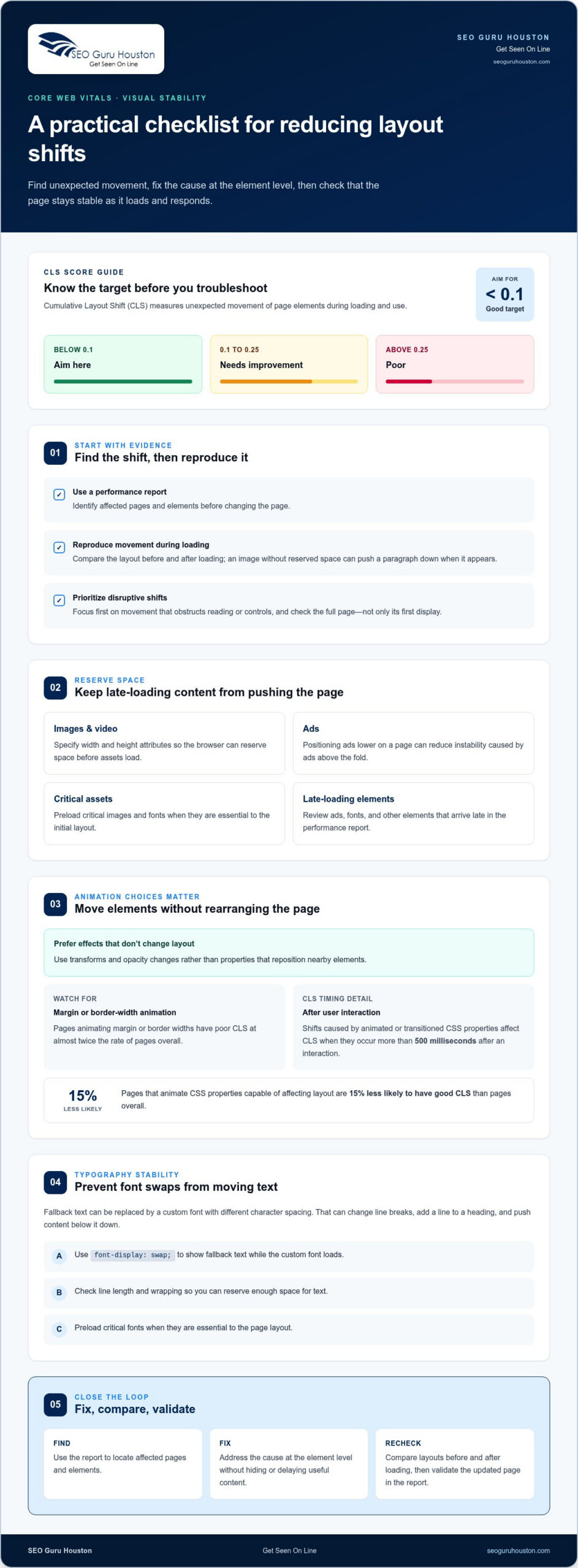
Cumulative Layout Shift (CLS) measures unexpected movement of page elements during loading and use. Aim for a CLS score below 0.1; scores from 0.1 to 0.25 need improvement, while scores above 0.25 are poor.

Animation and Transition Layout Shifts

Animation-related layout shifts happen when motion changes an element’s position or size and pushes other content around. They matter because a moving page can make visitors lose their place or click the wrong control. Layout shifts caused by animated or transitioned CSS properties affect CLS when they occur more than 500 milliseconds after a user interaction.

Choose animations that don’t change the page’s layout, such as transforms and opacity changes, instead of properties that reposition nearby elements. Pages that animate CSS properties capable of affecting layout are 15% less likely to have good CLS than pages overall. Pages animating margin or border widths have poor CLS at almost twice the rate of pages overall.

Font Loading and Layout Stability

Font loading can shift a layout if the browser first displays fallback text, then replaces it with a custom font whose characters occupy different space. That change can alter line breaks and move headings, paragraphs, and buttons. For example, a heading that wraps onto an extra line after a font swap can push the content below it down.

Use the CSS property font-display: swap; to show fallback text while a custom font loads. Check how the chosen font affects line length and wrapping so you can reserve enough space for text. Preloading critical fonts can prioritize assets essential to the page layout and help reduce movement during loading.

Cumulative Layout Shift Optimization

CLS optimization means finding unexpected movement and reducing it without hiding or delaying useful content. Start with a performance report to identify affected pages and elements, then reproduce the movement during loading. For example, an image without reserved space may push a paragraph down when it appears.

Fix the cause at the element level. Specify image and video width and height attributes so the browser can reserve space before those assets load. Positioning ads lower on a page can reduce instability caused by ads above the fold. Preload critical images and fonts when they are essential to the initial layout.

  • Reserve space for images and videos with explicit dimensions.
  • Keep animated effects from changing surrounding layout.
  • Review font swaps, ads, and other late-loading elements in the report.

Check visual stability across the page, not only on first display. A change to one element can affect nearby content, so compare the layout before and after loading. Prioritize shifts that obstruct reading or controls, then validate the updated page in the report.

What are the three Core Web Vitals metrics?

Core Web Vitals measure real-world loading performance, responsiveness, and visual stability. Largest Contentful Paint (LCP) tracks loading, Interaction to Next Paint (INP) evaluates responsiveness, and Cumulative Layout Shift (CLS) captures unexpected movement. Good targets are LCP within 2.5 seconds, INP below 200 milliseconds, and CLS below 0.1. A core web vitals optimization guide can help connect each metric to the page experience it represents.

To measure Core Web Vitals, open the report in Google Search Console to review groups of pages. Use PageSpeed Insights for page-level results and Chrome DevTools’ Performance panel to inspect a browser session. Search Console and Chrome User Experience Report data reflect real-world Chrome user experiences, while DevTools helps investigate issues in a controlled test.

The three metrics reveal different bottlenecks. A simple page may display its main content slowly if the server responds late. A page can load quickly yet feel unresponsive when JavaScript blocks the browser’s main thread. Or the layout can shift after loading, disrupting reading or interaction.

Google evaluates field performance at the 75th percentile of user experiences. That means the report reflects the slower end of real visits, not only a developer’s fastest test. The Chrome User Experience Report uses anonymized data collected from Chrome users, helping distinguish a lab-only issue from a problem visitors encounter across devices and network conditions.

PageSpeed Insights helps connect results to possible causes. Compare field data with lab diagnostics: field data reflects user experience, while a lab test provides a repeatable view of a page load. Test important templates, such as a product page and a lead form, because each may have different bottlenecks.

Performance dashboards are most useful when they track trends alongside affected page groups. In Search Console, check whether issues cluster around a template or URL type, then compare later reports after making changes. One test cannot show whether a fix improved the experience for real users.

Page builders and plugins can add scripts, styles, and requests that compete for browser time. On WordPress, review active plugins and remove unused features or scripts where safe. If TTFB stays above 400 milliseconds, address hosting before relying on frontend changes to improve LCP; a good TTFB target is below 0.8 seconds.

Shared WordPress hosting typically has a TTFB of 500 to 1500 milliseconds, compared with 100 to 300 milliseconds for managed WordPress hosting. Caching can reduce repeated server work, while a content delivery network can deliver assets to users in different locations. When template changes are needed, website development and landing page work can address the page structure behind recurring performance problems.

Interaction to Next Paint (INP): What Is It?

Interaction to Next Paint (INP) measures how quickly a page responds throughout a visitor’s interactions. A good INP is below 200 milliseconds; a score from 200 to 500 milliseconds needs improvement, and above 500 milliseconds is poor. Unlike a metric focused on one input, INP reflects the delay from interaction through the browser’s next visual update.

Google replaced First Input Delay (FID) with INP in March 2024. FID measured only the delay before a browser began processing a visitor’s first input. It did not account for later interactions or the time needed to process an event and render its visual response. INP provides a broader view by considering interactions such as clicking a menu, typing into a search field, or adding an item to a cart.

Consider a visitor selecting a filter. The browser may receive the click promptly, but a long JavaScript task can delay the filtered results appearing. INP includes that wait for the next paint. A page’s INP is 500 milliseconds if its slowest interaction takes half a second to process. This helps identify sluggish controls that a fast initial page display can conceal.

Start diagnosis by reproducing the slow interaction, then inspect the page’s main-thread work in Chrome DevTools. Browser tasks lasting more than 50 milliseconds are considered long tasks and can block responses to user actions. Look for expensive event handlers, repeated layout calculations, and scripts that run during the interaction. Break lengthy JavaScript work into smaller tasks, remove unnecessary processing, and avoid updating large sections of the page when one element changes.

Third-party scripts can compete for processing time. Review analytics, chat widgets, and advertising scripts, then load them asynchronously or limit their use where possible. For example, avoid recalculating search results on every keystroke if the interface can wait until typing pauses. Keep the response clear, such as by showing a loading state while results render.

Use real-user monitoring and the Core Web Vitals report in Search Console to identify patterns across page groups. Lab testing can help reproduce an interaction, while field data shows how visitors experience it across devices and network conditions. Prioritize the slowest meaningful interactions, then compare measurements after each code change.

Preloading helps with resources needed early, but it does not directly fix every INP problem. Prioritizing a critical script can help it arrive sooner, but competing resources can still delay interaction processing. Distinguish loading delays from JavaScript execution issues, then address the bottleneck affecting the visitor’s next action.
Core Web Vitals Optimization for Faster, More Stable Pages

Image format and responsive image optimization

For mobile users, prioritize the image that becomes the largest contentful paint element, then reduce its file size and loading delay. Serve appropriately sized images, use modern formats such as WebP, and lazy-load images outside the viewport while ensuring the primary visual is discoverable early.

Images often determine whether a mobile page feels ready. The 2024 Web Almanac reports that 73% of mobile pages have an image as their LCP element. Compress large files and serve WebP where appropriate; WebP media content is 34% smaller than the usual format. Match each image’s dimensions to its display size instead of sending a large desktop asset to a narrow screen.

Responsive image markup lets the browser choose a suitable source for the screen and layout. Use srcset to offer image variants and sizes to describe their expected display width. For example, a phone showing a small product thumbnail shouldn’t download the oversized file used for a full-width desktop banner. This reduces unnecessary data transfer.

Make the LCP image easy for the browser to discover in the initial HTML. Among pages whose LCP element was an image, 35% had image source URLs that weren’t discoverable in the initial HTML response. A further 7% obscured the LCP image behind a data-src attribute. Avoid hiding the primary image behind JavaScript-driven loading when it needs to appear early.

Prioritize images larger than 10,000 square pixels when investigating LCP. Use image preloading selectively for a critical, immediately visible visual, so the browser can request it sooner. Don’t preload every image: unnecessary requests compete for network capacity and can delay the resource that matters most.

Reserve layout space by setting image dimensions, then lazy-load below-the-fold images. Sixty-six percent of pages have at least one image without an explicit size, which can leave the browser unable to allocate space before loading. WordPress has supported native WebP images since version 5.8, and native lazy loading since version 5.5.

Image optimization is only part of resource optimization. Render-blocking CSS can delay the first display, while large JavaScript bundles and third-party scripts compete for browser time. Minify CSS and JavaScript, defer noncritical resources, and load below-the-fold images as they approach the viewport.

  • Compress images and select responsive variants for mobile display.
  • Keep the LCP image visible in initial HTML and prioritize it selectively.
  • Reserve image space and lazy-load visuals outside the viewport.

A content delivery network can serve image assets quickly to users in different locations. After changing formats, markup, or delivery, compare mobile field performance and inspect the LCP element again. This helps show whether the image itself, its discovery, or another resource is still delaying the visual result in Google Search.

The practical targets help teams decide what to fix. Aim for Largest Contentful Paint within 2.5 seconds, Interaction to Next Paint below 200 milliseconds, and Cumulative Layout Shift below 0.1. Google assesses user experiences at the 75th percentile, so a page’s fastest visit does not represent every visitor. A page that performs well only on a developer’s laptop may still struggle on slower mobile networks.

Use that percentile perspective to prioritize pages and templates. If a Search Console report groups URLs with similar performance, investigate their shared layout or components first. For example, a slow product template may affect many product pages; fixing shared image handling or scripts can address a pattern rather than one URL. Reassess field data after changes because real-world results reflect users’ devices and connections.

Keep the metrics in context. A good LCP score means the largest visible content appeared promptly; it does not prove every form or menu responds well. Likewise, a good Interaction to Next Paint result does not show that a page answers the visitor’s query. Pair Core Web Vitals data with the page’s purpose and user tasks, such as reaching a contact form or comparing service details.

Make the next action specific: connect a page group’s Search Console status to its template, then prioritize changes affecting loading, responsiveness, or stability. For a stronger search experience, build a performance-focused website strategy around the pages visitors need most.

SEO Guru Houston: Houston SEO Services

SEO Guru Houston helps businesses connect organic search priorities with the pages customers use to evaluate their services. If Core Web Vitals reports reveal recurring issues across important landing pages, our professional optimization strategies can align technical performance priorities with search visibility and page goals.

That work can support a broader growth strategy. Comprehensive digital marketing and B2B campaigns help businesses pursue different acquisition goals, while a well-structured website gives visitors a clearer path to useful information and next steps.

For a focused discussion about your website’s search priorities and core web vitals optimization guide implementation, contact SEO Guru Houston.

Turn Better Page Experience Into Your Next Step

Performance work creates the most value when it supports a clear business goal. Choose a priority page, connect its technical needs to the action you want visitors to take, and keep that focus as your site evolves. A core web vitals optimization guide can frame the work, but progress depends on applying the right changes to the pages that matter to your audience.

When technical improvements need to align with broader visibility and growth objectives, SEO Guru Houston offers search engine optimization, pay-per-click advertising, and B2B marketing. These services can support different acquisition strategies while your website gives visitors a smoother path to useful information and next steps.

Bring your priorities into focus and decide what better page experience should help your business achieve. Contact SEO Guru Houston to discuss how its digital marketing services fit your goals. Keep moving forward with a site built to serve both your audience and your growth strategy.

Frequently Asked Questions

FCP vs LCP: What Is the Difference?

First Contentful Paint (FCP) records when the browser first renders visible content, such as text or an image. Largest Contentful Paint (LCP) measures when the largest visible content element appears. FCP may occur while the main image or headline is still loading. Use both measurements to narrow down delays: slow FCP points to an early rendering issue, while a later LCP may point to the primary content element.

FID vs INP: What Changed?

Interaction to Next Paint (INP) replaced First Input Delay (FID) in Google’s Core Web Vitals in March 2024. FID measured delay before the browser began processing a visitor’s first interaction. INP assesses the responsiveness of interactions across a visit, including the delay until the next visual update. For example, a quick first click doesn’t reveal whether a later filter selection takes too long to display results.

First Input Delay (FID): What Is FID?

First Input Delay measured the time between a visitor’s first interaction and the browser beginning to process it. It focused on input delay, not the full time required to update the page afterward. An ideal FID was below 100 milliseconds; 100 to 300 milliseconds needed improvement, and above 300 milliseconds was poor. FID is now a legacy metric, so use INP when evaluating current Core Web Vitals.

Largest Contentful Paint (LCP): What Is LCP?

Largest Contentful Paint measures how long the largest visible content element takes to appear after a page starts loading. That element might be a prominent heading, an image, or another large content area. LCP helps identify whether the content visitors came to see appears promptly. For example, a page may show its logo quickly but still have a slow LCP if its main banner loads later.

What Is a Good LCP Score?

A good LCP is within the first 2.5 seconds after loading begins. A score from 2.5 to 4.0 seconds needs improvement, while a score greater than 4.0 seconds is poor. If a report flags LCP, identify which element was measured before changing code. A large image, delayed server response, or render-blocking resource can each affect when that element appears.

What Does Insufficient Real User Data in PageSpeed Insights Mean?

It means PageSpeed Insights lacks enough eligible real-world Chrome user data to show field results for that page or origin. It is not a performance score and does not establish whether the page is fast or slow. Use available lab diagnostics to investigate a specific test, then review field data later as it becomes available. Test important page templates, not just the homepage.

What Are Core Web Vitals, and What Are the Current LCP, INP, and CLS Thresholds?

Core Web Vitals measure real-world loading performance, responsiveness, and visual stability. Good targets are LCP within 2.5 seconds, INP below 200 milliseconds, and CLS below 0.1. LCP above 4.0 seconds, INP above 500 milliseconds, and CLS above 0.25 are poor. The middle ranges need improvement: LCP from 2.5 to 4.0 seconds, INP from 200 to 500 milliseconds, and CLS from 0.1 to 0.25.

How Do Field Data and Lab Data Differ When Evaluating Core Web Vitals?

Field data reflects real visits from Chrome users, while lab data comes from a controlled test that helps reproduce and diagnose page behavior. Field results show how people experience a page across their actual devices and network conditions. A lab test can help isolate a slow script or image, but one test does not represent every visitor. Compare both views to connect real-world patterns with specific technical causes.

Technical SEO Audit Checklist: The Assertive Blueprint for Market Dominance in 2026

Is your website a high-performance revenue engine, or is it a silent liability bleeding profit every time a search engine attempts to crawl it? You’ve likely invested heavily in content and design, yet you remain invisible while competitors dominate the rankings. It’s a common reality; even the best content is useless if technical bottlenecks prevent search engines from indexing it properly. This technical seo audit checklist is the definitive solution for leaders tired of confusing jargon that doesn’t translate to actual business outcomes.

This is the end of the guesswork. You are about to gain an assertive blueprint for market dominance in 2026. We’re moving past basic fixes to tackle high-impact variables like Googlebot’s 2MB truncation threshold and the permanent shift to Interaction to Next Paint (INP) for responsiveness. You’ll receive a prioritized list of technical fixes designed to optimize your site for both human users and AI search engines. We are going to transform your digital presence from a passive brochure into a measurable, high-ROI growth machine that captures every available dollar of organic demand.

Key Takeaways

  • Master your crawl budget by using robots.txt to assertively direct search engines away from low-value pages and toward your high-conversion assets.
  • Treat site speed as a non-negotiable competitive advantage to ensure you aren’t gifting market share to faster competitors.
  • Eliminate revenue leaks by following this technical seo audit checklist to repair broken redirect chains and establish a logical, high-authority internal link hierarchy.
  • Secure your 2026 competitive edge by optimizing for LLM-readiness, ensuring your brand is the primary citation for AI search assistants and chatbots.
  • Shift from passive analysis to aggressive growth by prioritizing technical fixes that deliver the fastest measurable ROI and financial return.

The Foundation of Dominance: Crawlability and Indexing

Crawlability is the bedrock of your digital empire. If search engines can’t find your pages, your content is essentially non-existent. Every second a bot spends on a low-value page costs you money in lost opportunity. You must treat your crawl budget as a high-stakes investment. A successful strategy requires mastering search engine optimization fundamentals to ensure bots prioritize your high-conversion assets over digital clutter. This is the first pillar of any professional technical seo audit checklist intended for market leaders.

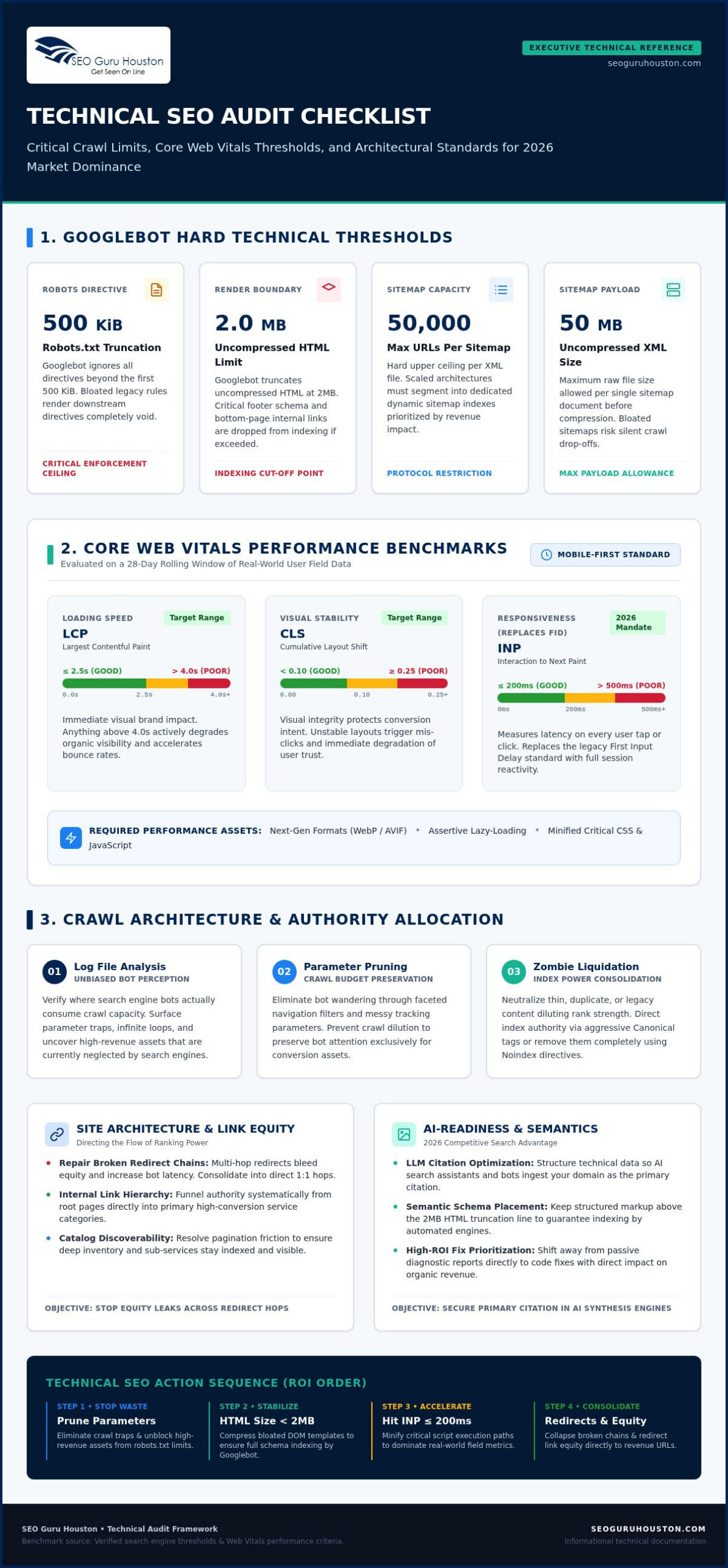
Your robots.txt file is a power play. It’s not a suggestion; it’s a directive. However, Googlebot ignores anything beyond the first 500 KiB of this file. If your file is bloated with legacy rules, you’re flying blind. Similarly, your XML sitemaps must move beyond basic lists. In 2026, dynamic sitemaps that prioritize high-revenue URLs are the standard for market dominance. Stick to the verified limits: 50,000 URLs and an uncompressed file size of 50MB per sitemap. Anything more is a waste of resources that search engines will simply ignore.

Crawl Budget Optimization for High-Traffic Sites

Stop letting search bots wander aimlessly through faceted navigation or messy tracking parameters. These traps dilute your authority and exhaust your crawl budget. You need to identify and prune these low-value parameters immediately. Leverage Log File Analysis to see exactly how search engines perceive your site. This data doesn’t lie. It reveals where bots are getting stuck and which high-revenue landing pages they’re ignoring. Your audit must prioritize frequent recrawling of pages that actually drive business growth.

Advanced Indexing Control and Canonicalization

Zombie pages are silent killers. These are thin, outdated, or duplicate pages that dilute your site’s ranking power and confuse search algorithms. Use Canonical tags as a weapon to consolidate link equity into your primary URLs. If a page doesn’t serve a clear business purpose, use Noindex directives to focus ranking power on your most important assets. Be aggressive with your uncompressed HTML size. Googlebot truncates content after the 2MB mark. If your code is bloated, your internal links and schema at the bottom of the page won’t be indexed. Solving pagination challenges ensures your full catalog of products and services remains discoverable and ready to rank.

The Speed of Money: Performance and Core Web Vitals

Speed isn’t just a technical metric; it’s a financial imperative. Every millisecond your site lingers during a load is an assertive gift to your competitors. If a user has to wait, they leave. It’s that simple. In the high-stakes environment of 2026, performance is the silent engine driving your conversion rates and organic visibility. A comprehensive technical seo audit checklist must prioritize speed as a non-negotiable foundation for market dominance.

Google’s judgment is based on the Google Core Web Vitals metrics and thresholds, which rely on a 28-day rolling window of real-world user data. You don’t get a pass because your local dev environment is fast. You need to dominate these field metrics to stay relevant. Mobile-first isn’t a trend anymore; it’s the only standard that matters. If your mobile performance isn’t flawless, you’re effectively invisible to a majority of your audience. High-converting Websites Dev & Landing Pages require a robust server-side environment to handle traffic surges without sacrificing speed.

Crushing Core Web Vitals Thresholds

Dominating user experience starts with meeting strict thresholds. Your Largest Contentful Paint (LCP) must be 2.5 seconds or less to ensure an instant brand impact. Anything over 4.0 seconds is considered poor and will tank your rankings. Cumulative Layout Shift (CLS) is about professional trust. Keep your score under 0.10 to prevent frustrating visual jumps that kill conversion rates. Finally, you must master Interaction to Next Paint (INP). With a target of 200 milliseconds or less, INP ensures your site feels high-energy and responsive to every click or tap. Audits still citing First Input Delay (FID) are obsolete; INP is the only responsiveness standard that counts today.

Advanced Performance Tactics for 2026

  • Next-Gen Assets: Use WebP or AVIF image formats combined with assertive lazy-loading to reduce initial payload without sacrificing visual quality.
  • Code Streamlining: Minify your critical CSS and JavaScript. Every unnecessary byte in the rendering path is a bottleneck that delays your time-to-interactive.
  • Edge Delivery: Utilize a high-performance Content Delivery Network (CDN) to ensure your site loads at lightning speeds nationally, regardless of the user’s distance from your primary server.

Your hosting environment is the silent engine of your success. Cheap, unoptimized hosting is a liability that no amount of front-end tweaking can fix. Professional execution ensures your infrastructure is built for growth, not just survival. If you’re ready to stop losing revenue to slow load times, it’s time to audit your stack against these 2026 standards.

Your site architecture is either a conduit for authority or a graveyard for link equity. If your structure is flat and disorganized, search engines can’t determine your true niche expertise. You need a logical hierarchy that directs power toward your high-value assets. This isn’t just about organization; it’s about establishing market dominance. A professional technical seo audit checklist must scrutinize how every internal link serves the bottom line and fuels growth.

Topical Authority through Strategic Siloing

Siloing is the assertive method of grouping related content to signal deep expertise. By creating thematic clusters, you help search engines understand your topical relevance. Use descriptive anchor text to reinforce this. Every link from a high-authority blog post should strategically point toward your high converting landing page design to maximize conversion potential. This ensures your most powerful backlinks fuel your most important service pages. Don’t let your link power dissipate across irrelevant pages.

Redirect Management and Site Hygiene

404 errors and broken redirect chains are revenue leaks. They frustrate users and signal neglect to search algorithms. Audit your 301 redirects to ensure they point to live, relevant content. Redirect loops are even worse. They exhaust your crawl budget and kill the user experience. Fix them immediately. Clean, keyword-rich URL paths are essential for both humans and bots. If a URL is messy, it’s a barrier to success. Regularly scan for broken outbound links to maintain professional site integrity.

Backlinks are expensive and difficult to acquire. Wasting that equity on low-value pages is a strategic failure. Your architecture should act as a funnel, concentrating authority where it generates the most ROI. If you aren’t auditing your link distribution monthly, you’re leaving money on the table. Dominance requires precision in how you direct the flow of digital power across your domain.

Technical SEO Audit Checklist: The Assertive Blueprint for Market Dominance in 2026

AI-Readiness and Content Semantics: The 2026 Competitive Edge

Keywords are no longer enough. To dominate in 2026, your website must function as a structured data source for both traditional algorithms and generative AI. This is where most brands fail. They focus on visible text while ignoring the semantic layer that search engines crave. An assertive technical seo audit checklist bridges this gap by turning your site into a recognized entity in the Knowledge Graph. If you aren’t optimizing for machine readability, you’re voluntarily handing your market share to competitors who are.

Advanced Schema Deployment

Schema markup is your direct line to the search engine’s brain. While many sites use basic JSON-LD, few deploy it with the precision required for market dominance. Focus on Organization, Product, and Service schema to establish your brand’s authority. You must stay current with recent deprecations; Google has pruned several rich result types, including How-To and most FAQ snippets. Don’t waste resources on dead schema. Instead, prioritize PriceSpecification and Author nodes to provide the granular data that fuels modern search results. Validating this structured data is essential. Even a single syntax error can render your entire schema block invisible to search bots.

Optimizing for AI Search and Discovery

AI search engines like SearchGPT and Perplexity don’t just crawl; they synthesize. If your content isn’t structured for easy extraction, these engines will ignore you. You must differentiate between training bots like GPTBot and citation bots like OAI-SearchBot. Blocking all AI agents is a strategic blunder. A recent cohort audit revealed that 41% of B2B websites inadvertently block AI search crawlers, resulting in a loss of up to 34% of potential citations in generative engines. Deploying an /llms.txt file at your domain root provides clean Markdown context that minimizes token waste and ensures your brand is the primary source for AI-generated summaries. This is a critical component of any 2026 technical seo audit checklist.

Success in this landscape requires a sophisticated blend of technical precision and strategic content mapping. You can’t afford to leave your AI visibility to chance. If you’re ready to secure your 2026 competitive edge, professional Digital Marketing and Lead Generation Services can ensure your brand remains at the forefront of this digital evolution. Stop guessing and start scaling with a strategy built for the future of search.

From Audit to Action: Implementing for Massive ROI

Data without decisive action is just expensive noise. Completing a technical seo audit checklist is only the first step; the real profit lies in the execution. Most businesses fail here because they treat technical fixes as a long-term “to-do” list rather than an urgent offensive strategy. If you aren’t prioritizing fixes based on their immediate impact on revenue, you’re wasting time. Market dominance requires a ruthless focus on the variables that move the needle today.

The 3-Tier Prioritization Framework

Success in 2026 demands a structured approach to implementation. You can’t fix everything at once, and you shouldn’t try. Use this framework to allocate your resources effectively:

  • Tier 1: Critical Blockers. These are the “fires” that stop search engines in their tracks. This includes resolving server errors, fixing indexation blocks, and securing your site against vulnerabilities. If bots can’t see you, nothing else matters.
  • Tier 2: Growth Drivers. Once the path is clear, focus on performance. This means crushing the Core Web Vitals thresholds we discussed earlier and refining your site architecture. These improvements directly correlate with higher conversion rates and better user retention.
  • Tier 3: Competitive Polish. This is where you pull ahead of the pack. Advanced schema deployment, entity optimization, and AI-readiness ensure you aren’t just ranking, but dominating the semantic search landscape.

Scaling Your Success with Expert Guidance

Technical SEO is high-stakes surgery, not a hobby for an internal IT generalist. One misconfigured line in a robots.txt file or a botched canonical tag can wipe out years of organic growth in hours. Professional execution is a fundamental necessity for business survival. A “guru” approach is required to navigate complex migrations and the nuances of the 28-day CrUX rolling window. You need a partner who measures success through leads and real revenue growth, not just abstract traffic numbers.

To achieve total search coverage, your technical foundation must be integrated with broader Professional SEO Services. This ensures your content and authority strategies are built on a rock-solid platform. For those ready for immediate market capture, pairing these fixes with PPC Management Services creates a dual-threat presence that leaves no revenue on the table. Stop guessing and start scaling. The blueprint is in your hands; now it’s time to lead.

Secure Your Market Dominance Before the Competition Wakes Up

Winning in the 2026 search ecosystem requires more than just good content; it demands a flawless technical foundation. You’ve seen how crawl budget optimization and AI-readiness separate market leaders from invisible entities. By following this technical seo audit checklist, you’re not just fixing errors. You’re building a high-performance revenue engine that captures every available lead.

We specialize in technical SEO and demand generation with a proven track record of scaling B2B and industrial brands. Our results-oriented approach is focused entirely on your measurable ROI. Don’t let invisible technical gaps bleed your marketing budget dry. It’s time to transform your site from a liability into your most powerful sales asset.

Stop Losing Revenue and Claim Your Market Dominance—Get Your Professional Audit Today!

The digital landscape moves fast, but with the right blueprint, you’ll move faster. Take decisive action now and watch your organic growth accelerate.

Frequently Asked Questions

What is a technical SEO audit and why does my business need one?

A technical SEO audit is a comprehensive evaluation of your website’s backend infrastructure. It identifies barriers that prevent search engines from crawling, indexing, and ranking your content. Your business needs this because even the best content is useless if it’s invisible. By identifying and fixing these deep-seated issues, you ensure your site functions as a high-performance revenue engine that captures every available lead in your market.

How often should I perform a comprehensive technical SEO audit?

You should perform a comprehensive audit at least once every quarter. Digital trends and search engine algorithms evolve at a breakneck pace. Regular checkups using a professional technical seo audit checklist allow you to catch silent errors before they sabotage your rankings. If you’re making frequent site updates or migrating content, monthly audits are a fundamental necessity for maintaining your competitive edge and market dominance.

Can technical SEO issues actually lead to a loss in revenue?

Yes, technical failures are direct revenue leaks. If your site takes too long to load or contains broken redirect chains, potential customers will bounce to a competitor. Search engines will also penalize your visibility, meaning your high-conversion landing pages never reach your target audience. You aren’t just losing rankings; you’re leaving actual dollars on the table by ignoring the backend health of your digital presence.

What are Core Web Vitals and why are they a non-negotiable in 2026?

Core Web Vitals are specific metrics Google uses to measure user experience, focusing on loading speed, interactivity, and visual stability. In 2026, these are non-negotiable because search engines prioritize sites that provide a seamless human experience. Failing to meet these thresholds, like the 200ms limit for Interaction to Next Paint (INP), tells Google your site is a liability, resulting in lower organic visibility and decreased trust from your visitors.

How long does it take to see results after fixing technical SEO issues?

You typically see measurable ROI within four to twelve weeks after implementation. While some performance improvements like faster load times provide an immediate boost to conversion rates, search engines require time to recrawl and re-evaluate your site. Consistency is key. Following a detailed technical seo audit checklist ensures that once these improvements take hold, your site is positioned for long-term growth rather than a temporary spike in traffic.

What is the difference between a technical audit and a content audit?

A technical audit examines the “pipes” of your website, such as crawlability, indexation, and server response codes. A content audit evaluates the quality, relevance, and engagement of the actual information on your pages. Think of it this way: the technical audit ensures the stage is built correctly, while the content audit ensures the performance is worth watching. You need both to establish yourself as a recognized authority.

Is a technical SEO audit necessary if I am already running PPC campaigns?

Absolutely. Technical SEO is the foundation for all other marketing, including PPC and demand generation. A technically sound website improves your landing page experience, which can lead to higher Quality Scores and lower costs per click. If your site is slow or broken, you’re essentially paying to send traffic to a dead end. Professional execution ensures your paid and organic strategies work together for maximum financial return.

Why should I hire a professional agency for a technical SEO audit?

Hiring a specialized agency provides the precision and “guru” level expertise required to navigate complex digital landscapes. Professional teams use advanced tools like Log File Analysis to see exactly how bots perceive your site. They identify subtle errors that an internal generalist might miss. This isn’t an optional luxury; it’s a strategic investment in professional execution that ensures no revenue is left on the table during your growth journey.

Conversion Rate Optimization Houston: The Assertive Blueprint for 2026 Market Dominance

Conversion Rate Optimization Houston: The Assertive Blueprint for 2026 Market Dominance

If your website is currently acting as a passive digital brochure, you aren’t just losing leads; you are surrendering your market share to competitors who are hungry for your business. In a Houston market where retail occupancy has hit a record 95.2%, the digital battlefield is the only place left for aggressive, uncapped expansion. You likely feel the sting of a high cost-per-acquisition and the headache of staring at complex analytics that don’t translate to cash. We know that the average conversion rate of 2.9% is no longer enough to win. This is why professional conversion rate optimization houston is no longer an optional luxury; it’s a fundamental necessity for survival and dominance in 2026.

You deserve a website that functions as a high-performance revenue engine, not a static expense. We promise to show you exactly how to transform your digital presence into a dominant force that crushes the competition without spending an extra dime on advertising. This blueprint provides a clear, data-driven roadmap to maximize your ROI while staying compliant with the Texas Responsible AI Governance Act. We are moving beyond abstract theories to give you a sequence of logical, technical steps that turn passive visitors into measurable business growth. Get ready to stop guessing and start scaling.

Key Takeaways

  • Stop bleeding revenue by shifting your focus from vanity traffic metrics to a high-performance conversion framework that forces your website to work for you.
  • Master the psychological mechanics of friction to eliminate the cognitive load that’s currently driving your potential customers into the arms of the competition.
  • Deploy a systematic “Friction Audit” across your digital assets to identify technical and behavioral bottlenecks that are sabotaging your ROI.
  • Execute a professional strategy for conversion rate optimization houston that utilizes a repeatable 5-step cycle to turn every click into a measurable business outcome.
  • Transition from a static, “one-and-done” mindset to a continuous growth model that’s non-negotiable for achieving total market dominance in 2026.

Stop Bleeding Revenue: The Absolute Necessity of Conversion Rate Optimization

Stop treating your website like a digital business card. If you are pumping capital into search engines and social platforms only to watch visitors bounce without taking action, your marketing strategy is a financial liability. In the high-stakes Houston market of 2026, where cost-per-click rates in sectors like energy and medicine are skyrocketing, you cannot afford a leaky funnel. You need to understand what is conversion rate optimization to stop the hemorrhage. It is the systematic, data-driven process of increasing the percentage of website visitors who complete a specific goal; whether that is filling out a lead form, making a purchase, or picking up the phone.

Passive web design is for companies that are content with mediocrity. An assertive conversion strategy is for those who demand market dominance. Your website must be a high-performance revenue engine that captures interest and forces action. With Houston’s retail occupancy hitting 95.2% and digital competition becoming more surgical, simply “having a site” is a recipe for invisibility. Professional conversion rate optimization houston ensures that every dollar you spend on traffic works twice as hard for your bottom line. It transforms your digital presence from a static expense into a precision tool for aggressive growth.

The ROI of CRO: Why Every Percent Matters

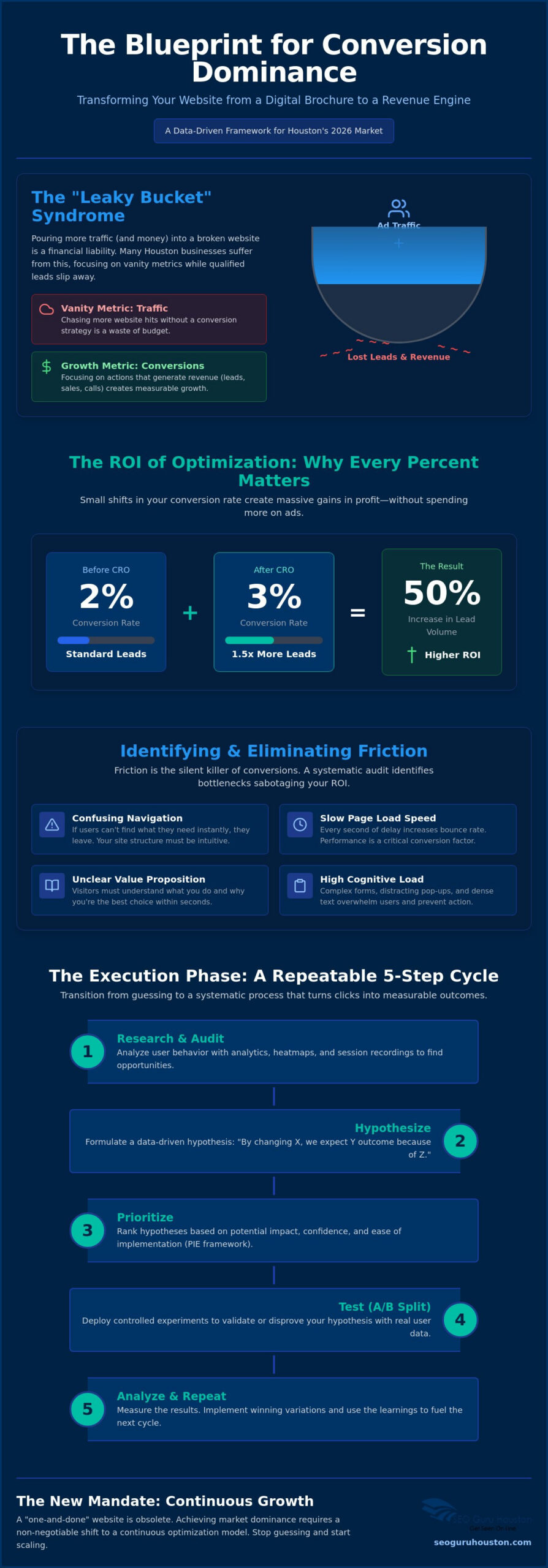
Small shifts in performance create massive shifts in profit. If you increase your conversion rate from 2% to 3%, you haven’t just gained a single percentage point; you have increased your lead volume by 50% without spending an extra cent on ads. This is the power of compounding growth in a digital ecosystem. When you optimize the middle of your funnel, every subsequent marketing effort becomes more efficient and less expensive. A focused conversion rate optimization houston strategy ensures that your B2B sales cycle remains short, profitable, and resistant to market fluctuations. It’s the difference between struggling to break even and scaling with total confidence.

Conversion vs. Traffic: Breaking the Vanity Metric Trap

Traffic is a vanity metric that hides the truth about your business health. Chasing more hits is a waste of your budget if your high converting landing page design is fundamentally broken. Many Houston enterprises suffer from “Leaky Bucket” syndrome. They pour more water (traffic) into the bucket while ignoring the holes at the bottom. Don’t fall into the trap of prioritizing aesthetics over performance. A beautiful website that doesn’t convert is a failure. You need a site that prioritizes user intent and psychological triggers over abstract design trends. If your landing pages aren’t engineered for the specific goal of conversion, you are essentially subsidizing your competitors’ success by letting qualified leads slip through your fingers.

The Psychological Mechanics of High-Performance Funnels

Data tells you what your visitors are doing, but psychology tells you why they’re doing it. If you want to dominate your niche, you must master consumer psychology to understand the hidden drivers behind every click. High-performance funnels aren’t built on guesswork; they’re engineered to reduce cognitive load. Every time a user has to think too hard about your navigation or wonder what your value proposition actually is, you’ve created friction. Friction is the silent killer of ROI. In the aggressive landscape of 2026, your website must be intuitive enough to guide a prospect from curiosity to conversion without a single moment of hesitation.

We utilize the Fogg Behavior Model to drive decisive action. This framework dictates that behavior happens when motivation, ability, and a prompt converge at the same moment. If your motivation is high but the task is too difficult, you fail. If the task is easy but the motivation is low, you still fail. Deploying a rigorous strategy for conversion rate optimization houston means we align these three pillars perfectly. We amplify the user’s motivation through assertive messaging, increase their ability by removing technical hurdles, and provide the perfect prompt to close the deal. If you are ready to stop guessing, it’s time to partner with a high-performance growth strategist who understands these mechanics.

The Anatomy of a High-Converting Call to Action

Your Call to Action (CTA) shouldn’t ask for permission; it should command attention. Vague phrases like “Submit” or “Click Here” are relics of a passive era. You need assertive language that mirrors the user’s desired outcome, such as “Claim My Market Dominance” or “Secure My Growth Strategy.” Visual hierarchy is equally critical. We use color theory and spatial design to ensure the “Money Action” is the most prominent element on the screen. By layering in urgency and scarcity, such as limited-time offers or exclusive B2B insights, we force the user to act now rather than “thinking about it” later.

Leveraging Social Proof and Authority

Trust is the primary currency of the B2B world. You cannot expect a prospect to hand over their budget if they don’t view you as the undisputed authority in your field. Integrating testimonials and case studies is a baseline requirement, but the delivery matters. Static text is easily ignored. However, utilizing video marketing for business websites allows you to establish immediate, visceral trust through human connection and verified results. To truly crush the competition in 2026, your site must prominently feature certification badges and “As Seen In” sections. These aren’t just decorations; they are non-negotiable authority signals that tell your visitors you’ve already won for others, and you’ll win for them too.

Identifying the Friction: A Systematic Audit of Your Digital Assets

You can’t optimize what you don’t understand. If your conversion rates are stagnant, you have hidden friction points that are actively repelling your prospects. A “Friction Audit” isn’t a casual look at your homepage; it’s a deep, forensic investigation into every touchpoint of your user journey. We look for the exact moment interest turns into irritation. In the competitive Houston landscape, technical performance is your baseline. If your site doesn’t load instantly or fails to respond perfectly on every device, you’ve lost the battle before it even started. Baseline metrics like page speed and mobile responsiveness are no longer “features.” They are the prerequisites for conversion rate optimization houston survival.

We use heatmaps and session recordings to uncover the “hidden” journey that your analytics dashboard misses. Watching a user “rage-click” on a broken link or scroll past your primary value proposition provides the raw truth that numbers alone cannot convey. The number one conversion killer we see is confusing navigation paired with an unclear value proposition. If a visitor can’t determine what you do and how to buy it within five seconds, they’ll bounce. We perform systematic usability testing to ensure your interface is a frictionless path to the “Money Action.”

Quantitative vs. Qualitative Data: The Full Picture

Google Analytics 4 (GA4) is excellent for identifying “where” the blood is hitting the floor. We look for high-exit pages and sudden drops in the funnel to pinpoint technical failures. However, qualitative data through user surveys and feedback loops uncovers “The Why.” You need to know the specific objections preventing a lead from converting. It’s a proven reality that users often claim they want more technical specifications while their actual behavior shows they want a faster, simpler path to a consultation. Balancing these two data sets is how you build a dominant conversion rate optimization houston strategy.

Mobile-First Optimization: The Non-Negotiable Standard

Looking good on a phone isn’t enough. Your site must be optimized for mobile action. This means eliminating fat-finger errors on buttons, ensuring forms are easy to fill on small screens, and killing intrusive pop-ups that block the user’s path. Mobile friction is the fastest way to destroy your ROI. There is also a direct, aggressive relationship between mobile UX and your local seo houston success. Search engines prioritize sites that provide a seamless mobile experience. If you fail on mobile, you’re invisible in the local search results where the most motivated Houston buyers are looking for you right now.

Conversion Rate Optimization Houston: The Assertive Blueprint for 2026 Market Dominance

The Execution Phase: How to Optimize for Maximum Impact

Execution is where your strategy meets reality. If you have identified the friction points in your funnel, you are ready to deploy a systematic implementation cycle that turns data into revenue. We don’t guess; we test. The conversion rate optimization houston cycle follows five rigorous steps: Research, Hypothesis, Testing, Analysis, and Scaling. You must move through this process methodically to ensure every change is backed by statistical significance. Testing without a framework is just throwing paint at a wall; testing with a cycle is engineering a masterpiece.

Precision requires focus. You must choose between A/B testing, where you compare two versions of a single element, and Multivariate testing, which analyzes multiple variables simultaneously. For most Houston enterprises, A/B testing is the gold standard because it allows you to isolate exactly which change drove the result. If you change five things at once, you’ll never know which one actually worked. Adopt a “Winner’s Mindset” throughout this phase. Even a failed test isn’t a loss; it’s a valuable data point that narrows your path to the perfect funnel. If you want to see how this looks in practice, partner with an assertive growth coach today.

Crafting an Assertive Hypothesis

Stop saying “I think this looks better” and start saying “The data suggests this will perform better.” A strong hypothesis is the foundation of every winning test. We use a definitive formula: “By changing X into Y, we expect Z result because of [Psychological Reason].” This forces you to justify every design or copy change with logic rather than personal preference. Consider these high-impact examples for your B2B site:

  • By moving the lead form from the footer to above the fold, we expect a 15% increase in inquiries because we are reducing the physical effort required to convert.
  • By changing the headline from “Our Services” to “Explode Your Revenue in 90 Days,” we expect higher engagement because we are addressing the user’s primary desire immediately.
  • By adding a video testimonial next to the CTA, we expect a lower bounce rate because we are providing immediate social proof at the point of decision.

The Copywriting Pivot: Selling Results, Not Features

Your visitors don’t care about your “years of experience” or your “proprietary process” until they know you can solve their problem. You must pivot your copy to sell results, not features. Every sentence on your landing page must pass the “So What?” test. If you state a fact about your business, the reader should immediately understand the benefit to them. If it doesn’t add value, cut it. Your strategy as a leading seo marketing company must be paired with persuasive, assertive copy to be effective. High rankings get them to the door; high-performance copy is what makes them walk through it. Professional conversion rate optimization houston demands that your messaging is as sharp and aggressive as your technical SEO.

Scaling Your Success: Why a Growth Partner is Non-Negotiable

Market dominance isn’t a destination; it’s a relentless state of evolution. If you believe you can “finish” a website and walk away, you’re inviting your competitors to overtake you. In the 2026 Houston market, consumer behavior shifts as rapidly as the technology driving it. Professional conversion rate optimization houston is a continuous, high-stakes process of refinement and scaling. A “one-and-done” approach is a death sentence for growth. You need a partner who views your digital funnel as a living organism that requires constant precision tuning to maintain its edge. Professional conversion rate optimization houston strategies ensure your business remains agile and profitable in a landscape that punishes stagnation.

High-growth businesses cannot afford the limitations of “DIY” optimization. Playing with generic plugins or guessing at button colors is a waste of your most valuable asset: time. You need a high-performance coach who understands the intricate synergy between technical SEO, aggressive PPC management, and demand generation. SEO Guru Houston positions itself as that essential partner. We don’t just provide services; we engineer the systems that force your market share to expand. We align every click with a conversion, ensuring your ad spend isn’t just a cost but a calculated investment in dominance.

The Advantage of Professional Expertise

You are often too close to your own brand to see the friction points repelling your prospects. You’ve become blind to the gaps in your funnel that we identified earlier as “leaky buckets.” An outside perspective is essential for objective, data-driven forensics. We utilize enterprise-level analytics and specialized behavioral tools that aren’t available to the average business owner. Our professional seo services integrate CRO into the very foundation of your marketing ecosystem. We ensure that the traffic we drive is met with a landing page designed to close the deal, creating a seamless path from search results to revenue.

Ready for Transformation?

The journey from vanity traffic metrics to total market dominance requires a shift in mindset. You must move past the “passive brochure” mentality and embrace an aggressive revenue engine. The market won’t wait for you to fix your funnel. Every day you hesitate is a day your competitors are capturing the leads that should have been yours. It is time to stop the bleeding and start the scaling. Stop guessing and start scaling with SEO Guru Houston today! Your transformation from invisibility to prominence starts with a single, decisive action. Take it now.

Claim Your Digital Dominance

The time for hesitation is over. You have the blueprint to transform your website from a passive digital brochure into an aggressive revenue engine that captures every lead your competitors are currently stealing. By systematically auditing your digital assets for friction and mastering the psychological mechanics of high-performance funnels, you’re no longer just participating in the Houston market. You’re leading it. This strategy is about moving beyond vanity metrics to focus on the only number that matters: your bottom line.

Professional conversion rate optimization houston is the single most powerful lever you can pull to maximize ROI without increasing your advertising budget. Since 2017, we’ve served as results-oriented B2B marketing specialists with a high-performance coach mentality. We don’t settle for “good enough” when total market dominance is on the table. The gap between your current results and your full potential is simply a matter of technical execution and assertive strategy.

Stop bleeding revenue and dominate your market—get your assertive CRO strategy session now!

Your business is built for growth. It’s time to let your website prove it.

Frequently Asked Questions

What is a good conversion rate for a B2B website in 2026?

A strong B2B conversion rate in 2026 depends on your specific sector, but the cross-industry average sits at 2.9%. If you are in professional services, you should aim for 4.6%, while industrial sectors typically see 4.0%. Falling below these benchmarks means your competitors are likely outperforming you. Don’t settle for average results when market leaders are pushing for higher margins through aggressive optimization.

How long does it take to see results from conversion rate optimization?

You can see immediate improvements from fixing technical friction points like broken forms or slow load times. However, a comprehensive strategy for conversion rate optimization houston usually requires three to six months to gather statistically significant data. This duration allows for multiple testing cycles and psychological refinement. Patience is required for precision, but the compounding gains in your ROI make the wait a strategic necessity for growth.

Do I need a high-traffic website to perform A/B testing?

Statistical significance in A/B testing requires a healthy volume of traffic to reach a definitive winner quickly. If your traffic is lower, you should focus on heuristic audits, user recordings, and qualitative feedback instead of split testing small details. Dominating your niche doesn’t require millions of hits; it requires making every current visitor count. We prioritize high-impact changes that move the needle regardless of your current visitor count.

What is the difference between CRO and SEO?

SEO is the engine that drives qualified traffic to your site, while CRO is the mechanism that turns that traffic into revenue. One focuses on visibility and rankings; the other focuses on human behavior and psychological triggers. Achieving total market dominance requires both. Driving traffic to a site that doesn’t convert is a waste of your marketing capital. We integrate both to ensure your growth is sustainable.

How much does professional conversion rate optimization cost?

The investment for conversion rate optimization houston varies based on the complexity of your funnel and your traffic volume. High-performance agencies typically offer monthly retainers that reflect the depth of technical expertise and testing cycles required. You should view this as a strategic investment in your profit margins rather than a simple expense. A successful campaign pays for itself by lowering acquisition costs and exploding your revenue.

Can I do CRO myself or do I need an agency?

You can certainly perform basic audits yourself, but you’ll likely hit a ceiling without specialized tools and an objective, expert perspective. Most business owners are too close to their own brand to see the friction points repelling their leads. An agency provides the technical forensics and psychological insights needed for aggressive scaling. If you want to dominate your market in 2026, you need a high-performance coach who delivers measurable results.

What are the most common conversion killers on landing pages?

The most aggressive conversion killers are confusing navigation, slow load times, and vague value propositions. If a visitor can’t understand what you offer within five seconds, they’ll bounce. Excessive form fields and fat-finger errors on mobile devices also slaughter your ROI. Every extra step or bit of confusion adds friction. We eliminate these bottlenecks to ensure your funnel is a frictionless path to the money action.

How does mobile speed affect my conversion rates?

Mobile speed is a non-negotiable baseline for conversion success in 2026. A delay of even one second can cause a double-digit drop in your conversion rate. Houston buyers are impatient and expect instant results on their devices. If your site lags, you aren’t just losing a visitor; you are surrendering a lead to a faster competitor. Speed is the foundation of a high-performance user experience.