
Is your website a high-performance revenue engine, or is it a silent liability bleeding profit every time a search engine attempts to crawl it? You’ve likely invested heavily in content and design, yet you remain invisible while competitors dominate the rankings. It’s a common reality; even the best content is useless if technical bottlenecks prevent search engines from indexing it properly. This technical seo audit checklist is the definitive solution for leaders tired of confusing jargon that doesn’t translate to actual business outcomes.
This is the end of the guesswork. You are about to gain an assertive blueprint for market dominance in 2026. We’re moving past basic fixes to tackle high-impact variables like Googlebot’s 2MB truncation threshold and the permanent shift to Interaction to Next Paint (INP) for responsiveness. You’ll receive a prioritized list of technical fixes designed to optimize your site for both human users and AI search engines. We are going to transform your digital presence from a passive brochure into a measurable, high-ROI growth machine that captures every available dollar of organic demand.
Key Takeaways
- Master your crawl budget by using robots.txt to assertively direct search engines away from low-value pages and toward your high-conversion assets.
- Treat site speed as a non-negotiable competitive advantage to ensure you aren’t gifting market share to faster competitors.
- Eliminate revenue leaks by following this technical seo audit checklist to repair broken redirect chains and establish a logical, high-authority internal link hierarchy.
- Secure your 2026 competitive edge by optimizing for LLM-readiness, ensuring your brand is the primary citation for AI search assistants and chatbots.
- Shift from passive analysis to aggressive growth by prioritizing technical fixes that deliver the fastest measurable ROI and financial return.
The Foundation of Dominance: Crawlability and Indexing
Crawlability is the bedrock of your digital empire. If search engines can’t find your pages, your content is essentially non-existent. Every second a bot spends on a low-value page costs you money in lost opportunity. You must treat your crawl budget as a high-stakes investment. A successful strategy requires mastering search engine optimization fundamentals to ensure bots prioritize your high-conversion assets over digital clutter. This is the first pillar of any professional technical seo audit checklist intended for market leaders.
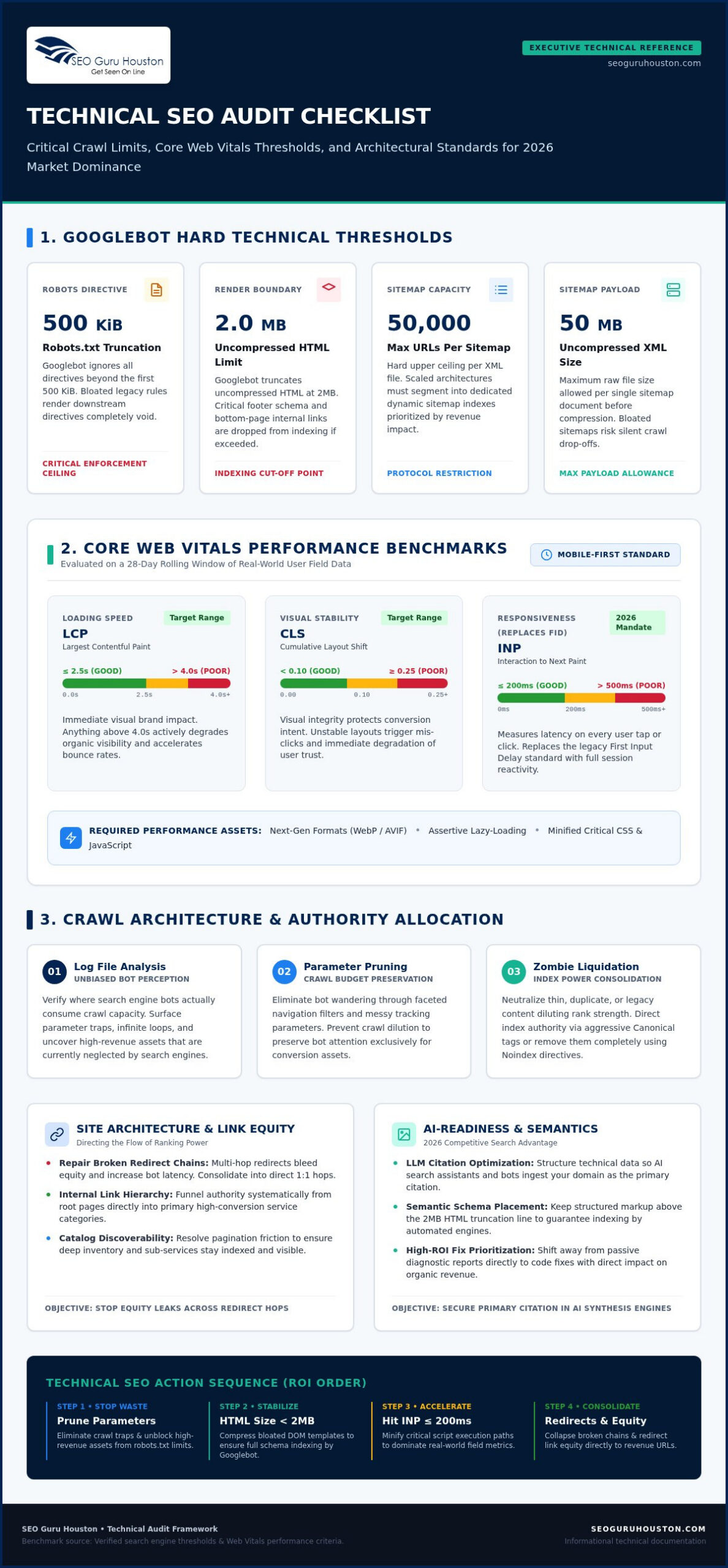
Your robots.txt file is a power play. It’s not a suggestion; it’s a directive. However, Googlebot ignores anything beyond the first 500 KiB of this file. If your file is bloated with legacy rules, you’re flying blind. Similarly, your XML sitemaps must move beyond basic lists. In 2026, dynamic sitemaps that prioritize high-revenue URLs are the standard for market dominance. Stick to the verified limits: 50,000 URLs and an uncompressed file size of 50MB per sitemap. Anything more is a waste of resources that search engines will simply ignore.
Crawl Budget Optimization for High-Traffic Sites
Stop letting search bots wander aimlessly through faceted navigation or messy tracking parameters. These traps dilute your authority and exhaust your crawl budget. You need to identify and prune these low-value parameters immediately. Leverage Log File Analysis to see exactly how search engines perceive your site. This data doesn’t lie. It reveals where bots are getting stuck and which high-revenue landing pages they’re ignoring. Your audit must prioritize frequent recrawling of pages that actually drive business growth.
Advanced Indexing Control and Canonicalization
Zombie pages are silent killers. These are thin, outdated, or duplicate pages that dilute your site’s ranking power and confuse search algorithms. Use Canonical tags as a weapon to consolidate link equity into your primary URLs. If a page doesn’t serve a clear business purpose, use Noindex directives to focus ranking power on your most important assets. Be aggressive with your uncompressed HTML size. Googlebot truncates content after the 2MB mark. If your code is bloated, your internal links and schema at the bottom of the page won’t be indexed. Solving pagination challenges ensures your full catalog of products and services remains discoverable and ready to rank.
The Speed of Money: Performance and Core Web Vitals
Speed isn’t just a technical metric; it’s a financial imperative. Every millisecond your site lingers during a load is an assertive gift to your competitors. If a user has to wait, they leave. It’s that simple. In the high-stakes environment of 2026, performance is the silent engine driving your conversion rates and organic visibility. A comprehensive technical seo audit checklist must prioritize speed as a non-negotiable foundation for market dominance.
Google’s judgment is based on the Google Core Web Vitals metrics and thresholds, which rely on a 28-day rolling window of real-world user data. You don’t get a pass because your local dev environment is fast. You need to dominate these field metrics to stay relevant. Mobile-first isn’t a trend anymore; it’s the only standard that matters. If your mobile performance isn’t flawless, you’re effectively invisible to a majority of your audience. High-converting Websites Dev & Landing Pages require a robust server-side environment to handle traffic surges without sacrificing speed.
Crushing Core Web Vitals Thresholds
Dominating user experience starts with meeting strict thresholds. Your Largest Contentful Paint (LCP) must be 2.5 seconds or less to ensure an instant brand impact. Anything over 4.0 seconds is considered poor and will tank your rankings. Cumulative Layout Shift (CLS) is about professional trust. Keep your score under 0.10 to prevent frustrating visual jumps that kill conversion rates. Finally, you must master Interaction to Next Paint (INP). With a target of 200 milliseconds or less, INP ensures your site feels high-energy and responsive to every click or tap. Audits still citing First Input Delay (FID) are obsolete; INP is the only responsiveness standard that counts today.
Advanced Performance Tactics for 2026
- Next-Gen Assets: Use WebP or AVIF image formats combined with assertive lazy-loading to reduce initial payload without sacrificing visual quality.
- Code Streamlining: Minify your critical CSS and JavaScript. Every unnecessary byte in the rendering path is a bottleneck that delays your time-to-interactive.
- Edge Delivery: Utilize a high-performance Content Delivery Network (CDN) to ensure your site loads at lightning speeds nationally, regardless of the user’s distance from your primary server.
Your hosting environment is the silent engine of your success. Cheap, unoptimized hosting is a liability that no amount of front-end tweaking can fix. Professional execution ensures your infrastructure is built for growth, not just survival. If you’re ready to stop losing revenue to slow load times, it’s time to audit your stack against these 2026 standards.
Site Architecture and Link Equity: Directing the Flow of Power
Your site architecture is either a conduit for authority or a graveyard for link equity. If your structure is flat and disorganized, search engines can’t determine your true niche expertise. You need a logical hierarchy that directs power toward your high-value assets. This isn’t just about organization; it’s about establishing market dominance. A professional technical seo audit checklist must scrutinize how every internal link serves the bottom line and fuels growth.
Topical Authority through Strategic Siloing
Siloing is the assertive method of grouping related content to signal deep expertise. By creating thematic clusters, you help search engines understand your topical relevance. Use descriptive anchor text to reinforce this. Every link from a high-authority blog post should strategically point toward your high converting landing page design to maximize conversion potential. This ensures your most powerful backlinks fuel your most important service pages. Don’t let your link power dissipate across irrelevant pages.
Redirect Management and Site Hygiene
404 errors and broken redirect chains are revenue leaks. They frustrate users and signal neglect to search algorithms. Audit your 301 redirects to ensure they point to live, relevant content. Redirect loops are even worse. They exhaust your crawl budget and kill the user experience. Fix them immediately. Clean, keyword-rich URL paths are essential for both humans and bots. If a URL is messy, it’s a barrier to success. Regularly scan for broken outbound links to maintain professional site integrity.
Backlinks are expensive and difficult to acquire. Wasting that equity on low-value pages is a strategic failure. Your architecture should act as a funnel, concentrating authority where it generates the most ROI. If you aren’t auditing your link distribution monthly, you’re leaving money on the table. Dominance requires precision in how you direct the flow of digital power across your domain.
AI-Readiness and Content Semantics: The 2026 Competitive Edge
Keywords are no longer enough. To dominate in 2026, your website must function as a structured data source for both traditional algorithms and generative AI. This is where most brands fail. They focus on visible text while ignoring the semantic layer that search engines crave. An assertive technical seo audit checklist bridges this gap by turning your site into a recognized entity in the Knowledge Graph. If you aren’t optimizing for machine readability, you’re voluntarily handing your market share to competitors who are.
Advanced Schema Deployment
Schema markup is your direct line to the search engine’s brain. While many sites use basic JSON-LD, few deploy it with the precision required for market dominance. Focus on Organization, Product, and Service schema to establish your brand’s authority. You must stay current with recent deprecations; Google has pruned several rich result types, including How-To and most FAQ snippets. Don’t waste resources on dead schema. Instead, prioritize PriceSpecification and Author nodes to provide the granular data that fuels modern search results. Validating this structured data is essential. Even a single syntax error can render your entire schema block invisible to search bots.
Optimizing for AI Search and Discovery
AI search engines like SearchGPT and Perplexity don’t just crawl; they synthesize. If your content isn’t structured for easy extraction, these engines will ignore you. You must differentiate between training bots like GPTBot and citation bots like OAI-SearchBot. Blocking all AI agents is a strategic blunder. A recent cohort audit revealed that 41% of B2B websites inadvertently block AI search crawlers, resulting in a loss of up to 34% of potential citations in generative engines. Deploying an /llms.txt file at your domain root provides clean Markdown context that minimizes token waste and ensures your brand is the primary source for AI-generated summaries. This is a critical component of any 2026 technical seo audit checklist.
Success in this landscape requires a sophisticated blend of technical precision and strategic content mapping. You can’t afford to leave your AI visibility to chance. If you’re ready to secure your 2026 competitive edge, professional Digital Marketing and Lead Generation Services can ensure your brand remains at the forefront of this digital evolution. Stop guessing and start scaling with a strategy built for the future of search.
From Audit to Action: Implementing for Massive ROI
Data without decisive action is just expensive noise. Completing a technical seo audit checklist is only the first step; the real profit lies in the execution. Most businesses fail here because they treat technical fixes as a long-term “to-do” list rather than an urgent offensive strategy. If you aren’t prioritizing fixes based on their immediate impact on revenue, you’re wasting time. Market dominance requires a ruthless focus on the variables that move the needle today.
The 3-Tier Prioritization Framework
Success in 2026 demands a structured approach to implementation. You can’t fix everything at once, and you shouldn’t try. Use this framework to allocate your resources effectively:
- Tier 1: Critical Blockers. These are the “fires” that stop search engines in their tracks. This includes resolving server errors, fixing indexation blocks, and securing your site against vulnerabilities. If bots can’t see you, nothing else matters.
- Tier 2: Growth Drivers. Once the path is clear, focus on performance. This means crushing the Core Web Vitals thresholds we discussed earlier and refining your site architecture. These improvements directly correlate with higher conversion rates and better user retention.
- Tier 3: Competitive Polish. This is where you pull ahead of the pack. Advanced schema deployment, entity optimization, and AI-readiness ensure you aren’t just ranking, but dominating the semantic search landscape.
Scaling Your Success with Expert Guidance
Technical SEO is high-stakes surgery, not a hobby for an internal IT generalist. One misconfigured line in a robots.txt file or a botched canonical tag can wipe out years of organic growth in hours. Professional execution is a fundamental necessity for business survival. A “guru” approach is required to navigate complex migrations and the nuances of the 28-day CrUX rolling window. You need a partner who measures success through leads and real revenue growth, not just abstract traffic numbers.
To achieve total search coverage, your technical foundation must be integrated with broader Professional SEO Services. This ensures your content and authority strategies are built on a rock-solid platform. For those ready for immediate market capture, pairing these fixes with PPC Management Services creates a dual-threat presence that leaves no revenue on the table. Stop guessing and start scaling. The blueprint is in your hands; now it’s time to lead.
Secure Your Market Dominance Before the Competition Wakes Up
Winning in the 2026 search ecosystem requires more than just good content; it demands a flawless technical foundation. You’ve seen how crawl budget optimization and AI-readiness separate market leaders from invisible entities. By following this technical seo audit checklist, you’re not just fixing errors. You’re building a high-performance revenue engine that captures every available lead.
We specialize in technical SEO and demand generation with a proven track record of scaling B2B and industrial brands. Our results-oriented approach is focused entirely on your measurable ROI. Don’t let invisible technical gaps bleed your marketing budget dry. It’s time to transform your site from a liability into your most powerful sales asset.
Stop Losing Revenue and Claim Your Market Dominance—Get Your Professional Audit Today!
The digital landscape moves fast, but with the right blueprint, you’ll move faster. Take decisive action now and watch your organic growth accelerate.
Frequently Asked Questions
What is a technical SEO audit and why does my business need one?
A technical SEO audit is a comprehensive evaluation of your website’s backend infrastructure. It identifies barriers that prevent search engines from crawling, indexing, and ranking your content. Your business needs this because even the best content is useless if it’s invisible. By identifying and fixing these deep-seated issues, you ensure your site functions as a high-performance revenue engine that captures every available lead in your market.
How often should I perform a comprehensive technical SEO audit?
You should perform a comprehensive audit at least once every quarter. Digital trends and search engine algorithms evolve at a breakneck pace. Regular checkups using a professional technical seo audit checklist allow you to catch silent errors before they sabotage your rankings. If you’re making frequent site updates or migrating content, monthly audits are a fundamental necessity for maintaining your competitive edge and market dominance.
Can technical SEO issues actually lead to a loss in revenue?
Yes, technical failures are direct revenue leaks. If your site takes too long to load or contains broken redirect chains, potential customers will bounce to a competitor. Search engines will also penalize your visibility, meaning your high-conversion landing pages never reach your target audience. You aren’t just losing rankings; you’re leaving actual dollars on the table by ignoring the backend health of your digital presence.
What are Core Web Vitals and why are they a non-negotiable in 2026?
Core Web Vitals are specific metrics Google uses to measure user experience, focusing on loading speed, interactivity, and visual stability. In 2026, these are non-negotiable because search engines prioritize sites that provide a seamless human experience. Failing to meet these thresholds, like the 200ms limit for Interaction to Next Paint (INP), tells Google your site is a liability, resulting in lower organic visibility and decreased trust from your visitors.
How long does it take to see results after fixing technical SEO issues?
You typically see measurable ROI within four to twelve weeks after implementation. While some performance improvements like faster load times provide an immediate boost to conversion rates, search engines require time to recrawl and re-evaluate your site. Consistency is key. Following a detailed technical seo audit checklist ensures that once these improvements take hold, your site is positioned for long-term growth rather than a temporary spike in traffic.
What is the difference between a technical audit and a content audit?
A technical audit examines the “pipes” of your website, such as crawlability, indexation, and server response codes. A content audit evaluates the quality, relevance, and engagement of the actual information on your pages. Think of it this way: the technical audit ensures the stage is built correctly, while the content audit ensures the performance is worth watching. You need both to establish yourself as a recognized authority.
Is a technical SEO audit necessary if I am already running PPC campaigns?
Absolutely. Technical SEO is the foundation for all other marketing, including PPC and demand generation. A technically sound website improves your landing page experience, which can lead to higher Quality Scores and lower costs per click. If your site is slow or broken, you’re essentially paying to send traffic to a dead end. Professional execution ensures your paid and organic strategies work together for maximum financial return.
Why should I hire a professional agency for a technical SEO audit?
Hiring a specialized agency provides the precision and “guru” level expertise required to navigate complex digital landscapes. Professional teams use advanced tools like Log File Analysis to see exactly how bots perceive your site. They identify subtle errors that an internal generalist might miss. This isn’t an optional luxury; it’s a strategic investment in professional execution that ensures no revenue is left on the table during your growth journey.

