
A website redesign without strict technical SEO architecture isn’t a refresh; it’s unforced revenue suicide. If you’re asking how to modernize your digital platform without watching hard-earned keyword rankings, backlink equity, and organic pipeline vanish overnight, your concern is entirely justified. Creative design teams frequently build visually stunning layouts while inadvertently breaking indexing protocols and content hierarchies. That’s why executing a proven website redesign seo checklist 2026 from day one is non-negotiable if you want to protect your digital market share.
You shouldn’t have to gamble your organic revenue to launch a faster, high-converting website. When you align development with technical search rigor, you don’t just prevent post-launch traffic collapses; you turn your redesign into a scalable demand generation asset. In this guide, we break down the exact pre-launch verification workflows, 301 redirect mapping frameworks, and modern Core Web Vitals thresholds you need to dominate competitors and launch with absolute confidence.
Key Takeaways
- Baseline your legacy organic traffic, keyword rankings, and backlink equity before staging begins to eliminate performance blind spots.
- Follow an airtight website redesign seo checklist 2026 to build precise 1:1 redirect maps that transfer authority without leaking equity.
- Engineer your new templates around mobile-first technical infrastructure, meeting strict Interaction to Next Paint and rendering speed benchmarks.
- Structure content hierarchies around semantic entity clarity to ensure full topical comprehension across modern AI search engines.
- Execute rigorous staging authentication and immediate post-launch crawl audits to neutralize indexing errors before they threaten pipeline revenue.
Pre-Redesign Discovery: Auditing Existing Assets and Benchmarking Baseline Metrics
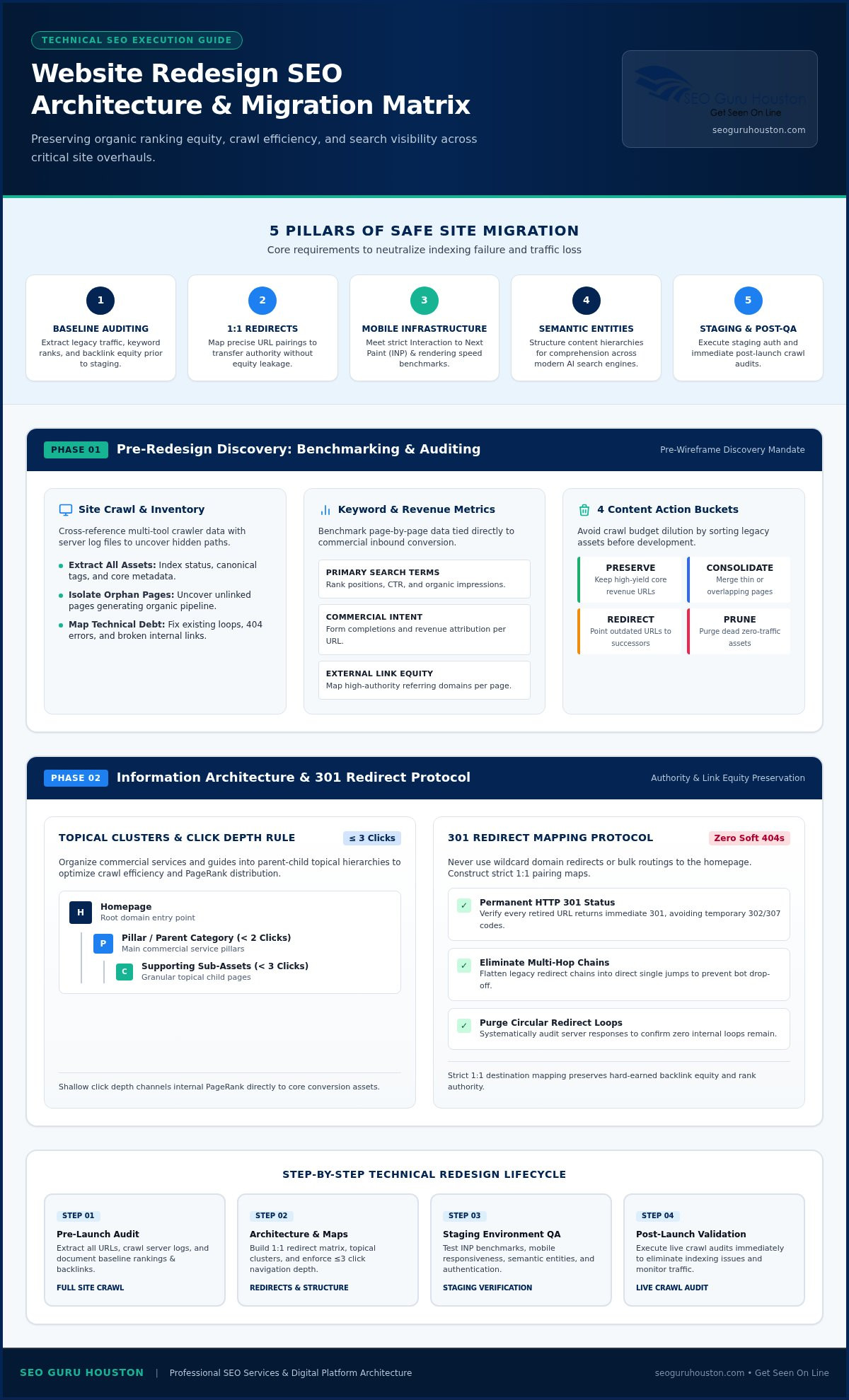
A redesign launched without forensic benchmarking guarantees unrecoverable organic traffic collapse. Visually stunning interfaces mean nothing if your search visibility tanks the moment new templates hit production. Modernizing your platform requires balancing foundational web design principles with an aggressive technical audit before touching a single wireframe. Following a rigorous website redesign seo checklist 2026 begins with uncovering what currently drives revenue, what builds authority, and what can be safely cut.
Comprehensive Site Crawl and URL Inventory
Never rely on a basic CMS export to map your digital footprint. Run a deep crawl using multiple crawler tools, cross-referencing server log files to uncover hidden access paths.
- Extract every indexed asset: Catalog all live pages, active status codes, canonical tags, and core technical metadata across the domain.
- Isolate orphan pages: Flag high-performing legacy pages that generate organic traffic despite missing from primary navigation menus.
- Map technical debt: Uncover existing redirect loops, 404 response errors, and broken internal links before they contaminate your staging environment.
Benchmarking Organic Performance and High-Yield Keywords
Raw traffic numbers don’t show the whole picture; revenue attribution does. Document your baseline metrics page by page, tracking primary search terms, click-through rates, organic impressions, and commercial form completions. Tie each URL to the specific commercial intent driving inbound pipeline. Crucially, map page-level external backlinks. If a legacy URL holds high-authority referring domains, altering or deleting it without a calculated preservation plan destroys accumulated link equity instantly.
Content Pruning and Architecture Audit
Migrating every outdated article and duplicate landing page simply bloats your crawl budget and dilutes domain authority. A redesign gives you the strategic mandate to prune dead weight ruthlessly. Group content into four clear action buckets: preserve, consolidate, redirect, or prune. That is why elite professional seo services audit technical foundations to protect revenue before creative development begins. Building your new site architecture on a lean, high-performing foundation sets the stage for genuine organic growth.
Information Architecture and URL Strategy: Preserving Authority and Link Equity
Your site architecture dictates search crawler efficiency and user journey velocity. When structural hierarchies break, organic visibility collapses rapidly. Retaining legacy URL paths whenever possible is the safest way to avoid unnecessary equity redistribution. If changing URLs is unavoidable, a disciplined execution of your website redesign seo checklist 2026 prevents link decay and keeps search bots focused on high-priority assets.
Structuring Logical Topical Clusters and Navigational Hierarchies
Organize content into tightly grouped topic clusters rather than sprawling, disconnected directories. Every commercial service and supporting guide must sit within a clear topical parent-child relationship. Ensure your primary conversion assets remain reachable within three clicks from the homepage. When search engines crawl shallow click depths, crawl budget utilization improves and internal PageRank flows directly to core commercial pillars.
Constructing an Airtight 301 Redirect Mapping Matrix
Never rely on wildcard domain redirects or lazy mass routings to the homepage; Google treats irrelevant bulk redirects as soft 404 errors, stripping away accumulated ranking authority. Build a granular 1:1 redirect map that pairs every retired URL with its exact conceptual successor.
- Audit status responses: Verify every legacy URL returns an immediate HTTP 301 status, avoiding temporary 302 or 307 headers.
- Eliminate redirect chains: Flatten legacy multi-hop redirect chains into single direct jumps to prevent crawler drop-off.
- Purge internal loops: Test server response codes systematically to guarantee zero circular redirect paths exist before staging review.
Updating Navigation Menus and Internal Linking Frameworks
Design modern header, footer, and sidebar menus with intent-driven anchor text rather than generic labels. Hardcode all internal navigation to link directly to final destination URLs, completely bypassing your 301 redirect engine. Pairing streamlined navigation with a high converting landing page design turns raw organic sessions into predictable pipeline. If managing complex technical architecture while overhauling front-end code feels overwhelming, partnering with proven search marketing specialists ensures zero equity leaks during the transition.
Technical SEO Infrastructure: Engineering Speed, Mobile-First, and Crawlability
Stunning front-end aesthetics collapse under the weight of bloated scripts and sluggish server infrastructure. If search engine bots hit render delays or execution timeouts, your visibility plummets regardless of visual appeal. Executing an uncompromising website redesign seo checklist 2026 demands that technical performance takes precedence before any styling frameworks are finalized.
Core Web Vitals and Page Experience Benchmarks
Passing page experience evaluations requires engineering your templates against rigid performance thresholds. Measure real-world field metrics relentlessly to keep Largest Contentful Paint (LCP) at or under 2.5 seconds, Cumulative Layout Shift (CLS) below 0.1, and Interaction to Next Paint (INP) strictly beneath 200 milliseconds across complete user sessions.
- Accelerate server response: Deploy edge caching and multi-region Content Delivery Networks to achieve sub-second Time to First Byte (TTFB).
- Modernize media delivery: Convert legacy graphic assets into compressed WebP or AVIF formats while enforcing explicit height and width dimensions to eliminate layout shifts.
- Strip execution bloat: Minify CSS and defer non-critical JavaScript to eradicate render-blocking execution bottlenecks.
- Streamline DOM structure: Reduce DOM depth to maximize mobile device processing efficiency and speed up interactive responsiveness.
Mobile-First Responsive Frameworks and Accessibility
Search crawlers evaluate your website strictly through a mobile smartphone lens. Desktop-only optimizations don’t move the needle. Your mobile viewports must maintain absolute content, internal link, and structured data parity with desktop layouts. Verify tap targets provide generous interactive spacing, typography remains legible without pinch-to-zoom gestures, and layout elements comply with accessibility standards to prevent user frustration.
Rendering, JavaScript Execution, and Indexation Control
Relying heavily on client-side JavaScript rendering introduces massive crawl delays and indexation blind spots. Search engines consume precious crawl budget when forced to render complex client-side scripts. Utilize server-side rendering (SSR) or static site generation for core commercial templates to feed bots pre-rendered HTML instantly. Enforce self-referential canonical tags across every unique template, configure parameter handling cleanly, and generate streamlined XML sitemaps containing only indexable 200-OK status URLs.
On-Page Optimization and Entity Integration for Modern AI Search
Modern search engines evaluate semantic topic context and entity relationships, not isolated keywords. Treating on-page optimization as an afterthought during a redesign ruins keyword footprint breadth. Web designers often strip out critical copy blocks or collapse descriptive headers into empty stylistic banners, confusing search models. Incorporating entity architecture into your website redesign seo checklist 2026 ensures search crawlers clearly connect your services to your broader corporate identity.
Metadata and Heading Hierarchy Preservation
Design overhauls must preserve semantic heading structures across every template. Keep exactly one clear H1 per URL, followed by logically ordered H2 and H3 subheadings that reflect topical progression. Craft concise, information-dense opening paragraphs that define your solutions within the first 60 words. This positioning satisfies immediate buyer search intent while claiming prime real estate in generative search snapshots. Rewrite stagnant title tags and meta descriptions to emphasize compelling value hooks, lifting click-through rates across updated SERPs.
Schema.org Markup and Semantic Entity Mapping
Structured data provides explicit semantic clues directly to search engine knowledge graphs. While Google retired FAQ rich results from search displays on May 7, 2026, structured JSON-LD remains foundational for establishing entity trust and machine comprehension. Research from Vynce Digital in July 2026 showed that 72% of first-page Google results utilize structured data, with roughly 41% of all web pages adopting JSON-LD.
- Establish organizational identity: Deploy nested Organization schema referencing your official brand assets, key leadership, and verified corporate registry profiles.
- Connect verified entities: Utilize
sameAsarrays linking to Wikidata profiles and authoritative industry directories to resolve entity ambiguity. - Define offerings granularly: Implement Service and Product schema with specific operational attributes rather than generic marketing text.
- Validate syntax pre-launch: Run every dynamic template through schema validation checkers to confirm zero broken properties or syntax errors.
Content Optimization for Buyer Intent and Demand Generation
Traffic without pipeline acceleration is a wasted investment. Every refreshed page must align directly with commercial intent, answering high-friction buying questions without unnecessary fluff. See how a leading b2b demand generation agency structures messaging to convert qualified organic visitors into measurable opportunities. Ready to dominate competitive search categories without risking your pipeline? Partner with our growth strategists to engineer an airtight technical foundation that drives sustainable market leadership.
The Staging, Launch, and Post-Launch QA Protocol: Safeguarding Organic Growth
The cutover window between staging and production represents the most volatile phase of your entire project. Even a minor deployment oversight can trigger catastrophic search visibility drops within hours. Implementing an airtight staging and cutover sequence within your website redesign seo checklist 2026 protects hard-won equity and ensures seamless operational execution when DNS records shift.
Staging Environment Security and Pre-Flight Validation
Search crawlers will index public test subdomains if you leave them open. Protect staging environments behind HTTP basic authentication or server-level IP whitelisting rather than relying solely on robots.txt disallow rules.
- Enforce authentication gates: Restrict staging access to authorized teams to block search bots from indexing draft templates and generating duplicate content flags.
- Execute synthetic pre-launch crawls: Crawl the authenticated staging environment to verify that internal navigation, canonical URLs, and schema markup match production specifications.
- Validate redirect behavior: Test your redirect mapping table in a staging container to ensure immediate 301 responses with zero intermediate hops.
Launch-Day Cutover Checklist and DNS Migration
Launch day requires decisive, disciplined execution. As DNS updates propagate globally, execute a rapid verification sequence. Remove staging noindex meta tags immediately, ensure your production robots.txt file permits crawler access to all indexable paths, and confirm SSL certificates force sitewide HTTPS without mixed content warnings. Submit refreshed XML sitemaps to major webmaster consoles immediately to prompt rapid recrawling of critical commercial URLs.
Post-Launch Auditing, Log Analysis, and Volatility Management
Deployment marks the beginning of intensive monitoring, not the finish line. Inspect search console indexation coverage reports every 24 hours to catch crawl anomalies, soft 404s, and unexpected dropped URLs. Parse real-time server access logs daily to verify Googlebot is discovering and parsing updated templates cleanly. If you notice isolated ranking fluctuations, address them instantly by fine-tuning internal links. Once baseline visibility stabilizes, align your platform with an aggressive inbound marketing strategy for b2b to accelerate demand generation and turn technical stability into lasting revenue dominance.
Turn Your Digital Overhaul Into an Unstoppable Revenue Engine
A website overhaul isn’t merely a creative aesthetic refresh; it’s a high-stakes operational pivot that directly impacts your bottom line. When you execute an airtight website redesign seo checklist 2026, you insulate years of hard-won domain authority, maintain precise 1:1 redirect integrity, and deliver lightning-fast Core Web Vitals across every device. Modernizing your platform must expand your market share and accelerate conversion velocity, never jeopardize it.
Don’t leave your organic pipeline to chance or accept ranking drops as an inevitable cost of growth. Combining rigorous technical SEO architecture, high-converting landing page frameworks, and aggressive inbound demand generation funnels ensures your new digital asset drives measurable ROI from day one. Partner with seasoned digital strategists to safeguard your rankings and scale revenue today. Take decisive control of your digital visibility, outpace hesitant competitors, and build an enduring competitive advantage that turns searchers into sustainable revenue.
Frequently Asked Questions
How long does organic traffic typically fluctuate after a website redesign?
Expect organic volatility to persist for two to six weeks while search crawlers discover, re-index, and evaluate updated templates. The exact timeline depends on site size, crawl frequency, and domain authority. Following a methodical website redesign seo checklist 2026 minimizes this stabilization period. If traffic remains depressed beyond eight weeks, unaddressed technical debt, broken redirect chains, or stripped semantic content are usually the culprits.
Can a website redesign improve organic search rankings immediately?
Immediate ranking gains are rare because search engines require time to process systemic architectural shifts. However, substantial performance lifts frequently emerge within 30 to 60 days post-launch. When you resolve severe legacy crawling hurdles, accelerate server response times, and deploy clearer topic structures, crawlers reward the upgraded user experience. The key is treating technical SEO as a baseline growth engine rather than a decorative cosmetic patch.
What happens if we launch without setting up 301 redirects?
Launching without 301 redirects instantly triggers widespread 404 response errors, destroying your accumulated page authority and inbound backlink equity. Search engines treat missing pages as vanished content, de-indexing URLs and wiping out historical keyword rankings in days. Beyond ranking devastation, incoming referral and organic visitors land on dead pages, causing immediate bounce spikes, fractured conversion paths, and severe top-line revenue destruction across your entire digital sales pipeline.
How do we prevent search engines from indexing our staging website?
Implement HTTP basic password authentication or restrict access exclusively to approved corporate IP addresses. Never rely solely on a staging robots.txt file or meta noindex directives, as minor configuration slips can still expose test URLs to public crawling. Server-level authentication creates an impenetrable barrier, preventing search bots from discovering staging subdomains, creating duplicate content conflicts, or prematurely indexing unfinished development templates.
Is it safe to change URL structures and permalinks during a redesign?
It’s safe only when paired with meticulous 1:1 permanent redirect mapping, but keeping existing URLs is always the lower-risk choice. Whenever permalinks change, search algorithms must rediscover the new paths and reassign link equity. If structural alterations are necessary for site scalability, document every old path and verify that every redirect points directly to its closest relevant successor without passing through intermediate redirect hops.
Why do websites often lose significant traffic after a visual revamp?
Traffic drops occur when creative design decisions accidentally strip away vital technical SEO elements. Web design teams often replace keyword-rich, crawlable body text with visual widgets, delete high-ranking subpages, or alter heading hierarchies. Executing a structured website redesign seo checklist 2026 keeps development teams accountable to search equity. Without that technical governance, search bots find an unrecognizable page context, resulting in swift ranking demotions across core revenue terms.
How does modern Core Web Vitals optimization impact post-redesign performance?
Fast, responsive technical infrastructure directly impacts how search engines evaluate user experience signals sitewide. Meeting benchmarks for Largest Contentful Paint and Interaction to Next Paint ensures that mobile visitors browse without input delays or layout shifts. Sites delivering rapid response times reduce bounce rates and maximize crawl efficiency. Search crawlers prioritize stable, performant digital platforms, turning superior technical speed into a decisive competitive advantage post-launch.

