
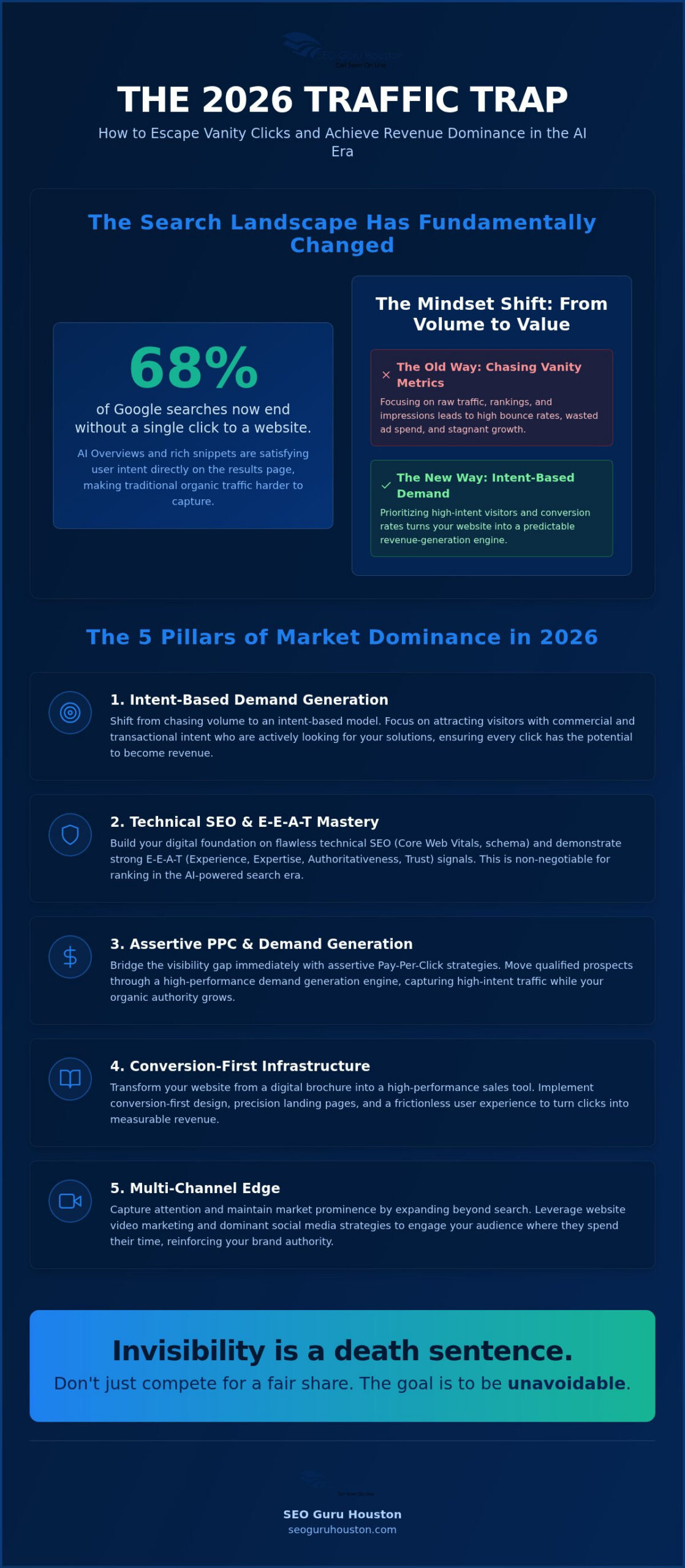
Did you know that 68% of Google searches in 2026 now end without a single click to a website? If you’re constantly asking how to increase website traffic for my business while AI Overviews swallow your organic visibility, you’re facing a cutthroat market reality. Most brands are currently hemorrhaging marketing budgets on low-quality traffic that never converts. It’s an exhausting cycle of invisible search presence and wasted spend that leaves your growth stagnant. You don’t need more vanity hits. You need high-intent visitors who fuel your bottom line.
We agree that the 2026 algorithm shifts have made traditional tactics obsolete for serious competitors. This guide promises to stop the guesswork and show you how to flood your site with traffic that actually generates revenue. We’ll preview the technical precision required to master the $5.42 average CPC environment and leverage AI content signals for total market dominance. It’s time to move from invisibility to prominence with a strategy built for measurable ROI. Let’s get to work.
Key Takeaways
- Shift from chasing vanity metrics to an intent-based demand generation model that prioritizes revenue over raw visitor volume.
- Discover the specific technical SEO and E-E-A-T requirements of the 2026 AI era to learn how to increase website traffic for my business that actually converts.
- Bridge the visibility gap immediately using assertive PPC strategies designed to move prospects through a high-performance demand generation engine.
- Transform your website from a digital brochure into a high-performance sales tool by implementing conversion-first infrastructure and precision landing page design.
- Leverage website video marketing and dominant multi-channel strategies to capture attention and maintain market prominence in a zero-click search environment.
Why Generic Traffic is a Vanity Metric in 2026
Stop chasing shadows. In 2026, raw numbers are a lie. You can drive 10,000 hits to your site today, but if they are “junk traffic” looking for a free definition, your business stays broke. This is the Traffic Trap. It’s a dangerous delusion where volume masks a lack of performance. True growth requires a shift from volume-based metrics to intent-based demand generation. If your visitors don’t convert into revenue, they are just a drain on your server and your sanity.
Professional intervention isn’t a luxury; it’s a fundamental necessity for market survival. If you’re asking how to increase website traffic for my business, you need to understand that the search landscape has fundamentally changed. You aren’t just fighting for attention; you’re fighting for a dominant market position against AI Overviews and zero-click search results. Ignoring this reality leads to “Invisible Business” syndrome, where your brand exists but remains irrelevant to your bottom line.
Intent Over Volume: The New Gold Standard
Not all visitors are created equal. Informational intent is nice for brand awareness, but commercial and transactional intent pay the bills. You must map your content to the buyer’s journey with surgical precision. If you flood your site with low-intent visitors, you actually hurt your long-term authority. Search engines see high bounce rates and low engagement, signaling that your site doesn’t satisfy the user’s needs. Success starts with understanding web traffic at a granular level. You need to distinguish between someone browsing for “what is SEO” and someone ready to buy professional B2B marketing services. One is a student; the other is a client. Focus on the latter.
The Cost of Invisibility in a Competitive Market
Invisibility is a death sentence. Every day you linger on page two, your competitors are winning the leads you deserve. The opportunity cost is staggering. Think about the lifetime value of a single lost client. Now multiply that by the hundreds of high-intent searches you’re missing every month. This isn’t just about a missing link; it’s about a missing future for your company. Your competitors aren’t smarter; they are just more visible where it matters most.
To win, you must make a psychological shift from “trying” to “dominating.” You don’t want a fair share of the market; you want the lion’s share. Dominance isn’t about being present; it’s about being unavoidable. When a high-intent prospect searches for your solution, your brand must be the definitive answer. Anything less is just noise. High-performance growth requires a commitment to being the authority in your niche, turning every click into a measurable step toward ROI. For those ready to scale aggressively, Peter Montoya provides the specialized SEO performance marketing and growth coaching required for total market dominance.
Mastering Search Engine Optimization for Absolute Dominance
You can’t dominate a market with a broken foundation. Technical SEO is the non-negotiable bedrock of your digital infrastructure. While many business owners look for savvy online marketing tactics, the reality is that 2026 algorithms demand surgical precision. If your site architecture is a mess, search engines won’t just ignore you; they’ll bury you. You need professional seo services to ensure your infrastructure can handle the volatility of the modern search ecosystem. Trust is the currency of the AI era, and your technical health is your first deposit.
Technical Precision: More Than Just Meta Tags
Speed is a survival factor. In 2026, Core Web Vitals and mobile-first indexing are the baseline. If your site takes more than two seconds to load, you’ve already lost the lead. Beyond speed, you must leverage structured data and schema markup. This helps AI-powered search engines understand your specific value proposition. A clean, logical site architecture ensures that crawl bots can index your most valuable pages without getting lost. If you’re serious about how to increase website traffic for my business, your technical setup must be flawless. AI search signals now evaluate editorial oversight and strategic intent, meaning your backend must prove you are a legitimate authority.
Content Authority: Writing for Humans and Algorithms
Ranking for a single keyword is a relic of the past. Today, you need to own the entire market conversation. Topic clusters and pillar pages allow you to establish undeniable authority across broad subject areas. An seo marketing company doesn’t rely on guesswork; we use data-driven content strategies to map out every touchpoint of your buyer’s journey. This is how you build E-E-A-T. Experience, Expertise, Authoritativeness, and Trustworthiness are the criteria Google uses to separate leaders from followers. Your content must provide original insights that AI cannot simply hallucinate.
Backlinks remain the ultimate votes of confidence. High-quality, relevant links from authoritative domains tell search engines that your brand is a trusted source. In a landscape filled with automated noise, a robust link profile is your competitive moat. If you want to stop being invisible, you must earn the respect of the web’s most established players. It’s about building a reputation that the algorithms cannot ignore. Ready to stop guessing? Partner with an agency that understands the technical nuances of high-performance SEO and start your transformation from invisible to prominent.
Precision Scaling with PPC and Demand Generation
SEO is your long-term moat, but aggressive PPC is the bridge that crosses the visibility gap today. If you’re asking how to increase website traffic for my business in a market where organic clicks are shrinking, you can’t wait months for results. You need immediate, high-intent visibility. With the average Google Ads CPC rising 12% in 2026 to $5.42, “trying out” ads is a recipe for financial disaster. You need a high-performance engine that converts expensive clicks into predictable revenue. Scaling requires precision, not just a bigger budget.
Stopping the “budget bleed” is the first priority. Most businesses lose 40% of their ad spend to poor targeting and “junk” search terms that don’t align with commercial intent. Success in 2026 means moving beyond basic lead generation. You need a comprehensive strategy from a b2b demand generation agency that focuses on creating market desire, not just chasing it. This is how you transform a volatile marketing expense into a scalable growth asset.
Paid Search Management: The Assertive Growth Engine
Google Ads in 2026 is a different beast. AI-powered features like generative asset creation and automated bidding are now the default settings. If you don’t have expert oversight, you’re essentially handing your credit card to an algorithm designed to maximize Google’s profit, not yours. Professional ppc management is required to navigate these automated waters and maintain editorial control. We focus on:
- High-Precision Targeting: Bypassing the $33.92 average CPC in marketing or $71.64 in legal by finding untapped, high-intent long-tail opportunities.
- Strategic Retargeting: Capturing the “lost” visitors who didn’t convert on their first visit, keeping your brand top-of-mind until they’re ready to act.
- AI Disclosure Compliance: Ensuring all AI-generated visuals include mandatory “How This Ad Was Made” labels to avoid account suspension.
B2B Demand Generation: Creating Markets, Not Just Following Them
Traditional inbound marketing often fails because it waits for the customer to realize they have a problem. Demand generation is assertive. It identifies industrial and B2B decision-makers before they even hit the search bar. While demand capture focuses on users searching for specific solutions, demand creation builds the case for your brand’s necessity. In 2026, traffic from AI search platforms converts at 3.49%, which is 22% higher than traditional organic search. Our goal is to position your business as the cited authority in these AI Overviews, ensuring that when the market is ready to buy, they’re already looking for you.
Conversion-First Infrastructure: Turning Clicks into Revenue
Traffic without conversion is just an expensive hobby. If you’re obsessing over how to increase website traffic for my business but neglecting your conversion architecture, you’re building your growth on sand. In 2026, the median website conversion rate across all industries sits at a meager 2.35%. That’s unacceptable for a business hungry for market dominance. To win, your website must function as a high-performance sales tool, not a static digital brochure. Conversion Rate Optimization (CRO) is the silent engine that determines whether your marketing budget is a waste or a wealth-builder. You must remove every ounce of friction and guide visitors toward decisive action with surgical precision.
Landing Page Excellence: The Blueprint for Conversion
A landing page isn’t just a place for someone to land; it’s where the deal is sealed. Successful brands utilize a high converting landing page design that commands immediate attention. This requires more than just “clean” aesthetics. It demands a psychological blueprint that triggers action through authoritative copy and logical flow. We don’t guess what works. We use AI-powered A/B testing that reaches statistical significance 31% faster than traditional methods. This discipline of constant improvement ensures your site evolves with your audience. Professional, assertive design beats generic templates every time because it’s built for your specific bottom line.
Inbound Marketing: The Long-Term Revenue Play
While PPC bridges the immediate visibility gap, a comprehensive inbound marketing strategy for b2b builds an indestructible revenue foundation. It’s about creating a trust-based digital ecosystem. You aren’t just capturing leads; you’re nurturing decision-makers through automated, high-value content sequences. This moves prospects from “just looking” to “ready to sign” without manual intervention. In a market where mobile conversion rates lag significantly behind desktop, your infrastructure must be optimized for every device and every stage of the buyer’s journey. High-quality inbound content proves your authority and justifies your premium position in the market.
Ready to stop losing leads to a mediocre website? Let’s transform your site into a revenue machine with our high-performance inbound marketing and specialized landing page services. Your growth depends on it.
The Multi-Channel Edge: Video and Social Dominance
In 2026, a single-channel strategy is a suicide mission. If you’re still asking how to increase website traffic for my business while ignoring the power of visual and social authority, you’re leaving your market share to the competition. Dominance requires an integrated digital marketing strategy where every channel feeds the other. You need a cumulative effect. One where your SEO authority is amplified by your social presence and cemented by the trust only video can build. This isn’t about being everywhere; it’s about being dominant where your high-intent buyers actually live.
Website Video Marketing: The Ultimate Trust Builder
Website video marketing is no longer optional. It’s the #1 engagement booster because it humanizes your technical expertise. Video content significantly increases time-on-site, which directly signals to search algorithms that your content is valuable and relevant. Every B2B site needs a strategic mix of explainers, case studies, and thought leadership. Professional production signals authority and precision. In contrast, low-quality DIY efforts often signal a lack of resources, which can damage your brand’s reputation in high-stakes industrial markets. When you integrate high-quality video, you aren’t just showing a product; you’re proving a solution.
Strategic Social Dominance for B2B
Stop “posting” and start dominating LinkedIn. In 2026, LinkedIn is a demand generation powerhouse, not a digital rolodex. With global social media ad spend projected to reach $338.75 billion, the noise is deafening. You must align your social messaging with your SEO and PPC goals to create a unified front. The average CPM for social ads sits between $4 and $10, making it a cost-effective way to stay top-of-mind. However, generic content is a waste of capital. Success requires an assertive presence that cuts through the noise.
The “Guru” method involves repurposing your high-authority pillar content into snackable social insights. This ensures you maintain multi-channel visibility without reinventing the wheel. When your social presence mirrors the technical authority of your website, you create a seamless experience for decision-makers. You aren’t just following the market; you’re creating it. This integrated approach is the most assertive answer to how to increase website traffic for my business: it’s about building a single, high-performance growth engine that leaves the competition in the dust.
Secure Your Market Dominance Now
The digital landscape of 2026 doesn’t reward participation; it rewards dominance. You’ve seen why chasing vanity metrics is a recipe for stagnation. Success requires a shift toward high-intent demand generation and a conversion-first infrastructure that turns every click into a measurable asset. If you’re still wondering how to increase website traffic for my business, the answer lies in the aggressive integration of technical SEO authority, high-precision PPC management, and strategic website video marketing. Invisibility is a choice. You can either settle for the crumbs your competitors leave behind or you can build a high-performance engine that commands the lion’s share of your market.
We specialize in moving brands from the shadows to prominence through expert B2B demand generation and high-ROI digital strategies. Don’t let another lead slip through a mediocre funnel. It’s time to stop losing revenue and start winning. Stop Losing Revenue and Start Dominating Your Market Today! We’re ready to help you transform your digital presence into a dominant revenue machine. Your future growth starts with a single, decisive action.
Frequently Asked Questions
How long does it take to see an increase in website traffic from SEO?
You should expect significant results within four to twelve months. SEO is a long-term compound interest play, not a quick fix. Your timeline depends on technical infrastructure and existing domain authority. If your site has a weak foundation, you must fix it first. In the 2026 search environment, editorial oversight and original content signals are mandatory for ranking. Patience is required, but the result is a dominant, sustainable market position.
Is paid search (PPC) better than organic SEO for quick growth?
PPC is undeniably faster for immediate visibility. While SEO builds a long-term moat, paid search allows you to bridge the gap and capture demand today. With the average CPC on the Google Search Network hitting $5.42 in 2026, you can’t afford to guess. Success requires assertive management to ensure you aren’t wasting budget on low-intent clicks. Use PPC for speed and SEO for lasting authority.
How much should I spend on digital marketing to see real ROI?
Your investment should be dictated by your growth targets and the lifetime value of your customers. Arbitrary budgets lead to mediocre results. High-performance marketing requires enough capital to compete in aggressive auctions, especially in industries where search costs are high. Focus on your return on ad spend rather than the raw cost. If your marketing isn’t generating a measurable ROI, you’re just subsidizing the platform’s profit.
Why is my website traffic increasing but my sales are staying the same?
You are likely caught in the Traffic Trap where you’re attracting low-intent visitors who have no intention of buying. High volume is a vanity metric if your conversion-first infrastructure is broken. If you’re researching how to increase website traffic for my business, you must prioritize intent over raw hits. Check your landing page design and user experience. If your site doesn’t guide visitors toward a decisive action, your traffic is just a server expense.
Do I really need professional video marketing for my business website?
Professional video is a fundamental necessity for business survival in 2026. It’s the most effective tool for building trust and keeping visitors on your site longer. High-quality video signals authority and technical expertise that grainy, DIY content simply can’t match. Since time-on-site is a major ranking signal, video directly impacts your search performance. If you want to dominate your niche, you need a visual strategy that proves your market leadership.
What is the difference between lead generation and demand generation?
What is the difference between lead generation and demand generation?
Lead generation captures people already looking for a solution, while demand generation creates the desire for your solution before the search starts. Lead gen is reactive; demand gen is assertive. In the 2026 ecosystem, you need both to survive. Demand generation positions your brand as the definitive expert, ensuring that when prospects are finally ready to buy, you’re the only logical choice they consider. It’s about owning the market conversation. For home service providers looking to lead in their space, learn more about Lighthouse Lead Generation and their expertise in visibility.
Small businesses can absolutely outmaneuver national brands by being more precise and agile. Large corporations often rely on generic authority, leaving gaps in specialized topic clusters. By focusing on technical excellence and deep expertise, you can win high-intent searches that the giants overlook. You don’t need a national budget to achieve a dominant position in your specific niche. Success is about strategic precision and out-executing the competition on a technical level.
How do I know if my current SEO agency is actually delivering results?
Your agency is delivering results if your revenue and high-quality lead flow are increasing. Stop looking at impressions or keyword movements as the primary success metrics. A real partner focuses on the bottom line and provides transparent data on ROI. If you’re asking how to increase website traffic for my business and they only offer vague reports without commercial context, they are failing you. Demand accountability and focus on measurable business growth.

