
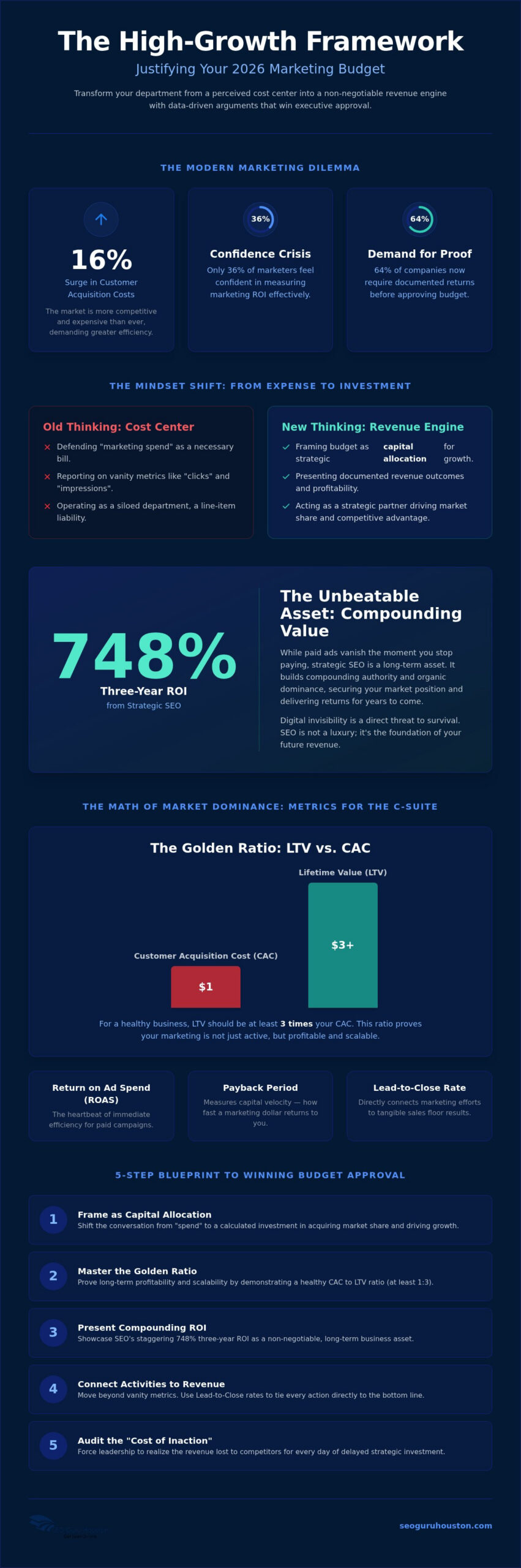
If your marketing budget is the first thing on the chopping block during quarterly reviews, you aren’t running a department; you’re managing a liability. In a market where customer acquisition costs have surged by up to 16% this year alone, guessing isn’t an option. You might be searching for how to justify marketing spend to my boss because the old ways of reporting ‘clicks’ and ‘impressions’ aren’t cutting it anymore. It’s a common pain. Only 36% of marketers feel confident in their ability to measure ROI, yet 64% of companies now demand documented returns before approving a single dollar.
You know that marketing is a profit center, but translating that belief into an executive-ready presentation is a different beast. We’re here to bridge that gap. This 2026 guide transforms your budget from an optional line-item into a non-negotiable revenue engine using our high-growth justification framework. You’ll learn how to connect long-term SEO gains, which deliver a staggering 748% three-year ROI, directly to immediate business goals. We’re moving past the fluff and giving you the technical authority to lead the room, secure your 2026 budget, and finally claim your seat as a strategic partner in the executive suite.
Key Takeaways
- Stop treating your budget like a bill to be paid and start framing it as strategic capital allocation for market dominance.
- Learn exactly how to justify marketing spend to my boss by shifting the conversation from daily activities to documented revenue outcomes.
- Master the “golden ratio” of CAC vs. LTV to prove that every dollar invested is a calculated step toward long-term profitability.
- Discover why SEO remains the most efficient 2026 investment and how to present its compounding ROI as a non-negotiable business asset.
- Use our 5-step blueprint to audit the “cost of inaction,” forcing leadership to realize exactly what the company loses by playing it safe.
Stop Defending an Expense: Frame Marketing as a Revenue Engine
Marketing isn’t a bill you pay; it’s an investment you leverage. If you’re still treating your department budget like a utility payment, you’ve already lost the battle for growth. Most executives view marketing as a cost center, a necessary evil that bleeds cash without a clear return. You must flip this script immediately. To win the room, you need to stop talking about “marketing spend” and start talking about capital allocation for growth. You aren’t asking for permission to spend money. You’re presenting a calculated plan to acquire market share. Marketing ROI is the ratio of revenue generated to the cost of the engine that produced it.
The 2026 reality is brutal. With the rise of AI Overviews and generative search, the digital landscape is shifting faster than most legacy companies can react. Standing still in this environment is actually moving backward. If you aren’t aggressively claiming digital real estate now, you’re handing your future revenue to competitors who are. Understanding understanding marketing effectiveness is the first step in learning how to justify marketing spend to my boss. It requires moving beyond tactical execution and into strategic financial planning.
The Survival Necessity of Digital Presence
Digital invisibility is a fundamental threat to business survival. In the 2026 search ecosystem, if your brand doesn’t appear in the initial AI-generated answers, you don’t exist to the modern buyer. The cost of inaction is staggering. Every day you delay a high-growth strategy, you’re paying an “invisibility tax” in the form of revenue lost to faster, more aggressive competitors. This is why professional seo services are not a luxury; they’re a long-term asset. Unlike paid ads that stop the moment you stop paying, organic dominance builds compounding value over time, delivering an estimated 748% three-year ROI that secures your market position for years to come.
Winning the Mindset War with the C-Suite
To secure a bigger budget, you must speak the language of the CEO: growth, market share, and competitive advantage. Executives don’t care about “likes” or “impressions” because those metrics don’t show up on a balance sheet. They care about leads and revenue. When you’re figuring out how to justify marketing spend to my boss, position your department as the growth engine of the enterprise. Frame every dollar as a scalable lever. If you can prove that $1 in equals $X out, the conversation stops being about “saving money” and starts being about how much more capital the company can afford to deploy into your high-performance machine.
The Math of Market Dominance: Key Metrics Your Boss Actually Cares About
Executives don’t care about “engagement.” They care about the math. If you want to know how to justify marketing spend to my boss, start with the golden ratio: Customer Acquisition Cost (CAC) vs. Lifetime Value (LTV). In a high-performance organization, your LTV should be at least three times your CAC. If it’s lower, your strategy is inefficient. If it’s significantly higher, you’re actually under-investing and leaving market share for your rivals to snatch up. This is the assertive logic of persuading your boss to invest in aggressive growth rather than safe stagnation.
Return on Ad Spend (ROAS) is the heartbeat of effective ppc management. It tells the story of immediate efficiency. However, don’t stop there. You must track the “Payback Period.” This is the exact number of months it takes for a marketing dollar to return to the company’s pocket. A shorter payback period means more capital can be recycled back into the engine, accelerating your dominance. Finally, connect your efforts directly to the sales floor by tracking Lead-to-Close rates. If marketing generates leads that don’t close, you aren’t building a revenue engine; you’re just making noise.
B2B and Industrial Specific Metrics
B2B sales cycles are complex. You can’t rely on simple click-to-buy data. In industrial sectors, ‘Demand Generation’ is the metric that truly matters. Stop reporting on Marketing Qualified Leads (MQLs) that clutter the CRM without converting. Focus on Sales-Ready Leads. These are prospects who have bypassed the fluff and are ready for a bottom-line conversation. Partnering with a specialized b2b demand generation agency ensures your data aligns with the reality of the sales floor, not just a marketing spreadsheet.
Attribution Models: Proving What Actually Works
Which attribution model should you show your boss? While first-touch shows where the journey began, multi-touch attribution provides the full picture of how high converting landing page design impacts the final decision. You must also account for ‘Dark Social.’ This is the brand authority built in private channels and word-of-mouth that drives the highest-quality deals. If you’re ready to prove your department’s impact, it’s time to implement a data-driven growth strategy that your executive team cannot ignore.
Beyond Vanity Metrics: Connecting SEO and PPC to the Bottom Line
Stop showing your boss traffic graphs that don’t lead to a bank deposit. Traffic is a vanity metric unless it’s tied to a transaction. When you’re figuring out how to justify marketing spend to my boss, you must demonstrate how SEO and PPC function as a unified front to seize market share. You aren’t building a digital scrapbooking project; you’re building a revenue engine. By dominating the search results on both ends, you create an undeniable aura of authority that increases trust and conversion rates across the board. Search dominance is the modern equivalent of owning the most valuable real estate in your industry.
SEO as a Long-Term Business Asset
SEO is the most efficient long-term investment in the 2026 ecosystem. Cutting your SEO budget is exactly like stopping the maintenance on a multi-million dollar factory; the production line might keep moving today, but eventual collapse is a mathematical certainty. Organic traffic builds “equity” that your competitors can’t simply buy their way over with a larger credit card limit. By leveraging a high-performance seo marketing company, you aren’t just “ranking” for keywords. You’re systematically reducing your long-term Customer Acquisition Cost. Every piece of authority you build today acts as a permanent moat around your market position, making it increasingly expensive for rivals to challenge your dominance.
PPC: The Precision Tool for Rapid Growth
If SEO is the engine’s durability, PPC is the high-octane fuel that provides immediate acceleration. It’s the precision tool you use to test new markets and products with surgical accuracy. You can use the “instant gratification” of paid search to offset the longer lead times of organic growth, ensuring the company sees cash flow while the SEO moat is being dug. A strategic PPC audit is a powerful weapon when you’re explaining how to justify marketing spend to my boss because it highlights immediate cost-saving opportunities. If your current campaigns are bleeding budget due to sloppy oversight, identifying that waste and redirecting it into high-intent leads proves you’re a steward of the company’s capital. Showing that $1 in equals $X out with aggressive management transforms your budget from an expense into a scalable lever for growth.
The 5-Step Blueprint to Winning Budget Approval Every Time
Data alone won’t win the room. If you want to know how to justify marketing spend to my boss, you have to realize that leadership doesn’t buy services; they buy outcomes. You aren’t presenting a request for funds. You’re presenting a blueprint for market dominance. To succeed, you must shift from a defensive posture to an assertive, strategic one. Follow this five-step sequence to transform your budget meeting into a growth summit.
- Step 1: Audit the ‘Cost of Inaction’. Show exactly what the company is losing right now. If your competitors are scaling and you’re standing still, calculate the revenue leakage. Fear of loss is often a more powerful motivator than the hope of gain.
- Step 2: Align Marketing Goals with Business Objectives. Forget rankings. Talk about revenue, market share, and customer acquisition. If the CEO wants 20% growth, show how your budget is the direct path to that number.
- Step 3: Present a Tiered Budget Plan. Offer three options: Good, Better, and Market Dominance. This shifts the conversation from “Should we do this?” to “Which level of growth do we want to achieve?”
- Step 4: Use Competitor Benchmarking. Trigger the competitive ambition of your executive team. Show them the “Search Share of Voice” charts where rivals are eating your lunch. No boss likes losing to a competitor they feel superior to.
- Step 5: Propose a ‘Pilot Program’. Reduce the perceived risk by suggesting a 90-day high-intensity sprint with clear KPIs. It’s much easier to get a “yes” for a proven pilot than a permanent annual commitment.
Crafting the Narrative: The ‘Guru’ Approach
Stop presenting dry spreadsheets. Start telling a story of transformation. You are the high-performance coach leading the company from digital invisibility to market prominence. When the “it’s too expensive” rebuttal comes, don’t flinch. Remind them that expensive is a relative term. A $10,000 investment that returns $0 is expensive. A $100,000 investment that returns $1,000,000 is a bargain. Lead them to the logical conclusion that they can’t afford *not* to invest.
The Power of Visual Proof
Visuals should scream authority. Use “Search Share of Voice” charts to visualize the gap between your brand and the market leaders. Present an inbound marketing strategy for b2b funnel that illustrates a crystal-clear path from the first click to the final cash deposit. Your comparison slide should be stark: a “Current State” of stagnation versus a “Future Growth State” of dominance. If you’re ready to stop guessing and start winning, it’s time to partner with a results-oriented strategist who can provide the data you need to secure your 2026 budget.
Scaling with a Results-Oriented Partner: Why Strategy Beats Activity
Activity is just noise without a high-growth strategy. You don’t need a vendor who simply checks boxes; you need an assertive partner who hunts for market dominance. Most businesses fail because they hire an “Affordable SEO Company” that provides generic reports and stagnant results. That’s a cost center. You need a High-ROI Growth Partner. This is a fundamental necessity for businesses hungry for prominence in the 2026 search ecosystem. SEO Guru Houston bridges the gap between technical nuance and raw business strategy. We don’t just “do SEO”; we provide the measurable progress and strategic advantage your executive team demands to see on the balance sheet.
A specialized partner understands that every dollar must be a calculated move. When you’re figuring out how to justify marketing spend to my boss, you need to present more than just a list of tasks. You need to show a sophisticated understanding of how technical search metrics translate into financial return. We provide the data-driven justification framework that transforms your marketing budget from a line-item expense into a non-negotiable revenue engine. Strategy beats activity every single time because strategy is focused on the bottom line.
The Value of External Authority
Bosses often ignore internal pleas but listen intently to external experts. It’s the “Guru Effect.” When you’re struggling with how to justify marketing spend to my boss, a third-party audit is your most powerful weapon. It provides an unbiased, data-driven validation of your budget requests that internal spreadsheets often lack. By leveraging an agency’s track record of proven success, you effectively de-risk the entire investment. It’s no longer just your opinion against the CFO’s skepticism; it’s a proven roadmap backed by specialized expertise and market-leading results.
Execution: Moving from Approval to Prominence
Securing the budget is only the beginning of the transformation. You must move from approval to prominence immediately to maintain executive confidence. Our “First 90 Days” plan focuses on delivering quick wins that build trust and solidify your budget for the rest of the year. This creates a relentless feedback loop of success where each win justifies the next dollar of capital allocation. Constant, transparent reporting ensures the C-suite sees the revenue engine working in real-time. If you’re ready to stop defending and start leading, it’s time to Dominate your market and explode your revenue with SEO Guru Houston.
Claim Your Market Dominance in 2026
You have the blueprint and the data. Now, you need the conviction to lead. The shift toward AI-driven search means that playing it safe is no longer an option; it’s a slow path to irrelevance. By reframing your budget as a profit center and focusing on the core math of CAC and LTV, you’ve mastered how to justify marketing spend to my boss. You aren’t asking for a favor. You’re offering a path to industrial dominance that your competitors are too slow to take.
Our team specializes in results-oriented B2B and industrial demand generation. We provide the technical nuance and ambitious digital strategies required to transform your brand from invisible to indispensable. Don’t settle for “activity” when you can have measurable progress. Ready to secure your budget and dominate your market? Let SEO Guru Houston build your high-ROI growth engine today!
The transition from a cost center to a revenue engine starts with your next meeting. Go in with authority and claim the growth your company deserves. Your seat at the executive table is waiting; it’s time to take it.
Frequently Asked Questions
What is the best way to explain the value of SEO to a non-technical boss?
Explain it as a digital asset. SEO is like owning the building instead of renting it. It’s the most efficient way to lower long-term CAC. Tell them it delivers a 748% three-year ROI. This isn’t just about rankings; it’s about owning the search ecosystem. This shift in perspective helps when you’re learning how to justify marketing spend to my boss. You’re building a permanent revenue engine that works even when you sleep.
How do I justify a marketing budget increase when sales are down?
Defend the engine. When sales are down, you don’t cut the fuel; you fix the engine. Cutting spend now ensures your competitors will capture the remaining market share. Frame the increase as a recovery plan. Show how the cost of inaction is higher than the budget request. If you stop now, the cost to restart and regain your position later will be 5 to 25 times more expensive than maintaining it.
What metrics should I prioritize in a budget meeting with the CFO?
CFOs speak the language of capital efficiency. Prioritize Customer Acquisition Cost (CAC), Lifetime Value (LTV), and the Payback Period. They don’t care about clicks; they care about how quickly a marketing dollar returns to the balance sheet. Show the “Golden Ratio” of 3:1 for LTV to CAC. This data-driven approach is the ultimate answer for how to justify marketing spend to my boss during high-stakes financial reviews.
How can I prove that our PPC spend isn’t being wasted?
Transparency is the antidote to skepticism. Present a surgical audit that identifies “bleeding budget” from low-intent keywords. Show exactly how you’ve eliminated waste and redirected those funds into high-converting landing pages. Use multi-touch attribution to link every dollar spent directly to a sales-ready lead. When you prove that $1 in equals $X out with aggressive management, the conversation shifts from “wasted spend” to “scalable growth lever.”
What is a ‘reasonable’ marketing budget as a percentage of revenue in 2026?
Most high-growth B2B firms allocate 5% to 15% of total revenue to marketing. In the competitive 2026 landscape, staying at the lower end often leads to stagnation. If your goal is market dominance, you must treat this as capital allocation for growth rather than an expense. The right percentage depends on your specific industry’s CAC benchmarks and your company’s ambition to outpace the competition in search visibility.
How do I handle a boss who only believes in traditional print advertising?
Shift the focus to trackable ROI. Traditional print is a “spray and pray” tactic that offers zero visibility into effectiveness. Digital marketing allows for precision targeting and measurable returns. Show your boss a “Search Share of Voice” chart that visualizes exactly how much revenue your competitors are siphoning away through search. Once they see the digital gap, the argument for print usually collapses under the weight of lost opportunity.
What is the ‘cost of inaction’ and how do I calculate it for my company?
The cost of inaction is the revenue you lose every day you aren’t at the top of search results. Calculate it by taking the total search volume for your top keywords, multiplying by the average click-through rate of a top-3 position, and then applying your close rate and average deal value. This number represents the “Invisibility Tax” you’re currently paying. It’s often much higher than the cost of a high-performance marketing strategy.
Can I justify spend on ‘brand awareness’ in a B2B industrial sector?
Absolutely, but frame it as “Brand Authority.” In industrial B2B sectors, buyers don’t just click and buy; they research. Brand awareness builds the trust needed to shorten long sales cycles. It creates a “halo effect” that increases the efficiency of your PPC and SEO efforts. By establishing yourself as the authoritative expert, you reduce resistance on the sales floor and make every other marketing dollar work harder for the bottom line.

