
What if the SEO reports landing in your inbox show plenty of activity but reveal nothing about leads, conversions, or revenue? That gap doesn’t automatically prove your SEO company is failing, but it does mean you need clearer evidence. The signs of a bad seo company often hide behind confident ranking promises, vague updates, and work you can’t verify.
You’re right to expect more than charts and claims. SEO takes time, rankings can shift, and no company can responsibly guarantee a top position. But a capable partner should be able to explain the strategy, show what work was completed, and connect search performance to meaningful business goals. This guide covers nine warning signs, from secretive tactics and missing account access to reports that overlook qualified traffic and conversions. You’ll learn how to assess the evidence, distinguish a genuine concern from a normal fluctuation, and choose a practical next step that protects search visibility and supports growth.
Key Takeaways
- Recognize the signs of a bad seo company by looking for risky practices and claims that aren’t backed by clear, verifiable work.
- Separate normal ranking fluctuations from recurring unexplained changes by considering your site’s conditions, competition, and the work being done.
- Use a simple review process to check account access, goals, reports, completed work, and business outcomes.
- Document specific concerns and use them to guide a focused discussion about deliverables and measurable next steps.
- Look for a partnership that connects SEO activity to audience needs, qualified traffic, leads, and conversions.
What are the signs of a bad SEO company? Start with these warning signals
Unclear work, disappointing results, and confident claims can leave you wondering whether your SEO investment is moving the business forward. One concern alone doesn’t prove misconduct. Look for a pattern: repeated opacity, risky tactics, or activity that can’t be connected to your goals. Search engine optimization (SEO) improves a site’s visibility in search results, but the work should still be explainable and open to review.
Start with these warning signals:
- Guaranteed rankings: A promise of a specific position or certain result treats search outcomes as controllable when they aren’t.
- Unexplained tactics: The company refers to “secret methods” but won’t describe the work or its purpose, even at a high level.
- Vague reporting: Updates show activity or ranking charts without explaining what changed, why it matters, or how performance relates to qualified traffic and leads.
- Withheld account access: You can’t access your own Google Search Console, Google Analytics 4, or website administrator accounts.
A bad SEO company repeatedly hides its methods, uses risky practices, or can’t connect its work to your business goals. A temporary ranking change alone is not proof of poor service.
Which SEO promises should make you pause?
Be cautious of claims like “number one by next month” or “we guarantee page-one rankings.” An SEO company can set targets and explain the work intended to pursue them, but it can’t dictate search-engine decisions, competitors’ activity, or how a search result changes. Ambition is useful when it comes with a strategy, milestones, and honest uncertainty. A guaranteed position or exact timeline is different: it presents an uncertain outcome as certain.
“Secret methods” deserve scrutiny if the company won’t explain what it’s doing, which pages or issues the work addresses, or how progress will be assessed. A strategy may involve technical details, but the business purpose and deliverables shouldn’t be a mystery.
What does poor SEO communication look like?
A report that lists impressions, clicks, or rankings without interpretation leaves you guessing. Useful reporting explains what the metrics indicate and how search activity relates to your goals, such as qualified visits, inquiries, or conversions. Communication is also a concern when updates repeatedly go missing, no one clarifies who owns a task, or questions about completed work go unanswered.
Keep direct access to your analytics and search accounts. You need to review performance and retain continuity if the working relationship changes. If access is withheld, ask for a clear explanation and a way to regain control. Treat the issue as a reason to investigate the broader pattern, not as a verdict on its own.
Bad SEO company or normal delay? Separate red flags from search volatility
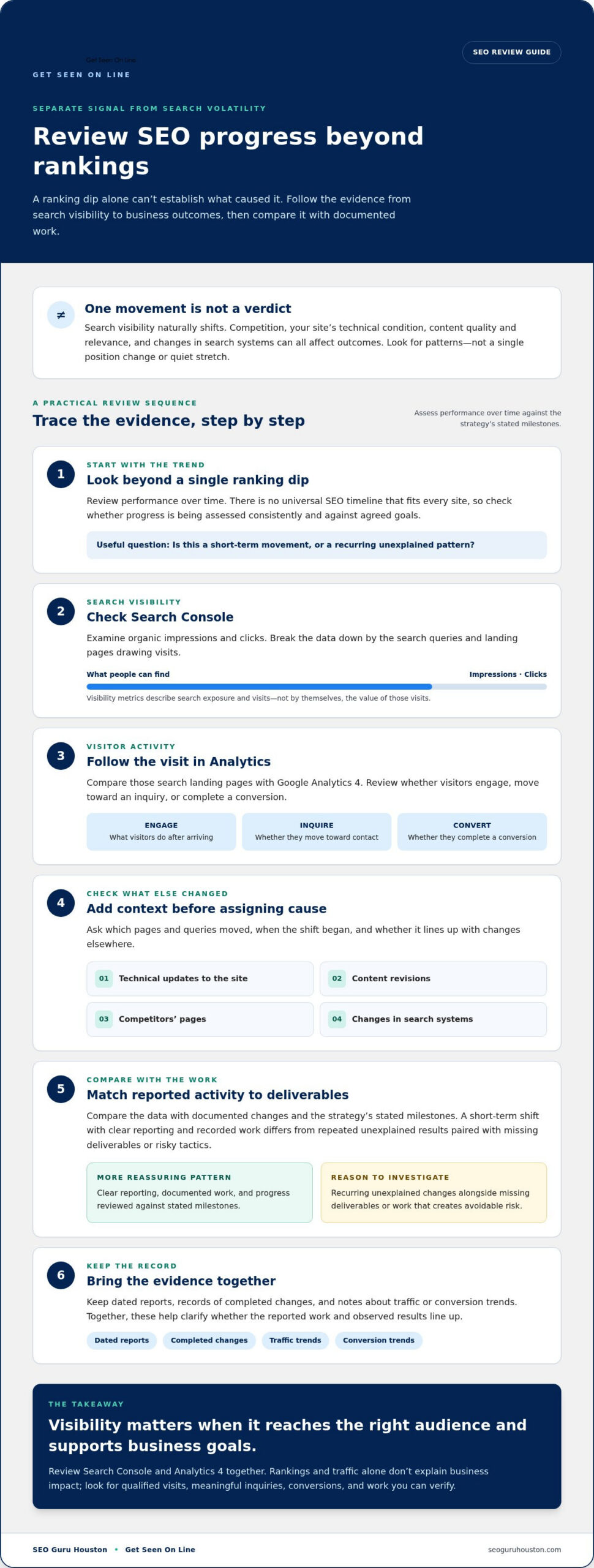
A ranking dip can feel like proof that something has gone wrong. But search visibility naturally shifts, and SEO outcomes depend on factors beyond an agency’s control, including competition, your site’s technical condition, and the quality and relevance of its content. One change in position, or a quiet stretch in traffic, can’t establish who or what caused it.
Look for a pattern instead. A short-term movement accompanied by clear reporting and documented work is different from recurring unexplained changes, risky tactics, or promised deliverables that never appear. Compare performance over time with the strategy’s stated milestones. There’s no universal timeline that fits every site, so focus on whether progress is being assessed consistently and the work is moving toward agreed goals.
Is a ranking drop proof your SEO company is failing?
No. Before drawing a conclusion, consider what else changed: a technical update, a content revision, shifts in competitors’ pages, or changes in search systems. Ask which pages and queries moved, when the shift began, and whether the change lines up with documented site or SEO work. The signs of a bad seo company are more persuasive when a pattern of unexplained results appears alongside missing deliverables or work that creates avoidable risk.
Keep evidence together: dated reports, records of completed changes, and notes about traffic or conversion trends. If you suspect deceptive or unfair business conduct rather than ordinary underperformance, the Federal Trade Commission (FTC) offers information about reporting such concerns in the United States.
Which SEO metrics reveal progress beyond rankings?
Use Google Search Console to examine organic impressions and clicks, including the queries and landing pages drawing search visits. Then compare those pages with Google Analytics 4 data to understand what visitors do after arriving: whether they engage, move toward an inquiry, or complete a conversion. Review these sources together, since neither rankings nor traffic alone explains the business impact.
Visibility metrics show whether people can find you; business-context metrics show whether that visibility is attracting the right audience and supporting growth. A rise in clicks to an irrelevant page may not help your goals, while a smaller stream of qualified visits can be valuable if it leads to meaningful inquiries. Assess trends alongside completed deliverables, and ask for a clear explanation when the data and reported work don’t line up.
If you’re reassessing your approach, explore how SEO strategy can support business goals by connecting search visibility with qualified traffic and conversions.
How to review an SEO company’s work, reports, and account access
Use a repeatable review, not a gut check. Start by confirming you can access the relevant accounts, then compare the SEO plan with its reports, completed tasks, and business outcomes. This makes it easier to identify gaps without assuming that a disappointing metric proves poor service.
- Confirm access: Sign in to your business’s Google Search Console and Google Analytics 4 properties.
- Define the goals: Identify the outcomes the strategy is meant to support, such as qualified organic visits, inquiries, or conversions.
- Inspect the reports: Check the reporting period, metrics, findings, completed actions, and proposed next steps.
- Match work to strategy: Compare reported tasks with visible content updates, site changes, and documented technical findings.
- Assess outcomes: Consider trends in search visibility alongside landing-page performance and business results.
Google’s SEO Starter Guide provides context for claims about search fundamentals and practices. Use Google Search Central documentation to assess whether explanations align with published guidance, rather than accepting technical-sounding claims without evidence. Access to data makes a review possible, but it doesn’t prove the work is effective or appropriate. The signs of a bad seo company become clearer when access problems are part of a wider pattern of unclear work or unsubstantiated reporting.
What should an SEO report show?
A useful report identifies the period covered, the goals being tracked, work completed, findings, and next steps. It should explain changes in organic impressions and clicks in context, such as which landing pages gained or lost search visits and whether those visits led to measurable conversion actions. If lead quality can be assessed, include that context too. Rankings are one indicator, not the whole performance story.
Look for a clear connection between an action and its purpose. For example, a report that lists a page update should identify the page, summarize what changed, and explain what the team will monitor. If the report presents a metric without interpretation, ask how it relates to the strategy’s goals.
What account access and ownership should you review?
Confirm that your business can access its own Google Search Console and Google Analytics 4 properties. Also identify who controls the website, domain registration, tracking configuration, and other marketing accounts used in the work. Access arrangements can differ, but you should know who holds administrative control and how access can be maintained if the relationship changes.
Record missing access or unclear ownership before changing settings or removing users. Document which account is involved, who currently controls it, and what access you need. That creates a clear starting point for resolving the issue without disrupting tracking or site operations.
What to do when your SEO company shows these warning signs
Don’t make a major decision based on a vague concern. Build a clear record first, then use it to seek answers and decide whether the engagement can be corrected. Note the specific claim or issue, the date, the related report or message, any missing deliverable, and the account or access involved. Keep copies of reports and relevant site or campaign settings you can access.
Next, request a focused review meeting. Bring the agreed goals, documented work, and the evidence that raised concern. Ask for a plain-language explanation of what was completed, what remains, and how the next steps will address the issue. A credible corrective plan should name the root problem, assign actions, connect those actions to business goals, and set a review point. Vague reassurance isn’t a plan.
Prioritize account security and ownership. Confirm you can access your business accounts and understand who controls the website, domain, tracking, and marketing tools. Before removing access, changing technical settings, or ending the relationship, preserve records and make sure you won’t lose control of essential accounts or disrupt tracking. The signs of a bad seo company matter most when the company won’t address documented issues or repeatedly avoids accountability.
How should you raise concerns about SEO performance?
Keep the discussion specific and evidence-based. Instead of saying, “SEO isn’t working,” point to an agreed goal, a report period, a missing deliverable, or a change that needs explanation. Ask which completed actions support the strategy, what the current data suggests, and which priorities come next. After the meeting, write down commitments, owners, and review dates so you can assess progress against the same expectations.
When should you consider changing your SEO approach?
Consider a change if opacity continues, access concerns remain unresolved, or the work relies on tactics that conflict with Google Search guidance. Before a transition, preserve account access and document current site, tracking, and campaign settings. Avoid abrupt technical changes until you understand what they do and how they could affect search visibility. A careful handoff protects continuity while giving you a clearer basis for deciding what should change.
Ready to connect search visibility with qualified traffic and business goals? Explore SEO strategy and services to move toward a more focused growth plan.
What a trustworthy SEO partnership should deliver, and how to move forward
A strong SEO partnership doesn’t sell certainty. It gives you realistic expectations, a strategy you can understand, reporting that explains progress and setbacks, and communication that makes responsibilities clear. Most of all, its work connects to your audience and business goals, not just a list of completed tasks.
How can you recognize accountable SEO work?
Look for a plan that explains how technical improvements, content, and authority-building activities support your stated objectives. The right priorities depend on your site and audience, but each recommendation should have a clear purpose. Reporting should explain what the team decided, what changed, what the evidence suggests, and what comes next. If a result falls short, expect a reasoned explanation and an adjustment, not just another chart.
An accountable SEO partnership sets realistic expectations, explains its strategy, reports on evidence and outcomes, and takes responsibility for clear next steps. Use that standard alongside the warning signs you’ve reviewed. It helps distinguish a working relationship that needs better alignment from one that repeatedly avoids transparency.
How can SEO support broader business growth?
Search visibility can contribute to demand generation when it connects the right audience with useful pages designed to guide visitors toward a meaningful action. SEO can help people discover relevant content; a focused landing page can make the next step clear. Depending on your goals, PPC may complement organic search by supporting paid visibility. These channels should work toward shared business objectives, not operate as disconnected activity.
For more context on building search visibility, see Professional SEO Services: Dominating the 2026 Search Ecosystem. The broader relationship between search strategy and marketing goals is also explored in SEO MARKETING COMPANY: Dominate Search and Explode Your Revenue in 2026!
Choose a practical next step: define the outcomes that matter, review the evidence against them, and agree on a strategy with clear responsibilities and measurable priorities. If your current approach can’t meet that standard, use what you’ve documented to guide a more accountable growth plan.
Make your next SEO decision with confidence
The clearest signs of a bad seo company aren’t a single ranking dip or a slow month. Look for recurring patterns: promises presented as certainties, work you can’t verify, reports disconnected from business results, or restricted access to your own accounts. Review the evidence over time, and distinguish ordinary search movement from practices that deserve a closer look.
A stronger partnership gives you realistic expectations, an explainable strategy, transparent reporting, and clear next steps. Judge progress by more than rankings: consider whether SEO is attracting qualified visitors and supporting leads and conversions. When your goals call for it, SEO and PPC can work alongside website development and landing pages to support visibility and lead generation.
Start by defining the outcomes that matter, reviewing the work against those goals, and choosing a strategy you can understand and evaluate. Explore SEO strategies built around measurable business growth. Take control of your search strategy with evidence, clarity, and a focus on the customers you want to reach.
Frequently Asked Questions
What are the biggest signs of a bad SEO company?
Common signs of a bad seo company include guaranteed rankings, tactics the company refuses to explain, reports that don’t connect work to business goals, and restricted access to your accounts. Look for a recurring pattern rather than treating one missed update or ranking dip as proof. Ask for evidence of completed work, a clear explanation of the strategy, and reporting that relates search activity to qualified traffic, leads, or conversions.
Can an SEO company guarantee first-page Google rankings?
No company can control Google’s search results, so a guaranteed first-page position should make you cautious. A responsible SEO partner can set targets, explain the strategy, and track progress, but rankings depend on factors such as competition, your site, and search systems. Ask what actions support the target, how progress will be measured, and what the company will do if results differ from expectations.
How long should SEO take to show results?
There isn’t one reliable timeline for every SEO campaign. Progress depends on factors such as your site’s condition, competition, content, and the scope of the work. Rather than relying on a promised deadline, review the strategy’s stated milestones and evidence of completed tasks. Ask how progress will be evaluated over time, including search visibility, organic traffic, and meaningful outcomes like inquiries or conversions.
Is a sudden drop in rankings proof my SEO company did something wrong?
No. A single ranking drop doesn’t establish cause or responsibility. Technical changes, content updates, competitors, and search-system changes can all affect visibility. Review which pages and queries changed, when the shift began, and whether it aligns with documented work. Check Google Search Console for notifications about manual actions. A ranking change after a broad search update isn’t automatically a penalty; assess patterns, deliverables, and business outcomes before deciding what happened.
What should an SEO company include in its monthly report?
A useful report should identify the period covered, agreed goals, completed work, findings, and next steps. It should explain organic impressions and clicks in context, such as which landing pages changed and whether visitors took measurable actions. Rankings can provide useful context, but they shouldn’t stand alone. Look for clear reporting on qualified traffic, inquiries, or conversions where tracking allows, and ask for plain-language explanations of unexplained changes.
Should my business own its Google Search Console and Analytics accounts?
Yes. Your business should retain access to its Google Search Console and Google Analytics 4 properties so you can review search performance and website activity. Confirm that you can sign in and understand who has administrative access. Also clarify ownership and access for your website, domain, and tracking setup. An agency may help manage these accounts, but your ability to review the data shouldn’t depend on its reports alone.
What should I do if my SEO company refuses to explain its work?
Document the request, the response, relevant reports, and any missing deliverables. Ask for a plain-language summary of completed actions, their purpose, and the next priorities tied to your goals. Record commitments and review dates. If explanations remain vague or account access is restricted, preserve your records and confirm control of essential accounts before changing settings or ending access. Judge the response by whether it resolves the specific concern with verifiable evidence.

