
Weighing the in-house marketing vs agency pros and cons starts with a practical question: which capabilities should your business own, and where would specialist support make a bigger difference? The answer affects your control, execution capacity, and ability to connect marketing activity to measurable business goals.
Keeping marketing close to the business can help your team understand customers and respond to changing priorities. But a small team may struggle to cover every channel, while agency support without clear ownership can create extra coordination instead of better execution. The right model should fit your goals, workload, and internal expertise.
This guide compares in-house, agency, and hybrid marketing. You’ll learn how to evaluate control, specialist skills, capacity, and accountability, with practical examples involving SEO, PPC, and landing pages. You’ll also find a framework for assigning responsibilities and setting expectations for the work.
Key Takeaways
- Compare the in-house marketing vs agency pros and cons across control, expertise, capacity, continuity, coordination, and accountability.
- Assess actual team capacity, including hiring, onboarding, current workloads, and the time needed to manage marketing.
- Start with business outcomes, then identify which skills and recurring tasks your team can realistically own.
- Keep strategy ownership and business context internal while using specialist support where execution needs exceed your team’s capabilities.
- Consider a hybrid model that combines internal priorities and approvals with external expertise in areas such as SEO, PPC, and landing pages.
In-House Marketing vs. Agency: What Each Model Actually Means
Every marketing model needs a clear strategy, skilled execution, and a way to measure progress. The in-house marketing vs agency pros and cons comparison is about how that work gets done, not whether marketing deserves investment.
In-house marketing means employees own and perform marketing work within the company; agency marketing means an external partner contributes specialist guidance, execution, or both. An advertising agency is an outside organization that supports clients’ advertising and marketing efforts. Agency engagements can focus on one discipline or cover a wider range of work. Neither model guarantees better results. Clear responsibilities, communication, and alignment with business goals matter in either case.
What does an in-house marketing team typically handle?
Employees are close to the company’s brand, products, customers, and internal decision-makers. They may plan content, coordinate campaigns, monitor analytics, and work with sales, leadership, or product teams. That proximity can help keep marketing connected to day-to-day business priorities.
The team’s scope depends on its headcount, skills, and goals. A small team may focus on a few core activities, while a larger department may divide work across channels and specialisms. Internal knowledge is valuable, but it does not guarantee enough time or expertise to execute every task well.
What does an agency contribute to a marketing operation?
An agency can add specialist skills and execution capacity without requiring every capability to sit on the company payroll. Depending on the engagement, it may guide strategy, carry out defined work, or collaborate with employees. SEO, PPC, web development, and landing pages can be handled internally, externally, or jointly.
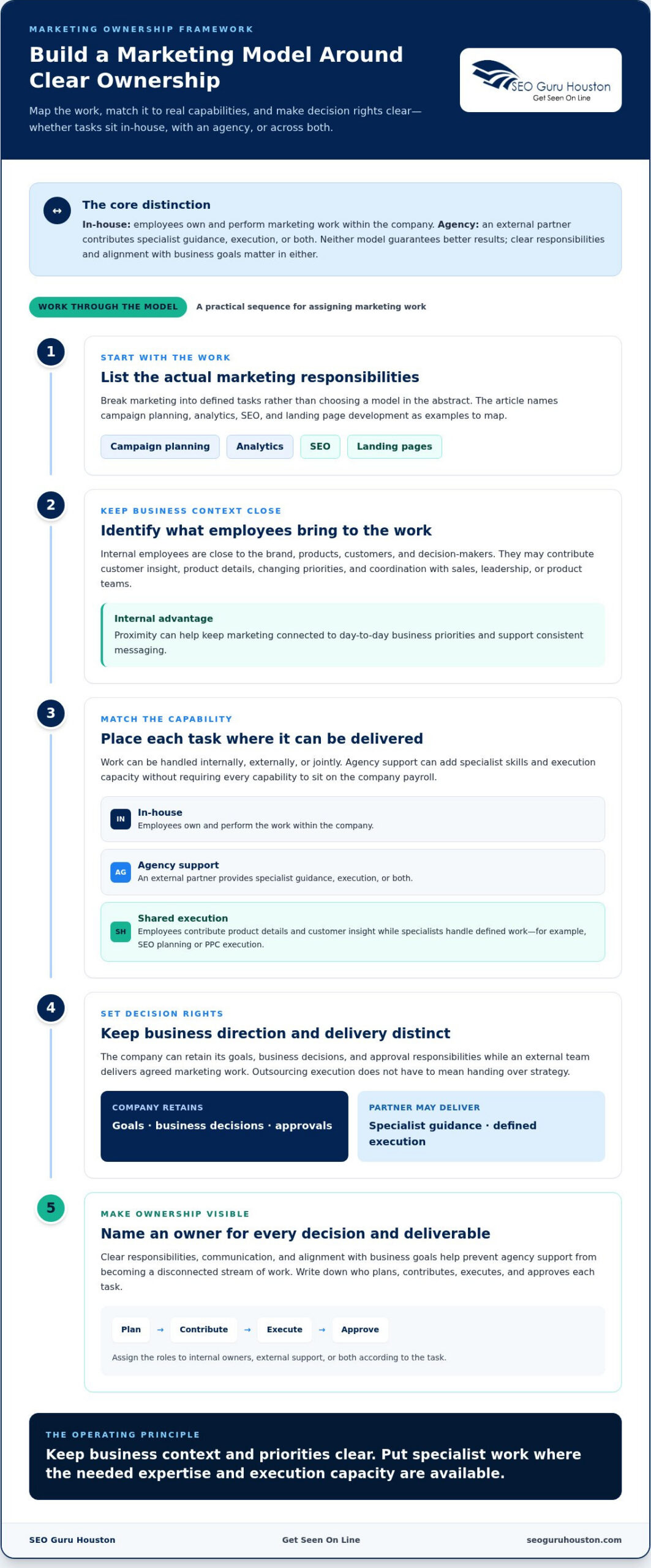
For example, employees can provide product details and customer insight while an external specialist handles SEO planning or PPC execution. The agency contributes expertise and delivery capacity; the company retains its business decisions, goals, and approval responsibilities. Clear ownership helps avoid the misconception that outsourcing execution means handing over strategy.
The practical distinction is where capabilities sit and who is accountable for each decision or deliverable. Map specific work, such as campaign planning, analytics, SEO, and landing page development, to internal owners and external support. This makes the in-house marketing vs agency pros and cons easier to assess and shows where specialist help could extend your team’s capacity.
In-House Marketing Pros and Cons: Control, Context, and Team Capacity
An internal team can move quickly because its members are close to the people, products, and decisions that shape marketing. But company knowledge and control do not guarantee effective campaigns. The practical question is whether employees have the time and skills to turn that context into consistent execution.
Where in-house marketing has an advantage
Employees work alongside product, sales, and leadership teams. They can hear customer feedback directly, understand changes in business priorities, and bring that insight into campaign planning. Their proximity can also support consistent messaging and simplify approvals, since they do not need an outside partner to learn the business from scratch.
That control is most valuable when the team has clear processes, enough capacity, and the expertise to deliver. An internal marketer may respond quickly to a product update, for example, but responsiveness is not the same as deep expertise in every channel. A team can know the brand well and still need specialist support for complex SEO work. A guide to professional SEO services can help clarify what that work involves.
Where an internal team can run into limits
One or two generalists may be responsible for content, campaign coordination, analytics, paid media, and search optimization. That breadth can leave little time for focused testing or ongoing improvement. Recruiting and developing specialist skills takes time, and onboarding, management, and employee retention all affect delivery. If a key employee leaves or priorities change, work may slow while responsibilities are reassigned.
The result can be a gap between planned marketing and what the team can reliably execute. Campaigns may launch late, optimization may be postponed, and activity across channels may become inconsistent. These problems are not inevitable with an in-house team. They are signs that workload and available expertise need closer attention.
Separate internal responsiveness from specialist depth when weighing the in-house marketing vs agency pros and cons. If your team understands the brand but has limited SEO capacity, external expertise can complement its work rather than replace its business insight. Harvard Business School Working Knowledge explores the strategic considerations involved in deciding whether to bring advertising expertise in-house.
Map recurring marketing tasks against the skills and time your team can consistently provide. If SEO execution is a bottleneck, specialist SEO support can extend capacity while internal stakeholders retain brand context and priorities.
Agency Marketing Pros and Cons: Specialist Skills Without Losing Accountability
An agency can add expertise and execution capacity, but outsourcing work does not mean surrendering business direction. Your company can retain ownership of goals, priorities, budgets, and approvals while an external team delivers agreed marketing work. Clear decision rights distinguish useful support from a disconnected stream of tasks.
Agency advantages: expertise, capacity, and execution
Specialists can bring focused experience in disciplines such as SEO, PPC, and web development. Their support can be useful when a launch, growth initiative, or uneven workload calls for skills your internal team does not use every day. For example, PPC management can include campaign setup, monitoring, and ongoing optimization, while company stakeholders provide product knowledge and approve business priorities.
Agency value depends on measurable outcomes, not activity volume. A report full of tasks or clicks is not enough on its own. Agree on the business objective, relevant performance indicators, reporting cadence, and how results will guide next steps. Outcomes depend on the work, context, and constraints, so set expectations around what the engagement can influence and how progress will be assessed.
Agency drawbacks: coordination, context, and oversight
External specialists need timely information and access to the right decision-makers. If a brief leaves the target audience unclear, approvals stall, or the agency cannot get answers about a product change, execution may drift from business needs. Coordination also takes internal time. Assign someone to consolidate feedback, resolve competing priorities, and connect agency work to sales and leadership goals.
Give channel-specific work explicit owners. A PPC management plan, for instance, should clarify what the agency handles, what the company approves, and which indicators will be reported. Define how campaign changes, budget decisions, and performance reviews will be managed before activity begins.
Compare the trade-offs
| Area | Potential agency advantage | What to manage |
|---|---|---|
| Expertise | Focused skills across specialist channels | Set priorities and define the work’s purpose |
| Control | Execution support while internal leaders retain decisions | Document approvals and decision rights |
| Capacity | Additional delivery support for defined needs | Align workload and scope with available resources |
| Continuity | External support can sustain assigned work | Keep records, access, and knowledge organized |
| Coordination | Specialists can collaborate with internal teams | Provide timely context and a clear point of contact |
| Accountability | Regular reporting can make progress visible | Connect metrics to goals and agreed actions |
Evaluate how the partnership will work, not just which tasks it covers. A written scope, named owners, shared reporting, and scheduled reviews help preserve strategy ownership while making external execution accountable.
How to Choose In-House Marketing vs. an Agency for Your Situation
Choose the operating model that closes the gap between your business goals and your team’s ability to execute. Start with the outcome you need, then decide who should own the strategy, deliver the work, and measure progress. This keeps the in-house marketing vs agency pros and cons grounded in capability rather than channel preference.
- Define the business outcome. Specify the change marketing needs to support, such as attracting more qualified traffic, improving lead quality, or contributing to pipeline growth. If coordinated pipeline goals are central, use B2B demand generation planning to connect marketing activity with sales priorities.
- Assess internal capacity honestly. List your team’s relevant skills, current workload, and available management time. Consider whether employees can sustain the work alongside existing responsibilities and whether they have the expertise for tasks that require specialist execution.
- Sort work by ownership and need. Separate strategic decisions, such as audience and priorities, from specialist execution and routine coordination. Rank tasks by business impact, urgency, complexity, and available internal skills. Identify whether each need is ongoing, project-based, or tied to a defined growth push.
- Assign clear accountability. For every priority task, name the person responsible for delivery, the decision-maker, the measure of progress, and how often results will be reviewed. Shared work still needs one clear owner for decisions and follow-through.
- Set expectations and review the model. Establish a baseline and choose KPIs that connect to the objective, such as qualified traffic, leads, conversion rates, or pipeline contribution. Name the reporting owner, set a review period, and agree how to adjust direction when the evidence calls for it.
Compare the full resource commitment
A fair comparison includes more than the person doing the work. Account for internal hiring and training, specialist skill gaps, employee workload, and the time required to brief and manage an external partner. Neither model guarantees savings. The right choice depends on the capabilities you need, how consistently you need them, and the internal effort required to support delivery.
For example, your team may own customer insight and pipeline priorities but lack the time or expertise to coordinate specialist execution. External support can fill that gap. If work is closely tied to daily internal decisions and your team has the skills and capacity, keeping execution in-house may fit better.
Use this process to create a practical ownership plan, then explore B2B demand generation support for coordinated marketing work tied to pipeline goals.
Build a Hybrid Marketing Model That Can Scale With Your Business
A hybrid model keeps business knowledge and strategic control close to your team while adding specialist execution where internal capacity or expertise is limited. Employees set priorities, provide product and customer insight, approve key decisions, and connect marketing activity to revenue goals. Agency specialists handle clearly defined work, such as SEO, PPC, or landing page execution, and report against agreed measures.
The model works when responsibilities are explicit. Treat the agency as an extension of your marketing operation, not a substitute for internal leadership. One internal point of contact should coordinate priorities, provide timely decisions, and keep both sides aligned.
Divide responsibilities clearly between employees and agency specialists
Use a responsibility matrix to name an owner for each part of the work. Adapt this starting point to your team and engagement:
- Strategy and priorities: Internal leadership owns business goals; agency specialists contribute channel recommendations.
- Execution: The agency delivers agreed specialist tasks; employees provide the context and inputs needed.
- Approvals: Internal stakeholders make final decisions on brand, product, and business commitments.
- Analytics: The agency manages or supports channel measurement; the internal owner connects findings to business context.
- Reporting: The agency reports agreed metrics and actions; the internal point of contact leads review and follow-up.
Agree on what counts as a qualified lead, conversion, and successful campaign before reporting begins. Clarify how attribution will be interpreted, which data sources matter, and how often performance will be reviewed. Shared definitions reduce confusion and help the team decide what to adjust, continue, or stop.
Know when to expand, outsource, or rebalance
Consider hiring internally when work requires sustained ownership, close daily coordination, and ongoing decisions tied to company operations. Agency support can fit when specialist skills or flexible execution capacity are the immediate constraint. The right balance can change as goals, channel mix, workload, and internal capabilities evolve. Revisit responsibilities and measures rather than letting an old setup run by default.
The in-house marketing vs agency pros and cons discussion is most useful when it leads to a working plan: who owns each decision, what gets delivered, how success is measured, and when the team will reassess. That structure helps a business retain control without limiting execution to the skills already on staff.
For an approach that connects specialist marketing work to business priorities, explore our marketing services.
Make Your Marketing Model Work for Your Next Stage of Growth
The right choice is not automatically all in-house or all agency. Use the in-house marketing vs agency pros and cons to decide which work needs close company ownership and where specialist support can extend capacity. Keep business priorities, product insight, approvals, and revenue context clear, then connect each responsibility to measurable outcomes and regular reviews.
A hybrid approach can combine internal knowledge with focused execution. SEO, PPC, B2B marketing, and inbound marketing can work alongside web development and landing page design, with responsibilities shaped around your goals and team capabilities.
Turn your priorities into a practical plan with marketing support built around your growth goals. Define the work, ownership, and measures that matter, then review progress and adjust as your needs change.
Frequently Asked Questions
Is in-house marketing better than hiring an agency?
Neither model is universally better. The right fit depends on your goals, internal capabilities, workload, and need for specialist skills. An in-house team has close access to company knowledge and day-to-day decisions. An agency can add expertise and execution capacity for specific channels or projects. Compare who can own the strategy, complete the work consistently, and report against meaningful business outcomes. A hybrid model can combine internal direction with external support.
What are the main pros and cons of an in-house marketing team?
An in-house team can build deep product and customer knowledge, coordinate closely with colleagues, and respond quickly as priorities change. The trade-off is that hiring, onboarding, training, and retaining skilled employees takes time and management effort. A small team may also struggle to cover specialist channels alongside routine work. Assess whether employees have the expertise and available capacity to deliver consistently, rather than judging the model by internal control alone.
What are the advantages and disadvantages of a marketing agency?
A marketing agency can provide specialist expertise, flexible execution capacity, and an outside perspective without requiring every skill to sit internally. External teams need clear briefs, timely business context, access to decision-makers, and coordinated approvals. Set the scope, responsibilities, reporting expectations, and performance measures at the start. Outsourcing execution does not mean giving up strategy ownership: your company can retain goals, priorities, and final business decisions while specialists deliver agreed work.
How much does in-house marketing cost compared with an agency?
The comparison depends on the roles, expertise, and scope of work involved. For an internal team, consider compensation alongside recruitment, onboarding, benefits, training, software, and management time. For an agency, assess the agreed scope, deliverables, reporting, and any resources your team must provide. Neither option is automatically less expensive. Compare the total resources needed to meet your goals, including coordination time and the cost of capability gaps or inconsistent execution.
Can a small business use both an in-house team and an agency?
Yes. A small business can keep priorities, approvals, customer insight, and revenue context with an internal owner while assigning defined specialist tasks to an agency. Employees might set campaign goals and provide product information while external specialists support SEO, PPC, or landing page work. Name one internal point of contact, agree on deliverables and measures, and establish a regular review routine so shared work stays coordinated and accountable.
When should a company switch from in-house marketing to an agency?
Consider agency support when recurring marketing work exceeds your team’s available capacity, specialist skills are missing, or execution is repeatedly delayed. A full switch is not always necessary. Identify which tasks need outside expertise and which decisions should remain internal. Define the business outcome, assign an internal decision-maker, and agree on reporting measures before work begins. If the need involves sustained daily coordination and ownership, building internal capability may be a better fit.
Ready to decide which marketing work to own and where to add specialist support? Talk with our team about a growth plan.

