
What if your next growth move isn’t adding another marketing channel, but getting the right expertise behind the ones you already use? If you’re asking when to hire a digital marketing agency, look at the gap between your goals and your team’s capacity to execute and measure. Campaigns that keep slipping, disconnected channel activity, and unclear links between marketing and qualified leads are signals worth investigating.
You don’t need to outsource every marketing decision to make progress. But when your team lacks the time or specialist skills to build a consistent strategy, outside support can turn scattered effort into focused work tied to business outcomes. The key is to set priorities, share useful information, and agree on how success will be measured.
This 2026 decision guide will help you recognize when agency support is timely, what to prepare before engaging a team, and how to make the investment accountable. You’ll learn how to assess readiness, match needs such as search visibility, paid campaigns, and landing page performance to relevant services, and set goals and measurement expectations before work begins.
Key Takeaways
- Recognize when stalled progress, inconsistent execution, skill gaps, or limited capacity make outside expertise a strategic next step.
- Before choosing channels or tactics, clarify your business goals, audience, offer, available data, and decision-makers.
- Connect needs such as stronger search visibility or more qualified leads to relevant capabilities and meaningful measures of success.
- Set a focused scope and document responsibilities, communication, decision rights, and reporting expectations before work begins.
- Use a readiness checklist to decide when to hire a digital marketing agency, when to prepare first, or when your current team can keep moving forward.
When should you hire a digital marketing agency? Recognize the signals
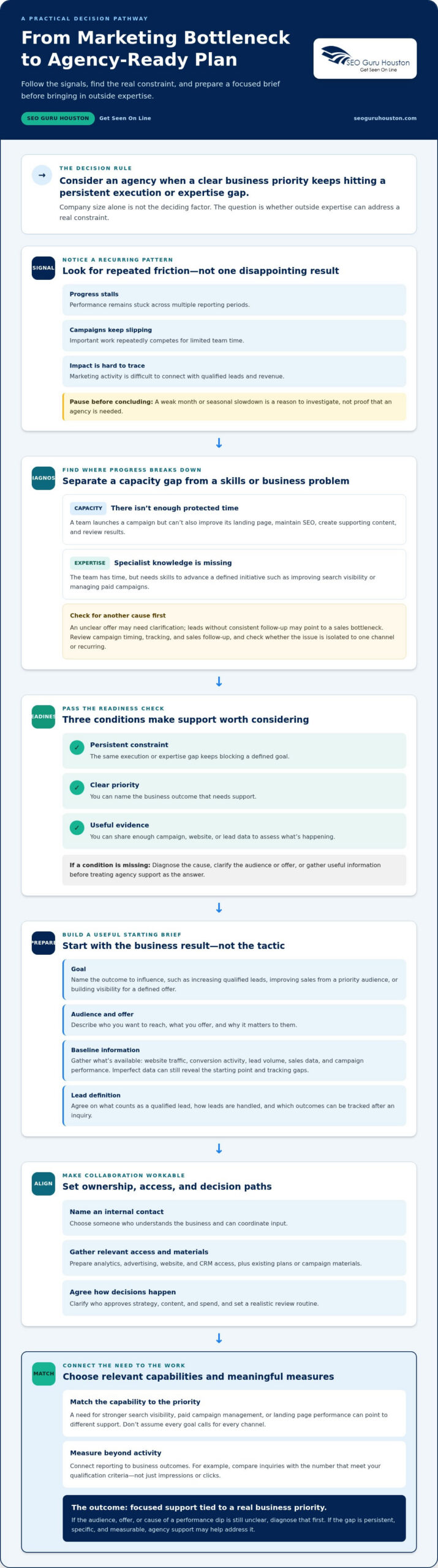
Hiring an agency is a strategic decision, not an automatic milestone as your business grows. The right time is when a clear business priority keeps running into a persistent execution or expertise gap. A small team may be ready if it has a defined growth goal and needs specialist support. A larger company may not need an agency if its in-house team has the time and skills to deliver.
Look for a pattern rather than reacting to one disappointing result. Progress may stall across multiple reporting periods, important campaigns may repeatedly slip, or marketing activity may be difficult to connect to qualified leads and revenue. A temporary campaign dip or seasonal slowdown calls for diagnosis first. Check whether the change is limited to one channel or points to a recurring issue. Review campaign timing, tracking, and sales follow-up before deciding that outside help is the answer.
Which marketing problems signal a capacity or expertise gap?
A capacity gap appears when essential work repeatedly competes for the same limited hours. Your team might launch a campaign but lack time to improve its landing page, maintain SEO, create supporting content, and review results. A skills gap is different: the team has time, but not the specialist knowledge to advance a defined initiative, such as improving search visibility or managing paid campaigns. Because Digital marketing spans multiple channels and methods, identify the capability you need instead of assuming you need help with everything.
Separate execution problems from strategy or sales problems, too. If customers don’t understand the offer, more promotion may amplify the confusion. If leads arrive but aren’t followed up consistently, the bottleneck may be in sales rather than marketing. Pinpoint where progress breaks down before assigning the problem to an agency.
When is an agency premature or unnecessary?
Promotion works best when you can explain who the offer serves, what value it provides, and what action you want customers to take. If those fundamentals are unsettled, clarify them before scaling campaigns. Likewise, don’t treat one weak month as proof that you need an outside team. Review the underlying data, compare performance over an appropriate period, and look for a recurring constraint.
Focused internal execution may be the right choice when your team has the relevant skills, protected time, and a way to measure progress. Use this quick readiness check:
- Persistent constraint: The same execution or expertise gap keeps blocking a defined goal.
- Clear priority: You can name the business outcome that needs support.
- Useful evidence: You can share enough campaign, website, or lead data to assess what’s happening.
If those conditions are present, agency support may help close a specific gap. If the audience, offer, or cause of a performance dip is still unclear, diagnose that first. The deciding factor isn’t company size. It’s whether outside expertise can address a real constraint tied to a business priority.
What should your business have in place before hiring an agency?
You don’t need a flawless marketing operation before bringing in outside expertise. You do need enough clarity to collaborate: what the business is trying to achieve, who it serves, what it offers, what information is available, and who can make decisions. This preparation keeps the work anchored to business outcomes rather than defaulting to channel activity.
Start with the result, not the tactic. “Grow the business” is an ambition; increasing qualified leads, improving sales from a priority audience, or building visibility for a defined offer gives the work a clearer direction. Once the outcome is clear, assess whether SEO, PPC, a landing page, or another approach fits the need. That sequence helps you evaluate when to hire a digital marketing agency without assuming every goal calls for every channel.
Set goals and establish a usable baseline
Write down the priority, the audience you want to reach, and the offer you want them to consider. Then gather the baseline information you already have: website traffic, conversion activity, lead volume, sales data, and campaign performance. The data doesn’t need to be perfect. It should help your team and agency understand the starting point and identify gaps in tracking.
Connect marketing measures to the sales process. Clarify what counts as a qualified lead, how leads are handled, and which outcomes the business can track after an inquiry. For example, compare the number of inquiries with the number that meet your qualification criteria. That context makes reporting more useful than a list of impressions or clicks alone.
Prepare the people, access, and decision process
Name an internal contact who understands the business and can coordinate input. Gather access to relevant analytics, advertising, website, and CRM accounts, along with existing plans or campaign materials. Decide who approves strategy, content, and spend, and agree on a realistic routine for reviews. Clear ownership prevents important decisions from stalling between teams.
Use this short preparation sequence before an agency conversation:
- Goal: State the business outcome you want to influence.
- Audience and offer: Describe who you serve and why the offer matters to them.
- Data: Collect available performance and sales information, noting any gaps.
- People: Identify the day-to-day contact and decision-makers.
- Process: Clarify access, approval responsibilities, and review expectations.
Readiness means being prepared to share context, make timely decisions, and learn from evidence, not having every metric or process optimized in advance. If your priorities involve visibility, qualified traffic, or lead generation, reviewing SEO and PPC marketing support can help you identify capabilities that fit those goals.
How do you know agency support can deliver value, not just activity?
Agency support creates value when it closes a specific capability or capacity gap and ties the work to a business priority. Compare the options realistically: an internal team may know the product and customers deeply, while an agency can add specialist expertise or execution capacity. Either model still needs coordination, timely decisions, and clear accountability. The question of when to hire a digital marketing agency comes down to whether the added support can advance an outcome your team has defined, not simply produce more tasks.
Separate deliverables from results. Publishing content, launching ads, or building a landing page are deliverables. Qualified opportunities, sales, and stronger visibility for relevant searches are outcomes. Deliverables can be tracked directly; outcomes depend on factors such as the offer, execution, competition, customer behavior, and measurement quality. No channel or agency can guarantee a particular business result.
Which capabilities may be worth bringing in?
Match support to the constraint. SEO can build organic visibility and attract relevant search traffic over time. PPC can capture paid demand and support disciplined campaign testing. Website development and landing pages can improve the path from an ad or search result to a meaningful action. These capabilities work best when the audience, offer, and desired next step are clear.
| Business need | Relevant capability | Useful measures |
|---|---|---|
| Improve visibility for relevant searches | SEO | Organic impressions, relevant traffic, qualified inquiries |
| Reach people actively searching for an offer | PPC | Campaign traffic, conversion activity, cost per qualified lead |
| Turn campaign visits into inquiries | Landing pages or website development | Conversion rate, form submissions, qualified leads |
What should meaningful reporting help you understand?
Good reporting explains what changed, what it may mean, and what action comes next. Google Analytics can help assess website visits and on-site behavior. Google Search Console can show search visibility and activity from organic results. CRM data can help connect inquiries to lead quality and sales progress. These sources answer different questions, so they’re most useful when interpreted together.
Separate leading indicators, such as impressions, clicks, and page conversions, from downstream outcomes like qualified opportunities and closed sales. Revenue attribution may be incomplete when customer journeys span channels or data is missing, so make limitations visible rather than overstating certainty. In regular reviews, expect a clear account of work completed, performance against agreed measures, decisions made, and next steps. That’s how you judge progress, not by the length of an activity report.
How should you define scope, goals, and accountability before hiring?
A strong agency engagement starts with clear boundaries: which business priority needs attention, what work falls within scope, and how both sides will judge progress. Resist the urge to buy every channel at once. A focused first engagement makes it easier to coordinate work, interpret results, and decide what deserves investment next.
How do you choose a realistic first scope?
Start with the constraint you’ve diagnosed. If relevant searchers aren’t finding your business, SEO may fit the priority. If you need to capture existing demand through paid campaigns, PPC may be appropriate. If visitors arrive but struggle to take the next step, website development or a landing page could address the friction. Demand generation may fit when the challenge is creating and developing interest among potential buyers.
Factor in your sales cycle, internal support, and ability to measure progress. A longer sales cycle may require tracking early engagement and lead quality before closed sales provide a useful signal. A campaign also needs internal owners who can supply business context, respond to inquiries, and make timely decisions. Connected services can make sense when one isolated tactic can’t address the full path from discovery to conversion. Keep the scope focused on the business problem, not a checklist of channels.
Which expectations should be agreed before work begins?
Put the working agreement in writing so the team and agency share the same definition of progress. Include the objective, baseline measures, deliverables, responsibilities, approval rights, communication cadence, and review intervals. Clarify who provides source materials, approves content, manages access, and decides whether to adjust campaign direction or spend.
Set a review framework that considers business outcomes alongside context. A change in traffic or lead volume matters, but so do lead quality, seasonality, sales follow-up, and changes to the offer. Agree on how results and limitations will be explained, what decisions each review should inform, and how strategic changes will be communicated. This creates accountability without treating a single metric as the whole story.
- Objective: Name the business priority and the audience it serves.
- Scope: Specify the work included and what falls outside the engagement.
- Ownership: Assign agency and internal responsibilities, including approvals.
- Measurement: Record the starting point, success indicators, and reporting rhythm.
Be wary of promises of guaranteed rankings, leads, or revenue. A clear scope can make work and decisions accountable, but outcomes depend on execution, market conditions, the offer, and reliable measurement. SEO Guru Houston provides SEO, PPC, web development, and demand generation services. Explore digital marketing services to see how these capabilities can support a focused plan.
When is it time to move forward with a digital marketing agency?
Move forward when four conditions align: your business has a clear goal, a persistent capability gap is holding back progress, relevant data can be shared, and leadership agrees on the priority. That combination gives an agency something concrete to work toward and your team a basis for evaluating the work. Company size alone doesn’t determine readiness.
Still unsure when to hire a digital marketing agency? Use this decision check:
- Act now: You can name the business challenge, identify the expertise or capacity you’re missing, provide useful context or data, and get decisions from aligned leaders.
- Prepare first: Your audience, offer, goal, or measurement is unclear. Resolve those questions before expanding activity.
- Continue with current resources: Your team has the skills and protected time to address the priority, and current execution is consistent enough to assess.
Begin with the challenge, not a predetermined channel or package. A visibility problem may point toward SEO; a need to capture existing demand may call for PPC; a conversion bottleneck may involve the website or landing page. If the gap concerns reaching and developing potential business customers, B2B or inbound marketing may be relevant. The right scope follows the diagnosis.
What does a productive agency relationship require?
Strong collaboration depends on shared context: who your customers are, how your offer is positioned, how sales handles inquiries, and which business priorities matter most. The agency brings marketing expertise and execution capacity, while your team provides decisions and knowledge of the business. Progress is a cycle of strategy, implementation, measurement, and informed adjustment, not a handoff that replaces internal judgment.
What is the next step if your business is ready?
Prepare a concise brief before discussing scope. Include your goal, audience, offer, current marketing efforts, known constraints, available data, and the decisions or support your team can provide. Note whether the priority is search visibility, paid demand capture, B2B lead generation, inbound growth, or a website conversion challenge. This keeps the conversation focused on the business need and the capabilities that may address it.
With that brief in hand, you can discuss a tailored scope with SEO Guru Houston and define what progress should look like before work begins. Build a focused digital growth plan around a real business priority, clear responsibilities, and measures your team can use to make decisions.
Turn Your Marketing Priorities Into a Focused Plan
The decision about when to hire a digital marketing agency comes down to more than a growth target. Look for a clear business priority, a persistent gap your team can’t readily close, and the people, data, and decision-making support needed to act. Then define a focused scope and agree on how progress will be reviewed.
Agency support should connect expertise to business needs, not just increase the volume of marketing activity. SEO and PPC can support search visibility and qualified traffic, while B2B and inbound marketing, website development, landing pages, and demand generation can address other growth priorities. The right starting point depends on your goals, audience, and current constraints.
Ready to turn your next priority into a practical, accountable plan? Build a focused digital growth plan with SEO Guru Houston. Start with the challenge you need to solve, then move forward with clear responsibilities and measures.
Frequently Asked Questions
When should a small business hire a digital marketing agency?
A small business should consider agency support when it has a defined growth goal but lacks the time, specialist skills, or consistent execution to pursue it. First clarify your target audience, offer, and desired outcome. Then identify the specific gap external expertise would address, such as improving search visibility or managing paid campaigns. Company size matters less than readiness and a clear business need when deciding when to hire a digital marketing agency.
How do I know if my business is ready to hire a marketing agency?
Your business is ready when you can explain its priority, target audience, and desired outcome, even if the strategy is still developing. Assign an internal decision-maker, make relevant website, campaign, or CRM data accessible, and confirm who follows up with leads. You don’t need perfect reporting. You do need enough context and internal coordination to collaborate, review progress, and make timely decisions as the work develops.
Can a digital marketing agency help if my business has no marketing strategy?
Yes, an agency can help shape a strategy, but your business should contribute knowledge of its customers, offer, competitive context, and commercial goals. If those fundamentals are unclear, make clarifying them part of the strategic work. Agree on a business priority and how progress will be assessed before launching campaigns. This helps prevent disconnected tactics and keeps expectations realistic while the strategy takes shape and is put into practice.
What should I expect when hiring a digital marketing agency?
Expect an initial alignment on business goals, audience, current marketing activity, responsibilities, and measurement. The agreed scope may include SEO, PPC, website development, landing pages, or demand generation, depending on the need. Set communication and review expectations early, including who approves work and how decisions are shared. Evaluate progress through clear reporting and business context, not activity counts alone. Results depend on execution, market conditions, and measurement.
Is it better to hire an agency or build an in-house marketing team?
The right choice depends on the expertise, time, and management capacity your business needs. An in-house team may offer close day-to-day knowledge of customers and operations, while an agency can add external specialist capabilities and execution support. Some businesses combine both. Compare the skills required, how consistently the work is getting done, and whether results can be measured. Choose the approach that best supports your priorities and available resources.
How much does it cost to hire a digital marketing agency?
Agency fees vary based on the work’s scope, services, complexity, and level of support, so there isn’t one useful figure for every business. Define the business outcome and work required before comparing proposals. Review responsibilities, deliverables, reporting, and measurement alongside the fee. A low price or a long list of promised activities doesn’t establish value on its own. Focus on whether the proposed scope addresses a clear business need.
What happens if I hire a digital marketing agency before my business is ready?
An unclear offer, misaligned goals, missing account access, or limited internal follow-through can slow work and make progress harder to assess. You don’t need a perfect foundation before engaging an agency, though. Identify the biggest readiness gap and decide whether it can be addressed within a defined scope. Agree on responsibilities, access, and how progress will be reviewed. Clear expectations help both sides address constraints rather than mistake them for campaign results.

