
Amazon DSP works best not as a replacement for Sponsored Ads, but as an audience and measurement layer that can extend your media plan beyond active searches. The two approaches are easy to blur, especially when campaigns use different audiences, placements, and formats. Treating them as interchangeable can make goals and results harder to interpret. This amazon dsp advertising guide explains where each approach fits and how they can work together.
If you’re deciding which audiences to target, how to structure a campaign, or how to connect ad activity with business outcomes, start by setting objectives and measurement criteria before launch. That gives you a basis for evaluating results instead of relying on guesswork after the budget is spent. This guide covers how Amazon DSP works, when it can complement Sponsored Ads, how to compare access models, and which signals can help assess performance. You’ll be better prepared to plan a measurable campaign and connect Amazon advertising to your wider marketing goals.
Key Takeaways
- Use Amazon DSP to reach relevant audiences across eligible placements, with campaign choices tied to a clear business objective.
- Plan campaigns in sequence: define the goal, audience, creative, delivery approach, and measurement plan.
- Compare Amazon DSP with Sponsored Ads by audience strategy, placement context, and each channel’s role in the customer journey.
- This amazon dsp advertising guide explains how to distinguish delivery metrics from business outcomes and choose KPIs before launch.
- Use a readiness checklist to clarify your destination, budget controls, and measurement needs before deciding how to execute.
What Is Amazon DSP Advertising, and What Role Does It Play?
Amazon DSP is a programmatic platform for buying digital advertising placements and reaching audiences across eligible Amazon-owned and third-party environments. Instead of relying mainly on a shopper’s search terms, advertisers can use audience signals to serve display, video, and other available ad formats. This distinguishes DSP from keyword-led Sponsored Ads, which commonly appear in shopping contexts when customers search or browse products. The Demand-Side Platform (DSP) model automates the purchase of eligible ad impressions according to campaign settings.
Think of DSP as an audience-reach layer in a broader Amazon marketing plan, not a default replacement for Sponsored Ads. It can help a brand reach people before they search, reconnect with relevant audiences later, or support both stages with different messages. Inventory and features depend on the market, account eligibility, and buying arrangement. Plan around the inventory and controls available to your campaign instead of assuming every format or environment is accessible.
How does demand-side platform advertising work?
Programmatic buying uses automated bidding to compete for eligible ad impressions. The advertiser sets campaign inputs, including the objective, audience, creative, placements, and budget controls. The platform evaluates opportunities and bids according to that setup. Auction mechanics, inventory, and controls vary by placement and platform configuration, so selecting an audience does not mean the same ad will appear everywhere.
For a practical starting point, define who you want to reach and what response matters before choosing creative. A prospecting campaign might introduce a product category to a relevant audience, while remarketing could show a follow-up message to people who have already engaged. Treat these as separate campaign jobs, each with its own message and success criteria.
Which goals can Amazon DSP support?
DSP campaigns can be planned around awareness, consideration, or conversion, depending on available formats, audiences, and campaign setup. Awareness introduces a brand to relevant people; consideration encourages deeper product or brand exploration; conversion focuses on a defined action. These are planning objectives, not guaranteed results. Choose measures that match the goal and interpret performance in the context of the customer journey.
For example, a brand seeking new prospects could prioritize relevant reach and exposure, then use a separate remarketing campaign to reconnect with people who showed interest. The first campaign builds awareness; the second encourages an already-engaged audience to take a next step. Keeping those purposes distinct makes performance easier to assess and gives each creative a clear role.
This distinction is central to an effective amazon dsp advertising guide: DSP buys access to audiences across eligible placements, while Sponsored Ads commonly capture shopping intent within Amazon contexts. Use DSP when audience reach or re-engagement supports your objectives, and coordinate it with Sponsored Ads when both channels can serve different moments in the journey. Before launch, confirm the eligible inventory and capabilities for the campaign’s market and buying arrangement. Then set clear expectations for what each activity is designed to accomplish.
How to Plan an Amazon DSP Campaign From Audience to Creative
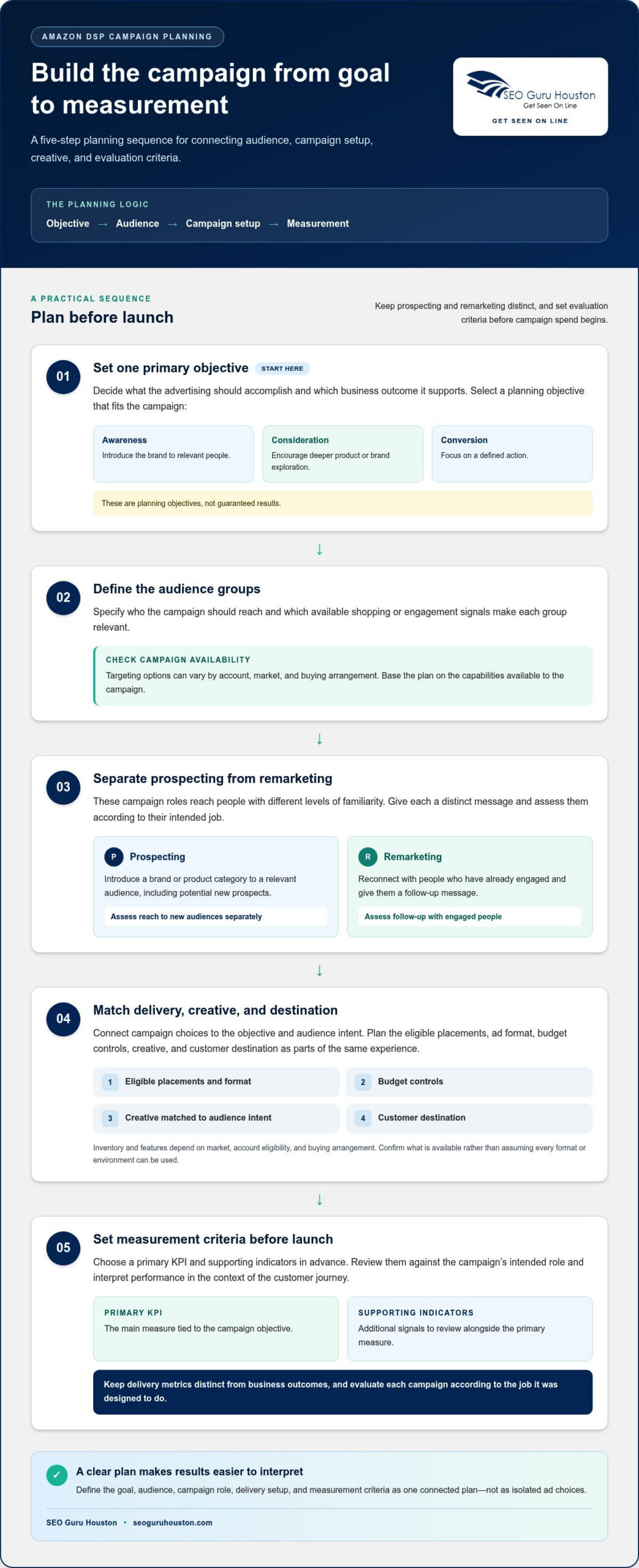
A campaign becomes more focused when every choice follows from a business objective. Before selecting audiences or formats, decide what the advertising needs to accomplish and how you’ll recognize progress. Then connect that goal to campaign structure, creative, the destination customers will visit, and a measurement plan. This sequence ties media activity to the wider Amazon marketing plan instead of treating each ad as a standalone tactic.
Set the objective, audience, and campaign structure
Start with one primary objective, such as introducing a product to potential customers or encouraging an interested audience to take a next step. Define the business outcome it should support, then identify relevant audience groups using available shopping or engagement signals. Targeting options can vary by account, market, and buying arrangement, so base the plan on current campaign capabilities rather than assumptions.
Organize prospecting and remarketing separately. Their audiences have different levels of familiarity, so they need different messages and should not be judged by identical expectations. Use this planning sequence:
- Set the objective. State the business goal and the primary outcome you’ll use to evaluate it.
- Define audience groups. Specify who the campaign should reach and which signals make each group relevant.
- Separate campaign roles. Keep prospecting distinct from remarketing so you can assess reach to new audiences separately from follow-up with engaged people.
- Choose delivery inputs. Match eligible placements, format, and budget controls to the audience and objective.
- Set measurement criteria. Choose a primary KPI and supporting indicators before launch, then review them against the campaign’s intended role.
For example, a prospecting campaign for a product category might introduce the brand to relevant shoppers, while remarketing could focus on people who have already interacted with the brand or product. The available audience signals and controls depend on the campaign setup.
Match creative and landing experience to audience intent
Creative should meet people where they are in the customer journey. An awareness message needs to communicate the product or brand clearly. A consideration message can explain a meaningful point of difference. A conversion-focused ad should make the next step easy to understand. Select formats based on the message and eligible inventory, not novelty alone.
Review the customer journey from ad to destination before launch. If an ad promotes a product, make sure the product is available and its detail page supports the promise with accurate, useful information. For off-Amazon campaigns, check that the destination page is relevant, functional, and consistent with the ad. A mismatch can undermine the experience even when the audience and creative are well chosen.
Test with discipline. Change one meaningful variable at a time, such as the headline, visual, or call to action, while keeping other elements consistent. That makes results easier to interpret and helps distinguish a creative effect from changes in audience or delivery. This amazon dsp advertising guide’s planning approach works best when testing and measurement are designed together.
When campaign strategy, execution, and destination experience need to work as one, explore Amazon marketing services as part of a coordinated growth plan.
Amazon DSP vs. Sponsored Ads: Choose the Right Channel Mix
Choose the channel based on the moment you need to influence. Sponsored Ads commonly connect products with active shopping intent, while Amazon DSP can support audience-based reach across eligible Amazon-owned and third-party placements. They address different media needs, so the decision is not simply which channel is better. Consider whether your plan needs to capture demand, build awareness beyond search, or coordinate both.
Use this comparison as a starting point. Specific formats, placements, targeting options, and reporting can vary by market, account, and campaign setup.
| Consideration | Sponsored Ads | Amazon DSP |
|---|---|---|
| Typical objective | Promote product discovery and reach shoppers showing relevant shopping intent. | Build broader audience reach, support consideration, or re-engage eligible audiences. |
| Audience approach | Often connects ads with search queries or shopping activity, depending on ad type and settings. | Uses audience-based buying, with targeting options dependent on current campaign capabilities. |
| Placement context | Commonly appears in Amazon shopping contexts, such as search results and product pages. | Can include eligible Amazon-owned and third-party environments, depending on inventory and setup. |
| Measurement considerations | Assess performance against the campaign objective, including relevant clicks and attributed sales. | Consider delivery and audience measures alongside outcomes such as product consideration and attributed conversions. |
When should a brand prioritize Sponsored Ads?
Prioritize Sponsored Ads when capturing active product searches is the immediate need. They can suit campaigns built around specific products, search intent, and product discovery. First check that the advertised catalog is available and its listings are clear, accurate, and ready to turn interest into consideration. Then assess results against the campaign’s defined objective instead of assuming every campaign should use the same success measure.
When can Amazon DSP add a complementary layer?
Consider DSP when your strategy needs to reach relevant audiences beyond active search moments or reconnect with eligible audiences who have already engaged. It is not automatically necessary or superior. Its role depends on the objective, available inventory, audience options, and your capacity to measure the campaign. Keep its purpose distinct from Sponsored Ads, and avoid counting the same outcome twice in reporting.
The channels can complement each other when their roles, budgets, and reporting are coordinated. For example, Sponsored Ads may focus on shoppers searching for a product, while DSP supports awareness among broader audiences or remarketing to eligible previous engagers. Set separate objectives and budget controls, then use a shared reporting view to understand how each channel contributes to the customer journey. That is the practical decision framework at the heart of an amazon dsp advertising guide: choose media for its job, not simply because it is available.
How to Measure Amazon DSP Performance and Address Common Concerns
Measurement starts before launch. Set one primary KPI that reflects the campaign’s business objective, then choose secondary metrics to explain what may be helping or hindering progress. A reach campaign should not be judged by the same standard as a conversion-focused effort. Define the reporting period and attribution settings in advance, too, so the team compares results consistently rather than changing the rules after seeing the numbers.
Separate delivery signals from outcomes. Impressions, reach, frequency, and spend describe how a campaign ran. Qualified visits, product consideration, and attributed conversions indicate responses or actions. Both matter, but delivery alone does not prove business impact, and an attributed conversion does not by itself establish that an ad caused a sale.
Which KPIs should an Amazon DSP campaign track?
Match measures to the campaign’s job. For awareness, monitor reach and frequency to understand audience exposure. For consideration, review engagement and relevant product signals, such as detail page views where available. For conversion objectives, assess attributed conversions alongside spend and delivery context. Keep the primary KPI focused, then use secondary indicators to diagnose performance rather than treating every metric as equally important.
Before launch, write down what each KPI means, its data source, and the decision it will inform. This makes later reporting more useful.
How can advertisers test incrementality and reduce waste?
Establish a baseline and, where data and platform options allow, compare campaign results with an appropriate holdout or another comparison method. During optimization, review frequency, audience overlap, creative fatigue, and placement quality. These checks can reveal saturation or weak delivery, but changes should follow evidence and remain aligned with the campaign objective.
Document limitations before drawing conclusions. Seasonality, price changes, inventory, promotions, and other marketing activity can affect results alongside advertising. Where available and appropriate, deeper cross-channel analysis can help assess how exposures relate to outcomes, but the method and its limits should be clear in the report.
Attribution is a measurement lens, not conclusive proof of incremental impact. It assigns credit according to defined rules; it does not necessarily show what would have happened without the ad. Campaign windows and attribution settings affect which interactions qualify for credit and therefore can change reported results. For Amazon Store ads, including DSP, Amazon’s shopping-signal enhanced last-touch model took effect on January 1, 2026, replacing the previous 14-day view-through window.
Keep reporting grounded by reading delivery, customer response, and attributed outcomes together, then qualifying conclusions according to the measurement method. For a campaign plan built around objectives and measurable growth, explore Amazon advertising support.
Turn Amazon DSP Strategy Into a Measurable Growth Plan
A campaign is ready when its objective, execution, and measurement plan connect to a business outcome. Before committing media, make sure your team can explain who it wants to reach, what the audience should see, where interested customers will go, and how performance will inform the next decision. This makes Amazon DSP a governed part of your marketing strategy rather than a standalone media test.
What should a team prepare before launching?
Use this readiness checklist to find gaps before campaign delivery begins:
- Goal: State the business objective and define the primary success measure.
- Audience: Document the intended audience, relevant signals, and the role of prospecting or remarketing.
- Product and creative: Gather accurate product information and creative that matches the campaign’s objective and audience intent.
- Destination: Confirm the product detail page or landing page is relevant, available, and consistent with the ad promise.
- Budget governance: Set spending guardrails, approval responsibilities, and the process for reviewing or adjusting investment.
- Measurement plan: Record primary and supporting KPIs, attribution settings, reporting cadence, and known limitations.
Assign owners before launch. Decide who approves creative, monitors delivery, reviews results, and authorizes optimization. Agree on a reporting cadence and what conditions would trigger a change, such as delivery outside agreed guardrails or a gap between the campaign objective and observed performance. Clear ownership keeps decisions timely and makes results easier to interpret.
How can specialist support connect campaign strategy to growth?
In-house execution can work when your team has the time, platform knowledge, creative resources, and measurement process to manage the campaign consistently. Specialized Amazon campaign support can add capacity when planning, audience strategy, creative coordination, or performance analysis competes with other priorities. The right model depends on your team’s capabilities and the work required, not on the assumption that every advertiser needs the same level of support.
Our Amazon-specific marketing can be aligned with PPC and demand generation around shared business objectives and the customer journey. This coordination helps clarify how Amazon advertising fits alongside other paid activity and demand-building efforts. Landing-page design and web development can also support a consistent post-click experience when a campaign sends customers to a website. Strategy, execution, market conditions, and measurement all shape results, so set expectations around what the campaign can test and learn rather than treating outcomes as guaranteed.
Use this amazon dsp advertising guide to turn campaign decisions into a plan your team can govern and assess. Ready to connect Amazon advertising with broader growth goals? Build a stronger Amazon marketing strategy.
Make Your Next Amazon Campaign More Intentional
Your next step is not necessarily to launch another campaign. Decide what your current plan needs to learn, then align the people, budget, and reporting around that priority. Use this amazon dsp advertising guide as a starting point for a focused working session: identify the business question, agree on how you’ll evaluate it, and assign clear ownership for acting on what the data shows.
That planning can connect Amazon-specific marketing with PPC and demand generation, so each effort supports shared business outcomes rather than competing for attention. Our digital marketing services bring these capabilities together with a focus on strategy, execution, and measurable growth. Campaign outcomes still depend on strategy, implementation, market conditions, and measurement, so build learning and optimization into the plan.
Ready to turn your next decision into a coordinated growth plan? Build a smarter Amazon advertising strategy. Move forward with clarity and make every campaign choice serve a defined purpose.
Frequently Asked Questions
What is Amazon DSP advertising?
Amazon DSP advertising is the programmatic buying of eligible digital ad placements to reach selected audiences. It can support awareness, consideration, or conversion goals, depending on campaign setup and current capabilities. Unlike keyword-led Sponsored Ads, DSP can help reach people outside an active product search. In this amazon dsp advertising guide, think of DSP as one part of a coordinated plan, not a shortcut to guaranteed sales.
Is Amazon DSP only for companies that sell on Amazon?
No. Selling products on Amazon is not the only possible strategic context for Amazon DSP, though access, inventory, and features depend on current policies and campaign arrangements. For example, a business seeking to introduce its brand to relevant audiences may assess DSP even if its main conversion destination is its own website. Before planning, clarify account eligibility and whether the intended campaign can use its chosen audience, placement, and destination.
How is Amazon DSP different from Amazon Sponsored Ads?
Sponsored Ads commonly connect product discovery with shopping intent, while DSP supports programmatic, audience-based reach across eligible placements. A brand promoting a newly launched product might use Sponsored Ads to appear in relevant shopping contexts and evaluate DSP to reach audiences earlier in their decision process. Start the comparison with the job each campaign must do, then consider audience, placement, and measurement. Confirm current product names and capabilities during planning.
Can a small or growing brand use Amazon DSP?
Potentially, if the campaign’s objectives, resources, audience strategy, and measurement needs make it a sensible fit. Company size alone does not determine suitability. A growing brand should first assess whether product listings are ready, whether it has usable creative, who will manage delivery, and what outcome the investment needs to demonstrate. If those inputs are unclear, strengthen the plan before committing rather than treating DSP access as the goal.
How much does Amazon DSP advertising cost?
There is no single cost that applies to every Amazon DSP campaign. Spend can vary with the buying arrangement, campaign setup, audience, eligible inventory, and management needs. Budget planning should also account for creative production and measurement, not just media delivery. Start with the business objective and define spending limits and evaluation criteria before launch. Then assess current platform terms and the full campaign requirements for your plan.
How long does it take to see results from Amazon DSP?
Timing depends on the objective, audience, delivery, creative, measurement window, and outcome being assessed. Delivery indicators can show whether a campaign is serving before conversion patterns are clear. For example, an awareness effort may be reviewed through exposure measures, while a sales-focused effort requires enough time and data to assess attributed actions. Set review intervals before launch and avoid firm conclusions from a small or incomplete data set.
What should I measure in an Amazon DSP campaign?
Choose metrics that answer the campaign’s business question. For awareness, review reach and frequency. For consideration, look at engagement or relevant product-interest signals. For conversion, assess attributed outcomes alongside spend and delivery. A useful reporting note records campaign dates, attribution settings, and external influences such as promotions or price changes. This context helps teams interpret the data without claiming that an ad alone caused the result.

