
Clicks can climb while your pipeline stays flat. Learning how to work effectively with a ppc agency means connecting campaign decisions to business goals, not just filling a dashboard with activity. A productive partnership depends on shared priorities, complete information, and timely approvals. Without those, even well-managed campaigns can lose momentum.
This guide explains how to build a focused, accountable relationship that connects paid campaigns to qualified leads and revenue. You’ll learn how to agree on goals and responsibilities, interpret reports, and make evidence-based decisions without unnecessary delays. We’ll also cover how useful conversion data, regular optimization, and focused landing pages help tie campaign activity to business outcomes.
Key Takeaways
- Learn how to work effectively with a ppc agency by aligning campaign priorities with qualified leads, sales, and other business outcomes.
- Prepare audience details, sales-cycle context, campaign history, and an approval process before work begins.
- Choose performance indicators that fit the campaign objective, and look beyond clicks to understand lead quality and conversion value.
- Use a recurring review process to turn evidence and timely feedback into clear tests, assigned actions, and documented learning.
- Recognize when campaign insights point to opportunities in landing pages, website development, or demand generation.
Why Working Effectively With a PPC Agency Starts With Shared Business Goals
A campaign can generate clicks and still miss the mark if those visits don’t become valuable inquiries or sales. Before discussing keywords, bids, or ad copy, agree on the business result paid advertising should support. Pay-per-click (PPC) is an advertising model in which advertisers pay for clicks, but a click alone doesn’t show whether a campaign is moving your business forward.
That’s why how to work effectively with a ppc agency starts with a shared definition of success. Agree on the outcome, who owns each decision, and which reliable information will guide campaign changes. Platform metrics such as impressions, clicks, and click-through rate describe campaign activity. Qualified leads, sales, and conversion quality help show whether that activity matters to your business.
A productive PPC agency partnership turns shared business goals, clear responsibilities, and trustworthy campaign data into informed decisions. No campaign result is guaranteed.
What should a PPC agency partnership accomplish?
Start with a specific business objective. That might mean generating qualified leads, increasing online sales, or driving another clearly defined conversion. Then map how paid search fits into your wider marketing and sales process: which audience it should reach, what offer it should present, and what action a visitor should take next.
Make the success criteria observable to both teams. For example, assess a lead-generation campaign not only by form submissions, but also by whether those inquiries fit your target customer profile and progress through your sales process. Agree on how often to review results and which data sources to use. If the agency reports more conversions but your sales team says lead quality has declined, investigate the difference instead of treating the conversion increase as a win.
Which responsibilities belong to the client and agency?
The agency brings paid-campaign expertise; your team brings essential business knowledge. Define responsibilities early so work doesn’t stall over missing context, unclear approvals, or conflicting assumptions. Agree on ownership of account access, budget decisions, conversion definitions, and final approval of significant changes.
- The agency plans campaigns, manages execution, analyzes performance, and recommends optimizations based on available evidence.
- The client shares business priorities, product or service knowledge, audience details, and timely feedback on incoming leads.
- Both teams agree on the budget, access permissions, what counts as a conversion, who approves changes, and how decisions are recorded.
Consider a campaign that attracts inquiries from people outside your target market. The agency can examine targeting, search terms, and messaging; your team can explain which inquiries are relevant and why. That feedback helps shape the next decision. Set an approval process with named owners and clear expectations for routine changes versus decisions that need additional review. When each side knows what to provide and decide, campaign strategy stays connected to business reality, not just platform activity.
How to Set Up a PPC Agency Relationship for a Strong Start
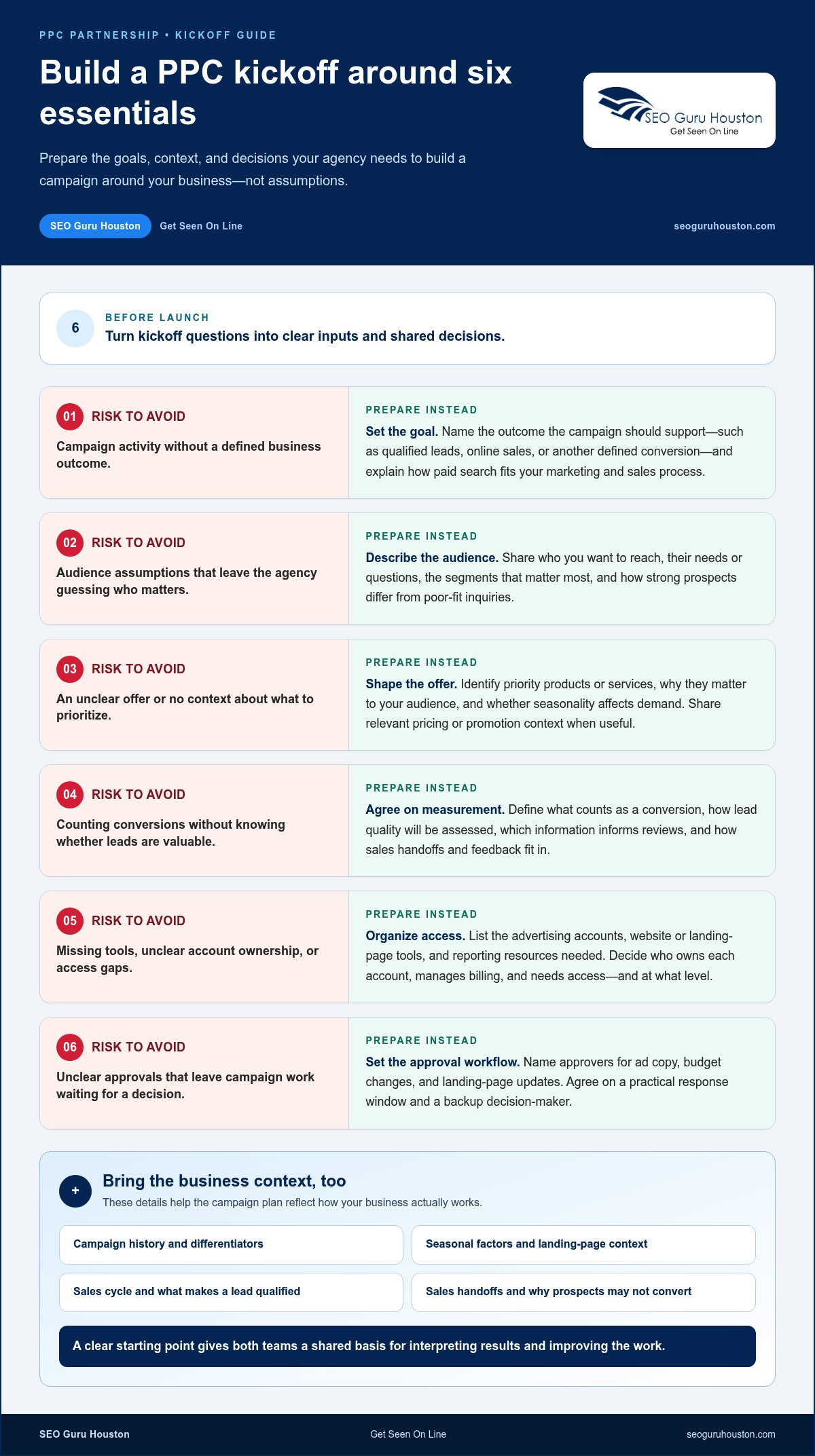
A strong kickoff turns broad expectations into a usable campaign plan. Before launch, bring together the people, information, and decision process the agency needs to build around your business rather than fill gaps with assumptions. This preparation also gives both teams a clear starting point for interpreting results and improving the work.
- Set the goal. Identify the business outcome the campaign should support, such as qualified lead generation, online sales, or another defined conversion. Clarify how paid search fits into your marketing and sales process.
- Describe the audience. Share who you want to reach, what needs or questions bring them to you, and which audience segments matter most. Explain how strong prospects differ from poor-fit inquiries.
- Shape the offer. Explain which products or services to prioritize, why they matter to your audience, and whether seasonality affects demand. Share relevant pricing or promotion context when it helps shape the campaign plan.
- Agree on measurement. Define what counts as a conversion, how lead quality will be assessed, and which information the teams will use to review performance. Include the sales handoff and any available feedback from sales conversations.
- Organize access. List the advertising accounts, website or landing-page tools, and reporting resources needed for campaign work. Decide who owns each account, who manages billing, and what access level each team member needs.
- Set the approval workflow. Name the people who approve ad copy, budget changes, and landing-page updates. Agree on a practical response window and a backup decision-maker so work doesn’t stall when someone is unavailable.
What information should clients bring to a PPC kickoff?
Come prepared with business priorities, target customer details, differentiators, seasonal factors, and relevant campaign history. Explain your sales cycle: how an inquiry becomes a customer, what makes a lead qualified, where handoffs happen, and why prospects sometimes don’t convert. Share landing-page context, including what visitors are asked to do. Past campaign data can inform planning, but it doesn’t guarantee the same approach will perform the same way again.
For broader strategic context, the PPC management guide discusses connecting paid traffic with business priorities.
How should access, approvals, and communication be organized?
Choose one primary communication channel and a recurring meeting cadence that fits the campaign’s needs. Keep a shared record of priorities, blockers, decisions, owners, and follow-up actions. At each check-in, clarify what needs approval and who will provide it. This structure keeps campaign work moving and makes decisions easier to find than scattered email threads.
Effective collaboration depends on consistent preparation, not a perfect brief. A clear kickoff gives your PPC management team the context to plan and the feedback loop to refine its work. PPC management support can be part of a coordinated approach to paid campaigns.
How to Measure PPC Agency Performance Beyond Clicks
Clicks show that someone interacted with an ad. They don’t show whether that person became a qualified prospect or customer. Clicks alone can’t establish commercial effectiveness because they measure visits, not the value those visits create for the business. A useful review connects advertising activity to lead quality, sales, and the campaign’s agreed objective.
Before using a report to make budget decisions, check that its conversion definitions and underlying data are reliable. Confirm which actions count as conversions, whether duplicate or low-value actions are included, and whether the reporting period gives prospects enough time to progress. If tracking is incomplete or inconsistent, apparent performance changes may not reflect what’s happening in the business.
Which PPC metrics deserve attention in an agency report?
Interpret each metric according to what it can tell you. Impressions indicate visibility; clicks and click-through rate can help assess ad engagement. None proves that the campaign is creating valuable business outcomes. Conversions, conversion rate, and cost per conversion provide a closer view of response, but still need context. A form submission has different value if it comes from a target customer rather than a poor-fit inquiry.
- Visibility and engagement: Impressions, clicks, and click-through rate help explain whether ads are being seen and attracting interactions.
- Conversion activity: Conversions, conversion rate, and cost per conversion show how visitors respond, based on the actions being tracked.
- Business value: Qualified leads, sales, and conversion quality help reveal whether campaign activity supports the sales model and business objective.
For longer sales cycles, platform reporting may capture an inquiry before its eventual outcome is known. Add marketing and sales feedback, such as whether leads fit the target customer profile or progress through the handoff process. That context helps the agency assess patterns the platform alone can’t explain.
How can reporting turn into useful decisions?
A strong report explains more than what changed. It connects a campaign adjustment to the evidence behind it, the interpretation of that evidence, and the recommended next action. For example, if conversions rise but sales feedback suggests lead quality has weakened, discuss whether targeting, ad messaging, the offer, or the post-click experience may be contributing.
Compare results with the campaign’s agreed goals and measurement definitions, then consider relevant historical context. Avoid treating a single metric or short reporting window as a complete verdict. If visitors engage with ads but don’t take the intended next step, examine the landing page as part of the conversion path. High-converting landing page design can support a clearer post-click experience, while reporting helps identify where friction may be occurring.
That’s how to work effectively with a ppc agency when performance data gets complicated: verify what’s being measured, bring business feedback into the analysis, and agree on a next step you can review. The goal isn’t a fuller dashboard. It’s a clearer basis for action.
How to Keep PPC Agency Campaigns Improving Through Clear Feedback
Campaign optimization works best as a steady learning loop, not a string of last-minute reactions. The agency can analyze campaign signals, but your team sees what happens after an inquiry arrives. Share that feedback consistently so both teams can make more informed decisions about targeting, messaging, and the landing-page experience.
Use a simple review cycle: examine the evidence, agree on a test, assign an owner, then record what happened and what comes next. Separate planned experiments from urgent fixes. If a tracking issue or misleading claim needs immediate attention, address it directly and document the change. For routine optimization, avoid changing several major campaign elements at once. Otherwise, it may be difficult to tell which adjustment influenced the outcome.
How should clients give feedback on PPC leads and sales?
Make lead feedback consistent enough to reveal patterns, not just anecdotes. Agree on practical categories such as relevant, poor fit, sales-ready, or not yet ready, and share recurring objections or reasons prospects disengage. Set a regular schedule for passing along this information, such as including updates in campaign reviews. Protect sensitive customer information: share only the details needed for analysis, use appropriate access controls, and follow your organization’s privacy practices.
Specific feedback gives the agency something actionable. “The leads were weak” is hard to use. “Several inquiries came from people seeking a service we don’t provide” points to a possible mismatch in search targeting, ad language, or the landing-page offer. If relevant prospects repeatedly raise the same concern, the team can assess whether campaign messaging or page content should address it more clearly.
How can both teams make testing more disciplined?
Before launching a test, write down the question it’s meant to answer, the audience it affects, and what evidence would inform the next decision. For example, a team might test whether clearer qualification language attracts more suitable inquiries. Agree on who will implement the change, who will review lead feedback, and when you’ll assess what the evidence supports.
Keep a shared test record with the hypothesis, change, owner, review point, observations, and next action. Don’t label a test a success just because one metric moved. Check whether the movement aligns with the campaign objective and the quality of resulting leads. If the evidence is inconclusive, record that plainly and decide whether to continue, adjust, or close the test. “We can’t tell yet” is more useful than a confident conclusion based on noise.
This is how to work effectively with a ppc agency over time: make feedback timely, experiments interpretable, and decisions traceable. When campaign evidence points to the post-click experience as an area to investigate, coordinate landing-page updates with the agency so the ad promise and page experience stay aligned.
PPC management services can connect campaign analysis with practical optimization.
How to Build a Long-Term PPC Agency Partnership That Drives Growth
A useful agency relationship evolves with the business. Goals set at launch may need revisiting as offers change, new audiences become priorities, or sales capacity shifts. Keep the partnership grounded in shared priorities, candid feedback, and documented decisions. That record helps both teams understand why a campaign changed, what the evidence showed, and which business question deserves attention next.
Consistency matters, but it shouldn’t mean sticking with a strategy after the business has moved on. Revisit campaign priorities when your products or services, target customers, sales process, or objectives change. Use campaign data alongside marketing and sales feedback to identify the next useful question. Avoid adding campaigns or chasing more activity simply because it’s possible. Each change should connect to a business need.
When should a PPC strategy change as the business grows?
Reassess the strategy when an offer changes, a new audience becomes more important, or the sales team can handle a different volume or type of inquiry. Bring those updates to the agency with context: what changed, why it matters, and what you want to learn. Together, decide whether the campaign, its messaging, or its conversion path needs adjustment. Document the reason for each change so future reviews reflect the business decision behind it.
How can PPC connect with landing pages and demand generation?
A paid ad sets an expectation. The landing page should carry that message forward, make the next step clear, and match the offer that prompted the click. If ads attract relevant visitors but the page doesn’t explain the value or guide action, assess campaign performance alongside the post-click experience. PPC management, landing page design, and website development can work as connected parts of the visitor journey, with each considered in light of the campaign objective.
The relationship can extend beyond the initial conversion. Lead capture is one point in a broader demand-generation process: prospects may need useful follow-up and a clear handoff to sales before they’re ready to make a decision. For B2B teams, the B2B demand generation guide offers related context on connecting marketing activity with the process of developing prospects.
Our PPC management works alongside landing page design, website development, and demand generation, so teams can consider campaign traffic and the experience that follows as connected growth work. No single channel or change guarantees a particular outcome. The value comes from keeping business goals visible, sharing honest feedback, and using each review to make the next decision more deliberate.
That’s the practical answer to how to work effectively with a ppc agency over the long term: treat the relationship as an ongoing collaboration, not a set-and-forget arrangement. Our PPC management services can support paid campaigns as part of your broader business priorities.
Make Your Next PPC Decision Count
The strongest agency relationships don’t stand still. As your business shifts, use the next planning conversation to identify the constraint that matters most: reaching a more relevant audience, improving the page experience, or helping qualified prospects move forward. That focus gives both teams a practical direction for the next stage of growth.
Knowing how to work effectively with a ppc agency means treating paid campaigns as part of a broader business system, not an isolated channel. Our PPC management can connect with landing page design, website development, and demand generation to support a coordinated marketing effort. The right priorities depend on your goals and what your campaign data reveals.
Choose one business objective for your next discussion, then turn it into a clear question your marketing team can act on. Discuss your PPC campaign goals and take the next step toward a more focused partnership.
Frequently Asked Questions
What should I expect from a PPC agency each month?
Expect work and communication that match the agreed scope, not a guaranteed number of leads or sales. A useful monthly update identifies work completed, budget pacing, significant account issues, and decisions needed from your team. Check whether recommendations have owners and next steps. For example, if a campaign’s landing page needs a change, the update should explain what needs review and how it relates to the campaign objective.
How often should I communicate with my PPC agency?
Set communication frequency according to campaign complexity and how quickly your team can make decisions. A scheduled monthly review may suit a stable account, while a launch or major offer change can call for closer coordination. Agree on which channel to use for routine questions and how to flag urgent issues, such as a broken conversion form or an unexpected budget concern. The goal is useful contact, not meetings without decisions.
What information should I share with a PPC agency?
Share information that helps the agency distinguish a valuable opportunity from a poor fit: customer qualification criteria, product or service constraints, sales capacity, and common reasons prospects decline. Explain which customer types are most valuable without sharing unnecessary confidential details. A brief summary of a lead’s status or reason for disqualification may be enough to guide campaign decisions. Limit access to sensitive records and follow appropriate privacy practices.
How do I know whether my PPC agency is doing a good job?
Look for clear reasoning, accurate measurement, and follow-through tied to your agreed objective. Ask the agency to explain why it made a meaningful change, what evidence informed it, and what it will monitor next. Your team should also be able to see whether lead quality aligns with the audience you want. Knowing how to work effectively with a ppc agency means evaluating the quality of decisions as well as campaign outcomes, without treating short-term fluctuations as a full verdict.
Should a PPC agency guarantee leads or sales?
No agency should promise a specific number of leads or sales as a certainty. Results depend on factors beyond campaign management, including the offer, competition, website experience, tracking quality, and how promptly sales follows up. An agency can explain its strategy, define how progress will be assessed, and make informed adjustments. Treat guaranteed outcomes cautiously, especially if the promise doesn’t explain assumptions, lead qualification, or what happens when the stated target isn’t reached.
Who owns the Google Ads account when working with an agency?
Your business should retain ownership and administrative control of its advertising account, while the agency receives the access needed to manage campaigns. Clarify account access, billing responsibility, and who controls related assets such as conversion tracking before work begins. This arrangement keeps account history and business data accessible to your organization if staff or agency relationships change. Review user permissions periodically and remove access that’s no longer needed.
How long does it take for a PPC agency to improve campaign performance?
There’s no reliable universal timeline. The pace depends on the account’s starting condition, tracking accuracy, volume of meaningful conversions, and how long prospects take to become customers. Correcting a measurement issue may clarify reporting before the business impact of campaign changes is visible. Ask the agency to identify what it will review at each checkpoint and what evidence would support a decision. Treat early signals as learning, not a promise of future results.

