
Industrial buyers can rule out your company before your sales team knows they were looking. That’s why digital marketing for industrial companies must do more than attract traffic. It needs to make complex products easier to understand, build confidence across a buying committee, and turn research into sales-ready opportunities.
Long buying cycles and multiple decision-makers make that challenging. A website visit or form fill rarely tells the whole story, and marketing activity can look busy without moving qualified prospects forward. A focused strategy connects the dots, helping technical buyers find useful answers, evaluate your capabilities, and take the next step.
This guide shows you how to build that strategy for 2026. You’ll learn how to match channels to buyer needs and your team’s resources, connect search visibility and paid campaigns with conversion-focused pages, and use inbound marketing and demand generation to support lead progression. You’ll also see which pipeline and revenue indicators can reveal whether your efforts are creating meaningful business opportunities.
Key Takeaways
- Digital marketing for industrial companies works best when it supports buyers from early research through supplier comparison and sales engagement.
- Match each buying stage with useful content, credible proof, and a clear next step for technical buyers.
- Choose SEO, PPC, content, email, social media, and website improvements according to their role in your strategy, not a one-size-fits-all channel mix.
- Build a practical plan by defining business outcomes, researching buyers, auditing existing assets, and prioritizing the next steps.
- Track leading indicators alongside pipeline and revenue outcomes so activity is not mistaken for business impact.
Why Digital Marketing for Industrial Companies Must Reach Buyers Before Sales Conversations
Industrial digital marketing is the coordinated use of online channels and content to help potential buyers discover a supplier, evaluate its capabilities, and progress toward a sales conversation. It connects a company’s website, search visibility, paid campaigns, and useful information to the questions buyers need answered at each stage. The approach builds on industrial marketing, where organizations select products and services to meet business needs rather than individual preferences.
That distinction matters. A straightforward purchase may be judged on convenience and price; an industrial purchase can require scrutiny of technical fit, operating requirements, procurement criteria, and business impact. The process varies by company, product, and buying group. A digital strategy should serve different buyer needs rather than assume every prospect follows the same path.
How industrial buyers research suppliers before contacting sales
Independent online research is one part of a broader supplier-evaluation process. Buyers may use websites and search results to identify potential suppliers, clarify specifications, compare capabilities, and prepare questions. Their research can continue alongside internal discussions, referrals, sales conversations, and practical assessments. A company’s website may be an early checkpoint, but it isn’t the entire decision.
Different stakeholders look for different evidence. For example:
- Engineers may need specifications, operating details, compatibility information, or application examples.
- Procurement teams may look for clear capabilities, product ranges, and information that helps compare suppliers.
- Operations leaders may want to understand how a solution fits existing processes and business requirements.
- Executives may focus on strategic fit, risk, and the rationale for moving forward.
Useful content makes these questions easier to investigate before a prospect is ready to speak with sales. It also gives sales teams a stronger starting point: conversations can build on shared information instead of beginning with basic explanations.
Why technical companies need more than a brochure website
A brochure-style website can introduce a company, but technical buyers often need more substance to assess whether its products or capabilities fit their requirements. Clear product descriptions, application details, capability information, and answers to common technical questions give visitors something concrete to evaluate. Keep terminology accurate, explain specialized terms where needed, and organize information so different stakeholders can find what matters to them.
Clarity supports credibility, but it doesn’t guarantee visibility, leads, or a sale. An informative site is also only one part of the system. A connected demand-generation strategy aligns useful content with channels that help buyers discover it, provides relevant next steps, and gives the sales team context for follow-up. That’s the difference between publishing information and supporting buyer progression. For digital marketing for industrial companies, the goal is not simply to appear online. It’s to make each digital touchpoint useful before, during, and after the first sales conversation.
Map the Industrial Buying Journey to Digital Touchpoints and Content
Industrial buyers don’t move from search to purchase in a straight line. A technical evaluator may investigate specifications while procurement compares suppliers and an operations leader weighs implementation needs. Map digital touchpoints to the questions buyers are asking, then give each one a useful next step. This turns digital marketing for industrial companies into a practical journey rather than a collection of disconnected posts and pages.
What industrial buyers need at each decision stage
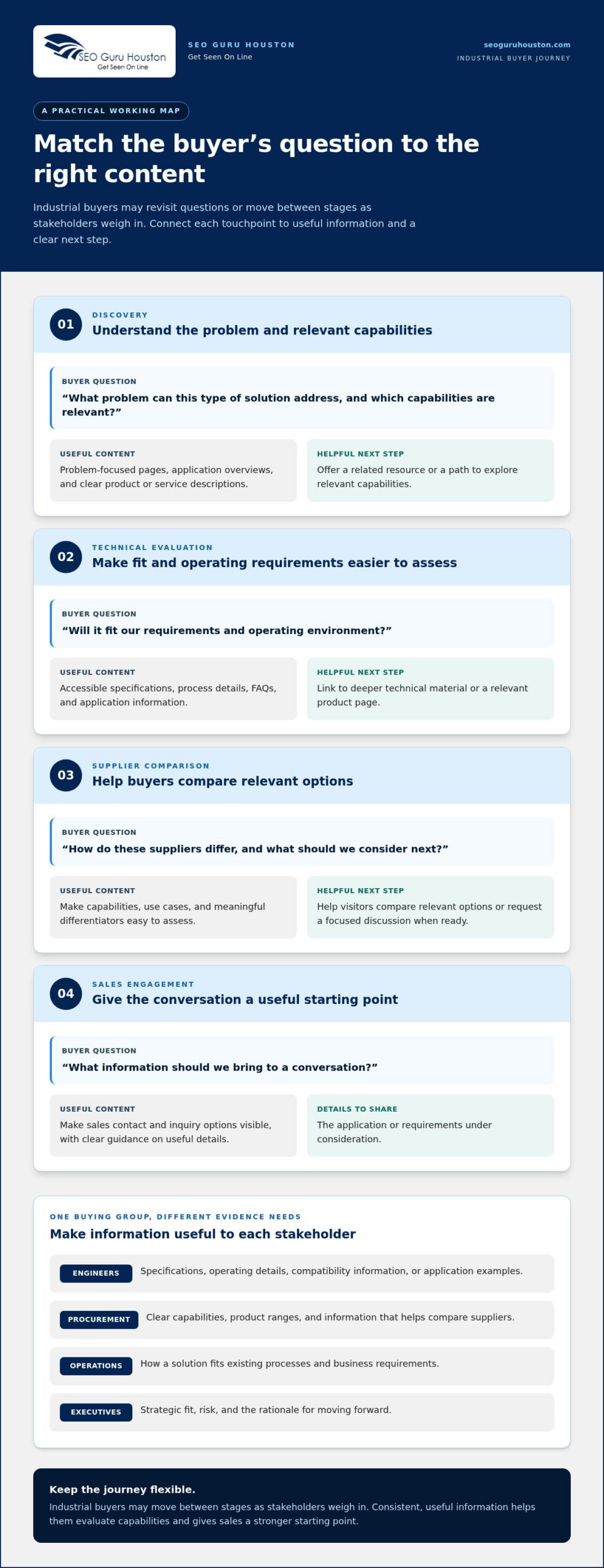
Use four stages as a working map, not a rigid funnel. People may revisit earlier questions or move between stages as stakeholders weigh in. For each stage, connect the buyer’s concern to relevant information, credible proof, and an appropriate next action:
- Discovery: “What problem can this type of solution address, and which capabilities are relevant?” Publish problem-focused pages, application overviews, and clear service or product descriptions. Offer a related resource or a path to explore relevant capabilities.
- Technical evaluation: “Will it fit our requirements and operating environment?” Organize specifications, process details, FAQs, and application information in accessible language. Link to deeper technical material or a relevant product page.
- Supplier comparison: “How do these suppliers differ, and what should we consider next?” Make capabilities, use cases, and meaningful differentiators easy to assess. Help visitors compare relevant options or request a focused discussion when they’re ready.
- Sales engagement: “What information should we bring to a conversation?” Make sales contact and inquiry options visible, with clear guidance about what details will help the discussion, such as the application or requirements under consideration.
These stages need consistent information. If a product page describes a capability one way and a downloadable resource describes it another, buyers have to resolve the mismatch themselves. Keep claims, terminology, and supporting details aligned across pages and materials.
How to support a multi-person buying committee
Stakeholder roles vary by sale, so use them as prompts for content planning, not as a checklist every deal must follow. Engineers may need technical detail; procurement may need supplier and product information; operations may focus on fit with existing processes; executives may need a concise view of business relevance. One well-structured page can serve several readers when it offers a clear overview alongside links to deeper detail.
Make the handoff between marketing and sales a two-way process. Sales can share recurring questions, objections, and the information prospects request before a conversation. Marketing can use those patterns to update pages and resources. If opportunities stall at technical review, identify which question remains unanswered, then improve the relevant content and give sales a useful follow-up resource.
Connected B2B demand generation can coordinate useful touchpoints across the journey, while B2B inbound marketing helps organize content around buyer needs. When pages and follow-up feel disconnected, coordinated B2B marketing and demand generation can bring those pieces into a clearer plan.
Choose Digital Marketing Channels for Industrial Companies by Their Job
More channels don’t automatically mean more qualified opportunities. Each should solve a buyer need and support a business goal, whether that’s being found during research, explaining a technical application, or helping an interested prospect take a next step. Choose a channel mix by matching buyer behavior and sales goals with your team’s expertise and current channel performance.
When SEO, PPC, and content support different buyer needs
SEO helps relevant pages appear for searches buyers use to research problems, applications, and suppliers. PPC can put selected offers in front of chosen searchers or audiences while campaigns are active. Technical content gives both channels something valuable to lead to: clear explanations of applications, capabilities, and considerations that help prospects evaluate options. Connect activity to meaningful outcomes, not clicks alone.
| Channel | Primary job and timing | Useful measures |
|---|---|---|
| SEO | Support discovery through relevant searches and useful answers over time. | Relevant organic visits, inquiry quality, and assisted pipeline. |
| PPC | Reach selected searches or audiences while campaigns run. | Qualified conversions, cost per qualified opportunity, and pipeline contribution. |
| Technical content | Explain applications and answer evaluation questions across the journey. | Engagement with key resources, influenced opportunities, and recurring sales questions addressed. |
| Website improvements | Make product and capability information easier to find and act on. | Visits to priority pages, relevant actions, and conversion-path completion. |
| Share relevant information and sustain engagement with opted-in audiences. | Meaningful clicks, replies, and progression of engaged opportunities. | |
| Social media | Distribute useful content and maintain visibility with relevant audiences. | Engagement from target audiences, referral visits, and assisted conversions. |
How websites, landing pages, email, and social media connect
Your website is the central destination for product and capability information. Use focused landing pages to connect a specific campaign or audience with a clear action, such as exploring an application or submitting an inquiry. Email can deliver related material to people who want to keep learning; social media can extend the reach of that material and bring interested readers back to relevant pages. Keep claims consistent at every step.
Don’t select channels by habit. Review what buyers search for, which questions sales hears repeatedly, where current opportunities originate, and what your team can produce and maintain well. Then test a focused combination and assess whether it reaches the right audience and contributes to qualified pipeline. A channel that earns attention but attracts poor-fit inquiries may need a sharper audience, message, or destination.
For digital marketing for industrial companies, the strongest mix depends on the business, buying process, and available resources. Coordinating SEO, PPC, content, website development, and demand generation can connect discovery with follow-up instead of leaving each channel to operate alone. Learn how B2B marketing and demand generation can be coordinated around those goals.
Build an Industrial Digital Marketing Plan You Can Measure and Improve
A useful plan connects marketing activity to sales progress, then uses feedback to improve the next decision. Keep the process focused: choose a business outcome, understand buyer needs, assess what you already have, and invest in the channels your team can support. That’s a stronger starting point than launching campaigns simply because a channel is popular.
Set goals and measurement around sales progress
Build the plan in sequence. Each step should inform the next, so channel choices and performance reviews stay tied to real buyer needs.
- Define outcomes. Choose a goal such as improving visibility for priority searches, increasing engagement with technical resources, generating qualified inquiries, or advancing opportunities through the pipeline.
- Research buyers. Review the questions prospects ask, the capabilities they evaluate, and the information sales needs to move discussions forward.
- Audit assets. Check whether website pages, landing pages, content, and analytics support those needs. Note gaps, outdated information, and unclear conversion paths.
- Prioritize channels. Select a manageable set of channels that match buyer behavior, business goals, available expertise, and current performance.
- Review and adjust. Compare activity with sales feedback, identify bottlenecks, and decide what to improve before expanding the plan.
Separate leading indicators from business outcomes. Search visibility, relevant page visits, resource engagement, and inquiry volume can show whether marketing is reaching and engaging an audience. They don’t prove revenue. Track qualified inquiries, accepted opportunities, pipeline progression, and closed business as outcomes, using consistent definitions for each. Reliable analytics and clear campaign tracking help connect visits and conversions to the pages and channels that contributed.
Marketing and sales should agree on what makes an inquiry qualified, who owns follow-up, and how often they’ll review feedback. If form submissions rise but sales reports poor fit, investigate targeting, page messaging, and qualification questions before treating the volume as progress.
Prioritize a realistic first phase and improve it
Start with a focused buyer need and the channels best placed to address it. Assign clear owners for content accuracy, campaign management, website updates, and reporting. A high-converting landing page design blueprint can help teams plan the connection between a campaign’s message and its destination.
Set a regular review cadence that fits your sales cycle. Look for drop-offs between stages, unanswered buyer questions, and differences between raw inquiries and sales-accepted opportunities. Then make a specific adjustment, such as improving a page, refining campaign targeting, or creating content to address a recurring objection. Measure the effect before adding more activity.
To connect channel activity with sales progress, build a measurable industrial marketing plan with coordinated SEO, PPC, B2B marketing, demand generation, and website work.
Turn Industrial Digital Marketing Into a Connected Growth Program
Growth comes from connecting the steps, not simply adding more marketing activity. Start with buyer insight: identify the questions technical and business stakeholders ask, the evidence they need, and the points where opportunities tend to stall. Then select channels, create useful content, provide a relevant next action, and measure whether those efforts support sales progress. That sequence keeps digital marketing for industrial companies anchored to buyer needs and business priorities.
Coordination matters when separate efforts create gaps. SEO may bring a prospect to a technical page, while a PPC campaign sends another audience to a landing page. If those pages use different claims, offer no clear next step, or fail to connect with follow-up, each activity works in isolation. Align the message, destination, conversion action, and sales handoff so buyers encounter a coherent experience.
What coordinated digital execution can include
SEO and content can work together to make useful answers easier to find for relevant searches. PPC can direct selected audiences to focused landing pages with a clearly defined action, such as requesting information or exploring an application. Website development supports the destination with clear, organized product and capability information. Each element has a distinct job, but the experience should feel connected.
Inbound marketing and demand generation can organize these touchpoints around discovery and lead progression, while B2B marketing helps align messaging with business buyers. Marketing and sales can share recurring questions, qualification feedback, and follow-up context so content and campaigns respond to real conversations. SEO Guru Houston provides SEO, PPC, B2B marketing, inbound marketing, demand generation, and website and landing-page development. The right combination depends on your goals and existing gaps, not a promise of a particular result.
Choose next steps based on your current growth bottleneck
Don’t try to overhaul every channel at once. Find the break in the buyer journey, then focus the next phase there:
- If discovery is weak, review search visibility and whether key pages clearly address buyer questions and relevant capabilities.
- If traffic doesn’t convert, assess page clarity, the relevance of the information, and whether calls to action offer a logical next step.
- If leads don’t progress, examine qualification criteria, follow-up ownership, and the feedback loop between marketing and sales.
Use the bottleneck to guide a focused plan. For example, a landing page receiving relevant visits but few inquiries may need a clearer value proposition or simpler conversion path. If inquiries arrive but stall, improving follow-up context may matter more than expanding campaign reach. Review the change against agreed measures, learn from sales feedback, and then decide what to improve next.
SEO Guru Houston brings search, paid campaigns, B2B and inbound marketing, demand generation, and website work together as parts of a digital growth strategy. A focused strategy discussion can help identify the right next step for your business. Explore digital marketing strategy options.
Make Your Next Marketing Move Count
The next step doesn’t need to be a full-scale overhaul. Choose one growth bottleneck, decide what progress would look like, and focus your team on a change you can assess. That discipline keeps digital marketing for industrial companies grounded in business priorities, while giving you a clearer basis for deciding what to improve or expand next.
Execution can be easier to coordinate when strategy and delivery connect. SEO, PPC, and B2B marketing can support discovery and audience reach; inbound marketing and demand generation can help organize engagement and lead progression. Website development and landing-page design can align the destination with the campaign. The right mix depends on your objectives and where buyers need a stronger experience.
SEO Guru Houston brings these capabilities together to help businesses plan connected digital marketing activity. Start a focused conversation about your goals, current challenges, and practical next move. Discuss a digital marketing strategy and take a confident step toward building a more connected growth program.
Frequently Asked Questions
How long does SEO take to produce results for an industrial company?
SEO timing depends on your site’s condition, search competition, content depth, and how quickly improvements are implemented, so there’s no reliable fixed ranking date. For digital marketing for industrial companies, review early signals such as whether important pages can be crawled, relevant search impressions, and qualified organic visits. Then assess whether those visits lead to useful inquiries and sales conversations. A technical page may begin earning relevant impressions before it contributes to a sales opportunity.
Can a small industrial company compete with larger manufacturers online?
Yes. A smaller company can focus its online presence on the applications and customer needs where its capabilities are most relevant. For example, a supplier might create a detailed page for a specific use case instead of trying to cover every product category. Specific educational content and focused search campaigns can help buyers assess that fit. Visibility and lead volume still depend on competition, buyer demand, and execution, not company size alone.
How can industrial companies reach several decision-makers in one buying committee?
Start with the roles that actually appear in your sales conversations, then document the questions each one raises. An engineer may request compatibility details, while a procurement contact may need product or supplier information. Create shareable resources for those distinct concerns, and keep claims consistent across pages and sales materials. After conversations, ask sales which resource helped and what questions remained. Use that feedback to refine content instead of relying on assumed stakeholder needs.
Is digital marketing useful for industrial distributors as well as manufacturers?
Yes. Distributors can use digital marketing to make relevant catalog, product, and service information easier for buyers to find and understand. The strategy should reflect the distributor’s role in the purchase, including the product range it carries, the customers it serves, and how prospects move from research to inquiry. A manufacturer’s content plan may not fit as-is. Adapt topics and calls to action to the distributor’s own sales process and buyer questions.
What should an industrial company do if digital campaigns generate leads that are not sales-ready?
Review lead fit before increasing campaign volume. Compare the audience and campaign message with the inquiries sales considers useful, then look for patterns such as requests outside your capabilities or confusion about what the offer includes. Adjust targeting, page copy, or form questions to set clearer expectations. Agree with sales on what counts as a qualified inquiry, and report that measure alongside total submissions so campaign decisions reflect opportunity quality.
Does industrial digital marketing require publishing content every week?
No. A steady publishing schedule matters less than having accurate, useful content for important buyer questions and keeping it current. Start by identifying the pages prospects rely on during research, such as product details, application guidance, or technical FAQs. Update them when product information or customer questions change. Add new resources at a pace your team can sustain, and make sure each one has a clear purpose and a way to reach its intended audience.

