
What if stronger search rankings still leave your law firm short on qualified inquiries? SEO for law firms creates business value when visibility, legal trust, and the path to contacting your firm work together. Rankings matter, but they’re only one part of the result.
Potential clients often compare firms before they reach out. FindLaw research cited by MyCase reports that 75% visit between two and five law firm websites before making contact. If your pages don’t clearly address their needs or make the next step easy to find, more traffic may not mean more relevant consultations.
This guide lays out a practical sequence for building and improving your SEO strategy, from useful legal content and site structure to local visibility and intake tracking. You’ll also find a framework for assessing an agency or in-house approach and measuring progress beyond rankings and visits. The goal is a clearer connection between organic search and the inquiries that support your firm’s growth.
Key Takeaways
- Build SEO for law firms around practice-area priorities and business goals, not an unfocused list of keywords.
- Use a step-by-step workflow to audit your site, understand search intent, prioritize pages, make improvements, and review progress.
- Compare in-house SEO, agency support, and paid search by considering control, expertise, coordination, capacity, and reporting.
- Track the path from search visibility to relevant visits, contact actions, and qualified inquiries instead of relying on rankings alone.
- Coordinate SEO with PPC and website improvements to create a growth plan aligned with your firm’s goals.
SEO for Law Firms: What It Does and Why It Matters
Referrals can be a strong source of new matters, but they don’t give every potential client a way to discover your firm while researching a legal problem. A well-planned organic search strategy can help close that gap and show how people find and engage with your website.
SEO for law firms means improving relevant visibility in unpaid search results and making the website useful once a searcher arrives. It involves more than keywords: page structure, content, technical accessibility, and clear next steps all shape the experience. For a broader overview of the discipline, see Search Engine Optimization (SEO).
Visibility means appearing in relevant search results, traffic means the visits those appearances bring, and a qualified inquiry is a contact from someone whose legal needs align with the firm’s work. These are connected stages, not interchangeable measures. A firm can gain visibility without meaningful visits or attract visits that never become appropriate inquiries.
Organic SEO and paid placements can support different acquisition needs. SEO builds a foundation for relevant unpaid discovery over time, while paid search can provide placement for selected searches through advertising. Both require relevant landing pages and a clear contact path. Neither channel, by itself, guarantees that a visitor is a suitable prospective client.
Which searches can bring potential clients to a law firm?
Search terms offer clues about what a person needs, but they don’t prove readiness to hire. Match the page to the likely intent:
- Practice-area searches: Someone looking for a family law attorney may benefit from a focused service page explaining the practice and how to make contact.
- Problem-based searches: A person asking what to do after a workplace injury may be looking for initial information. An educational article can address the question and guide readers to relevant services.
- Firm-name searches: Someone searching for a specific firm may want its website, practice details, or contact information. Make those details easy to find.
Organizing pages around these distinct needs helps avoid sending every searcher to a generic homepage. It also gives your firm a practical way to decide which content to create or improve first.
Why rankings alone do not show whether SEO is working
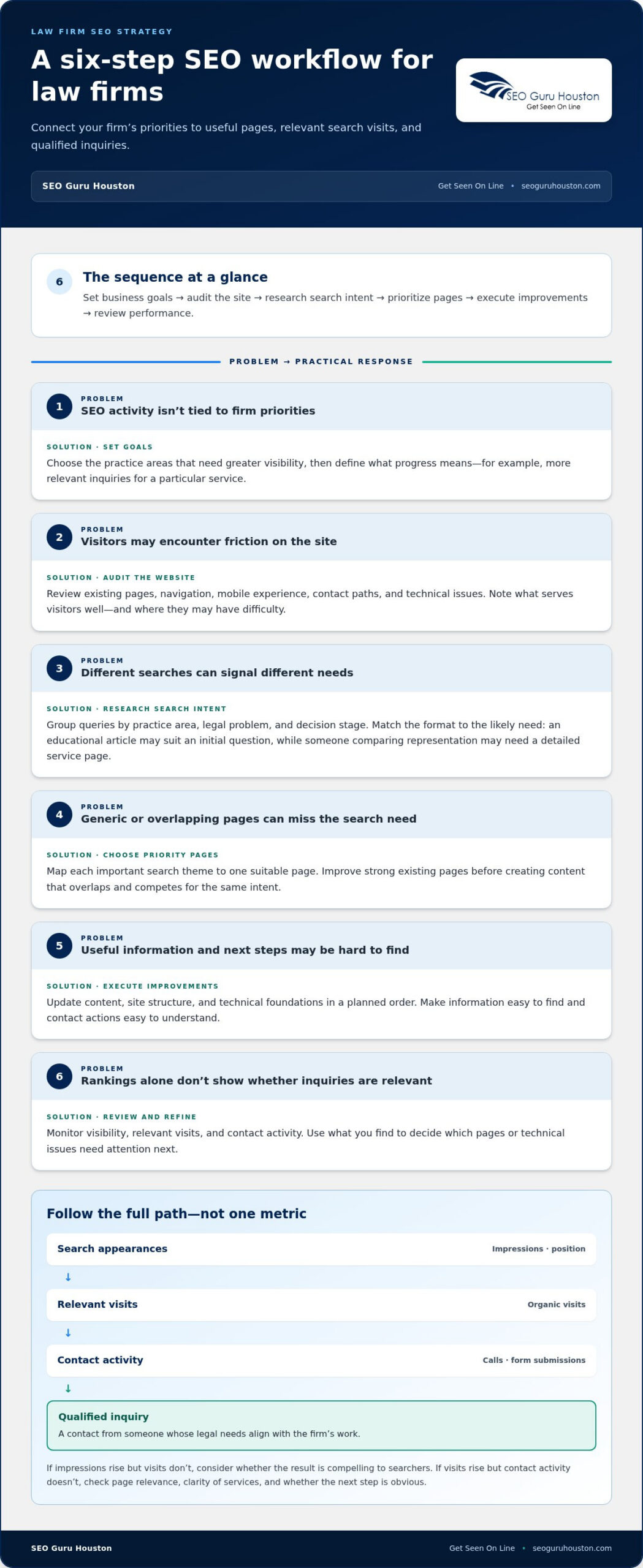
A ranking is one signal, not a verdict. Impressions show how often a page appeared; position estimates where it appeared; organic visits show who clicked through. Calls and form submissions show contact actions, but those contacts still need to be assessed for relevance.
Look at the journey as a whole. If impressions rise but visits don’t, the result may not be compelling to searchers. If visits rise but calls and submissions don’t, check whether the page answers the query, explains the firm’s services clearly, and makes the next step obvious.
Traffic quality depends on search relevance, useful page content, and a clear path to contact. Results also depend on competition, the website’s existing condition, and sustained execution, so progress can vary. Evaluate the full path from search appearance to qualified inquiry rather than treating one position as proof of success.
How to Build a Law Firm SEO Strategy Step by Step
A focused SEO programme starts with your firm’s growth priorities, not a spreadsheet full of search terms. Decide which practice areas need greater visibility and what a useful inquiry looks like, then align your website and content with those priorities. This keeps SEO for law firms tied to the work your firm wants to attract.
Strategy sequence: set business goals, audit the site, research search intent, prioritize pages, execute improvements, and review performance.
- Set goals. Identify priority practice areas and define what progress means, such as more relevant inquiries for a particular service.
- Audit the website. Review existing pages, navigation, mobile experience, contact paths, and technical issues. Note what already serves visitors well and where they encounter friction.
- Research search intent. Group queries by practice area, legal problem, and decision stage. A person seeking a definition may need an educational article; someone comparing representation may need a detailed service page.
- Choose priority pages. Map each important search theme to one suitable page. Improve strong existing pages before creating overlapping content that competes for the same intent.
- Execute improvements. Update content, site structure, and technical foundations in a planned order. Make useful information easy to find and contact actions easy to understand.
- Review and refine. Monitor search visibility, relevant visits, and contact activity. Use the findings to decide which pages or technical issues need attention next.
Research keywords around practice areas and client questions
Build topic groups rather than treating every phrase as a separate target. For example, a practice-area group can include service terms, questions about a legal problem, and searches that suggest someone is comparing options. Review the current results for each theme to see whether searchers are shown service pages, explainers, or another format. Use relevant phrases naturally, and prioritize accurate answers over repeated keywords.
Improve pages, technical foundations, and legal content
Give each priority page a specific title, clear headings, useful internal links, and a next step that fits its purpose. Check that menus and forms work on mobile, important pages can be crawled, and pages load efficiently. Google’s SEO Starter Guide offers practical guidance on making content accessible to search engines and people.
Legal content also needs care. Attorney review can help ensure explanations reflect the firm’s knowledge and remain accurate, while clear author information helps readers understand who stands behind the material. Avoid implying a particular case result. For broader strategic context, see this guide to professional SEO services.
Effective execution connects content, technical health, and conversion paths instead of treating them as separate projects. A tailored SEO strategy can align site improvements with your firm’s growth priorities.
In-House SEO, Agency Support, or Paid Search: How to Compare
The right setup depends on the work your firm can consistently own, the expertise available, and how quickly you need campaign visibility. In-house SEO, agency support, and paid search aren’t interchangeable. Each has different strengths, and they can work together when responsibilities and reporting are clear.
Use this comparison to identify where your current resources fit. The best approach to SEO for law firms connects execution to practice-area priorities and qualified inquiries instead of focusing on activity for its own sake.
Control
In-house teams have direct access to firm decisions and can adjust priorities internally. Agency support involves an external working relationship, with scope and decisions coordinated with the firm. Paid search offers campaign-level control over targeting and spend.
Available expertise
Internal skills depend on the staff assigned to the work. An agency can bring SEO, paid search, website development, and landing-page capabilities into a coordinated plan. Paid search requires campaign management as well as a relevant destination page.
Coordination
In-house teams can connect marketing closely with attorneys and intake staff. Agency support can coordinate search strategy with site structure and page improvements. Paid campaigns need messaging and landing pages that match the search and the firm’s services.
Capacity
Internal execution works when staff have dedicated time for research, publishing, technical tasks, and reviews. Agency support can add execution capacity. Paid search requires ongoing campaign attention, separate from organic content and technical work.
Reporting
Whichever route you choose, reports should connect activity to business goals. Track visibility and visits alongside contact actions and inquiry relevance, not just completed tasks or campaign clicks.
When does an in-house law firm SEO approach make sense?
In-house execution can suit a firm with people who have relevant skills and protected time to use them. Internal staff understand practice-area priorities, firm language, and the questions attorneys hear from clients. That access can support accurate, useful content. The constraint is capacity: if research, writing, technical fixes, and performance reviews compete with other duties, progress can stall. Assign an owner to each task before choosing this model.
What should a firm assess when considering agency support?
Assess whether the proposed strategy starts with business goals and explains how search activity will be evaluated for lead quality. Look for coordination across organic SEO, paid search, and the website experience, with responsibilities and reporting made clear. A search click is only the start; a focused next step can help visitors find relevant information and contact options. For that journey, consider high-converting landing-page design.
Organic search builds visibility through sustained work and may compound as relevant pages gain traction. Paid search can put a firm in front of selected searches once campaigns are live, providing a different route to campaign visibility. It doesn’t replace SEO, and SEO doesn’t provide the same paid placement. Choose based on priorities, capacity, and measurement, then coordinate channels where they serve complementary needs.
How to Measure Law Firm SEO Beyond Rankings
Strong reporting follows the full path from a search result to a relevant inquiry. For SEO for law firms, that means separating early signs of visibility from business outcomes and asking what each metric says about the next step. A ranking can improve while inquiries stay flat, so evaluate performance as a connected journey, not a single score.
Interpret rankings alongside conversion and lead-quality data because visibility alone does not show whether relevant searchers visit, contact the firm, or become qualified inquiries.
Which SEO metrics should a law firm review?
Use search-performance reports to understand how often pages appear and earn clicks, and analytics to assess what visitors do after arrival. Review trends over consistent periods, such as month to month or quarter to quarter, and annotate significant site changes, new content, or campaign activity. This context makes it easier to distinguish a real shift from normal variation.
- Organic impressions and positions: Leading indicators that show whether priority pages are appearing for relevant searches.
- Organic clicks and visits: Signals that searchers chose a result and reached the website.
- Landing-page engagement: Review whether visitors explore useful content or take a next step, rather than judging a page by visits alone.
- Contact actions: Track completed forms and calls where the measurement setup allows.
Where data allows, segment results by practice-area page and search intent. An educational article may attract people researching a question, while a service page may draw searchers comparing legal representation. Their engagement and contact patterns may differ, so combining them into one site-wide average can hide useful detail.
Analytics and search-performance tools each show only part of the journey. Search data can connect queries with impressions and clicks, while website analytics can record on-site activity. Neither necessarily reveals whether a person became a suitable prospective client. Attribution can also be incomplete when people switch devices, return later, or contact the firm through another route.
How should firms connect online inquiries to intake?
Track form submissions and calls when consent, privacy requirements, and technical setup permit. Configure events carefully so reports distinguish genuine completed actions from button clicks or incomplete forms. Then create a consistent intake process: record the stated source when available, the relevant practice area, and whether the inquiry fits the firm’s work. Keep collection and access to sensitive information aligned with the firm’s privacy practices.
Inquiry volume is not the same as qualified matter volume. A rise in contacts may include requests outside the firm’s practice areas, while fewer but more relevant inquiries may better reflect the goal. Review intake notes alongside page and channel performance, using consistent definitions so teams compare like with like.
Use a regular reporting cadence to identify what to investigate next, such as a page with growing visibility but few clicks or visits that rarely lead to relevant contact. This turns measurement into a decision tool, not a scoreboard. Explore a strategy that connects SEO reporting to lead-generation goals.
Turn Law Firm SEO Into a Coordinated Growth Plan
A stronger search programme isn’t a list of disconnected tasks. Define your firm’s growth goals, prioritize the practice-area pages that support them, decide who owns the work, make improvements, and measure what happens after people find the site. This gives SEO for law firms a clear direction and keeps effort focused on meaningful business outcomes.
SEO can work alongside paid search and website improvements, but neither channel is a guaranteed substitute for the other. Organic work develops relevant visibility over time. PPC can support campaign visibility for selected searches, while a useful website experience helps visitors understand the firm’s services and find an appropriate next step. The value comes from coordination, not simply adding more channels.
What a coordinated law firm digital strategy can include
Start with search research and your firm’s priority practice areas. Use those insights to shape content topics and page structure: a service page can explain a specific area of legal work, while an educational article can address a related question. Connect the pages through clear navigation and relevant internal links, then make sure each page offers a sensible next step for its audience.
A coordinated programme can bring together SEO, PPC, website development, landing-page design, and demand-generation capabilities. These are complementary parts of a digital growth strategy. For example, PPC can help a firm test campaign opportunities while organic pages are being developed, and the resulting search and inquiry data can inform future content and page improvements. Paid activity still needs a relevant landing page and clear measurement; it doesn’t guarantee qualified inquiries.
Reporting should tie channel activity to your firm’s stated goals. Review organic visibility and relevant visits alongside campaign engagement, contact actions, and inquiry relevance. This helps identify where the journey needs attention, whether that’s search targeting, page content, site structure, or the path to contact. Set expectations around learning and ongoing refinement, not promised rankings, lead volumes, or timelines.
Choose a practical next step for your firm
Before deciding what to change, write down the practice areas your firm wants to prioritize, the audiences it needs to reach, and the gaps in its current measurement. Then decide what the team can own internally and where coordinated support could connect search strategy, PPC, and website improvements. A focused discussion about these goals can turn a broad marketing ambition into a workable plan.
Make the next move specific: identify one priority page or measurement gap, assign ownership, and define how you’ll review progress. From there, your firm can build a coordinated strategy that adapts as evidence comes in. Build a stronger law firm search strategy.
Make Your Next Search Move Count
The next opportunity for your firm may not be another marketing task. It may be a sharper decision about which audience to reach, what you want them to do, and how you’ll recognize a useful inquiry. Set that direction first, then build a plan your team can sustain. That’s how SEO for law firms becomes a focused growth investment rather than activity without a clear purpose.
Our SEO, PPC, website development, and landing-page design services are supported by demand-generation and inbound-marketing capabilities. These services can be coordinated around your firm’s priorities, connecting search visibility with a relevant website experience and measurable goals. No channel can promise a particular outcome, but a tailored strategy gives you a clearer basis for choosing what to improve and how to assess progress.
Bring your priority practice areas and current measurement questions into the conversation. Build a stronger law firm search strategy with a plan shaped around your goals. Your next step can be focused, practical, and built for progress.
Frequently Asked Questions
What is SEO for law firms?
SEO for law firms improves a firm’s visibility in relevant unpaid search results and makes the pages people reach useful and easy to navigate. Unlike paid advertising, organic search visibility isn’t purchased as an ad placement. The goal goes beyond appearing near the top: clear service information, helpful answers, and a straightforward way to take action all matter. No SEO approach can promise a specific position or number of clients.
How long does SEO take to work for a law firm?
There’s no universal timeline for SEO results. Competition, the website’s condition, content quality, technical needs, and the consistency of implementation all affect progress. Early signs, such as impressions for relevant searches, can appear before meaningful business outcomes are clear. Set a baseline before work begins, then review results regularly against agreed goals. This helps distinguish initial visibility changes from longer-term patterns in relevant visits and inquiries.
How much does SEO for a law firm cost?
SEO fees depend on the work involved, including competition, website improvements, content needs, and whether the firm handles tasks internally or uses agency support. Compare proposals by scope, specific deliverables, reporting, and how the strategy connects to your practice-area priorities. A low fee may not cover the work you need, while a larger fee alone doesn’t establish value. No investment guarantees rankings or qualified inquiries.
Can a law firm do SEO in-house?
Yes, a law firm can manage SEO in-house if it has appropriate expertise and enough dedicated time for research, content, technical upkeep, and measurement. Internal staff may have close access to attorneys and a strong understanding of the firm’s services, but competing responsibilities can limit execution. One practical option is for firm staff to guide legal substance while outside support handles selected SEO, web, or paid-search tasks.
Is local SEO important for law firms?
Local SEO can matter when a firm serves clients in defined geographic areas and people search for legal services tied to those places. Keep business information accurate and make service pages clear about the work and audiences the firm serves. The right priorities depend on the firm’s actual service footprint. A national or highly specialized practice may focus more on specific legal topics than on place-based searches.
Should law firms use SEO and PPC together?
SEO and PPC can work together because they serve different roles. Organic SEO supports relevant unpaid visibility, while paid campaigns can place ads in front of selected searches while those campaigns are active. For example, a firm could direct a paid campaign to a page tailored to that service and compare its engagement with organic visits. Coordinate targeting and landing-page messaging, then assess the mix against goals and available resources. Neither channel guarantees leads.
What content should a law firm publish for SEO?
Publish accurate, useful content that reflects the firm’s practice areas and answers questions potential clients commonly ask. A service page can explain what the firm handles, while an article can clarify a related legal topic for someone still researching. Match the format to the searcher’s need, use clear headings, and arrange appropriate attorney review. Link each page to a relevant next step, such as a related service page or contact option.

