
What if the lowest agency proposal costs your business more in missed opportunity? The cost of hiring a marketing agency isn’t a universal rate. It reflects the work, expertise, and accountability built into the plan. Two proposals can look similar at a glance while covering very different deliverables.
To compare them, identify what the agency fee covers, what advertising spend you’ll pay separately, and whether project work includes ongoing support. Regular marketing activity also needs to connect to measurable business goals, so you can tell what progress should look like.
This guide explains what shapes an agency proposal and how to compare scope, reporting, and accountability. We’ll look at how goals, channel mix, research, and team involvement affect the work, using SEO and PPC as practical examples. You’ll also learn to distinguish PPC management fees from per-click ad charges and assess how conversion tracking, reporting, and account management support agreed goals. The aim is to choose support that fits your priorities and your team’s capacity.
Key Takeaways
- The cost of hiring a marketing agency depends on the scope, expertise, cadence, and management responsibility in the proposal, not a universal rate.
- Match the pricing model to the work: recurring support, a defined project, hourly consulting, or performance-based arrangements each shape responsibilities differently.
- Compare proposals against the same criteria, including goals, deliverables, reporting, ownership, cadence, and exclusions.
- Build a budget around business priorities: identify the goal, choose a relevant channel, define how progress will be measured, and set a review process.
- Explore SEO, PPC, website design, and lead-generation services with SEO Guru Houston, backed by 950+ completed projects and 12+ years of experience.
What Determines the Cost of Hiring a Marketing Agency?
An agency fee covers a defined body of work, delivered at an agreed cadence by people with particular expertise and levels of management responsibility. The cost of hiring a marketing agency therefore depends on what the agency is expected to do, how often it will do it, and how closely it will manage and measure the work. A monthly SEO service, a one-time website project, and ongoing PPC campaign management are different scopes, even when they support a similar business goal.
There is no universal rate that applies to every agency or business. Objectives, channels, deliverables, internal resources, and campaign complexity all change the work involved. A company with a defined offer and established conversion tracking may need a different plan from one that still needs audience research, landing-page development, and measurement setup. A fee without that context tells you little about the proposal’s value or completeness.
Scope and accountability are more useful benchmarks than a generic average: compare the work promised, how often it happens, and how progress will be assessed.
What does an agency fee actually cover?
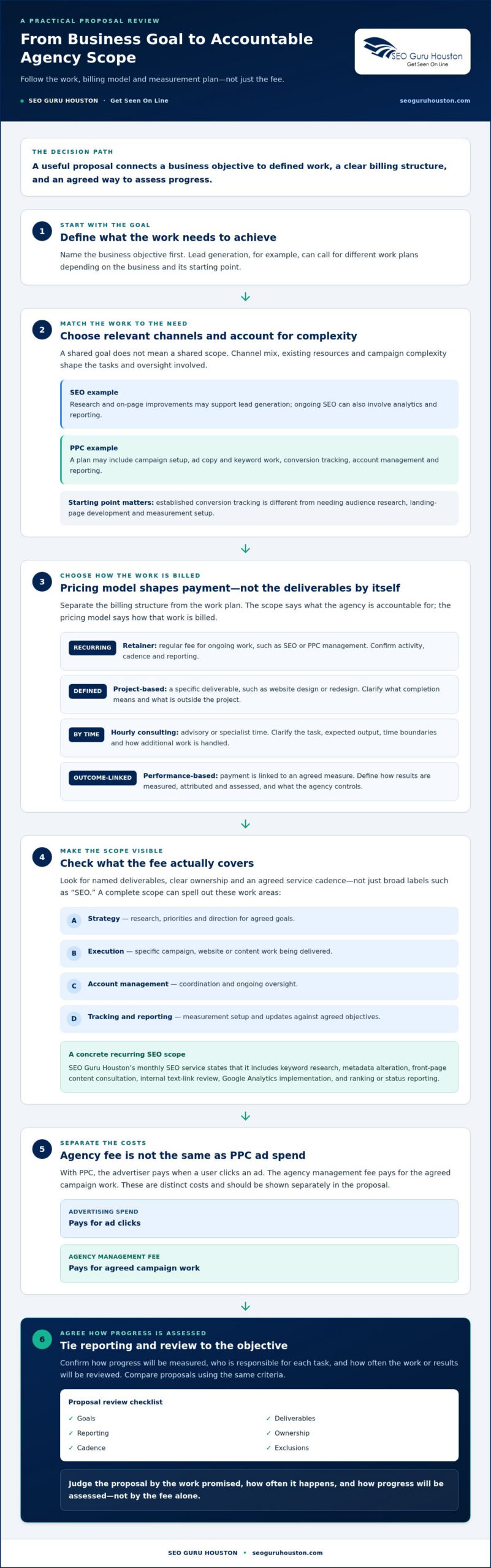
A proposal may include strategy, execution, account management, tracking, and reporting, but the labels alone don’t show how much work is included. Look for named deliverables and a clear service cadence. For example, “SEO” is broad; a useful scope explains the activities involved and how they relate to your objective.
SEO Guru Houston’s monthly SEO service is recurring, not a one-time fee. Its stated work includes keyword research, metadata alteration, front-page content consultation, internal text-link review, Google Analytics implementation, and ranking or status reporting. These components offer a concrete picture of ongoing SEO. For any proposal, identify who is responsible for each task, what gets delivered, and how often the work or results are reviewed.
- Strategy: research, priorities, and direction for the agreed goals.
- Execution: the specific campaign, website, or content work being delivered.
- Account management: coordination and ongoing oversight of the work.
- Tracking and reporting: measurement setup and updates that show activity against agreed objectives.
Separate agency fees from advertising spend, too. With PPC, the advertiser pays when a user clicks an ad, while the agency’s management fee covers its agreed campaign work. These are distinct costs. A proposal should make that distinction clear so you can see what funds the ads and what pays for the agency’s services.
Why can proposals for similar goals differ?
A shared goal doesn’t mean a shared work plan. Lead generation, for instance, might involve SEO research and on-page improvements for one business, while another may need PPC campaign setup, ad copy and keyword work, conversion tracking, account management, and reporting. Different channel mixes require different tasks, expertise, and oversight.
Complexity matters, too. The number of campaigns, the state of existing analytics, the amount of coordination required, and the cadence of management can all shape a proposal. Compare these elements directly rather than assuming that a higher fee guarantees stronger results or that a lower one is automatically better. The key question is whether the specified work and accountability fit your business needs.
How Agency Pricing Models Change the Scope of Work
A pricing model sets how work is billed, but it doesn’t tell you by itself what the agency will deliver. A retainer might include regular optimization and reporting, while a project fee may cover a defined website redesign with a clear endpoint. To compare proposals fairly, separate the payment structure from the work plan: scope tells you what the agency is accountable for, while the pricing model tells you how that work is billed.
- Recurring retainer: A regular fee for ongoing work, such as SEO or PPC management. The proposal should spell out the activity, cadence, and reporting included.
- Project-based work: A defined engagement with a specific deliverable, such as a website design or redesign. Look for what completion means and what falls outside the project.
- Hourly consulting: Payment for advisory or specialist time. Clarify the task, expected output, time boundaries, and how additional work is handled.
- Performance-based arrangements: Payment is linked to an agreed performance measure. The proposal needs to define how results are measured, attributed, and assessed, as well as what the agency controls.
These approaches are useful reference points, not interchangeable packages. MarketerHire’s overview of marketing agency pricing models also discusses hourly, retainer, project-based, performance-based, and value-based structures. Focus on how the chosen model fits the work rather than treating the label as a guarantee of what’s included.
When does a recurring retainer make sense?
Recurring work can suit services that need continued attention. SEO involves ongoing research, on-page work, analytics, and reporting; PPC account management can include campaign setup, ad copy optimization, keyword targeting, conversion tracking, and regular reporting. SEO Guru Houston’s recurring monthly SEO service includes keyword research, metadata alteration, front-page content consultation, internal text-link review, Google Analytics implementation, and ranking or status reporting. These are continuing activities, not a one-time payment for a fixed deliverable.
For a retainer, look beyond the monthly label. Identify what the agency does each cycle, how account management works, and how reporting helps assess activity against your business goals. Recurring fees make sense when the work itself is ongoing and the plan makes that cadence clear.
When is project-based or hourly work a better fit?
A project structure can suit a bounded need, such as website design or redesign, where the work has a defined output rather than a continuing campaign. Set expectations around the deliverables, milestones, review process, and any work that would be treated separately. That clarity helps prevent a one-time project from being mistaken for ongoing marketing management.
Hourly consulting may suit a focused question or a specific planning task. Define the issue to be addressed, the output you expect, and the time boundary before work begins. The best structure depends on the work required, not a universal rule. For a PPC engagement, keep advertising spend distinct from the agency fee: advertisers pay when users click ads, while management fees cover the agency’s agreed campaign work.
If you’re weighing recurring SEO or PPC against a defined website project, explore SEO and PPC marketing support as distinct scope options. Then compare the proposed work and payment structure side by side.
How to Compare Marketing Agency Proposals Without Guessing
Put proposals side by side and compare the work, not just the totals. A higher fee doesn’t automatically mean better service, just as a lower fee doesn’t prove a proposal is weak. Look for evidence in the scope: named deliverables, a stated cadence, clear ownership, and reporting tied to your goal. A sound comparison evaluates defined work and evidence, not price alone.
| Comparison point | What to look for |
|---|---|
| Goals | A stated business objective and a clear connection between that objective and the proposed work. |
| Deliverables | Specific tasks or outputs, not just broad labels such as “SEO” or “PPC.” |
| Cadence | How often work is completed, accounts are managed, and progress is reviewed. |
| Ownership | Who handles each activity, including agency tasks and responsibilities that remain with your team. |
| Reporting | What is measured, how results are reported, and how the information informs decisions. |
| Exclusions | Work outside the stated scope and, for PPC, how advertising spend is separated from agency fees. |
Use the same questions for every proposal. If one agency describes a monthly reporting cadence and another only promises “regular updates,” record that difference instead of treating the phrases as equivalent. This framework makes it easier to judge whether the cost of hiring a marketing agency reflects a work plan you can understand and evaluate.
Which deliverables should buyers compare?
For SEO, compare whether keyword research, metadata alteration, front-page content consultation, internal text-link review, Google Analytics implementation, and ranking or status reporting are explicitly included. For PPC, look for keyword bidding, ad placement, geographic targeting, conversion tracking, account management, monthly calls, and reporting. SEO Guru Houston’s PPC service includes campaign creation, ad copy optimization, keyword targeting, geographic targeting, conversion tracking, and ongoing account management, with monthly calls and reporting. Changes to PPC ads or keywords have an immediate effect.
Keep stated activities separate from assumptions. If a proposal mentions “optimization,” look for the tasks that term covers. Don’t treat an unlisted deliverable as included, and don’t mistake a promised business outcome for a defined service. Rankings, lead volume, and sales are outcomes to measure, not substitutes for a clear scope.
How can you spot unclear scope or hidden assumptions?
Flag responsibilities without an owner, deliverables without a description, and reports that don’t explain what they measure. For PPC, make sure the proposal distinguishes the advertiser’s per-click charge from the agency’s management fee. Then check whether the goal, tracking method, and review cadence fit together. If the plan promises progress but doesn’t show what work supports it or how it will be assessed, the scope needs greater clarity.
Judge a higher fee by its evidence: broader or more frequent work, defined management responsibilities, and useful reporting may explain a difference. The fee alone can’t. Compare what each proposal commits to deliver, what it excludes, and how it will make activity visible against your agreed objectives.
How to Set a Marketing Budget Around Business Goals
A useful marketing budget starts with the business outcome, not a list of channels you’d like to try. Decide what the business needs to move forward, then shape the work and its measurement around that priority. This keeps the cost of hiring a marketing agency connected to a business purpose instead of turning the budget into a collection of disconnected activities.
Start with the business outcome, not a channel list
Clarify whether your priority is generating qualified leads, improving visibility, or supporting sales. These goals overlap, but they aren’t interchangeable. Visibility work may be assessed through relevant reach and engagement, while lead-generation work needs a way to assess inquiries and their quality. Sales-focused activity calls for tracking that connects marketing touchpoints with sales outcomes where the available data allows.
Once the objective is clear, consider which channel and scope can support it. SEO, PPC, social media marketing, and website or landing-page work involve different tasks. For example, PPC may be relevant when you want to test paid search activity, while SEO involves ongoing research and website work. Neither channel guarantees a specific result. The right choice depends on your goal, existing marketing assets, and the work your team can support.
- Set the outcome: State what the business wants marketing to contribute.
- Choose the priority work: Select a channel and deliverables that logically support that outcome.
- Define measurement: Identify what will be tracked, how lead quality will be assessed, and what reporting will show.
- Plan a review: Decide when to evaluate the information and adjust priorities or scope.
Prioritize work and review progress
Separate essential deliverables from work that can wait. If the immediate objective is lead generation, prioritize the activities and tracking needed to attract and evaluate inquiries. Additional channels or assets may be useful later, but they shouldn’t crowd out the work tied to the current business priority. Set a scope your team can support, including the time needed to review reports and act on relevant findings.
For PPC, budget for two distinct items: the agency’s management work and the advertising spend. The advertiser pays when a user clicks an ad; that media charge is separate from the agency’s management fee. PPC management includes conversion tracking, ongoing account management, monthly calls, and reporting. Use agreed conversion measures and reporting during review discussions to assess campaign activity against the business objective, not as a promise of a particular outcome.
For channel-specific context, explore this PPC management guide. To align marketing scope with your goals, explore marketing support for your business priorities.
What Hiring SEO Guru Houston Means for Your Agency Scope
Choosing an agency is ultimately a scope decision: which marketing work supports your priorities, who manages it, and how you’ll assess progress. SEO Guru Houston provides SEO, PPC, website design, and lead-generation services that can form parts of an engagement. The right combination depends on your business goals and the work you need, not on adding every channel to a plan.
SEO Guru Houston has completed 950+ projects and brings 12+ years of experience. The company describes its work as Award-Winning Digital Marketing. Those details provide context, but a useful proposal still needs to show the specific activities, management responsibilities, and reporting relevant to your goals. That’s how you can judge the cost of hiring a marketing agency against a defined plan rather than a broad promise.
What SEO and PPC work can the engagement include?
SEO scope includes keyword research, metadata alteration, front-page content consultation, internal text-link review, Google Analytics implementation, and ranking or status reporting. These activities provide a clearer picture of the work than the word “SEO” alone. Review the SEO scope and consider how the activities relate to your visibility and lead-generation priorities.
PPC scope includes bidding on keywords, ad placement to the right of search results, geographic targeting, conversion tracking, monthly calls, and reporting. Changes to PPC ads or keywords have an immediate effect. The advertiser’s per-click charge is separate from the agency’s management fee. Conversion tracking and reporting help assess campaign activity against agreed business goals; they don’t guarantee a particular volume of leads, sales, or return.
Website design and lead-generation work can also be relevant scope options. A website project may focus on design or redesign, while lead-generation work can include lead-capture and call-to-action tactics. Keep the proposed activities distinct: a plan should identify what the engagement covers rather than imply unlisted deliverables or guaranteed outcomes.
How can you take the next step with a clear brief?
Prepare a short brief before discussing scope. State the business outcome you want to support, the services or offers you want to prioritize, the marketing challenges you’re facing, and the reporting that would help you evaluate progress. If you have existing analytics or conversion tracking, describe what you currently measure. This context helps focus the conversation on relevant work and practical accountability.
- Business goal: Clarify whether the priority is visibility, qualified leads, or sales support.
- Priority scope: Identify the services and marketing activities most relevant to that goal.
- Evaluation: Define which reporting and conversion measures will inform review.
Bring those priorities into a conversation about the work, cadence, and accountability you need. Discuss a marketing plan that aligns the proposed scope with your business goals and capacity.
Turn Your Marketing Priorities Into a Clear Next Step
The strongest agency partnership starts before the work begins: decide what your business needs to change, who on your team will support the effort, and what information will help you make the next decision. That preparation turns the cost of hiring a marketing agency into a practical investment question: does the proposed scope address a real priority, and can your business act on what the work reveals?
Keep your first step focused. Choose one business objective, identify the constraints your team is working with, and use those details to shape a marketing plan you can evaluate over time. You don’t need to map every future channel today. You need a clear starting point and a way to judge whether the work remains aligned as your priorities evolve.
Ready to put that plan into motion? Discuss a results-focused marketing plan and take the next step toward marketing support built around your business goals. Your growth strategy starts with a clear decision.
Frequently Asked Questions
How much does it cost to hire a marketing agency?
There isn’t one figure that establishes what a particular engagement should cost. The cost of hiring a marketing agency depends on the work, service mix, management needs, and reporting scope in the proposal. Compare proposals by listing each deliverable and responsibility, then note what’s excluded or billed separately. For PPC, keep the agency’s management fee separate from the advertiser’s per-click charges.
What affects the cost of hiring a marketing agency?
Channels, the amount of ongoing work, campaign management, tracking, and reporting all influence the scope. For instance, recurring SEO work involves different activities from a defined website project or ongoing PPC management. To assess a proposal, connect each task to a business goal: identify what the agency will do, how often it will be done, and what information will help you review progress. Compare those details rather than relying on the headline fee.
Is agency ad spend the same as the agency management fee?
No. Advertising spend goes to the advertising platform, while the agency management fee covers the agreed campaign-management work. With PPC, the advertiser pays when a user clicks an ad. Don’t assume the agency’s fee follows that same billing method. In your budget, record the media spend and management fee as separate items so you can see how much is allocated to advertising and how much to campaign services.
What should a monthly SEO service include?
Check the activities named in the scope rather than assuming every SEO service includes the same work. SEO Guru Houston’s recurring monthly SEO service includes keyword research, metadata alteration, front-page content consultation, internal text-link review, Google Analytics implementation, and ranking or status reporting. Use that list to understand what the recurring service covers. Don’t assume unrelated work, such as hosting or additional content production, is included unless the specific agreement says so.
Can a small business hire a marketing agency for only one service?
Yes, a business can focus its scope on a priority such as SEO or PPC instead of taking on every channel. For example, if your immediate need is improving search visibility, compare the proposed SEO activities with that objective rather than adding unrelated services. A focused engagement still needs clear responsibilities and a way to assess progress. Consider whether your team can provide the information or approvals needed to keep the agreed work moving.
How can I tell whether a marketing agency proposal is worth considering?
A proposal is worth considering when it connects a business goal to specific activities, explains who manages the account, and describes how progress will be tracked and reported. Compare proposals using the same categories, then look for gaps that could affect evaluation, such as undefined responsibilities or unclear reporting. Treat guaranteed rankings and fixed ROI claims cautiously; SEO Guru Houston describes growth goals, not guaranteed outcomes. Choose a scope you can understand and review.

