
Clicks without conversions don’t automatically mean your ads are failing. The reason why my PPC campaigns are not converting may be inaccurate tracking, but it could also be a mismatch between the search, ad, landing page, or offer. Until those elements align, more clicks may simply mean more wasted spend.
It’s frustrating to see traffic arrive without qualified leads or sales, especially when campaign reports look stronger than the results you’re seeing. A clear diagnosis follows the path from search term to ad click to landing-page action, then checks whether conversion data reflects what actually happened.
This guide explains how tracking errors can hide real results, how irrelevant search terms attract the wrong visitors, and how landing-page or offer friction can stop someone from acting. You’ll learn what a professional review should examine before changing the budget or pausing a campaign.
Key Takeaways
- Trace the full path from search query to landing-page action to spot where relevant visitors drop off.
- Review search terms for mismatches with your offer, then refine targeting to reduce irrelevant clicks.
- Compare conversion-platform data with CRM records so tracking gaps don’t disguise leads or sales.
- Align each landing page with the ad’s promise and make the next step clear and easy to complete.
- Judge campaign performance by qualified leads and sales, not clicks or low cost per click alone.
How a PPC professional finds landing-page and form-abandonment issues
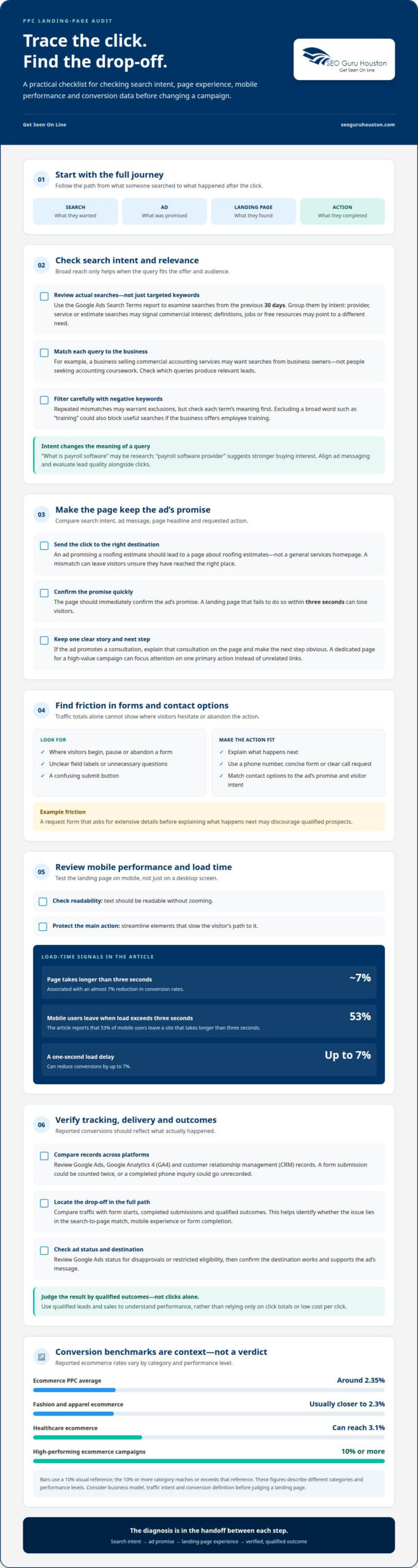
A landing-page audit follows each paid click from the Google search to the completed form. The professional compares search intent, ad message, landing-page headline, and requested action. For example, an ad promising a roofing estimate should lead to a page about roofing estimates, not a general services homepage. That mismatch can attract clicks but leave visitors unsure they’ve reached the right place.
Next, the review checks whether the page immediately confirms the ad’s promise. A landing page that fails to do so within three seconds can lose visitors. The ad, headline, offer, and contact options should tell one consistent story. If the ad promotes a consultation, the page should explain it and make the next step obvious. A dedicated page for a high-value campaign can focus attention on one primary action instead of dividing it among unrelated links.
Forms reveal friction that traffic totals can’t explain. A PPC professional examines where visitors begin, pause, or abandon a form, then looks for barriers such as unclear field labels, unnecessary questions, or a confusing submit button. For example, a request form that asks for extensive details before explaining what happens next may discourage qualified prospects. Contact options matter, too: a phone number, concise form, or clear call request should fit the ad’s promise and the visitor’s intent.
Industry benchmarks provide context, not a pass-or-fail target. Reported ecommerce PPC conversion rates average around 2.35%; fashion and apparel ecommerce is usually closer to 2.3%, while healthcare ecommerce can reach 3.1%. High-performing ecommerce campaigns can reach 10% or more. These figures describe different categories and performance levels, so a professional weighs the business model, traffic intent, and conversion definition before judging a landing page.
Common PPC policy or compliance problems include ad disapprovals, restricted eligibility, and destination issues that prevent an ad from serving or a visitor from completing the intended action. A professional reviews Google Ads status and the landing experience, checking that the destination works and supports the ad’s message.
Mobile performance needs its own review. A professional tests the landing page on mobile, checks whether text is readable without zooming, and streamlines elements that slow the main action. A page taking more than three seconds to load is associated with an almost 7% reduction in conversion rates; 53% of mobile users leave a site that takes longer than three seconds. A one-second load delay can reduce conversions by up to 7%.
Finally, performance is judged across the full path, not by clicks alone. The professional compares traffic with form starts, completed submissions, and qualified outcomes to locate the drop-off. This shows whether the problem lies in the search-to-page match, mobile experience, or form completion, giving the next change a clear purpose.
2. Broad match keywords and irrelevant search terms
Broad match can connect a keyword with searches using related wording, but related doesn’t always mean relevant. Someone searching for “free marketing course” may not want a paid service. A PPC professional evaluates whether each query fits the offer, intended audience, and campaign goal. Broad match can expand reach, but weak intent can turn that reach into clicks without qualified inquiries.
The review starts with Google Ads’ Search Terms report. A PPC professional examines the previous 30 days of searches that triggered ads, then groups them by intent. Searches for a provider, service, or estimate may signal commercial interest. Searches for definitions, jobs, or free resources may reflect a different need. The actual search term matters more than the keyword selected for targeting because it shows what the person wanted.
Context determines what counts as irrelevant. For example, a company selling commercial accounting services may want searches from business owners, not people seeking accounting coursework. A professional compares search terms with the business’s services and intended audience, then checks which queries produced relevant leads. If “accounting course” brings visits but no suitable inquiries, the term may warrant a negative keyword.
Negative keywords help prevent ads from appearing for searches that don’t fit the offer. A PPC specialist identifies repeated mismatches, checks each term’s meaning, and adds negatives at an appropriate campaign or ad-group level. This requires care: excluding a broad word such as “training” could block useful searches if the business also offers employee training. The goal is precise filtering, not simply less traffic.
Keyword targeting should reflect intent at each stage. Someone searching “what is payroll software” may be researching, while “payroll software provider” suggests stronger buying interest. A professional separates these themes where campaign structure allows, aligns ad messaging with each group, and evaluates lead quality alongside clicks. Conversion tracking helps reveal whether a query produces meaningful actions, rather than merely attracting visits.
Search-term analysis also protects audience relevance across service lines and customer types. If a provider serving businesses receives searches for unrelated consumer services, the professional can refine targeting and exclusions. Patterns in search terms, lead records, and conversion tracking help show whether broad match is uncovering valuable demand or drifting away from the offer. A focused paid search landing page strategy can support that alignment from query to next step.
Conversion tracking accuracy
Before changing bids or spending, a PPC professional checks whether reported conversions match actual outcomes. A form submission can be counted twice, or a completed phone inquiry can go unrecorded. The review compares Google Ads, Google Analytics 4 (GA4), and customer relationship management (CRM) records. Differences can reveal broken tags, duplicate events, or leads missing from platform reports. This audit can clarify why my ppc campaigns are not converting by separating tracking gaps from campaign issues.
Next, the professional tests the conversion path. Google Tag Assistant or GA4 DebugView can help confirm whether an event fires after a real action, such as submitting a form. The audit checks the trigger, event name, and destination, then compares test activity with platform reporting. If a thank-you page loads without a valid submission, its page view shouldn’t automatically count as a qualified lead.
Phone and offline outcomes need attention, too. Calls after ad clicks can be missed if call conversions aren’t tracked. A professional compares call records with campaign data and checks whether a call event represents a meaningful inquiry. For offline sales, CRM records help connect an initial lead with later stages, giving optimization a stronger signal than a button click alone.
Meta reporting requires a separate reconciliation. Apple’s iOS 14.5 privacy changes in 2021 materially reduced Meta’s ability to track off-platform conversions. A PPC professional therefore compares Meta-reported results with CRM data or server-side events, rather than treating Meta’s dashboard as the only record. This can clarify whether fewer reported conversions mean fewer actual leads or reduced visibility.
How should a professional compare Google Ads and Microsoft Ads conversion performance? The comparison uses the same date range, conversion definitions, attribution approach, and CRM outcomes wherever possible. Google Ads historically used last-click attribution as its default, while GA4 uses data-driven attribution by default, so platform totals may differ even when campaigns generate similar leads.
An agency reviewing digital marketing performance should separate measurement problems from campaign problems. The professional checks that each platform records the intended action, then traces sample conversions into first-party records. For teams still asking why my PPC campaigns are not converting, comparing platform totals with CRM outcomes can reveal whether the issue is measurement or lead quality. Accurate events provide a sounder basis for spending decisions.
4. Offer value and conversion friction
A click becomes a lead when the offer addresses the need behind the search. In Google Ads, “emergency roof repair” signals a different need from “roof replacement options.” If both searches lead to the same broad offer, visitors may struggle to see why they should act. A professional checks the search terms, ad promise, and offer together before blaming the conversion rate.
Price alignment means matching expectations, not simply lowering a price. Someone searching for a low-cost consultation may hesitate if the page presents a premium package without explaining its value. A professional examines whether the offer’s scope, price presentation, and next step fit the search intent. If pricing varies by project, clear language about what affects a quote can prevent uncertainty from becoming a barrier.
Offer readiness matters just as much. A visitor comparing providers may not be ready to request a full proposal, while a search for a specific service may show stronger intent. The professional checks whether the campaign offers each audience a suitable next step. For example, a concise consultation request may be more appropriate than a lengthy application asking for detailed project information.
The value exchange should be immediate and specific. A landing page can explain what a consultation covers, what information the prospect receives, and what happens next. Case studies, relevant results, or testimonials can support credibility when they relate directly to the advertised service. A customer example addressing the same business problem provides more context than generic praise.
Friction also arises when an offer asks for commitment before explaining its benefit. A professional reviews each step from the call to action through confirmation, noting unclear wording, extra form fields, and unexpected requirements. For instance, asking for detailed business data before describing the requested assessment may discourage a qualified visitor. Removing a field makes sense only if it isn’t needed to respond effectively.
Offer testing should isolate one meaningful change at a time. A professional might compare a consultation offer with a direct quote request while keeping the audience and ad messaging consistent. Reliable tracking then shows which action leads to qualified opportunities, not just more button clicks. If conversion data counts low-value actions, the apparent winner may not support business goals.
Finally, irrelevant clicks can point to an offer mismatch, not just a weak page. If search terms show research intent but the campaign asks for an immediate purchase, the offer may be premature. A PPC professional uses query patterns, lead feedback, and sales outcomes to refine the offer’s timing and message. Then the next optimization addresses why prospects hesitate.
5. PPC clicks without conversions
A click proves an ad earned attention, not that it reached a likely buyer. A high click-through rate can still mask poor results if the search term attracts people unlikely to purchase. The same is true of a low cost per click: cheap traffic has little value if visitors don’t become qualified leads or sales.
Start with the outcome behind each click. For example, a campaign might generate 50 leads in one month, yet sales feedback could show weak fit or no follow-up. A professional connects campaign data with lead quality and sales outcomes, then looks for patterns by search term, audience, device, and landing page. That separates traffic volume from business value.
Timing matters, too. A PPC professional avoids major changes based on only 10-15 clicks, which usually provide too little evidence. The review may wait for a sample of 50-100+ clicks, depending on the typical conversion rate. This helps distinguish a real performance issue from normal variation before changing bids or pausing a campaign.
Bidding strategy, budget, and cost per click affect how much traffic a campaign attracts and which conversions its platform pursues. A low CPC doesn’t make a campaign profitable on its own, and a sudden budget increase can amplify targeting or landing-page problems without improving lead quality.
Geographic targeting can explain clicks that never had a realistic chance to convert. A home services company targeting 50 miles may reach people beyond its technicians’ 15-mile service area. A professional compares locations producing clicks with the business’s actual coverage, then narrows targeting or excludes areas it can’t serve.
Conversion timing also shapes the diagnosis. A business with a 60-90-day sales cycle may not see an immediate sale after a click. The professional reviews conversion paths and qualified lead progress, rather than treating early sales totals as the only signal. That helps distinguish delayed decisions from traffic that lacks buying intent.
Before pausing an entire campaign, the review isolates clear underperformers, such as a keyword or ad group attracting irrelevant clicks. It also checks whether the campaign’s primary goal reflects a qualified lead or sale, rather than a proxy action such as a page view. Each platform metric should inform decisions about actual business outcomes.
If clicks aren’t turning into meaningful opportunities, get professional PPC campaign support to diagnose the conversion path before increasing spend.
SEO Guru Houston
SEO Guru Houston helps businesses trace PPC clicks through targeting, landing pages, and lead quality to identify where conversions stall. Its PPC services connect campaign performance with qualified inquiries, while B2B Marketing and Inbound Marketing can support broader demand-generation goals. Turn to SEO Guru Houston when campaign reports show activity but the sales pipeline isn’t reflecting it, or when tracking, search intent, and offer friction need a coordinated review.
Contact SEO Guru Houston to discuss the conversion challenges affecting your campaigns.
Turn campaign diagnosis into your next decision
Asking why your PPC campaigns are not converting is useful when it leads to a clear decision, not another round of guesswork. Before changing spend, define what a successful campaign should produce for your business: qualified inquiries, sales, or another meaningful outcome. That definition gives future adjustments a sharper purpose and keeps attention on business impact, not activity alone.
If the causes remain tangled, an outside review can help connect campaign data to the sales process and identify where attention should go next. SEO Guru Houston offers professional PPC services, search engine optimization, and B2B marketing to support businesses nationwide in evaluating their digital acquisition strategy.
Discuss your PPC campaign with SEO Guru Houston and choose a focused next step. With a clearer diagnosis, you can move forward with greater confidence.
Frequently Asked Questions
Could Your Conversion Tracking Be Incorrect?
Yes, tracking can undercount, overcount, or misclassify conversions. For example, reloading a thank-you page might register another conversion, while a completed phone inquiry may not appear in platform reports. A professional compares sample leads with business records and checks whether each event represents the intended action. If recorded conversions diverge from actual inquiries, decisions based on those totals can point in the wrong direction.
How Can a PPC Professional Improve Campaign Performance?
A PPC professional improves performance by prioritizing changes that address the clearest business bottleneck. If relevant prospects reach the site but don’t progress, the review may focus on the offer or follow-up path. If inquiries arrive but aren’t suitable, targeting and messaging may need attention. The professional then evaluates outcomes against qualified leads and sales, judging changes by business impact rather than a short-term rise in traffic.
How Can a PPC Professional Prevent PPC Problems From Returning?
A professional can reduce recurring issues by building routine reviews into campaign management. Those reviews track significant account changes, conversion definitions, disapproved ads, and shifts in lead quality. A change log also helps connect performance shifts to specific adjustments, rather than relying on memory. For example, if a landing page or offer changes, the team can assess its effect before applying the same assumptions to other campaigns.
How Can a PPC Professional Improve Your PPC Campaign Conversion Rate?
A professional improves conversion rates by finding where interested visitors stop progressing, then addressing that barrier. For example, if prospects begin a booking request but don’t finish, the process may need clearer expectations or fewer unnecessary steps. The professional evaluates completed actions alongside lead quality, since a higher rate built on unqualified submissions may not help the business. The goal is more valuable outcomes from relevant traffic.
How can keyword strategy influence the quality of PPC leads?
Keyword strategy shapes lead quality by determining which needs and expectations an ad attracts. “Enterprise inventory system” signals a different context from “inventory spreadsheet template.” A professional considers those distinctions when grouping keywords, writing ad messages, and selecting landing-page content. Clear alignment helps prospects understand whether the offer fits their situation before they submit an inquiry, giving sales conversations a more relevant starting point.
How can the sales cycle timeline affect PPC conversion rates?
A longer sales cycle can make recent campaign activity look weak if reporting counts only immediate purchases. In business-to-business sales, a prospect may move through research, internal approval, and procurement before signing. Strategic marketing and sales agencies like Stratagon emphasize building customer-centric campaigns that nurture prospects across these complex stages to support long-term revenue growth. A professional reviews progress through those milestones rather than treating every unclosed opportunity as a failed lead. This gives campaign evaluation a more realistic view of how paid traffic contributes to future revenue.
How Can a PPC Professional Increase Conversion Rates for eCommerce Ads?
A PPC professional can assess the shopping journey from product selection through checkout. For example, an ad may promise a specific product benefit while the product page leaves that benefit unclear or hides important purchase details. The review considers product-page relevance, mobile usability, and checkout obstacles, then measures completed orders rather than add-to-cart activity alone. That distinction separates shopping interest from transactions that contribute to revenue.
What are the most common reasons PPC campaigns get clicks but no conversions?
Clicks without conversions often point to a gap between visitor intent and the experience after the click. The offer may not fit the search, the page may create uncertainty, or the form may ask for more commitment than the visitor is ready to give. Tracking gaps can also hide genuine inquiries. In some cases, leads arrive but sales follow-up doesn’t happen, so both campaign and sales processes deserve attention.

